The Production Process
4 The Production Process Page 34
5 Production Project Page 38
6 Factual Production Page 48
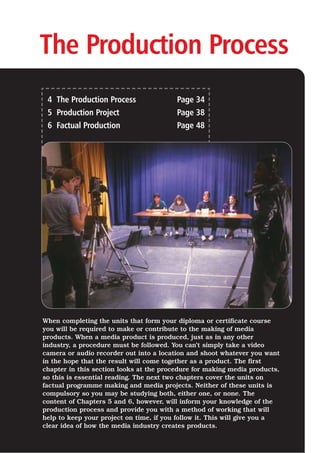
When completing the units that form your diploma or certificate course
you will be required to make or contribute to the making of media
products. When a media product is produced, just as in any other
industry, a procedure must be followed. You can’t simply take a video
camera or audio recorder out into a location and shoot whatever you want
in the hope that the result will come together as a product. The first
chapter in this section looks at the procedure for making media products,
so this is essential reading. The next two chapters cover the units on
factual programme making and media projects. Neither of these units is
compulsory so you may be studying both, either one, or none. The
content of Chapters 5 and 6, however, will inform your knowledge of the
production process and provide you with a method of working that will
help to keep your project on time, if you follow it. This will give you a
clear idea of how the media industry creates products.
4The
Production Process
Introducing the production process
The production of any media artefact must be
planned – whether you are making a television
programme, promotional or training video, radio
programme, film, magazine, newspaper, website or
computer game. The process is generally the same
whatever the product. First the idea for the product
is developed and its viability considered. The
commissioning editor (or commissioner – the person
who would pay you to make the product) has to be
convinced that it’s a good product idea and that you
have the resources and skills to make it. Having
secured the commission, you then have to plan the
production in great detail, to make sure you complete
every stage at the right time in the schedule and
deliver the completed artefact to the client on time
and within budget.
35.
THEPRODUCTIONPROCESSTHEPRODUCTIONPROCESS
35.
Securing a commission
If the demand to make a media product comes from a media sector
company, a commissioner will ‘call for expressions of interest’ by sending
a brief to a number of different production companies. If a non-media
sector company wants a media product made – a training video, for
example – they become the client and will contact an independent
production company and discuss their needs. Alternatively, a company
could invite anyone to apply for the commission, rather than selecting a
group of particular companies.
The four stages of the production
process
In most industries (the car industry, for example) a product is made
according to a production process. The media industry is no exception, so
to produce media artefacts you must follow a logical production process.
Making a product is a linear time-based process, which means that the
various stages take place one after another, in succession.
There may be slight variations in this process according to the sector, the
type of product being made and the in-house procedures of each media
company, but the general media production process has four stages:
Initiation
Planning
Production
Completion
36. BTEC First in Media: A Practical Handbook
Initiation
When you first think of the idea, you check its feasibility, using a SWOT
analysis, and then turn it into a finished proposal. You pitch (present) this to
your commissioning editor or client (tutor) in, for example, a PowerPoint
presentation, in order to be commissioned (get agreement) to make the
product. The initiation stage finishes when you get approval to make your
product.
Planning
Having been given the approval to make the product, you have to complete
all the detailed planning needed to get the product made. It will include
preparing a treatment: getting clearances for acquisition and copyright,
getting permissions for use of locations, planning how much time will be
needed in the production and completion stages, gathering production
personnel, and preparing production schedules and budgets. The
schedule should show an estimate of how you are going to use your time
efficiently.
Production
This stage happens in three parts: pre-production, production (sometimes
referred to as content acquisition) and post-production.
• Pre-production involves scriptwriting, having pre-interview meetings
with contributors, preparing to record, shoot and photograph the
images for the production, and creating shot lists and recording lists.
• The production/content acquisition part of the stage may involve
shooting footage on location for a television programme, recording
sound for a radio programme, writing copy for newspapers, magazines
and advertisements, inputting data for websites, drawing animation
frames or creating graphic images.
• Post-production is the editing part of the stage, where all the material
that has been gathered in the production part is put together in the right
order to make the finished product. In many cases it will take place
onscreen, on an edit workstation, but there are products that require
visual craft skills to edit, so this work will take place in a design studio.
An important part of post-production is reviewing material. This may be
with a client or an audience. The review will confirm whether or not the
finished product is appropriate and changes can be made as a result of
the review.
See pages 39 and 53 to find
out more about SWOT
analyses.
37.
THEPRODUCTIONPROCESSTHEPRODUCTIONPROCESS
Completion
Your product will probably have been created using an industry standard
computer application (program) that isn’t available generally to the target
audience or consumer. During the completion stage the product is turned
into a format that is compatible with the means of distribution. In the case
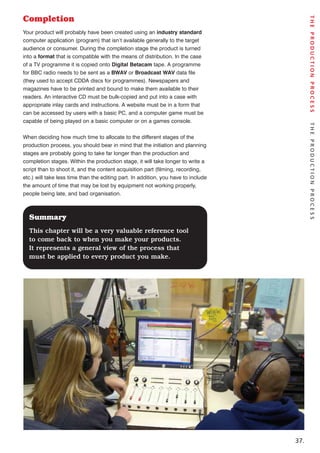
of a TV programme it is copied onto Digital Betacam tape. A programme
for BBC radio needs to be sent as a BWAV or Broadcast WAV data file
(they used to accept CDDA discs for programmes). Newspapers and
magazines have to be printed and bound to make them available to their
readers. An interactive CD must be bulk-copied and put into a case with
appropriate inlay cards and instructions. A website must be in a form that
can be accessed by users with a basic PC, and a computer game must be
capable of being played on a basic computer or on a games console.
When deciding how much time to allocate to the different stages of the
production process, you should bear in mind that the initiation and planning
stages are probably going to take far longer than the production and
completion stages. Within the production stage, it will take longer to write a
script than to shoot it, and the content acquisition part (filming, recording,
etc.) will take less time than the editing part. In addition, you have to include
the amount of time that may be lost by equipment not working properly,
people being late, and bad organisation.
Summary
This chapter will be a very valuable reference tool
to come back to when you make your products.
It represents a general view of the process that
must be applied to every product you make.

The production process

  • 1.
    The Production Process 4The Production Process Page 34 5 Production Project Page 38 6 Factual Production Page 48 When completing the units that form your diploma or certificate course you will be required to make or contribute to the making of media products. When a media product is produced, just as in any other industry, a procedure must be followed. You can’t simply take a video camera or audio recorder out into a location and shoot whatever you want in the hope that the result will come together as a product. The first chapter in this section looks at the procedure for making media products, so this is essential reading. The next two chapters cover the units on factual programme making and media projects. Neither of these units is compulsory so you may be studying both, either one, or none. The content of Chapters 5 and 6, however, will inform your knowledge of the production process and provide you with a method of working that will help to keep your project on time, if you follow it. This will give you a clear idea of how the media industry creates products.
  • 2.
    4The Production Process Introducing theproduction process The production of any media artefact must be planned – whether you are making a television programme, promotional or training video, radio programme, film, magazine, newspaper, website or computer game. The process is generally the same whatever the product. First the idea for the product is developed and its viability considered. The commissioning editor (or commissioner – the person who would pay you to make the product) has to be convinced that it’s a good product idea and that you have the resources and skills to make it. Having secured the commission, you then have to plan the production in great detail, to make sure you complete every stage at the right time in the schedule and deliver the completed artefact to the client on time and within budget.
  • 3.
    35. THEPRODUCTIONPROCESSTHEPRODUCTIONPROCESS 35. Securing a commission Ifthe demand to make a media product comes from a media sector company, a commissioner will ‘call for expressions of interest’ by sending a brief to a number of different production companies. If a non-media sector company wants a media product made – a training video, for example – they become the client and will contact an independent production company and discuss their needs. Alternatively, a company could invite anyone to apply for the commission, rather than selecting a group of particular companies. The four stages of the production process In most industries (the car industry, for example) a product is made according to a production process. The media industry is no exception, so to produce media artefacts you must follow a logical production process. Making a product is a linear time-based process, which means that the various stages take place one after another, in succession. There may be slight variations in this process according to the sector, the type of product being made and the in-house procedures of each media company, but the general media production process has four stages: Initiation Planning Production Completion
  • 4.
    36. BTEC Firstin Media: A Practical Handbook Initiation When you first think of the idea, you check its feasibility, using a SWOT analysis, and then turn it into a finished proposal. You pitch (present) this to your commissioning editor or client (tutor) in, for example, a PowerPoint presentation, in order to be commissioned (get agreement) to make the product. The initiation stage finishes when you get approval to make your product. Planning Having been given the approval to make the product, you have to complete all the detailed planning needed to get the product made. It will include preparing a treatment: getting clearances for acquisition and copyright, getting permissions for use of locations, planning how much time will be needed in the production and completion stages, gathering production personnel, and preparing production schedules and budgets. The schedule should show an estimate of how you are going to use your time efficiently. Production This stage happens in three parts: pre-production, production (sometimes referred to as content acquisition) and post-production. • Pre-production involves scriptwriting, having pre-interview meetings with contributors, preparing to record, shoot and photograph the images for the production, and creating shot lists and recording lists. • The production/content acquisition part of the stage may involve shooting footage on location for a television programme, recording sound for a radio programme, writing copy for newspapers, magazines and advertisements, inputting data for websites, drawing animation frames or creating graphic images. • Post-production is the editing part of the stage, where all the material that has been gathered in the production part is put together in the right order to make the finished product. In many cases it will take place onscreen, on an edit workstation, but there are products that require visual craft skills to edit, so this work will take place in a design studio. An important part of post-production is reviewing material. This may be with a client or an audience. The review will confirm whether or not the finished product is appropriate and changes can be made as a result of the review. See pages 39 and 53 to find out more about SWOT analyses.
  • 5.
    37. THEPRODUCTIONPROCESSTHEPRODUCTIONPROCESS Completion Your product willprobably have been created using an industry standard computer application (program) that isn’t available generally to the target audience or consumer. During the completion stage the product is turned into a format that is compatible with the means of distribution. In the case of a TV programme it is copied onto Digital Betacam tape. A programme for BBC radio needs to be sent as a BWAV or Broadcast WAV data file (they used to accept CDDA discs for programmes). Newspapers and magazines have to be printed and bound to make them available to their readers. An interactive CD must be bulk-copied and put into a case with appropriate inlay cards and instructions. A website must be in a form that can be accessed by users with a basic PC, and a computer game must be capable of being played on a basic computer or on a games console. When deciding how much time to allocate to the different stages of the production process, you should bear in mind that the initiation and planning stages are probably going to take far longer than the production and completion stages. Within the production stage, it will take longer to write a script than to shoot it, and the content acquisition part (filming, recording, etc.) will take less time than the editing part. In addition, you have to include the amount of time that may be lost by equipment not working properly, people being late, and bad organisation. Summary This chapter will be a very valuable reference tool to come back to when you make your products. It represents a general view of the process that must be applied to every product you make.