ShiranShen
Swarthmore College
Presentation Objectives


• To debunk the “China Threat Theory”
• To flesh out the true shaping forces of
  Chinese foreign policy
• To identify the implications for US-China
  relations
Problem with Contemporary
Scholarship on Chinese Foreign Policy
• Misuse of classical international relations
  theories
  – The Hegemonic War Theory
  – The China Threat Theory
• Misinterpretation of Chinese political thinking
  due to inappropriate historical comparisons
  – Middle Kingdom tribute system
  – Rise of Wilhelmine Germany
The Shaping Forces of Chinese
           Foreign Policy

• Core state interests (primary)
• Historical memory of the “Century of
  Humiliation” (near primary)
• Chinese nationalism (factored in only
  occasionally)
Core Chinese State Interests
Goals:
• To maintain social stability
  – The most fundamental among all state interests
• To promote economic development
  – Global hunt for natural resources (traditional path,
    economic rather than strategic, Chinese separation
    of economic and political interests)
• To safeguard the Chinese Communist Party
  political system
Core Chinese State Interests

Dictum:
• Peaceful development (和平发展)

Strategies:
• Maintain a low profile and achieve something (
  韬光养晦,有所作为)
• “Enter the world” (入世) and socialize
  internationally
Historical Memory of the “Century
      of Humiliation” (百年国耻)

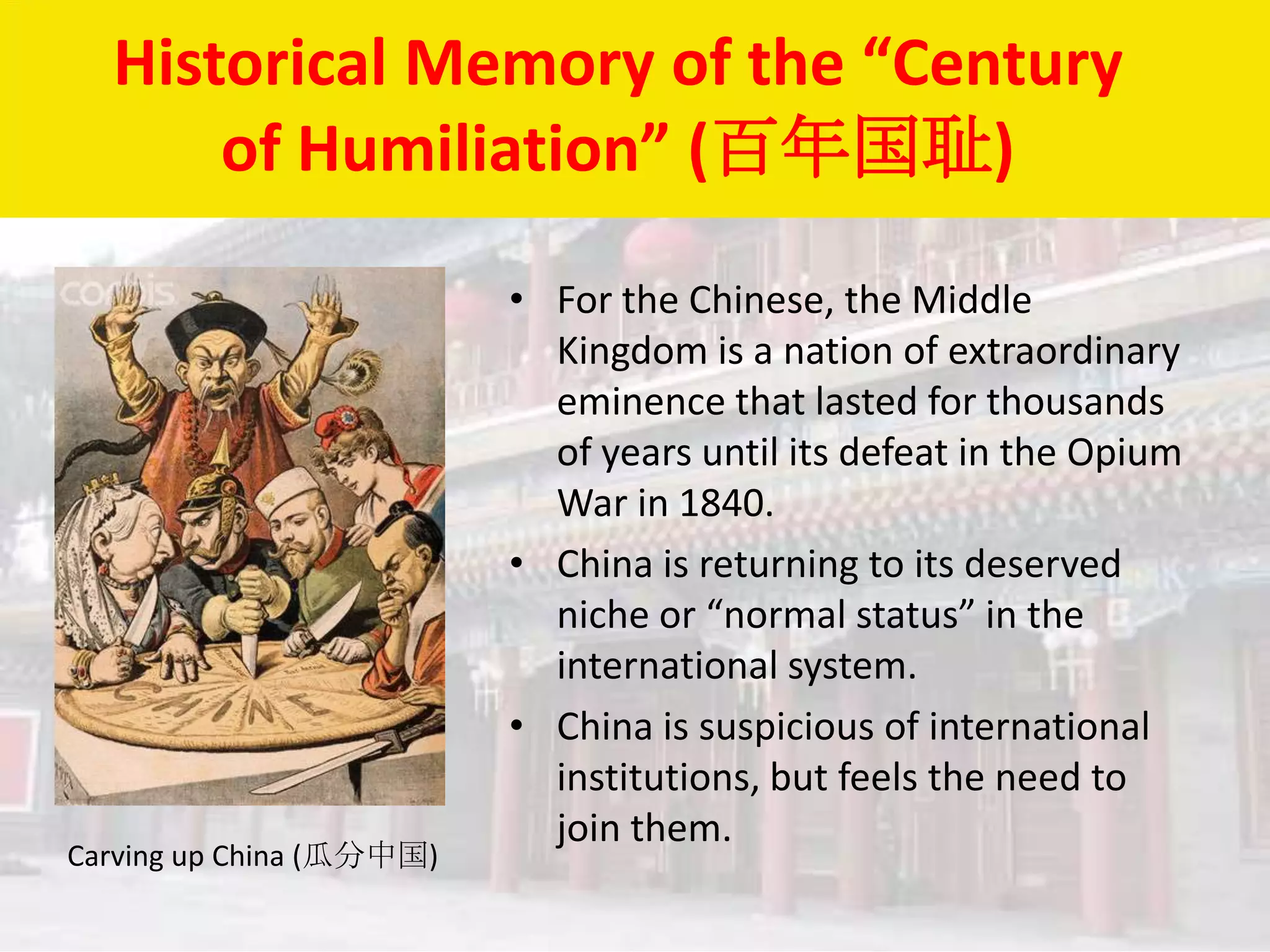
                          • For the Chinese, the Middle
                            Kingdom is a nation of extraordinary
                            eminence that lasted for thousands
                            of years until its defeat in the Opium
                            War in 1840.
                          • China is returning to its deserved
                            niche or “normal status” in the
                            international system.
                          • China is suspicious of international
                            institutions, but feels the need to
                            join them.
Carving up China (瓜分中国)
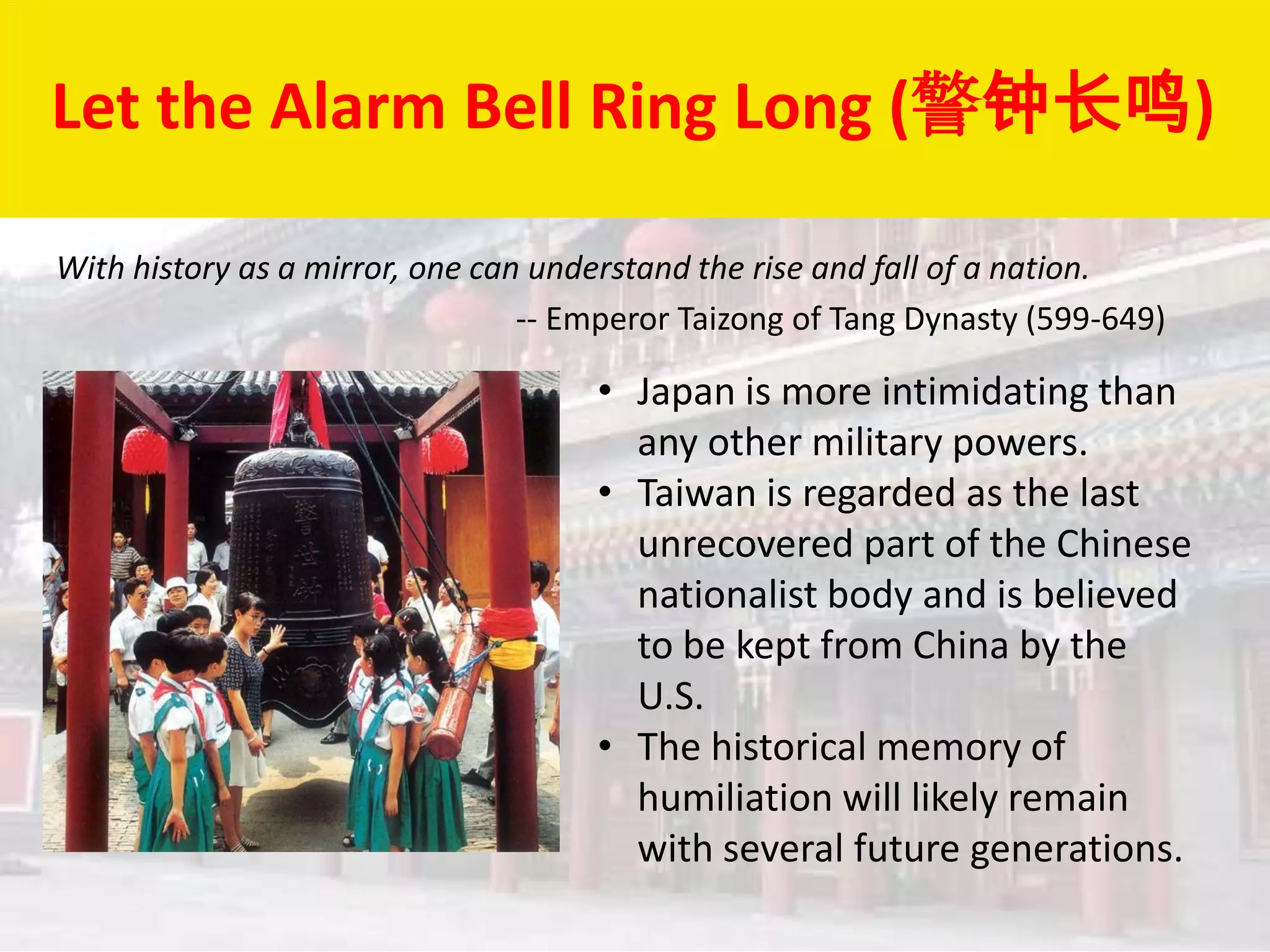
Let the Alarm Bell Ring Long (警钟长鸣)

With history as a mirror, one can understand the rise and fall of a nation.
                                 -- Emperor Taizong of Tang Dynasty (599-649)

                                     • Japan is more intimidating than
                                       any other military powers.
                                     • Taiwan is regarded as the last
                                       unrecovered part of the Chinese
                                       nationalist body and is believed
                                       to be kept from China by the
                                       U.S.
                                     • The historical memory of
                                       humiliation will likely remain
                                       with several future generations.
Looking into the Future

• National interests and historical lessons are still likely
  to play significant roles.
• China is likely to be more involved and take on
  leadership roles in international discourses and
  cooperation (e.g. sanctioning rogue states).
• China will likely claim a more active role in the Asia-
  Pacific region, but will not be capable of replacing U.S.
  leadership any time soon.
• China is likely to continue to expand its international
  presence in the years to come (state-sponsored news
  agencies abroad, Confucius Institutes).
Implications for US-China Relations

• In ordernot to make China a threat, the U.S.
  should not view and treat China as a threat.
• The U.S. should actively seek common ground
  with China and avoid actions that may be
  interpreted by China as threatening to its core
  state interests (e.g. Taiwan).
• The U.S. should make constant efforts to
  enhance mutual understanding and improve
  mutual perception.
Conclusions
• China’s global engagement stands in line with the priorities of the
  CCP and Chinese national interests and is largely informed by the
  country’s haunting memory of the “Century of Humiliation.”
• Nationalism is sometimes factored into the making of Chinese
  foreign policy, but does not override vital national interests.
• China will be more willing to accept international leadership in the
  decades to come.
• Agrowing sense of insecurity in terms of political stability that
  accompanies increasing national confidence might put confines on
  China’s foreign policymaking in favor of considerations for national
  interests and historical lessons.
• By all means, the U.S. and China should and can avoid a Hunger
  Game-like scenario.

The Primacy of State Interests and Lessons of the Past in Shaping Chinese Foreign Policy

  • 1.
  • 2.
    Presentation Objectives • Todebunk the “China Threat Theory” • To flesh out the true shaping forces of Chinese foreign policy • To identify the implications for US-China relations
  • 3.
    Problem with Contemporary Scholarshipon Chinese Foreign Policy • Misuse of classical international relations theories – The Hegemonic War Theory – The China Threat Theory • Misinterpretation of Chinese political thinking due to inappropriate historical comparisons – Middle Kingdom tribute system – Rise of Wilhelmine Germany
  • 4.
    The Shaping Forcesof Chinese Foreign Policy • Core state interests (primary) • Historical memory of the “Century of Humiliation” (near primary) • Chinese nationalism (factored in only occasionally)
  • 5.
    Core Chinese StateInterests Goals: • To maintain social stability – The most fundamental among all state interests • To promote economic development – Global hunt for natural resources (traditional path, economic rather than strategic, Chinese separation of economic and political interests) • To safeguard the Chinese Communist Party political system
  • 6.
    Core Chinese StateInterests Dictum: • Peaceful development (和平发展) Strategies: • Maintain a low profile and achieve something ( 韬光养晦,有所作为) • “Enter the world” (入世) and socialize internationally
  • 7.
    Historical Memory ofthe “Century of Humiliation” (百年国耻) • For the Chinese, the Middle Kingdom is a nation of extraordinary eminence that lasted for thousands of years until its defeat in the Opium War in 1840. • China is returning to its deserved niche or “normal status” in the international system. • China is suspicious of international institutions, but feels the need to join them. Carving up China (瓜分中国)
  • 8.
    Let the AlarmBell Ring Long (警钟长鸣) With history as a mirror, one can understand the rise and fall of a nation. -- Emperor Taizong of Tang Dynasty (599-649) • Japan is more intimidating than any other military powers. • Taiwan is regarded as the last unrecovered part of the Chinese nationalist body and is believed to be kept from China by the U.S. • The historical memory of humiliation will likely remain with several future generations.
  • 9.
    Looking into theFuture • National interests and historical lessons are still likely to play significant roles. • China is likely to be more involved and take on leadership roles in international discourses and cooperation (e.g. sanctioning rogue states). • China will likely claim a more active role in the Asia- Pacific region, but will not be capable of replacing U.S. leadership any time soon. • China is likely to continue to expand its international presence in the years to come (state-sponsored news agencies abroad, Confucius Institutes).
  • 10.
    Implications for US-ChinaRelations • In ordernot to make China a threat, the U.S. should not view and treat China as a threat. • The U.S. should actively seek common ground with China and avoid actions that may be interpreted by China as threatening to its core state interests (e.g. Taiwan). • The U.S. should make constant efforts to enhance mutual understanding and improve mutual perception.
  • 11.
    Conclusions • China’s globalengagement stands in line with the priorities of the CCP and Chinese national interests and is largely informed by the country’s haunting memory of the “Century of Humiliation.” • Nationalism is sometimes factored into the making of Chinese foreign policy, but does not override vital national interests. • China will be more willing to accept international leadership in the decades to come. • Agrowing sense of insecurity in terms of political stability that accompanies increasing national confidence might put confines on China’s foreign policymaking in favor of considerations for national interests and historical lessons. • By all means, the U.S. and China should and can avoid a Hunger Game-like scenario.