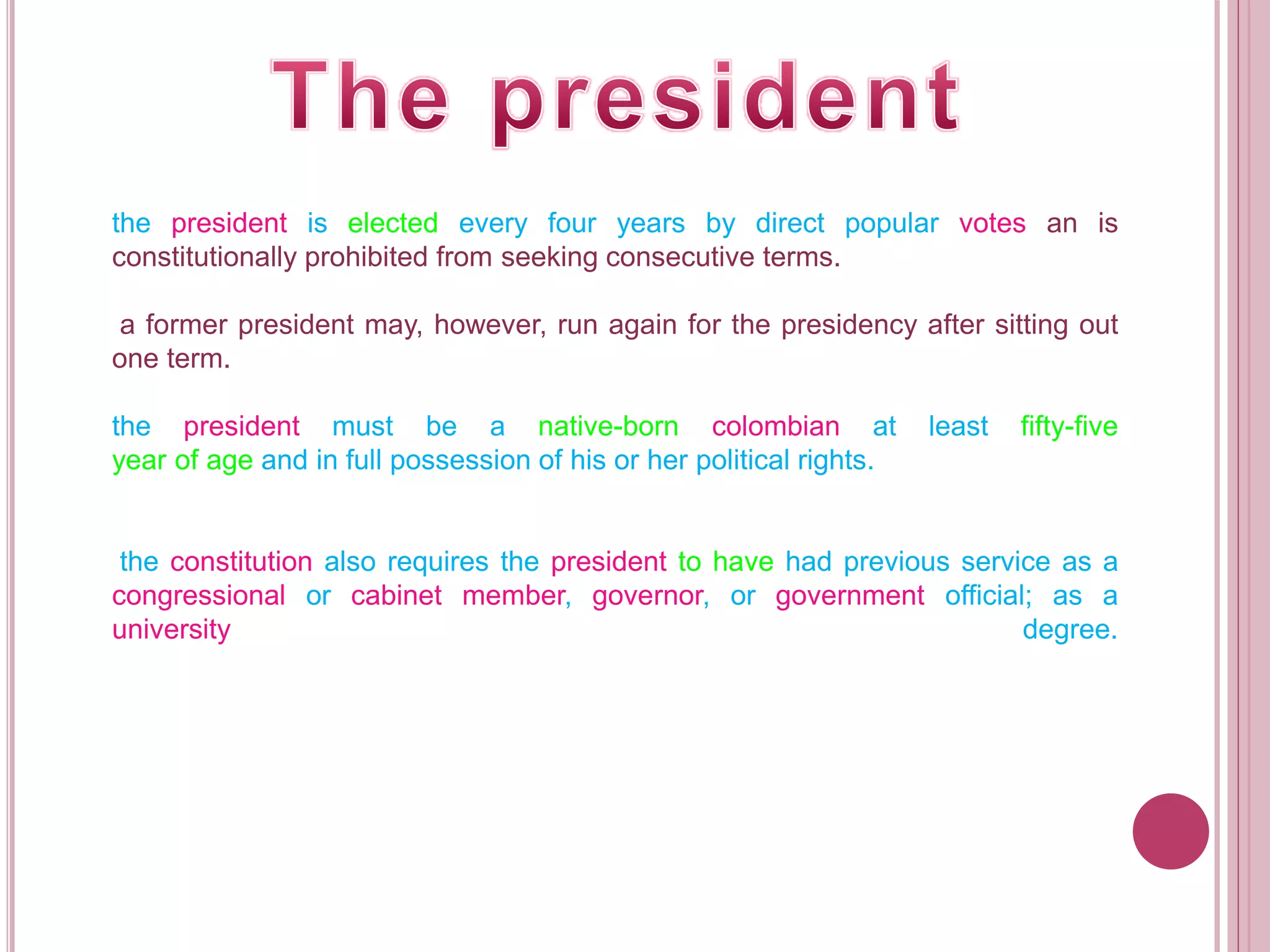
the president is elected every four years by direct popular votes an is
constitutionally prohibited from seeking consecutive terms.
a former president may, however, run again for the presidency after sitting out
one term.
the president must be a native-born colombian at least fifty-five
year of age and in full possession of his or her political rights.
the constitution also requires the president to have had previous service as a
congressional or cabinet member, governor, or government official; as a
university degree.
as chief of state, the president oversees the executive branch of government,
consisting of a thirteen-member cabinet, various administrative agencies, a
developing bureaucracy,and more than 100 semiautonomous or decentralized
agencies, institutes, and corporations,generally known as institutos
decentralizados.
these appointive powers allow the president to select the cabinet and the
chiefs of all the administrative agencies whithout the approval of either house of
congress.
under colombia's unitary system of government, the president also appoints
and may remove the governors of the twenty-three territorial departments and
the heads of the nine national territories(territorios)
unlike the departments, which have limited self-government, the national capital
controls the territories directly though presidentially appointed officials.
presidentially appointed commissions--composed of gevernment, party, and interest group
representatives--occasionally played an important role in policy making in the executive
branch. their findings were usually highly respected and often turned into pending
legistation development-oriented and well-qualified technocrats(tecnicos)--such as
economists, agronomists, and engineers--also strengthened the executive branch in the
1980s by staffing important decentralized government agencies.these included the national
planning department (departamento nacional de planeacion), monetary board(junta
monetaria), and the colombian institute of agrarian reform(instituto colomniano de reforma
agraria--incora)
. the expertise provided the resident and his cabinet by the technocrats moderated the
influence of powerful interest groups and enabled the chief executive to develop complex
legislation.although the semiautonomous or decentralized agencies extended the influence
of the executive into most areas of society, they had gained substantial independence by
the 1980s.
the larger and more skilled staffs and international funding sources of many agencies,
along with the inabity of ministers to supervise closely the agencies under their purview,
contributed to his indepedence.
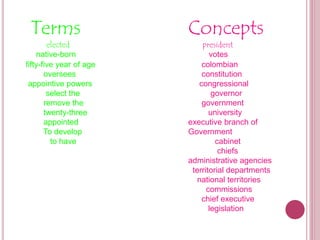
Terms
elected
native-born
fifty-five year of age
oversees
appointive powers
select the
remove the
twenty-three
appointed
To develop
to have
Concepts
president
votes
colombian
constitution
congressional
governor
government
university
executive branch of
Government
cabinet
chiefs
administrative agencies
territorial departments
national territories
commissions
chief executive
legislation
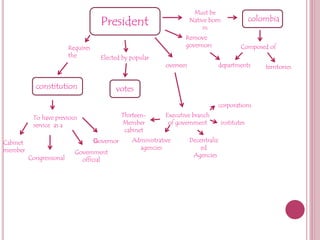
Elected by popular
votes
Must be
Native born
in
colombiaPresident
Requires
the
constitution
To have previous
service as a
Congressional
Cabinet
member
Governor
Government
official
oversees
Executive branch
of government
Thirteen-
Member
cabinet
Administrative
agencies
Decentraliz
ed
Agencies
institutes
corporations
departments territories
Composed of
Remove
governors

The President

  • 1.
    the president iselected every four years by direct popular votes an is constitutionally prohibited from seeking consecutive terms. a former president may, however, run again for the presidency after sitting out one term. the president must be a native-born colombian at least fifty-five year of age and in full possession of his or her political rights. the constitution also requires the president to have had previous service as a congressional or cabinet member, governor, or government official; as a university degree.
  • 2.
    as chief ofstate, the president oversees the executive branch of government, consisting of a thirteen-member cabinet, various administrative agencies, a developing bureaucracy,and more than 100 semiautonomous or decentralized agencies, institutes, and corporations,generally known as institutos decentralizados. these appointive powers allow the president to select the cabinet and the chiefs of all the administrative agencies whithout the approval of either house of congress. under colombia's unitary system of government, the president also appoints and may remove the governors of the twenty-three territorial departments and the heads of the nine national territories(territorios) unlike the departments, which have limited self-government, the national capital controls the territories directly though presidentially appointed officials.
  • 3.
    presidentially appointed commissions--composedof gevernment, party, and interest group representatives--occasionally played an important role in policy making in the executive branch. their findings were usually highly respected and often turned into pending legistation development-oriented and well-qualified technocrats(tecnicos)--such as economists, agronomists, and engineers--also strengthened the executive branch in the 1980s by staffing important decentralized government agencies.these included the national planning department (departamento nacional de planeacion), monetary board(junta monetaria), and the colombian institute of agrarian reform(instituto colomniano de reforma agraria--incora) . the expertise provided the resident and his cabinet by the technocrats moderated the influence of powerful interest groups and enabled the chief executive to develop complex legislation.although the semiautonomous or decentralized agencies extended the influence of the executive into most areas of society, they had gained substantial independence by the 1980s. the larger and more skilled staffs and international funding sources of many agencies, along with the inabity of ministers to supervise closely the agencies under their purview, contributed to his indepedence.
  • 4.
    Terms elected native-born fifty-five year ofage oversees appointive powers select the remove the twenty-three appointed To develop to have Concepts president votes colombian constitution congressional governor government university executive branch of Government cabinet chiefs administrative agencies territorial departments national territories commissions chief executive legislation
  • 5.
    Elected by popular votes Mustbe Native born in colombiaPresident Requires the constitution To have previous service as a Congressional Cabinet member Governor Government official oversees Executive branch of government Thirteen- Member cabinet Administrative agencies Decentraliz ed Agencies institutes corporations departments territories Composed of Remove governors