THE EXECUTIVE
DEPARTMENT
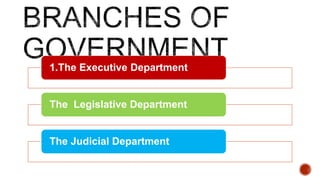
1.The Executive Department
The Legislative Department
The Judicial Department
THE EXECUTIVE
DEPARTMENT
• President
• Vice President
• Cabinet
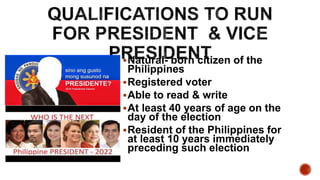
Natural- born citizen of the
Philippines
Registered voter
Able to read & write
At least 40 years of age on the
day of the election
Resident of the Philippines for
at least 10 years immediately
preceding such election
The President and VP shall be
elected…for a term of six
years
The president shall not be
eligible for any reelection
No VP shall serve for more
than two consecutive terms
TRIVIA:
Ferdinand Marcos is
the longest-serving
President, having
been in office for 20
years, 57 days
(7,362 days).
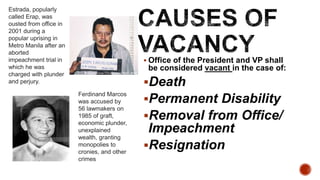
 Office of the President and VP shall
be considered vacant in the case of:
Death
Permanent Disability
Removal from Office/
Impeachment
Resignation
Estrada, popularly
called Erap, was
ousted from office in
2001 during a
popular uprising in
Metro Manila after an
aborted
impeachment trial in
which he was
charged with plunder
and perjury.
Ferdinand Marcos
was accused by
56 lawmakers on
1985 of graft,
economic plunder,
unexplained
wealth, granting
monopolies to
cronies, and other
crimes
Shall not …
…hold any other office or employment
during their tenure
…practice any other profession
…participate in any business or be
financially interested in any contract with
the government
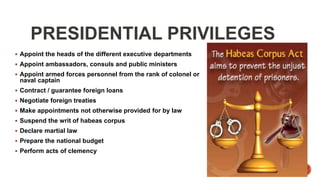
PRESIDENTIAL PRIVILEGES
 Appoint the heads of the different executive departments
 Appoint ambassadors, consuls and public ministers
 Appoint armed forces personnel from the rank of colonel or
naval captain
 Contract / guarantee foreign loans
 Negotiate foreign treaties
 Make appointments not otherwise provided for by law
 Suspend the writ of habeas corpus
 Declare martial law
 Prepare the national budget
 Perform acts of clemency
The President Cannot:
 Hold any other office or enjoy any other form of
employment
 Make appointments two months prior to the next
elections
 Make appointments within the 4th civil degree of
consanguinity
 Increase his/her salary or that of the Vice-President
during his/her term
 Ratify foreign treaties
 Grant clemency in cases of impeachment
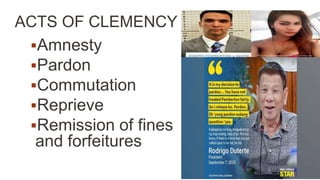
ACTS OF CLEMENCY
Amnesty
Pardon
Commutation
Reprieve
Remission of fines
and forfeitures
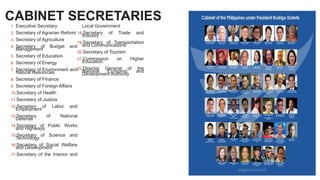
CABINET SECRETARIES
1. Executive Secretary
2. Secretary of Agrarian Reform
3. Secretary of Agriculture
4. Secretary of Budget and
Management
5. Secretary of Education
6. Secretary of Energy
7. Secretary of Environment and
Natural Resources
8. Secretary of Finance
9. Secretary of Foreign Affairs
10.Secretary of Health
11.Secretary of Justice
12.Secretary of Labor and
Employment
13.Secretary of National
Defense
14.Secretary of Public Works
and Highways
15.Secretary of Science and
Technology
16.Secretary of Social Welfare
and Development
17.Secretary of the Interior and
Local Government
18.Secretary of Trade and
Industry
19.Secretary of Transportation
and Communications
20.Secretary of Tourism
21.Commission on Higher
Education
22.Director General of the
National Economic and
Development Authority
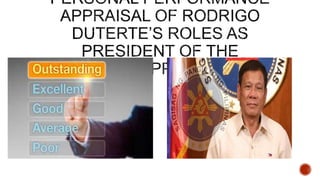
RATE THE PERFORMANCE
POOR AVERAGE GOOD
EXCELLENT, OUTSTANDING. EXPLAIN THE
REASON FOR THE RATING.
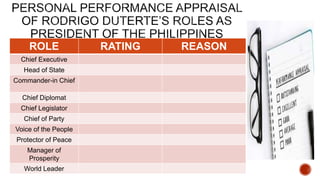
ROLE RATING REASON
Chief Executive
Head of State
Commander-in Chief
Chief Diplomat
Chief Legislator
Chief of Party
Voice of the People
Protector of Peace
Manager of
Prosperity
World Leader

Lesson-6-THe-Executive-Branch.pptx

  • 1.
  • 3.
    1.The Executive Department TheLegislative Department The Judicial Department
  • 5.
  • 7.
    Natural- born citizenof the Philippines Registered voter Able to read & write At least 40 years of age on the day of the election Resident of the Philippines for at least 10 years immediately preceding such election
  • 8.
    The President andVP shall be elected…for a term of six years The president shall not be eligible for any reelection No VP shall serve for more than two consecutive terms TRIVIA: Ferdinand Marcos is the longest-serving President, having been in office for 20 years, 57 days (7,362 days).
  • 9.
     Office ofthe President and VP shall be considered vacant in the case of: Death Permanent Disability Removal from Office/ Impeachment Resignation Estrada, popularly called Erap, was ousted from office in 2001 during a popular uprising in Metro Manila after an aborted impeachment trial in which he was charged with plunder and perjury. Ferdinand Marcos was accused by 56 lawmakers on 1985 of graft, economic plunder, unexplained wealth, granting monopolies to cronies, and other crimes
  • 10.
    Shall not … …holdany other office or employment during their tenure …practice any other profession …participate in any business or be financially interested in any contract with the government
  • 12.
    PRESIDENTIAL PRIVILEGES  Appointthe heads of the different executive departments  Appoint ambassadors, consuls and public ministers  Appoint armed forces personnel from the rank of colonel or naval captain  Contract / guarantee foreign loans  Negotiate foreign treaties  Make appointments not otherwise provided for by law  Suspend the writ of habeas corpus  Declare martial law  Prepare the national budget  Perform acts of clemency
  • 14.
    The President Cannot: Hold any other office or enjoy any other form of employment  Make appointments two months prior to the next elections  Make appointments within the 4th civil degree of consanguinity  Increase his/her salary or that of the Vice-President during his/her term  Ratify foreign treaties  Grant clemency in cases of impeachment
  • 15.
  • 16.
    CABINET SECRETARIES 1. ExecutiveSecretary 2. Secretary of Agrarian Reform 3. Secretary of Agriculture 4. Secretary of Budget and Management 5. Secretary of Education 6. Secretary of Energy 7. Secretary of Environment and Natural Resources 8. Secretary of Finance 9. Secretary of Foreign Affairs 10.Secretary of Health 11.Secretary of Justice 12.Secretary of Labor and Employment 13.Secretary of National Defense 14.Secretary of Public Works and Highways 15.Secretary of Science and Technology 16.Secretary of Social Welfare and Development 17.Secretary of the Interior and Local Government 18.Secretary of Trade and Industry 19.Secretary of Transportation and Communications 20.Secretary of Tourism 21.Commission on Higher Education 22.Director General of the National Economic and Development Authority
  • 19.
    RATE THE PERFORMANCE POORAVERAGE GOOD EXCELLENT, OUTSTANDING. EXPLAIN THE REASON FOR THE RATING.
  • 20.
    ROLE RATING REASON ChiefExecutive Head of State Commander-in Chief Chief Diplomat Chief Legislator Chief of Party Voice of the People Protector of Peace Manager of Prosperity World Leader

Editor's Notes

  • #3 After the most celebrated "EDSA People Power," a sweeping change in government put to power a new Chief Executive, Corazon C. Aquino. She immediately promulgated the Freedom Constitution by issuing Proclamation No. 3 on February 25, 1986, the same day she assumed office. The new constitution set in motion a reorganized government. After establishing a provisional government, President Aquino assigned delegates who would frame the new constitution. The draft was finished in 133 days after the delegates' appointment, and was later ratified on February 2, 1987. The new Constitution, restoring democracy, offers Filipinos social freedom and economic justice, national sovereignty, and participatory democracy
  • #5 Legislative Branch which consist of the congress. Under congress we have two houses. The senate and the house of representatives Executive Branch which consist of Presidents and its cabinet members Judiciary which consist of Supreme Courts and other courts. But for this week we will be discussing the Executive branch