The Power of 5G Networks
5G networks represent the next generation of mobile internet
connectivity, promising faster speeds and more reliable connections on
smartphones and other devices. This technology has the potential to
revolutionize the way we live and work, opening doors to new
possibilities in various industries.
Er. Shreeraj Khatiwada, MSc
Pokhara University
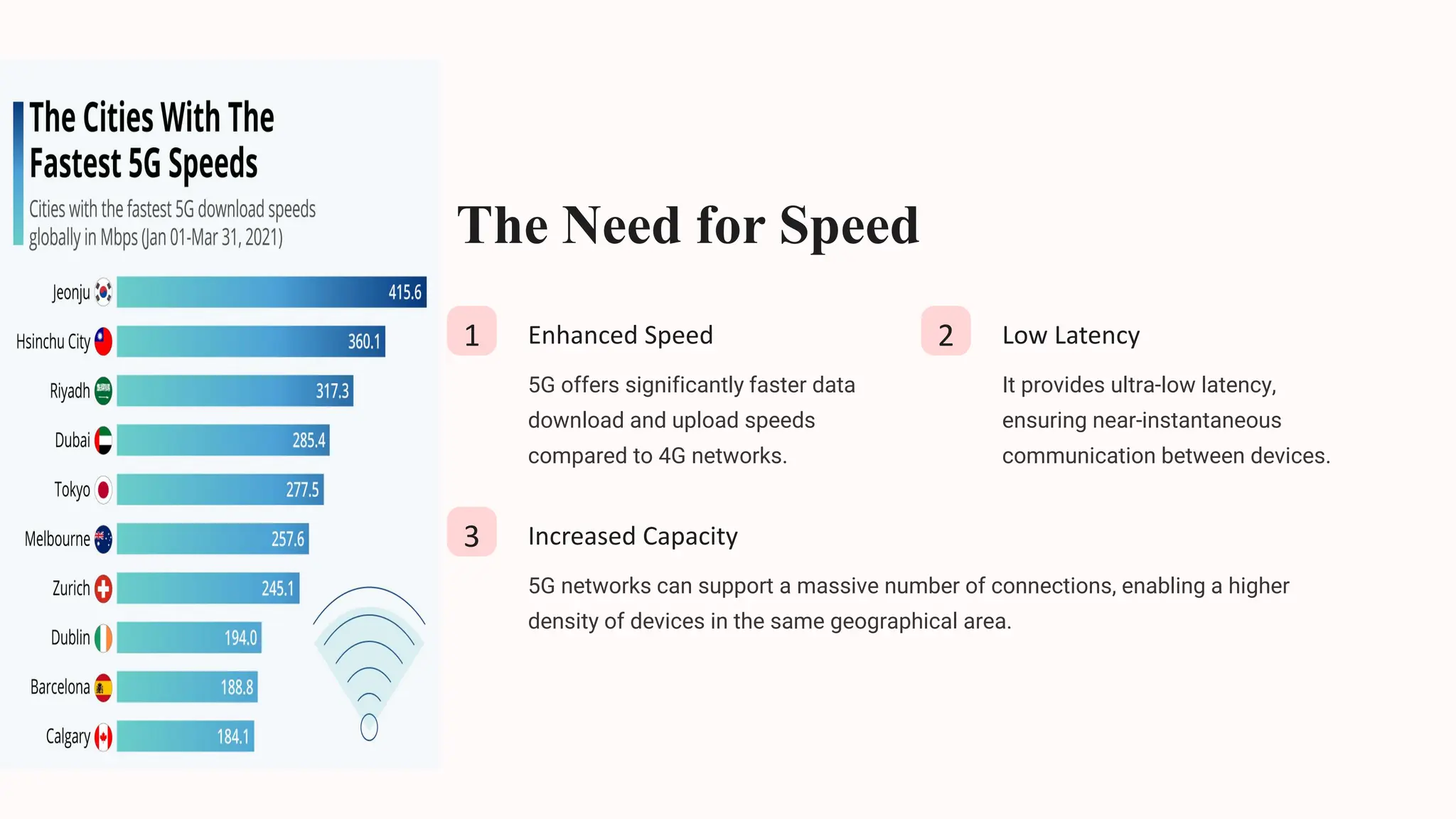
The Need for Speed
1 Enhanced Speed
5G offers significantly faster data
download and upload speeds
compared to 4G networks.
2 Low Latency
It provides ultra-low latency,
ensuring near-instantaneous
communication between devices.
3 Increased Capacity
5G networks can support a massive number of connections, enabling a higher
density of devices in the same geographical area.
Revolutionizing Industries
Healthcare
5G will enable real-time
remote health monitoring
and telemedicine,
revolutionizing healthcare
practices.
Manufacturing
It will facilitate the use of
advanced robotics and
automation, leading to
smart factories and
enhanced efficiency.
Transportation
5G will be pivotal in the
development of
autonomous vehicles,
enhancing safety and
navigation.
Building a Connected World
Consumer Devices
5G will empower faster and
more reliable connections for
smartphones, tablets, and
wearables.
Internet of Things
It will accelerate the adoption
of IoT devices, leading to
smarter homes and cities.
Cloud Services
Cloud-based services will
experience a significant
performance boost,
enhancing productivity.
The Era of Innovation
1 Deployment and Adoption
Vast 5G network deployment worldwide and widespread consumer adoption.
2 Evolving Technologies
Continued evolution of technologies and services leveraging 5G capabilities.
3 New Business Models
Emergence of innovative business models and applications powered by 5G
networks.
Security and Privacy
Cybersecurity Challenges
Addressing the security concerns and vulnerabilities associated with 5G
networks.
Privacy Regulations
Developing stringent privacy regulations to protect user data and digital rights.
Encryption Standards
Advancing encryption standards to ensure secure communications over 5G
networks.
Global Connectivity
1 Rural Connectivity
Bringing high-speed internet access
to rural and remote areas, bridging
the digital divide.
2 International Collaboration
Fostering collaborations among
countries to establish global 5G
standards and infrastructure.
3 Emerging Economies
Empowering emerging economies with advanced connectivity, driving economic growth.
Environmental Impact
Energy Efficiency
5G networks offer greater
energy efficiency,
reducing the carbon
footprint of
communication systems.
E-Waste Management
Addressing e-waste
challenges with
sustainable practices for
5G network equipment
and devices.
Sustainable
Infrastructure
Implementing
sustainable infrastructure
for 5G deployments to
minimize environmental
impact.
Regulatory Advancements
Policy Frameworks Developing robust regulatory frameworks to
govern 5G networks and services.
Spectrum Allocation Efficient spectrum allocation and
management to support the growing
demand for 5G.
Compliance Standards Establishing compliance standards to
ensure the safety and reliability of 5G
technologies.
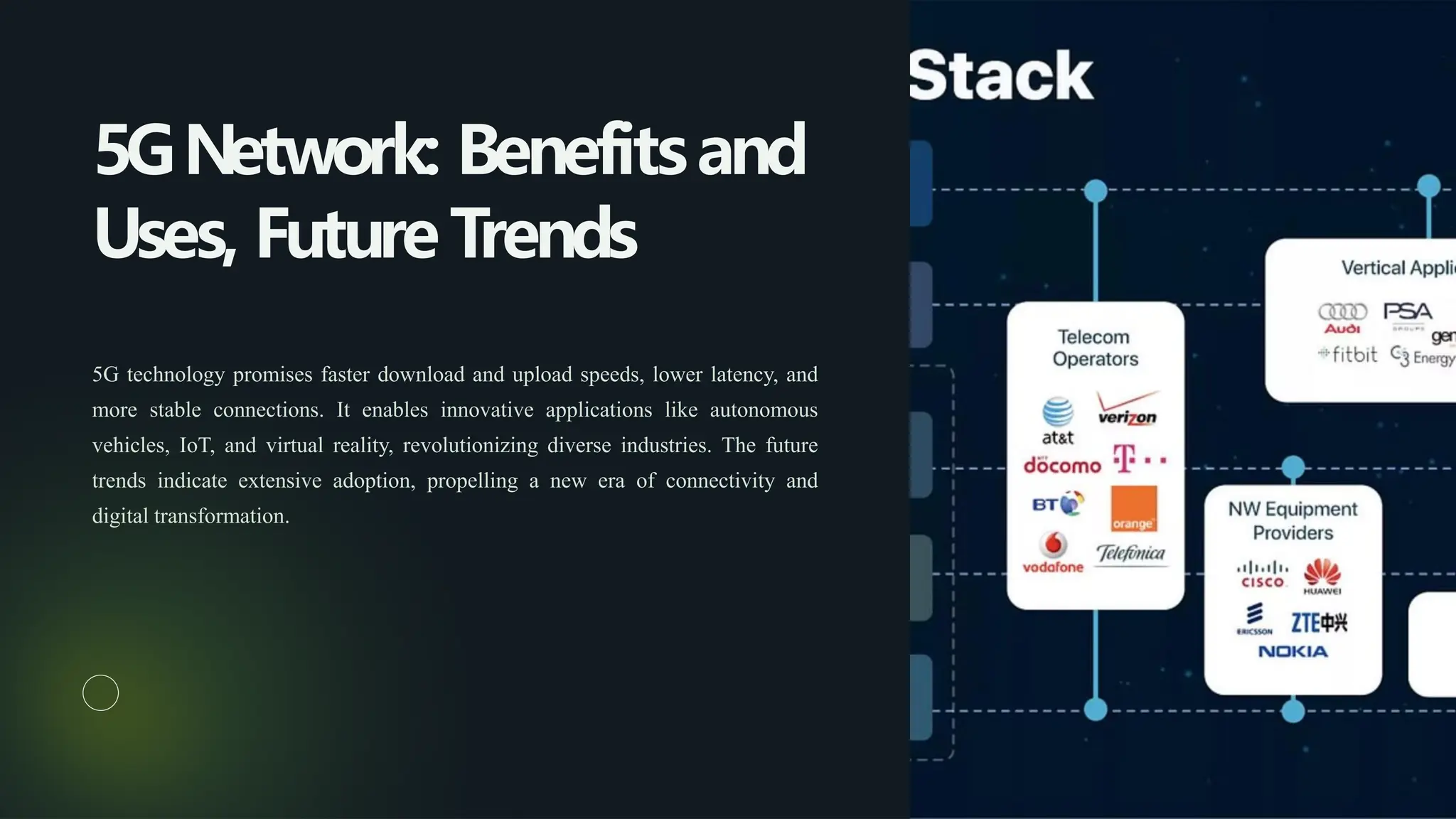
5GNetwork: Benefitsand
Uses, FutureTrends
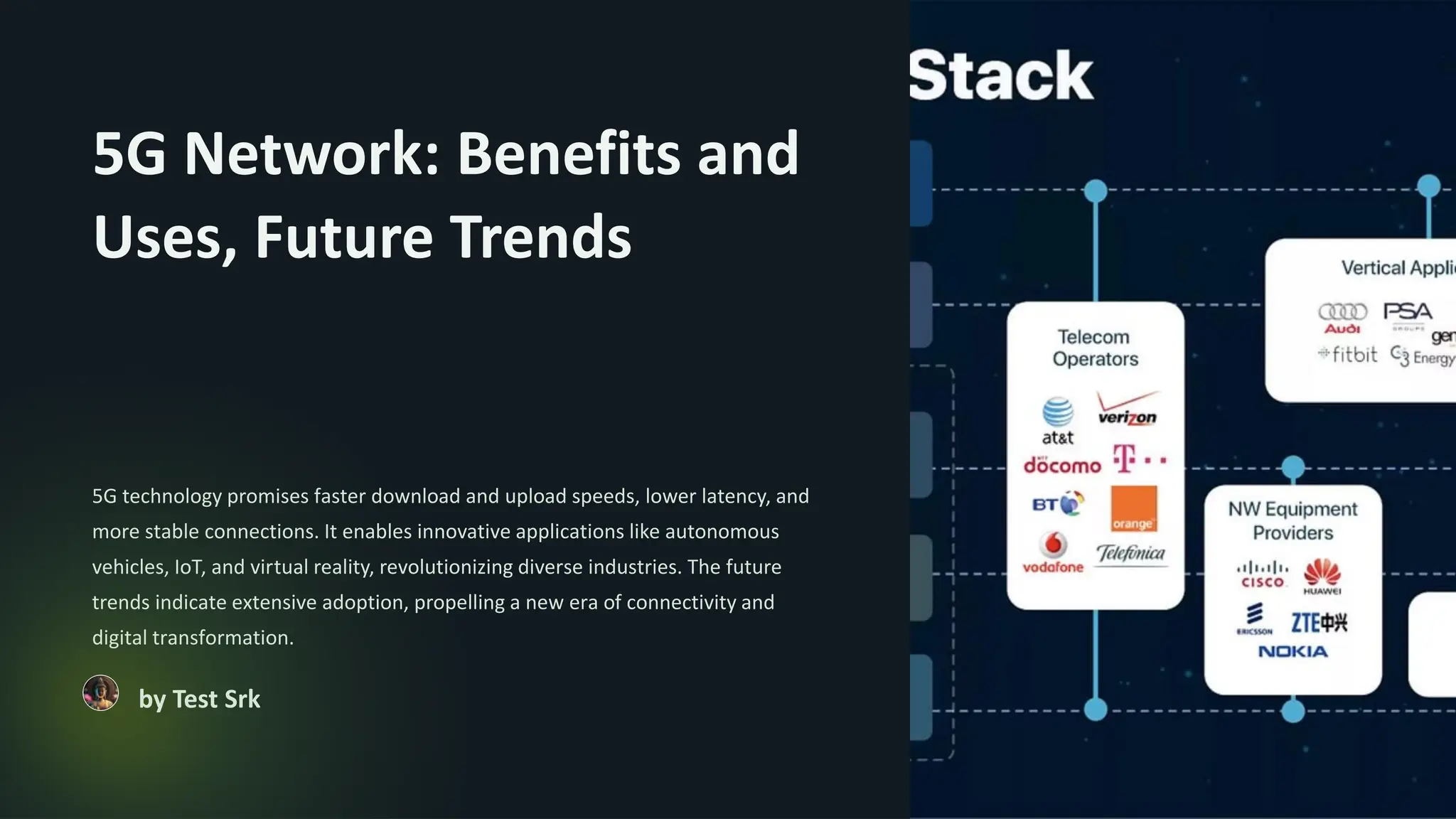
5G technology promises faster download and upload speeds, lower latency, and
more stable connections. It enables innovative applications like autonomous
vehicles, IoT, and virtual reality, revolutionizing diverse industries. The future
trends indicate extensive adoption, propelling a new era of connectivity and
digital transformation.
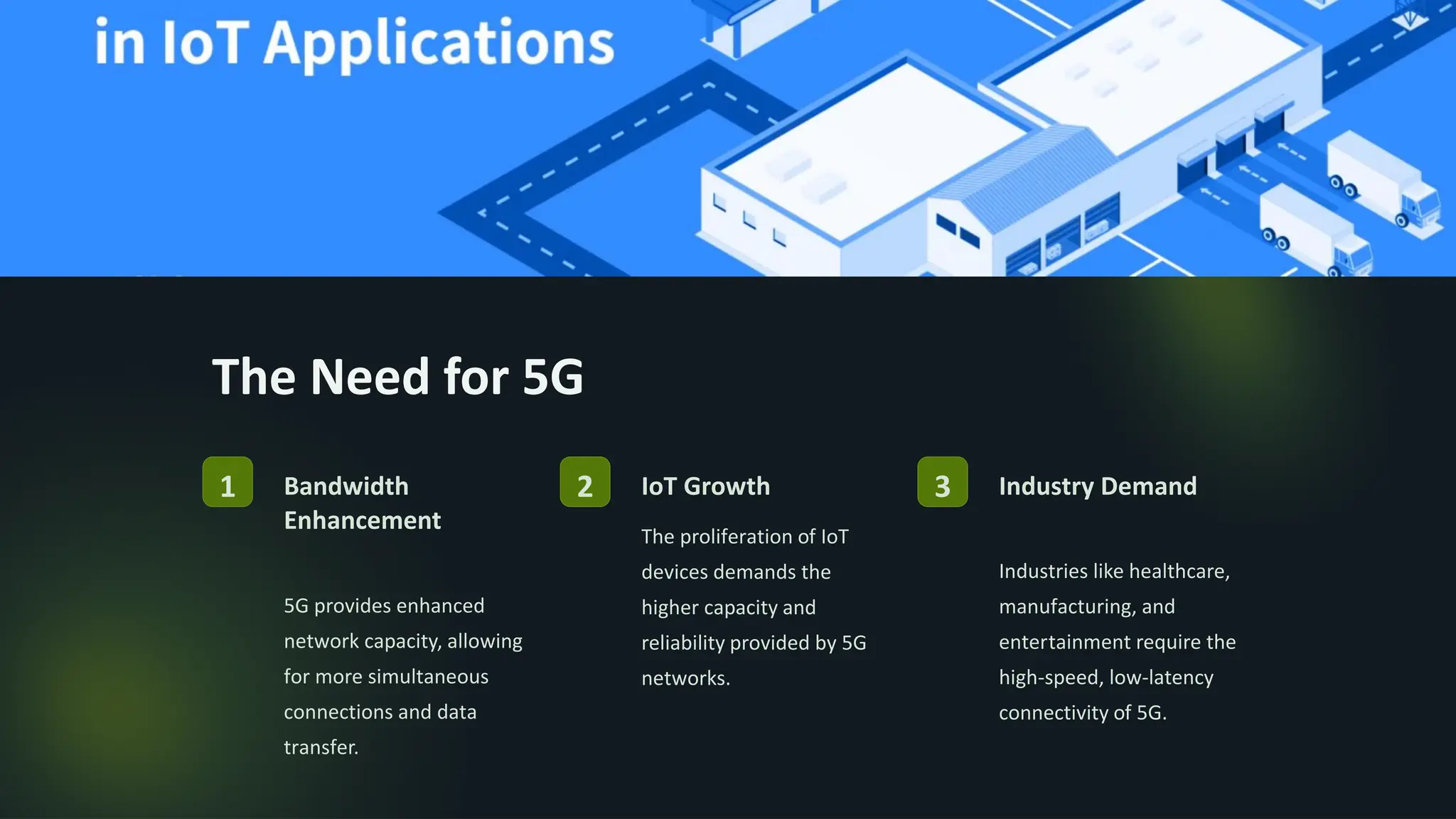
The Need for 5G
1 Bandwidth
Enhancement
5G provides enhanced
network capacity, allowing
allowing for more
simultaneous connections
connections and data
transfer.
2 IoT Growth
The proliferation of IoT
devices demands the
higher capacity and
reliability provided by 5G
networks.
3 Industry Demand
Industries like healthcare,
manufacturing, and
entertainment require the
high-speed, low-latency
connectivity of 5G.
Challenges to Overcome
Infrastructure Upgrades
Expanding 5G infrastructure
requires significant investment
in new equipment and advanced
technology.
Regulatory Hurdles
Navigation through spectrum
regulations and compatibility
standards poses complex
challenges.
Security Concerns
Ensuring the security and
privacy of 5G networks amidst
increasing cyber threats is
imperative.
5G Network: Benefits and
Uses, Future Trends
5G technology promises faster download and upload speeds, lower latency, and
more stable connections. It enables innovative applications like autonomous
vehicles, IoT, and virtual reality, revolutionizing diverse industries. The future
trends indicate extensive adoption, propelling a new era of connectivity and
digital transformation.
by Test Srk
The Need for 5G
1 Bandwidth
Enhancement
5G provides enhanced
network capacity, allowing
for more simultaneous
connections and data
transfer.
2 IoT Growth
The proliferation of IoT
devices demands the
higher capacity and
reliability provided by 5G
networks.
3 Industry Demand
Industries like healthcare,
manufacturing, and
entertainment require the
high-speed, low-latency
connectivity of 5G.
Challenges to Overcome
Infrastructure Upgrades
Expanding 5G infrastructure
requires significant investment
in new equipment and advanced
technology.
Regulatory Hurdles
Navigation through spectrum
regulations and compatibility
standards poses complex
challenges.
Security Concerns
Ensuring the security and
privacy of 5G networks amidst
increasing cyber threats is
imperative.
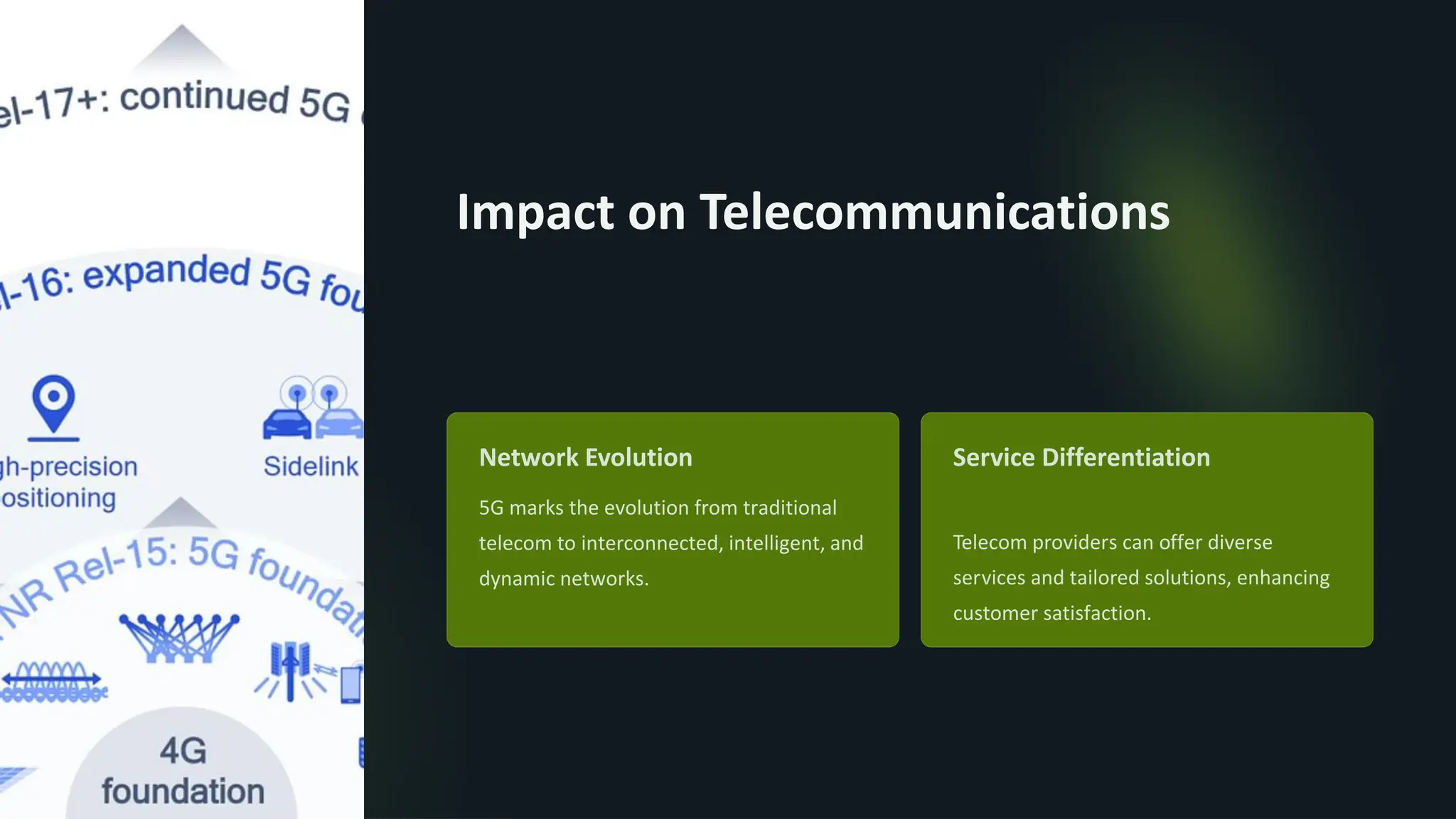
Impact on Telecommunications
Network Evolution
5G marks the evolution from traditional
telecom to interconnected, intelligent, and
dynamic networks.
Service Differentiation
Telecom providers can offer diverse
services and tailored solutions, enhancing
customer satisfaction.
Consumer Benefits
1 Enhanced Mobile
Experience
Consumers enjoy faster
downloads, lag-free
streaming, and enhanced
connectivity for everyday
tasks.
2 Innovative
Applications
5G enables immersive
AR/VR experiences, real-
time gaming, and seamless
multimedia consumption.
3 Remote Healthcare
Improved network
capabilities empower
remote diagnosis,
monitoring, and access to
medical services.
Global Connectivity
200+ Countries
Global Reach
5G expansion aims to provide high-speed connectivity
across 200+ countries and territories globally.
Billions of Devices
Device Connectivity
5G networks are expected to connect billions of
devices, fostering a hyper-connected world.
5G in Enterprise
Industry Automation Enhanced automation and robotics capabilities for
industries like manufacturing and logistics.
Remote Monitoring Real-time monitoring and management of assets
and resources in distributed environments.
Edge Computing Integration of edge computing with 5G networks
for low-latency data processing and analytics.
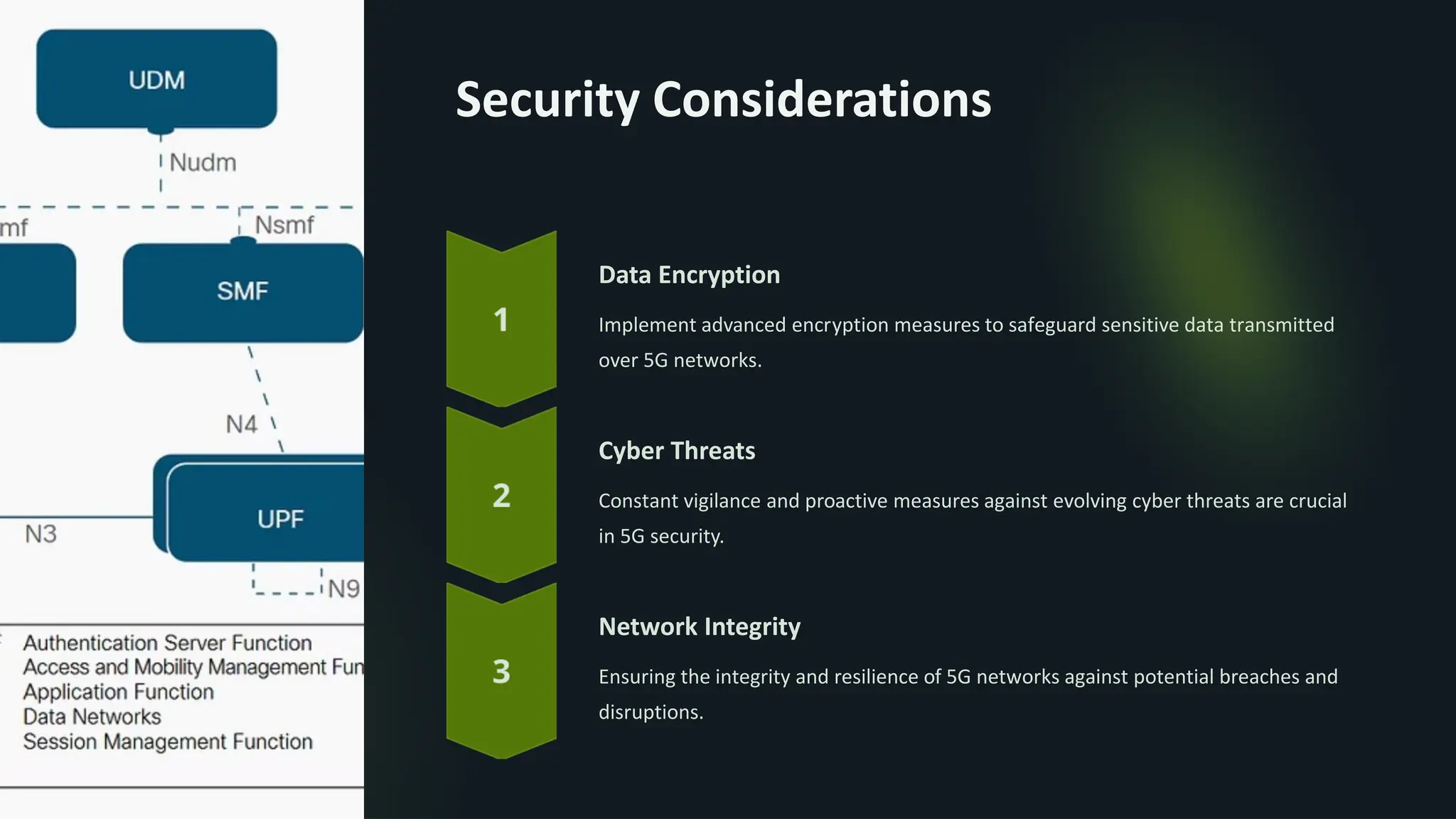
Security Considerations
Data Encryption
Implement advanced encryption measures to safeguard sensitive data transmitted
over 5G networks.
Cyber Threats
Constant vigilance and proactive measures against evolving cyber threats are crucial
in 5G security.
Network Integrity
Ensuring the integrity and resilience of 5G networks against potential breaches and
disruptions.

The Power of 5th Generation Networks: Uses, Future Trends

  • 1.
    The Power of5G Networks 5G networks represent the next generation of mobile internet connectivity, promising faster speeds and more reliable connections on smartphones and other devices. This technology has the potential to revolutionize the way we live and work, opening doors to new possibilities in various industries. Er. Shreeraj Khatiwada, MSc Pokhara University
  • 2.
    The Need forSpeed 1 Enhanced Speed 5G offers significantly faster data download and upload speeds compared to 4G networks. 2 Low Latency It provides ultra-low latency, ensuring near-instantaneous communication between devices. 3 Increased Capacity 5G networks can support a massive number of connections, enabling a higher density of devices in the same geographical area.
  • 3.
    Revolutionizing Industries Healthcare 5G willenable real-time remote health monitoring and telemedicine, revolutionizing healthcare practices. Manufacturing It will facilitate the use of advanced robotics and automation, leading to smart factories and enhanced efficiency. Transportation 5G will be pivotal in the development of autonomous vehicles, enhancing safety and navigation.
  • 4.
    Building a ConnectedWorld Consumer Devices 5G will empower faster and more reliable connections for smartphones, tablets, and wearables. Internet of Things It will accelerate the adoption of IoT devices, leading to smarter homes and cities. Cloud Services Cloud-based services will experience a significant performance boost, enhancing productivity.
  • 5.
    The Era ofInnovation 1 Deployment and Adoption Vast 5G network deployment worldwide and widespread consumer adoption. 2 Evolving Technologies Continued evolution of technologies and services leveraging 5G capabilities. 3 New Business Models Emergence of innovative business models and applications powered by 5G networks.
  • 6.
    Security and Privacy CybersecurityChallenges Addressing the security concerns and vulnerabilities associated with 5G networks. Privacy Regulations Developing stringent privacy regulations to protect user data and digital rights. Encryption Standards Advancing encryption standards to ensure secure communications over 5G networks.
  • 7.
    Global Connectivity 1 RuralConnectivity Bringing high-speed internet access to rural and remote areas, bridging the digital divide. 2 International Collaboration Fostering collaborations among countries to establish global 5G standards and infrastructure. 3 Emerging Economies Empowering emerging economies with advanced connectivity, driving economic growth.
  • 8.
    Environmental Impact Energy Efficiency 5Gnetworks offer greater energy efficiency, reducing the carbon footprint of communication systems. E-Waste Management Addressing e-waste challenges with sustainable practices for 5G network equipment and devices. Sustainable Infrastructure Implementing sustainable infrastructure for 5G deployments to minimize environmental impact.
  • 9.
    Regulatory Advancements Policy FrameworksDeveloping robust regulatory frameworks to govern 5G networks and services. Spectrum Allocation Efficient spectrum allocation and management to support the growing demand for 5G. Compliance Standards Establishing compliance standards to ensure the safety and reliability of 5G technologies.
  • 10.
    5GNetwork: Benefitsand Uses, FutureTrends 5Gtechnology promises faster download and upload speeds, lower latency, and more stable connections. It enables innovative applications like autonomous vehicles, IoT, and virtual reality, revolutionizing diverse industries. The future trends indicate extensive adoption, propelling a new era of connectivity and digital transformation.
  • 11.
    The Need for5G 1 Bandwidth Enhancement 5G provides enhanced network capacity, allowing allowing for more simultaneous connections connections and data transfer. 2 IoT Growth The proliferation of IoT devices demands the higher capacity and reliability provided by 5G networks. 3 Industry Demand Industries like healthcare, manufacturing, and entertainment require the high-speed, low-latency connectivity of 5G.
  • 12.
    Challenges to Overcome InfrastructureUpgrades Expanding 5G infrastructure requires significant investment in new equipment and advanced technology. Regulatory Hurdles Navigation through spectrum regulations and compatibility standards poses complex challenges. Security Concerns Ensuring the security and privacy of 5G networks amidst increasing cyber threats is imperative.
  • 13.
    5G Network: Benefitsand Uses, Future Trends 5G technology promises faster download and upload speeds, lower latency, and more stable connections. It enables innovative applications like autonomous vehicles, IoT, and virtual reality, revolutionizing diverse industries. The future trends indicate extensive adoption, propelling a new era of connectivity and digital transformation. by Test Srk
  • 14.
    The Need for5G 1 Bandwidth Enhancement 5G provides enhanced network capacity, allowing for more simultaneous connections and data transfer. 2 IoT Growth The proliferation of IoT devices demands the higher capacity and reliability provided by 5G networks. 3 Industry Demand Industries like healthcare, manufacturing, and entertainment require the high-speed, low-latency connectivity of 5G.
  • 15.
    Challenges to Overcome InfrastructureUpgrades Expanding 5G infrastructure requires significant investment in new equipment and advanced technology. Regulatory Hurdles Navigation through spectrum regulations and compatibility standards poses complex challenges. Security Concerns Ensuring the security and privacy of 5G networks amidst increasing cyber threats is imperative.
  • 16.
    Impact on Telecommunications NetworkEvolution 5G marks the evolution from traditional telecom to interconnected, intelligent, and dynamic networks. Service Differentiation Telecom providers can offer diverse services and tailored solutions, enhancing customer satisfaction.
  • 17.
    Consumer Benefits 1 EnhancedMobile Experience Consumers enjoy faster downloads, lag-free streaming, and enhanced connectivity for everyday tasks. 2 Innovative Applications 5G enables immersive AR/VR experiences, real- time gaming, and seamless multimedia consumption. 3 Remote Healthcare Improved network capabilities empower remote diagnosis, monitoring, and access to medical services.
  • 18.
    Global Connectivity 200+ Countries GlobalReach 5G expansion aims to provide high-speed connectivity across 200+ countries and territories globally. Billions of Devices Device Connectivity 5G networks are expected to connect billions of devices, fostering a hyper-connected world.
  • 19.
    5G in Enterprise IndustryAutomation Enhanced automation and robotics capabilities for industries like manufacturing and logistics. Remote Monitoring Real-time monitoring and management of assets and resources in distributed environments. Edge Computing Integration of edge computing with 5G networks for low-latency data processing and analytics.
  • 20.
    Security Considerations Data Encryption Implementadvanced encryption measures to safeguard sensitive data transmitted over 5G networks. Cyber Threats Constant vigilance and proactive measures against evolving cyber threats are crucial in 5G security. Network Integrity Ensuring the integrity and resilience of 5G networks against potential breaches and disruptions.