4th Summer School
“Occupational Health crossing Borders”
August 1st – 13th 2011 in Munich, Germany


          Occupational Medicine and Environmental Institute
          Ludwig Maxmilllians University Munich
ABOUT THE COURSE

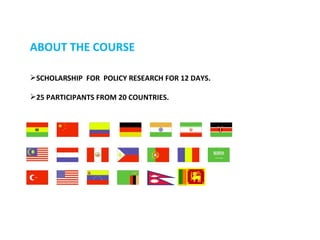
SCHOLARSHIP FOR POLICY RESEARCH FOR 12 DAYS.

25 PARTICIPANTS FROM 20 COUNTRIES.
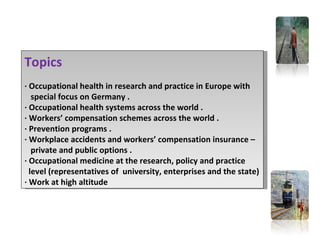
Topics
· Occupational health in research and practice in Europe with
   special focus on Germany .
· Occupational health systems across the world .
· Workers’ compensation schemes across the world .
· Prevention programs .
· Workplace accidents and workers’ compensation insurance –
   private and public options .
· Occupational medicine at the research, policy and practice
  level (representatives of university, enterprises and the state)
· Work at high altitude
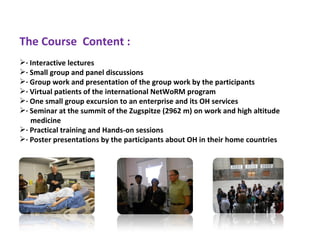
The Course Content :
· Interactive lectures
· Small group and panel discussions
· Group work and presentation of the group work by the participants
· Virtual patients of the international NetWoRM program
· One small group excursion to an enterprise and its OH services
· Seminar at the summit of the Zugspitze (2962 m) on work and high altitude
   medicine
· Practical training and Hands-on sessions
· Poster presentations by the participants about OH in their home countries
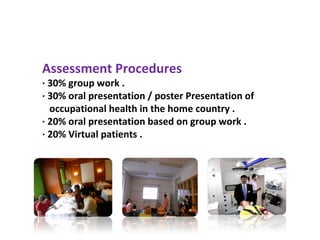
Assessment Procedures
· 30% group work .
· 30% oral presentation / poster Presentation of
  occupational health in the home country .
· 20% oral presentation based on group work .
· 20% Virtual patients .
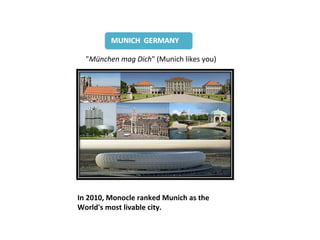
"München mag Dich" (Munich likes you)


In 2010, Monocle ranked Munich as the
World's most livable city.
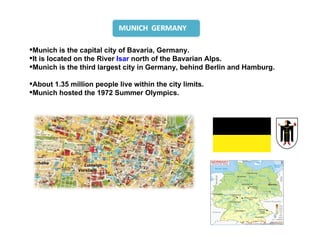
Munich is the capital city of Bavaria, Germany.
It is located on the River Isar north of the Bavarian Alps.
Munich is the third largest city in Germany, behind Berlin and Hamburg.

About 1.35 million people live within the city limits.
Munich hosted the 1972 Summer Olympics.
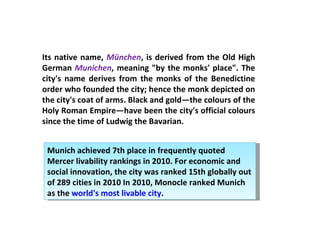
Its native name, München, is derived from the Old High
German Munichen, meaning "by the monks' place". The
city's name derives from the monks of the Benedictine
order who founded the city; hence the monk depicted on
the city's coat of arms. Black and gold—the colours of the
Holy Roman Empire—have been the city's official colours
since the time of Ludwig the Bavarian.


 Munich achieved 7th place in frequently quoted
 Mercer livability rankings in 2010. For economic and
 social innovation, the city was ranked 15th globally out
 of 289 cities in 2010 In 2010, Monocle ranked Munich
 as the world's most livable city.
Marineplatz
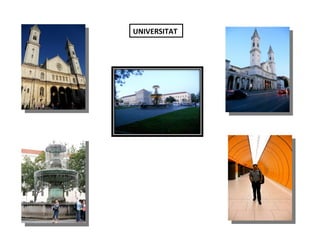
UNIVERSITAT
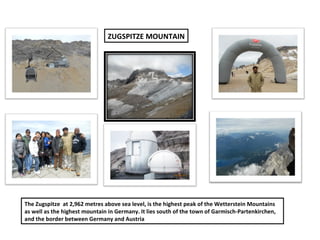
ZUGSPITZE MOUNTAIN


The Zugspitze at 2,962 metres above sea level, is the highest peak of the Wetterstein Mountains
as well as the highest mountain in Germany. It lies south of the town of Garmisch-Partenkirchen,
and the border between Germany and Austria
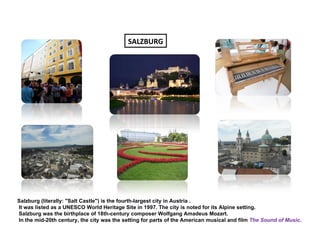
SALZBURG


Salzburg (literally: "Salt Castle") is the fourth-largest city in Austria .
It was listed as a UNESCO World Heritage Site in 1997. The city is noted for its Alpine setting.
Salzburg was the birthplace of 18th-century composer Wolfgang Amadeus Mozart.
In the mid-20th century, the city was the setting for parts of the American musical and film The Sound of Music.
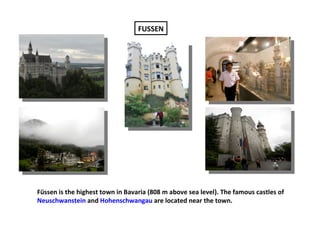
FUSSEN


Füssen is the highest town in Bavaria (808 m above sea level). The famous castles of
Neuschwanstein and Hohenschwangau are located near the town.
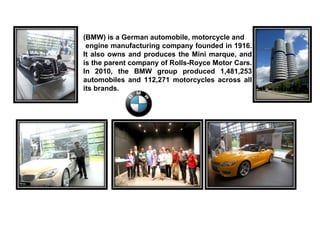
(BMW) is a German automobile, motorcycle and
 engine manufacturing company founded in 1916.
It also owns and produces the Mini marque, and
is the parent company of Rolls-Royce Motor Cars.
In 2010, the BMW group produced 1,481,253
automobiles and 112,271 motorcycles across all
its brands.
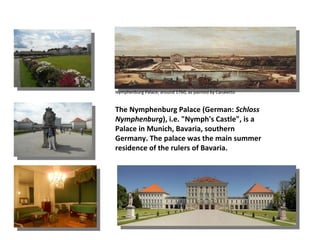
Nymphenburg Palace, around 1760, as painted by Canaletto


The Nymphenburg Palace (German: Schloss
Nymphenburg), i.e. "Nymph's Castle", is a
Palace in Munich, Bavaria, southern
Germany. The palace was the main summer
residence of the rulers of Bavaria.
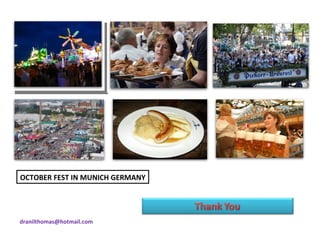
OCTOBER FEST IN MUNICH GERMANY


dranilthomas@hotmail.com

Munich ppt

  • 1.
    4th Summer School “OccupationalHealth crossing Borders” August 1st – 13th 2011 in Munich, Germany Occupational Medicine and Environmental Institute Ludwig Maxmilllians University Munich
  • 3.
    ABOUT THE COURSE SCHOLARSHIPFOR POLICY RESEARCH FOR 12 DAYS. 25 PARTICIPANTS FROM 20 COUNTRIES.
  • 4.
    Topics · Occupational healthin research and practice in Europe with special focus on Germany . · Occupational health systems across the world . · Workers’ compensation schemes across the world . · Prevention programs . · Workplace accidents and workers’ compensation insurance – private and public options . · Occupational medicine at the research, policy and practice level (representatives of university, enterprises and the state) · Work at high altitude
  • 5.
    The Course Content: · Interactive lectures · Small group and panel discussions · Group work and presentation of the group work by the participants · Virtual patients of the international NetWoRM program · One small group excursion to an enterprise and its OH services · Seminar at the summit of the Zugspitze (2962 m) on work and high altitude medicine · Practical training and Hands-on sessions · Poster presentations by the participants about OH in their home countries
  • 6.
    Assessment Procedures · 30%group work . · 30% oral presentation / poster Presentation of occupational health in the home country . · 20% oral presentation based on group work . · 20% Virtual patients .
  • 7.
    "München mag Dich"(Munich likes you) In 2010, Monocle ranked Munich as the World's most livable city.
  • 8.
    Munich is thecapital city of Bavaria, Germany. It is located on the River Isar north of the Bavarian Alps. Munich is the third largest city in Germany, behind Berlin and Hamburg. About 1.35 million people live within the city limits. Munich hosted the 1972 Summer Olympics.
  • 9.
    Its native name,München, is derived from the Old High German Munichen, meaning "by the monks' place". The city's name derives from the monks of the Benedictine order who founded the city; hence the monk depicted on the city's coat of arms. Black and gold—the colours of the Holy Roman Empire—have been the city's official colours since the time of Ludwig the Bavarian. Munich achieved 7th place in frequently quoted Mercer livability rankings in 2010. For economic and social innovation, the city was ranked 15th globally out of 289 cities in 2010 In 2010, Monocle ranked Munich as the world's most livable city.
  • 10.
  • 11.
  • 12.
    ZUGSPITZE MOUNTAIN The Zugspitzeat 2,962 metres above sea level, is the highest peak of the Wetterstein Mountains as well as the highest mountain in Germany. It lies south of the town of Garmisch-Partenkirchen, and the border between Germany and Austria
  • 13.
    SALZBURG Salzburg (literally: "SaltCastle") is the fourth-largest city in Austria . It was listed as a UNESCO World Heritage Site in 1997. The city is noted for its Alpine setting. Salzburg was the birthplace of 18th-century composer Wolfgang Amadeus Mozart. In the mid-20th century, the city was the setting for parts of the American musical and film The Sound of Music.
  • 14.
    FUSSEN Füssen is thehighest town in Bavaria (808 m above sea level). The famous castles of Neuschwanstein and Hohenschwangau are located near the town.
  • 15.
    (BMW) is aGerman automobile, motorcycle and engine manufacturing company founded in 1916. It also owns and produces the Mini marque, and is the parent company of Rolls-Royce Motor Cars. In 2010, the BMW group produced 1,481,253 automobiles and 112,271 motorcycles across all its brands.
  • 16.
    Nymphenburg Palace, around1760, as painted by Canaletto The Nymphenburg Palace (German: Schloss Nymphenburg), i.e. "Nymph's Castle", is a Palace in Munich, Bavaria, southern Germany. The palace was the main summer residence of the rulers of Bavaria.
  • 17.
    OCTOBER FEST INMUNICH GERMANY dranilthomas@hotmail.com