The Periodic Table
Mainfeatures
• The layout of the periodic table gives valuable information
about the elements: chemical and physical etc
• The vertical columns are known as groups. Elements in the
same group have the same configuration in the valence
shell (outer most shell): Group I [X]ns1, Group II [X]ns2
• The horizontal rows are called periods. There are seven
periods each representing quantum numbers n = 1 → n= 7
• Each period is filled more or less sequentially. The period an
element is in tells us the highest shell occupied
2
Introduction to Chemistry 2025
3.
Effective nuclear charge
•Properties of elements are affected by the
amount of positive charge experienced by the
outer electrons
• The positive charge is always less than the
full nuclear charge (except for hydrogen)
• The negative charge of the inner electrons
partially offset (neutralise) the positive charge
of the nucleus
• The effective nuclear charge is determined by
the difference between the charge of the
nucleus and the charge on the core
3
Introduction to Chemistry 2025
Example
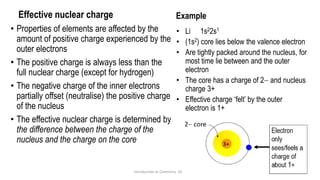
• Li 1s22s1
• (1s2) core lies below the valence electron
• Are tightly packed around the nucleus, for
most time lie between and the outer
electron
• The core has a charge of 2− and nucleus
charge 3+
• Effective charge ‘felt’ by the outer
electron is 1+
4.
Atomic Size
• Twoimportant
factors to consider:
• increasing
principal number
• effective nuclear
charge
4
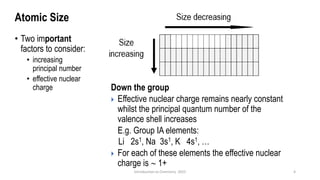
Down the group
Effective nuclear charge remains nearly constant
whilst the principal quantum number of the
valence shell increases
E.g. Group IA elements:
Li 2s1, Na 3s1, K 4s1, …
For each of these elements the effective nuclear
charge is 1+
Introduction to Chemistry 2025
5.
Atomic Size
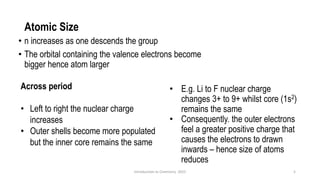
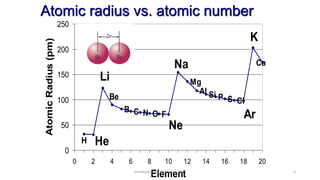
• nincreases as one descends the group
• The orbital containing the valence electrons become
bigger hence atom larger
5
• E.g. Li to F nuclear charge
changes 3+ to 9+ whilst core (1s2)
remains the same
• Consequently. the outer electrons
feel a greater positive charge that
causes the electrons to drawn
inwards – hence size of atoms
reduces
Across period
• Left to right the nuclear charge
increases
• Outer shells become more populated
but the inner core remains the same
Introduction to Chemistry 2025
6.
Atomic radius vs.atomic number
Ca
K
H He
Li
B
Be
C N O F
Ne
Na
Mg
Al Si P S Cl
Ar
0
50
100
150
200
250
0 2 4 6 8 10 12 14 16 18 20
Element
Atomic
Radius
(pm)
Introduction to Chemistry 2025 6
7.
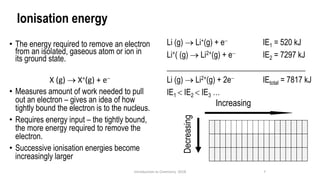
Ionisation energy
• Theenergy required to remove an electron
from an isolated, gaseous atom or ion in
its ground state.
X (g) → X+(g) + e−
• Measures amount of work needed to pull
out an electron – gives an idea of how
tightly bound the electron is to the nucleus.
• Requires energy input – the tightly bound,
the more energy required to remove the
electron.
• Successive ionisation energies become
increasingly larger
7
Introduction to Chemistry 2018
Decreasing
Increasing
Li (g) → Li+(g) + e− IE1 = 520 kJ
Li+( (g) → Li2+(g) + e− IE2 = 7297 kJ
___________________________________
Li (g) → Li2+(g) + 2e− IEtotal = 7817 kJ
IE1 IE2 IE3 …
8.
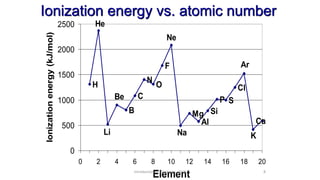
Ionization energy vs.atomic number
Ca
K
H
He
Li
B
Be C
N
O
F
Ne
Na
Mg
Al
Si
P S
Cl
Ar
0
500
1000
1500
2000
2500
0 2 4 6 8 10 12 14 16 18 20
Element
Ionization
energy
(kJ/mol)
8
Introduction to Chemistry 2018
9.
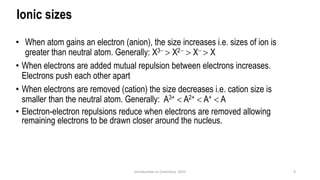
Ionic sizes
• Whenatom gains an electron (anion), the size increases i.e. sizes of ion is
greater than neutral atom. Generally: X3− X2− X− X
• When electrons are added mutual repulsion between electrons increases.
Electrons push each other apart
• When electrons are removed (cation) the size decreases i.e. cation size is
smaller than the neutral atom. Generally: A3+ A2+ A+ A
• Electron-electron repulsions reduce when electrons are removed allowing
remaining electrons to be drawn closer around the nucleus.
9
Introduction to Chemistry 2025
10.
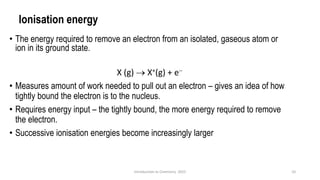
Ionisation energy
• Theenergy required to remove an electron from an isolated, gaseous atom or
ion in its ground state.
X (g) → X+(g) + e−
• Measures amount of work needed to pull out an electron – gives an idea of how
tightly bound the electron is to the nucleus.
• Requires energy input – the tightly bound, the more energy required to remove
the electron.
• Successive ionisation energies become increasingly larger
10
Introduction to Chemistry 2025
11.
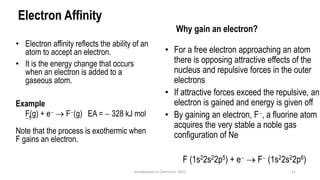
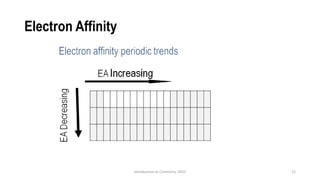
Electron Affinity
• Electronaffinity reflects the ability of an
atom to accept an electron.
• It is the energy change that occurs
when an electron is added to a
gaseous atom.
Example
F(g) + e− → F−(g) EA = − 328 kJ mol
−1
Note that the process is exothermic when
F gains an electron.
11
Introduction to Chemistry 2025
• For a free electron approaching an atom
there is opposing attractive effects of the
nucleus and repulsive forces in the outer
electrons
• If attractive forces exceed the repulsive, an
electron is gained and energy is given off
• By gaining an electron, F−, a fluorine atom
acquires the very stable a noble gas
configuration of Ne
F (1s22s22p5) + e− → F− (1s22s22p6)
Why gain an electron?
Electronegativity
• Electronegativity isa measure of the attraction of an atom for the electrons in
a chemical bond.
• The higher the electronegativity of an atom, the greater its attraction for
bonding electrons.
• It is related to ionization energy. Electrons with low ionization energies have
low electronegativities because their nuclei do not exert a strong attractive
force an electrons.
• Elements with have high ionisation energies have high electronegativities due
to the strong pull exerted on electrons by the nucleus (effective nuclear
charge)
13
Introduction to Chemistry 2025
14.
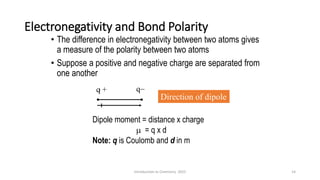
Electronegativity and BondPolarity
• The difference in electronegativity between two atoms gives
a measure of the polarity between two atoms
• Suppose a positive and negative charge are separated from
one another
Direction of dipole
Dipole moment = distance x charge
= q x d
Note: q is Coulomb and d in m
q + q−
14
Introduction to Chemistry 2025

![The Periodic Table
Main features
• The layout of the periodic table gives valuable information
about the elements: chemical and physical etc
• The vertical columns are known as groups. Elements in the
same group have the same configuration in the valence
shell (outer most shell): Group I [X]ns1, Group II [X]ns2
• The horizontal rows are called periods. There are seven
periods each representing quantum numbers n = 1 → n= 7
• Each period is filled more or less sequentially. The period an
element is in tells us the highest shell occupied
2
Introduction to Chemistry 2025](https://image.slidesharecdn.com/theperiodtableandperiodictrendsinatomic-250409053043-849784a3/85/The-Period-Table-and-Periodic-Trends-in-Atomic-pdf-2-320.jpg)