5. Actually, theyalready ___ more
varieties of flowering plants two
days ago.
COLLECT
8.
PRESENT PERFECT
TENSE
used toshow an action that is complete and finished, or
perfected. This tense is expressed by adding one of the
auxiliary verbs — have, has, or had — to the past
participle form of the main verb.
Mira had gone to the movies.” Here, 'had gone' refers to
he fact that Ira already went to the movies in the past,
and the action is already completed while we are
speaking about it.
9.
PRESENT PERFECT
TENSE
Is madeup of has/have plus the past participle
form of the verb.
It refers to an action or state that happened or
occured at an indefinite time in the past or something
that began in the past and continued up the present.
10.
PRESENT PERFECT
TENSE
A. Has+ past participle of the verb of the verb
is used when the subject is singular.
Example:
Sheila has worked as a nurse for a year now.
11.
PRESENT PERFECT
TENSE
A. Have+ past participle of the verb of the verb
is used when the subject is plural. It is also used
when the subject is I or You
Examples:
They have explored Igbaclang Cave for almost an
hour.
I have worked as a teacher two years ago.
12.
PAST PERFECT TENSE
Indicatesan action that had already happened at
some point in the past before another action took
place.
It also refers to actions that were completed
before specific time in the past.
Had + past participle form
13.
Example:
After Sheila andMaricel had
passed the nursing licensure
examination, they applied for
work.
14.
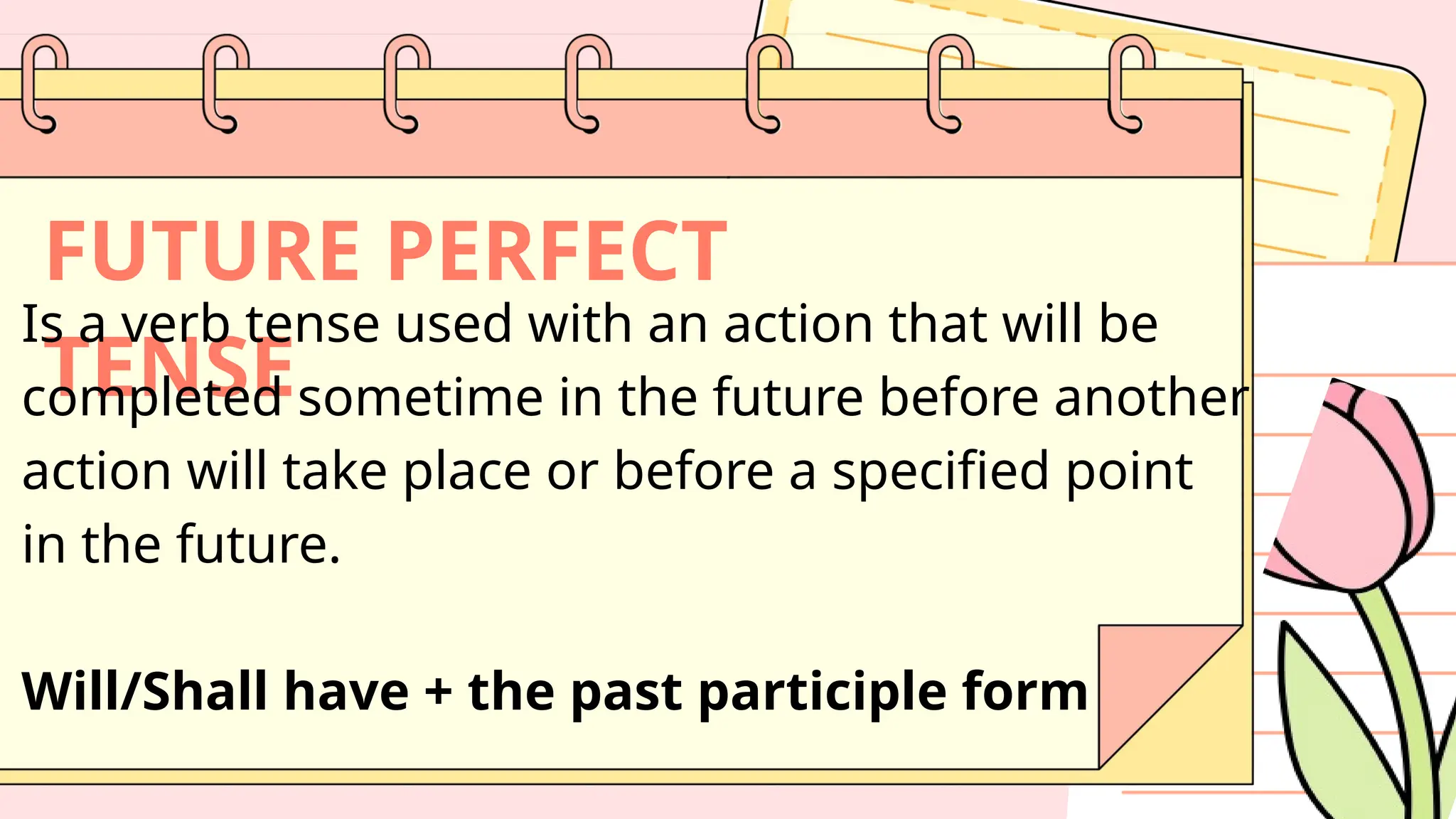
FUTURE PERFECT
TENSE
Is averb tense used with an action that will be
completed sometime in the future before another
action will take place or before a specified point
in the future.
Will/Shall have + the past participle form
SW # 2
Composea clear and coherent sentence by
choosing the correct perfect form of the
verb in the parenthesis.
18.
1.Father (has planted,had
planted, will have planted)
vegetables in the yard since
last summer.
19.
2. He (hasspent, had spent,
will have spent) most of his
free time taking care of them
for almost a year now.
20.
3. The children(have helped,
will have helped, had helped)
him water the vegetables
before the sun rose.
21.
4. They saidthat they (have
enjoyed, had enjoyed, will have
enjoyed) watching the plants
grow.
22.
5. He (hasbrought, had
brought, will have brought)
them to the market by
tomorrow for selling before the
typhoon came
Editor's Notes
#8 A tense is a form of the verb that allows you to express time. The tense of the verb tells us when an event or something existed or when a person did something. Past, present, and future are the three main types of tenses