1
Strengthening School-Based
Child Protection Policy and
Suicide Awareness
Rose F. De Guzman
Discussant
1. Which of the following is NOT a sign of
potential child abuse or neglect?
a. Frequent unexplained injuries
b. Sudden changes in behavior
c. Consistently happy and outgoing behavior
d. Difficulty trusting others
Choose the letter of the best answer:
2. If a child discloses information about being abused, what is the
first thing you should do?
a. Tell them they should stay quiet about it
b. Reassure them and listen carefully without asking leading
questions
c. Promise to keep it a secret
d. Discuss it with other children to verify the story
3. What is a warning sign that a child may be experiencing
thoughts of suicide?
a. Decline in school performance
b. Giving away valued possessions
c. Increased interest in activities they previously enjoyed
d. Talking about future PLANS
4. Who should you report to if you suspect child abuse?
a. A friend or family member
b. Your local child protective services or designated
authority in your institution
c. The child themselves
d. No one; keep it to yourself
5. If a child expresses thoughts of suicide,
which of the following is an appropriate
response?
a. Tell them they shouldn’t feel that way
b. Listen without judgment and refer them to
a mental health professional
c. Ignore it; they’re probably seeking attention
d. Ask them to promise never to talk about it
again
BALLOON ATTACK GAME
Group 1:
Ties balloons around
their own ankles with
string and then tries to
protect these balloons
from any attacks
Group 2:
are the attackers
They must try to
burst/pop
the balloons
BALLOON ATTACK GAME
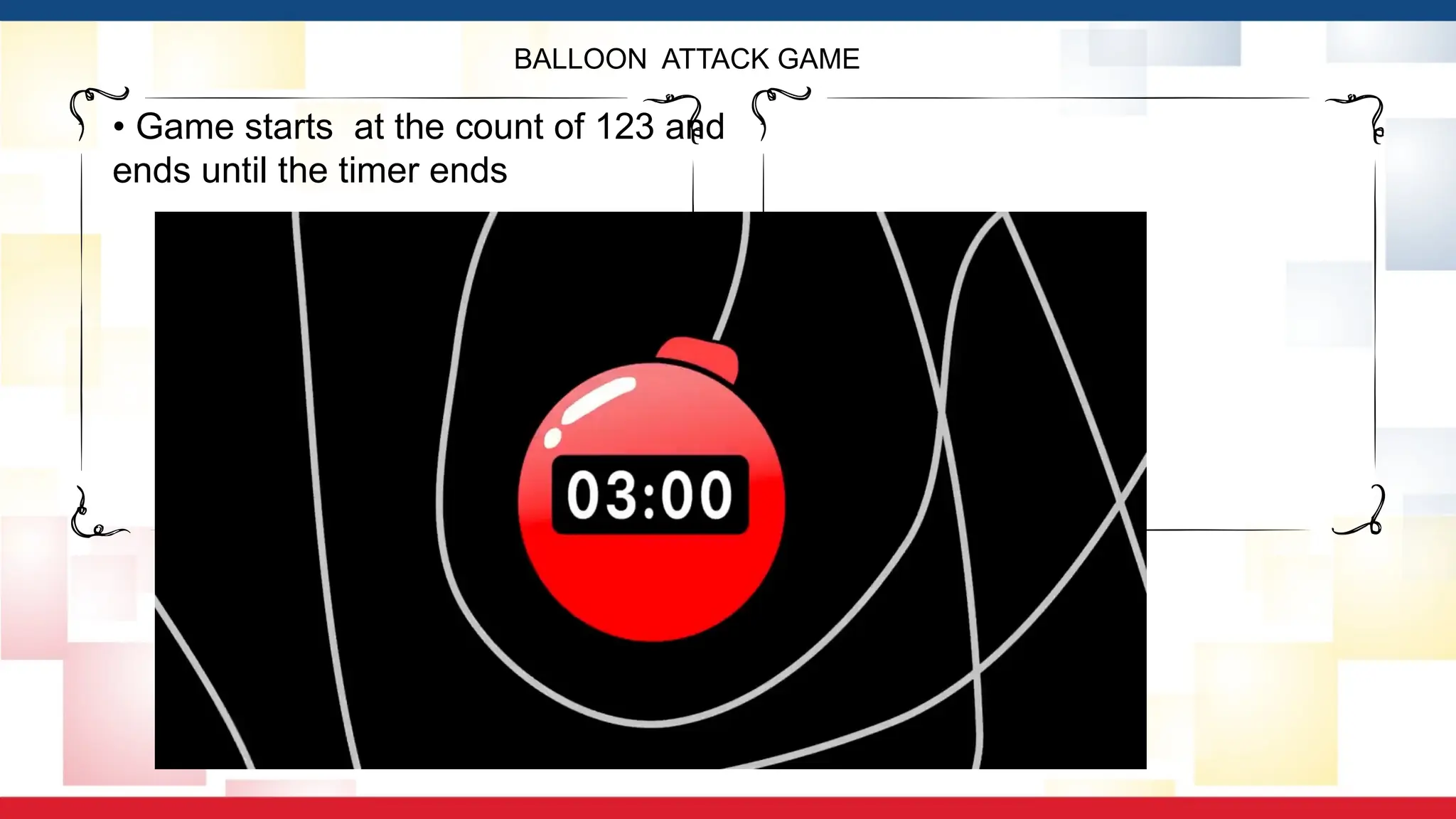
• Game starts at the count of 123 and
ends until the timer ends
BALLOON GAME
Group 1:
a.What did you feel when you were trying
to protect the balloons?
b.What made protecting your balloons
easier? What made it harder?”
?”
BALLOON GAME
Group 2:
a.What made it easy for you
to attack the balloons?
b.What made it difficult
Child Protection Policy
Department of Education
DepEd Order no. 40 series of 2012
The Department of Education
Policy on Child Protection
Under DEPEd Order no. 40 s. 2012
MANDATE
Art. XV. Sec. 3 (b). 1987 Philippines
Constitution
● “The state shall defend the right
of children to assistance,
including proper care and
nutrition, and special protection
from all forms of neglect,
abuse, cruelty, exploitation and
other conditions prejudicial to
their development.
Article XIV, Section 3,(b)
● All educational institution
shall inculcate patriotism and
nationalism, foster love of
humanity respect for human
rights..”
MANDATE
The Convention on the Rights of the Child
(CRC)
● Aims to protect children from all forms of physical
or mental violence,injury, and abuse neglect or
negligent treatment,maltreatment and exploitation
including sexual abuse,it is also establishes the
right of the child to education,and with a view to
achieving this right,it obliges the government to
take measures to encourage regular attendance
in school and reduce drop-out rates.it is
mandated that all appropriate measures be
undertaken to ensure that school discipline is
administered in a manner consistent with the
child’s human dignity.
The Department of Education (DepEd) in
collaboration with its partners and Stakeholders
Ensure that all schools are conducive to the
education of children.The best interest
of the child shall be the paramount
consideration in all decisions and
actions involving children.
Teachers and learning Facilitator especially
in learning centers are their substitute
parents,and expected to discharge their
functions and duties with this in mind.
KEEP IN MIND
● The Family code empowers the
school,its administrators,and
teachers, or the individual, entity
or institution engaged in child care
to exercise the special parental
authority and responsibility over
the child, while under their
supervision, instruction or custody.
The Department reiterates a zero
tolerance policy for any act of
child
abuse,exploitation,violence,di
scrimination, bullying and
other forms of abuse.
DEFINITION OF TERMS
Child
● Refers to any person below
eighteen (18) years of age or those
over but are unable to fully take
care of themselvesor protect
themselves from
abuse,neglect,cruelty.for DEPED
the term also includes pupils or
students who may be eighteen of
age or older but are in school.
Child Protection
Refers to
programs,services,procedure
s,and structures that are
intended to prevent and
respond to
abuse,neglect,exploitation,dis
crimination,and violence.
Definition of Terms
Child Abuse
● Refers to the maltreatment of
a child whether habitual or
not.
Child Exploitation
Refers to the use of children for
someone elses
advantage.gratification or
profit often resulting in an
unjust, cruel and harmful
treatment of the child.
Violence against Children Committed in Schools
Physical Violence
● Refers to acts that inflict
bodily or physical harm.it
includes assigning children to
perform tasks which are
hazardous to their physical
well- being
Sexual Violence
Refers to acts that are sexual in
nature, it includes, but is not limited
to :rape,sexual harassment, act of
lasciviousness, forcing the child to
watch obscene publications and
indecent shows,attempting to
cause the child to engage in any
sexual activity by force.
Violence against Children Committed in Schools
Psychological Violence
● Refers to acts or omissions causing
or likely to cause mental or
emotional suffering of the
child,intimidation,harassment,stalkin
g,damage to property,public ridicule
or humiliation,deduction or threat of
deduction from grade or merit as a
form of punishment and repeated
verbal abuse.
Corporal Punishment
Refers to a kind of punishment or
penalty imposed for an alleged or
actual offense,which is carried out
or inflicted for the purpose of
discipline,training or control by a
teacher,school administrator, an
adult or any other child who has
given or has assumed authority or
responsibility for punishment.
CORPORAL PUNISHMENT
● Beating
● Kicking
● Hitting
● Slapping
● Lashing
● With or without the use of
instrument like
cane,broom,stick,whip or belt
Striking of a child’s face or head
“NO CONTACT ZONE”
Pulling hair
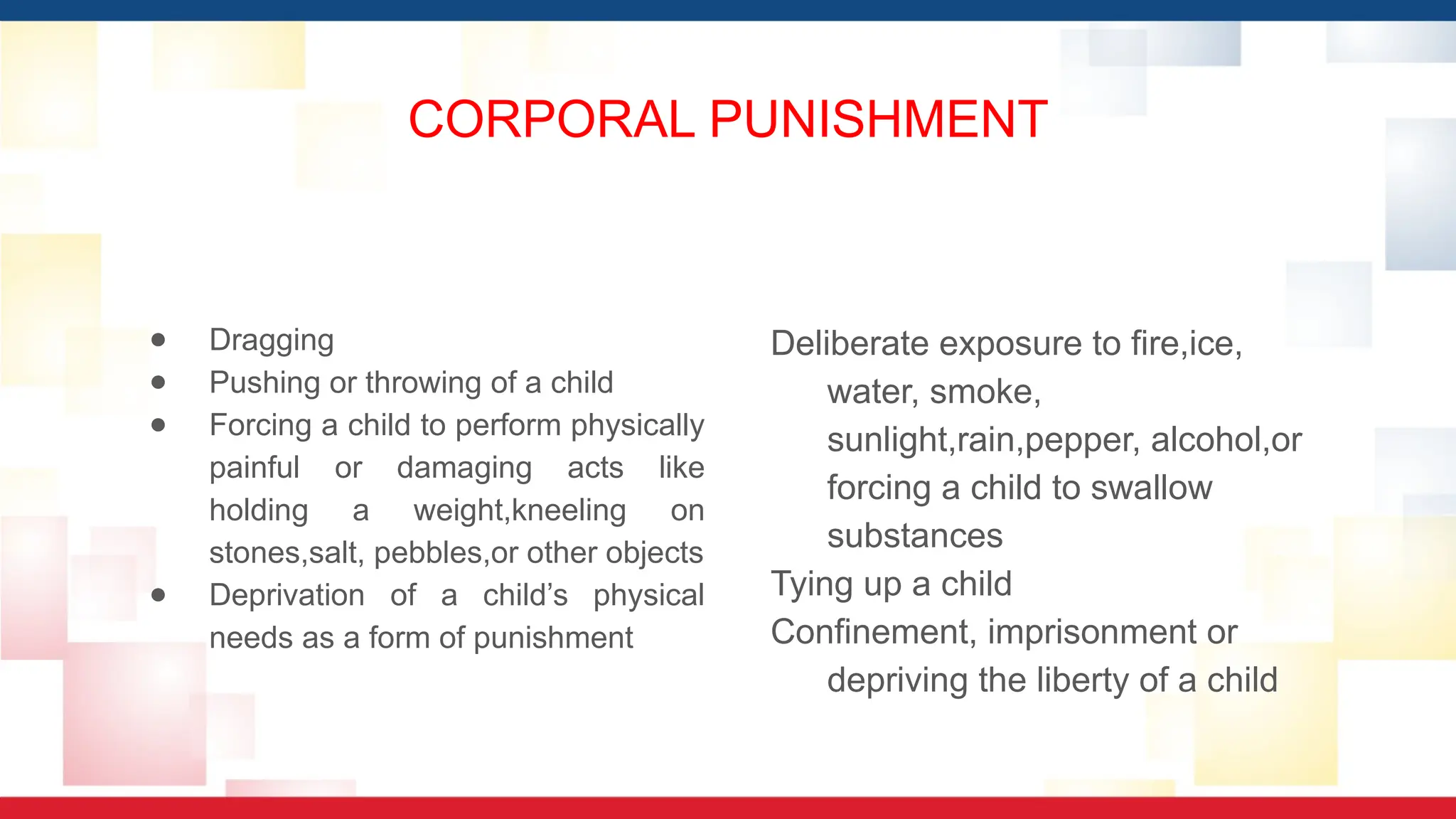
Shaking
Twisting joint
Cutting or piercing skin
CORPORAL PUNISHMENT
● Dragging
● Pushing or throwing of a child
● Forcing a child to perform physically
painful or damaging acts like
holding a weight,kneeling on
stones,salt, pebbles,or other objects
● Deprivation of a child’s physical
needs as a form of punishment
Deliberate exposure to fire,ice,
water, smoke,
sunlight,rain,pepper, alcohol,or
forcing a child to swallow
substances
Tying up a child
Confinement, imprisonment or
depriving the liberty of a child
CORPORAL PUNISHMENT
● Verbal abuse or assaults like
intimidation or threat of bodily harm,
swearing or cursing,ridiculing or
denigrating the child.
● Forcing a child to wear a sign, to
undress or disrobe or to put on
anything that will make a child look
or feel foolish which humiliates the
child in front of others.
Permanent confiscation of
personal property of pupils
except when such pieces of
property pose a danger to the
child or to others
Other analogous acts( behaviors
that are related to or could
lead to criminal actions)
BULLYING
President Aquino signed last Republic Act 10627 or the
“Anti-Bullying Act of 2013” last Sept. 6, requiring all
elementary and secondary schools to adopt policies to
prevent and address bullying in their institutions.
The law defines bullying as any severe or repeated use by
one or more students of a written, verbal or electronic
expression, or a physical act or gesture, or any
combination thereof, directed at another student that
has the effect of actually causing or placing the latter
in reasonable fear of physical or emotional harm or
damage to his property; creating a hostile
environment at school for the other students. The act
of bullying also involves infringing on the rights of
other students at school or materially and
substantially disrupting the education process or the
orderly preparation of a school.
Bullying (DepEd Order no. 40 s. 2012)
Is committed when a student
commits an act or a series of
single acts directed towards
another student in a school
setting or a place of learning
which results in physical and
mental abuse, harassment,
intimidation or humiliation
Bullying
Threats to inflict a wrong upon a
person, honor, or property of the
person or on his or her family
Stalking or constantly following or
pursuing a person in his or her
daily activities with unwanted
and obsessive attention
Taking of property
Public humiliation, or public and malicious
imputation of a crime or of a vice or
defects whether real or imaginary
Deliberate destruction or damage to the
child’s property
Physical Violence committed upon a
student such as
mauling,hitting,punching,kicking,throw
ing things at the student pinching,
spanking.
Bullying
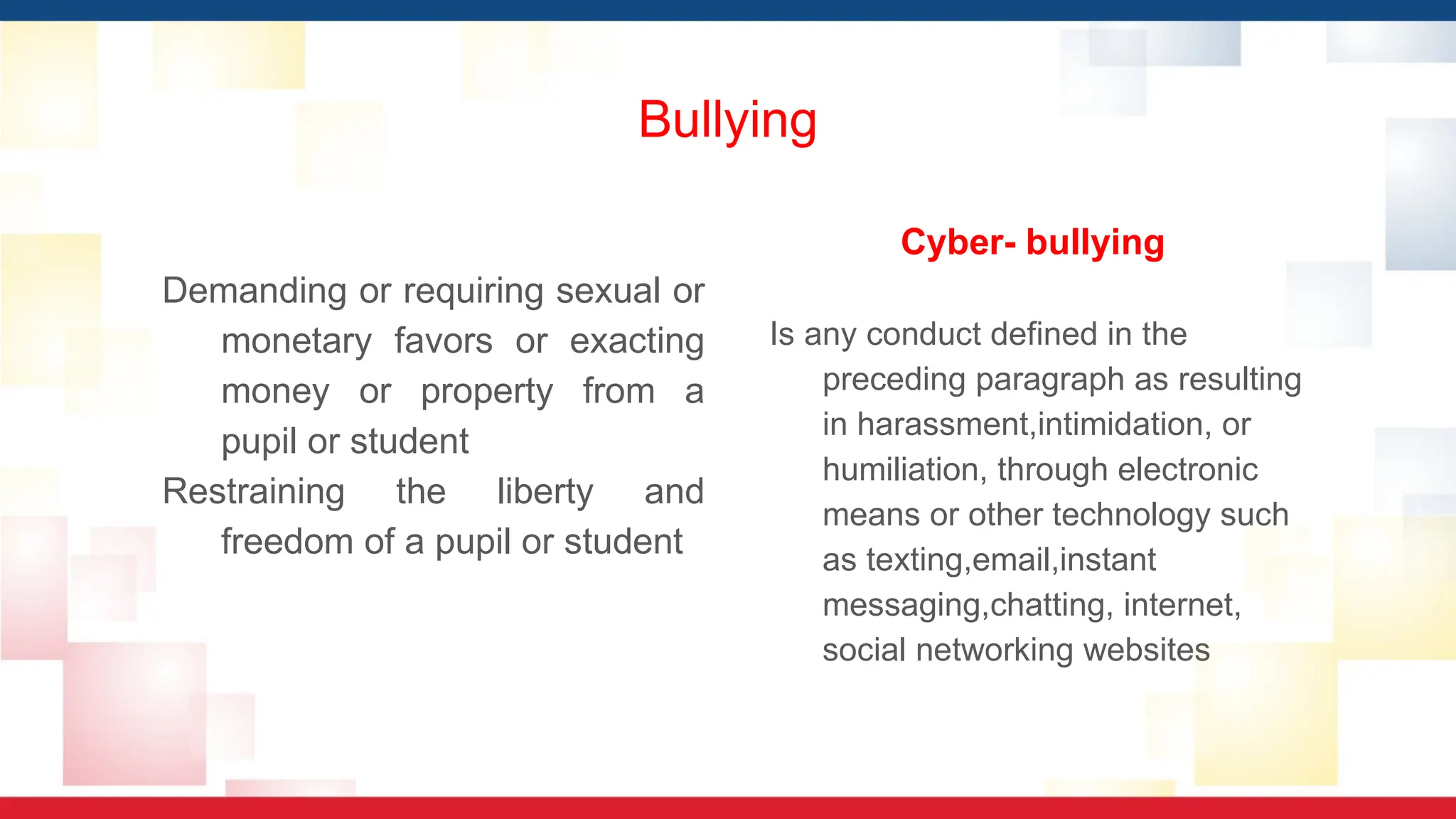
Demanding or requiring sexual or
monetary favors or exacting
money or property from a
pupil or student
Restraining the liberty and
freedom of a pupil or student
Cyber- bullying
Is any conduct defined in the
preceding paragraph as resulting
in harassment,intimidation, or
humiliation, through electronic
means or other technology such
as texting,email,instant
messaging,chatting, internet,
social networking websites
WHAT WILL HAPPEN IF WE VIOLATE THIS DEPED ORDER no.40 s. 2012
Teachers/School Authorities
● There is a procedures in
handling child abuse first if that
is being reported it will undergo
Fact Finding Investigation.
Note: the identity of a respondent
teacher shall be kept
confidential
Students
It is the Child Protection
Committee to decide in any
abuses by students to
another. Like suspension or
expulsion depending on the
ground of offense.
DepEd-Division Office -LEGAL
UNIT
A. Expeditious conduct of investigation and
reporting of cases;
B. School Head or the Schools Division
Superintendent shall forward the
complaint and Intake Sheet within 48
hours to the Disciplining Authority, who
shall issue an Order for the conduct of a
fact-finding investigation, not later than
72 hours from submission;
DepEd-Division Office -LEGAL
UNIT
b.1 Upon receipt of the complaint the School
heads shall properly fill-up the INTAKE
SHEET-annex B of DepEd Order 40, s.
2012;
b.2 Conduct INTERVENTION program to the
parties/students.
b.3 Intervention made by Guidance
Counselor is made in series/programs and
to be reported to the Regional Office
b.4 If the school have no Guidance
Counselor, referred to the nearest school
with guidance counselor or to the DSWD;
DepEd-Division Office -LEGAL
UNIT
Note: The school personnel
SHOULD NOT BE ALLOWED to
settle and investigate child abuse
cases in the school without proper
authorization;
DepEd-Division Office -LEGAL
UNIT
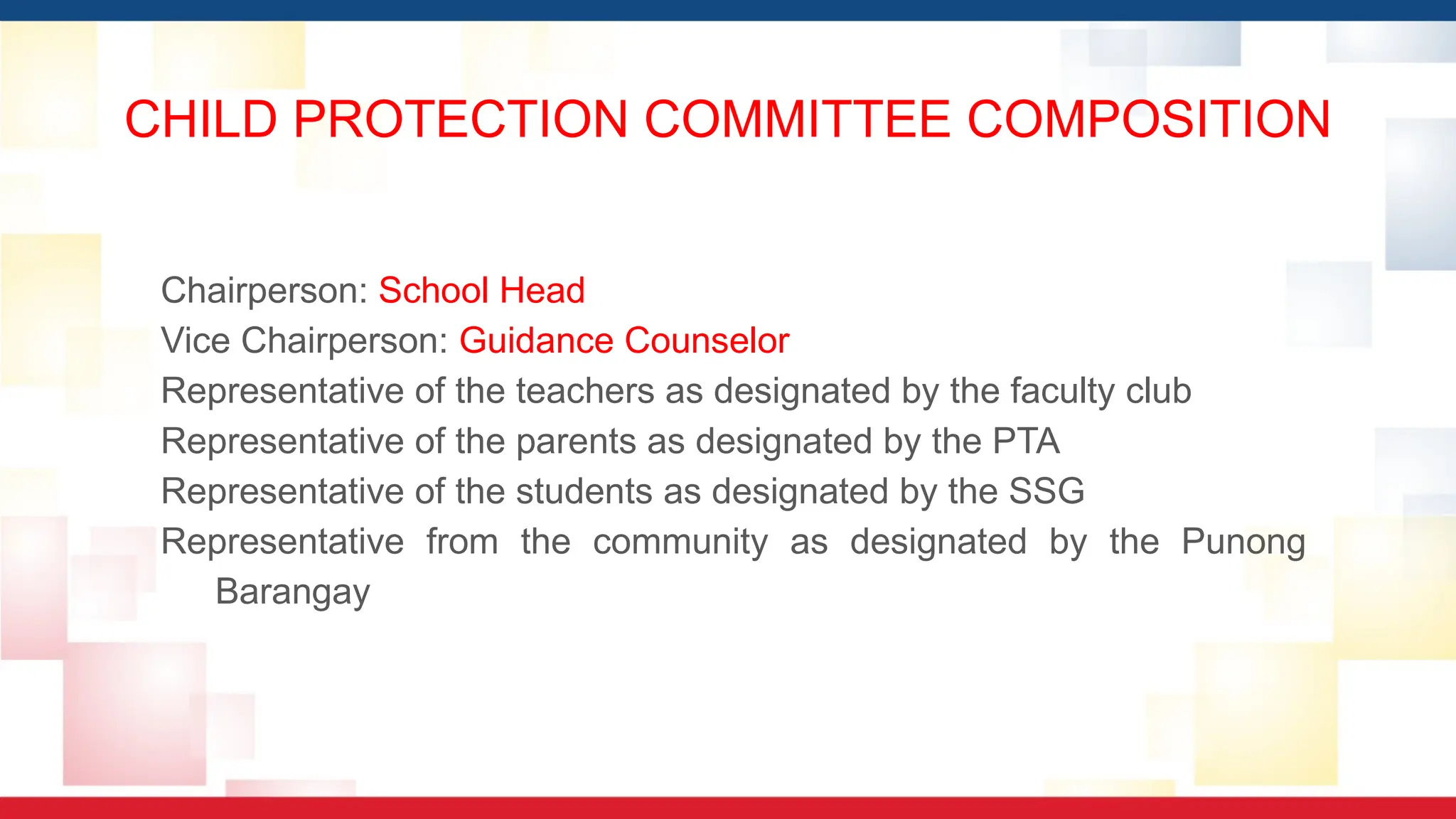
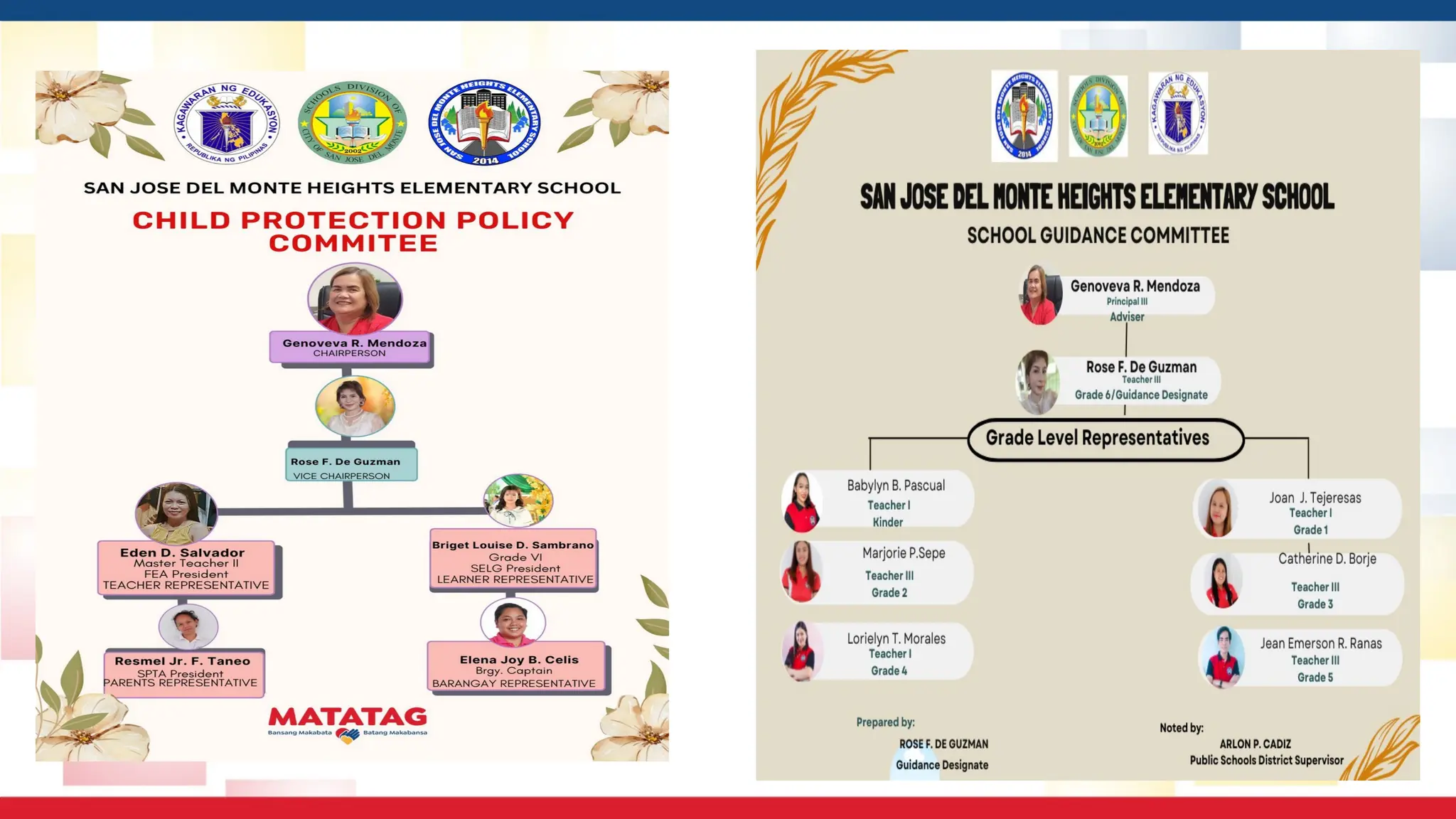
CHILD PROTECTION COMMITTEE COMPOSITION
Chairperson: School Head
Vice Chairperson: Guidance Counselor
Representative of the teachers as designated by the faculty club
Representative of the parents as designated by the PTA
Representative of the students as designated by the SSG
Representative from the community as designated by the Punong
Barangay
Suicide
Awareness and
Prevention
PSA
●HOW COULD YOU TELL IF
A CHILD/PERSON HAS A
SUICIDAL THOUGHT?
Mandates -LAW
● A BILL that aims to set up suicide prevention programs for students at all school levels has been filed
in the House of Representatives, citing the need to recognize and address mental health concerns
among the youth.
● House Bill 2895 or the proposed Student Suicide Prevention Act tasks the Department of
Education (DepEd), the Commission on Higher Education (CHED), and the Technical Education and
Skills Development Authority (TESDA) to establish their respective programs that will help prevent
student suicide incidents.
● The bill was filed by Camarines Sur Reps. Luis Raymund F. Villafuerte Jr., Miguel R. Villafuerte, and
Tsuyoshi Anthony G. Horibata, and BICOL-SARO Party-list Rep. Nicolas C. Enciso VIII.
● REPUBLIC ACT No. 11036
● An Act Establishing a National Mental Health Policy for the Purpose of Enhancing the Delivery of Integrated
Mental Health Services, Promoting and Protecting the Rights of Persons Utilizing Psychosocial Health
Services, Appropriating Funds Therefor and Other Purposes
Prevention & Intervention
● Pay attention to who your students are, not just how
they perform academically
• Notice appearance
• Observe social skills/relationships
• Monitor behavior changes
• Incorporation suicide awareness into your syllabi and
introductions
• Establish (and communicate to your students) that
you are an available resource and support figure
Prevention in the Classroom
School Referral System
-Teacher/adviser
-anecdotal Record/Intake Sheet
-Inform the parent/guardian
-Guidance Office
Intervention with At-Risk Students
● Effective suicide prevention should integrate with supportive mental health services.
● Engage the entire school community in a positive school climate through student behavioral expectations and a caring and
trusting student-adult relationship
● All school staff should know of risk factors and warning signs of suicidal behavior.
● The school should work to create an environment where students feel safe sharing information.
● Trained school counselors and administrators should intervene when a student is a suicide risk.
● They should conduct a risk assessment, inform parents, provide recommendations and referrals to community services, and
often provide follow-up counseling and support at school.
● The school should obtain information from parents on learners' mental health history, family dynamics, recent traumatic events,
and previous suicidal behaviors. Even if a youth is at low risk for suicide, the school should document this relevant information.
● More guidance counselors and mental health experts and assign them to rural or urban areas. It should conduct comprehensive
mental health training for all designated school counselors.
● Suicide is the leading cause of death among school-age youth. However, it is preventable. Parents and teachers are in a crucial
position to pick up on these warning signs and get help before it is too late. The role of school in suicide prevention is significant
and critical for the next generation's survival.
HELP LINE
National Center for Mental Health (NCMH) Crisis Hotlines – 1553 (nationwide and toll-free landline), 0966-351-4518 (Globe/TM),
0917-899-8727 (Globe/TM), or 0908-639-2672 (Smart/Sun/TNT).
• In Touch Community Services Crisis Lines – Contact at (02) 8893-7603 (landline), 0917-800-1123 (Globe subscribers), or
0922-893-8944 (Sun subscribers).
• Philippine Mental Health Association, Inc. – [call and chat] [Call between 7 a.m. to 4 p.m., Mondays to Fridays]
(02) 8921-4958 / (02) 8921-4959; One can send inquiries outside those times using pmhacds@gmail.com or through text:
09175652036. Chat is available 8am-5pm, Monday to Saturday. Facebook PMHA official
• Kapwa MH – [chat] Menu-based chatbot by MentalHealthPH on Twitter. https://twitter.com/kapwamh
• Lunas Collective – [chat] Feminist, inclusive volunteer-powered chat service, rooted in providing a safe and comfortable
online space on issues related to gender-based violence and reproductive health.
https://www.facebook.com/LunasCollective/
• 700 Club Asia – Prayer and counseling services via chat and Skype. Contact their Manila Office through these contact
information: (02) 8737-0700, 1-800-1-888-8700 (toll-free), 0949-889-8138 (Smart), 0943-706-7633 / 0943-145-4815 (Sun),
0917-836-1531 (Globe), Skype: the700clubasia, email (prayforme@cbnasia.org), or Viber (0949-888-8001 – the700clubasia).
• Mood Harmony – Makati Medical Center’s mood disorder support group. (02) 844-2941.
• Dial-a-Friend – (02) 8525-1743 or (02) 8525-1881
PLEDGE WALL
Write one actionable step THAT YOU CAN DO as a teacher to support Child
Protection Policy and suicide prevention.
Examples:
• “I will check in with students showing warning signs.”
1. Which of the following is NOT a sign of
potential child abuse or neglect?
a. Frequent unexplained injuries
b. Sudden changes in behavior
c. Consistently happy and outgoing behavior
d. Difficulty trusting others
2. If a child discloses information about being abused, what is the
first thing you should do?
a. Tell them they should stay quiet about it
b. Reassure them and listen carefully without asking leading
questions
c. Promise to keep it a secret
d. Discuss it with other children to verify the story
3. What is a warning sign that a child may be experiencing
thoughts of suicide?
a. Decline in school performance
b. Giving away valued possessions
c. Increased interest in activities they previously enjoyed
d. Talking about future PLANS
4. Who should you report to if you suspect child abuse?
a. A friend or family member
b. Your local child protective services or designated
authority in your institution
c. The child themselves
d. No one; keep it to yourself
Session 12 - Child Protection Policy and Suicide Awareness.pptx

Session 12 - Child Protection Policy and Suicide Awareness.pptx

  • 1.
    1 Strengthening School-Based Child ProtectionPolicy and Suicide Awareness Rose F. De Guzman Discussant
  • 3.
    1. Which ofthe following is NOT a sign of potential child abuse or neglect? a. Frequent unexplained injuries b. Sudden changes in behavior c. Consistently happy and outgoing behavior d. Difficulty trusting others Choose the letter of the best answer:
  • 4.
    2. If achild discloses information about being abused, what is the first thing you should do? a. Tell them they should stay quiet about it b. Reassure them and listen carefully without asking leading questions c. Promise to keep it a secret d. Discuss it with other children to verify the story
  • 5.
    3. What isa warning sign that a child may be experiencing thoughts of suicide? a. Decline in school performance b. Giving away valued possessions c. Increased interest in activities they previously enjoyed d. Talking about future PLANS
  • 6.
    4. Who shouldyou report to if you suspect child abuse? a. A friend or family member b. Your local child protective services or designated authority in your institution c. The child themselves d. No one; keep it to yourself
  • 7.
    5. If achild expresses thoughts of suicide, which of the following is an appropriate response? a. Tell them they shouldn’t feel that way b. Listen without judgment and refer them to a mental health professional c. Ignore it; they’re probably seeking attention d. Ask them to promise never to talk about it again
  • 9.
    BALLOON ATTACK GAME Group1: Ties balloons around their own ankles with string and then tries to protect these balloons from any attacks Group 2: are the attackers They must try to burst/pop the balloons
  • 10.
    BALLOON ATTACK GAME •Game starts at the count of 123 and ends until the timer ends
  • 11.
    BALLOON GAME Group 1: a.Whatdid you feel when you were trying to protect the balloons? b.What made protecting your balloons easier? What made it harder?” ?”
  • 12.
    BALLOON GAME Group 2: a.Whatmade it easy for you to attack the balloons? b.What made it difficult
  • 13.
    Child Protection Policy Departmentof Education DepEd Order no. 40 series of 2012
  • 14.
    The Department ofEducation Policy on Child Protection Under DEPEd Order no. 40 s. 2012
  • 15.
    MANDATE Art. XV. Sec.3 (b). 1987 Philippines Constitution ● “The state shall defend the right of children to assistance, including proper care and nutrition, and special protection from all forms of neglect, abuse, cruelty, exploitation and other conditions prejudicial to their development. Article XIV, Section 3,(b) ● All educational institution shall inculcate patriotism and nationalism, foster love of humanity respect for human rights..”
  • 16.
    MANDATE The Convention onthe Rights of the Child (CRC) ● Aims to protect children from all forms of physical or mental violence,injury, and abuse neglect or negligent treatment,maltreatment and exploitation including sexual abuse,it is also establishes the right of the child to education,and with a view to achieving this right,it obliges the government to take measures to encourage regular attendance in school and reduce drop-out rates.it is mandated that all appropriate measures be undertaken to ensure that school discipline is administered in a manner consistent with the child’s human dignity. The Department of Education (DepEd) in collaboration with its partners and Stakeholders Ensure that all schools are conducive to the education of children.The best interest of the child shall be the paramount consideration in all decisions and actions involving children. Teachers and learning Facilitator especially in learning centers are their substitute parents,and expected to discharge their functions and duties with this in mind.
  • 17.
    KEEP IN MIND ●The Family code empowers the school,its administrators,and teachers, or the individual, entity or institution engaged in child care to exercise the special parental authority and responsibility over the child, while under their supervision, instruction or custody. The Department reiterates a zero tolerance policy for any act of child abuse,exploitation,violence,di scrimination, bullying and other forms of abuse.
  • 18.
    DEFINITION OF TERMS Child ●Refers to any person below eighteen (18) years of age or those over but are unable to fully take care of themselvesor protect themselves from abuse,neglect,cruelty.for DEPED the term also includes pupils or students who may be eighteen of age or older but are in school. Child Protection Refers to programs,services,procedure s,and structures that are intended to prevent and respond to abuse,neglect,exploitation,dis crimination,and violence.
  • 19.
    Definition of Terms ChildAbuse ● Refers to the maltreatment of a child whether habitual or not. Child Exploitation Refers to the use of children for someone elses advantage.gratification or profit often resulting in an unjust, cruel and harmful treatment of the child.
  • 20.
    Violence against ChildrenCommitted in Schools Physical Violence ● Refers to acts that inflict bodily or physical harm.it includes assigning children to perform tasks which are hazardous to their physical well- being Sexual Violence Refers to acts that are sexual in nature, it includes, but is not limited to :rape,sexual harassment, act of lasciviousness, forcing the child to watch obscene publications and indecent shows,attempting to cause the child to engage in any sexual activity by force.
  • 21.
    Violence against ChildrenCommitted in Schools Psychological Violence ● Refers to acts or omissions causing or likely to cause mental or emotional suffering of the child,intimidation,harassment,stalkin g,damage to property,public ridicule or humiliation,deduction or threat of deduction from grade or merit as a form of punishment and repeated verbal abuse. Corporal Punishment Refers to a kind of punishment or penalty imposed for an alleged or actual offense,which is carried out or inflicted for the purpose of discipline,training or control by a teacher,school administrator, an adult or any other child who has given or has assumed authority or responsibility for punishment.
  • 23.
    CORPORAL PUNISHMENT ● Beating ●Kicking ● Hitting ● Slapping ● Lashing ● With or without the use of instrument like cane,broom,stick,whip or belt Striking of a child’s face or head “NO CONTACT ZONE” Pulling hair Shaking Twisting joint Cutting or piercing skin
  • 24.
    CORPORAL PUNISHMENT ● Dragging ●Pushing or throwing of a child ● Forcing a child to perform physically painful or damaging acts like holding a weight,kneeling on stones,salt, pebbles,or other objects ● Deprivation of a child’s physical needs as a form of punishment Deliberate exposure to fire,ice, water, smoke, sunlight,rain,pepper, alcohol,or forcing a child to swallow substances Tying up a child Confinement, imprisonment or depriving the liberty of a child
  • 25.
    CORPORAL PUNISHMENT ● Verbalabuse or assaults like intimidation or threat of bodily harm, swearing or cursing,ridiculing or denigrating the child. ● Forcing a child to wear a sign, to undress or disrobe or to put on anything that will make a child look or feel foolish which humiliates the child in front of others. Permanent confiscation of personal property of pupils except when such pieces of property pose a danger to the child or to others Other analogous acts( behaviors that are related to or could lead to criminal actions)
  • 26.
    BULLYING President Aquino signedlast Republic Act 10627 or the “Anti-Bullying Act of 2013” last Sept. 6, requiring all elementary and secondary schools to adopt policies to prevent and address bullying in their institutions. The law defines bullying as any severe or repeated use by one or more students of a written, verbal or electronic expression, or a physical act or gesture, or any combination thereof, directed at another student that has the effect of actually causing or placing the latter in reasonable fear of physical or emotional harm or damage to his property; creating a hostile environment at school for the other students. The act of bullying also involves infringing on the rights of other students at school or materially and substantially disrupting the education process or the orderly preparation of a school. Bullying (DepEd Order no. 40 s. 2012) Is committed when a student commits an act or a series of single acts directed towards another student in a school setting or a place of learning which results in physical and mental abuse, harassment, intimidation or humiliation
  • 27.
    Bullying Threats to inflicta wrong upon a person, honor, or property of the person or on his or her family Stalking or constantly following or pursuing a person in his or her daily activities with unwanted and obsessive attention Taking of property Public humiliation, or public and malicious imputation of a crime or of a vice or defects whether real or imaginary Deliberate destruction or damage to the child’s property Physical Violence committed upon a student such as mauling,hitting,punching,kicking,throw ing things at the student pinching, spanking.
  • 28.
    Bullying Demanding or requiringsexual or monetary favors or exacting money or property from a pupil or student Restraining the liberty and freedom of a pupil or student Cyber- bullying Is any conduct defined in the preceding paragraph as resulting in harassment,intimidation, or humiliation, through electronic means or other technology such as texting,email,instant messaging,chatting, internet, social networking websites
  • 29.
    WHAT WILL HAPPENIF WE VIOLATE THIS DEPED ORDER no.40 s. 2012 Teachers/School Authorities ● There is a procedures in handling child abuse first if that is being reported it will undergo Fact Finding Investigation. Note: the identity of a respondent teacher shall be kept confidential Students It is the Child Protection Committee to decide in any abuses by students to another. Like suspension or expulsion depending on the ground of offense.
  • 30.
  • 31.
    A. Expeditious conductof investigation and reporting of cases; B. School Head or the Schools Division Superintendent shall forward the complaint and Intake Sheet within 48 hours to the Disciplining Authority, who shall issue an Order for the conduct of a fact-finding investigation, not later than 72 hours from submission; DepEd-Division Office -LEGAL UNIT
  • 32.
    b.1 Upon receiptof the complaint the School heads shall properly fill-up the INTAKE SHEET-annex B of DepEd Order 40, s. 2012; b.2 Conduct INTERVENTION program to the parties/students. b.3 Intervention made by Guidance Counselor is made in series/programs and to be reported to the Regional Office b.4 If the school have no Guidance Counselor, referred to the nearest school with guidance counselor or to the DSWD; DepEd-Division Office -LEGAL UNIT
  • 33.
    Note: The schoolpersonnel SHOULD NOT BE ALLOWED to settle and investigate child abuse cases in the school without proper authorization; DepEd-Division Office -LEGAL UNIT
  • 34.
    CHILD PROTECTION COMMITTEECOMPOSITION Chairperson: School Head Vice Chairperson: Guidance Counselor Representative of the teachers as designated by the faculty club Representative of the parents as designated by the PTA Representative of the students as designated by the SSG Representative from the community as designated by the Punong Barangay
  • 38.
  • 39.
  • 40.
    ●HOW COULD YOUTELL IF A CHILD/PERSON HAS A SUICIDAL THOUGHT?
  • 46.
    Mandates -LAW ● ABILL that aims to set up suicide prevention programs for students at all school levels has been filed in the House of Representatives, citing the need to recognize and address mental health concerns among the youth. ● House Bill 2895 or the proposed Student Suicide Prevention Act tasks the Department of Education (DepEd), the Commission on Higher Education (CHED), and the Technical Education and Skills Development Authority (TESDA) to establish their respective programs that will help prevent student suicide incidents. ● The bill was filed by Camarines Sur Reps. Luis Raymund F. Villafuerte Jr., Miguel R. Villafuerte, and Tsuyoshi Anthony G. Horibata, and BICOL-SARO Party-list Rep. Nicolas C. Enciso VIII. ● REPUBLIC ACT No. 11036 ● An Act Establishing a National Mental Health Policy for the Purpose of Enhancing the Delivery of Integrated Mental Health Services, Promoting and Protecting the Rights of Persons Utilizing Psychosocial Health Services, Appropriating Funds Therefor and Other Purposes
  • 47.
  • 48.
    ● Pay attentionto who your students are, not just how they perform academically • Notice appearance • Observe social skills/relationships • Monitor behavior changes • Incorporation suicide awareness into your syllabi and introductions • Establish (and communicate to your students) that you are an available resource and support figure Prevention in the Classroom
  • 49.
    School Referral System -Teacher/adviser -anecdotalRecord/Intake Sheet -Inform the parent/guardian -Guidance Office
  • 50.
    Intervention with At-RiskStudents ● Effective suicide prevention should integrate with supportive mental health services. ● Engage the entire school community in a positive school climate through student behavioral expectations and a caring and trusting student-adult relationship ● All school staff should know of risk factors and warning signs of suicidal behavior. ● The school should work to create an environment where students feel safe sharing information. ● Trained school counselors and administrators should intervene when a student is a suicide risk. ● They should conduct a risk assessment, inform parents, provide recommendations and referrals to community services, and often provide follow-up counseling and support at school. ● The school should obtain information from parents on learners' mental health history, family dynamics, recent traumatic events, and previous suicidal behaviors. Even if a youth is at low risk for suicide, the school should document this relevant information. ● More guidance counselors and mental health experts and assign them to rural or urban areas. It should conduct comprehensive mental health training for all designated school counselors. ● Suicide is the leading cause of death among school-age youth. However, it is preventable. Parents and teachers are in a crucial position to pick up on these warning signs and get help before it is too late. The role of school in suicide prevention is significant and critical for the next generation's survival.
  • 51.
    HELP LINE National Centerfor Mental Health (NCMH) Crisis Hotlines – 1553 (nationwide and toll-free landline), 0966-351-4518 (Globe/TM), 0917-899-8727 (Globe/TM), or 0908-639-2672 (Smart/Sun/TNT). • In Touch Community Services Crisis Lines – Contact at (02) 8893-7603 (landline), 0917-800-1123 (Globe subscribers), or 0922-893-8944 (Sun subscribers). • Philippine Mental Health Association, Inc. – [call and chat] [Call between 7 a.m. to 4 p.m., Mondays to Fridays] (02) 8921-4958 / (02) 8921-4959; One can send inquiries outside those times using pmhacds@gmail.com or through text: 09175652036. Chat is available 8am-5pm, Monday to Saturday. Facebook PMHA official • Kapwa MH – [chat] Menu-based chatbot by MentalHealthPH on Twitter. https://twitter.com/kapwamh • Lunas Collective – [chat] Feminist, inclusive volunteer-powered chat service, rooted in providing a safe and comfortable online space on issues related to gender-based violence and reproductive health. https://www.facebook.com/LunasCollective/ • 700 Club Asia – Prayer and counseling services via chat and Skype. Contact their Manila Office through these contact information: (02) 8737-0700, 1-800-1-888-8700 (toll-free), 0949-889-8138 (Smart), 0943-706-7633 / 0943-145-4815 (Sun), 0917-836-1531 (Globe), Skype: the700clubasia, email (prayforme@cbnasia.org), or Viber (0949-888-8001 – the700clubasia). • Mood Harmony – Makati Medical Center’s mood disorder support group. (02) 844-2941. • Dial-a-Friend – (02) 8525-1743 or (02) 8525-1881
  • 52.
    PLEDGE WALL Write oneactionable step THAT YOU CAN DO as a teacher to support Child Protection Policy and suicide prevention. Examples: • “I will check in with students showing warning signs.”
  • 56.
    1. Which ofthe following is NOT a sign of potential child abuse or neglect? a. Frequent unexplained injuries b. Sudden changes in behavior c. Consistently happy and outgoing behavior d. Difficulty trusting others
  • 57.
    2. If achild discloses information about being abused, what is the first thing you should do? a. Tell them they should stay quiet about it b. Reassure them and listen carefully without asking leading questions c. Promise to keep it a secret d. Discuss it with other children to verify the story
  • 58.
    3. What isa warning sign that a child may be experiencing thoughts of suicide? a. Decline in school performance b. Giving away valued possessions c. Increased interest in activities they previously enjoyed d. Talking about future PLANS
  • 59.
    4. Who shouldyou report to if you suspect child abuse? a. A friend or family member b. Your local child protective services or designated authority in your institution c. The child themselves d. No one; keep it to yourself

Editor's Notes

  • #13 RA 7610
  • #16  The Convention applies to every child without discrimination, whatever their ethnicity, sex, religion, language, abilities or any other status, whatever they think or say, whatever their family background. The best interests of the child must be a top priority in all decisions and actions that affect children
  • #39 death caused by self-directed injurious behavior with intent to die as a result of the behavior. 
  • #46 Effective suicide prevention should integrate with supportive mental health services. It should engage the entire school community in a positive school climate through student behavioral expectations and a caring and trusting student-adult relationship. All school staff should know of risk factors and warning signs of suicidal behavior. The school should work to create an environment where students feel safe sharing information. Trained school counselors and administrators should intervene when a student is a suicide risk. They should conduct a risk assessment, inform parents, provide recommendations and referrals to community services, and often provide follow-up counseling and support at school. The school should obtain information from parents on learners' mental health history, family dynamics, recent traumatic events, and previous suicidal behaviors. Even if a youth is at low risk for suicide, the school should document this relevant information. It is about time the Department of Education should hire more guidance counselors and mental health experts and assign them to rural or urban areas. It should conduct comprehensive mental health training for all designated school counselors. Suicide is the leading cause of death among school-age youth. However, it is preventable. Parents and teachers are in a crucial position to pick up on these warning signs and get help before it is too late. The role of school in suicide prevention is significant and critical for the next generation's survival. Be The First To React How Do You Feel About This Article?
  • #52 Trace your Right hand to the bond paper Write one actionable step THAT YOU CAN DO as a teacher to support Child Protection Policy and suicide prevention.