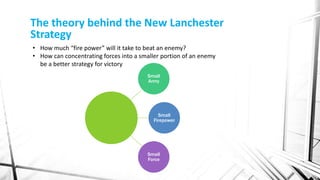
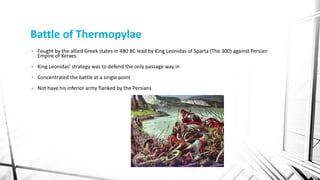
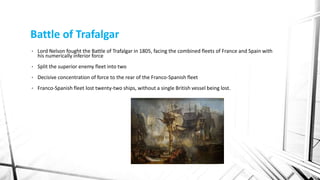
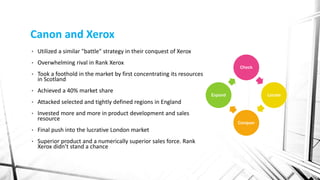
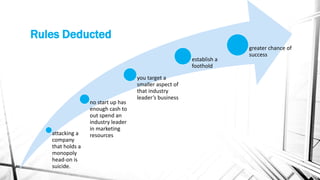
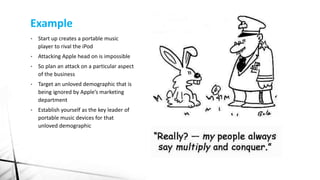
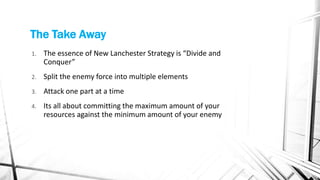
The document discusses the New Lanchester Strategy, which involves concentrating forces to defeat a larger enemy. It takes its name from Fred Lanchester, who observed that a smaller army with a 2:1 disadvantage in size would have firepower quadrupled against it. The strategy is to concentrate forces against parts of the enemy sequentially rather than facing the whole directly. Examples like Canon defeating Xerox and ancient battles like Thermopylae are discussed, showing how concentrating against weak points can defeat a numerically superior force. The key is dividing the enemy and focusing all resources on sub-elements one at a time.








![New Approach To Consumer Theory[1]](https://cdn.slidesharecdn.com/ss_thumbnails/new-approach-to-consumer-theory1-1224060992494169-8-thumbnail.jpg?width=640&height=640&fit=bounds)


