LEARNING OUTCOME
•List thegeneral functions of the
nervous system.
•Identify the major parts of nervous
system (peripheral and central NS),
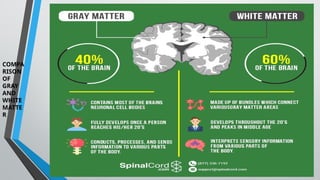
gray and white matter functions
•Explain the senses and its
functions
NERVOUS SYSTEM
• thebody's intricate communication network, comprising
the central nervous system (CNS) (brain and spinal cord)
and the peripheral nervous system (PNS) (nerves
extending throughout the body).
• It uses specialized cells called neurons to transmit
electrochemical signals, allowing the brain to send
messages to the body and receive sensory information
from it. The nervous system controls all body functions,
from thoughts, feelings, and movement to basic life
processes like breathing, heart rate, digestion, and even
the sense of touch, sight, hearing, taste, and smell.
9.
NEURONS
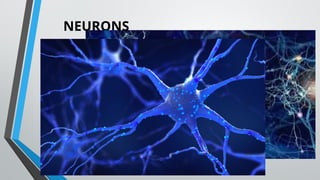
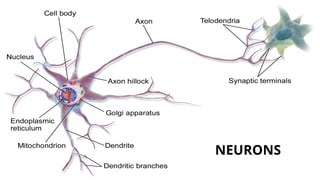
• the specializedcells of the brain and
nervous system that transmit information
through electrical and chemical
signals. They are the basic units that allow
us to move, feel, think, and remember. Each
neuron typically consists of a cell body
(soma), dendrites that receive signals, and
an axon that sends signals.
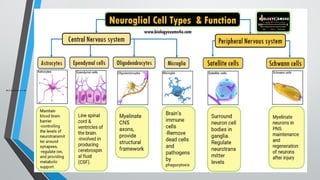
NEUROGLIA
•The supportive cellsof the nervous system,
neuroglia are also called glial cells (meaning
holds neurons together). The four types of
neuroglia exist. Astroglia or Astrocytes,
Ependymal Cells (choroid plexuses),
Microglia and Oligodendroglia
CENTRAL NERVOUS SYSTEM
•thebody's main control center, consisting of
the brain and spinal cord. It receives and
processes sensory information, then sends
out signals that direct all voluntary actions
(like walking) and involuntary functions (like
breathing and heart rate
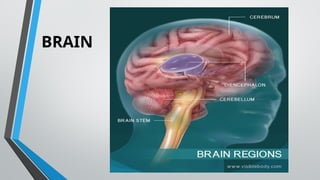
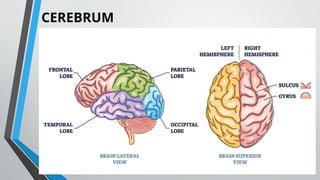
CEREBRUM
The largest partof the brain, split into two hemispheres that
specialize in different functions. Its outer layer, the cerebral
cortex (or gray matter), is responsible for higher-level
functions.
• Frontal lobe: Manages planning, reasoning, complex
thought, problem-solving, and voluntary movement.
• Parietal lobe: Processes sensory input from touch,
temperature, and pain.
• Temporal lobe: Responsible for hearing, speech
comprehension, and memory formation.
• Occipital lobe: Processes visual information from the eyes.
CEREBRUM
The largest partof the brain, split into two hemispheres that
specialize in different functions. Its outer layer, the cerebral cortex
(or gray matter), is responsible for higher-level functions.
• Frontal Lobe: Manages planning, reasoning, complex thought,
problem-solving, and voluntary movement.
• Parietal Lobe: Processes sensory input from touch,
temperature, and pain.
• Temporal Lobe: Responsible for hearing, speech
comprehension, and memory formation.
• Occipital Lobe: Processes visual information from the eyes.
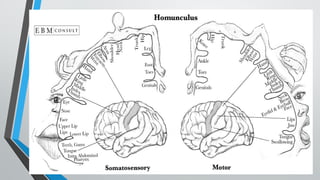
• Somatotope (somatosensory) / Motor Cortex:
• Internal Capsule
20.
CORPUS CALLOSUM
a thickband of nerve fibers that connects the left
and right hemispheres of the brain, enabling
communication and coordination between them.
As the largest white matter structure in the brain, it
consists of over 200 million myelinated nerve fibers
21.
CEREBELLUM
Latin for "littlebrain," is a fist-sized structure located
at the back of the head, beneath the temporal and
occipital lobes and above the brainstem. It is a
critical component of the nervous system,
responsible for coordinating voluntary movements,
maintaining balance, and facilitating motor learning
22.
HYPOTHALAMUS
a small, almond-sizedstructure located deep in the brain
that acts as the main link between the nervous system
and the endocrine system. It serves as the body's "smart
control" center, constantly monitoring and maintaining a
stable internal environment, a process known as
homeostasis. It accomplishes this by managing both the
autonomic nervous system and the release of hormones.
23.
THALAMUS
an egg-shaped structuredeep in the center of the
brain that acts as a crucial relay station for sensory
and motor information, sending it to the cerebral
cortex for further processing. It plays vital roles in
consciousness, alertness, sleep regulation, and
memory. Composed of various nuclei, each with
specific functions, the thalamus processes
information from all senses (except smell) before it
reaches the brain's outer layer, the cortex.
24.
LIMBIC SYSTEM
a groupof structures in your brain that regulate
your emotions, behavior, motivation and memory.
While small in size, your limbic system has a big job
to help you interact with the world around you
25.
BRAIN STEM
a stalk-likestructure at the base of the brain that
connects the cerebrum and cerebellum to the spinal
cord. It consists of the midbrain, pons, and medulla
oblongata, and is responsible for regulating vital
functions like breathing, heart rate, blood pressure, and
consciousness. The brainstem also contains nerve cell
bodies and white matter tracts that transmit signals
between different parts of the central nervous system
and house the nuclei of ten of the twelve cranial nerves
26.
BRAIN STEM
• Midbrain:The top section, involved in vision, hearing, motor
control, sleep-wake cycles, and temperature regulation. It contains
the substantia nigra, which is affected in Parkinson's disease.
• Pons: The middle section that relays signals between different
parts of the brain and spinal cord. It helps coordinate facial
movements, sensations, eye movements, balance, and posture.
• Medulla oblongata: The bottom section connected to the spinal
cord. It is critical for survival, regulating heart rhythm, breathing,
and blood pressure. It also controls reflexes like coughing,
sneezing, and swallowing
27.
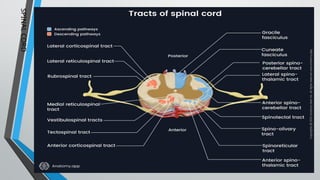
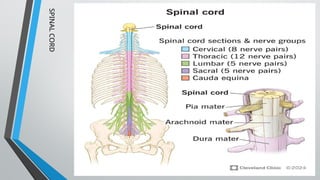
SPINAL CORD
•a bundleof nerves and tissue that extends from
the brainstem to the lower back, serving as the
central "information superhighway" of the body.
As part of the central nervous system (CNS), it
relays signals between the brain and the rest of
the body to control movement, sensation, and
automatic functions.
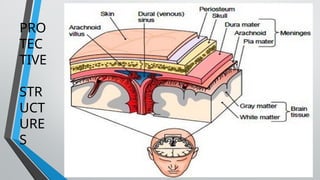
PROTECTIVE STRUCTURES
•a seriesof structures, including the skull, the
meninges, the cerebrospinal fluid (CSF), and the
blood-brain barrier. These layers work together to
provide physical cushioning and regulate the
internal environment of the brain.