cmaximino@unifesspa.edu.br
The nervous system: an evolutionary
approach
Prof. Dr. Caio Maximino
cmaximino@unifesspa.edu.br
Program
●
Common misconceptions of brain evolution
●
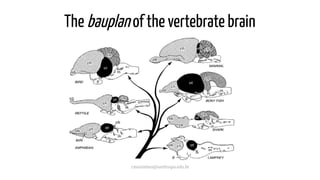
The bauplan of the vertebrate brain
●
Late equals large
●
Conservation of function vs. structure
cmaximino@unifesspa.edu.br
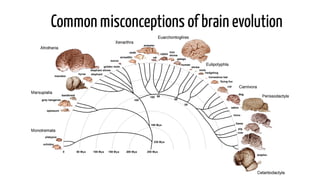
Common misconceptions of brain evolution
●
Brain evolution is linear – from simple, puny fish
brains to the mighty and complex brains of
humans
cmaximino@unifesspa.edu.br
Common misconceptions of brain evolution
cmaximino@unifesspa.edu.br
Common misconceptions of brain evolution
●
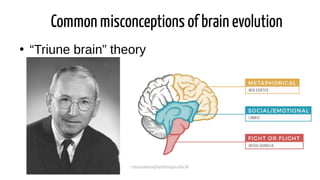
“Triune brain” theory
cmaximino@unifesspa.edu.br
“New wave reductionism” and evolutionary biology
●
“the molecular mechanisms of any psychological kind that is
causally efficacious and confers fitness on its possessors
must engage the functionally constrained regions of
"housekeeping" proteins involved in basic cellular
metabolism. And as we just saw, these are the regions of
biological molecules that evolve the slowest. Thus we should
expect cellular and molecular neuroscience to find common
molecular mechanisms across existing species that share
psychological processes.” (Bickle, 2003)
cmaximino@unifesspa.edu.br
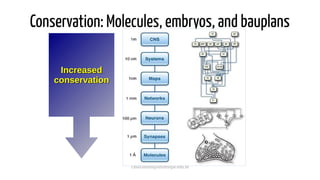
Conservation: Molecules, embryos, and bauplans
Increased
Increased
conservation
conservation
cmaximino@unifesspa.edu.br
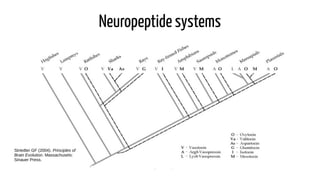
Neuropeptide systems
Striedter GF (2004). Principles of
Brain Evolution. Massachusets:
Sinauer Press.
cmaximino@unifesspa.edu.br
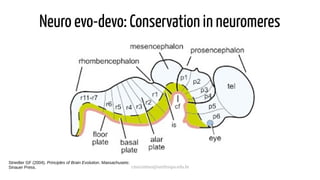
Neuro evo-devo: Conservation in neuromeres
Striedter GF (2004). Principles of Brain Evolution. Massachusets:
Sinauer Press.
cmaximino@unifesspa.edu.br
The bauplan of the vertebrate brain
cmaximino@unifesspa.edu.br
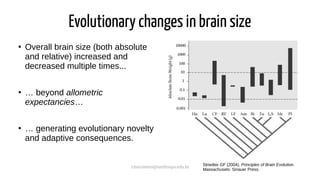
Evolutionary changes in brain size
●
Overall brain size (both absolute
and relative) increased and
decreased multiple times...
●
… beyond allometric
expectancies…
●
… generating evolutionary novelty
and adaptive consequences.
Striedter GF (2004). Principles of Brain Evolution.
Massachusets: Sinauer Press.
cmaximino@unifesspa.edu.br
Adaptive consequences of brain size evolution
●
Changes in the number of neurons and non-neural
cells
●
Changes in modularity
●
Changes in connectivity in local systems
cmaximino@unifesspa.edu.br
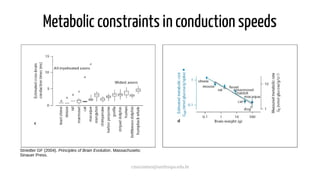
Metabolic constraints in conduction speeds
Striedter GF (2004). Principles of Brain Evolution. Massachusets:
Sinauer Press.
cmaximino@unifesspa.edu.br
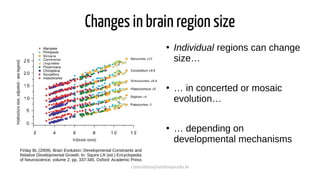
Changes in brain region size
●
Individual regions can change
size…
●
… in concerted or mosaic
evolution…
●
… depending on
developmental mechanisms
Finlay BL (2009). Brain Evolution: Developmental Constraints and
Relative Developmental Growth. In: Squire LR (ed.) Encyclopedia
of Neuroscience, volume 2, pp. 337-345. Oxford: Academic Press
cmaximino@unifesspa.edu.br
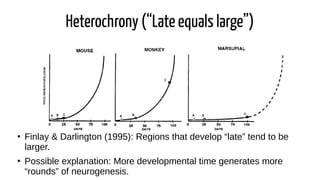
Heterochrony (“Late equals large”)
●
Finlay & Darlington (1995): Regions that develop “late” tend to be
larger.
●
Possible explanation: More developmental time generates more
“rounds” of neurogenesis.
cmaximino@unifesspa.edu.br
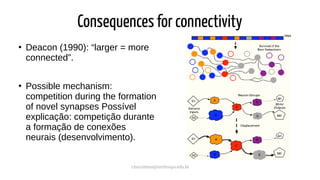
Consequences for connectivity
●
Deacon (1990): “larger = more
connected”.
●
Possible mechanism:
competition during the formation
of novel synapses Possível
explicação: competição durante
a formação de conexões
neurais (desenvolvimento).
cmaximino@unifesspa.edu.br
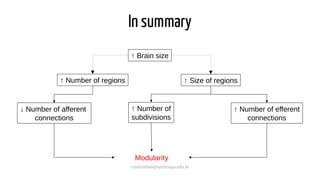
In summary
↑ Number of
subdivisions
↑ Number of efferent
connections
↑ Brain size
↑ Number of regions ↑ Size of regions
Modularity
↓ Number of afferent
connections
cmaximino@unifesspa.edu.br
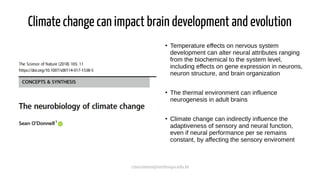
Climate change can impact brain development and evolution
●
Temperature effects on nervous system
development can alter neural attributes ranging
from the biochemical to the system level,
including effects on gene expression in neurons,
neuron structure, and brain organization
●
The thermal environment can influence
neurogenesis in adult brains
●
Climate change can indirectly influence the
adaptiveness of sensory and neural function,
even if neural performance per se remains
constant, by affecting the sensory enviroment

The nervous system: an evolutionary approach