Vertebrate stress mechanisms under
change
Prof. Dr. Caio Maximino
Program
●
Definitions of stress
●
The HP(A/I) axis
●
GCs and its effects
●
Central control
“Stress” is a polysemic concept
●
Selye (1950); non-specific response of the body to any noxious stimulus
●
Stressor X stress response
– Chrousos (2009): A stressor is any stimulus that threatens homeostasis → circular definition
– Armario (2006): many studies interpret the presence of a stress response as an indicator of stress exposure,
without an independent definition of either the stressor or the stress response
●
Levine and Ursin (1991): stress should be considered as a process that includes the stimulus, the
perceptual processing of this input, and the behavioral and physiological outputs
●
Adaptive X maldaptive
– Selye (1976): eustress X distress
Koolhaas JM, de Boer SF, Ruiter AJH, Meerlo P,
Sgoifo A (1997). Social stress in rats and mice. Acta
Physiologica Scandinavica 161: 9-72
Characteristics of stressors
●
Controllability and predictability
– Weiss (1972): it is not the physical nature of an aversive stimulus that induces
stress, but rather the degree in which the stimulus can be predicted and controlled
– Salvador (2005): perceived, not actual, control
●
Frequency (e.g., acute vs. repeated vs. chronic) – can be related to
predictability
●
Intensity
Characteristics of stressors
Koolhaas et al. (2011). Stress revisited: A critical evaluation of the stress
concept. Neuroscience & Biobehavioral Reviews 35: 1291-1301
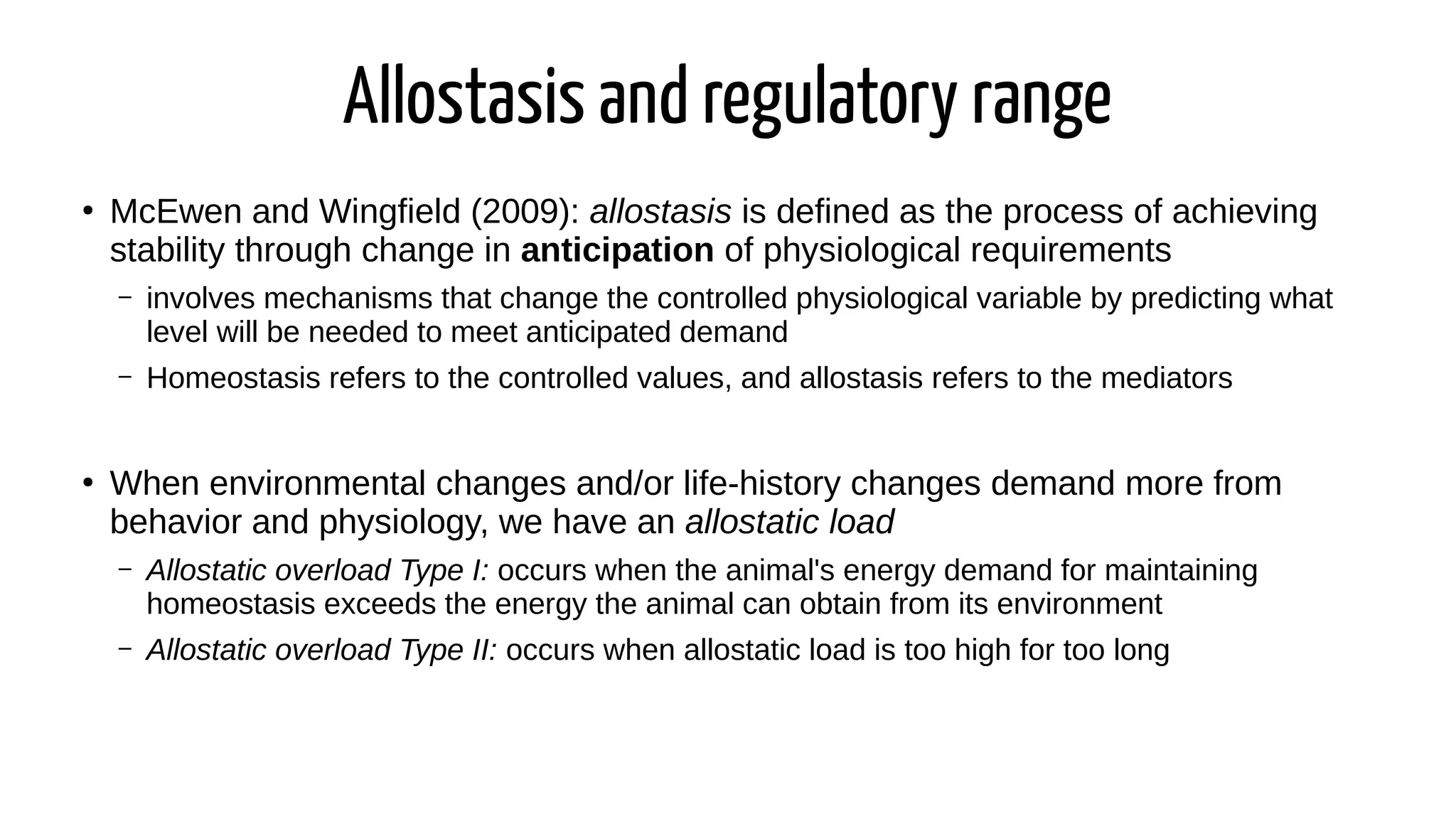
Allostasis and regulatory range
●
McEwen and Wingfield (2009): allostasis is defined as the process of achieving
stability through change in anticipation of physiological requirements
– involves mechanisms that change the controlled physiological variable by predicting what
level will be needed to meet anticipated demand
– Homeostasis refers to the controlled values, and allostasis refers to the mediators
●
When environmental changes and/or life-history changes demand more from
behavior and physiology, we have an allostatic load
– Allostatic overload Type I: occurs when the animal's energy demand for maintaining
homeostasis exceeds the energy the animal can obtain from its environment
– Allostatic overload Type II: occurs when allostatic load is too high for too long
The reactive scope model
Romero LM, Dickens MJ & Cyr NE (2009). The reactive scope model — A
new model integrating homeostasis, allostasis, and stress. Horm. Behav. 55:
375–389
HP(A/I) axis
Steenbergen PJ, Richardson MK, Champagne DL (2011). The use of the
zebrafish model in stress research. Prog. Neuro-Psychopharmacol. Biol.
Psychiatry 35: 1432-1451
Comparative issues
Bouyoucos IA, Schoen AN, Wahl RC, Anderson G (2021). Ancient fishes
and the functional evolution of the corticosteroid stress response in
vertebrates. Comp. Biochem. Physiol A 260: 111024
Despite differences, function is conserved
Bouyoucos IA, Schoen AN, Wahl RC, Anderson G (2021). Ancient fishes and the functional
evolution of the corticosteroid stress response in vertebrates. Comp. Biochem. Physiol A 260:
111024
GC act by genomic and nongenomic mechanisms
GCs act by genomic and nongenomic mechanisms
Le PP, Friedman JR, Schug J, Brestelli JE, Parker JB, et al. (2005)
Glucocorticoid receptor-dependent gene regulatory networks. PLoS
Genet 1(2): e16.
Borski RJ (2000). Nongenomic Membrane Actions of
Glucocorticoids in Vertebrates. Trends Endocrinol Metabol 11:
P427-436
Koepsell, H. (2021). General Overview of Organic Cation
Transporters in Brain. In: Daws, L.C. (eds) Organic Cation
Transporters in the Central Nervous System. Handbook of
Experimental Pharmacology, vol 266. Springer
Maximino, C. (2021). Decynium-22 affects behavior in the
zebrafish light/dark test. Neuroanatomy and Behaviour, 3, e21
Gould GG, Barba-Escobedo PA, Horton RE and Daws LC (2022) High Affinity Decynium
22 Binding to Brain Membrane Homogenates and Reduced Dorsal Camouflaging after
Acute Exposure to it in Zebrafish. Front. Pharmacol. 13:841423
Actions of GCs
●
Permissive: exerted by GCs present before the stressor; prime the defense
mechanisms by which an organism responds to stress
●
Suppressive: inhibitory effects attributable to the stress-induced rise in GC
concentrations; prevent overshoot
●
Stimulating: excitatory effects attributable to stress-induced rise in GC concentrations
●
Preparative: do not affect the immediate response to a stressor, but modulate the
organism’s response to a subsequent stressor.
Impacts of the capitalocene on stress axes
●
Musa et al. (2017): Tilapias acclimated to high water temperatures for 14 d showed higher cortisol levels at 1, 7,
and 14 d; and much higher 11-ß-hydroxylase activity at 14 d
●
Leishman et al. (2022): Higher fecal cortisol metabolite concentration in adult polar bears in the wild or in zoos
with temperatures above 20 ºC
●
Petochi et al. (2011): CO2 exposure (“ocean acidification”) can increase plasma cortisol levels on acute
exposures, but not chronic exposure
●
Bisson & Hontela (2002): Agrichemicals inhibit cortisol secretion in steroidogenic cells of rainbow trout (in vitro)
●
Cericato et al. (2008): Jundiás exposed to sub-lethal concentrations of agrichemicals show blunted GC
secretion after acute stress

Vertebrate stress mechanisms under change

  • 1.
    Vertebrate stress mechanismsunder change Prof. Dr. Caio Maximino
  • 2.
    Program ● Definitions of stress ● TheHP(A/I) axis ● GCs and its effects ● Central control
  • 3.
    “Stress” is apolysemic concept ● Selye (1950); non-specific response of the body to any noxious stimulus ● Stressor X stress response – Chrousos (2009): A stressor is any stimulus that threatens homeostasis → circular definition – Armario (2006): many studies interpret the presence of a stress response as an indicator of stress exposure, without an independent definition of either the stressor or the stress response ● Levine and Ursin (1991): stress should be considered as a process that includes the stimulus, the perceptual processing of this input, and the behavioral and physiological outputs ● Adaptive X maldaptive – Selye (1976): eustress X distress
  • 4.
    Koolhaas JM, deBoer SF, Ruiter AJH, Meerlo P, Sgoifo A (1997). Social stress in rats and mice. Acta Physiologica Scandinavica 161: 9-72
  • 5.
    Characteristics of stressors ● Controllabilityand predictability – Weiss (1972): it is not the physical nature of an aversive stimulus that induces stress, but rather the degree in which the stimulus can be predicted and controlled – Salvador (2005): perceived, not actual, control ● Frequency (e.g., acute vs. repeated vs. chronic) – can be related to predictability ● Intensity
  • 6.
    Characteristics of stressors Koolhaaset al. (2011). Stress revisited: A critical evaluation of the stress concept. Neuroscience & Biobehavioral Reviews 35: 1291-1301
  • 7.
    Allostasis and regulatoryrange ● McEwen and Wingfield (2009): allostasis is defined as the process of achieving stability through change in anticipation of physiological requirements – involves mechanisms that change the controlled physiological variable by predicting what level will be needed to meet anticipated demand – Homeostasis refers to the controlled values, and allostasis refers to the mediators ● When environmental changes and/or life-history changes demand more from behavior and physiology, we have an allostatic load – Allostatic overload Type I: occurs when the animal's energy demand for maintaining homeostasis exceeds the energy the animal can obtain from its environment – Allostatic overload Type II: occurs when allostatic load is too high for too long
  • 8.
    The reactive scopemodel Romero LM, Dickens MJ & Cyr NE (2009). The reactive scope model — A new model integrating homeostasis, allostasis, and stress. Horm. Behav. 55: 375–389
  • 10.
    HP(A/I) axis Steenbergen PJ,Richardson MK, Champagne DL (2011). The use of the zebrafish model in stress research. Prog. Neuro-Psychopharmacol. Biol. Psychiatry 35: 1432-1451
  • 11.
    Comparative issues Bouyoucos IA,Schoen AN, Wahl RC, Anderson G (2021). Ancient fishes and the functional evolution of the corticosteroid stress response in vertebrates. Comp. Biochem. Physiol A 260: 111024
  • 12.
    Despite differences, functionis conserved Bouyoucos IA, Schoen AN, Wahl RC, Anderson G (2021). Ancient fishes and the functional evolution of the corticosteroid stress response in vertebrates. Comp. Biochem. Physiol A 260: 111024
  • 13.
    GC act bygenomic and nongenomic mechanisms
  • 14.
    GCs act bygenomic and nongenomic mechanisms Le PP, Friedman JR, Schug J, Brestelli JE, Parker JB, et al. (2005) Glucocorticoid receptor-dependent gene regulatory networks. PLoS Genet 1(2): e16.
  • 15.
    Borski RJ (2000).Nongenomic Membrane Actions of Glucocorticoids in Vertebrates. Trends Endocrinol Metabol 11: P427-436
  • 16.
    Koepsell, H. (2021).General Overview of Organic Cation Transporters in Brain. In: Daws, L.C. (eds) Organic Cation Transporters in the Central Nervous System. Handbook of Experimental Pharmacology, vol 266. Springer Maximino, C. (2021). Decynium-22 affects behavior in the zebrafish light/dark test. Neuroanatomy and Behaviour, 3, e21 Gould GG, Barba-Escobedo PA, Horton RE and Daws LC (2022) High Affinity Decynium 22 Binding to Brain Membrane Homogenates and Reduced Dorsal Camouflaging after Acute Exposure to it in Zebrafish. Front. Pharmacol. 13:841423
  • 18.
    Actions of GCs ● Permissive:exerted by GCs present before the stressor; prime the defense mechanisms by which an organism responds to stress ● Suppressive: inhibitory effects attributable to the stress-induced rise in GC concentrations; prevent overshoot ● Stimulating: excitatory effects attributable to stress-induced rise in GC concentrations ● Preparative: do not affect the immediate response to a stressor, but modulate the organism’s response to a subsequent stressor.
  • 20.
    Impacts of thecapitalocene on stress axes ● Musa et al. (2017): Tilapias acclimated to high water temperatures for 14 d showed higher cortisol levels at 1, 7, and 14 d; and much higher 11-ß-hydroxylase activity at 14 d ● Leishman et al. (2022): Higher fecal cortisol metabolite concentration in adult polar bears in the wild or in zoos with temperatures above 20 ºC ● Petochi et al. (2011): CO2 exposure (“ocean acidification”) can increase plasma cortisol levels on acute exposures, but not chronic exposure ● Bisson & Hontela (2002): Agrichemicals inhibit cortisol secretion in steroidogenic cells of rainbow trout (in vitro) ● Cericato et al. (2008): Jundiás exposed to sub-lethal concentrations of agrichemicals show blunted GC secretion after acute stress