TAMSA PANDYA, RESEARCH SCHOLAR, MKBU
THE MONKEY’S
PAW- W.W.JACOBS
About the play
 "The Monkey's Paw" is a supernatural short story by author "W.W.Jacobs" first published in
England in 1902.

In the story, three wishes are granted to the owner of the Monkey's hand , but the wishes come
with an enormous price for interfering with fate.

"The Monkey’s Paw” is W.W. Jacob 's most famous story. It is considered to be a classic of horror
fiction. The story opens with the White family spending a cozy evening together around the hearth.
An old friend of Mr. White’s comes to visit them. Sergeant-Major Morris came home after more
than twenty years in India. He entertains his hosts with exotic stories of life abroad. He also sells
to Mr. White a mummified monkey’s paw. Jacobs uses foreshadowing, imagery and symbolism in
this story to explore the consequences of tempting fate.
The tittle: What’s “paw”
1) The foot of any animal having
Claws
2) The human hand especially one
that is large, rough oe clumsy
MR. WHITE MRS. WHITE
THE SERGEANT -
MAJOR
HERBERT
01. 02.
03. 04.
Characters
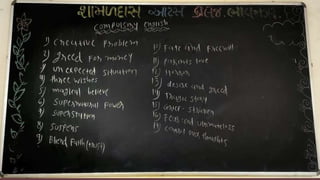
● NAMES
● WAR
● A MONKEY’S PAW
● THREE WISHES
● A SPELL
● INDIA
● A MONEY BAG
● THE NUMBER 3
IMAGES AND SYMBOLS USED….
THEMES OF THE PLAY
The Danger of Wishing
1. The downfall comes as the result of wishing for more than what they
actually needed. Even though Mr. White feels content with his life—he has a
happy family, a comfortable home, and plenty of love—he nevertheless uses
the monkey’s paw to wish for money that he doesn’t really need. As Jacobs
suggests, making one seemingly harmless wish only intensifies and
magnifies desire as each subsequent wish becomes more outlandish.
Unchecked greed, therefore, only leads to unhappiness, no matter how much
more one asks for. Intense desire also often leads to unfulfilled expectations
or unintended consequences as with Herbert’s unexpected death and rise
from the grave as a living corpse. Put simply, Jacobs is reminding readers to
be careful what they wish for because it may just come true.
● The Whites’ house is full of symbols of happy domesticity: a piano, knitting, a copper
kettle, a chessboard, a fireplace, and a breakfast table. But the Whites repeatedly
invite trouble into this cozy world. Sergeant-Major Morris disrupts the tranquility in
the Whites’ home with his stories of India and magic and warnings of evil. He gives
Mr. White the monkey’s paw, the ultimate token of the dangerous outside world. Mr.
and Mrs. Mr. White’s terrified reaction to his dead son’s desire for entrance suggests
not just his horror at the prospect of an animated corpse, but his understanding, won
from experience, that any person coming from the outside should be treated as a
dangerous threat to the sanctity of the home.
The Clash between Domesticity and the
Outside World
For more themes click on the word
monkey’s paw themes, it is hyperlinked
here
Monkey’s paw themes
SYMBOLS
The Monkey’s Paw
1. The monkey’s paw is a symbol of desire and greed—everything that its owner could
possibly wish for and the unrestricted ability to make it happen. This power makes the
paw alluring, even to unselfish people who desire nothing and have everything they
need. Mr. White, for example, hastily retrieves the paw from the fire, even though he
himself admits that he wouldn’t know what to wish for if he owned the paw. The paw
grants Mr. White’s wishes by killing Herbert and raising his corpse from the grave in
an unexpected and highly sinister twist. At the same time, however, the paw’s
omnipotent power may be misperceived, because Herbert’s death may have been
entirely coincidental and the knocks on the door may be from someone other than his
living corpse.
● Chess symbolizes life in “The Monkey’s Paw.” Those who play a daring,
risky game of chess, for example, will lose, just as those who take
unnecessary risks in life will die. When the story opens, Mr. White and
Herbert play chess by the fire, and the game’s outcome mirrors the
story’s outcome. Mr. White, the narrator explains, has a theory of
“radical changes” concerning chess. He takes terrible, unnecessary risks
with his king, risks that make his wife nervous as she watches the game
unfold. As he plays, he notices that he has made a mistake that will prove
deadly. The risks and mistakes Mr. White makes playing chess parallel
the risks and mistakes he makes wishing on the monkey’s paw. These
mistakes ultimately lead to Herbert’s death, the most “radical change” of
all.
Chess
MONKEY’S PAW – A CLASSIC HORROR PIECE
1. More than a classic horror piece, “The Monkey’s Paw” is also a modern
parable, infused with moral messages and instructions on how to live a more
fulfilling life. As with all fables, the story’s morals are familiar: don’t tempt
fate, and be careful what you wish for. The White family isn’t wealthy, but
they still have everything that’s important, including love, happiness, and a
comfortable life. Mr. White even says that he is so content that he wouldn’t
even know what to wish for. When he does make his first wish—partly in
jest, partly out of curiosity—it is not for untold riches or worldly power, but
merely for enough money to finally purchase their house. His small and
sensible wish, however, is enough to tempt fate into killing Herbert. Jacobs’s
story adheres to the traditional belief that we do not really want what we
think we want and that wanting more than what’s sufficient may bring ruin.
 Mr. White is an old man who is tempted to alter fate and who suffers dire consequences as a
(possible) result. Jacobs characterizes Mr. White as a man who cannot accept his own fate,
whether it’s a chess game he knows he is going to lose because of a reckless move or his quiet
life in a remote part of Britain compared to his friend Morris’s exciting adventures in India.
At the beginning of the story, Mr. White lives a cozy, domestic life with his wife, Mrs. White,
and his son, Herbert, who amusedly accept his father’s frustrated outbursts over his fate.
 By the climax of the story, Mr. White himself seems to fully learn the consequences of
tempting fate, as he fears that after wishing his son back alive, a mangled corpse will come to
their home. Yet Mr. White’s relationship to reality is dubious throughout the story. He claims
he sees the paw move on its own, but no other character verifies this. The tragedies that befall
him could be a direct result of his wishing on the paw, but they could also just be coincidences
that he subscribes supernatural meaning to because of his belief in fate-altering magic. Mr.
White’s opaque, shifting relationship to reality shows the troubled state of mind one enters
when they attempt to change destiny through supernatural.
Mr. White
Mrs. White
 Herbert’s mother and Mr. White’s wife. Mrs. White is an intelligent and passionate woman. She
shares her husband’s and son’s fascination with Sergeant-Major Morris’s stories and questions him
just as eagerly as they do. She is lovingly attentive to her husband and son, although she also
enjoys teasing them. Herbert’s death traumatizes Mrs. White, and she forces Mr. White to wish
Herbert back to life.
 Mrs. White also undergo an upsetting change, transforming from a happy couple into parents
racked by grief. During the sergeant-major’s visit, Mrs. White is as eager as Herbert and Mr. White
are to hear the tales of his exploits abroad. She is more willing to consider the truth of the monkey-
paw story than Herbert is, but she is far less credulous than her husband. Indeed, she often shows
herself to be more quick-witted than Mr. White. For example, she understands the significance of
the Maw and Meggins representative’s visit before her husband does, and she is the one to suggest
wishing on the monkey’s paw a second time to bring Herbert back to life. The death of her son and
the belief that it might have been prevented nearly drive Mrs. White insane. Her transformation is
far less dramatic than her son’s, but she still changes from an intelligent, self-possessed woman
into a raving, shrieking, weeping mourner.
● The son of Mr. and Mrs. White. Herbert is an irreverent, affectionate, and loyal young man and the only
surviving child of the Whites. He works in an unidentified capacity with heavy machinery at a company
called Maws and Meggins. It is possible, although not certain, that Mr. White’s second wish reanimates
Herbert as a terrifying corpse.
● The possible transformation of Herbert White from a gentle, happy, and devoted young man into a
threatening monster is the central horror of “The Monkey’s Paw.” A thoughtful and loving son, Herbert
plays chess with his father and gently teases his mother. He is the only member of the family who works,
so readers can assume that he supports his parents in their old age. Herbert believes that Sergeant-Major
Morris’s stories are nothing but a pack of tall tales and treats the monkey’s paw with irreverent humor. He
encourages his father to wish for an emperorship and then jokingly suggests he wish for two hundred
pounds to pay off the mortgage. Herbert does not believe for a moment that the paw is magical, but he
unwittingly predicts the outcome of the wish when he tells his parents that he knows he’ll never see the
money. The sunny, skeptical quality of Herbert’s nature makes his eventual transformation, induced by
his father’s wish, more horrifying. Mr. White fears that his son has become a horribly mangled, evil
being, after wishing him back to life. The fact that Jacobs never actually describes who—or what—
knocks repeatedly on the Whites’ door, however, suggests that the caller may not really be Herbert’s
revived corpse
HERBERT
THE SERGEANT - MAJOR
1. A friend of the Whites. A mysterious and possibly sinister figure, Sergeant-
Major Morris enjoys talking about his adventures abroad and shows the
Whites his monkey’s paw, in spite of his professed reservations. A jaded and
world-weary man, he discourages Mr. White from dreaming of India,
suggesting that life is better and simpler at home in England. He throws the
monkey’s paw into the fire and urges Mr. White not to make any wishes, but
he ultimately tells him exactly how to make a wish.
1) Can you think another
interpretation of ‘Monkey’s paw” ?
2) What is the story isn’t a horror
story?
Please try to answer……..
THANK YOU

THE MONKEYS PAW [Autosaved].pptx

  • 1.
    TAMSA PANDYA, RESEARCHSCHOLAR, MKBU THE MONKEY’S PAW- W.W.JACOBS
  • 2.
    About the play "The Monkey's Paw" is a supernatural short story by author "W.W.Jacobs" first published in England in 1902.  In the story, three wishes are granted to the owner of the Monkey's hand , but the wishes come with an enormous price for interfering with fate.  "The Monkey’s Paw” is W.W. Jacob 's most famous story. It is considered to be a classic of horror fiction. The story opens with the White family spending a cozy evening together around the hearth. An old friend of Mr. White’s comes to visit them. Sergeant-Major Morris came home after more than twenty years in India. He entertains his hosts with exotic stories of life abroad. He also sells to Mr. White a mummified monkey’s paw. Jacobs uses foreshadowing, imagery and symbolism in this story to explore the consequences of tempting fate.
  • 3.
    The tittle: What’s“paw” 1) The foot of any animal having Claws 2) The human hand especially one that is large, rough oe clumsy
  • 4.
    MR. WHITE MRS.WHITE THE SERGEANT - MAJOR HERBERT 01. 02. 03. 04. Characters
  • 5.
    ● NAMES ● WAR ●A MONKEY’S PAW ● THREE WISHES ● A SPELL ● INDIA ● A MONEY BAG ● THE NUMBER 3 IMAGES AND SYMBOLS USED….
  • 6.
    THEMES OF THEPLAY The Danger of Wishing 1. The downfall comes as the result of wishing for more than what they actually needed. Even though Mr. White feels content with his life—he has a happy family, a comfortable home, and plenty of love—he nevertheless uses the monkey’s paw to wish for money that he doesn’t really need. As Jacobs suggests, making one seemingly harmless wish only intensifies and magnifies desire as each subsequent wish becomes more outlandish. Unchecked greed, therefore, only leads to unhappiness, no matter how much more one asks for. Intense desire also often leads to unfulfilled expectations or unintended consequences as with Herbert’s unexpected death and rise from the grave as a living corpse. Put simply, Jacobs is reminding readers to be careful what they wish for because it may just come true.
  • 7.
    ● The Whites’house is full of symbols of happy domesticity: a piano, knitting, a copper kettle, a chessboard, a fireplace, and a breakfast table. But the Whites repeatedly invite trouble into this cozy world. Sergeant-Major Morris disrupts the tranquility in the Whites’ home with his stories of India and magic and warnings of evil. He gives Mr. White the monkey’s paw, the ultimate token of the dangerous outside world. Mr. and Mrs. Mr. White’s terrified reaction to his dead son’s desire for entrance suggests not just his horror at the prospect of an animated corpse, but his understanding, won from experience, that any person coming from the outside should be treated as a dangerous threat to the sanctity of the home. The Clash between Domesticity and the Outside World
  • 8.
    For more themesclick on the word monkey’s paw themes, it is hyperlinked here Monkey’s paw themes
  • 9.
    SYMBOLS The Monkey’s Paw 1.The monkey’s paw is a symbol of desire and greed—everything that its owner could possibly wish for and the unrestricted ability to make it happen. This power makes the paw alluring, even to unselfish people who desire nothing and have everything they need. Mr. White, for example, hastily retrieves the paw from the fire, even though he himself admits that he wouldn’t know what to wish for if he owned the paw. The paw grants Mr. White’s wishes by killing Herbert and raising his corpse from the grave in an unexpected and highly sinister twist. At the same time, however, the paw’s omnipotent power may be misperceived, because Herbert’s death may have been entirely coincidental and the knocks on the door may be from someone other than his living corpse.
  • 10.
    ● Chess symbolizeslife in “The Monkey’s Paw.” Those who play a daring, risky game of chess, for example, will lose, just as those who take unnecessary risks in life will die. When the story opens, Mr. White and Herbert play chess by the fire, and the game’s outcome mirrors the story’s outcome. Mr. White, the narrator explains, has a theory of “radical changes” concerning chess. He takes terrible, unnecessary risks with his king, risks that make his wife nervous as she watches the game unfold. As he plays, he notices that he has made a mistake that will prove deadly. The risks and mistakes Mr. White makes playing chess parallel the risks and mistakes he makes wishing on the monkey’s paw. These mistakes ultimately lead to Herbert’s death, the most “radical change” of all. Chess
  • 11.
    MONKEY’S PAW –A CLASSIC HORROR PIECE 1. More than a classic horror piece, “The Monkey’s Paw” is also a modern parable, infused with moral messages and instructions on how to live a more fulfilling life. As with all fables, the story’s morals are familiar: don’t tempt fate, and be careful what you wish for. The White family isn’t wealthy, but they still have everything that’s important, including love, happiness, and a comfortable life. Mr. White even says that he is so content that he wouldn’t even know what to wish for. When he does make his first wish—partly in jest, partly out of curiosity—it is not for untold riches or worldly power, but merely for enough money to finally purchase their house. His small and sensible wish, however, is enough to tempt fate into killing Herbert. Jacobs’s story adheres to the traditional belief that we do not really want what we think we want and that wanting more than what’s sufficient may bring ruin.
  • 13.
     Mr. Whiteis an old man who is tempted to alter fate and who suffers dire consequences as a (possible) result. Jacobs characterizes Mr. White as a man who cannot accept his own fate, whether it’s a chess game he knows he is going to lose because of a reckless move or his quiet life in a remote part of Britain compared to his friend Morris’s exciting adventures in India. At the beginning of the story, Mr. White lives a cozy, domestic life with his wife, Mrs. White, and his son, Herbert, who amusedly accept his father’s frustrated outbursts over his fate.  By the climax of the story, Mr. White himself seems to fully learn the consequences of tempting fate, as he fears that after wishing his son back alive, a mangled corpse will come to their home. Yet Mr. White’s relationship to reality is dubious throughout the story. He claims he sees the paw move on its own, but no other character verifies this. The tragedies that befall him could be a direct result of his wishing on the paw, but they could also just be coincidences that he subscribes supernatural meaning to because of his belief in fate-altering magic. Mr. White’s opaque, shifting relationship to reality shows the troubled state of mind one enters when they attempt to change destiny through supernatural. Mr. White
  • 14.
    Mrs. White  Herbert’smother and Mr. White’s wife. Mrs. White is an intelligent and passionate woman. She shares her husband’s and son’s fascination with Sergeant-Major Morris’s stories and questions him just as eagerly as they do. She is lovingly attentive to her husband and son, although she also enjoys teasing them. Herbert’s death traumatizes Mrs. White, and she forces Mr. White to wish Herbert back to life.  Mrs. White also undergo an upsetting change, transforming from a happy couple into parents racked by grief. During the sergeant-major’s visit, Mrs. White is as eager as Herbert and Mr. White are to hear the tales of his exploits abroad. She is more willing to consider the truth of the monkey- paw story than Herbert is, but she is far less credulous than her husband. Indeed, she often shows herself to be more quick-witted than Mr. White. For example, she understands the significance of the Maw and Meggins representative’s visit before her husband does, and she is the one to suggest wishing on the monkey’s paw a second time to bring Herbert back to life. The death of her son and the belief that it might have been prevented nearly drive Mrs. White insane. Her transformation is far less dramatic than her son’s, but she still changes from an intelligent, self-possessed woman into a raving, shrieking, weeping mourner.
  • 15.
    ● The sonof Mr. and Mrs. White. Herbert is an irreverent, affectionate, and loyal young man and the only surviving child of the Whites. He works in an unidentified capacity with heavy machinery at a company called Maws and Meggins. It is possible, although not certain, that Mr. White’s second wish reanimates Herbert as a terrifying corpse. ● The possible transformation of Herbert White from a gentle, happy, and devoted young man into a threatening monster is the central horror of “The Monkey’s Paw.” A thoughtful and loving son, Herbert plays chess with his father and gently teases his mother. He is the only member of the family who works, so readers can assume that he supports his parents in their old age. Herbert believes that Sergeant-Major Morris’s stories are nothing but a pack of tall tales and treats the monkey’s paw with irreverent humor. He encourages his father to wish for an emperorship and then jokingly suggests he wish for two hundred pounds to pay off the mortgage. Herbert does not believe for a moment that the paw is magical, but he unwittingly predicts the outcome of the wish when he tells his parents that he knows he’ll never see the money. The sunny, skeptical quality of Herbert’s nature makes his eventual transformation, induced by his father’s wish, more horrifying. Mr. White fears that his son has become a horribly mangled, evil being, after wishing him back to life. The fact that Jacobs never actually describes who—or what— knocks repeatedly on the Whites’ door, however, suggests that the caller may not really be Herbert’s revived corpse HERBERT
  • 16.
    THE SERGEANT -MAJOR 1. A friend of the Whites. A mysterious and possibly sinister figure, Sergeant- Major Morris enjoys talking about his adventures abroad and shows the Whites his monkey’s paw, in spite of his professed reservations. A jaded and world-weary man, he discourages Mr. White from dreaming of India, suggesting that life is better and simpler at home in England. He throws the monkey’s paw into the fire and urges Mr. White not to make any wishes, but he ultimately tells him exactly how to make a wish.
  • 17.
    1) Can youthink another interpretation of ‘Monkey’s paw” ? 2) What is the story isn’t a horror story? Please try to answer……..
  • 18.