THE MOBILE OF EVERYTHING 
WHAT DOES A HYPER-CONNECTED WORLD MEAN FOR THE SMARTPHONE ?
This thought piece was written by: 
Frederic Joseph, CEO, EMEA, Performics 
Linda Tan, Consumer Insights Director, ZenithOptimedia 
Tim Collison, Global Communications Director, ZenithOptimedia
CONTENTS 
THE FUTURE IS PROFOUNDLY MOBILE 3 
WELCOME TO THE MOBILE OF EVERYTHING 5 
WHAT’S THE FUTURE FOR THE SMARTPHONE? 11 
CONCLUSION 15
THE FUTURE IS PROFOUNDLY MOBILE 
At this year’s Consumer Electronics Show, many of the major tech 
companies were falling over themselves to demonstrate their 
credentials in the Internet of Everything space. Smart homes, 
connected devices, and sensor technology were on display in 
abundance. Many delegates would have been left thinking that an 
intelligent, programmable world, where all objects and devices are 
connected, cannot be too far away. 
ZenithOptimedia identified the Internet of Everything as one of six key 
trends for the next 25 years in its 2038 futures programme. In this 
world, where everything is connected, the consumer - or rather 
people - take centre stage, with sensors detecting their every 
movement, and all types of services and experiences customised for 
them throughout the day. 
What becomes clear when you look at the engagement opportunities 
in this new hyper-connected world is that the term the Internet of 
Everything does not go far enough. More precisely, we are looking at 
the Mobile of Everything. 
This new hyper-connected world is profoundly mobile. This world is 
already taking shape with the rapid growth in mobile devices, the 
uptake of mobile internet access and our increasing reliance on 
mobile apps. Wearable devices is the next chapter in our journey into 
the Mobile of Everything. 
Wearable devices promise a future of self-knowledge, sensors and 
superpowers. Wearable devices offer us a new intimacy with mobile 
technology. Fuelled by personal data, wearable devices will know our 
behaviour and will enable brands to offers us what we want, exactly 
when we want it. 
So, with ever smarter handsets being produced, analysts 
predicting the rapid take-up of wearable devices, and the Mobile 
of Everything on the horizon, mobile has a very secure future. 
However, what we understand by the concept of mobile will 
fundamentally change. 
‘Mobile’ will transcend the handset to focus of the mobility of 
people and the multitude of devices and connection points 
through which we will connect online. In this world, the 
smartphone will evolve into a multitude of different devices: 
handsets in our pockets, devices we will wear, devices integrated 
into bags and clothing, and connection points embedded into a 
myriad of objects around us. 
In this report, we set out the case for an exciting and determinedly 
mobile future. However, it is a future that just a year or two ago, 
few would have predicted. It’s a future where consumers are in 
control, where personalisation is taken to completely new levels, 
and where the rules of mobile marketing as we currently know 
them will no longer apply. 
3
MOBILE PHONE INTERNET USER PENETRATION WORLDWIDE BY REGION 
2014- 2017 % of internet users 
64.3% 
79.2% 
NORTH 
AMERICA 
2014 
2017 
67.8% 
90.6% 
WESTERN 
EUROPE 
94.0% 
96.0% 
MIDDLE 
EAST & 
AFRICA 
72.4% 
91.7% 
CENTRAL 
& EASTERN 
EUROPE 
58.5% 
75.2% 
LATIN 
AMERICA 
79.1% 
90.1% WORLDWIDE 
87.4% 
93.9% 
ASIA 
PACIFIC 
Source: eMarketer, Dec 2013 Mobile phone users of any age who access the internet from a mobile browser or installed application at least 
once per month; use of SMS/MMS is not considered mobile internet access. 
4
WELCOME TO THE MOBILE OF EVERYTHING 
AVERAGE NUMBER OF PORTABLE DEVICES OWNED PER RESPONDENT, 
BY COUNTRY(DEVELOPED MARKETS). 
AVERAGE NUMBER OF PORTABLE DEVICES OWNED PER RESPONDENT, 
BY COUNTRY (DEVELOPING MARKETS). 
8 
7 
6 
5 
4 
3 
2 
1 
10 
8 
6 
4 
2 
0 
8.4 
6.9 6.6 
5.9 
5.7 5.4 5.2 5.1 
India 
Indonesia 
Argentina 
Mexico 
China 
Turkey 
Brazil 
Russia 
Source: Deloitte Global Mobile Consumer Survey, Developed markets, May-July 2013 
0 
7.2 
6.8 
5.9 
5.4 5.4 5.2 
4.7 4.5 4.5 4.3 4.3 4.2 
Spain 
Singapore 
Portugal 
UK 
France 
US 
Belgium 
Germany 
Finland 
Netherlands 
South Korea 
Japan 
Source: Deloitte Global Mobile Consumer Survey, Developed markets, May-July 2013 
From the word that describes the multifunctional device in your 
hand, ‘mobile’ will become a term that encapsulates a 
super-computing landscape that powers the Internet of 
Everything, or rather the Mobile of Everything. 
As we enter the era of the Mobile of Everything, we will come to 
expect and rely on mobile devices to program and be the control 
point for all aspects of our daily work, communication, shopping, 
comfort and convenience. To understand how this new world of 
The Mobile of Everything will evolve, we have identified five key 
developments: 
5
OUR CONNECTED MOBILE DEVICES SPEAK THE SAME LANGUAGE 
WHAT THIS MEANS FOR MARKETERS: 
Marketers that want to develop a personal relationship with 
consumers, must create a personal voice. In this way, people will 
feel that brands know them on a personal level. In order to truly 
adopt the mindset of the consumer, brands need to truly live with 
the consumer, supporting them with suggestions of relevant things 
they should know about. Marketers will need to rethink how best to 
leverage consumer data in order to personalise services and 
offers. Of course, there is a fine line between adding value and 
invading consumers’ privacy, so companies will need to tread 
carefully. Reassuringly, 80% of consumers are willing to share their 
data if they know how it is going to be used. Consumers want to 
feel in control, but 73% are quite willing to share data in return for 
benefits (source: PwC), which paves the way for a market of data 
commoditisation. 
The relationship we have with our mobile devices has changed 
significantly with the development of smartphones and tablets. 
They have become deeply rooted in our lives and we now rely on 
them to organise, curate and control our daily activities. The more 
we reveal ourselves to our devices, the higher expectation we have 
of them to know us as a person - to know our needs and wants and 
to lead us to quick, relevant and personalised results. We also 
expect the way we communicate on the various interfaces to be 
intuitive and spontaneous. With the growth in the number of things 
connected to our mobile devices, there are more and more 
opportunities for consumers to receive personalised content and 
services. By 2017, there will be five devices/connections for every 
internet user (source: Cisco). 
The leap in big-data processing also means our mobile devices can 
now monitor the world around us in real time. They can get the 
right data to the right devices at the right time in order for us to be 
able to make the right decisions. As we approach the Mobile of 
Everything, our data-fuelled mobiles will nearly always be a step 
ahead. Our devices will be prompting us with suggestions of 
content and services we may not have even thought of. 
6
2 OUR CONNECTED MOBILE DEVICES KNOW OUR TRUE FEELINGS 
WHAT THIS MEANS FOR MARKETERS: 
In order to influence consumer decision-making, brands will need 
to know and understand consumers’ moods, behaviours and their 
characteristics. Brands will also need to design real-time 
response mechanisms to deliver content in accordance with 
consumers’ moods and behaviour. Marketers will be able to 
leverage biometric technology to establish a standardised and 
secure platform for consumers to identify themselves. 
We believe another game changer in human-machine interaction 
is biometric technology. It is estimated that biometric sensors - 
which includes work-time-management and security entry 
consoles - will total at least 500 million ‘Internet of Everything’ 
connections by 2018 (source: Biometric Research Group). 
Biometric technology can sense even the subtlest nuances of 
our body language, with sensitivity we only expect from another 
human. Facial recognition, voice activation, eye tracking and 
sensors to measure consumers’ real-time emotional and 
physiological responses will be deployed to gauge consumers’ 
emotional involvement. The expanded range of feedback 
mechanisms can make the experiences more immersive. For 
example, BioBeats creates a world where our apps and devices 
understand and adapt to the way we feel. It uses your iOS device to 
detect your heart rate, then generates custom music in any genre 
you choose. With smartphones able to interpret our emotions, 
consumers’ moods and behaviours can be matched with relevant 
content, just right for that moment. 
7
3OUR CONNECTED MOBILE DEVICES ARE READY TO SERVE 
WHAT THIS MEANS FOR MARKETERS: 
Brands should see apps as their ‘just a click away’ customer 
service tools. However, any brand-created or supported app must 
truly add value for consumers, providing them with a tool to make 
their life easier or information to empower them. The data 
generated through such apps will help brands to improve 
functionality, to anticipate other app requirements and to deliver 
on the value exchange. Brands can encourage repeat usage and 
get the most from interaction with apps by really focusing on the 
user-experience. 
230% 
Mobiles are increasingly becoming lifestyle organisers, and as we 
move into the era of the Mobile of Everything, this will extend to 
mobiles becoming the device with which we understand and 
control the connected world around us. In recent months, there 
has been a huge surge in the creation of apps that are fully capable 
of anticipating our daily needs, from weather predictions to 
updating our schedules according to delays on public transport. 
Google Now and apps such as the Sherpa personal assistant have 
gone a step further, taking into account customers’ past behaviour 
to predict their next move. The AutoPebble app, for the Pebble 
wrist device, can help you perform a multitude of daily tasks, for 
example, controlling the TV, and it can display different screens 
throughout the day to help your perform a range of key tasks. 
Brands will need to consider their role in creating online, concierge 
services for their consumers. 
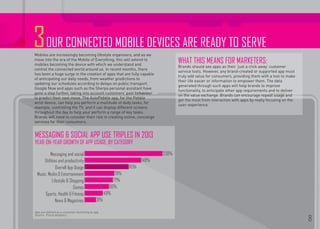
MESSAGING & SOCIAL APP USE TRIPLES IN 2013 
YEAR-ON-YEAR GROWTH OF APP USAGE, BY CATEGORY 
149% 
115% 
78% 
77% 
66% 
49% 
31% 
Messaging and social 
Utilities and productivity 
Overall App Usage 
Music, Media & Entertainment 
Lifestyle & Shopping 
Games 
Sports, Health & Fitness 
News & Magazines 
App use defined as a consumer launching an app 
Source : Flurry Analytics 
8
4 OUR CONNECTED MOBILE DEVICES MASTER THE ART OF SHOPPING 
WHAT THIS MEANS FOR MARKETERS: 
With the onset of the Mobile of Everything, we are promised a 
whole new personalised shopping experience via our mobiles. 
Powered by a wealth of data, sophisticated predictive models will 
enable brands to customise our shopping experiences throughout 
the retail journey…and to curate content in accordance with our 
needs and interests. Brands will need to invest in the latest mobile 
technologies in order to offer customers multi-sensory 
experiences and to explore and interact with their products. 
With the arrival of the Mobile of Everything, our mobile devices will 
become central to our shopping experience and will be used to 
make most, if not all, of our purchases. Imagine entering a store, 
and being recognised via your mobile handset, which through 
automatic check-in features enables you to receive bonus points 
and special promotions. iBeacons offers smartphone users the 
opportunity to receive discounts, rewards or contextual 
suggestions even when their phones are locked. Apple just 
installed iBeacons in all their US stores. ‘Retailtainment’ will be 
the new norm as in-store mobile technology enables customers to 
explore and discover brand stories. For example, some Burberry 
stores are equipped with Near Field Communication (NFC) 
technology - when scanned, the tags direct the customers to videos 
showing the creation of the products. 
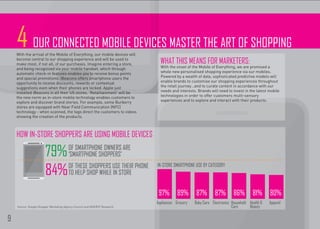
97% 89% 87% 87% 86% 81% 80% 
Appliances Household 
Care 
Health & 
Beauty 
Grocery Baby Care Electronics 
Apparel 
HOW IN-STORE SHOPPERS ARE USING MOBILE DEVICES 
OF SMARTPHONE OWNERS ARE 
‘SMARTPHONE SHOPPERS’ 
OF THESE SHOPPERS USE THEIR PHONE 
TO HELP SHOP WHILE IN STORE 
79% 
IN-STORE SMARTPHONE USE BY CATEGORY 84% 
Source: Google Shopper Marketing Agency Council and M/A/R/C Research 
9
5 OUR CONNECTED DEVICES ARE CAREFUL NAVIGATORS 
CARS EMERGE AS TOP TEN CONNECTED APPS IN 2020 
APPLICATION VALUE ($USbn) 
Connected Car 600 
Clinical Remote Monitoring 350 
Assisted Living 270 
Home and Building Security 250 
Pay-As-You-Drive Car Insurance 245 
New Business Models for Cars Usage 225 
Smart Meters 105 
Traffic Management 100 
Electric Vehicle Charging 75 
Building Automation 40 
WHAT THIS MEANS FOR MARKETERS: 
Marketers looking to engage consumers in-car are set to benefit 
from increased lengths of engagement time, bigger and better 
screens and a more “quality” environment. The car could become a 
key control and engagement point within the Mobile of Everything, 
and marketers are set to enjoy new content, engagement and retail 
opportunities in the new in-car environment. The immediate 
impact of enhanced in-car technology will be better location-based 
services, but as in-car technology moves further into 
entertainment and general information, brands will be able 
to tailor content for both drivers and passengers. 
For delegates at CES this year, it was clear that cars are becoming 
mobile content environments in their own right. The development 
of auto technology is turning cars into intelligent hubs for mobile 
computing, accessing information and general entertainment. 
The car of the future will become a mobile computer. 
It will become an environment for social communication 
and the various technologies will be able to help us organise our 
lives. By 2015, it is estimated that 50% of all cars will be internet 
connected. In fact the connected car is the third fastest growing 
technology device after phones and tablets (Source: Intel). And 
more driverless cars are being developed. At the heart of the 
driverless car is the GPS system which allows the computer to 
locate its position to within a few inches. The car has radars in its 
fenders so that it can sense obstacles. 
10
WHAT’S THE FUTURE FOR THE SMARTPHONE ? 
The exciting world of hyper-connectivity will see sensors tracking 
our every movement, and people able to get online through a 
myriad of new connection points. In this world, having one device 
you carry around with you - a smartphone - will no longer be the 
norm. . The evidence of a mobile world the transcends 
smartphones and handsets is out there now. Google’s recent sale 
of Motorola to Lenovo indicates that the company is envisaging 
mobile opportunities beyond the smartphone . And even Google's 
$3.2bn purchase of Nest points to business opportunities that 
transcend handsets. Nest's Learning Thermostat and Protect 
smoke and carbon monoxide alarm are both designed to connect to 
one receiver: the Nest app on a smartphone. But the value here 
isn't the smartphone itself, but in peripherals - the software and 
hardware that run Nest. 
TECHNOLOGY CYCLES HAVE TENDED TO LAST TEN YEARS 
PERSONAL 
COMPUTING 
1980s 
DESKTOP 
INTERNET 
COMPUTING 
1980s 
MOBILE 
INTERNET 
COMPUTING 
2000s 
WEARABLE 
EYE-WEAR 
COMPUTING 
2014+ 
DEVICE 
FREE 
COMPUTING 
2025+ 
MINI 
COMPUTING 
1970s 
MAINFRAME 
COMPUTING 
1960s 
Source: KPCB 
11
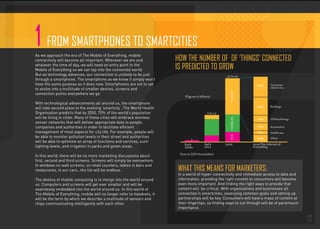
FROM SMARTPHONES TO SMARTCITIES 
HOW THE NUMBER OF OF ‘THINGS’ CONNECTED 
IS PREDICTED TO GROW 
1 
6 to 12 
Source: GSM Association 
2020 The Internet of 
Everything 
(Figures in billions) 
Early 
2000s 
Early 
2011 
25 to 50 
2020 
Consumer 
electronics 
Buildings 
Utilities/energy 
Automotive 
Healthcare 
Other 
35% 
30% 
10% 
10% 
5% 
10% 
PCS MOBILES ‘THINGS’ 
WHAT THIS MEANS FOR MARKETERS: 
In a world of hyper-connectivity and immediate access to data and 
information, providing the right content to consumers will become 
even more important. And finding the right ways to provide that 
content will be critical. With organisations and businesses all 
connected in smartcities, assessing common goals and setting up 
partnerships will be key. Consumers will have a mass of content at 
their fingertips, so finding ways to cut through will be of paramount 
importance. 
As we approach the era of The Mobile of Everything, mobile 
connectivity will become all important. Wherever we are and 
whatever the time of day, we will need an entry point to the 
Mobile of Everything so we can tap into the connected world. 
But as technology advances, our connection is unlikely to be just 
through a smartphone. The smartphone as we know it simply won’t 
have the same purpose as it does now. Smartphones are set to set 
to evolve into a multitude of smaller devices, screens and 
connection points everywhere we go. 
With technological advancements all around us, the smartphone 
will take second place to the evolving ‘smartcity’. The World Health 
Organisation predicts that by 2050, 70% of the world’s population 
will be living in cities. Many of these cities will embrace wireless 
sensor networks that will deliver appropriate data to people, 
companies and authorities in order to facilitate efficient 
management of most aspects for city life. For example, people will 
be able to monitor pollution levels in their street and authorities 
will be able to optimise an array of functions and services, such 
lighting levels, and irrigation in parks and green areas. 
In this world, there will be no more marketing discussions about 
first, second and third screens. Screens will simply be everywhere. 
In windows on wall screens, on retail counters, tables in bars and 
restaurants, in our cars…the list will be endless. 
The destiny of mobile computing is to merge into the world around 
us. Computers and screens will get ever smaller and will be 
seamlessly embedded into the world around us. In this world of 
The Mobile of Everything, mobile will no longer refer to handsets, it 
will be the term by which we describe a multitude of sensors and 
chips communicating intelligently with each other. 
12
2 THE SENSOR REVOLUTION 
THE POWER OF SENSORS 
40 zettabytes 
Of data usage 
by 2020 (IDC) 
WHAT THIS MEANS FOR MARKETERS: 
Marketers are already sitting on a wealth of data, and in the future 
the amount of available data will only increase. Making full use of 
this data to truly understand consumers and personalise services 
and content for them will be the secret to successful marketing. 
However, with so much available data and the ever increasing need 
to personalise, brands will need to work hard to surprise and 
delight their consumers. Hyper-personalisation could lead to 
consumers only ever receiving the predictable and the expected. 
Sensors will be everywhere. As stated earlier, by 2020 there will be 
50 billion objects connected to the internet (Cisco). By then, a 
variety of new interaction technologies will emerge, with no more 
need for an in-hand screen. 
We will be surrounded by sensors, wherever we go: at home, while 
driving, in shops, on public transport and at work. Sensors will 
connect us with each other and they will capture data about how 
we live and what we do. 
Visualisation will be done on ubiquitous proxy screens - no device 
will be necessary for data storage as that will most certainly all be 
in the Cloud. Objects will start predicting desires based on 
movements and history. This is already happening with the likes of 
Netflix knowing what films we might like and Spotify understanding 
what music we want to listen to. 
And, potentially, sensors could get smaller and smaller as 
technology advances. Back in 1990, Kris Peter (a Berkley 
Researcher) predicted that sensors would not just be embedded 
in products, but would literally be everywhere; in the air as “Smart 
Dust” particles. Acting like electronic nerve endings for the planet 
and fitted with computer processors, these sensors would monitor 
everything and power interactive, smart systems. While this may 
seem like science fiction, sensors are already very much rooted in 
science reality. 
1 Trillion 
Sensors for context aware 
computing by 2015 (IBM) 7 Trillion 
Sensors, globally, by 2017 
(Wireless World Research) 
$14bn 
Of business driven by the 
Internet of Things by 
2020 (Cisco) $29.95bn 
Will be the total value of consumer 
electronics sensor market by 2020 
(World Market Forecasts) 
13
3THE END OF MEDIA CHANNELS? 
WHAT THIS MEANS FOR MARKETERS: 
The shift away from media channels will mean that marketers will 
need to equally shift away from their screen-centric focus. The 
focus will need to be on consumers and how they live their lives. 
More than ever, marketers will need to understand what they want, 
how they want it and when they want it. But with the move to 
immediate digital delivery of content and messaging to consumers, 
it will be important for marketers to remember the value of 
creating physical and sensory experiences for consumers. 
The impending changes for the smartphone, coupled with the 
rising power and dominance of the sensor, heralds a significant 
shift in our concept of media channels. In the era of the Mobile of 
Everything, content will be customised and distributed to 
consumers wherever they are, and on whatever screen they choose 
to access. 
In this new world, the focus will be on the consumer and the 
content that is being curated and customised for them. Media 
owners will move from organising content according to channels 
and media brands, to horizontal content that is distributed to 
consumers according to behavioural analytics. 
Consumers are already using online search to find the content they 
need, wherever they are, rather than going directly to specific 
media brands. In a truly mobile, hyper-connected world, what will 
matter will be the consumer and the content, not the device or the 
channel. 
For the media and advertising industry, this fundamental shift will 
mean that many skills and capabilities that were mainstay of 
success in the past will need outright replacement. Going forward, 
it will no longer be necessary or efficient to have dedicated 
planning and trading platforms for each channel. 
14
CONCLUSION 
As we march towards the Mobile of Everything, there are really 
exciting opportunities ahead for marketers. The future will be 
profoundly mobile, and we must prepare for what this means in 
terms of the new ways that we will connect online and consume 
content. The smartphone is set change dramatically over the 
coming years, and the technology and the new devices that will 
emerge will inevitably better suit the ways in which we will live our 
lives in the future. 
With a move to hyper-personalisation, mass marketing campaigns 
could well become very hard to execute. Marketers - and the 
industry that supports marketers - will need to work out ways to 
communicate and engage on personal level, but to very large 
numbers of people. Marketers will need to also be careful to 
ensure that the content and experiences they are creating for 
consumers are ‘authentic’. A world where everything is highly 
automated and programmed, leaves little left to personal 
discovery. For many people, personal discovery and 
recommendation is critical to an authentic experience. 
And, the ongoing issue of privacy will remain ever present. The 
marketing and communications industry will need to be mindful of 
issues of privacy at all times in a data-fueled world 
of hyper-personalisation. 
15
16
ABOUT PERFORMICS 
Headquartered in Chicago with offices in 32 countries and regional hubs in London and 
Singapore, Performics is the performance marketing arm of ZenithOptimedia, and part of 
Publicis Groupe. Founded in 1998 in Chicago, Performics has a track record of innovation, and 
was awarded Best Agency at the European Search Awards. We were also named a leader among 
search marketing agencies by US company Forrester Research. Performics' team of certified 
experts in paid search, SEO, affiliate marketing, paid social, real-time bidding, and display 
advertising develop holistic strategies to drive enhanced performance for every one of our 
clients' digital marketing campaigns. Data is at the heart of our strategy and we know the 
importance of fully understanding consumers’ motivations and media habits. We do this by 
investing heavily in market-leading tools and technology to ensure clients benefit from the 
maximum return on their investments. Performics has a broad list of international clients, 
including RBS, O2, HP, Bacardi, Clarins, Hertz, H&M, IKEA, Novartis, Nestle, and Travelodge. 
1717
ABOUT ZENITHOPTIMEDIA 
ZenithOptimedia - www.zenithoptimedia.com - is a leading global media services 
network with 250 offices in 74 countries. We are part of Publicis Groupe, the world’s third 
largest communications group, and the world’s second largest media counsel and buying 
group. As the first agency to apply a rigorous and objective approach to improving the 
effectiveness of marketing spend, ZenithOptimedia delivers to clients the best possible 
return on their communications investment. This philosophy is supported by a unique 
approach to strategy development and implementation across the full spectrum of paid, 
owned and earned contact points – the Live ROI planning process. The ZenithOptimedia 
Group of companies equips our clients with a full range of integrated skills across 
communications planning, value optimisation, performance media and content creation. 
Our key clients include Armani Group, ASUS, Aviva, BBC Worldwide, Bacardi-Martini, 
Electrolux, General Mills, Lactalis, LVMH, Nestlé, News Corporation, L’Oréal, Oracle, 
Puma, Qantas, Reckitt Benckiser, Richemont Group, Royal Bank of Scotland, Sanofi, SCA, 
Telefónica O2, Toyota/Lexus, Verizon and Whirlpool. 
18
The Mobile of Everything

The Mobile of Everything

  • 1.
    THE MOBILE OFEVERYTHING WHAT DOES A HYPER-CONNECTED WORLD MEAN FOR THE SMARTPHONE ?
  • 2.
    This thought piecewas written by: Frederic Joseph, CEO, EMEA, Performics Linda Tan, Consumer Insights Director, ZenithOptimedia Tim Collison, Global Communications Director, ZenithOptimedia
  • 3.
    CONTENTS THE FUTUREIS PROFOUNDLY MOBILE 3 WELCOME TO THE MOBILE OF EVERYTHING 5 WHAT’S THE FUTURE FOR THE SMARTPHONE? 11 CONCLUSION 15
  • 4.
    THE FUTURE ISPROFOUNDLY MOBILE At this year’s Consumer Electronics Show, many of the major tech companies were falling over themselves to demonstrate their credentials in the Internet of Everything space. Smart homes, connected devices, and sensor technology were on display in abundance. Many delegates would have been left thinking that an intelligent, programmable world, where all objects and devices are connected, cannot be too far away. ZenithOptimedia identified the Internet of Everything as one of six key trends for the next 25 years in its 2038 futures programme. In this world, where everything is connected, the consumer - or rather people - take centre stage, with sensors detecting their every movement, and all types of services and experiences customised for them throughout the day. What becomes clear when you look at the engagement opportunities in this new hyper-connected world is that the term the Internet of Everything does not go far enough. More precisely, we are looking at the Mobile of Everything. This new hyper-connected world is profoundly mobile. This world is already taking shape with the rapid growth in mobile devices, the uptake of mobile internet access and our increasing reliance on mobile apps. Wearable devices is the next chapter in our journey into the Mobile of Everything. Wearable devices promise a future of self-knowledge, sensors and superpowers. Wearable devices offer us a new intimacy with mobile technology. Fuelled by personal data, wearable devices will know our behaviour and will enable brands to offers us what we want, exactly when we want it. So, with ever smarter handsets being produced, analysts predicting the rapid take-up of wearable devices, and the Mobile of Everything on the horizon, mobile has a very secure future. However, what we understand by the concept of mobile will fundamentally change. ‘Mobile’ will transcend the handset to focus of the mobility of people and the multitude of devices and connection points through which we will connect online. In this world, the smartphone will evolve into a multitude of different devices: handsets in our pockets, devices we will wear, devices integrated into bags and clothing, and connection points embedded into a myriad of objects around us. In this report, we set out the case for an exciting and determinedly mobile future. However, it is a future that just a year or two ago, few would have predicted. It’s a future where consumers are in control, where personalisation is taken to completely new levels, and where the rules of mobile marketing as we currently know them will no longer apply. 3
  • 5.
    MOBILE PHONE INTERNETUSER PENETRATION WORLDWIDE BY REGION 2014- 2017 % of internet users 64.3% 79.2% NORTH AMERICA 2014 2017 67.8% 90.6% WESTERN EUROPE 94.0% 96.0% MIDDLE EAST & AFRICA 72.4% 91.7% CENTRAL & EASTERN EUROPE 58.5% 75.2% LATIN AMERICA 79.1% 90.1% WORLDWIDE 87.4% 93.9% ASIA PACIFIC Source: eMarketer, Dec 2013 Mobile phone users of any age who access the internet from a mobile browser or installed application at least once per month; use of SMS/MMS is not considered mobile internet access. 4
  • 6.
    WELCOME TO THEMOBILE OF EVERYTHING AVERAGE NUMBER OF PORTABLE DEVICES OWNED PER RESPONDENT, BY COUNTRY(DEVELOPED MARKETS). AVERAGE NUMBER OF PORTABLE DEVICES OWNED PER RESPONDENT, BY COUNTRY (DEVELOPING MARKETS). 8 7 6 5 4 3 2 1 10 8 6 4 2 0 8.4 6.9 6.6 5.9 5.7 5.4 5.2 5.1 India Indonesia Argentina Mexico China Turkey Brazil Russia Source: Deloitte Global Mobile Consumer Survey, Developed markets, May-July 2013 0 7.2 6.8 5.9 5.4 5.4 5.2 4.7 4.5 4.5 4.3 4.3 4.2 Spain Singapore Portugal UK France US Belgium Germany Finland Netherlands South Korea Japan Source: Deloitte Global Mobile Consumer Survey, Developed markets, May-July 2013 From the word that describes the multifunctional device in your hand, ‘mobile’ will become a term that encapsulates a super-computing landscape that powers the Internet of Everything, or rather the Mobile of Everything. As we enter the era of the Mobile of Everything, we will come to expect and rely on mobile devices to program and be the control point for all aspects of our daily work, communication, shopping, comfort and convenience. To understand how this new world of The Mobile of Everything will evolve, we have identified five key developments: 5
  • 7.
    OUR CONNECTED MOBILEDEVICES SPEAK THE SAME LANGUAGE WHAT THIS MEANS FOR MARKETERS: Marketers that want to develop a personal relationship with consumers, must create a personal voice. In this way, people will feel that brands know them on a personal level. In order to truly adopt the mindset of the consumer, brands need to truly live with the consumer, supporting them with suggestions of relevant things they should know about. Marketers will need to rethink how best to leverage consumer data in order to personalise services and offers. Of course, there is a fine line between adding value and invading consumers’ privacy, so companies will need to tread carefully. Reassuringly, 80% of consumers are willing to share their data if they know how it is going to be used. Consumers want to feel in control, but 73% are quite willing to share data in return for benefits (source: PwC), which paves the way for a market of data commoditisation. The relationship we have with our mobile devices has changed significantly with the development of smartphones and tablets. They have become deeply rooted in our lives and we now rely on them to organise, curate and control our daily activities. The more we reveal ourselves to our devices, the higher expectation we have of them to know us as a person - to know our needs and wants and to lead us to quick, relevant and personalised results. We also expect the way we communicate on the various interfaces to be intuitive and spontaneous. With the growth in the number of things connected to our mobile devices, there are more and more opportunities for consumers to receive personalised content and services. By 2017, there will be five devices/connections for every internet user (source: Cisco). The leap in big-data processing also means our mobile devices can now monitor the world around us in real time. They can get the right data to the right devices at the right time in order for us to be able to make the right decisions. As we approach the Mobile of Everything, our data-fuelled mobiles will nearly always be a step ahead. Our devices will be prompting us with suggestions of content and services we may not have even thought of. 6
  • 8.
    2 OUR CONNECTEDMOBILE DEVICES KNOW OUR TRUE FEELINGS WHAT THIS MEANS FOR MARKETERS: In order to influence consumer decision-making, brands will need to know and understand consumers’ moods, behaviours and their characteristics. Brands will also need to design real-time response mechanisms to deliver content in accordance with consumers’ moods and behaviour. Marketers will be able to leverage biometric technology to establish a standardised and secure platform for consumers to identify themselves. We believe another game changer in human-machine interaction is biometric technology. It is estimated that biometric sensors - which includes work-time-management and security entry consoles - will total at least 500 million ‘Internet of Everything’ connections by 2018 (source: Biometric Research Group). Biometric technology can sense even the subtlest nuances of our body language, with sensitivity we only expect from another human. Facial recognition, voice activation, eye tracking and sensors to measure consumers’ real-time emotional and physiological responses will be deployed to gauge consumers’ emotional involvement. The expanded range of feedback mechanisms can make the experiences more immersive. For example, BioBeats creates a world where our apps and devices understand and adapt to the way we feel. It uses your iOS device to detect your heart rate, then generates custom music in any genre you choose. With smartphones able to interpret our emotions, consumers’ moods and behaviours can be matched with relevant content, just right for that moment. 7
  • 9.
    3OUR CONNECTED MOBILEDEVICES ARE READY TO SERVE WHAT THIS MEANS FOR MARKETERS: Brands should see apps as their ‘just a click away’ customer service tools. However, any brand-created or supported app must truly add value for consumers, providing them with a tool to make their life easier or information to empower them. The data generated through such apps will help brands to improve functionality, to anticipate other app requirements and to deliver on the value exchange. Brands can encourage repeat usage and get the most from interaction with apps by really focusing on the user-experience. 230% Mobiles are increasingly becoming lifestyle organisers, and as we move into the era of the Mobile of Everything, this will extend to mobiles becoming the device with which we understand and control the connected world around us. In recent months, there has been a huge surge in the creation of apps that are fully capable of anticipating our daily needs, from weather predictions to updating our schedules according to delays on public transport. Google Now and apps such as the Sherpa personal assistant have gone a step further, taking into account customers’ past behaviour to predict their next move. The AutoPebble app, for the Pebble wrist device, can help you perform a multitude of daily tasks, for example, controlling the TV, and it can display different screens throughout the day to help your perform a range of key tasks. Brands will need to consider their role in creating online, concierge services for their consumers. MESSAGING & SOCIAL APP USE TRIPLES IN 2013 YEAR-ON-YEAR GROWTH OF APP USAGE, BY CATEGORY 149% 115% 78% 77% 66% 49% 31% Messaging and social Utilities and productivity Overall App Usage Music, Media & Entertainment Lifestyle & Shopping Games Sports, Health & Fitness News & Magazines App use defined as a consumer launching an app Source : Flurry Analytics 8
  • 10.
    4 OUR CONNECTEDMOBILE DEVICES MASTER THE ART OF SHOPPING WHAT THIS MEANS FOR MARKETERS: With the onset of the Mobile of Everything, we are promised a whole new personalised shopping experience via our mobiles. Powered by a wealth of data, sophisticated predictive models will enable brands to customise our shopping experiences throughout the retail journey…and to curate content in accordance with our needs and interests. Brands will need to invest in the latest mobile technologies in order to offer customers multi-sensory experiences and to explore and interact with their products. With the arrival of the Mobile of Everything, our mobile devices will become central to our shopping experience and will be used to make most, if not all, of our purchases. Imagine entering a store, and being recognised via your mobile handset, which through automatic check-in features enables you to receive bonus points and special promotions. iBeacons offers smartphone users the opportunity to receive discounts, rewards or contextual suggestions even when their phones are locked. Apple just installed iBeacons in all their US stores. ‘Retailtainment’ will be the new norm as in-store mobile technology enables customers to explore and discover brand stories. For example, some Burberry stores are equipped with Near Field Communication (NFC) technology - when scanned, the tags direct the customers to videos showing the creation of the products. 97% 89% 87% 87% 86% 81% 80% Appliances Household Care Health & Beauty Grocery Baby Care Electronics Apparel HOW IN-STORE SHOPPERS ARE USING MOBILE DEVICES OF SMARTPHONE OWNERS ARE ‘SMARTPHONE SHOPPERS’ OF THESE SHOPPERS USE THEIR PHONE TO HELP SHOP WHILE IN STORE 79% IN-STORE SMARTPHONE USE BY CATEGORY 84% Source: Google Shopper Marketing Agency Council and M/A/R/C Research 9
  • 11.
    5 OUR CONNECTEDDEVICES ARE CAREFUL NAVIGATORS CARS EMERGE AS TOP TEN CONNECTED APPS IN 2020 APPLICATION VALUE ($USbn) Connected Car 600 Clinical Remote Monitoring 350 Assisted Living 270 Home and Building Security 250 Pay-As-You-Drive Car Insurance 245 New Business Models for Cars Usage 225 Smart Meters 105 Traffic Management 100 Electric Vehicle Charging 75 Building Automation 40 WHAT THIS MEANS FOR MARKETERS: Marketers looking to engage consumers in-car are set to benefit from increased lengths of engagement time, bigger and better screens and a more “quality” environment. The car could become a key control and engagement point within the Mobile of Everything, and marketers are set to enjoy new content, engagement and retail opportunities in the new in-car environment. The immediate impact of enhanced in-car technology will be better location-based services, but as in-car technology moves further into entertainment and general information, brands will be able to tailor content for both drivers and passengers. For delegates at CES this year, it was clear that cars are becoming mobile content environments in their own right. The development of auto technology is turning cars into intelligent hubs for mobile computing, accessing information and general entertainment. The car of the future will become a mobile computer. It will become an environment for social communication and the various technologies will be able to help us organise our lives. By 2015, it is estimated that 50% of all cars will be internet connected. In fact the connected car is the third fastest growing technology device after phones and tablets (Source: Intel). And more driverless cars are being developed. At the heart of the driverless car is the GPS system which allows the computer to locate its position to within a few inches. The car has radars in its fenders so that it can sense obstacles. 10
  • 12.
    WHAT’S THE FUTUREFOR THE SMARTPHONE ? The exciting world of hyper-connectivity will see sensors tracking our every movement, and people able to get online through a myriad of new connection points. In this world, having one device you carry around with you - a smartphone - will no longer be the norm. . The evidence of a mobile world the transcends smartphones and handsets is out there now. Google’s recent sale of Motorola to Lenovo indicates that the company is envisaging mobile opportunities beyond the smartphone . And even Google's $3.2bn purchase of Nest points to business opportunities that transcend handsets. Nest's Learning Thermostat and Protect smoke and carbon monoxide alarm are both designed to connect to one receiver: the Nest app on a smartphone. But the value here isn't the smartphone itself, but in peripherals - the software and hardware that run Nest. TECHNOLOGY CYCLES HAVE TENDED TO LAST TEN YEARS PERSONAL COMPUTING 1980s DESKTOP INTERNET COMPUTING 1980s MOBILE INTERNET COMPUTING 2000s WEARABLE EYE-WEAR COMPUTING 2014+ DEVICE FREE COMPUTING 2025+ MINI COMPUTING 1970s MAINFRAME COMPUTING 1960s Source: KPCB 11
  • 13.
    FROM SMARTPHONES TOSMARTCITIES HOW THE NUMBER OF OF ‘THINGS’ CONNECTED IS PREDICTED TO GROW 1 6 to 12 Source: GSM Association 2020 The Internet of Everything (Figures in billions) Early 2000s Early 2011 25 to 50 2020 Consumer electronics Buildings Utilities/energy Automotive Healthcare Other 35% 30% 10% 10% 5% 10% PCS MOBILES ‘THINGS’ WHAT THIS MEANS FOR MARKETERS: In a world of hyper-connectivity and immediate access to data and information, providing the right content to consumers will become even more important. And finding the right ways to provide that content will be critical. With organisations and businesses all connected in smartcities, assessing common goals and setting up partnerships will be key. Consumers will have a mass of content at their fingertips, so finding ways to cut through will be of paramount importance. As we approach the era of The Mobile of Everything, mobile connectivity will become all important. Wherever we are and whatever the time of day, we will need an entry point to the Mobile of Everything so we can tap into the connected world. But as technology advances, our connection is unlikely to be just through a smartphone. The smartphone as we know it simply won’t have the same purpose as it does now. Smartphones are set to set to evolve into a multitude of smaller devices, screens and connection points everywhere we go. With technological advancements all around us, the smartphone will take second place to the evolving ‘smartcity’. The World Health Organisation predicts that by 2050, 70% of the world’s population will be living in cities. Many of these cities will embrace wireless sensor networks that will deliver appropriate data to people, companies and authorities in order to facilitate efficient management of most aspects for city life. For example, people will be able to monitor pollution levels in their street and authorities will be able to optimise an array of functions and services, such lighting levels, and irrigation in parks and green areas. In this world, there will be no more marketing discussions about first, second and third screens. Screens will simply be everywhere. In windows on wall screens, on retail counters, tables in bars and restaurants, in our cars…the list will be endless. The destiny of mobile computing is to merge into the world around us. Computers and screens will get ever smaller and will be seamlessly embedded into the world around us. In this world of The Mobile of Everything, mobile will no longer refer to handsets, it will be the term by which we describe a multitude of sensors and chips communicating intelligently with each other. 12
  • 14.
    2 THE SENSORREVOLUTION THE POWER OF SENSORS 40 zettabytes Of data usage by 2020 (IDC) WHAT THIS MEANS FOR MARKETERS: Marketers are already sitting on a wealth of data, and in the future the amount of available data will only increase. Making full use of this data to truly understand consumers and personalise services and content for them will be the secret to successful marketing. However, with so much available data and the ever increasing need to personalise, brands will need to work hard to surprise and delight their consumers. Hyper-personalisation could lead to consumers only ever receiving the predictable and the expected. Sensors will be everywhere. As stated earlier, by 2020 there will be 50 billion objects connected to the internet (Cisco). By then, a variety of new interaction technologies will emerge, with no more need for an in-hand screen. We will be surrounded by sensors, wherever we go: at home, while driving, in shops, on public transport and at work. Sensors will connect us with each other and they will capture data about how we live and what we do. Visualisation will be done on ubiquitous proxy screens - no device will be necessary for data storage as that will most certainly all be in the Cloud. Objects will start predicting desires based on movements and history. This is already happening with the likes of Netflix knowing what films we might like and Spotify understanding what music we want to listen to. And, potentially, sensors could get smaller and smaller as technology advances. Back in 1990, Kris Peter (a Berkley Researcher) predicted that sensors would not just be embedded in products, but would literally be everywhere; in the air as “Smart Dust” particles. Acting like electronic nerve endings for the planet and fitted with computer processors, these sensors would monitor everything and power interactive, smart systems. While this may seem like science fiction, sensors are already very much rooted in science reality. 1 Trillion Sensors for context aware computing by 2015 (IBM) 7 Trillion Sensors, globally, by 2017 (Wireless World Research) $14bn Of business driven by the Internet of Things by 2020 (Cisco) $29.95bn Will be the total value of consumer electronics sensor market by 2020 (World Market Forecasts) 13
  • 15.
    3THE END OFMEDIA CHANNELS? WHAT THIS MEANS FOR MARKETERS: The shift away from media channels will mean that marketers will need to equally shift away from their screen-centric focus. The focus will need to be on consumers and how they live their lives. More than ever, marketers will need to understand what they want, how they want it and when they want it. But with the move to immediate digital delivery of content and messaging to consumers, it will be important for marketers to remember the value of creating physical and sensory experiences for consumers. The impending changes for the smartphone, coupled with the rising power and dominance of the sensor, heralds a significant shift in our concept of media channels. In the era of the Mobile of Everything, content will be customised and distributed to consumers wherever they are, and on whatever screen they choose to access. In this new world, the focus will be on the consumer and the content that is being curated and customised for them. Media owners will move from organising content according to channels and media brands, to horizontal content that is distributed to consumers according to behavioural analytics. Consumers are already using online search to find the content they need, wherever they are, rather than going directly to specific media brands. In a truly mobile, hyper-connected world, what will matter will be the consumer and the content, not the device or the channel. For the media and advertising industry, this fundamental shift will mean that many skills and capabilities that were mainstay of success in the past will need outright replacement. Going forward, it will no longer be necessary or efficient to have dedicated planning and trading platforms for each channel. 14
  • 16.
    CONCLUSION As wemarch towards the Mobile of Everything, there are really exciting opportunities ahead for marketers. The future will be profoundly mobile, and we must prepare for what this means in terms of the new ways that we will connect online and consume content. The smartphone is set change dramatically over the coming years, and the technology and the new devices that will emerge will inevitably better suit the ways in which we will live our lives in the future. With a move to hyper-personalisation, mass marketing campaigns could well become very hard to execute. Marketers - and the industry that supports marketers - will need to work out ways to communicate and engage on personal level, but to very large numbers of people. Marketers will need to also be careful to ensure that the content and experiences they are creating for consumers are ‘authentic’. A world where everything is highly automated and programmed, leaves little left to personal discovery. For many people, personal discovery and recommendation is critical to an authentic experience. And, the ongoing issue of privacy will remain ever present. The marketing and communications industry will need to be mindful of issues of privacy at all times in a data-fueled world of hyper-personalisation. 15
  • 17.
  • 18.
    ABOUT PERFORMICS Headquarteredin Chicago with offices in 32 countries and regional hubs in London and Singapore, Performics is the performance marketing arm of ZenithOptimedia, and part of Publicis Groupe. Founded in 1998 in Chicago, Performics has a track record of innovation, and was awarded Best Agency at the European Search Awards. We were also named a leader among search marketing agencies by US company Forrester Research. Performics' team of certified experts in paid search, SEO, affiliate marketing, paid social, real-time bidding, and display advertising develop holistic strategies to drive enhanced performance for every one of our clients' digital marketing campaigns. Data is at the heart of our strategy and we know the importance of fully understanding consumers’ motivations and media habits. We do this by investing heavily in market-leading tools and technology to ensure clients benefit from the maximum return on their investments. Performics has a broad list of international clients, including RBS, O2, HP, Bacardi, Clarins, Hertz, H&M, IKEA, Novartis, Nestle, and Travelodge. 1717
  • 19.
    ABOUT ZENITHOPTIMEDIA ZenithOptimedia- www.zenithoptimedia.com - is a leading global media services network with 250 offices in 74 countries. We are part of Publicis Groupe, the world’s third largest communications group, and the world’s second largest media counsel and buying group. As the first agency to apply a rigorous and objective approach to improving the effectiveness of marketing spend, ZenithOptimedia delivers to clients the best possible return on their communications investment. This philosophy is supported by a unique approach to strategy development and implementation across the full spectrum of paid, owned and earned contact points – the Live ROI planning process. The ZenithOptimedia Group of companies equips our clients with a full range of integrated skills across communications planning, value optimisation, performance media and content creation. Our key clients include Armani Group, ASUS, Aviva, BBC Worldwide, Bacardi-Martini, Electrolux, General Mills, Lactalis, LVMH, Nestlé, News Corporation, L’Oréal, Oracle, Puma, Qantas, Reckitt Benckiser, Richemont Group, Royal Bank of Scotland, Sanofi, SCA, Telefónica O2, Toyota/Lexus, Verizon and Whirlpool. 18