THE MEDICAID APPLICATION PROCESS
FOR INSTITUTIONAL COVERAGE
JAN NEAL LAW FIRM, LLC
Jan Neal
Jan Neal Law Firm, LLC
207 N 4th St
Opelika, AL 36801
(334) 745-2779
800-270-7635
neal@janneallaw.com
www.janneallaw.com
https://www.facebook.com/janneallaw
@janneallawllc
www.linkedin.com/in/jboydneal
These slides will be made available after the presentation through the Jan Neal Law Firm, LLC, Slideshare account
and the Jan Neal Law Firm, LLC, Facebook page.
This publication contains general information for educational purposes only. No attorney client relationship is intended or established by
providing this information. All persons accessing this information are encouraged to seek legal representation before relying on
information provided here for specific purposes and legal planning. Because laws change over time, it is important to recognize that this
publication is effective April 20, 2021, but may become outdated in part after that time.
In this presentation we will examine the following issues related to the Alabama Medicaid application process:
• Nursing Home Placement
• Medical, Income and Resource Eligibility for Medicaid
• Medicaid Transfer Penalties
• Application Mechanics (including care facility contracts)
• Post Eligibility Concerns
• Medicaid Estate Recovery
OVERVIEW
• Provide a tool for reference concerning application for institutional Medicaid
• Teach you how to spot issues
• Help you determine the issues where you need to get help
• Help you avoid obvious mistakes that result in Medicaid ineligibility
GOALS
STATE LAWS DIFFER
Medicaid is a joint federal and state program, so there are some rules that every state must follow in order to receive
funding. But each state has significant leeway in administering its individual program. Resources that may count for
eligibility purposes in one state may not count in another; what an applicant can do in one state will not be permitted in
another. States use functional assessment tools in order to determine if a person meets a nursing facility level of care, and
even a finding of medical eligibility may differ from one state to another.
The same is true for Medicaid Estate Recovery. Property that would be subject to Medicaid’s claim for reimbursement of
funds spent on care might be protected in another state because the estate recovery laws vary tremendously from state to
state.
Even with issues that are federal requirements, often states interpret the federal law in differing ways. When this
happens, the claimant may believe that federal rules were not followed requiring the claimant to file a lawsuit to challenge
the state’s interpretation of the law as written.
PLANNING FOR INSTITUTIONALIZATION
One of the most stressful events for any caregiver is arranging for long-term care. It is especially hard to arrange for a
nursing home placement while trying to determine how to pay for that care and whether any governmental assistance will
be available. It can be a complete shock to learn the high cost of nursing home care, and how complicated it is to apply for
governmental assistance through Medicaid. Even with legal help, which can help considerably, the caregiver must gather
all of the financial records needed to establish eligibility.
Often there was no prior planning, and, as a result, family members (such as spouses, children, extended family members)
and assisting professionals – find themselves trying to locate financial documents to provide information required to
complete the Medicaid application. This is one reason why the application process is so hard. The person who may have
known where these documents are is usually unable to participate in locating necessary information due to illness.
For one person to conduct business for another there must be documented authority to act, even in many situations for
a spouse to plan for another. It is not at all unusual to see a person with no legal authority completing a Medicaid
application for a sick relative, and that works fine until liquidating an asset, providing a lien or establishing a Medicaid
Qualifying Income Trust becomes necessary. Then legal authority is needed. For this reason any person who may be at
risk for nursing home placement needs to have a durable power of attorney established to name the agent to act for him or
her if he or she cannot act independently.
FINDING A NURSING HOME
Alabama Public Health Database can be accessed at
http://dph1.adph.state.al.us/FacilitiesDirectory/(S(055uosbpzjmwozuawfzpdern))/default
The Medicare.gov database can be accessed at
https://www.medicare.gov/care-compare/?providerType=NursingHome&redirect=true#search
Another resource to locate nursing homes in your area is at:
https://elderguide.com/
For Medicaid to pay, a claimant must be be in a facility certified to participate in the Medicaid program. If a facility
accepts Medicaid for payment, Medicaid’s quality of care regulations apply to all residents, even those privately
paying.
SPECIAL FOCUS FACILITIES
The Centers for Medicare & Medicaid Services (CMS) provides a list of “special focus facilities” (SFF) on its website. SFFs
are nursing homes that have a history of serious quality issues or are included in a special program to work toward
improvements in their quality of care.
As of March 16, 2021, CMS records list the following Alabama facilities:
SFF status:
Ahava Healthcare of Alabaster, Alabaster, AL
On that same date the candidate list (potential SFFs) include the following Alabama facilities:
Attalla Health and Rehab, Attalla, AL
Diversicare of Foley, Foley, AL
Diversicare of Pell City, Pell City, AL
Merry Wood Lodge, Elmore, AL
Village at Cook Springs Skilled Nursing Facility, Pell City, AL
We need to briefly cover Medicare’s role in payment for nursing home care since many people are convinced that
Medicare will pay for 100 days of nursing home care.
Medicare will pay for the first 20 days of care in a nursing home if the patient has a three day prior hospitalization
and is admitted to a nursing home within 30 days and requires skilled care. While the Medicare literature does
indicate that Medicare pays for up to 100 days of nursing home care, the reality is that if the patient continues to
have skilled care ordered by the doctor, on day 21 a co-payment of $185.50 (for 2021) per day begins and must
be paid through the 100 days.
There are some Medigap policies that will cover this co-payment, but they are the more expensive plans.
It is not at all unusual for people to think that Medicare will pay for long-term care, and the reality of Medicare’s
limited assistance comes as a shocking realization. For this reason, it is crucial for people to understand the
limited help offered by Medicare and to focus on qualification for Medicaid when nursing home care is the long-
range plan.
MEDICARE LIMITATIONS
People often think that an application can be submitted in advance of placement, but it cannot. Some nursing homes,
however, do have potential residents complete a Medicaid application to screen for eligibility.
A Medicaid application cannot be approved until an applicant is institutionalized for 30 continuous days, and, if the
resident met all requirements for the preceding three months prior to the application being filed, retroactive eligibility for
those months also may be established. The exception is an SSI recipient who is automatically eligible for nursing home
Medicaid.
There are occasional cases where a person dies before being institutionalized for 30 days, and no Medicaid
payment is ever made.
TIMING THE APPLICATON
Medicaid is the primary single insurer for long-term care in Alabama covering roughly 65 to 75 percent of nursing
home residents.
According to Genworth, the median cost of nursing home care in Alabama in 2020 was $6540 per month for a
semi-private room and $6911 for a private room. Nursing home costs exceeded that in many areas of the state,
but using Genworth’s median cost of care across Alabama, a private pay resident in 2020 paid $78,500 - $83,000
per year for nursing home care.
Medicaid becomes an essential benefit when you realize that few people can afford an extended stay in a nursing
home at private pay rates.
FINANCIAL IMPORTANCE OF MEDICAID
GENERAL ELIGIBILITY REQUIREMENTS
Alabama General Eligibility Requirements for Nursing Home Medicaid Benefits require the following:
• File a written application with the Alabama Medicaid Agency, on Medicaid Form 204/205 available online as a paper copy to
print and fill out at
https://medicaid.alabama.gov/documents/9.0_Resources/9.4_Forms_Library/9.4.1_Applicant-
Recipient_Forms/9.4.1_Form_204-205_EnD_App_1-14-21.pdf
or to fill online and print at
https://medicaid.alabama.gov/documents/9.0_Resources/9.4_Forms_Library/9.4.1_Applicant-
Recipient_Forms/9.4.1_Form_204-205_EnD_App_1-14-21_Fillable.pdf
• Be a U. S. citizen or qualified resident alien.
• Be an Alabama resident.
• Have a certified medical need for nursing home care.
• Meet income eligibility requirements.
• Meet asset/resource eligibility requirements.
ALABAMA RESIDENCY
A claimant must be a resident of Alabama during the period covered by application and must indicate intent to
remain in Alabama. If incapable of stating intent, the state of residence is the state where the claimant is living.
There is no waiting period to establish residency in Alabama to qualify for Medicaid benefits.
If an applicant is a resident of Alabama but their Medicaid has not terminated in another state, it does not prohibit
them from applying for and being approved for Alabama Medicaid. It is the other state’s responsibility to terminate
their coverage. The other state’s failure to do so will not prevent the applicant from having access to medical
coverage and services in the state where they currently reside.
MEDICAL ELIGIBILITY
To be medically eligible for Medicaid to pay for long-term care a doctor must certify that nursing care is required on a daily
basis, in a nursing facility on an inpatient basis and under the supervision of a RN and under the general direction of a
physician. The nursing facility will submit the medical information to Medicaid.
The Alabama Administrative Code lists specific services that a resident might require, two of which are needed for an initial
admission. These services include:
• administration of a potent and dangerous injectable medication and solutions on a daily basis or administration of routine
oral medications, eye drops or ointment;
• restorative nursing procedures such as gait training, bowel and bladder training;
• nasopharyngeal aspiration requirement for maintenance of a clear airway;
• maintenance of tracheostomy, gastrostomy, colostomy, ileostomy and other tubes;
• feeding tubes;
• Pressure ulcers or other widespread skin disorders;
• observation of unstable medical conditions;
• use of oxygen on a regular or continuing basis;
• application of dressing involving prescription medications; comatose condition;
• assistance with at least one defined activity of daily living (transfer, mobility, eating, toileting, expressive and receptive
communication, orientation, medication administration).
Medicaid residents who are discharged to a hospital and have had no break in institutional care since discharge from a
nursing home and residents re-admitted in less than 30 days after being discharged into the community must meet only
one of the service requirements.
Persons admitted to a nursing facility as a private pay resident in spend down status with no break in institutional care
for more than 30 days who become financially eligible for Medicaid only need one of the service requirements to be
medically eligible for Medicaid to pay for nursing home services.
FINANCIAL ELIGIBILITY
To qualify for institutional Medicaid the applicant must be financially eligible by meeting the limitations set for both Income
and Resources.
Items received in cash or in kind during a month are counted as income.
Items retained as of the first moment of the month following receipt are counted as resources.
It is important to distinguish between resources and income to know which rules to use. An item cannot be counted as both
income and a resource in the same month.
INCOME ELIGIBILITY
Individual income of the applicant must be at or below $2382 per month (in 2021). For a married couple the spouse’s income
is reportable but does not count.
For Medicaid eligibility purposes, any income from most any source that a Medicaid applicant receives is counted. Examples
include pension income, employment wages, rental income, Railroad Retirement benefits, Black Lung benefits, alimony
payments, Social Security benefits, withdrawals from an IRA, stock dividends.
COVID-19 stimulus checks do not count as income. Another exception is VA Aid and Attendance (A&A), Unusual Medical
Expenses (UME), Continuing Medical Expenses (CME), and Housebound Allowance which are not counted in the eligibility
step of the budget process for all cases. So if a person’s VA A&A benefits push him over the income limit, a MQIT would not
be necessary.
SSI does not count as income. SSI recipients are automatically eligible for nursing home Medicaid when they meet medical
eligibility requirements. If they own a house that was excluded for eligibility for SSI, it will need to be sold.
If countable income exceeds $2382 a Medicaid Qualifying Income Trust (MQIT) will need to be established.
INCOME ISSUES
Medicaid will not permit an applicant to refuse or decline income. Refusal of income or resources is treated as
giving that income or asset away. However, the cost-of-living adjustment for the Alabama Teachers Retirement or
State Employees Retirement Pension Plan is an exception to that rule. A person can refuse the cost-of-living
increase if such increase negatively impacts Medicaid eligibility.
When a couple receives joint income (e.g. a rent check) the income is allocated between the husband and wife in
proportion to that which each owns the assets producing the income. Otherwise when a check is received that is not
related to an underlying investment, the income is attributed to the name on the check.
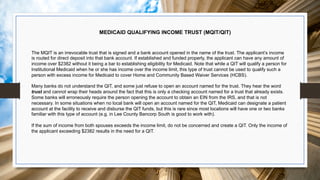
MEDICAID QUALIFYING INCOME TRUST (MQIT/QIT)
The MQIT is an irrevocable trust that is signed and a bank account opened in the name of the trust. The applicant’s income
is routed for direct deposit into that bank account. If established and funded properly, the applicant can have any amount of
income over $2382 without it being a bar to establishing eligibility for Medicaid. Note that while a QIT will qualify a person for
Institutional Medicaid when he or she has income over the income limit, this type of trust cannot be used to qualify such a
person with excess income for Medicaid to cover Home and Community Based Waiver Services (HCBS).
Many banks do not understand the QIT, and some just refuse to open an account named for the trust. They hear the word
trust and cannot wrap their heads around the fact that this is only a checking account named for a trust that already exists.
Some banks will erroneously require the person opening the account to obtain an EIN from the IRS, and that is not
necessary. In some situations when no local bank will open an account named for the QIT, Medicaid can designate a patient
account at the facility to receive and disburse the QIT funds, but this is rare since most locations will have one or two banks
familiar with this type of account (e.g. in Lee County Bancorp South is good to work with).
If the sum of income from both spouses exceeds the income limit, do not be concerned and create a QIT. Only the income of
the applicant exceeding $2382 results in the need for a QIT.
It is not necessary to route all sources of income into the QIT bank account, though it may make life easier in the long run to do so. It
is only necessary to place enough funds into the QIT to bring the non-QIT income level below the $2382 income limit. However, all
income from any sources determined to go into the QIT must be deposited into the QIT because Alabama Medicaid will not exempt
income that is only partially deposited into the QIT. Example: an applicant has $1900 SS and $700 pension income for a total of
$2600. Either income source alone can be directed to the QIT to bring the non-QIT income total below $2382. But if the Social
Security is selected, ALL of it must be routed to the QIT, and if the pension income is selected, ALL of it must be routed to the QIT.
Timing is important for establishing a QIT. It needs to be in place to receive income exceeding the income limit for any month the
applicant/resident requests coverage by Medicaid.
It can take 30 to 60 days for direct deposit changes to take effect, regardless of the method you use to make those changes. If
you've opened the new QIT bank account, don't close your old account until you're certain your Social Security benefits and other
income are being deposited into the new QIT account. For QIT purposes, if income does not get deposited to the new bank
account named for the trust (which is often the case the first month the QIT is established), you must move the exact
amount of income received from the old account to the QIT account on the next business day.
Resources should NEVER be placed in a QIT.
Alabama Medicaid Form 262 is a packet including an acceptable trust form to create a MQIT. It can be found at:
https://medicaid.alabama.gov/documents/7.0_Providers/7.1_Benefit_Coordination_3rd_Party/7.1.1_Estate_Recovery/7.1.1_Qualifyin
g_Income_Trust_Packet.pdf
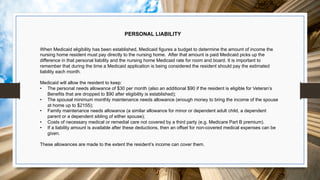
PERSONAL LIABILITY
When Medicaid eligibility has been established, Medicaid figures a budget to determine the amount of income the
nursing home resident must pay directly to the nursing home. After that amount is paid Medicaid picks up the
difference in that personal liability and the nursing home Medicaid rate for room and board. It is important to
remember that during the time a Medicaid application is being considered the resident should pay the estimated
liability each month.
Medicaid will allow the resident to keep:
• The personal needs allowance of $30 per month (also an additional $90 if the resident is eligible for Veteran’s
Benefits that are dropped to $90 after eligibility is established);
• The spousal minimum monthly maintenance needs allowance (enough money to bring the income of the spouse
at home up to $2155);
• Family maintenance needs allowance (a similar allowance for minor or dependent adult child, a dependent
parent or a dependent sibling of either spouse);
• Costs of necessary medical or remedial care not covered by a third party (e.g. Medicare Part B premium).
• If a liability amount is available after these deductions, then an offset for non-covered medical expenses can be
given.
These allowances are made to the extent the resident’s income can cover them.
MINIMUM MONTHLY MAINTENANCE NEEDS ALLOWANCE (MMMNA)
Spousal Impoverishment rules allow the spouse remaining at home (known as the Community Spouse) to keep a portion of
the institutionalized spouse’s income (an amount deducted in the post-eligibility phase when the personal liability of the
applicant is calculated). Both spouses have to agree to the allocation.
This rule allows the community spouse to claim from the income of the institutionalized spouse an amount to bring the
community spouse’s income up to $2155 per month in 2021 (known as the MMMNA).
The MMMNA is recalculated every year and changes are effective in July.
Example:
Wife’s income is $1200, and Husband’s income is $2500. A QIT works to qualify the Husband for Medicaid (because his
income exceeds $2382).
MMMNA $2155
-Wife’s Income 1200
Potential allocation for Wife 955
The allocation can only be made if the institutionalized spouse’s income is high enough to cover it from his personal liability.
It may be beneficial for a person to apply for Medicaid even when he or she has enough income to
pay for nursing home charges if the community spouse will be left with income below $2155. In that
case the person with adequate income to pay for a nursing home can apply with a QIT, qualify, and
send funds from his or her income home to the spouse as the MMMNA.
FAMILY ALLOWANCE
To calculate the family allowance payable:
Step 1. Deduct the gross income of the family member from the community spouse minimum monthly maintenance needs
allowance (MMMNA) standard;
Step 2. Calculate 1/3 of the remainder found in Step 1.
Step 3. The remainder in Step 2, rounded down to the nearest dollar, is the minimum family monthly maintenance needs
allowance used in the post-eligibility calculation to be allocated to the family member. If in excess of the available income, an
allowance is not made available.
All of these allowances are made to the extent the resident’s income can cover them. It is entirely possible for the patient to
exhaust his or her income before paying any personal liability to the nursing home.
There is also a Family Monthly Needs Allowance available from the resident’s personal liability for minor or dependent
adult children, dependent parents, or dependent siblings of either spouse, who is living with the community spouse and
who is an IRS tax dependent.
RESOURCES
Examples of resources include:
• Cash
• Mortgages
• Cash surrender value of life insurance when face value exceeds $5,000
• Mutual Funds
• Promissory Notes
• Equity in Real Estate
• Checking and Savings
• Stocks and Bonds
• Loans
• Mineral and Timber Rights, etc.
• Time Deposits (Certificates of Deposit, Annuities, IRAs, etc.)
The First-Of-The-Month Rule requires that a resource determination be made as of the first moment of each calendar month
and is applicable to the entire month. A claimant's countable resources on the first day of the month will be counted for the
entire month. Therefore, if a claimant has excess resources on the first day of the month, he/she cannot be eligible for
Medicaid until the first day of the following month, and then only if his/her resources are at or below the limit on the first
moment of that month
Income received during the month that pushes bank balances over $2000 for part of the month will not be a problem as
long as those funds are spent back down before the first day of the next month. Remember that funds cannot be
considered income and resources at the same time. Funds are either income (if received that month) or resources (if
accumulated on the first day of the next month).
It is important to recognize that property held in a trust that allows the Medicaid applicant to access and use the property
will count for eligibility purposes. The only way a trust can shield assets from being counted is for the trust to be
irrevocable, established over five years prior to application AND for the assets to be unreachable by the applicant. Income
only from the trust can be available to the applicant by the terms of the trust. Do not confuse this with a Special Needs
Trust which is a different tool that can be used to set aside funds to pay for special needs for a disabled person.
Many people think that property in a living trust will not be counted for Medicaid purposes, but it will count. A living trust is
not irrevocable, and the person creating it has full access to all the assets held by the trust. If you can access resources,
Medicaid counts those resources.
Retirement funds do not have to be liquidated in some states, but in Alabama they do.
RESOURCE CALCULATIONS
Countable resources must be at or below $2000 to qualify for Medicaid. This is straightforward for a single person to determine
whether he or she is currently eligible or whether a spend down of excess resources will be required.
For married persons the calculation is more complicated because of the Spousal Impoverishment Rules that allow the
community spouse remaining at home to keep some assets to meet his or her needs in the community. This is known as the
Community Spouse Resource Allowance (CSRA). In order to determine how much a spouse at home can preserve for himself or
herself, a married person applying for Medicaid must provide an inventory of property/assets the couple jointly and individually
owned on the "snapshot" date (defined as when the person entered long-term care, which might be when he or she entered a
hospital from which a placement was made to a nursing home without a 30 day break in institutional care).
From those resources that existed on the snapshot date, the home is protected for the spouse if he or she continues to live
there. Besides the home and a vehicle, the community spouse is allowed to keep the first $26,076 (in 2021). If joint assets
exceed $52,152, the community spouse can keep one-half up to a limit of $130,380 (for 2021 – use the allowance for the year of
institutionalization). This is Community Spousal Resource Allowance. After reserving what can be set aside for the spouse, all
remaining funds over $2000 plus the income of the applicant/institutionalized spouse must be spent down by the
applicant/institutionalized spouse to become eligible.
Note that when a married couple are both institutionalized and both apply, each is treated as an individual rather than as a
couple. Treatment as individuals begins as of the first day of the month following the month both are institutionalized. Spousal
impoverishment rules do not apply and an assessment of resources will not be conducted because each is evaluated as an
individual applicant.
The first $26,076 in countable resources allocated to Community Spouse
Resources at or above $52,152 ($26,076 x 2), one-half allocated to the Community Spouse up to a cap of $130,380.
When ½ of countable resources > $130,380 (resources exceeding $260,760), all resources above $130,380 are attributed
to the Medicaid applicant and require a spend down to $2000.
Remember that during spend down the nursing home resident’s income also must be spent down.
SPOUSAL RESOURCE ALLOCATION IN A NUTSHELL
Example One: A couple has $20,000 in countable assets. The community spouse keeps $18,000 (because all
assets are below $26,076), $2000 is assigned to the institutional spouse for his or her resource allowance, and the
institutional spouse qualifies for Medicaid without a spend down.
Example Two: A couple has $40,000 in countable assets. One-half is $20,000, BUT the spouse keeps the first
$26,076. The applicant must spend down the rest above $26,076 except for $2000 ($40,000 - $26,076 = $13,924 -
$2000 = $11,924) before qualifying for Medicaid. The institutional spouse spends down $11,924 and his or her
income before qualifying for Medicaid.
Example Three: A couple has $60,000 in countable assets. The community spouse keeps one-half, $30,000. The
applicant must spend down the rest except for $2000 ($60,000 - $30,000 = $30,000 - $2000 = $28,000). The
institutional spouse spends down $28,000 and his or her income before qualifying for Medicaid.
Example Four: A couple has $300,000 in countable assets. One-half is $150,000, so the cap of $130,380 applies,
and that amount only is retained by the community spouse. The applicant spouse must now spend down the rest
except for $2000 ($300,000 – 130,380 = 169,620 – 2000 = 167,620). The institutional spouse spends down
$167,620 and his or her income before qualifying for Medicaid.
EXAMPLES OF SPOUSAL RESOURCE ALLOCATION
SPOUSAL RESOURCE ASSESSMENT
All resources, whether owned jointly or individually by either spouse, must be combined beginning with the point that a
spouse was institutionalized (the Snapshot Date). This often means that people are reconstructing what resources they
owned at an earlier date, and that can be confusing.
Medicaid can perform an assessment if requested to provide the couple with written instructions on what the community
spouse can keep and how much the institutionalized spouse must spend down. The assessment is supposed to be
completed at the request of an institutionalized spouse or a community spouse, a representative acting on behalf of
either spouse, or at the time of application for Medicaid benefits. A copy of the assessment results (Agency Form 230) is
to be provided to each spouse with a copy retained for the case record.
In situations where the community spouse cannot be located, is alleged deceased, or refuses to cooperate with the
institutionalized spouse the institutionalized spouse or other person with knowledge of the whereabouts of the community
spouse must provide a sworn statement providing the following:
• Last known name;
• Last known address;
• forwarding address at the post office;
• last known employment;
• circumstances surrounding disappearance;
• health of the individual at time of disappearance;
• state of mind of the individual at time of disappearance;
• efforts to locate;
• SSN/VA claim number/other identifying information for the individual; and
• if alleged to be deceased, obtain death certificate from the Department of Public Health.
Medicaid will follow up on any leads, and, if possible, verify financial accounts, property, and employment.
Spousal refusal is when a spouse simply refuses to reveal his or her resources.
EXCLUDED PROPERTY
When applying for Medicaid, all property counts unless it is specifically excluded. While some property is
totally excluded, some property can be excluded and a lien taken, and some property can actually be transferred
without creating a penalty. Some excluded resources include the following:
• Household goods and personal effects
• One automobile
• The home for the community spouse as long as he or she lives there (no lien can be taken)
• The home if a dependent relative other than a child under 21, blind or disabled lives there (a lien may be
taken)
• The home if a dependent child who is under 21, blind or disabled lives there (no lien may be taken and the
property may be transferred without penalty)
• The home if a sibling with an equity interest lives there and was lawfully residing in the home for at least one
years immediately prior to the applicant being admitted to the medical institution (no lien may be taken and
property may be transferred without penalty)
• The home if the applicant has a reasonable intent to return home (a lien may be taken but dissolves if the
patient actually does return home)
• Real property where a joint owner lives for whom sale of the property would cause a loss of housing (a lien
may be taken)
• Property essential to self-support used in trade or business regardless of its value or rate of return
• Up to $6000 equity value in income producing property (remaining equity is a countable resource)
• Life estates (value does not count and no transfer penalty if the deed dates back prior to five years from
application)
• Assets held in a special needs trust
• Real property the applicant is making a bona fide effort to sell (a lien will be taken)
• Term life insurance with no cash surrender value
• $5000 titled for burial or designated in a Statement of Claimant form
• Prepaid burial funds worth $5000 (in calculating the amount invested, do not count the space items such as plot,
marker, casket, vault, opening and closing the grave which are completely excluded as a resource)
• Face value of life and burial Insurance policies that have a combined face value of $5000 or less (the face value is a
countable resource but may be excluded when designated for burial)
• Cash surrender value of life and burial insurance policies that have a combined face value exceeding $5000 where
up to $5000 is designated for burial (the amount not designated for burial is treated as a countable resource)
• Proceeds paid by a long-term care Partnership Policy (for each dollar of benefits paid one dollar of assets is not
counted toward the eligibility limit).
Insurance companies in Alabama issue long-term care (LTC) insurance policies known as Partnership Policies which
must meet specific requirementsoutlined in the Deficit Reduction Act of 2005 to contain consumer protection and inflation
provisions.
There is a financial incentive to purchasing a Partnership Policy in Alabama. In determining eligibility, Medicaid will allow the
insured individual to disregard resources in an amount equal to LTC insurance benefits paid by a Partnership Policy for LTC
services received. To qualify for this resource exclusion, the insurance benefit payments may have been made for any LTC
services received (including those not usually covered by Medicaid) for any length of time in any long-term care setting.
Resources excluded in determining Medicaid eligibility under this provision will also be exempt from estate recovery.
Alabama requires LTC policies to offer graduated coverage in different settings by prohibiting the sale of long-term care
insurance policies which provide ONLY nursing home care.
A comprehensive shopper’s guide to long-term care insurance written by the National Association of Insurance Commissioners
in 2019 is available at https://www.naic.org/documents/prod_serv_consumer_ltc_lp.pdf
And For more about what qualifies as a Partnership Policy see the Alabama Department of Insurance resources at
https://www.aldoi.gov/Consumers/LongTermPartnership.aspx
LONG-TERM CARE PARTNERSHIP POLICIES
MEDICAID TRANSFER PENALTIES
Medicaid looks back at all financial transactions for 5 years prior to application, and all gifts or sales of property for less than the
value assigned by Medicaid is added and divided by $6400 (in 2021) to determine the months of ineligibility for Medicaid that will be
assessed. The penalty begins to run when the person is institutionalized and would otherwise be eligible if it were not for the transfer.
Example:
A second home valued at $175,000 is transferred to a child in January 2017. The parent applies for Medicaid in January 2020
(within five years). A penalty of 27.34 months (175,000 ÷ 6400) would be imposed. That penalty would not begin to run until
the parent is in the nursing home and has used all of his resources and, but for the transfer, would be eligible for Medicaid. That
means someone will have to privately paying for care for over two years during the time the penalty runs.
Gifting is not just giving away property. It is any transfer of an asset for less that the value assigned by Medicaid. An example might
be selling a home for less than the tax assessor’s appraised value. Often people trying to sell property will reduce the price to unload
the property, and this is fine unless the owner is, or may become, a Medicaid applicant within five years. A better plan is to have the
property reassessed or to obtain a commercial appraisal if the tax appraised value is over one year old. A house sold for $35,000
when the tax assessors appraised value is $52,000 will be a $17,000 uncompensated transfer and result in a 2.65 month penalty.
See more on selling property on Slide 37.
Be careful of application timing:
A person gives away $350,000 in March 2015. He has a stroke in December 2019 and is placed in a nursing home. If he applies for
Medicaid in January 2020, a 54.68 month penalty will be assessed, and he won’t be eligible for Medicaid until August 2024. If he had
waited until April 2020 to apply he would have qualified with no penalty because he was past five years from when he gave away the
money.
If property has been transferred it can be returned to eliminate the transfer, but credit given depends on when the asset is
returned during the application process:
If the return occurs after the initial application (once eligibility has been established and the penalty has been imposed),
the assets must be returned in its entirety for a single full month to negate the transfer. But prior to the imposition of the
penalty the claimant will be credited with any amount returned, so a partial return can result in a reduction of the transfer
penalty that will ultimately be imposed.
Example: You transfer $50,000 on January 16, 2021, and apply for Medicaid in February. If the penalty has not yet been
imposed, you can return $25,000 of the money and cut the penalty in half. If the penalty has been imposed, all of the
$50,000 must be returned to eliminate the penalty.
Beware that the way the penalty for transfers work to determine when you are outside the five year look back period. It is
necessary to calculate five years and then make it to the first day of the next month.
Example: A person gives away $100,000 on March 17, 2016. Five years ends on March 18, 2021, however to be outside
the time a penalty can be imposed, it is necessary to reach April 1, 2021.
Valuation of real property is established by the tax assessor’s appraised value. People often experience transfer penalties
for selling property for less than the tax assessor’s appraised value.
In the case of real property, the current market value of the property, for Medicaid eligibility purposes, is the tax assessor’s
appraised value (TAAV) of the property established by the current tax assessment notice from the tax assessor's office in
the county in which the property is located. This appraised value will be used unless the tax assessment:
• Is more than one year old;
• Is a special purpose assessment;
• Is under appeal;
• Is based on a fixed rate per acre method;
• Does not provide an appraised value or an assessment ratio for determining such value.
Only if one of the above conditions exists, other evidence, such as appraisals or estimated from knowledgeable sources,
may be used to establish current market value.
When property has been sold for less than the tax assessor’s appraised value the lower value sale may be challenged by a
realtor showing that the condition of the property required a lower sales price to prove to Medicaid that the property was not
sold for less than fair market value. An example might be that the property was listed for less than the TAAV because the
cost of needed repairs met or exceed the difference between the tax appraised value and the offered lower value, and if
proven to Medicaid’s satisfaction, the sale may be approved with no penalty.
REAL ESTATE VALUATION
Permissible transfers are those allowed by law resulting in no penalty being imposed. Property that can be transferred
without creating a penalty include:
• Home when a child under 21, blind or disabled lives there
• Home when a sibling with an equity interest was residing there for at least one year prior to the institutionalization
• Home when a son or daughter of the claimant who was residing in the applicant’s home for a period of at least two
years immediately before the date of applicant’s admission to the medical institution or nursing facility, and who
provided care to the claimant which permitted him or her to reside at home rather than in an institution or facility
• Transfers of money into a Special Needs Trust
• Resources transferred to (or to another for the sole benefit of) the community spouse, or the claimant's child who is
blind or permanently and totally disabled. All funds transferred must be spent only for the benefit of the spouse or the
child who is blind or permanently and totally disabled within a time frame actuarially commensurate with the life
expectancy of the beneficiary. No other individual or entity can benefit from the assets transferred in any way, whether
at the time of the transfer or any time in the future.
PERMISSIBLE TRANSFERS
CAREGIVER AGREEMENTS
A Personal Service Agreement is a legally enforceable written agreement for personal care services to be provided in
exchange for anything of value. While the regulations will permit Medicaid to treat payments for caregiver services as a
transfer without proper documentation, the agency is less strict about non-relative caregivers. In the case of paid relative
caregivers, the agency requires a caregiver agreement. Otherwise, a transfer of assets is presumed to have occurred at
the time of the exchange and a transfer penalty shall be imposed unless all of the following are met:
• At the time of the receipt of the services, the services were recommended in writing and signed by the applicant’s
physician, as necessary to prevent the admission of the applicant to a nursing facility. Such services may not include the
providing of companionship and related services;
• At the time of the receipt of the services, the applicant was not residing in a nursing facility;
• At the time of the receipt of the services, the transfer of the consideration (money and/or property) to the provider/relative
occurred; and
• At the time of the receipt of the services there already existed a written and signed agreement executed between the
applicant and provider for the specific service(s) rendered.
Caregiver agreement requirements further include the following:
• The caregiver agreement must fully describe the type, frequency and duration of the services being provided
to the applicant in such a way that they can be documented when provided; and the amount of consideration
(money and/or property) being received by the provider/relative
• The caregiver agreement must provide that the amount of consideration (money and/or property) cannot
exceed the fair market value for that rendered service(s). Rates for these services must be shown to be
comparable to the usual and customary rates in the local area. The fair market value of the services may be
determined by consultation with an area business which provides such services.
• Services that are provided pursuant to a valid personal services agreement must be documented with time
sheets and attendance logs for each hour of services provided. Contracts cannot provide for a “lump sum”
payment regardless of the services that are to be provided, as each service must be individually documented
to be justified.
• Payment must only be for actual services rendered. Any reimbursement for out-of-pocket expenses incurred
by the caregiver must be documented by a receipt
CONVERTING COUNTABLE RESOURCES INTO EXCLUDED RESOURCES
If a person needs to spend down a certain amount of money to qualify for Medicaid, it makes perfect sense to use that
money instead to convert it into non-countable resources or put it to use toward reducing the community spouse’s monthly
income needs. Examples might be:
• Paying off debt on a vehicle
• Paying off credit card debt
• Making needed home repairs
• Paying off a mortgage
• Purchasing pre-paid burial arrangements
• Using money to fund a Special Needs Trust
LIFE ESTATE DEEDS
A life estate is a form of joint ownership that allows one person to remain on property until his or her death, at which time it
passes to the other owner, referred to as the person with the remainder interest. Life estates can be used to avoid probate
while giving a house to children without losing the ability to live in the home, remaining responsible for property tax (with
the benefit of homestead and age-related tax exemptions), remaining responsible for homeowner insurance, yet creating
ownership in the children at the death of the parent.
This type of deed can play an important role in Medicaid planning since Medicaid does not assign any value to a life estate
when the parent applies for Medicaid to pay for nursing home care. If the transfer occurred prior to five years before
application, there will be no penalty for the transfer.
Further, purchasing a life estate should not result in a transfer penalty if you buy a life estate in someone else’s home, pay
an appropriate amount for the property (determined by Life Estate and Remainder Tables at 26 C.F.R. §20.2031.7) and
live in the house for more than a year.
For example, an older man who can no longer live in his home might sell the home and use the proceeds to purchase a
life estate interest in his child’s existing home. Assuming the father lives in the home for more than a year and he paid a
fair amount for the life estate, the purchase of the life estate should not be a disqualifying transfer for Medicaid.
SPENDING DOWN WITH A SPECIAL NEEDS TRUST (SNT)
Special Needs Trusts in a long-term care setting are particularly useful in accomplishing spend down while acquiring additional
resources for the long-term care resident.
There are many types of Special Needs Trusts (SNTs), including trusts for disabled younger persons, disabled children whose
parents and grandparents want to provide for their future needs, persons on public benefits who recover money from personal
injury lawsuits or who inherit money when a relative dies. Each type of SNT has highly specific requirements and
responsibilities. But what they all have in common is the goal of protecting funds for a disabled person without those funds
resulting in the loss of public benefits.
In a long-term care setting an applicant can create a SNT. Instead of spending down the money required to be spent by Medicaid
on nursing home care before eligibility can be established, the money is paid into a SNT and can then be used to pay for special
needs not otherwise paid for by Medicaid for the disabled person once he or she becomes eligible. Medicaid eligibility can be
immediately established while these funds remain available to pay for special needs for the nursing home resident such as a
private room in a nursing home (since Medicaid will only cover a semi-private room), sitters, and items items and services that
can improve the quality of life for the nursing home resident. This could be hair salon charges, manicures, telephone,
newspaper, subscriptions, audiobooks, movies, recreation, medical and dental expenses not otherwise covered,
special equipment like wheelchairs or specially-equipped vans, therapy or rehabilitation services, training and education, travel,
electronic equipment including computers and mobile devices.
Another incredibly useful expenditure from a SNT is payment for nursing home charges during a penalty period. For instance, if
money was transferred earlier creating a penalty period, money placed without penalty into a SNT can be used to pay for care to
get the resident through the penalty period.
The drawback to this type of SNT is the requirement that, on the death of the person for whom the trust was
established, Medicaid must be reimbursed from funds remaining in the trust up to the amount Medicaid has
paid for the nursing home resident’s care.
Still, creating a pool of money to meet the special needs of the nursing home resident after being awarded
Medicaid is far better than simply spending down those funds before qualifying for Medicaid and leaving the
resident with no resources to pay for special needs. Since Medicaid allows a nursing home resident to keep
only $30 of his or her income each month to pay for personal needs, you can see how that is not enough to
have needs met without families pitching in to help pay for necessary items.
If the resident dies with money left in the trust after the Medicaid payback, an alternate beneficiary is named
to take the remaining funds.
THE APPLICATION
A link to the application can be found on Slide 11. I strongly recommend the fillable form due to its neatness and ease
to read when typed. An application easy to read referencing attachments (e.g. see A attached) is more likely to keep
the applicant organized and result in a faster approval time for the Medicaid worker reviewing the application. If you
complete the form by hand, it must be completed in ink, not pencil.
The resident can sign the application if well enough to comprehend, but usually someone with power of attorney/ court
appointed guardianship or conservatorship or a relative (referred to as sponsor) completes the application. Due to the
complex nature of the application, someone familiar with the applicant’s business will need to gather all the
information and documentation to complete the application.
An Appointment of Representative form can be downloaded at
https://medicaid.alabama.gov/documents/9.0_Resources/9.4_Forms_Library/9.4.1_Applicant-
Recipient_Forms/9.4.1_Form_202_Appoint_Representative_9-12-14.pdf
This form is used when the Medicaid applicant cannot sign his or her own application. It can be used by the applicant
(if capable of signing) or a person with legal authority to act for the claimant or one without legal authority when the
claimant cannot sign. It can be used to appoint an individual or attorney to represent the claimant.
INFORMATION NEEDED
Gather all financial records for the preceeding five years. Medicaid suggests you gather:
• If applicant has ever been married, the Spouse’s Name, Social Security Number, and, if a Veteran, the VA Claim Number
• Copies of Medicare and Social Security cards
• Verification of the gross (before anything is taken out) amount of Social Security, Veterans Administration, Railroad Retirement,
Civil Service checks, private pension checks, rental income and annuities. (Verification should include claim and/or
identification numbers.)
• Verification of CDs, IRAs and Savings Bonds
• Verification of stocks, bonds and mutual funds
• Copies of deeds to property currently owned (including heir property, life estate, etc.)
• Purchase and sale deeds to property which has been sold or transferred within the past five (5) years
• Copies of trusts, mortgages, loans, and promissory notes
• Copies of all insurance policies, including life, burial, funeral, vault, casket, cash, term and/or group Long Term Care policies,
health, hospital, and/or cancer policies. (A copy of the card or premium notice and copy of payment method is needed)
• Copies of pre-need/prearranged burial contracts, including an itemized list of charges.
• Verification of gross wages (amount before anything is taken out)
• Copy of power of attorney, letters of guardianship/conservatorship
The application for Medicaid warns the applicant and sponsor that Alabama law makes it a felony to defraud or
deceive Medicaid in the application process through false statements or omission of material facts punishable by a
fine of not more than $10,000 or imprisonment for not less than one nor more than five years or both.
False information may also result in loss of eligibility and a bar from future eligibility for not less than a year and until
full resititution has been made to Medicaid.
LEGAL CONSEQUENCES OF FRAUD
FILING THE APPLICATION
Applications are filed at the Medicaid District office that serves the county where the applicant lives. District offices
are listed here:
https://medicaid.alabama.gov/content/10.0_Contact/10.1_Medicaid_Contacts/10.1.1_Medicaid_Locations.aspx
Always keep a copy of the original application you submit to Medicaid. Send copies of all other documents, do not
send your original documents except for proof of citizenship or identity, if required. Proof of citizenship and identity is
not needed if you are currently receiving SSI benefits or are entitled to or enrolled in Medicare. If additional
information is requested, make sure you supply the information as soon as possible and definitely within the window
requested by Medicaid. If additional time is needed, get that time approved by the caseworker requesting the
information.
When nursing homes assist with completion of the application it can be uploaded online.
WHEN TO EXPECT APPROVAL
A Medicaid application cannot be approved until an applicant is institutionalized for 30 continuous days. If a person
dies before being institutionalized for 30 days, and no Medicaid payment is ever made. When awarded, Medicaid goes
back to the month of application and sometimes up to three months prior to that time.
RETITLING ASSETS
In the case of a married couple it is necessary to remove the Medicaid recipient spouse’s name from resources set
aside for the community spouse before a year passes and the case is up for review.
DUTY TO CLAIM AGAINST ESTATE OF SPOUSE
If a spouse should die owning resources the nursing home resident is required to claim any amount he or she could
from the estate of the deceased spouse. If that does not happen a transfer penalty can be imposed. That is generally
at least $37,500 ($15,000 for homestead allowance, $7500 for personal property allowance and $15,000 for family
allowance). It could exceed this amount, so legal advice would be needed to determine the amount the nursing home
resident is entitled to from the estate of his or her deceased spouse.
POST ELIGIBILITY CONCERNS
VA REDUCTION OF PENSION
A veteran who begins to receive nursing home care will have his or her monthly pension payment reduced to
$90 if:
• the veteran has no dependents
• the veteran is living in a Medicaid-approved nursing facility, and
• the nursing home care is paid for by Medicaid.
ESTATE RECOVERY
See slide 53. When the application is completed the applicant is warned that the estate of the applicant is
subject to estate recovery for funds spent by Medicaid for his or her care.
APPEALS
An appeal of an adverse determination must be filed within 60 days of determination
APPLICANT OR RECIPIENT’S RESPONSIBILITY TO REPORT CHANGES
If you report a change in your situation to the Social Security Office, you must also report the change to Medicaid. It is your
responsibility to notify the Medicaid District Office of any changes, such as the following:
• If the value of your countable resources goes over the legal limit for the Medicaid program for which you were approved.
(For example, interest on your bank account makes the balance go over the limit or the county changes the assessment
on land you own, and it is worth more)
• If someone puts your name on a bank account, on bonds, on the title of property, or on anything else. (For example, your
brother puts your name on his accounts for emergencies)
• If you start getting any type of check or money. (For example, you start getting a VA or Social Security check, or you get a
job and receive wages)
• If there is a change in the amount of any check you now get, or a change in the amount of money you get. (For example,
the rent you receive on a rental property increases or decreases, or you get an increase or decrease in your Social
Security, VA or pension check)
• If the amount of your health insurance premium increases or decreases or if you stop paying the premium
• If you are not on Medicare and you start receiving Medicare coverage.
• If someone puts money in your checking or savings account. (For example, your nephew puts $75.00 in your checking
account as a gift)
• If someone dies and leaves you money, any type of property (a house, land, a car or truck) or anything that might be
valuable. (For example, an uncle dies and leaves you a house and lot)
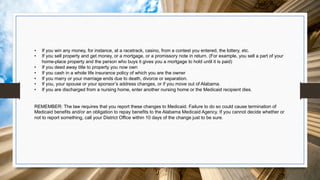
• If you win any money, for instance, at a racetrack, casino, from a contest you entered, the lottery, etc.
• If you sell property and get money, or a mortgage, or a promissory note in return. (For example, you sell a part of your
home-place property and the person who buys it gives you a mortgage to hold until it is paid)
• If you deed away title to property you now own
• If you cash in a whole life insurance policy of which you are the owner
• If you marry or your marriage ends due to death, divorce or separation.
• If you, your spouse or your sponsor’s address changes, or if you move out of Alabama.
• If you are discharged from a nursing home, enter another nursing home or the Medicaid recipient dies.
REMEMBER: The law requires that you report these changes to Medicaid. Failure to do so could cause termination of
Medicaid benefits and/or an obligation to repay benefits to the Alabama Medicaid Agency. If you cannot decide whether or
not to report something, call your District Office within 10 days of the change just to be sure.
MEDICAID ESTATE RECOVERY
Federal law requires states to recoup money spent for some Medicaid services, and the rules implementing this required federal
recoupment vary from state to state.
In Alabama Medicaid Estate Recovery is required from the PROBATE ESTATE for the following expenditures:
• Benefits that were not paid correctly to a person of any age (resulting in what is known as an overpayment)
• Benefits paid after age 55 for nursing home Medicaid
• Benefits paid after age 55 for home and community based waiver services
• Benefits paid for hospital and drugs for persons who received those benefits in connection with nursing home or waiver
services after the age of 55
• Expenditures for services received after age 55 for SSI eligible persons who qualify for Medicaid in the community
The provider, attorney, personal representative, sponsor or case manager is asked by Medicaid to contact Alabama Medicaid
Agency’s Estate Recovery section to provide notification of a recipient’s death within 30 days of the death. Upon notification of
death, Medicaid will send a questionnaire to the next of kin to ask about property the decedent owned at the time of death. Those
handling the estate of the decedent who formerly drew benefits have always been under a duty to treat Medicaid as they would any
creditor and notify the agency of intent to distribute the estate, but that requirement is now more stringent, and all estates are
subject to notice.
As of 09/01/19 all estates filed in Alabama notify Medicaid to give the agency an opportunity to review its records to determine if
the estate may be subject to estate recovery. This is true for probating wills, administering estates and filing for Small Estate
(Summary) Distribution, and the notice is required whether the decedent ever received Medicaid or not. The agency will have 30
days to file any claim it may have against the estate.
CONTRACTING FOR SERVICES
In compliance with federal law, the Alabama Medicaid Administrative Code states that nursing facilities must not require a
third party guarantee of payment to the facility as a condition of admission, or expedited admission, or continued stay in the
facility.
Nursing facilities may require an individual who has legal access to a resident's income or resources available to pay for
nursing facility care to sign a contract, without incurring personal financial liability, to provide facility payment from the
resident's income or resources.
Likewise the Administrative Code for the Alabama State Board of Health – Division of Licensure and Certification states:
“Medicare/Medicaid facilities must not require a third party guarantee of payment to the facility as a condition of admission
or expedited admission, or continued stay in the facility. However, the facility may require an individual who has legal access
to a resident's income or resources available to pay for facility care to sign a contract, without incurring personal financial
liability, to provide facility payment from the resident's income or resources.”
In the case of KNIGHT v. JOHN KNOX MANOR, INC. 92 So.3d 111 (Ala. Civ. App. 2012) states that a lower court judgment
in favor of a nursing home on its breach of contract and conversion claims was reversed; admission contract imposing
personal liability on appellant for payment of his mother’s charges was unenforceable.
For additional protection an agent should always sign in a representative capacity:
Resident’s name by Agents name as POA/or Agent, etc.
Federal and state law provides that nursing home (rehabilitation facility) admission agreements and addendums:
• Cannot require the resident to waive his/her rights included under the federal regulations and other protections under state
or local nursing home law, nor can the agreement and addendums contradict federal or state laws/regulations.
• Cannot require or request the resident waive his/her rights to Medicare or Medicaid. (example: the nursing home cannot
request or require residents agree to not apply for Medicaid until the resident has first privately paid for a certain period of
time.
• Cannot require as a condition of admission (or continued residency) the resident enter into a binding arbitration
agreement. Entering into an arbitration agreement means you waive your right to pursue legal action in the court system if
you are harmed.
• Cannot waive (or request the resident waive) its liability for loss of resident personal property. The law requires nursing
homes to “exercise reasonable care for the protection of the resident’s property from loss or theft.”
• Cannot include financial guarantees. (Nursing homes cannot request a third party guarantee of payment. This means
family or friends who co-sign the agreement cannot be financially responsible, however, nursing homes may request and
require a resident representative who has legal access to a resident’s funds and resources (i.e. Power of Attorney) pay for
care out of the resident’s funds without being held financially liable. Caution, while a Power of Attorney may not be directly
financially liable to the nursing home under the admissions agreement, the Power of Attorney may be liable for failure to
provide for payment from the resident’s funds where he/she breaches a fiduciary duty.
NURSING HOME AGREEMENTS
• Cannot require residents to deposit personal funds with the nursing home. Every resident (unless pursuant to a court order)
has the right to manage his/her financial affairs. While a nursing home cannot require residents deposit personal funds
with the facility, a resident may choose to do so through written authorization. Typically found in addendums, nursing
homes will request that the resident agree to allow the nursing home to become his/her Representative Payee for Social
Security. This means the resident will lose the ability to manage his/her Social Security payments. The nursing home
cannot require a resident (or a resident representative) do this.
• Arbitration agreements must not be used as a condition of admission to a nursing home or as a requirement for a resident
to continue to receive care at the facility; Nursing homes must explicitly inform the resident or resident representative it is
his/her right to not sign the agreement (this language must also be in the agreement); The agreement must explicitly grant
residents the right to rescind the agreement within 30 days of signing it; provide for the selection of a neutral arbitrator
agreed upon by both parties; provide for the selection of a venue that is convenient to both parties; not contain any
language that prohibits or discourages the resident (or anyone else) from communicating with federal, state or local officials
(including surveyors, and representatives of the Office of the State Long-Term Care Ombudsman)
Review admission agreement and addendums carefully. You have the right to cross out provisions you do not agree with or are
otherwise improper. If you have questions about anything, ask. The nursing home is required to explain the terms of its
agreement and addendums. Delaying signing the agreement enables the resident to review the agreement carefully, dispute
positions, and perhaps secure counsel to review the paperwork. Once in the nursing home, there are only limited reasons a
nursing home may transfer/discharge a resident. Failure to sign the admissions agreement is not one of them.

The Medicaid Application Process

  • 1.
    THE MEDICAID APPLICATIONPROCESS FOR INSTITUTIONAL COVERAGE JAN NEAL LAW FIRM, LLC
  • 2.
    Jan Neal Jan NealLaw Firm, LLC 207 N 4th St Opelika, AL 36801 (334) 745-2779 800-270-7635 neal@janneallaw.com www.janneallaw.com https://www.facebook.com/janneallaw @janneallawllc www.linkedin.com/in/jboydneal These slides will be made available after the presentation through the Jan Neal Law Firm, LLC, Slideshare account and the Jan Neal Law Firm, LLC, Facebook page. This publication contains general information for educational purposes only. No attorney client relationship is intended or established by providing this information. All persons accessing this information are encouraged to seek legal representation before relying on information provided here for specific purposes and legal planning. Because laws change over time, it is important to recognize that this publication is effective April 20, 2021, but may become outdated in part after that time.
  • 3.
    In this presentationwe will examine the following issues related to the Alabama Medicaid application process: • Nursing Home Placement • Medical, Income and Resource Eligibility for Medicaid • Medicaid Transfer Penalties • Application Mechanics (including care facility contracts) • Post Eligibility Concerns • Medicaid Estate Recovery OVERVIEW
  • 4.
    • Provide atool for reference concerning application for institutional Medicaid • Teach you how to spot issues • Help you determine the issues where you need to get help • Help you avoid obvious mistakes that result in Medicaid ineligibility GOALS
  • 5.
    STATE LAWS DIFFER Medicaidis a joint federal and state program, so there are some rules that every state must follow in order to receive funding. But each state has significant leeway in administering its individual program. Resources that may count for eligibility purposes in one state may not count in another; what an applicant can do in one state will not be permitted in another. States use functional assessment tools in order to determine if a person meets a nursing facility level of care, and even a finding of medical eligibility may differ from one state to another. The same is true for Medicaid Estate Recovery. Property that would be subject to Medicaid’s claim for reimbursement of funds spent on care might be protected in another state because the estate recovery laws vary tremendously from state to state. Even with issues that are federal requirements, often states interpret the federal law in differing ways. When this happens, the claimant may believe that federal rules were not followed requiring the claimant to file a lawsuit to challenge the state’s interpretation of the law as written.
  • 6.
    PLANNING FOR INSTITUTIONALIZATION Oneof the most stressful events for any caregiver is arranging for long-term care. It is especially hard to arrange for a nursing home placement while trying to determine how to pay for that care and whether any governmental assistance will be available. It can be a complete shock to learn the high cost of nursing home care, and how complicated it is to apply for governmental assistance through Medicaid. Even with legal help, which can help considerably, the caregiver must gather all of the financial records needed to establish eligibility. Often there was no prior planning, and, as a result, family members (such as spouses, children, extended family members) and assisting professionals – find themselves trying to locate financial documents to provide information required to complete the Medicaid application. This is one reason why the application process is so hard. The person who may have known where these documents are is usually unable to participate in locating necessary information due to illness. For one person to conduct business for another there must be documented authority to act, even in many situations for a spouse to plan for another. It is not at all unusual to see a person with no legal authority completing a Medicaid application for a sick relative, and that works fine until liquidating an asset, providing a lien or establishing a Medicaid Qualifying Income Trust becomes necessary. Then legal authority is needed. For this reason any person who may be at risk for nursing home placement needs to have a durable power of attorney established to name the agent to act for him or her if he or she cannot act independently.
  • 7.
    FINDING A NURSINGHOME Alabama Public Health Database can be accessed at http://dph1.adph.state.al.us/FacilitiesDirectory/(S(055uosbpzjmwozuawfzpdern))/default The Medicare.gov database can be accessed at https://www.medicare.gov/care-compare/?providerType=NursingHome&redirect=true#search Another resource to locate nursing homes in your area is at: https://elderguide.com/ For Medicaid to pay, a claimant must be be in a facility certified to participate in the Medicaid program. If a facility accepts Medicaid for payment, Medicaid’s quality of care regulations apply to all residents, even those privately paying.
  • 8.
    SPECIAL FOCUS FACILITIES TheCenters for Medicare & Medicaid Services (CMS) provides a list of “special focus facilities” (SFF) on its website. SFFs are nursing homes that have a history of serious quality issues or are included in a special program to work toward improvements in their quality of care. As of March 16, 2021, CMS records list the following Alabama facilities: SFF status: Ahava Healthcare of Alabaster, Alabaster, AL On that same date the candidate list (potential SFFs) include the following Alabama facilities: Attalla Health and Rehab, Attalla, AL Diversicare of Foley, Foley, AL Diversicare of Pell City, Pell City, AL Merry Wood Lodge, Elmore, AL Village at Cook Springs Skilled Nursing Facility, Pell City, AL
  • 9.
    We need tobriefly cover Medicare’s role in payment for nursing home care since many people are convinced that Medicare will pay for 100 days of nursing home care. Medicare will pay for the first 20 days of care in a nursing home if the patient has a three day prior hospitalization and is admitted to a nursing home within 30 days and requires skilled care. While the Medicare literature does indicate that Medicare pays for up to 100 days of nursing home care, the reality is that if the patient continues to have skilled care ordered by the doctor, on day 21 a co-payment of $185.50 (for 2021) per day begins and must be paid through the 100 days. There are some Medigap policies that will cover this co-payment, but they are the more expensive plans. It is not at all unusual for people to think that Medicare will pay for long-term care, and the reality of Medicare’s limited assistance comes as a shocking realization. For this reason, it is crucial for people to understand the limited help offered by Medicare and to focus on qualification for Medicaid when nursing home care is the long- range plan. MEDICARE LIMITATIONS
  • 10.
    People often thinkthat an application can be submitted in advance of placement, but it cannot. Some nursing homes, however, do have potential residents complete a Medicaid application to screen for eligibility. A Medicaid application cannot be approved until an applicant is institutionalized for 30 continuous days, and, if the resident met all requirements for the preceding three months prior to the application being filed, retroactive eligibility for those months also may be established. The exception is an SSI recipient who is automatically eligible for nursing home Medicaid. There are occasional cases where a person dies before being institutionalized for 30 days, and no Medicaid payment is ever made. TIMING THE APPLICATON
  • 11.
    Medicaid is theprimary single insurer for long-term care in Alabama covering roughly 65 to 75 percent of nursing home residents. According to Genworth, the median cost of nursing home care in Alabama in 2020 was $6540 per month for a semi-private room and $6911 for a private room. Nursing home costs exceeded that in many areas of the state, but using Genworth’s median cost of care across Alabama, a private pay resident in 2020 paid $78,500 - $83,000 per year for nursing home care. Medicaid becomes an essential benefit when you realize that few people can afford an extended stay in a nursing home at private pay rates. FINANCIAL IMPORTANCE OF MEDICAID
  • 12.
    GENERAL ELIGIBILITY REQUIREMENTS AlabamaGeneral Eligibility Requirements for Nursing Home Medicaid Benefits require the following: • File a written application with the Alabama Medicaid Agency, on Medicaid Form 204/205 available online as a paper copy to print and fill out at https://medicaid.alabama.gov/documents/9.0_Resources/9.4_Forms_Library/9.4.1_Applicant- Recipient_Forms/9.4.1_Form_204-205_EnD_App_1-14-21.pdf or to fill online and print at https://medicaid.alabama.gov/documents/9.0_Resources/9.4_Forms_Library/9.4.1_Applicant- Recipient_Forms/9.4.1_Form_204-205_EnD_App_1-14-21_Fillable.pdf • Be a U. S. citizen or qualified resident alien. • Be an Alabama resident. • Have a certified medical need for nursing home care. • Meet income eligibility requirements. • Meet asset/resource eligibility requirements.
  • 13.
    ALABAMA RESIDENCY A claimantmust be a resident of Alabama during the period covered by application and must indicate intent to remain in Alabama. If incapable of stating intent, the state of residence is the state where the claimant is living. There is no waiting period to establish residency in Alabama to qualify for Medicaid benefits. If an applicant is a resident of Alabama but their Medicaid has not terminated in another state, it does not prohibit them from applying for and being approved for Alabama Medicaid. It is the other state’s responsibility to terminate their coverage. The other state’s failure to do so will not prevent the applicant from having access to medical coverage and services in the state where they currently reside.
  • 14.
    MEDICAL ELIGIBILITY To bemedically eligible for Medicaid to pay for long-term care a doctor must certify that nursing care is required on a daily basis, in a nursing facility on an inpatient basis and under the supervision of a RN and under the general direction of a physician. The nursing facility will submit the medical information to Medicaid. The Alabama Administrative Code lists specific services that a resident might require, two of which are needed for an initial admission. These services include: • administration of a potent and dangerous injectable medication and solutions on a daily basis or administration of routine oral medications, eye drops or ointment; • restorative nursing procedures such as gait training, bowel and bladder training; • nasopharyngeal aspiration requirement for maintenance of a clear airway; • maintenance of tracheostomy, gastrostomy, colostomy, ileostomy and other tubes; • feeding tubes; • Pressure ulcers or other widespread skin disorders; • observation of unstable medical conditions; • use of oxygen on a regular or continuing basis; • application of dressing involving prescription medications; comatose condition; • assistance with at least one defined activity of daily living (transfer, mobility, eating, toileting, expressive and receptive communication, orientation, medication administration).
  • 15.
    Medicaid residents whoare discharged to a hospital and have had no break in institutional care since discharge from a nursing home and residents re-admitted in less than 30 days after being discharged into the community must meet only one of the service requirements. Persons admitted to a nursing facility as a private pay resident in spend down status with no break in institutional care for more than 30 days who become financially eligible for Medicaid only need one of the service requirements to be medically eligible for Medicaid to pay for nursing home services.
  • 16.
    FINANCIAL ELIGIBILITY To qualifyfor institutional Medicaid the applicant must be financially eligible by meeting the limitations set for both Income and Resources. Items received in cash or in kind during a month are counted as income. Items retained as of the first moment of the month following receipt are counted as resources. It is important to distinguish between resources and income to know which rules to use. An item cannot be counted as both income and a resource in the same month.
  • 17.
    INCOME ELIGIBILITY Individual incomeof the applicant must be at or below $2382 per month (in 2021). For a married couple the spouse’s income is reportable but does not count. For Medicaid eligibility purposes, any income from most any source that a Medicaid applicant receives is counted. Examples include pension income, employment wages, rental income, Railroad Retirement benefits, Black Lung benefits, alimony payments, Social Security benefits, withdrawals from an IRA, stock dividends. COVID-19 stimulus checks do not count as income. Another exception is VA Aid and Attendance (A&A), Unusual Medical Expenses (UME), Continuing Medical Expenses (CME), and Housebound Allowance which are not counted in the eligibility step of the budget process for all cases. So if a person’s VA A&A benefits push him over the income limit, a MQIT would not be necessary. SSI does not count as income. SSI recipients are automatically eligible for nursing home Medicaid when they meet medical eligibility requirements. If they own a house that was excluded for eligibility for SSI, it will need to be sold. If countable income exceeds $2382 a Medicaid Qualifying Income Trust (MQIT) will need to be established.
  • 18.
    INCOME ISSUES Medicaid willnot permit an applicant to refuse or decline income. Refusal of income or resources is treated as giving that income or asset away. However, the cost-of-living adjustment for the Alabama Teachers Retirement or State Employees Retirement Pension Plan is an exception to that rule. A person can refuse the cost-of-living increase if such increase negatively impacts Medicaid eligibility. When a couple receives joint income (e.g. a rent check) the income is allocated between the husband and wife in proportion to that which each owns the assets producing the income. Otherwise when a check is received that is not related to an underlying investment, the income is attributed to the name on the check.
  • 19.
    MEDICAID QUALIFYING INCOMETRUST (MQIT/QIT) The MQIT is an irrevocable trust that is signed and a bank account opened in the name of the trust. The applicant’s income is routed for direct deposit into that bank account. If established and funded properly, the applicant can have any amount of income over $2382 without it being a bar to establishing eligibility for Medicaid. Note that while a QIT will qualify a person for Institutional Medicaid when he or she has income over the income limit, this type of trust cannot be used to qualify such a person with excess income for Medicaid to cover Home and Community Based Waiver Services (HCBS). Many banks do not understand the QIT, and some just refuse to open an account named for the trust. They hear the word trust and cannot wrap their heads around the fact that this is only a checking account named for a trust that already exists. Some banks will erroneously require the person opening the account to obtain an EIN from the IRS, and that is not necessary. In some situations when no local bank will open an account named for the QIT, Medicaid can designate a patient account at the facility to receive and disburse the QIT funds, but this is rare since most locations will have one or two banks familiar with this type of account (e.g. in Lee County Bancorp South is good to work with). If the sum of income from both spouses exceeds the income limit, do not be concerned and create a QIT. Only the income of the applicant exceeding $2382 results in the need for a QIT.
  • 20.
    It is notnecessary to route all sources of income into the QIT bank account, though it may make life easier in the long run to do so. It is only necessary to place enough funds into the QIT to bring the non-QIT income level below the $2382 income limit. However, all income from any sources determined to go into the QIT must be deposited into the QIT because Alabama Medicaid will not exempt income that is only partially deposited into the QIT. Example: an applicant has $1900 SS and $700 pension income for a total of $2600. Either income source alone can be directed to the QIT to bring the non-QIT income total below $2382. But if the Social Security is selected, ALL of it must be routed to the QIT, and if the pension income is selected, ALL of it must be routed to the QIT. Timing is important for establishing a QIT. It needs to be in place to receive income exceeding the income limit for any month the applicant/resident requests coverage by Medicaid. It can take 30 to 60 days for direct deposit changes to take effect, regardless of the method you use to make those changes. If you've opened the new QIT bank account, don't close your old account until you're certain your Social Security benefits and other income are being deposited into the new QIT account. For QIT purposes, if income does not get deposited to the new bank account named for the trust (which is often the case the first month the QIT is established), you must move the exact amount of income received from the old account to the QIT account on the next business day. Resources should NEVER be placed in a QIT. Alabama Medicaid Form 262 is a packet including an acceptable trust form to create a MQIT. It can be found at: https://medicaid.alabama.gov/documents/7.0_Providers/7.1_Benefit_Coordination_3rd_Party/7.1.1_Estate_Recovery/7.1.1_Qualifyin g_Income_Trust_Packet.pdf
  • 21.
    PERSONAL LIABILITY When Medicaideligibility has been established, Medicaid figures a budget to determine the amount of income the nursing home resident must pay directly to the nursing home. After that amount is paid Medicaid picks up the difference in that personal liability and the nursing home Medicaid rate for room and board. It is important to remember that during the time a Medicaid application is being considered the resident should pay the estimated liability each month. Medicaid will allow the resident to keep: • The personal needs allowance of $30 per month (also an additional $90 if the resident is eligible for Veteran’s Benefits that are dropped to $90 after eligibility is established); • The spousal minimum monthly maintenance needs allowance (enough money to bring the income of the spouse at home up to $2155); • Family maintenance needs allowance (a similar allowance for minor or dependent adult child, a dependent parent or a dependent sibling of either spouse); • Costs of necessary medical or remedial care not covered by a third party (e.g. Medicare Part B premium). • If a liability amount is available after these deductions, then an offset for non-covered medical expenses can be given. These allowances are made to the extent the resident’s income can cover them.
  • 22.
    MINIMUM MONTHLY MAINTENANCENEEDS ALLOWANCE (MMMNA) Spousal Impoverishment rules allow the spouse remaining at home (known as the Community Spouse) to keep a portion of the institutionalized spouse’s income (an amount deducted in the post-eligibility phase when the personal liability of the applicant is calculated). Both spouses have to agree to the allocation. This rule allows the community spouse to claim from the income of the institutionalized spouse an amount to bring the community spouse’s income up to $2155 per month in 2021 (known as the MMMNA). The MMMNA is recalculated every year and changes are effective in July. Example: Wife’s income is $1200, and Husband’s income is $2500. A QIT works to qualify the Husband for Medicaid (because his income exceeds $2382). MMMNA $2155 -Wife’s Income 1200 Potential allocation for Wife 955 The allocation can only be made if the institutionalized spouse’s income is high enough to cover it from his personal liability.
  • 23.
    It may bebeneficial for a person to apply for Medicaid even when he or she has enough income to pay for nursing home charges if the community spouse will be left with income below $2155. In that case the person with adequate income to pay for a nursing home can apply with a QIT, qualify, and send funds from his or her income home to the spouse as the MMMNA.
  • 24.
    FAMILY ALLOWANCE To calculatethe family allowance payable: Step 1. Deduct the gross income of the family member from the community spouse minimum monthly maintenance needs allowance (MMMNA) standard; Step 2. Calculate 1/3 of the remainder found in Step 1. Step 3. The remainder in Step 2, rounded down to the nearest dollar, is the minimum family monthly maintenance needs allowance used in the post-eligibility calculation to be allocated to the family member. If in excess of the available income, an allowance is not made available. All of these allowances are made to the extent the resident’s income can cover them. It is entirely possible for the patient to exhaust his or her income before paying any personal liability to the nursing home. There is also a Family Monthly Needs Allowance available from the resident’s personal liability for minor or dependent adult children, dependent parents, or dependent siblings of either spouse, who is living with the community spouse and who is an IRS tax dependent.
  • 25.
    RESOURCES Examples of resourcesinclude: • Cash • Mortgages • Cash surrender value of life insurance when face value exceeds $5,000 • Mutual Funds • Promissory Notes • Equity in Real Estate • Checking and Savings • Stocks and Bonds • Loans • Mineral and Timber Rights, etc. • Time Deposits (Certificates of Deposit, Annuities, IRAs, etc.) The First-Of-The-Month Rule requires that a resource determination be made as of the first moment of each calendar month and is applicable to the entire month. A claimant's countable resources on the first day of the month will be counted for the entire month. Therefore, if a claimant has excess resources on the first day of the month, he/she cannot be eligible for Medicaid until the first day of the following month, and then only if his/her resources are at or below the limit on the first moment of that month
  • 26.
    Income received duringthe month that pushes bank balances over $2000 for part of the month will not be a problem as long as those funds are spent back down before the first day of the next month. Remember that funds cannot be considered income and resources at the same time. Funds are either income (if received that month) or resources (if accumulated on the first day of the next month). It is important to recognize that property held in a trust that allows the Medicaid applicant to access and use the property will count for eligibility purposes. The only way a trust can shield assets from being counted is for the trust to be irrevocable, established over five years prior to application AND for the assets to be unreachable by the applicant. Income only from the trust can be available to the applicant by the terms of the trust. Do not confuse this with a Special Needs Trust which is a different tool that can be used to set aside funds to pay for special needs for a disabled person. Many people think that property in a living trust will not be counted for Medicaid purposes, but it will count. A living trust is not irrevocable, and the person creating it has full access to all the assets held by the trust. If you can access resources, Medicaid counts those resources. Retirement funds do not have to be liquidated in some states, but in Alabama they do.
  • 27.
    RESOURCE CALCULATIONS Countable resourcesmust be at or below $2000 to qualify for Medicaid. This is straightforward for a single person to determine whether he or she is currently eligible or whether a spend down of excess resources will be required. For married persons the calculation is more complicated because of the Spousal Impoverishment Rules that allow the community spouse remaining at home to keep some assets to meet his or her needs in the community. This is known as the Community Spouse Resource Allowance (CSRA). In order to determine how much a spouse at home can preserve for himself or herself, a married person applying for Medicaid must provide an inventory of property/assets the couple jointly and individually owned on the "snapshot" date (defined as when the person entered long-term care, which might be when he or she entered a hospital from which a placement was made to a nursing home without a 30 day break in institutional care). From those resources that existed on the snapshot date, the home is protected for the spouse if he or she continues to live there. Besides the home and a vehicle, the community spouse is allowed to keep the first $26,076 (in 2021). If joint assets exceed $52,152, the community spouse can keep one-half up to a limit of $130,380 (for 2021 – use the allowance for the year of institutionalization). This is Community Spousal Resource Allowance. After reserving what can be set aside for the spouse, all remaining funds over $2000 plus the income of the applicant/institutionalized spouse must be spent down by the applicant/institutionalized spouse to become eligible. Note that when a married couple are both institutionalized and both apply, each is treated as an individual rather than as a couple. Treatment as individuals begins as of the first day of the month following the month both are institutionalized. Spousal impoverishment rules do not apply and an assessment of resources will not be conducted because each is evaluated as an individual applicant.
  • 28.
    The first $26,076in countable resources allocated to Community Spouse Resources at or above $52,152 ($26,076 x 2), one-half allocated to the Community Spouse up to a cap of $130,380. When ½ of countable resources > $130,380 (resources exceeding $260,760), all resources above $130,380 are attributed to the Medicaid applicant and require a spend down to $2000. Remember that during spend down the nursing home resident’s income also must be spent down. SPOUSAL RESOURCE ALLOCATION IN A NUTSHELL
  • 29.
    Example One: Acouple has $20,000 in countable assets. The community spouse keeps $18,000 (because all assets are below $26,076), $2000 is assigned to the institutional spouse for his or her resource allowance, and the institutional spouse qualifies for Medicaid without a spend down. Example Two: A couple has $40,000 in countable assets. One-half is $20,000, BUT the spouse keeps the first $26,076. The applicant must spend down the rest above $26,076 except for $2000 ($40,000 - $26,076 = $13,924 - $2000 = $11,924) before qualifying for Medicaid. The institutional spouse spends down $11,924 and his or her income before qualifying for Medicaid. Example Three: A couple has $60,000 in countable assets. The community spouse keeps one-half, $30,000. The applicant must spend down the rest except for $2000 ($60,000 - $30,000 = $30,000 - $2000 = $28,000). The institutional spouse spends down $28,000 and his or her income before qualifying for Medicaid. Example Four: A couple has $300,000 in countable assets. One-half is $150,000, so the cap of $130,380 applies, and that amount only is retained by the community spouse. The applicant spouse must now spend down the rest except for $2000 ($300,000 – 130,380 = 169,620 – 2000 = 167,620). The institutional spouse spends down $167,620 and his or her income before qualifying for Medicaid. EXAMPLES OF SPOUSAL RESOURCE ALLOCATION
  • 30.
    SPOUSAL RESOURCE ASSESSMENT Allresources, whether owned jointly or individually by either spouse, must be combined beginning with the point that a spouse was institutionalized (the Snapshot Date). This often means that people are reconstructing what resources they owned at an earlier date, and that can be confusing. Medicaid can perform an assessment if requested to provide the couple with written instructions on what the community spouse can keep and how much the institutionalized spouse must spend down. The assessment is supposed to be completed at the request of an institutionalized spouse or a community spouse, a representative acting on behalf of either spouse, or at the time of application for Medicaid benefits. A copy of the assessment results (Agency Form 230) is to be provided to each spouse with a copy retained for the case record.
  • 31.
    In situations wherethe community spouse cannot be located, is alleged deceased, or refuses to cooperate with the institutionalized spouse the institutionalized spouse or other person with knowledge of the whereabouts of the community spouse must provide a sworn statement providing the following: • Last known name; • Last known address; • forwarding address at the post office; • last known employment; • circumstances surrounding disappearance; • health of the individual at time of disappearance; • state of mind of the individual at time of disappearance; • efforts to locate; • SSN/VA claim number/other identifying information for the individual; and • if alleged to be deceased, obtain death certificate from the Department of Public Health. Medicaid will follow up on any leads, and, if possible, verify financial accounts, property, and employment. Spousal refusal is when a spouse simply refuses to reveal his or her resources.
  • 32.
    EXCLUDED PROPERTY When applyingfor Medicaid, all property counts unless it is specifically excluded. While some property is totally excluded, some property can be excluded and a lien taken, and some property can actually be transferred without creating a penalty. Some excluded resources include the following: • Household goods and personal effects • One automobile • The home for the community spouse as long as he or she lives there (no lien can be taken) • The home if a dependent relative other than a child under 21, blind or disabled lives there (a lien may be taken) • The home if a dependent child who is under 21, blind or disabled lives there (no lien may be taken and the property may be transferred without penalty) • The home if a sibling with an equity interest lives there and was lawfully residing in the home for at least one years immediately prior to the applicant being admitted to the medical institution (no lien may be taken and property may be transferred without penalty) • The home if the applicant has a reasonable intent to return home (a lien may be taken but dissolves if the patient actually does return home) • Real property where a joint owner lives for whom sale of the property would cause a loss of housing (a lien may be taken) • Property essential to self-support used in trade or business regardless of its value or rate of return • Up to $6000 equity value in income producing property (remaining equity is a countable resource) • Life estates (value does not count and no transfer penalty if the deed dates back prior to five years from application)
  • 33.
    • Assets heldin a special needs trust • Real property the applicant is making a bona fide effort to sell (a lien will be taken) • Term life insurance with no cash surrender value • $5000 titled for burial or designated in a Statement of Claimant form • Prepaid burial funds worth $5000 (in calculating the amount invested, do not count the space items such as plot, marker, casket, vault, opening and closing the grave which are completely excluded as a resource) • Face value of life and burial Insurance policies that have a combined face value of $5000 or less (the face value is a countable resource but may be excluded when designated for burial) • Cash surrender value of life and burial insurance policies that have a combined face value exceeding $5000 where up to $5000 is designated for burial (the amount not designated for burial is treated as a countable resource) • Proceeds paid by a long-term care Partnership Policy (for each dollar of benefits paid one dollar of assets is not counted toward the eligibility limit).
  • 34.
    Insurance companies inAlabama issue long-term care (LTC) insurance policies known as Partnership Policies which must meet specific requirementsoutlined in the Deficit Reduction Act of 2005 to contain consumer protection and inflation provisions. There is a financial incentive to purchasing a Partnership Policy in Alabama. In determining eligibility, Medicaid will allow the insured individual to disregard resources in an amount equal to LTC insurance benefits paid by a Partnership Policy for LTC services received. To qualify for this resource exclusion, the insurance benefit payments may have been made for any LTC services received (including those not usually covered by Medicaid) for any length of time in any long-term care setting. Resources excluded in determining Medicaid eligibility under this provision will also be exempt from estate recovery. Alabama requires LTC policies to offer graduated coverage in different settings by prohibiting the sale of long-term care insurance policies which provide ONLY nursing home care. A comprehensive shopper’s guide to long-term care insurance written by the National Association of Insurance Commissioners in 2019 is available at https://www.naic.org/documents/prod_serv_consumer_ltc_lp.pdf And For more about what qualifies as a Partnership Policy see the Alabama Department of Insurance resources at https://www.aldoi.gov/Consumers/LongTermPartnership.aspx LONG-TERM CARE PARTNERSHIP POLICIES
  • 35.
    MEDICAID TRANSFER PENALTIES Medicaidlooks back at all financial transactions for 5 years prior to application, and all gifts or sales of property for less than the value assigned by Medicaid is added and divided by $6400 (in 2021) to determine the months of ineligibility for Medicaid that will be assessed. The penalty begins to run when the person is institutionalized and would otherwise be eligible if it were not for the transfer. Example: A second home valued at $175,000 is transferred to a child in January 2017. The parent applies for Medicaid in January 2020 (within five years). A penalty of 27.34 months (175,000 ÷ 6400) would be imposed. That penalty would not begin to run until the parent is in the nursing home and has used all of his resources and, but for the transfer, would be eligible for Medicaid. That means someone will have to privately paying for care for over two years during the time the penalty runs. Gifting is not just giving away property. It is any transfer of an asset for less that the value assigned by Medicaid. An example might be selling a home for less than the tax assessor’s appraised value. Often people trying to sell property will reduce the price to unload the property, and this is fine unless the owner is, or may become, a Medicaid applicant within five years. A better plan is to have the property reassessed or to obtain a commercial appraisal if the tax appraised value is over one year old. A house sold for $35,000 when the tax assessors appraised value is $52,000 will be a $17,000 uncompensated transfer and result in a 2.65 month penalty. See more on selling property on Slide 37. Be careful of application timing: A person gives away $350,000 in March 2015. He has a stroke in December 2019 and is placed in a nursing home. If he applies for Medicaid in January 2020, a 54.68 month penalty will be assessed, and he won’t be eligible for Medicaid until August 2024. If he had waited until April 2020 to apply he would have qualified with no penalty because he was past five years from when he gave away the money.
  • 36.
    If property hasbeen transferred it can be returned to eliminate the transfer, but credit given depends on when the asset is returned during the application process: If the return occurs after the initial application (once eligibility has been established and the penalty has been imposed), the assets must be returned in its entirety for a single full month to negate the transfer. But prior to the imposition of the penalty the claimant will be credited with any amount returned, so a partial return can result in a reduction of the transfer penalty that will ultimately be imposed. Example: You transfer $50,000 on January 16, 2021, and apply for Medicaid in February. If the penalty has not yet been imposed, you can return $25,000 of the money and cut the penalty in half. If the penalty has been imposed, all of the $50,000 must be returned to eliminate the penalty. Beware that the way the penalty for transfers work to determine when you are outside the five year look back period. It is necessary to calculate five years and then make it to the first day of the next month. Example: A person gives away $100,000 on March 17, 2016. Five years ends on March 18, 2021, however to be outside the time a penalty can be imposed, it is necessary to reach April 1, 2021.
  • 37.
    Valuation of realproperty is established by the tax assessor’s appraised value. People often experience transfer penalties for selling property for less than the tax assessor’s appraised value. In the case of real property, the current market value of the property, for Medicaid eligibility purposes, is the tax assessor’s appraised value (TAAV) of the property established by the current tax assessment notice from the tax assessor's office in the county in which the property is located. This appraised value will be used unless the tax assessment: • Is more than one year old; • Is a special purpose assessment; • Is under appeal; • Is based on a fixed rate per acre method; • Does not provide an appraised value or an assessment ratio for determining such value. Only if one of the above conditions exists, other evidence, such as appraisals or estimated from knowledgeable sources, may be used to establish current market value. When property has been sold for less than the tax assessor’s appraised value the lower value sale may be challenged by a realtor showing that the condition of the property required a lower sales price to prove to Medicaid that the property was not sold for less than fair market value. An example might be that the property was listed for less than the TAAV because the cost of needed repairs met or exceed the difference between the tax appraised value and the offered lower value, and if proven to Medicaid’s satisfaction, the sale may be approved with no penalty. REAL ESTATE VALUATION
  • 38.
    Permissible transfers arethose allowed by law resulting in no penalty being imposed. Property that can be transferred without creating a penalty include: • Home when a child under 21, blind or disabled lives there • Home when a sibling with an equity interest was residing there for at least one year prior to the institutionalization • Home when a son or daughter of the claimant who was residing in the applicant’s home for a period of at least two years immediately before the date of applicant’s admission to the medical institution or nursing facility, and who provided care to the claimant which permitted him or her to reside at home rather than in an institution or facility • Transfers of money into a Special Needs Trust • Resources transferred to (or to another for the sole benefit of) the community spouse, or the claimant's child who is blind or permanently and totally disabled. All funds transferred must be spent only for the benefit of the spouse or the child who is blind or permanently and totally disabled within a time frame actuarially commensurate with the life expectancy of the beneficiary. No other individual or entity can benefit from the assets transferred in any way, whether at the time of the transfer or any time in the future. PERMISSIBLE TRANSFERS
  • 39.
    CAREGIVER AGREEMENTS A PersonalService Agreement is a legally enforceable written agreement for personal care services to be provided in exchange for anything of value. While the regulations will permit Medicaid to treat payments for caregiver services as a transfer without proper documentation, the agency is less strict about non-relative caregivers. In the case of paid relative caregivers, the agency requires a caregiver agreement. Otherwise, a transfer of assets is presumed to have occurred at the time of the exchange and a transfer penalty shall be imposed unless all of the following are met: • At the time of the receipt of the services, the services were recommended in writing and signed by the applicant’s physician, as necessary to prevent the admission of the applicant to a nursing facility. Such services may not include the providing of companionship and related services; • At the time of the receipt of the services, the applicant was not residing in a nursing facility; • At the time of the receipt of the services, the transfer of the consideration (money and/or property) to the provider/relative occurred; and • At the time of the receipt of the services there already existed a written and signed agreement executed between the applicant and provider for the specific service(s) rendered.
  • 40.
    Caregiver agreement requirementsfurther include the following: • The caregiver agreement must fully describe the type, frequency and duration of the services being provided to the applicant in such a way that they can be documented when provided; and the amount of consideration (money and/or property) being received by the provider/relative • The caregiver agreement must provide that the amount of consideration (money and/or property) cannot exceed the fair market value for that rendered service(s). Rates for these services must be shown to be comparable to the usual and customary rates in the local area. The fair market value of the services may be determined by consultation with an area business which provides such services. • Services that are provided pursuant to a valid personal services agreement must be documented with time sheets and attendance logs for each hour of services provided. Contracts cannot provide for a “lump sum” payment regardless of the services that are to be provided, as each service must be individually documented to be justified. • Payment must only be for actual services rendered. Any reimbursement for out-of-pocket expenses incurred by the caregiver must be documented by a receipt
  • 41.
    CONVERTING COUNTABLE RESOURCESINTO EXCLUDED RESOURCES If a person needs to spend down a certain amount of money to qualify for Medicaid, it makes perfect sense to use that money instead to convert it into non-countable resources or put it to use toward reducing the community spouse’s monthly income needs. Examples might be: • Paying off debt on a vehicle • Paying off credit card debt • Making needed home repairs • Paying off a mortgage • Purchasing pre-paid burial arrangements • Using money to fund a Special Needs Trust
  • 42.
    LIFE ESTATE DEEDS Alife estate is a form of joint ownership that allows one person to remain on property until his or her death, at which time it passes to the other owner, referred to as the person with the remainder interest. Life estates can be used to avoid probate while giving a house to children without losing the ability to live in the home, remaining responsible for property tax (with the benefit of homestead and age-related tax exemptions), remaining responsible for homeowner insurance, yet creating ownership in the children at the death of the parent. This type of deed can play an important role in Medicaid planning since Medicaid does not assign any value to a life estate when the parent applies for Medicaid to pay for nursing home care. If the transfer occurred prior to five years before application, there will be no penalty for the transfer. Further, purchasing a life estate should not result in a transfer penalty if you buy a life estate in someone else’s home, pay an appropriate amount for the property (determined by Life Estate and Remainder Tables at 26 C.F.R. §20.2031.7) and live in the house for more than a year. For example, an older man who can no longer live in his home might sell the home and use the proceeds to purchase a life estate interest in his child’s existing home. Assuming the father lives in the home for more than a year and he paid a fair amount for the life estate, the purchase of the life estate should not be a disqualifying transfer for Medicaid.
  • 43.
    SPENDING DOWN WITHA SPECIAL NEEDS TRUST (SNT) Special Needs Trusts in a long-term care setting are particularly useful in accomplishing spend down while acquiring additional resources for the long-term care resident. There are many types of Special Needs Trusts (SNTs), including trusts for disabled younger persons, disabled children whose parents and grandparents want to provide for their future needs, persons on public benefits who recover money from personal injury lawsuits or who inherit money when a relative dies. Each type of SNT has highly specific requirements and responsibilities. But what they all have in common is the goal of protecting funds for a disabled person without those funds resulting in the loss of public benefits. In a long-term care setting an applicant can create a SNT. Instead of spending down the money required to be spent by Medicaid on nursing home care before eligibility can be established, the money is paid into a SNT and can then be used to pay for special needs not otherwise paid for by Medicaid for the disabled person once he or she becomes eligible. Medicaid eligibility can be immediately established while these funds remain available to pay for special needs for the nursing home resident such as a private room in a nursing home (since Medicaid will only cover a semi-private room), sitters, and items items and services that can improve the quality of life for the nursing home resident. This could be hair salon charges, manicures, telephone, newspaper, subscriptions, audiobooks, movies, recreation, medical and dental expenses not otherwise covered, special equipment like wheelchairs or specially-equipped vans, therapy or rehabilitation services, training and education, travel, electronic equipment including computers and mobile devices. Another incredibly useful expenditure from a SNT is payment for nursing home charges during a penalty period. For instance, if money was transferred earlier creating a penalty period, money placed without penalty into a SNT can be used to pay for care to get the resident through the penalty period.
  • 44.
    The drawback tothis type of SNT is the requirement that, on the death of the person for whom the trust was established, Medicaid must be reimbursed from funds remaining in the trust up to the amount Medicaid has paid for the nursing home resident’s care. Still, creating a pool of money to meet the special needs of the nursing home resident after being awarded Medicaid is far better than simply spending down those funds before qualifying for Medicaid and leaving the resident with no resources to pay for special needs. Since Medicaid allows a nursing home resident to keep only $30 of his or her income each month to pay for personal needs, you can see how that is not enough to have needs met without families pitching in to help pay for necessary items. If the resident dies with money left in the trust after the Medicaid payback, an alternate beneficiary is named to take the remaining funds.
  • 45.
    THE APPLICATION A linkto the application can be found on Slide 11. I strongly recommend the fillable form due to its neatness and ease to read when typed. An application easy to read referencing attachments (e.g. see A attached) is more likely to keep the applicant organized and result in a faster approval time for the Medicaid worker reviewing the application. If you complete the form by hand, it must be completed in ink, not pencil. The resident can sign the application if well enough to comprehend, but usually someone with power of attorney/ court appointed guardianship or conservatorship or a relative (referred to as sponsor) completes the application. Due to the complex nature of the application, someone familiar with the applicant’s business will need to gather all the information and documentation to complete the application. An Appointment of Representative form can be downloaded at https://medicaid.alabama.gov/documents/9.0_Resources/9.4_Forms_Library/9.4.1_Applicant- Recipient_Forms/9.4.1_Form_202_Appoint_Representative_9-12-14.pdf This form is used when the Medicaid applicant cannot sign his or her own application. It can be used by the applicant (if capable of signing) or a person with legal authority to act for the claimant or one without legal authority when the claimant cannot sign. It can be used to appoint an individual or attorney to represent the claimant.
  • 46.
    INFORMATION NEEDED Gather allfinancial records for the preceeding five years. Medicaid suggests you gather: • If applicant has ever been married, the Spouse’s Name, Social Security Number, and, if a Veteran, the VA Claim Number • Copies of Medicare and Social Security cards • Verification of the gross (before anything is taken out) amount of Social Security, Veterans Administration, Railroad Retirement, Civil Service checks, private pension checks, rental income and annuities. (Verification should include claim and/or identification numbers.) • Verification of CDs, IRAs and Savings Bonds • Verification of stocks, bonds and mutual funds • Copies of deeds to property currently owned (including heir property, life estate, etc.) • Purchase and sale deeds to property which has been sold or transferred within the past five (5) years • Copies of trusts, mortgages, loans, and promissory notes • Copies of all insurance policies, including life, burial, funeral, vault, casket, cash, term and/or group Long Term Care policies, health, hospital, and/or cancer policies. (A copy of the card or premium notice and copy of payment method is needed) • Copies of pre-need/prearranged burial contracts, including an itemized list of charges. • Verification of gross wages (amount before anything is taken out) • Copy of power of attorney, letters of guardianship/conservatorship
  • 47.
    The application forMedicaid warns the applicant and sponsor that Alabama law makes it a felony to defraud or deceive Medicaid in the application process through false statements or omission of material facts punishable by a fine of not more than $10,000 or imprisonment for not less than one nor more than five years or both. False information may also result in loss of eligibility and a bar from future eligibility for not less than a year and until full resititution has been made to Medicaid. LEGAL CONSEQUENCES OF FRAUD
  • 48.
    FILING THE APPLICATION Applicationsare filed at the Medicaid District office that serves the county where the applicant lives. District offices are listed here: https://medicaid.alabama.gov/content/10.0_Contact/10.1_Medicaid_Contacts/10.1.1_Medicaid_Locations.aspx Always keep a copy of the original application you submit to Medicaid. Send copies of all other documents, do not send your original documents except for proof of citizenship or identity, if required. Proof of citizenship and identity is not needed if you are currently receiving SSI benefits or are entitled to or enrolled in Medicare. If additional information is requested, make sure you supply the information as soon as possible and definitely within the window requested by Medicaid. If additional time is needed, get that time approved by the caseworker requesting the information. When nursing homes assist with completion of the application it can be uploaded online.
  • 49.
    WHEN TO EXPECTAPPROVAL A Medicaid application cannot be approved until an applicant is institutionalized for 30 continuous days. If a person dies before being institutionalized for 30 days, and no Medicaid payment is ever made. When awarded, Medicaid goes back to the month of application and sometimes up to three months prior to that time. RETITLING ASSETS In the case of a married couple it is necessary to remove the Medicaid recipient spouse’s name from resources set aside for the community spouse before a year passes and the case is up for review. DUTY TO CLAIM AGAINST ESTATE OF SPOUSE If a spouse should die owning resources the nursing home resident is required to claim any amount he or she could from the estate of the deceased spouse. If that does not happen a transfer penalty can be imposed. That is generally at least $37,500 ($15,000 for homestead allowance, $7500 for personal property allowance and $15,000 for family allowance). It could exceed this amount, so legal advice would be needed to determine the amount the nursing home resident is entitled to from the estate of his or her deceased spouse. POST ELIGIBILITY CONCERNS
  • 50.
    VA REDUCTION OFPENSION A veteran who begins to receive nursing home care will have his or her monthly pension payment reduced to $90 if: • the veteran has no dependents • the veteran is living in a Medicaid-approved nursing facility, and • the nursing home care is paid for by Medicaid. ESTATE RECOVERY See slide 53. When the application is completed the applicant is warned that the estate of the applicant is subject to estate recovery for funds spent by Medicaid for his or her care. APPEALS An appeal of an adverse determination must be filed within 60 days of determination
  • 51.
    APPLICANT OR RECIPIENT’SRESPONSIBILITY TO REPORT CHANGES If you report a change in your situation to the Social Security Office, you must also report the change to Medicaid. It is your responsibility to notify the Medicaid District Office of any changes, such as the following: • If the value of your countable resources goes over the legal limit for the Medicaid program for which you were approved. (For example, interest on your bank account makes the balance go over the limit or the county changes the assessment on land you own, and it is worth more) • If someone puts your name on a bank account, on bonds, on the title of property, or on anything else. (For example, your brother puts your name on his accounts for emergencies) • If you start getting any type of check or money. (For example, you start getting a VA or Social Security check, or you get a job and receive wages) • If there is a change in the amount of any check you now get, or a change in the amount of money you get. (For example, the rent you receive on a rental property increases or decreases, or you get an increase or decrease in your Social Security, VA or pension check) • If the amount of your health insurance premium increases or decreases or if you stop paying the premium • If you are not on Medicare and you start receiving Medicare coverage. • If someone puts money in your checking or savings account. (For example, your nephew puts $75.00 in your checking account as a gift) • If someone dies and leaves you money, any type of property (a house, land, a car or truck) or anything that might be valuable. (For example, an uncle dies and leaves you a house and lot)
  • 52.
    • If youwin any money, for instance, at a racetrack, casino, from a contest you entered, the lottery, etc. • If you sell property and get money, or a mortgage, or a promissory note in return. (For example, you sell a part of your home-place property and the person who buys it gives you a mortgage to hold until it is paid) • If you deed away title to property you now own • If you cash in a whole life insurance policy of which you are the owner • If you marry or your marriage ends due to death, divorce or separation. • If you, your spouse or your sponsor’s address changes, or if you move out of Alabama. • If you are discharged from a nursing home, enter another nursing home or the Medicaid recipient dies. REMEMBER: The law requires that you report these changes to Medicaid. Failure to do so could cause termination of Medicaid benefits and/or an obligation to repay benefits to the Alabama Medicaid Agency. If you cannot decide whether or not to report something, call your District Office within 10 days of the change just to be sure.
  • 53.
    MEDICAID ESTATE RECOVERY Federallaw requires states to recoup money spent for some Medicaid services, and the rules implementing this required federal recoupment vary from state to state. In Alabama Medicaid Estate Recovery is required from the PROBATE ESTATE for the following expenditures: • Benefits that were not paid correctly to a person of any age (resulting in what is known as an overpayment) • Benefits paid after age 55 for nursing home Medicaid • Benefits paid after age 55 for home and community based waiver services • Benefits paid for hospital and drugs for persons who received those benefits in connection with nursing home or waiver services after the age of 55 • Expenditures for services received after age 55 for SSI eligible persons who qualify for Medicaid in the community The provider, attorney, personal representative, sponsor or case manager is asked by Medicaid to contact Alabama Medicaid Agency’s Estate Recovery section to provide notification of a recipient’s death within 30 days of the death. Upon notification of death, Medicaid will send a questionnaire to the next of kin to ask about property the decedent owned at the time of death. Those handling the estate of the decedent who formerly drew benefits have always been under a duty to treat Medicaid as they would any creditor and notify the agency of intent to distribute the estate, but that requirement is now more stringent, and all estates are subject to notice. As of 09/01/19 all estates filed in Alabama notify Medicaid to give the agency an opportunity to review its records to determine if the estate may be subject to estate recovery. This is true for probating wills, administering estates and filing for Small Estate (Summary) Distribution, and the notice is required whether the decedent ever received Medicaid or not. The agency will have 30 days to file any claim it may have against the estate.
  • 54.
    CONTRACTING FOR SERVICES Incompliance with federal law, the Alabama Medicaid Administrative Code states that nursing facilities must not require a third party guarantee of payment to the facility as a condition of admission, or expedited admission, or continued stay in the facility. Nursing facilities may require an individual who has legal access to a resident's income or resources available to pay for nursing facility care to sign a contract, without incurring personal financial liability, to provide facility payment from the resident's income or resources. Likewise the Administrative Code for the Alabama State Board of Health – Division of Licensure and Certification states: “Medicare/Medicaid facilities must not require a third party guarantee of payment to the facility as a condition of admission or expedited admission, or continued stay in the facility. However, the facility may require an individual who has legal access to a resident's income or resources available to pay for facility care to sign a contract, without incurring personal financial liability, to provide facility payment from the resident's income or resources.” In the case of KNIGHT v. JOHN KNOX MANOR, INC. 92 So.3d 111 (Ala. Civ. App. 2012) states that a lower court judgment in favor of a nursing home on its breach of contract and conversion claims was reversed; admission contract imposing personal liability on appellant for payment of his mother’s charges was unenforceable. For additional protection an agent should always sign in a representative capacity: Resident’s name by Agents name as POA/or Agent, etc.
  • 55.
    Federal and statelaw provides that nursing home (rehabilitation facility) admission agreements and addendums: • Cannot require the resident to waive his/her rights included under the federal regulations and other protections under state or local nursing home law, nor can the agreement and addendums contradict federal or state laws/regulations. • Cannot require or request the resident waive his/her rights to Medicare or Medicaid. (example: the nursing home cannot request or require residents agree to not apply for Medicaid until the resident has first privately paid for a certain period of time. • Cannot require as a condition of admission (or continued residency) the resident enter into a binding arbitration agreement. Entering into an arbitration agreement means you waive your right to pursue legal action in the court system if you are harmed. • Cannot waive (or request the resident waive) its liability for loss of resident personal property. The law requires nursing homes to “exercise reasonable care for the protection of the resident’s property from loss or theft.” • Cannot include financial guarantees. (Nursing homes cannot request a third party guarantee of payment. This means family or friends who co-sign the agreement cannot be financially responsible, however, nursing homes may request and require a resident representative who has legal access to a resident’s funds and resources (i.e. Power of Attorney) pay for care out of the resident’s funds without being held financially liable. Caution, while a Power of Attorney may not be directly financially liable to the nursing home under the admissions agreement, the Power of Attorney may be liable for failure to provide for payment from the resident’s funds where he/she breaches a fiduciary duty. NURSING HOME AGREEMENTS
  • 56.
    • Cannot requireresidents to deposit personal funds with the nursing home. Every resident (unless pursuant to a court order) has the right to manage his/her financial affairs. While a nursing home cannot require residents deposit personal funds with the facility, a resident may choose to do so through written authorization. Typically found in addendums, nursing homes will request that the resident agree to allow the nursing home to become his/her Representative Payee for Social Security. This means the resident will lose the ability to manage his/her Social Security payments. The nursing home cannot require a resident (or a resident representative) do this. • Arbitration agreements must not be used as a condition of admission to a nursing home or as a requirement for a resident to continue to receive care at the facility; Nursing homes must explicitly inform the resident or resident representative it is his/her right to not sign the agreement (this language must also be in the agreement); The agreement must explicitly grant residents the right to rescind the agreement within 30 days of signing it; provide for the selection of a neutral arbitrator agreed upon by both parties; provide for the selection of a venue that is convenient to both parties; not contain any language that prohibits or discourages the resident (or anyone else) from communicating with federal, state or local officials (including surveyors, and representatives of the Office of the State Long-Term Care Ombudsman) Review admission agreement and addendums carefully. You have the right to cross out provisions you do not agree with or are otherwise improper. If you have questions about anything, ask. The nursing home is required to explain the terms of its agreement and addendums. Delaying signing the agreement enables the resident to review the agreement carefully, dispute positions, and perhaps secure counsel to review the paperwork. Once in the nursing home, there are only limited reasons a nursing home may transfer/discharge a resident. Failure to sign the admissions agreement is not one of them.