The Manyworlds Interpretation Of Quantum
Mechanics Bryce Seligman Dewitt Editor Neill
Graham Editor download
https://ebookbell.com/product/the-manyworlds-interpretation-of-
quantum-mechanics-bryce-seligman-dewitt-editor-neill-graham-
editor-51959822
Explore and download more ebooks at ebookbell.com
Here are some recommended products that we believe you will be
interested in. You can click the link to download.
The Manyworlds Interpretation Of Quantum Mechanics Lev Vaidman
https://ebookbell.com/product/the-manyworlds-interpretation-of-
quantum-mechanics-lev-vaidman-59155042
The Many Worlds Of American Communism Joshua Morris
https://ebookbell.com/product/the-many-worlds-of-american-communism-
joshua-morris-48674024
The Many Worlds Of Sarala Devi A Diary The Tagores And Sartorial Style
A Photo Essay Sukhendu Ray Bharati Ray Malavika Karlekar Jeevaner
Jharapata
https://ebookbell.com/product/the-many-worlds-of-sarala-devi-a-diary-
the-tagores-and-sartorial-style-a-photo-essay-sukhendu-ray-bharati-
ray-malavika-karlekar-jeevaner-jharapata-33123110
The Many Worlds Of Hugh Everett Iii Multiple Universes Mutual Assured
Destruction And The Meltdown Of A Nuclear Family 1st Edition Peter
Byrne
https://ebookbell.com/product/the-many-worlds-of-hugh-everett-iii-
multiple-universes-mutual-assured-destruction-and-the-meltdown-of-a-
nuclear-family-1st-edition-peter-byrne-5241116
The Many Worlds Of Hugh Everett Iii Multiple Universes Mutual Assured
Destruction And The Meltdown Of A Nuclear Family Peter Byrne
https://ebookbell.com/product/the-many-worlds-of-hugh-everett-iii-
multiple-universes-mutual-assured-destruction-and-the-meltdown-of-a-
nuclear-family-peter-byrne-55997822
The Many Worlds Of Albie Bright Christopher Edge
https://ebookbell.com/product/the-many-worlds-of-albie-bright-
christopher-edge-42701252
The Many Worlds Of Albie Bright Us Edge Christopher
https://ebookbell.com/product/the-many-worlds-of-albie-bright-us-edge-
christopher-9641886
The Many Worlds Of Hugh Everett Iii Multiple Universes Mutual Assured
Destruction And The Meltdown Of A Nuclear Family Peter Byrne
https://ebookbell.com/product/the-many-worlds-of-hugh-everett-iii-
multiple-universes-mutual-assured-destruction-and-the-meltdown-of-a-
nuclear-family-peter-byrne-4920834
Behind The Legend The Many Worlds Of Charles Todd 1st Edition Denis
Cryle
https://ebookbell.com/product/behind-the-legend-the-many-worlds-of-
charles-todd-1st-edition-denis-cryle-51883358
The Many-Worlds Interpretation
of Quantum Mechanics
Princeton Series in Physics
edited by Arthur S. Wightman
and John J. Hopfield
Quantum Mechanics for Hamiltonians Defined as
Quadratic Forms by Barry Simon
Lectures on Current Algebra and Its Applications
by Sam B. Treiman, Roman Jackiw, and David J. Gross
Physical Cosmology by P. J. E. Peebles
The Many-Worlds Interpretation of Quantum Mechanics
edited by B. S. DeWitt and N. Graham
The Many-Worlds
Interpretation
of Quantum Mechanics
A Fundamental Exposition by
HUGH EVERETT, III, with Papers by
J. A. WHEELER, B. S. DEWITT,
L. N. COOPER and D. VAN VECHTEN,
and N. GRAHAM
Edited by
BRYCE S. DEWITT and NEILL GRAHAM
Princeton Series in Physics
Princeton University Press
Princeton, New Jersey, 1973
Copyright © 1973, by Princeton University Press
Ail Rights Reserved
LC Card: 72-12116
ISBN: 0-691-08126-3 (hard cover edition)
ISBN: 0-691-88131-X (paperback edition)
Library of Congress Cataloguing in Publication data will be found on
the last printed page of this book.
The following papers have been included in this volume with the
permission of the copyright owners: "'Relative State' Formulation of
Quantum Mechanics" by Hugh Everett ΙΠ, and "Assessment of Ever-
ett's 'Relative State* Formulation of Quantum Theory," by John A.
Wheeler, copyright July 1957 by The Review of Modern Physics;
"Quantum Mechanics and Reality," by Bryce S. DeWitt, copyright
September 1970 by Physics Today·, "The Many-Universes Interpreta-
tion of Quantum Mechanics," by Bryce S. DeWitt, in Proceedings of
the International School of Physics "Enrico Fermi" Course IL: Foun­
dations of Quantum Mechanics, copyright 1972 by Academic Press;
"On the Interpretation of Measurement within the Quantum Theory,"
by Leon N. Cooper and Deborah van Vechten, copyright December
1969 by American Journal of Physics. The epigraph is taken from
"The Garden of Forking Paths," from Ficciones by Jorge Luis Borges,
copyright 1962 by Grove Press, Inc.; translated from the Spanish,
copyright 1956 by Emece Editores, SA, Buenos Aires.
Printed in the United States of America
by Princeton University Press
PREFACE
In 1957, in his Princeton doctoral dissertation, Hugh Everett, III, pro-
posed a new interpretation of quantum mechanics that denies the exist-
ence of a separate classical realm and asserts that it makes ·sense to talk
about a state vector for the whole universe. This state vector never col-
lapses, and hence reality as a whole is rigorously deterministic. This
reality, which is described jointly by the dynamical variables and the
state vector, is not the reality we customarily think of, but is a reality
composed of many worlds. By virtue of the temporal development of the
dynamical variables the state vector decomposes naturally into orthogonal
vectors, reflecting a continual splitting of the universe into a multitude of
mutually unobservable but equally real worlds, in each of which every
good measurement has yielded a definite result ahd in most of which the
familiar statistical quantum laws hold.
In addition to his short thesis Everett wrote a much larger exposition
of his ideas, which was never published. The present volume contains
both of these works, together with a handful of papers by others on the
same theme. Looked at in one way, Everett's interpretation calls for a
return to naive realism and the old fashioned idea that there can be a
direct .correspondence between f~rmalism and reality. Because physicists
have become more sophisticated than this, and above all because the im-
plications of his approach appear to them so bizarre, few have taken
Everett seriously. Nevertheless his basic premise provides such a stimu-
lating framework for discussions of the quantum theory of measurement
that this volume should be on every quantum theoretician's shelf.
v
"... a picture, incomplete yet not false, of the universe as Ts'ui Pen con-
ceived it to be. Differing from Newton and Schopenhauer,... [he] did not
think of time as absolute and uniform. He believed in an infinite series
of times, in a dizzily growing, ever spreading network of diverging, con-
verging and parallel times. This web of time — the strands of which
approach one another, bifurcate, intersect or ignore each other through
the centuries — embraces every possibility. We do not exist in most of
them. In some you exist and not I, while in others I do, and you do not,
and in yet others both of us exist. In this one, in which chance has
favored me, you have come to my gate. In another, you, crossing the gar-
den, have found me dead. In yet another, I say these very same words,
but am an error, a phantom."
Jorge Luis Borges, The Garden of Forking Paths
"Actualities seem to float in a wider sea of possibilities from out of
which they were chosen; and SornewAere, indeterminism says, such possi-
bilities exist, and form part of the truth."
William James
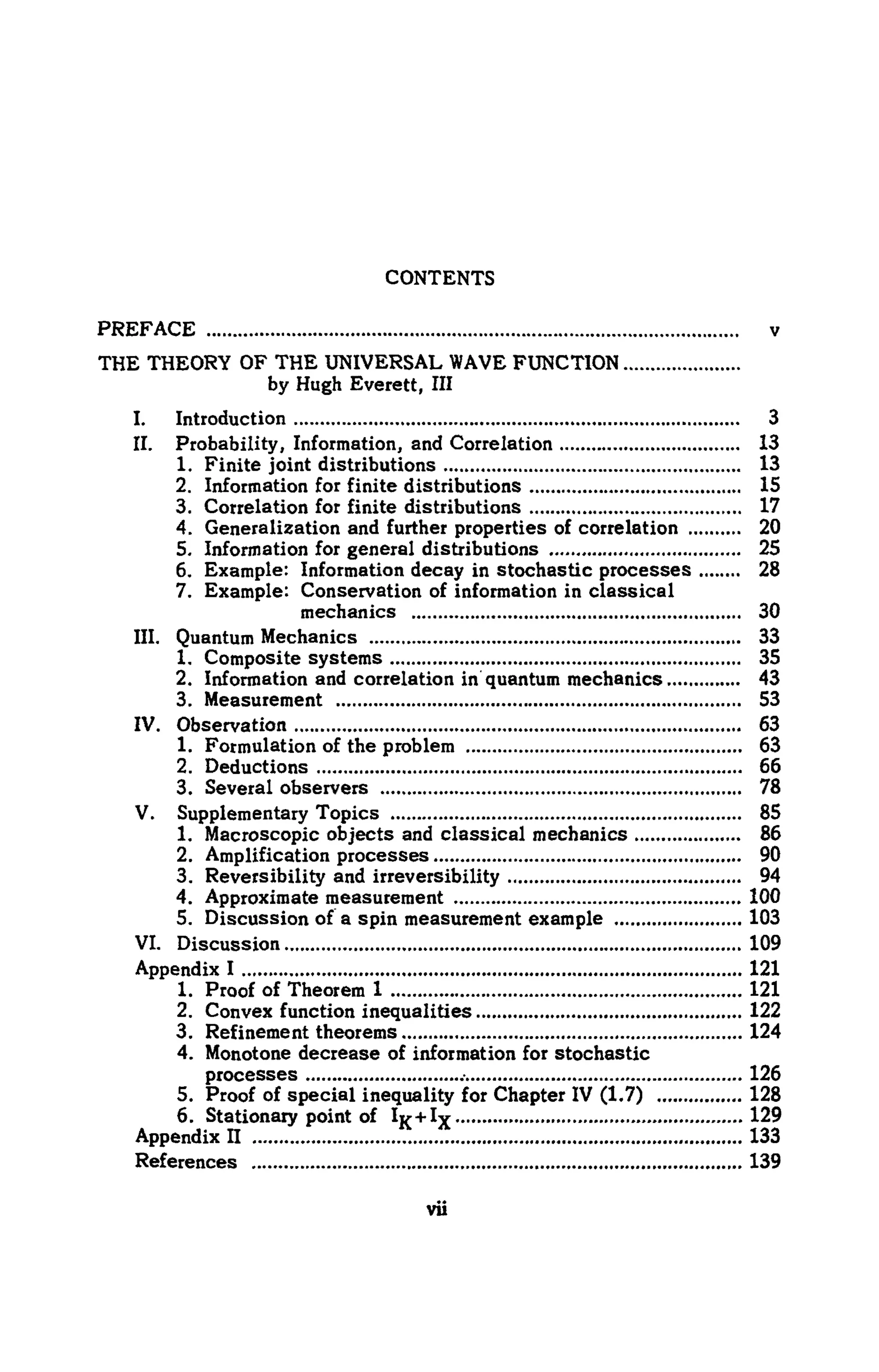
CONTENTS
PREFACE ν
THE THEORY OF THE UNIVERSAL WAVEFUNCTION
by Hugh Everett, III
I. Introduction 3
II. Probability, Information, and Correlation 13
1. Finite joint distributions 13
2. Information for finite distributions 15
3. Correlation for finite distributions 17
4. Generalization and further properties of correlation 20
5. Information for general distributions 25
6. Example: Information decay in stochastic processes 28
7. Example: Conservation of information in classical
mechanics 30
III. Quantum Mechanics 33
1. Composite systems 35
2. Information and correlation in quantum mechanics 43
3. Measurement 53
IV. Observation 63
1. Formulation of the problem 63
2. Deductions 66
3. Several observers 78
V. Supplementary Topics 85
1. Macroscopic objects and classical mechanics 86
2. Amplification processes 90
3. Reversibility and irreversibility 94
4. Approximate measurement 100
5. Discussion of a spin measurement example 103
VI. Discussion 109
Appendix I 121
1. Proof of Theorem 1 121
2. Convex function inequalities 122
3. Refinement theorems 124
4. Monotone decrease of information for stochastic
processes 126
5. Proof of special inequality for Chapter IV (1.7) 128
6. Stationary point of %+Ιχ 129
Appendix Π 133
References 139
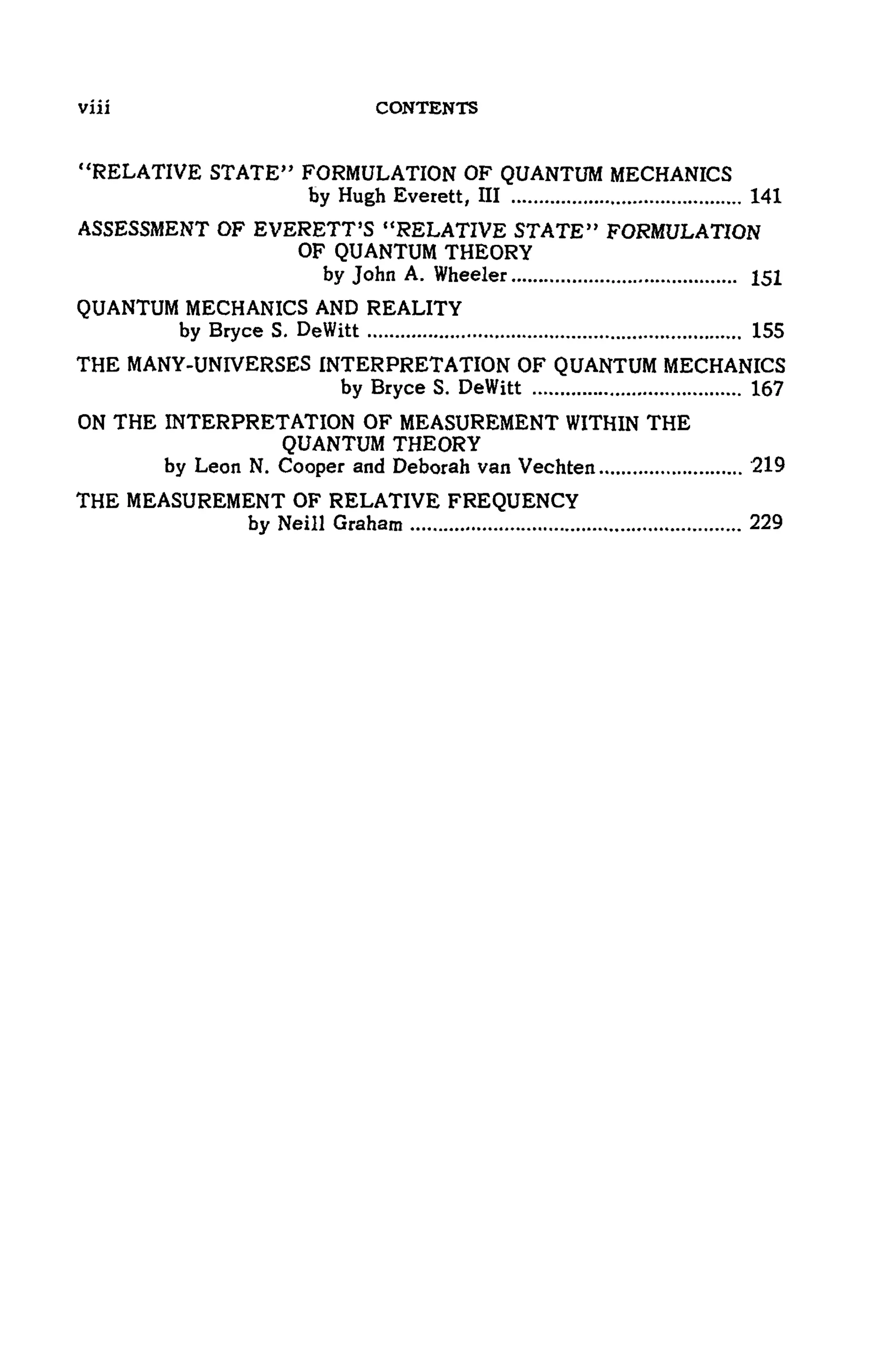
viii CONTENTS
"RELATIVE STATE" FORMULATION OF QUANTUM MECHANICS
by Hugh Everett, ΠΙ 141
ASSESSMENT OF EVERETT'S "RELATIVE STATE" FORMULATION
OF QUANTUM THEORY
by John A. Wheeler 151
QUANTUM MECHANICS AND REALITY
by Bryce S. DeWitt 155
THE MANY-UNIVERSES INTERPRETATION OF QUANTUM MECHANICS
by Bryce S. DeWitt 167
ON THE INTERPRETATION OF MEASUREMENT WITHIN THE
QUANTUM THEORY
by Leon N. Cooper and Deborah van Vechten 219
THE MEASUREMENT OF RELATIVE FREQUENCY
by Neill Graham 229
The Many-Worlds Interpretation
of Quantum Mechanics
THE THEORY OF THE UNIVERSAL WAVE FUNCTION
Hugh Everett, III
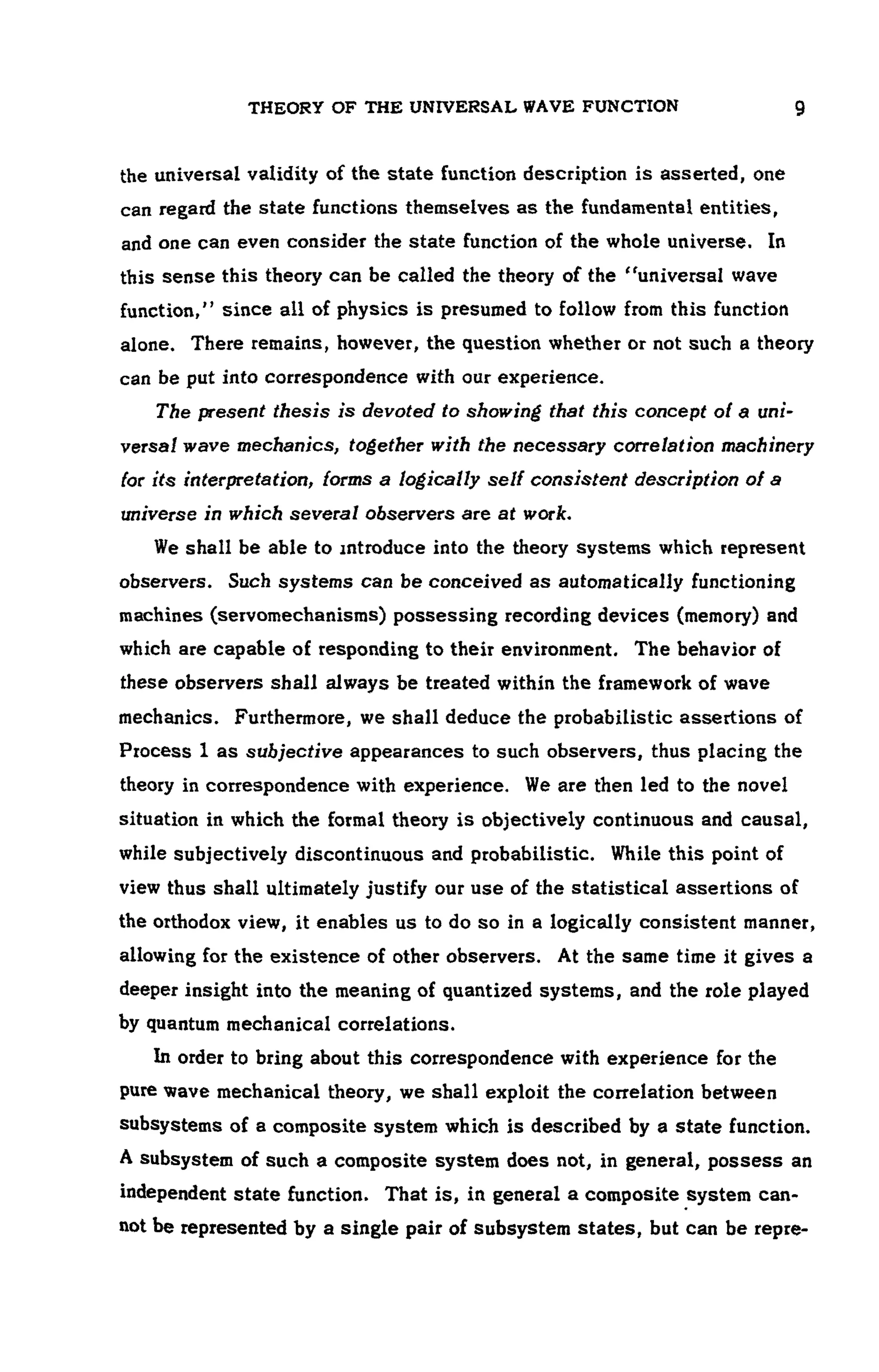
I. INTRODUCTION
We begin, as a way of entering our subject, by characterizing a particu -
lar interpretation of quantum theory which, although not representative of
the more careful formulations of some writers, is the most common form
encountered in textbooks and university lectures on the subject.
A physical system is described completely by a state function φ,
which is an element of a Hilbert space, and which furthermore gives in-
formation only concerning the probabilities of the results of various obser-
vations which can be made on the system. The state function φ is
thought of as objectively characterizing the physical system, i.e., at all
times an isolated system is thought of as possessing a state function, in-
dependently of our state of knowledge of it. On the other hand, φ changes
in a causal manner so long as the system remains isolated, obeying a dif-
ferential equation. Thus there are two fundamentally different ways in
which the state function can change:1
Process 1: The discontinuous change brought about by the observa-
tion of a quantity with eigenstates φ^,φ2,··., in which the state
φ will be changed to the state φ^ with probability (φ,φ^2
.
Process 2: The continuous, deterministic change of state of the
(isolated) system with time according to a wave equation
where U is a linear operator.
We use here the terminology of νοα Neumann [l7].
4 HUGH EVERETT, ΠΙ
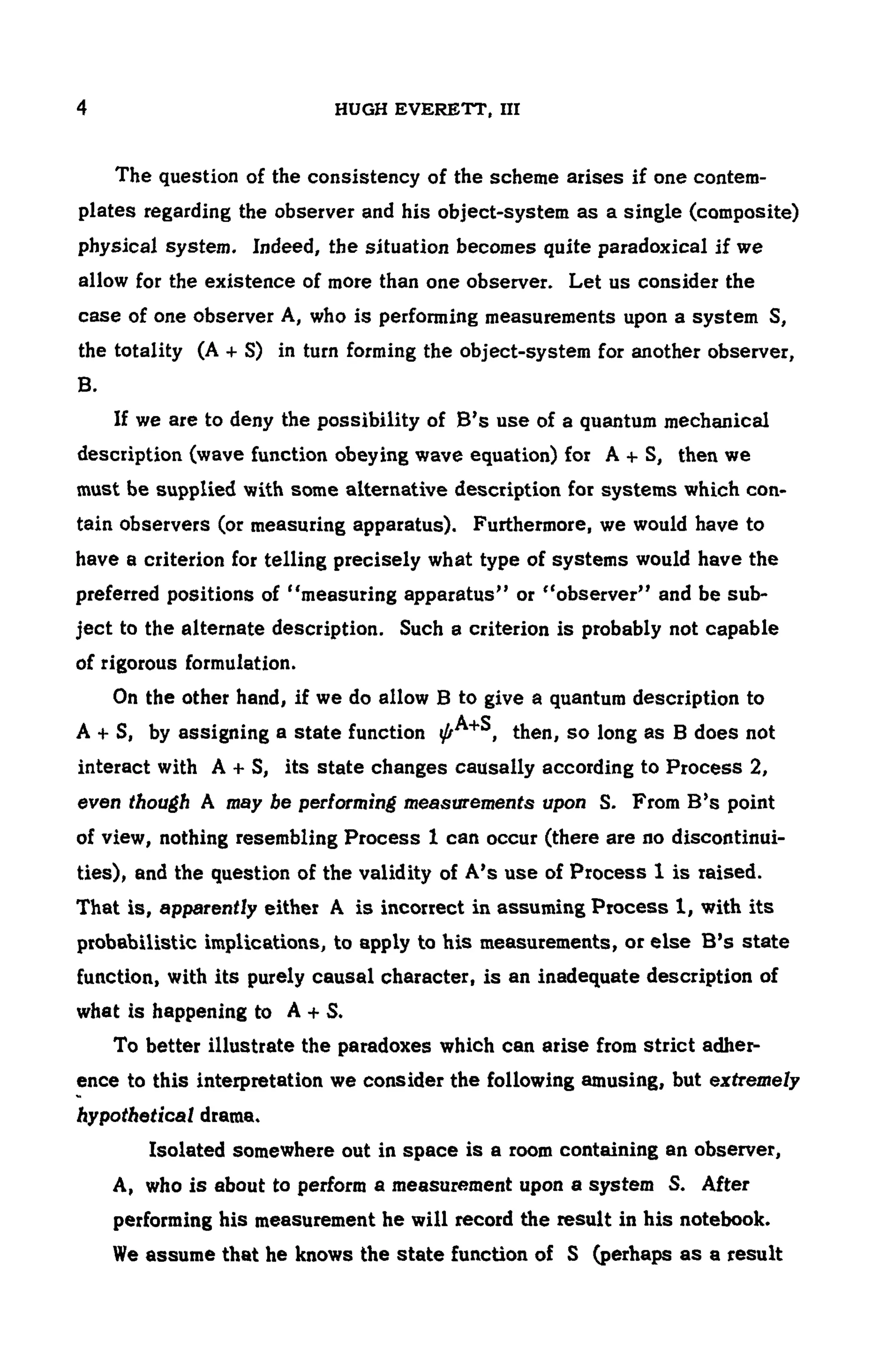
The question of the consistency of the scheme arises if one contem -
plates regarding the observer and his object-system as a single (composite)
physical system. Indeed, the situation becomes quite paradoxical if we
allow for the existence of more than one observer. Let us consider the
case of one observer A, who is performing measurements upon a system S,
the totality (A + S) in turn forming the object-system for another observer,
B.
If we are to deny the possibility of B's use of a quantum mechanical
description (wave function obeying wave equation) for A + S, then we
must be supplied with some alternative description for systems which con-
tain observers (or measuring apparatus). Furthermore, we would have to
have a criterion for telling precisely what type of systems would have the
preferred positions of "measuring apparatus" or "observer" and be sub-
ject to the alternate description. Such a criterion is probably not capable
of rigorous formulation.
On the other hand, if we do allow B to give a quantum description to
A + S, by assigning a state function then, so long as B does not
interact with A + S, its state changes causally according to Process 2,
even though A may be performing measurements upon S. From B's point
of view, nothing resembling Process 1 can occur (there are no discontinui-
ties), and the question of the validity of A's use of Process 1 is Taised.
That is, apparently either A is incorrect in assuming Process1, with its
probabilistic implications, to apply to his measurements, or else B's state
function, with its purely causal character, is an inadequate description of
what is happening to A + S.
To better illustrate the paradoxes which can arise from strict adher-
ence to this interpretation we consider the following amusing, but extremely
hypothetical drama.
Isolated somewhere out in space is a room containing an observer,
A, who is about to perform a measurement upon a system S. After
performing his measurement he will record the result in his notebook.
We assume that he knows the state function of S (perhaps as a result
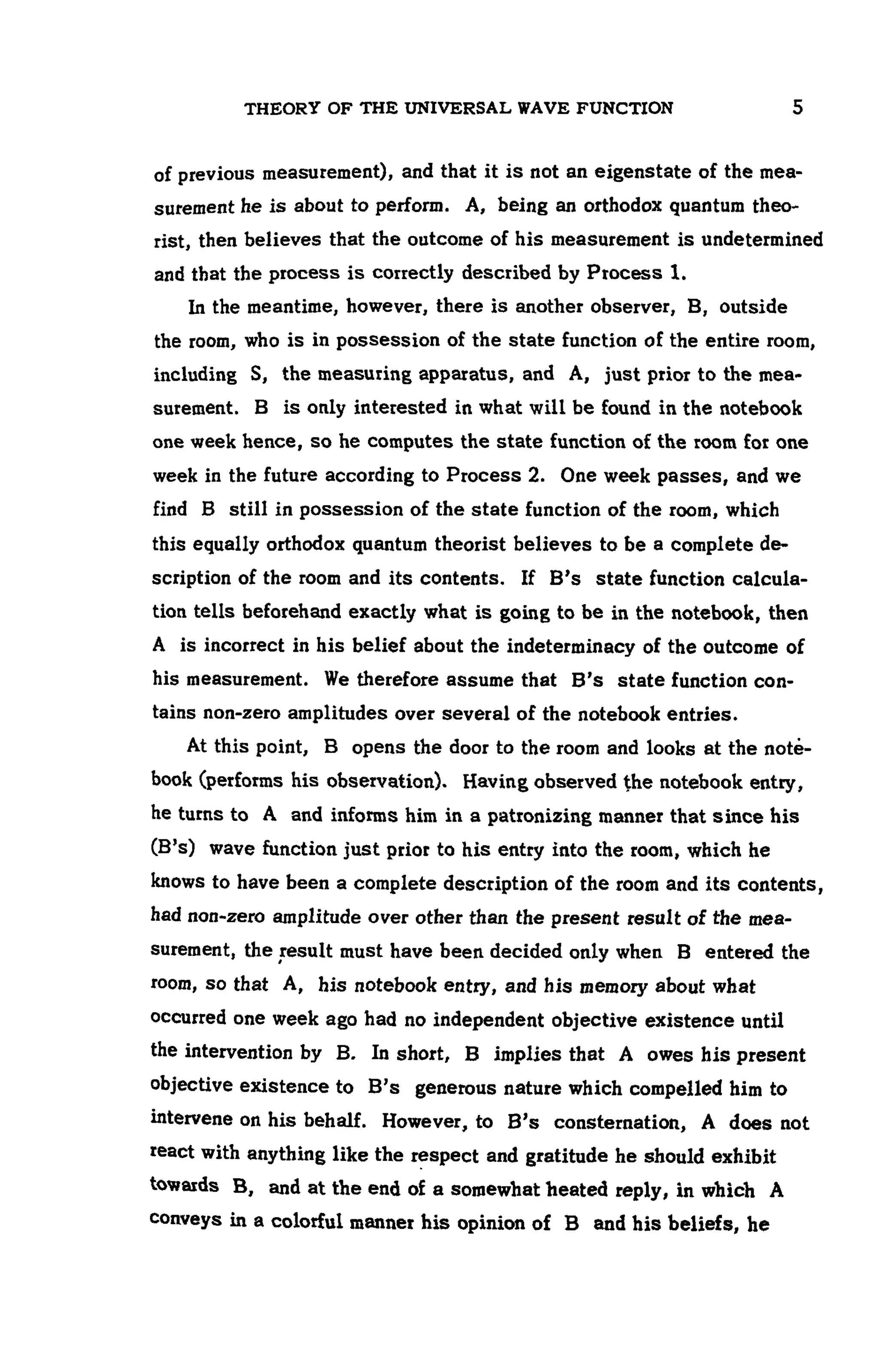
THEORY OF THE UNIVERSAL WAVE FUNCTION 5
of previous measurement), and that it is not an eigenstate of the mea-
surement he is about to perform. A, being an orthodox quantum theo-
rist, then believes that the outcome of his measurement is undetermined
and that the process is correctly described by Process 1.
In the meantime, however, there is another observer, B, outside
the room, who is in possession of the state function of the entire room,
including S, the measuring apparatus, and A, just prior to the mea-
surement. B is only interested in what will be found in the notebook
one week hence, so he computes the state function of the room for one
week in the future according to Process 2. One week passes, and we
find B still in possession of the state function of the room, which
this equally orthodox quantum theorist believes to be a complete de-
scription of the room and its contents. If B's state function calcula-
tion tells beforehand exactly what is going to be in the notebook, then
A is incorrect in his belief about the indeterminacy of the outcome of
his measurement. We therefore assume that B's state function con-
tains non-zero amplitudes over several of the notebook entries.
At this point, B opens the door to the room and looks at the note-
book (performs his observation). Having observed the notebook entry,
he turns to A and informs him in a patronizing manner that since his
(B's) wave function just prior to his entry into the room, which he
knows to have been a complete description of the room and its contents,
had non-zero amplitude over other than the present result of the mea-
surement, the result must have been decided only when B entered the
room, so that A, his notebook entry, and his memory about what
occurred one week ago had no independent objective existence until
the intervention by B. In short, B implies that A owes his present
objective existence to B's generous nature which compelled him to
intervene on his behalf. However, to B's consternation, A does not
react with anything like the respect and gratitude he should exhibit
towards B, and at the end of a somewhat heated reply, in which A
conveys in a colorful manner his opinion of B and his beliefs, he
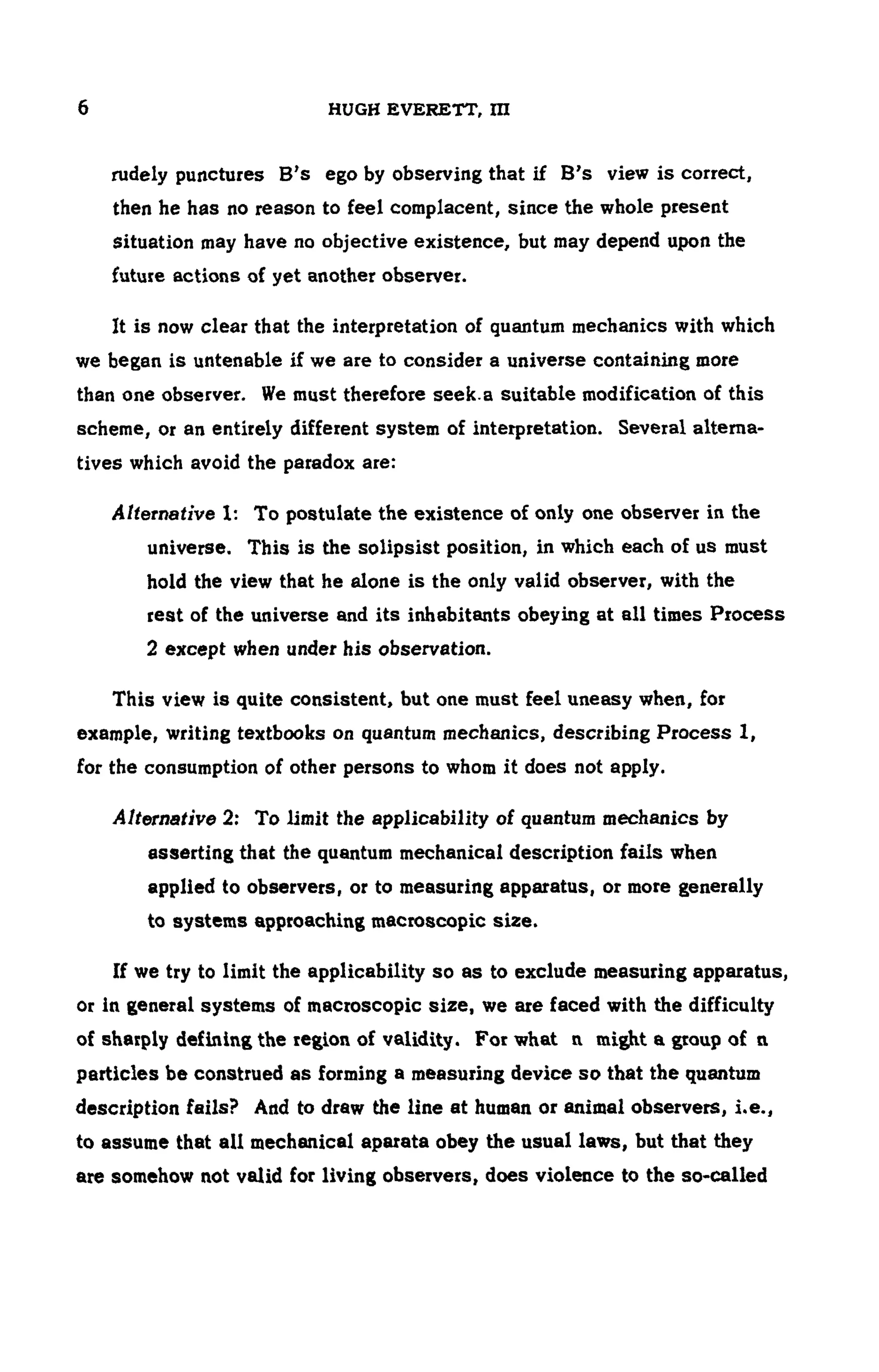
6 HUGH EVERETT, ΠΙ
rudely punctures B's ego by observing that if B's view is correct,
then he has no reason to feel complacent, since the whole present
situation may have no objective existence, but may depend upon the
future actions of yet another observer.
It is now clear that the interpretation of quantum mechanics with which
we began is untenable if we are to consider a universe containing more
than one observer. We must therefore seek.a suitable modification of this
scheme, or an entirely different system of interpretation. Several alterna -
tives which avoid the paradox are:
Alternative 1: To postulate the existence of only one observer in the
universe. This is the solipsist position, in which each of us must
hold the view that he alone is the only valid observer, with the
rest of the universe and its inhabitants obeying at all times Process
2 except when under his observation.
This view is quite consistent, but one must feel uneasy when, for
example, writing textbooks on quantum mechanics, describing Process 1,
for the consumption of other persons to whom it does not apply.
Alternative 2: To limit the applicability of quantum mechanics by
asserting that the quantum mechanical description fails when
applied to observers, or to measuring apparatus, or more generally
to systems approaching macroscopic size.
If we try to limit the applicability so as to exclude measuring apparatus,
or in general systems of macroscopic size, we are faced with the difficulty
of sharply defining the region of validity. For what η might a group of η
particles be construed as forming a measuring device so that the quantum
description fails? And to draw the line at human or animal observers, i.e.,
to assume that all mechanical aparata obey the usual laws, but that they
are somehow not valid for living observers, does violence to the so-called
THEORY OF THE UNIVERSAL WAVE FUNCTION 7
principle of psycho-physical parallelism,2 and constitutes a view to be
avoided, if possible. To do justice to this principle we must insist that
we be able to conceive of mechanical devices (such as servomechanisms),
obeying natural laws, which we would be willing to call observers.
Alternative 3: To admit the validity of the state function description,
but to deny the possibility that B could ever be in possession of
the state function of A + S. Thus one might argue that a determi-
nation of the state of A would constitute such a drastic interven-
tion that A would cease to function as an observer.
The first objection to this view is that no matter what the state of
A + S is, there is in principle a complete set of commuting operators for
which it is an eigenstate, so that, at least, the determination of these
quantities will not affect the state nor in any way disrupt the operation of
A. There are no fundamental restrictions in the usual theory about the
knowability of any state functions, and the introduction of any such re-
strictions to avoid the paradox must therefore require extra postulates.
The second objection is that it is not particularly relevant whether or
not B actually knows the precise state function of A + S. If he merely
believes that the system is described by a state function, which he does
not presume to know, then the difficulty still exists. He must then believe
that this state function changed deterministically, and hence that there
was nothing probabilistic in A's determination.
2
In the words of von Neumann ([17], p. 418): "...it is a fundamental requirement
of the scientific viewpoint — the so-called principle of the psycho-phyeicel parallel-
ism — that it must be possible so to describe the extra-physical process of the sub-
jective perception as if it were in reality in the physical world — i.e., to assign to
its parts equivalent physical processes in the objective environment, in ordinary
8 HUGH EVERETT, ΙΠ
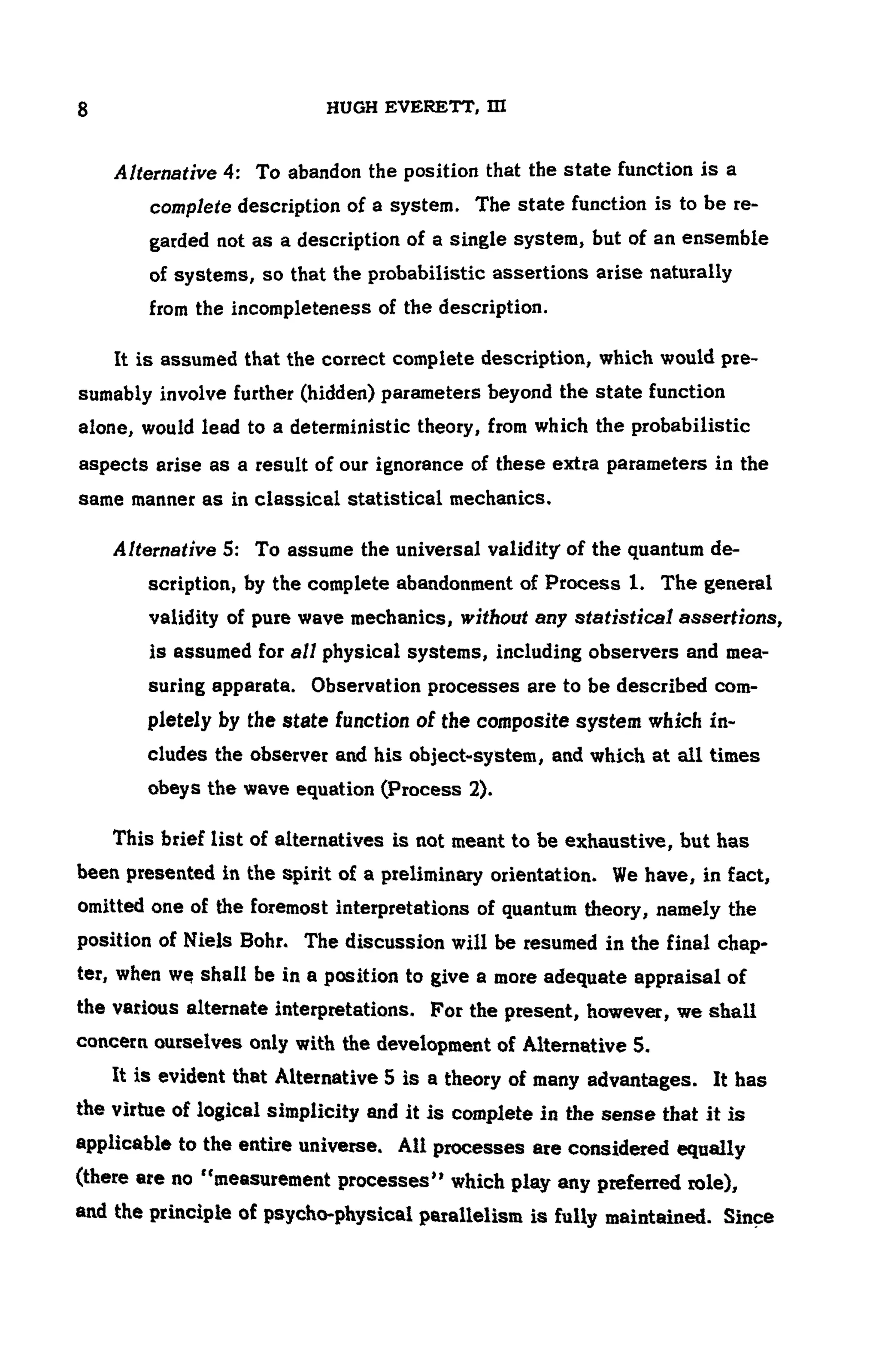
Alternative 4: To abandon the position that the state function is a
complete description of a system. The state function is to be re-
garded not as a description of a single system, but of an ensemble
of systems, so that the probabilistic assertions arise naturally
from the incompleteness of the description.
It is assumed that the correct complete description, which would pre-
sumably involve further (hidden) parameters beyond the state function
alone, would lead to a deterministic theory, from which the probabilistic
aspects arise as a result of our ignorance of these extra parameters in the
same manner as in classical statistical mechanics.
Alternative 5: To assume the universal validity of the quantum de-
scription, by the complete abandonment of Process 1. The general
validity of pure wave mechanics, without any statistical assertions,
is assumed for all physical systems, including observers and mea-
suring apparata. Observation processes are to be described com-
pletely by the state function of the composite system which in-
cludes the observer and his object-system, and which at all times
obeys the wave equation (Process 2).
This brief list of alternatives is not meant to be exhaustive, but has
been presented in the spirit of a preliminary orientation. We have, in fact,
omitted one of the foremost interpretations of quantum theory, namely the
position of Niels Bohr. The discussion will be resumed in the final chap-
ter, when we shall be in a position to give a more adequate appraisal of
the various alternate interpretations. For the present, however, we shall
concern ourselves only with the development of Alternative 5.
It is evident that Alternative 5 is a theory of many advantages. It has
the virtue of logical simplicity and it is complete in the sense that it is
applicable to the entire universe. All processes are considered equally
(there are no "measurement processes" which play any preferred role),
and the principle of psycho-physical parallelism is fully maintained. Since
THEORY OF THE UNIVERSAL WAVE FUNCTION 9
the universal validity of the state function description is asserted, one
can regard the state functions themselves as the fundamental entities,
and one can even consider the state function of the whole universe. In
this sense this theory can be called the theory of the "universal wave
function," since all of physics is presumed to follow from this function
alone. There remains, however, the question whether or not such a theory
can be put into correspondence with our experience.
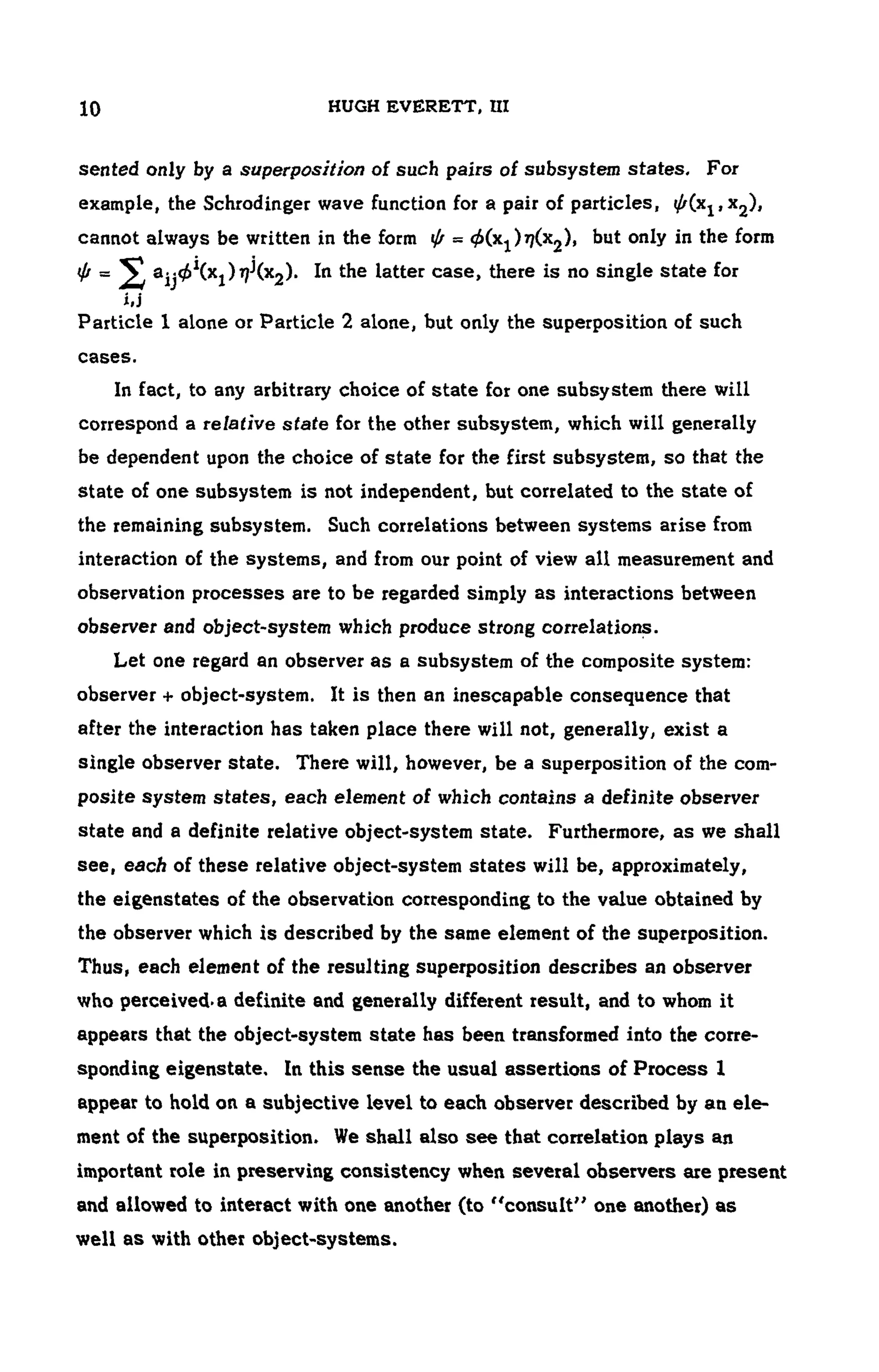
The present thesis is devoted to showing that this concept of a uni­
versal wave mechanics, together with the necessary correlation machinery
(or its interpretation, forms a logically self consistent description of a
universe in which several observers are at work.
We shall be able to introduce into the theory systems which represent
observers. Such systems can be conceived as automatically functioning
machines (servomechanisms) possessing recording devices (memory) and
which are capable of responding to their environment. The behavior of
these observers shall always be treated within the framework of wave
mechanics. Furthermore, we shall deduce the probabilistic assertions of
Process 1as subjective appearances to such observers, thus placing the
theory in correspondence with experience. We are then led to the novel
situation in which the formal theory is objectively continuous and causal,
while subjectively discontinuous and probabilistic. While this point of
view thus shall ultimately justify our use of the statistical assertions of
the orthodox view, it enables us to do so in a logically consistent manner,
allowing for the existence of other observers. At the same time it gives a
deeper insight into the meaning of quantized systems, and the role played
by quantum mechanical correlations.
In order to bring about this correspondence with experience for the
pure wave mechanical theory, we shall exploit the correlation between
subsystems of a composite system which is described by a state function.
A subsystem of such a composite system does not, in general, possess an
independent state function. That is, in general a composite system can-
not be represented by a single pair of subsystem states, but can be repre-
10 HUGH EVERETT, UI
sen ted only by a superposition of such pairs of subsystem states. For
example, the Schrodinger wave function for a pair of particles, ^(X1, x2),
cannot always be written in the form ψ = ^Cx1 J^Cx2)) but only in the form
= a-^Cxj) 77j
(x2). In the latter case, there is no single state for
i,j
Particle 1 alone or Particle 2 alone, but only the superposition of such
cases.
In fact, to any arbitrary choice of state for one subsystem there will
correspond a relative state for the other subsystem, which will generally
be dependent upon the choice of state for the first subsystem, so that the
state of one subsystem is not independent, but correlated to the state of
the remaining subsystem. Such correlations between systems arise from
interaction of the systems, and from our point of view all measurement and
observation processes are to be regarded simply as interactions between
observer and object-system which produce strong correlations.
Let one regard an observer as a subsystem of the composite system:
observer + object-system. It is then an inescapable consequence that
after the interaction has taken place there will not, generally, exist a
single observer state. There will, however, be a superposition of the com-
posite system states, each element of which contains a definite observer
state and a definite relative object-system state. Furthermore, as we shall
see, each of these relative object-system states will be, approximately,
the eigenstates of the observation corresponding to the value obtained by
the observer which is described by the same element of the superposition.
Thus, each element of the resulting superposition describes an observer
who perceived,a definite and generally different result, and to whom it
appears that the object-system state has been transformed into the corre-
sponding eigenstate. In this sense the usual assertions of Process 1
appear to hold on a subjective level to each observer described by an ele-
ment of the superposition. We shall also see that correlation plays an
important role in preserving consistency when several observers are present
and allowed to interact with one another (to "consult" one another) as
well as with other object-systems.
THEORY OF THE UNIVERSAL WAVE FUNCTION 11
In order to develop a language for interpreting our pure wave mechan -
ics for composite systems we shall find it useful to develop quantitative
definitions for such notions as the "sharpness" or "definiteness" of an
operator A for a state ψ, and the "degree of correlation" between the
subsystems of a.composite system or between a pair of operators in the
subsystems, so that we can use these concepts in an unambiguous manner.
The mathematical development of these notions will be carried out in the
next chapter (II) using some concepts borrowed from Information Theory.
We shall develop there the general definitions of information and correla-
tion, as well as some of their more important properties. Throughout
Chapter II we shall use the language of probability theory to facilitate the
exposition, and because it enables us to introduce in a unified manner a
number of concepts that will be of later use. We shall nevertheless sub-
sequently apply the mathematical definitions directly to state functions,
by replacing probabilities by square amplitudes, without, however, making
any reference to probability models.
Having set the stage, so to speak, with Chapter II, we turn to quantum
mechanics in Chapter III. There we first investigate the quantum forma-
lism of composite systems, particularly the concept of relative state func-
tions, and the meaning of the representation of subsystems by non-
interfering mixtures of states characterized by density matrices. The
notions of information and correlation are then applied to quantum mechan-
ics. The final section of this chapter discusses the measurement process,
which is regarded simply as a correlation-inducing interaction between
subsystems of a single isolated system. A simple example of such a
measurement is given and discussed, and some general consequences of
the superposition principle are considered.
J
The theory originated by Claude E. Shannon [l9].
12 HUGH EVERETT, UI
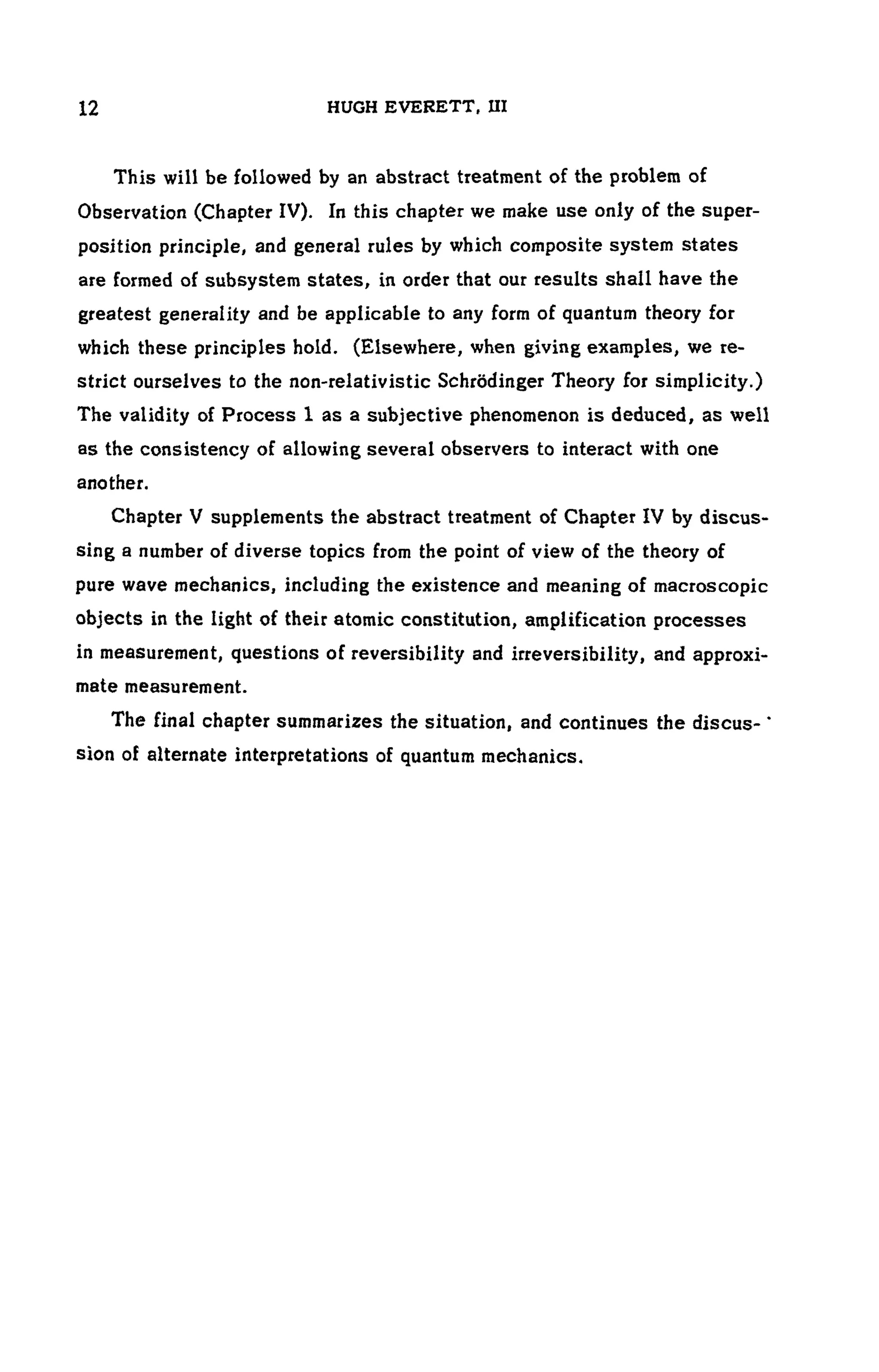
This will be followed by an abstract treatment of the problem of
Observation (Chapter IV). In this chapter we make use only of the super-
position principle, and general rules by which composite system states
are formed of subsystem states, in order that our results shall have the
greatest generality and be applicable to any form of quantum theory for
which these principles hold. (Elsewhere, when giving examples, we re-
strict ourselves to the non-relativistic Schrodinger Theory for simplicity.)
The validity of Process 1 as a subjective phenomenon is deduced, as well
as the consistency of allowing several observers to interact with one
another.
Chapter V supplements the abstract treatment of Chapter IV by discus-
sing a number of diverse topics from the point of view of the theory of
pure wave mechanics, including the existence and meaning of macroscopic
objects in the light of their atomic constitution, amplification processes
in measurement, questions of reversibility and irreversibility, and approxi-
mate measurement.
The final chapter summarizes the situation, and continues the discus- '
sion of alternate interpretations of quantum mechanics.
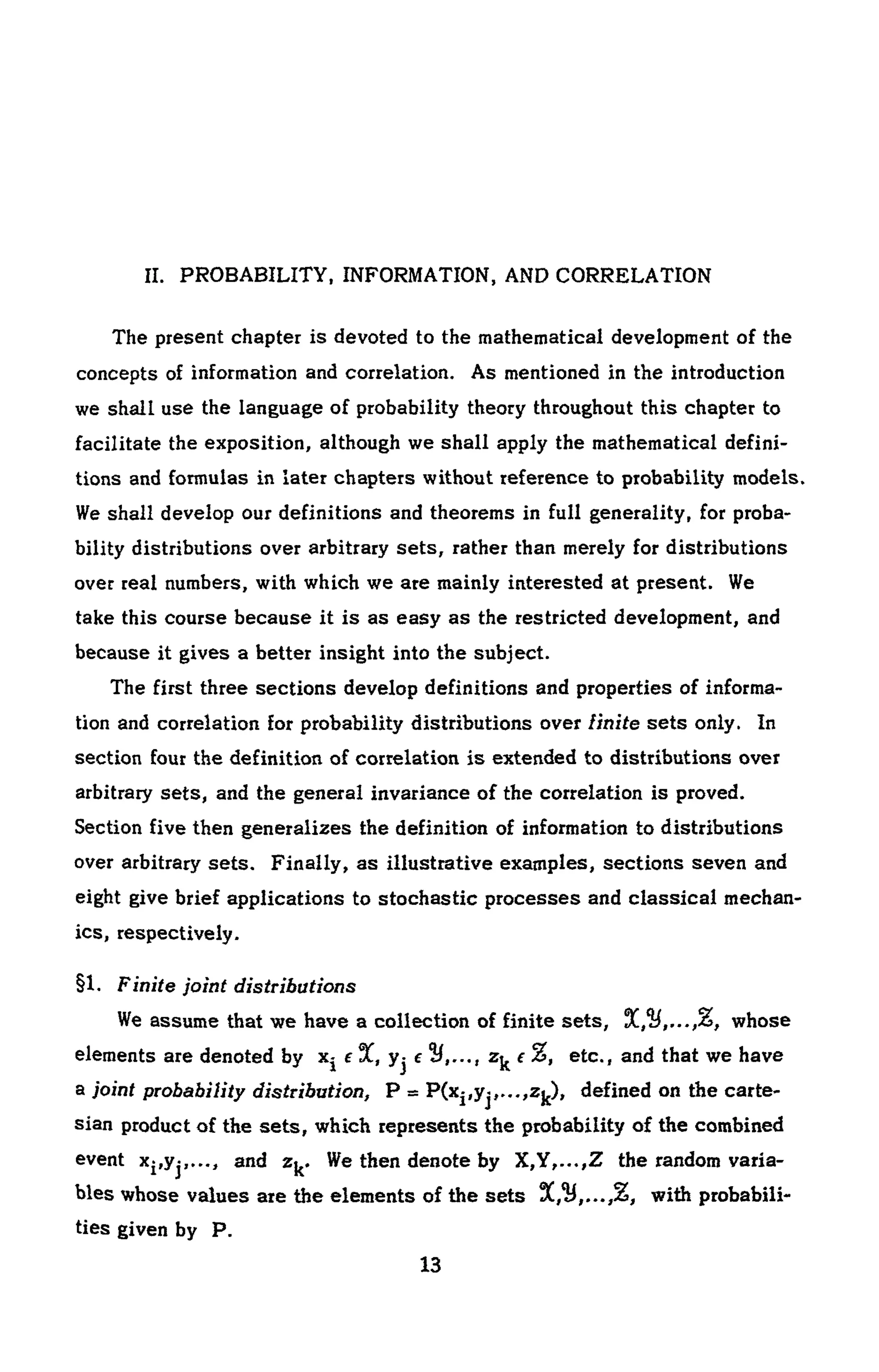
II. PROBABILITY, INFORMATION, AND CORRELATION
The present chapter is devoted to the mathematical development of the
concepts of information and correlation. As mentioned in the introduction
we shall use the language of probability theory throughout this chapter to
facilitate the exposition, although we shall apply the mathematical defini-
tions and formulas in later chapters without reference to probability models.
We shall develop our definitions and theorems in full generality, for proba-
bility distributions over arbitrary sets, rather than merely for distributions
over real numbers, with which we are mainly interested at present. We
take this course because it is as easy as the restricted development, and
because it gives a better insight into the subject.
The first three sections develop definitions and properties of informa-
tion and correlation for probability distributions over Unite sets only. In
section four the definition of correlation is extended to distributions over
arbitrary sets, and the general invariance of the correlation is proved.
Section five then generalizes the definition of information to distributions
over arbitrary sets. Finally, as illustrative examples, sections seven and
eight give brief applications to stochastic processes and classical mechan-
ics, respectively.
§1. Finite joint distributions
We assume that we have a collection of finite sets, whose
elements are denoted by Xj e 3C, yj e tU,.-., Zjt e %, etc., and that we have
a joint probability distribution, P = Ρ(Χ|^,...,ζ^), defined on the carte -
sian product of the sets, which represents the probability of the combined
event X|,yj,..., and z^. We then denote by X,Y,...,Z the random varia-
bles whose values are the elements of the sets 3!!,¾,...,%, with probabili-
ties given by P.
104 HUGH EVERETT, III
For any subset Y,...,Z, of a set of random variables
with joint probability distribution the marginal dis-
tribution, is defined to be:
(1.1 )
which represents the probability of the joint occurrence of with
no restrictions upon the remaining variables.
For any subset Y,...,Z of a set of random variables the conditional
distribution, conditioned upon the v a l u e s f o r any re-
maining subset W,...,X, and denoted by ), is defined
to be:1
(1.2)
which represents the probability of the joint event con-
ditioned by the fact that W,...,X are known to have taken the values
respectively.
For any numerical valued function defined on the ele-
ments of the cartesian product of the expectation, denoted by
Exp [F3, is defined to be:
(1.3) Exp
We note that if is a marginal distribution of some larger dis-
tribution then
(1.4) Exp [F]
1 We regard it as undefined if In this case
is necessarily zero also.
THEORY OF THE UNIVERSAL WAVE FUNCTION 107
so that if we wish to compute Exp [F] with respect to some joint distri-
bution it suffices to use any marginal distribution of the original distribu-
tion which contains at least those variables which occur in F.
We shall also occasionally be interested in conditional expectations,
which we define as:
(1.5)
and we note the following easily verified rules for expectations:
(1.6) Exp
(1.7)
(1.8)
We should like finally to comment upon the notion of independence.
Two random variables X and Y with joint distribution will be
said to be independent if and only if is equal to
for all i,j. Similarly, the groups of random variables (U...V), (W...X),...,
(Y...Z) will be called mutually independent groups if and only if
is always equal to
Independence means that the random variables take on values which
are not influenced by the values of other variables with respect to which
they are independent. That is, the conditional distribution of one of two
independent variables, Y, conditioned upon the value x- for the other,
is independent of x^, so that knowledge about one variable tells nothing
of the other.
§2. Information for finite distributions
Suppose that we have a single random variable X, with distribution
We then define a number, called the information of X, to be:
2
This definition corresponds to the negative of the entropy of a probability
distribution as defined by Shannon [l9].
104 HUGH EVERETT, III
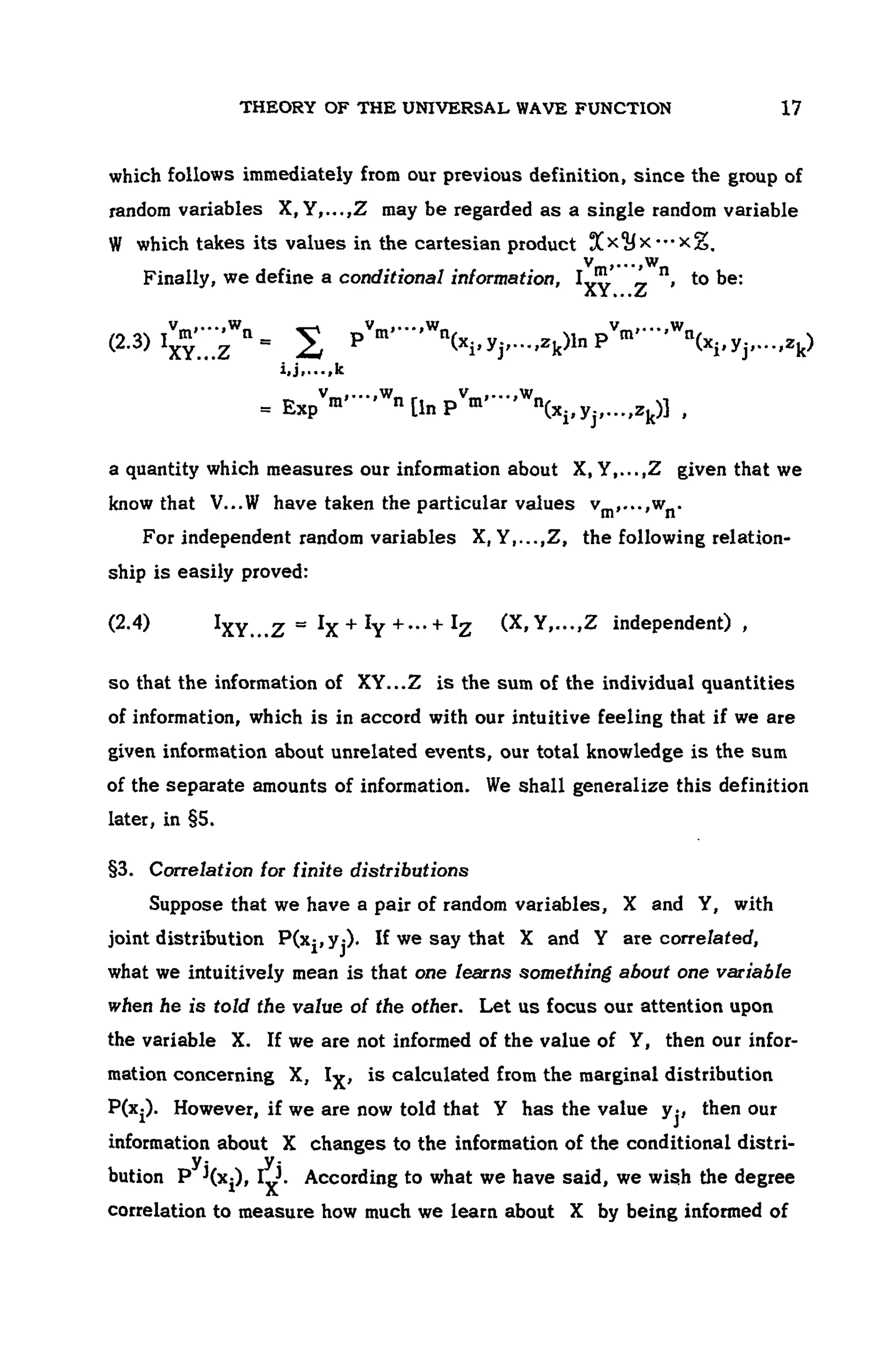
(2.1 )
which is a function of the probabilities alone and not of any possible
numerical values of the Xj's themselves.
The information is essentially a measure of the sharpness of a proba-
bility distribution, that is, an inverse measure of its "spread." In this
respect information plays a role similar to that of variance. However, it
has a number of properties which make it a superior measure of the
"sharpness" than the variance, not the least of which is the fact that it
can be defined for distributions over arbitrary sets, while variance is de-
fined only for distributions over real numbers.
Any change in the distribution which "levels out" the proba-
bilities decreases the information. It has the value zero for "perfectly
sharp" distributions, in which the probability is one for one of the x^ and
zero for all others, and ranges downward to —Inn for distributions over
n elements which are equal over all of the x-. The fact that the informa-
tion is nonpositive is no liability, since we are seldom interested in the
absolute information of a distribution, but only in differences.
We can generalize (2.1) to obtain the formula for the information of a
group of random variables X, Y,...,Z, with joint distribution
which we denote by
(2.2)
3
A good discussion of information is to be found in Shannon [l9], or Woodward
[21]. Note, however, that in the theory of communication one defines the informa-
tion of a state Xj, which has a priori probability to be We prefer,
however, to regard information as a property of the distribution itself.
THEORY OF THE UNIVERSAL WAVE FUNCTION 107
which follows immediately from our previous definition, since the group of
random variables X, Y,...,Z may be regarded as a single random variable
W which takes its values in the cartesian product
Finally, we define a conditional information, to be:
(2.3)
a quantity which measures our information about X, Y Z given that we
know that V...W have taken the particular values
For independent random variables X, Y,...,Z, the following relation-
ship is easily proved:
(2.4) independent) ,
so that the information of XY...Z is the sum of the individual quantities
of information, which is in accord with our intuitive feeling that if we are
given information about unrelated events, our total knowledge is the sum
of the separate amounts of information. We shall generalize this definition
later, in §5.
§3. Correlation tor finite distributions
Suppose that we have a pair of random variables, X and Y, with
joint distribution . If we say that X and Y are correlated,
what we intuitively mean is that one learns something about one variable
when he is told the value of the other. Let us focus our attention upon
the variable X. If we are not informed of the value of Y, then our infor-
mation concerning X, 1^, is calculated from the marginal distribution
P(x-). However, if we are now told that Y has the value yj, then our
information about X changes to the information of the conditional distri-
bution According to what we have said, we wish the degree
correlation to measure how much we learn about X by being informed of
104 HUGH EVERETT, III
Y's value. However, since the change of information, may de-
pend upon the particular value, y-}, of Y which we are told, the natural
thing to do to arrive at a single number to measure the strength of correla-
tion is to consider the expected change in information about X, given
that we are to be told the value of Y. This quantity we call the correla-
tion information, or for brevity, the correlation, of X and Y, and denote
it by |X,Y|. Thus:
(3.1)
Expanding the quantity E x p u s i n g (2.3) and the rules for expecta-
tions (1.6>— (1.8) we find:
/
Exp
(3.2)
and combining with (3.1) we have:
(3.3)
Thus the correlation is symmetric between X and Y, and hence also
equal to the expected change of information about Y given that we will
be told the value of X. Furthermore, according to (3.3) the correlation
corresponds precisely to the amount of "missing information" if we
possess only the marginal distributions, i.e., the loss of information if we
choose to regard the variables as independent.
THEOREM 1. IX, Y] = 0 if and only if X and Y are independent, and
is otherwise strictly positive. (Proof in Appendix I.)
THEORY OF THE UNIVERSAL WAVE FUNCTION 19
In this respect the correlation so defined is superior to the usual cor-
relation coefficients of statistics, such as covariance, etc., which can be
zero even when the variables are not independent, and which can assume
both positive and negative values. An inverse correlation is, after all,
quite as useful as a direct correlation. Furthermore, it has the great ad-
vantage of depending upon the probabilities alone, and not upon any
numerical values of Xi and yj, so that it is defined for distributions
over sets whose elements are of an arbitrary nature, and not only for dis-
tributions over numerical properties. For example, we might have a joint
probability distribution for the political party and religious affiliation of
individuals. Correlation and information are defined for such distributions,
although they possess nothing like covariance or variance.
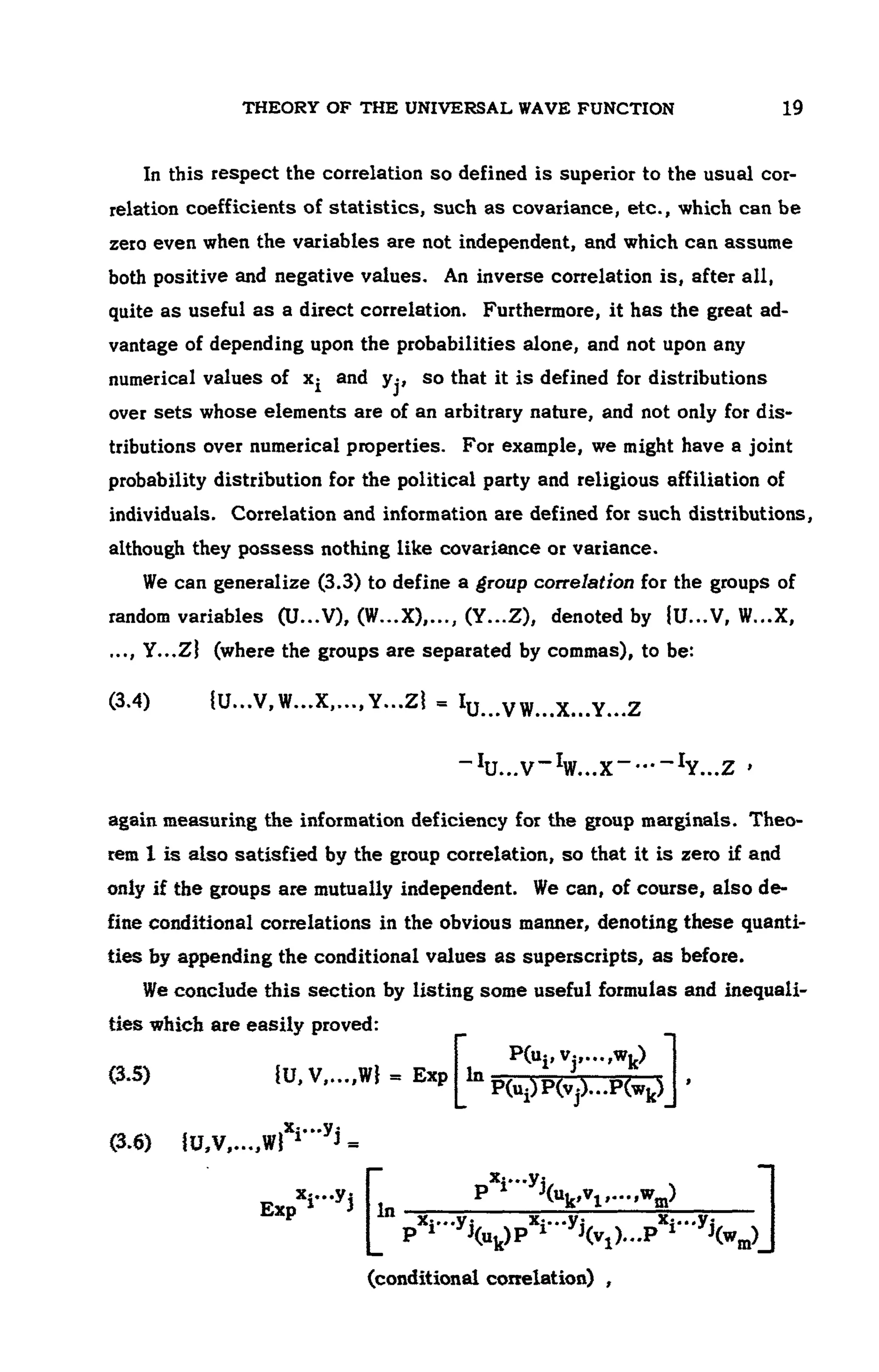
We can generalize (3.3) to define a group correlation for the groups of
random variables (U...V), (W...X),..., (Y...Z), denoted by {U...V, W...X,
..., Y...Zl (where the groups are separated by commas), to be:
(3.4) {U...V, W...X,..., Y...ZI = Iu .VW...X...Y...Z
again measuring the information deficiency for the group marginals. Theo-
rem 1is also satisfied by the group correlation, so that it is zero if and
only if the groups are mutually independent. We can, of course, also de-
fine conditional correlations in the obvious manner, denoting these quanti-
ties by appending the conditional values as superscripts, as before.
We conclude this section by listing some useful formulas and inequali-
ties which are easily proved:
_IU...V_IW...X~ —_IY...Z '
(3.5) {U,V,...,W} = Exp In
P(Ui)P(Vj)-P(Wk)J '
PGipV.,...^)
(3.6) {U,V,...,W}Xi'"yi =
(conditional correlation) ,
104 HUGH EVERETT, III
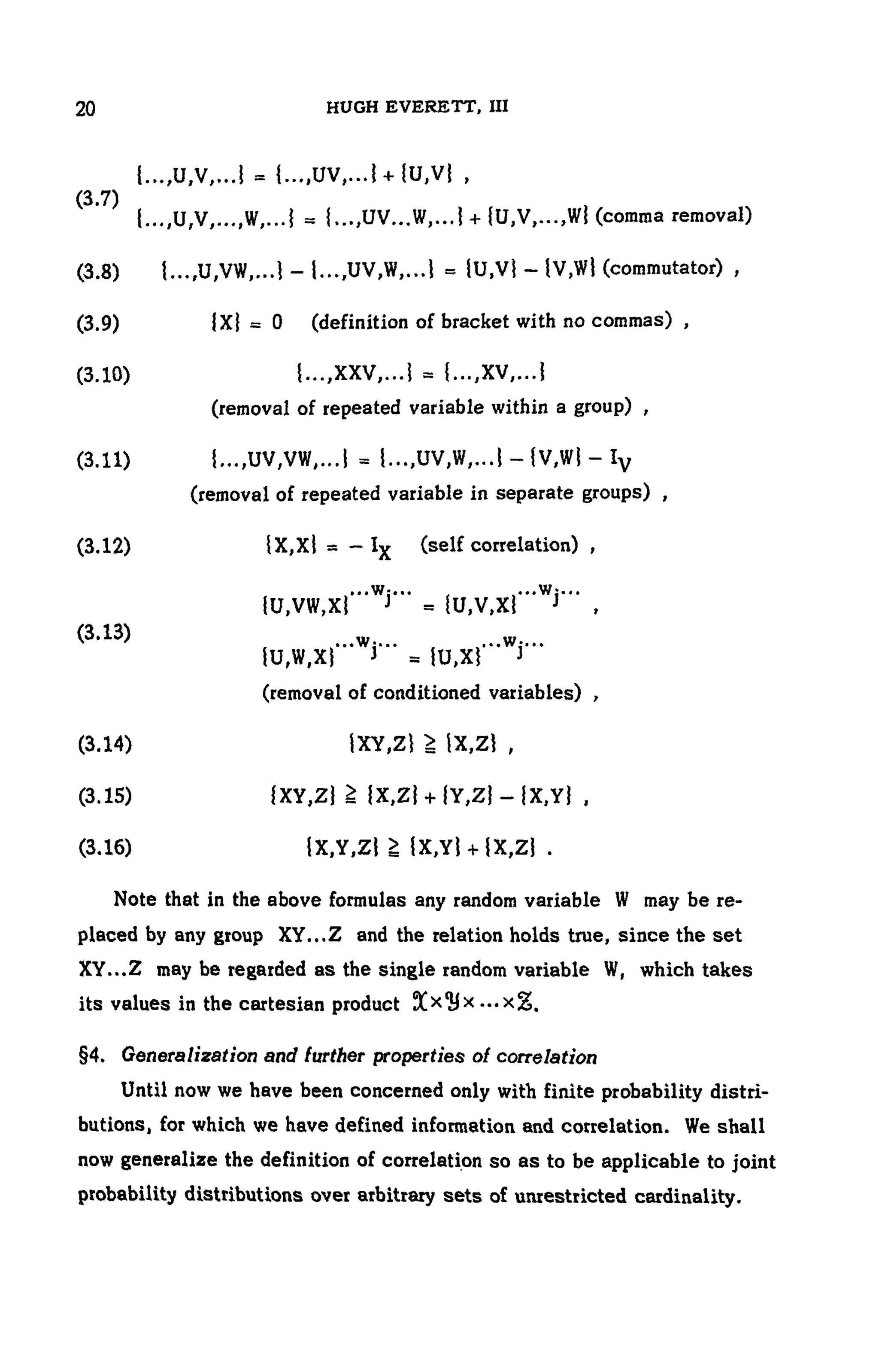
(3.7)
(comma removal)
(3.8) (commutator) ,
(3.9) (definition of bracket with no commas) ,
(3.10)
(removal of repeated variable within a group) ,
(3.11)
(removal of repeated variable in separate groups) ,
(3.12) (self correlation) ,
(3.13)
(removal of conditioned variables) ,
(3.14)
(3.15)
(3.16)
Note that in the above formulas any random variable W may be re-
placed by any group XY...Z and the relation holds true, since the set
XY...Z may be regarded as the single random variable W, which takes
its values in the cartesian product
§4. Generalization and further properties of correlation
Until now we have been concerned only with finite probability distri-
butions, for which we have defined information and correlation. We shall
now generalize the definition of correlation so as to be applicable to joint
probability distributions over arbitrary sets of unrestricted cardinality.
THEORY OF THE UNIVERSAL WAVE FUNCTION 107
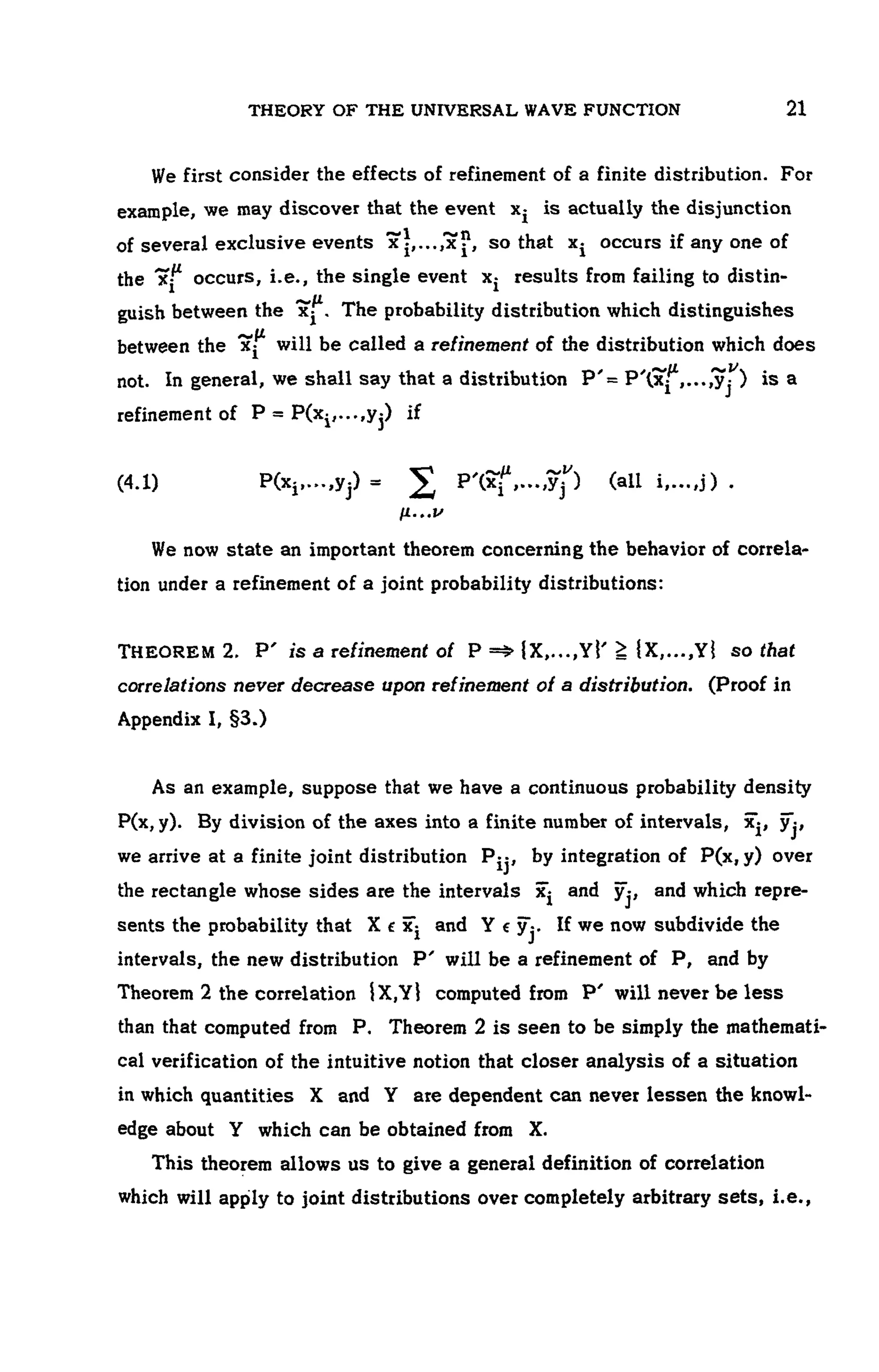
We first consider the effects of refinement of a finite distribution. For
example, we may discover that the event is actually the disjunction
of several exclusive events so that occurs if any one of
the occurs, i.e., the single event results from failing to distin-
guish between the The probability distribution which distinguishes
between the will be called a refinement of the distribution which does
not. In general, we shall say that a distribution is a
refinement of if
(4.1)
We now state an important theorem concerning the behavior of correla-
tion under a refinement of a joint probability distributions:
THEOREM 2. P ' is a refinement of so that
correlations never decrease upon refinement of a distribution. (Proof in
Appendix I, §3.)
As an example, suppose that we have a continuous probability density
P(x, y). By division of the axes into a finite number of intervals,
we arrive at a finite joint distribution by integration of P(x, y) over
the rectangle whose sides are the intervals and and which repre-
sents the probability that and If we now subdivide the
intervals, the new distribution P ' will be a refinement of P, and by
Theorem 2 the correlation computed from P ' will never be less
than that computed from P. Theorem 2 is seen to be simply the mathemati-
cal verification of the intuitive notion that closer analysis of a situation
in which quantities X and Y are dependent can never lessen the knowl-
edge about Y which can be obtained from X.
This theorem allows us to give a general definition of correlation
which will apply to joint distributions over completely arbitrary sets, i.e.,
104 HUGH EVERETT, III
for any probability measure4 on an arbitrary product space, in the follow-
ing manner:
Assume that we have a collection of arbitrary sets and a
probability measure, on their cartesian product. Let
be any finite partition of into subsets into subsets
and into subsets such that the sets
of the cartesian product are measurable in the probability measure Mp.
Another partition is a refinement of results
from by further subdivision of the subsets Each par-
tition results in a finite probability distribution, for which the corre-
lation, is always defined through (3.3). Furthermore a
refinement of a partition leads to a refinement of the probability distribu-
tion, so that by Theorem 2:
(4.8)
Now the set of all partitions is partially ordered under the refinement
relation. Moreover, because for any pair of partitions there is
always a third partition which is a refinement of both (common lower
bound), the set of ail partitions forms a directed set.s For a function, f,
on a directed set, one defines a directed set limit, lim f,:
DEFINITION, lim f exists and is equal to for every there
exists an such that for every for which
It is easily seen from the directed set property of common lower bounds
that if this limit exists it is necessarily unique.
4
A measure is a non-negative, countably additive set function, defined on some
subsets of a given set. It is a probability measure if the measure of the entire set
is unity, See Halmos [l2],
5 See Kelley [l5], p. 65.
THEORY OF THE UNIVERSAL WAVE FUNCTION 107
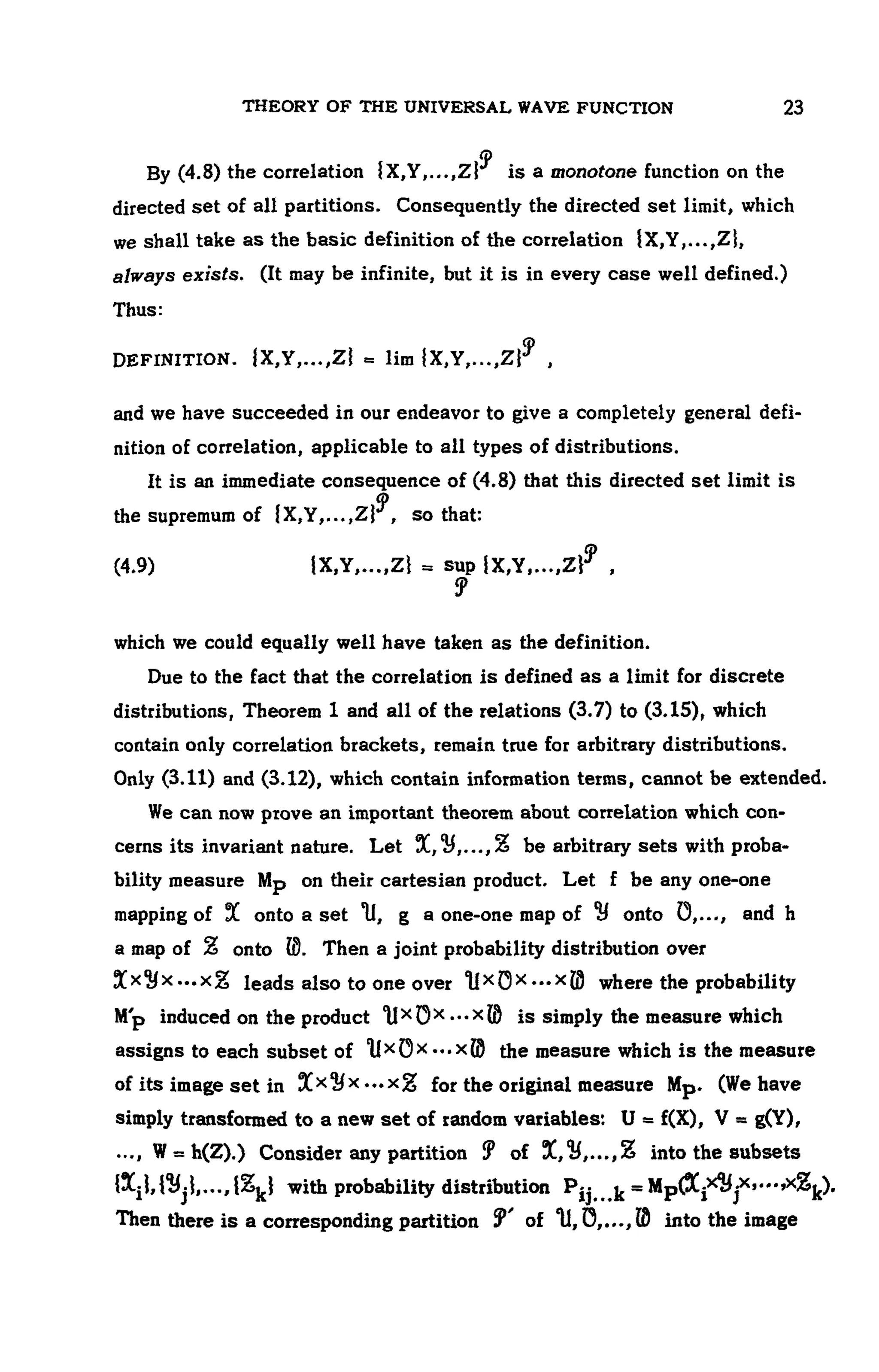
By (4.8) the correlation is a monotone function on the
directed set of all partitions. Consequently the directed set limit, which
we shall take as the basic definition of the correlation {X,Y,...,Zi,
always exists. (It may be infinite, but it is in every case well defined.)
Thus:
DEFINITION.
and we have succeeded in our endeavor to give a completely general defi-
nition of correlation, applicable to all types of distributions.
It is an immediate consequence of (4.8) that this directed set limit is
the supremum of so that:
(4.9)
which we could equally well have taken as the definition.
Due to the fact that the correlation is defined as a limit for discrete
distributions, Theorem 1 and all of the relations (3.7) to (3.15), which
contain only correlation brackets, remain true for arbitrary distributions.
Only (3.11) and (3.12), which contain information terms, cannot be extended.
We can now prove an important theorem about correlation which con-
cerns its invariant nature. Let be arbitrary sets with proba-
bility measure Mp on their cartesian product. Let f be any one-one
mapping of onto a set g a one-one map of H onto and h
a map of onto Then a joint probability distribution over
leads also to one over where the probability
Mp induced on the product is simply the measure which
assigns to each subset of the measure which is the measure
of its image set in for the original measure . (We have
simply transformed to a new set of random variables:
Consider any partition into the subsets
with probability distribution
Then there is a corresponding partition into the image
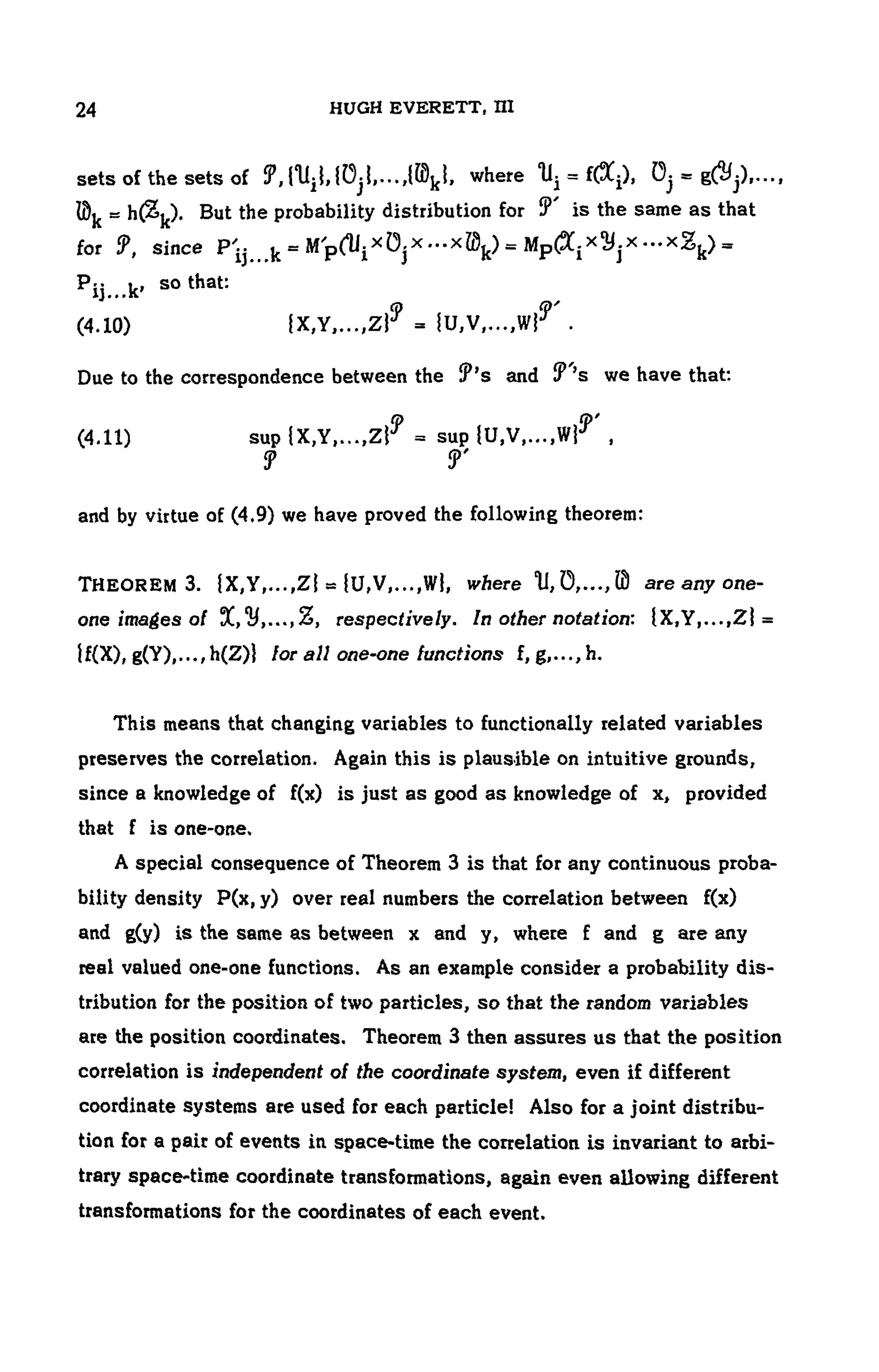
104 HUGH EVERETT, III
sets of the sets of where
. But the probability distribution for T is the same as that
for since
so that:
(4.10)
Due to the correspondence between the and we have that:
(4.11)
and by virtue of (4.9) we have proved the following theorem:
THEOREM 3. where are any one-
one images of , respectively. In other notation:
lor all one-one functions f, g,..., h.
This means that changing variables to functionally related variables
preserves the correlation. Again this is plausible on intuitive grounds,
since a knowledge of f(x) is just as good as knowledge of x, provided
that f is one-one,
A special consequence of Theorem 3 is that for any continuous proba-
bility density P(x, y) over real numbers the correlation between f(x)
and g(y) is the same as between x and y, where f and g are any
real valued one-one functions. As an example consider a probability dis-
tribution for the position of two particles, so that the random variables
are the position coordinates. Theorem 3 then assures us that the position
correlation is independent of the coordinate system, even if different
coordinate systems are used for each particle! Also for a joint distribu-
tion for a pair of events in space-time the correlation is invariant to arbi-
trary space-time coordinate transformations, again even allowing different
transformations for the coordinates of each event.
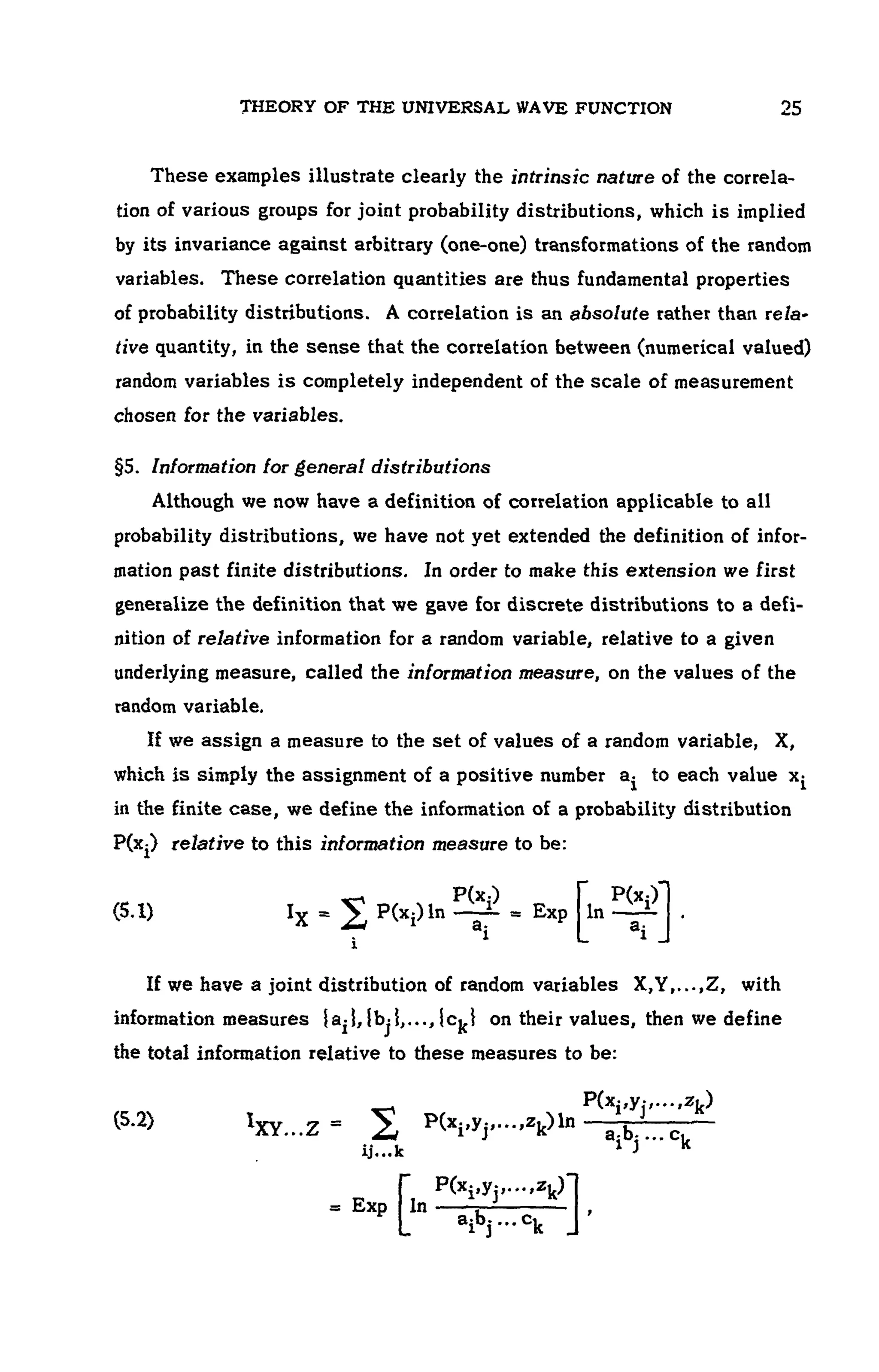
THEORY OF THE UNIVERSAL WAVE FUNCTION 25
These examples illustrate clearly the intrinsic nature of the correla -
tion of various groups for joint probability distributions, which is implied
by its invariance against arbitrary (one-one) transformations of the random
variables. These correlation quantities are thus fundamental properties
of probability distributions. A correlation is an absolute rather than re/a-
dve quantity, in the sense that the correlation between (numerical valued)
random variables is completely independent of the scale of measurement
chosen for the variables.
§5. Information for general distributions
Although we now have a definition of correlation applicable to all
probability distributions, we have not yet extended the definition of infor-
mation past finite distributions. In order to make this extension we first
generalize the definition that we gave for discrete distributions to a defi-
nition of relative information for a random variable, relative to a given
underlying measure, called the information measure, on the values of the
random variable.
If we assign a measure to the set of values of a random variable, X,
which is simply the assignment of a positive number a· to each value x^
in the finite case, we define the information of a probability distribution
P(Xi) relative to this information measure to be:
Ifwehaveajointdistributionofrandomvariables Χ,Υ,.,.,Ζ, with
information measures Ja - i, ibjj,..., ic^l on their values, then we define
the total information relative to these measures to be:
(5.1)
«-a P(x;) P(X;)
1X = X p^xPln — = Εχ
ρ ln
—
i L
(5.2)
P(Xj,y;,-.-,Zk)
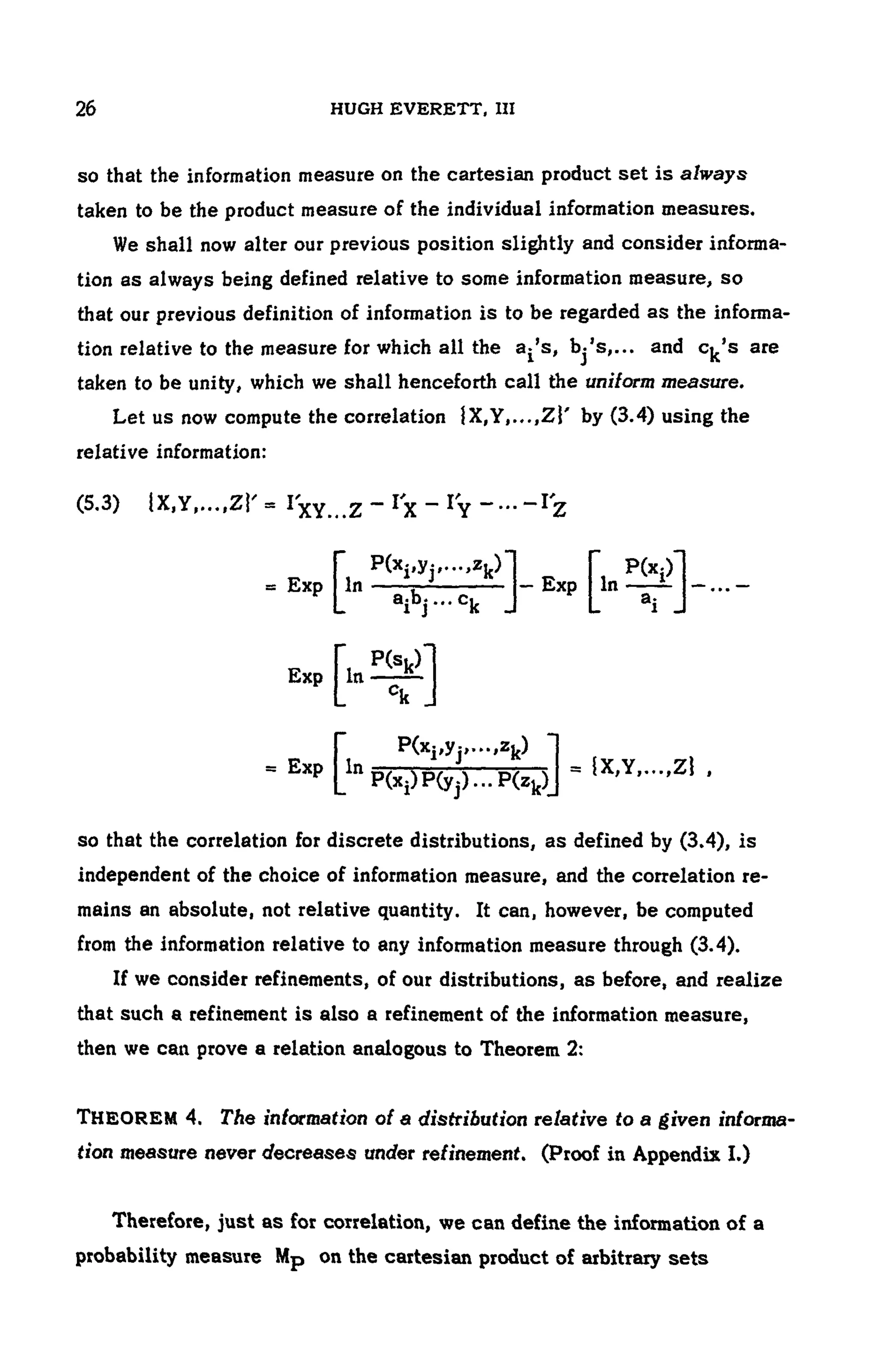
26 HUGH EVERETT, III
so that the information measure on the cartesian product set is always
taken to be the product measure of the individual information measures.
We shall now alter our previous position slightly and consider informa -
tion as always being defined relative to some information measure, so
that our previous definition of information is to be regarded as the informa-
tion relative to the measure for which all the a^s, bj's,... and c^'s are
taken to be unity, which we shall henceforth call the uniform measure.
Let us now compute the correlation {X,Y,.,.,Zj' by (3.4) using the
relative information:
so that the correlation for discrete distributions, as defined by (3.4), is
independent of the choice of information measure, and the correlation re-
mains an absolute, not relative quantity. It can, however, be computed
from the information relative to any information measure through (3.4).
If we consider refinements, of our distributions, as before, and realize
that such a refinement is also a refinement of the information measure,
then we can prove a relation analogous to Theorem 2:
THEOREM 4. The information of a distribution relative to a given informa­
tion measure never decreases under refinement. (Proof in Appendix I.)
(5.3) lX,Y,...,ZY = Ιχγ,.,ζ — *χ _
Ιγ ~···~Ι'ζ
- Exp Lln
P(Xi)P(yj) ...P(z k)_
P(xj,yj>.",Zk)
= {X,Y,...,Z! ,
Therefore, just as for correlation, we can define the information of a
probability measure Mp on the cartesian product of arbitrary sets
THEORY OF THE UNIVERSAL WAVE FUNCTION 107
, relative to the information measures , on the
individual sets, by considering finite partitions into subsets
for which we take as the definition of the information:
(5.4)
Then is, as was , a monotone function upon the
directed set of partitions (by Theorem 4), and as before we take the
directed set limit for our definition:
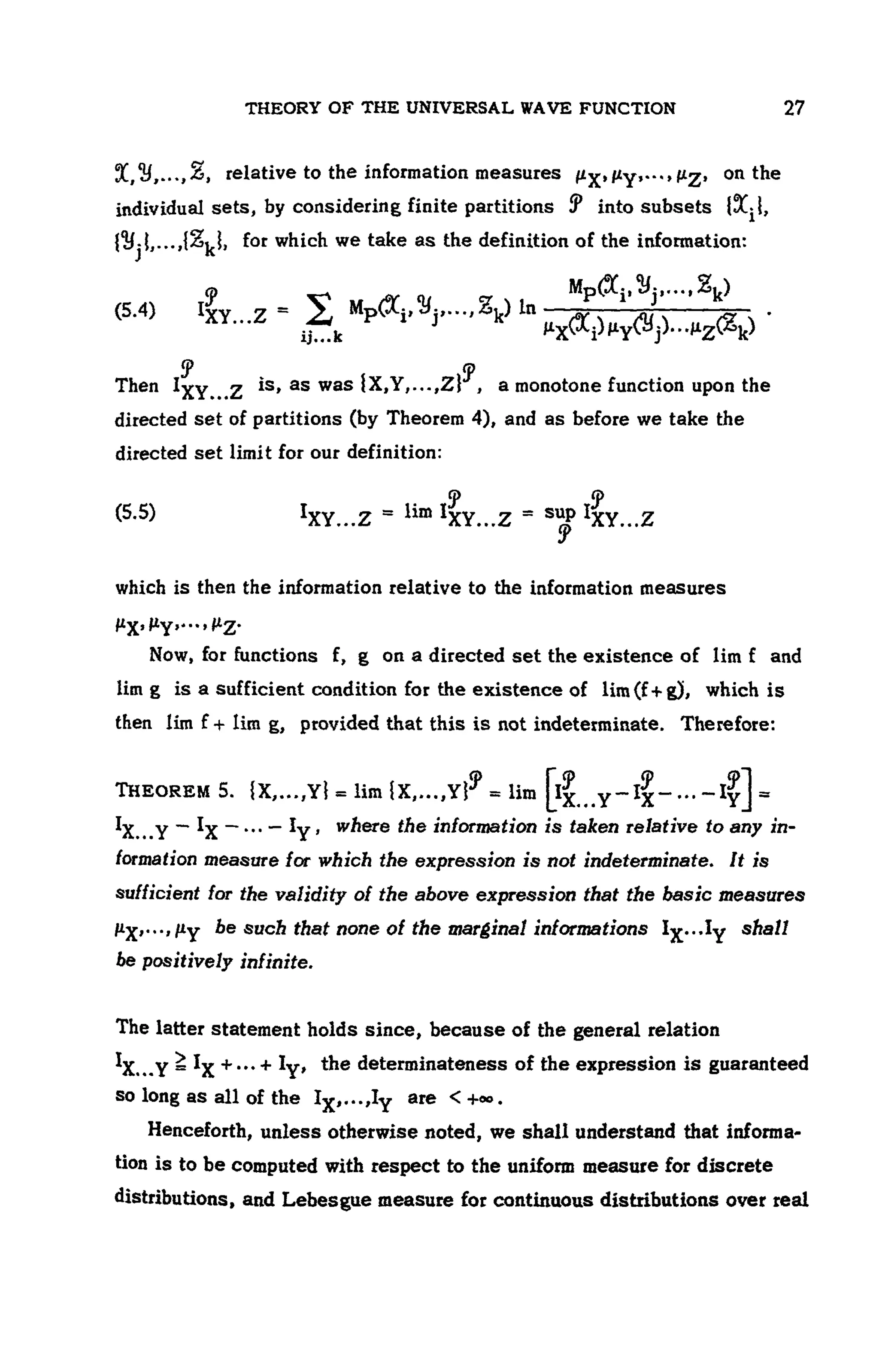
(5.5)
which is then the information relative to the information measures
Now, for functions f, g on a directed set the existence of lim f and
lim g is a sufficient condition for the existence of lim(f+g), which is
then lim f + lim g, provided that this is not indeterminate. Therefore:
THEOREM 5.
, where the information is taken relative to any in-
formation measure /or which the expression is not indeterminate. It is
sufficient for the validity of the above expression that the basic measures
be such that none of the marginal informations shall
be positively infinite.
The latter statement holds since, because of the general relation
, the determinateness of the expression is guaranteed
so long as all of the are
Henceforth, unless otherwise noted, we shall understand that informa-
tion is to be computed with respect to the uniform measure for discrete
distributions, and Lebesgue measure for continuous distributions over real
104 HUGH EVERETT, III
numbers. In case of a mixed distribution, with a continuous density
plus discrete "lumps" , we shall understand
the information measure to be the uniform measure over the discrete range,
and Lebesgue measure over the continuous range. These conventions
then lead us to the expressions:
(5.6)
(unless otherwise noted) .
The mixed case occurs often in quantum mechanics, for quantities
which have both a discrete and continuous spectrum.
§6. Example: Information decay in stochastic processes
As an example illustrating the usefulness of the concept of relative
information we shall consider briefly stochastic processes.® Suppose that
we have a stationary Markov7 process with a flsite number of states Sj,
and that the process occurs at discrete (integral) times at
which times the transition probability from the state Sj to the state Sj
is The probabilities then form wfeat is called a stochastic
6 See Feller Clo], or Boob [fi].
A Markov process is a stochastic process whose future development depends
only upon its present state, and not O
R its pest Watery.
THEORY OF THE UNIVERSAL WAVE FUNCTION 29
matrix, i.e., the elements are between 0 and 1, and ^ Tjj = 1 for all
i. If at any time k the probability distribution over the states is IP- c
I
then at the next time the probabilities will be pj""1
= Pjt
T-j.
ί
In the special case where the matrix is doubly-stochastic, which
means that ;T;·, as well as jT-, equals unity, and which amounts
to a principle of detailed balancing holding, it is known that the entropy
of a probability distribution over the states, defined as H = — ^In P-,
is a monotone increasing function of the time. This entropy is, however,
simply the negative of the information relative to the uniform measure.
One can extend this result to more general stochastic processes only
if one uses the more general definition of relative information. For an
arbitrary stationary process the choice of an information measure which is
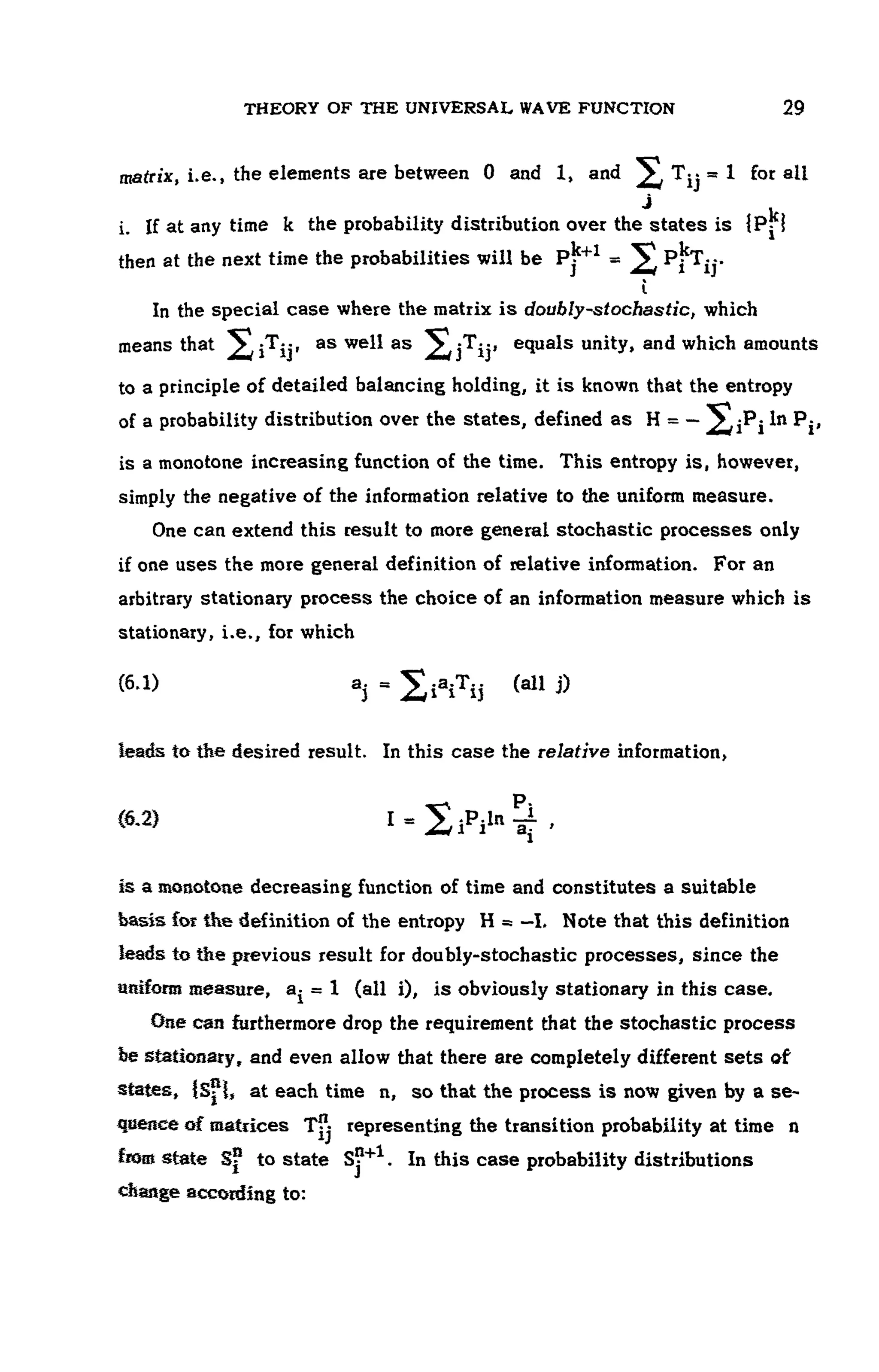
stationary, i.e., for which
(6.1) . 2iaiTij (all j)
leads to the desired result. In this case the relative information,
<6-2) I = Xip
i^ ,
is a monotone decreasing function of time and constitutes a suitable
basis for the definition of the entropy H a —I, Note that this definition
leads to the previous result for doubly-stochastic processes, since the
uniform measure, a^ = 1 (all i), is obviously stationary in this case.
One can furthermore drop the requirement that the stochastic process
be stationary, and even allow that there are completely different sets of
states, {S?l, at each time n, so that the process is now given by a se-
quence of matrices T-j representing the transition probability at time η
fiom state S? to state S?+1
. In this case probability distributions
change according to:
104 HUGH EVERETT, III
(6.3)
If we then choose any time-dependent information measure which satisfies
the relations:
(6.4)
then the information of a probability distribution is again monotone de-
creasing with time. (Proof in Appendix I.)
All of these results are easily extended to the continuous case, and
we see that the concept of relative information allows us to define entropy
for quite general stochastic processes.
§7. Example: Conservation of information in classical mechanics
As a second illustrative example we consider briefly the classical
mechanics of a group of particles. The system at any instant is repre-
sented by a point, in the phase
space of all position and momentum coordinates. The natural motion of
the system then carries each point into another, defining a continuous
transformation of the phase space into itself. According to Liouville's
theorem the measure of a set of points of the phase space is invariant
A
under this transformation. This invariance of measure implies that if we
begin with a probability distribution over the phase space, rather than a
single point, the total information
(7.1)
which is the information of the joint distribution for all positions and
momenta, remains constant in time.
8 See Khinchin [l6], p. 15.
THEORY OF THE UNIVERSAL WAVE FUNCTION 107
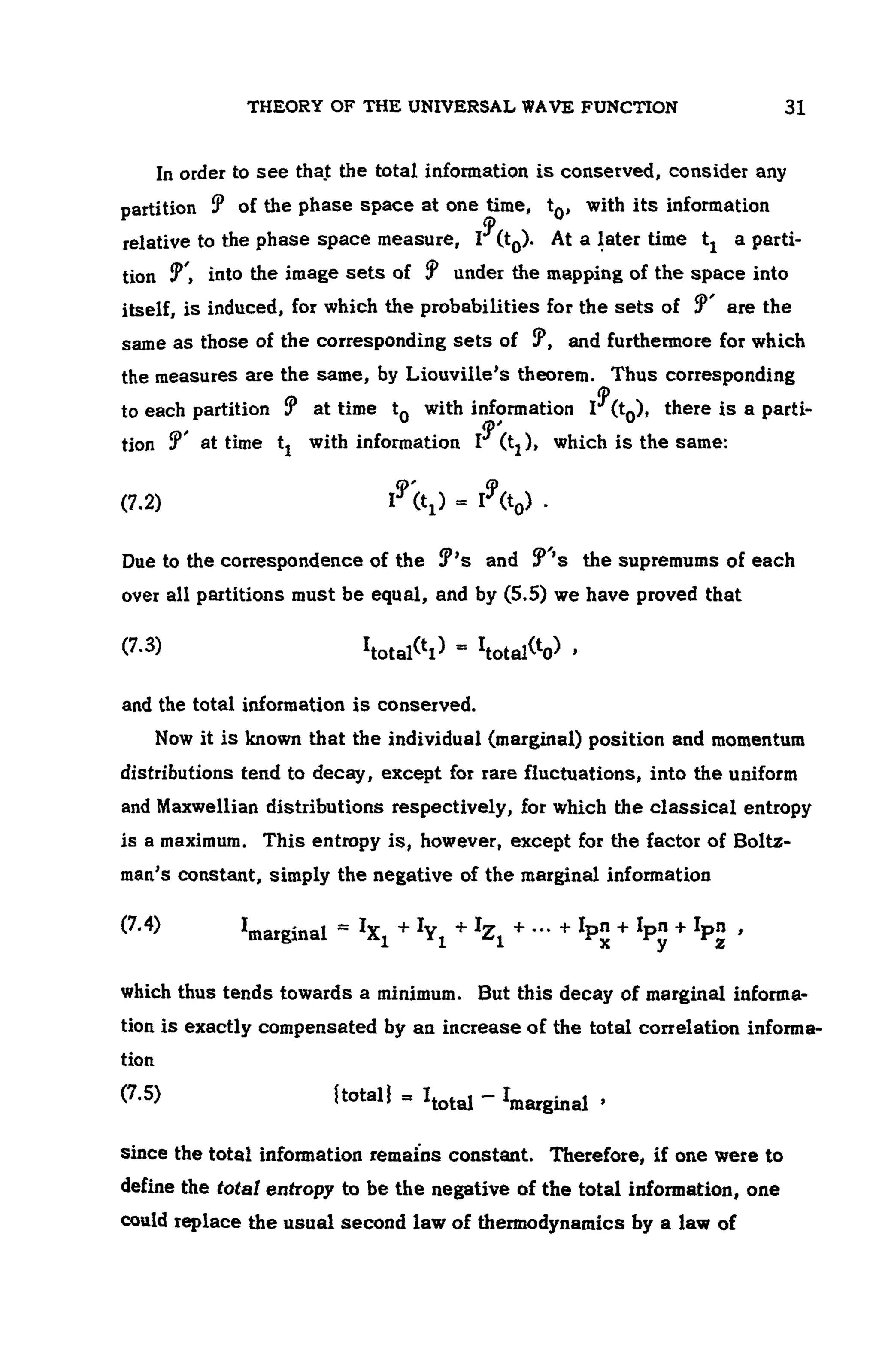
In order to see thajt the total information is conserved, consider any
partition of the phase space at one time, with its information
relative to the phase space measure, At a later time a parti-
tion into the image sets of under the mapping of the space into
itself, is induced, for which the probabilities for the sets of are the
same as those of the corresponding sets of , and furthermore for which
the measures are the same, by Liouville's theorem. Thus corresponding
to each partition at time with information there is a parti-
tion at time tj with information , which is the same:
(7.2)
Due to the correspondence of the and the supremums of each
over all partitions must be equal, and by (5.5) we have proved that
(7.3)
and the total information is conserved.
Now it is known that the individual (marginal) position and momentum
distributions tend to decay, except for rare fluctuations, into the uniform
and Maxwellian distributions respectively, for which the classical entropy
is a maximum. This entropy is, however, except for the factor of Boltz-
man's constant, simply the negative of the marginal information
^marginal
which thus tends towards a minimum. But this decay of marginal informa-
tion is exactly compensated by an increase of the total correlation informa-
tion
(7.5)
since the total information remains constant. Therefore, if one were to
define the total entropy to be the negative of the total information, one
could replace the usual second law of thermodynamics by a law of
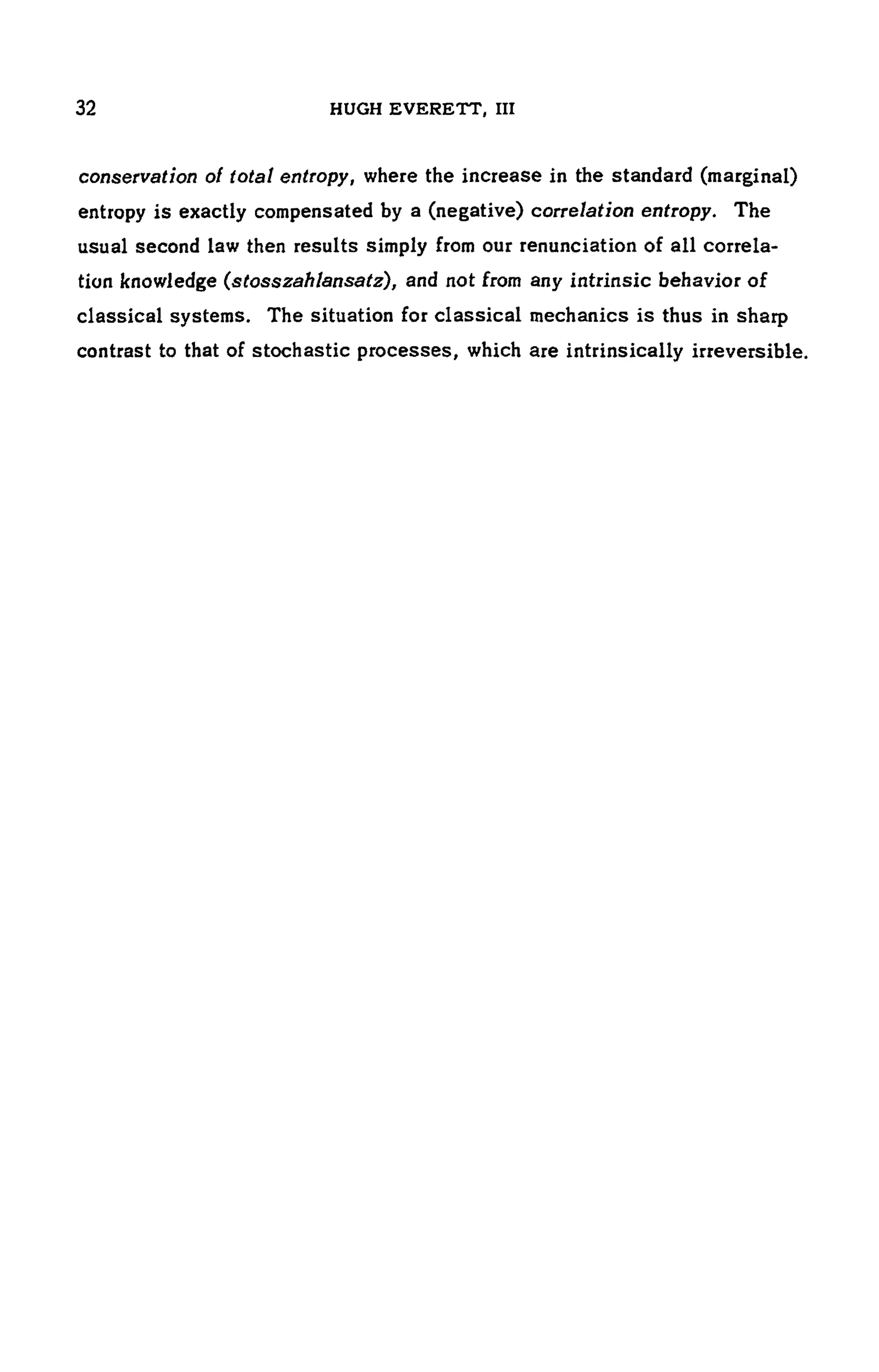
32 HUGH EVERETT, III
conservation of total entropy, where the increase in the standard (marginal)
entropy is exactly compensated by a (negative) correlation entropy. The
usual second law then results simply from our renunciation of all correla-
tion knowledge (stosszahlansatz), and not from any intrinsic behavior of
classical systems. The situation for classical mechanics is thus in sharp
contrast to that of stochastic processes, which are intrinsically irreversible.
III. QUANTUM MECHANICS
Having mathematically formulated the ideas of information and correla-
tion for probability distributions, we turn to the field of quantum mechanics.
In this chapter we assume that the states of physical systems are repre-
sented by points in a Hilbert space, and that the time dependence of the
state of an isolated system is governed by a linear wave equation.
It is well known that state functions lead to distributions over eigen-
values of Hermitian operators (square amplitudes of the expansion coeffi-
cients of the state in terms of the basis consisting of eigenfunctions of
the operator) which have the mathematical properties of probability distri-
butions (non-negative and normalized). The standard interpretation of
quantum mechanics regards these distributions as actually giving the
probabilities that the various eigenvalues of the operator will be observed,
when a measurement represented by the operator is performed.
A feature of great importance to our interpretation is the fact that a
state function of a composite system leads to joint distributions over sub-
system quantities, rather than independent subsystem distributions, i.e.,
the quantities in different subsystems may be correlated with one another.
The first section of this chapter is accordingly devoted to the development
of the formalism of composite systems, and the connection of composite
system states and their derived joint distributions with the various possible
subsystem conditional and marginal distributions. We shall see that there
exist relative state functions which correctly give the conditional distri-
butions for all subsystem operators, while marginal distributions can not
generally be represented by state functions, but only by density matrices.
In Section 2 the concepts of information and correlation, developed
in the preceding chapter, are applied to quantum mechanics, by defining
34 HUGH EVERETT,ΙΠ
information and correlation for operators on systems with prescribed
states. It is also shown that for composite systems there exists a quantity
which can be thought of as the fundamental correlation between subsys-
tems, and a closely related canonical representation of the composite sys-
tem state. In addition, a stronger form of the uncertainty principle, phrased
in information language, is indicated.
The third section takes up the question of measurement in quantum
mechanics, viewed as a correlation producing interaction between physical
systems. A simple example of such a measurement is given and discussed.
Finally some general consequences of the superposition principle are con-
sidered.
It is convenient at this point to introduce some notational conventions.
We shall be concerned with points ψ in a Hilbert space H, with scalar
product (φj,^2) · Asfaieisapoint φ for which (φ,φ) = 1. Forany
linear operator A we define a functional, <Α>ψ, called the expectation
0/ A for ψ, to be:
<Α>φ = (φ, Αφ) .
A class of operators of particular interest is the class of projection opera­
tors. The operator [φΐ, called the projection on φ, is defined through:
= <Φ,Φ)Φ ·
For a complete orthonormal set φ^} and a state φ we define a
square-amplitude distribution, Pj, called the distribution of φ over
}0|i through:
Pi = I(^)I 2
= <[φ{>φ .
In the probabilistic interpretation this distribution represents the proba-
bility distribution over the results of a measurement with eigenstates
performed upon a system in the state φ. (Hereafter when referring to the
probabilistic interpretation we shall say briefly "the probability that the
system will be found in φ^' > rather than the more cumbersome phrase
"the probability that the measurement of a quantity B, with eigenfunc-
THEORY OF THE UNIVERSAL WAVE FUNCTION 107
tions shall yield the eigenvalue corresponding to which is
meant.)
For two Hilbert spaces and , we form the direct product Hil-
bert space (tensor product) which is taken to be the space
of all possible1 sums of formal products of points of and i.e.,
the elements of , are those of the form where and
The scalar product in is taken to be
— j
It is then easily seen that if and form
complete orthonormal sets in and respectively, then the set of
all formal products is a complete orthonormal set in For any
pair of operators A, B, in and there corresponds an operator
the direct product of A and B, in which can be defined
by its effect on the elements of
§1. Composite systems
It is well known that if the states of a pair of systems and
are represented by points in Hilbert spaces and respectively,
then the states of the composite system (the two systems
and regarded as a single system S) are represented correctly by
points of the direct product This fact has far reaching conse-
quences which we wish to investigate in some detail. Thus if is a
complete orthonormal set for and for the general state of
has the form:
(1.1)
1 More rigorouslv. one considers only finite sums, then completes the resulting
space to arrive at
104 HUGH EVERETT, III
In this case we shall call the joint square'amplitude distri-
bution of , over and In the standard probabilistic interpre-
tation represents the joint probability that Sj will be found in
the state and will be found in the state Following the proba-
bilistic model we now derive some distributions from the state Let
A be a Hermitian operator in with eigenfunctions and eigen-
values and B an operator in with eigenfunctions and eigen-
values Then the joint distribution of over and i
is:
(1.2)
The marginal distributions, of over and of over
are:
(1.3)
and the conditional distributions and are:
(1.4) conditioned on
conditioned on
We now define the conditional expectationof an operator A on S t ,
conditioned on in denoted by Exp to be:
(1.5) Exp
THEORY OF THE UNIVERSAL WAVE FUNCTION 107
and we define the marginal expectation of A on to be:
(1.6) Exp
We shall now introduce projection operators to get more convenient
forms of the conditional and marginal expectations, which will also exhibit
more clearly the degree of dependence of these quantities upon the chosen
basis Let the operators and be the projections on
in and in respectively, and let I1 and be the identi-
ty operators in Sj and S2. Then, making use of the identity
for any complete orthonormal set we have:
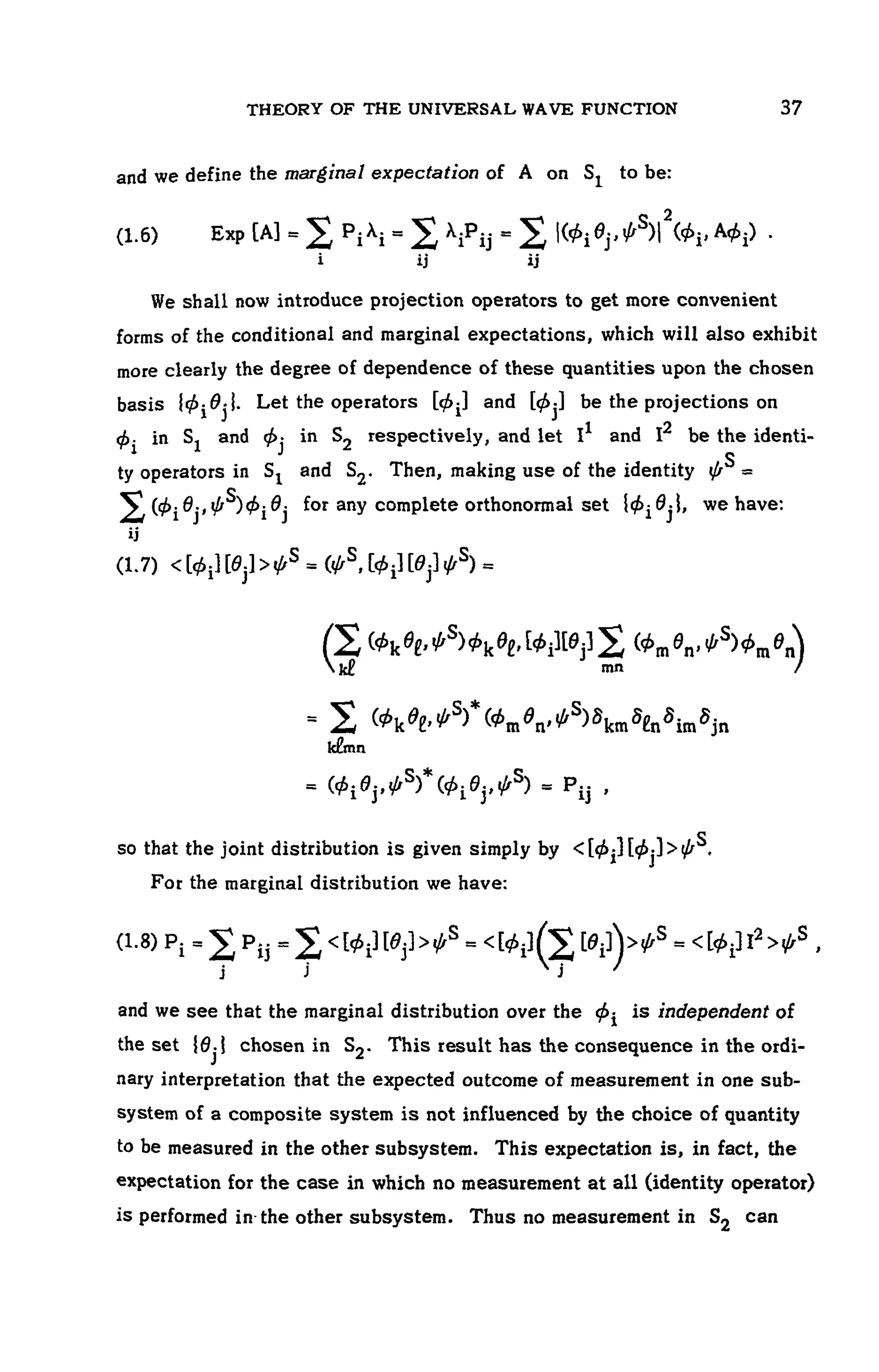
(1.7)
so that the joint distribution is given simply by
For the marginal distribution we have:
(1.8 )
and we see that the marginal distribution over the is independent of
the set chosen in This result has the consequence in the ordi-
nary interpretation that the expected outcome of measurement in one sub-
system of a composite system is not influenced by the choice of quantity
to be measured in the other subsystem. This expectation is, in fact, the
expectation for the case in which no measurement at all (identity operator)
is performed in the other subsystem. Thus no measurement in can
104 HUGH EVERETT, III
affect the expected outcome of a measurement in so long as the re-
sult of any S2 measurement remains unknown. The case is quite different,
however, if this result is known, and we must turn to the conditional dis-
tributions and expectations in such a case.
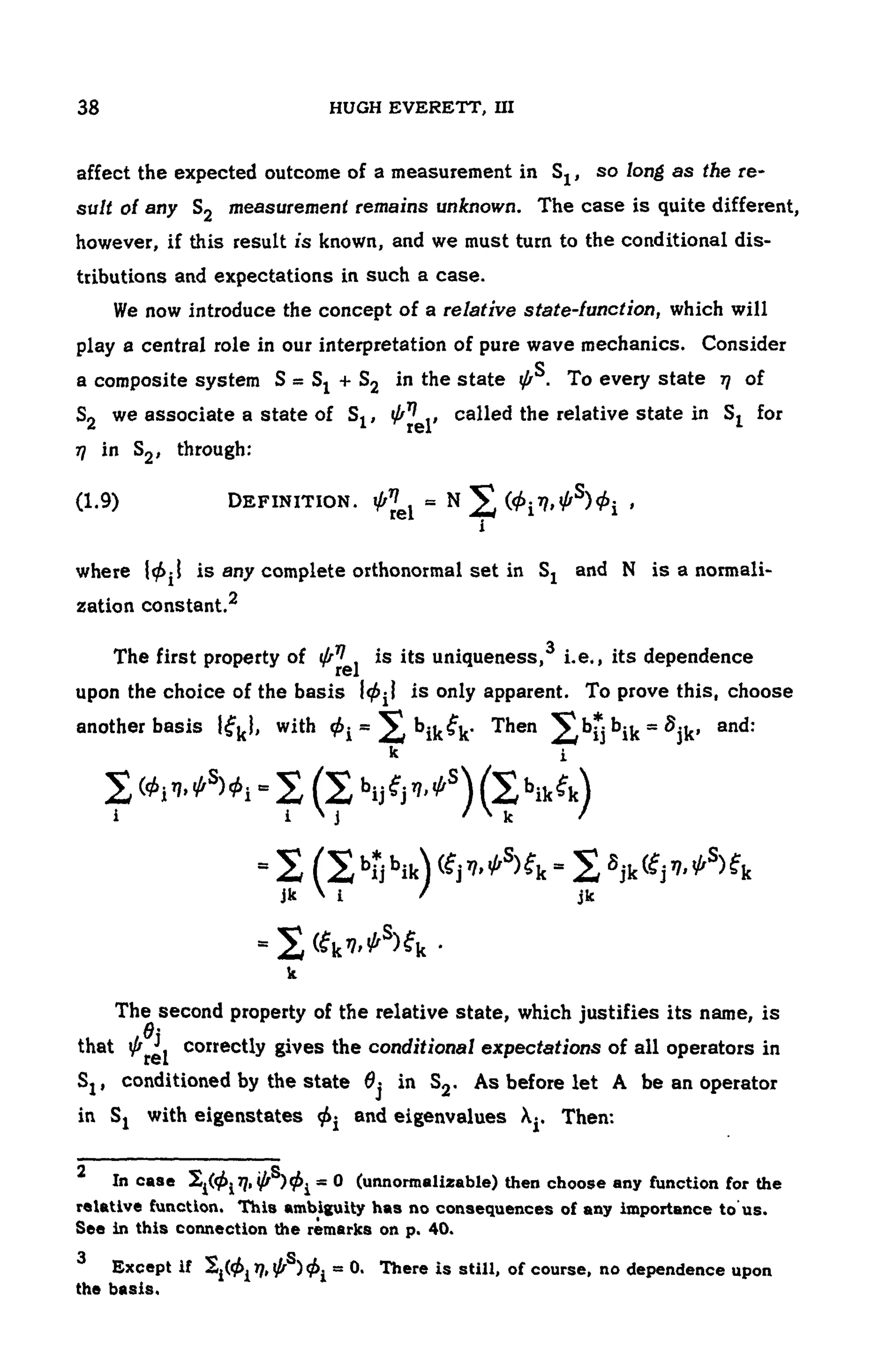
We now introduce the concept of a relative state-function, which will
play a central role in our interpretation of pure wave mechanics. Consider
a composite system in the state To every state of
we associate a state o f c a l l e d the relative state in for
in through:
(1.9) DEFINITION. ,
where is any complete orthonormal set in and N is a normali-
zation constant.2
The first property of is its uniqueness, i.e., its dependence
upon the choice of the basis is only apparent. To prove this, choose
another basis with Then and:
The second property of the relative state, which justifies its name, is
that correctly gives the conditional expectations of all operators in
conditioned by the state in As before let A be an operator
in with eigenstates and eigenvalues Then:
2
In case (unnormalizable) then choose any function for the
relative function. This ambiguity has no consequences of any importance to us.
See in this connection the remarks on p. 40.
3
Except i f T h e r e is still, of course, no dependence upon
the basis.
THEORY OF THE UNIVERSAL WAVE FUNCTION 107
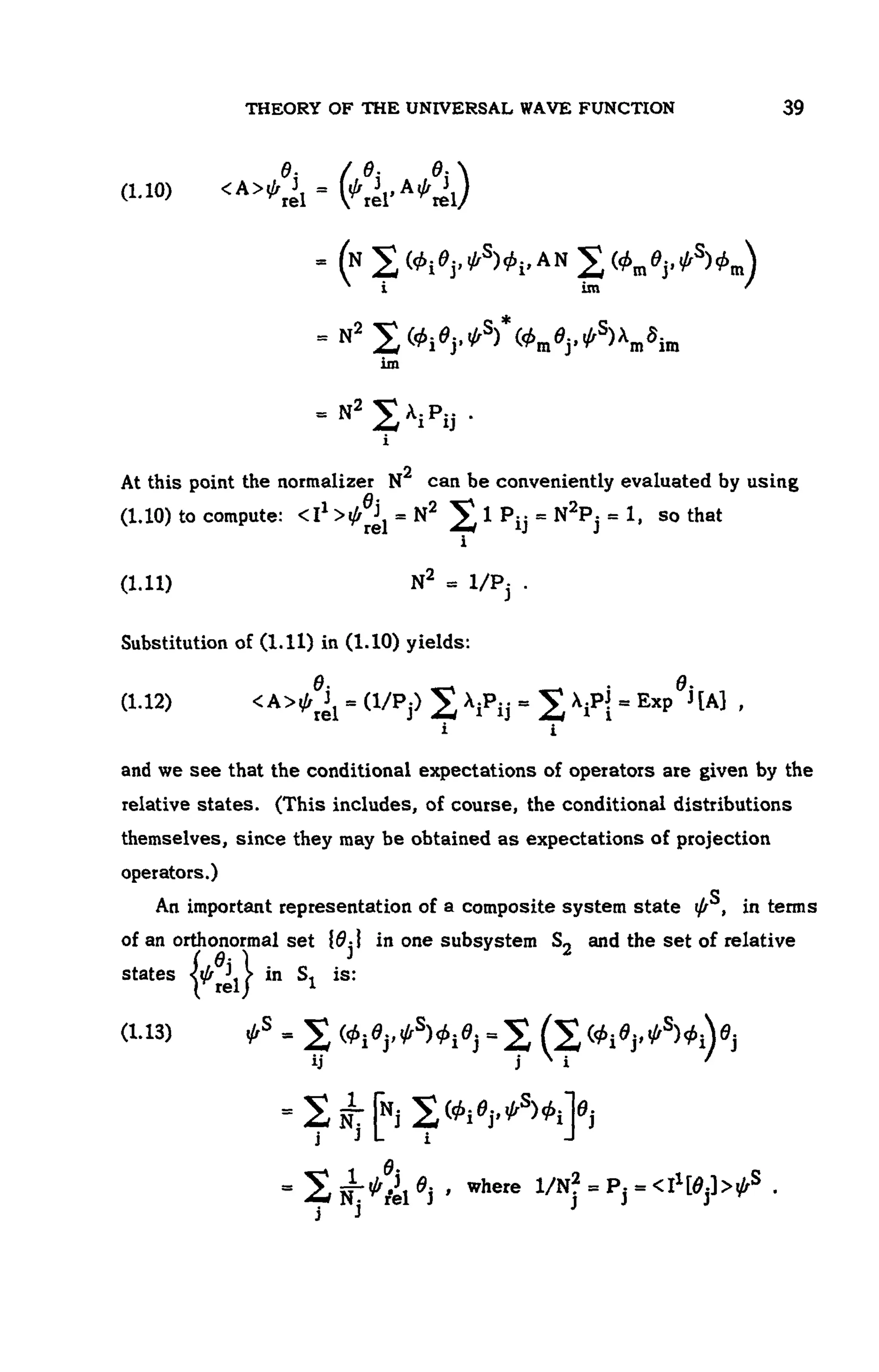
(1.10 )
At this point the normalizer can be conveniently evaluated by using
(1.10) to c o m p u t e : s o that
(1.11 )
Substitution of (1.11) in (1.10) yields:
(1.12)
and we see that the conditional expectations of operators are given by the
relative states. (This includes, of course, the conditional distributions
themselves, since they may be obtained as expectations of projection
operators.)
An important representation of a composite system state in terms
of an orthonormal set in one subsystem and the set of relative
states in S1 is:
(1.13)
104 HUGH EVERETT, III
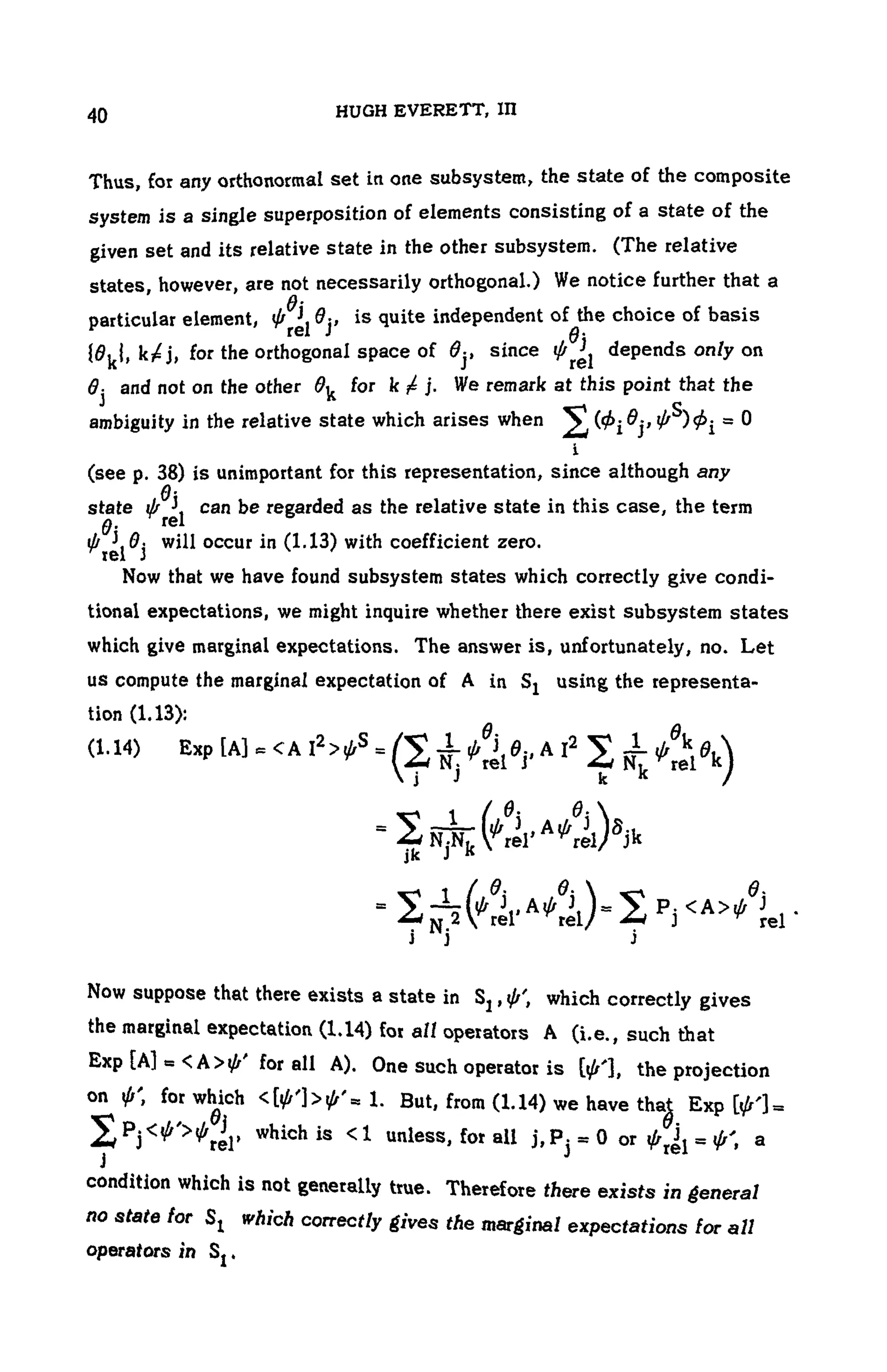
Thus, for any orthonormal set in one subsystem, the state of the composite
system is a single superposition of elements consisting of a state of the
given set and its relative state in the other subsystem. (The relative
states, however, are not necessarily orthogonal.) We notice further that a
particular element, is quite independent ofthe choice of basis
for the orthogonal space of since depends only on
and not on the other for We remark at this point that the
ambiguity in the relative state which arises when
(see p. 38) is unimportant for this representation, since although any
state can be regarded as the relative state in this case, the term
will occur in (1.13) with coefficient zero.
Now that we have found subsystem states which correctly give condi-
tional expectations, we might inquire whether there exist subsystem states
which give marginal expectations. The answer is, unfortunately, no. Let
us compute the marginal expectation of A in Sj using the representa-
tion (1.13):
(1.14) Exp
Now suppose that there exists a state in which correctly gives
the marginal expectation (1.14) for all operators A (i.e., such that
E x P f t * all A)- One such operator is the projection
on for which But, from (1.14) we have tha| Exp
, which is < 1 unless, for all or a
condition which is not generally true. Therefore there exists in general
no state for SI which correctly gives the marginal expectations for all
operators in
THEORY OF THE UNIVERSAL WAVE FUNCTION 107
However, even though there is generally no single state describing
marginal expectations, we see that there is always a mixture of states,
namely the states weighted with , which does yield the correct
expectations. The distinction between a mixture, M, of states
weighted by and a pure state • which is a superposition,
is that there are no interference phenomena between the various
states of a mixture. The expectation of an operator A for the mixture is
while the expectation for the
pure state is
which is not the same as that of the mixture with weights due
to the presence of the interference terms for
It is convenient to represent such a mixture by a density matrix,4
If the mixture consists of the states weighted by and if we are
working in a basis consisting of the complete orthonormal set where
then we define the elements of the density matrix for the
mixture to be:
(1.15)
Then if A is any operator, with matrix representation
in the chosen basis, its expectation for the mixture is:
(1.16)
4 " ' '
Also called a statistical operator (von Neumann [l 7]).
104 HUGH EVERETT, III
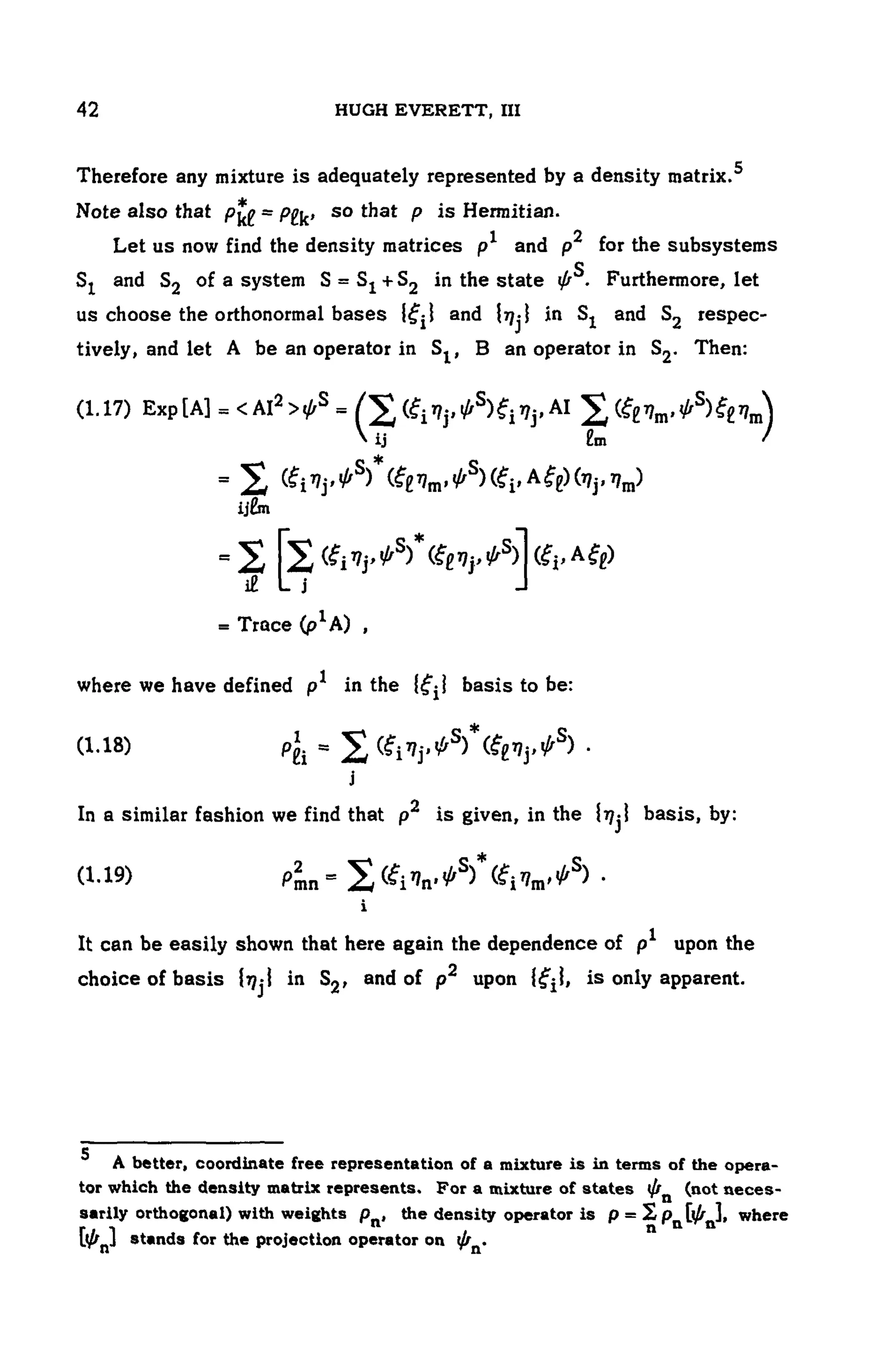
Therefore any mixture is adequately represented by a density matrix.5
Note also that so that is Hermitian.
Let us now find the density matrices and for the subsystems
and of a system in the state Furthermore, let
us choose the orthonormal bases and in and respec-
tively, and let A be an operator in , B an operator in Then:
(1.17)
where we have defined in the basis to be:
(1.18)
In a similar fashion we find that is given, in the basis, by:
(1.19)
It can be easily shown that here again the dependence of upon the
choice of basis in and of upon is only apparent.
5 A better, coordinate free representation of a mixture is in terms of the opera-
tor which the density matrix represents. For a mixture of states (not neces-
sarily orthogonal) with weights the density operator i s w h e r e
stands for the projection operator on
Random documents with unrelated
content Scribd suggests to you:
the pipe tomahawk with which he had been smoking, and exclaimed, "Let
that woman take care of herself"—meaning the Empress Catharine—"this
may yet be a dangerous man!"
The Captain explained to the Turtle some anecdotes respecting the
Empress and her favorites, one of whom,—the king of Poland,—had at first
been by her elevated to the throne, and afterwards driven from it. He was
much astonished to find that men, and particularly warriors, would submit
to a woman. He said that perhaps if his friend Kosciusko had been a portly,
handsome man, he might have better succeeded with her majesty of all the
Russias, and might by means of a love-intrigue have obtained that
independence for his country, to which his skill and valor in the field had
been found unequal.
The Turtle was fond of joking, and was possessed of considerable
talent for repartee. In the year 1797, he lodged in a house in Philadelphia, in
which was an Irish gentleman of considerable wit, who became much
attached to the Indian, and frequently amused himself in drawing out his wit
by good-humored jests. The Turtle and this gentlemen were at that time
both sitting for their portraits—the former by order of the President of the
United States, the picture to be hung up in the war-office—to the celebrated
Stewart. The two meeting one morning in the painter's room, the Turtle
appeared to be rather more thoughtful than usual. The Irishman rallied him
upon it, and affected to construe it into an acknowledgment of his
superiority in the jocular contest. "He mistakes," said the Turtle to the
interpreter, "I Was just thinking of proposing to this man, to paint us both
on one board, and here I would stand face to face with him, and confound
him to all eternity."
CHAPTER XVI.
The Seneca Chief, Red-Jacket—Circumstances under which he succeeded Corn-
Planter in his influence—Anecdotes of the latter—Red-Jacket's earliest oratorical
triumph—His speech at the Treaty of Canandaigua—Account of Farmer's-Brother,
and Brandt—Red-Jacket's political and religious principles—Speech to Mr.
Alexander, in 1811—Speech to Mr. Richardson—Remarks on the causes of his
heathenism in the conduct of the whites—His military career—Speech in favor of
declaring war against the British, in 1812—Seneca Manifesto—Red-Jacket's
interview with Washington—His interview with Lafayette—His Memorial to the
New-York Legislature—Speech to a Missionary in 1825—His deposition and
restoration in 1827—Visits to the Atlantic cities—Death and funeral obsequies—
Anecdotes.
The Indian orator of modern times, par excellence, was the New-York
Chief, Saguoaha, or the Keeper-Awake, but by the whites commonly called
Red-Jacket;—a man who, with whatever propriety he might be entitled
"the Last of the Senecas," has at least transiently renewed, in these latter
days, the ancient glory of the Mingoes. "Thy name is princely,"—a popular
writer has said of him,—
. . . Though no poet's magic
Could make Red-Jacket grace an English rhyme,
Unless he had a genius for the tragic,
And introduced it in a pantomime;
Yet it is music in the language spoken
Of thine own land; and on her herald-roll,
As nobly fought for, and as proud a token
As Coeur-de-Lion's of a warrior's soul. [FN]
[FN] Talisman fox 1830.
This, by the way, is considerably nearer the truth than the statement in
a preceding stanza:
. . . Tradition's pages
Tell not the planting of thy parent tree;
But that the forest tribes have Dent for ages,
To thee and to thy sires the subject knee.
Better historical, if not poetical authority informs us, that the Seneca
literally "fought" for his rank, if not for his name; and that, like the subject
of our last notice, he owed nothing to the advantages of illustrious birth.
[FN] We should add, however, that the struggle was in the council-house as
well as in the field of battle. "A warrior!"—he once (and probably more
than once) had the modesty to say of himself, with a smile of contempt,
when some enquiries were made respecting the deeds of blood which are
sometimes supposed to constitute the character of an Indian;—"A Warrior! I
am an Orator. I was born an Orator!"
[FN] Governor Clinton's Discourse before the New-York Historical Society; 1811.
The predecessor of Red-Jacket, in the respect of the Senecas, and of
the Confederacy at large, was a celebrated chief named by the English the
Corn-Planter, a personage also well known for his eloquence, and worthy
on that account to be distinctly commemorated, were there on record any
definite and well authenticated sketches of his efforts. Unfortunately, there
are not. The speeches commonly ascribed to him, are believed to have been
mostly composed by some of his civilized acquaintances, rather on the
principle of those effusions usually attributed to popular candidates for the
gallows. Still, there is less reason, we apprehend, for doubting his real
genius, than for disputing his nationality. He considered himself a half-
breed, [FN] his father being an Indian, according to his own account, and
his mother a white woman.
[FN] Appendix, III. and VI.
By a singular combination of circumstances, Red-Jacket was brought
forward into public life, and that to great advantage, mainly in consequence
of the same incident which destroyed the influence of Corn-Planter. This,
indeed, had been rather declining for some time, owing partly to his agency
in effecting a large cession of Seneca land to the American Government, at
the treaty of Fort Stanwix, in 1784. His loss of popularity, in fine, bitterly
chagrined him, and he resolved on a desperate exertion to restore it. With
this view, he undertook to practice upon the never-failing superstition of his
countrymen, by persuading his brother to announce himself as a Prophet,—
of course commissioned by the Great Spirit "to redeem the fallen fortunes
of his race,"—that is, his own.
The savages listened to the new pretender with all the veracious
credulity which characterises the race. Among the Onondagas, previously
the most drunken and profligate of the Six Nations, he acquired such an
ascendancy, as to induce them to abandon the use of spirituous liquors
entirely, and to observe the common laws of morality and decency in some
other respects, wherein they had before been grievously deficient. Indeed,
among the Confederates generally, he obtained a supremacy equal to that of
the same character obtained by Elskwatawa among the western tribes, not
far from the same time. The Oneidas alone rejected him.
Like that notorious impostor, too, he soon availed himself, for evil
purposes, of the confidence gained by the preliminary manifestation of
good. A cry of "witchcraft" was raised, and a sort of examining committee
of conjurers was selected to designate the offenders. And that duty was
zealously discharged. The victims were actually sentenced, and would
doubtless have been executed, but for the interference of the magistrates of
Oneida and the officers of the garrison at Niagara.
But neither the Corn-Planter nor his pious coadjutor was yet
discouraged. Nothing but an accident had prevented success, and the failure
only made it the more imperatively necessary to try the experiment again.
Red-Jacket was publicly denounced. His accusers came forward at a great
Indian council held at Buffalo Creek. "At this crisis," says an eminent
writer, "he well knew that the future color of his life depended upon the
powers of his mind. He spoke in his defence for near three hours. The iron
brow of superstition relented under the magic of his eloquence; he declared
the Prophet an impostor and a cheat; he prevailed; the Indians divided, and
a small majority appeared in his favor. Perhaps the annals of history cannot
furnish a more conspicuous instance of the triumph and power of oratory, in
a barbarous nation, devoted to superstition, and looking up to the accuser as
a delegated minister of the Almighty." [FN]
[FN] Discourse of Governor Clinton.
If this anecdote be true,—and we are not aware of its having been
doubted,—the Orator, whatever be said of his genius as such, hardly
deserved the precise compliment which is paid him by his eulogist in verse.
"Is eloquence," he asks, "a monarch's merit?"
. . . Her spell is thine that reaches
The heart, and makes the wisest head its sport,
And there's one rare, strange virtue in thy speeches.
The secret of their mastery—they are short.
But the Seneca's case, it must be allowed, was one of clear
compulsion; and he probably felt, on the occasion in question, very little of
the impatience which induced Horne Tooke to say, after a noble friend's
plea of eleven hours in his behalf before the Commons, that "he would
rather be hanged, another time, than defended."
Such was the Orator's first triumph. It was not, however, his first
effort; for many years before the transaction just referred to, as we suppose,
when Red-Jacket was probably about thirty years of age,—and at a period
when our relations with all the Indians are well known to have been
continually wavering,—a treaty was held with the Six Nations on the
beautiful acclivity which overlooks the Canandaigua Lake. Some
reminiscences of it, bearing a high interest, have reached us, on the
authenticity of which we do not hesitate to rely.
"Two days," says our authority, [FN] "had passed away in negotiation
with the Indians for a cession of their lands. The contract was supposed to
be nearly completed, when Red-Jacket arose. With the grace and dignity of
a Roman senator, he drew his blanket around him, and, with a piercing eye,
surveyed the multitude. All was hushed. Nothing interposed to break the
silence, save the gentle rustling of the tree-tops, under whose shade they
were gathered. After a long and solemn, but not unmeaning pause, he
commenced his speech in a low voice and a sententious style. Rising
gradually with his subject, he depicted the primitive simplicity and
happiness of his nation, and the wrongs they had sustained from the
usurpations of white men, with such a bold but faithful pencil, that every
auditor was soon roused to vengeance, or melted into tears."
[FN] The writer of a communication on "Indian Biography," for the New-York
American, about ten years since. We give him credit for his statements of facts,
though we cannot concur with him in charging Red-Jacket with "cowardice." He adds,
"It was only at the 'Council-fire' he shone pre-eminent. There, indeed, he was great.
The belittling simplicity of his name did not seem to detract from the splendors of his
eloquence."
"The effect was inexpressible. But ere the emotions of admiration and
sympathy had subsided, the white men became alarmed. They were in the
heart of an Indian country, surrounded by more than ten times their number,
who were inflamed by the remembrance of their injuries, and excited to
indignation by the eloquence of a favorite chief. Appalled and terrified, the
white men cast a cheerless gaze upon the hordes around them. A nod from
the chiefs might be the onset of destruction. At that portentous moment,
Farmer's-Brother interposed. He replied not to his brother chief; but, with
a sagacity truly aboriginal, he caused a cessation of the council, introduced
good cheer, commended the eloquence of Red-Jacket, and, before the
meeting had re-assembled, with the aid of other prudent chiefs, he had
moderated the fury of his nation to a more salutary review of the question
before them."
The council came together again in cooler blood, and the treaty was
concluded. The Western District at this day, it is added, "owes no small
portion of its power and influence to the councils of a savage, in
comparison with whom for genius, heroism, virtue, or any other quality that
can adorn the bauble of a diadem, not only George the IV. and Louis le
Desire, but the German Emperor and the Czar of Muscovy, alike dwindle
into insignificance."
This somewhat warmly expressed compliment,—the extravagance of
which in an old friend of the subject, may be excused in its good feeling,—
reminds us of the consideration really due to a man distinguished not alone
as a competitor with our hero for savage glory.
Except as related to oratory, he was a competitor in the same course.
The name of Farmer's-Brother was merely arbitrary. He was a warrior in
principle and in practice, and he spurned agriculture and every other
civilized art, with the contempt of Red-Jacket himself. In the war between
France and England, which resulted in the conquest of Canada, he fought
against the latter, and probably under the remote command of the great
Ottawa "Emperor" of the north. One of his exploits in the contest is still told
to the traveler who passes a noted stream not very far from the ancient Fort
Niagara, in the vicinity of which it occurred. The particulars come to us
authenticated by one to whom they were furnished by the Farmer himself
on the site of the adventure.
There, with a party of Indians, he lay in ambush, patiently awaiting the
approach of a guard that accompanied the English teams employed between
the falls of Niagara and the garrison, which had there lately surrendered to
Sir William Johnston. The place selected for that purpose is now known by
the name of the Devil's Hole, and is three and a half miles below the famous
cataract upon the American side of the strait. The mind can scarcely
conceive a more dismal looking den. A large ravine, occasioned by the
falling in of the perpendicular bank, made dark by the spreading branches
of the birch and cedar, which had taken root below, and the low murmuring
of the rapids in the chasm, added to the solemn thunder of the cataract
itself, conspire to render the scene truly awful. The English party were not
aware of the dreadful fate that awaited them. Unconscious of danger, the
drivers were gaily whistling to their dull ox-teams. Farmer's-Brother and his
band, on their arrival at this spot, rushed from the thicket that had concealed
them, and commenced a horrid butchery. So unexpected was such an event,
and so completely were the English disarmed of their presence of mind, that
but a feeble resistance was made. The guard, the teamsters, the oxen and the
wagons, were precipitated into the gulf. But two of them escaped; a Mr.
Stedman, who lived at Schioper, above the falls, being mounted on a fleet
horse, made good his retreat; and one of the soldiers, who was caught on
the projecting root of a cedar, which sustained him until assured, by the
distant yell of the savages, that they had quited the ground.—It is the
rivulet, pouring itself down this precipice, whose name is the only
monument that records the massacre. It is said to have been literally colored
with the blood of the vanquished.
In the Revolutionary War, Farmer's-Brother evinced his hostility to the
Americans upon every occasion that presented itself; and, with the same
zeal, he engaged in the late war against his former friends, the English.
Another anecdote of this Chief will show, in more glowing colors, the
real savage. A short time before our army crossed the Niagara, Farmer's-
Brother chanced to observe an Indian, who had mingled with the Senecas,
and whom he instantly recognized as belonging to the Mohawks, a tribe
living in Canada, and then employed in the service of the enemy. He went
up to him, and addressed him in the Indian tongue—"I know you well—you
belong to the Mohawks—you are a spy—here is my rifle—my tomahawk—
my scalping-knife. I give you your choice which I shall use, but I am in
haste." The young warrior, finding resistance vain, chose to be put to death
with a rifle. He was ordered to lie down upon the grass, while, with his left
foot upon the breast of the victim, the Chief lodged the contents of his rifle
in his head.
With so much of the savage, Farmer's-Brother possessed some noble
traits. He was as firm a friend where he promised fidelity, as a bitter enemy
to those against whom he contended; and would lose the last drop of blood
in his veins sooner than betray the cause he had espoused. He was fond of
recounting his exploits, and dwelt with much satisfaction upon the number
of scalps he had taken in his skirmishes with the whites. In company with
several other chiefs, he once paid a visit to General Washington, who
presented him with a silver medal. This he constantly wore suspended from
his neck; and so precious did he esteem the gift, that he was often heard to
declare he would lose it only with his life.
Soon after the battles of Chippewa and Bridgewater, this veteran
warrior paid the debt of nature, aged more than eighty years, at the Seneca
village, where, as a mark of respect for his distinguished bravery, the fifth
regiment of United States Infantry interred him with military honors. [FN]
[FN] See Village Register, American, and other New-York papers of about 1820.—
Also, Appendix. V and VI.
Another elder contemporary of Red-Jacket was the Mohawk chief
Brandt, "the accursed Brandt" of Gertrude of Wyoming, whom, however,
we think it the less necessary to notice at much length, from his being, like
the Corn-Planter, only a half-breed. In the French and English war, he
rendered some services to the former. In the Revolution, he was
commissioned Colonel in the English army, and distinguished himself in the
horrid massacre at Wyoming. His services were rewarded by the present of
a fine tract of land on the western shores of Lake Ontario. One of his sons,
an intelligent, high-minded man, quite civilized, and much esteemed by his
American acquaintances, a few years since laudably undertook the
vindication of his father's memory from the often repeated charges of
treachery and cruelty, but we apprehend with rather more zeal than success.
The father deceased in 1807; the son, only a month or two since.
To return to Red-Jacket After his first oratorical triumph, he rose as
rapidly as the Corn-Planter declined in the esteem of his countrymen. The
latter withdrew from the rivalry, [FN] but the ambition of his successor was
thoroughly aroused. He burned to be, and to be called, the Great Speaker of
his nation and his age; to renew that glorious era when the white men
trembled at the breath of Garangula; to feel and to make felt.
The monarch mind—the mystery of commanding—
The godlike power—the art Napoleon,
Of winning, fettering, moulding, wielding, banding
The hearts of millions, till they move like one.
[FN] The Prophet died in 1815.
And he succeeded as far perhaps as could be expected in the
circumstances of the modern Seneca, as compared with those of the orator
who bearded the Canadian lion in his den. More than a century had since
elapsed, during which the proud confederacy that had kept all other nations
on the continent at bay was reduced to a few lingering, scattered
settlements,—surrounded and crowded by civilization,—perhaps besotted
in vice,—where the very ground of their ancient council-halls scarcely was
sought for. With such discouragements in his way, the young Orator
deserves some credit for making the exertions he did, and his countrymen
for rewarding them as they were able. They elected him a chief; and then
upon all occasions obeyed him in peace, and followed him in war.
Red-Jacket justified their confidence by a strict adherence to principles
which on the whole are equally creditable to his heart and head, although
either the policy itself, or his singular pertinacity in maintaining it, no doubt
made him many adversaries and some enemies, even with his own people.
He had early reflected upon and felt deeply the impotent insignificance to
which the tribes were reduced;—and he resolved, if he could not restore
them to their primitive position, at least to stay the progress of ruin. How
should this be done,—was the great question,—by receiving civilization, or
by resisting it?
He determined on the latter alternative, and from that hour never in the
slightest degree swerved from his resolution to drive away and keep away
every innovation on the character, and every intrusion on the territory of the
nation. Traders, travelers, teachers, missionaries, speculators in land, were
regarded with the same jealousy. In a word, he labored against
circumstances whose force had now become inevitable and irresistible, to
maintain a system of complete Indian Independence, which few of his
countrymen understood, and still fewer were willing to practice.
And this is the trait which distinguishes his character from the majority
of those we have heretofore sketched. Some of the most eminent of the
number, like Pontiac and Little-Turtle, were anxious to avail themselves of
the arts of civilization at least, were it only for purposes of offence and
defence against the race whom they borrowed from; and scarcely any were
opposed, other than incidentally, to their introduction into Indian use. But
Red-Jacket was a Pagan in principle. He advocated as well as acted
Paganism on all occasions. He was prouder of his genuine Indianism, if
possible, than he was of his oratory. His bitterest foe could not deny him the
merit of frankness.
One of his clearest manifestos, in explanation of his system, was
delivered as long ago as May, 1811, before a council of the Senecas, held at
Buffalo Creek, in the form of a speech to the Rev. Mr. Alexander, a
missionary from a Society in the city of New-York, whose commission the
address itself sufficiently explains.
"Brother!"—the Orator began, with a complaisance which never, under
any excitement, deserted him,-"Brother!—We listened to the talk you
delivered us from the Council of Black-Coats, [FN] in New-York. We have
fully considered your talk, and the offers you have made us. We now return
our answer, which we wish you also to understand. In making up our minds,
we have looked back to remember what has been done in our days, and
what our fathers have told us was done in old times."
[FN] His usual designation of Clergymen.
"Brother!—Great numbers of Black-Coats have been among the
Indians. With sweet voices and smiling faces, they offered to teach them the
religion of the white people. Our brethren in the East listened to them. They
turned from the religion of their fathers, and took up the religion of the
white people. What good has it done? Are they more friendly one to another
than we are? No, Brother! They are a divided people;—we are united. They
quarrel about religion;—we live in love and friendship. Besides, they drink
strong waters. And they have learned how to cheat, and how to practice all
the other vices of the white people, without imitating their virtues. Brother!
—If you wish us well, keep away; do not disturb us.
"Brother!—We do not worship the Great Spirit as the white people do,
but we believe that the forms of worship are indifferent to the Great Spirit.
It is the homage of sincere hearts that pleases him, and we worship him in
that manner.
"According to your religion, we must believe in a Father and Son, or
we shall not be happy hereafter. We have always believed in a Father, and
we worship him as our old men taught us. Your book says that the Son was
sent on earth by the Father. Did all the people who saw the Son believe
him? No! they did not. And if you have read the book, the consequence
must be known to you.
"Brother!—You wish us to change our religion for yours. We like our
religion, and do not want another. Our friends here, [pointing to Mr.
Granger, the Indian Agent, and two other whites, {FN}] do us great good;
they counsel us in trouble; they teach us now to be comfortable at all times.
Our friends the Quakers do more. They give us ploughs, and teach us how
to use them. They tell us we are accountable beings. But they do not tell us
we must change our religion.—We are satisfied with what they do, and with
what they say."
[FN] An Indian Interpreter, and an Agent of the Society of Friends for improving the
condition of the Indians.
"Brother!—For these reasons we cannot receive your offers. We have
other things to do, and beg you to make your mind easy, without troubling
us, lest our heads should be too much loaded, and by and by burst."
At the same Council, the following reply was made by Red-Jacket, in
behalf of his tribe, to the application of a Mr. Richardson, to buy out their
right to the reservations lying in the territory commonly called the Holland
Purchase.
"Brother!—We opened our ears to the talk you lately delivered to us, at
our council-fire. In doing important business it is best not to tell long
stories, but to come to it in a few words. We therefore shall not repeat your
talk, which is fresh in our minds. We have well considered it, and the
advantages and disadvantages of your offers. We request your attention to
our answer, which is not from the speaker alone, but from all the Sachems
and Chiefs now around our council-fire.
"Brother!—We know that great men, as well as great nations, have
different interests and different minds, and do not see the same light—but
we hope our answer will be agreeable to you and your employers.
"Brother!—Your application for the purchase of our lands is to our
minds very extraordinary. It has been made in a crooked manner. You have
not walked in the straight path pointed out by the great Council of your
nation. You have no writings from your great Father, the President. In
making up our minds we have looked back, and remembered how the
Yorkers purchased our lands in former times. They bought them, piece after
piece,—for a little money paid to a few men in our nation, and not to all our
brethren,—until our planting and hunting-grounds have become very small,
and if we sell them, we know not where to spread our blankets.
"Brother!—You tell us your employers have purchased of the Council
of Yorkers, a right to buy our lands. We do not understand how this can be.
The lands do not belong to the Yorkers; they are ours, and were given to us
by the Great Spirit.
"Brother!—We think it strange that you should jump over the lands of
our brethren in the East, to come to our council-fire so far off to get our
lands. When we sold our lands in the East to the white people, we
determined never to sell those we kept, which are as small as we can
comfortably live on.
"Brother!—You want us to travel with you and look for new lands. If
we should sell our lands and move off into a distant country towards the
setting sun, we should be looked upon in the country to which we go, as
foreigners and strangers. We should be despised by the red, as well as the
white men, and we should soon be surrounded by the white people, who
will there also kill our game, and come upon our lands and try to get them
from us.
"Brother!—We are determined not to sell our lands, but to continue on
them. We like them. They are fruitful, and produce us corn in abundance for
the support of our women and children, and grass and herbs for our cattle.
"Brother!—At the treaties held for the purchase of our lands, the white
men, with sweet voices and smiling faces, told us they loved us, and that
they would not cheat us, but that the king's children on the other side of the
lake would cheat us. When we go on the other side of the lake, the king's
children tell us your people will cheat us. These things puzzle our heads,
and we believe that the Indians must take care of themselves, and not trust
either in your people, or in the king's children.
"Brother!—At a late council we requested our agents to tell you that
we would not sell our lands, and we think you have not spoken to our
agents, or they would have told you so, and we should not have met you at
our council-fire at this time.
"Brother!—The white people buy and sell false rights to our lands, and
your employers have, you say, paid a great price for their rights. They must
have a plenty of money, to spend it in buying false rights to lands belonging
to Indians. The loss of it will not hurt them, but our lands are of great value
to us, and we wish you to go back with our talk to your employers, and tell
them and the Yorkers that they have no right to buy and sell false rights to
our lands.
"Brother!—We hope you clearly understand the Ideas we have offered.
This is all we have to say."
It is not surprising that Red-Jacket should misunderstand, or not
understand at all, the right to buy Indian land, which Richardson said his
employers had obtained of the "Council of Yorkers." It was the right of
preemption, in plain English—by which better read jurists than the Seneca
have been perplexed. He naturally enough mistook the "right" of the State
for a right, whereas it amounted to nothing but the privilege of preventing
all other parties from acquiring a right. It was a prerogative—as against the
whites alone—the legal effect of which was to incapacitate, not the Indians
from selling, but themselves from buying.
There certainly can be no mistaking the shrewd independent reflection
and plausible reasoning in the address, however much the perversion of
such ability and spirit may give occasion for regret. Several of the
arguments, too, are clearly founded in reason, as several of the statements
are fortified by truth. In regard to the Indians being cheated by the whites,
particularly, the only error of Red-Jacket, and that a perfectly obvious one,
was in ascribing to the whites at large, and consequently to Christianity, the
credit which in fact belonged to a few unprincipled traders and greedy
speculators in land, who had indeed carried their manœuvres to an
aggravated extent.
There is good reason to believe that Red-Jacket,—whose military
career it is time to allude to,—took his earnest lessons in the art of war
during the Revolution, in the ranks of those Senecas who so signally
distinguished themselves by their ravages on the frontiers of New-York,
Pennsylvania, New-Jersey and Virginia. [FN-1] The only reference,
however, which he ever himself made to that part of his history, so far as we
know, was latterly at Buffalo, when he was introduced to General Lafayette,
then on his tour through the country. He Reminded the latter of a Council at
Fort Stanwix in 1784, where both were present, and which had been called
with the view of negotiating a treaty with some of the Six Nations. "And
where," asked Lafayette, "is the Young Warrior who so eloquently opposed
the burying of the tomahawk?" "He is before you," answered the chief.
"Ah!"—he added with a melancholy air, and stripping off a handkerchief
from his bald head,—"Time has made bad work with me. But you, I
perceive,"—and here he narrowly reconnoitered the General's wig—"You
have hair enough left yet!" [FN-2] At the date of this interview, seven years
since, he was at least sixty-five years of age, and therefore must have been
about twenty-five at the time of the treaty.
[FN-1] App. No. VII.
[FN-2] Levasseur's "Tour of Lafayette."
A few years subsequent to the negotiation referred to on this occasion,
Red-Jacket had an interview with General Washington, who gave him a
silver medal, which he wore ever afterwards, and is said to have named him
"the Flower of the Forest." But the Senecas were again hostile soon
afterwards, and it was only at the expense of an expedition which ravaged
their territory far and wide, that this haughty people were at length subdued
into any thing like a state of composure. Red-Jacket is believed to have
been second to none of his countrymen in his opposition to the American
interest down to that period; but a peace was granted upon liberal terms—
some complaints of the Indians were adjusted—a system of protection was
devised for their benefit—and thenceforth, both they and he were quite
friendly in most instances, and faithful to their engagements in all.
As early at least as 1810, Red-Jacket gave information to the Indian
Agent of attempts made by Tecumseh, the Prophet and others, to draw his
nation into the great western combination; but the war of 1812 had scarcely
commenced, when they volunteered their services to their American
neighbors. For some time these were rejected, and every exertion was made
to induce them to remain neutral. They bore the restraint with an ill-grace,
but said nothing. At length, in the summer of 1812, the English unadvisedly
took possession of Grand Island, in the Niagara river, a valuable territory of
the Senecas. This was too much for the pride of such men as Red-Jacket
and Farmers-Brother. A council was called forthwith—the American Agent
was summoned to attend—-and the orator rose and addressed him.
"Brother!"—said he, after stating the information received,—"you
have told us we had nothing to do with the war between you and the British.
But the war has come to our doors. Our property is seized upon by the
British and their Indian friends. It is necessary for us, then, to take up this
business. We must defend our property; we must drive the enemy from our
soil. If we sit still on our lands, and take no means of redress, the British,
following the customs of you white people, will hold them by conquest; and
you, if you conquer Canada, will claim them, on the same principles, as
conquered from the British. Brother!—We wish to go with our warriors, and
drive off these bad people, and take possession of those lands."
The effect of this reasonable declaration, and especially of the manner
in which it was made, was such as might be expected. A grand council of
the Six Nations came together, and a manifesto, of which the following is a
literal translation, issued against the British in Canada, and signed by all the
grand Councilors of the Confederation.
"We, the Chiefs and Councilors of the Six Nations of Indians, residing
in the State of New-York, do hereby proclaim to all the war-chiefs and
warriors of the Six Nations, that war is declared on our part against the
provinces of Upper and Lower Canada.
"Therefore, we do hereby command and advise all the war-chiefs to
call forth immediately the warriors under them, and put them in motion to
protect their rights and liberties, which our brethren, the Americans are now
defending." [FN]
[FN] Niles's Register, Vol. IV.
No speech of Red-Jacket at this memorable meeting of the tribes is
preserved, but from the address of one of the oldest warriors it appears that
they expected to raise as many as three thousand fighting-men. But this
must be an exaggeration. In 1817, there were supposed to be only seven
thousand Indians of all descriptions within the State of New-York, on a
liberal estimate, and the usual proportion of warriors would be in that case
about two thousand. It is improbable that more than half this number were
actually organized for service at any period during the war.—Those who
engaged, however, cannot be accused of want of zeal, for although the
Declaration was made quite late in 1812, we find a considerable body of
them taking a spirited part in an action near Fort George, of which an
official account was given by General Boyd, under date of August 13th. The
enemy were completely routed, and a number of British Indians captured by
our allies.
"Those," adds the General, "who participated in this contest,
particularly the Indians, conducted with great bravery and activity. General
Porter volunteered in the affair, and Major Chapin evinced his accustomed
zeal and courage. The regulars under Major Cummings, as far as they were
engaged, conducted well. The principal chiefs who led the warriors this day,
were Farmers-Brother, Red-Jacket, Little-Billey, Pollard, Black-Snake,
Johnson, Silver-Heels, Captain Halftown, Major Henry O. Ball, (Corn-
planter's son,) and Captain Cold, who was wounded. In a council which was
held with them yesterday, they covenanted not to scalp or murder; and I am
happy to say that they treated the prisoners with humanity, and committed
no wanton cruelties on the dead."
Of the chiefs here mentioned, we believe all were Senecas, except
Captain Cold. The General repeats, in his next bulletin,—"The bravery and
humanity of the Indians were equally conspicuous;" and another authority
says,—"They behaved with great gallantry and betrayed no disposition to
violate the restrictions which Boyd has imposed." [FN] These restrictions,
—it should be observed in justice to Red-Jacket and his brave comrades,—
had been previously agreed upon at the Grand Council, and the former
probably felt no humiliation in departing in this particular from the usual
savagery on which he prided himself. We have met with no authentic
charges against him, either of cruelty or cowardice, and it is well known
that he took part in a number of sharply contested engagements.
[FN] Niles's Register.
After the conclusion of peace, he resumed, with his accustomed
energy, the superintendence of the civil interests of the Senecas. The
division of the tribe into parties,—the Christian and Anti-Christian,—was
now completely distinct; the former being headed by Little-Billey, Captain
Pollard, and other noted chiefs; and the latter by Red-Jacket, with young
Corn-planter and several more spirited assistants, whose names are
appended to the following memorial to the Governor of New-York. This
was the composition of Red-Jacket It had been preceded by a private letter
from himself to the Governor, which had probably produced little or no
effect.
"To the Chief of the Council-fire at Albany.
"Brother!
"About three years ago, our friends of the great council-fire at Albany,
wrote down in their book that the priests of white people should no longer
reside on our lands, and told their officers to move them off whenever we
complained. This was to us good news, and made our hearts glad. These
priests had a long time troubled us, and made us bad friends and bad
neighbors. After much difficulty we removed them from our lands; and for
a short time have been quiet and our minds easy. But we are now told that
the priests have asked liberty to return; and that our friends of the great
council-fire are about to blot from their book the law which they made, and
leave their poor red brethren once more a prey to hungry priests.
"Brother!—Listen to what we say. These men do us no good. They
deceive every body. They deny the Great Spirit, which we, and our fathers
before us, have looked upon as our Creator. They disturb us in our worship.
They tell our children they must not believe like our fathers and mothers,
and tell us many things that we do not understand and cannot believe. They
tell us we must be like white people—but they are lazy and won't work, nor
do they teach our young men to do so. The habits of our women are worse
than they were before these men came amongst us, and our young men
drink more whiskey. We are willing to be taught to read, and write, and
work, but not by people who have done us so much injury. Brother!—we
wish you to lay before the council-fire the wishes of your red brethren. We
ask our brothers not to blot out the law which has made us peaceable and
happy, and not to force a strange religion upon us. We ask to be let alone,
and, like the white people, to worship the Great Spirit as we think it best.
We shall then be happy in filling the little space in life which is left us, and
shall go down to our fathers in peace." [FN]
[FN] Niles's Register, Vol. XXVIII; 1828.
This unique document was subscribed with the mark of Red-Jacket
first, and then followed those of Corn-Planter, Green-Blanket, Big-Kettle,
Robert Bob, Twenty-Canoes, senior and junior, Two-Guns, Fish-Hook, Hot-
Bread, Bare-Foot, and many other staunch advocates of the same principles.
It was presented to the Assembly, but we have not learned that any efficient
order was taken upon it. About the same time, Red-Jacket made an earnest
appeal to his Quaker neighbors,—a people always beloved by the Indians,
—with the same design. He told them that those whites who pretended to
instruct and preach to his people, stole their horses and drove off their
cattle, while such of the Senecas as they nominally converted from
heathenism to Christianity, only disgraced themselves by paltry attempts to
cover the profligacy of the one with the hypocrisy of the other.
The Pagans were generally opposed to the cession of land, but foreign
influence, united with that of their antagonists at home, sometimes proved
too strong for them. At a treaty held with the tribe in 1826, eighty-two
thousand acres of fine territory were given up. Red-Jacket opposed the
measure in an eloquent appeal to the Indian feelings of his countrymen, but
the effort gained him but few votes.
The speech which has perhaps added most to his reputation was a
thoroughly Pagan one, delivered not long previous to the affair just
mentioned to a council at Buffalo, convened at the request of a missionary
from Massachusetts, with the view of introducing and recommending
himself to them in his religious capacity. The Missionary made a speech to
the Indians, explaining the objects for which he had called them together. It
was by no means, he said, to get away their lands or money. There was but
one religion, and without that they could not prosper. They had lived all
their lives in gross darkness. Finally he wished to hear their objections, if
any could be made; and the sooner, the better, inasmuch as some other
Indians whom he had visited, had resolved to reply to him in accordance
with their decision.
At the close of this address, the Senecas spent several hours in private
conference, and then Red-Jacket came forward as speaker.
"Friend and Brother!"—he began—"It was the will of the Great Spirit
that we should meet together this day. He orders all things, and he has given
us a fine day for our council. He has taken his garment from before the sun,
and caused it to shine with brightness upon us. Our eyes are opened that we
see clearly. Our ears are unstopped that we have been able to hear distinctly
the words you have spoken. For all these favors we thank the Great Spirit,
and him only.
"Brother!—This council fire was kindled by you. It was at your
request that we came together at this time. We have listened with attention
to what you have said. You requested us to speak our minds freely. This
gives us great joy, for we now consider that we stand upright before you,
and can speak what we think. All have heard your voice, and all speak to
you as one man. Our minds are agreed.
"Brother!—You say you want an answer to your talk before you leave
this place. It is right you should have one, as you are a great distance from
home, and we do not wish to detain you. But we will first look back a little,
and tell you what our fathers have told us, and what we have heard from the
white people.
"Brother!—Listen to what we say. There was a time when our
forefathers owned this great island." [FN-1] Their seats extended from the
rising to the setting sun. The Great Spirit had made it for the use of Indians.
He had created the buffalo, the deer, and other animals for food. He made
the bear and the beaver, and their skins served us for clothing. He had
scattered them over the country, and taught us how to take them. He had
caused the earth to produce corn for bread. All this he had done for his red
children because he loved them. If we had any disputes about hunting-
grounds, they were generally settled without the shedding of much blood.
But an evil day came upon us. Your forefathers crossed the great waters,
and landed on this island. Their numbers were small. They found friends
and not enemies. They told us they had fled from their own country for fear
of wicked men, and come here to enjoy their religion. They asked for a
small seat. We took pity on them, granted their request, and they sat down
amongst us. We gave them corn and meat. They gave us poison [FN-2] in
return. The white people had now found our country. Tidings were carried
back, and more came amongst us. Yet we did not fear them. We took them
to be friends. They called us brothers. We believed them, and gave them a
larger seat. At length their numbers had greatly increased. They wanted
more land. They wanted our country. Our eyes were opened, and our minds
became uneasy. Wars took place. Indians were hired to fight against
Indians, and many of our people were destroyed. They also brought strong
liquors among us. It was strong and powerful, and has slain thousands.
[FN-1] Meaning the Continent—a common belief and expression among the Indians.
[FN-2] Spirituous liquor.
"Brother!—Our seats were once large, and yours were very small. You
have now become a great people, and we have scarcely a place left to
spread our blankets. You have got our country, but are not satisfied. You
want to force your religion upon us.
"Brother!—Continue to listen. You say that you to sent to instruct us
how to worship the Great Spirit agreeably to his mind; and if we do not take
hold of the religion which you white people teach, we shall be unhappy
hereafter. You say that you are right and we are lost. How do we know this
to be true? We understand that your religion is written in a book. If it was
intended for us as well as for you, why has not the Great Spirit given it to
us; and not only to us, but why did he not give to our forefathers the
knowledge of that book, with the means of understanding it rightly? We
only know what you tell us about it. How shall we know when to believe,
being so often deceived by the white people.
"Brother!—You say there is but one way to worship and serve the
Great Spirit. If there is but one religion, why do you white people differ so
much about it? Why not all agree, as you can all read the book?
"Brother!—We do not understand these things. We are told that your
religion was given to your forefathers, and has been handed down from
father to son. We also have a religion which was given to our forefathers,
and has been handed down to us their children. We worship that way. It
teaches us to be thankful for all the favors we receive, to love each other,
and to be united. We never quarrel about religion.
"Brother!—The Great Spirit has made us all. But he has made a great
difference between his white and red children. He has given us a different
complexion and different customs. To you he has given the arts; to these he
has not opened our eyes. We know these things to be true. Since he has
made so great a difference between us in other things, why may we not
conclude that he has given us a different religion, according to our
understanding? The Great Spirit does right. He knows what is best for his
children. We are satisfied.
"Brother!—We do not wish to destroy your religion, or take it from
you. We only want to enjoy our own.
"Brother!—You say you have not come to get our land or our money,
but to enlighten our minds. I will now tell you that I have been at your
meetings and saw you collecting money from the meeting. I cannot tell
what this money was intended for, but suppose it was for your minister; and
if we should conform to your way of thinking, perhaps you may want some
from us.
"Brother!—We are told that you have been preaching to white people
in this place. These people are our neighbors. We are acquainted with them.
We will wait a little while, and see what effect your preaching has upon
them. If we find it does them good and makes them honest and less
disposed to cheat Indians, we will then consider again what you have said.
"Brother!—You have now heard our answer to your talk, and this is all
we have to say at present. As we are going to part, we will come and take
you by the hand, and hope the Great Spirit will protect you on your journey,
and return you safe to your friends."
The speech being finished, Red-Jacket and several others, intending to
suit the action to the word, came forward to exchange a farewell greeting
with their visitor. This however he declined, and the Indians quietly
withdrew.
The civility of the old orator was in somewhat singular contrast with
his obstinacy on many other occasions. A young clergyman once made a
strong effort to enlighten him, through the medium of an Indian interpreter
named Jack Berry [FN]—for Red-Jacket spoke very little of the English
language. The result was discouraging. "Brother!"—said Jack, at length, for
the Chief,—"If you white people murdered 'the Saviour,' make it up
yourselves. We had nothing to do with it. If he had come among us we
should have treated him better." This was gross heathenism, truly, but it was
not aggravated by insolence. The Chieftain made a sincere acknowledgment
of the clergyman's kindness, and paid him some deserved compliments
upon other scores.
[FN] Jack called himself a chief, too, though his importance was owing mainly to his
speaking bad English, and to a bustling shrewdness which enabled him to play the
factotum to some advantage. Jack made himself first marshal at the funeral of
Farmer's-Brother.
During the last war with England, a gallant officer of the American
Army, [FN] stationed on the Niagara frontier, shewed some peculiarly
gratifying attentions to Red-Jacket. The former being soon afterwards
ordered to Governor's Island, the Chief came to bid him farewell.
"Brother,"—said he, "I hear you are going to a place called Governor's
Island. I hope you will be a Governor yourself. I am told you whites
consider children a blessing. I hope you will have one thousand at least.
Above all, wherever you go, I hope you will never find whiskey more than
two shillings a quart."
[FN] Colonel Snelling. For several of the anecdotes in the text we are under
obligations to the author of "Tales of the North-West." He was present at the interview
when Berry acted as Interpreter.
The last of these benevolent aspirations was perhaps the highest
possible evidence which Red-Jacket could give of his good will, for we are
under the mortifying necessity of placing this talented Chieftain in the same
class, as relates to his personal habits, with Uncas, Logan, and Pipe. In a
word, he gradually became, in his latter days, a confirmed drunkard.
Temptation and association proved too strong for him, and the pride of the
Confederates made himself but too frequently a laughing-stock for the
blackguards of Buffalo.
Unfortunately for his political as well as personal interests, he indulged
his weakness to such an extent as not unfrequently to incapacitate him for
the discharge of his public duties. This was an advantage which his
opponents shrewdly considered, and, in 1827, they took a favorable
opportunity to deprive him of his civil rank. The document issued from the
Seneca council-house on this singular occasion, under date of September
15th, is too extraordinary to be omitted. The following is a literal
translation, made by an intelligent American who was present.
"We, the Chiefs [FN-1] of the Seneca tribe, of the Six Nations, say to
you, Yaugoyawathaw, [FN-2] that you have a long time disturbed our
councils; that you have procured some white men to assist you in sending a
great number of false stories to our father the President of the United States,
and induced our people to sign those falsehoods at Tonnawanta as Chiefs of
our tribe, when you knew that they were not Chiefs; that you have apposed
the improvement of our nation, and made divisions and disturbances among
our people; that you have abused and insulted our great father the President;
that you have not regarded the rules which make the Great Spirit love us,
and which make his red children do good to each other; that you have a bad
heart, because, in a time of great distress, when our people were starving,
you took and hid the body of a deer you had killed, when your starving
brothers should have shared their proportion of it with you; that the last
time our father the President was fighting against the king, across the great
waters, you divided us, you acted against our father the President and his
officers, and advised with those who were no friends; that you have always
prevented and discouraged our children from going to school, where they
could learn, and abused and lied about our people who were willing to
learn, and about those who were offering to instruct them how to worship
the Great Spirit in the manner Christians do; that you have always placed
yourself before those who would be instructed, and have done all you could
to prevent their going to schools; that you have taken goods to your own
use, which were received as annuities, and which belonged to orphan
children and to old people; that for the last ten years you have often said the
communications of our great father to his red children were forgeries, made
up at New-York by those who wanted to buy our lands; that you left your
wife, because she joined the Christians and worshiped the Great Spirit as
they do, knowing that she was a good woman; that we have waited for
nearly ten years for you to reform, and do better; but are now discouraged,
as you declare you never will receive instruction from those who wish to do
us good, as our great father advises, and induce others to hold the same
language."
[FN] Several of them were soi-disant functionaries.
[FN] A variation of Saguoaha, which is the orthography adopted by Governor Clinton.
"We might say a great many other things, which make you an enemy
to the Great Spirit, and also to your own brothers,—but we have said
enough, and now renounce you as a chief, and from this time you are forbid
to act as such. All of our nation will hereafter regard you as a private man;
and we say to them all, that every one who shall do as you have done, if a
chief will, in like manner be disowned, and set back where he started from
by his brethren." [FN]
[FN] Buffalo Emporium.
Several of these charges, it is fair to presume, were dictated by party
spirit, and those who subscribed the deposition cared but little about
proving them, could they but prostrate their great antagonist. The signatures
are twenty-six, and most of them are well-known Anti-Pagans; though with
Young-King, Pollard, and Little-Billey, who led the subscription, we also
find the names of Twenty-Canoes, Doxtateri, Two-Guns, Barefoot, and
some other partizans of the fallen orator in his better days.
But Red-Jacket was not yet prepared to submit patiently to his
degradation, especially when he knew so well the true motives of those who
effected it. Nor was he by any means so much under the control of his bad
habits as not to feel occasionally, perhaps generally, both the consciousness
of his power and the sting of his shame. "It shall not be said of me,"—
thought the old Orator, with the gleam of a fiery soul in his eye,—"It shall
not be said that Saguoaha lived in insignificance and died in dishonor. Am I
too feeble to revenge myself of my enemies? Am I not as I have been?" In
fine, he roused himself to a great effort. Representations were made to the
neighboring tribes,—for he knew too well the hopelessness of a movement
confined to his own,—and only a month had elapsed since his deposition,
when a Grand Council of the chiefs of the Six Nations assembled together
at the upper council-house of the Seneca-village reservation.
The document of the Christian party was read, and then Half-Town
rose, and, in behalf of the Catteraugus (Seneca) Indians, said there was but
one voice in his nation, and that was of general indignation at the
contumely cast on so great a man as Red-Jacket. Several other chiefs
addressed the council to the same effect. The condemned orator rose slowly,
as if grieved and humiliated, but yet with his ancient air of command.
"My Brothers!"—he said, after a solemn pause,—You have this day
been correctly informed of an attempt to make me sit down and throw off
the authority of a chief, by twenty-six misguided chiefs of my nation. You
Welcome to our website – the perfect destination for book lovers and
knowledge seekers. We believe that every book holds a new world,
offering opportunities for learning, discovery, and personal growth.
That’s why we are dedicated to bringing you a diverse collection of
books, ranging from classic literature and specialized publications to
self-development guides and children's books.
More than just a book-buying platform, we strive to be a bridge
connecting you with timeless cultural and intellectual values. With an
elegant, user-friendly interface and a smart search system, you can
quickly find the books that best suit your interests. Additionally,
our special promotions and home delivery services help you save time
and fully enjoy the joy of reading.
Join us on a journey of knowledge exploration, passion nurturing, and
personal growth every day!
ebookbell.com

The Manyworlds Interpretation Of Quantum Mechanics Bryce Seligman Dewitt Editor Neill Graham Editor

  • 1.
    The Manyworlds InterpretationOf Quantum Mechanics Bryce Seligman Dewitt Editor Neill Graham Editor download https://ebookbell.com/product/the-manyworlds-interpretation-of- quantum-mechanics-bryce-seligman-dewitt-editor-neill-graham- editor-51959822 Explore and download more ebooks at ebookbell.com

  • 2.
    Here are somerecommended products that we believe you will be interested in. You can click the link to download. The Manyworlds Interpretation Of Quantum Mechanics Lev Vaidman https://ebookbell.com/product/the-manyworlds-interpretation-of- quantum-mechanics-lev-vaidman-59155042 The Many Worlds Of American Communism Joshua Morris https://ebookbell.com/product/the-many-worlds-of-american-communism- joshua-morris-48674024 The Many Worlds Of Sarala Devi A Diary The Tagores And Sartorial Style A Photo Essay Sukhendu Ray Bharati Ray Malavika Karlekar Jeevaner Jharapata https://ebookbell.com/product/the-many-worlds-of-sarala-devi-a-diary- the-tagores-and-sartorial-style-a-photo-essay-sukhendu-ray-bharati- ray-malavika-karlekar-jeevaner-jharapata-33123110 The Many Worlds Of Hugh Everett Iii Multiple Universes Mutual Assured Destruction And The Meltdown Of A Nuclear Family 1st Edition Peter Byrne https://ebookbell.com/product/the-many-worlds-of-hugh-everett-iii- multiple-universes-mutual-assured-destruction-and-the-meltdown-of-a- nuclear-family-1st-edition-peter-byrne-5241116
  • 3.
    The Many WorldsOf Hugh Everett Iii Multiple Universes Mutual Assured Destruction And The Meltdown Of A Nuclear Family Peter Byrne https://ebookbell.com/product/the-many-worlds-of-hugh-everett-iii- multiple-universes-mutual-assured-destruction-and-the-meltdown-of-a- nuclear-family-peter-byrne-55997822 The Many Worlds Of Albie Bright Christopher Edge https://ebookbell.com/product/the-many-worlds-of-albie-bright- christopher-edge-42701252 The Many Worlds Of Albie Bright Us Edge Christopher https://ebookbell.com/product/the-many-worlds-of-albie-bright-us-edge- christopher-9641886 The Many Worlds Of Hugh Everett Iii Multiple Universes Mutual Assured Destruction And The Meltdown Of A Nuclear Family Peter Byrne https://ebookbell.com/product/the-many-worlds-of-hugh-everett-iii- multiple-universes-mutual-assured-destruction-and-the-meltdown-of-a- nuclear-family-peter-byrne-4920834 Behind The Legend The Many Worlds Of Charles Todd 1st Edition Denis Cryle https://ebookbell.com/product/behind-the-legend-the-many-worlds-of- charles-todd-1st-edition-denis-cryle-51883358
  • 5.
  • 6.
    Princeton Series inPhysics edited by Arthur S. Wightman and John J. Hopfield Quantum Mechanics for Hamiltonians Defined as Quadratic Forms by Barry Simon Lectures on Current Algebra and Its Applications by Sam B. Treiman, Roman Jackiw, and David J. Gross Physical Cosmology by P. J. E. Peebles The Many-Worlds Interpretation of Quantum Mechanics edited by B. S. DeWitt and N. Graham
  • 7.
    The Many-Worlds Interpretation of QuantumMechanics A Fundamental Exposition by HUGH EVERETT, III, with Papers by J. A. WHEELER, B. S. DEWITT, L. N. COOPER and D. VAN VECHTEN, and N. GRAHAM Edited by BRYCE S. DEWITT and NEILL GRAHAM Princeton Series in Physics Princeton University Press Princeton, New Jersey, 1973
  • 8.
    Copyright © 1973,by Princeton University Press Ail Rights Reserved LC Card: 72-12116 ISBN: 0-691-08126-3 (hard cover edition) ISBN: 0-691-88131-X (paperback edition) Library of Congress Cataloguing in Publication data will be found on the last printed page of this book. The following papers have been included in this volume with the permission of the copyright owners: "'Relative State' Formulation of Quantum Mechanics" by Hugh Everett ΙΠ, and "Assessment of Ever- ett's 'Relative State* Formulation of Quantum Theory," by John A. Wheeler, copyright July 1957 by The Review of Modern Physics; "Quantum Mechanics and Reality," by Bryce S. DeWitt, copyright September 1970 by Physics Today·, "The Many-Universes Interpreta- tion of Quantum Mechanics," by Bryce S. DeWitt, in Proceedings of the International School of Physics "Enrico Fermi" Course IL: Foun­ dations of Quantum Mechanics, copyright 1972 by Academic Press; "On the Interpretation of Measurement within the Quantum Theory," by Leon N. Cooper and Deborah van Vechten, copyright December 1969 by American Journal of Physics. The epigraph is taken from "The Garden of Forking Paths," from Ficciones by Jorge Luis Borges, copyright 1962 by Grove Press, Inc.; translated from the Spanish, copyright 1956 by Emece Editores, SA, Buenos Aires. Printed in the United States of America by Princeton University Press
  • 9.
    PREFACE In 1957, inhis Princeton doctoral dissertation, Hugh Everett, III, pro- posed a new interpretation of quantum mechanics that denies the exist- ence of a separate classical realm and asserts that it makes ·sense to talk about a state vector for the whole universe. This state vector never col- lapses, and hence reality as a whole is rigorously deterministic. This reality, which is described jointly by the dynamical variables and the state vector, is not the reality we customarily think of, but is a reality composed of many worlds. By virtue of the temporal development of the dynamical variables the state vector decomposes naturally into orthogonal vectors, reflecting a continual splitting of the universe into a multitude of mutually unobservable but equally real worlds, in each of which every good measurement has yielded a definite result ahd in most of which the familiar statistical quantum laws hold. In addition to his short thesis Everett wrote a much larger exposition of his ideas, which was never published. The present volume contains both of these works, together with a handful of papers by others on the same theme. Looked at in one way, Everett's interpretation calls for a return to naive realism and the old fashioned idea that there can be a direct .correspondence between f~rmalism and reality. Because physicists have become more sophisticated than this, and above all because the im- plications of his approach appear to them so bizarre, few have taken Everett seriously. Nevertheless his basic premise provides such a stimu- lating framework for discussions of the quantum theory of measurement that this volume should be on every quantum theoretician's shelf. v
  • 10.
    "... a picture,incomplete yet not false, of the universe as Ts'ui Pen con- ceived it to be. Differing from Newton and Schopenhauer,... [he] did not think of time as absolute and uniform. He believed in an infinite series of times, in a dizzily growing, ever spreading network of diverging, con- verging and parallel times. This web of time — the strands of which approach one another, bifurcate, intersect or ignore each other through the centuries — embraces every possibility. We do not exist in most of them. In some you exist and not I, while in others I do, and you do not, and in yet others both of us exist. In this one, in which chance has favored me, you have come to my gate. In another, you, crossing the gar- den, have found me dead. In yet another, I say these very same words, but am an error, a phantom." Jorge Luis Borges, The Garden of Forking Paths "Actualities seem to float in a wider sea of possibilities from out of which they were chosen; and SornewAere, indeterminism says, such possi- bilities exist, and form part of the truth." William James
  • 11.
    CONTENTS PREFACE ν THE THEORYOF THE UNIVERSAL WAVEFUNCTION by Hugh Everett, III I. Introduction 3 II. Probability, Information, and Correlation 13 1. Finite joint distributions 13 2. Information for finite distributions 15 3. Correlation for finite distributions 17 4. Generalization and further properties of correlation 20 5. Information for general distributions 25 6. Example: Information decay in stochastic processes 28 7. Example: Conservation of information in classical mechanics 30 III. Quantum Mechanics 33 1. Composite systems 35 2. Information and correlation in quantum mechanics 43 3. Measurement 53 IV. Observation 63 1. Formulation of the problem 63 2. Deductions 66 3. Several observers 78 V. Supplementary Topics 85 1. Macroscopic objects and classical mechanics 86 2. Amplification processes 90 3. Reversibility and irreversibility 94 4. Approximate measurement 100 5. Discussion of a spin measurement example 103 VI. Discussion 109 Appendix I 121 1. Proof of Theorem 1 121 2. Convex function inequalities 122 3. Refinement theorems 124 4. Monotone decrease of information for stochastic processes 126 5. Proof of special inequality for Chapter IV (1.7) 128 6. Stationary point of %+Ιχ 129 Appendix Π 133 References 139
  • 12.
    viii CONTENTS "RELATIVE STATE"FORMULATION OF QUANTUM MECHANICS by Hugh Everett, ΠΙ 141 ASSESSMENT OF EVERETT'S "RELATIVE STATE" FORMULATION OF QUANTUM THEORY by John A. Wheeler 151 QUANTUM MECHANICS AND REALITY by Bryce S. DeWitt 155 THE MANY-UNIVERSES INTERPRETATION OF QUANTUM MECHANICS by Bryce S. DeWitt 167 ON THE INTERPRETATION OF MEASUREMENT WITHIN THE QUANTUM THEORY by Leon N. Cooper and Deborah van Vechten 219 THE MEASUREMENT OF RELATIVE FREQUENCY by Neill Graham 229
  • 13.
  • 15.
    THE THEORY OFTHE UNIVERSAL WAVE FUNCTION Hugh Everett, III I. INTRODUCTION We begin, as a way of entering our subject, by characterizing a particu - lar interpretation of quantum theory which, although not representative of the more careful formulations of some writers, is the most common form encountered in textbooks and university lectures on the subject. A physical system is described completely by a state function φ, which is an element of a Hilbert space, and which furthermore gives in- formation only concerning the probabilities of the results of various obser- vations which can be made on the system. The state function φ is thought of as objectively characterizing the physical system, i.e., at all times an isolated system is thought of as possessing a state function, in- dependently of our state of knowledge of it. On the other hand, φ changes in a causal manner so long as the system remains isolated, obeying a dif- ferential equation. Thus there are two fundamentally different ways in which the state function can change:1 Process 1: The discontinuous change brought about by the observa- tion of a quantity with eigenstates φ^,φ2,··., in which the state φ will be changed to the state φ^ with probability (φ,φ^2 . Process 2: The continuous, deterministic change of state of the (isolated) system with time according to a wave equation where U is a linear operator. We use here the terminology of νοα Neumann [l7].
  • 16.
    4 HUGH EVERETT,ΠΙ The question of the consistency of the scheme arises if one contem - plates regarding the observer and his object-system as a single (composite) physical system. Indeed, the situation becomes quite paradoxical if we allow for the existence of more than one observer. Let us consider the case of one observer A, who is performing measurements upon a system S, the totality (A + S) in turn forming the object-system for another observer, B. If we are to deny the possibility of B's use of a quantum mechanical description (wave function obeying wave equation) for A + S, then we must be supplied with some alternative description for systems which con- tain observers (or measuring apparatus). Furthermore, we would have to have a criterion for telling precisely what type of systems would have the preferred positions of "measuring apparatus" or "observer" and be sub- ject to the alternate description. Such a criterion is probably not capable of rigorous formulation. On the other hand, if we do allow B to give a quantum description to A + S, by assigning a state function then, so long as B does not interact with A + S, its state changes causally according to Process 2, even though A may be performing measurements upon S. From B's point of view, nothing resembling Process 1 can occur (there are no discontinui- ties), and the question of the validity of A's use of Process 1 is Taised. That is, apparently either A is incorrect in assuming Process1, with its probabilistic implications, to apply to his measurements, or else B's state function, with its purely causal character, is an inadequate description of what is happening to A + S. To better illustrate the paradoxes which can arise from strict adher- ence to this interpretation we consider the following amusing, but extremely hypothetical drama. Isolated somewhere out in space is a room containing an observer, A, who is about to perform a measurement upon a system S. After performing his measurement he will record the result in his notebook. We assume that he knows the state function of S (perhaps as a result
  • 17.
    THEORY OF THEUNIVERSAL WAVE FUNCTION 5 of previous measurement), and that it is not an eigenstate of the mea- surement he is about to perform. A, being an orthodox quantum theo- rist, then believes that the outcome of his measurement is undetermined and that the process is correctly described by Process 1. In the meantime, however, there is another observer, B, outside the room, who is in possession of the state function of the entire room, including S, the measuring apparatus, and A, just prior to the mea- surement. B is only interested in what will be found in the notebook one week hence, so he computes the state function of the room for one week in the future according to Process 2. One week passes, and we find B still in possession of the state function of the room, which this equally orthodox quantum theorist believes to be a complete de- scription of the room and its contents. If B's state function calcula- tion tells beforehand exactly what is going to be in the notebook, then A is incorrect in his belief about the indeterminacy of the outcome of his measurement. We therefore assume that B's state function con- tains non-zero amplitudes over several of the notebook entries. At this point, B opens the door to the room and looks at the note- book (performs his observation). Having observed the notebook entry, he turns to A and informs him in a patronizing manner that since his (B's) wave function just prior to his entry into the room, which he knows to have been a complete description of the room and its contents, had non-zero amplitude over other than the present result of the mea- surement, the result must have been decided only when B entered the room, so that A, his notebook entry, and his memory about what occurred one week ago had no independent objective existence until the intervention by B. In short, B implies that A owes his present objective existence to B's generous nature which compelled him to intervene on his behalf. However, to B's consternation, A does not react with anything like the respect and gratitude he should exhibit towards B, and at the end of a somewhat heated reply, in which A conveys in a colorful manner his opinion of B and his beliefs, he
  • 18.
    6 HUGH EVERETT,ΠΙ rudely punctures B's ego by observing that if B's view is correct, then he has no reason to feel complacent, since the whole present situation may have no objective existence, but may depend upon the future actions of yet another observer. It is now clear that the interpretation of quantum mechanics with which we began is untenable if we are to consider a universe containing more than one observer. We must therefore seek.a suitable modification of this scheme, or an entirely different system of interpretation. Several alterna - tives which avoid the paradox are: Alternative 1: To postulate the existence of only one observer in the universe. This is the solipsist position, in which each of us must hold the view that he alone is the only valid observer, with the rest of the universe and its inhabitants obeying at all times Process 2 except when under his observation. This view is quite consistent, but one must feel uneasy when, for example, writing textbooks on quantum mechanics, describing Process 1, for the consumption of other persons to whom it does not apply. Alternative 2: To limit the applicability of quantum mechanics by asserting that the quantum mechanical description fails when applied to observers, or to measuring apparatus, or more generally to systems approaching macroscopic size. If we try to limit the applicability so as to exclude measuring apparatus, or in general systems of macroscopic size, we are faced with the difficulty of sharply defining the region of validity. For what η might a group of η particles be construed as forming a measuring device so that the quantum description fails? And to draw the line at human or animal observers, i.e., to assume that all mechanical aparata obey the usual laws, but that they are somehow not valid for living observers, does violence to the so-called
  • 19.
    THEORY OF THEUNIVERSAL WAVE FUNCTION 7 principle of psycho-physical parallelism,2 and constitutes a view to be avoided, if possible. To do justice to this principle we must insist that we be able to conceive of mechanical devices (such as servomechanisms), obeying natural laws, which we would be willing to call observers. Alternative 3: To admit the validity of the state function description, but to deny the possibility that B could ever be in possession of the state function of A + S. Thus one might argue that a determi- nation of the state of A would constitute such a drastic interven- tion that A would cease to function as an observer. The first objection to this view is that no matter what the state of A + S is, there is in principle a complete set of commuting operators for which it is an eigenstate, so that, at least, the determination of these quantities will not affect the state nor in any way disrupt the operation of A. There are no fundamental restrictions in the usual theory about the knowability of any state functions, and the introduction of any such re- strictions to avoid the paradox must therefore require extra postulates. The second objection is that it is not particularly relevant whether or not B actually knows the precise state function of A + S. If he merely believes that the system is described by a state function, which he does not presume to know, then the difficulty still exists. He must then believe that this state function changed deterministically, and hence that there was nothing probabilistic in A's determination. 2 In the words of von Neumann ([17], p. 418): "...it is a fundamental requirement of the scientific viewpoint — the so-called principle of the psycho-phyeicel parallel- ism — that it must be possible so to describe the extra-physical process of the sub- jective perception as if it were in reality in the physical world — i.e., to assign to its parts equivalent physical processes in the objective environment, in ordinary
  • 20.
    8 HUGH EVERETT,ΙΠ Alternative 4: To abandon the position that the state function is a complete description of a system. The state function is to be re- garded not as a description of a single system, but of an ensemble of systems, so that the probabilistic assertions arise naturally from the incompleteness of the description. It is assumed that the correct complete description, which would pre- sumably involve further (hidden) parameters beyond the state function alone, would lead to a deterministic theory, from which the probabilistic aspects arise as a result of our ignorance of these extra parameters in the same manner as in classical statistical mechanics. Alternative 5: To assume the universal validity of the quantum de- scription, by the complete abandonment of Process 1. The general validity of pure wave mechanics, without any statistical assertions, is assumed for all physical systems, including observers and mea- suring apparata. Observation processes are to be described com- pletely by the state function of the composite system which in- cludes the observer and his object-system, and which at all times obeys the wave equation (Process 2). This brief list of alternatives is not meant to be exhaustive, but has been presented in the spirit of a preliminary orientation. We have, in fact, omitted one of the foremost interpretations of quantum theory, namely the position of Niels Bohr. The discussion will be resumed in the final chap- ter, when we shall be in a position to give a more adequate appraisal of the various alternate interpretations. For the present, however, we shall concern ourselves only with the development of Alternative 5. It is evident that Alternative 5 is a theory of many advantages. It has the virtue of logical simplicity and it is complete in the sense that it is applicable to the entire universe. All processes are considered equally (there are no "measurement processes" which play any preferred role), and the principle of psycho-physical parallelism is fully maintained. Since
  • 21.
    THEORY OF THEUNIVERSAL WAVE FUNCTION 9 the universal validity of the state function description is asserted, one can regard the state functions themselves as the fundamental entities, and one can even consider the state function of the whole universe. In this sense this theory can be called the theory of the "universal wave function," since all of physics is presumed to follow from this function alone. There remains, however, the question whether or not such a theory can be put into correspondence with our experience. The present thesis is devoted to showing that this concept of a uni­ versal wave mechanics, together with the necessary correlation machinery (or its interpretation, forms a logically self consistent description of a universe in which several observers are at work. We shall be able to introduce into the theory systems which represent observers. Such systems can be conceived as automatically functioning machines (servomechanisms) possessing recording devices (memory) and which are capable of responding to their environment. The behavior of these observers shall always be treated within the framework of wave mechanics. Furthermore, we shall deduce the probabilistic assertions of Process 1as subjective appearances to such observers, thus placing the theory in correspondence with experience. We are then led to the novel situation in which the formal theory is objectively continuous and causal, while subjectively discontinuous and probabilistic. While this point of view thus shall ultimately justify our use of the statistical assertions of the orthodox view, it enables us to do so in a logically consistent manner, allowing for the existence of other observers. At the same time it gives a deeper insight into the meaning of quantized systems, and the role played by quantum mechanical correlations. In order to bring about this correspondence with experience for the pure wave mechanical theory, we shall exploit the correlation between subsystems of a composite system which is described by a state function. A subsystem of such a composite system does not, in general, possess an independent state function. That is, in general a composite system can- not be represented by a single pair of subsystem states, but can be repre-
  • 22.
    10 HUGH EVERETT,UI sen ted only by a superposition of such pairs of subsystem states. For example, the Schrodinger wave function for a pair of particles, ^(X1, x2), cannot always be written in the form ψ = ^Cx1 J^Cx2)) but only in the form = a-^Cxj) 77j (x2). In the latter case, there is no single state for i,j Particle 1 alone or Particle 2 alone, but only the superposition of such cases. In fact, to any arbitrary choice of state for one subsystem there will correspond a relative state for the other subsystem, which will generally be dependent upon the choice of state for the first subsystem, so that the state of one subsystem is not independent, but correlated to the state of the remaining subsystem. Such correlations between systems arise from interaction of the systems, and from our point of view all measurement and observation processes are to be regarded simply as interactions between observer and object-system which produce strong correlations. Let one regard an observer as a subsystem of the composite system: observer + object-system. It is then an inescapable consequence that after the interaction has taken place there will not, generally, exist a single observer state. There will, however, be a superposition of the com- posite system states, each element of which contains a definite observer state and a definite relative object-system state. Furthermore, as we shall see, each of these relative object-system states will be, approximately, the eigenstates of the observation corresponding to the value obtained by the observer which is described by the same element of the superposition. Thus, each element of the resulting superposition describes an observer who perceived,a definite and generally different result, and to whom it appears that the object-system state has been transformed into the corre- sponding eigenstate. In this sense the usual assertions of Process 1 appear to hold on a subjective level to each observer described by an ele- ment of the superposition. We shall also see that correlation plays an important role in preserving consistency when several observers are present and allowed to interact with one another (to "consult" one another) as well as with other object-systems.
  • 23.
    THEORY OF THEUNIVERSAL WAVE FUNCTION 11 In order to develop a language for interpreting our pure wave mechan - ics for composite systems we shall find it useful to develop quantitative definitions for such notions as the "sharpness" or "definiteness" of an operator A for a state ψ, and the "degree of correlation" between the subsystems of a.composite system or between a pair of operators in the subsystems, so that we can use these concepts in an unambiguous manner. The mathematical development of these notions will be carried out in the next chapter (II) using some concepts borrowed from Information Theory. We shall develop there the general definitions of information and correla- tion, as well as some of their more important properties. Throughout Chapter II we shall use the language of probability theory to facilitate the exposition, and because it enables us to introduce in a unified manner a number of concepts that will be of later use. We shall nevertheless sub- sequently apply the mathematical definitions directly to state functions, by replacing probabilities by square amplitudes, without, however, making any reference to probability models. Having set the stage, so to speak, with Chapter II, we turn to quantum mechanics in Chapter III. There we first investigate the quantum forma- lism of composite systems, particularly the concept of relative state func- tions, and the meaning of the representation of subsystems by non- interfering mixtures of states characterized by density matrices. The notions of information and correlation are then applied to quantum mechan- ics. The final section of this chapter discusses the measurement process, which is regarded simply as a correlation-inducing interaction between subsystems of a single isolated system. A simple example of such a measurement is given and discussed, and some general consequences of the superposition principle are considered. J The theory originated by Claude E. Shannon [l9].
  • 24.
    12 HUGH EVERETT,UI This will be followed by an abstract treatment of the problem of Observation (Chapter IV). In this chapter we make use only of the super- position principle, and general rules by which composite system states are formed of subsystem states, in order that our results shall have the greatest generality and be applicable to any form of quantum theory for which these principles hold. (Elsewhere, when giving examples, we re- strict ourselves to the non-relativistic Schrodinger Theory for simplicity.) The validity of Process 1 as a subjective phenomenon is deduced, as well as the consistency of allowing several observers to interact with one another. Chapter V supplements the abstract treatment of Chapter IV by discus- sing a number of diverse topics from the point of view of the theory of pure wave mechanics, including the existence and meaning of macroscopic objects in the light of their atomic constitution, amplification processes in measurement, questions of reversibility and irreversibility, and approxi- mate measurement. The final chapter summarizes the situation, and continues the discus- ' sion of alternate interpretations of quantum mechanics.
  • 25.
    II. PROBABILITY, INFORMATION,AND CORRELATION The present chapter is devoted to the mathematical development of the concepts of information and correlation. As mentioned in the introduction we shall use the language of probability theory throughout this chapter to facilitate the exposition, although we shall apply the mathematical defini- tions and formulas in later chapters without reference to probability models. We shall develop our definitions and theorems in full generality, for proba- bility distributions over arbitrary sets, rather than merely for distributions over real numbers, with which we are mainly interested at present. We take this course because it is as easy as the restricted development, and because it gives a better insight into the subject. The first three sections develop definitions and properties of informa- tion and correlation for probability distributions over Unite sets only. In section four the definition of correlation is extended to distributions over arbitrary sets, and the general invariance of the correlation is proved. Section five then generalizes the definition of information to distributions over arbitrary sets. Finally, as illustrative examples, sections seven and eight give brief applications to stochastic processes and classical mechan- ics, respectively. §1. Finite joint distributions We assume that we have a collection of finite sets, whose elements are denoted by Xj e 3C, yj e tU,.-., Zjt e %, etc., and that we have a joint probability distribution, P = Ρ(Χ|^,...,ζ^), defined on the carte - sian product of the sets, which represents the probability of the combined event X|,yj,..., and z^. We then denote by X,Y,...,Z the random varia- bles whose values are the elements of the sets 3!!,¾,...,%, with probabili- ties given by P.
  • 26.
    104 HUGH EVERETT,III For any subset Y,...,Z, of a set of random variables with joint probability distribution the marginal dis- tribution, is defined to be: (1.1 ) which represents the probability of the joint occurrence of with no restrictions upon the remaining variables. For any subset Y,...,Z of a set of random variables the conditional distribution, conditioned upon the v a l u e s f o r any re- maining subset W,...,X, and denoted by ), is defined to be:1 (1.2) which represents the probability of the joint event con- ditioned by the fact that W,...,X are known to have taken the values respectively. For any numerical valued function defined on the ele- ments of the cartesian product of the expectation, denoted by Exp [F3, is defined to be: (1.3) Exp We note that if is a marginal distribution of some larger dis- tribution then (1.4) Exp [F] 1 We regard it as undefined if In this case is necessarily zero also.
  • 27.
    THEORY OF THEUNIVERSAL WAVE FUNCTION 107 so that if we wish to compute Exp [F] with respect to some joint distri- bution it suffices to use any marginal distribution of the original distribu- tion which contains at least those variables which occur in F. We shall also occasionally be interested in conditional expectations, which we define as: (1.5) and we note the following easily verified rules for expectations: (1.6) Exp (1.7) (1.8) We should like finally to comment upon the notion of independence. Two random variables X and Y with joint distribution will be said to be independent if and only if is equal to for all i,j. Similarly, the groups of random variables (U...V), (W...X),..., (Y...Z) will be called mutually independent groups if and only if is always equal to Independence means that the random variables take on values which are not influenced by the values of other variables with respect to which they are independent. That is, the conditional distribution of one of two independent variables, Y, conditioned upon the value x- for the other, is independent of x^, so that knowledge about one variable tells nothing of the other. §2. Information for finite distributions Suppose that we have a single random variable X, with distribution We then define a number, called the information of X, to be: 2 This definition corresponds to the negative of the entropy of a probability distribution as defined by Shannon [l9].
  • 28.
    104 HUGH EVERETT,III (2.1 ) which is a function of the probabilities alone and not of any possible numerical values of the Xj's themselves. The information is essentially a measure of the sharpness of a proba- bility distribution, that is, an inverse measure of its "spread." In this respect information plays a role similar to that of variance. However, it has a number of properties which make it a superior measure of the "sharpness" than the variance, not the least of which is the fact that it can be defined for distributions over arbitrary sets, while variance is de- fined only for distributions over real numbers. Any change in the distribution which "levels out" the proba- bilities decreases the information. It has the value zero for "perfectly sharp" distributions, in which the probability is one for one of the x^ and zero for all others, and ranges downward to —Inn for distributions over n elements which are equal over all of the x-. The fact that the informa- tion is nonpositive is no liability, since we are seldom interested in the absolute information of a distribution, but only in differences. We can generalize (2.1) to obtain the formula for the information of a group of random variables X, Y,...,Z, with joint distribution which we denote by (2.2) 3 A good discussion of information is to be found in Shannon [l9], or Woodward [21]. Note, however, that in the theory of communication one defines the informa- tion of a state Xj, which has a priori probability to be We prefer, however, to regard information as a property of the distribution itself.
  • 29.
    THEORY OF THEUNIVERSAL WAVE FUNCTION 107 which follows immediately from our previous definition, since the group of random variables X, Y,...,Z may be regarded as a single random variable W which takes its values in the cartesian product Finally, we define a conditional information, to be: (2.3) a quantity which measures our information about X, Y Z given that we know that V...W have taken the particular values For independent random variables X, Y,...,Z, the following relation- ship is easily proved: (2.4) independent) , so that the information of XY...Z is the sum of the individual quantities of information, which is in accord with our intuitive feeling that if we are given information about unrelated events, our total knowledge is the sum of the separate amounts of information. We shall generalize this definition later, in §5. §3. Correlation tor finite distributions Suppose that we have a pair of random variables, X and Y, with joint distribution . If we say that X and Y are correlated, what we intuitively mean is that one learns something about one variable when he is told the value of the other. Let us focus our attention upon the variable X. If we are not informed of the value of Y, then our infor- mation concerning X, 1^, is calculated from the marginal distribution P(x-). However, if we are now told that Y has the value yj, then our information about X changes to the information of the conditional distri- bution According to what we have said, we wish the degree correlation to measure how much we learn about X by being informed of
  • 30.
    104 HUGH EVERETT,III Y's value. However, since the change of information, may de- pend upon the particular value, y-}, of Y which we are told, the natural thing to do to arrive at a single number to measure the strength of correla- tion is to consider the expected change in information about X, given that we are to be told the value of Y. This quantity we call the correla- tion information, or for brevity, the correlation, of X and Y, and denote it by |X,Y|. Thus: (3.1) Expanding the quantity E x p u s i n g (2.3) and the rules for expecta- tions (1.6>— (1.8) we find: / Exp (3.2) and combining with (3.1) we have: (3.3) Thus the correlation is symmetric between X and Y, and hence also equal to the expected change of information about Y given that we will be told the value of X. Furthermore, according to (3.3) the correlation corresponds precisely to the amount of "missing information" if we possess only the marginal distributions, i.e., the loss of information if we choose to regard the variables as independent. THEOREM 1. IX, Y] = 0 if and only if X and Y are independent, and is otherwise strictly positive. (Proof in Appendix I.)
  • 31.
    THEORY OF THEUNIVERSAL WAVE FUNCTION 19 In this respect the correlation so defined is superior to the usual cor- relation coefficients of statistics, such as covariance, etc., which can be zero even when the variables are not independent, and which can assume both positive and negative values. An inverse correlation is, after all, quite as useful as a direct correlation. Furthermore, it has the great ad- vantage of depending upon the probabilities alone, and not upon any numerical values of Xi and yj, so that it is defined for distributions over sets whose elements are of an arbitrary nature, and not only for dis- tributions over numerical properties. For example, we might have a joint probability distribution for the political party and religious affiliation of individuals. Correlation and information are defined for such distributions, although they possess nothing like covariance or variance. We can generalize (3.3) to define a group correlation for the groups of random variables (U...V), (W...X),..., (Y...Z), denoted by {U...V, W...X, ..., Y...Zl (where the groups are separated by commas), to be: (3.4) {U...V, W...X,..., Y...ZI = Iu .VW...X...Y...Z again measuring the information deficiency for the group marginals. Theo- rem 1is also satisfied by the group correlation, so that it is zero if and only if the groups are mutually independent. We can, of course, also de- fine conditional correlations in the obvious manner, denoting these quanti- ties by appending the conditional values as superscripts, as before. We conclude this section by listing some useful formulas and inequali- ties which are easily proved: _IU...V_IW...X~ —_IY...Z ' (3.5) {U,V,...,W} = Exp In P(Ui)P(Vj)-P(Wk)J ' PGipV.,...^) (3.6) {U,V,...,W}Xi'"yi = (conditional correlation) ,
  • 32.
    104 HUGH EVERETT,III (3.7) (comma removal) (3.8) (commutator) , (3.9) (definition of bracket with no commas) , (3.10) (removal of repeated variable within a group) , (3.11) (removal of repeated variable in separate groups) , (3.12) (self correlation) , (3.13) (removal of conditioned variables) , (3.14) (3.15) (3.16) Note that in the above formulas any random variable W may be re- placed by any group XY...Z and the relation holds true, since the set XY...Z may be regarded as the single random variable W, which takes its values in the cartesian product §4. Generalization and further properties of correlation Until now we have been concerned only with finite probability distri- butions, for which we have defined information and correlation. We shall now generalize the definition of correlation so as to be applicable to joint probability distributions over arbitrary sets of unrestricted cardinality.
  • 33.
    THEORY OF THEUNIVERSAL WAVE FUNCTION 107 We first consider the effects of refinement of a finite distribution. For example, we may discover that the event is actually the disjunction of several exclusive events so that occurs if any one of the occurs, i.e., the single event results from failing to distin- guish between the The probability distribution which distinguishes between the will be called a refinement of the distribution which does not. In general, we shall say that a distribution is a refinement of if (4.1) We now state an important theorem concerning the behavior of correla- tion under a refinement of a joint probability distributions: THEOREM 2. P ' is a refinement of so that correlations never decrease upon refinement of a distribution. (Proof in Appendix I, §3.) As an example, suppose that we have a continuous probability density P(x, y). By division of the axes into a finite number of intervals, we arrive at a finite joint distribution by integration of P(x, y) over the rectangle whose sides are the intervals and and which repre- sents the probability that and If we now subdivide the intervals, the new distribution P ' will be a refinement of P, and by Theorem 2 the correlation computed from P ' will never be less than that computed from P. Theorem 2 is seen to be simply the mathemati- cal verification of the intuitive notion that closer analysis of a situation in which quantities X and Y are dependent can never lessen the knowl- edge about Y which can be obtained from X. This theorem allows us to give a general definition of correlation which will apply to joint distributions over completely arbitrary sets, i.e.,
  • 34.
    104 HUGH EVERETT,III for any probability measure4 on an arbitrary product space, in the follow- ing manner: Assume that we have a collection of arbitrary sets and a probability measure, on their cartesian product. Let be any finite partition of into subsets into subsets and into subsets such that the sets of the cartesian product are measurable in the probability measure Mp. Another partition is a refinement of results from by further subdivision of the subsets Each par- tition results in a finite probability distribution, for which the corre- lation, is always defined through (3.3). Furthermore a refinement of a partition leads to a refinement of the probability distribu- tion, so that by Theorem 2: (4.8) Now the set of all partitions is partially ordered under the refinement relation. Moreover, because for any pair of partitions there is always a third partition which is a refinement of both (common lower bound), the set of ail partitions forms a directed set.s For a function, f, on a directed set, one defines a directed set limit, lim f,: DEFINITION, lim f exists and is equal to for every there exists an such that for every for which It is easily seen from the directed set property of common lower bounds that if this limit exists it is necessarily unique. 4 A measure is a non-negative, countably additive set function, defined on some subsets of a given set. It is a probability measure if the measure of the entire set is unity, See Halmos [l2], 5 See Kelley [l5], p. 65.
  • 35.
    THEORY OF THEUNIVERSAL WAVE FUNCTION 107 By (4.8) the correlation is a monotone function on the directed set of all partitions. Consequently the directed set limit, which we shall take as the basic definition of the correlation {X,Y,...,Zi, always exists. (It may be infinite, but it is in every case well defined.) Thus: DEFINITION. and we have succeeded in our endeavor to give a completely general defi- nition of correlation, applicable to all types of distributions. It is an immediate consequence of (4.8) that this directed set limit is the supremum of so that: (4.9) which we could equally well have taken as the definition. Due to the fact that the correlation is defined as a limit for discrete distributions, Theorem 1 and all of the relations (3.7) to (3.15), which contain only correlation brackets, remain true for arbitrary distributions. Only (3.11) and (3.12), which contain information terms, cannot be extended. We can now prove an important theorem about correlation which con- cerns its invariant nature. Let be arbitrary sets with proba- bility measure Mp on their cartesian product. Let f be any one-one mapping of onto a set g a one-one map of H onto and h a map of onto Then a joint probability distribution over leads also to one over where the probability Mp induced on the product is simply the measure which assigns to each subset of the measure which is the measure of its image set in for the original measure . (We have simply transformed to a new set of random variables: Consider any partition into the subsets with probability distribution Then there is a corresponding partition into the image
  • 36.
    104 HUGH EVERETT,III sets of the sets of where . But the probability distribution for T is the same as that for since so that: (4.10) Due to the correspondence between the and we have that: (4.11) and by virtue of (4.9) we have proved the following theorem: THEOREM 3. where are any one- one images of , respectively. In other notation: lor all one-one functions f, g,..., h. This means that changing variables to functionally related variables preserves the correlation. Again this is plausible on intuitive grounds, since a knowledge of f(x) is just as good as knowledge of x, provided that f is one-one, A special consequence of Theorem 3 is that for any continuous proba- bility density P(x, y) over real numbers the correlation between f(x) and g(y) is the same as between x and y, where f and g are any real valued one-one functions. As an example consider a probability dis- tribution for the position of two particles, so that the random variables are the position coordinates. Theorem 3 then assures us that the position correlation is independent of the coordinate system, even if different coordinate systems are used for each particle! Also for a joint distribu- tion for a pair of events in space-time the correlation is invariant to arbi- trary space-time coordinate transformations, again even allowing different transformations for the coordinates of each event.
  • 37.
    THEORY OF THEUNIVERSAL WAVE FUNCTION 25 These examples illustrate clearly the intrinsic nature of the correla - tion of various groups for joint probability distributions, which is implied by its invariance against arbitrary (one-one) transformations of the random variables. These correlation quantities are thus fundamental properties of probability distributions. A correlation is an absolute rather than re/a- dve quantity, in the sense that the correlation between (numerical valued) random variables is completely independent of the scale of measurement chosen for the variables. §5. Information for general distributions Although we now have a definition of correlation applicable to all probability distributions, we have not yet extended the definition of infor- mation past finite distributions. In order to make this extension we first generalize the definition that we gave for discrete distributions to a defi- nition of relative information for a random variable, relative to a given underlying measure, called the information measure, on the values of the random variable. If we assign a measure to the set of values of a random variable, X, which is simply the assignment of a positive number a· to each value x^ in the finite case, we define the information of a probability distribution P(Xi) relative to this information measure to be: Ifwehaveajointdistributionofrandomvariables Χ,Υ,.,.,Ζ, with information measures Ja - i, ibjj,..., ic^l on their values, then we define the total information relative to these measures to be: (5.1) «-a P(x;) P(X;) 1X = X p^xPln — = Εχ ρ ln — i L (5.2) P(Xj,y;,-.-,Zk)
  • 38.
    26 HUGH EVERETT,III so that the information measure on the cartesian product set is always taken to be the product measure of the individual information measures. We shall now alter our previous position slightly and consider informa - tion as always being defined relative to some information measure, so that our previous definition of information is to be regarded as the informa- tion relative to the measure for which all the a^s, bj's,... and c^'s are taken to be unity, which we shall henceforth call the uniform measure. Let us now compute the correlation {X,Y,.,.,Zj' by (3.4) using the relative information: so that the correlation for discrete distributions, as defined by (3.4), is independent of the choice of information measure, and the correlation re- mains an absolute, not relative quantity. It can, however, be computed from the information relative to any information measure through (3.4). If we consider refinements, of our distributions, as before, and realize that such a refinement is also a refinement of the information measure, then we can prove a relation analogous to Theorem 2: THEOREM 4. The information of a distribution relative to a given informa­ tion measure never decreases under refinement. (Proof in Appendix I.) (5.3) lX,Y,...,ZY = Ιχγ,.,ζ — *χ _ Ιγ ~···~Ι'ζ - Exp Lln P(Xi)P(yj) ...P(z k)_ P(xj,yj>.",Zk) = {X,Y,...,Z! , Therefore, just as for correlation, we can define the information of a probability measure Mp on the cartesian product of arbitrary sets
  • 39.
    THEORY OF THEUNIVERSAL WAVE FUNCTION 107 , relative to the information measures , on the individual sets, by considering finite partitions into subsets for which we take as the definition of the information: (5.4) Then is, as was , a monotone function upon the directed set of partitions (by Theorem 4), and as before we take the directed set limit for our definition: (5.5) which is then the information relative to the information measures Now, for functions f, g on a directed set the existence of lim f and lim g is a sufficient condition for the existence of lim(f+g), which is then lim f + lim g, provided that this is not indeterminate. Therefore: THEOREM 5. , where the information is taken relative to any in- formation measure /or which the expression is not indeterminate. It is sufficient for the validity of the above expression that the basic measures be such that none of the marginal informations shall be positively infinite. The latter statement holds since, because of the general relation , the determinateness of the expression is guaranteed so long as all of the are Henceforth, unless otherwise noted, we shall understand that informa- tion is to be computed with respect to the uniform measure for discrete distributions, and Lebesgue measure for continuous distributions over real
  • 40.
    104 HUGH EVERETT,III numbers. In case of a mixed distribution, with a continuous density plus discrete "lumps" , we shall understand the information measure to be the uniform measure over the discrete range, and Lebesgue measure over the continuous range. These conventions then lead us to the expressions: (5.6) (unless otherwise noted) . The mixed case occurs often in quantum mechanics, for quantities which have both a discrete and continuous spectrum. §6. Example: Information decay in stochastic processes As an example illustrating the usefulness of the concept of relative information we shall consider briefly stochastic processes.® Suppose that we have a stationary Markov7 process with a flsite number of states Sj, and that the process occurs at discrete (integral) times at which times the transition probability from the state Sj to the state Sj is The probabilities then form wfeat is called a stochastic 6 See Feller Clo], or Boob [fi]. A Markov process is a stochastic process whose future development depends only upon its present state, and not O R its pest Watery.
  • 41.
    THEORY OF THEUNIVERSAL WAVE FUNCTION 29 matrix, i.e., the elements are between 0 and 1, and ^ Tjj = 1 for all i. If at any time k the probability distribution over the states is IP- c I then at the next time the probabilities will be pj""1 = Pjt T-j. ί In the special case where the matrix is doubly-stochastic, which means that ;T;·, as well as jT-, equals unity, and which amounts to a principle of detailed balancing holding, it is known that the entropy of a probability distribution over the states, defined as H = — ^In P-, is a monotone increasing function of the time. This entropy is, however, simply the negative of the information relative to the uniform measure. One can extend this result to more general stochastic processes only if one uses the more general definition of relative information. For an arbitrary stationary process the choice of an information measure which is stationary, i.e., for which (6.1) . 2iaiTij (all j) leads to the desired result. In this case the relative information, <6-2) I = Xip i^ , is a monotone decreasing function of time and constitutes a suitable basis for the definition of the entropy H a —I, Note that this definition leads to the previous result for doubly-stochastic processes, since the uniform measure, a^ = 1 (all i), is obviously stationary in this case. One can furthermore drop the requirement that the stochastic process be stationary, and even allow that there are completely different sets of states, {S?l, at each time n, so that the process is now given by a se- quence of matrices T-j representing the transition probability at time η fiom state S? to state S?+1 . In this case probability distributions change according to:
  • 42.
    104 HUGH EVERETT,III (6.3) If we then choose any time-dependent information measure which satisfies the relations: (6.4) then the information of a probability distribution is again monotone de- creasing with time. (Proof in Appendix I.) All of these results are easily extended to the continuous case, and we see that the concept of relative information allows us to define entropy for quite general stochastic processes. §7. Example: Conservation of information in classical mechanics As a second illustrative example we consider briefly the classical mechanics of a group of particles. The system at any instant is repre- sented by a point, in the phase space of all position and momentum coordinates. The natural motion of the system then carries each point into another, defining a continuous transformation of the phase space into itself. According to Liouville's theorem the measure of a set of points of the phase space is invariant A under this transformation. This invariance of measure implies that if we begin with a probability distribution over the phase space, rather than a single point, the total information (7.1) which is the information of the joint distribution for all positions and momenta, remains constant in time. 8 See Khinchin [l6], p. 15.
  • 43.
    THEORY OF THEUNIVERSAL WAVE FUNCTION 107 In order to see thajt the total information is conserved, consider any partition of the phase space at one time, with its information relative to the phase space measure, At a later time a parti- tion into the image sets of under the mapping of the space into itself, is induced, for which the probabilities for the sets of are the same as those of the corresponding sets of , and furthermore for which the measures are the same, by Liouville's theorem. Thus corresponding to each partition at time with information there is a parti- tion at time tj with information , which is the same: (7.2) Due to the correspondence of the and the supremums of each over all partitions must be equal, and by (5.5) we have proved that (7.3) and the total information is conserved. Now it is known that the individual (marginal) position and momentum distributions tend to decay, except for rare fluctuations, into the uniform and Maxwellian distributions respectively, for which the classical entropy is a maximum. This entropy is, however, except for the factor of Boltz- man's constant, simply the negative of the marginal information ^marginal which thus tends towards a minimum. But this decay of marginal informa- tion is exactly compensated by an increase of the total correlation informa- tion (7.5) since the total information remains constant. Therefore, if one were to define the total entropy to be the negative of the total information, one could replace the usual second law of thermodynamics by a law of
  • 44.
    32 HUGH EVERETT,III conservation of total entropy, where the increase in the standard (marginal) entropy is exactly compensated by a (negative) correlation entropy. The usual second law then results simply from our renunciation of all correla- tion knowledge (stosszahlansatz), and not from any intrinsic behavior of classical systems. The situation for classical mechanics is thus in sharp contrast to that of stochastic processes, which are intrinsically irreversible.
  • 45.
    III. QUANTUM MECHANICS Havingmathematically formulated the ideas of information and correla- tion for probability distributions, we turn to the field of quantum mechanics. In this chapter we assume that the states of physical systems are repre- sented by points in a Hilbert space, and that the time dependence of the state of an isolated system is governed by a linear wave equation. It is well known that state functions lead to distributions over eigen- values of Hermitian operators (square amplitudes of the expansion coeffi- cients of the state in terms of the basis consisting of eigenfunctions of the operator) which have the mathematical properties of probability distri- butions (non-negative and normalized). The standard interpretation of quantum mechanics regards these distributions as actually giving the probabilities that the various eigenvalues of the operator will be observed, when a measurement represented by the operator is performed. A feature of great importance to our interpretation is the fact that a state function of a composite system leads to joint distributions over sub- system quantities, rather than independent subsystem distributions, i.e., the quantities in different subsystems may be correlated with one another. The first section of this chapter is accordingly devoted to the development of the formalism of composite systems, and the connection of composite system states and their derived joint distributions with the various possible subsystem conditional and marginal distributions. We shall see that there exist relative state functions which correctly give the conditional distri- butions for all subsystem operators, while marginal distributions can not generally be represented by state functions, but only by density matrices. In Section 2 the concepts of information and correlation, developed in the preceding chapter, are applied to quantum mechanics, by defining
  • 46.
    34 HUGH EVERETT,ΙΠ informationand correlation for operators on systems with prescribed states. It is also shown that for composite systems there exists a quantity which can be thought of as the fundamental correlation between subsys- tems, and a closely related canonical representation of the composite sys- tem state. In addition, a stronger form of the uncertainty principle, phrased in information language, is indicated. The third section takes up the question of measurement in quantum mechanics, viewed as a correlation producing interaction between physical systems. A simple example of such a measurement is given and discussed. Finally some general consequences of the superposition principle are con- sidered. It is convenient at this point to introduce some notational conventions. We shall be concerned with points ψ in a Hilbert space H, with scalar product (φj,^2) · Asfaieisapoint φ for which (φ,φ) = 1. Forany linear operator A we define a functional, <Α>ψ, called the expectation 0/ A for ψ, to be: <Α>φ = (φ, Αφ) . A class of operators of particular interest is the class of projection opera­ tors. The operator [φΐ, called the projection on φ, is defined through: = <Φ,Φ)Φ · For a complete orthonormal set φ^} and a state φ we define a square-amplitude distribution, Pj, called the distribution of φ over }0|i through: Pi = I(^)I 2 = <[φ{>φ . In the probabilistic interpretation this distribution represents the proba- bility distribution over the results of a measurement with eigenstates performed upon a system in the state φ. (Hereafter when referring to the probabilistic interpretation we shall say briefly "the probability that the system will be found in φ^' > rather than the more cumbersome phrase "the probability that the measurement of a quantity B, with eigenfunc-
  • 47.
    THEORY OF THEUNIVERSAL WAVE FUNCTION 107 tions shall yield the eigenvalue corresponding to which is meant.) For two Hilbert spaces and , we form the direct product Hil- bert space (tensor product) which is taken to be the space of all possible1 sums of formal products of points of and i.e., the elements of , are those of the form where and The scalar product in is taken to be — j It is then easily seen that if and form complete orthonormal sets in and respectively, then the set of all formal products is a complete orthonormal set in For any pair of operators A, B, in and there corresponds an operator the direct product of A and B, in which can be defined by its effect on the elements of §1. Composite systems It is well known that if the states of a pair of systems and are represented by points in Hilbert spaces and respectively, then the states of the composite system (the two systems and regarded as a single system S) are represented correctly by points of the direct product This fact has far reaching conse- quences which we wish to investigate in some detail. Thus if is a complete orthonormal set for and for the general state of has the form: (1.1) 1 More rigorouslv. one considers only finite sums, then completes the resulting space to arrive at
  • 48.
    104 HUGH EVERETT,III In this case we shall call the joint square'amplitude distri- bution of , over and In the standard probabilistic interpre- tation represents the joint probability that Sj will be found in the state and will be found in the state Following the proba- bilistic model we now derive some distributions from the state Let A be a Hermitian operator in with eigenfunctions and eigen- values and B an operator in with eigenfunctions and eigen- values Then the joint distribution of over and i is: (1.2) The marginal distributions, of over and of over are: (1.3) and the conditional distributions and are: (1.4) conditioned on conditioned on We now define the conditional expectationof an operator A on S t , conditioned on in denoted by Exp to be: (1.5) Exp
  • 49.
    THEORY OF THEUNIVERSAL WAVE FUNCTION 107 and we define the marginal expectation of A on to be: (1.6) Exp We shall now introduce projection operators to get more convenient forms of the conditional and marginal expectations, which will also exhibit more clearly the degree of dependence of these quantities upon the chosen basis Let the operators and be the projections on in and in respectively, and let I1 and be the identi- ty operators in Sj and S2. Then, making use of the identity for any complete orthonormal set we have: (1.7) so that the joint distribution is given simply by For the marginal distribution we have: (1.8 ) and we see that the marginal distribution over the is independent of the set chosen in This result has the consequence in the ordi- nary interpretation that the expected outcome of measurement in one sub- system of a composite system is not influenced by the choice of quantity to be measured in the other subsystem. This expectation is, in fact, the expectation for the case in which no measurement at all (identity operator) is performed in the other subsystem. Thus no measurement in can
  • 50.
    104 HUGH EVERETT,III affect the expected outcome of a measurement in so long as the re- sult of any S2 measurement remains unknown. The case is quite different, however, if this result is known, and we must turn to the conditional dis- tributions and expectations in such a case. We now introduce the concept of a relative state-function, which will play a central role in our interpretation of pure wave mechanics. Consider a composite system in the state To every state of we associate a state o f c a l l e d the relative state in for in through: (1.9) DEFINITION. , where is any complete orthonormal set in and N is a normali- zation constant.2 The first property of is its uniqueness, i.e., its dependence upon the choice of the basis is only apparent. To prove this, choose another basis with Then and: The second property of the relative state, which justifies its name, is that correctly gives the conditional expectations of all operators in conditioned by the state in As before let A be an operator in with eigenstates and eigenvalues Then: 2 In case (unnormalizable) then choose any function for the relative function. This ambiguity has no consequences of any importance to us. See in this connection the remarks on p. 40. 3 Except i f T h e r e is still, of course, no dependence upon the basis.
  • 51.
    THEORY OF THEUNIVERSAL WAVE FUNCTION 107 (1.10 ) At this point the normalizer can be conveniently evaluated by using (1.10) to c o m p u t e : s o that (1.11 ) Substitution of (1.11) in (1.10) yields: (1.12) and we see that the conditional expectations of operators are given by the relative states. (This includes, of course, the conditional distributions themselves, since they may be obtained as expectations of projection operators.) An important representation of a composite system state in terms of an orthonormal set in one subsystem and the set of relative states in S1 is: (1.13)
  • 52.
    104 HUGH EVERETT,III Thus, for any orthonormal set in one subsystem, the state of the composite system is a single superposition of elements consisting of a state of the given set and its relative state in the other subsystem. (The relative states, however, are not necessarily orthogonal.) We notice further that a particular element, is quite independent ofthe choice of basis for the orthogonal space of since depends only on and not on the other for We remark at this point that the ambiguity in the relative state which arises when (see p. 38) is unimportant for this representation, since although any state can be regarded as the relative state in this case, the term will occur in (1.13) with coefficient zero. Now that we have found subsystem states which correctly give condi- tional expectations, we might inquire whether there exist subsystem states which give marginal expectations. The answer is, unfortunately, no. Let us compute the marginal expectation of A in Sj using the representa- tion (1.13): (1.14) Exp Now suppose that there exists a state in which correctly gives the marginal expectation (1.14) for all operators A (i.e., such that E x P f t * all A)- One such operator is the projection on for which But, from (1.14) we have tha| Exp , which is < 1 unless, for all or a condition which is not generally true. Therefore there exists in general no state for SI which correctly gives the marginal expectations for all operators in
  • 53.
    THEORY OF THEUNIVERSAL WAVE FUNCTION 107 However, even though there is generally no single state describing marginal expectations, we see that there is always a mixture of states, namely the states weighted with , which does yield the correct expectations. The distinction between a mixture, M, of states weighted by and a pure state • which is a superposition, is that there are no interference phenomena between the various states of a mixture. The expectation of an operator A for the mixture is while the expectation for the pure state is which is not the same as that of the mixture with weights due to the presence of the interference terms for It is convenient to represent such a mixture by a density matrix,4 If the mixture consists of the states weighted by and if we are working in a basis consisting of the complete orthonormal set where then we define the elements of the density matrix for the mixture to be: (1.15) Then if A is any operator, with matrix representation in the chosen basis, its expectation for the mixture is: (1.16) 4 " ' ' Also called a statistical operator (von Neumann [l 7]).
  • 54.
    104 HUGH EVERETT,III Therefore any mixture is adequately represented by a density matrix.5 Note also that so that is Hermitian. Let us now find the density matrices and for the subsystems and of a system in the state Furthermore, let us choose the orthonormal bases and in and respec- tively, and let A be an operator in , B an operator in Then: (1.17) where we have defined in the basis to be: (1.18) In a similar fashion we find that is given, in the basis, by: (1.19) It can be easily shown that here again the dependence of upon the choice of basis in and of upon is only apparent. 5 A better, coordinate free representation of a mixture is in terms of the opera- tor which the density matrix represents. For a mixture of states (not neces- sarily orthogonal) with weights the density operator i s w h e r e stands for the projection operator on
  • 55.
    Random documents withunrelated content Scribd suggests to you:
  • 56.
    the pipe tomahawkwith which he had been smoking, and exclaimed, "Let that woman take care of herself"—meaning the Empress Catharine—"this may yet be a dangerous man!" The Captain explained to the Turtle some anecdotes respecting the Empress and her favorites, one of whom,—the king of Poland,—had at first been by her elevated to the throne, and afterwards driven from it. He was much astonished to find that men, and particularly warriors, would submit to a woman. He said that perhaps if his friend Kosciusko had been a portly, handsome man, he might have better succeeded with her majesty of all the Russias, and might by means of a love-intrigue have obtained that independence for his country, to which his skill and valor in the field had been found unequal. The Turtle was fond of joking, and was possessed of considerable talent for repartee. In the year 1797, he lodged in a house in Philadelphia, in which was an Irish gentleman of considerable wit, who became much attached to the Indian, and frequently amused himself in drawing out his wit by good-humored jests. The Turtle and this gentlemen were at that time both sitting for their portraits—the former by order of the President of the United States, the picture to be hung up in the war-office—to the celebrated Stewart. The two meeting one morning in the painter's room, the Turtle appeared to be rather more thoughtful than usual. The Irishman rallied him upon it, and affected to construe it into an acknowledgment of his superiority in the jocular contest. "He mistakes," said the Turtle to the interpreter, "I Was just thinking of proposing to this man, to paint us both on one board, and here I would stand face to face with him, and confound him to all eternity."
  • 57.
    CHAPTER XVI. The SenecaChief, Red-Jacket—Circumstances under which he succeeded Corn- Planter in his influence—Anecdotes of the latter—Red-Jacket's earliest oratorical triumph—His speech at the Treaty of Canandaigua—Account of Farmer's-Brother, and Brandt—Red-Jacket's political and religious principles—Speech to Mr. Alexander, in 1811—Speech to Mr. Richardson—Remarks on the causes of his heathenism in the conduct of the whites—His military career—Speech in favor of declaring war against the British, in 1812—Seneca Manifesto—Red-Jacket's interview with Washington—His interview with Lafayette—His Memorial to the New-York Legislature—Speech to a Missionary in 1825—His deposition and restoration in 1827—Visits to the Atlantic cities—Death and funeral obsequies— Anecdotes. The Indian orator of modern times, par excellence, was the New-York Chief, Saguoaha, or the Keeper-Awake, but by the whites commonly called Red-Jacket;—a man who, with whatever propriety he might be entitled "the Last of the Senecas," has at least transiently renewed, in these latter days, the ancient glory of the Mingoes. "Thy name is princely,"—a popular writer has said of him,— . . . Though no poet's magic Could make Red-Jacket grace an English rhyme, Unless he had a genius for the tragic, And introduced it in a pantomime; Yet it is music in the language spoken Of thine own land; and on her herald-roll, As nobly fought for, and as proud a token As Coeur-de-Lion's of a warrior's soul. [FN] [FN] Talisman fox 1830.
  • 58.
    This, by theway, is considerably nearer the truth than the statement in a preceding stanza: . . . Tradition's pages Tell not the planting of thy parent tree; But that the forest tribes have Dent for ages, To thee and to thy sires the subject knee. Better historical, if not poetical authority informs us, that the Seneca literally "fought" for his rank, if not for his name; and that, like the subject of our last notice, he owed nothing to the advantages of illustrious birth. [FN] We should add, however, that the struggle was in the council-house as well as in the field of battle. "A warrior!"—he once (and probably more than once) had the modesty to say of himself, with a smile of contempt, when some enquiries were made respecting the deeds of blood which are sometimes supposed to constitute the character of an Indian;—"A Warrior! I am an Orator. I was born an Orator!" [FN] Governor Clinton's Discourse before the New-York Historical Society; 1811. The predecessor of Red-Jacket, in the respect of the Senecas, and of the Confederacy at large, was a celebrated chief named by the English the Corn-Planter, a personage also well known for his eloquence, and worthy on that account to be distinctly commemorated, were there on record any definite and well authenticated sketches of his efforts. Unfortunately, there are not. The speeches commonly ascribed to him, are believed to have been mostly composed by some of his civilized acquaintances, rather on the principle of those effusions usually attributed to popular candidates for the gallows. Still, there is less reason, we apprehend, for doubting his real genius, than for disputing his nationality. He considered himself a half- breed, [FN] his father being an Indian, according to his own account, and his mother a white woman. [FN] Appendix, III. and VI.
  • 59.
    By a singularcombination of circumstances, Red-Jacket was brought forward into public life, and that to great advantage, mainly in consequence of the same incident which destroyed the influence of Corn-Planter. This, indeed, had been rather declining for some time, owing partly to his agency in effecting a large cession of Seneca land to the American Government, at the treaty of Fort Stanwix, in 1784. His loss of popularity, in fine, bitterly chagrined him, and he resolved on a desperate exertion to restore it. With this view, he undertook to practice upon the never-failing superstition of his countrymen, by persuading his brother to announce himself as a Prophet,— of course commissioned by the Great Spirit "to redeem the fallen fortunes of his race,"—that is, his own. The savages listened to the new pretender with all the veracious credulity which characterises the race. Among the Onondagas, previously the most drunken and profligate of the Six Nations, he acquired such an ascendancy, as to induce them to abandon the use of spirituous liquors entirely, and to observe the common laws of morality and decency in some other respects, wherein they had before been grievously deficient. Indeed, among the Confederates generally, he obtained a supremacy equal to that of the same character obtained by Elskwatawa among the western tribes, not far from the same time. The Oneidas alone rejected him. Like that notorious impostor, too, he soon availed himself, for evil purposes, of the confidence gained by the preliminary manifestation of good. A cry of "witchcraft" was raised, and a sort of examining committee of conjurers was selected to designate the offenders. And that duty was zealously discharged. The victims were actually sentenced, and would doubtless have been executed, but for the interference of the magistrates of Oneida and the officers of the garrison at Niagara. But neither the Corn-Planter nor his pious coadjutor was yet discouraged. Nothing but an accident had prevented success, and the failure only made it the more imperatively necessary to try the experiment again. Red-Jacket was publicly denounced. His accusers came forward at a great Indian council held at Buffalo Creek. "At this crisis," says an eminent writer, "he well knew that the future color of his life depended upon the powers of his mind. He spoke in his defence for near three hours. The iron
  • 60.
    brow of superstitionrelented under the magic of his eloquence; he declared the Prophet an impostor and a cheat; he prevailed; the Indians divided, and a small majority appeared in his favor. Perhaps the annals of history cannot furnish a more conspicuous instance of the triumph and power of oratory, in a barbarous nation, devoted to superstition, and looking up to the accuser as a delegated minister of the Almighty." [FN] [FN] Discourse of Governor Clinton. If this anecdote be true,—and we are not aware of its having been doubted,—the Orator, whatever be said of his genius as such, hardly deserved the precise compliment which is paid him by his eulogist in verse. "Is eloquence," he asks, "a monarch's merit?" . . . Her spell is thine that reaches The heart, and makes the wisest head its sport, And there's one rare, strange virtue in thy speeches. The secret of their mastery—they are short. But the Seneca's case, it must be allowed, was one of clear compulsion; and he probably felt, on the occasion in question, very little of the impatience which induced Horne Tooke to say, after a noble friend's plea of eleven hours in his behalf before the Commons, that "he would rather be hanged, another time, than defended." Such was the Orator's first triumph. It was not, however, his first effort; for many years before the transaction just referred to, as we suppose, when Red-Jacket was probably about thirty years of age,—and at a period when our relations with all the Indians are well known to have been continually wavering,—a treaty was held with the Six Nations on the beautiful acclivity which overlooks the Canandaigua Lake. Some reminiscences of it, bearing a high interest, have reached us, on the authenticity of which we do not hesitate to rely. "Two days," says our authority, [FN] "had passed away in negotiation with the Indians for a cession of their lands. The contract was supposed to be nearly completed, when Red-Jacket arose. With the grace and dignity of
  • 61.
    a Roman senator,he drew his blanket around him, and, with a piercing eye, surveyed the multitude. All was hushed. Nothing interposed to break the silence, save the gentle rustling of the tree-tops, under whose shade they were gathered. After a long and solemn, but not unmeaning pause, he commenced his speech in a low voice and a sententious style. Rising gradually with his subject, he depicted the primitive simplicity and happiness of his nation, and the wrongs they had sustained from the usurpations of white men, with such a bold but faithful pencil, that every auditor was soon roused to vengeance, or melted into tears." [FN] The writer of a communication on "Indian Biography," for the New-York American, about ten years since. We give him credit for his statements of facts, though we cannot concur with him in charging Red-Jacket with "cowardice." He adds, "It was only at the 'Council-fire' he shone pre-eminent. There, indeed, he was great. The belittling simplicity of his name did not seem to detract from the splendors of his eloquence." "The effect was inexpressible. But ere the emotions of admiration and sympathy had subsided, the white men became alarmed. They were in the heart of an Indian country, surrounded by more than ten times their number, who were inflamed by the remembrance of their injuries, and excited to indignation by the eloquence of a favorite chief. Appalled and terrified, the white men cast a cheerless gaze upon the hordes around them. A nod from the chiefs might be the onset of destruction. At that portentous moment, Farmer's-Brother interposed. He replied not to his brother chief; but, with a sagacity truly aboriginal, he caused a cessation of the council, introduced good cheer, commended the eloquence of Red-Jacket, and, before the meeting had re-assembled, with the aid of other prudent chiefs, he had moderated the fury of his nation to a more salutary review of the question before them." The council came together again in cooler blood, and the treaty was concluded. The Western District at this day, it is added, "owes no small portion of its power and influence to the councils of a savage, in comparison with whom for genius, heroism, virtue, or any other quality that can adorn the bauble of a diadem, not only George the IV. and Louis le
  • 62.
    Desire, but theGerman Emperor and the Czar of Muscovy, alike dwindle into insignificance." This somewhat warmly expressed compliment,—the extravagance of which in an old friend of the subject, may be excused in its good feeling,— reminds us of the consideration really due to a man distinguished not alone as a competitor with our hero for savage glory. Except as related to oratory, he was a competitor in the same course. The name of Farmer's-Brother was merely arbitrary. He was a warrior in principle and in practice, and he spurned agriculture and every other civilized art, with the contempt of Red-Jacket himself. In the war between France and England, which resulted in the conquest of Canada, he fought against the latter, and probably under the remote command of the great Ottawa "Emperor" of the north. One of his exploits in the contest is still told to the traveler who passes a noted stream not very far from the ancient Fort Niagara, in the vicinity of which it occurred. The particulars come to us authenticated by one to whom they were furnished by the Farmer himself on the site of the adventure. There, with a party of Indians, he lay in ambush, patiently awaiting the approach of a guard that accompanied the English teams employed between the falls of Niagara and the garrison, which had there lately surrendered to Sir William Johnston. The place selected for that purpose is now known by the name of the Devil's Hole, and is three and a half miles below the famous cataract upon the American side of the strait. The mind can scarcely conceive a more dismal looking den. A large ravine, occasioned by the falling in of the perpendicular bank, made dark by the spreading branches of the birch and cedar, which had taken root below, and the low murmuring of the rapids in the chasm, added to the solemn thunder of the cataract itself, conspire to render the scene truly awful. The English party were not aware of the dreadful fate that awaited them. Unconscious of danger, the drivers were gaily whistling to their dull ox-teams. Farmer's-Brother and his band, on their arrival at this spot, rushed from the thicket that had concealed them, and commenced a horrid butchery. So unexpected was such an event, and so completely were the English disarmed of their presence of mind, that but a feeble resistance was made. The guard, the teamsters, the oxen and the
  • 63.
    wagons, were precipitatedinto the gulf. But two of them escaped; a Mr. Stedman, who lived at Schioper, above the falls, being mounted on a fleet horse, made good his retreat; and one of the soldiers, who was caught on the projecting root of a cedar, which sustained him until assured, by the distant yell of the savages, that they had quited the ground.—It is the rivulet, pouring itself down this precipice, whose name is the only monument that records the massacre. It is said to have been literally colored with the blood of the vanquished. In the Revolutionary War, Farmer's-Brother evinced his hostility to the Americans upon every occasion that presented itself; and, with the same zeal, he engaged in the late war against his former friends, the English. Another anecdote of this Chief will show, in more glowing colors, the real savage. A short time before our army crossed the Niagara, Farmer's- Brother chanced to observe an Indian, who had mingled with the Senecas, and whom he instantly recognized as belonging to the Mohawks, a tribe living in Canada, and then employed in the service of the enemy. He went up to him, and addressed him in the Indian tongue—"I know you well—you belong to the Mohawks—you are a spy—here is my rifle—my tomahawk— my scalping-knife. I give you your choice which I shall use, but I am in haste." The young warrior, finding resistance vain, chose to be put to death with a rifle. He was ordered to lie down upon the grass, while, with his left foot upon the breast of the victim, the Chief lodged the contents of his rifle in his head. With so much of the savage, Farmer's-Brother possessed some noble traits. He was as firm a friend where he promised fidelity, as a bitter enemy to those against whom he contended; and would lose the last drop of blood in his veins sooner than betray the cause he had espoused. He was fond of recounting his exploits, and dwelt with much satisfaction upon the number of scalps he had taken in his skirmishes with the whites. In company with several other chiefs, he once paid a visit to General Washington, who presented him with a silver medal. This he constantly wore suspended from his neck; and so precious did he esteem the gift, that he was often heard to declare he would lose it only with his life.
  • 64.
    Soon after thebattles of Chippewa and Bridgewater, this veteran warrior paid the debt of nature, aged more than eighty years, at the Seneca village, where, as a mark of respect for his distinguished bravery, the fifth regiment of United States Infantry interred him with military honors. [FN] [FN] See Village Register, American, and other New-York papers of about 1820.— Also, Appendix. V and VI. Another elder contemporary of Red-Jacket was the Mohawk chief Brandt, "the accursed Brandt" of Gertrude of Wyoming, whom, however, we think it the less necessary to notice at much length, from his being, like the Corn-Planter, only a half-breed. In the French and English war, he rendered some services to the former. In the Revolution, he was commissioned Colonel in the English army, and distinguished himself in the horrid massacre at Wyoming. His services were rewarded by the present of a fine tract of land on the western shores of Lake Ontario. One of his sons, an intelligent, high-minded man, quite civilized, and much esteemed by his American acquaintances, a few years since laudably undertook the vindication of his father's memory from the often repeated charges of treachery and cruelty, but we apprehend with rather more zeal than success. The father deceased in 1807; the son, only a month or two since. To return to Red-Jacket After his first oratorical triumph, he rose as rapidly as the Corn-Planter declined in the esteem of his countrymen. The latter withdrew from the rivalry, [FN] but the ambition of his successor was thoroughly aroused. He burned to be, and to be called, the Great Speaker of his nation and his age; to renew that glorious era when the white men trembled at the breath of Garangula; to feel and to make felt. The monarch mind—the mystery of commanding— The godlike power—the art Napoleon, Of winning, fettering, moulding, wielding, banding The hearts of millions, till they move like one. [FN] The Prophet died in 1815.
  • 65.
    And he succeededas far perhaps as could be expected in the circumstances of the modern Seneca, as compared with those of the orator who bearded the Canadian lion in his den. More than a century had since elapsed, during which the proud confederacy that had kept all other nations on the continent at bay was reduced to a few lingering, scattered settlements,—surrounded and crowded by civilization,—perhaps besotted in vice,—where the very ground of their ancient council-halls scarcely was sought for. With such discouragements in his way, the young Orator deserves some credit for making the exertions he did, and his countrymen for rewarding them as they were able. They elected him a chief; and then upon all occasions obeyed him in peace, and followed him in war. Red-Jacket justified their confidence by a strict adherence to principles which on the whole are equally creditable to his heart and head, although either the policy itself, or his singular pertinacity in maintaining it, no doubt made him many adversaries and some enemies, even with his own people. He had early reflected upon and felt deeply the impotent insignificance to which the tribes were reduced;—and he resolved, if he could not restore them to their primitive position, at least to stay the progress of ruin. How should this be done,—was the great question,—by receiving civilization, or by resisting it? He determined on the latter alternative, and from that hour never in the slightest degree swerved from his resolution to drive away and keep away every innovation on the character, and every intrusion on the territory of the nation. Traders, travelers, teachers, missionaries, speculators in land, were regarded with the same jealousy. In a word, he labored against circumstances whose force had now become inevitable and irresistible, to maintain a system of complete Indian Independence, which few of his countrymen understood, and still fewer were willing to practice. And this is the trait which distinguishes his character from the majority of those we have heretofore sketched. Some of the most eminent of the number, like Pontiac and Little-Turtle, were anxious to avail themselves of the arts of civilization at least, were it only for purposes of offence and defence against the race whom they borrowed from; and scarcely any were opposed, other than incidentally, to their introduction into Indian use. But
  • 66.
    Red-Jacket was aPagan in principle. He advocated as well as acted Paganism on all occasions. He was prouder of his genuine Indianism, if possible, than he was of his oratory. His bitterest foe could not deny him the merit of frankness. One of his clearest manifestos, in explanation of his system, was delivered as long ago as May, 1811, before a council of the Senecas, held at Buffalo Creek, in the form of a speech to the Rev. Mr. Alexander, a missionary from a Society in the city of New-York, whose commission the address itself sufficiently explains. "Brother!"—the Orator began, with a complaisance which never, under any excitement, deserted him,-"Brother!—We listened to the talk you delivered us from the Council of Black-Coats, [FN] in New-York. We have fully considered your talk, and the offers you have made us. We now return our answer, which we wish you also to understand. In making up our minds, we have looked back to remember what has been done in our days, and what our fathers have told us was done in old times." [FN] His usual designation of Clergymen. "Brother!—Great numbers of Black-Coats have been among the Indians. With sweet voices and smiling faces, they offered to teach them the religion of the white people. Our brethren in the East listened to them. They turned from the religion of their fathers, and took up the religion of the white people. What good has it done? Are they more friendly one to another than we are? No, Brother! They are a divided people;—we are united. They quarrel about religion;—we live in love and friendship. Besides, they drink strong waters. And they have learned how to cheat, and how to practice all the other vices of the white people, without imitating their virtues. Brother! —If you wish us well, keep away; do not disturb us. "Brother!—We do not worship the Great Spirit as the white people do, but we believe that the forms of worship are indifferent to the Great Spirit. It is the homage of sincere hearts that pleases him, and we worship him in that manner.
  • 67.
    "According to yourreligion, we must believe in a Father and Son, or we shall not be happy hereafter. We have always believed in a Father, and we worship him as our old men taught us. Your book says that the Son was sent on earth by the Father. Did all the people who saw the Son believe him? No! they did not. And if you have read the book, the consequence must be known to you. "Brother!—You wish us to change our religion for yours. We like our religion, and do not want another. Our friends here, [pointing to Mr. Granger, the Indian Agent, and two other whites, {FN}] do us great good; they counsel us in trouble; they teach us now to be comfortable at all times. Our friends the Quakers do more. They give us ploughs, and teach us how to use them. They tell us we are accountable beings. But they do not tell us we must change our religion.—We are satisfied with what they do, and with what they say." [FN] An Indian Interpreter, and an Agent of the Society of Friends for improving the condition of the Indians. "Brother!—For these reasons we cannot receive your offers. We have other things to do, and beg you to make your mind easy, without troubling us, lest our heads should be too much loaded, and by and by burst." At the same Council, the following reply was made by Red-Jacket, in behalf of his tribe, to the application of a Mr. Richardson, to buy out their right to the reservations lying in the territory commonly called the Holland Purchase. "Brother!—We opened our ears to the talk you lately delivered to us, at our council-fire. In doing important business it is best not to tell long stories, but to come to it in a few words. We therefore shall not repeat your talk, which is fresh in our minds. We have well considered it, and the advantages and disadvantages of your offers. We request your attention to our answer, which is not from the speaker alone, but from all the Sachems and Chiefs now around our council-fire.
  • 68.
    "Brother!—We know thatgreat men, as well as great nations, have different interests and different minds, and do not see the same light—but we hope our answer will be agreeable to you and your employers. "Brother!—Your application for the purchase of our lands is to our minds very extraordinary. It has been made in a crooked manner. You have not walked in the straight path pointed out by the great Council of your nation. You have no writings from your great Father, the President. In making up our minds we have looked back, and remembered how the Yorkers purchased our lands in former times. They bought them, piece after piece,—for a little money paid to a few men in our nation, and not to all our brethren,—until our planting and hunting-grounds have become very small, and if we sell them, we know not where to spread our blankets. "Brother!—You tell us your employers have purchased of the Council of Yorkers, a right to buy our lands. We do not understand how this can be. The lands do not belong to the Yorkers; they are ours, and were given to us by the Great Spirit. "Brother!—We think it strange that you should jump over the lands of our brethren in the East, to come to our council-fire so far off to get our lands. When we sold our lands in the East to the white people, we determined never to sell those we kept, which are as small as we can comfortably live on. "Brother!—You want us to travel with you and look for new lands. If we should sell our lands and move off into a distant country towards the setting sun, we should be looked upon in the country to which we go, as foreigners and strangers. We should be despised by the red, as well as the white men, and we should soon be surrounded by the white people, who will there also kill our game, and come upon our lands and try to get them from us. "Brother!—We are determined not to sell our lands, but to continue on them. We like them. They are fruitful, and produce us corn in abundance for the support of our women and children, and grass and herbs for our cattle.
  • 69.
    "Brother!—At the treatiesheld for the purchase of our lands, the white men, with sweet voices and smiling faces, told us they loved us, and that they would not cheat us, but that the king's children on the other side of the lake would cheat us. When we go on the other side of the lake, the king's children tell us your people will cheat us. These things puzzle our heads, and we believe that the Indians must take care of themselves, and not trust either in your people, or in the king's children. "Brother!—At a late council we requested our agents to tell you that we would not sell our lands, and we think you have not spoken to our agents, or they would have told you so, and we should not have met you at our council-fire at this time. "Brother!—The white people buy and sell false rights to our lands, and your employers have, you say, paid a great price for their rights. They must have a plenty of money, to spend it in buying false rights to lands belonging to Indians. The loss of it will not hurt them, but our lands are of great value to us, and we wish you to go back with our talk to your employers, and tell them and the Yorkers that they have no right to buy and sell false rights to our lands. "Brother!—We hope you clearly understand the Ideas we have offered. This is all we have to say." It is not surprising that Red-Jacket should misunderstand, or not understand at all, the right to buy Indian land, which Richardson said his employers had obtained of the "Council of Yorkers." It was the right of preemption, in plain English—by which better read jurists than the Seneca have been perplexed. He naturally enough mistook the "right" of the State for a right, whereas it amounted to nothing but the privilege of preventing all other parties from acquiring a right. It was a prerogative—as against the whites alone—the legal effect of which was to incapacitate, not the Indians from selling, but themselves from buying. There certainly can be no mistaking the shrewd independent reflection and plausible reasoning in the address, however much the perversion of such ability and spirit may give occasion for regret. Several of the arguments, too, are clearly founded in reason, as several of the statements
  • 70.
    are fortified bytruth. In regard to the Indians being cheated by the whites, particularly, the only error of Red-Jacket, and that a perfectly obvious one, was in ascribing to the whites at large, and consequently to Christianity, the credit which in fact belonged to a few unprincipled traders and greedy speculators in land, who had indeed carried their manœuvres to an aggravated extent. There is good reason to believe that Red-Jacket,—whose military career it is time to allude to,—took his earnest lessons in the art of war during the Revolution, in the ranks of those Senecas who so signally distinguished themselves by their ravages on the frontiers of New-York, Pennsylvania, New-Jersey and Virginia. [FN-1] The only reference, however, which he ever himself made to that part of his history, so far as we know, was latterly at Buffalo, when he was introduced to General Lafayette, then on his tour through the country. He Reminded the latter of a Council at Fort Stanwix in 1784, where both were present, and which had been called with the view of negotiating a treaty with some of the Six Nations. "And where," asked Lafayette, "is the Young Warrior who so eloquently opposed the burying of the tomahawk?" "He is before you," answered the chief. "Ah!"—he added with a melancholy air, and stripping off a handkerchief from his bald head,—"Time has made bad work with me. But you, I perceive,"—and here he narrowly reconnoitered the General's wig—"You have hair enough left yet!" [FN-2] At the date of this interview, seven years since, he was at least sixty-five years of age, and therefore must have been about twenty-five at the time of the treaty. [FN-1] App. No. VII. [FN-2] Levasseur's "Tour of Lafayette." A few years subsequent to the negotiation referred to on this occasion, Red-Jacket had an interview with General Washington, who gave him a silver medal, which he wore ever afterwards, and is said to have named him "the Flower of the Forest." But the Senecas were again hostile soon afterwards, and it was only at the expense of an expedition which ravaged their territory far and wide, that this haughty people were at length subdued into any thing like a state of composure. Red-Jacket is believed to have
  • 71.
    been second tonone of his countrymen in his opposition to the American interest down to that period; but a peace was granted upon liberal terms— some complaints of the Indians were adjusted—a system of protection was devised for their benefit—and thenceforth, both they and he were quite friendly in most instances, and faithful to their engagements in all. As early at least as 1810, Red-Jacket gave information to the Indian Agent of attempts made by Tecumseh, the Prophet and others, to draw his nation into the great western combination; but the war of 1812 had scarcely commenced, when they volunteered their services to their American neighbors. For some time these were rejected, and every exertion was made to induce them to remain neutral. They bore the restraint with an ill-grace, but said nothing. At length, in the summer of 1812, the English unadvisedly took possession of Grand Island, in the Niagara river, a valuable territory of the Senecas. This was too much for the pride of such men as Red-Jacket and Farmers-Brother. A council was called forthwith—the American Agent was summoned to attend—-and the orator rose and addressed him. "Brother!"—said he, after stating the information received,—"you have told us we had nothing to do with the war between you and the British. But the war has come to our doors. Our property is seized upon by the British and their Indian friends. It is necessary for us, then, to take up this business. We must defend our property; we must drive the enemy from our soil. If we sit still on our lands, and take no means of redress, the British, following the customs of you white people, will hold them by conquest; and you, if you conquer Canada, will claim them, on the same principles, as conquered from the British. Brother!—We wish to go with our warriors, and drive off these bad people, and take possession of those lands." The effect of this reasonable declaration, and especially of the manner in which it was made, was such as might be expected. A grand council of the Six Nations came together, and a manifesto, of which the following is a literal translation, issued against the British in Canada, and signed by all the grand Councilors of the Confederation. "We, the Chiefs and Councilors of the Six Nations of Indians, residing in the State of New-York, do hereby proclaim to all the war-chiefs and
  • 72.
    warriors of theSix Nations, that war is declared on our part against the provinces of Upper and Lower Canada. "Therefore, we do hereby command and advise all the war-chiefs to call forth immediately the warriors under them, and put them in motion to protect their rights and liberties, which our brethren, the Americans are now defending." [FN] [FN] Niles's Register, Vol. IV. No speech of Red-Jacket at this memorable meeting of the tribes is preserved, but from the address of one of the oldest warriors it appears that they expected to raise as many as three thousand fighting-men. But this must be an exaggeration. In 1817, there were supposed to be only seven thousand Indians of all descriptions within the State of New-York, on a liberal estimate, and the usual proportion of warriors would be in that case about two thousand. It is improbable that more than half this number were actually organized for service at any period during the war.—Those who engaged, however, cannot be accused of want of zeal, for although the Declaration was made quite late in 1812, we find a considerable body of them taking a spirited part in an action near Fort George, of which an official account was given by General Boyd, under date of August 13th. The enemy were completely routed, and a number of British Indians captured by our allies. "Those," adds the General, "who participated in this contest, particularly the Indians, conducted with great bravery and activity. General Porter volunteered in the affair, and Major Chapin evinced his accustomed zeal and courage. The regulars under Major Cummings, as far as they were engaged, conducted well. The principal chiefs who led the warriors this day, were Farmers-Brother, Red-Jacket, Little-Billey, Pollard, Black-Snake, Johnson, Silver-Heels, Captain Halftown, Major Henry O. Ball, (Corn- planter's son,) and Captain Cold, who was wounded. In a council which was held with them yesterday, they covenanted not to scalp or murder; and I am happy to say that they treated the prisoners with humanity, and committed no wanton cruelties on the dead."
  • 73.
    Of the chiefshere mentioned, we believe all were Senecas, except Captain Cold. The General repeats, in his next bulletin,—"The bravery and humanity of the Indians were equally conspicuous;" and another authority says,—"They behaved with great gallantry and betrayed no disposition to violate the restrictions which Boyd has imposed." [FN] These restrictions, —it should be observed in justice to Red-Jacket and his brave comrades,— had been previously agreed upon at the Grand Council, and the former probably felt no humiliation in departing in this particular from the usual savagery on which he prided himself. We have met with no authentic charges against him, either of cruelty or cowardice, and it is well known that he took part in a number of sharply contested engagements. [FN] Niles's Register. After the conclusion of peace, he resumed, with his accustomed energy, the superintendence of the civil interests of the Senecas. The division of the tribe into parties,—the Christian and Anti-Christian,—was now completely distinct; the former being headed by Little-Billey, Captain Pollard, and other noted chiefs; and the latter by Red-Jacket, with young Corn-planter and several more spirited assistants, whose names are appended to the following memorial to the Governor of New-York. This was the composition of Red-Jacket It had been preceded by a private letter from himself to the Governor, which had probably produced little or no effect. "To the Chief of the Council-fire at Albany. "Brother! "About three years ago, our friends of the great council-fire at Albany, wrote down in their book that the priests of white people should no longer reside on our lands, and told their officers to move them off whenever we complained. This was to us good news, and made our hearts glad. These priests had a long time troubled us, and made us bad friends and bad neighbors. After much difficulty we removed them from our lands; and for a short time have been quiet and our minds easy. But we are now told that the priests have asked liberty to return; and that our friends of the great
  • 74.
    council-fire are aboutto blot from their book the law which they made, and leave their poor red brethren once more a prey to hungry priests. "Brother!—Listen to what we say. These men do us no good. They deceive every body. They deny the Great Spirit, which we, and our fathers before us, have looked upon as our Creator. They disturb us in our worship. They tell our children they must not believe like our fathers and mothers, and tell us many things that we do not understand and cannot believe. They tell us we must be like white people—but they are lazy and won't work, nor do they teach our young men to do so. The habits of our women are worse than they were before these men came amongst us, and our young men drink more whiskey. We are willing to be taught to read, and write, and work, but not by people who have done us so much injury. Brother!—we wish you to lay before the council-fire the wishes of your red brethren. We ask our brothers not to blot out the law which has made us peaceable and happy, and not to force a strange religion upon us. We ask to be let alone, and, like the white people, to worship the Great Spirit as we think it best. We shall then be happy in filling the little space in life which is left us, and shall go down to our fathers in peace." [FN] [FN] Niles's Register, Vol. XXVIII; 1828. This unique document was subscribed with the mark of Red-Jacket first, and then followed those of Corn-Planter, Green-Blanket, Big-Kettle, Robert Bob, Twenty-Canoes, senior and junior, Two-Guns, Fish-Hook, Hot- Bread, Bare-Foot, and many other staunch advocates of the same principles. It was presented to the Assembly, but we have not learned that any efficient order was taken upon it. About the same time, Red-Jacket made an earnest appeal to his Quaker neighbors,—a people always beloved by the Indians, —with the same design. He told them that those whites who pretended to instruct and preach to his people, stole their horses and drove off their cattle, while such of the Senecas as they nominally converted from heathenism to Christianity, only disgraced themselves by paltry attempts to cover the profligacy of the one with the hypocrisy of the other. The Pagans were generally opposed to the cession of land, but foreign influence, united with that of their antagonists at home, sometimes proved
  • 75.
    too strong forthem. At a treaty held with the tribe in 1826, eighty-two thousand acres of fine territory were given up. Red-Jacket opposed the measure in an eloquent appeal to the Indian feelings of his countrymen, but the effort gained him but few votes. The speech which has perhaps added most to his reputation was a thoroughly Pagan one, delivered not long previous to the affair just mentioned to a council at Buffalo, convened at the request of a missionary from Massachusetts, with the view of introducing and recommending himself to them in his religious capacity. The Missionary made a speech to the Indians, explaining the objects for which he had called them together. It was by no means, he said, to get away their lands or money. There was but one religion, and without that they could not prosper. They had lived all their lives in gross darkness. Finally he wished to hear their objections, if any could be made; and the sooner, the better, inasmuch as some other Indians whom he had visited, had resolved to reply to him in accordance with their decision. At the close of this address, the Senecas spent several hours in private conference, and then Red-Jacket came forward as speaker. "Friend and Brother!"—he began—"It was the will of the Great Spirit that we should meet together this day. He orders all things, and he has given us a fine day for our council. He has taken his garment from before the sun, and caused it to shine with brightness upon us. Our eyes are opened that we see clearly. Our ears are unstopped that we have been able to hear distinctly the words you have spoken. For all these favors we thank the Great Spirit, and him only. "Brother!—This council fire was kindled by you. It was at your request that we came together at this time. We have listened with attention to what you have said. You requested us to speak our minds freely. This gives us great joy, for we now consider that we stand upright before you, and can speak what we think. All have heard your voice, and all speak to you as one man. Our minds are agreed. "Brother!—You say you want an answer to your talk before you leave this place. It is right you should have one, as you are a great distance from
  • 76.
    home, and wedo not wish to detain you. But we will first look back a little, and tell you what our fathers have told us, and what we have heard from the white people. "Brother!—Listen to what we say. There was a time when our forefathers owned this great island." [FN-1] Their seats extended from the rising to the setting sun. The Great Spirit had made it for the use of Indians. He had created the buffalo, the deer, and other animals for food. He made the bear and the beaver, and their skins served us for clothing. He had scattered them over the country, and taught us how to take them. He had caused the earth to produce corn for bread. All this he had done for his red children because he loved them. If we had any disputes about hunting- grounds, they were generally settled without the shedding of much blood. But an evil day came upon us. Your forefathers crossed the great waters, and landed on this island. Their numbers were small. They found friends and not enemies. They told us they had fled from their own country for fear of wicked men, and come here to enjoy their religion. They asked for a small seat. We took pity on them, granted their request, and they sat down amongst us. We gave them corn and meat. They gave us poison [FN-2] in return. The white people had now found our country. Tidings were carried back, and more came amongst us. Yet we did not fear them. We took them to be friends. They called us brothers. We believed them, and gave them a larger seat. At length their numbers had greatly increased. They wanted more land. They wanted our country. Our eyes were opened, and our minds became uneasy. Wars took place. Indians were hired to fight against Indians, and many of our people were destroyed. They also brought strong liquors among us. It was strong and powerful, and has slain thousands. [FN-1] Meaning the Continent—a common belief and expression among the Indians. [FN-2] Spirituous liquor. "Brother!—Our seats were once large, and yours were very small. You have now become a great people, and we have scarcely a place left to spread our blankets. You have got our country, but are not satisfied. You want to force your religion upon us.
  • 77.
    "Brother!—Continue to listen.You say that you to sent to instruct us how to worship the Great Spirit agreeably to his mind; and if we do not take hold of the religion which you white people teach, we shall be unhappy hereafter. You say that you are right and we are lost. How do we know this to be true? We understand that your religion is written in a book. If it was intended for us as well as for you, why has not the Great Spirit given it to us; and not only to us, but why did he not give to our forefathers the knowledge of that book, with the means of understanding it rightly? We only know what you tell us about it. How shall we know when to believe, being so often deceived by the white people. "Brother!—You say there is but one way to worship and serve the Great Spirit. If there is but one religion, why do you white people differ so much about it? Why not all agree, as you can all read the book? "Brother!—We do not understand these things. We are told that your religion was given to your forefathers, and has been handed down from father to son. We also have a religion which was given to our forefathers, and has been handed down to us their children. We worship that way. It teaches us to be thankful for all the favors we receive, to love each other, and to be united. We never quarrel about religion. "Brother!—The Great Spirit has made us all. But he has made a great difference between his white and red children. He has given us a different complexion and different customs. To you he has given the arts; to these he has not opened our eyes. We know these things to be true. Since he has made so great a difference between us in other things, why may we not conclude that he has given us a different religion, according to our understanding? The Great Spirit does right. He knows what is best for his children. We are satisfied. "Brother!—We do not wish to destroy your religion, or take it from you. We only want to enjoy our own. "Brother!—You say you have not come to get our land or our money, but to enlighten our minds. I will now tell you that I have been at your meetings and saw you collecting money from the meeting. I cannot tell what this money was intended for, but suppose it was for your minister; and
  • 78.
    if we shouldconform to your way of thinking, perhaps you may want some from us. "Brother!—We are told that you have been preaching to white people in this place. These people are our neighbors. We are acquainted with them. We will wait a little while, and see what effect your preaching has upon them. If we find it does them good and makes them honest and less disposed to cheat Indians, we will then consider again what you have said. "Brother!—You have now heard our answer to your talk, and this is all we have to say at present. As we are going to part, we will come and take you by the hand, and hope the Great Spirit will protect you on your journey, and return you safe to your friends." The speech being finished, Red-Jacket and several others, intending to suit the action to the word, came forward to exchange a farewell greeting with their visitor. This however he declined, and the Indians quietly withdrew. The civility of the old orator was in somewhat singular contrast with his obstinacy on many other occasions. A young clergyman once made a strong effort to enlighten him, through the medium of an Indian interpreter named Jack Berry [FN]—for Red-Jacket spoke very little of the English language. The result was discouraging. "Brother!"—said Jack, at length, for the Chief,—"If you white people murdered 'the Saviour,' make it up yourselves. We had nothing to do with it. If he had come among us we should have treated him better." This was gross heathenism, truly, but it was not aggravated by insolence. The Chieftain made a sincere acknowledgment of the clergyman's kindness, and paid him some deserved compliments upon other scores. [FN] Jack called himself a chief, too, though his importance was owing mainly to his speaking bad English, and to a bustling shrewdness which enabled him to play the factotum to some advantage. Jack made himself first marshal at the funeral of Farmer's-Brother.
  • 79.
    During the lastwar with England, a gallant officer of the American Army, [FN] stationed on the Niagara frontier, shewed some peculiarly gratifying attentions to Red-Jacket. The former being soon afterwards ordered to Governor's Island, the Chief came to bid him farewell. "Brother,"—said he, "I hear you are going to a place called Governor's Island. I hope you will be a Governor yourself. I am told you whites consider children a blessing. I hope you will have one thousand at least. Above all, wherever you go, I hope you will never find whiskey more than two shillings a quart." [FN] Colonel Snelling. For several of the anecdotes in the text we are under obligations to the author of "Tales of the North-West." He was present at the interview when Berry acted as Interpreter. The last of these benevolent aspirations was perhaps the highest possible evidence which Red-Jacket could give of his good will, for we are under the mortifying necessity of placing this talented Chieftain in the same class, as relates to his personal habits, with Uncas, Logan, and Pipe. In a word, he gradually became, in his latter days, a confirmed drunkard. Temptation and association proved too strong for him, and the pride of the Confederates made himself but too frequently a laughing-stock for the blackguards of Buffalo. Unfortunately for his political as well as personal interests, he indulged his weakness to such an extent as not unfrequently to incapacitate him for the discharge of his public duties. This was an advantage which his opponents shrewdly considered, and, in 1827, they took a favorable opportunity to deprive him of his civil rank. The document issued from the Seneca council-house on this singular occasion, under date of September 15th, is too extraordinary to be omitted. The following is a literal translation, made by an intelligent American who was present. "We, the Chiefs [FN-1] of the Seneca tribe, of the Six Nations, say to you, Yaugoyawathaw, [FN-2] that you have a long time disturbed our councils; that you have procured some white men to assist you in sending a great number of false stories to our father the President of the United States, and induced our people to sign those falsehoods at Tonnawanta as Chiefs of
  • 80.
    our tribe, whenyou knew that they were not Chiefs; that you have apposed the improvement of our nation, and made divisions and disturbances among our people; that you have abused and insulted our great father the President; that you have not regarded the rules which make the Great Spirit love us, and which make his red children do good to each other; that you have a bad heart, because, in a time of great distress, when our people were starving, you took and hid the body of a deer you had killed, when your starving brothers should have shared their proportion of it with you; that the last time our father the President was fighting against the king, across the great waters, you divided us, you acted against our father the President and his officers, and advised with those who were no friends; that you have always prevented and discouraged our children from going to school, where they could learn, and abused and lied about our people who were willing to learn, and about those who were offering to instruct them how to worship the Great Spirit in the manner Christians do; that you have always placed yourself before those who would be instructed, and have done all you could to prevent their going to schools; that you have taken goods to your own use, which were received as annuities, and which belonged to orphan children and to old people; that for the last ten years you have often said the communications of our great father to his red children were forgeries, made up at New-York by those who wanted to buy our lands; that you left your wife, because she joined the Christians and worshiped the Great Spirit as they do, knowing that she was a good woman; that we have waited for nearly ten years for you to reform, and do better; but are now discouraged, as you declare you never will receive instruction from those who wish to do us good, as our great father advises, and induce others to hold the same language." [FN] Several of them were soi-disant functionaries. [FN] A variation of Saguoaha, which is the orthography adopted by Governor Clinton. "We might say a great many other things, which make you an enemy to the Great Spirit, and also to your own brothers,—but we have said enough, and now renounce you as a chief, and from this time you are forbid to act as such. All of our nation will hereafter regard you as a private man; and we say to them all, that every one who shall do as you have done, if a
  • 81.
    chief will, inlike manner be disowned, and set back where he started from by his brethren." [FN] [FN] Buffalo Emporium. Several of these charges, it is fair to presume, were dictated by party spirit, and those who subscribed the deposition cared but little about proving them, could they but prostrate their great antagonist. The signatures are twenty-six, and most of them are well-known Anti-Pagans; though with Young-King, Pollard, and Little-Billey, who led the subscription, we also find the names of Twenty-Canoes, Doxtateri, Two-Guns, Barefoot, and some other partizans of the fallen orator in his better days. But Red-Jacket was not yet prepared to submit patiently to his degradation, especially when he knew so well the true motives of those who effected it. Nor was he by any means so much under the control of his bad habits as not to feel occasionally, perhaps generally, both the consciousness of his power and the sting of his shame. "It shall not be said of me,"— thought the old Orator, with the gleam of a fiery soul in his eye,—"It shall not be said that Saguoaha lived in insignificance and died in dishonor. Am I too feeble to revenge myself of my enemies? Am I not as I have been?" In fine, he roused himself to a great effort. Representations were made to the neighboring tribes,—for he knew too well the hopelessness of a movement confined to his own,—and only a month had elapsed since his deposition, when a Grand Council of the chiefs of the Six Nations assembled together at the upper council-house of the Seneca-village reservation. The document of the Christian party was read, and then Half-Town rose, and, in behalf of the Catteraugus (Seneca) Indians, said there was but one voice in his nation, and that was of general indignation at the contumely cast on so great a man as Red-Jacket. Several other chiefs addressed the council to the same effect. The condemned orator rose slowly, as if grieved and humiliated, but yet with his ancient air of command. "My Brothers!"—he said, after a solemn pause,—You have this day been correctly informed of an attempt to make me sit down and throw off the authority of a chief, by twenty-six misguided chiefs of my nation. You
  • 82.
    Welcome to ourwebsite – the perfect destination for book lovers and knowledge seekers. We believe that every book holds a new world, offering opportunities for learning, discovery, and personal growth. That’s why we are dedicated to bringing you a diverse collection of books, ranging from classic literature and specialized publications to self-development guides and children's books. More than just a book-buying platform, we strive to be a bridge connecting you with timeless cultural and intellectual values. With an elegant, user-friendly interface and a smart search system, you can quickly find the books that best suit your interests. Additionally, our special promotions and home delivery services help you save time and fully enjoy the joy of reading. Join us on a journey of knowledge exploration, passion nurturing, and personal growth every day! ebookbell.com