SSM ACADEMY [CBSE] SR.SEC.SCHOOL-DINDIGUL
Affiliated by Central Board of Secondary Education-New Delhi
Affiliation number: 1930414 school code: TN-55351
ACADEMIC YEAR (2023-2024)
PROJECT IN ENGLISH
Project submitted to the
CENTRAL BOARD OF SCHOOL EDUCATION
in partial fulfillment of the requirements for the
ALL INDIA SENIOR SECONDARY CERTIFICATE EXAMINATION
(AISSCE) - SECOND YEAR
SUBMITED BY
NAME: S. ARAVIND
ROLL NO:
GRADE: XII – B1
GROUP: BIOLOGY MATHS
Certificate
This is to certify that S. ARAVIND bearing Roll Number
is a bonafide student of Class XII- B1 Section.
She has successfully completed her ENGLISH Project
Titled ON THE FACE OF IT as per the guidelines of
Central Board of Secondary Education for the academic
Year 2023-2024 .
It is further certified that this project is the individual and
bonafide work of the student And submitted on __________.
External Examiner Internal Examiner Principal
Acknowledgement
First and foremost would like to thank my school for giving
each and every student a platform where even before the
completion of the syllabus, interaction and exposure to the
same is made possible.
It gives me immense pleasure to submit the project on English
titled “ ON THE FACE OF IT ”. I am grateful to
“Mr. AROCKIYA RAJ”- my English teacher for his
valuable guidance and support. The instructions and the
suggestions given by him have been a major contributor
towards the completion of this project.
I am very much thankful to my beloved parents and all those
people who provided me the best information directly or
indirectly throughout my project.
-S. ARAVIND
XII- B1
ENGLISH PROJECT
ON THE FACE OF IT
SUBMITTED TO SUBMITTED BY
MR. AROCKIARAJ. S. ARAVIND
INDEX
➢ INTRODUCTION
➢SUMMARY
➢ABOUT THE AUTHOR
➢JUSTIFICATION OF THE TITLE OF THE PLAY
➢THEME OF THE PLAY
➢THE TWO DIFFERENT WORLD VIEWS
➢MESSAGE OF THE PLAY
➢CONCLUSION
➢BIBLIOGRAPHY
INTRODUCTION
On the Face of It is a play written by Susan Hill. She is an English
novelist who writes both fiction and nonfiction. She won the
Somerset Maugham prize in 1971 for her novel I’m the King of
the Castle. Her other works include The Mist in the Mirror and
The Woman in Black.
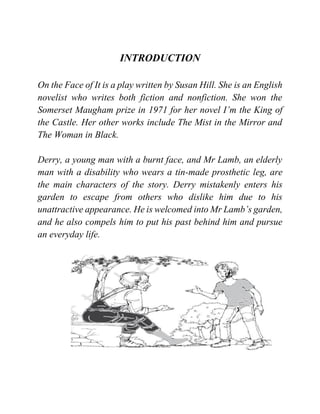
Derry, a young man with a burnt face, and Mr Lamb, an elderly
man with a disability who wears a tin-made prosthetic leg, are
the main characters of the story. Derry mistakenly enters his
garden to escape from others who dislike him due to his
unattractive appearance. He is welcomed into Mr Lamb’s garden,
and he also compels him to put his past behind him and pursue
an everyday life.
SUMMARY
Derry enters an isolated garden and walks cautiously around it.
A while later, to Derry’s surprise, he finds the garden is owned
by Mr Lamb, who strikes up a conversation with him. Derry plans
to leave immediately when Mr Lamb informs him that everyone is
welcome in his garden and that Derry looks mature enough not
to steal anything from his garden. Derry explains to Mr Lamb that
he is not scared of him. Instead, it was other people who were
always frightened of him.
Mr Lamb finds this unusual and asks Derry why he feels this way.
Derry says that it does not matter what people say; he can easily
figure out what they think of his face. He believes that people find
his face ugly. He tells Mr Lamb that even he finds his face ugly
when he looks in the mirror. Mr Lamb does not say much about it
and starts talking about plucking crab apples to make jelly. Derry
assumes that Mr Lamb is just trying to change the topic of
conversation as other people do. He asks Mr Lamb to question
him about his condition and stop pretending there is nothing
wrong with his face.
Mr Lamb tries to guess the cause behind his burnt face. Derry
reveals that one side of his face was burnt due to exposure to acid,
and it will remain the same forever. Derry finds Mr Lamb’s
composed reaction to this piece of information a bit odd. He asks
Mr Lamb astonishingly if he is not interested in it. The latter
reasons that everything created by God is interesting. Every
living thing is the same no matter what. Mr Lamb talks about how
he has a tin leg and kids call him ‘Lamey-Lamb’. Some people
notice and talk about his tin leg, while some do not. But it does
not bother him. Mr Lamb tries to compare this phenomenon to the
fairy tale of ‘Beauty and the Beast’.
Derry reminds Mr Lamb that he has heard about this tale in which
a girl’s kiss turns a monstrous beast into a handsome prince. But
in his case, he remains a monster. His mother only kissed him on
the unburnt side of his face. He fears that no one would like him
or look at him. Mr Lamb contradicts this by saying that Derry
might not have a whole face, but the world has one, which is to
be looked at. Talking about Mr Lamb’s tin leg during winters,
Derry reveals how he has been told of the blind, deaf and dumb
who were worse off than him; how people he has heard people
whisper nasty things about him to each other. Mr Lamb advises
him to stop listening to what people say about him.
Derry does not like to see people being scared of him. Mr Lamb
tells the story of a man who was so scared of anything wrong
happening to him that he stopped going out of the house but was
killed, nonetheless, by a picture frame that fell on him. Mr Lamb
explains to Derry that his hatred of people could do more harm
than what acid had done to his face.
Derry likes Mr Lamb’s house and garden and expresses his desire
to return to the place some other time. Mr Lamb welcomes this
proposal gladly and warns him that he might meet plenty of other
people also who are his friends. He could make friends with them
because he was not scared of them and vice versa. Derry wants
to help Mr Lamb with plucking the crab apples. He is worried
about his family not knowing his whereabouts. So, he rushes home
to inform his mother and promises Mr lamb to return soon.
Meanwhile, we see that Mr Lamb thinks aloud to himself about
no one ever returning back.
At home, Derry’s mother refuses to send Derry again to Mr
Lamb’s. Derry retaliates by saying that he likes Mr Lamb’s house
and wants to go there to think about things. His mother refuses
again, and Derry expresses his hatred towards his home. He runs
away from his house, saying that if he does not go to Mr Lamb’s,
he will never be able to go anywhere, and finally reaches Mr
Lamb’s garden to find him dead under an apple tree.
ABOUT THE AUTHOR
Susan Hill (born on 5 February 1942-) is an English author of
fiction and non-fiction works. Her novels include The Woman in
Black, The Mist in the Mirror and I’m the King of the Castle. She
received the Somerset Maugham Award in 1971 for her novel I’m
the King of the Castle. She was appointed Commander of the
Order of the British Empire in the 2012 Birthday Honours for her
services to literature. She is known to explore the inner fears and
loneliness. Her works reflect honest suffering and optimism.
JUSTIFICATION OF THE TITLE OF THE PLAY
The title of the story ‘On the Face of It’ seems to be very
appropriate. The idiom ‘On the Face of It’ means from
appearance alone or apparently. In the play, Derry is frustrated
and has lost self-esteem due to people’s attitude to him. Everyone
thought that his burnt face was terrible, and he was handicapped.
Similar was Mr. Lamb’s case.
He had lost one leg in a bomb explosion. Apparently both Mr.
Lamb and Derry had deformities. But Mr. Lamb enabled Derry to
have faith in himself and look at the bright side of things and to
learn to live with his deformity. Their physical handicap was an
apparent thing for them as well as for the world. But the most
significant thing is the strength of one’s soul.
Mr. Lamb was a mentally strong person who handled his own
handicap and loneliness very effectively. He became instrumental
in Derry change his views about himself and his deformity and
start taking things positively. The play deals with the acceptance
of the fact that things are not always as they appear, i.e. physical
handicap has nothing to do with the mental strength and positive
attitude to life.
THEME OF THE PLAY
The play deals with the sense of loss, a sense of isolation and how
to overcome it. The actual pain caused by a physical impairment
is often much less than the sense of alienation felt by the person.
The title ‘On the Face of it’ is used to mean that something seems
to be good, true etc. but that needs to be changed when you know
more about it.
Appearances are deceptive and most often, we go on dealing with
impressions and prejudices about others without bothering to
know them. People know Mr Lamb as a lonely, eccentric lame old
man but in reality, he is a very kind and generous man who longs
for company and he loves his fellow human beings along with all
the other creations of God. Similarly, Derek appears to be an
abominable ugly boy with a huge scar on his face whom no one
loves or likes or befriends. He is the object of other people’s
hateful stares, ridicules and neglect. Even his mother does not
dare to kiss him on the cheek with the scar. Yet this boy who is
suffering from an acute inferiority complex has a tender and
sensitive heart. He wants to love and be loved. Fortunately, he
meets Mr Lamb who transforms him with his healing touch.
THE TWO DIFFERENT WORLD VIEWS
Mr Lamb believes that beauty was relative and he enjoyed
everything that God had made. He respected the individuality of
God’s creation. He said that the world was how one looked at it.
He did not care about physical attributes. Though he had led a
lonely life, he felt that the people who entered his garden were
his friends, and to avoid his isolation, he invited people by
keeping the gate open. His concept of the world is quite unique
and different from others because he thinks the world is where
you are and nowhere else.
Derry is a complex-ridden fourteen year old boy. He is a victim
of inferiority complex after acid accidently spilled and burnt one
side of his face. His handicap has filled him with bitterness and
so Derry suffers more on account of the pain that his own views
of how everyone hates him, causes him.
MESSAGE OF THE PLAY
The message woven into the plot of the play is that scars do not
change a person and handicaps must be accepted by individuals
and society. With a burned face, Derry had to face discrimination,
because of which he had turned pessimistic.
He had started hating being around people and had concluded
that everyone hated him too because of his face. Then Derry meets
Mr Lamb, a person who looks at things with a “half full”
perspective.
He points out that how one green plant is considered desirable
and how the other (weed) is undesirable and how the sound made
by the bees may be noise to some and music to others. He teaches
Deny not to look at his burned face as a disability and try to
overcome it just as Mr Lamb had dealt with his tin leg.
The moral is very loud and clear that people who are physically
disabled should not be isolated, we should help them expand their
social interactions and help them fight loneliness, depression and
disappointment. Mr Lamb tells Derry that it all depends upon
people’s individual perceptions. A thing is a beauty for one while
that beauty may be a beast for others.
CONCLUSION
The Play On the Face of It teaches us critical morale – to accept
ourselves for whatever we are. The advice given by an
experienced and wise man like Mr Lamb boosts Derry’s self-
esteem and inspires him to start working on himself anew.
Towards the end of the play, we can see that Derry wants to help
Mr Lamb with plucking apples. He also has some more positive
vibes towards socialising – as we can see, Derry harbours a
desire to return to Mr Lamb’s garden again for a visit sometime.
Derry finally realises the worth of living a positive and fruitful
life, but the death of Mr Lamb is an unfortunate incident. He
played a very small but powerful role in Derry’s life. He gave a
new meaning to his existence.
BIBLIOGRAPHY
https://byjus.com/cbse-notes/class-12-english-on-the-face-of-it-
summary/
https://edumantra.net/learn-english/on-the-face-of-it-message-
chapter-nutshell/
Ncert book
https://edurev.in/
https://www.vedantu.com/english/on-the-face-of-it-summary