THE
LESSON
STUDY
POEM
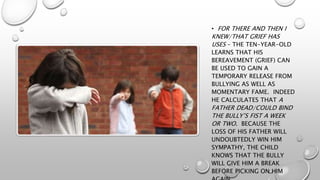
“Your father’s gone,” my bald headmaster
said.
His shiny dome and brown tobacco jar
Splintered at once in tears. It wasn’t grief.
I cried for knowledge which was bitterer
Than any grief. For there and then I knew
That grief has uses – that a father dead
Could bind the bully’s fist a week or two;
And then I cried for shame, then for relief.
I was a month past ten when I learnt this:
I still remember how the noise was stilled
In school-assembly when my grief came in.
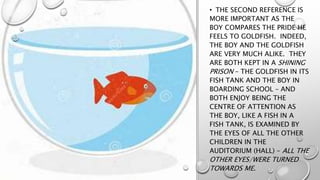
Some goldfish in a bowl quietly sculled
Around their shining prison on its shelf.
They were indifferent. All the other eyes
Were turned towards me. Somewhere in myself
Pride, like a goldfish, flashed a sudden fin.
NOTES
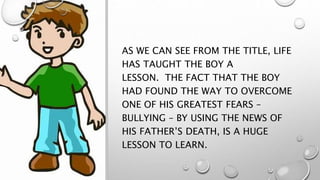
AS WE CAN SEE FROM THE TITLE, LIFE
HAS TAUGHT THE BOY A
LESSON. THE FACT THAT THE BOY
HAD FOUND THE WAY TO OVERCOME
ONE OF HIS GREATEST FEARS –
BULLYING – BY USING THE NEWS OF
HIS FATHER’S DEATH, IS A HUGE
LESSON TO LEARN.
LINE
BY
LINE
Line 1 – The direct speech makes the
situation more realistic and the news sounds
harsher.
Line 2 – The use of details shows that the
news had an impact on him and he still
remembers it very well.
Line 3 – Alliteration + run-on
lines/enjambment so the rhythm is
fast. The speaker cannot see clearly
because of his tears so the jar and the
headmaster’s head appear broken. The
short sentence “It wasn’t grief” is effective
as it keeps us curious. The rhythm slows
down as the speaker stops to deal with the
news.
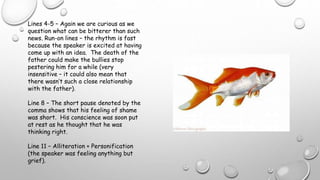
Lines 4-5 – Again we are curious as we
question what can be bitterer than such
news. Run-on lines – the rhythm is fast
because the speaker is excited at having
come up with an idea. The death of the
father could make the bullies stop
pestering him for a while (very
insensitive – it could also mean that
there wasn’t such a close relationship
with the father).
Line 8 – The short pause denoted by the
comma shows that his feeling of shame
was short. His conscience was soon put
at rest as he thought that he was
thinking right.
Line 11 – Alliteration + Personification
(the speaker was feeling anything but
grief).
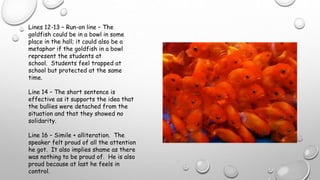
Lines 12-13 – Run-on line – The
goldfish could be in a bowl in some
place in the hall; it could also be a
metaphor if the goldfish in a bowl
represent the students at
school. Students feel trapped at
school but protected at the same
time.
Line 14 – The short sentence is
effective as it supports the idea that
the bullies were detached from the
situation and that they showed no
solidarity.
Line 16 – Simile + alliteration. The
speaker felt proud of all the attention
he got. It also implies shame as there
was nothing to be proud of. He is also
proud because at last he feels in
control.
DICTION
THE USE OF WORDS IN
THE POEM WHICH ARE
OPPOSITE TO EACH
OTHER. SHAME-PROUD,
RELIEF –GRIEF BRINGS
OUT THE IDEA OF
CONFLICTING FEELINGS.
THEME
THE LOSS OF
INNOCENCE, THE
CRUELTY OF
CHILDREN, THE
YEARNING FOR
ATTENTION AND
SELF-PRIDE, AND
BULLYING.
STRUCTURE
• IT HAS 2 OCTAVES,
CONSTANT AND FAST
RHYTHM. RHYME IS
EXISTENT BUT IS IRREGULAR
AND THERE IS USE OF
SIMPLE DICTION, RUN-ON
LINES, USE OF DIRECT
SPEECH.
MOOD
CONFLICTI
NG
FEELINGS.
TONE
SAD TONE
AND
HOPEFUL
AS WELL.
IMAGERY
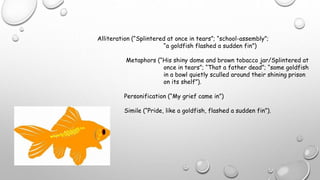
Alliteration (“Splintered at once in tears”; “school-assembly”;
“a goldfish flashed a sudden fin”)
Metaphors (“His shiny dome and brown tobacco jar/Splintered at
once in tears”; “That a father dead”; “some goldfish
in a bowl quietly sculled around their shining prison
on its shelf”).
Personification (“My grief came in”)
Simile (“Pride, like a goldfish, flashed a sudden fin”).
GENERAL NOTES
BULLYING IS SUCH A DOMINANT
ASPECT IN THE SPEAKER’S LIFE THAT
THE DEATH OF HIS FATHER BECOMES
LESS IMPORTANT. IT MIGHT ALSO
REFLECT THE IDEA THAT THERE
WASN’T SUCH A GOOD
RELATIONSHIP BETWEEN THE FATHER
AND THE SON.
INTRODUCTION
EDWARD LUCIE-SMITH WAS BORN IN
KINGSTON, JAMAICA BUT HE MOVED TO
THE UNITED KINGDOM IN 1946. HE
STUDIED AT THE KING’S SCHOOL,
CANTERBURY, AND AFTER SPENDING SOME
TIME IN PARIS HE ALSO STUDIED AT
MERTON COLLEGE, OXFORD.
THEME AND
DEVELOPMENT
• ON A FIRST READING, THE
POEM GIVES THE IMPRESSION
THAT IT IS ABOUT GRIEF BUT, ON
A DEEPER ANALYSIS, OTHER
THEMES – SUCH AS THE LOSS OF
INNOCENCE, THE CRUELTY OF
CHILDREN, AND THE YEARNING
FOR ATTENTION AND SELF-PRIDE
– SEEM TO PREVAIL.
• DEATH IS A COMMON AND
TOTALLY NATURAL PROCESS,
AND EVEN THOUGH RELATIVES
AND CLOSE FRIENDS OF THE
DECEASED MAY FIND IT VERY
HARD TO COPE WITH THE LOSS,
IT IS A PHENOMENON THAT
NEEDS TO BE CONFRONTED AND
EVENTUALLY ACCEPTED.
• “THE LESSON” IS A
PSYCHOLOGICAL POEM THAT
EXPLORES THE MIND OF A TEN-
YEAR-OLD BOY (LUCIE-SMITH
HIMSELF) WHO HAS JUST LOST
HIS FATHER. THE LESSON IN LIFE
(OR IN THIS CASE DEATH)
STARTS WHEN THE HEADMASTER
BLUNTLY DECLARED , YOUR
FATHER IS GONE. THE NORMAL
AND ACCEPTED REACTION OF
THE BOY BURSTING INTO TEARS
FOLLOWS. HOWEVER, LUCIE-
SMITH SUGGESTS THAT THE BOY
DOES NOT CRY BECAUSE HE
TRULY EXPERIENCES GRIEF BUT
BECAUSE CRYING IS WHAT IS
EXPECTED OF HIM. INDEED A
MYRIAD (A LOT) OF OTHER
EMOTIONS OVERWHELM (GO
• FOR THERE AND THEN I
KNEW/THAT GRIEF HAS
USES – THE TEN-YEAR-OLD
LEARNS THAT HIS
BEREAVEMENT (GRIEF) CAN
BE USED TO GAIN A
TEMPORARY RELEASE FROM
BULLYING AS WELL AS
MOMENTARY FAME. INDEED
HE CALCULATES THAT A
FATHER DEAD/COULD BIND
THE BULLY’S FIST A WEEK
OR TWO. BECAUSE THE
LOSS OF HIS FATHER WILL
UNDOUBTEDLY WIN HIM
SYMPATHY, THE CHILD
KNOWS THAT THE BULLY
WILL GIVE HIM A BREAK
BEFORE PICKING ON HIM
• OF COURSE, ONE MUST NOT THINK
THAT THE CHILD IS TOTALLY
PLEASED WITH THESE GROSS
THOUGHTS ABOUT USING HIS
FATHER’S DEATH IN HIS FAVOUR. IN
FACT, THE POEM DOES SAY AND
THEN I CRIED FOR SHAME FOR THE
BOY DOES ACKNOWLEDGE THE FACT
THAT THESE FEELINGS OF HIS ARE
FAR FROM ACCEPTABLE. HOWEVER,
HE ALSO CRIES FOR RELIEF AS,
IRONICALLY, THIS LOSS OF HIS WILL
ACTUALLY RESULT IN GAIN FOR HIM.
• IN THE SECOND OCTET
LUCIE-SMITH’S FATHER’S
DEATH IS MADE PUBLIC IN AN
ANNOUNCEMENT DURING
ASSEMBLY AND GRIEF IS
PERSONIFIED. LUCIE-SMITH
EXPLAINS HOW HIS GRIEF CAME
IN, ALMOST AS IF IT HAD
WALKED INTO THE ASSEMBLY
HALL LIKE A NORMAL
PERSON. HOWEVER, THIS
FOCUS ON GRIEF IS
MOMENTARY AS, ONCE AGAIN,
IT IS OVERSHADOWED, THIS
TIME BY A SENSE OF
PRIDE. LIKE ANY CHILD OF
TEN, THE POET DESIRES
(WISHES) ATTENTION, AND
WHEN HE GETS IT HE FEELS THE
UNCONTROLLABLE PANG OF
PRIDE.
• THE REFERENCE TO GOLDFISH
IN THE SECOND OCTET IS
PARTICULARLY INTERESTING. IN
THE FIRST REFERENCE, WHERE
SOME GOLDFISH QUIETLY
SCULLED/AROUND THEIR
SHINING PRISON ON ITS SHELF,
THE POET SEEMS TO HIGHLIGHT
THE BLISSFUL STUPIDITY OF
THESE FISH THAT SEEM TO BE
HAPPY JUST SWIMMING AROUND
IN A FISH BOWL. INDEED, THEY
WERE INDIFFERENT (SHOWED NO
MERCY) TO EVERYTHING ELSE
THAT WAS HAPPENING AROUND
THEM.
• THE SECOND REFERENCE IS
MORE IMPORTANT AS THE
BOY COMPARES THE PRIDE HE
FEELS TO GOLDFISH. INDEED,
THE BOY AND THE GOLDFISH
ARE VERY MUCH ALIKE. THEY
ARE BOTH KEPT IN A SHINING
PRISON – THE GOLDFISH IN ITS
FISH TANK AND THE BOY IN
BOARDING SCHOOL – AND
BOTH ENJOY BEING THE
CENTRE OF ATTENTION AS
THE BOY, LIKE A FISH IN A
FISH TANK, IS EXAMINED BY
THE EYES OF ALL THE OTHER
CHILDREN IN THE
AUDITORIUM (HALL) – ALL THE
OTHER EYES/WERE TURNED
TOWARDS ME.
• LUCIE-SMITH’S FINAL MESSAGE IS THAT THE TRUTH OF
OUR OWN THOUGHTS COULD ACTUALLY BE NASTIER AND
MORE UNNERVING THAT WE GIVE THEM CREDIT FOR. THE
BOY IS ASHAMED OF HIS TRUE FEELINGS AND THOUGHTS,
BUT ONE PERHAPS CANNOT BLAME HIM FOR TAKING
ADVANTAGE OF THE SITUATION. BEING ONLY TEN AND
IN A BOARDING SCHOOL, THE BOY PROBABLY NEVER GOT
TO KNOW HIS FATHER VERY WELL ANYWAY. HAVING SAID
THAT, WE SEE HOW THE BOY IS STILL CONDITIONED TO
FEEL GRIEF AT THE DEATH OF A RELATIVE, EVEN IF IT
TURNS OUT TO BE JUST PRETENCE. WHAT HE FEELS IS A
NATURAL REACTION – A RESPONSE THAT SOCIETY
EXPECTS OF HIM AS THE SON OF THE DECEASED (DEAD
PERSON).
FIGURES OF SPEECH
• THE TITLE OF THE
POEM ITSELF SUGGESTS
THAT THE WHOLE
GRIEVING EPISODE
SHOULD BE A LESSON IN
LIFE TO YOUNG
EDWARD. INDEED,
EDWARD DOES LEARN A
LESSON – HE LEARNS
HOW TO REAP (GAIN)
BENEFITS FROM HIS
BEING FATHERLESS.
METHAPHORS
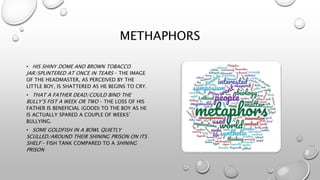
• HIS SHINY DOME AND BROWN TOBACCO
JAR/SPLINTERED AT ONCE IN TEARS – THE IMAGE
OF THE HEADMASTER, AS PERCEIVED BY THE
LITTLE BOY, IS SHATTERED AS HE BEGINS TO CRY.
• THAT A FATHER DEAD/COULD BIND THE
BULLY’S FIST A WEEK OR TWO – THE LOSS OF HIS
FATHER IS BENEFICIAL (GOOD) TO THE BOY AS HE
IS ACTUALLY SPARED A COUPLE OF WEEKS’
BULLYING.
• SOME GOLDFISH IN A BOWL QUIETLY
SCULLED/AROUND THEIR SHINING PRISON ON ITS
SHELF – FISH TANK COMPARED TO A SHINING
PRISON
PERSONIFICATION
•My grief came in – Grief
literally walks into the
auditorium
SIMILIES
• PRIDE, LIKE A GOLDFISH, FLASHED A SUDDEN
FIN – PRIDE IS COMPARED TO A GOLDFISH AS IT IS
SHOWY, BUT ALSO CHEAP, COMMONPLACE, AND
STUPID. THIS IS THE MOST IMPORTANT FIGURE
OF SPEECH IN THE WHOLE POEM AS IT REFERS
BACK TO DEATH – HENCE MAKING DEATH APPEAR
AS CHEAP AND COMMONPLACE AND STUPID. THE
MESSAGE IS THAT DEATH IS SOMETHING NATURAL
AND TOO ORDINARY TO BE CONSIDERED A
LESSON TO ANYBODY. OF COURSE, THIS IS A
SHOCKING SUPPOSITION; HOWEVER, IT IS
POSSIBLY ALSO SHOCKINGLY TRUE.
STRUCTURE 2
• THE POEM IS MADE UP OF TWO OCTAVES WITH VERSES OF
VARYING LENGTHS. THE RHYTHM IS CONSTANT (THE
SAME). USE OF DICTION IS RELATIVELY SIMPLE WHICH FITS IN
WELL WITH THE NOTION THAT THE WHOLE POEM IS WRITTEN
FROM THE POINT OF VIEW OF A TEN-YEAR-OLD BOY. RHYME
IS EXISTENT BUT IS IRREGULAR.
COMPARE (SIMILARITIES) AND
CONTRAST (DIFFERENCES) “MY
PARENTS KEPT ME FROM CHILDREN
WHO WERE ROUGH” WITH “THE
LESSON”
SIMILARITIE
S
1) BOTH POEMS DEAL WITH SPEAKERS (BOTH CHILDREN) FOR
WHOM BULLYING IS A DOMINANT
ASPECT IN THEIR LIVES.
2) THE READER SEES BULLYING FROM THE VICTIM’S POINT OF
VIEW (BOTH
AUTOBIOGRAPHICAL POEMS).
3) BOTH POETS USE ANIMAL IMAGERY. IN “MY PARENTS KEPT
ME FROM CHILDREN WHO
WERE ROUGH”, THE BULLIES WERE COMPARED TO WILD
ANIMALS (“DOGS”, “TIGERS”) WHILE
IN “THE LESSON”, THE INDIFFERENT BOYS ARE COMPARED
TO “GOLDFISH”.
4) BOTH BULLIED VICTIMS TRY
TO FIND A MEANS OF
SURVIVAL.
5) BOTH HAVE AN IRREGULAR
RHYME (MODERN POEMS).
6) BOTH MAKE USE OF SIMILES:
“MUSCLES LIKE IRON” (“MY
PARENTS…..ROUGH”);
“PRIDE,
LIKE A GOLDFISH …” (“THE
LESSON”)
BOTH MAKE USE OF METAPHORS: “SALT COARSE POINTING…” (“MY PARENTS …ROUGH”);
“GOLDFISH IN A BOWL QUIETLY SCULLED/AROUND THEIR SHINING PRISON ON A SHELF …”
(“THE LESSON”).
8) BOTH MAKE USE OF ALLITERATION: “CLIMBED CLIFFS” AND “STRIPPED BY THE COUNTRY
STREAMS” (“MY PARENTS … ROUGH”).
9) BOTH MAKE USE OF RUN-ON LINES (ENJAMBMENT).
10) BOTH MAKE USE OF PUNCTUATION WHICH MAKES THE READER
STOP AND THINK.
11) BOTH MAKE USE OF REPETITION SO AS TO BRING OUT THE
VICTIM’S EXPERIENCE.
12) BOTH BOYS TRY TO HIDE THEIR TRUE FEELINGS. THE BOY
FROM “THE LESSON” WASN’T
FEELING GRIEF BUT CRIED, WHILE THE BOY FROM “MY PARENTS
…ROUGH” WASN’T FEELING
HAPPY AT ALL, BUT SMILED.
DIFFERENCES
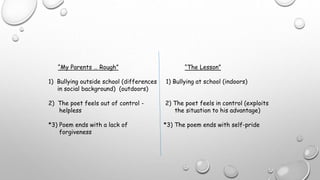
“My Parents … Rough” “The Lesson”
1) Bullying outside school (differences 1) Bullying at school (indoors)
in social background) (outdoors)
2) The poet feels out of control - 2) The poet feels in control (exploits
helpless the situation to his advantage)
*3) Poem ends with a lack of *3) The poem ends with self-pride
forgiveness
“My Parents … Rough” “The Lesson”
4) The first line of the poem 4) There are indications that the poet
indicates that the poet is (victim-bullied) didn’t find any
overprotected by his parents support from his parents
5) Bullies are street children from a 5) Bullies are students attending the
different social class same school
6) Detailed description of the bullies 6) Detailed description at a particular
and the bullying itself (physical + moment in the speaker’s life (only
verbal bullying mentioned) physical bullying is mentioned -
“could bind the bully’s fist a week or
two”
“My Parents … Rough” “The Lesson”
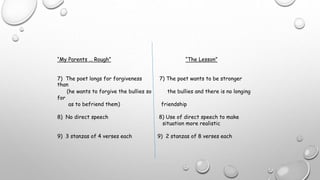
7) The poet longs for forgiveness 7) The poet wants to be stronger
than
(he wants to forgive the bullies so the bullies and there is no longing
for
as to befriend them) friendship
8) No direct speech 8) Use of direct speech to make
situation more realistic
9) 3 stanzas of 4 verses each 9) 2 stanzas of 8 verses each
“My Parents … Rough” “The Lesson”
10) It is quite fast as there is a fast 10) Mixture of fast and slow rhythm
rhythm – frequent use of run-on
lines (enjambment)
11) The use of diction which has 11) The poet makes use of diction with
negative connotation which ties to positive connotation (contradictory
the theme of the poem to the theme of the poem
*12) The poem ends on a bad note – *12) The poem ends on a good note – the
the speaker feels that the bullies speaker feels good, the centre of
have overpowered him and so he attention, has managed to stop
has lost all hope that bullying bullying
might stop
THE END

The lesson

  • 1.
  • 2.
  • 3.
    “Your father’s gone,”my bald headmaster said. His shiny dome and brown tobacco jar Splintered at once in tears. It wasn’t grief. I cried for knowledge which was bitterer Than any grief. For there and then I knew That grief has uses – that a father dead Could bind the bully’s fist a week or two; And then I cried for shame, then for relief.
  • 4.
    I was amonth past ten when I learnt this: I still remember how the noise was stilled In school-assembly when my grief came in. Some goldfish in a bowl quietly sculled Around their shining prison on its shelf. They were indifferent. All the other eyes Were turned towards me. Somewhere in myself Pride, like a goldfish, flashed a sudden fin.
  • 5.
  • 6.
    AS WE CANSEE FROM THE TITLE, LIFE HAS TAUGHT THE BOY A LESSON. THE FACT THAT THE BOY HAD FOUND THE WAY TO OVERCOME ONE OF HIS GREATEST FEARS – BULLYING – BY USING THE NEWS OF HIS FATHER’S DEATH, IS A HUGE LESSON TO LEARN.
  • 7.
  • 8.
    Line 1 –The direct speech makes the situation more realistic and the news sounds harsher. Line 2 – The use of details shows that the news had an impact on him and he still remembers it very well. Line 3 – Alliteration + run-on lines/enjambment so the rhythm is fast. The speaker cannot see clearly because of his tears so the jar and the headmaster’s head appear broken. The short sentence “It wasn’t grief” is effective as it keeps us curious. The rhythm slows down as the speaker stops to deal with the news.
  • 9.
    Lines 4-5 –Again we are curious as we question what can be bitterer than such news. Run-on lines – the rhythm is fast because the speaker is excited at having come up with an idea. The death of the father could make the bullies stop pestering him for a while (very insensitive – it could also mean that there wasn’t such a close relationship with the father). Line 8 – The short pause denoted by the comma shows that his feeling of shame was short. His conscience was soon put at rest as he thought that he was thinking right. Line 11 – Alliteration + Personification (the speaker was feeling anything but grief).
  • 10.
    Lines 12-13 –Run-on line – The goldfish could be in a bowl in some place in the hall; it could also be a metaphor if the goldfish in a bowl represent the students at school. Students feel trapped at school but protected at the same time. Line 14 – The short sentence is effective as it supports the idea that the bullies were detached from the situation and that they showed no solidarity. Line 16 – Simile + alliteration. The speaker felt proud of all the attention he got. It also implies shame as there was nothing to be proud of. He is also proud because at last he feels in control.
  • 11.
  • 12.
    THE USE OFWORDS IN THE POEM WHICH ARE OPPOSITE TO EACH OTHER. SHAME-PROUD, RELIEF –GRIEF BRINGS OUT THE IDEA OF CONFLICTING FEELINGS.
  • 13.
  • 14.
    THE LOSS OF INNOCENCE,THE CRUELTY OF CHILDREN, THE YEARNING FOR ATTENTION AND SELF-PRIDE, AND BULLYING.
  • 15.
  • 16.
    • IT HAS2 OCTAVES, CONSTANT AND FAST RHYTHM. RHYME IS EXISTENT BUT IS IRREGULAR AND THERE IS USE OF SIMPLE DICTION, RUN-ON LINES, USE OF DIRECT SPEECH.
  • 17.
  • 18.
  • 19.
  • 20.
  • 21.
  • 22.
    Alliteration (“Splintered atonce in tears”; “school-assembly”; “a goldfish flashed a sudden fin”) Metaphors (“His shiny dome and brown tobacco jar/Splintered at once in tears”; “That a father dead”; “some goldfish in a bowl quietly sculled around their shining prison on its shelf”). Personification (“My grief came in”) Simile (“Pride, like a goldfish, flashed a sudden fin”).
  • 23.
  • 24.
    BULLYING IS SUCHA DOMINANT ASPECT IN THE SPEAKER’S LIFE THAT THE DEATH OF HIS FATHER BECOMES LESS IMPORTANT. IT MIGHT ALSO REFLECT THE IDEA THAT THERE WASN’T SUCH A GOOD RELATIONSHIP BETWEEN THE FATHER AND THE SON.
  • 25.
  • 26.
    EDWARD LUCIE-SMITH WASBORN IN KINGSTON, JAMAICA BUT HE MOVED TO THE UNITED KINGDOM IN 1946. HE STUDIED AT THE KING’S SCHOOL, CANTERBURY, AND AFTER SPENDING SOME TIME IN PARIS HE ALSO STUDIED AT MERTON COLLEGE, OXFORD.
  • 27.
  • 28.
    • ON AFIRST READING, THE POEM GIVES THE IMPRESSION THAT IT IS ABOUT GRIEF BUT, ON A DEEPER ANALYSIS, OTHER THEMES – SUCH AS THE LOSS OF INNOCENCE, THE CRUELTY OF CHILDREN, AND THE YEARNING FOR ATTENTION AND SELF-PRIDE – SEEM TO PREVAIL. • DEATH IS A COMMON AND TOTALLY NATURAL PROCESS, AND EVEN THOUGH RELATIVES AND CLOSE FRIENDS OF THE DECEASED MAY FIND IT VERY HARD TO COPE WITH THE LOSS, IT IS A PHENOMENON THAT NEEDS TO BE CONFRONTED AND EVENTUALLY ACCEPTED.
  • 29.
    • “THE LESSON”IS A PSYCHOLOGICAL POEM THAT EXPLORES THE MIND OF A TEN- YEAR-OLD BOY (LUCIE-SMITH HIMSELF) WHO HAS JUST LOST HIS FATHER. THE LESSON IN LIFE (OR IN THIS CASE DEATH) STARTS WHEN THE HEADMASTER BLUNTLY DECLARED , YOUR FATHER IS GONE. THE NORMAL AND ACCEPTED REACTION OF THE BOY BURSTING INTO TEARS FOLLOWS. HOWEVER, LUCIE- SMITH SUGGESTS THAT THE BOY DOES NOT CRY BECAUSE HE TRULY EXPERIENCES GRIEF BUT BECAUSE CRYING IS WHAT IS EXPECTED OF HIM. INDEED A MYRIAD (A LOT) OF OTHER EMOTIONS OVERWHELM (GO
  • 30.
    • FOR THEREAND THEN I KNEW/THAT GRIEF HAS USES – THE TEN-YEAR-OLD LEARNS THAT HIS BEREAVEMENT (GRIEF) CAN BE USED TO GAIN A TEMPORARY RELEASE FROM BULLYING AS WELL AS MOMENTARY FAME. INDEED HE CALCULATES THAT A FATHER DEAD/COULD BIND THE BULLY’S FIST A WEEK OR TWO. BECAUSE THE LOSS OF HIS FATHER WILL UNDOUBTEDLY WIN HIM SYMPATHY, THE CHILD KNOWS THAT THE BULLY WILL GIVE HIM A BREAK BEFORE PICKING ON HIM
  • 31.
    • OF COURSE,ONE MUST NOT THINK THAT THE CHILD IS TOTALLY PLEASED WITH THESE GROSS THOUGHTS ABOUT USING HIS FATHER’S DEATH IN HIS FAVOUR. IN FACT, THE POEM DOES SAY AND THEN I CRIED FOR SHAME FOR THE BOY DOES ACKNOWLEDGE THE FACT THAT THESE FEELINGS OF HIS ARE FAR FROM ACCEPTABLE. HOWEVER, HE ALSO CRIES FOR RELIEF AS, IRONICALLY, THIS LOSS OF HIS WILL ACTUALLY RESULT IN GAIN FOR HIM.
  • 32.
    • IN THESECOND OCTET LUCIE-SMITH’S FATHER’S DEATH IS MADE PUBLIC IN AN ANNOUNCEMENT DURING ASSEMBLY AND GRIEF IS PERSONIFIED. LUCIE-SMITH EXPLAINS HOW HIS GRIEF CAME IN, ALMOST AS IF IT HAD WALKED INTO THE ASSEMBLY HALL LIKE A NORMAL PERSON. HOWEVER, THIS FOCUS ON GRIEF IS MOMENTARY AS, ONCE AGAIN, IT IS OVERSHADOWED, THIS TIME BY A SENSE OF PRIDE. LIKE ANY CHILD OF TEN, THE POET DESIRES (WISHES) ATTENTION, AND WHEN HE GETS IT HE FEELS THE UNCONTROLLABLE PANG OF PRIDE.
  • 33.
    • THE REFERENCETO GOLDFISH IN THE SECOND OCTET IS PARTICULARLY INTERESTING. IN THE FIRST REFERENCE, WHERE SOME GOLDFISH QUIETLY SCULLED/AROUND THEIR SHINING PRISON ON ITS SHELF, THE POET SEEMS TO HIGHLIGHT THE BLISSFUL STUPIDITY OF THESE FISH THAT SEEM TO BE HAPPY JUST SWIMMING AROUND IN A FISH BOWL. INDEED, THEY WERE INDIFFERENT (SHOWED NO MERCY) TO EVERYTHING ELSE THAT WAS HAPPENING AROUND THEM.
  • 34.
    • THE SECONDREFERENCE IS MORE IMPORTANT AS THE BOY COMPARES THE PRIDE HE FEELS TO GOLDFISH. INDEED, THE BOY AND THE GOLDFISH ARE VERY MUCH ALIKE. THEY ARE BOTH KEPT IN A SHINING PRISON – THE GOLDFISH IN ITS FISH TANK AND THE BOY IN BOARDING SCHOOL – AND BOTH ENJOY BEING THE CENTRE OF ATTENTION AS THE BOY, LIKE A FISH IN A FISH TANK, IS EXAMINED BY THE EYES OF ALL THE OTHER CHILDREN IN THE AUDITORIUM (HALL) – ALL THE OTHER EYES/WERE TURNED TOWARDS ME.
  • 35.
    • LUCIE-SMITH’S FINALMESSAGE IS THAT THE TRUTH OF OUR OWN THOUGHTS COULD ACTUALLY BE NASTIER AND MORE UNNERVING THAT WE GIVE THEM CREDIT FOR. THE BOY IS ASHAMED OF HIS TRUE FEELINGS AND THOUGHTS, BUT ONE PERHAPS CANNOT BLAME HIM FOR TAKING ADVANTAGE OF THE SITUATION. BEING ONLY TEN AND IN A BOARDING SCHOOL, THE BOY PROBABLY NEVER GOT TO KNOW HIS FATHER VERY WELL ANYWAY. HAVING SAID THAT, WE SEE HOW THE BOY IS STILL CONDITIONED TO FEEL GRIEF AT THE DEATH OF A RELATIVE, EVEN IF IT TURNS OUT TO BE JUST PRETENCE. WHAT HE FEELS IS A NATURAL REACTION – A RESPONSE THAT SOCIETY EXPECTS OF HIM AS THE SON OF THE DECEASED (DEAD PERSON).
  • 36.
  • 37.
    • THE TITLEOF THE POEM ITSELF SUGGESTS THAT THE WHOLE GRIEVING EPISODE SHOULD BE A LESSON IN LIFE TO YOUNG EDWARD. INDEED, EDWARD DOES LEARN A LESSON – HE LEARNS HOW TO REAP (GAIN) BENEFITS FROM HIS BEING FATHERLESS.
  • 38.
    METHAPHORS • HIS SHINYDOME AND BROWN TOBACCO JAR/SPLINTERED AT ONCE IN TEARS – THE IMAGE OF THE HEADMASTER, AS PERCEIVED BY THE LITTLE BOY, IS SHATTERED AS HE BEGINS TO CRY. • THAT A FATHER DEAD/COULD BIND THE BULLY’S FIST A WEEK OR TWO – THE LOSS OF HIS FATHER IS BENEFICIAL (GOOD) TO THE BOY AS HE IS ACTUALLY SPARED A COUPLE OF WEEKS’ BULLYING. • SOME GOLDFISH IN A BOWL QUIETLY SCULLED/AROUND THEIR SHINING PRISON ON ITS SHELF – FISH TANK COMPARED TO A SHINING PRISON
  • 39.
    PERSONIFICATION •My grief camein – Grief literally walks into the auditorium
  • 40.
    SIMILIES • PRIDE, LIKEA GOLDFISH, FLASHED A SUDDEN FIN – PRIDE IS COMPARED TO A GOLDFISH AS IT IS SHOWY, BUT ALSO CHEAP, COMMONPLACE, AND STUPID. THIS IS THE MOST IMPORTANT FIGURE OF SPEECH IN THE WHOLE POEM AS IT REFERS BACK TO DEATH – HENCE MAKING DEATH APPEAR AS CHEAP AND COMMONPLACE AND STUPID. THE MESSAGE IS THAT DEATH IS SOMETHING NATURAL AND TOO ORDINARY TO BE CONSIDERED A LESSON TO ANYBODY. OF COURSE, THIS IS A SHOCKING SUPPOSITION; HOWEVER, IT IS POSSIBLY ALSO SHOCKINGLY TRUE.
  • 41.
  • 42.
    • THE POEMIS MADE UP OF TWO OCTAVES WITH VERSES OF VARYING LENGTHS. THE RHYTHM IS CONSTANT (THE SAME). USE OF DICTION IS RELATIVELY SIMPLE WHICH FITS IN WELL WITH THE NOTION THAT THE WHOLE POEM IS WRITTEN FROM THE POINT OF VIEW OF A TEN-YEAR-OLD BOY. RHYME IS EXISTENT BUT IS IRREGULAR.
  • 43.
    COMPARE (SIMILARITIES) AND CONTRAST(DIFFERENCES) “MY PARENTS KEPT ME FROM CHILDREN WHO WERE ROUGH” WITH “THE LESSON”
  • 44.
  • 45.
    1) BOTH POEMSDEAL WITH SPEAKERS (BOTH CHILDREN) FOR WHOM BULLYING IS A DOMINANT ASPECT IN THEIR LIVES. 2) THE READER SEES BULLYING FROM THE VICTIM’S POINT OF VIEW (BOTH AUTOBIOGRAPHICAL POEMS). 3) BOTH POETS USE ANIMAL IMAGERY. IN “MY PARENTS KEPT ME FROM CHILDREN WHO WERE ROUGH”, THE BULLIES WERE COMPARED TO WILD ANIMALS (“DOGS”, “TIGERS”) WHILE IN “THE LESSON”, THE INDIFFERENT BOYS ARE COMPARED TO “GOLDFISH”.
  • 46.
    4) BOTH BULLIEDVICTIMS TRY TO FIND A MEANS OF SURVIVAL. 5) BOTH HAVE AN IRREGULAR RHYME (MODERN POEMS). 6) BOTH MAKE USE OF SIMILES: “MUSCLES LIKE IRON” (“MY PARENTS…..ROUGH”); “PRIDE, LIKE A GOLDFISH …” (“THE LESSON”)
  • 47.
    BOTH MAKE USEOF METAPHORS: “SALT COARSE POINTING…” (“MY PARENTS …ROUGH”); “GOLDFISH IN A BOWL QUIETLY SCULLED/AROUND THEIR SHINING PRISON ON A SHELF …” (“THE LESSON”). 8) BOTH MAKE USE OF ALLITERATION: “CLIMBED CLIFFS” AND “STRIPPED BY THE COUNTRY STREAMS” (“MY PARENTS … ROUGH”). 9) BOTH MAKE USE OF RUN-ON LINES (ENJAMBMENT).
  • 48.
    10) BOTH MAKEUSE OF PUNCTUATION WHICH MAKES THE READER STOP AND THINK. 11) BOTH MAKE USE OF REPETITION SO AS TO BRING OUT THE VICTIM’S EXPERIENCE. 12) BOTH BOYS TRY TO HIDE THEIR TRUE FEELINGS. THE BOY FROM “THE LESSON” WASN’T FEELING GRIEF BUT CRIED, WHILE THE BOY FROM “MY PARENTS …ROUGH” WASN’T FEELING HAPPY AT ALL, BUT SMILED.
  • 49.
  • 50.
    “My Parents …Rough” “The Lesson” 1) Bullying outside school (differences 1) Bullying at school (indoors) in social background) (outdoors) 2) The poet feels out of control - 2) The poet feels in control (exploits helpless the situation to his advantage) *3) Poem ends with a lack of *3) The poem ends with self-pride forgiveness
  • 51.
    “My Parents …Rough” “The Lesson” 4) The first line of the poem 4) There are indications that the poet indicates that the poet is (victim-bullied) didn’t find any overprotected by his parents support from his parents 5) Bullies are street children from a 5) Bullies are students attending the different social class same school 6) Detailed description of the bullies 6) Detailed description at a particular and the bullying itself (physical + moment in the speaker’s life (only verbal bullying mentioned) physical bullying is mentioned - “could bind the bully’s fist a week or two”
  • 52.
    “My Parents …Rough” “The Lesson” 7) The poet longs for forgiveness 7) The poet wants to be stronger than (he wants to forgive the bullies so the bullies and there is no longing for as to befriend them) friendship 8) No direct speech 8) Use of direct speech to make situation more realistic 9) 3 stanzas of 4 verses each 9) 2 stanzas of 8 verses each
  • 53.
    “My Parents …Rough” “The Lesson” 10) It is quite fast as there is a fast 10) Mixture of fast and slow rhythm rhythm – frequent use of run-on lines (enjambment) 11) The use of diction which has 11) The poet makes use of diction with negative connotation which ties to positive connotation (contradictory the theme of the poem to the theme of the poem *12) The poem ends on a bad note – *12) The poem ends on a good note – the the speaker feels that the bullies speaker feels good, the centre of have overpowered him and so he attention, has managed to stop has lost all hope that bullying bullying might stop
  • 54.