Language
Poetic Technique Definition
Adjective Describing words
Alliteration Repetition of consonant sounds at the start of two or more words
Assonance Repetition of vowel sounds within two or more words
Imagery Visual pictures in the reader’s mind
Juxtaposition The use of contrasting images for effect
Metaphor Saying something is something else
Onomatopoeia The use of words which imitate a sound
Oxymoron Two words of opposite meaning placed next to each other
Personification Giving human qualities to inanimate objects
Sibilance Repetition of the letter ‘s’
Simile Comparison between two things using ‘like’ or ‘as’
Verbs ‘Doing’ words
Structure
Poetic Technique Definition
Ballad A poem that tells a story
Caesura The use of punctuation within a line of poetry
Enjambment When a sentence in a poem runs onto the next line
Form The type of poem it is
Free verse A poem with no rhyme scheme
Dramatic Monologue A type of poem written as a speech from an individual or character
Repetition The duplication of words or phrases throughout a poem
Rhyme Scheme The structure of rhymes within a poem
Rhythm The beat, pace or flow of a poem
Speaker/poetic voice The person speaking in the poem – may be different from the poet
Stanza A verse or paragraph of a poem
Tone The feeling of the poem
Year 11 Revision Guide
Writing Paragraphs
Use PEEL
Point: Briefly answer the question; you could also refer to poetic techniques here.
Evidence: Provide a quotation or reference to the poem to support your idea.
Explanation: Explore the effect of the poet’s methods in detail, commenting on specific words.
Link: Make sure you link your ideas back to your point so that you answer is clear and focussed.
Example:
Structuring Your Answer
Introduction:
Explain what the poem is about and who is speaking in the poem, making sure you are briefly answering the question and
introducing the methods that the poet is using.
Main body:
You should then aim to write three to five PEEL paragraphs, making sure that you comment the effect of language and
structural features.
Conclusion:
Summarise the main points you have made, ending with a statement about what you think the poet is trying to say.
What do I do?
1. Read the question
2. Read the poem, checking the glossary for any words you are unsure of
3. Read the question again, highlighting any keywords.
4. Read the poem again, annotating any techniques and their effects
5. Plan your answer by mind mapping your ideas.
6. Write your answer
7. Check your answer
Answering an Unseen Poetry Question
Useful Words and Phrases
 Here, the poet suggests…
 This conveys…
 This connotes…
 This word has connotations of…
 The use of… emphasises the idea that….
 The poet is implying that…
 From this we can infer that…
At the start of the poem, the poet uses a list to show the child’s many other varied skills: “make
sculptures…fabulous machines…invent games”. The specific use of dynamic verbs and positive adjectives in
the list show that at the start of the poem, the poet believes in the child’s different abilities. By using the
words “sculptures” and “invent”, which are words that conjure up complex adult and artistic endeavours,
the poet clearly sees the child as incredibly capable. In addition, the use of “fabulous” helps to show that
what he puts together is worthy of high praise. As mentioned, at the outset of the poem, the poet clearly
values the child. The poet does this in order to strongly show in the rest of the poem that the process of
reading is only one of many difficult experiences that children have to learn and they may struggle in spite
of their other valuable skills.
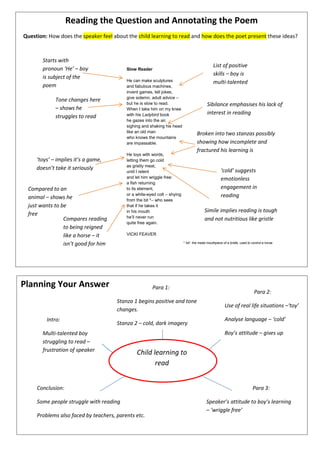
Slow Reader
He can make sculptures
and fabulous machines,
invent games, tell jokes,
give solemn, adult advice –
but he is slow to read.
When I take him on my knee
with his Ladybird book
he gazes into the air,
sighing and shaking his head
like an old man
who knows the mountains
are impassable.
He toys with words,
letting them go cold
as gristly meat,
until I relent
and let him wriggle free:
a fish returning
to its element,
or a white-eyed colt – shying
from the bit *– who sees
that if he takes it
in his mouth
he’ll never run
quite free again.
VICKI FEAVER
* ‘bit’: the metal mouthpiece of a bridle, used to control a horse
Reading the Question and Annotating the Poem
Planning Your Answer
Question: How does the speaker feel about the child learning to read and how does the poet present these ideas?
Child learning to
read
Intro:
Multi-talented boy
struggling to read –
frustration of speaker
Para 1:
Stanza 1 begins positive and tone
changes.
Stanza 2 – cold, dark imagery
Para 2:
Use of real life situations –‘toy’
Analyse language – ‘cold’
Boy’s attitude – gives up
Para 3:
Speaker’s attitude to boy’s learning
– ‘wriggle free’
Conclusion:
Some people struggle with reading
Problems also faced by teachers, parents etc.
Starts with
pronoun ‘He’ – boy
is subject of the
poem
List of positive
skills – boy is
multi-talented
‘cold’ suggests
emotionless
engagement in
reading
Broken into two stanzas possibly
showing how incomplete and
fractured his learning is
Tone changes here
– shows he
struggles to read
‘toys’ – implies it’s a game,
doesn’t take it seriously
Simile implies reading is tough
and not nutritious like gristle
Compared to an
animal – shows he
just wants to be
free
Compares reading
to being reigned
like a horse – it
isn’t good for him
Sibilance emphasises his lack of
interest in reading
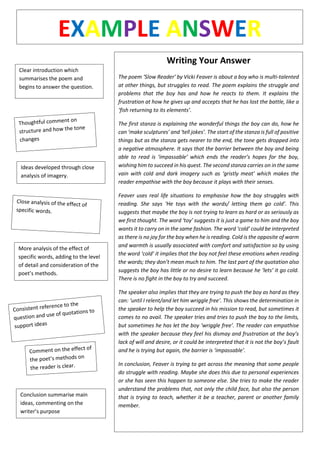
Writing Your Answer
The poem ‘Slow Reader’ by Vicki Feaver is about a boy who is multi-talented
at other things, but struggles to read. The poem explains the struggle and
problems that the boy has and how he reacts to them. It explains the
frustration at how he gives up and accepts that he has lost the battle, like a
‘fish returning to its elements’.
The first stanza is explaining the wonderful things the boy can do, how he
can ‘make sculptures’ and ‘tell jokes’. The start of the stanza is full of positive
things but as the stanza gets nearer to the end, the tone gets dropped into
a negative atmosphere. It says that the barrier between the boy and being
able to read is ‘impassable’ which ends the reader’s hopes for the boy,
wishing him to succeed in his quest. The second stanza carries on in the same
vain with cold and dark imagery such as ‘gristly meat’ which makes the
reader empathise with the boy because it plays with their senses.
Feaver uses real life situations to emphasise how the boy struggles with
reading. She says ‘He toys with the words/ letting them go cold’. This
suggests that maybe the boy is not trying to learn as hard or as seriously as
we first thought. The word ‘toy’ suggests it is just a game to him and the boy
wants it to carry on in the same fashion. The word ‘cold’ could be interpreted
as there is no joy for the boy when he is reading. Cold is the opposite of warm
and warmth is usually associated with comfort and satisfaction so by using
the word ‘cold’ it implies that the boy not feel these emotions when reading
the words; they don’t mean much to him. The last part of the quotation also
suggests the boy has little or no desire to learn because he ‘lets’ it go cold.
There is no fight in the boy to try and succeed.
The speaker also implies that they are trying to push the boy as hard as they
can: ‘until I relent/and let him wriggle free’. This shows the determination in
the speaker to help the boy succeed in his mission to read, but sometimes it
comes to no avail. The speaker tries and tries to push the boy to the limits,
but sometimes he has let the boy ‘wriggle free’. The reader can empathise
with the speaker because they feel his dismay and frustration at the boy’s
lack of will and desire, or it could be interpreted that it is not the boy’s fault
and he is trying but again, the barrier is ‘impassable’.
In conclusion, Feaver is trying to get across the meaning that some people
do struggle with reading. Maybe she does this due to personal experiences
or she has seen this happen to someone else. She tries to make the reader
understand the problems that, not only the child face, but also the person
that is trying to teach, whether it be a teacher, parent or another family
member.
Clear introduction which
summarises the poem and
begins to answer the question.
Ideas developed through close
analysis of imagery.
More analysis of the effect of
specific words, adding to the level
of detail and consideration of the
poet’s methods.
Conclusion summarise main
ideas, commenting on the
writer’s purpose
EXAMPLE ANSWER

unseen+poetry+revision+guide.pdf

  • 1.
    Language Poetic Technique Definition AdjectiveDescribing words Alliteration Repetition of consonant sounds at the start of two or more words Assonance Repetition of vowel sounds within two or more words Imagery Visual pictures in the reader’s mind Juxtaposition The use of contrasting images for effect Metaphor Saying something is something else Onomatopoeia The use of words which imitate a sound Oxymoron Two words of opposite meaning placed next to each other Personification Giving human qualities to inanimate objects Sibilance Repetition of the letter ‘s’ Simile Comparison between two things using ‘like’ or ‘as’ Verbs ‘Doing’ words Structure Poetic Technique Definition Ballad A poem that tells a story Caesura The use of punctuation within a line of poetry Enjambment When a sentence in a poem runs onto the next line Form The type of poem it is Free verse A poem with no rhyme scheme Dramatic Monologue A type of poem written as a speech from an individual or character Repetition The duplication of words or phrases throughout a poem Rhyme Scheme The structure of rhymes within a poem Rhythm The beat, pace or flow of a poem Speaker/poetic voice The person speaking in the poem – may be different from the poet Stanza A verse or paragraph of a poem Tone The feeling of the poem Year 11 Revision Guide
  • 2.
    Writing Paragraphs Use PEEL Point:Briefly answer the question; you could also refer to poetic techniques here. Evidence: Provide a quotation or reference to the poem to support your idea. Explanation: Explore the effect of the poet’s methods in detail, commenting on specific words. Link: Make sure you link your ideas back to your point so that you answer is clear and focussed. Example: Structuring Your Answer Introduction: Explain what the poem is about and who is speaking in the poem, making sure you are briefly answering the question and introducing the methods that the poet is using. Main body: You should then aim to write three to five PEEL paragraphs, making sure that you comment the effect of language and structural features. Conclusion: Summarise the main points you have made, ending with a statement about what you think the poet is trying to say. What do I do? 1. Read the question 2. Read the poem, checking the glossary for any words you are unsure of 3. Read the question again, highlighting any keywords. 4. Read the poem again, annotating any techniques and their effects 5. Plan your answer by mind mapping your ideas. 6. Write your answer 7. Check your answer Answering an Unseen Poetry Question Useful Words and Phrases  Here, the poet suggests…  This conveys…  This connotes…  This word has connotations of…  The use of… emphasises the idea that….  The poet is implying that…  From this we can infer that… At the start of the poem, the poet uses a list to show the child’s many other varied skills: “make sculptures…fabulous machines…invent games”. The specific use of dynamic verbs and positive adjectives in the list show that at the start of the poem, the poet believes in the child’s different abilities. By using the words “sculptures” and “invent”, which are words that conjure up complex adult and artistic endeavours, the poet clearly sees the child as incredibly capable. In addition, the use of “fabulous” helps to show that what he puts together is worthy of high praise. As mentioned, at the outset of the poem, the poet clearly values the child. The poet does this in order to strongly show in the rest of the poem that the process of reading is only one of many difficult experiences that children have to learn and they may struggle in spite of their other valuable skills.
  • 3.
    Slow Reader He canmake sculptures and fabulous machines, invent games, tell jokes, give solemn, adult advice – but he is slow to read. When I take him on my knee with his Ladybird book he gazes into the air, sighing and shaking his head like an old man who knows the mountains are impassable. He toys with words, letting them go cold as gristly meat, until I relent and let him wriggle free: a fish returning to its element, or a white-eyed colt – shying from the bit *– who sees that if he takes it in his mouth he’ll never run quite free again. VICKI FEAVER * ‘bit’: the metal mouthpiece of a bridle, used to control a horse Reading the Question and Annotating the Poem Planning Your Answer Question: How does the speaker feel about the child learning to read and how does the poet present these ideas? Child learning to read Intro: Multi-talented boy struggling to read – frustration of speaker Para 1: Stanza 1 begins positive and tone changes. Stanza 2 – cold, dark imagery Para 2: Use of real life situations –‘toy’ Analyse language – ‘cold’ Boy’s attitude – gives up Para 3: Speaker’s attitude to boy’s learning – ‘wriggle free’ Conclusion: Some people struggle with reading Problems also faced by teachers, parents etc. Starts with pronoun ‘He’ – boy is subject of the poem List of positive skills – boy is multi-talented ‘cold’ suggests emotionless engagement in reading Broken into two stanzas possibly showing how incomplete and fractured his learning is Tone changes here – shows he struggles to read ‘toys’ – implies it’s a game, doesn’t take it seriously Simile implies reading is tough and not nutritious like gristle Compared to an animal – shows he just wants to be free Compares reading to being reigned like a horse – it isn’t good for him Sibilance emphasises his lack of interest in reading
  • 4.
    Writing Your Answer Thepoem ‘Slow Reader’ by Vicki Feaver is about a boy who is multi-talented at other things, but struggles to read. The poem explains the struggle and problems that the boy has and how he reacts to them. It explains the frustration at how he gives up and accepts that he has lost the battle, like a ‘fish returning to its elements’. The first stanza is explaining the wonderful things the boy can do, how he can ‘make sculptures’ and ‘tell jokes’. The start of the stanza is full of positive things but as the stanza gets nearer to the end, the tone gets dropped into a negative atmosphere. It says that the barrier between the boy and being able to read is ‘impassable’ which ends the reader’s hopes for the boy, wishing him to succeed in his quest. The second stanza carries on in the same vain with cold and dark imagery such as ‘gristly meat’ which makes the reader empathise with the boy because it plays with their senses. Feaver uses real life situations to emphasise how the boy struggles with reading. She says ‘He toys with the words/ letting them go cold’. This suggests that maybe the boy is not trying to learn as hard or as seriously as we first thought. The word ‘toy’ suggests it is just a game to him and the boy wants it to carry on in the same fashion. The word ‘cold’ could be interpreted as there is no joy for the boy when he is reading. Cold is the opposite of warm and warmth is usually associated with comfort and satisfaction so by using the word ‘cold’ it implies that the boy not feel these emotions when reading the words; they don’t mean much to him. The last part of the quotation also suggests the boy has little or no desire to learn because he ‘lets’ it go cold. There is no fight in the boy to try and succeed. The speaker also implies that they are trying to push the boy as hard as they can: ‘until I relent/and let him wriggle free’. This shows the determination in the speaker to help the boy succeed in his mission to read, but sometimes it comes to no avail. The speaker tries and tries to push the boy to the limits, but sometimes he has let the boy ‘wriggle free’. The reader can empathise with the speaker because they feel his dismay and frustration at the boy’s lack of will and desire, or it could be interpreted that it is not the boy’s fault and he is trying but again, the barrier is ‘impassable’. In conclusion, Feaver is trying to get across the meaning that some people do struggle with reading. Maybe she does this due to personal experiences or she has seen this happen to someone else. She tries to make the reader understand the problems that, not only the child face, but also the person that is trying to teach, whether it be a teacher, parent or another family member. Clear introduction which summarises the poem and begins to answer the question. Ideas developed through close analysis of imagery. More analysis of the effect of specific words, adding to the level of detail and consideration of the poet’s methods. Conclusion summarise main ideas, commenting on the writer’s purpose EXAMPLE ANSWER