The
Learners
Characteric
tics and
Needs
MASCARA JUNAID
BSED- 4
Learning Outcomes
In this episode , we must be able to differentiate the
Characteristics and Needs from Developmental Levels.
Domains of Developmental
Learning
 Physical
Social
Emotional
Cognitive
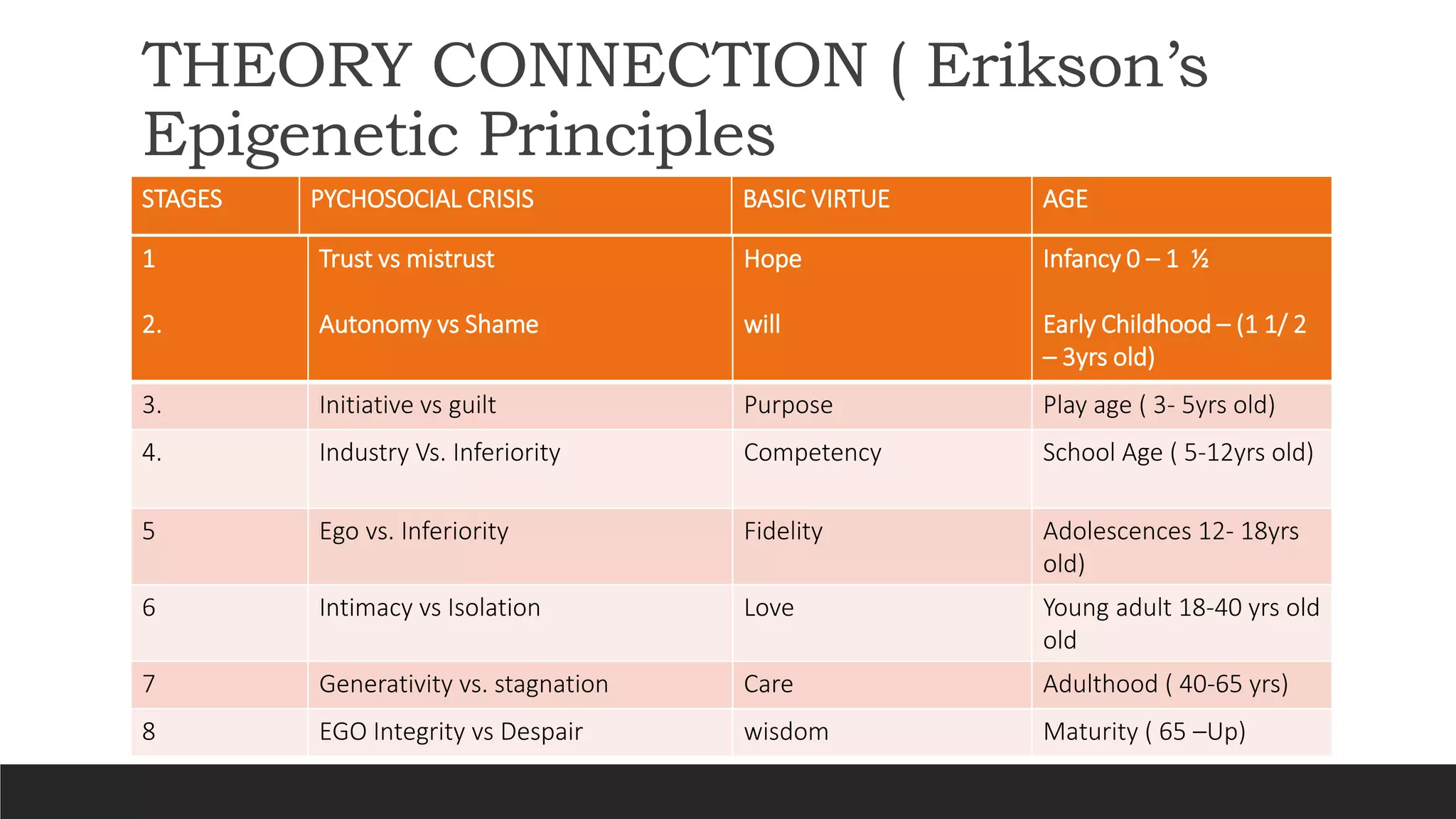
THEORY CONNECTION ( Erikson’s
Epigenetic Principles
STAGES PYCHOSOCIAL CRISIS BASIC VIRTUE AGE
1
2.
Trust vs mistrust
Autonomy vs Shame
Hope
will
Infancy 0 – 1 ½
Early Childhood – (1 1/ 2
– 3yrs old)
3. Initiative vs guilt Purpose Play age ( 3- 5yrs old)
4. Industry Vs. Inferiority Competency School Age ( 5-12yrs old)
5 Ego vs. Inferiority Fidelity Adolescences 12- 18yrs
old)
6 Intimacy vs Isolation Love Young adult 18-40 yrs old
old
7 Generativity vs. stagnation Care Adulthood ( 40-65 yrs)
8 EGO Integrity vs Despair wisdom Maturity ( 65 –Up)
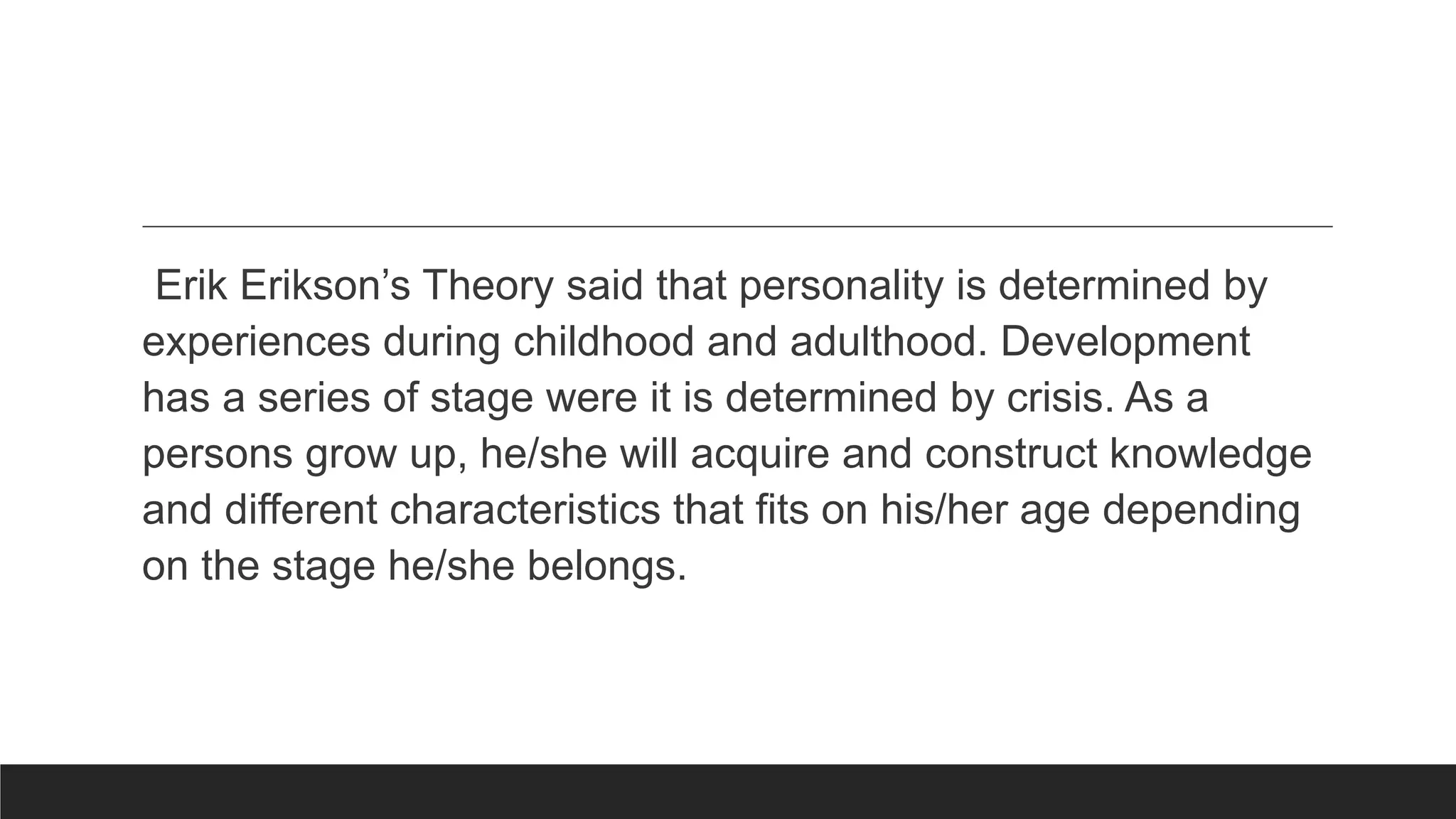
Erik Erikson’s Theory said that personality is determined by
experiences during childhood and adulthood. Development
has a series of stage were it is determined by crisis. As a
persons grow up, he/she will acquire and construct knowledge
and different characteristics that fits on his/her age depending
on the stage he/she belongs.
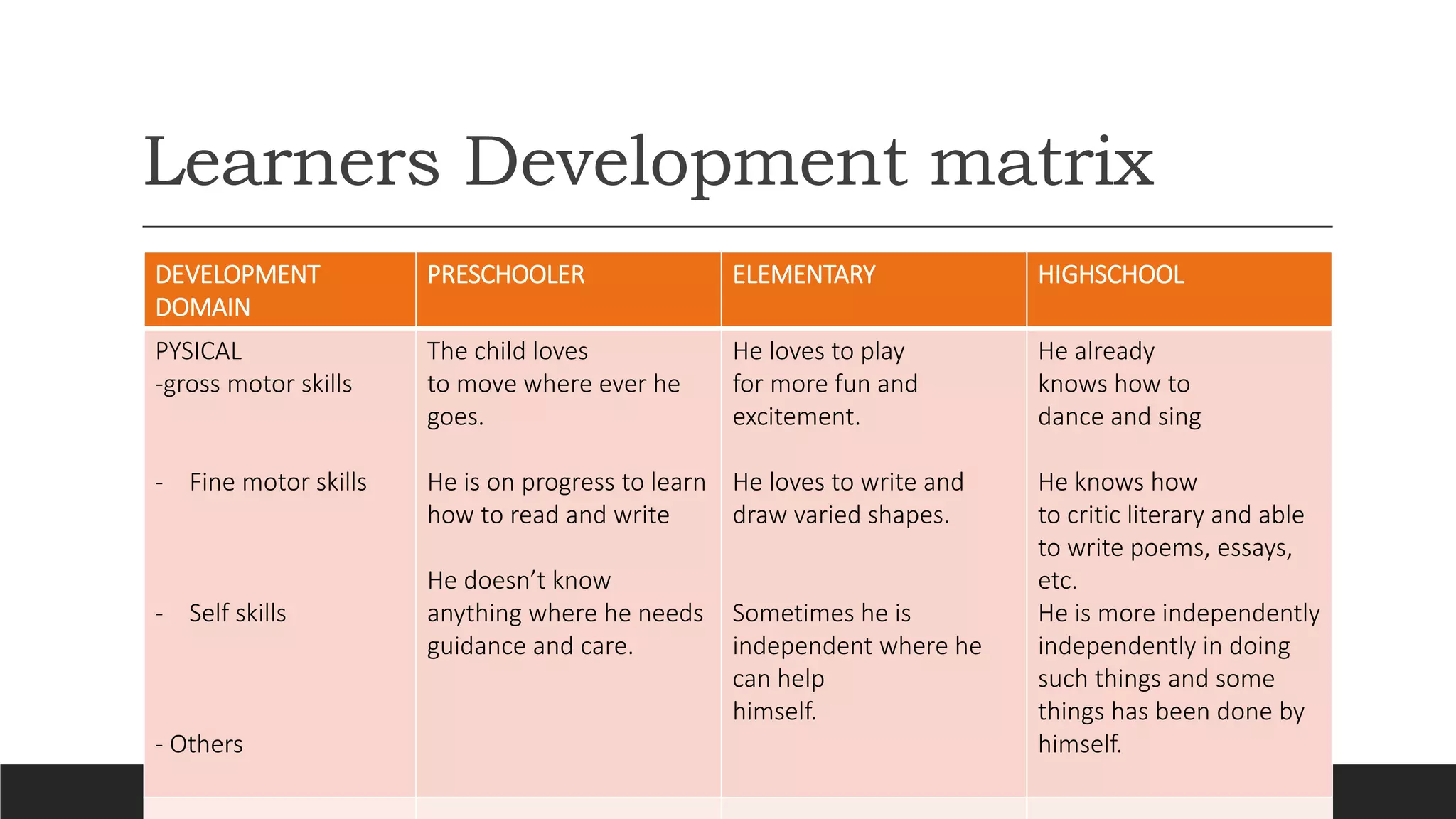
Learners Development matrix
DEVELOPMENT
DOMAIN
PRESCHOOLER ELEMENTARY HIGHSCHOOL
PYSICAL
-gross motor skills
- Fine motor skills
- Self skills
- Others
The child loves
to move where ever he
goes.
He is on progress to learn
how to read and write
He doesn’t know
anything where he needs
guidance and care.
He loves to play
for more fun and
excitement.
He loves to write and
draw varied shapes.
Sometimes he is
independent where he
can help
himself.
He already
knows how to
dance and sing
He knows how
to critic literary and able
to write poems, essays,
etc.
He is more independently
independently in doing
such things and some
things has been done by
himself.
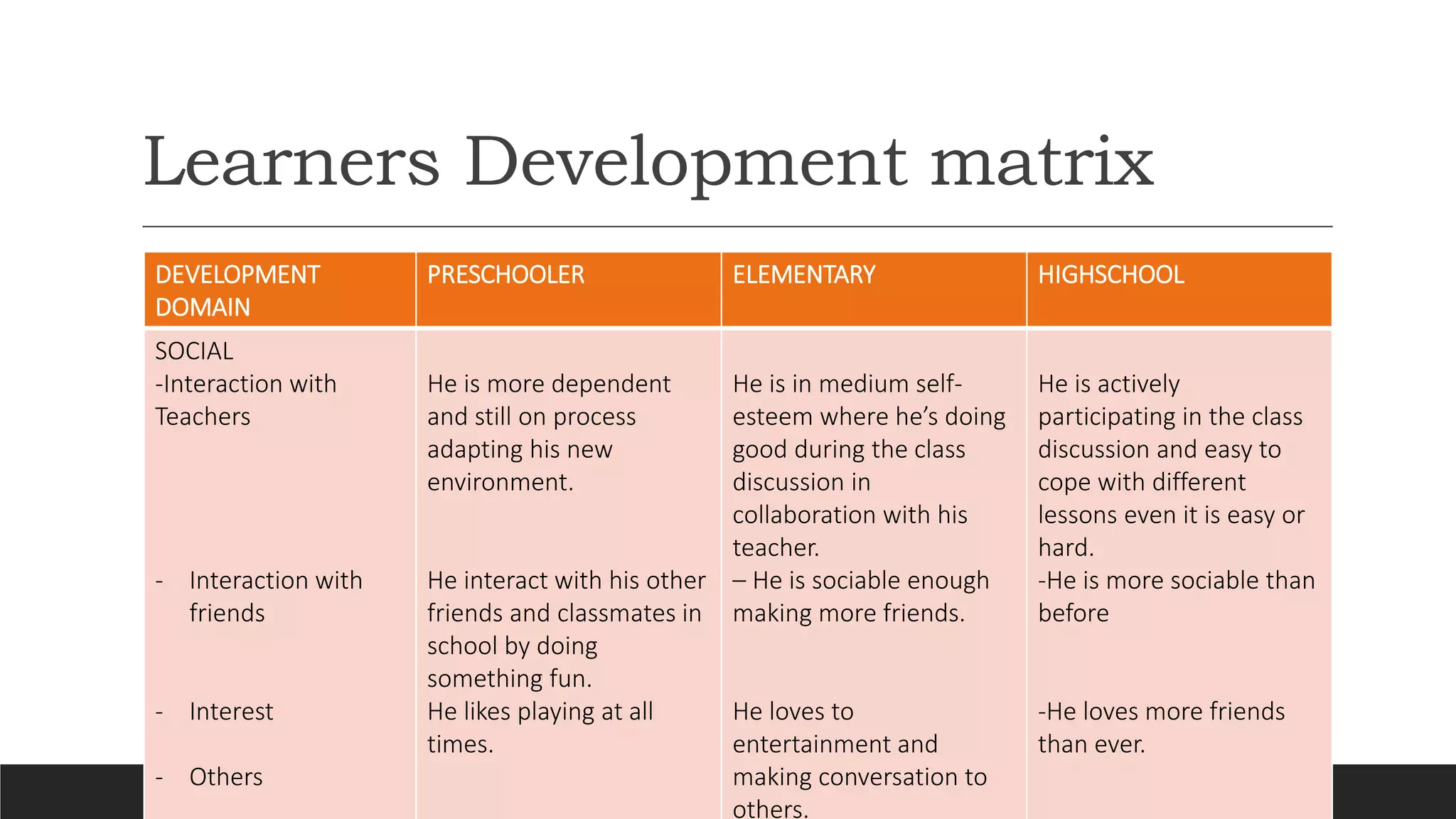
Learners Development matrix
DEVELOPMENT
DOMAIN
PRESCHOOLER ELEMENTARY HIGHSCHOOL
SOCIAL
-Interaction with
Teachers
- Interaction with
friends
- Interest
- Others
He is more dependent
and still on process
adapting his new
environment.
He interact with his other
friends and classmates in
school by doing
something fun.
He likes playing at all
times.
He is in medium self-
esteem where he’s doing
good during the class
discussion in
collaboration with his
teacher.
– He is sociable enough
making more friends.
He loves to
entertainment and
making conversation to
others.
He is actively
participating in the class
discussion and easy to
cope with different
lessons even it is easy or
hard.
-He is more sociable than
before
-He loves more friends
than ever.
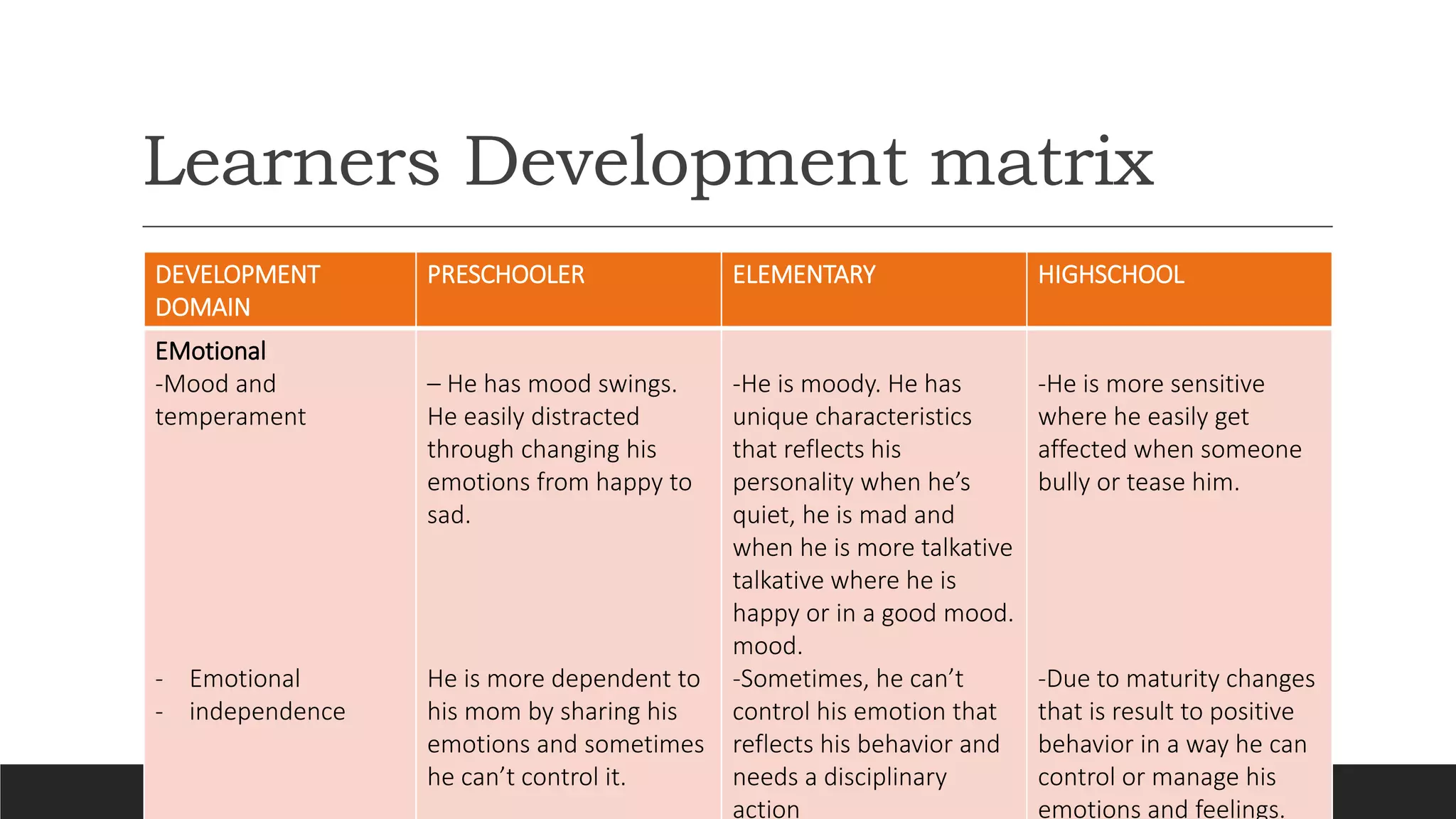
Learners Development matrix
DEVELOPMENT
DOMAIN
PRESCHOOLER ELEMENTARY HIGHSCHOOL
EMotional
-Mood and
temperament
- Emotional
- independence
– He has mood swings.
He easily distracted
through changing his
emotions from happy to
sad.
He is more dependent to
his mom by sharing his
emotions and sometimes
he can’t control it.
-He is moody. He has
unique characteristics
that reflects his
personality when he’s
quiet, he is mad and
when he is more talkative
talkative where he is
happy or in a good mood.
mood.
-Sometimes, he can’t
control his emotion that
reflects his behavior and
needs a disciplinary
action
-He is more sensitive
where he easily get
affected when someone
bully or tease him.
-Due to maturity changes
that is result to positive
behavior in a way he can
control or manage his
emotions and feelings.
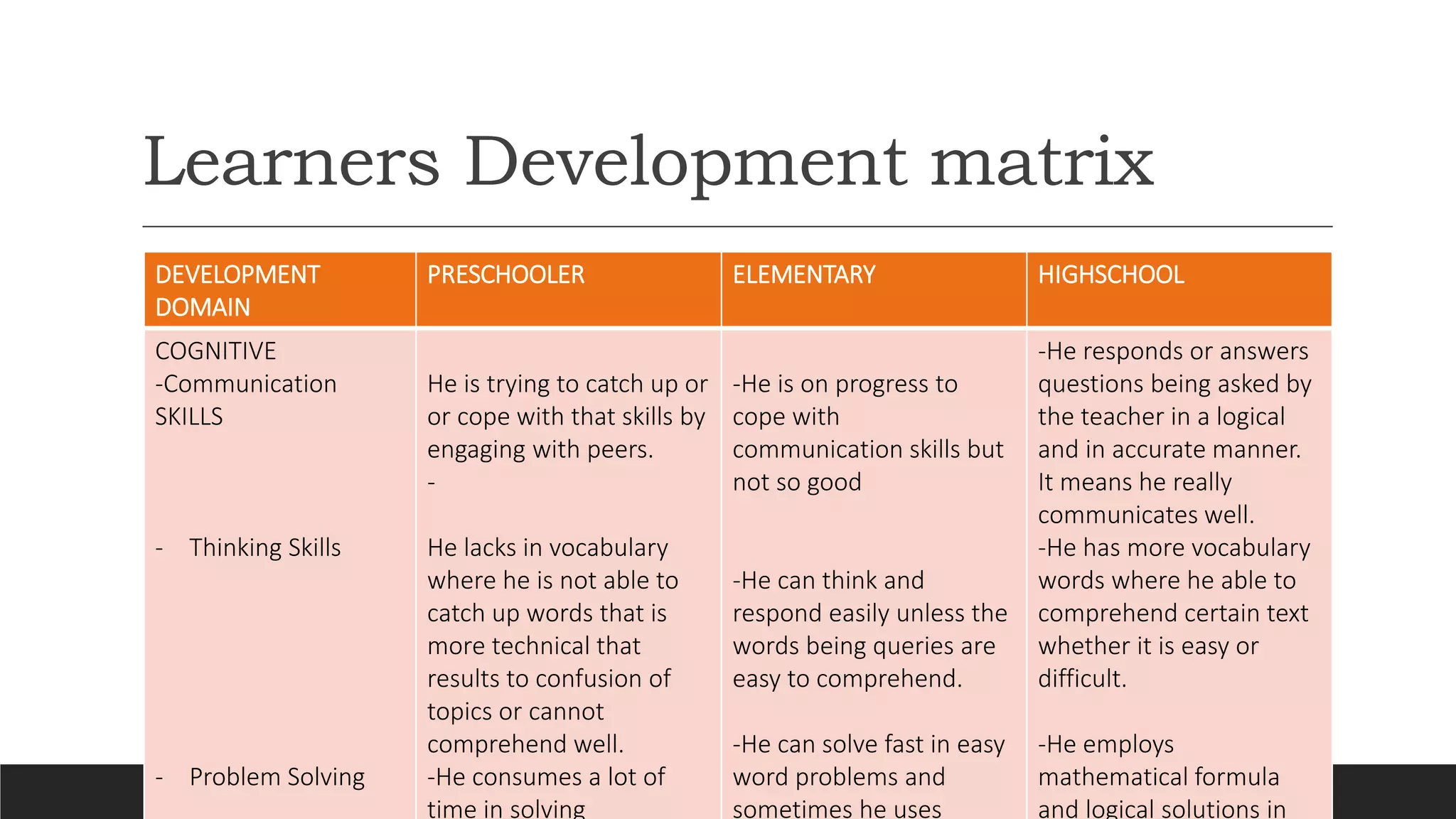
Learners Development matrix
DEVELOPMENT
DOMAIN
PRESCHOOLER ELEMENTARY HIGHSCHOOL
COGNITIVE
-Communication
SKILLS
- Thinking Skills
- Problem Solving
He is trying to catch up or
or cope with that skills by
engaging with peers.
-
He lacks in vocabulary
where he is not able to
catch up words that is
more technical that
results to confusion of
topics or cannot
comprehend well.
-He consumes a lot of
time in solving
-He is on progress to
cope with
communication skills but
not so good
-He can think and
respond easily unless the
words being queries are
easy to comprehend.
-He can solve fast in easy
word problems and
sometimes he uses
-He responds or answers
questions being asked by
the teacher in a logical
and in accurate manner.
It means he really
communicates well.
-He has more vocabulary
words where he able to
comprehend certain text
whether it is easy or
difficult.
-He employs
mathematical formula
and logical solutions in
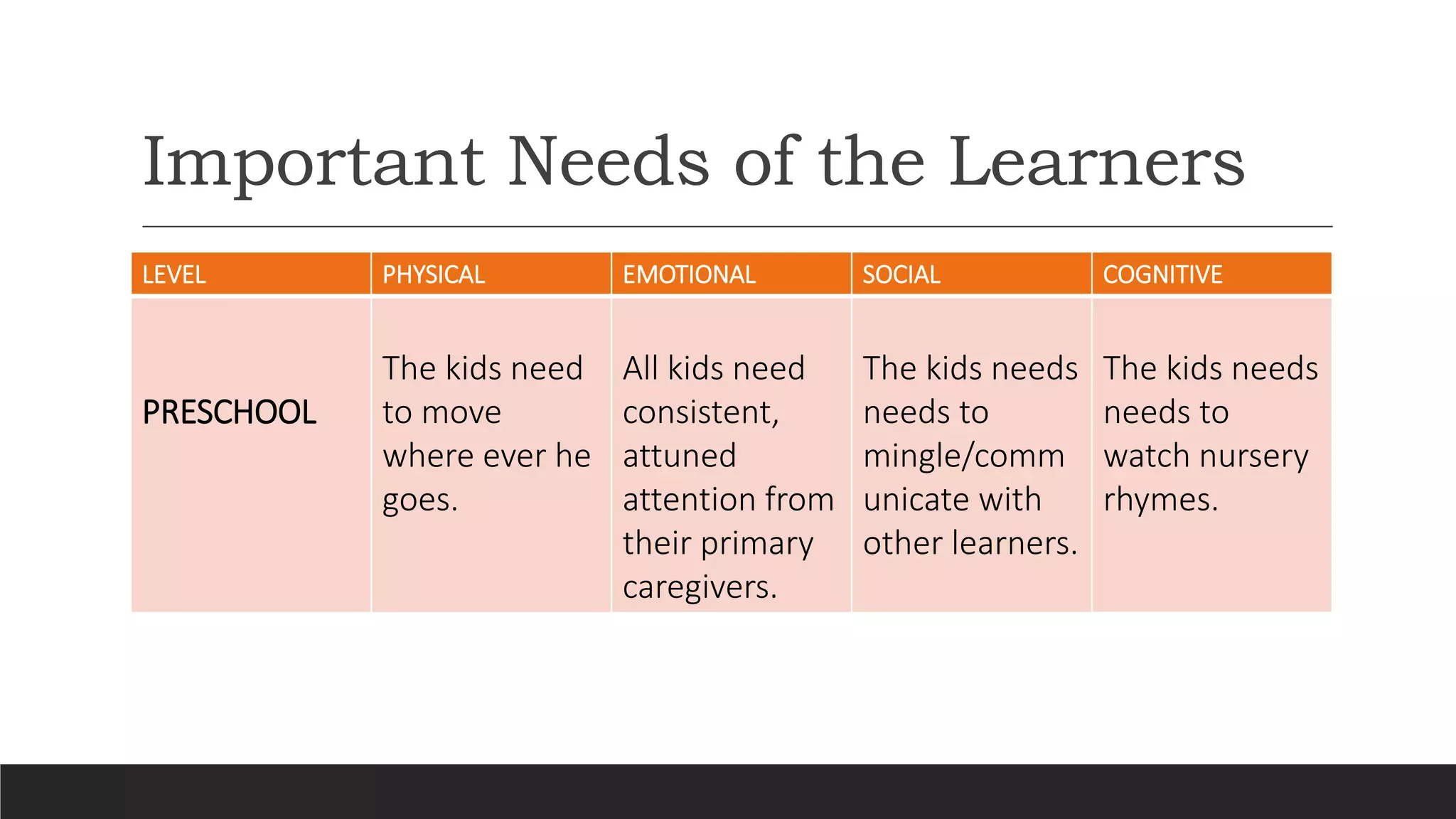
Important Needs of the Learners
LEVEL PHYSICAL EMOTIONAL SOCIAL COGNITIVE
PRESCHOOL
The kids need
to move
where ever he
goes.
All kids need
consistent,
attuned
attention from
their primary
caregivers.
The kids needs
needs to
mingle/comm
unicate with
other learners.
The kids needs
needs to
watch nursery
rhymes.
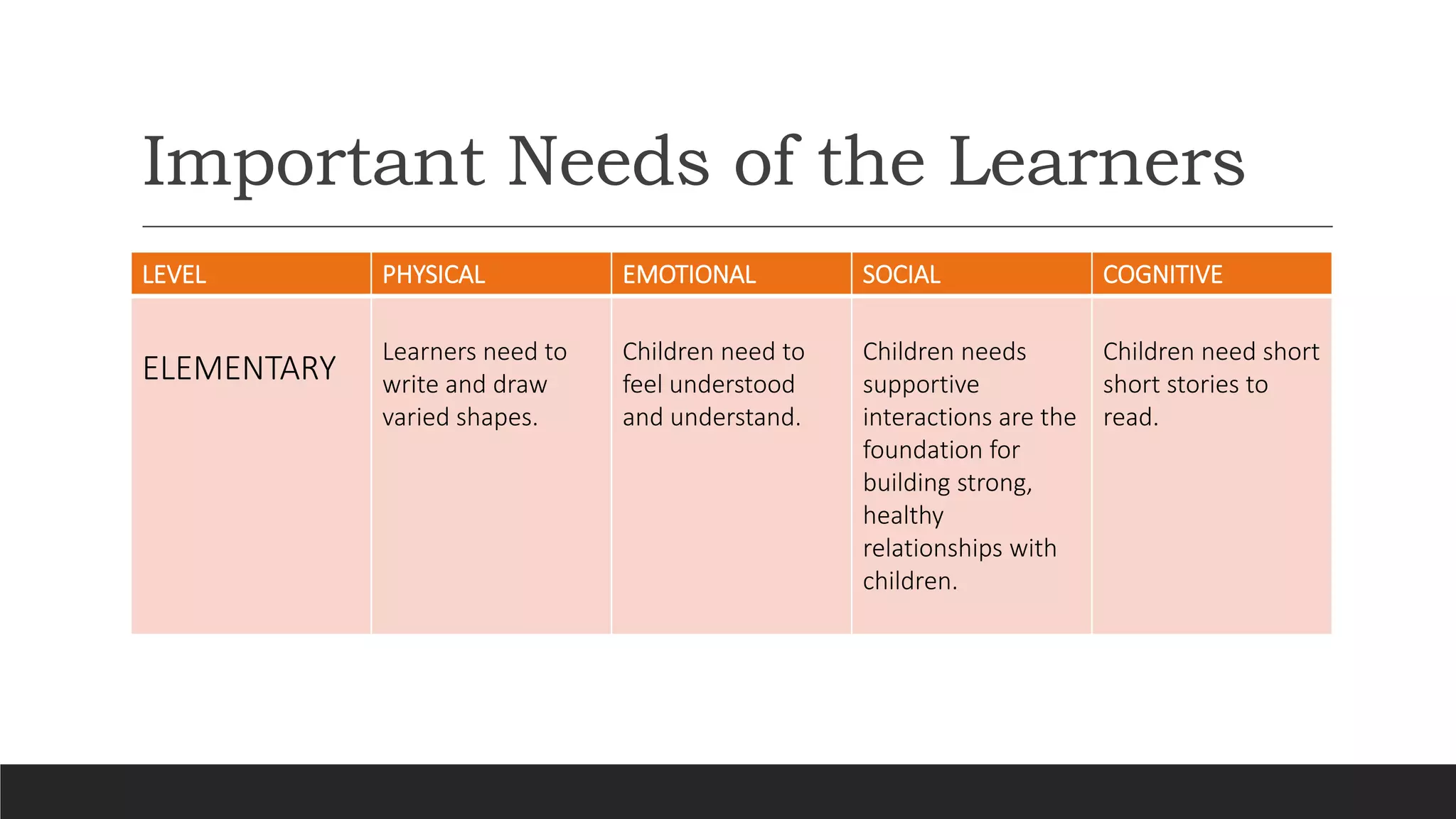
Important Needs of the Learners
LEVEL PHYSICAL EMOTIONAL SOCIAL COGNITIVE
ELEMENTARY
Learners need to
write and draw
varied shapes.
Children need to
feel understood
and understand.
Children needs
supportive
interactions are the
foundation for
building strong,
healthy
relationships with
children.
Children need short
short stories to
read.
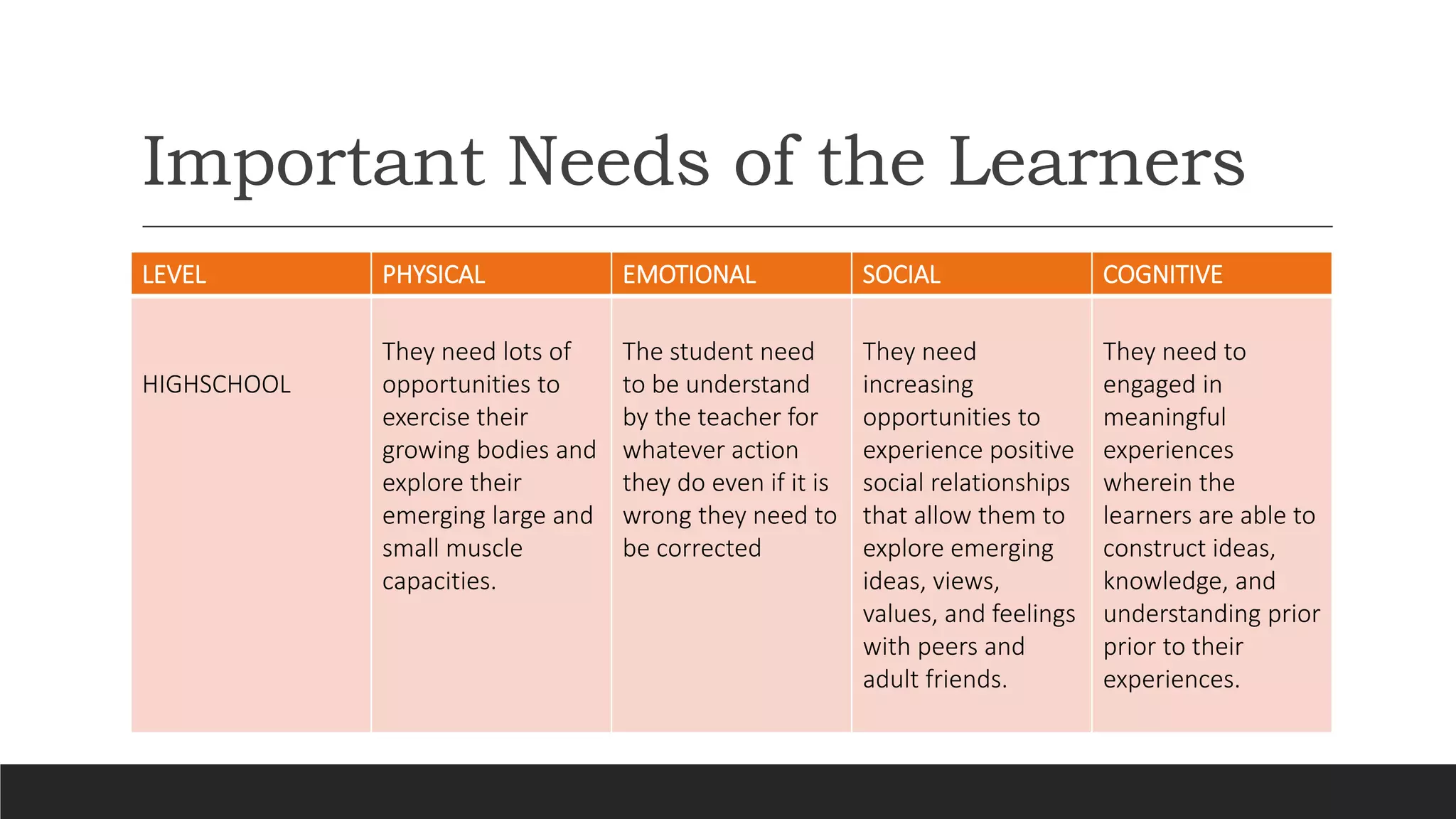
Important Needs of the Learners
LEVEL PHYSICAL EMOTIONAL SOCIAL COGNITIVE
HIGHSCHOOL
They need lots of
opportunities to
exercise their
growing bodies and
explore their
emerging large and
small muscle
capacities.
The student need
to be understand
by the teacher for
whatever action
they do even if it is
wrong they need to
be corrected
They need
increasing
opportunities to
experience positive
social relationships
that allow them to
explore emerging
ideas, views,
values, and feelings
with peers and
adult friends.
They need to
engaged in
meaningful
experiences
wherein the
learners are able to
construct ideas,
knowledge, and
understanding prior
prior to their
experiences.
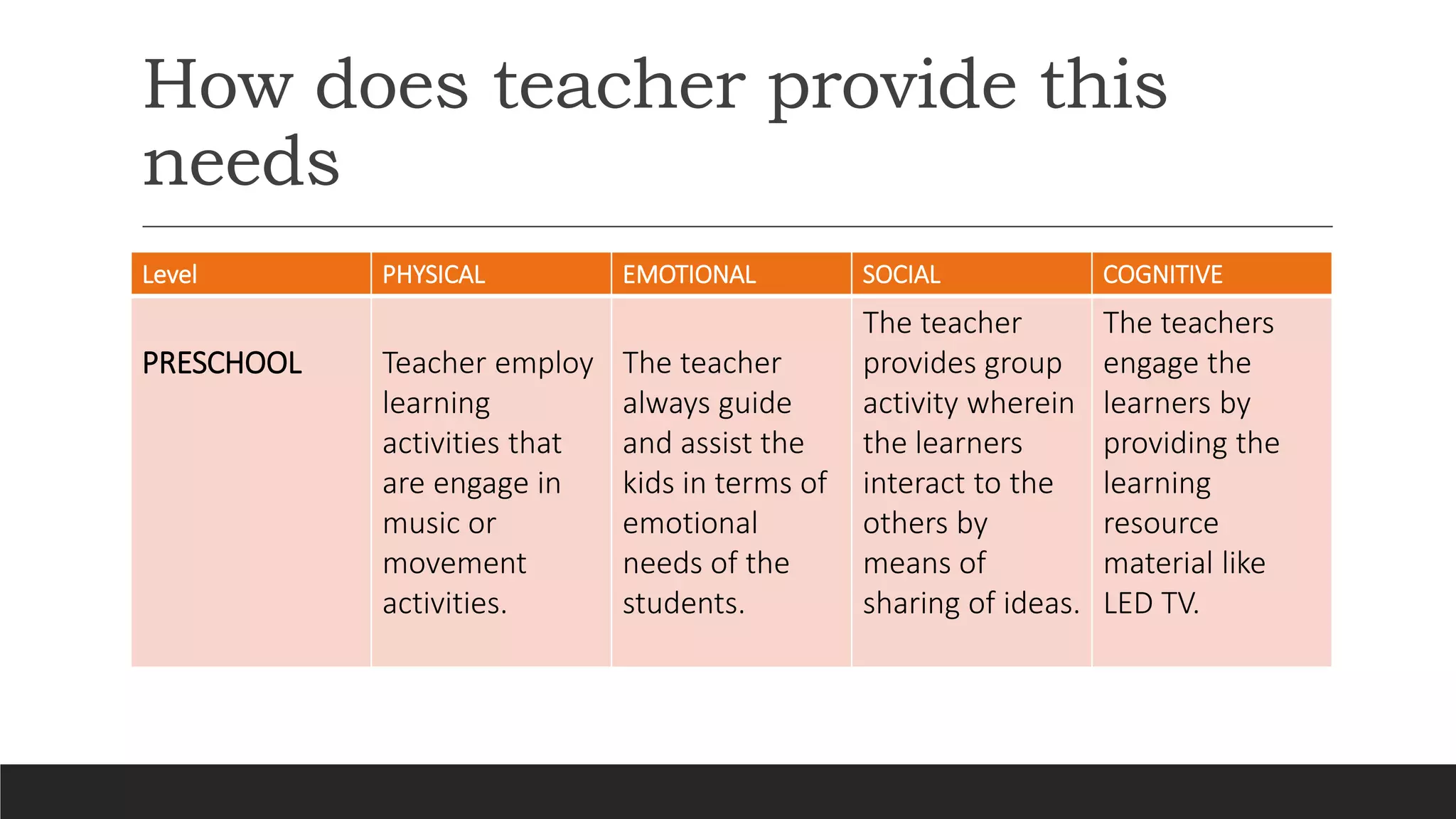
How does teacher provide this
needs
Level PHYSICAL EMOTIONAL SOCIAL COGNITIVE
PRESCHOOL Teacher employ
learning
activities that
are engage in
music or
movement
activities.
The teacher
always guide
and assist the
kids in terms of
emotional
needs of the
students.
The teacher
provides group
activity wherein
the learners
interact to the
others by
means of
sharing of ideas.
The teachers
engage the
learners by
providing the
learning
resource
material like
LED TV.
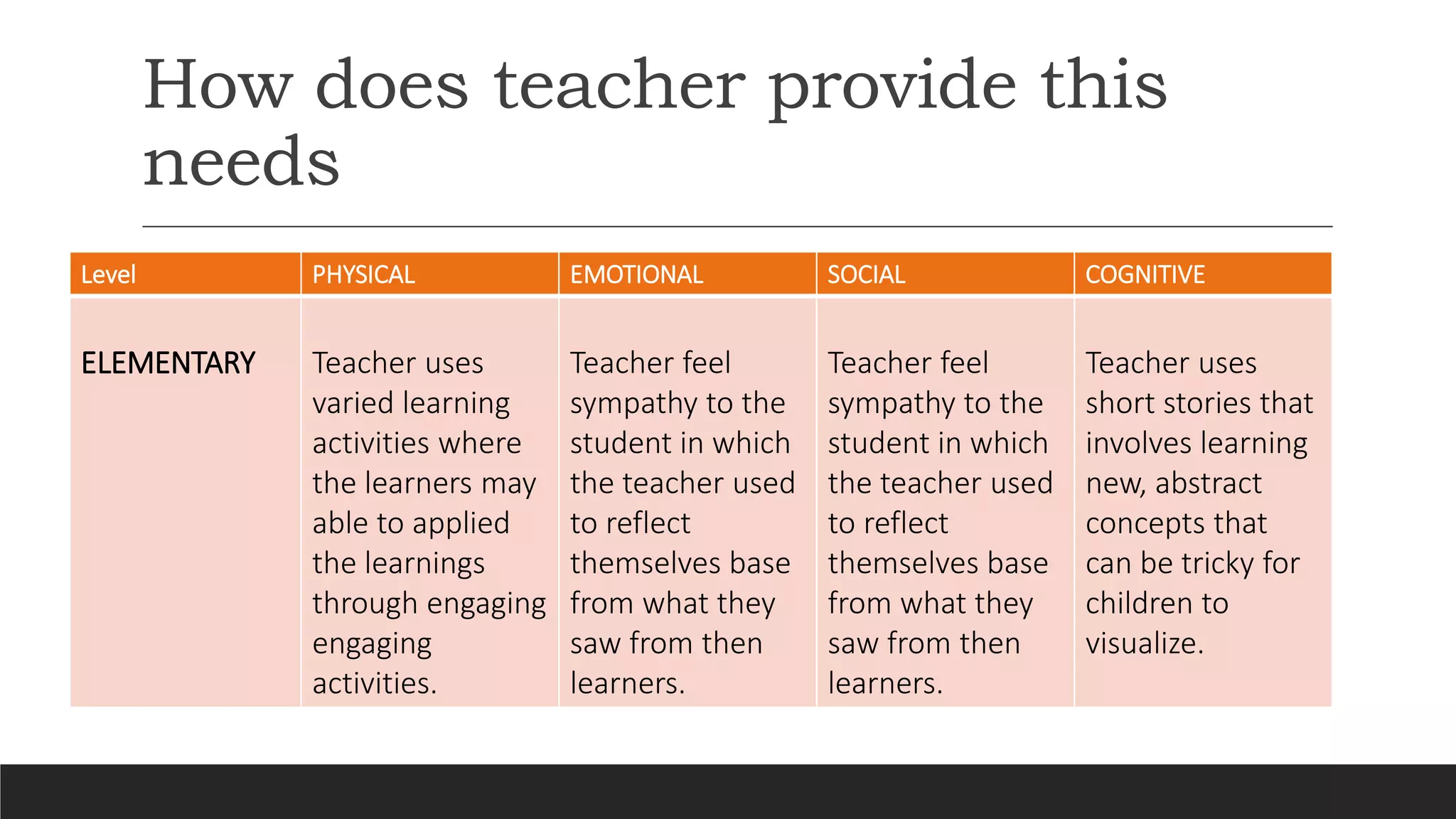
How does teacher provide this
needs
Level PHYSICAL EMOTIONAL SOCIAL COGNITIVE
ELEMENTARY Teacher uses
varied learning
activities where
the learners may
able to applied
the learnings
through engaging
engaging
activities.
Teacher feel
sympathy to the
student in which
the teacher used
to reflect
themselves base
from what they
saw from then
learners.
Teacher feel
sympathy to the
student in which
the teacher used
to reflect
themselves base
from what they
saw from then
learners.
Teacher uses
short stories that
involves learning
new, abstract
concepts that
can be tricky for
children to
visualize.
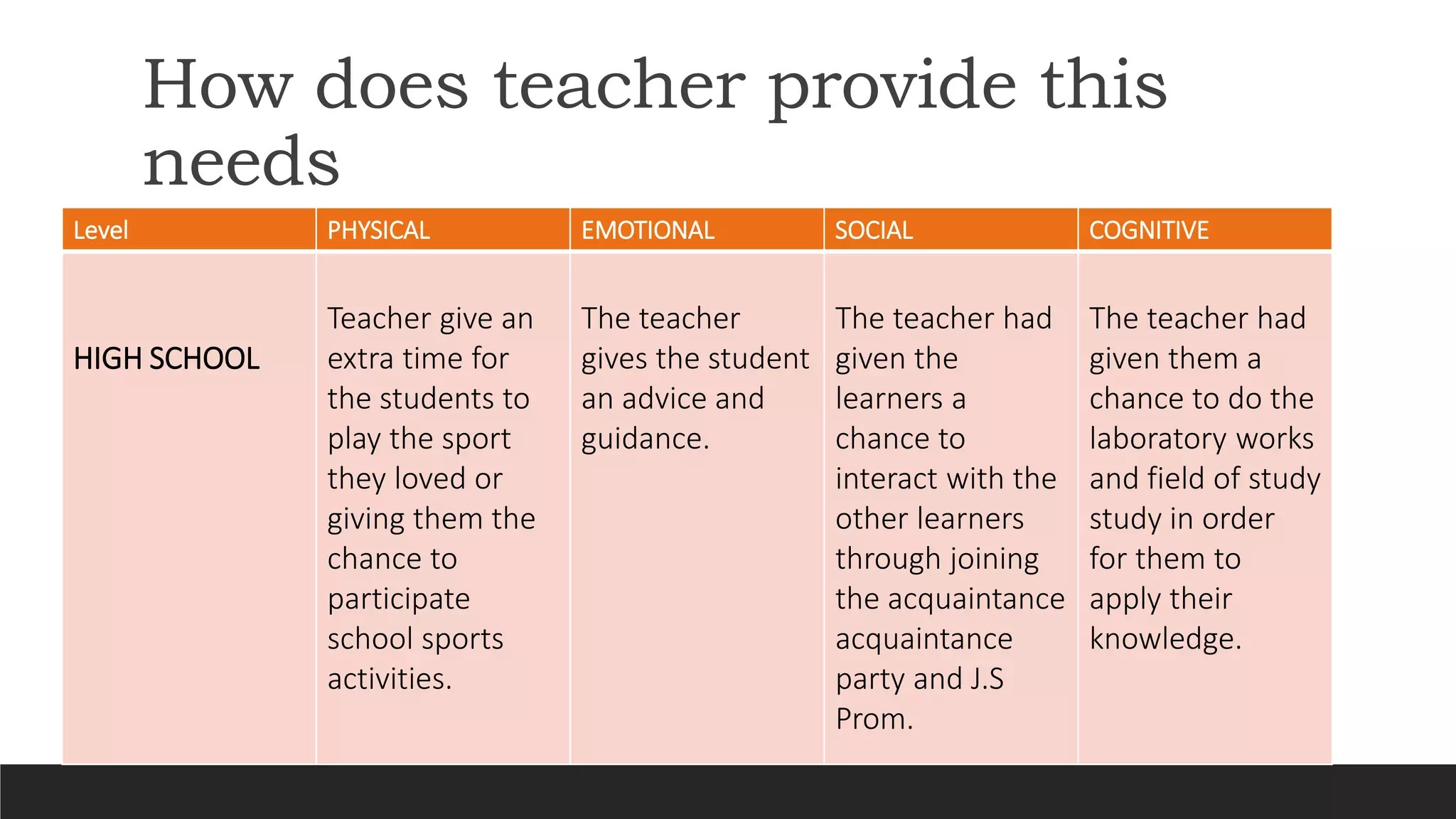
How does teacher provide this
needs
Level PHYSICAL EMOTIONAL SOCIAL COGNITIVE
HIGH SCHOOL
Teacher give an
extra time for
the students to
play the sport
they loved or
giving them the
chance to
participate
school sports
activities.
The teacher
gives the student
an advice and
guidance.
The teacher had
given the
learners a
chance to
interact with the
other learners
through joining
the acquaintance
acquaintance
party and J.S
Prom.
The teacher had
given them a
chance to do the
laboratory works
and field of study
study in order
for them to
apply their
knowledge.
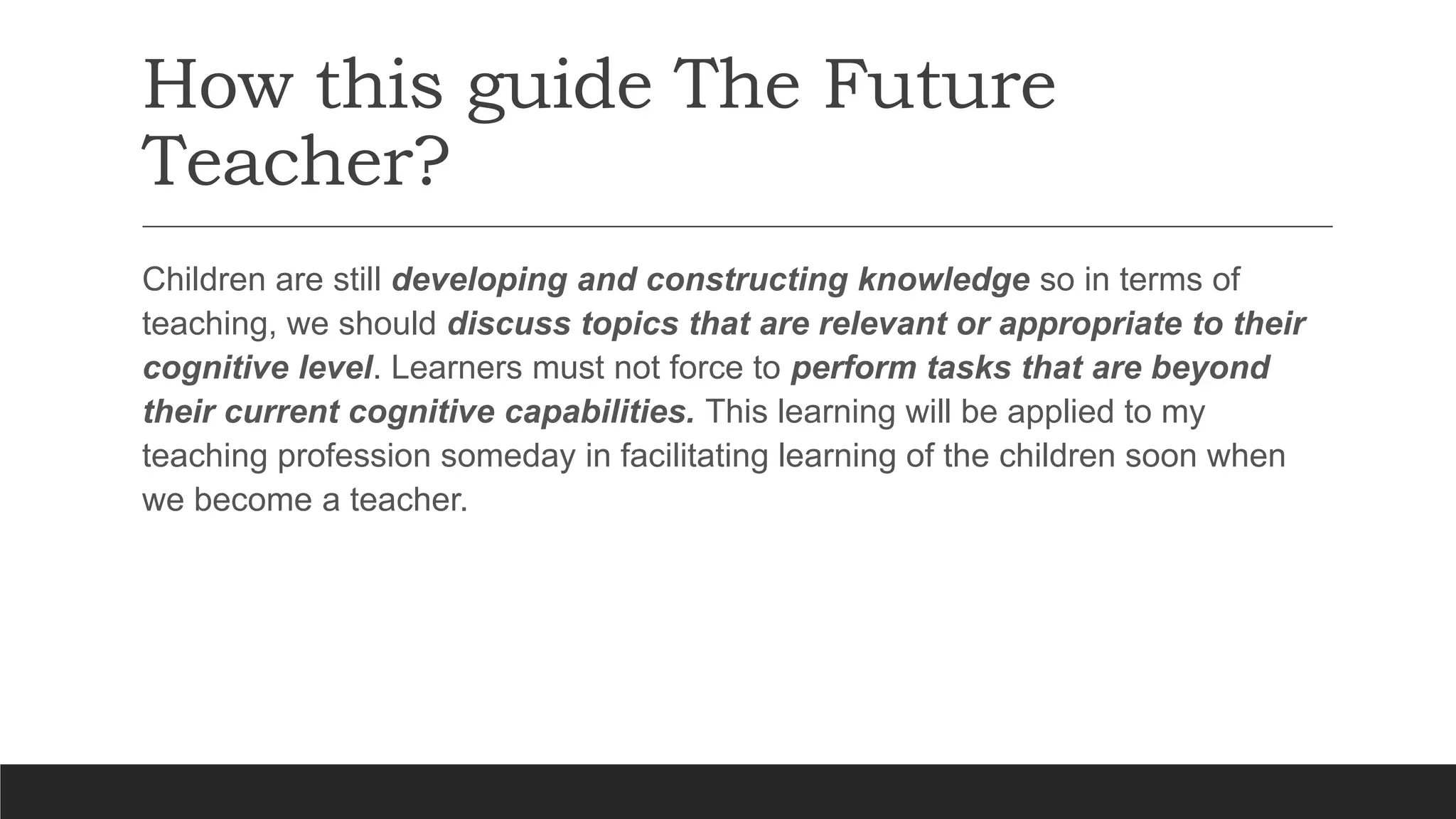
How this guide The Future
Teacher?
Children are still developing and constructing knowledge so in terms of
teaching, we should discuss topics that are relevant or appropriate to their
cognitive level. Learners must not force to perform tasks that are beyond
their current cognitive capabilities. This learning will be applied to my
teaching profession someday in facilitating learning of the children soon when
we become a teacher.
The learners characteristics and needs ep  2

The learners characteristics and needs ep 2

  • 1.
  • 2.
    Learning Outcomes In thisepisode , we must be able to differentiate the Characteristics and Needs from Developmental Levels.
  • 3.
    Domains of Developmental Learning Physical Social Emotional Cognitive
  • 4.
    THEORY CONNECTION (Erikson’s Epigenetic Principles STAGES PYCHOSOCIAL CRISIS BASIC VIRTUE AGE 1 2. Trust vs mistrust Autonomy vs Shame Hope will Infancy 0 – 1 ½ Early Childhood – (1 1/ 2 – 3yrs old) 3. Initiative vs guilt Purpose Play age ( 3- 5yrs old) 4. Industry Vs. Inferiority Competency School Age ( 5-12yrs old) 5 Ego vs. Inferiority Fidelity Adolescences 12- 18yrs old) 6 Intimacy vs Isolation Love Young adult 18-40 yrs old old 7 Generativity vs. stagnation Care Adulthood ( 40-65 yrs) 8 EGO Integrity vs Despair wisdom Maturity ( 65 –Up)
  • 5.
    Erik Erikson’s Theorysaid that personality is determined by experiences during childhood and adulthood. Development has a series of stage were it is determined by crisis. As a persons grow up, he/she will acquire and construct knowledge and different characteristics that fits on his/her age depending on the stage he/she belongs.
  • 6.
    Learners Development matrix DEVELOPMENT DOMAIN PRESCHOOLERELEMENTARY HIGHSCHOOL PYSICAL -gross motor skills - Fine motor skills - Self skills - Others The child loves to move where ever he goes. He is on progress to learn how to read and write He doesn’t know anything where he needs guidance and care. He loves to play for more fun and excitement. He loves to write and draw varied shapes. Sometimes he is independent where he can help himself. He already knows how to dance and sing He knows how to critic literary and able to write poems, essays, etc. He is more independently independently in doing such things and some things has been done by himself.
  • 7.
    Learners Development matrix DEVELOPMENT DOMAIN PRESCHOOLERELEMENTARY HIGHSCHOOL SOCIAL -Interaction with Teachers - Interaction with friends - Interest - Others He is more dependent and still on process adapting his new environment. He interact with his other friends and classmates in school by doing something fun. He likes playing at all times. He is in medium self- esteem where he’s doing good during the class discussion in collaboration with his teacher. – He is sociable enough making more friends. He loves to entertainment and making conversation to others. He is actively participating in the class discussion and easy to cope with different lessons even it is easy or hard. -He is more sociable than before -He loves more friends than ever.
  • 8.
    Learners Development matrix DEVELOPMENT DOMAIN PRESCHOOLERELEMENTARY HIGHSCHOOL EMotional -Mood and temperament - Emotional - independence – He has mood swings. He easily distracted through changing his emotions from happy to sad. He is more dependent to his mom by sharing his emotions and sometimes he can’t control it. -He is moody. He has unique characteristics that reflects his personality when he’s quiet, he is mad and when he is more talkative talkative where he is happy or in a good mood. mood. -Sometimes, he can’t control his emotion that reflects his behavior and needs a disciplinary action -He is more sensitive where he easily get affected when someone bully or tease him. -Due to maturity changes that is result to positive behavior in a way he can control or manage his emotions and feelings.
  • 9.
    Learners Development matrix DEVELOPMENT DOMAIN PRESCHOOLERELEMENTARY HIGHSCHOOL COGNITIVE -Communication SKILLS - Thinking Skills - Problem Solving He is trying to catch up or or cope with that skills by engaging with peers. - He lacks in vocabulary where he is not able to catch up words that is more technical that results to confusion of topics or cannot comprehend well. -He consumes a lot of time in solving -He is on progress to cope with communication skills but not so good -He can think and respond easily unless the words being queries are easy to comprehend. -He can solve fast in easy word problems and sometimes he uses -He responds or answers questions being asked by the teacher in a logical and in accurate manner. It means he really communicates well. -He has more vocabulary words where he able to comprehend certain text whether it is easy or difficult. -He employs mathematical formula and logical solutions in
  • 10.
    Important Needs ofthe Learners LEVEL PHYSICAL EMOTIONAL SOCIAL COGNITIVE PRESCHOOL The kids need to move where ever he goes. All kids need consistent, attuned attention from their primary caregivers. The kids needs needs to mingle/comm unicate with other learners. The kids needs needs to watch nursery rhymes.
  • 11.
    Important Needs ofthe Learners LEVEL PHYSICAL EMOTIONAL SOCIAL COGNITIVE ELEMENTARY Learners need to write and draw varied shapes. Children need to feel understood and understand. Children needs supportive interactions are the foundation for building strong, healthy relationships with children. Children need short short stories to read.
  • 12.
    Important Needs ofthe Learners LEVEL PHYSICAL EMOTIONAL SOCIAL COGNITIVE HIGHSCHOOL They need lots of opportunities to exercise their growing bodies and explore their emerging large and small muscle capacities. The student need to be understand by the teacher for whatever action they do even if it is wrong they need to be corrected They need increasing opportunities to experience positive social relationships that allow them to explore emerging ideas, views, values, and feelings with peers and adult friends. They need to engaged in meaningful experiences wherein the learners are able to construct ideas, knowledge, and understanding prior prior to their experiences.
  • 13.
    How does teacherprovide this needs Level PHYSICAL EMOTIONAL SOCIAL COGNITIVE PRESCHOOL Teacher employ learning activities that are engage in music or movement activities. The teacher always guide and assist the kids in terms of emotional needs of the students. The teacher provides group activity wherein the learners interact to the others by means of sharing of ideas. The teachers engage the learners by providing the learning resource material like LED TV.
  • 14.
    How does teacherprovide this needs Level PHYSICAL EMOTIONAL SOCIAL COGNITIVE ELEMENTARY Teacher uses varied learning activities where the learners may able to applied the learnings through engaging engaging activities. Teacher feel sympathy to the student in which the teacher used to reflect themselves base from what they saw from then learners. Teacher feel sympathy to the student in which the teacher used to reflect themselves base from what they saw from then learners. Teacher uses short stories that involves learning new, abstract concepts that can be tricky for children to visualize.
  • 15.
    How does teacherprovide this needs Level PHYSICAL EMOTIONAL SOCIAL COGNITIVE HIGH SCHOOL Teacher give an extra time for the students to play the sport they loved or giving them the chance to participate school sports activities. The teacher gives the student an advice and guidance. The teacher had given the learners a chance to interact with the other learners through joining the acquaintance acquaintance party and J.S Prom. The teacher had given them a chance to do the laboratory works and field of study study in order for them to apply their knowledge.
  • 16.
    How this guideThe Future Teacher? Children are still developing and constructing knowledge so in terms of teaching, we should discuss topics that are relevant or appropriate to their cognitive level. Learners must not force to perform tasks that are beyond their current cognitive capabilities. This learning will be applied to my teaching profession someday in facilitating learning of the children soon when we become a teacher.