-Alphonse Daudet
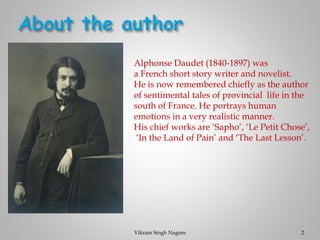
Alphonse Daudet (1840-1897) was
a French short story writer and novelist.
He is now remembered chiefly as the author
of sentimental tales of provincial life in the
south of France. He portrays human
emotions in a very realistic manner.
His chief works are ‘Sapho’, ‘Le Petit Chose’,
‘In the Land of Pain’ and ‘The Last Lesson’.
2
Vikram Singh Nagore
Theme of the story
❑ Relates to culture and language
❑ Dominance of the imperial and colonial power
❑ Lust for ruling the world influencing culture and
identities
❑ Linguistic Chauvinism
❑ Language: an asset , more so in times of crisis
❑ Fear, shame and agony of losing freedom of
learning and using mother tongue
❑ Student and teacher attitudes to learning and
teaching
3
Vikram Singh Nagore
4
Vikram Singh Nagore
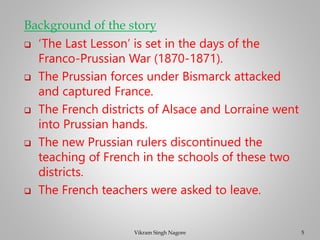
Background of the story
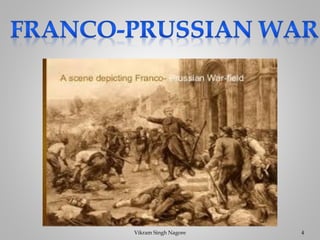
❑ ‘The Last Lesson’ is set in the days of the
Franco-Prussian War (1870-1871).
❑ The Prussian forces under Bismarck attacked
and captured France.
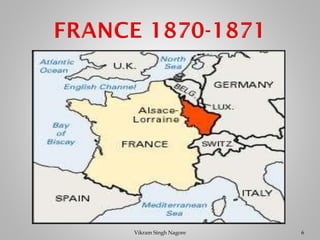
❑ The French districts of Alsace and Lorraine went
into Prussian hands.
❑ The new Prussian rulers discontinued the
teaching of French in the schools of these two
districts.
❑ The French teachers were asked to leave.
5
Vikram Singh Nagore
6
Vikram Singh Nagore
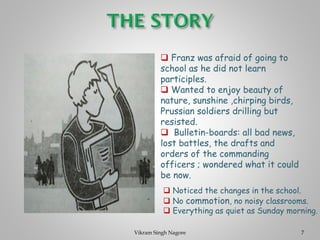
❑ Franz was afraid of going to
school as he did not learn
participles.
❑ Wanted to enjoy beauty of
nature, sunshine ,chirping birds,
Prussian soldiers drilling but
resisted.
❑ Bulletin-boards: all bad news,
lost battles, the drafts and
orders of the commanding
officers ; wondered what it could
be now.
❑ Noticed the changes in the school.
❑ No commotion, no noisy classrooms.
❑ Everything as quiet as Sunday morning.
7
Vikram Singh Nagore
8
Vikram Singh Nagore
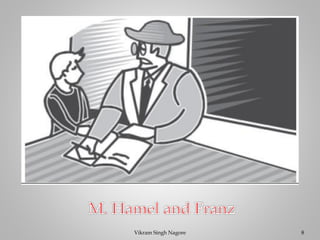
❑ M.Hamel, the teacher did not scold him, but spoke
kindly.
❑ Franz noticed the teacher dressed in his Sunday
best.
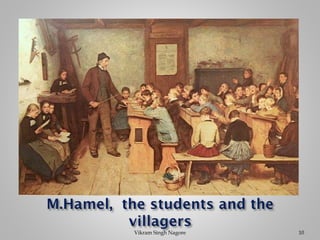
❑ Villagers occupying the last benches.
❑ To pay tribute to M. Hamel for his 40 years of
sincere service.
❑ To express their solidarity with France.
❑ Hamel made the announcement of it being the last
French lesson.
❑ Franz realized what was put on the bulletin –board.
❑ Regretted that he did not know his mother-tongue.
❑ Repented of not taking his lessons seriously.
9
Vikram Singh Nagore
10
Vikram Singh Nagore
❑ Franz realized why the teacher was dressed in his
Sunday best and villagers sitting at the back.
❑ Hamel accepted that all three – the children, parents
and he himself were to be blamed for losing respect
and regard for the mother tongue.
❑ Always keep the mother – tongue close to your heart
as it is the key to the prison of slavery.
❑ Atmosphere in class: teacher teaching sincerely and
patiently; students and others studying with utmost
sincerity.
❑ Franz wondered sarcastically if the Prussians could
force pigeons to coo in German.
❑ Tears rolled down their eyes.
11
Vikram Singh Nagore
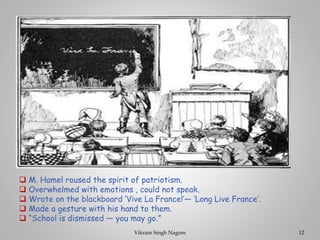
❑ M. Hamel roused the spirit of patriotism.
❑ Overwhelmed with emotions , could not speak.
❑ Wrote on the blackboard ‘Vive La France!’— ‘Long Live France’.
❑ Made a gesture with his hand to them.
❑ “School is dismissed — you may go.”
12
Vikram Singh Nagore
XII-L.1-PPT-of-THE-LAST-LESSON-2.pdf

XII-L.1-PPT-of-THE-LAST-LESSON-2.pdf

  • 1.
  • 2.
    Alphonse Daudet (1840-1897)was a French short story writer and novelist. He is now remembered chiefly as the author of sentimental tales of provincial life in the south of France. He portrays human emotions in a very realistic manner. His chief works are ‘Sapho’, ‘Le Petit Chose’, ‘In the Land of Pain’ and ‘The Last Lesson’. 2 Vikram Singh Nagore
  • 3.
    Theme of thestory ❑ Relates to culture and language ❑ Dominance of the imperial and colonial power ❑ Lust for ruling the world influencing culture and identities ❑ Linguistic Chauvinism ❑ Language: an asset , more so in times of crisis ❑ Fear, shame and agony of losing freedom of learning and using mother tongue ❑ Student and teacher attitudes to learning and teaching 3 Vikram Singh Nagore
  • 4.
  • 5.
    Background of thestory ❑ ‘The Last Lesson’ is set in the days of the Franco-Prussian War (1870-1871). ❑ The Prussian forces under Bismarck attacked and captured France. ❑ The French districts of Alsace and Lorraine went into Prussian hands. ❑ The new Prussian rulers discontinued the teaching of French in the schools of these two districts. ❑ The French teachers were asked to leave. 5 Vikram Singh Nagore
  • 6.
  • 7.
    ❑ Franz wasafraid of going to school as he did not learn participles. ❑ Wanted to enjoy beauty of nature, sunshine ,chirping birds, Prussian soldiers drilling but resisted. ❑ Bulletin-boards: all bad news, lost battles, the drafts and orders of the commanding officers ; wondered what it could be now. ❑ Noticed the changes in the school. ❑ No commotion, no noisy classrooms. ❑ Everything as quiet as Sunday morning. 7 Vikram Singh Nagore
  • 8.
  • 9.
    ❑ M.Hamel, theteacher did not scold him, but spoke kindly. ❑ Franz noticed the teacher dressed in his Sunday best. ❑ Villagers occupying the last benches. ❑ To pay tribute to M. Hamel for his 40 years of sincere service. ❑ To express their solidarity with France. ❑ Hamel made the announcement of it being the last French lesson. ❑ Franz realized what was put on the bulletin –board. ❑ Regretted that he did not know his mother-tongue. ❑ Repented of not taking his lessons seriously. 9 Vikram Singh Nagore
  • 10.
  • 11.
    ❑ Franz realizedwhy the teacher was dressed in his Sunday best and villagers sitting at the back. ❑ Hamel accepted that all three – the children, parents and he himself were to be blamed for losing respect and regard for the mother tongue. ❑ Always keep the mother – tongue close to your heart as it is the key to the prison of slavery. ❑ Atmosphere in class: teacher teaching sincerely and patiently; students and others studying with utmost sincerity. ❑ Franz wondered sarcastically if the Prussians could force pigeons to coo in German. ❑ Tears rolled down their eyes. 11 Vikram Singh Nagore
  • 12.
    ❑ M. Hamelroused the spirit of patriotism. ❑ Overwhelmed with emotions , could not speak. ❑ Wrote on the blackboard ‘Vive La France!’— ‘Long Live France’. ❑ Made a gesture with his hand to them. ❑ “School is dismissed — you may go.” 12 Vikram Singh Nagore