THE LADDERING TECHNIQUE
   A way to conduct interviews
           Tina Blegind Jensen
         Aarhus School of Business
                 Denmark
What is it?
• Laddering is an interview technique used in semi-
  structured interviews.
• Laddering is a method that helps you elicit the
  higher or lower level abstractions of the concepts
  that people use to organize their world.
• The method is performed by using probes. Probing
  means to “peel back the layers” of the informant’s
  experience.
• Laddering and probing is used to: “understand the
  way in which the informant sees the world”
  (Reynolds & Gutman, 1988).
In which situations?
Laddering is used within two streams of research:
Consumer research and organization research

• Consumer research to elicit consumers’ preferences
  towards certain products or services.
• Consumers’ preferences are categorized into three
  dimensions:
   – Attributes of a product/service
   – Consequences
   – Values
• Example:
    – Cola light
In which situations?
• Organization research to elicit values and decision
  making structures in organizations.
• The laddering method can be used to elicit values
  among managers or employees (e.g. work conditions
  among employees).
• Preferences are categorized into means and ends.
• Example:
    – Work conditions for employees
How is it performed?
• It is performed on the basis of a one-to-one inter-
  viewing technique.
• In consumer research, you start out by focusing on
  a certain product or service and its attributes.
• In organization research, you start out by focusing
  on certain aspects related to a specific work
  situation/event.
• Probes are oriented towards ‘why’-questions, i.e.:
  “Why is that (attribute/aspect) important to you?”
Example – consumer research
• The example is based on a salty-snack study.
• The consumer is asked about the product’s
  attributes.
• On the basis of the attributes, you start probing:
  “Why is that (attribute) important to you?”
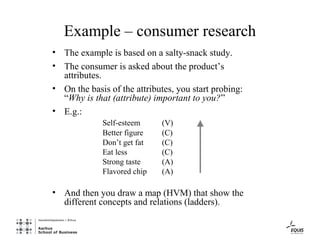
• E.g.:
             Self-esteem     (V)
             Better figure   (C)
             Don’t get fat   (C)
             Eat less        (C)
             Strong taste    (A)
             Flavored chip   (A)

• And then you draw a map (HVM) that show the
  different concepts and relations (ladders).
In my PhD project
• Not a product…rather an event.
• Focus is on an implementation of an Electronic
  Patient Record (EPR) in a Danish hospital.
• Interviews with nurses and doctors.
• What do nurses and doctors consider as important
  aspects in the EPR implementation and why.
• Laddering and probing as a method to study user
  perceptions.
In my PhD project
• 21 cards were composed before the interview, each
  containing an activity or aspect in the EPR
  implementation process at a more or less abstract level,
  e.g.:
     – User training
     – Support
     – Work stations etc.
• On the basis of the cards, the informant was asked:
  “What do you understand by…?” or “what is implied
  by…?”
• And then: “Why is that [aspect] important to you?”
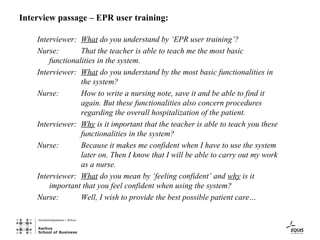
Interview passage – EPR user training:

    Interviewer: What do you understand by ‘EPR user training’?
    Nurse:        That the teacher is able to teach me the most basic
        functionalities in the system.
    Interviewer: What do you understand by the most basic functionalities in
                  the system?
    Nurse:        How to write a nursing note, save it and be able to find it
                  again. But these functionalities also concern procedures
                  regarding the overall hospitalization of the patient.
    Interviewer: Why is it important that the teacher is able to teach you these
                  functionalities in the system?
    Nurse:        Because it makes me confident when I have to use the system
                  later on. Then I know that I will be able to carry out my work
                  as a nurse.
    Interviewer: What do you mean by ‘feeling confident’ and why is it
        important that you feel confident when using the system?
    Nurse:        Well, I wish to provide the best possible patient care…
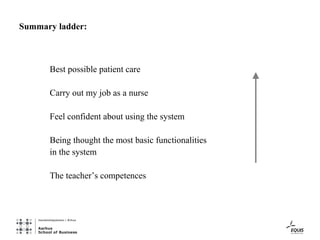
Summary ladder:


      Best possible patient care

      Carry out my job as a nurse

      Feel confident about using the system

      Being thought the most basic functionalities
      in the system

      The teacher’s competences
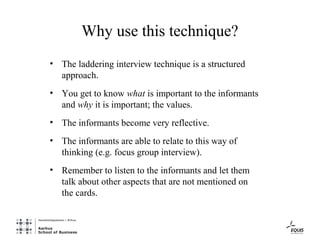
Why use this technique?
• The laddering interview technique is a structured
  approach.
• You get to know what is important to the informants
  and why it is important; the values.
• The informants become very reflective.
• The informants are able to relate to this way of
  thinking (e.g. focus group interview).
• Remember to listen to the informants and let them
  talk about other aspects that are not mentioned on
  the cards.
Interview with Margunn

Mention three things that are important
for you when conducting an interview

The laddering technique tina

  • 1.
    THE LADDERING TECHNIQUE A way to conduct interviews Tina Blegind Jensen Aarhus School of Business Denmark
  • 2.
    What is it? •Laddering is an interview technique used in semi- structured interviews. • Laddering is a method that helps you elicit the higher or lower level abstractions of the concepts that people use to organize their world. • The method is performed by using probes. Probing means to “peel back the layers” of the informant’s experience. • Laddering and probing is used to: “understand the way in which the informant sees the world” (Reynolds & Gutman, 1988).
  • 3.
    In which situations? Ladderingis used within two streams of research: Consumer research and organization research • Consumer research to elicit consumers’ preferences towards certain products or services. • Consumers’ preferences are categorized into three dimensions: – Attributes of a product/service – Consequences – Values • Example: – Cola light
  • 4.
    In which situations? •Organization research to elicit values and decision making structures in organizations. • The laddering method can be used to elicit values among managers or employees (e.g. work conditions among employees). • Preferences are categorized into means and ends. • Example: – Work conditions for employees
  • 5.
    How is itperformed? • It is performed on the basis of a one-to-one inter- viewing technique. • In consumer research, you start out by focusing on a certain product or service and its attributes. • In organization research, you start out by focusing on certain aspects related to a specific work situation/event. • Probes are oriented towards ‘why’-questions, i.e.: “Why is that (attribute/aspect) important to you?”
  • 6.
    Example – consumerresearch • The example is based on a salty-snack study. • The consumer is asked about the product’s attributes. • On the basis of the attributes, you start probing: “Why is that (attribute) important to you?” • E.g.: Self-esteem (V) Better figure (C) Don’t get fat (C) Eat less (C) Strong taste (A) Flavored chip (A) • And then you draw a map (HVM) that show the different concepts and relations (ladders).
  • 7.
    In my PhDproject • Not a product…rather an event. • Focus is on an implementation of an Electronic Patient Record (EPR) in a Danish hospital. • Interviews with nurses and doctors. • What do nurses and doctors consider as important aspects in the EPR implementation and why. • Laddering and probing as a method to study user perceptions.
  • 8.
    In my PhDproject • 21 cards were composed before the interview, each containing an activity or aspect in the EPR implementation process at a more or less abstract level, e.g.: – User training – Support – Work stations etc. • On the basis of the cards, the informant was asked: “What do you understand by…?” or “what is implied by…?” • And then: “Why is that [aspect] important to you?”
  • 9.
    Interview passage –EPR user training: Interviewer: What do you understand by ‘EPR user training’? Nurse: That the teacher is able to teach me the most basic functionalities in the system. Interviewer: What do you understand by the most basic functionalities in the system? Nurse: How to write a nursing note, save it and be able to find it again. But these functionalities also concern procedures regarding the overall hospitalization of the patient. Interviewer: Why is it important that the teacher is able to teach you these functionalities in the system? Nurse: Because it makes me confident when I have to use the system later on. Then I know that I will be able to carry out my work as a nurse. Interviewer: What do you mean by ‘feeling confident’ and why is it important that you feel confident when using the system? Nurse: Well, I wish to provide the best possible patient care…
  • 10.
    Summary ladder: Best possible patient care Carry out my job as a nurse Feel confident about using the system Being thought the most basic functionalities in the system The teacher’s competences
  • 12.
    Why use thistechnique? • The laddering interview technique is a structured approach. • You get to know what is important to the informants and why it is important; the values. • The informants become very reflective. • The informants are able to relate to this way of thinking (e.g. focus group interview). • Remember to listen to the informants and let them talk about other aspects that are not mentioned on the cards.
  • 13.
    Interview with Margunn Mentionthree things that are important for you when conducting an interview