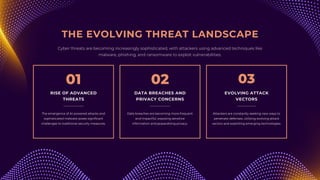
THE EVOLVING THREATLANDSCAPE
Cyber threats are becoming increasingly sophisticated, with attackers using advanced techniques like
malware, phishing, and ransomware to exploit vulnerabilities.
The emergence of AI-powered attacks and
sophisticated malware poses significant
challenges to traditional security measures.
RISE OF ADVANCED
THREATS
01
Attackers are constantly seeking new ways to
penetrate defenses, utilizing evolving attack
vectors and exploiting emerging technologies.
EVOLVING ATTACK
VECTORS
03
DATA BREACHES AND
PRIVACY CONCERNS
Data breaches are becoming more frequent
and impactful, exposing sensitive
information and jeopardizing privacy.
02
3.
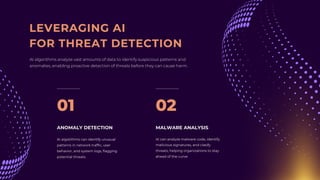
LEVERAGING AI
FOR THREATDETECTION
AI algorithms analyze vast amounts of data to identify suspicious patterns and
anomalies, enabling proactive detection of threats before they can cause harm.
AI algotithms can identify unusual
patterns in network traffic, user
behavior, and system logs, flagging
potential threats.
AI can analyze malware code, identify
malicious signatures, and clasify
threats, helping organizations to stay
ahead of the curve
ANOMALY DETECTION MALWARE ANALYSIS
01 02
4.
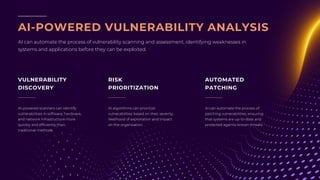
AI-POWERED VULNERABILITY ANALYSIS
AIcan automate the process of vulnerability scanning and assessment, identifying weaknesses in
systems and applications before they can be exploited.
AI-powered scanners can identify
vulnerabilities in software, hardware,
and network infrastructure more
quickly and efficiently than
traditional methods.
AI algorithms can prioritize
vulnerabilities based on their severity,
likelihood of exploitation and impact
on the organization.
AI can automate the process of
patching vulnerabilities, ensuring
that systems are up-to-date and
protected againts known threats.
VULNERABILITY
DISCOVERY
RISK
PRIORITIZATION
AUTOMATED
PATCHING
5.
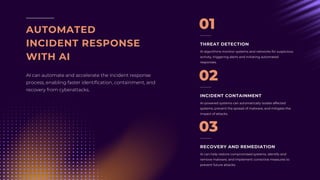
AUTOMATED
INCIDENT RESPONSE
WITH AI
AIcan automate and accelerate the incident response
process, enabling faster identification, containment, and
recovery from cyberattacks.
AI algorithms monitor systems and networks for suspicious
activity, triggering alerts and initiating automated
responses.
THREAT DETECTION
01
AI-powered systems can automatically isolate affected
systems, prevent the spread of malware, and mitigate the
impact of attacks.
INCIDENT CONTAINMENT
02
AI can help restore compromised systems, identify and
remove malware, and implement corrective measures to
prevent future attacks.
RECOVERY AND REMEDIATION
03
6.
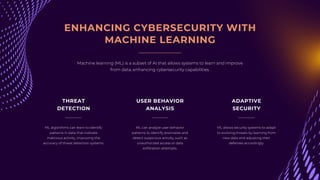
ENHANCING CYBERSECURITY WITH
MACHINELEARNING
Machine learning (ML) is a subset of AI that allows systems to learn and improve
from data, enhancing cybersecurity capabilities.
ML algorithms can learn to identify
patterns in data that indicate
malicious activity, improving the
accuracy of threat detection systems.
THREAT
DETECTION
ML can analyze user behavior
patterns to identify anomalies and
detect suspicious activity, such as
unauthorized access or data
exfiltration attempts.
USER BEHAVIOR
ANALYSIS
ML allows security systems to adapt
to evolving threats by learning from
new data and adjusting their
defenses accordingly.
ADAPTIVE
SECURITY
7.
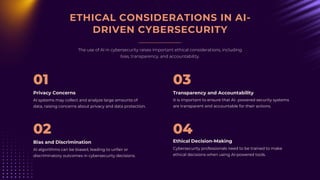
ETHICAL CONSIDERATIONS INAI-
DRIVEN CYBERSECURITY
The use of AI in cybersecurity raises important ethical considerations, including
bias, transparency, and accountability.
AI systems may collect and analyze large amounts of
data, raising concerns about privacy and data protection.
Privacy Concerns
01
It is important to ensure that AI- powered security systems
are transparent and accountable for their actions.
Transparency and Accountability
03
Cybersecurity professionals need to be trained to make
ethical decisions when using AI-powered tools.
Ethical Decision-Making
04
AI algorithms can be biased, leading to unfair or
discriminatory outcomes in cybersecurity decisions.
Bias and Discrimination
02
8.
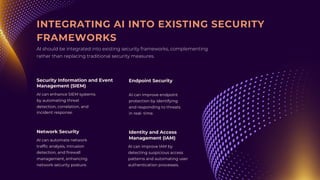
AI can automatenetwork
traffic analysis, intrusion
detection, and firewall
management, enhancing
network security posture.
AI can enhance SIEM systems
by automating threat
detection, correlation, and
incident response.
AI can improve endpoint
protection by identifying
and responding to threats
in real- time.
AI can improve IAM by
detecting suspicious access
patterns and automating user
authentication processes.
Network Security
Security Information and Event
Management (SIEM)
Endpoint Security
Identity and Access
Management (IAM)
INTEGRATING AI INTO EXISTING SECURITY
FRAMEWORKS
AI should be integrated into existing security frameworks, complementing
rather than replacing traditional security measures.
9.
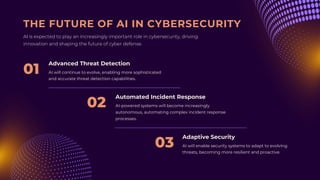
AI will enablesecurity systems to adapt to evolving
threats, becoming more resilient and proactive.
AI-powered systems will become increasingly
autonomous, automating complex incident response
processes.
AI will continue to evolve, enabling more sophisticated
and accurate threat detection capabilities.
Adaptive Security
Advanced Threat Detection
Automated Incident Response
THE FUTURE OF AI IN CYBERSECURITY
AI is expected to play an increasingly important role in cybersecurity, driving
innovation and shaping the future of cyber defense.
01
02
03
10.
AI presents bothopportunities and challenges for cybersecurity. By
leveraging its power responsibly, organizations can strengthen their
defenses, mitigate risks, and stay ahead of evolving threats.
CONCLUSION AND
KEY TAKEAWAYS




![[DSC Europe 25] Bassam Maharmeh - Artificial Intelligence: Opportunities and ...](https://cdn.slidesharecdn.com/ss_thumbnails/thhfmr2fqpawzj7hsjpg-5-251211083048-2c23204f-thumbnail.jpg?width=640&height=640&fit=bounds)


![[DSC Europe 23][AI:CSI] Aleksa Stojanovic - Applying AI for Threat Detection ...](https://cdn.slidesharecdn.com/ss_thumbnails/jytahfl2tqyatpbxfkpe-aleksa-stojanovic-applying-ai-for-threat-detection-in-the-world-of-cybersecurit-231130130512-290ee1ec-thumbnail.jpg?width=640&height=640&fit=bounds)


