1. The document discusses the issue of foreign language instruction in Italian schools becoming dominated by English alone. It argues for the introduction of a non-ethnic but truly international language like Esperanto to avoid this problem and promote multilingualism.
2. Esperanto was created in 1887 to be a universal language that could promote international communication and brotherhood. It grew rapidly in the early 20th century with international congresses and associations. While estimates of current speakers vary, Esperanto remains the most widely spoken constructed international language.
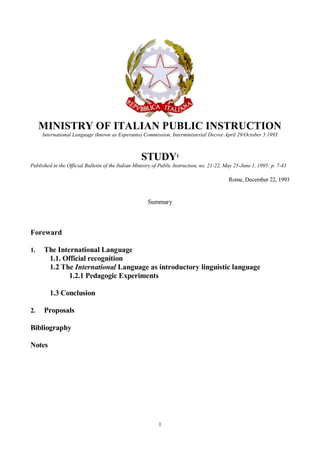
3. The document provides historical context on the many constructed language projects over centuries to achieve a universal language for international communication. Volapük and Esperanto were the most
![18
Sheffield (Halloran) and the Egerton Park School (Williams) experiments].
Antonius NOLTE, Auswirkungen des Sprachorientierungsunterrichts in Fremdsprachenunterricht weiterführender Schulen. In
“Eŭropa Dokumentaro”, 1979, n. 24, pp. 7-10.
Antonius NOLTE, Korespondenz im Sprachorientierungsunterricht / Korespondado en la lingvoorientiga instruado. In “Paderborner
Arbeitspapier”, IfKyP, Paderborn, FEoLL, GmbH, 1980.
Antonius NOLTE, La lernplifaciligo de la angla lingvo surbaze de la lingvoorientiga-instruado. In “Lingvo-kibernetiko”, 1982, pp.
35-38, Günter Narr Verlag, Tübingen.
Lian O’CUIRE, An Cas do Esperanto, Esperanto-Asocio de Irlando, Dublin 1984, 5 p.
Nino PALA, Corso di formazione linguistica mediante la lingua internazionale esperanto 1979-1986, 475 p. and 15 audiocassettes,
Cagliari 1992.
PARERA, RIBES, ALBERIC, (in Catalan) El que s’ha de saber del problema linguistic, Sabadell, 1979, 28 p.
Mario PEI, Articolo in “Cahiers J.E.B.”, 1965, and “Heroldo de Esperanto”, February 1, 1965.
Mario PEI, Wanted: a world language, The Public Affairs Committee, New York, 1969.
Mario PEI, Propedeŭtiko al instruado de fremdaj lingvoj, in “Heroldo de Esperanto”, 1973 n. 15, p.
J. M. PICARD, L’espéranto à l’école ou l’enseignement de la langue française aux enfants par l’espéranto, Coulomiers, 1911.
Claude PIRON, Esperanto, ]u Eŭropa aŭ Azia lingvo?, Esperanto-dokumentoj, nova serio, n-ro 10 E, UEA, Rotterdam, 1977.
Claude PIRON, Esperanto: European or Asiatic Language? UEA. Rotterdam. 1981, 31 p.
Ludovik PREBIL, Internacia pedagogia eksperimento en 5 landoj (1-a regiono), nella rivista “Esperanto”, 1972, no. 121, July-
August.
W. PERRENOUD, Conférence International sur l’enseignement de l’espéranto dans les écoles, au secrétariat de la Société des
Natios, du 18 au 20 avril 1920. Compte rendu sommaire en français. Genève.
R. RAKUGA, Spertoj pri provinstruado de Esperanto 1957-1958 (eksperimentoj de 5 instruistinoj), in “Jugoslavia Esperantisto”,
1958, n. 8-9.
Juán REGULO-PÉREZ, Discussione sul tema: lo studio dell’esperanto può sostituire quello delle lingue classiche? (with:
Asvinikunar, D. B. Gregor, M. Halvelik, Njanasatta, in Esperanto). In “Esperanto”, no. 716, July 1965.
Bagger PREBEN, Sprog or sprog imellem, Forlaget Kommunikation og Kultur, 1986, 142 p.
M. ROLLET de L’ISLE, La valeur pédagogique de l’espéranto pour l’enseignement du français, Paris, 1920.
Eddy ROSSEEL / Edward SYMOENS (a cura di), La intereso kaj utilo de komuna interlingvo. The Relevance of a Common
Intermediate Language (with the collaboration of the Commission of the European Comunities). L’intérêt d’une langue intermédiaire
commune (avec la colaboration de la Commission des Communautès européennes). Proceedings of a Round Table in Ghent (Belgium),
Sept. 1987. Edit. AIMAV, Brussels, 1988.
Christiun A. RUCKMICK, The Wellesley College Danish-Esperanto Experiment, in “International Language”, 1924, p. 51-56.
O. SAMPOLA, Lerneja raporto pri la eksperimento en Somero, Finnlando, 1958-1963, (translated into Esperanto from Finnish by V.
Setala). In “Esperanta Finnlando”, 1963, n-ro 7, p.53-54.
SAM-SU KIM, Historio de la Esperanto-Movado en Koreujo, Women’s University Sukmjong, 1976, 473 p.
Wilhelm SANKE, Linguistische und sprachdidaktische Aspekte eines Sprachorientierungsunterrichts - Thesen und Fragen am
Beispiel einer Plansprache. In: I. Meyer (Red.): “5. Werkstattgesprach - Interlinguistik in Wissenschaft und Bildung, Arbeitspapier n.
62”, IfKyP. Paderborn: FEoLL GmbH, 1981, pp. 187-206.
Mary SCICLUNA, The Contribution of Esperanto to the International Communication and Understanding. Graduate thesis in
Teaching from the College of Arts, Science and Technology, Malta, 1977, 102 p.
Vilko SETÄLÄ, Vizito al la eksperimenta lernejo en Somero, Finnlando. In “Esperanto”, June, 1 96 1 , 1 07 p .
Vilko SETÄLÄ, La eksperimenta instruado de Esperanto en la Geknaba Mezgrada Lernejo de Somero (Suomio). In “El Popola Ĉinio”,
1963, no. 1, pp. 38-39.
Bruce SHERWOOD, The educational value of Esperanto studies. In “Esperanto in the modern world”, Esperanto Press, Bailieboro,
Canada, 1982, pp.408-413.
G. LEON SMITH, The Role of Esperanto in the teaching of modern languages, ed. Esperanto-Asocio de Britio, Reg. Charity nr.27676,
1987, 7 p. Helmut SONNABEND, Esperanto: lerneja eksperimento. Raporto - analizo - konkludo, Edistudio, Pisa, 1979, 157 p.
Helmut SONNABEND, Esperanto: lerneja eksperimento. Resumo. In “Internacia Pedagogia Revuo”, 1980, n. 2, pp.32-35.
Helmut SONNABEND, La lerneja eksperimento de ILEI en ia dua Eŭropa Regiono. In: Carlevaro, Lobin (Hrsg.), “Einführung in die
Interlinguistik / Enkonduko en la Interlingvistikon”, Alsbach: Leuchtturm-Verlag, 1979, pp. 159-167.
Helmut SONNABEND, Fremdlingva orientado pere de Esperanto. In “Internacia Pedagogia Revuo”, 1979, n. 1, pp.9-12.
Edward SYMOENS, The Socio-Political, Educational and Cultural Roles of Esperanto. ILEI/FEL, Antwerpen (Belgio), 1989, 40 p.
Edward SYMOENS, La soci-politika, pedagogia kaj kultura valoroj de Esperanto, Universala Esperanto-Asocio, Rotterdam, Serio
Esperanto-Dokumentoj 23E, 1982, 40 p.
Edward SYMOENS, De sociopolitieke, pedagogische en culturele waarde van Esperanto. (4a ediz.), ILEI/FEL, Antwerpen (Belgio),
1988. Edward SYMOENS, Valeurs socio-politique, pédagogique et culturele de l’espéranto, ILEI/FEL, Antwerpen (Belgio), 1989.
István SZERDAHELYI, Pedagogiaj valoroj de instruado de Esperanto, In “Internacia Lingvistika Simpozio, Kumrovec 1975”,
Zagreb 1976 (Yugoslavia), pp. 9-18.
István SZERDAHELYI, Espéranto et propédeutique linguistique. In “Les Langues Modernes”, vol. 60, 1966, no. 3, pp. 255-259.
István SZERDAHELYI, Esperanto kaj lingvistika propedeŭtiko. In “Internacia Pedagogia Revuo”, 1979, n. 1.
István SZERDAHELYI, Kvinlanda pedagogia-didaktika eksperimento pri la oficiala enkonduko de Esperanto en lernejojn 1971/1972-
1973/1974. In “Internacia Pedagogia Revuo”, 1971, n. 1, p. 21 and following.
István SZERDAHELYI, La Internacia Pedagogia-Didaktika Eksperimento Kvinlanda: la rezultoj de la unua mezurado. In: H.
Behrmann, “Lehrplanerische Rationalisierung des Sprachunterrichts”, Institut für Kybernetische Pädagogik, Paderborn, 1975.
István SZERDAHELYI, La didaktika loko de la Internacia Lingvo en la sistemo de lernejaj studobjektoj. In “Esperanto: La internacia
lingvo - sciencaj aspektoj”, (Red. Detlev Blanke), Kulturbund der DDR, Berlin, 1979, pp. 211-219.
István SZERDAHELYI, Metodologio de Esperanto, University of Budapest (Hungary), 1975, pp. 264-270.
H . THOMPSON, Untersuchungen der nationalen Sprachen hinsichtlich ihrer Eignung zur sprachlichen internationalen](https://image.slidesharecdn.com/theinternationalalanguagecalledesperanto-150627115002-lva1-app6892/85/The-international-language-called-esperanto-18-320.jpg)