AI IN THE EU
A €2.7 TRILLION
OPPORTUNITY
GOING DIGITAL
AN INTERVIEW WITH
L’OREAL’S
CEO AND CDO
5G
WILL EUROPE
LAG BEHIND?
#11 – May 2019 - Viva Technology 2019
Distributed at VivaTech and in Les Echos # 22946
SUPPLÉMENT GRATUIT AU #22946
DU QUOTIDIEN « LES ÉCHOS
DU 13 MAI 2019 »
NE PEUT ÊTRE VENDU SÉPARÉMENT
CAN
DIGITAL
EUROPE
COMPETE?
— P.3
LETTER FROM THE EDITOR
This issue marks the Innovator’s two year anniver-
sary. The launch pad for our magazine was Viva Technology’s
2017 conference. The raison d’être for the Paris conference,
which is jointly owned by Les Echos and Publicis, is to bring to-
gether big corporates and startups and highlight the technolo-
gy disruptions that will transform business and society. This is
also the key mission of The Innovator.
In this issue we have focused on whether digital Europe can
compete.
The World Economic Forum and the Continent’s digital leaders
have an action plan and corporates are expected to play a key
role.
The stakes are high. Although United Tech of Europe is a ma-
jor theme at this year’s VivaTech the long sought after goal of
creating a single digital market has yet to be achieved. The same
risks to be true with newer technologies, such as artificial intel-
ligence. Without a united effort, industry observers say it will
be difficult for Europe to compete against the U.S. and China
and Europe will miss the chance to add trillions to its GDP and
shape its future.
Let's hope by the time VivaTech rolls around next year that there
will be lots of progress to report.
ByJenniferL.Schenker
Editor-in-Chief,TheInnovator
THEBRIEF
COVERSTORY:
CANEUROPELEADININNOVATION?
WHYTHENEXTTECHCHAMPIONCOULD
BEBUILTINEUROPE
EUROPE’STECHUNICORNS
N26ANDTHERISEOFEUROPE’S
CHALLENGERBANKS
5G:WILLEUROPELAGBEHIND?
AIINTHEEU:A$2TRILLION
OPPORTUNITY
ANINTERVIEWWITHCAPGEMINICEO
ANDCHAIRMANPAULHERMELIN
WHOWILLDRIVETHEFUTUREOF
MOBILITY?
THERACETODOMINATEAUTONOMOUS
CARS
BEYONDSMARTTIRES:MICHELIN’S
LATESTSTRATEGY
GOINGDIGITAL:L’OREALCEO
JEAN-PAULAGONANDCDO
LUBOMIRAROCHETDISCUSSTHE
COMPANY’SPROGRESS
ACCORHOTELS’DIGITAL
TRANSFORMATION
THETOP25STARTUPSTOMEETATVIVA
TECHNOLOGY
WHOWILLLEADINBUILDINGTHE
FACTORIESOFTHEFUTURE?
DEMOCRATIZINGHEALTHDATA
P.04
P.06
P.11
P.12
P.13
P.14
P.18
P.22
P.24
P.26
P.28
P.30
P.32
P.34
P.36
P.38
TABLE
OF CONTENTS
Everyone wants
to spot Europe’s next
extraordinary
tech entrepreneur.
Someone
already has.
VENTURE CAPITAL FOR
THE WORLD’S TECH ENTREPRENEURS
LAKESTAR.COM
BERLIN LONDON ZURICH
— P.5P.4 — THE INNOVATOR
THE BRIEF THE BRIEF
Entrepreneurs are building
groundbreaking solutions to some
of the world’s most pressing
problems: from bio-based chemicals
to animal-free meat, zero-emissions
transportation, secure land registries
that empower smallholder farmers
in developing countries, and satellite
imagerypreventinghumantrafficking.
Nowcorporatesarejumpingonboard.
Corporate-startup collaboration is
rampingupinimpacttech–technology
that helps achieve progress on the
17 Sustainable Development Goals
(SDGs) for 2030 agreed by all U.N.
member states. And the potential for
positiveimpactonsocietyandbusiness
is enormous. That’s one of the major
conclusions of a report to be released
May 16 at Viva Technology by Good
Tech Lab, a Paris-based research and
innovation firm.
Thegrowingnumberofcollaborations
is due in part to market forces, says
the report. "The Frontiers of Impact
Tech: An overview of moonshots
worth taking in the 21st century,"
is being published with support from
MAIF, Michelin, thecamp, Autodesk,
ComicRelief,andtheFrenchNational
Energy and Environment Agency
(Ademe). The report notes that the
SDGs represent at least a $12 trillion
annualmarketopportunity,according
to the Business and Sustainable
DevelopmentCommissionco-founded
by Unilever ex-CEO Paul Polman.
Meanwhile, Project Drawdown
estimated the net financial gain of
removing 1,000 gigatons of CO2
from the atmosphere, to achieve
carbon neutrality by 2050, at $45 Togettechnologynewsincontexteveryweek,subscribetoournewsletter:http://innovator.news
trillion. Among 180 impact tech
trends, the report outlines how the
food sector is being disrupted in a
good way. Examples include startups
using AI to prevent food waste in
restaurants, others engineering
soil micro-organisms to replace
unsustainable synthetic fertilizers,
and French agtech startup Ynsect,
which just raised €110 million to
buildaroboticfarmthatwillproduce
20,000 tons of insect protein for the
aquaculturemarket.Cell-basedmeat,
made from in-vitro cultivation of
animal cells, and plant-based meat,
couldmakeindustrialanimalfarming
obsolete. Even Tyson Foods, one of
the world’s largest meat processors,
has invested in “new meat” startups
Memphis Meats and Beyond Meat,
in addition to launching its own line
of plant-based products.
Impacttechinnovatorsaredisrupting
almost every sector, and large
companies are taking notice.
Ecovative, which produces bio-based
packagingfrommyceliummushrooms,
has partnered with furniture giant
IKEA. In clean energy and clean
mobility, startups are attracting
massiveinvestmentfromEngie,Enel,
Michelin, Air Liquide, Schneider
Electric, BMW and Renault, among
many others. Some companies, such
as Unilever and Danone, are even
creating impact investing funds.
Building The New Carbon
Economy Is Today’s
Moonshot
The report also stresses that the
increased interest of corporates in
impact tech is not driven solely by
social responsibility, but also by a
wide range of business factors, a
trend recognized by the World
Economic Forum, Boston Consulting
Group, and various business think
tanks.GoodTechLab’ssecondreport,
planned for late 2019, will focus on
those drivers, such as opening new
markets, product innovation,
strengthening supply chains and
partnernetworks,fosteringcustomer
engagement, securing licenses to
operate, and responding to new
investor expectations — including
institutional investors aiming to
increase their portfolio’s societal
impact.
With mounting interest in impact
tech rise it’s not surprising that the
topic will be on the agenda at Viva
Technology. French President
Emmanuel Macron is expected to
convene some of the world’s biggest
tech stars to discuss the topic on
May 15, the day before the
conference’s official opening. Impact
tech innovations aimed at solving
some of the world’s biggest problems
will be on display at Viva Tech with
multiple sessions scheduled on the
topic.
Benjamin Tincq, co-founder and
CEO of Good Tech Lab, the producer
of the report, will be leading one of
them. He sees the growing startup
activity and corporate interest as
very positive signs. “In the last year,
we have seen many citizens and
business leaders joining scientists
in declaring a climate emergency,”
says Tincq. “Impact Tech can help
create a New Carbon Economy —
aprosperouseconomywhichcaptures
morecarbonthanitemits.Fiftyyears
ago, the first humans set foot on the
moon. Building that new economy
istoday’smoonshot,anditwillrequire
systemic collaboration. I think
partnerships between Impact Tech
innovatorsandcorporatescouldhelp
us achieve that at startup speed and
industrial scale.”
J.L.S.
Fatoumata Ba, founder and
CEOofJanngo,atechforgoodplatform,
is passionate about using technology
to help Africa leapfrog ahead, by
empowering women and helping
strengthen small- and medium-sized
businessesacrosstheAfricancontinent.
The goal is to create a network effect
for good.
Prior to launching Janngo, Ba, a
scheduledspeakeratVivaTechnology,
worked at e-commerce marketplace
Jumia, the first African unicorn,
serving as Ivory Coast CEO, a
managing director in Nigeria and a
member of the executive committee
at Africa level, helping drive the
performance of 130+ operations
across Africa, spanning around 10+
verticalsin30+countrieswith3,000+
direct jobs, 7,0000+ indirect jobs
and creating opportunities for more
than 500,000 SMEs across Africa.
Inhernewventure,Janngo,Babuilds
digital ecosystems in high growth
sectorsbyprovidingbusinesssupport
to small and medium enterprises.
The goal is to help SMEs to scale
and contribute to the economic
empowerment of youth and women
through job creation and capacity
building. Through this approach
Janngo, which means future, hopes
to create inclusive economic models
for the future, generating profits and
a positive social impact, says Ba.
In the run-up to Viva Technology,
Ba told The Innovator she is in the
process of raising a new Africa-
dedicated early stage fund that will
be distributed evenly between male
and female entrepreneurs and seek
to more evenly distribute capital
across Africa. Over 90% of funding
currentlyflowstojustthreecountries,
she says. Ba is just one of a large
groupofentrepreneursandinvestors
attending Viva Tech this year. Topics
of planned sessions include access
to funding, competition between
local and international startups
targeting the African market, and
difficulty for investors to overcome
theirperceptionofrisk.SevenAfrican
startup competitions will take place
during the conference sponsored by
four large corporates: Drug maker
Sanofi, energy companies Vinci and
Total, and Société Générale, the
French bank.
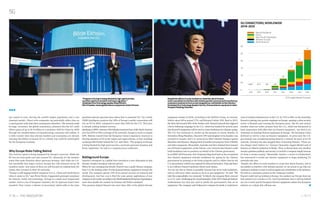
Euclideon’s Hologram Table for business, is just one of the
innovations that will be on display at Viva Technology this year. It
displays digital models of cities or buildings as miniatures, with the
ability to zoom in down to single blades of grass or even smaller. It is
being used by architects, city planners, military and university researchers,
and industrial players who want to keep track of large-scale assets,
including railways and power lines.
REINFORCINGAFRICA’S
DIGITAL
ECOSYSTEMS
PROJECTING
THEFUTURE
MARKETFORCESARE
BOOSTINGTECHFORGOOD
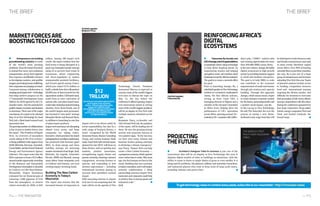
$12
TRILLION
Sizeoftheannualmarketopportunityfor
techforgoodinfoureconomic
sectors-foodandagriculture,cities,
energyandmaterials,health
andwellbeing,accordingtotheBusiness
andSustainableDevelopment
Commission,co-foundedbyUnilever
ex-CEOPaulPolman.
VivaTechspeaker,
FatoumataBa
VivaTechspeaker,
BenjaminTincq
P.6 — THE INNOVATOR
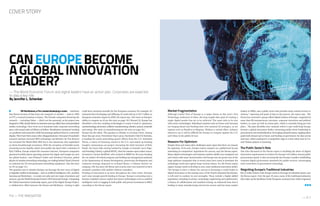
CANEUROPEBECOME
AGLOBALINNOVATION
LEADER?
OlliMartikainen,aFinn,starteddevelopingarouter — hardware
that directs streams of data from one computer to another — back in 1982
at VTT, a research institute in Espoo. The Finnish companies financing the
research — including Nokia — didn’t see the potential, so the project was
droppedin1986,shortlybeforeanAmericanstart-upcalledCiscocommercialized
similar technology. Cisco went on to dominate basic corporate networking
gear, with annual sales of billions of dollars. Martikainen continued working
as a professor and researcher while his prototype gathered dust in a university
display. There have been many other disappointments: Germany’s Fraunhofer
research institute invented MP3 technology and Britain’s Sir Tim Berners
Lee invented the World Wide Web but it was Americans who capitalized
on these breakthrough inventions. With the exception of Swedish music
streaming service Spotify, which went public last April with a valuation of
$26.5 billion, Europe missed the consumer Internet. European companies
pioneered mobile phone operating systems but Apple and Google are now
the global leaders. And Finland’s Nokia and Sweden’s Ericsson, global
players in wireless networking technology, are trailing behind China’s Huawei
on contracts for 5G next generation networking equipment. (See the story
on 5G on page 14.)
The question now is whether Europe can leverage the new wave of digital
or digitally enabled technologies – such as artificial intelligence (AI), machine
learning and blockchain – to create new jobs and new types of products and
services, says the World Economic Forum’s 2019 Innovate Europe: Competing
For Global Innovation Leadership report, part of the Digital Europe Project,
a collaborative effort between the Forum and McKinsey. Getting it right
could have enormous benefits for the European economy. For example, it’s
estimated that developing and diffusing AI could add up to €2.7 trillion to
European economic output by 2030, the report says. (For more on Europe’s
ability to compete on AI see the story on page 18.) Beyond AI, Europe has
identified a few key enabling technologies it wants to lead in: photonics,
nanotechnology,electronics,additivemanufacturing,robotics,sensors,materials
and energy. (For more on manufacturing see the story on page 36.)
Europe has the talent. The question is whether it can keep it here. Among
those that got away: Frenchmen Yann Lacun, Facebook’s Chief AI Scientist,
is leading the social networking giant’s efforts from the U.S. Sebastian
Thurn, a native of Germany, moved to the U.S. and ended up heading
Google’s autonomous car project, becoming the chief executive of Kitty
Hawk, the hover bike startup backed by Google co-founder Larry Page,
and founding Udacity, a global MOOC, short for massive open online course.
Germany’s Carsten Breiffeld, who worked at BMW for 20 years heading
the car maker’s i8 vehicle program and holding top management positions
in the departments of chassis development, powertrain development and
corporate strategy, departed to co-found Byton, a Chinese electric car
company. (He has since left Byton and at press time was rumored to have
accepted a position with another Chinese carmaker.)
Funding of innovation is an issue throughout the value chain. Startups
can’t raise enough growth funding in Europe. Europe is attracting only a
fraction of global venture capital into future technologies such as artificial
intelligence and it is lagging in both public and private investment in R&D,
according to the Forum report.
Market Fragmentation
Although United Tech of Europe is a major theme at this year’s Viva
Technology conference in Paris, the long sought-after goal of creating a
single digital market has yet to be achieved. The same risks to be true
with newer technologies. Individual countries such as France and Germany
are forging ahead and funding their own national AI strategies, as are
regions such as Flanders in Belgium. Without a united effort, industry
observers say it will be difficult for Europe to compete against the U.S.
and China in the global AI race.
Reasons For Optimism
Despite these and many other challenges some argue that there are reasons
for optimism. To be sure, Europe cannot compete on a global level by just
mimicking its competitors’ ingredients for success, says the Forum report.
Many digital technologies and business models exhibit zero-marginal cost
and winner-take-most characteristics and Europe has not grown any of the
large platform companies that in recent years have come to dominate the
technology world and capture large revenue shares. So, the Forum report
argues, Europe needs to develop its own, more ambitious innovation model.
“For Europe to have a chance for success in becoming a world leader in
digital innovation in this coming wave of the Fourth Industrial Revolution,
it will need to catalyze its own strengths. These include a highly skilled
population, including in science, technology, engineering and mathematics;
a history of collaboration and standard setting; an industrial base that is
leading in many manufacturing and service sectors and has many market
leaders in SMEs; and a public sector that provides many critical services to
citizens,” capturing rich pools of data in the process, the report says. The
Forum has convened a group called Digital Leaders of Europe, comprised of
more than 80 entrepreneurs, investors, corporate executives and political
leaders, to come up with an action plan, which is currently being put into
place. The plan identifies four catalysts which it says could help Europe
become a global innovation leader: promoting public-sector leadership in
procurement and standardization; leveraging industrial assets; tapping talent
pools both abroad and at home; and leading on governance for data access
and trust, which could give it a competitive edge at a time when trust in U.S.
and Chinese players is wavering.
The Public Sector’s Role
One idea discussed in the Forum report is doubling the share of digital
innovation requirements in tenders for Europe’s €2 trillion annual public
procurement spend. It also recommends that Europe consider establishing
common digital government standards for public services, encouraging
more innovation in government technology.
Reigniting Europe’s Traditional Industries
But to really achieve scale Europe needs to leverage its industrial assets, says
the Forum report. Over the past 10 years, many of the traditional industries
that make up the backbone of the European economy have either stagnated
COVER STORY
— P.7
— The World Economic Forum and digital leaders have an action plan. Corporates are expected
to play a key role.
By Jennifer L. Schenker
— P.9P.8 — THE INNOVATOR
COVER STORY
DigitalLeadersofEuropeworkinggroupandaFoundingPartnerofFACTOR10,
an independent corporate company builder that helps corporates do just
that. While European businesses are embracing digital technologies into the
core parts of their businesses most are not yet embracing the type of new
business models that have a major impact on revenues, says says Simon
Torrance, Managing Director UK, FACTOR10 and chairman of the Platform
Economy Summit conference.
“European companies are not as bold as some of their American and Chinese
counterparts who have integrated platform business models into their mix
more effectively,” says Torrance. Both Staeritz and Torrance are members of
the World Economic Forum’s Digital Platforms & Ecosystems group, part of
the Forum’s Digital Economy and Society initiative. Over 50 large corporations
– including some of Europe’s largest companies – are participating in the
group to determine how they might adopt platform business models: the
creation of digital communities and marketplaces that allow different groups
to interact and transact. Seven of the 10 most valuable companies globally
are now based on platform business models.
Companies like Apple, Google, Amazon and Alibaba have used the model
to grow exponentially and grab significant market share from established
players. Platforms could account for more than $60 trillion by 2025, or more
than30%ofglobalcorporaterevenue,andyetonly3%ofestablishedcompanies
have adopted an effective platform strategy. “European boards and leadership
teams don’t have a real understanding of the types of business models that
are effective in the digital world,” says Torrance. He and Staeritz are co-
authoring a book and creating a community called “Fightback” to help Europe’s
corporates get up to speed. “I am frustrated by how slow European corporates
are adopting and executing new business models and ventures,” he says. “In
order to accelerate their ability to transform rather than being left behind
we are building up a community of corporates, entrepreneurs, investors and
policy makers who are not satisfied with the pace of Europe’s digital activity.”
There is a need for a radical new way to solve problems from a commercial
point of view but also from a societal point of view, says Staeritz. “The same
digital platforms that can be used to transform corporates’ business model
can be applied to societal challenges in areas like climate change or future
jobs training or transportation or health care. But we can’t do it with linear
thinking,” he says. “We need more entrepreneurial thinking not only for
Europe’s corporates to fight back but also to create better jobs, better health
and to take better care of the Earth.”
Enlarging The Talent Pool
If it is going to tackle such tough challenges, the Forum report calls for Europe
to do more to attract international talent by improving compensation and
emphasizing advantages such as the quality of life. And it says Europe should
do more to tap into existing talent pools.Women and minorities are
underrepresented at every level of the ecosystem..
Using Data Access and Trust As A Competitive Edge
European companies have amassed fewer customers and less data than
non-European global platforms, leading some to argue that the EU will
never be able to catch up with the U.S. and China. To level the playing
field Europe could open its large vaults of government owned non-
personal and anonymized data for research, while creating new governance
rules that give citizens more control over their data and more companies
access to them, says the Forum report. Europeans’ strong belief in data
privacy is not reflected in the technology being developed in the U.S.
and China, so fostering secure platforms that make transparent which
data are shared and when and that allow citizens to change access rights
for data sets, could be a real market differentiator.
“It is very important that Europe has an offer – not just a law – but an
offer of technical products that embody ethics in them, ethics as a design
principle,” says Francoise Soulié, a scheduled speaker at Viva Technology
2019 who has more than 40 years of experience working with neural
networks, machine learning, social network and Big Data analysis in
both academia and industry. “This is going to be a competitive advantage,”
says Soulié. “The European mark will say ‘this can be trusted’ – and they
are going to be on the market side by side with American and Chinese
products without that label.”
Learning From The Past
As Europe forges ahead, it is vital that it “makes the most of our second
mover advantage – both in the companies we build and in our approach
to building them,” says the Atomico report. “European tech has escaped
most of the backlash that has engulfed big U.S. technology companies.
For this to continue, we’ll need to learn from past failures and act ethically
from day one.”
or declined, undermining Europe’s overall rate of growth, says European
venture capital firm Atomico’s December, 2018 report, The State of European
Tech. (See the chart.) As of Q3 2018, European growth was flat-lining at
0.2%, the lowest in four years, while Europe’s software industry is growing
at least five times faster than the rest of the European economy. And the
report predicts tech’s importance to the overall economy will only increase.
Yet the European economy today remains heavily dependent on traditional
industries,suchasindustrialmanufacturing,construction,retailandtransportation.
“As technology becomes an increasingly more transformative force across all
parts of the economy, there is a huge opportunity to digitize and reignite
Europe’s traditional industries with trillions of dollars of value in play,” says
the Atomico report. It notes that the combined market capitalization of
European constituents of the S&P Global 1,200 equates to $8.8 trillion in
just the top 10 most valuable traditional industries.
The median age of the incumbent companies in these industries is well over
100 years. “In the battle of incumbent versus startup, it is not the young who
beats the old or the large who beats the small,” says the Atomico report. “It
is those who are fast that are more likely to succeed against the slow.” The
only way for Europe to become an innovation leader is to create stronger
ties between Europe’s new technology players and traditional industries, say
industry observers.
Europe’s corporates will need to up their game in other ways. Creating joint
venture “speedboats” with successful entrepreneurs to grab new market
opportunities can be an effective way to test new business models, says
German serial entrepreneur Felix Staeritz, a board member of the Forum’s
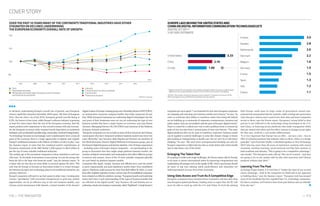
OVER THE PAST 10 YEARS MANY OF THE CONTINENT'S TRADITIONAL INDUSTRIES HAVE EITHER
STAGNATED OR DECLINED, UNDERMINING
THE EUROPEAN ECONOMY'S OVERALL RATE OF GROWTH
Tech
Real estate activities
Wholesale and retail trade, transport, accommodation
and food service activities
Industry
Financial and insurance activities
Construction
Telecommunication
2007 2008 2009 2010 2011 2012 2013 2014 2015
2016
140
120
100
80
SOURCE: Eurostat
EUROPE LAGS BEHIND THE UNITED STATES AND
CHINA ON DIGITAL INFORMATION COMMUNICATION TECHNOLOGIES (ICT)
DIGITAL ICT 20171
% OF GDP, ESTIMATE
3.33
3.0
2.8
2.6
2.2
1.6
1.5
1.5
1.3
1.2
1.1
1.66
2.16
UnitedStates
China
Europe
Finland
Sweden
Netherlands
Denmark
Belgium
Germany
France
Spain
Italy
Greece
1 Digital share of ICT value added is estimated by taking the share of revenue made through
digital channels and by taking the portion of cost of all functions performed digitally
SOURCE: Directorate-General for Research and Innovation, European Commission, 2018;
McKinsey Digital Survey, 2018; McKinsey Global Institute analysis
— P.11P.10 — THE INNOVATOR
VENTURE CAPITAL
Your fund is aimed at Canada and
Europe. What is the link between
these markets?
PP: The upcoming wave of applied
machine learning and AI gives
advantages to Canada, the U.K. and
Europe for a number of reasons. First,
these ecosystems have taken a long-
term view on investments.
TechnologieslikeAIwillrequirealong
arc to maturity and so taking a long-
term view is a distinct advantage over
short-term financial returns. In
addition, all three of these ecosystems
are united by what I call a “gentler”
form of capitalism: one that protects
civil liberties and privacy to a much
greater extent. Take, for example,
healthcare data. Sharing anonymized
data is much easier in Canada and
Europe than it is in the U.S. — which
means that the benefits of broad
studies and data analysis will take
hold here sooner than in the U.S. Of
course, there is hyper awareness of
privacyintheU.S.,butwithdatabeing
siloed, there will be less advancement
through the applications of AI. So the
piece. The reason I joined Inovia —
and the reason we are building this
growth fund and our practices here
in the U.K. — is simply that founders
need experienced leadership to help
them structure their ideas, their
businessmodels,theirteams,andtheir
global growth strategies. Scaling up
a powerhouse global brand is not for
the faint of heart, and it really helps
to have advisors who know how to
listen, and have been in the founders’
shoes before so that they may best
support their growth cycles. I have a
massive amount of experience, as do
the other general partners at Inovia
— and beyond the money, we’re
looking to really transform how early
stage founders with tons of potential
think about themselves and their
opportunities.
In the past, European companies
such as DeepMind sold out early to
companies like Google rather than
grow into behemoths in their own
right. Do you see that changing?
PP: There is no reason why the next
champion cannot be built here. We
hope to act as a turbo-charger for
promising startups. If you just look
at the numbers there are well over
200,000 startups in the U.K. alone.
Beyondthat,havingdonemygraduate
work here in Oxford, I know first-
hand that there is a deep well of top-
quality thought leadership here; roots
that are in deep and respected
academic areas have the potential to
fuel enormous gains for the U.K. The
game has changed in the past decade,
andsothoserulesthatappliedtoearly-
aughts companies may not apply
today; that’s why Inovia’s global
approach is so important as well. We
are giving founders here the chance
to envision a global growth trajectory
plusthecoachingandfinancialsupport
they need to succeed.
WhyTheNextGlobalTech
ChampionCouldBeBuiltHere
AnInterview
With
PatrickPichette
Google’sformerChiefFinancial
Officerandaboardmember
ofTwitter,isnowleadingCanadian
venturecapitalfirmInoviaCapital’s
newLondonoffice.InoviaCapital
recentlyraised $600million
acrosstwofunds,whichwillbeused
inparttoinvestinEuropeantech
startups.ThisspringPichettealso
assumedtheroleofchairman
ofOxfordSciencesInnovation,
whichaimstocommercialize
technologiesdevelopedatOxford
University.Herecentlymetwith
TheInnovator’sEditor-in-Chief
JenniferL.Schenkertodiscuss
whyheisbullishonEurope
European model is very promising
and can offer benefits that are
essentially lost in committee in the
U.S.It’stime;Europecanquicklymove
into a leadership position.
China says it will win the AI race
because it can collect more data.
Do you agree?
PP:It depends on what you are trying
to solve. If you want to control every
citizen’s keyboard then you end up
with the Chinese model. But if you
respect privacy and you want to cure
Alzheimer’s, or other diseases, then
there is enough data in Europe and
you don’t need the Chinese data on
top of that.
Europe has a lack of growth capital.
How will your new fund help fix
that?
PP: This year we plan to make a few
large investments and several other
veryearlystageinvestmentsinbiotech,
fundamental materials, and other
deep-science technologies.
The investment, in terms of dollars,
is only part of the story, and I would
argue, potentially the less valuable
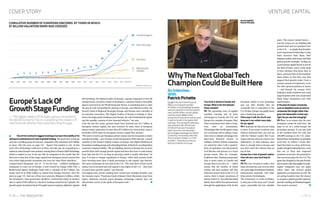
CUMULATIVE NUMBER OF EUROPEAN UNICORNS BY YEARS IN WHICH
$1 BILLION VALUATION MARK WAS CROSSED
UnitedKingdom
RestofEurope
Germany
Netherlands
Sweden
2000 2001 2002 2003 2004 2005 2006 2007 2008 2009 2010 2011 2012 2013 2014 2015 2016 2017 2019 YTD1999
62
47
27
13
11
50
42
34
24
131211
9
666
4332222
SOURCE: Dealroom.co
COVER STORY
One of the Continent’s biggest handicaps has been the inability of its
startupstoscalebecauseofalackofgrowthfunding. The good news is Europe
now has a swelling group of unicorns, companies with valuations of $1 billion
or more. (See the story on page 12). Expect that number to rise. At this
year’s Viva Technology conference in Paris, 30 scale-ups are competing in a
contesttonameEurope’snextunicorns.AmongthemisFrance’sShiftTechnology,
which is ranked as one of the top 100 AI companies in the world. But the
bad news is that lack of late stage capital from European sources means that
even when high-growth companies stay here the value flows elsewhere.
London-based Deepmind, one of – if not the best – artificial intelligence
companies to come out of Europe, is now owned by Google while N26, a
Berlin-based digital challenger bank with a valuation of $2.7 billion, has
raised most of its $500 million in capital from foreign investors. (See the
story on page 13). And one of four new unicorns, Belgium’s Collibra, which
has developed a data governance platform, reached that status in January
after it raised $100 million in a Series-E funding round led by CapitalG, the
growth equity investment fund of Google’s parent company, Alphabet. Against
this backdrop, the Digital Leaders of Europe, a group comprised of over 80
entrepreneurs, investors, heads of incubators, corporate leaders and public
figures convened by the World Economic Forum, is examining how to close
the gap in scale-up funding for startups in Europe, says Martina Larkin, the
Forum’s Head of Regional Strategies-Europe and Eurasia and a member of
its executive committee. The Digital Leaders of Europe is looking at “how
best to leverage private funding across Europe, the role of institutional capital,
and the possible creation of new financial vehicles,” she says.
Over the last five years, pension funds have invested just $1.7 billion in
European venture capital, but have invested 45 times more in European
buyout funds, equivalent to more than $75 billion over that period, notes a
December 2018 report by European venture capital firm Atomico.
“We need to work to get European private money into the ecosystem to foster
entrepreneurship,” says German serial entrepreneur Felix Staeritz, a board
member of the Forum’s Digital Leaders of Europe and Digital Platforms 
EcosystemsworkinggroupsandaFoundingPartnerofFactor10,anindependent
corporate company builder. “We are building unicorns in Europe but we don’t
provide them with enough growth capital and then they have to raise money
from Asia and the U.S. to keep on growing, which is totally ridiculous,” he
says. It is time to change regulations in Europe, which limit pension funds
from investing more than a small percentage in risk capital, says Staeritz.
The same constraints do not exist in the U.S. “The total share of how much
money can be invested into risk capital is way higher in the U.S. – they have
so much more growth capital,” says Staeritz.
Leveraging more private funding here would have multiple benefits, says
the Atomico report. “If pension funds rebalance their allocations away from
legacy industries towards game-changing technology instead, they can
democratize access to the spoils of European tech.”
J.L.S.
Europe’sLackOf
GrowthStageFunding
— The Digital Leaders Of Europe, a group convened by
the World Economic Forum, is exploring the creation of
new financial vehicles that could help close the gap.
InoviaCapital's
PatrickPichette
— P.13P.12 — THE INNOVATOR
Darktrace,acompanythatusesartificialintelligence to combat cyber
threats, is one of Europe’s unicorns, the term used to describe scale-ups that
have a valuation of $1 billion or more. Founded in 2013 by mathematicians
and machine learning specialists from the University of Cambridge, together
with British intelligence agency veterans, Darktrace has raised $230.5 million
in venture capital to date, giving the company a valuation of $1.65 billion.
It has 900 employees across five continents and splits its headquarters between
London and San Francisco. Darktrace has thousands of customers in top
industries, including three of the top five European banks, top insurance
firms, two of the world’s top three consumer goods companies, two of the
top five media companies, and the U.S.’s number one telecom operator. The
company’s machine learning and AI technology is designed to detect threats
without any pre-existing knowledge of attacker targets, tools or capabilities.
While traditional security tools depend on specific indicators of compromise
to identify malicious activity, Darktrace’s technology is self-learning, embedding
in a network, learning on the fly what be¬¬haviors are normal, and
automatically responding to emerging threats. “In order to leverage the
technology’s power, corporates need to learn to trust AI to make real-time
autonomous decisions about the best way to respond to cyber-attacks,” says
Darktrace co-founder and Chief Marketing Officer Emily Orton, a scheduled
speaker at Viva Technology, a Paris conference taking place May 16-18. “By
now the industry has recognized the importance of using AI in cyber security
because the threats are simply outpacing humans,” she says. “However,
critical to the adoption of AI, is trust in AI, and knowing when to relinquish
our control to the machine.” Darktrace developed a mobile app that gives
humans the power to approve the AI’s proposed actions in the short term.
After four to six weeks most companies realize the AI consistently proposes
the right course of action, and the decision is made to switch to autonomous
mode, without the need for human confirmation, she says.
“Allowing AI to make autonomous decisions is an important defensive weapon
for corporates to have in their arsenal against cyber-attacks,” says Orton. “It
is incredibly difficult for companies to defend themselves against sophisticated
threats and will be even more so when we see offensive AI used by adversaries
to supercharge their missions. That’s why it is important for companies to
get ahead of the curve.” More and more corporates are starting to heed that
advice, helping this European unicorn to further increase its growth trajectory.
he company’s machine learning and AI technology is designed to detect
threats without any pre-existing knowledge of attacker targets, tools or
capabilities. While traditional security tools depend on specific indicators of
compromise to identify malicious activity, Darktrace’s technology is self-
learning, embedding in a network, learning on the fly what be¬¬haviors
are normal, and automatically responding to emerging threats. “In order to
leverage the technology’s power, corporates need to learn to trust AI to make
real-time autonomous decisions about the best way to respond to cyber-
attacks,” says Darktrace co-founder and Chief Marketing Officer Emily Orton,
a scheduled speaker at Viva Technology, a Paris conference taking place May
16-18. “By now the industry has recognized the importance of using AI in
cyber security because the threats are simply outpacing humans,” she says.
“However, critical to the adoption of AI, is trust in AI, and knowing when to
relinquish our control to the machine.” Darktrace developed a mobile app
that gives humans the power to approve the AI’s proposed actions in the
short term. After four to six weeks most companies realize the AI consistently
proposes the right course of action, and the decision is made to switch to
autonomous mode, without the need for human confirmation, she says.
“Allowing AI to make autonomous decisions is an important defensive weapon
for corporates to have in their arsenal against cyber-attacks,” says Orton. “It
is incredibly difficult for companies to defend themselves against sophisticated
threats and will be even more so when we see offensive AI used by adversaries
to supercharge their missions.
J.L.S.
EUROPEAN UNICORNSEUROPEAN UNICORNS
FightingCybercrime
withAI
AfterDisrupting
BankingInEurope
N26SetsItsSights
OnTheU.S.
Valentin Stalf, co-founder of European unicorn N26 – one of the
Continent’s hottest digital challenger banks with a valuation of $2.7 billion
–learnedhowtobuildcompaniesatRocketInternet,theBerlin-basedincubator
created by Germany’s Samwer brothers. Like many young entrepreneurs,
Stalfandhisco-founder,MaximilianTayenthal,bothnativesofVienna,decided
to headquarter their company in Berlin because they knew it would be easier
to find financial backing and talent in the German capital. They incubated
their venture in an accelerator created by Axel Springer. The German media
company invested, as did Earlybird, one of Germany’s most active venture
funds, and Swiss venture fund Redalpine.
But almost all of the funds N26 has since raised – about a half billion dollars
– came from U.S. and Asian investors, including PayPal co-founder Peter
Thiel’s Valar Ventures, China’s Tencent and Singapore’s sovereign wealth
fund GIC. It is just one example of how – due to Europe’s lack of growth
capital – even when scale-ups remain headquartered in Europe, the value
flows elsewhere. But N26, which now has 2.5 million customers and is
processing $2 billion in transactions per month, is also a symbol for how far
OTHERNOTABLE
EUROPEAN
CHALLENGER
BANKS
REVOLUT
UNITEDKINGDOM
Some4.7millioncustomershavejoinedRevolut,with12,000
newaccountssigningupeachday.ItoperatesacrossEurope
andhasannouncedplanstolaunchintotheU.S.,Canada,
Japan,SingaporeandAustralia.ItsCEO,NikolayStoronsky,isa
scheduledspeakeratVivaTechnology.
https://www.revolut.com/en-FR
MONZO
UNITEDKINGDOM
Accordingtopressreports,Monzoissettoraisefundingfrom
aU.S.investorthatcoulddoubleitsvalueto£2billion.Ifthe
newinvestmentgoesahead,Monzowouldleapfrogrival
RevolutastheUK’ssecondmostvaluablefintechstartup,
behindsmallbusinesslenderOakNorth.Itissaidtobe
planningexpansiontotheU.S.
https://monzo.com
STARLINGBANK
UNITEDKINGDOM
Createdin2014,Starlinghasreceivedmorethan$300million
infundingandoperatesaround460,000consumerbanking
accountsand30,000businessaccounts.Itisexpectedto
expandintoEuropelaterthisyear,openingbranchesin
Ireland,GermanyandFrance.
https://www.starlingbank.com
BUNQ
NETHERLANDS
Bunqstartedoutinpaymentsbutexpandedtodeposit
accountsandreceiveditsofficialbankinglicensein2015.It
operatesinFrance,Germany,Belgium,Austriaanditshome
countryoftheNetherlands.
https://www.bunq.com
Europe has come. In just four short years N26 was able to roll out services
to 24 European countries plus the U.K. because the EU has a single market
for banking licenses. That and new rules – such as one enabling digital “know
your customer” verification – make the EU more attractive for challenger
banks than many other markets, says Alexander Weber, N26’s Director of
International Expansion and a scheduled speaker at Viva Technology 2019.
“The evolution in European regulation has really enabled our business,” says
Weber.“AfterChina,Europeis probablythebiggestmarket–some500million
people – that can be accessed with a single banking license.” Next up for
N26? The U.S. and Brazil. “We recognize the general problem we are trying
tosolveisverymuchaglobalproblem,”saysWeber.“Theshiftinuserbehavior
that is being driven and led by global digital companies has really raised the
bar in terms of expectations towards digital user experience,” he says. U.S.
banks, like their European counterparts, are still being driven by legacy tech.
“People use checks and the cost of wire transfers is still high, so we think that
this is a market that needs some innovation,” says Weber.
J.L.S
— Darktrace is helping corporates learn to trust
artificial intelligence to make autonomous decisions AlexanderWeber,N26'sDirectorofInternationalExpansion
EmilyOrton,Darktraceco-founder
andChiefMarketingOfficer
— P.15P.14 — THE INNOVATOR
On an early April morning, a line of nattily dressed business
executives snaked around the exterior of Palais Brongniart in Paris. The
neoclassical Napoleon-era building was formerly the home of the Paris
Stock Exchange. But on this day, it was the scene of a conference organized
by telecom carrier Orange to explain the importance of 5G, short for fifth
generation wireless broadband technology.
Orange CEO Stéphane Richard kicked off the conference by stating that
industry will feel the effects of 5G sooner and more profoundly than
consumers. While the transition is just beginning, he said, Orange wants
to start now to help companies in transportation, retail, healthcare and
media to rethink their business models from the ground up. “Identify all
the possible uses of tomorrow and imagine all the possibilities of the day
after tomorrow,” said Richard, a scheduled speaker at Viva Technology, a
Paris conference taking place May 16-18. “That, in summary, is what awaits
us with 5G.” While wireless standards evolve every 10 years or so, industry
experts say the shift from 4G to 5G will have a far greater impact than
previous upgrades. Not only will speed increase from 4G’s 1 gigabytes per
second to 5G’s 10 gigabytes per second or more, but a far greater number
of devices can be connected, and latency -- delay in data communication
over a network – is expected to all but disappear. That’s important because
5G is positioned as a way of enabling real-time, mission-critical applications
such as autonomous vehicles, smart grids, industrial automation, remote
surgeries and managing drones. “There is widespread recognition that 5G
is a genuine break from the past,” says Tim Hatt, head of research for
GSMA Intelligence. “Before, it was about speed upgrades. Now, it’s about
WillEurope
LagBehindIn5G?
— Fifth generation networking technology will enable
real-time, mission-critical applications such as
autonomous vehicles, smart grids, industrial
automation, remote surgeries and the management
of drones, impacting the health of businesses
and economies
By Chris O’Brien
5G
the digitization of the broader economy.” A report by IHS Markit and
Berkeley Research Group that assesses the importance of 5G technology
to the global economy predicts that by 2035 5G will create 22 million new
jobs globally, directly generate $3.5 trillion in economic activity and fuel
sustainable long-term growth to global real GDP, impacting the competitiveness
of nations. China, for example, views 5G as key to helping it become a
tech leader not just in wireless but in the Internet of Things and artificial
intelligence while at the same time boosting its own industries over those
of others. While the U.S. had an early lead in 5G, it is expected to be
quickly surpassed by China, as is Europe. It is imperative that European
companies embrace 5G technologies quickly, Richard said, because other
regions are already moving ahead, and any hesitation could have dire
consequences. “I am convinced the story of 5G is a different story than
4G,” Richard said. “This is not a story where everyone can work in their
own silo. It’s a story we have to write together. Because we don’t want to
fall behind.”
Indeed, as the rollout of 5G mobile wireless networks begins, the stakes
for Europe’s economy are higher and more complex than ever before,
thanks in part to the political drama surrounding Chinese telecom equipment
maker Huawei, which claims it has better technology and can enable 5G
faster than anyone else. To shut out Huawei would be to risk Europe’s
economic future, the company says. “We rank number one in terms of
commercial 5G contracts,” scheduled Viva Technology speaker Ken Hu,
Huawei’s rotating chairman, said during a December 18 press conference.
“This is the result of our far-leading technological innovation.”
Huawei claims to be the first company that can deploy 5G networks at
scale. “We can bring powerful, simple and intelligent 5G networks to
carriers anywhere in the world, faster than anyone else,” Guo Ping, Huawei’s
deputy chairman of the board, said during a February keynote at Mobile
World Congress 2019 in Barcelona. While it is clear that falling behind
could leave Europe’s traditional industries at a competitive disadvantage,
the U.S. government has raised concerns that Huawei’s technology includes
a back door that the Chinese government could use to conduct espionage,
introducing security flaws that could leave increasingly critical data vulnerable
to theft or spying. Local champions Finland’s Nokia and Sweden’s Ericsson,
two of Huawei’s biggest telecom equipment competitors, offer alternative
technology. Both companies have fallen mightily from their respective
perches two decades ago when they ruled the global telecom equipment
markets. The decision about whether to let Huawei compete in Europe
could profoundly affect the future of these two former super stars at a
moment when they are beginning to stabilize their businesses.
Can Europe Succeed Without Huawei?
At a shareholder’s meeting, Ericsson CEO Borje Ekholm, a scheduled speaker
at Viva Technology, insisted: “We are well prepared to make the switch to
5G as easy as possible for our customers.” Orange, for example, will deploy
virtuous investment cycle,” says Phil Twist, Nokia’s vice president for
networks marketing and communications. “You can bring in new capabilities
now. Many of these new models will start to be delivered by 4G. Because
4G is going to be an important part of the equation for several more years.”
China Racing Ahead
Europe may continue to rely on 4G but China is racing ahead (see the
chart). One of the biggest changes between 4G and 5G is the ability to
take the advanced computing power usually kept in the protected “core”
of a network and distribute it to other parts of the system. This will provide
more reliable high-speed connections and support a massive expansion
in the Internet of Things (IoT) -a shorthand term for connecting all kinds
of machines, devices and vehicles to each other and to the Internet.
A recent report by the telecom industry association GMSA projected that
global IoT connections would triple to 25 billion by 2025. It also forecast
that global IoT revenue would quadruple to $1.1 trillion. During a February
speech at Mobile World Congress 2019 in Barcelona, Cisco Systems CEO
Chuck Robbins said the company expects there will be 4 billion machine-
to-machine connections in the coming years. And beyond just the number
of connections, each device connected would generate six or more times
as much data as a typical device connected today. This data can be used
to train computers and develop artificial intelligence (AI), a field China
its initial 5G services using a mix of hardware from Ericsson and Nokia.
Its 4G networks also run on equipment from these two vendors. Most
recently, Ericsson notched a win when Danish service provider TDC selected
it to roll out nationwide commercial 5G, as part of a major network overhaul,
to provide managed services through the Ericsson Operations Engine.
While the company reported flat revenue for 2018, it claimed victory for
ending years of declines. At press time it said it had 18 publicly announced
5G deals. Nokia also reported relatively flat sales for 2018, but it too says
it’s making strong progress in 5G partnerships, particularly in North America.
During a Nokia press event at MWC 2019, CEO Rajeev Suri addressed the
Huawei drama by insisting other providers could offer fast, affordable 5G
rollouts on par with the offers of the Chinese vendor.
“People everywhere are asking legitimate questions about how best to
secure critical networks, about which vendors are appropriate to use, and
which are not,” Suri said to media and analysts in Barcelona. “I do want
to address comments suggesting that if certain vendors are held back,
then Europe’s 5G roll-out will stall and costs will rise. Bluntly, the facts
just do not support the claims.” Even as these companies try to push the
pace of 5G, they are also trying to convince business partners that they
best be ready for this transition by doing more with 4G. “We see it as a
“Iamconvincedthestoryof5Gisadifferentstorythan4G.
Thisisnotastorywhereeveryonecanworkintheirownsilo.
It’sastorywehavetowritetogetherbecausewedon’twanttofallbehind.”
ScheduledVivaTechnologySpeakerOrangeCEOStéphaneRichard
— P.17P.16 — THE INNOVATOR
5G
questions telecom operators have about how to monetize 5G.” As a result,
GSMA Intelligence projects that 30% of Europe’s mobile connections will
run on 5G by 2025, compared to more than 50% for the U.S. That pace
is already making insiders nervous.
Speaking at MWC, Ericsson CEO Ekholm lamented that while North America
now has 85% to 90% coverage of 4G networks, Europe is stuck at around
60%. Ekholm warned that the European Union’s regulatory structure is
slowing adoption of 5G in the region and urged reforms, or face watching
as Europe falls further behind the U.S. and China. “The progress in Europe
is being blocked by high spectrum fees, uncertain spectrum duration and
heavy regulation,” he said at a company press conference.
Battleground Europe
Huawei’s emergence as a global force introduces a new dimension to that
already complex European telecom picture.
When 4G was emerging last decade, Huawei was a small Chinese company.
Now it is the leading seller of telecommunications equipment around the
world. The company spends 14% of its annual revenue on research and
development. And last year it filed the most patent applications of any
companyintheworld,accordingtotheWorldIntellectualPropertyOrganization,
more than double the number by Ericsson and Nokia combined.
That prowess helped Huawei win more than 30% of the global telecom
equipment market in 2018, according to the Dell’Oro Group. In contrast,
Nokia’s share fell to around 17%, and Ericsson’s below 16%. Back in 2013,
the three had around 20% of the market each. Huawei’s growth has triggered
a fierce lobbying campaign by the U.S., which has insisted for several years
that Huawei’s equipment will be used to create backdoors for Chinese spying.
The U.S. has continued to ratchet up the pressure in recent months. In
December, Meng Wanzhou, Huawei’s CFO and daughter of its founder, was
arrested in Canada. And U.S. prosecutors filed criminal changes against
Wanzhou and Huawei, alleging theft of intellectual property from T-Mobile
and other companies. Meanwhile, Australia and New Zealand have banned
use of Huawei equipment, as has Taiwan, over concerns that Huawei could
build backdoors into its products on behalf of the Chinese government.
In an MWC 2019 keynote, Vice-Chairman Ping fired back at the accusations
that Huawei equipment includes backdoors for spying by the Chinese
government by pointing to the Prism program used to collect data by the
U.S. government (which was exposed by Edward Snowden). Ping said there
is no evidence Huawei hardware allows such abuses.
“Let me say this as clearly as possible: Huawei has never built backdoors,
and we will never allow anyone to do so in our equipment,” he said. “We
take this responsibility very seriously.” In March, the company filed a lawsuit
in a U.S. court, challenging the constitutionality of the 2019 National Defense
Authorization Act that was used to justify the government’s ban on its
equipment. The company said if allowed to compete for deals, it could lower
costs of wireless infrastructure in the U.S. by 15% to 40%. In the meantime
Huawei is placing even greater emphasis on Europe, opening a cyber security
center in Brussels and courting the European press. The EU and various
member states are under pressure from the U.S., which has threatened to
limit cooperation with allies that use Huawei equipment, but there is no
consensus on banning Huawei equipment in Europe. The European Union
declined to call for a ban on Huawei equipment. At press time the U.K.
government was considering giving Huawei a contract for parts of its 5G
network. Germany has also stopped short of banning Huawei. “There are
two things I don’t believe in,” German Chancellor Angela Merkel said of
Huawei at a March conference in Berlin. “First, to discuss these very sensitive
security questions publicly, and second, to exclude a company simply because
it’s from a certain country.” Meanwhile, Sunrise, a carrier in Switzerland,
has announced it would use Huawei equipment to begin deploying 5G
networks this year.
“Despite the efforts in some markets to create fear about Huawei, and to
use politics to interfere with industry growth, we are proud to say that our
customers continue to trust us and recognize our contribution to the industry,”
Hu said in a statement posted on the company’s website.
Huawei could end up leading in Europe, but analysts say Europe does not
look poised to be a leader in 5G. And if predictions that it will lag behind
are true it won’t just be European telecom equipment makers but European
industry as a whole that will lose out.
has vowed to lead. Serving the world’s largest population and a vast
domestic market, China’s tech companies can potentially collect data on
a much greater scale than their counterparts elsewhere. The rewards could
be huge. Accenture, the global consultancy, estimated that the IoT could
deliver gains of up to $1.8 trillion in cumulative GDP for China by 2030
through the transformation of manufacturing, resources and utilities. It
is little wonder then that telecom insiders and economists are already
warning that failure to launch 5G in a timely way could be catastrophic
for the European economy.
Why Europe Risks Falling Behind
The need for speed is being hampered by Europe’s structure. While the
EU has set some goals and rules around 5G, ultimately, it’s the member
states that make decisions about spectrum auctions. And while the U.S.
has essentially four major carriers, Europe has 120 scattered across 28
members states. And many of them are still focused on making back the
money they invested in their 4G networks.
“Europe is still lagging behind compared to U.S., China and South Korea
when it comes to 5G,” says Pierre Fortier, Capgemini’s principal consultant
for telecom, media and technology. “Europe is a much more fragmented
market. And in a lot of European countries, the 5G spectrum hasn’t been
awarded. That creates a climate of uncertainty which adds to the main
“ProgressinEuropeisbeingblockedbyhighspectrumfees,
uncertainspectrumdurationandheavyregulation.”
ScheduledVivaTechnologyspeakerBorjeEkholm,
CEOofSweden-basedglobaltelecomequipmentmakerEricsson
DespitetheeffortsinsomemarketstocreatefearaboutHuawei,
andtousepoliticstointerferewithindustrygrowth,weareproudtosaythatour
customerscontinuetotrustusandrecognizeourcontributiontotheindustry.”
ScheduledVivaTechnologySpeakerKenHu,Chinesetelecomequipmentmaker
Huawei’sRotatingChairman
5G CONNECTIONS, WORLDWIDE
2018-2025
20222021
0,8
1,4
1,9
2,7
2020
0,06 0,28
2019
0,012
2018
0,0001
2023 2024 2025
3,0
2,5
2,0
1,5
1,0
0,5
0
Rest of the World
China
Asia-Pacific Developed
Western Europe
North America
CCS Insight Market Forecast
— P.19P.18 — THE INNOVATOR
AI
In mid-April some 200 VIPs – including two French ministers
and some of Europe’s top AI scientists crowded into a gilded room at the
French Foreign Ministry. The occasion was a gathering of AI4EU, a new
umbrella organization that is seeking to serve as a kind of one-stop shop
to unify Europe’s artificial intelligence initiatives.
It was a fitting venue. “The declaration drafted by (then-French foreign
minister) Robert Schuman in an adjoining room was the first attempt to
build the EU,” noted France Digitale CEO Nicolas Brien, the evening’s
host. “Today Europe has to be built with data and AI… To be strong in
AI we have to do it at the Continental level.”
His remarks underscore the growing recognition that wide adoption of
AI technologies will be critical to the global competitiveness of Europe.
If the EU-28 develop and diffuse AI using current digital and AI capabilities,
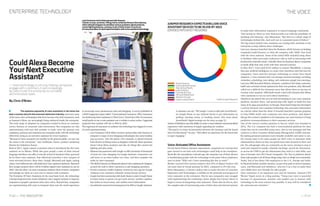
the region could add some €2.7 trillion, or 19 %, to its economic output
by 2030, without sacrificing employment, says Eric Hazan, a McKinsey
 Company senior partner. But there is a substantial difference in the
investment in AI between regions, says Hazan. Most AI investments are
concentrated in the U.S. and Asia while Europe lags behind. So, unless
things change radically, Mckinsey is predicting that Europe’s disadvantage
in digital diffusion will spill over into AI. A new gap is already appearing.
Early digital companies in Europe were among the first to develop strong
positions in AI, yet only two European companies are in the worldwide
digital top 30, and Europe is home to only 10% of the world’s digital
unicorns, the report says. Europe has about 25% of AI startups, in line
with its size in the world economy, but the report says its early-stage
investment in AI lags behind that of the United States and China.
Lagging Behind The U.S.
With the exception of smart robotics, Europe is not ahead of the U.S. in
AI adoption, and less than half of European firms have adopted one AI
technology, with a majority of those still in the pilot stage, the report says.
AI initiatives remain fragmented in Europe.
Europe attracted only 11% of global venture capital and corporate funding
in 2016 with 50 % of total funds devoted to U.S. companies and the
balance going to Asia (mostly China). That share was about the same in
AIInTheEU:
A$2.7Trillion
Opportunity
— The boost to Europe’s economy could be huge
but the gap with the world’s digital leaders
is now being compounded by an emerging gap in
artificial intelligence.
EricHazan,
SeniorPartner,McKinseyAndCompany
FrançoiseSoulie,
Co-founderofHubFranceIntelligence
Artificialleandamemberof
theEU’sHigh-LevelExpertGrouponAI
“MostAIinvestments
areconcentrated
intheU.S.andAsia,
andEuropelags
behind.”
“Don’ttellme
Europecandonothing
inthisbattle.
Europehasagame
toplayhere.
Thisisnotover.”
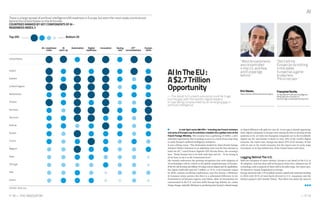
Top 25%	 Bottom 25
UnitedStates
Ireland
Sweden
UnitedKingdom
Netherlands
Finland
Germany
Denmark
Estonia
Austria
France
Belgium
Spain
Portugal
Italy
Greece
Human
skills
ICT2
connectedness
Digital
readiness
AI
start-up
AI—readiness
index
Automation Saving
rate
Innovation
Thereisalargespreadofartificial-intelligence(AI)readinessinEurope,buteventhemostreadycountriesare
behindtheUnitedStatesontheAIfrontier.
COUNTRIES RANKED BY KEY COMPONENTS OF AI -
READINESS INDEX, %
SOURCE: McKinsey
P.20 — THE INNOVATOR
AI
Digital Council of the German Chancellor. “But then this is a data point
that does not have to have a very long validity.”
“Europe is behind today because we don’t have any platform companies
investing massively in all kinds of AI applications,” he says. European
companies in sectors as diverse as steel distribution, energy, corporate
pensions, cement and insurance are starting to embrace such platform
business models, models based on the creation of digital communities
and marketplaces that allow different groups to interact and transact.
But it doesn’t have deep-pocketed Internet giants like Apple, Google,
Amazon and Alibaba which have used the model to grow exponentially
and grab significant market share from established firms. Failure to
executive is another issue.
“We have strategies,” says Boos, “but contrary to other geographies, we
take the publishing of a strategy as an invitation for discussion instead
of an invitation for execution and alignment.”
Boos says that, while “none of these points are directly related to AI,
they are more about execution in an economic or corporate sense.” And
he believes that’s where Europe must improve. “We do have talent, we
do have fundamental research, we even have people who want to move
forward, but we have a lot of institutions and corporations who prefer
to see problems instead of opportunities, and having identified these
problems, choose to do nothing or keep others from doing anything.”Still,
Boos says he thinks Europe could easily enter the race. “We have the
financial means, we have the talent, we even have much more knowledge
on the value chain than anyone else – which AI needs as input – but we
have to start executing rapidly.”
Market Fragmentation
Easier said then done. French, German and EU politicians all want to
create their own AI strategies, making it difficult for Europe to compete
as a continent.
The AI4EU group is expected to go some way toward solving the issue,
says Francoise Soulie, co-founder of HubFrance Intelligence Artificialle
and a member of the EU’s High-Level Expert Group on AI. She remains
bullish on Europe. “Don’t tell me Europe can do nothing in this battle,”
she says. “Europe has a game to play here – this is not over.”
She points to Europe’s strengths in B2B technology and says the Continent’s
2018. Only four European companies are in the top 100 global AI startups,
the report says.
While available data on AI adoption is scarce, McKinsey’s survey research
demonstrates that European companies may lag behind their U.S. counterparts
in their adoption of big data architecture and of the advanced machine
learning techniques that are the foundations of AI — with 12 % less use
than in the U.S. What’s more, a possible gap may exist between Europe
and the U.S. on the use of AI tools such as smart workflows, cognitive
agents, and language processing.
And, European AI is yet to be deployed broadly by enterprises and instead
is typically used in one or only a few functions. Mckinsey found that only
5% of European AI adopters (compared with about 8% in the U.S.) are
using these tools in about 90% of their entire organizations.
“Carefully managing the disruption during the transition to AI and seizing
the potential will be challenging,” says Hazan, a co-author of the McKinsey
report. “However, Europe has some strengths on which to build, notably
one of the world’s largest bases of software developers, outstanding
innovation in some countries, a social model that can help support the
transition toward new skills, and several European AI leaders — in Northern
Europe, for instance — that already compare well with the United States
in their ability to benefit from AI.”
Will Europe Be The Loser ?
Not everybody agrees. Kai Fu Lee, an ex-head of Google China, investor
and author of “AI Superpowers: China, Silicon Valley and The New World
Order,” sees the battle to dominate in AI as a two-way race. “China and
the United States are currently incubating the AIgiants that will dominate
global markets and extract wealth from consumers around the globe,”
he writes in his book. As far as he is concerned Europe is a distant third
and doesn’t even merit a bronze metal.
“Unfortunately, he is absolutely right,” says Hans-Christian Boos, the
founder of artificial intelligence company Argos and a Member of the
focus on public services will help it collect rich data sets to improve health
care and innovate new types of services.
Trust As A Differentiator
At a time when people mistrust the handling of data by U.S. and Chinese
actors, Soulie and others believe that there is an opportunity for Europe
to differentiate itself by making its brand of AI more human-centric,
transparent and trustworthy, incorporating European values, such as data
privacy, so that people know that European AI can be trusted.
“Creating AI in Europe that is ethical is going to become like ‘Intel inside,’
a trustworthy label, not a regulation, but something that people are going
to expect and demand,” predicts Barry O’Sullivan, Vice Chair, of the
European Commission High-level Expert Group on AI, a speaker at the
April event in Paris. “It is a great idea,” says Boos, “but first we have to
get going, be relevant, step on the playing field. I believe this third way
is an excellent idea and it is precisely why I am in Europe, but we need
to learn to crawl before we learn to walk.”
J.L.S.
Hans-ChristianBoos
FounderandCEOofGermanAIcompany
aragoandamemberoftheDigitalCouncil
oftheGermanChancellor
NicolasBrien,
CEOofFranceDigitale
Kai-FuLee,
Ex-headofGoogleChina,investorand
authorof“AISuperpowers:China,Silicon
ValleyandTheNewWorldOrder”
BarryO’Sullivan,
ViceChair,EuropeanCommission
High-levelExpertGrouponAI
“ Contrarytoother
geographieswetake
thepublishingofa
strategyasaninvitation
fordiscussioninstead
ofaninvitation
forexecution
andalignment.”
“TodayEuropehas
tobebuiltwithdata
andAI…
TobestronginAI
wehavetodoitatthe
continentallevel.”
“ChinaandtheUnited
Statesarecurrently
incubatingtheAIgiants
thatwilldominate
globalmarkets
andextractwealthfrom
consumersaround
theglobe.”
“CreatingAIinEurope
thatisethicalisgoingto
becomelike‘Intelinside,’
atrustworthylabel.Not
aregulation,but
somethingthatpeople
aregoingtoexpectand
demand.”
P.22 — THE INNOVATOR
CAPGEMINI
We need to work on this.
There is a lot of fear and
misunderstanding around AI. And
so now there’s an emphasis on
transparency, and how to build
trust. What do you think
companies need to do, in order to
build trust with their suppliers and
their clients?
PH: I will give you an example. I
received a tentative code of ethics
fromwithinCapgemini,to determine
where we can work on AI, and where
we should not. I think we will issue
guidelines and I would want these
guidelinestoberevisitedeveryquarter
or twice a year. My view is that after
thesuccessofGDPR(shortforGeneral
Data Protection Regulation, an EU
law on data protection and privacy)
people will want to have the GDPR
of AI. If that is developed too early,
it will restrict the eventual usage of
AI. So, I think we should accept that
there will be rules but at this stage
we should provide a few directions
and accept that we will need to
progressively adapt the rules. So,
let’s get ready, let’s get there, but
let’s not rush there.
PaulHermelinischairman
and CEO of Capgemini, a global
company specializing in consulting,
technology services and digital
transformation. He was recently
interviewed by The Innovator’s
Jennifer L. Schenker during a fireside
chat at the French Foreign Ministry,
in the presence of 200 European
artificial intelligence (AI) experts
and two French ministers. The
following is an edited excerpt of the
discussion.
Statistics show that private
companies in Europe are investing
less in AI than their counterparts in
China and the U.S. Do they risk
falling behind and, if so, how might
this affect the overall
competitiveness of Europe?
PH:Large,European-basedcompanies
or multinationals are on par with
their U.S. counterparts, they all work
with AI with the same amount of
energy. So the question is more in
Europe how can we help small
companies to adopt AI, and do we
invest enough in European AI
startups? These are big challenges.
arepushingandfavoringmetropolitan
areas, at the expense of other
geographies. In France, in the last
14 years, 84% of new jobs created
by the private sector were created
in large metropolitan areas so,
unfortunately, if you’re the mother
and the father of a young boy or a
young girl and you live in rural areas,
if you want your kid to find a job
they will need to go to the big cities.
I took the initiative to create a tech
acceleratorinAvignon,myhometown.
I am the chairman of that initiative
and I can tell you that it’s really tough
tocompeteagainstcitiesfromAvignon.
And the problem is not just in France.
I really believe that this challenging
gap, this increasing gap, between
metropolitan areas and the rest of
our geographies, explains the Brexit
vote. London voted remain, and
Newcastle voted exit. It’s not about
the EU, it’s about globalization. It is
how the new world is really favoring
employment in service jobs that are
concentrated in large, metropolitan
areas. So we have to think about
how to secure employment in small
towns.
“Howcanwehelp
smallcompanies
toadoptAI,
anddoweinvest
enoughin
EuropeanAI
startups?”
Europe’s
AIChallenges
AnInterview
WithPaulHermelin
Chairman and CEO of Capgemini, which is hosting an AI corner
and eight startup challenges during Viva Technology
Somebody once said, “the future is
already here, it’s just not evenly
distributed.” How do we make sure
that, as AI gradually replaces
current jobs and new jobs are
formed, that these new jobs are not
created only in big cities, but also in
smaller cities and rural areas, so
that we can prevent more social
unrest, like we’ve seen with the
yellow vests in France?
PH: This is something absolutely
crucial. At the global scale,
globalization and now digitization,
PaulHermelin,CEOofCapgemini
How does L’Oréal
attract innovators?
©Copyright2018L’Oréal-Allrightsreserved
On May 23, for the first time, the
leading company in the Beauty
Industry will offer the winners of its
international student competition
“Brandstorm”, a 3 months
immersive Program in Station F,
the biggest startups campus in
the world and a partner
of L’Oréal. Eva Azoulay,
L’Oréal’s Head of
Talent Acquisition
tells us more about
this initiative and
the recruitment
ecosystem of a
Group that receives
more than 1 million
applications
each year.
Brandstorm was born 27 years ago
and the worldwide competition
keeps attracting more students every
year. How do you meet the young
generations’ expectations, keeping in
mind that their interests are constantly
changing?
— To keep a step ahead, we place
innovation at the heart of everything.
Following the business strategy,
recruitment constantly evolves in order to
identify and attract talents who will invent
the beauty of the future. Brandstorm has
never stopped transforming itself and
that’s probably the key of its amazing
success - more than 40,000 students from
65 countries in 2019 and over 200,000
students worldwide since its creation.
• The initial marketing competition has
branched out to offer a multi-disciplinary
and innovation experience. With this new
positioning, we enlarged the audience
to broader backgrounds by adding
engineering profiles to our business
student target. We also increased the
focus on tech, digital and CSR.
• The competition has been entirely
digitalized, with a 100% of the process
taking place online, while keeping the
“real-life experience” DNA of the game.
• L’Oréal is also more and more committed
to providing participants with learning
resources, coaching, workshops, etc.
And today, students are challenged to
pitch their ideas in a startup-like fair. For
this 2019 edition, the participants have
been challenged by “Active Cosmetics”,
L’Oréal’s dermocosmetics Division to
invent the future skincare experience for
health-conscious consumers
For the first time, the winners will get a
three-month fully immersive Program
in Station F...
— Indeed! We have launched this year the
Intrapreneurship Award to give winning
students an opportunity to implement
their idea thanks to a three-month
immersion Programme at Station F, the
biggest startups campus in the world and
a partner of L’Oréal. The winning team
will be mentored by L’Oréal experts to
demonstrate the feasibility of their concept
to the Group’s decision-makers and will
be given the unique opportunity to create
a prototype of their project by a L’Oréal
business team. Through this immersion,
the Group is continuing to develop the
next generations of beauty entrepreneurs.
Do you recruit via Brandstorm?
— For sure, Brandstorm is a key element
of our recruitment ecosystem. The
real-life experience reveals skills, even
soft skills the Group is looking for, such
as entrepreneur spirit and innovation,
tenacity and audacity, or the ability to take
risks and to create a team to leverage
collective intelligence. Around 200 students
are recruited via Brandstorm each year
either for internships or for permanent
jobs. Brandstorm contributes to identify
the talents that will foster the Beauty Tech
Company. Besides, who knows... May be
the future CEO of L’Oréal will be among
these new recruits!...
Another cutting edge innovation at
L’Oréal is the way you now integrate AI
into the recruitment process. How does
it work exactly?
— In HR, our mission is to hire the
best and most diversified talents on each
market. On their end, candidates expect
transparency and reactivity. IA is really
about enhancing “people centricity”, for
the recruiters as well as for the candidates.
For example, we have deployed, the Mya
Chatbot, in 15 countries. This solution
targets candidates seeking internships and
positions such as Beauty Advisors which
involves high volumes. The bot answers
frequently asked questions and performs
a first screening round by clarifying
availability dates, location, language, level
of education expected for the job…
By freeing up time, this technology allows
HR to focus on the human dimension
of recruitment. HR can also devote more
time to feedback which in turn improves
the candidate journey. We see digital as a
tool that amplifies the human capabilities
of our recruiters, and helps diversify
sourcing by processing higher volumes
of applications.
https://brandstorm.loreal.com
Eva AZOULAY
L’Oréal’s Head of
Talent Acquisition
ADVERTORIAL
Innovation Fair,
International Finals
2018 in Paris,
Brazilian Team
— P.25P.24 — THE INNOVATOR
Europe’scarmakersareshiftingfromsellingandservicingvehicles
to becoming mobility players that can offer multiple ways of transporting
people and goods. To that end, German auto makers BMW and Daimler
announced earlier this year that they are pooling their resources in a joint
mobility effort called NOW that spans autonomous cars, ride-hailing,
electric scooters, car-sharing, and electric car charging.
“We have a clear vision: these five services will merge ever more closely
to form a single mobility service portfolio with an all-electric, self-driving
fleet of vehicles that charge and park autonomously and interconnect
with the other modes of transport,” Harald Krüger, Management Board
Chairman of BMW said during the new venture’s launch.
The German auto makers said they plan to spend €1.1 billion on the joint
venture. While that might sound like a lot it is only a fraction of what is
needed to remain competitive.In an April 2019 report McKinsey estimate
that securing a strong position across the four new mobility growth areas
- autonomous driving, connected cars, electrified vehicles, and smart
mobility—would cost a single player an estimated $70 billion through 2030.
« It’s doubtful any individual OEM could shoulder this level of investment
alone, which is why partnerships and targeted acquisitions offer an attractive
strategy for staying ahead of competitors, » the report says.
Its explains why Daimler and BMW, two fierce rivals, have merged their
mobility activities, a move that would have been unthinkable just a short
time ago. The cooperation comprises five joint ventures: REACH NOW
focuses on trip-planning and ticketing, SHARE NOW is a platform for
MOBILITY
car-sharing; FREE NOW is a ride-hailing platform; PARK NOW puts drivers
in touch with parking options; and CHARGE NOW connects electric vehicle
drivers with public charging services.
Ride-hailing is a key part of the joint venture. BMW and Daimler don't
want to let Uber, Lyft and other global ride-sharing companies dominate
the future of transportation. To keep ahead of the curve the two German
automakers are treating each NOW unit like a stand-alone autonomous
company. FREE NOW, the ride-hailing platform is headed by Marc Berg,
the former head of GetTaxi, one of a number of European ride-hailing
startups acquired by Daimler. At the end of April the NOW ride-hailng
unit announced that it is rebranding as a mobility platform, adding
e-scooters and launching its own fleet of private hire vehicles.
« This is a key decision, » says Berg. « We are opening up the platform to
capture a broader share of transportation. » Globally, $55 billion has been
invested in the ride-hailing industry in the past seven years, according
to McKinsey. It is the first step towards the move to autonomous vehicles,
which is why automakers need to be in this space.
Autonomous Vehicles
The projected global revenues associated with driverless cars in urban
areas could reach $1.6 trillion a year in 2030—more than two times the
combined 2017 revenues of Ford, General Motors, Toyota, and Volkswagen,
according to the McKinsey Mobility Institute. And, driverless cars will
unlock far more sophisticated types of connected services such as preference-
based personalization and live dialogue, culminating with cars functioning
as virtual chauffeurs, according to McKinsey.
Its research suggests that by 2030, 45% of new vehicles will reach a
level of connectivity that will allow all occupants to use personalized
controls for infotainment content and targeted contextual advertising,
representing a market the consultancy says could be worth anywhere
from $450 billion to $750 billion.
This not only represents a lucrative new revenue stream for Europe’s
automakers it could signficantly impact car sales. The consultancy’s
surveys indicate that 40 % of today’s drivers would be willing to change
vehicle brands for their next purchase in return for greater connectivity.
The Future Is Electric
Traditional auto makers risk losing customers in other ways. Electronic
vehicle (EV) sales have doubled annually in several markets with the
help of subsidies and regulations that encourage adoption, notes a McKinsey
report.
Norway is an example of how fast the transition can happen: EVs soared
to 32 % of car sales, from 11%, between 2014 to 2018. China has taken
the global lead in sales—electric vehicle sales increased by 72 % in 2017—
and the growth trajectory looks set to continue. Europe is at somewhat
of a disadvantage as the EU is developing the manufacturing capacity for
lithium-ion batteries used in electric vehicles later than other leading
global regions, says an April 1 briefing paper authored by the European
Citroënwillrevealaconceptcaranda
newmobilityprojectatVivaTech.
Traditionalcarmakersareentering
intotheridesharingmarket.
BMWandDaimlerareteamingonthecreationofnew
mobilityservices.
ReinventingThe
Wheel
— The shift to new technologies and services
and the entrance of deep-pocketed Silicon Valley
players is pushing Europe’s auto industry into
new areas.
Court of Auditors.« As it will enter the battery-production market as a
‘second mover’, it may have difficulties gaining a competitive advantage, »
the paper says. Europe is « somewhat behind on electric batteries and
power train technology, » acknowledges Markus Winkler, Executive Vice
President, Global Head of Automotive at Capgemini. « It has to catch up
but in the overall connected world batteries will become more of a
commodity. » And, Winkler says, Europe’s car makers have an edge :
they know how to scale in an industry that involves heavy manufacturing
and is very product focused. Still, when it comes to EVs Tesla is a force
to contend with and so are the Chinese. Several top BMW executives
departed to co-found Byton, a Chinese electric car company.
Moving On
Given all of the changes and competitive pressures will the European
industry succeed in this new world of mobility? « Billions are being shifted
into autonomous and shared areas and that gives me hope. » says Winkler.
“The future will be a mix of mobility services and I am personally confident
that European OEMs can still be successful.’’But he says, in order to to
stay ahead « Europe has to learn to speak with one voice and bundle
innovation in a different way – not only to follow but to futher innovative
the market, » says. « And this will require not only pure mechanical
engineering knowledge but also the development of new European software,
technology and electronics. »
J.L.S.
— P.27P.26 — THE INNOVATOR
MOBILITY
TheDriveTo
Dominate
AutonomousShuttles
— As U.S. and Chinese competitors ratchet up efforts in
this space can Europe maintain its early lead?
By Chris O’Brien
Whilemuchofthehypearoundautonomousvehicleshasfocused
on passenger cars, the most advanced emerging use case is less sexy but
more practical: self-driving shuttles that are already being used to ferry
people in retirement communities, industrial complexes, shopping centers
and airports. Because they can operate in well-defined spaces the number
of pilot projects is multiplying and so are the number of players targeting
this space. European companies, new and old, have an early lead but are
facing growing competition from Chinese and U.S. rivals.
“We are seeing newcomers making strong investments,” says Nicolas de
Cremiers, head of marketing for Paris-based NAVYA, one of the earliest
autonomousshuttlecompanies.“Thecompetitionwillbeverystrong.Idon’t
know what the real future of the market will be. But it is 100% sure that
there is a market.” NAVYA makes the kind of boxy, slow-moving vehicles
that shuttle around passengers in defined areas.
But self-driving shuttles embrace a much broader range of vehicles. Mercedes-
Benz’s “Future Bus” is among them. The company demonstrated the bus
– which uses its CityPilot autonomous software, in Amsterdam but it is
not expected to be market ready for some time.
Chinese Internet giant Baidu has developed 14-seater autonomous “Apolong”
buses in collaboration with Chinese bus manufacturer King Long. The
buses are already being deployed in several Chinese cities, with plans to
introduce them in Japan by year’s end. These buses are capable of Level
4 autonomy: They can mostly drive on their own and need human intervention
only under some circumstances when the special maps they rely on aren’t
available. (Apolong buses run on the Baidu’s Apollo autonomous driving
platform, which underpins its broader ambitions for self-driving cars. Apollo,
which is open source, is now being used by Valeo and Jaguar Land Rover.)
On the other end of the spectrum are “robot-taxi” services, such as the
partnership between ride hailing leader Lyft and Dublin-based Aptiv which
together deployed a fleet of 30 self-driving cars in Las Vegas. Aptiv acquired
Ottomatika, a Carnegie Mellon University spinoff in 2015 for its software
and systems development for self-driving vehicles.
Like Lyft and Uber in America, Chinese ride-hailing giant Didi Chuxing
is aiming to build autonomous robotaxis. And Voyage, a spin-out of Udacity
University which was briefly chaired by Sebastian Thrun, the German
founder of Google’s self-driving car project, has already launched autonomous
car shuttle services in retirement communities in California and Florida.
Waymo, the self-driving car unit owned by Alphabet, Google’s parent
company, has conducted its own trial in Phoenix, Arizona with Walmart
and shopping mall owner DDR to bring shoppers to stores after they
purchased an item online. Waymo said it will continue to study such retail
partnerships with an eye toward an eventual national rollout.
The U.S. market also includes a number of other new entrants. Local
Motors, a Phoenix-based manufacturer, has developed a self-driving electric
shuttle dubbed “Olli” that is built using 3-D printing and open source tools
at “microfactories” around the country.
And in Michigan, May Mobility has now raised $34 million in venture
capital for its autonomous driving platform, which is being used by some
manufacturers to build low-cost shuttles. Shuttles using May Mobility’s
technology are roaming streets in Columbus, Ohio and Detroit, Michigan.
And with investors such as BMW and Toyota, it’s one more sign of the
potential many see in this market.
The Road Ahead
A number of technical challenges must still be overcome before autonomous
vehicles become commonplace on the roads, says Sam Abuelsamid, a
principal analyst at Navigant Research, who tracks the autonomous vehicle
market. Shuttles that have the ability to geofence their movements are a
more interesting option in the short term with a clearer business model,
he says. They’re also appealing as cities rethink urban mobility. As more
people move to cities and they become more crowded and more polluted,
urban leaders are becoming more aggressive in trying to redesign public
and private transit, from scooter sharing to new forms of public transportation.
Shuttles that can move people between public modes of transport could
play a critical role in these new mobility systems. “They will not solve all
the problems of urban transport,” says Abuelsamid. “But having shared
autonomous vehicles will be an important part of an overall mobility
system.”
That’s NAVYA’s vision. Founded in 2014, the French company has focused
exclusively on developing electric autonomous shuttles. The company
raised €80+ million in venture capital in 2018 and has recently opened
a sales office and manufacturing facility in Michigan. The company has
sold more than 115 shuttles around the world in more than 20 countries.
Some of the fleets have been running for several years now. Due to legislation,
all its shuttles still have a human on board, but NAVYA says it is hopeful
that will begin to change soon.
“What we see in the near future is removing human operators from
operations,” says de Cremiers. “For that, we really need to have a global
regulatory framework. It’s not in place yet, but it’s coming.”
While NAYVA is regularly ranked as one of the leaders in this space, there
is no firm data about the number of self-driving shuttles operating. One
of its rivals is EasyMile, based in Toulouse, France, which has raised €22
million in venture capital. The company’s fully-electric autonomous shuttle,
the EZ10, transports up to 15 people and is being used at over 200 sites
worldwide, including on the grounds of a factory in Sorigny, France owned
by TLD Group, a maker of aviation ground support equipment. An EZ10
shuttle carries employees 1.5 km round trip to the company’s cafeteria.
More recently, in the U.S., the Utah Department of Transportation and
Utah Transit Authority has launched an autonomous shuttle pilot using
an EasyMile EZ10. The shuttle will travel the state giving free rides to get
feedback from the public as the state considers adopting more of them.
France is also home to AutoKAB, short for Automation Kits for Autos and
Buses. As the full name suggests, the company makes technology to allow
current vehicles to convert to being autonomous. The company evolved
out of France’s National Institute for Research in Computer Science and
Automation which started a program to develop a public transit system
using electric, automated vehicles in the mid-1990s.
Having defined the market, these French players are watching warily as
some deep-pocked competitors target the market.
That said, NAVYA says it is confident its experience and long track record
of testing will help it maintain an edge. And while it’s prepared to fight
for deals, in some ways the growing attention validates the vision such
early movers had when the rest of the market was more focused on consumer
vehicles, de Cremiers says.
“When we started there were just two or three players,” he says. “And this
market was not obvious for everybody back then. But now that we are in
2019, based on what we achieved, we can see that we have been going
in the right direction.”
Anautonomousshuttle
madebyParis-basedNAVYA,one
ofthesector’spioneers.
Mercedes-Benz’sFutureBus,
whichusestheGermanautomaker’s CityPilot
autonomousdrivingsoftware.
A 130-year-old French tire manufacturer may not seem like a
likelypioneerindigitaltransformation.But Michelin began its journey early,
launching tires-as-service back in 2000, charging for outcomes rather than
just tires. The move was prescient: corporates the world over are now seeking
to move from being product providers to service companies in order to ward
off digital interlopers aiming to disrupt their sectors. The ability of Europe’s
large corporates to embrace these types of new digital models is crucial if
Europe is going to compete on the global stage. (See the cover story)
That message is not lost on Michelin. “This is just the beginning of our digital
transformation,” says Eric Chaniot, Michelin’s Chief Digital Officer, who
previously worked for tech startups as well as Hewlett-Packard and Apple.
“We don’t see ourselves as a tire company, we see ourselves as one of the
leaders in mobility and if we want to continue to be one of the leaders in
mobility we have to be much better at everything digital.” To that end, the
tocommunicatethevaluepropositionoftheaddedservice(bettermaintained
tires last longer), and its inability to align internal incentives, according to
an analysis posted on Harvard Business School’s Digital Initiative page. For
instance, Michelin’s sales teams felt that by selling the services, they would
be undermining their sales of new tires.
In 2013, the company decided to try again, creating a separate division –
Michelin Solutions – to design services for commercial vehicles. Leveraging
Internet of Things (IoT) technology, Michelin launched EFFIFUEL, a system
that uses sensors inside trucks to collect data, like fuel consumption, tire
pressure, temperature, speed and location. The data is then processed in the
cloud and analyzed by Michelin experts, who provide recommendations and
trainingineco-drivingtechniques.Thetiremakeroffersacontractualagreement
to meet pre-defined targets or provide a refund in proportion to expenses
incurred. EFFIFUEL encourages careful truck diving, leading to extra savings
for companies and a potential doubling of per-vehicle profits, according to
a World Economic Forum case study. A reduction in fuel consumption of 2.5
litres per 100 kilometers represents annual savings of €3,200 for long-haul
transport, at least a 2.1% reduction in total cost of ownership and 8 tons in
CO2 emissions, the study says. Michelin’s 2017 acquisition of Nextraq, a
U.S. company specializing in GPS fleet and mobile workforce management,
helped Michelin move into fleet management. “When you start to manage
a fleet of trucks, guess what? Our customers start seeing us in a very different
way, as a company that can help them optimize their business, enable them
to be more efficient and generate more margins,” says Chaniot. “We are also
convinced our fleet customers will give preference to Michelin tires, so it is
a way to both differentiate ourselves and drive the core business.”
Michelin is also currently exploring how to use connected tires to reduce
safe waiting time between airplane flights, to help cities conduct predictive
maintenance on buses, and make mining operations more efficient. At the
same time it is experimenting with new materials that could help make tires
more durable and environmentally friendly, and with new ways to engage
consumers around food and travel to reinforce its brand.
Mastering Change Management
But the tire manufacturer – like all big corporates – still faces a number of
challenges. Only about 5% of a successful digital transformation depends
ontech,saysChaniot.Theother95%isaboutchangemanagement.Changing
procedures and mindsets is hard, he says. “No one ever tells you ‘no’ but you
can see in their eyes that they feel like saying it. Luckily I report to the global
CEO so we always find a solution.”
J.L.S
MOBILITY
tire-maker has formed its own venture capital unit and regularly collaborates
with a wide range of startups. It has provided digital skills training to some
16,000 of its 140,000 employees. And it has built a digital accelerator in
India to help it scale digital application deployments worldwide and master
specific domains such as mobile app development, data analytics and user
interfaces (with the aid of consultancy Capgemini.)
“Everything we do – even on digital – is connected with the purpose of
Michelin:toenablepeopleandgoodstotravelinabetterandmoresustainable
way,” says Chaniot. “Our digital efforts are focused around the four pillars
of our strategy: tires, services and solutions, mobility experience, and high-
tech materials.” He points to Michelin’s history of innovating everything from
radial tires and airplane landing gear to restaurant guides and travel maps.
From Tires To Fleet Management
Selling stand-alone tires is still an important part of Michelin’s revenues and
that business is also going digital. The company does not own distribution
channels in all countries but it is making it easier for consumers to find and
buyitstiresfromdealersthroughMichelin-ownedwebsitesordigitalinitiatives
supporting its partner dealers. That effort, along with other initiatives, should
help the company reach its strategic objective of “a plus 20% increase in tire
sales by 2020,” Chaniot says. Michelin first became a service provider 19
years ago with the launch of Michelin Fleet Solutions. The idea was to create
a value-added service for fleet operators using large vehicles. Instead of
having fleet operators bear the upfront cost of buying and replacing tires,
the unit offered to maintain and guarantee the tires for a nominal monthly
fee.The project was not as successful as hoped due to the company’s failure
WhereTheRubber
MeetsTheRoad
— Michelin’s digital transformation journey has
evolved from tires-as-service to fleet management and
new forms of customer engagement
STARTUPS
WORKINGWITH
MICHELIN
EXOTICSYSTEMS
FRANCE
WHAT IT DOES: Provides connected
solutions and robust sensors for
hostile environments, such as mining.
https://www.exotic-systems.com
DATAWORDS
FRANCE
WHAT IT DOES: Provides technology
and knowledge about different
cultures to help brands roll out their
international strategy across all digital
platforms.
https://datawords.com
PIXLEE
UNITEDSTATES
WHAT IT DOES: Uses photos and
videos from real customers to tell
brands’ stories.
https://www.pixlee.com
P.28 — — P.29
— P.31P.30 — THE INNOVATOR
DIGITAL TRANSFORMATION
France’sL’Oreal,aworldleaderinbeauty,makeup,haircareand
perfume, is working with startups across the globe. It has revamped its
marketing for the digital age (it now commands a third of the total beauty
traffic on Facebook and 12% of the total beauty website traffic worldwide)
and has significantly grown its e-commerce business, generating around €3
billion last year, or about 11% of the company’s total revenues.
It’s also hired more than 2,000 digital experts, trained some 22,000 people
in a digital upskilling program and restructured its marketing teams. And
that’s just the start. “We have completely transformed the company but we
are still at the beginning of the journey,” says Jean-Paul Agon, L’Oreal’s CEO,
a scheduled speaker at Viva Technology 2019. Agon and Lubomira Rochet,
the company’s chief digital officer, outlined the company’s digital strategy
during a recent hour-long interview at the company’s headquarters, just
outside of Paris.
L’Oreal, which reported sales of €26.9 billion in 2018, prides itself in being
out front on technological innovations. It began its digital journey 10 years
ago – ahead of most European corporates and its global competitors, says
Agon.“We are at the end of the first phase,” says Rochet, who is also scheduled
to speak at Viva Technology. “Digital is at the heart of everything: our
marketing, sales, communications, supply chain and operations. Now we
are entering a new phase focused on the new ways consumers are discovering,
testing and buying beauty products and beauty brands.”
Personalization Is The New, New Thing
A drive to introduce new types of services and greater levels of customization
and personalization in the beauty market are the reasons why L’Oreal acquired
Canadian startup Modiface in 2018, says Rochet. Modiface has developed
an augmented reality-based application that consumers can use for skin
care assessment or to simulate the application of makeup, hairstyles or hair
coloring. Since the acquisition more than 20 Modiface services have been
developed and deployed by 11 of L’Oreal’s brands in 16 countries, creating
increases in consumerengagementandconversion rates,shesays.By equipping
its websites, points of sales and apps, these services create more personalized
relationships with consumers and allow more tailored recommendations and
products, such as Le Teint Particulier by Lancôme, a technology that precisely
matches an individual’s unique skin tone to create customized foundation
at the point of sale, says Rochet.
Relationships with partners such as the U.K.’s Founders Factory have helped
L’Orealidentifyandleverageotherwaystomoredirectlyengagewithconsumers.
Sampler – one of the startups L’Oreal has invested in at Founders Factory –
digitizes the process of distributing product samples to consumers at scale,
giving the company valuable insights into clients and their preferences.
Sampler’s engagement with L’Oreal illustrates the advantages for big companies
of working with open innovation programs like London-based Founders
Factory. Its accelerator arm invests in 35 startups per year, connects them
with corporates, and helps them scale. On its own Sampler had landed a
contract and successfully worked with one of L’Oreal’s brands but found it
difficult and frustrating to try and scale across the group, says Marie Chevier,
Sampler’s CEO. “It is one of the biggest challenges that large corporates have:
how do we share best practice around innovation?” she says.
While searching for innovative startups that could interest L’Oreal, Founders
Factory came across Sampler and connected them to L’Oreal’s headquarters,
helping the Canadian startup land a meeting with Rochet and other members
of the beauty company’s top management. Rochet was immediately sold on
the idea. Today Sampler is being used in campaigns by L’Oreal brands in 18
countries. L’Oreal is also engaging with startups through BOLD (Business
Opportunities for L’Oreal Development), its new corporate venture capital
fund. The fund plans to take minority stakes in startups with new business
modelsinmarketing,digital,retail,communication,supplychainandpackaging.
L’Oreal’s relationships with Internet giants such as Google, Facebook, Amazon,
Alibaba and Tencent, is another way for it to source startups, as are partnerships
with a variety of investors, accelerators and incubators, including the Partech
Africa Fund and Station F, a Paris startup campus. L’Oreal’s program at Station
F involves mentoring startups in areas such as digital marketing and logistics
and gives the beauty product behemoth the opportunity to learn about new
business models. Sillages Paris, the first startup to be admitted into the Station
F program, allows people to choose ingredients online to create their personal
fragrance. The perfumes are sent to people’s homes and can be returned for
free if the customer is not satisfied. “L’Oreal understands that beauty and
fragrance are changing really, really fast,” says Sillages Paris CEO Maxime
Garcia-Janin, a former L’Oreal employee.
The pace of change is prompting L’Oreal to test new technologies such as
artificial intelligence, voice assistance and blockchain. “You have to try many
things because the game is permanently changing,” says Agon.
Test, Learn, Pilot, Scale
The company’s digital services factory acts as a kind of operating system for
innovation, allowing L’Oreal to “test, pilot, learn and then scale,” says Rochet.
Change management is tricky because L’Oreal includes a flotilla of brands,
businesses and divisions across many different countries. The key has been
a clear message from the top about the importance of digital while at the
same time granting autonomy to division chiefs. Rochet reports directly to
Agon and has the same rank as all the top bosses from the luxury division,
human resources and finance. “This helps a lot,” she says. “It sends a signal
that digital is not optional, it is not icing on the cake, it is vital.” Strategy is
only 10% of the battle and it is not the hardest, she says. “The key piece of
the transformation is change management and onboarding everybody –
every brand general manager, country general manager and division manager
is in charge, not me alone. We have to steer transformation together.”
A Long Term Play
It’s a long-term play. “We think the beauty industry, like many industries,
will become a tech industry,” says Agon. “We want to be the champion, the
pioneer of the beauty tech world, so we will embrace any new development.
We look at this as a marathon without a finish line. We are happy to keep
running.”
J.L.S.
L’OrealCEOJean-PaulAgonand
ChiefDigitalOfficerLubomiraRochet,
scheduledspeakers
atVivaTechnology2019
EXAMPLESOF
STARTUPS
WORKINGWITH
L’OREAL
MODIFACE
CANADA
WHATITDOES: Augmentedrea-
lity-basedapplicationthatconsumers
canuseforskincareassessment
ortosimulatetheapplicationof
makeup,hairstylesorhaircoloring.
L’Orealacquiredthecompanyin2018.
Modiface.com
SAMPLER
CANADA
WHATITDOES:Usesenterprise
softwaretoinjectdigitalmeasurability
intoproductsampling.
https://sampler.io
SILLAGESPARIS
FRANCE
WHATITDOES:Allowsconsumers
tochooseingredientsonlinetocreate
theircustomizedfragrance.
www.sillagesparis.co
Photo:AlainBuu
L’Orealand
TheBeautyofTech
— Digital is changing the way consumers are discovering
and buying makeup, hair care products and perfume.
— P.33P.32 — THE INNOVATOR
Adding Digital Tools
And Services
Tobetterserveitsenlargedtargetaudience,Accorhasacquireddigitalservice
companies such as John Paul, a concierge services provider and Gekko, an
online hotel reservation platform.
ThehotelchainhasamajoradvantageoverdigitalplayerslikeExpedia,says
Bailly. “We have a direct ownership of customers so we can personalize their
stay according to preferences, this level of personalization is key.” Its efforts
to tailor services to clients have been aided by a collaboration with a startup
called Tiny Clues which uses artificial intelligence to enable marketers to
identify, with precision, future buyers for any offer featured in a campaign.
Tinyclues’ deep learning technology makes it possible to communicate on
currentneeds(suchasalastminutedestinationornichehotel)andtobroaden
audiences beyond traditional targets based on prior purchases.
Accor has been using Tinyclues for its relationship marketing campaigns in
FranceandsaysithasimprovedboththetargetingofitsB2Ccommunications
andcustomerexperiencewhilesimultaneouslyincreasingmarketingcampaign
efficiency. To personalize guests’ experiences, Accor has also implemented
ACDC (Accor Customer Digital Card) across 3,500 of its properties. Once a
guest gives his/her approval, preferences and data are registered.
Accor will be looking for more digital tools and services to add to its arsenal
at this year’s Viva Technology conference. It plans to run seven startup
challengesduringtheParisconferenceMay16-18.Itislookingfortechnology
that can help it: optimize hotel assets and create new business lines; offer
clients sustainable tours and activities during and after their stay; enhance
efficiencywithdigitalproductsandservices;attractandmaintainhigh-value
VIP clients; encourage guests to generate content that the hotel chain can
leverage. “We have to preserve and keep this dialogue with startups because
theyarethebestwaytomeasurewhatishappeninginthemarketandwhether
we are still on track,” says Bailly.
Digital is a race. “You want to do everything faster, increase the frequency of
the release of information technology, work on shorter cycles, test and learn
from minimally viable products and manage cultural change because there
can be no successful digital transformation without it,” she says.
For Bailly, Accor is “in the middle” of its digital transformation. But she is
quick to point out that this journey has no end. “It is not over and it is never
goingtobe,”shesays.“Tostayintheraceyouhavetoconstantlyrethinkyour
strategy.”
J.L.S.
Augmenting
Hospitality
— Accor is aiming to use technology
to become a part of everyone’s life, regardless of whether
they are traveling.
The hospitality industry is coping with major change: airlines,
hotel chains and car rentals have moved online; online travel agents like
Expedia and Hotels.com are now mainstream; metasearch has emerged as a
disruptiveforce;self-servecorporatebookingtoolsarecommon; Google has
become a huge player in travel; and Airbnb has become a major disruptive
force, rapidly creating a new category and then purchasing HotelTonight.
As if that isn’t enough, the next wave of technologies promises to further
transform the sector. None of this fazes Maud Bailly, Accor’s Chief Digital
Officer,whopreviouslyworkedinFrance’sFinanceMinistryandfortheOffice
of the French Prime Minister.
“The reason I accepted to join the group two years ago was precisely to lead
thistransformationintechnologyandcompanyculture,”saysBailly.“Instead
of suffering from each shock I encourage my people to anticipate them and
transform these digital shocks into opportunities.” Accor, a world-leading
augmented hospitality group, which operates 4,800 hotels, resorts and
residences in more than 100 countries, has determined the best way to do
that is to diversify. So, it is evolving its business into a hospitality platform
that aims to become a part of customers’ lives, regardless of whether they
are traveling.
Itsstrategyisbasedaroundthreepillars:Divestingrealestatewhileexpanding
acquisitions in tech and innovative lifestyle brands to widen its portfolio;
extending services outside of hospitality, including servicing non-travelers
by adding activities and perks that increase loyalty and brand recognition;
andforgingpartnershipswithairlines,carrentalagenciesandothercompanies
that people intersect with daily to multiply touch points with them.
From Asset Rich To Asset Light
Accor CEO Sebastien Bazin set the stage for the company’s digital transition
by starting to sell off its properties. In 2018 Accor announced that it was
selling 55% of its stake in the company’s real estate arm to a consortium of
institutional investors for $5.4 billion, under an agreement that allowed the
chain to continue to manage the properties. Accor has used funds from the
saleofitsrealestatetoextenditsportfolio.“Scalematters,”saysBailly,noting
that the group has rapidly moved from 12 to 38 brands.
Diversifying The Portfolio
Inadditiontoitstraditionalbrandsibis,NovotelandMercure,thehotelchain
nowownsluxurypropertieslikeRafflesInternationalandtheRoyalMonceau
inParisaswellasparticipationsinthelifestylesegmentsuchas25Hours and
Mama Shelter. The group also invested in short-term lodging through the
acquisition of Onefinestay, a luxury private rental platform. It also created
JOJOE in 2016, a new lifestyle brand with the intention of capturing
millennial-mindeddemandforan“openhouse”hostel-typeexperience.(See
the photo).
Increasing Interaction
The goal is to increase the interaction with guests of all ages, at work and at
play, across all its properties. One approach is a loyalty scheme that allows
topclientstoexchangeearnedpointsforrewardssuchasaninvitationtosee
U.S. former first lady Michelle Obama speak at the AccorHotels arena or
attend sports events like the Ryder Cup or Roland Garros.
Accorisalsoworkingonhowtousetechnologytoenhanceguestexperiences.
Like other hotels, it is adding electronic gadgets, including voice assistance
devices, in some of its hotel rooms. Today voice assistants are mainly used
for search. “Tomorrow I would like to develop many new use cases so that
(the voice assistant) acts like a life daily companion and can maybe prepare
things for you before, during and after your stay,” says Bailly.
Accorwantstobefarmorethanaplacetosleepawayfromhome,saysBailly.
“Today, what is really differentiating Accor is augmented hospitality,” she
says. The group is looking to add a variety of new experiences for guests,
such as special tours. And it is not stopping there. An initiative called Accor
Local tries to draw in people who are not guests but live nearby. Everything
from cooking courses to yoga and gym classes are being used as a lure, with
more to come. “We are looking to widen the scope of partners to meet the
expectations and needs of people in adjoining neighborhoods,” says Bailly.
Last March the group decided to go one step further with a new loyalty
program called ALL, short for Accor Live Limitless, which includes new
benefits and partnerships such as with soccer team Paris Saint Germain. “No
matter whether our guests will be abroad, on the road or in a hotel, with ALL
we want to provide them a unique and very wide bunch of services,
accompanyingthemintheirdailylife(payment,co-working,transportation…)
as well as offering them ‘money can’t buy experiences’ such as an attending
Elton John concert backstage,” says Bailly. “It is a major switch to a more
inspirational, experiential loyalty ecosystem.” ALL will be live by Q4 2019.”
DIGITAL TRANSFORMATION
MaudBailly,Accor’sChiefDigitalOfficerandascheduled
speakeratVivaTechnology2019
Accor’snew“openhouse”JOJOE
hotelbrandtargetedtowardthemillennial-minded
Photo:ThierrySauvage
— P.35P.34 — THE INNOVATOR
25 STARTUPS
TO MEET
AT VIVA TECHNOLOGY
Thisyearsome9,000startupsareexpectedtoattendtheParisconference
TheInnovatorhasselected25under-the-radartolate-stagecompaniesdisrupting
businesses.Thirteenofthem,markedwithanasterisk,arefinalistsinVivaTechnology’s
NextUnicorncontest.ThewinnerswillbeannouncedMay16.
FINTECH
ZILINGO
SINGAPORE
WHATITDOES: A commerce platform that
connects fashion businesses across the supply
chain to make them more efficient.
https://zilingo.com
FINTECH
BUNQ
NETHERLANDS
WHATITDOES: A digital challenger bank with
operations in multiple European countries.
https://www.bunq.com
FINTECH
GOCARDLESS*
UNITEDKINGDOM
WHATITDOES: : Helps businesses collect
recurring payments from across Europe.
https://gocardless.com
ENERGY
ECO WAVE POWER
ISRAEL
WHATITDOES: A system that converts ocean
waves into energy.
https://www.ecowavepower.com
ENERGY
CLIMEWORKS
SWITZERLAND
WHATITDOES: Captures CO2 from the air
to sell to customers in industries such as food and
beverage, agriculture and automotive.
http://www.climeworks.com
ENERGY
INVENIA*
UNITEDKINGDOM
WHATITDOES: Applies machine learning to
electricity production and distribution, with the
aim of improving reliability, efficiency
and transparency while reducing pollution.
https://www.invenia.ca
B2B
SHIFT TECHNOLOGY*
FRANCE
WHATITDOES: AI-based fraud detection for the
global insurance industry
https://www.shift-technology.com
TECHFORGOOD	
YNSECT*
FRANCE
WHATITDOES: Building tools for software
developers to work with quantum computers,
a next-generation computing architecture that
allows processing to occur on a molecular level.
https://www.strangeworks.com
B2B
SOLDO*
UNITEDKINGDOM
WHATITDOES: Developed technology to help
businesses of all sizes manage employee
and other company spending in a smarter, more
efficient way.
https://www.soldo.com
B2B
DATAIKU*
FRANCE/UNITEDSTATES
WHATITDOES: A technology platform that aims
to help companies do everything from data
preparation to analytics at scale to Enterprise AI.
https://www.dataiku.com
FINTECH
IMPAK FINANCE
CANADA
WHATITDOES: Allows consumers and
investors to connect with socially
and environmentally responsible companies.
https://www.impak.eco
CYBERSECURITY
DARKTRACE
U.K/UNITEDSTATES
WHATITDOES: Uses artificial intelligence
to detect viruses and cyber threats inside
corporate networks, cloud and virtualized
environments, IoT and industrial control systems.
https://www.darktrace.com/en
FINTECH
SUMUP*
UNITEDKINGDOM
WHATITDOES: Produces a compact, low-cost
device for contactless and chip card payments
that makes it easy for small merchants to accept
payments anywhere.
https://www.sumup.co.uk
CYBERSECURITY
TESSIAN*
UNITEDKINGDOM
WHATITDOES: Uses machine learning to analyze
inbound and outbound emails in order to
automatically prevent cybersecurity threats,
including spear phishing and unauthorized email.
https://www.tessian.com
B2B
ALGOLIA*
FRANCE
WHATITDOES: Search as a service. Its hosted
search application programming interface (API)
helps businesses across industries create fast,
relevant searches to connect their users with
what matters.
https://www.algolia.com
B2B
TYPEFORM*
SPAIN
WHATITDOES: Software as a service.
Specializes `in online form building and surveys.
Its main software creates dynamic forms based
on user needs.
https://www.typeform.com
B2B
AIRCALL*
FRANCE
WHATITDOES: Advanced cloud-based
system that includes business phone and call
center software in one tool.
https://www.aircall.io
B2B
PAYFIT*
INDONESIA
WHATITDOES: Integrated payroll and HR
management software that aims to help small
and medium enterprises to easily and quickly pay
their employees.
https://payfit.com/
Compiled and written
by Chris O’Brien and Jennifer L.
Schenker.
O’Brien is a regulator contributor to The Innovator.
Before moving to France in 2014,
O’Brien spent 15 years covering Silicon Valley for the
San Jose Mercury News and Los Angeles Times.
TECHFORGOOD	
JANNGO
IVORYCOAST
WHATITDOES: Builds, grows and invests in
pan-African digital champions with proven
business models and inclusive social impact.
https://www.janngo.com
TECHFORGOOD	
AGRICOOL*
FRANCE
WHATITDOES:Uses containers to grow fruit
and vegetables in urban areas.
https://agricool.co
TECHFORGOOD	
SKIPPING ROCKS LAB
UNITEDKINGDOM
WHATITDOES: Developing Ooho!,
an edible water bottle made from seaweed that is
biodegradable.
http://skippingrockslab.com
MOBILITY
ZAPATA
FRANCE
WHATITDOES: Makes the Flyboard Air
hoverboard, a personal flight device. It is pursuing
potential uses for the military, industrial and
medical sectors.
https://zapata.com
MOBILITY
LILIUM
GERMANY
WHATITDOES: A planned air taxi service
employing an electrically powered, vertical take-off
and landing airplane that it designed.
https://lilium.com
ENERGY
HOLALUZ
SPAIN
WHATITDOES: Its platform allows consumers
and businesses to purchase renewable
energy while managing their costs and
consumption.
https://www.holaluz.com
ENERGY
PHYSEE
NETHERLANDS
WHATITDOES: Develops SmartWindows which
generate clean power. Sensors embedded in the
windows monitor light and temperature to
automically adjust heating and cooling inside
buildings.
https://www.physee.eu
P.34 — THE INNOVATOR — P.35
— P.37P.36 — THE INNOVATOR — P.37P.36 — THE INNOVATOR
1,000 Startups And A Billion Euros
In Funding
Last summer, the European Institute of Innovation  Technology (EIT), an
independent body of the European Union set up in 2008 to boost innovation
and entrepreneurship, announced it was creating a new EIT Manufacturing
project. By 2030, the new association wants to support 1,000 startups using
a €325 million EIT venture fund, train 50,000 people in the skills needed
for digitized factories, open six innovation hubs around Europe, and bring
together university researchers and industry. And the EU is backing its
own Factory of the Future initiative with more than €1 billion. The money
will go toward funding projects based around key emerging technologies.
As part of these initiatives, the EU has funded 14 projects that scale nano-
based technologies developed in laboratories and apply them to industrial
production applications. Super strong, small and lightweight nanomaterials
may help create new medicines and healthcare tools, reduce pollution,
and create new modes of transport. Beyond societal benefits, the economic
opportunity is potentially enormous.
In one such program, the EU provided €6.3 million to a NanoPilot program
coordinated by research agency CIDETEC in San Sebastián, Spain. After
four years, the team has refined the process for manufacturing nano-
pharmaceuticals which can be absorbed faster and target specific parts of
the body more precisely. Such breakthroughs are a good example of how
innovation in the underlying manufacturing technology is needed to enable
revolutionary products, says Alexandre Affre, Director for Industrial Affairs
for industry association Business Europe. “We have to create the right
conditions for increasing investment in Europe for developing these
technologies,” Affre says. . “And then we need these technologies to be
deployed in hundreds of industrial processes in Europe if want to be
competitive.”
The rollout of 5G networks, coupled with increasingly powerful
sensors, and artificial intelligence, is projected to transform factories into
powerful, data-driven operations that are far more flexible and efficient.
If done right, it is expected to have a huge impact on economic growth.
But Europe is missing some of the key building blocks and it could take
a decade or more for it to build the expertise, say industry observers.
Taiwanese company TSMC makes 50% of the chips in the world and South
Korea has the monopoly on the memory side with companies like 3D
NAND and DRAM. Six other Asian equipment manufacturers - Foxconn,
Quanta, Compal, Pegatron, Winstron and Invenec — control crucial parts
of the supply chain.
“Europe needs to ensure that it has the key technologies underlying
manufacturing and supply chain management,” Haisong Tang, a Shanghai-
based serial entrepreneur and investor, said in an interview with The
Innovator earlier this year. “This requires long-term thinking. Only the
governments can do that. This is a big challenge for Europe.”
Other regions are racing ahead: China’s “Made in China 2025” initiative
includes a $3 billion Advanced Manufacturing Fund. The U.S., which saw
18 million manufacturing jobs evaporate in the first decade of this century,
announced sweeping initiatives to revive the sector, including an Advanced
Manufacturing Partnership to bring together industry, academia and
entrepreneurs to do fundamental research on advanced materials, advanced
sensors for manufacturing, and digital manufacturing. The U.S. has also
launched a network of public-private partnerships such as the MIT-led
Advanced Functional Fabrics of America Institute and the National Additive
Manufacturing Innovation Institute.
Europe has its own strengths and programs but fragmentation of efforts
remains the EU’s Achilles heel, says Ricarda Wagner, Advisor on Digital
Transformation for BVDW, the German Association for the Digital Economy.
“To say Europe is falling behind belongs to a ‘black-and-white-ideology’
that I don’t agree with, as it’s not as simple as that,” Wagner says. “European
countries still are at the heart of manufacturing and excel in many of the
RD-relevant fields. Nevertheless, it would be arrogant to underestimate
foreign developments in technologies for factories and supply chains –
especially as those are well funded and don’t have to struggle to find
common strategies with 27 partners.”
Filip Geerts, Director General of the European Committee for Co-operation
of the Machine Tool Industries (CECIMO), says Europe manufacturing
can claim leadership in a number of areas. He points to development of
industrial B2B platforms that are supporting greater use of automation
such as Axoom by Trumpf, Mindsphere by Siemens, Bosch Rexroth IoT
Gateaway, Field System by Fanuc, and Adamos by DMG MORI.
Still Geerts would like to see the EU do more to encourage adoption of
next generation manufacturing technologies. “It is critical that the EU,
together with the member states, develops the right supportive policies
and investments to diffuse advanced manufacturing technologies across
different sectors in Europe,” he says.
Manufacturing Europe’s Future
More than a decade ago, the European Commission created an association
called MANUFUTURE to encourage innovation around manufacturing in
Europe. Late last year, that group updated its goals in a document called
“ManuFUTURE Vision 2030.” In the document, the group calls on industries
and governments to redouble their efforts in terms of researching and
deploying innovative technologies.
Among other things, the report calls for more cooperation between academia
and industry, more investment in fundamental research around key
technologies, the reduction of barriers to transferring intellectual property
fromlabstobusinesses,andmorefundingforentrepreneurs.“Themanufacturing
sector is of vital importance for Europe to foster economic growth and job
creationandhasapivotalroletoplayinpromptinginvestmentandinnovation,
in particular as a vehicle for the introduction of radical innovations,” Heinrich
Flegel Chairman of the ManuFUTURE High-Level Group, wrote in the
report’s introduction.
MANUFACTURING
WhoWillLeadIn
Building
TheFactoriesOf
TheFuture?
— As China and the U.S. race ahead, the EU is backing
its own Factory of the Future initiative with more than
€1 billion in funding.
By Chris O’Brien
“Themanufacturingsectoris
ofvitalimportanceforEuropetofoster
economicgrowthandjobcreationand
hasapivotalroletoplayinprompting
investmentandinnovation,
inparticularasavehicleforthe
introductionofradicalinnovations.”
P.38 — THE INNOVATOR
HEALTH
Open and free access to knowledge
leads to human societal progress,
he says. Having no access to data
and open AI models leads to zero
progress. What’s more, he says, the
expected market consolidation of AI
health care data could undermine the
Since the 5th century BC
themedicalprofessionhasbeenguided
by the ethical maxims enshrined in
the Hippocratic Oath, which, among
other things obliges physicians to
share–atnocost–medicalknowledge
with others who are interested.
But how do we keep the oath of
Hippocrates alive in a digital world
in which knowledge is created by
algorithms, asks Berlin-based Bart De
Witte,whowas,untilrecentlyaregional
director of digital health at IBM. De
Witte left that job earlier this year to
focus on creating artificial intelligence
thatisbasedonopenmodelsavailable
to all, a key component, he says in
ensuring universal health care.
De Witte is in the process of forming
the Hippo Foundation, a not-for-profit
organization that is raising funds in
stealth mode.
He says he believes we are at a pivotal
time in history. When Gutenberg
invented the printing press he
effectively democratized knowledge.
Without it, none of the stunning
inventionsthathavechangedmedicine
and our world, increased prosperity,
and decreased inequalities in wealth,
status, education and health would
have been possible, he says.
Currently, investments in AI are being
driven by private investors, most
coming from venture capital firms,
he says, and this will lead to a world
where knowledge gets privatized,
leadingtodatahegemony.Knowledge
needs to be open and remain a public
good, or we could risk to turn back
to the pre-Gutenberg era, he says.
innovative AI appear likely. As these
companies feed more data into its
algorithms, it will give the companies
important competitive advantages
and enable winner-take-all markets,
rather than ensuring that society
benefits the most from AI in medicine,
says De Witte.
“With AI we have the opportunity to
really solve current and future
inequalitiesinhealthcareortoincrease
them,”hesays.“Thequestionweneed
to ask as a society is do we want
health care expert knowledge to
become a private or a public good?”
De Witte argues that “AI should not
be owned by a corporate or a
government – it should be owned by
all of us.” His NGO would act as an
open source foundation that facilitates
open sourced training of medical AI
algorithms. It will introduce a new
licence model that is based on so-
calledfederatedAI.Federatedlearning
is a new framework for AI model
development that can be distributed
via decentralized organizations,
centralizingthelearningeffectswithout
compromising user privacy. The new
licence model allows entrepreneurs
and developers to build for-profit
products and services. “While the
end-products won’t be free, the
knowledge will be,” says de Witte.
Anyone using the data base would
be obliged to give back by sharing
their learnings, enriching the data,
and improving healthcare.
De Witte plans to launch his NGO by
the end of the year.
We have a choice, says De Witte.
A choice of becoming one of the
dumbest generations because we
reversed public access to knowledge,
or the generation that uses the
superpower of human collaboration,
shared values and beliefs to build
medicalAIonafoundationthatfurther
decreases inequalities in health and
length of life.
J.L.S.
Democratizing
Healthcare
— How Do We Keep The Hippocratic Oath Alive in the Age of AI?
“Thequestionweneedtoask
asasocietyisdowewanthealthcare
expertknowledgetobecomeaprivate
orapublicgood?”
Photo:NadiaAmelieWitte
foundation of altruism on which
modern medicine was built.
Major internet platforms like Amazon,
Google and Alibaba have started
significant investments in the digital
health care sector. And consolidations
through mergers and acquisitions of
MORE THAN EVER,
A PARTNER IN YOUR COMMUNICATION
Ambitious communication programs for your brands
mixing media, content, data and experiences.
Architectural detail of the 10 Grenelle by Ora-ito: the reception areas
Team Media, the advertising network
of the Les Echos-Le Parisien Group,
is changing its name.
Nicolas Grivon, International Sales Director :
ngrivon@lesechosleparisien.fr
— P.41P.40 — THE INNOVATOR
ENTERPRISE TECHNOLOGY
A customer can say: “Ok Google, I want to talk with AccorHotels,”
on Google Home or any Android device to get information on
parking, meeting rooms, or booking rooms. (For more about
AccorHotels’ digital strategy see the story on page X.)
Aurine of Salesforce says this ability to create a more intimate and personalized
experience with customers is hugely appealing for retailers.
“The goal is to create an interaction between the customer and the brand
that is bi-directional,” he says. “That offers an experience for the brand that
is super engaging.”
Voice-Activated Office Assistants
On the heels of these customer experiments, companies are turning their
gaze inward to see how such technologies could help in the workplace.
Much like the smartphone a decade ago, the consumer use of these devices
is familiarizing people with the technology to the point where employees
start to think: “Why can’t I have something like this at work?”
Market research firm Gartner projects that 25% of digital workers will
use some kind of virtual assistant by 2021, compared to 2% this year.
Brian Manusama, a Gartner analyst who is senior director of Customer
Experience and Technologies, is bullish on the potential and progress of
voice assistants in the enterprise. But he says companies may struggle
with implementing the technology. Some simply don’t know where to
begin in terms of integrating voice assistants. Those that do dive in, face
the complex task of restructuring some of their data and internal systems
CouldAlexaBecome
YourNextExecutive
Assistant?
— Voice technology is not only helping companies
engage with customers, it will increasingly
be used inside the enterprise to complete
administrative tasks
By Chris O’Brien
THE VOICE
The explosive popularity of voice assistants in the home has
been a success story for the consumer electronics industry. And now, some
of the same voice technologies that have become a hit with consumers, such
as Amazon’s Alexa, are increasingly being embraced inside the enterprise.
The early surge in adoption by companies tended to focus on customer
service features or consumer sales interactions. But companies are also
experimenting with uses that promise to make voice the primary way
employees, partners and customers use enterprise tools, with the technology
effectively acting as an executive assistant for every employee.
“Because it’s been accepted very quickly by the general public, we now see
the same in the enterprise,” says Guillaume Aurine, product marketing
director for Salesforce France.
Back in 2011, Apple caused a sensation when it introduced the Siri voice
assistant on its iPhone. While that gave people a taste of what natural
language interfaces can offer, it was the arrival of Amazon’s Echo, powered
by its Alexa voice assistant, that effectively launched a new category of
voice-activated devices. Since then, Google, Microsoft and Apple, among
others, have followed suit with dedicated voice assistant hardware. Research
firm Juniper projects there will be 8 billion digital voice assistants in use by
2023. (See the chart.) As more consumers embrace them at home, companies
increasingly see them as a new way to connect with customers.
The Evolution Of Voice Assistance.At the most basic level, the technology
is being integrated into classic telephone voice support systems to improve
responses to people’s questions when they call in. Beyond that, companies
are experimenting with ways to integrate them into the retail experience
to make their information responsive to natural language commands.
“Just having an Alexa on your desk provides you with the possibility of
speaking and listening,” says Manusama. “But there is a whole range of
technologies behind this. And each one is a potential point of failure.”
The big names behind voice assistants are turning their attention to the
enterprise to help address these challenges.
Last year, Amazon launched Alexa for Business, which focuses on helping
companies build features, or what the company calls “skills” that work
with the voice assistant. Some of the initial skills included using Alexa
to facilitate video and audio conference calls as well as interacting with
productivity tools like email. Critically, Alexa for Business allows companies
to build skills that only work with their internal systems.
In May 2017, Cisco paid $125 million to acquire MindMeld, a startup
that uses artificial intelligence to create voice interfaces and chat bots for
companies. Cisco used the startup’s technology to create Cisco Spark
Assistant, a voice assistant that can manage internal meetings, including
reminders, scheduling, note taking, and conference people into meetings.
Last year, IBM launched Watson Assistant, a platform that helps customers
build voice-activated virtual assistants for their own products. And, Microsoft
rolled out a skills kit for enterprise users that allows them to tap into its
Cortana voice assistant. (Microsoft struck a deal with Amazon that allows
voice assistants to run on each other’s hardware.)
Salesforce has joined this race by both developing its own voice assistant
platform, Einstein Voice, and partnering with Apple to build Siri into
many of its apps and products. In Europe, Paris-based Snips has developed
a privacy-focused voice assistant technology that processes information
on a device rather than the cloud. It recently launched a partner program
to help OEM’s build voice assistants into their products. And Spain’s
Sherpa has created a platform to let businesses use voice features to bring
predictive recommendations to their consumer services.
One of the sector’s earliest pioneers is Tact.ai, which was founded in
2012. The U.S. company has built a conversational platform for sales
teams that can be controlled using voice, chat or text messages and that
connects to their Customer Relationship Management (CRM) systems.
By making personal assistants more broadly available and easier to use,
the startup aims to let sales people use their voice to automate daily
administrative chores so they can spend more time focused on their core
job. For salespeople who are constantly on the move, having to stop to
send and respond to emails, schedule meetings, search for documents,
or access the CRM to get the information they need is a time killer, says
Tact.ai founder and CEO Chuck Ganapathi. The Tact.ai platform allows
those sales people to do all those things using voice or simple text commands.
Today, Tact.ai has about 100 employees in the U.S., Europe and India.
Its financial backers include Amazon, as part of its push to attract businsess
users, and Microsoft and Salesforce, who see it as a way to make their
own CRMs more user friendly for sales people.
Voice assistance is an important new tool for business, Amazon CTO
Werner Vogels wrote in a blog posting. “Using your voice is powerful
because it’s spontaneous, intuitive and enables you to interact with
technology in the most natural way possible. It may well be considered
the universal user interface.”
LastChristmasCalvinKleinteamedwithAmazon
Fashiononpop-upstores.FittingroomscontainedAmazonEchodevices,
whichallowedshopperstoaskAlexavariousquestionsaboutproducts,
controllightingfeatures, andplaymusicoftheirchoice.It’sjustone
ofmanyexamplesofretailexperimentationwithvoiceassistanttechnology.
to encourage more spontaneous sales and shopping. A survey published in
a 2018 Capgemini report called: “Conversational Commerce: Why Consumers
Are Embracing Voice Assistants in Their Lives,” found that 24% of consumers
would prefer to use a voice assistant over a website to place orders. Capgemini
projected that number will rise to 40% by 2021.
The eagerness of consumers to embrace the technology has triggered a wave
of retail experimentation.
	 — Last Christmas Calvin Klein created a partnership with Amazon to
integrate a range of new shopping technologies into some holiday
pop-up stores. (See the photo.) For example, it placed Amazon
Echo devices in fitting rooms so shoppers could ask Alexa questions
about Calvin Klein products and also do things like control the
lighting and play music.
	 — Walmart has partnered with Google to offer hundreds of thousands
of items for voice shopping via Google Assistant. Consumers can
add items to an order basket over time, and then complete the
order by voice command.
	 — The Mall of America in Minnesota placed voice assistants for shoppers
around the mall to allow customers to ask shopping questions.
	 — French cosmetics retailer Sephora created its own app for Google
Assistant to let customers schedule various beauty services.
	 — Google has been partnering with hotel chains to place Google Home
in hotel rooms so guests can get room service, weather updates,
buy tickets to local events, and confirm travel information.
	 — AccorHotels connected its homegrown bot Phil to Google Assistant.
JUNIPER RESEARCH EXPECTS 8 BILLION VOICE
ASSISTANT DEVICES TO BE IN USE BY 2023
(DIVIDED INTO 8 KEY REGIONS)
Credit: Juniper Research
North America
Central  East Europe
Rest of Asia Pacific
Latin America
Far East  China
Africa  Middle East
Western Europe
Indian subcontinent
P.42 — THE INNOVATOR
POUR NOS LECTEURS
FRANCOPHONES
ENBREF
L’EUROPEPEUT-ELLEPRENDRELATÊTEDELACOURSE
ÀL’INNOVATION?
POURQUOILEPROCHAINCHAMPIONDELATECH
POURRAITÊTREEUROPÉEN
LESLICORNESDELASCÈNETECHEUROPÉENNE
N26,OUL’ÉMERGENCEDESBANQUESEUROPÉENNES
100%DIGITALES
5G:L’EUROPESERA-T-ELLEENRETARD?
L’IAENEUROPE:UNEOPPORTUNITÉÀ2000MILLIARDS
DEDOLLARS
INTERVIEWAVECLEPDGDECAPGEMINI,
PAULHERMELIN
QUIPEUTPRENDRELATÊTEDELACOURSEÀL’INNOVATION
ENMATIÈREDESMARTMOBILITÉ?
LACOURSEPOURDOMINERLEMARCHÉDESVOITURES
AUTONOMES
LANOUVELLESTRATÉGIEDIGITALEDEMICHELIN
ENROUTEVERSLEDIGITAL:
DISCUSSIONAVECLEPDG ETCDODEL’ORÉAL,
JEAN-PAULAGONETLUBOMIRAROCHET
ACCORHOTELSINVESTITDANSSATRANSFORMATION
NUMÉRIQUE
LETOP25DESSTARTUPSÀVOIR
ÀVIVATECH
QUIPOURINVENTERLESUSINESDUFUTUR?
DONNÉESMÉDICALES:VERSUNEDÉMOCRATISATION
DELAESANTÉ
ALEXA:AVEZ-VOUSTROUVÉVOTREPROCHAINE
SECRÉTAIRE?
P.26
P.28
P.30
P.32
P.34
P.36
P.38
P.40
P.04
P.06
P.11
P.12
P.13
P.14
P.18
P.22
P.24
Directeur de la publication,
président de la
SAS Les Échos
Pierre Louette
Directeur des rédactions
Nicolas Barré
Directeur des
développements éditoriaux
du pôle Les Échos
Henri Gibier
Directrice générale du pôle
Les Echos
Bérénice Lajouanie
Directeur de création
Fabien Laborde
Editor-in-Chief
Jennifer L. Schenker
jschenker@lesechos.fr
Publisher
Laure Joly
ljoly@lesechos.fr
Artwork  Layout
Studio L’Eclaireur
www.les-eclaireurs.com
Contributing Editor
Jacalyn Carfagno
Contributing Journalists
Chris O’Brien
Editorial assistant
Simon Luling
Head of Strategy and
Communication
Fabrice Février
Press relations
Karine Mazurier
kmazurier@lesechos.fr
(+33187397392)
PUBLICITÉ/ADVERTISING
Présidente
Corinne Mrejen
Directrice générale
Cécile Colomb
ccolomb@teamedia.fr
(+33 187397508)
Directeur du pôle Réseaux,
International et Régions
Nicolas Grivon
ngrivon@teamedia.fr
(+33187397526)
Directeur commercial
du pôle BtoB
Nicolas Danard
ndanard@teamedia.fr
(+33187397510)
Directrice commerciale
pôle Lifestyle  Culture
Anne-Valérie Oesterlé
avoesterle@teamedia.fr
(+33 187397545)
SERVICE ABONNEMENTS
LES ÉCHOS
4, ruedeMouchy 60438
Noailles Cedex
Du lundi au vendredi, de
9hà 17h30, au
01 70 37 61 36
serviceclients@lesechos.fr
FABRICATION
Directeur Jérôme Mancellon
Responsable fabrication
groupe Sandrine Lebreton
Impression
NewsPrint, France
Origine du papier : Italie
Taux de fibres recyclées 0%
Le papier de ce magazine
provient de forêts gérées
durablement et est
porteur de
l’Ecolabel européen
IT/11/011
Ptot : 0,013Kg/tonne
The Innovator est une
publication éditée par
Les Échos, SAS au capital de
794240 euros RCSParis
582071 437
ISSN en cours d’obtention
CPPAP: 04 21C83015
Dépôt légal : novembre 2017
10 boulevard de Grenelle
CS 10817
75738Paris Cedex 15
Tél. : +33 187397000
Principal associé Ufipar
(LVMH)
Président-directeur général
Pierre Louette
Directrice générale du pôle
Les Echos
Bérénice Lajouanie
Directeur délégué
Bernard Villeneuve
Credits photo :
Getty Images/Shutterstock
Pourrecevoirchaquesemaine undécryptagedel’actualitédesnouvellestechnologies,
abonnez-vousànotrenewsletter: http://innovator.news
La généreuse hospitalité de notre classe Business vient du coeur.
Un désir véritable d’offrir un environnement à nos clients pour qu’ils se
sentent toujours comme chez eux.
La généreuse hospitalité de notre classe Business vient du coeur.
HOSPITALITÉ
PLUS QU’UN SIMPLE MOT
The Innovator #11

The Innovator #11

  • 1.
    AI IN THEEU A €2.7 TRILLION OPPORTUNITY GOING DIGITAL AN INTERVIEW WITH L’OREAL’S CEO AND CDO 5G WILL EUROPE LAG BEHIND? #11 – May 2019 - Viva Technology 2019 Distributed at VivaTech and in Les Echos # 22946 SUPPLÉMENT GRATUIT AU #22946 DU QUOTIDIEN « LES ÉCHOS DU 13 MAI 2019 » NE PEUT ÊTRE VENDU SÉPARÉMENT CAN DIGITAL EUROPE COMPETE?
  • 2.
    — P.3 LETTER FROMTHE EDITOR This issue marks the Innovator’s two year anniver- sary. The launch pad for our magazine was Viva Technology’s 2017 conference. The raison d’être for the Paris conference, which is jointly owned by Les Echos and Publicis, is to bring to- gether big corporates and startups and highlight the technolo- gy disruptions that will transform business and society. This is also the key mission of The Innovator. In this issue we have focused on whether digital Europe can compete. The World Economic Forum and the Continent’s digital leaders have an action plan and corporates are expected to play a key role. The stakes are high. Although United Tech of Europe is a ma- jor theme at this year’s VivaTech the long sought after goal of creating a single digital market has yet to be achieved. The same risks to be true with newer technologies, such as artificial intel- ligence. Without a united effort, industry observers say it will be difficult for Europe to compete against the U.S. and China and Europe will miss the chance to add trillions to its GDP and shape its future. Let's hope by the time VivaTech rolls around next year that there will be lots of progress to report. ByJenniferL.Schenker Editor-in-Chief,TheInnovator THEBRIEF COVERSTORY: CANEUROPELEADININNOVATION? WHYTHENEXTTECHCHAMPIONCOULD BEBUILTINEUROPE EUROPE’STECHUNICORNS N26ANDTHERISEOFEUROPE’S CHALLENGERBANKS 5G:WILLEUROPELAGBEHIND? AIINTHEEU:A$2TRILLION OPPORTUNITY ANINTERVIEWWITHCAPGEMINICEO ANDCHAIRMANPAULHERMELIN WHOWILLDRIVETHEFUTUREOF MOBILITY? THERACETODOMINATEAUTONOMOUS CARS BEYONDSMARTTIRES:MICHELIN’S LATESTSTRATEGY GOINGDIGITAL:L’OREALCEO JEAN-PAULAGONANDCDO LUBOMIRAROCHETDISCUSSTHE COMPANY’SPROGRESS ACCORHOTELS’DIGITAL TRANSFORMATION THETOP25STARTUPSTOMEETATVIVA TECHNOLOGY WHOWILLLEADINBUILDINGTHE FACTORIESOFTHEFUTURE? DEMOCRATIZINGHEALTHDATA P.04 P.06 P.11 P.12 P.13 P.14 P.18 P.22 P.24 P.26 P.28 P.30 P.32 P.34 P.36 P.38 TABLE OF CONTENTS Everyone wants to spot Europe’s next extraordinary tech entrepreneur. Someone already has. VENTURE CAPITAL FOR THE WORLD’S TECH ENTREPRENEURS LAKESTAR.COM BERLIN LONDON ZURICH
  • 3.
    — P.5P.4 —THE INNOVATOR THE BRIEF THE BRIEF Entrepreneurs are building groundbreaking solutions to some of the world’s most pressing problems: from bio-based chemicals to animal-free meat, zero-emissions transportation, secure land registries that empower smallholder farmers in developing countries, and satellite imagerypreventinghumantrafficking. Nowcorporatesarejumpingonboard. Corporate-startup collaboration is rampingupinimpacttech–technology that helps achieve progress on the 17 Sustainable Development Goals (SDGs) for 2030 agreed by all U.N. member states. And the potential for positiveimpactonsocietyandbusiness is enormous. That’s one of the major conclusions of a report to be released May 16 at Viva Technology by Good Tech Lab, a Paris-based research and innovation firm. Thegrowingnumberofcollaborations is due in part to market forces, says the report. "The Frontiers of Impact Tech: An overview of moonshots worth taking in the 21st century," is being published with support from MAIF, Michelin, thecamp, Autodesk, ComicRelief,andtheFrenchNational Energy and Environment Agency (Ademe). The report notes that the SDGs represent at least a $12 trillion annualmarketopportunity,according to the Business and Sustainable DevelopmentCommissionco-founded by Unilever ex-CEO Paul Polman. Meanwhile, Project Drawdown estimated the net financial gain of removing 1,000 gigatons of CO2 from the atmosphere, to achieve carbon neutrality by 2050, at $45 Togettechnologynewsincontexteveryweek,subscribetoournewsletter:http://innovator.news trillion. Among 180 impact tech trends, the report outlines how the food sector is being disrupted in a good way. Examples include startups using AI to prevent food waste in restaurants, others engineering soil micro-organisms to replace unsustainable synthetic fertilizers, and French agtech startup Ynsect, which just raised €110 million to buildaroboticfarmthatwillproduce 20,000 tons of insect protein for the aquaculturemarket.Cell-basedmeat, made from in-vitro cultivation of animal cells, and plant-based meat, couldmakeindustrialanimalfarming obsolete. Even Tyson Foods, one of the world’s largest meat processors, has invested in “new meat” startups Memphis Meats and Beyond Meat, in addition to launching its own line of plant-based products. Impacttechinnovatorsaredisrupting almost every sector, and large companies are taking notice. Ecovative, which produces bio-based packagingfrommyceliummushrooms, has partnered with furniture giant IKEA. In clean energy and clean mobility, startups are attracting massiveinvestmentfromEngie,Enel, Michelin, Air Liquide, Schneider Electric, BMW and Renault, among many others. Some companies, such as Unilever and Danone, are even creating impact investing funds. Building The New Carbon Economy Is Today’s Moonshot The report also stresses that the increased interest of corporates in impact tech is not driven solely by social responsibility, but also by a wide range of business factors, a trend recognized by the World Economic Forum, Boston Consulting Group, and various business think tanks.GoodTechLab’ssecondreport, planned for late 2019, will focus on those drivers, such as opening new markets, product innovation, strengthening supply chains and partnernetworks,fosteringcustomer engagement, securing licenses to operate, and responding to new investor expectations — including institutional investors aiming to increase their portfolio’s societal impact. With mounting interest in impact tech rise it’s not surprising that the topic will be on the agenda at Viva Technology. French President Emmanuel Macron is expected to convene some of the world’s biggest tech stars to discuss the topic on May 15, the day before the conference’s official opening. Impact tech innovations aimed at solving some of the world’s biggest problems will be on display at Viva Tech with multiple sessions scheduled on the topic. Benjamin Tincq, co-founder and CEO of Good Tech Lab, the producer of the report, will be leading one of them. He sees the growing startup activity and corporate interest as very positive signs. “In the last year, we have seen many citizens and business leaders joining scientists in declaring a climate emergency,” says Tincq. “Impact Tech can help create a New Carbon Economy — aprosperouseconomywhichcaptures morecarbonthanitemits.Fiftyyears ago, the first humans set foot on the moon. Building that new economy istoday’smoonshot,anditwillrequire systemic collaboration. I think partnerships between Impact Tech innovatorsandcorporatescouldhelp us achieve that at startup speed and industrial scale.” J.L.S. Fatoumata Ba, founder and CEOofJanngo,atechforgoodplatform, is passionate about using technology to help Africa leapfrog ahead, by empowering women and helping strengthen small- and medium-sized businessesacrosstheAfricancontinent. The goal is to create a network effect for good. Prior to launching Janngo, Ba, a scheduledspeakeratVivaTechnology, worked at e-commerce marketplace Jumia, the first African unicorn, serving as Ivory Coast CEO, a managing director in Nigeria and a member of the executive committee at Africa level, helping drive the performance of 130+ operations across Africa, spanning around 10+ verticalsin30+countrieswith3,000+ direct jobs, 7,0000+ indirect jobs and creating opportunities for more than 500,000 SMEs across Africa. Inhernewventure,Janngo,Babuilds digital ecosystems in high growth sectorsbyprovidingbusinesssupport to small and medium enterprises. The goal is to help SMEs to scale and contribute to the economic empowerment of youth and women through job creation and capacity building. Through this approach Janngo, which means future, hopes to create inclusive economic models for the future, generating profits and a positive social impact, says Ba. In the run-up to Viva Technology, Ba told The Innovator she is in the process of raising a new Africa- dedicated early stage fund that will be distributed evenly between male and female entrepreneurs and seek to more evenly distribute capital across Africa. Over 90% of funding currentlyflowstojustthreecountries, she says. Ba is just one of a large groupofentrepreneursandinvestors attending Viva Tech this year. Topics of planned sessions include access to funding, competition between local and international startups targeting the African market, and difficulty for investors to overcome theirperceptionofrisk.SevenAfrican startup competitions will take place during the conference sponsored by four large corporates: Drug maker Sanofi, energy companies Vinci and Total, and Société Générale, the French bank. Euclideon’s Hologram Table for business, is just one of the innovations that will be on display at Viva Technology this year. It displays digital models of cities or buildings as miniatures, with the ability to zoom in down to single blades of grass or even smaller. It is being used by architects, city planners, military and university researchers, and industrial players who want to keep track of large-scale assets, including railways and power lines. REINFORCINGAFRICA’S DIGITAL ECOSYSTEMS PROJECTING THEFUTURE MARKETFORCESARE BOOSTINGTECHFORGOOD $12 TRILLION Sizeoftheannualmarketopportunityfor techforgoodinfoureconomic sectors-foodandagriculture,cities, energyandmaterials,health andwellbeing,accordingtotheBusiness andSustainableDevelopment Commission,co-foundedbyUnilever ex-CEOPaulPolman. VivaTechspeaker, FatoumataBa VivaTechspeaker, BenjaminTincq
  • 4.
    P.6 — THEINNOVATOR CANEUROPEBECOME AGLOBALINNOVATION LEADER? OlliMartikainen,aFinn,starteddevelopingarouter — hardware that directs streams of data from one computer to another — back in 1982 at VTT, a research institute in Espoo. The Finnish companies financing the research — including Nokia — didn’t see the potential, so the project was droppedin1986,shortlybeforeanAmericanstart-upcalledCiscocommercialized similar technology. Cisco went on to dominate basic corporate networking gear, with annual sales of billions of dollars. Martikainen continued working as a professor and researcher while his prototype gathered dust in a university display. There have been many other disappointments: Germany’s Fraunhofer research institute invented MP3 technology and Britain’s Sir Tim Berners Lee invented the World Wide Web but it was Americans who capitalized on these breakthrough inventions. With the exception of Swedish music streaming service Spotify, which went public last April with a valuation of $26.5 billion, Europe missed the consumer Internet. European companies pioneered mobile phone operating systems but Apple and Google are now the global leaders. And Finland’s Nokia and Sweden’s Ericsson, global players in wireless networking technology, are trailing behind China’s Huawei on contracts for 5G next generation networking equipment. (See the story on 5G on page 14.) The question now is whether Europe can leverage the new wave of digital or digitally enabled technologies – such as artificial intelligence (AI), machine learning and blockchain – to create new jobs and new types of products and services, says the World Economic Forum’s 2019 Innovate Europe: Competing For Global Innovation Leadership report, part of the Digital Europe Project, a collaborative effort between the Forum and McKinsey. Getting it right could have enormous benefits for the European economy. For example, it’s estimated that developing and diffusing AI could add up to €2.7 trillion to European economic output by 2030, the report says. (For more on Europe’s ability to compete on AI see the story on page 18.) Beyond AI, Europe has identified a few key enabling technologies it wants to lead in: photonics, nanotechnology,electronics,additivemanufacturing,robotics,sensors,materials and energy. (For more on manufacturing see the story on page 36.) Europe has the talent. The question is whether it can keep it here. Among those that got away: Frenchmen Yann Lacun, Facebook’s Chief AI Scientist, is leading the social networking giant’s efforts from the U.S. Sebastian Thurn, a native of Germany, moved to the U.S. and ended up heading Google’s autonomous car project, becoming the chief executive of Kitty Hawk, the hover bike startup backed by Google co-founder Larry Page, and founding Udacity, a global MOOC, short for massive open online course. Germany’s Carsten Breiffeld, who worked at BMW for 20 years heading the car maker’s i8 vehicle program and holding top management positions in the departments of chassis development, powertrain development and corporate strategy, departed to co-found Byton, a Chinese electric car company. (He has since left Byton and at press time was rumored to have accepted a position with another Chinese carmaker.) Funding of innovation is an issue throughout the value chain. Startups can’t raise enough growth funding in Europe. Europe is attracting only a fraction of global venture capital into future technologies such as artificial intelligence and it is lagging in both public and private investment in R&D, according to the Forum report. Market Fragmentation Although United Tech of Europe is a major theme at this year’s Viva Technology conference in Paris, the long sought-after goal of creating a single digital market has yet to be achieved. The same risks to be true with newer technologies. Individual countries such as France and Germany are forging ahead and funding their own national AI strategies, as are regions such as Flanders in Belgium. Without a united effort, industry observers say it will be difficult for Europe to compete against the U.S. and China in the global AI race. Reasons For Optimism Despite these and many other challenges some argue that there are reasons for optimism. To be sure, Europe cannot compete on a global level by just mimicking its competitors’ ingredients for success, says the Forum report. Many digital technologies and business models exhibit zero-marginal cost and winner-take-most characteristics and Europe has not grown any of the large platform companies that in recent years have come to dominate the technology world and capture large revenue shares. So, the Forum report argues, Europe needs to develop its own, more ambitious innovation model. “For Europe to have a chance for success in becoming a world leader in digital innovation in this coming wave of the Fourth Industrial Revolution, it will need to catalyze its own strengths. These include a highly skilled population, including in science, technology, engineering and mathematics; a history of collaboration and standard setting; an industrial base that is leading in many manufacturing and service sectors and has many market leaders in SMEs; and a public sector that provides many critical services to citizens,” capturing rich pools of data in the process, the report says. The Forum has convened a group called Digital Leaders of Europe, comprised of more than 80 entrepreneurs, investors, corporate executives and political leaders, to come up with an action plan, which is currently being put into place. The plan identifies four catalysts which it says could help Europe become a global innovation leader: promoting public-sector leadership in procurement and standardization; leveraging industrial assets; tapping talent pools both abroad and at home; and leading on governance for data access and trust, which could give it a competitive edge at a time when trust in U.S. and Chinese players is wavering. The Public Sector’s Role One idea discussed in the Forum report is doubling the share of digital innovation requirements in tenders for Europe’s €2 trillion annual public procurement spend. It also recommends that Europe consider establishing common digital government standards for public services, encouraging more innovation in government technology. Reigniting Europe’s Traditional Industries But to really achieve scale Europe needs to leverage its industrial assets, says the Forum report. Over the past 10 years, many of the traditional industries that make up the backbone of the European economy have either stagnated COVER STORY — P.7 — The World Economic Forum and digital leaders have an action plan. Corporates are expected to play a key role. By Jennifer L. Schenker
  • 5.
    — P.9P.8 —THE INNOVATOR COVER STORY DigitalLeadersofEuropeworkinggroupandaFoundingPartnerofFACTOR10, an independent corporate company builder that helps corporates do just that. While European businesses are embracing digital technologies into the core parts of their businesses most are not yet embracing the type of new business models that have a major impact on revenues, says says Simon Torrance, Managing Director UK, FACTOR10 and chairman of the Platform Economy Summit conference. “European companies are not as bold as some of their American and Chinese counterparts who have integrated platform business models into their mix more effectively,” says Torrance. Both Staeritz and Torrance are members of the World Economic Forum’s Digital Platforms & Ecosystems group, part of the Forum’s Digital Economy and Society initiative. Over 50 large corporations – including some of Europe’s largest companies – are participating in the group to determine how they might adopt platform business models: the creation of digital communities and marketplaces that allow different groups to interact and transact. Seven of the 10 most valuable companies globally are now based on platform business models. Companies like Apple, Google, Amazon and Alibaba have used the model to grow exponentially and grab significant market share from established players. Platforms could account for more than $60 trillion by 2025, or more than30%ofglobalcorporaterevenue,andyetonly3%ofestablishedcompanies have adopted an effective platform strategy. “European boards and leadership teams don’t have a real understanding of the types of business models that are effective in the digital world,” says Torrance. He and Staeritz are co- authoring a book and creating a community called “Fightback” to help Europe’s corporates get up to speed. “I am frustrated by how slow European corporates are adopting and executing new business models and ventures,” he says. “In order to accelerate their ability to transform rather than being left behind we are building up a community of corporates, entrepreneurs, investors and policy makers who are not satisfied with the pace of Europe’s digital activity.” There is a need for a radical new way to solve problems from a commercial point of view but also from a societal point of view, says Staeritz. “The same digital platforms that can be used to transform corporates’ business model can be applied to societal challenges in areas like climate change or future jobs training or transportation or health care. But we can’t do it with linear thinking,” he says. “We need more entrepreneurial thinking not only for Europe’s corporates to fight back but also to create better jobs, better health and to take better care of the Earth.” Enlarging The Talent Pool If it is going to tackle such tough challenges, the Forum report calls for Europe to do more to attract international talent by improving compensation and emphasizing advantages such as the quality of life. And it says Europe should do more to tap into existing talent pools.Women and minorities are underrepresented at every level of the ecosystem.. Using Data Access and Trust As A Competitive Edge European companies have amassed fewer customers and less data than non-European global platforms, leading some to argue that the EU will never be able to catch up with the U.S. and China. To level the playing field Europe could open its large vaults of government owned non- personal and anonymized data for research, while creating new governance rules that give citizens more control over their data and more companies access to them, says the Forum report. Europeans’ strong belief in data privacy is not reflected in the technology being developed in the U.S. and China, so fostering secure platforms that make transparent which data are shared and when and that allow citizens to change access rights for data sets, could be a real market differentiator. “It is very important that Europe has an offer – not just a law – but an offer of technical products that embody ethics in them, ethics as a design principle,” says Francoise Soulié, a scheduled speaker at Viva Technology 2019 who has more than 40 years of experience working with neural networks, machine learning, social network and Big Data analysis in both academia and industry. “This is going to be a competitive advantage,” says Soulié. “The European mark will say ‘this can be trusted’ – and they are going to be on the market side by side with American and Chinese products without that label.” Learning From The Past As Europe forges ahead, it is vital that it “makes the most of our second mover advantage – both in the companies we build and in our approach to building them,” says the Atomico report. “European tech has escaped most of the backlash that has engulfed big U.S. technology companies. For this to continue, we’ll need to learn from past failures and act ethically from day one.” or declined, undermining Europe’s overall rate of growth, says European venture capital firm Atomico’s December, 2018 report, The State of European Tech. (See the chart.) As of Q3 2018, European growth was flat-lining at 0.2%, the lowest in four years, while Europe’s software industry is growing at least five times faster than the rest of the European economy. And the report predicts tech’s importance to the overall economy will only increase. Yet the European economy today remains heavily dependent on traditional industries,suchasindustrialmanufacturing,construction,retailandtransportation. “As technology becomes an increasingly more transformative force across all parts of the economy, there is a huge opportunity to digitize and reignite Europe’s traditional industries with trillions of dollars of value in play,” says the Atomico report. It notes that the combined market capitalization of European constituents of the S&P Global 1,200 equates to $8.8 trillion in just the top 10 most valuable traditional industries. The median age of the incumbent companies in these industries is well over 100 years. “In the battle of incumbent versus startup, it is not the young who beats the old or the large who beats the small,” says the Atomico report. “It is those who are fast that are more likely to succeed against the slow.” The only way for Europe to become an innovation leader is to create stronger ties between Europe’s new technology players and traditional industries, say industry observers. Europe’s corporates will need to up their game in other ways. Creating joint venture “speedboats” with successful entrepreneurs to grab new market opportunities can be an effective way to test new business models, says German serial entrepreneur Felix Staeritz, a board member of the Forum’s OVER THE PAST 10 YEARS MANY OF THE CONTINENT'S TRADITIONAL INDUSTRIES HAVE EITHER STAGNATED OR DECLINED, UNDERMINING THE EUROPEAN ECONOMY'S OVERALL RATE OF GROWTH Tech Real estate activities Wholesale and retail trade, transport, accommodation and food service activities Industry Financial and insurance activities Construction Telecommunication 2007 2008 2009 2010 2011 2012 2013 2014 2015 2016 140 120 100 80 SOURCE: Eurostat EUROPE LAGS BEHIND THE UNITED STATES AND CHINA ON DIGITAL INFORMATION COMMUNICATION TECHNOLOGIES (ICT) DIGITAL ICT 20171 % OF GDP, ESTIMATE 3.33 3.0 2.8 2.6 2.2 1.6 1.5 1.5 1.3 1.2 1.1 1.66 2.16 UnitedStates China Europe Finland Sweden Netherlands Denmark Belgium Germany France Spain Italy Greece 1 Digital share of ICT value added is estimated by taking the share of revenue made through digital channels and by taking the portion of cost of all functions performed digitally SOURCE: Directorate-General for Research and Innovation, European Commission, 2018; McKinsey Digital Survey, 2018; McKinsey Global Institute analysis
  • 6.
    — P.11P.10 —THE INNOVATOR VENTURE CAPITAL Your fund is aimed at Canada and Europe. What is the link between these markets? PP: The upcoming wave of applied machine learning and AI gives advantages to Canada, the U.K. and Europe for a number of reasons. First, these ecosystems have taken a long- term view on investments. TechnologieslikeAIwillrequirealong arc to maturity and so taking a long- term view is a distinct advantage over short-term financial returns. In addition, all three of these ecosystems are united by what I call a “gentler” form of capitalism: one that protects civil liberties and privacy to a much greater extent. Take, for example, healthcare data. Sharing anonymized data is much easier in Canada and Europe than it is in the U.S. — which means that the benefits of broad studies and data analysis will take hold here sooner than in the U.S. Of course, there is hyper awareness of privacyintheU.S.,butwithdatabeing siloed, there will be less advancement through the applications of AI. So the piece. The reason I joined Inovia — and the reason we are building this growth fund and our practices here in the U.K. — is simply that founders need experienced leadership to help them structure their ideas, their businessmodels,theirteams,andtheir global growth strategies. Scaling up a powerhouse global brand is not for the faint of heart, and it really helps to have advisors who know how to listen, and have been in the founders’ shoes before so that they may best support their growth cycles. I have a massive amount of experience, as do the other general partners at Inovia — and beyond the money, we’re looking to really transform how early stage founders with tons of potential think about themselves and their opportunities. In the past, European companies such as DeepMind sold out early to companies like Google rather than grow into behemoths in their own right. Do you see that changing? PP: There is no reason why the next champion cannot be built here. We hope to act as a turbo-charger for promising startups. If you just look at the numbers there are well over 200,000 startups in the U.K. alone. Beyondthat,havingdonemygraduate work here in Oxford, I know first- hand that there is a deep well of top- quality thought leadership here; roots that are in deep and respected academic areas have the potential to fuel enormous gains for the U.K. The game has changed in the past decade, andsothoserulesthatappliedtoearly- aughts companies may not apply today; that’s why Inovia’s global approach is so important as well. We are giving founders here the chance to envision a global growth trajectory plusthecoachingandfinancialsupport they need to succeed. WhyTheNextGlobalTech ChampionCouldBeBuiltHere AnInterview With PatrickPichette Google’sformerChiefFinancial Officerandaboardmember ofTwitter,isnowleadingCanadian venturecapitalfirmInoviaCapital’s newLondonoffice.InoviaCapital recentlyraised $600million acrosstwofunds,whichwillbeused inparttoinvestinEuropeantech startups.ThisspringPichettealso assumedtheroleofchairman ofOxfordSciencesInnovation, whichaimstocommercialize technologiesdevelopedatOxford University.Herecentlymetwith TheInnovator’sEditor-in-Chief JenniferL.Schenkertodiscuss whyheisbullishonEurope European model is very promising and can offer benefits that are essentially lost in committee in the U.S.It’stime;Europecanquicklymove into a leadership position. China says it will win the AI race because it can collect more data. Do you agree? PP:It depends on what you are trying to solve. If you want to control every citizen’s keyboard then you end up with the Chinese model. But if you respect privacy and you want to cure Alzheimer’s, or other diseases, then there is enough data in Europe and you don’t need the Chinese data on top of that. Europe has a lack of growth capital. How will your new fund help fix that? PP: This year we plan to make a few large investments and several other veryearlystageinvestmentsinbiotech, fundamental materials, and other deep-science technologies. The investment, in terms of dollars, is only part of the story, and I would argue, potentially the less valuable CUMULATIVE NUMBER OF EUROPEAN UNICORNS BY YEARS IN WHICH $1 BILLION VALUATION MARK WAS CROSSED UnitedKingdom RestofEurope Germany Netherlands Sweden 2000 2001 2002 2003 2004 2005 2006 2007 2008 2009 2010 2011 2012 2013 2014 2015 2016 2017 2019 YTD1999 62 47 27 13 11 50 42 34 24 131211 9 666 4332222 SOURCE: Dealroom.co COVER STORY One of the Continent’s biggest handicaps has been the inability of its startupstoscalebecauseofalackofgrowthfunding. The good news is Europe now has a swelling group of unicorns, companies with valuations of $1 billion or more. (See the story on page 12). Expect that number to rise. At this year’s Viva Technology conference in Paris, 30 scale-ups are competing in a contesttonameEurope’snextunicorns.AmongthemisFrance’sShiftTechnology, which is ranked as one of the top 100 AI companies in the world. But the bad news is that lack of late stage capital from European sources means that even when high-growth companies stay here the value flows elsewhere. London-based Deepmind, one of – if not the best – artificial intelligence companies to come out of Europe, is now owned by Google while N26, a Berlin-based digital challenger bank with a valuation of $2.7 billion, has raised most of its $500 million in capital from foreign investors. (See the story on page 13). And one of four new unicorns, Belgium’s Collibra, which has developed a data governance platform, reached that status in January after it raised $100 million in a Series-E funding round led by CapitalG, the growth equity investment fund of Google’s parent company, Alphabet. Against this backdrop, the Digital Leaders of Europe, a group comprised of over 80 entrepreneurs, investors, heads of incubators, corporate leaders and public figures convened by the World Economic Forum, is examining how to close the gap in scale-up funding for startups in Europe, says Martina Larkin, the Forum’s Head of Regional Strategies-Europe and Eurasia and a member of its executive committee. The Digital Leaders of Europe is looking at “how best to leverage private funding across Europe, the role of institutional capital, and the possible creation of new financial vehicles,” she says. Over the last five years, pension funds have invested just $1.7 billion in European venture capital, but have invested 45 times more in European buyout funds, equivalent to more than $75 billion over that period, notes a December 2018 report by European venture capital firm Atomico. “We need to work to get European private money into the ecosystem to foster entrepreneurship,” says German serial entrepreneur Felix Staeritz, a board member of the Forum’s Digital Leaders of Europe and Digital Platforms EcosystemsworkinggroupsandaFoundingPartnerofFactor10,anindependent corporate company builder. “We are building unicorns in Europe but we don’t provide them with enough growth capital and then they have to raise money from Asia and the U.S. to keep on growing, which is totally ridiculous,” he says. It is time to change regulations in Europe, which limit pension funds from investing more than a small percentage in risk capital, says Staeritz. The same constraints do not exist in the U.S. “The total share of how much money can be invested into risk capital is way higher in the U.S. – they have so much more growth capital,” says Staeritz. Leveraging more private funding here would have multiple benefits, says the Atomico report. “If pension funds rebalance their allocations away from legacy industries towards game-changing technology instead, they can democratize access to the spoils of European tech.” J.L.S. Europe’sLackOf GrowthStageFunding — The Digital Leaders Of Europe, a group convened by the World Economic Forum, is exploring the creation of new financial vehicles that could help close the gap. InoviaCapital's PatrickPichette
  • 7.
    — P.13P.12 —THE INNOVATOR Darktrace,acompanythatusesartificialintelligence to combat cyber threats, is one of Europe’s unicorns, the term used to describe scale-ups that have a valuation of $1 billion or more. Founded in 2013 by mathematicians and machine learning specialists from the University of Cambridge, together with British intelligence agency veterans, Darktrace has raised $230.5 million in venture capital to date, giving the company a valuation of $1.65 billion. It has 900 employees across five continents and splits its headquarters between London and San Francisco. Darktrace has thousands of customers in top industries, including three of the top five European banks, top insurance firms, two of the world’s top three consumer goods companies, two of the top five media companies, and the U.S.’s number one telecom operator. The company’s machine learning and AI technology is designed to detect threats without any pre-existing knowledge of attacker targets, tools or capabilities. While traditional security tools depend on specific indicators of compromise to identify malicious activity, Darktrace’s technology is self-learning, embedding in a network, learning on the fly what be¬¬haviors are normal, and automatically responding to emerging threats. “In order to leverage the technology’s power, corporates need to learn to trust AI to make real-time autonomous decisions about the best way to respond to cyber-attacks,” says Darktrace co-founder and Chief Marketing Officer Emily Orton, a scheduled speaker at Viva Technology, a Paris conference taking place May 16-18. “By now the industry has recognized the importance of using AI in cyber security because the threats are simply outpacing humans,” she says. “However, critical to the adoption of AI, is trust in AI, and knowing when to relinquish our control to the machine.” Darktrace developed a mobile app that gives humans the power to approve the AI’s proposed actions in the short term. After four to six weeks most companies realize the AI consistently proposes the right course of action, and the decision is made to switch to autonomous mode, without the need for human confirmation, she says. “Allowing AI to make autonomous decisions is an important defensive weapon for corporates to have in their arsenal against cyber-attacks,” says Orton. “It is incredibly difficult for companies to defend themselves against sophisticated threats and will be even more so when we see offensive AI used by adversaries to supercharge their missions. That’s why it is important for companies to get ahead of the curve.” More and more corporates are starting to heed that advice, helping this European unicorn to further increase its growth trajectory. he company’s machine learning and AI technology is designed to detect threats without any pre-existing knowledge of attacker targets, tools or capabilities. While traditional security tools depend on specific indicators of compromise to identify malicious activity, Darktrace’s technology is self- learning, embedding in a network, learning on the fly what be¬¬haviors are normal, and automatically responding to emerging threats. “In order to leverage the technology’s power, corporates need to learn to trust AI to make real-time autonomous decisions about the best way to respond to cyber- attacks,” says Darktrace co-founder and Chief Marketing Officer Emily Orton, a scheduled speaker at Viva Technology, a Paris conference taking place May 16-18. “By now the industry has recognized the importance of using AI in cyber security because the threats are simply outpacing humans,” she says. “However, critical to the adoption of AI, is trust in AI, and knowing when to relinquish our control to the machine.” Darktrace developed a mobile app that gives humans the power to approve the AI’s proposed actions in the short term. After four to six weeks most companies realize the AI consistently proposes the right course of action, and the decision is made to switch to autonomous mode, without the need for human confirmation, she says. “Allowing AI to make autonomous decisions is an important defensive weapon for corporates to have in their arsenal against cyber-attacks,” says Orton. “It is incredibly difficult for companies to defend themselves against sophisticated threats and will be even more so when we see offensive AI used by adversaries to supercharge their missions. J.L.S. EUROPEAN UNICORNSEUROPEAN UNICORNS FightingCybercrime withAI AfterDisrupting BankingInEurope N26SetsItsSights OnTheU.S. Valentin Stalf, co-founder of European unicorn N26 – one of the Continent’s hottest digital challenger banks with a valuation of $2.7 billion –learnedhowtobuildcompaniesatRocketInternet,theBerlin-basedincubator created by Germany’s Samwer brothers. Like many young entrepreneurs, Stalfandhisco-founder,MaximilianTayenthal,bothnativesofVienna,decided to headquarter their company in Berlin because they knew it would be easier to find financial backing and talent in the German capital. They incubated their venture in an accelerator created by Axel Springer. The German media company invested, as did Earlybird, one of Germany’s most active venture funds, and Swiss venture fund Redalpine. But almost all of the funds N26 has since raised – about a half billion dollars – came from U.S. and Asian investors, including PayPal co-founder Peter Thiel’s Valar Ventures, China’s Tencent and Singapore’s sovereign wealth fund GIC. It is just one example of how – due to Europe’s lack of growth capital – even when scale-ups remain headquartered in Europe, the value flows elsewhere. But N26, which now has 2.5 million customers and is processing $2 billion in transactions per month, is also a symbol for how far OTHERNOTABLE EUROPEAN CHALLENGER BANKS REVOLUT UNITEDKINGDOM Some4.7millioncustomershavejoinedRevolut,with12,000 newaccountssigningupeachday.ItoperatesacrossEurope andhasannouncedplanstolaunchintotheU.S.,Canada, Japan,SingaporeandAustralia.ItsCEO,NikolayStoronsky,isa scheduledspeakeratVivaTechnology. https://www.revolut.com/en-FR MONZO UNITEDKINGDOM Accordingtopressreports,Monzoissettoraisefundingfrom aU.S.investorthatcoulddoubleitsvalueto£2billion.Ifthe newinvestmentgoesahead,Monzowouldleapfrogrival RevolutastheUK’ssecondmostvaluablefintechstartup, behindsmallbusinesslenderOakNorth.Itissaidtobe planningexpansiontotheU.S. https://monzo.com STARLINGBANK UNITEDKINGDOM Createdin2014,Starlinghasreceivedmorethan$300million infundingandoperatesaround460,000consumerbanking accountsand30,000businessaccounts.Itisexpectedto expandintoEuropelaterthisyear,openingbranchesin Ireland,GermanyandFrance. https://www.starlingbank.com BUNQ NETHERLANDS Bunqstartedoutinpaymentsbutexpandedtodeposit accountsandreceiveditsofficialbankinglicensein2015.It operatesinFrance,Germany,Belgium,Austriaanditshome countryoftheNetherlands. https://www.bunq.com Europe has come. In just four short years N26 was able to roll out services to 24 European countries plus the U.K. because the EU has a single market for banking licenses. That and new rules – such as one enabling digital “know your customer” verification – make the EU more attractive for challenger banks than many other markets, says Alexander Weber, N26’s Director of International Expansion and a scheduled speaker at Viva Technology 2019. “The evolution in European regulation has really enabled our business,” says Weber.“AfterChina,Europeis probablythebiggestmarket–some500million people – that can be accessed with a single banking license.” Next up for N26? The U.S. and Brazil. “We recognize the general problem we are trying tosolveisverymuchaglobalproblem,”saysWeber.“Theshiftinuserbehavior that is being driven and led by global digital companies has really raised the bar in terms of expectations towards digital user experience,” he says. U.S. banks, like their European counterparts, are still being driven by legacy tech. “People use checks and the cost of wire transfers is still high, so we think that this is a market that needs some innovation,” says Weber. J.L.S — Darktrace is helping corporates learn to trust artificial intelligence to make autonomous decisions AlexanderWeber,N26'sDirectorofInternationalExpansion EmilyOrton,Darktraceco-founder andChiefMarketingOfficer
  • 8.
    — P.15P.14 —THE INNOVATOR On an early April morning, a line of nattily dressed business executives snaked around the exterior of Palais Brongniart in Paris. The neoclassical Napoleon-era building was formerly the home of the Paris Stock Exchange. But on this day, it was the scene of a conference organized by telecom carrier Orange to explain the importance of 5G, short for fifth generation wireless broadband technology. Orange CEO Stéphane Richard kicked off the conference by stating that industry will feel the effects of 5G sooner and more profoundly than consumers. While the transition is just beginning, he said, Orange wants to start now to help companies in transportation, retail, healthcare and media to rethink their business models from the ground up. “Identify all the possible uses of tomorrow and imagine all the possibilities of the day after tomorrow,” said Richard, a scheduled speaker at Viva Technology, a Paris conference taking place May 16-18. “That, in summary, is what awaits us with 5G.” While wireless standards evolve every 10 years or so, industry experts say the shift from 4G to 5G will have a far greater impact than previous upgrades. Not only will speed increase from 4G’s 1 gigabytes per second to 5G’s 10 gigabytes per second or more, but a far greater number of devices can be connected, and latency -- delay in data communication over a network – is expected to all but disappear. That’s important because 5G is positioned as a way of enabling real-time, mission-critical applications such as autonomous vehicles, smart grids, industrial automation, remote surgeries and managing drones. “There is widespread recognition that 5G is a genuine break from the past,” says Tim Hatt, head of research for GSMA Intelligence. “Before, it was about speed upgrades. Now, it’s about WillEurope LagBehindIn5G? — Fifth generation networking technology will enable real-time, mission-critical applications such as autonomous vehicles, smart grids, industrial automation, remote surgeries and the management of drones, impacting the health of businesses and economies By Chris O’Brien 5G the digitization of the broader economy.” A report by IHS Markit and Berkeley Research Group that assesses the importance of 5G technology to the global economy predicts that by 2035 5G will create 22 million new jobs globally, directly generate $3.5 trillion in economic activity and fuel sustainable long-term growth to global real GDP, impacting the competitiveness of nations. China, for example, views 5G as key to helping it become a tech leader not just in wireless but in the Internet of Things and artificial intelligence while at the same time boosting its own industries over those of others. While the U.S. had an early lead in 5G, it is expected to be quickly surpassed by China, as is Europe. It is imperative that European companies embrace 5G technologies quickly, Richard said, because other regions are already moving ahead, and any hesitation could have dire consequences. “I am convinced the story of 5G is a different story than 4G,” Richard said. “This is not a story where everyone can work in their own silo. It’s a story we have to write together. Because we don’t want to fall behind.” Indeed, as the rollout of 5G mobile wireless networks begins, the stakes for Europe’s economy are higher and more complex than ever before, thanks in part to the political drama surrounding Chinese telecom equipment maker Huawei, which claims it has better technology and can enable 5G faster than anyone else. To shut out Huawei would be to risk Europe’s economic future, the company says. “We rank number one in terms of commercial 5G contracts,” scheduled Viva Technology speaker Ken Hu, Huawei’s rotating chairman, said during a December 18 press conference. “This is the result of our far-leading technological innovation.” Huawei claims to be the first company that can deploy 5G networks at scale. “We can bring powerful, simple and intelligent 5G networks to carriers anywhere in the world, faster than anyone else,” Guo Ping, Huawei’s deputy chairman of the board, said during a February keynote at Mobile World Congress 2019 in Barcelona. While it is clear that falling behind could leave Europe’s traditional industries at a competitive disadvantage, the U.S. government has raised concerns that Huawei’s technology includes a back door that the Chinese government could use to conduct espionage, introducing security flaws that could leave increasingly critical data vulnerable to theft or spying. Local champions Finland’s Nokia and Sweden’s Ericsson, two of Huawei’s biggest telecom equipment competitors, offer alternative technology. Both companies have fallen mightily from their respective perches two decades ago when they ruled the global telecom equipment markets. The decision about whether to let Huawei compete in Europe could profoundly affect the future of these two former super stars at a moment when they are beginning to stabilize their businesses. Can Europe Succeed Without Huawei? At a shareholder’s meeting, Ericsson CEO Borje Ekholm, a scheduled speaker at Viva Technology, insisted: “We are well prepared to make the switch to 5G as easy as possible for our customers.” Orange, for example, will deploy virtuous investment cycle,” says Phil Twist, Nokia’s vice president for networks marketing and communications. “You can bring in new capabilities now. Many of these new models will start to be delivered by 4G. Because 4G is going to be an important part of the equation for several more years.” China Racing Ahead Europe may continue to rely on 4G but China is racing ahead (see the chart). One of the biggest changes between 4G and 5G is the ability to take the advanced computing power usually kept in the protected “core” of a network and distribute it to other parts of the system. This will provide more reliable high-speed connections and support a massive expansion in the Internet of Things (IoT) -a shorthand term for connecting all kinds of machines, devices and vehicles to each other and to the Internet. A recent report by the telecom industry association GMSA projected that global IoT connections would triple to 25 billion by 2025. It also forecast that global IoT revenue would quadruple to $1.1 trillion. During a February speech at Mobile World Congress 2019 in Barcelona, Cisco Systems CEO Chuck Robbins said the company expects there will be 4 billion machine- to-machine connections in the coming years. And beyond just the number of connections, each device connected would generate six or more times as much data as a typical device connected today. This data can be used to train computers and develop artificial intelligence (AI), a field China its initial 5G services using a mix of hardware from Ericsson and Nokia. Its 4G networks also run on equipment from these two vendors. Most recently, Ericsson notched a win when Danish service provider TDC selected it to roll out nationwide commercial 5G, as part of a major network overhaul, to provide managed services through the Ericsson Operations Engine. While the company reported flat revenue for 2018, it claimed victory for ending years of declines. At press time it said it had 18 publicly announced 5G deals. Nokia also reported relatively flat sales for 2018, but it too says it’s making strong progress in 5G partnerships, particularly in North America. During a Nokia press event at MWC 2019, CEO Rajeev Suri addressed the Huawei drama by insisting other providers could offer fast, affordable 5G rollouts on par with the offers of the Chinese vendor. “People everywhere are asking legitimate questions about how best to secure critical networks, about which vendors are appropriate to use, and which are not,” Suri said to media and analysts in Barcelona. “I do want to address comments suggesting that if certain vendors are held back, then Europe’s 5G roll-out will stall and costs will rise. Bluntly, the facts just do not support the claims.” Even as these companies try to push the pace of 5G, they are also trying to convince business partners that they best be ready for this transition by doing more with 4G. “We see it as a “Iamconvincedthestoryof5Gisadifferentstorythan4G. Thisisnotastorywhereeveryonecanworkintheirownsilo. It’sastorywehavetowritetogetherbecausewedon’twanttofallbehind.” ScheduledVivaTechnologySpeakerOrangeCEOStéphaneRichard
  • 9.
    — P.17P.16 —THE INNOVATOR 5G questions telecom operators have about how to monetize 5G.” As a result, GSMA Intelligence projects that 30% of Europe’s mobile connections will run on 5G by 2025, compared to more than 50% for the U.S. That pace is already making insiders nervous. Speaking at MWC, Ericsson CEO Ekholm lamented that while North America now has 85% to 90% coverage of 4G networks, Europe is stuck at around 60%. Ekholm warned that the European Union’s regulatory structure is slowing adoption of 5G in the region and urged reforms, or face watching as Europe falls further behind the U.S. and China. “The progress in Europe is being blocked by high spectrum fees, uncertain spectrum duration and heavy regulation,” he said at a company press conference. Battleground Europe Huawei’s emergence as a global force introduces a new dimension to that already complex European telecom picture. When 4G was emerging last decade, Huawei was a small Chinese company. Now it is the leading seller of telecommunications equipment around the world. The company spends 14% of its annual revenue on research and development. And last year it filed the most patent applications of any companyintheworld,accordingtotheWorldIntellectualPropertyOrganization, more than double the number by Ericsson and Nokia combined. That prowess helped Huawei win more than 30% of the global telecom equipment market in 2018, according to the Dell’Oro Group. In contrast, Nokia’s share fell to around 17%, and Ericsson’s below 16%. Back in 2013, the three had around 20% of the market each. Huawei’s growth has triggered a fierce lobbying campaign by the U.S., which has insisted for several years that Huawei’s equipment will be used to create backdoors for Chinese spying. The U.S. has continued to ratchet up the pressure in recent months. In December, Meng Wanzhou, Huawei’s CFO and daughter of its founder, was arrested in Canada. And U.S. prosecutors filed criminal changes against Wanzhou and Huawei, alleging theft of intellectual property from T-Mobile and other companies. Meanwhile, Australia and New Zealand have banned use of Huawei equipment, as has Taiwan, over concerns that Huawei could build backdoors into its products on behalf of the Chinese government. In an MWC 2019 keynote, Vice-Chairman Ping fired back at the accusations that Huawei equipment includes backdoors for spying by the Chinese government by pointing to the Prism program used to collect data by the U.S. government (which was exposed by Edward Snowden). Ping said there is no evidence Huawei hardware allows such abuses. “Let me say this as clearly as possible: Huawei has never built backdoors, and we will never allow anyone to do so in our equipment,” he said. “We take this responsibility very seriously.” In March, the company filed a lawsuit in a U.S. court, challenging the constitutionality of the 2019 National Defense Authorization Act that was used to justify the government’s ban on its equipment. The company said if allowed to compete for deals, it could lower costs of wireless infrastructure in the U.S. by 15% to 40%. In the meantime Huawei is placing even greater emphasis on Europe, opening a cyber security center in Brussels and courting the European press. The EU and various member states are under pressure from the U.S., which has threatened to limit cooperation with allies that use Huawei equipment, but there is no consensus on banning Huawei equipment in Europe. The European Union declined to call for a ban on Huawei equipment. At press time the U.K. government was considering giving Huawei a contract for parts of its 5G network. Germany has also stopped short of banning Huawei. “There are two things I don’t believe in,” German Chancellor Angela Merkel said of Huawei at a March conference in Berlin. “First, to discuss these very sensitive security questions publicly, and second, to exclude a company simply because it’s from a certain country.” Meanwhile, Sunrise, a carrier in Switzerland, has announced it would use Huawei equipment to begin deploying 5G networks this year. “Despite the efforts in some markets to create fear about Huawei, and to use politics to interfere with industry growth, we are proud to say that our customers continue to trust us and recognize our contribution to the industry,” Hu said in a statement posted on the company’s website. Huawei could end up leading in Europe, but analysts say Europe does not look poised to be a leader in 5G. And if predictions that it will lag behind are true it won’t just be European telecom equipment makers but European industry as a whole that will lose out. has vowed to lead. Serving the world’s largest population and a vast domestic market, China’s tech companies can potentially collect data on a much greater scale than their counterparts elsewhere. The rewards could be huge. Accenture, the global consultancy, estimated that the IoT could deliver gains of up to $1.8 trillion in cumulative GDP for China by 2030 through the transformation of manufacturing, resources and utilities. It is little wonder then that telecom insiders and economists are already warning that failure to launch 5G in a timely way could be catastrophic for the European economy. Why Europe Risks Falling Behind The need for speed is being hampered by Europe’s structure. While the EU has set some goals and rules around 5G, ultimately, it’s the member states that make decisions about spectrum auctions. And while the U.S. has essentially four major carriers, Europe has 120 scattered across 28 members states. And many of them are still focused on making back the money they invested in their 4G networks. “Europe is still lagging behind compared to U.S., China and South Korea when it comes to 5G,” says Pierre Fortier, Capgemini’s principal consultant for telecom, media and technology. “Europe is a much more fragmented market. And in a lot of European countries, the 5G spectrum hasn’t been awarded. That creates a climate of uncertainty which adds to the main “ProgressinEuropeisbeingblockedbyhighspectrumfees, uncertainspectrumdurationandheavyregulation.” ScheduledVivaTechnologyspeakerBorjeEkholm, CEOofSweden-basedglobaltelecomequipmentmakerEricsson DespitetheeffortsinsomemarketstocreatefearaboutHuawei, andtousepoliticstointerferewithindustrygrowth,weareproudtosaythatour customerscontinuetotrustusandrecognizeourcontributiontotheindustry.” ScheduledVivaTechnologySpeakerKenHu,Chinesetelecomequipmentmaker Huawei’sRotatingChairman 5G CONNECTIONS, WORLDWIDE 2018-2025 20222021 0,8 1,4 1,9 2,7 2020 0,06 0,28 2019 0,012 2018 0,0001 2023 2024 2025 3,0 2,5 2,0 1,5 1,0 0,5 0 Rest of the World China Asia-Pacific Developed Western Europe North America CCS Insight Market Forecast
  • 10.
    — P.19P.18 —THE INNOVATOR AI In mid-April some 200 VIPs – including two French ministers and some of Europe’s top AI scientists crowded into a gilded room at the French Foreign Ministry. The occasion was a gathering of AI4EU, a new umbrella organization that is seeking to serve as a kind of one-stop shop to unify Europe’s artificial intelligence initiatives. It was a fitting venue. “The declaration drafted by (then-French foreign minister) Robert Schuman in an adjoining room was the first attempt to build the EU,” noted France Digitale CEO Nicolas Brien, the evening’s host. “Today Europe has to be built with data and AI… To be strong in AI we have to do it at the Continental level.” His remarks underscore the growing recognition that wide adoption of AI technologies will be critical to the global competitiveness of Europe. If the EU-28 develop and diffuse AI using current digital and AI capabilities, the region could add some €2.7 trillion, or 19 %, to its economic output by 2030, without sacrificing employment, says Eric Hazan, a McKinsey Company senior partner. But there is a substantial difference in the investment in AI between regions, says Hazan. Most AI investments are concentrated in the U.S. and Asia while Europe lags behind. So, unless things change radically, Mckinsey is predicting that Europe’s disadvantage in digital diffusion will spill over into AI. A new gap is already appearing. Early digital companies in Europe were among the first to develop strong positions in AI, yet only two European companies are in the worldwide digital top 30, and Europe is home to only 10% of the world’s digital unicorns, the report says. Europe has about 25% of AI startups, in line with its size in the world economy, but the report says its early-stage investment in AI lags behind that of the United States and China. Lagging Behind The U.S. With the exception of smart robotics, Europe is not ahead of the U.S. in AI adoption, and less than half of European firms have adopted one AI technology, with a majority of those still in the pilot stage, the report says. AI initiatives remain fragmented in Europe. Europe attracted only 11% of global venture capital and corporate funding in 2016 with 50 % of total funds devoted to U.S. companies and the balance going to Asia (mostly China). That share was about the same in AIInTheEU: A$2.7Trillion Opportunity — The boost to Europe’s economy could be huge but the gap with the world’s digital leaders is now being compounded by an emerging gap in artificial intelligence. EricHazan, SeniorPartner,McKinseyAndCompany FrançoiseSoulie, Co-founderofHubFranceIntelligence Artificialleandamemberof theEU’sHigh-LevelExpertGrouponAI “MostAIinvestments areconcentrated intheU.S.andAsia, andEuropelags behind.” “Don’ttellme Europecandonothing inthisbattle. Europehasagame toplayhere. Thisisnotover.” Top 25% Bottom 25 UnitedStates Ireland Sweden UnitedKingdom Netherlands Finland Germany Denmark Estonia Austria France Belgium Spain Portugal Italy Greece Human skills ICT2 connectedness Digital readiness AI start-up AI—readiness index Automation Saving rate Innovation Thereisalargespreadofartificial-intelligence(AI)readinessinEurope,buteventhemostreadycountriesare behindtheUnitedStatesontheAIfrontier. COUNTRIES RANKED BY KEY COMPONENTS OF AI - READINESS INDEX, % SOURCE: McKinsey
  • 11.
    P.20 — THEINNOVATOR AI Digital Council of the German Chancellor. “But then this is a data point that does not have to have a very long validity.” “Europe is behind today because we don’t have any platform companies investing massively in all kinds of AI applications,” he says. European companies in sectors as diverse as steel distribution, energy, corporate pensions, cement and insurance are starting to embrace such platform business models, models based on the creation of digital communities and marketplaces that allow different groups to interact and transact. But it doesn’t have deep-pocketed Internet giants like Apple, Google, Amazon and Alibaba which have used the model to grow exponentially and grab significant market share from established firms. Failure to executive is another issue. “We have strategies,” says Boos, “but contrary to other geographies, we take the publishing of a strategy as an invitation for discussion instead of an invitation for execution and alignment.” Boos says that, while “none of these points are directly related to AI, they are more about execution in an economic or corporate sense.” And he believes that’s where Europe must improve. “We do have talent, we do have fundamental research, we even have people who want to move forward, but we have a lot of institutions and corporations who prefer to see problems instead of opportunities, and having identified these problems, choose to do nothing or keep others from doing anything.”Still, Boos says he thinks Europe could easily enter the race. “We have the financial means, we have the talent, we even have much more knowledge on the value chain than anyone else – which AI needs as input – but we have to start executing rapidly.” Market Fragmentation Easier said then done. French, German and EU politicians all want to create their own AI strategies, making it difficult for Europe to compete as a continent. The AI4EU group is expected to go some way toward solving the issue, says Francoise Soulie, co-founder of HubFrance Intelligence Artificialle and a member of the EU’s High-Level Expert Group on AI. She remains bullish on Europe. “Don’t tell me Europe can do nothing in this battle,” she says. “Europe has a game to play here – this is not over.” She points to Europe’s strengths in B2B technology and says the Continent’s 2018. Only four European companies are in the top 100 global AI startups, the report says. While available data on AI adoption is scarce, McKinsey’s survey research demonstrates that European companies may lag behind their U.S. counterparts in their adoption of big data architecture and of the advanced machine learning techniques that are the foundations of AI — with 12 % less use than in the U.S. What’s more, a possible gap may exist between Europe and the U.S. on the use of AI tools such as smart workflows, cognitive agents, and language processing. And, European AI is yet to be deployed broadly by enterprises and instead is typically used in one or only a few functions. Mckinsey found that only 5% of European AI adopters (compared with about 8% in the U.S.) are using these tools in about 90% of their entire organizations. “Carefully managing the disruption during the transition to AI and seizing the potential will be challenging,” says Hazan, a co-author of the McKinsey report. “However, Europe has some strengths on which to build, notably one of the world’s largest bases of software developers, outstanding innovation in some countries, a social model that can help support the transition toward new skills, and several European AI leaders — in Northern Europe, for instance — that already compare well with the United States in their ability to benefit from AI.” Will Europe Be The Loser ? Not everybody agrees. Kai Fu Lee, an ex-head of Google China, investor and author of “AI Superpowers: China, Silicon Valley and The New World Order,” sees the battle to dominate in AI as a two-way race. “China and the United States are currently incubating the AIgiants that will dominate global markets and extract wealth from consumers around the globe,” he writes in his book. As far as he is concerned Europe is a distant third and doesn’t even merit a bronze metal. “Unfortunately, he is absolutely right,” says Hans-Christian Boos, the founder of artificial intelligence company Argos and a Member of the focus on public services will help it collect rich data sets to improve health care and innovate new types of services. Trust As A Differentiator At a time when people mistrust the handling of data by U.S. and Chinese actors, Soulie and others believe that there is an opportunity for Europe to differentiate itself by making its brand of AI more human-centric, transparent and trustworthy, incorporating European values, such as data privacy, so that people know that European AI can be trusted. “Creating AI in Europe that is ethical is going to become like ‘Intel inside,’ a trustworthy label, not a regulation, but something that people are going to expect and demand,” predicts Barry O’Sullivan, Vice Chair, of the European Commission High-level Expert Group on AI, a speaker at the April event in Paris. “It is a great idea,” says Boos, “but first we have to get going, be relevant, step on the playing field. I believe this third way is an excellent idea and it is precisely why I am in Europe, but we need to learn to crawl before we learn to walk.” J.L.S. Hans-ChristianBoos FounderandCEOofGermanAIcompany aragoandamemberoftheDigitalCouncil oftheGermanChancellor NicolasBrien, CEOofFranceDigitale Kai-FuLee, Ex-headofGoogleChina,investorand authorof“AISuperpowers:China,Silicon ValleyandTheNewWorldOrder” BarryO’Sullivan, ViceChair,EuropeanCommission High-levelExpertGrouponAI “ Contrarytoother geographieswetake thepublishingofa strategyasaninvitation fordiscussioninstead ofaninvitation forexecution andalignment.” “TodayEuropehas tobebuiltwithdata andAI… TobestronginAI wehavetodoitatthe continentallevel.” “ChinaandtheUnited Statesarecurrently incubatingtheAIgiants thatwilldominate globalmarkets andextractwealthfrom consumersaround theglobe.” “CreatingAIinEurope thatisethicalisgoingto becomelike‘Intelinside,’ atrustworthylabel.Not aregulation,but somethingthatpeople aregoingtoexpectand demand.”
  • 12.
    P.22 — THEINNOVATOR CAPGEMINI We need to work on this. There is a lot of fear and misunderstanding around AI. And so now there’s an emphasis on transparency, and how to build trust. What do you think companies need to do, in order to build trust with their suppliers and their clients? PH: I will give you an example. I received a tentative code of ethics fromwithinCapgemini,to determine where we can work on AI, and where we should not. I think we will issue guidelines and I would want these guidelinestoberevisitedeveryquarter or twice a year. My view is that after thesuccessofGDPR(shortforGeneral Data Protection Regulation, an EU law on data protection and privacy) people will want to have the GDPR of AI. If that is developed too early, it will restrict the eventual usage of AI. So, I think we should accept that there will be rules but at this stage we should provide a few directions and accept that we will need to progressively adapt the rules. So, let’s get ready, let’s get there, but let’s not rush there. PaulHermelinischairman and CEO of Capgemini, a global company specializing in consulting, technology services and digital transformation. He was recently interviewed by The Innovator’s Jennifer L. Schenker during a fireside chat at the French Foreign Ministry, in the presence of 200 European artificial intelligence (AI) experts and two French ministers. The following is an edited excerpt of the discussion. Statistics show that private companies in Europe are investing less in AI than their counterparts in China and the U.S. Do they risk falling behind and, if so, how might this affect the overall competitiveness of Europe? PH:Large,European-basedcompanies or multinationals are on par with their U.S. counterparts, they all work with AI with the same amount of energy. So the question is more in Europe how can we help small companies to adopt AI, and do we invest enough in European AI startups? These are big challenges. arepushingandfavoringmetropolitan areas, at the expense of other geographies. In France, in the last 14 years, 84% of new jobs created by the private sector were created in large metropolitan areas so, unfortunately, if you’re the mother and the father of a young boy or a young girl and you live in rural areas, if you want your kid to find a job they will need to go to the big cities. I took the initiative to create a tech acceleratorinAvignon,myhometown. I am the chairman of that initiative and I can tell you that it’s really tough tocompeteagainstcitiesfromAvignon. And the problem is not just in France. I really believe that this challenging gap, this increasing gap, between metropolitan areas and the rest of our geographies, explains the Brexit vote. London voted remain, and Newcastle voted exit. It’s not about the EU, it’s about globalization. It is how the new world is really favoring employment in service jobs that are concentrated in large, metropolitan areas. So we have to think about how to secure employment in small towns. “Howcanwehelp smallcompanies toadoptAI, anddoweinvest enoughin EuropeanAI startups?” Europe’s AIChallenges AnInterview WithPaulHermelin Chairman and CEO of Capgemini, which is hosting an AI corner and eight startup challenges during Viva Technology Somebody once said, “the future is already here, it’s just not evenly distributed.” How do we make sure that, as AI gradually replaces current jobs and new jobs are formed, that these new jobs are not created only in big cities, but also in smaller cities and rural areas, so that we can prevent more social unrest, like we’ve seen with the yellow vests in France? PH: This is something absolutely crucial. At the global scale, globalization and now digitization, PaulHermelin,CEOofCapgemini How does L’Oréal attract innovators? ©Copyright2018L’Oréal-Allrightsreserved On May 23, for the first time, the leading company in the Beauty Industry will offer the winners of its international student competition “Brandstorm”, a 3 months immersive Program in Station F, the biggest startups campus in the world and a partner of L’Oréal. Eva Azoulay, L’Oréal’s Head of Talent Acquisition tells us more about this initiative and the recruitment ecosystem of a Group that receives more than 1 million applications each year. Brandstorm was born 27 years ago and the worldwide competition keeps attracting more students every year. How do you meet the young generations’ expectations, keeping in mind that their interests are constantly changing? — To keep a step ahead, we place innovation at the heart of everything. Following the business strategy, recruitment constantly evolves in order to identify and attract talents who will invent the beauty of the future. Brandstorm has never stopped transforming itself and that’s probably the key of its amazing success - more than 40,000 students from 65 countries in 2019 and over 200,000 students worldwide since its creation. • The initial marketing competition has branched out to offer a multi-disciplinary and innovation experience. With this new positioning, we enlarged the audience to broader backgrounds by adding engineering profiles to our business student target. We also increased the focus on tech, digital and CSR. • The competition has been entirely digitalized, with a 100% of the process taking place online, while keeping the “real-life experience” DNA of the game. • L’Oréal is also more and more committed to providing participants with learning resources, coaching, workshops, etc. And today, students are challenged to pitch their ideas in a startup-like fair. For this 2019 edition, the participants have been challenged by “Active Cosmetics”, L’Oréal’s dermocosmetics Division to invent the future skincare experience for health-conscious consumers For the first time, the winners will get a three-month fully immersive Program in Station F... — Indeed! We have launched this year the Intrapreneurship Award to give winning students an opportunity to implement their idea thanks to a three-month immersion Programme at Station F, the biggest startups campus in the world and a partner of L’Oréal. The winning team will be mentored by L’Oréal experts to demonstrate the feasibility of their concept to the Group’s decision-makers and will be given the unique opportunity to create a prototype of their project by a L’Oréal business team. Through this immersion, the Group is continuing to develop the next generations of beauty entrepreneurs. Do you recruit via Brandstorm? — For sure, Brandstorm is a key element of our recruitment ecosystem. The real-life experience reveals skills, even soft skills the Group is looking for, such as entrepreneur spirit and innovation, tenacity and audacity, or the ability to take risks and to create a team to leverage collective intelligence. Around 200 students are recruited via Brandstorm each year either for internships or for permanent jobs. Brandstorm contributes to identify the talents that will foster the Beauty Tech Company. Besides, who knows... May be the future CEO of L’Oréal will be among these new recruits!... Another cutting edge innovation at L’Oréal is the way you now integrate AI into the recruitment process. How does it work exactly? — In HR, our mission is to hire the best and most diversified talents on each market. On their end, candidates expect transparency and reactivity. IA is really about enhancing “people centricity”, for the recruiters as well as for the candidates. For example, we have deployed, the Mya Chatbot, in 15 countries. This solution targets candidates seeking internships and positions such as Beauty Advisors which involves high volumes. The bot answers frequently asked questions and performs a first screening round by clarifying availability dates, location, language, level of education expected for the job… By freeing up time, this technology allows HR to focus on the human dimension of recruitment. HR can also devote more time to feedback which in turn improves the candidate journey. We see digital as a tool that amplifies the human capabilities of our recruiters, and helps diversify sourcing by processing higher volumes of applications. https://brandstorm.loreal.com Eva AZOULAY L’Oréal’s Head of Talent Acquisition ADVERTORIAL Innovation Fair, International Finals 2018 in Paris, Brazilian Team
  • 13.
    — P.25P.24 —THE INNOVATOR Europe’scarmakersareshiftingfromsellingandservicingvehicles to becoming mobility players that can offer multiple ways of transporting people and goods. To that end, German auto makers BMW and Daimler announced earlier this year that they are pooling their resources in a joint mobility effort called NOW that spans autonomous cars, ride-hailing, electric scooters, car-sharing, and electric car charging. “We have a clear vision: these five services will merge ever more closely to form a single mobility service portfolio with an all-electric, self-driving fleet of vehicles that charge and park autonomously and interconnect with the other modes of transport,” Harald Krüger, Management Board Chairman of BMW said during the new venture’s launch. The German auto makers said they plan to spend €1.1 billion on the joint venture. While that might sound like a lot it is only a fraction of what is needed to remain competitive.In an April 2019 report McKinsey estimate that securing a strong position across the four new mobility growth areas - autonomous driving, connected cars, electrified vehicles, and smart mobility—would cost a single player an estimated $70 billion through 2030. « It’s doubtful any individual OEM could shoulder this level of investment alone, which is why partnerships and targeted acquisitions offer an attractive strategy for staying ahead of competitors, » the report says. Its explains why Daimler and BMW, two fierce rivals, have merged their mobility activities, a move that would have been unthinkable just a short time ago. The cooperation comprises five joint ventures: REACH NOW focuses on trip-planning and ticketing, SHARE NOW is a platform for MOBILITY car-sharing; FREE NOW is a ride-hailing platform; PARK NOW puts drivers in touch with parking options; and CHARGE NOW connects electric vehicle drivers with public charging services. Ride-hailing is a key part of the joint venture. BMW and Daimler don't want to let Uber, Lyft and other global ride-sharing companies dominate the future of transportation. To keep ahead of the curve the two German automakers are treating each NOW unit like a stand-alone autonomous company. FREE NOW, the ride-hailing platform is headed by Marc Berg, the former head of GetTaxi, one of a number of European ride-hailing startups acquired by Daimler. At the end of April the NOW ride-hailng unit announced that it is rebranding as a mobility platform, adding e-scooters and launching its own fleet of private hire vehicles. « This is a key decision, » says Berg. « We are opening up the platform to capture a broader share of transportation. » Globally, $55 billion has been invested in the ride-hailing industry in the past seven years, according to McKinsey. It is the first step towards the move to autonomous vehicles, which is why automakers need to be in this space. Autonomous Vehicles The projected global revenues associated with driverless cars in urban areas could reach $1.6 trillion a year in 2030—more than two times the combined 2017 revenues of Ford, General Motors, Toyota, and Volkswagen, according to the McKinsey Mobility Institute. And, driverless cars will unlock far more sophisticated types of connected services such as preference- based personalization and live dialogue, culminating with cars functioning as virtual chauffeurs, according to McKinsey. Its research suggests that by 2030, 45% of new vehicles will reach a level of connectivity that will allow all occupants to use personalized controls for infotainment content and targeted contextual advertising, representing a market the consultancy says could be worth anywhere from $450 billion to $750 billion. This not only represents a lucrative new revenue stream for Europe’s automakers it could signficantly impact car sales. The consultancy’s surveys indicate that 40 % of today’s drivers would be willing to change vehicle brands for their next purchase in return for greater connectivity. The Future Is Electric Traditional auto makers risk losing customers in other ways. Electronic vehicle (EV) sales have doubled annually in several markets with the help of subsidies and regulations that encourage adoption, notes a McKinsey report. Norway is an example of how fast the transition can happen: EVs soared to 32 % of car sales, from 11%, between 2014 to 2018. China has taken the global lead in sales—electric vehicle sales increased by 72 % in 2017— and the growth trajectory looks set to continue. Europe is at somewhat of a disadvantage as the EU is developing the manufacturing capacity for lithium-ion batteries used in electric vehicles later than other leading global regions, says an April 1 briefing paper authored by the European Citroënwillrevealaconceptcaranda newmobilityprojectatVivaTech. Traditionalcarmakersareentering intotheridesharingmarket. BMWandDaimlerareteamingonthecreationofnew mobilityservices. ReinventingThe Wheel — The shift to new technologies and services and the entrance of deep-pocketed Silicon Valley players is pushing Europe’s auto industry into new areas. Court of Auditors.« As it will enter the battery-production market as a ‘second mover’, it may have difficulties gaining a competitive advantage, » the paper says. Europe is « somewhat behind on electric batteries and power train technology, » acknowledges Markus Winkler, Executive Vice President, Global Head of Automotive at Capgemini. « It has to catch up but in the overall connected world batteries will become more of a commodity. » And, Winkler says, Europe’s car makers have an edge : they know how to scale in an industry that involves heavy manufacturing and is very product focused. Still, when it comes to EVs Tesla is a force to contend with and so are the Chinese. Several top BMW executives departed to co-found Byton, a Chinese electric car company. Moving On Given all of the changes and competitive pressures will the European industry succeed in this new world of mobility? « Billions are being shifted into autonomous and shared areas and that gives me hope. » says Winkler. “The future will be a mix of mobility services and I am personally confident that European OEMs can still be successful.’’But he says, in order to to stay ahead « Europe has to learn to speak with one voice and bundle innovation in a different way – not only to follow but to futher innovative the market, » says. « And this will require not only pure mechanical engineering knowledge but also the development of new European software, technology and electronics. » J.L.S.
  • 14.
    — P.27P.26 —THE INNOVATOR MOBILITY TheDriveTo Dominate AutonomousShuttles — As U.S. and Chinese competitors ratchet up efforts in this space can Europe maintain its early lead? By Chris O’Brien Whilemuchofthehypearoundautonomousvehicleshasfocused on passenger cars, the most advanced emerging use case is less sexy but more practical: self-driving shuttles that are already being used to ferry people in retirement communities, industrial complexes, shopping centers and airports. Because they can operate in well-defined spaces the number of pilot projects is multiplying and so are the number of players targeting this space. European companies, new and old, have an early lead but are facing growing competition from Chinese and U.S. rivals. “We are seeing newcomers making strong investments,” says Nicolas de Cremiers, head of marketing for Paris-based NAVYA, one of the earliest autonomousshuttlecompanies.“Thecompetitionwillbeverystrong.Idon’t know what the real future of the market will be. But it is 100% sure that there is a market.” NAVYA makes the kind of boxy, slow-moving vehicles that shuttle around passengers in defined areas. But self-driving shuttles embrace a much broader range of vehicles. Mercedes- Benz’s “Future Bus” is among them. The company demonstrated the bus – which uses its CityPilot autonomous software, in Amsterdam but it is not expected to be market ready for some time. Chinese Internet giant Baidu has developed 14-seater autonomous “Apolong” buses in collaboration with Chinese bus manufacturer King Long. The buses are already being deployed in several Chinese cities, with plans to introduce them in Japan by year’s end. These buses are capable of Level 4 autonomy: They can mostly drive on their own and need human intervention only under some circumstances when the special maps they rely on aren’t available. (Apolong buses run on the Baidu’s Apollo autonomous driving platform, which underpins its broader ambitions for self-driving cars. Apollo, which is open source, is now being used by Valeo and Jaguar Land Rover.) On the other end of the spectrum are “robot-taxi” services, such as the partnership between ride hailing leader Lyft and Dublin-based Aptiv which together deployed a fleet of 30 self-driving cars in Las Vegas. Aptiv acquired Ottomatika, a Carnegie Mellon University spinoff in 2015 for its software and systems development for self-driving vehicles. Like Lyft and Uber in America, Chinese ride-hailing giant Didi Chuxing is aiming to build autonomous robotaxis. And Voyage, a spin-out of Udacity University which was briefly chaired by Sebastian Thrun, the German founder of Google’s self-driving car project, has already launched autonomous car shuttle services in retirement communities in California and Florida. Waymo, the self-driving car unit owned by Alphabet, Google’s parent company, has conducted its own trial in Phoenix, Arizona with Walmart and shopping mall owner DDR to bring shoppers to stores after they purchased an item online. Waymo said it will continue to study such retail partnerships with an eye toward an eventual national rollout. The U.S. market also includes a number of other new entrants. Local Motors, a Phoenix-based manufacturer, has developed a self-driving electric shuttle dubbed “Olli” that is built using 3-D printing and open source tools at “microfactories” around the country. And in Michigan, May Mobility has now raised $34 million in venture capital for its autonomous driving platform, which is being used by some manufacturers to build low-cost shuttles. Shuttles using May Mobility’s technology are roaming streets in Columbus, Ohio and Detroit, Michigan. And with investors such as BMW and Toyota, it’s one more sign of the potential many see in this market. The Road Ahead A number of technical challenges must still be overcome before autonomous vehicles become commonplace on the roads, says Sam Abuelsamid, a principal analyst at Navigant Research, who tracks the autonomous vehicle market. Shuttles that have the ability to geofence their movements are a more interesting option in the short term with a clearer business model, he says. They’re also appealing as cities rethink urban mobility. As more people move to cities and they become more crowded and more polluted, urban leaders are becoming more aggressive in trying to redesign public and private transit, from scooter sharing to new forms of public transportation. Shuttles that can move people between public modes of transport could play a critical role in these new mobility systems. “They will not solve all the problems of urban transport,” says Abuelsamid. “But having shared autonomous vehicles will be an important part of an overall mobility system.” That’s NAVYA’s vision. Founded in 2014, the French company has focused exclusively on developing electric autonomous shuttles. The company raised €80+ million in venture capital in 2018 and has recently opened a sales office and manufacturing facility in Michigan. The company has sold more than 115 shuttles around the world in more than 20 countries. Some of the fleets have been running for several years now. Due to legislation, all its shuttles still have a human on board, but NAVYA says it is hopeful that will begin to change soon. “What we see in the near future is removing human operators from operations,” says de Cremiers. “For that, we really need to have a global regulatory framework. It’s not in place yet, but it’s coming.” While NAYVA is regularly ranked as one of the leaders in this space, there is no firm data about the number of self-driving shuttles operating. One of its rivals is EasyMile, based in Toulouse, France, which has raised €22 million in venture capital. The company’s fully-electric autonomous shuttle, the EZ10, transports up to 15 people and is being used at over 200 sites worldwide, including on the grounds of a factory in Sorigny, France owned by TLD Group, a maker of aviation ground support equipment. An EZ10 shuttle carries employees 1.5 km round trip to the company’s cafeteria. More recently, in the U.S., the Utah Department of Transportation and Utah Transit Authority has launched an autonomous shuttle pilot using an EasyMile EZ10. The shuttle will travel the state giving free rides to get feedback from the public as the state considers adopting more of them. France is also home to AutoKAB, short for Automation Kits for Autos and Buses. As the full name suggests, the company makes technology to allow current vehicles to convert to being autonomous. The company evolved out of France’s National Institute for Research in Computer Science and Automation which started a program to develop a public transit system using electric, automated vehicles in the mid-1990s. Having defined the market, these French players are watching warily as some deep-pocked competitors target the market. That said, NAVYA says it is confident its experience and long track record of testing will help it maintain an edge. And while it’s prepared to fight for deals, in some ways the growing attention validates the vision such early movers had when the rest of the market was more focused on consumer vehicles, de Cremiers says. “When we started there were just two or three players,” he says. “And this market was not obvious for everybody back then. But now that we are in 2019, based on what we achieved, we can see that we have been going in the right direction.” Anautonomousshuttle madebyParis-basedNAVYA,one ofthesector’spioneers. Mercedes-Benz’sFutureBus, whichusestheGermanautomaker’s CityPilot autonomousdrivingsoftware.
  • 15.
    A 130-year-old Frenchtire manufacturer may not seem like a likelypioneerindigitaltransformation.But Michelin began its journey early, launching tires-as-service back in 2000, charging for outcomes rather than just tires. The move was prescient: corporates the world over are now seeking to move from being product providers to service companies in order to ward off digital interlopers aiming to disrupt their sectors. The ability of Europe’s large corporates to embrace these types of new digital models is crucial if Europe is going to compete on the global stage. (See the cover story) That message is not lost on Michelin. “This is just the beginning of our digital transformation,” says Eric Chaniot, Michelin’s Chief Digital Officer, who previously worked for tech startups as well as Hewlett-Packard and Apple. “We don’t see ourselves as a tire company, we see ourselves as one of the leaders in mobility and if we want to continue to be one of the leaders in mobility we have to be much better at everything digital.” To that end, the tocommunicatethevaluepropositionoftheaddedservice(bettermaintained tires last longer), and its inability to align internal incentives, according to an analysis posted on Harvard Business School’s Digital Initiative page. For instance, Michelin’s sales teams felt that by selling the services, they would be undermining their sales of new tires. In 2013, the company decided to try again, creating a separate division – Michelin Solutions – to design services for commercial vehicles. Leveraging Internet of Things (IoT) technology, Michelin launched EFFIFUEL, a system that uses sensors inside trucks to collect data, like fuel consumption, tire pressure, temperature, speed and location. The data is then processed in the cloud and analyzed by Michelin experts, who provide recommendations and trainingineco-drivingtechniques.Thetiremakeroffersacontractualagreement to meet pre-defined targets or provide a refund in proportion to expenses incurred. EFFIFUEL encourages careful truck diving, leading to extra savings for companies and a potential doubling of per-vehicle profits, according to a World Economic Forum case study. A reduction in fuel consumption of 2.5 litres per 100 kilometers represents annual savings of €3,200 for long-haul transport, at least a 2.1% reduction in total cost of ownership and 8 tons in CO2 emissions, the study says. Michelin’s 2017 acquisition of Nextraq, a U.S. company specializing in GPS fleet and mobile workforce management, helped Michelin move into fleet management. “When you start to manage a fleet of trucks, guess what? Our customers start seeing us in a very different way, as a company that can help them optimize their business, enable them to be more efficient and generate more margins,” says Chaniot. “We are also convinced our fleet customers will give preference to Michelin tires, so it is a way to both differentiate ourselves and drive the core business.” Michelin is also currently exploring how to use connected tires to reduce safe waiting time between airplane flights, to help cities conduct predictive maintenance on buses, and make mining operations more efficient. At the same time it is experimenting with new materials that could help make tires more durable and environmentally friendly, and with new ways to engage consumers around food and travel to reinforce its brand. Mastering Change Management But the tire manufacturer – like all big corporates – still faces a number of challenges. Only about 5% of a successful digital transformation depends ontech,saysChaniot.Theother95%isaboutchangemanagement.Changing procedures and mindsets is hard, he says. “No one ever tells you ‘no’ but you can see in their eyes that they feel like saying it. Luckily I report to the global CEO so we always find a solution.” J.L.S MOBILITY tire-maker has formed its own venture capital unit and regularly collaborates with a wide range of startups. It has provided digital skills training to some 16,000 of its 140,000 employees. And it has built a digital accelerator in India to help it scale digital application deployments worldwide and master specific domains such as mobile app development, data analytics and user interfaces (with the aid of consultancy Capgemini.) “Everything we do – even on digital – is connected with the purpose of Michelin:toenablepeopleandgoodstotravelinabetterandmoresustainable way,” says Chaniot. “Our digital efforts are focused around the four pillars of our strategy: tires, services and solutions, mobility experience, and high- tech materials.” He points to Michelin’s history of innovating everything from radial tires and airplane landing gear to restaurant guides and travel maps. From Tires To Fleet Management Selling stand-alone tires is still an important part of Michelin’s revenues and that business is also going digital. The company does not own distribution channels in all countries but it is making it easier for consumers to find and buyitstiresfromdealersthroughMichelin-ownedwebsitesordigitalinitiatives supporting its partner dealers. That effort, along with other initiatives, should help the company reach its strategic objective of “a plus 20% increase in tire sales by 2020,” Chaniot says. Michelin first became a service provider 19 years ago with the launch of Michelin Fleet Solutions. The idea was to create a value-added service for fleet operators using large vehicles. Instead of having fleet operators bear the upfront cost of buying and replacing tires, the unit offered to maintain and guarantee the tires for a nominal monthly fee.The project was not as successful as hoped due to the company’s failure WhereTheRubber MeetsTheRoad — Michelin’s digital transformation journey has evolved from tires-as-service to fleet management and new forms of customer engagement STARTUPS WORKINGWITH MICHELIN EXOTICSYSTEMS FRANCE WHAT IT DOES: Provides connected solutions and robust sensors for hostile environments, such as mining. https://www.exotic-systems.com DATAWORDS FRANCE WHAT IT DOES: Provides technology and knowledge about different cultures to help brands roll out their international strategy across all digital platforms. https://datawords.com PIXLEE UNITEDSTATES WHAT IT DOES: Uses photos and videos from real customers to tell brands’ stories. https://www.pixlee.com P.28 — — P.29
  • 16.
    — P.31P.30 —THE INNOVATOR DIGITAL TRANSFORMATION France’sL’Oreal,aworldleaderinbeauty,makeup,haircareand perfume, is working with startups across the globe. It has revamped its marketing for the digital age (it now commands a third of the total beauty traffic on Facebook and 12% of the total beauty website traffic worldwide) and has significantly grown its e-commerce business, generating around €3 billion last year, or about 11% of the company’s total revenues. It’s also hired more than 2,000 digital experts, trained some 22,000 people in a digital upskilling program and restructured its marketing teams. And that’s just the start. “We have completely transformed the company but we are still at the beginning of the journey,” says Jean-Paul Agon, L’Oreal’s CEO, a scheduled speaker at Viva Technology 2019. Agon and Lubomira Rochet, the company’s chief digital officer, outlined the company’s digital strategy during a recent hour-long interview at the company’s headquarters, just outside of Paris. L’Oreal, which reported sales of €26.9 billion in 2018, prides itself in being out front on technological innovations. It began its digital journey 10 years ago – ahead of most European corporates and its global competitors, says Agon.“We are at the end of the first phase,” says Rochet, who is also scheduled to speak at Viva Technology. “Digital is at the heart of everything: our marketing, sales, communications, supply chain and operations. Now we are entering a new phase focused on the new ways consumers are discovering, testing and buying beauty products and beauty brands.” Personalization Is The New, New Thing A drive to introduce new types of services and greater levels of customization and personalization in the beauty market are the reasons why L’Oreal acquired Canadian startup Modiface in 2018, says Rochet. Modiface has developed an augmented reality-based application that consumers can use for skin care assessment or to simulate the application of makeup, hairstyles or hair coloring. Since the acquisition more than 20 Modiface services have been developed and deployed by 11 of L’Oreal’s brands in 16 countries, creating increases in consumerengagementandconversion rates,shesays.By equipping its websites, points of sales and apps, these services create more personalized relationships with consumers and allow more tailored recommendations and products, such as Le Teint Particulier by Lancôme, a technology that precisely matches an individual’s unique skin tone to create customized foundation at the point of sale, says Rochet. Relationships with partners such as the U.K.’s Founders Factory have helped L’Orealidentifyandleverageotherwaystomoredirectlyengagewithconsumers. Sampler – one of the startups L’Oreal has invested in at Founders Factory – digitizes the process of distributing product samples to consumers at scale, giving the company valuable insights into clients and their preferences. Sampler’s engagement with L’Oreal illustrates the advantages for big companies of working with open innovation programs like London-based Founders Factory. Its accelerator arm invests in 35 startups per year, connects them with corporates, and helps them scale. On its own Sampler had landed a contract and successfully worked with one of L’Oreal’s brands but found it difficult and frustrating to try and scale across the group, says Marie Chevier, Sampler’s CEO. “It is one of the biggest challenges that large corporates have: how do we share best practice around innovation?” she says. While searching for innovative startups that could interest L’Oreal, Founders Factory came across Sampler and connected them to L’Oreal’s headquarters, helping the Canadian startup land a meeting with Rochet and other members of the beauty company’s top management. Rochet was immediately sold on the idea. Today Sampler is being used in campaigns by L’Oreal brands in 18 countries. L’Oreal is also engaging with startups through BOLD (Business Opportunities for L’Oreal Development), its new corporate venture capital fund. The fund plans to take minority stakes in startups with new business modelsinmarketing,digital,retail,communication,supplychainandpackaging. L’Oreal’s relationships with Internet giants such as Google, Facebook, Amazon, Alibaba and Tencent, is another way for it to source startups, as are partnerships with a variety of investors, accelerators and incubators, including the Partech Africa Fund and Station F, a Paris startup campus. L’Oreal’s program at Station F involves mentoring startups in areas such as digital marketing and logistics and gives the beauty product behemoth the opportunity to learn about new business models. Sillages Paris, the first startup to be admitted into the Station F program, allows people to choose ingredients online to create their personal fragrance. The perfumes are sent to people’s homes and can be returned for free if the customer is not satisfied. “L’Oreal understands that beauty and fragrance are changing really, really fast,” says Sillages Paris CEO Maxime Garcia-Janin, a former L’Oreal employee. The pace of change is prompting L’Oreal to test new technologies such as artificial intelligence, voice assistance and blockchain. “You have to try many things because the game is permanently changing,” says Agon. Test, Learn, Pilot, Scale The company’s digital services factory acts as a kind of operating system for innovation, allowing L’Oreal to “test, pilot, learn and then scale,” says Rochet. Change management is tricky because L’Oreal includes a flotilla of brands, businesses and divisions across many different countries. The key has been a clear message from the top about the importance of digital while at the same time granting autonomy to division chiefs. Rochet reports directly to Agon and has the same rank as all the top bosses from the luxury division, human resources and finance. “This helps a lot,” she says. “It sends a signal that digital is not optional, it is not icing on the cake, it is vital.” Strategy is only 10% of the battle and it is not the hardest, she says. “The key piece of the transformation is change management and onboarding everybody – every brand general manager, country general manager and division manager is in charge, not me alone. We have to steer transformation together.” A Long Term Play It’s a long-term play. “We think the beauty industry, like many industries, will become a tech industry,” says Agon. “We want to be the champion, the pioneer of the beauty tech world, so we will embrace any new development. We look at this as a marathon without a finish line. We are happy to keep running.” J.L.S. L’OrealCEOJean-PaulAgonand ChiefDigitalOfficerLubomiraRochet, scheduledspeakers atVivaTechnology2019 EXAMPLESOF STARTUPS WORKINGWITH L’OREAL MODIFACE CANADA WHATITDOES: Augmentedrea- lity-basedapplicationthatconsumers canuseforskincareassessment ortosimulatetheapplicationof makeup,hairstylesorhaircoloring. L’Orealacquiredthecompanyin2018. Modiface.com SAMPLER CANADA WHATITDOES:Usesenterprise softwaretoinjectdigitalmeasurability intoproductsampling. https://sampler.io SILLAGESPARIS FRANCE WHATITDOES:Allowsconsumers tochooseingredientsonlinetocreate theircustomizedfragrance. www.sillagesparis.co Photo:AlainBuu L’Orealand TheBeautyofTech — Digital is changing the way consumers are discovering and buying makeup, hair care products and perfume.
  • 17.
    — P.33P.32 —THE INNOVATOR Adding Digital Tools And Services Tobetterserveitsenlargedtargetaudience,Accorhasacquireddigitalservice companies such as John Paul, a concierge services provider and Gekko, an online hotel reservation platform. ThehotelchainhasamajoradvantageoverdigitalplayerslikeExpedia,says Bailly. “We have a direct ownership of customers so we can personalize their stay according to preferences, this level of personalization is key.” Its efforts to tailor services to clients have been aided by a collaboration with a startup called Tiny Clues which uses artificial intelligence to enable marketers to identify, with precision, future buyers for any offer featured in a campaign. Tinyclues’ deep learning technology makes it possible to communicate on currentneeds(suchasalastminutedestinationornichehotel)andtobroaden audiences beyond traditional targets based on prior purchases. Accor has been using Tinyclues for its relationship marketing campaigns in FranceandsaysithasimprovedboththetargetingofitsB2Ccommunications andcustomerexperiencewhilesimultaneouslyincreasingmarketingcampaign efficiency. To personalize guests’ experiences, Accor has also implemented ACDC (Accor Customer Digital Card) across 3,500 of its properties. Once a guest gives his/her approval, preferences and data are registered. Accor will be looking for more digital tools and services to add to its arsenal at this year’s Viva Technology conference. It plans to run seven startup challengesduringtheParisconferenceMay16-18.Itislookingfortechnology that can help it: optimize hotel assets and create new business lines; offer clients sustainable tours and activities during and after their stay; enhance efficiencywithdigitalproductsandservices;attractandmaintainhigh-value VIP clients; encourage guests to generate content that the hotel chain can leverage. “We have to preserve and keep this dialogue with startups because theyarethebestwaytomeasurewhatishappeninginthemarketandwhether we are still on track,” says Bailly. Digital is a race. “You want to do everything faster, increase the frequency of the release of information technology, work on shorter cycles, test and learn from minimally viable products and manage cultural change because there can be no successful digital transformation without it,” she says. For Bailly, Accor is “in the middle” of its digital transformation. But she is quick to point out that this journey has no end. “It is not over and it is never goingtobe,”shesays.“Tostayintheraceyouhavetoconstantlyrethinkyour strategy.” J.L.S. Augmenting Hospitality — Accor is aiming to use technology to become a part of everyone’s life, regardless of whether they are traveling. The hospitality industry is coping with major change: airlines, hotel chains and car rentals have moved online; online travel agents like Expedia and Hotels.com are now mainstream; metasearch has emerged as a disruptiveforce;self-servecorporatebookingtoolsarecommon; Google has become a huge player in travel; and Airbnb has become a major disruptive force, rapidly creating a new category and then purchasing HotelTonight. As if that isn’t enough, the next wave of technologies promises to further transform the sector. None of this fazes Maud Bailly, Accor’s Chief Digital Officer,whopreviouslyworkedinFrance’sFinanceMinistryandfortheOffice of the French Prime Minister. “The reason I accepted to join the group two years ago was precisely to lead thistransformationintechnologyandcompanyculture,”saysBailly.“Instead of suffering from each shock I encourage my people to anticipate them and transform these digital shocks into opportunities.” Accor, a world-leading augmented hospitality group, which operates 4,800 hotels, resorts and residences in more than 100 countries, has determined the best way to do that is to diversify. So, it is evolving its business into a hospitality platform that aims to become a part of customers’ lives, regardless of whether they are traveling. Itsstrategyisbasedaroundthreepillars:Divestingrealestatewhileexpanding acquisitions in tech and innovative lifestyle brands to widen its portfolio; extending services outside of hospitality, including servicing non-travelers by adding activities and perks that increase loyalty and brand recognition; andforgingpartnershipswithairlines,carrentalagenciesandothercompanies that people intersect with daily to multiply touch points with them. From Asset Rich To Asset Light Accor CEO Sebastien Bazin set the stage for the company’s digital transition by starting to sell off its properties. In 2018 Accor announced that it was selling 55% of its stake in the company’s real estate arm to a consortium of institutional investors for $5.4 billion, under an agreement that allowed the chain to continue to manage the properties. Accor has used funds from the saleofitsrealestatetoextenditsportfolio.“Scalematters,”saysBailly,noting that the group has rapidly moved from 12 to 38 brands. Diversifying The Portfolio Inadditiontoitstraditionalbrandsibis,NovotelandMercure,thehotelchain nowownsluxurypropertieslikeRafflesInternationalandtheRoyalMonceau inParisaswellasparticipationsinthelifestylesegmentsuchas25Hours and Mama Shelter. The group also invested in short-term lodging through the acquisition of Onefinestay, a luxury private rental platform. It also created JOJOE in 2016, a new lifestyle brand with the intention of capturing millennial-mindeddemandforan“openhouse”hostel-typeexperience.(See the photo). Increasing Interaction The goal is to increase the interaction with guests of all ages, at work and at play, across all its properties. One approach is a loyalty scheme that allows topclientstoexchangeearnedpointsforrewardssuchasaninvitationtosee U.S. former first lady Michelle Obama speak at the AccorHotels arena or attend sports events like the Ryder Cup or Roland Garros. Accorisalsoworkingonhowtousetechnologytoenhanceguestexperiences. Like other hotels, it is adding electronic gadgets, including voice assistance devices, in some of its hotel rooms. Today voice assistants are mainly used for search. “Tomorrow I would like to develop many new use cases so that (the voice assistant) acts like a life daily companion and can maybe prepare things for you before, during and after your stay,” says Bailly. Accorwantstobefarmorethanaplacetosleepawayfromhome,saysBailly. “Today, what is really differentiating Accor is augmented hospitality,” she says. The group is looking to add a variety of new experiences for guests, such as special tours. And it is not stopping there. An initiative called Accor Local tries to draw in people who are not guests but live nearby. Everything from cooking courses to yoga and gym classes are being used as a lure, with more to come. “We are looking to widen the scope of partners to meet the expectations and needs of people in adjoining neighborhoods,” says Bailly. Last March the group decided to go one step further with a new loyalty program called ALL, short for Accor Live Limitless, which includes new benefits and partnerships such as with soccer team Paris Saint Germain. “No matter whether our guests will be abroad, on the road or in a hotel, with ALL we want to provide them a unique and very wide bunch of services, accompanyingthemintheirdailylife(payment,co-working,transportation…) as well as offering them ‘money can’t buy experiences’ such as an attending Elton John concert backstage,” says Bailly. “It is a major switch to a more inspirational, experiential loyalty ecosystem.” ALL will be live by Q4 2019.” DIGITAL TRANSFORMATION MaudBailly,Accor’sChiefDigitalOfficerandascheduled speakeratVivaTechnology2019 Accor’snew“openhouse”JOJOE hotelbrandtargetedtowardthemillennial-minded Photo:ThierrySauvage
  • 18.
    — P.35P.34 —THE INNOVATOR 25 STARTUPS TO MEET AT VIVA TECHNOLOGY Thisyearsome9,000startupsareexpectedtoattendtheParisconference TheInnovatorhasselected25under-the-radartolate-stagecompaniesdisrupting businesses.Thirteenofthem,markedwithanasterisk,arefinalistsinVivaTechnology’s NextUnicorncontest.ThewinnerswillbeannouncedMay16. FINTECH ZILINGO SINGAPORE WHATITDOES: A commerce platform that connects fashion businesses across the supply chain to make them more efficient. https://zilingo.com FINTECH BUNQ NETHERLANDS WHATITDOES: A digital challenger bank with operations in multiple European countries. https://www.bunq.com FINTECH GOCARDLESS* UNITEDKINGDOM WHATITDOES: : Helps businesses collect recurring payments from across Europe. https://gocardless.com ENERGY ECO WAVE POWER ISRAEL WHATITDOES: A system that converts ocean waves into energy. https://www.ecowavepower.com ENERGY CLIMEWORKS SWITZERLAND WHATITDOES: Captures CO2 from the air to sell to customers in industries such as food and beverage, agriculture and automotive. http://www.climeworks.com ENERGY INVENIA* UNITEDKINGDOM WHATITDOES: Applies machine learning to electricity production and distribution, with the aim of improving reliability, efficiency and transparency while reducing pollution. https://www.invenia.ca B2B SHIFT TECHNOLOGY* FRANCE WHATITDOES: AI-based fraud detection for the global insurance industry https://www.shift-technology.com TECHFORGOOD YNSECT* FRANCE WHATITDOES: Building tools for software developers to work with quantum computers, a next-generation computing architecture that allows processing to occur on a molecular level. https://www.strangeworks.com B2B SOLDO* UNITEDKINGDOM WHATITDOES: Developed technology to help businesses of all sizes manage employee and other company spending in a smarter, more efficient way. https://www.soldo.com B2B DATAIKU* FRANCE/UNITEDSTATES WHATITDOES: A technology platform that aims to help companies do everything from data preparation to analytics at scale to Enterprise AI. https://www.dataiku.com FINTECH IMPAK FINANCE CANADA WHATITDOES: Allows consumers and investors to connect with socially and environmentally responsible companies. https://www.impak.eco CYBERSECURITY DARKTRACE U.K/UNITEDSTATES WHATITDOES: Uses artificial intelligence to detect viruses and cyber threats inside corporate networks, cloud and virtualized environments, IoT and industrial control systems. https://www.darktrace.com/en FINTECH SUMUP* UNITEDKINGDOM WHATITDOES: Produces a compact, low-cost device for contactless and chip card payments that makes it easy for small merchants to accept payments anywhere. https://www.sumup.co.uk CYBERSECURITY TESSIAN* UNITEDKINGDOM WHATITDOES: Uses machine learning to analyze inbound and outbound emails in order to automatically prevent cybersecurity threats, including spear phishing and unauthorized email. https://www.tessian.com B2B ALGOLIA* FRANCE WHATITDOES: Search as a service. Its hosted search application programming interface (API) helps businesses across industries create fast, relevant searches to connect their users with what matters. https://www.algolia.com B2B TYPEFORM* SPAIN WHATITDOES: Software as a service. Specializes `in online form building and surveys. Its main software creates dynamic forms based on user needs. https://www.typeform.com B2B AIRCALL* FRANCE WHATITDOES: Advanced cloud-based system that includes business phone and call center software in one tool. https://www.aircall.io B2B PAYFIT* INDONESIA WHATITDOES: Integrated payroll and HR management software that aims to help small and medium enterprises to easily and quickly pay their employees. https://payfit.com/ Compiled and written by Chris O’Brien and Jennifer L. Schenker. O’Brien is a regulator contributor to The Innovator. Before moving to France in 2014, O’Brien spent 15 years covering Silicon Valley for the San Jose Mercury News and Los Angeles Times. TECHFORGOOD JANNGO IVORYCOAST WHATITDOES: Builds, grows and invests in pan-African digital champions with proven business models and inclusive social impact. https://www.janngo.com TECHFORGOOD AGRICOOL* FRANCE WHATITDOES:Uses containers to grow fruit and vegetables in urban areas. https://agricool.co TECHFORGOOD SKIPPING ROCKS LAB UNITEDKINGDOM WHATITDOES: Developing Ooho!, an edible water bottle made from seaweed that is biodegradable. http://skippingrockslab.com MOBILITY ZAPATA FRANCE WHATITDOES: Makes the Flyboard Air hoverboard, a personal flight device. It is pursuing potential uses for the military, industrial and medical sectors. https://zapata.com MOBILITY LILIUM GERMANY WHATITDOES: A planned air taxi service employing an electrically powered, vertical take-off and landing airplane that it designed. https://lilium.com ENERGY HOLALUZ SPAIN WHATITDOES: Its platform allows consumers and businesses to purchase renewable energy while managing their costs and consumption. https://www.holaluz.com ENERGY PHYSEE NETHERLANDS WHATITDOES: Develops SmartWindows which generate clean power. Sensors embedded in the windows monitor light and temperature to automically adjust heating and cooling inside buildings. https://www.physee.eu P.34 — THE INNOVATOR — P.35
  • 19.
    — P.37P.36 —THE INNOVATOR — P.37P.36 — THE INNOVATOR 1,000 Startups And A Billion Euros In Funding Last summer, the European Institute of Innovation Technology (EIT), an independent body of the European Union set up in 2008 to boost innovation and entrepreneurship, announced it was creating a new EIT Manufacturing project. By 2030, the new association wants to support 1,000 startups using a €325 million EIT venture fund, train 50,000 people in the skills needed for digitized factories, open six innovation hubs around Europe, and bring together university researchers and industry. And the EU is backing its own Factory of the Future initiative with more than €1 billion. The money will go toward funding projects based around key emerging technologies. As part of these initiatives, the EU has funded 14 projects that scale nano- based technologies developed in laboratories and apply them to industrial production applications. Super strong, small and lightweight nanomaterials may help create new medicines and healthcare tools, reduce pollution, and create new modes of transport. Beyond societal benefits, the economic opportunity is potentially enormous. In one such program, the EU provided €6.3 million to a NanoPilot program coordinated by research agency CIDETEC in San Sebastián, Spain. After four years, the team has refined the process for manufacturing nano- pharmaceuticals which can be absorbed faster and target specific parts of the body more precisely. Such breakthroughs are a good example of how innovation in the underlying manufacturing technology is needed to enable revolutionary products, says Alexandre Affre, Director for Industrial Affairs for industry association Business Europe. “We have to create the right conditions for increasing investment in Europe for developing these technologies,” Affre says. . “And then we need these technologies to be deployed in hundreds of industrial processes in Europe if want to be competitive.” The rollout of 5G networks, coupled with increasingly powerful sensors, and artificial intelligence, is projected to transform factories into powerful, data-driven operations that are far more flexible and efficient. If done right, it is expected to have a huge impact on economic growth. But Europe is missing some of the key building blocks and it could take a decade or more for it to build the expertise, say industry observers. Taiwanese company TSMC makes 50% of the chips in the world and South Korea has the monopoly on the memory side with companies like 3D NAND and DRAM. Six other Asian equipment manufacturers - Foxconn, Quanta, Compal, Pegatron, Winstron and Invenec — control crucial parts of the supply chain. “Europe needs to ensure that it has the key technologies underlying manufacturing and supply chain management,” Haisong Tang, a Shanghai- based serial entrepreneur and investor, said in an interview with The Innovator earlier this year. “This requires long-term thinking. Only the governments can do that. This is a big challenge for Europe.” Other regions are racing ahead: China’s “Made in China 2025” initiative includes a $3 billion Advanced Manufacturing Fund. The U.S., which saw 18 million manufacturing jobs evaporate in the first decade of this century, announced sweeping initiatives to revive the sector, including an Advanced Manufacturing Partnership to bring together industry, academia and entrepreneurs to do fundamental research on advanced materials, advanced sensors for manufacturing, and digital manufacturing. The U.S. has also launched a network of public-private partnerships such as the MIT-led Advanced Functional Fabrics of America Institute and the National Additive Manufacturing Innovation Institute. Europe has its own strengths and programs but fragmentation of efforts remains the EU’s Achilles heel, says Ricarda Wagner, Advisor on Digital Transformation for BVDW, the German Association for the Digital Economy. “To say Europe is falling behind belongs to a ‘black-and-white-ideology’ that I don’t agree with, as it’s not as simple as that,” Wagner says. “European countries still are at the heart of manufacturing and excel in many of the RD-relevant fields. Nevertheless, it would be arrogant to underestimate foreign developments in technologies for factories and supply chains – especially as those are well funded and don’t have to struggle to find common strategies with 27 partners.” Filip Geerts, Director General of the European Committee for Co-operation of the Machine Tool Industries (CECIMO), says Europe manufacturing can claim leadership in a number of areas. He points to development of industrial B2B platforms that are supporting greater use of automation such as Axoom by Trumpf, Mindsphere by Siemens, Bosch Rexroth IoT Gateaway, Field System by Fanuc, and Adamos by DMG MORI. Still Geerts would like to see the EU do more to encourage adoption of next generation manufacturing technologies. “It is critical that the EU, together with the member states, develops the right supportive policies and investments to diffuse advanced manufacturing technologies across different sectors in Europe,” he says. Manufacturing Europe’s Future More than a decade ago, the European Commission created an association called MANUFUTURE to encourage innovation around manufacturing in Europe. Late last year, that group updated its goals in a document called “ManuFUTURE Vision 2030.” In the document, the group calls on industries and governments to redouble their efforts in terms of researching and deploying innovative technologies. Among other things, the report calls for more cooperation between academia and industry, more investment in fundamental research around key technologies, the reduction of barriers to transferring intellectual property fromlabstobusinesses,andmorefundingforentrepreneurs.“Themanufacturing sector is of vital importance for Europe to foster economic growth and job creationandhasapivotalroletoplayinpromptinginvestmentandinnovation, in particular as a vehicle for the introduction of radical innovations,” Heinrich Flegel Chairman of the ManuFUTURE High-Level Group, wrote in the report’s introduction. MANUFACTURING WhoWillLeadIn Building TheFactoriesOf TheFuture? — As China and the U.S. race ahead, the EU is backing its own Factory of the Future initiative with more than €1 billion in funding. By Chris O’Brien “Themanufacturingsectoris ofvitalimportanceforEuropetofoster economicgrowthandjobcreationand hasapivotalroletoplayinprompting investmentandinnovation, inparticularasavehicleforthe introductionofradicalinnovations.”
  • 20.
    P.38 — THEINNOVATOR HEALTH Open and free access to knowledge leads to human societal progress, he says. Having no access to data and open AI models leads to zero progress. What’s more, he says, the expected market consolidation of AI health care data could undermine the Since the 5th century BC themedicalprofessionhasbeenguided by the ethical maxims enshrined in the Hippocratic Oath, which, among other things obliges physicians to share–atnocost–medicalknowledge with others who are interested. But how do we keep the oath of Hippocrates alive in a digital world in which knowledge is created by algorithms, asks Berlin-based Bart De Witte,whowas,untilrecentlyaregional director of digital health at IBM. De Witte left that job earlier this year to focus on creating artificial intelligence thatisbasedonopenmodelsavailable to all, a key component, he says in ensuring universal health care. De Witte is in the process of forming the Hippo Foundation, a not-for-profit organization that is raising funds in stealth mode. He says he believes we are at a pivotal time in history. When Gutenberg invented the printing press he effectively democratized knowledge. Without it, none of the stunning inventionsthathavechangedmedicine and our world, increased prosperity, and decreased inequalities in wealth, status, education and health would have been possible, he says. Currently, investments in AI are being driven by private investors, most coming from venture capital firms, he says, and this will lead to a world where knowledge gets privatized, leadingtodatahegemony.Knowledge needs to be open and remain a public good, or we could risk to turn back to the pre-Gutenberg era, he says. innovative AI appear likely. As these companies feed more data into its algorithms, it will give the companies important competitive advantages and enable winner-take-all markets, rather than ensuring that society benefits the most from AI in medicine, says De Witte. “With AI we have the opportunity to really solve current and future inequalitiesinhealthcareortoincrease them,”hesays.“Thequestionweneed to ask as a society is do we want health care expert knowledge to become a private or a public good?” De Witte argues that “AI should not be owned by a corporate or a government – it should be owned by all of us.” His NGO would act as an open source foundation that facilitates open sourced training of medical AI algorithms. It will introduce a new licence model that is based on so- calledfederatedAI.Federatedlearning is a new framework for AI model development that can be distributed via decentralized organizations, centralizingthelearningeffectswithout compromising user privacy. The new licence model allows entrepreneurs and developers to build for-profit products and services. “While the end-products won’t be free, the knowledge will be,” says de Witte. Anyone using the data base would be obliged to give back by sharing their learnings, enriching the data, and improving healthcare. De Witte plans to launch his NGO by the end of the year. We have a choice, says De Witte. A choice of becoming one of the dumbest generations because we reversed public access to knowledge, or the generation that uses the superpower of human collaboration, shared values and beliefs to build medicalAIonafoundationthatfurther decreases inequalities in health and length of life. J.L.S. Democratizing Healthcare — How Do We Keep The Hippocratic Oath Alive in the Age of AI? “Thequestionweneedtoask asasocietyisdowewanthealthcare expertknowledgetobecomeaprivate orapublicgood?” Photo:NadiaAmelieWitte foundation of altruism on which modern medicine was built. Major internet platforms like Amazon, Google and Alibaba have started significant investments in the digital health care sector. And consolidations through mergers and acquisitions of MORE THAN EVER, A PARTNER IN YOUR COMMUNICATION Ambitious communication programs for your brands mixing media, content, data and experiences. Architectural detail of the 10 Grenelle by Ora-ito: the reception areas Team Media, the advertising network of the Les Echos-Le Parisien Group, is changing its name. Nicolas Grivon, International Sales Director : ngrivon@lesechosleparisien.fr
  • 21.
    — P.41P.40 —THE INNOVATOR ENTERPRISE TECHNOLOGY A customer can say: “Ok Google, I want to talk with AccorHotels,” on Google Home or any Android device to get information on parking, meeting rooms, or booking rooms. (For more about AccorHotels’ digital strategy see the story on page X.) Aurine of Salesforce says this ability to create a more intimate and personalized experience with customers is hugely appealing for retailers. “The goal is to create an interaction between the customer and the brand that is bi-directional,” he says. “That offers an experience for the brand that is super engaging.” Voice-Activated Office Assistants On the heels of these customer experiments, companies are turning their gaze inward to see how such technologies could help in the workplace. Much like the smartphone a decade ago, the consumer use of these devices is familiarizing people with the technology to the point where employees start to think: “Why can’t I have something like this at work?” Market research firm Gartner projects that 25% of digital workers will use some kind of virtual assistant by 2021, compared to 2% this year. Brian Manusama, a Gartner analyst who is senior director of Customer Experience and Technologies, is bullish on the potential and progress of voice assistants in the enterprise. But he says companies may struggle with implementing the technology. Some simply don’t know where to begin in terms of integrating voice assistants. Those that do dive in, face the complex task of restructuring some of their data and internal systems CouldAlexaBecome YourNextExecutive Assistant? — Voice technology is not only helping companies engage with customers, it will increasingly be used inside the enterprise to complete administrative tasks By Chris O’Brien THE VOICE The explosive popularity of voice assistants in the home has been a success story for the consumer electronics industry. And now, some of the same voice technologies that have become a hit with consumers, such as Amazon’s Alexa, are increasingly being embraced inside the enterprise. The early surge in adoption by companies tended to focus on customer service features or consumer sales interactions. But companies are also experimenting with uses that promise to make voice the primary way employees, partners and customers use enterprise tools, with the technology effectively acting as an executive assistant for every employee. “Because it’s been accepted very quickly by the general public, we now see the same in the enterprise,” says Guillaume Aurine, product marketing director for Salesforce France. Back in 2011, Apple caused a sensation when it introduced the Siri voice assistant on its iPhone. While that gave people a taste of what natural language interfaces can offer, it was the arrival of Amazon’s Echo, powered by its Alexa voice assistant, that effectively launched a new category of voice-activated devices. Since then, Google, Microsoft and Apple, among others, have followed suit with dedicated voice assistant hardware. Research firm Juniper projects there will be 8 billion digital voice assistants in use by 2023. (See the chart.) As more consumers embrace them at home, companies increasingly see them as a new way to connect with customers. The Evolution Of Voice Assistance.At the most basic level, the technology is being integrated into classic telephone voice support systems to improve responses to people’s questions when they call in. Beyond that, companies are experimenting with ways to integrate them into the retail experience to make their information responsive to natural language commands. “Just having an Alexa on your desk provides you with the possibility of speaking and listening,” says Manusama. “But there is a whole range of technologies behind this. And each one is a potential point of failure.” The big names behind voice assistants are turning their attention to the enterprise to help address these challenges. Last year, Amazon launched Alexa for Business, which focuses on helping companies build features, or what the company calls “skills” that work with the voice assistant. Some of the initial skills included using Alexa to facilitate video and audio conference calls as well as interacting with productivity tools like email. Critically, Alexa for Business allows companies to build skills that only work with their internal systems. In May 2017, Cisco paid $125 million to acquire MindMeld, a startup that uses artificial intelligence to create voice interfaces and chat bots for companies. Cisco used the startup’s technology to create Cisco Spark Assistant, a voice assistant that can manage internal meetings, including reminders, scheduling, note taking, and conference people into meetings. Last year, IBM launched Watson Assistant, a platform that helps customers build voice-activated virtual assistants for their own products. And, Microsoft rolled out a skills kit for enterprise users that allows them to tap into its Cortana voice assistant. (Microsoft struck a deal with Amazon that allows voice assistants to run on each other’s hardware.) Salesforce has joined this race by both developing its own voice assistant platform, Einstein Voice, and partnering with Apple to build Siri into many of its apps and products. In Europe, Paris-based Snips has developed a privacy-focused voice assistant technology that processes information on a device rather than the cloud. It recently launched a partner program to help OEM’s build voice assistants into their products. And Spain’s Sherpa has created a platform to let businesses use voice features to bring predictive recommendations to their consumer services. One of the sector’s earliest pioneers is Tact.ai, which was founded in 2012. The U.S. company has built a conversational platform for sales teams that can be controlled using voice, chat or text messages and that connects to their Customer Relationship Management (CRM) systems. By making personal assistants more broadly available and easier to use, the startup aims to let sales people use their voice to automate daily administrative chores so they can spend more time focused on their core job. For salespeople who are constantly on the move, having to stop to send and respond to emails, schedule meetings, search for documents, or access the CRM to get the information they need is a time killer, says Tact.ai founder and CEO Chuck Ganapathi. The Tact.ai platform allows those sales people to do all those things using voice or simple text commands. Today, Tact.ai has about 100 employees in the U.S., Europe and India. Its financial backers include Amazon, as part of its push to attract businsess users, and Microsoft and Salesforce, who see it as a way to make their own CRMs more user friendly for sales people. Voice assistance is an important new tool for business, Amazon CTO Werner Vogels wrote in a blog posting. “Using your voice is powerful because it’s spontaneous, intuitive and enables you to interact with technology in the most natural way possible. It may well be considered the universal user interface.” LastChristmasCalvinKleinteamedwithAmazon Fashiononpop-upstores.FittingroomscontainedAmazonEchodevices, whichallowedshopperstoaskAlexavariousquestionsaboutproducts, controllightingfeatures, andplaymusicoftheirchoice.It’sjustone ofmanyexamplesofretailexperimentationwithvoiceassistanttechnology. to encourage more spontaneous sales and shopping. A survey published in a 2018 Capgemini report called: “Conversational Commerce: Why Consumers Are Embracing Voice Assistants in Their Lives,” found that 24% of consumers would prefer to use a voice assistant over a website to place orders. Capgemini projected that number will rise to 40% by 2021. The eagerness of consumers to embrace the technology has triggered a wave of retail experimentation. — Last Christmas Calvin Klein created a partnership with Amazon to integrate a range of new shopping technologies into some holiday pop-up stores. (See the photo.) For example, it placed Amazon Echo devices in fitting rooms so shoppers could ask Alexa questions about Calvin Klein products and also do things like control the lighting and play music. — Walmart has partnered with Google to offer hundreds of thousands of items for voice shopping via Google Assistant. Consumers can add items to an order basket over time, and then complete the order by voice command. — The Mall of America in Minnesota placed voice assistants for shoppers around the mall to allow customers to ask shopping questions. — French cosmetics retailer Sephora created its own app for Google Assistant to let customers schedule various beauty services. — Google has been partnering with hotel chains to place Google Home in hotel rooms so guests can get room service, weather updates, buy tickets to local events, and confirm travel information. — AccorHotels connected its homegrown bot Phil to Google Assistant. JUNIPER RESEARCH EXPECTS 8 BILLION VOICE ASSISTANT DEVICES TO BE IN USE BY 2023 (DIVIDED INTO 8 KEY REGIONS) Credit: Juniper Research North America Central East Europe Rest of Asia Pacific Latin America Far East China Africa Middle East Western Europe Indian subcontinent
  • 22.
    P.42 — THEINNOVATOR POUR NOS LECTEURS FRANCOPHONES ENBREF L’EUROPEPEUT-ELLEPRENDRELATÊTEDELACOURSE ÀL’INNOVATION? POURQUOILEPROCHAINCHAMPIONDELATECH POURRAITÊTREEUROPÉEN LESLICORNESDELASCÈNETECHEUROPÉENNE N26,OUL’ÉMERGENCEDESBANQUESEUROPÉENNES 100%DIGITALES 5G:L’EUROPESERA-T-ELLEENRETARD? L’IAENEUROPE:UNEOPPORTUNITÉÀ2000MILLIARDS DEDOLLARS INTERVIEWAVECLEPDGDECAPGEMINI, PAULHERMELIN QUIPEUTPRENDRELATÊTEDELACOURSEÀL’INNOVATION ENMATIÈREDESMARTMOBILITÉ? LACOURSEPOURDOMINERLEMARCHÉDESVOITURES AUTONOMES LANOUVELLESTRATÉGIEDIGITALEDEMICHELIN ENROUTEVERSLEDIGITAL: DISCUSSIONAVECLEPDG ETCDODEL’ORÉAL, JEAN-PAULAGONETLUBOMIRAROCHET ACCORHOTELSINVESTITDANSSATRANSFORMATION NUMÉRIQUE LETOP25DESSTARTUPSÀVOIR ÀVIVATECH QUIPOURINVENTERLESUSINESDUFUTUR? DONNÉESMÉDICALES:VERSUNEDÉMOCRATISATION DELAESANTÉ ALEXA:AVEZ-VOUSTROUVÉVOTREPROCHAINE SECRÉTAIRE? P.26 P.28 P.30 P.32 P.34 P.36 P.38 P.40 P.04 P.06 P.11 P.12 P.13 P.14 P.18 P.22 P.24 Directeur de la publication, président de la SAS Les Échos Pierre Louette Directeur des rédactions Nicolas Barré Directeur des développements éditoriaux du pôle Les Échos Henri Gibier Directrice générale du pôle Les Echos Bérénice Lajouanie Directeur de création Fabien Laborde Editor-in-Chief Jennifer L. Schenker jschenker@lesechos.fr Publisher Laure Joly ljoly@lesechos.fr Artwork Layout Studio L’Eclaireur www.les-eclaireurs.com Contributing Editor Jacalyn Carfagno Contributing Journalists Chris O’Brien Editorial assistant Simon Luling Head of Strategy and Communication Fabrice Février Press relations Karine Mazurier kmazurier@lesechos.fr (+33187397392) PUBLICITÉ/ADVERTISING Présidente Corinne Mrejen Directrice générale Cécile Colomb ccolomb@teamedia.fr (+33 187397508) Directeur du pôle Réseaux, International et Régions Nicolas Grivon ngrivon@teamedia.fr (+33187397526) Directeur commercial du pôle BtoB Nicolas Danard ndanard@teamedia.fr (+33187397510) Directrice commerciale pôle Lifestyle Culture Anne-Valérie Oesterlé avoesterle@teamedia.fr (+33 187397545) SERVICE ABONNEMENTS LES ÉCHOS 4, ruedeMouchy 60438 Noailles Cedex Du lundi au vendredi, de 9hà 17h30, au 01 70 37 61 36 serviceclients@lesechos.fr FABRICATION Directeur Jérôme Mancellon Responsable fabrication groupe Sandrine Lebreton Impression NewsPrint, France Origine du papier : Italie Taux de fibres recyclées 0% Le papier de ce magazine provient de forêts gérées durablement et est porteur de l’Ecolabel européen IT/11/011 Ptot : 0,013Kg/tonne The Innovator est une publication éditée par Les Échos, SAS au capital de 794240 euros RCSParis 582071 437 ISSN en cours d’obtention CPPAP: 04 21C83015 Dépôt légal : novembre 2017 10 boulevard de Grenelle CS 10817 75738Paris Cedex 15 Tél. : +33 187397000 Principal associé Ufipar (LVMH) Président-directeur général Pierre Louette Directrice générale du pôle Les Echos Bérénice Lajouanie Directeur délégué Bernard Villeneuve Credits photo : Getty Images/Shutterstock Pourrecevoirchaquesemaine undécryptagedel’actualitédesnouvellestechnologies, abonnez-vousànotrenewsletter: http://innovator.news La généreuse hospitalité de notre classe Business vient du coeur. Un désir véritable d’offrir un environnement à nos clients pour qu’ils se sentent toujours comme chez eux. La généreuse hospitalité de notre classe Business vient du coeur. HOSPITALITÉ PLUS QU’UN SIMPLE MOT