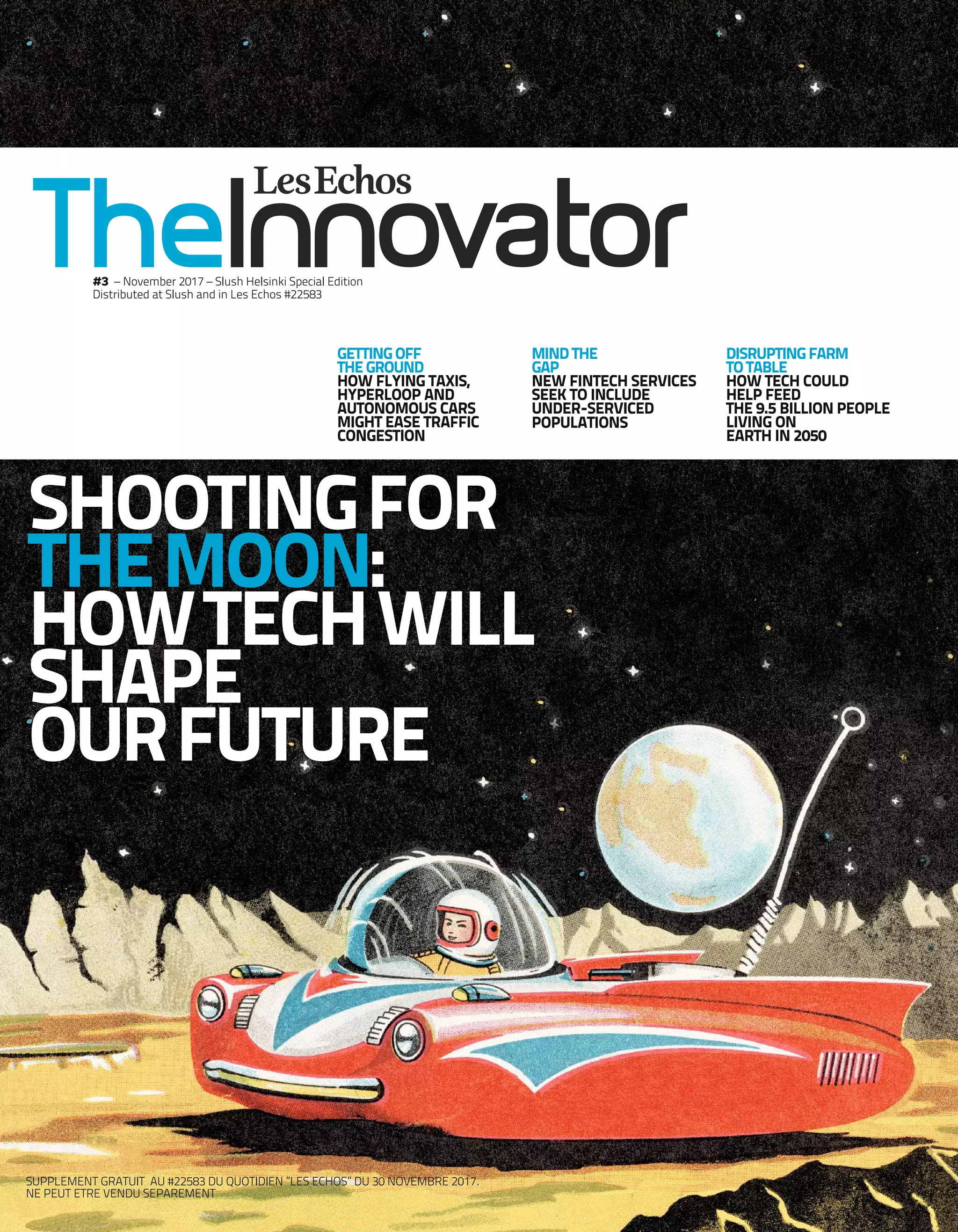
SHOOTINGFOR
THEMOON:
HOWTECHWILL
SHAPE
OURFUTURE
SUPPLEMENT GRATUIT AU #22583 DU QUOTIDIEN ”LES ECHOS” DU 30 NOVEMBRE 2017.
NE PEUT ETRE VENDU SEPAREMENT
#3 – November 2017 – Slush Helsinki Special Edition
Distributed at Slush and in Les Echos #22583
GETTING OFF
THE GROUND
HOW FLYING TAXIS,
HYPERLOOP AND
AUTONOMOUS CARS
MIGHT EASE TRAFFIC
CONGESTION
DISRUPTING FARM
TO TABLE
HOW TECH COULD
HELP FEED
THE 9.5 BILLION PEOPLE
LIVING ON
EARTH IN 2050
MIND THE
GAP
NEW FINTECH SERVICES
SEEK TO INCLUDE
UNDER-SERVICED
POPULATIONS
LETTER FROM THE EDITOR
TheentrepreneurandventurecapitalistPeterThielfamouslysaid
“Wewantedflyingcars,insteadwegot140characters,” in an introduction to
his venture capital firm’s 2011 manifesto entitled “What Happened to the Future?”
Less well-known is a slightly longer quote from Thiel during a 2013 debate “You have
as much computing power in your iPhone as was available at the time of the Apollo
missions. But what is it being used for? It’s being used to throw angry birds at pigs;
it’s being used to send pictures of your cat to people halfway around the world; it’s
being used to check in as the virtual mayor of a virtual nowhere while you’re riding
a subway from the 19th century.” Fast forward six years, and flying cars are coming
(see pages 24 and 25) with the promise that they will help make urban mobility more
fluid, reducing congestion and pollution.
And more tech entrepreneurs are working on innovations that truly change the world.
The research firm CB Insights recently named 30 tech companies they believe will
be game changers in 2018. Categories include synthetic animal products, regenerative
medicine and synthetic agriculture.
Many of those initiatives are chronicled in this edition of The Innovator. But there
are still not enough of them. Using tech to tackle hunger, poverty, diseases and climate
change should be a priority. Tech has the possibility to do what big companies and
big governments have so far failed to achieve – overhaul education, health, digital
identities and financial inclusion for the masses; offer work instead of aid for the
bottom billion; and even go to the moon, proving the sky is no longer the limit.
European companies of all sizes need to be encouraged to make more moon shots
or the Continent risks being left behind. It is encouraging to see AI initiatives from
Stan Boland and European unicorns like TomTom. Europe needs to build businesses
around the technologies that will underpin the future. TomTom’s Corinne Vigreux
put it perfectly when she said: “Europe needs to build up a vision of how we want
our new world to build up and evolve. We have got the brains, the vision, the diversity
– very important for innovation – the culture and the level of ambition here in Europe,
but spread out. We need to pull together and work on a common vision and get the
regulators to make it easier to build and innovate. We need to dream big and act
quickly: we need Europe at the table, not on the menu.”
ByJenniferL.Schenker
Editor-in-Chief,TheInnovator
THEBRIEF
MOONSHOT:
EUROPEANSERIALENTREPRENEUR
STANBOLAND
COVERSTORY
HOWTECHWILLSHAPE
OURFUTURE
FUTUREOFTRANSPORTATION
REINVENTINGAIRBUS
HYPERLOOP’SIMPACT
ONINTER-CITYTRAVEL
NAVIGATINGCHANGE
ATTOMTOM
TOP25STARTUPSTOMEETATSLUSH
HOWFLYINGCARSAND
AUTONOMOUSVEHICLESWILL
CHANGEURBANMOBILITY
ENERGY
THEMANYWAYSSTARTUPS
AREHELPINGREDUCE
DEPENDENCEONFOSSILFUELS
IMPROVINGGLOBALHEALTH
INDEXINGTHEPLANET
FOOD
USINGTECHTOINCREASE
NATURE’SBOUNTY
REPLACINGMILK,MEAT
ANDFISHWITHPRODUCTS
MADEINLABS
FINANCIALSERVICES
CLOSINGTHEGENDERDIVIDE
FUTUREOFWORK
MANAGINGANINCREASINGLY
MOBILEWORKFORCE
HELPINGTHEBOTTOMBILLION
JOINTHEGIGECONOMY
P.04
P.06
P.08
P.16
P.18
P.20
P.22
P.24
P.28
P.30
P.32
P.34
P.36
P.38
P.40
P.41
TABLE
OF CONTENTS
— P.03
P.04 — THE INNOVATOR
THE BRIEF
AI‘sImpactonJobsandSociety
Harvard Kennedy School of Government Professor Jason Furman,
who previously chaired U.S. President Barak Obama’s Council of Economic
Advisors,believesthat“peopleareworkingmorebutnotproducingverymuch,
which is exactly the opposite of what you’d expect from artificial intelligence.
So maybe the robots aren’t coming fast enough.”
His comments were made at a Fall Forum event in the U.S. co-hosted by The
Future Society to discuss AI and the workforce. The panel, which included
speakers from IBM and Google, was optimistic about AI’s potential to create
new jobs, replace menial tasks and enhance the quality of life. Not everyone
agrees. To contribute to the global civic debate on the governance of artificial
intelligence go to www.aiCivicDebate.org.
THEGAPBETWEEN
VISION
ANDREALITY
80%of3,000businessexecutives,
managersandanalystsin112countries
and21industriessurveyedbythe
BostonConsultingGroupandtheMIT
SloanManagementReviewsaidthey
seeartificialintelligence(AI)asa
strategicopportunity.
Onlyonein20
saidtheyhaveincludedAI
intheirofferingsor processesin
asignificantway
LOCATION
Munich,
Germany
Stuttgart,
Germany
Frankfurt,
Germany
Montrouge,
France
Cambridge,
UK
Paris,
France
Worblaufen,
Switzerland
TOPEUROPEANCORPORATEINVESTORS
INAI&DEEPTECH
FOLLOWTHEMONEY
$9.5billionInvestedinEuropeanDeepTechandAICompaniessince2012
EUROPEANDEEPTECHINVESTMENTS&ACQUISITIONS
Tado,ParkTAG,Pyreos,Panoratio,Wirescan,Sternico,Magazino,Enstorage,TASS
International
Graphcore,Actility,Robart,Modcam,Chronocam,Unispectral, Aimotive,
AdasWorks,Utilight,ParkTag,PebblesInterfaces,Ignuazio,Optomed,IntrinsicID
Micropelt,Cuculus,AugmentationIndustries,Trinckle,ParkTAG,Confovis,
ClickWorker
EOSImaging,Ween,FabZat,Enerbee,HiKob,3DRudder,Pixyl,Kleuster,Usitab,
PyntheasTechnologies
Jukedeck,AudioAnalytic,GeoSpock,Prowler.io,CambridgeMedicalRobotics
Actility,AwoX,Equisense,Smartly.ai,AccelaD
Ava,SophiaGenetics,PIQ,Insightness,Actility
EXITS
CyActive
—
BigRep
DiBcom
—
CoFluentDesign
—
Source : Dealroom.co.
note : 2017 up to Q3 annualized. Europe excludes Israel
45
2016 2017E
€ 2.3B
€ 4.6B
702
589
2012 2013 2014 2015
€ 0.4B
€ 0.8B
€ 0.9B
€ 1.7B
121
229
Source : Dealroom.co.
note : 2017 up to Q3 annualized. Europe excludes Israel
368
556
Sophia, a humanoid robot,
was recently granted
citizenship
by Saudi Arabia.
Total funding ( €B )
Number of rounds
2017 YTD:
— €3.4B from 442 rounds
— Roivant $1.1bn growth equity
— Improbable $ 502M series B
— Kreditch € 110M late VC
Declineinnumber
ofroundsisinline
withoverallmarkettrend
towardsfewer
largerdeals
COMPANY:SPOTIFY
COUNTRY:Sweden
SECTOR:Musicstreaming
CEO:DanielEk
Currentvaluation:
$16billion
Leadinvestors:
AccelPartners,GoldmanSachs,
FoundersFund,TCV,Horizon
Ventures
Funfact:
Spotify,whichhasover140million
usersin61markets,hassnapped
upninestartupssince2016,inclu-
dingSoundtrap,aStockholm-
basedonlinemusicstudiothat
letsuserscreatemusictogether
withothersinrealtime.
COMPANY:SUPERCELL
COUNTRY:Finland
SECTOR:Mobilegaming
CEO:IlkkaPaananen
Currentvaluation:
$10.2billion
Leadinvestors:
AcquiredbyTencent;Softbankis
amajorinvestor
Funfact:
Inadditiontoitsmobilegames,
SupercellcreatedClash-A-Rama,
anoriginalanimatedwebseries
fromthreewritersofThe
Simpsons.
Figuresforcurrentvaluationsweresourcedfrompressreports.
*Aunicornisatechcompanywithavaluationof1billioneurosormore
COMPANY:KLARNA
COUNTRY:Sweden
SECTOR:E-commerce
CEO:SebastianSiemiatkowski
Currentvaluation:
$2.5billion
Leadinvestors:
SequoiaCapital,Bestseller,
Permira,VisaandAtomico
Funfact:
Thecompanyobtainedabanking
licensein2017.
COMPANY:UNITY
TECHNOLOGIES
COUNTRY:U.S.
(foundedinDenmark)
SECTOR:Gamingtechnology
CEO:JohnRiccitiello
Currentvaluation:
$1.6billion
Leadinvestors:
Sequoia,DFJ,SilverLakeGrowth,
iGlobePartners,SummitCapital
Funfact:
770milliongamersfromaround
theworldusegamesmadeusing
Unity’sengine.
Togettechnologynewsincontexteveryweek,subscribetoournewsletter:http://innovator.news
— P.05
NORDICTECHTITANS
OutofthefiveEuropeantechunicornsthatwerefoundmostlikelytoreacha$50billionvaluation,
fourarefromNordiccountries,accordingtoaGPBullhoundsurvey.
57EUROPEANTECH
UNICORNS*
3VALUEDOVER
$10BILLION
14OFEUROPE’SUNICORNS
AREENTERPRISE
FOCUSED
MOON SHOT
are in Silicon Valley, Europe now has
investors ready to step up and fund
great entrepreneurs to develop deep
tech. FiveAI has so far raised $35
million. “We could have raised our
money five times over,” says Boland,
“It is quite encouraging.”
Building a robust system is not the
hard part, says Boland. The key
challenge will be attracting the right
talent, since Europe’s best and bri-
ghtest technologists go off to work
for American companies. “We want
to be a magnet for that talent in
Europe,” he says.
AMassiveOpportunity
In addition to venture capital finan-
cing, FiveAI has a $15 million grant
fromtheUKgovernmentforStreetWise,
a project with Transport for London
and others to develop a self-driving
car pilot for London that will reduce
traffic congestion and free up par-
king spaces.
“If we can get a service up and run-
ning in London that solves the pro-
blem of autonomous driving,reduces
congestion and people grow to love
it, it will be easy to move the service
into other European cities like Paris,
Berlin and Amsterdam,” Boland says.
“The opportunity is massive.”
Europe needs to have its own auto-
nomous car players, he adds. “This
is a holy mission we are trying to pur-
sue. There are loads of hazards and
it will be difficult, but I believe we
can build a company that will be si-
gnificant on a global scale in true
Silicon Valley-style that doesn’t have
to sell out early.”
J.L.S.
Can a European startup
successfully build a global giant by
developing a software platform for
autonomous cars and launching a
self-driving taxi fleet, a space in
which Silicon Valley players clearly
have a head start?
It’s a moon shot, but FiveAI CEO Stan
Boland, who has built and led four
Europeantechnologycompaniespur-
chased for a total of over $1.5 bil-
lion by Chinese and American acqui-
rers, is determined to do it.
Building a billion dollar-plus tech
company that is born in Europe and
stays in Europe has long been a goal
That doesn’t faze Boland. “Europe is
at least as good as the U.S. in raw
science,” he says. “I believe it is pos-
sible to build something globally si-
gnificant. There is a massive value
in integrating all of the layers of tech-
nologyandservicestogether.Wehave
to be brave enough to go all the way
to a service offer and sell directly to
consumers.”
Europe now has a new generation
of managers who have already been
through the experience of building
successful companies and have no
need to cash out early. And while the
rounds are not nearly as big as they
for Boland, a scheduled speaker at
Slush, a technology conference ta-
king place in Helsinki Nov. 30 to
Dec. 1. He wants FiveAI to become
Europe’s equivalent of Uber, the glo-
bal ride-sharing service.
TheChallengesAhead
Uber is far from being FiveAI’s only
competition. Google, Baidu and ma-
jor car companies are all entering
the autonomous vehicle space. And
startups gunning for the sector, such
as Boston-based nuTonomy, are star-
ting to gain some real traction.
P.06 — THE INNOVATOR
BuildingEurope’s
NextUnicorn
— The British entrepreneur Stan Boland built four startups
that were sold for a total of $1.5 billion to Chinese and U.S. companies.
His latest moon shot is to build a billion-dollar-plus AI company
with staying power.
WE NEED
Y U
The Beauty of Impact
Tech Pioneers in Public Health and Food Challenges
The Bayer founda�ons are impact investors since 1897 – we are partner of pioneers who are crea�ng new solu�ons
for humanity’s big challenges around public health and food safety. Our programs support those courageous men and
women whose hunger for breakthroughs has enabled them to excel in spheres never imagined. At our UPRISE booth,
you can meet tech founders and health ac�vists who have dared to brave the unknown for the purpose of shaping
the future of humanity.
*La beauté de l’impact. Les pionniers de l’innovation dans la santé publique et l’agro-alimentaire. The Bayer foundations sont des investisseurs à impact social depuis 1897 – nous sommes partenaires des pionniers qui créent de nouvelles solutions
aux plus grandes problématiques de santé publique et alimentaire. Nos programmes soutiennent les hommes et les femmes courageux que l’envie d’innover a poussé à atteindre des niveaux d’excellences inimaginables. Sur notre stand UPRISE,
vous pourrez rencontrer des fondateurs d’entreprise ainsi que des militants pour la santé qui ont osé braver l’inconnu dans le but de transformer le futur de l’humanité. Ce sont des icones du progrès qui pourront vous inspirer par leurs réalisations
en matière d’innovation sociale.
Vous cherchez des financements pour un projet fou de « tech-4-good » ? Venez pitcher et rencontrer le CEO de la fondation le 30 Novembre à 16h30 sur le stand Bayer à SLUSH
They are icons of progress. Let them inspire you for social innova�on and progress.
Seeking funding yourself for a crazy “tech-4-good” idea?
Pitch for funding and meet the founda�on CEO on Nov 30, 4.30 pm at the Bayer Booth @ SLUSH
P.08 — THE INNOVATOR
TheU.S.startupMoon
Express’sMX-2spacecraft
promisestobringtheinner
solarsystemwithinreach,
drivingmorepayloadtothe
lunarsurfaceorextending
reachtodeepspace.
SHOOTINGFOR
THEMOON:
HOWTECHWILL
SHAPE
OURFUTUREBy Jennifer L. Schenker
— P.09
COVER STORY
Naveen Jain’s first company, Infospace – which started out
by focusing on content and services for websites – was created during the
Internet dotcom boom. While that company had big ambitions, Jain is now
shooting for the moon. Moon Express, the third company he has co-
founded, is attempting to build machine-operated spacecraft that can mine
materials like gold, cobalt, platinum and Helium-3 (nuclear energy fuel)
on the moon. It won a contract from NASA and is participating in the
Google Lunar X-Prize.
Without even waiting for Moon Express to launch its first spacecraft, Jain
is already busy working on his next moon shot, a startup called Viome,
that seeks to prevent chronic diseases by examining the microorganisms
in users’ guts and counseling them on how to keep healthy.
Jain, a scheduled speaker at Slush, a technology conference taking place
in Helsinki on Nov. 30 and Dec.1, is one of a number of tech entrepreneurs
who are embracing moon shots, ambitious projects that address big
problems and propose radical solutions using breakthrough technology.
While the Internet revolutionized communications, today a whole host of
powerful technologies are converging, bringing about exponential change
and opening up the possibility for tech entrepreneurs to tackle challenges
that in the past only governments could handle: space exploration, the
eradication of diseases and ensuring an abundance of food, energy and
water. “None of these things are impossible any longer,” says Jain, “and
the cost is coming down so that it can be privately funded.”
Jain, who grew up poor in India and became a billionaire after moving to
the United States, says he believes the next set of superpowers will be
entrepreneurs, not nation states. “For the first time in human history a
small group of people can do things that only nation states could do
before,” says Jain. “We no longer have to rely on the government to impact
society, whether it is going to space or solving the problem of healthcare
or the clean energy talked about in the Paris Treaty – these things will be
solved by entrepreneurs.”
A Call To Action
Technology is at a point where it could potentially solve the world’s biggest
problems, but for that to happen more entrepreneurs will need to make
moon shots. Al Gore, a politician and environmentalist who served as the
45th Vice-President of the United States, is scheduled to speak at Slush
about the need for entrepreneurs to help solve climate change.
Executives at Bayer Foundations, a branch of Germany’s global drug and
agriculture company that focuses on frontier science, social pioneers and
startups with impactful tech innovations, will use their time at Slush to
search for startups with technologies that will impact hundreds of
thousands, if not millions of people across the globe. The German
entrepreneur Harald Neidhardt, who co-created one of a select few
health-related projects funded by the Bayer Foundations (see the story on
pages 30 and 31), will promote a HeroX competition at Slush that aims
to encourage one million people in the developing world to become
entrepreneurs over the next 30 years. (See the competition details at the
bottom of page 12.) And Bill Liao, a general partner at SOSV, a global fund
that accelerates over 150 startups a year in verticals that include synthetic
P.10— THE INNOVATOR
food and health, plans to talk to entrepreneurs at Slush about the
importance of purpose. SOSV’s core purpose is “making the impossible
inevitable,” says Liao. “It is not a slogan. It is what we do. Produce things
that the world needs and set the stage for a massive shift in what biology
is going to do to solve global grand challenges.”
There is good reason for this flurry of activity: global issues that urgently
need to be solved. The United Nations 2030 Agenda for Sustainable
Development and the Paris Agreement require an unprecedented
mobilization of both public and private finance – some $90 trillion over
the next 13 years. Only a fraction of that funding has been spent, says the
Slush attendee Marc Buckley, Al Gore’s Climate Reality Project Country
Manager for Germany and Austria and a jury member and open innovation
advisor to the Bayer Foundations. “Between 2015 and 2016 we did not
even spend $1 trillion,” says Buckley. He adds that Bayer Foundations,
which invests $15 million per year through all of its various programs, has
trouble giving out its grants. “There is plenty of money but there are just
not enough good, impactful innovations,” he says.
“This is not about a 3-, 5- or 10-minute pitch. It is not about a TED talk
about how to save the world. Impactful Global Solutions are complex
systems and dynamic models. What we want is business models that
address all aspects of complete systems and the global challenges we are
trying to solve in our world – whether it involves agriculture, food, water,
or power,” says Buckley. “Most companies are only doing one aspect and
those will not have sustainable resilient long-term impact.”
Systems Approach
A systems approach is necessary because problems are so complex. Take
the example of two of the world’s biggest problems: a lack of food and of
clean drinking water. Technology pioneers such as Indigo Agriculture are
using plant microbiomes to strengthen crops against disease and drought,
to help farmers sustainably feed the planet and reduce water use in
agriculture. (See the story pages 34 and 35.)
That is helpful, but it only solves part of the problem because the majority
of agriculture is used to fuel cars and feed animals. When it came to
introducing electric vehicles, which remove the need for fossil fuels and
bio-fuel production, big car manufacturers initially dragged their heels.
Then the entrepreneur Elon Musk came along and launched Tesla, which
earlier this year reached a market capitalization that surpassed that of Ford
Motor Company and General Motors. Tesla’s progress has spurred the big
auto companies to up their game. On the same day in November that Tesla
introduced a new all-electric truck and an electric sports car that goes from
0 to 60 miles per hour in 1.9 seconds and has a 620-mile range, the
Volkswagen group announced it had approved a €34 billion spending plan
to accelerate its efforts to become a global leader in electric cars.
Memphis Meats – one of SOSV’s investments – is among a number of
startups helping ease the other part of the issue: It creates beef from self-
reproducing cells, producing an animal-based product but avoiding the
need to breed, raise, and slaughter huge numbers of animals. (See the
story on pages 36 and 37.) Electric cars and lab-produced meats result in
more food for people and lead to huge reductions in water and land use.
If you eliminate cattle farming then you also eliminate the massive amounts
of methane that cows produce and which harm the environment.
That is why the Bayer Foundations’ new focus is finding entrepreneurs
aimed at disrupting agricultural, food and beverage industries. “Globally
these industries are responsible for the majority of climate change,” says
Buckley.
The Case for Change
These industries and others are in for a big shakeup. The $90 billion
global meat industry – which includes cattle farms, butchers,
slaughterhouses – is being transformed, as is real estate, since land use is
set to change radically. “There are 71 markets out there that are ripe for
disruption and it promises to be a lot worse than what happened to
Kodak.” says Buckley. “This exponential disruption will not only occur
because of the quantum leaps start-ups are taking in the digital age but
COVER STORY
KEEPINGCOOL
GlobalGood’sArktekcylinder-shaped
coolerusesinsulationdevelopedfor
spacecrafttokeepvaccinescoldfora
month,allowinghealthworkerstoreach
millionsmorechildren.
Photo:ShahimYassin,AfarPastoralists
DevelopmentAssociation
TAKINGABITEOUT
OFMALARIA
Usingcustomimagerecognition
software,EasyScanGO,anew
AI-poweredmicroscope,iscapableof
identifyingandcountingmalaria
parasitesinabloodsmearinaslittle
as20minutes.
to eat daily. After all food is our energy source. This is one big reason why
we can hear talk about the Anthropocene and that humanity may be
facing the sixth mass extinction.”
A Solution to Waste
Buckley is frustrated by what he sees to be limited efforts by the food and
beverage companies to change their business models and do less damage
to the environment. “If you are driving down the road in the wrong
direction and you slow down by 60% you are still going in the wrong
direction, just slower,” he says. “We need to stop and start going in the
right direction. If you tell me you are doing some minor changes or good
pilot (test) projects, or reductions in your green house emissions you are
still damaging our environment and killing people, you are just doing it
slower.”
Waste from the food and beverage industry includes mountains of single-
use plastic containers. The UN has estimated that yearly damage from
plastic pollution in the ocean is $13 billion, due to impact on marine life,
tourism and fishing. That is not all. Globally, 30% to 40% of food
produced for consumption is wasted. If food waste were a nation, it
would rank third in the world for harmful emissions, according to
OpenIDEO. An American startup called Full Cycle Bioplastics is aiming to
solve both of those issues by converting food waste into a fully
compostable bioplastic. As for the plastic that is already there, Boyan Slat,
a 23-year-old Dutch entrepreneur, has raised $30 million for The Ocean
because of the quantum leaps start-ups are taking in the digital age but
also due to the globally unknown effects of climate change and
deteriorating infrastructures.”
In the case of food, “there are 10 big companies out there that control all
of the brands – Nestle, Kraft, Unilver, Coke, Pepsi, etc – and in agriculture
when it comes to seeds it is DuPont and Montsano. This has to change if
we are going to feed all of the people we need to feed,” says Buckley.
Agriculture is also facing radical change. “The world is losing 23 global
hectares a minute to soil contamination and drought; five years ago it was
12 global hectares,” says Buckley. “If you think a new country the size of
Brazil is going to come along or a new place where we can grow crops
outdoors I will tell you that you are wrong,” he says. “We are going to
have to get vertical and go multilevel and build closed greenhouse systems
and use land more efficiently and use solar power and ambient water
harvesting.” Today 30% of everything the agriculture, food and beverage
industry produces “is thrown away, which is a 10x waste and then comes
back to bite us as methane which is 70% more effective at trapping heat
than CO2,” says Buckley.
What’s more, “we do not know what kind of climate calamities will come
upon us but if we do not have a resilient sustainable infrastructure in place
we will experience food security issues and other problems,” he says.
Puerto Rico is a case in point. Its agriculture sector was decimated by
Hurricane Maria, resulting in a 90% loss of local and regional food
sources. This type of devastation is due to climate change and if there is
no resilient sustainable infrastructure in place, the recovery takes years,
says Buckley. “This can prove to be devastating for humanity that needs
— P.11
DISRUPTINGTHEFOOD
CHAIN
Startupsarefindingwaysto
improvecropyieldsandproduce
meatanddairyproducts
inlaboratories.
TURNINGTHETIDE
Entrepreneursareusingavariety
oftechnologiestocleanuptheworld’s
pollutedwaterways.
BEINGRESOURCEFUL
TheseNikesneakersaremadefroma
technologicallyadvancedleather
material,developedbyaUKstartup,
thatsaveswaterandreduceswaste,
justoneexampleofhow
entrepreneursaremakingmanufac-
turingmoreecologicallyfriendly.
FINANCIALINCLUSION
TheHelsinkistartupMONIprovides
refugeeswithauniquedigitalidentity
storedonablockchainthathelps
withfinancialinclusion.
Itcouldbeadoptedbyrefugeecamps
throughouttheworld.
P.12— THE INNOVATOR
Cleanup, an initiative that aims to eradicate the Great Pacific Garbage
Patch, one of the most polluted areas of the ocean, using a boom to
capture plastic and keep it in areas where a boat can pick it up. These
are just some of the many examples of the rise of the non-expert, people
from outside industries who come up with novel approaches because they
see things from a completely different angle and just go out and do it. A
UK start-up called E-leather is another example. Its late founder, Chris
Bevan, was told that what he set out to do was impossible. Up to 50% of
natural leather hide is wasted and often destined for the landfill. E-leather
is using that waste by recycling it into a more durable, light-weight
leather, saving over 5,000 tons of traditional leather waste from landfill
– the equivalent of the weight of over 100 narrow-body aircraft.
Not only is E-Leather selling its leather to airlines who use it for seat
upholstery to save weight, fuel and money, in September the company
signed a partnership agreement with Nike, which is producing a sport
shoe made out of the material. A French startup called Pili is also doing
its part, by changing the environmentally toxic process used to make dyes.
It makes biosynthetic dyes as a cleaner alternative to petrochemical
syntheses or heavy-metal-containing pigments.
The Human Factor
Technology could also help solve some of the developing world’s biggest
problems, including the recording of births and deaths, financial exclusion
and inaccuracies and fraud in property registration. More than a billion
people do not have a recognized means of identifying themselves, leaving
them without access to healthcare, education, government assistance and
financial services. The Swiss technology firm WISeKey’s digital identity
dual factor authentication sits on top of the blockchain, an immutable
COVER STORY
NaveenJAIN,
FounderofMoonExpressandViome.
The Promise Hub stems from a project that converted a shipping container
into a mobile medical facility for refugees. The idea is to add additional
containers and create a platform that will offer digital tools, encouragement
and infrastructure to empower entrepreneurism to aid the rising billions in
underserved regions worldwide. The Promise Hub gives people in need an
opportunity to use the facility to create businesses and add sustainable value
to their community. Through the Human Potential Challenges on herox.com/
promisehub, innovators are being urged to co-create future Promise Hubs.
“Wenolongerhavetorely
onthegovernmenttoimpact
society,whetheritisgoingtospace
orsolvingtheproblemofhealthcare
orthecleanenergytalkedabout
intheParisTreaty–thesethings
willbesolvedbyentrepreneurs.”
ledger that allows third parties to validate that an original digital identity
or attribute certifications have not been changed or misrepresented.
This and other similar new technologies could help the United Nations
achieve its goal of helping everyone in the world have a secure digital
identity by 2020, paving the way for a better life both for citizens of the
developing world and for refugees. Already the Finnish Immigration
Service has begun providing unbanked refugees with prepaid Mastercards
rather than cash. These prepaid cards, which were developed by the
Helsinki startup MONI, also provide refugees with a unique digital identity
stored on a blockchain and could be adopted by refugee camps throughout
the world.
Entrepreneurs are also helping to improve the plight of the some-60
million displaced people in other ways. The German entrepreneur
BE
A
HERO
intelligence is also enabling a breakthrough in the fight against malaria,
which each year kills almost a half a million people. Malaria is one of the
hardest diseases to identify on a microscope slide. So the Global Good
Fund, a collaboration between Intellectual Ventures and the Microsoft co-
founder Bill Gates to develop technologies for humanitarian impact, has
just announced a collaboration with the advanced microscope designer
and manufacturer Motic China Group to create a distribute the EasyScan
GO, an AI-powered microscope to fight the spread of drug-resistant
malaria and assist in its case management. Using custom image
recognition software, EasyScan GO is capable of identifying and counting
malaria parasites in a blood smear in as little as 20 minutes.
Intellectual Ventures said it bases its work on “reverse innovation,” the
idea that to successfully tackle big problems like malaria, technology has
Neiderhardt co-developed with Cisco a refugee first response mobile
medical center out of converted shipping containers and outfitted it with
advanced technology tools that allow the translation of patient-doctor
dialogue into 50 languages. Technology is also finding unique approaches
to solving healthcare issues for millions – if not billions – of people.
For example, Israel’s Zebra Medical Vision teaches AI-powered computers
to automatically read and diagnose medical imaging data, allowing
healthcare institutions to identify patients at risk of conditions like
emphysema and coronary artery diseases and offer preventative
treatments. It recently introduced a new suite that offers all of its current
and future algorithms to healthcare providers globally for $1 per scan.
The company says its aim is to make it possible to deliver healthcare to
the next billion people who will join the middle class by 2020. Artificial
— P.13
TECH
GAME-CHANGERS
TOWATCH
MEMPHISMEAT
UNITEDSTATES
WHAT IT DOES : Uses stem cells from
real animals to grow meat in a lab. Its
investors include Microsoft’s Bill
Gates, Virgin Group’s Richard Branson,
and former GE Chairman and CEO Jack
Welch.
www.memphismeats.com
ZEBRAMEDICALVISION
ISRAEL
WHATITDOES: TeachesAI-powered
computerstoreadanddiagnose
medical-imagingdata,allowing
healthcareinstitutionstoidentify
patientsatriskofdiseaseandpropose
treatment.Zebraoffersitsalgorithmsto
providersfor$1perscan.
https://www.zebra-med.com/
TechForGood
CountrieswithSocialTechProjects(2013-2016)
*Projectsusingdigitaltechnologies
totacklesocialchallenges
Source:
SocialTechGuide|NominetTrust100
151
United
States
Mexico
Brazil
SouthAfrica
India
France Kenya
Israel
Germany
SwedenNetherlands
Ireland
Italy
United
Kingdom
China
100
6
8
5
4
5
5
7
7
7
17
12
5
5
P.14— THE INNOVATOR
FULLCYCLEBIOPLASTICS
UNITEDSTATES
WHAT IT DOES : Turnsorganicwaste
intoacompostablebioplastic,PHA,that
degradesharmlesslyinthesoilandthe
ocean.Itlicensesitstechnologyto
wasteproducerslikefoodandbeverage
companiessotheycanconvert
discardedmaterialintobioplasticresin.
http://fullcyclebioplastics.com/
WINDHORSE
UNITEDKINGDOM
WHAT IT DOES : Windhorsehas
developedaspecialistaiddronethatcan
beloadedwithfoodandwater,before
flyingindependentlytoapre-planned
destination.Thedrone’sshellcanbe
reusedtoprovideshelterandtheframe
canbeburntsafelytocookfood.
windhorse.aero
E-LEATHER
UNITEDKINGDOM
WHATIT DOES: Developedanew
lightweight,strongeco-materialfrom
leatherscrapsthatusedtoendupin
landfills.Itisbeingusedinairlineseat
upholsteryandNikesneakers.
http://www.eleathergroup.com/
VIOME
UNITEDSTATES
WHATITDOES: Sequencesthe
microorganismsthatliveinthedigestive
tracttomakedietrecommendations
andpredictriskforcertainconditions,
withtheaimofpreventingpeoplefrom
developingchronicdiseases.
https://www.viome.com/
COVER STORY
to be invented explicitly for conditions in the developing world such as
lack of consistent electricity and poor technician training, rather than
being retrofitted to those settings. Often these technologies are disruptive
enough to be re-deployed back to higher-income markets for profit,
creating a market incentive for commercial partners. In the case of
EasyScan GO, the microscope was built to tackle malaria, but Intellectual
Ventures is now exploring going after some forms of cancer in partnership
with Motic.
Other advanced technologies could do everything from help relieve the
global shortage of organ donors to eliminating chronic disease. Prellis
Biologics prints human organs in a laboratory setting. The company aims
to address organ donor shortage and provide human tissues to streamline
the development of therapeutics. As its first product, the startup is
developing insulin-secreting units of the pancreas to help people with
Type 1 Diabetes. Viome, Jain’s venture, and a number of other startups,
including Ubiome, are offering new services that sequence the
microorganisms that live in the digestive tract. The companies say they
can do things like make diet recommendations and predict risk for certain
diseases based on a person’s unique microbial makeup. If it lives up to
its promise, Jain says analysis of microbiomes could prevent people from
developing chronic diseases.
Shooting for the Moon and Beyond
By why stop at solving earth’s problems? Jain says he believes it is possible
to make other planets livable for humans. “That’s the ultimate goal,” he
says. “The moon is the first stepping stone. If we manage to make the
moon the eighth continent then we can go and live anywhere else.”
Jain dreams about bringing resources back to Earth, such as Helium-3,
“which could power this planet for generations to come.”
And he believes moon rocks may someday replace diamonds. DeBeers
made a fortune out of associating diamonds with love. Jain envisions a
marketing campaign that says “If you love her enough, give her the
moon.” Moon Express is one of five companies competing for the Google
Lunar X prize. If none of them manage to make a moon landing by March
of next year, the total of $30 million in promised prize money may be
rescinded. That doesn’t faze Jain.
“I am confident that we will launch by the end of March,” says Jain. “If
not the prize may be extended or someone else could fund a prize. It
doesn’t really matter. We are building a business that can survive with or
without a prize.”As Moon Express hopes to prove for entrepreneurs ready
to make moon shots, the sky could literally no longer be the limit.
MarcBUCKLEY,
AlGore’sClimateRealityProjectCountryManager
forGermanyandAustriaandajurymemberandopen
innovationadvisortoBayerFoundations
“Thisexponentialdisruption
willnotonlyoccurbecauseofthe
quantumleapsstart-ups
aretakinginthedigitalagebutalso
duetothegloballyunknowneffects
ofclimatechangeanddeteriorating
infrastructures.”
Our 115 lawyers bring together
their legal expertise and industy experience
to design tomorrow’s business solutions with you.
www.degaullefleurance.com#BusinessLawTogether
LET’STURNBUSINESS(LAW)
INTO A CREATIVE TOOL
-Créditphoto:GettyImages(1)Faisonsdudroitdesaffairesunematièrecréative(2)Nos115avocatscoordonnentleursénergiesetleurréseaupourvousapporterdessolutionssurlatotalitédevosenjeuxlégaux,enFranceetàl’international.
(1)
(2)
P.16 — THE INNOVATOR
TRANSPORTATION
AIRBUSBIZLAB
STARTUPS
TOWATCH
IRIDIUMDYNAMICS
AUSTRALIA
WHATITDOES: DevelopedtheHalo
VerticalTake-offandLanding
UnmannedAerialSystem,aplatform
thataddsextendedhovercapabilityto
fixed-wingmissions.
http://www.iridiumdynamics.com
EarlierthisyearattheGenevaMotorShow, the global aerospace
company Airbus revealed the Pop.Up, a conceptual autonomous two-
passenger pod that would clip to a set of wheels when traveling on roadways,
to a quadrocopter when it is more convenient to travel by air, to other
vehicles to create a train and – as if these options are not enough – could
even zip through a hyperloop tunnel.
While it is likely to be some time before such a project is realized, Airbus
is already reinventing itself in multiple ways. It has launched several ur-
ban air mobility projects, including Vahana, a single-passenger, self-pi-
loted electric vertical take-off and landing aircraft. It is focusing on the
development of electric and hybrid-electric propulsion, as the company
says it believes it is one of the most promising technologies in the future
of flight. It is developing products for digital factories which will make
greater use of augmented reality technology and automation. It is looking
at ways of harnessing and analyzing the wealth of data generated by its
aircraft and imaging satellites, to deliver new types of information and
services to customers. And it is exploring new business models that use
digital technologies to increase agility and performance.
Some of the moonshot projects – such as Vahana – are handled by A³, the
advanced projects and partnerships outpost in Silicon Valley.
“But we also need short-term innovation and by that I mean innovation
that is able to be realized within one to three years, which is short term
in our industry,” says Bruno Gutierres, head of BizLab, Airbus’s startup
accelerator program which was launched in 2015. “Most of the time we
are looking for projects that could enrich or seed the long-term strategy
but in a short time frame. We will not manage the overall autonomous
vehicle project, for example, but we will manage feeders to the global
projects.”
Just because their projects are short term doesn’t mean Bizlab startups
are not disruptive. “They are definitely disruptive,” he says. “They help
us create additional value for our platforms.” For example one of Bizlab’s
companies, bizpay, allows consumers to buy airline tickets in installments.
The company is offering a different business model for airlines, giving the
opportunity for the consumer to buy tickets and split the payment like a
loan. Like other big companies, Airbus needs to both encourage internal
innovation and bring in innovation from the outside, and figure out how
to balance the two.
A Hybrid Concept
“Some of the benchmarking I did on companies that decide to create acce-
lerators made me realize how difficult it is,” he says. “After you accelerate
(startups) how do you impact your core business? How will this startup be
accepted by your internal innovation people? The concern a big company
has is that by working with startups the message that is conveyed is ‘we are
Reinventing
Airbus
— The aerospace company is investing money
and resources in innovative technologies.
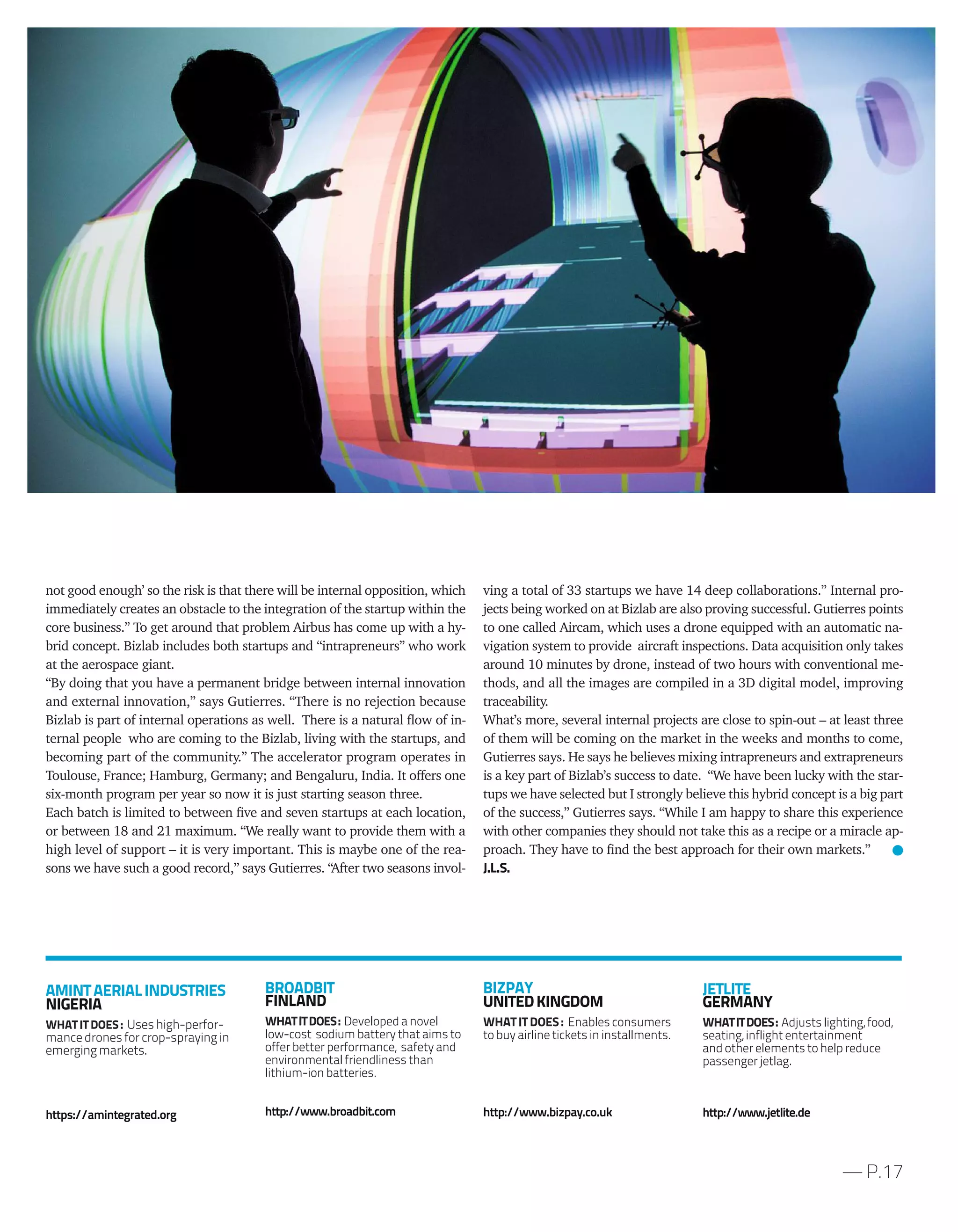
Anaugmentedrealityexperience
atAirbus’sCenterofApplied
AeronauticalResearch(ZAL)
inHamburg,Germany.
AMINTAERIALINDUSTRIES
NIGERIA
WHAT IT DOES : Uses high-perfor-
mance drones for crop-spraying in
emerging markets.
https://amintegrated.org
BIZPAY
UNITEDKINGDOM
WHAT IT DOES : Enables consumers
to buy airline tickets in installments.
http://www.bizpay.co.uk
BROADBIT
FINLAND
WHATITDOES: Developed a novel
low-cost sodium battery that aims to
offer better performance, safety and
environmental friendliness than
lithium-ion batteries.
http://www.broadbit.com
JETLITE
GERMANY
WHATITDOES: Adjusts lighting, food,
seating, inflight entertainment
and other elements to help reduce
passenger jetlag.
http://www.jetlite.de
— P.17
ving a total of 33 startups we have 14 deep collaborations.” Internal pro-
jects being worked on at Bizlab are also proving successful. Gutierres points
to one called Aircam, which uses a drone equipped with an automatic na-
vigation system to provide aircraft inspections. Data acquisition only takes
around 10 minutes by drone, instead of two hours with conventional me-
thods, and all the images are compiled in a 3D digital model, improving
traceability.
What’s more, several internal projects are close to spin-out – at least three
of them will be coming on the market in the weeks and months to come,
Gutierres says. He says he believes mixing intrapreneurs and extrapreneurs
is a key part of Bizlab’s success to date. “We have been lucky with the star-
tups we have selected but I strongly believe this hybrid concept is a big part
of the success,” Gutierres says. “While I am happy to share this experience
with other companies they should not take this as a recipe or a miracle ap-
proach. They have to find the best approach for their own markets.”
J.L.S.
not good enough’ so the risk is that there will be internal opposition, which
immediately creates an obstacle to the integration of the startup within the
core business.” To get around that problem Airbus has come up with a hy-
brid concept. Bizlab includes both startups and “intrapreneurs” who work
at the aerospace giant.
“By doing that you have a permanent bridge between internal innovation
and external innovation,” says Gutierres. “There is no rejection because
Bizlab is part of internal operations as well. There is a natural flow of in-
ternal people who are coming to the Bizlab, living with the startups, and
becoming part of the community.” The accelerator program operates in
Toulouse, France; Hamburg, Germany; and Bengaluru, India. It offers one
six-month program per year so now it is just starting season three.
Each batch is limited to between five and seven startups at each location,
or between 18 and 21 maximum. “We really want to provide them with a
high level of support – it is very important. This is maybe one of the rea-
sons we have such a good record,” says Gutierres. “After two seasons invol-
P.18— THE INNOVATOR
TRANSPORTATION
HyperloopWill
ChangeInter-City
Travel
— The very high-speed transit system has been called
a cross between the Concorde and an air hockey table.
Ifallworksoutasplannedatsomepointinthefuture, in a city
somewhere on the globe the first passengers will strap themselves into pods
that will float through tubes that have been pumped into a near-vacuum at
speeds of up to 760 miles per hour, dramatically reducing inter-city travel
time. And the expectation is that the travel will cost the price of an airline
ticket or less.
A race is on to see who will be the first to build this transit system, called
a hyperloop, and where.The concept behind the hyperloop – travel inside
a vacuum tube – has been for around for decades. Interest was renewed
when billionaire Elon Musk, the entrepreneur behind Tesla Motors and
SpaceX, issued a document outlining a suggested design in August 2013.
Since then several companies have been founded to commercialize hyperloop
services, one called Hyperloop Transportation Technologies and another
called Hyperloop One. The latter company recently raised funding from
investors that include billionaire Richard Branson, and the project has since
changed its name to Virgin Hyperloop One. One of Hyperloop One’s original
team members, Brogan BamBrogan, quit and started his own venture called
Arrivo. Rather than try and build a rival hyperloop, BamBrogan introduced
another type of futuristic transport in November described as an “enclosed,
electromagnetic superhighway that uses magnetic levitation to make vehicles
float and electric power to move them forward” at 200 miles per hour. It
will be built in Denver, Colorado, with the goal of transporting passengers
anywhere in the Denver metro area in 20 minutes or less, for the same
cost as a toll road.
Meanwhile in July Musk, who has launched a venture called The Boring
Company, tweeted that he had “just received verbal [government] approval”
to build a new underground hyperloop network that can shuttle commuters
between New York City and Washington D.C., about 230 miles apart, in
29 minutes. In a tweet Musk said the new super-fast transportation network
will also have stops in Philadelphia and Baltimore, as well as “up to a dozen
or more entry/exit elevators in each city.”
A Race to the Finish
In October, Governor Larry Hogan of Maryland tweeted that the state’s
Department of Transportation had approved the tunnel. The announcements
took people by surprise and raised a number of questions. The development
also has sparked speculation that Musk has ambitions to build his own
competing hyperloop company.
A flurry of announcements by Hyperloop One and Hyperloop Transportation
Technologies about discussions with cities around the world have added
to the confusion. Virgin Hyperloop One, which has built a fully operational
test track in the Nevada desert, says it has feasibility studies in the U.S.,
India, the UAE, Canada, Finland and the Netherlands. “The timeline is
determined by how fast local governments can work,” the company said
in a written reply to questions. “Hyperloop is about connecting people and
ultimately it is about how fast governments want to connect their people.”
Virgin Hyperloop One says it currently on target for the first operational
hyperloop by 2021. Its goal is to be able to provide a service that will
operate at 670 mph.
HyperloopTransportationTechnologies,whichhas28patents,iscrowdsourcing
its research and development from engineers working at places like NASA,
Tesla, Boeing and Lockheed Martin as well as the United States’ Lawrence
Livermore Lab, which is credited with developing an early levitation system.
It has opened offices in Abu Dhabi, Dubai, Toulouse, Slovakia, the UK,
India, Indonesia and Spain. It has a joint venture with the South Korean
government and in January it announced the signing of an agreement with
the city of Toulouse to open a facility for the development and testing of
hyperloop-related technologies. As part of this agreement the city is providing
a 3,000-square-meter facility along with outdoor terrain at a former military
airport base. It has also been given permission to test a two-kilometer
hyperloop line inside the airport, its chairman, Bibop Gresta, said in an
interview. Virgin Hyperloop One and Hyperloop Transportation Technologies
acknowledge that a number of things will need to be put into place before
either can launch commercial services.
Tunnel Vision
“We are a new mode of transportation and we have to ensure it’s as safe
as other modes of transportation,” Virgin Hyperloop One said in a statement.
“Given that it is a new mode we have to make sure it’s not regulated like
a plane, train, car, etc. and create new regulations…. similar to creating
regulations around autonomous cars.”As for who is going to launch a
commercial service first, it is anybody’s guess.Asked if Virgin Hyperloop
One considers Musk’s Boring Company to be a competitor, the company
responded: “Virgin Hyperloop loves tunnels. If the Boring Company can
accelerate tunneling it will ultimately help our company because their
system will be great for the last-mile solution that we can seamlessly integrate
into our passenger experience.”
Hyperloop Transportation Technologies’ Gresta takes a more circumspect
view. “We are in contact (with Musk’s venture) and are monitoring the
evolution. Sooner or later we will need to sit down and talk about how do
we speed the development. Whatever will be his position I think this could
be a really good development. A person like him can make a difference in
a market that needs to grow and gain credibility worldwide.”
J.L.S.
— P.19
HELSINKI
Destination
2 hr 13 min
5 hr 18 min
8 hr 49 min
11 hr 48 min
23 hr 7 min
PARIS
Origin
TRAVEL TIME
EstimatesfromHyperloopOneoftraveltimesfromParistoHelsinkiusing
variousformsoftransport.Timesareapproximated.
AnInterview
With
CorinneVIGREUX,
TomTom
Co-founder
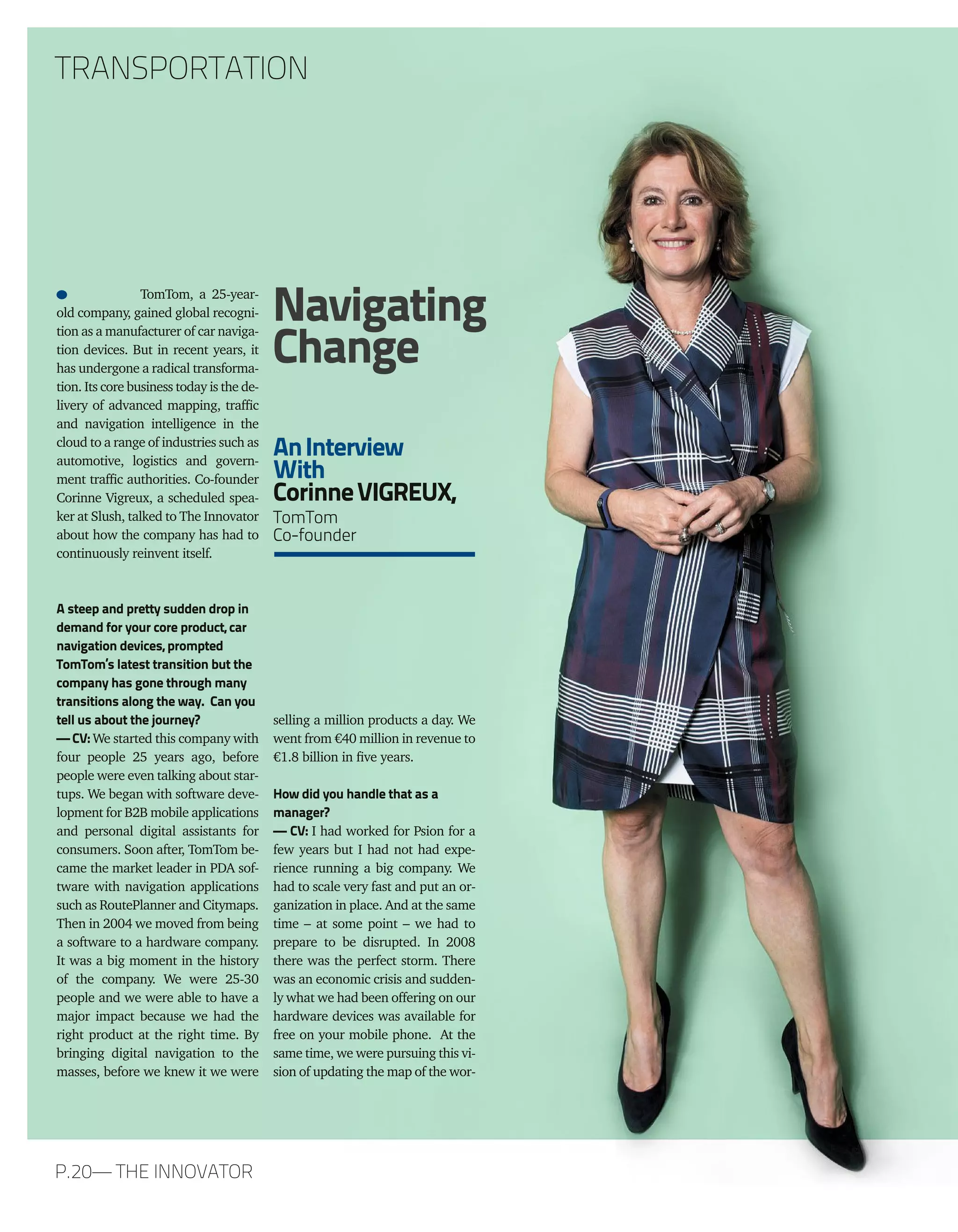
TomTom, a 25-year-
old company, gained global recogni-
tion as a manufacturer of car naviga-
tion devices. But in recent years, it
has undergone a radical transforma-
tion. Its core business today is the de-
livery of advanced mapping, traffic
and navigation intelligence in the
cloud to a range of industries such as
automotive, logistics and govern-
ment traffic authorities. Co-founder
Corinne Vigreux, a scheduled spea-
ker at Slush, talked to The Innovator
about how the company has had to
continuously reinvent itself.
A steep and pretty sudden drop in
demand for your core product, car
navigation devices, prompted
TomTom’s latest transition but the
company has gone through many
transitions along the way. Can you
tell us about the journey?
— CV: We started this company with
four people 25 years ago, before
people were even talking about star-
tups. We began with software deve-
lopment for B2B mobile applications
and personal digital assistants for
consumers. Soon after, TomTom be-
came the market leader in PDA sof-
tware with navigation applications
such as RoutePlanner and Citymaps.
Then in 2004 we moved from being
a software to a hardware company.
It was a big moment in the history
of the company. We were 25-30
people and we were able to have a
major impact because we had the
right product at the right time. By
bringing digital navigation to the
masses, before we knew it we were
selling a million products a day. We
went from €40 million in revenue to
€1.8 billion in five years.
How did you handle that as a
manager?
— CV: I had worked for Psion for a
few years but I had not had expe-
rience running a big company. We
had to scale very fast and put an or-
ganization in place. And at the same
time – at some point – we had to
prepare to be disrupted. In 2008
there was the perfect storm. There
was an economic crisis and sudden-
ly what we had been offering on our
hardware devices was available for
free on your mobile phone. At the
same time, we were pursuing this vi-
sion of updating the map of the wor-
P.20— THE INNOVATOR
TRANSPORTATION
Navigating
Change
population of more than five billion
people and collects massive
amounts of data. What are you
doing with this data?
— CV: TomTom’s Live Traffic-
enabled devices reach over 10%
of drivers. We have proven that,
through better network utilization,
this has a positive influence on the
personal journey time for all drivers.
That data is anonymized of course –
privacy is our number one priority –
and used in a way to optimize traf-
fic flow. We are working with cities
on a traffic index every year and
support them in moving cars around
in a better way. This has a massive
impact. Autonomous driving will
help improve traffic flow and reduce
deaths and injuries on the road be-
cause cars will not make the same
mistakes that humans make when
they cause accidents. The ultimate
goal is to get to a state where being
in cities will be a pleasant affair and
the cities will be returned to its ci-
tizens living in harmony with the en-
vironment. Our next moon shot is to
play a role in smart mobility, helping
reduce congestion and providing
mapping technologies to enable au-
tonomous driving.
What technologies will you apply
to autonomous driving?
— CV: We filed our first patents for
autonomous driving in 2009 be-
cause we saw that autonomous dri-
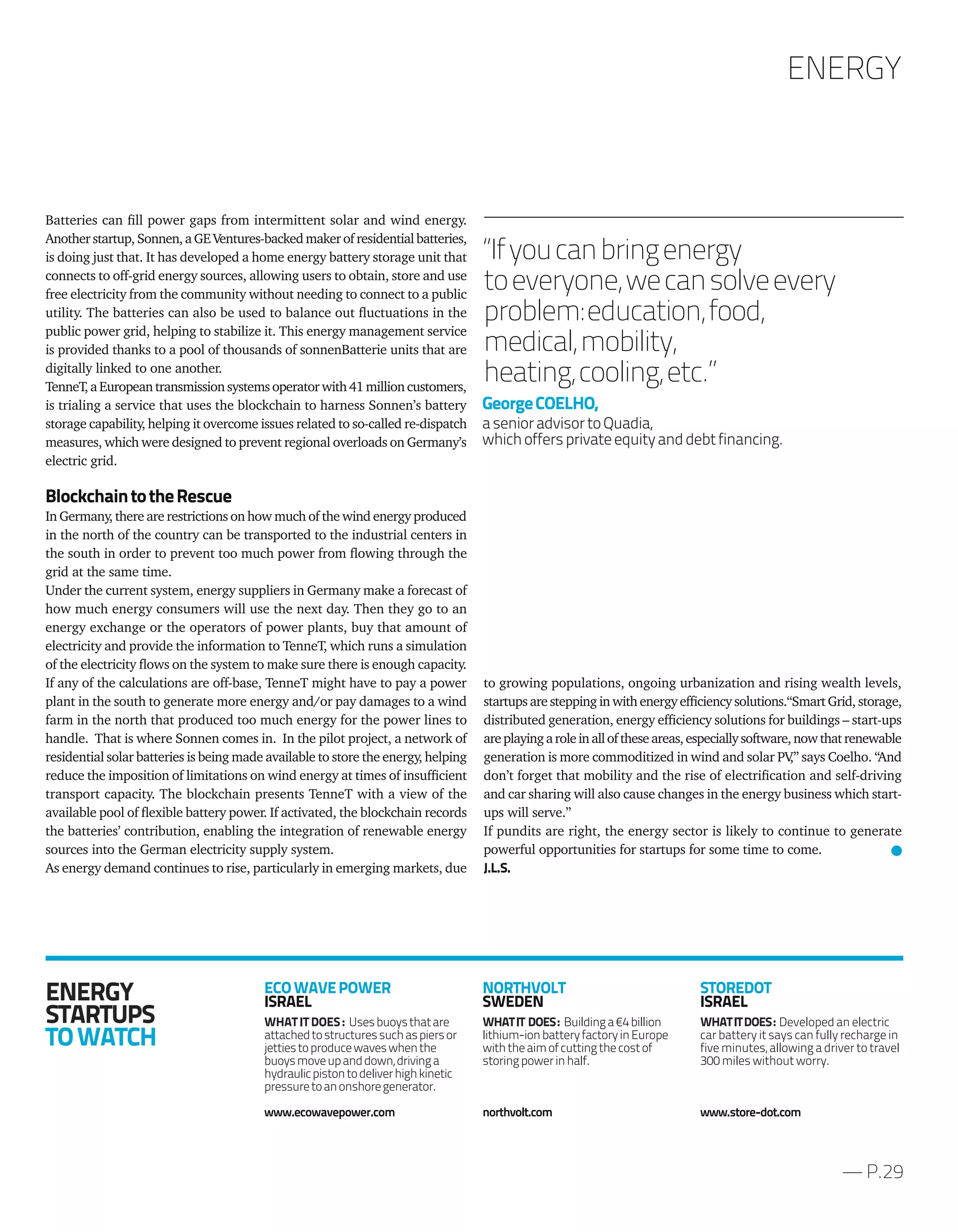
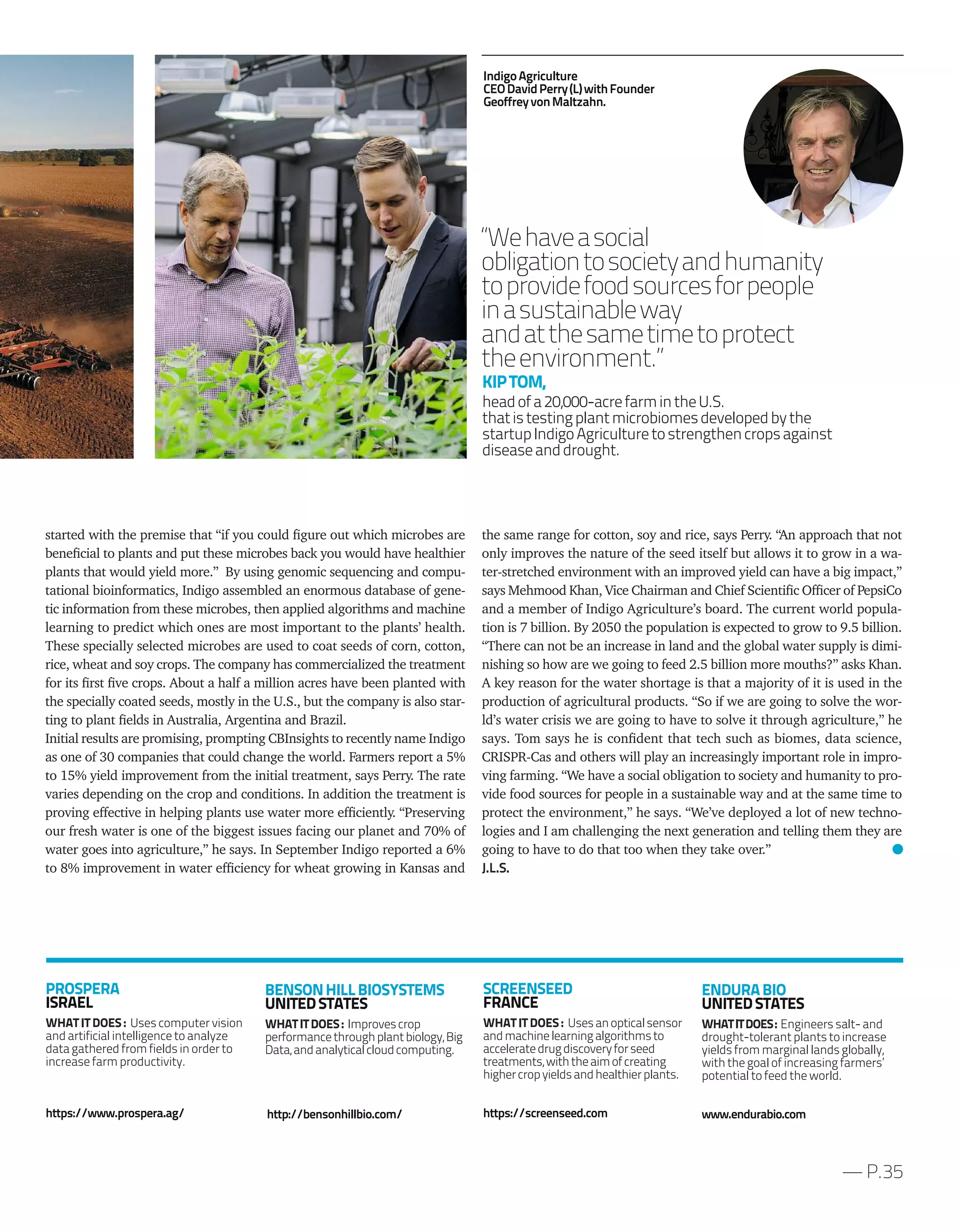
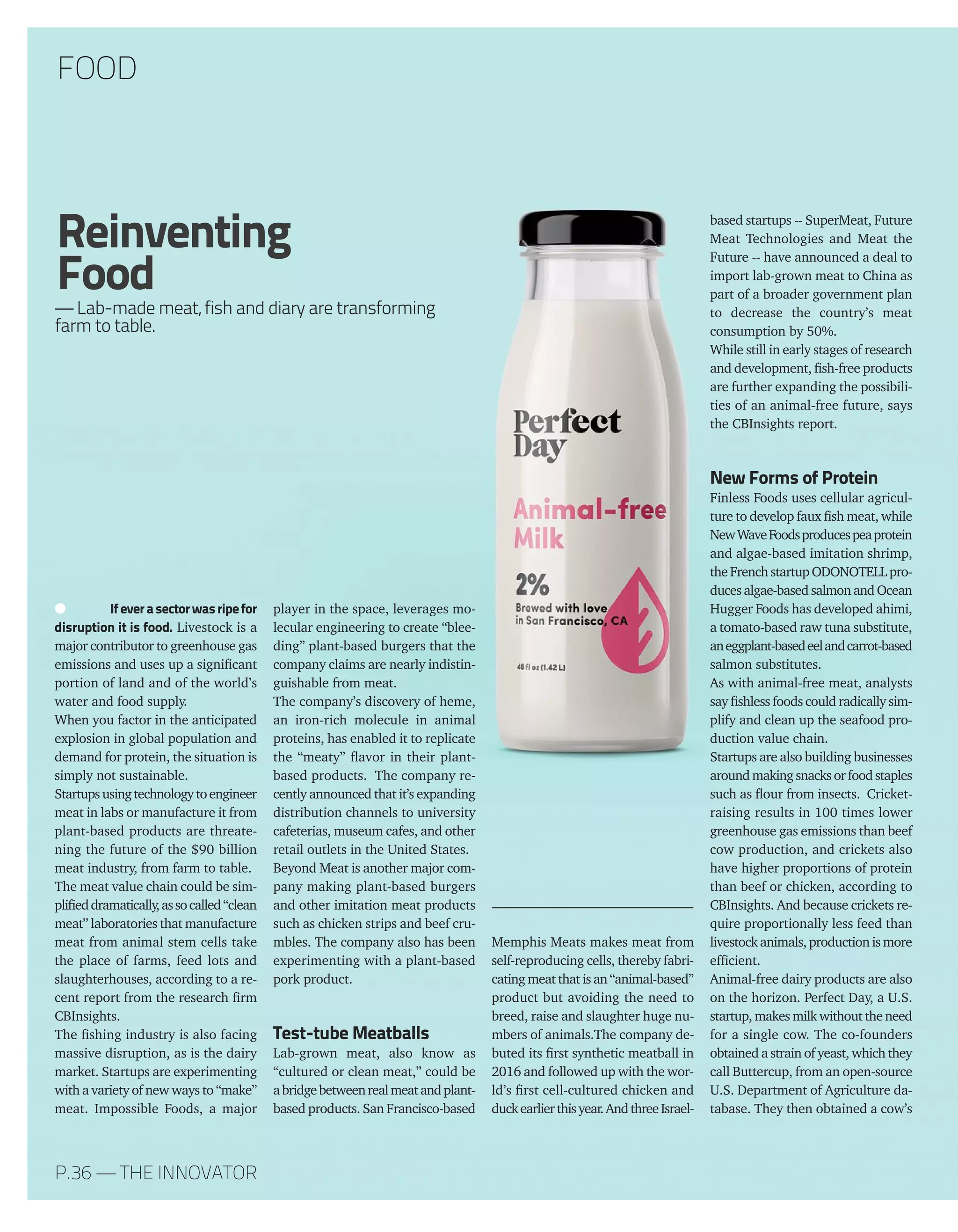
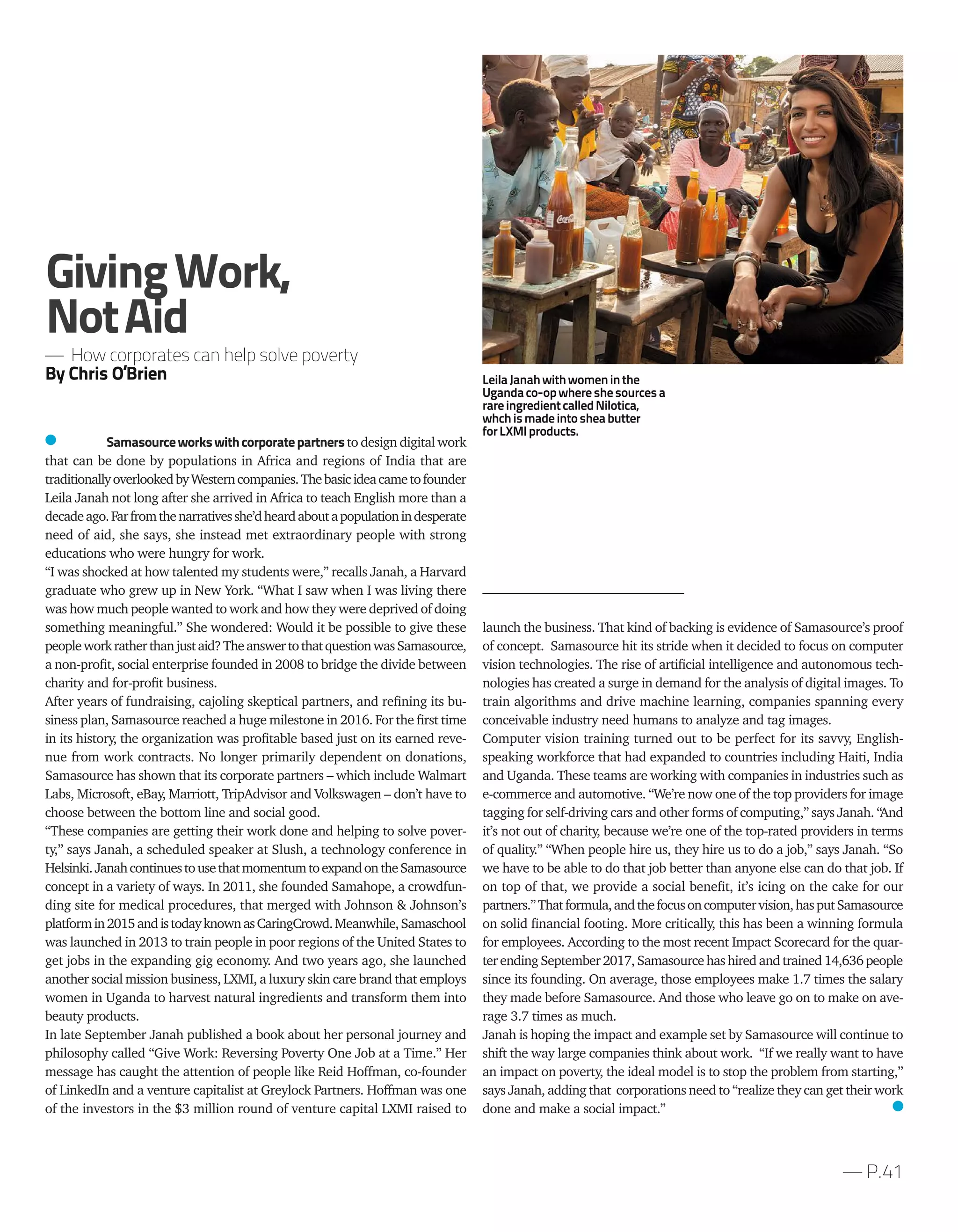
ving would be a big new area and
started working on HD (high defini-
tion) maps that are needed to in-
crease safety and comfort. We never
lost sight of what we wanted to do
(which formed TomTom Telematics),
Applied Generics (which formed
TomTom Traffic), the automotive en-
gineering team from the Siemens
R&D division (which formed
TomTom’s Automotive business
unit), TeleAtlas, one of the largest di-
gital mapmaking companies in the
world (which formed TomTom
Maps) and earlier this year
Autonomos (a Berlin-based autono-
mous driving startup with heritage
dating back to the DARPA challenge).
While we made bold acquisitions we
always kept an eye on the bottom
line. And we went public at the right
time – preparing for the future.
TomTom Traffic reaches 69
countries with a combined
ld in real time – which was our mo-
tivation behind acquiring the lea-
ding mapmaker TeleAtlas in 2007 –
and giving traffic information in real
time with a view to reducing overall
traffic congestion. We kept innova-
ting and that kept us in the race.
What is the secret to TomTom’s
survival?
— CV: You have to spread the risk by
making big bets on innovation. That
is what keeps us where we are – re-
lentlessly innovating and staying
ahead of the game. We have establi-
shed partnerships with, amongst
others, Baidu, Qualcomm, Bosch,
Nvidia and Cisco, and over the years,
we acquired a number of new bu-
sinesses including Datafactory
as a company – we know everything
happens in real time, so giving that
to the driver – or the car – in real-
time is important.
What will be your business model
in the autonomous car market?
— CV: There are so many moving
parts it is difficult to predict.
Autonomous driving is such a com-
plex area. It takes a lot of companies
partnering together to solve that
puzzle. What is sure is that we will
provide a HD map service right into
the vehicle. We are using state-of-
the-art AI and computer vision to be
able to process massive amounts of
incoming, real-time data about the
world.
So far, the really big players in
autonomous driving are coming
from the U.S. and Asia. Can Europe
produce global leaders in this
space?
— CV: I think we have a chance, if
we pull together. It would be nice to
have our own version of a
Singularity University, with our own
European vision of how we want
our new world to build up and
evolve. We have got the brains, the
vision, the diversity – very important
for innovation – the culture and the
level of ambition here in Europe, but
spread out. We need to pull together
and work on a common vision and
get the regulators to make it easier
to build and innovate. We need to
dream big and act quickly: we need
Europe at the table, not on the
menu.
J.L.S.
“Ournextmoonshotis
toplayaroleinsmartmobility,
helpingreducecongestion
andprovidingmapping
technologiesto
enableautonomousdriving.”
— P.21
P.22 — THE INNOVATOR
TOP25
STARTUPS
TOMEET
ATSLUSH2017Slush, a technology conference taking place in Helsinki, Finland
on November 30 and December 1, gathers the key players in the global tech
sector. The Innovator selected the most promising startups to meet at the
conference. Some are already well known, others are below-the-radar but
are unlikely to stay there for long.
ENERGY
NORTHVOLT
SWEDEN
WHATITDOES:Northvolt is building an advanced
factory designed to enable production of greener
energy storage batteries. The new battery form
is intended to require a minimal carbon footprint
while working in tandem with the expanding
European use of renewable energy sources.
http://northvolt.com/
ENERGY
ECO WAVE POWER
ISRAEL
WHATITDOES:EcoWavePowerhasdesigneda
newwavepowertechnologythatextractsenergy
fromoceanandseawavesandthentransforms
itintoelectricity.Suchtechnologycreates
asustainableandaffordableenergysourcefor
regionsaroundtheworld.
http://www.ecowavepower.com/
ENVIRONMENT
ECOHUB
BOTSWANA
WHATITDOES: Ecohub gathers plastic waste and
then recycles it into an “eco-brick,” a mix of wood
and the re-used waste. These can then be
assembled into walls that form the basis of a new
type of low-cost housing. The company is moving
from final prototype to testing phase.
http://ecohub.co.bw/
FOOD
PERFECT DAY
UNITEDSTATES
WHATITDOES:Perfect Day it trying to reinvent the
way milk is produced to create a healthier product
and a process that is more environmentally
sustainable. Rather than using any animals, the
company uses a craft-brewing technique to make a
product that contains the same nutrients as milk.
http://www.perfectdayfoods.com/
FOOD
HARGOL FOODTECH
ISRAEL
WHATITDOES:The company raises grasshoppers as
a protein source for alternative foods. The goal is to
provide a new protein ingredient that will lead to
lower-cost and sustainable food as traditional
forms like beef, chicken and fish reach their natural
limits and place a strain on the environment.
http://www.hargol.com/
ENERGY
STOREDOT
ISRAEL
WHATITDOES:StoreDot has developed a
fast-charging battery powered by organic
compounds and nanomaterials. The company is
partnering with original equipment manu
facturers (OEMs) to adapt the batteries for use in
smartphones, displays and electric vehicles.
https://www.store-dot.com/
HEALTH
FITED
UNITEDSTATES
WHATITDOES:Fited is using 3D printing, machine
learning, remote sensing, and its own compu-
ter-assisted design (CAD) technology to reinvent
medical braces and prosthetics. Its first product is
a custom-fitted brace for pediatric scoliosis
patients.
https://www.fited.co/
WORK
SMARP
FINLAND
WHATITDOES:SmarphascreatedaSaaSplatform
toenablebetterinternalcommunicationbetween
employeesandexecutives.Theserviceisaccessed
viaanappthatallowsemployeestosubmitand
shareknowledgeandcompanynews,whilecreating
betterengagementamongco-workers.
http://www.smarp.com/
WORK
INTEGRIFY
FINLAND
WHATITDOES:The company teaches coding to
refugees and immigrants and then helps them
find jobs in the tech economy. After launching in
Finland, Integrify is preparing to expand across
Europe.
https://www.integrify.fi/
FINANCE
TENX
SINGAPORE
WHATITDOES:TenXwantstomakecryptocurren-
cieseasiertospendintherealworld.Afterholdingan
ICOearlierthisyear,thecompanyhasdeveloped
smartphoneappsanddebitcardsthatconnectto
blockchainfinancialsystems.
http://www.tenx.tech
TRANSPORTATION
VECTOR SPACE SYSTEMS
UNITEDSTATES
WHATITDOES:: Vector has developed a new
launch system to make it easier and more
cost-effective to place space innovations in orbit.
The company is building a family of rockets to
launch micro-satellites and aims to place a
satellite for which developers write applications.
https://vectorspacesystems.com/
— P.23
ENERGY
KITEMILL
NORWAY
WHATITDOES:The company has developed a
fixed-wing kite tethered to a ground station that
generates energy as the kite spirals in the air.
Capturing energy from wind at higher altitudes is
more efficient, says Kitemill, which is moving into
the next stages of testing and fundraising.
http://www.kitemill.com/
ENERGY
HELIAC
DENMARK
WHATITDOES:The company has developed
large-scale polymer foil-based solar concentrators
for utilities to capture solar power and reduce costs.
It also sells a solar cooker that allows people to heat
food and water without using raw materials (wood
or kerosene), or creating emissions.
http://www.heliac.dk/
ENERGY
SMART PLANTS
NORWAY
WHATITDOES:The company is focused on
reducing the energy consumption of buildings,
which the European Commission has said is
responsible for 40% of energy use and 36% of CO2
emissions. Smart Plants uses connected hardware
and its platform to help building and factory
owners monitor and reduce energy use.
https://smartplants.io/
FOOD
MATSMART
SWEDEN
WHATITDOES:Matsmartaimstoreducemassive
foodwastebyfocusingonfoodthatgetsthrown
awaybecauseit’spasttheexpirationdate.Because
suchdatesareadvisory,ratherthanindicationsthe
foodisnolongersafe,Matsmartidentifiesonesthat
arestillokaytoeat,andsellsthemtocustomersata
discount.
www.matsmart.se
FOOD
FARMERS CUT
GERMANY
WHATITDOES:Thecompanyhasdevelopeda
“Dryponics”systemtogrowfoodindoorsaswellasa
retailsolutiontooptimizedelivery.Theautomated
cultivationmethodproducesfreshgreenswhile
minimizingtheuseofenergy,waterandpesticides.
Bygrowinginurbanareas,closertoconsumers,the
companywastesfewerresourcesontransportation.
https://farmerscut.com/
HEALTH
BABYLON
UNITEDKINGDOM
WHATITDOES:Babylon combines machine learning
with human medical expertise to create a
personalized health service available globally. The
company also partners with health care networks,
such as the NHS in Britain, to allow users to make
video calls for appointments and consultations.
https://www.babylonhealth.com/
HEALTH
UBIOME
UNITEDSTATES
WHATITDOES:UBiome’s SmartGut test uses
precision sequencing to detect beneficial and
pathogenic microorganisms associated with
specific infections, lifestyle choices and gut
conditions. Patients then work with their doctors
to assess the health of their microbiome and what
steps to take.
https://ubiome.com/
EDUCATION
NARA EDUCATIONAL
TECHNOLOGIESTURKEY
WHATITDOES:Thisstartupmakesvirtualand
augmentedrealitytechnologiesforteacherstousein
theclassroomacrossarangeofsubjects.Teachers
areabletochooseamongCardboardorGearVR.
Thecompanyisalsodevelopingaugmentedreality
solutionstoenhancelearningexperiences.
http://nara.com.tr/
VR/AR
VARJO TECHNOLOGIES
FINLAND
WHATITDOES:The company has created a “Bionic
Display” technology that mimics the human eye,
delivering far greater resolution for VR/AR
devices. Varjo is working with OEMs to enable
more powerful VR/AR that the company hopes
will help redefine work and play.
http://www.varjo.com/
FINANCE
AID:TECH
IRELAND
WHATITDOES:AID:Tech uses blockchain
technology to help international NGOs,
government, and corporations deliver aid and
donations. The system creates a digital identity
for the recipients, and allows organizations
to make sure resources reach the right recipients.
https://aid.technology/
Compiled and written by Chris O’Brien.
O’Brien is European Correspondent for
VentureBeat. Before moving to France in 2014,
he spent 15 years covering Silicon Valley
for the San Jose Mercury News and Los Angeles
Times.
TRANSPORTATION
SAVE TRACK
ARGENTINA
WHATITDOES: This computer vision company has
initially focused on developing the SaveBox, a
gadget that sits in the cabs of long-haul trucks
and uses its facial recognition and AI algorithms to
deliver warnings when a driver appears fatigued
or is falling asleep. The data is uploaded to the
SaveCloud so that fleet managers can monitor
and analyze drivers’ performance.
http://www.savetrack.com/
FINANCE
TOKEN
UNITEDSTATES
WHATITDOES:Tokenhasbuiltaglobalopen
bankingnetworkthatprovidesdeveloperswitha
singlepointofaccountaccessforpaymentsand
informationretrieval.Token’sopenAPIisintendedto
letbanksmonetizetheirinfrastructurewhile
creatingnewrelationshipswithpartners.
https://token.io/
TRANSPORTATION
FFLY4U
FRANCE
WHATITDOES:DevelopsembeddedIOTdevices
thathelpcompaniestracktheirmobileassetssuch
asdrums,trucks,palletsandconstruction
equipment.Thedataallowscustomerstoclosely
monitorthemovementoftheirequipmentthrough
awebplatformtooptimizeitsuse.
https://ffly4u.com
HEALTH
NATURAL CYCLES
SWEDEN
WHATITDOES:The company has developed an
app that uses an algorithm to track a woman’s
ovulation cycle. The self-testing app has proved so
accurate that it has been certified as a cont
raceptive in the European Union, and the founders
have applied for approval in the United States.
https://www.naturalcycles.com/
P.24 — THE INNOVATOR
It looks like flying cars may finally be getting off the ground.
No longer the stuff of science fiction, vertical take-off and landing aircraft
(VTOLs) – the technical name for flying cars – are being developed by the
likes of the aerospace giant Airbus and the global ride-sharing service
Uber as well as by VC-backed startups like Germany’s Lilium.
Geely, the Chinese automotive company behind Volvo, has just acquired
an American VTOL company called Terrafugia, and earlier this year the
German carmaker Daimler invested in Volocopter, a German VTOL startup
that is developing a battery-powered aircraft.There are VTOLs that look
like futuristic versions of jets or helicopters. Others resemble the type of
OnTheFly
— Urban mobility is expected to become more fluid
thanks to flying taxis, autonomous cars and new types
of car-sharing services.
TRANSPORTATION
Terrafugia’s
TF-Xflyingcar
aircraft featured in 1960s cartoons. Some are electric, others are battery-
powered. And some even operate both on land and in the sky. All are
being designed to be autonomous and offer ride-sharing services that can
be booked by a smartphone, on the fly.
VTOL technology is made for taking off, hovering and landing vertically
in places where there are no runways, such as city centers. The objective
is to make urban travel more fluid. If the roads are jammed you simply
take to the skies. In the past, services like on-demand urban helicopters
were only available to the rich. That is no longer the case. Uber, which
says it will begin offering flying taxi services as early as 2020, says its in-
the-air taxi service will be priced the same as Uber X.
So what will it take to make VTOLs fly? In November, Uber Chief Product
Officer Jeff Holden announced that the company has signed a deal with
NASA to help develop traffic systems for its autonomous flying cars, which
it hopes to start testing within two years in Los Angeles, Dallas-Fort Worth
and Dubai. Uber needs NASA’s help to create an air-traffic control system
that could allow liftoffs from numerous building rooftops without hindering
commercial aviation or endangering the public.
Finding suitable real estate for the launch pads and building a reasonable
system for automating the check-in process must still be worked out.
No One Behind the Wheel
Regulatory issues must also be resolved before autonomous cars take over
city streets, but tech companies are already pushing the boundaries.
Waymo – a company spun out of Google’s self-driving project – is already
testing autonomous vehicles in Phoenix, Arizona, without human safety
driversatthewheel.Waymo’sCEO,JeffKrafcik,saidhiscompany’semployees
autonomous cars vary. Companies like Waymo and Uber plan to operate
fleets of self-driving taxis. So does the UK-based FiveAI (see the story page
6).Some car manufacturers, including GM, BMW and Volkswagen, are
hedging their bets, pursuing both direct sales and fleet operation. While
Waymo hopes to have a commercial autonomous fleet service on the road
by 2018 some analysts are skeptical.
Building Trust
“We believe that widespread availability of level 5 cars could be at least
15 years away,” CB Insights said in a research note. “It will take a level of
trust in the technology to alter transport behaviors. It’s a matter of legislation,
regulation, safety and consumer acceptance all lining up. This will be a
big shift. Governments need to spend the next couple of years preparing
are already hailing driverless minivans in and around Phoenix through a
mobile app. Within months Krafcik says Waymo vans with no safety driver
will also pick up Phoenix residents registered in its Early Riders program,
with an eye towards launching a paid hailing service sometime during
2018. Waymo is moving quickly to develop the technology and lock in its
early-mover status, as self-driving car programs of other companies eye
the same goal of getting fully autonomous vehicles on the road.
However, this doesn’t mean that the technology will be adopted rapidly,
notes the research firm CB Insights. Waymo is operating cars in Phoenix
at a level 4 of autonomy, meaning they can drive without a human in most
– but not all – circumstances. The goal of Waymo and its rivals, including
traditional car companies, is to reach level 5, meaning the self-driving
system is so advanced that a vehicle would be capable of going anywhere
that a human can under all conditions. The business models behind
— P.25
“Itwilltakealeveloftrust
inthetechnology
toaltertransportbehaviors.
It’samatteroflegislation,
regulation,safetyandconsumer
acceptanceallliningup.
Thiswillbeabigshift.”
Researchnotefrom
CBInsights
URBANMOBILITY
STARTUPS
TOWATCH
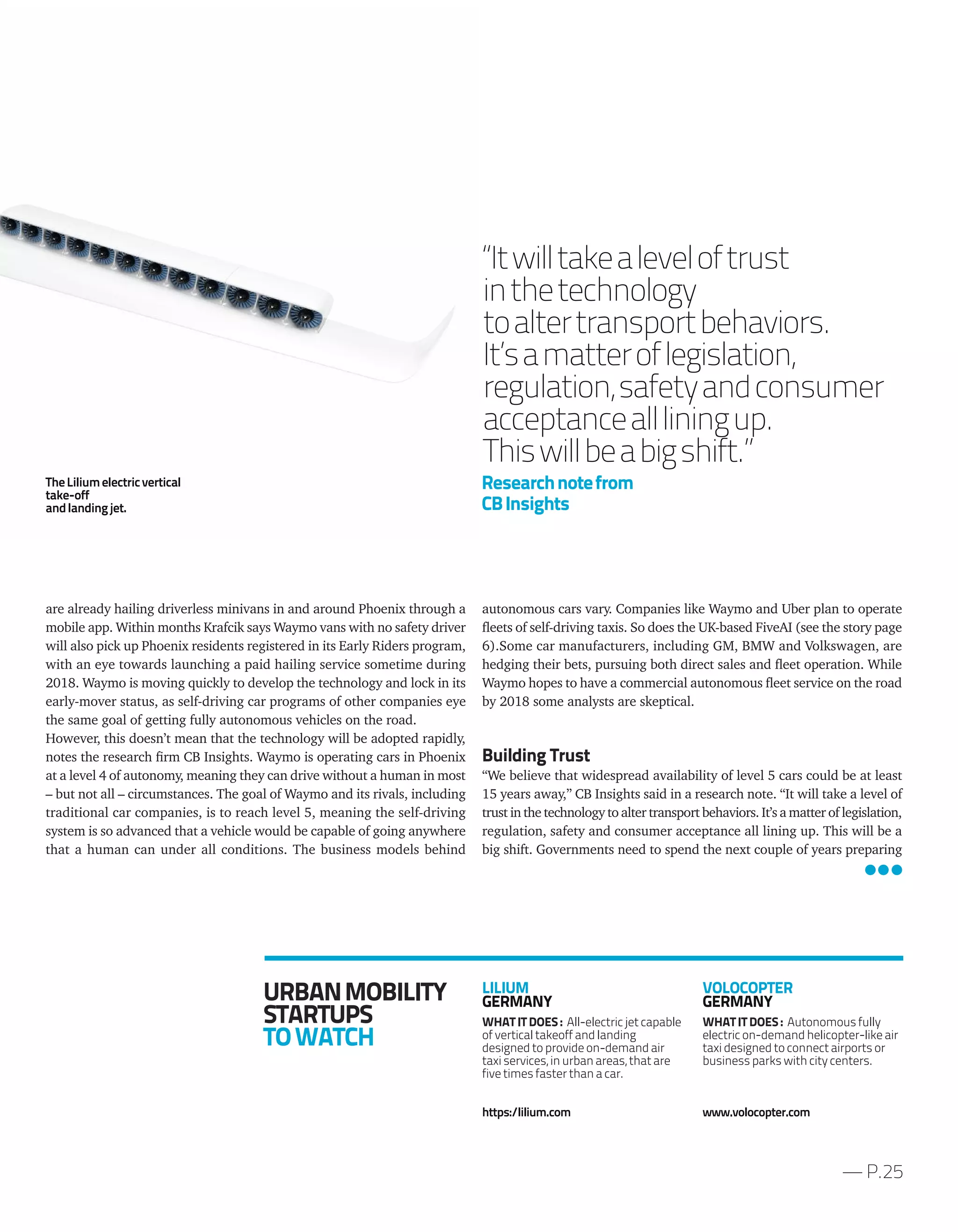
LILIUM
GERMANY
WHAT IT DOES : All-electric jet capable
of vertical takeoff and landing
designed to provide on-demand air
taxi services, in urban areas, that are
five times faster than a car.
https:/lilium.com
VOLOCOPTER
GERMANY
WHAT IT DOES : Autonomous fully
electric on-demand helicopter-like air
taxi designed to connect airports or
business parks with city centers.
www.volocopter.com
TheLiliumelectricvertical
take-off
andlandingjet.
the proper legislation, says Lucy Yu, who handles public policy for FiveAI,
which is also developing autonomous driving software. It is working with
Transport of London to test self-driving services in London by the end of
2019. For safety’s sake there need to be global standards for how autonomous
cars should behave under certain circumstances, says Yu. And cities need
to prepare for a very different future. While the timeframe for the uptake
of autonomous vehicles and aircraft remains uncertain, the introduction
of autonomous cars and VTOLs are expected to change city centers. If
pundits are right, few, if any, people will own their own cars, there will be
fewer cars on the road and they will operate more efficiently, meaning
cities will be greener, at least in principal. It is important that cities think
about this early on and envision what they want to do with unneeded
parking lots and extra space, says Yu. “Otherwise the great promise and
potential being sold to the public won’t be met.”
Yu says she sees autonomous vehicles as a complement to existing public
services. But it is yet unclear how private and public transport services
will work together to create the truly seamless types of mobility-as-a-
service offerings that are envisioned.
A Question of Control
The promise is that we will soon be able to smoothly move from our desired
destination to anywhere we want to go in a city, whether it be by ride-
hailing a VTOL or car-sharing service, bicycle, scooter, bus, train, metro,
or a combination of any of these services.
But to work well, mobility-as-a-service will demand significantly more
cooperation between companies and industries as well as a new digital
infrastructure layer. The question is whether that future will be centralized
and controlled by one or more big commercial players – such as a car
company building a closed ecosystem or a Silicon Valley player like Google
– or whether an open system will take root. “Everybody wants to have
an exclusive platform,” says Yu. “Cities have a lot of influence, so one of
the things cities can do is develop licensing requirements that spell out
what operators of private services must do for cities in return for a license.”
Until such details are worked out, new forms of autonomous transportation
like VTOLs might have trouble taking off.
J.L.S.
VULOG
FRANCE
WHAT IT DOES : Offersasoftware-as-
a-servicesolutionthatenablesautoma-
kers,carrentalcompanies,energy
companiesandstartupstolaunchand
operatesharedmobilityservices.
www.vulog.com
NAVYA
FRANCE
WHATIT DOES: Makerofafullyelectric
andautonomoussharedtaxiandan
autonomousshuttle.
navya.tech
LESS
FRANCE
WHATITDOES: Aride-sharingservicefor
commutersandothershort-distance
rides.ItwillcompetewithBlaBlaLines,a
ride-sharingmobileappfordaily
commuteslaunchedbyBlaBlaCar.
www.less.com
FIVEAI
UNITEDKINGDOM
WHATITDOES: An end-to-end solution
for autonomous cars, including a
software platform and a self-driving
taxi fleet.
www.five.ai
P.26 — THE INNOVATOR
TRANSPORTATION
TheLiliumJet,top,
andtheVolocopter2X,above.
2
3
4
5
1
Five Facts About Bitcoin
Brought to you by eToro
There are now hundreds, if not thousands, of decentralised, digital
‘cryptocurrencies’. They are all spawned from Bitcoin, the original
crypto. It was released as open-source software in January
2009 by the mysterious Satoshi Nakamoto – the unknown
person (or persons) who developed Bitcoin, and simulta-
neously invented the first blockchain database.
Initially individuals ‘mined’ Bitcoins, using powerful
computer software to crack complex algorithms
and ‘solve’ blocks in the blockchain, the digital
ledger that underpins Bitcoin. Nakamoto mined
the first block of Bitcoins – the so-called
‘genesis block’ – and was rewarded with 50
tokens. It is estimated that Nakamoto mined
1 million Bitcoins in the early years.
Less than three years after Bitcoin’s
launch, Satoshi Nakamoto vanished from
the internet – and has neither been heard
of since nor positively identified. At that
point the total value of all Bitcoin in circu-
lation was over $54.5 million.
Laszlo Hanyecz made the first document-
ed purchase of a good using Bitcoin on
22nd May, 2010. The Florida-based pro-
grammer paid 10,000 tokens in exchange
for two pizzas. Back then they were worth
roughly $25, but at the time of writing that is
equal to more than $40 million.
Since 1st January, 2017, the price of Bitcoin has
surged dramatically – 683% as of 16th November,
2017. That compares favourably against the S&P500
(15%) and UK100 (4%). By mid November, Bitcoin’s
market capitalisation was $125 billion, having hit an
all-time high of $7,800 per coin, surpassing Goldman Sachs
market capitalisation.
CRYPTO NEEDN’T BE CRYPTIC
Learn more about trading Bitcoin at eToro.com
• Buy and Short cryptos manually
• Copy the trades of our crypto experts
• Invest in our innovative Crypto CopyFund
All trading involves risk. Only risk capital you’re prepared to lose.
The information above is not investment advice. Past performance is not an indicator of future results. Trade.Invest
Five Facts About Bitcoin
There are now hundreds, if not thousands, of decentralised, digital
‘cryptocurrencies’. They are all spawned from Bitcoin, the original
crypto. It was released as open-source software in January
2009 by the mysterious Satoshi Nakamoto – the unknown
person (or persons) who developed Bitcoin, and simulta-
Initially individuals ‘mined’ Bitcoins, using powerful
computer software to crack complex algorithms
ledger that underpins Bitcoin. Nakamoto mined
-
grammer paid 10,000 tokens in exchange
for two pizzas. Back then they were worth
roughly $25, but at the time of writing that is
Since 1st January, 2017, the price of Bitcoin has
surged dramatically – 683% as of 16th November,
2017. That compares favourably against the S&P500
(15%) and UK100 (4%). By mid November, Bitcoin’s
market capitalisation was $125 billion, having hit an
all-time high of $7,800 per coin, surpassing Goldman Sachs
P.28 — THE INNOVATOR
MakingWaves
— Startups are reducing dependence on fossil fuels
and transforming electric car batteries.
Waveenergyhaspotentialasanalternativeenergysource,but
companies have had a tough time trying to commercialize the technology.
It costs too much to set up, no stationary equipment has been developed
toreliablydealwithwavesashighas20metersormoreandenvironmentalists
have objected to the presence of massive new structures on the ocean floor.
To make matters worse, insurance companies have refused to underwrite
projects due to the high risks. None of that fazed Inna Braverman, who
majored in English and political science at the University of Haifa in Israel
before co-founding Tel Aviv-based Eco Wave Power.
She and her co-founder, David Leb, believe they have cracked the problems
that have held back the sector. Rather than tethering multi-million-dollar
edifices to the ocean floor, Eco Wave Power uses buoys that are attached
to any type of structure, such as breakwaters, piers or jetties, to produce
waves when the buoys move up and down, driving a hydraulic piston to
deliver high kinetic pressure to an onshore generator to create electricity.
“Our floaters produce electricity at prices that are lower than wind and the
same as solar,” says Braverman.
The company has projects and project orders in the UK, China, Mexico,
Chile, Israel and Gibraltar. “Most of the wave-energy companies are managed
and owned by engineers and scientists,” says Braverman. “That’s a good
thing because they have a lot of knowledge,” she adds, “but it is also a bad
thing. The main difference with our project is thinking outside of the box.”
Braverman, a speaker at Slush, a technology conference in Helsinki on Nov.
29 and 30, is an example of how non-experts from outside particular
industries make waves by coming up with solutions that others think
impossible. Successful moon shots in the energy sector can have a particularly
big impact. “If you can bring energy to everyone, we can solve every
problem: education, food, medical, mobility, heating, cooling, etc.,” says
George Coelho, a senior advisor to Quadia, which provides private equity
and debt financing to companies that are inventing a regenerative economy
and driving global sustainability.
BatteriesGoGreen
Tech entrepreneurs are taking up the challenge in a variety of other ways.
A move to electric cars will have an important impact on the environment
but battery life is still an issue. Enter Storedot, an Israeli startup presenting
at Slush that makes an electric car battery it says can fully recharge in five
minutes, allowing a driver to travel 300 miles without worry. Lithium-ion
packs are also key for automakers banking on a new generation of plug-
in vehicles. Northvolt, a Swedish company founded by Peter Carlsson, a
former Tesla executive scheduled to speak at Slush, is aiming to cut the
cost of storing power in half by building a €4 billion lithium-ion battery
factory.
The objective is to build the world’s greenest battery, with a minimal carbon
footprint and the highest ambitions for recycling, to enable the European
transition to renewable energy, according to the company. Energy storage
is seen as the missing link in the world’s shift to a zero-carbon economy.
ENERGY
Batteries can fill power gaps from intermittent solar and wind energy.
Another startup, Sonnen, a GE Ventures-backedmakerofresidentialbatteries,
is doing just that. It has developed a home energy battery storage unit that
connects to off-grid energy sources, allowing users to obtain, store and use
free electricity from the community without needing to connect to a public
utility. The batteries can also be used to balance out fluctuations in the
public power grid, helping to stabilize it. This energy management service
is provided thanks to a pool of thousands of sonnenBatterie units that are
digitally linked to one another.
TenneT, a European transmissionsystems operator with 41 million customers,
is trialing a service that uses the blockchain to harness Sonnen’s battery
storage capability, helping it overcome issues related to so-called re-dispatch
measures, which were designed to prevent regional overloads on Germany’s
electric grid.
BlockchaintotheRescue
In Germany, there are restrictions on how much of the wind energy produced
in the north of the country can be transported to the industrial centers in
the south in order to prevent too much power from flowing through the
grid at the same time.
Under the current system, energy suppliers in Germany make a forecast of
how much energy consumers will use the next day. Then they go to an
energy exchange or the operators of power plants, buy that amount of
electricity and provide the information to TenneT, which runs a simulation
of the electricity flows on the system to make sure there is enough capacity.
If any of the calculations are off-base, TenneT might have to pay a power
plant in the south to generate more energy and/or pay damages to a wind
farm in the north that produced too much energy for the power lines to
handle. That is where Sonnen comes in. In the pilot project, a network of
residential solar batteries is being made available to store the energy, helping
reduce the imposition of limitations on wind energy at times of insufficient
transport capacity. The blockchain presents TenneT with a view of the
available pool of flexible battery power. If activated, the blockchain records
the batteries’ contribution, enabling the integration of renewable energy
sources into the German electricity supply system.
As energy demand continues to rise, particularly in emerging markets, due
to growing populations, ongoing urbanization and rising wealth levels,
startups are stepping in with energy efficiency solutions.“Smart Grid, storage,
distributed generation, energy efficiency solutions for buildings – start-ups
areplayingaroleinalloftheseareas,especiallysoftware,nowthatrenewable
generation is more commoditized in wind and solar PV,” says Coelho. “And
don’t forget that mobility and the rise of electrification and self-driving
and car sharing will also cause changes in the energy business which start-
ups will serve.”
If pundits are right, the energy sector is likely to continue to generate
powerful opportunities for startups for some time to come.
J.L.S.
ENERGY
STARTUPS
TOWATCH
ECOWAVEPOWER
ISRAEL
WHAT IT DOES : Usesbuoysthatare
attachedtostructuressuchaspiersor
jettiestoproducewaveswhenthe
buoysmoveupanddown,drivinga
hydraulicpistontodeliverhighkinetic
pressuretoanonshoregenerator.
www.ecowavepower.com
NORTHVOLT
SWEDEN
WHATIT DOES: Buildinga€4billion
lithium-ionbatteryfactoryinEurope
withtheaimofcuttingthecostof
storingpowerinhalf.
northvolt.com
STOREDOT
ISRAEL
WHATITDOES: Developed an electric
car battery it says can fully recharge in
five minutes, allowing a driver to travel
300 miles without worry.
www.store-dot.com
“Ifyoucanbringenergy
toeveryone,wecansolveevery
problem:education,food,
medical,mobility,
heating,cooling,etc.”
— P.29
GeorgeCOELHO,
asenioradvisortoQuadia,
whichoffersprivateequityanddebtfinancing.
P.30 — THE INNOVATOR
HEALTH
BAYERFOUNDATION
HEALTH
STARTUPS
Whileentrepreneursarecreditedwithchangingtheworld, they
sometimes do it with the help of big corporates who have been pioneering
social progress since long before the Internet was invented. The Bayer
Foundations, an arm of Bayer, the German global life sciences company
that focuses on the health care and agriculture sectors, has been funding
health, nutrition and education since 1897, when Friedrich Bayer Junior
created the framework for Bayer’s first activities as a foundation.
Today the foundation sets aside a total of $15 million a year to fund star-
tups and projects aimed at social good. Representatives of the foundation
attend technology conferences to seek out and inspire entrepreneurs ready
to work on globally impactful problems.
Companies can do well by doing good, but Thimo Schmitt-Lord, the Bayer
Foundations’ CEO, tells them, “if you want to be a startup billionaire, you
have to solve a billion peoples’ problems.” For the Bayer Foundations that
means focusing on issues like health and sanitation. The challenges are
huge. “I don’t have to tell you that the global health care system is broken
– completely and utterly broken!” Eugene Borukhovich, Bayer’s global head
of digital health and innovation, wrote in an essay for a Bayer Foundations
publication. “Incentive systems across the supply chain are fractured, with
a complete lack of focus on humans and an ICD code for billing instead.”
What is needed, he says, is to move the focus back to serving humanity
and to innovating in areas where there is a lack of resources and access.
For example, breast cancer is the most common invasive cancer in wo-
men. Survival depends on early detection, but since mammagrams are
expensive, 70% of breast cancer deaths occur in disadvantaged areas.
India leads the breast cancer mortality statistics because mammographies
are not affordable for most women, so early breast cancer screening is al-
most non-existent.That’s why the Bayer Foundations says it chose to fund
a project developed by medical device entrepreneurs at UE Life Sciences
called iBreastExam, a handheld sensor for the detection of breast lesions.
Using patented tactile sensor technology, the device can be operated by
community health workers with only minimal training – at a low cost –
for the early detention of breast cancer in all types of settings.
The Refugee First Response Center, another of some 17 health projects
funded by the foundation, is targeting the estimated 65 million refugees
currently seeking shelter, safety and medical aid. Harald Neidhardt, CEO
of the innovation agency and conference organizer MLOVE; and Mirko
Bass, technology evangelist at Cisco, developed a mobile health clinic in
a converted shipping container that provides ad-hoc video translations
services to connect doctors and patients with more than 750 live inter-
preters who are fluent in more than 50 languages. That project is now a
catalyst for a new venture called the Promise Hub. (For information about
how to contribute to that project see page 12.)
Toilets of the Future
Sanitation is another area primed for disruption. According to the World
Health Organization (WHO), some 2.4 billion people around the world
ImprovingGlobal
Health
— The Bayer Foundations are funding projects
that aim to solve the problems
of millions or even billions of people.
TheiBreastExamscreeningdevice
REFUGEEFIRSTRESPONSE
CENTER
GERMANY
WHATITDOES:Convertsshipping
containersintomobilemedicalresponse
centersforrefugeesandoffersthema
high-tech,on-demandtranslatorpool
capableofprovidinglivetranslationsby
medicalspecialistsin50languages.
http://refugeefirstresponsecenter.com
FITED
UNITEDSTATES
WHATITDOES: Ascreeningappwith
integrated3Dworkshopprocedures
enablinganyoneanywheretobe
diagnosedforscoliosisandgeta
custom-fitmedicalcorset.About2%of
thepopulationisaffectedbythiscondition,
especiallyinthedevelopingworld.
https://www.fited.co/
IBREASTEXAM
UNITEDSTATES
WHATITDOES:Ahandheldbreast
cancerscreeningdevicethatmakes
earlyscreeningaffordable,givingevery
healthworkertheabilitytodoeffective
breastcancerexaminationswithinfive
minutes–withouttheneedfora
professionalenvironmentanditscosts.
http://www.ibreastexam.com/
SANISOLAR
GERMANY
WHAT IT DOES : Asanitaryouthouse
designedforthemillionsofpeoplein
Africawhohavenoaccesstotoilets,Sani
Solardrieshumanwastewithsun
power,reducingthespreadofdisease
andeliminatingtheneedforanexternal
disposalserviceormaintenance.
3psanitation.de/
— P.31
part of the problem,” says Marc Buckley, a juror and open innovation ad-
visor to the Bayer Foundations. “The Bayer Cares Foundation wants to see
more impactful global solutions and we want the disrupters of current
models to come in to share their startup for the good of the planet and
people.” While the Bayer Foundations have had a strong focus on health
projects, the scope is being widened to include startups targeting the agri-
culture, food and beverage industries. Buckley is also on the the EAT and
World Business Council for Sustainable Development’s Food Reform for
Sustainability and Health (FReSH) Innovation Hub Task Group, which is
also looking for agriculture, food and beverage innovations that will re-
form the food system and steer the industry into a sustainable direction.
The launch of the Hub is planned during the World Economic Forum
Annual Meeting, which runs January 23rd to 26th.
Buckley, the Bayer Foundations CEO Schmitt-Lord and other members
of the Bayer Foundations’ teams will be scouting for interested entrepre-
neurs at Slush.
J.L.S.
AdoctorexaminesapatientintheRefugeeFirstResponseCenter,
withaninterpreterreadytotranslateviavideo.
still lack access to decent sanitation facilities. The typical approach for an
on-site, off-grid sanitation solution without water is still based on the la-
trine concept, which is more than 2,000 years old. Although the WHO
considers this simple toilet to be an improvement over open defecation,
it introduces other problems. The storage and removal of waste from la-
trines can easily transfer the bacteria, viruses and parasites found in hu-
man excrement to water, soil and food.
Contamination is one of the major causes of diarrhea, which is the second
biggest killer of children in developing countries and also leads to other
serious diseases. To solve the problem, a German entrepreneur working
for 3P Technik Filtersysteme came up with a sun-powered toilet for re-
mote areas in hot regions. Human waste is dried and reduced using the
heat of the sun. The toilets require a one-time investment with no future
costs. Today they are made in Germany but in the future could be pro-
duced locally with local materials.
While all of these most recent health projects were created by entrepre-
neurs, none were launched by startups from the tech community. “This is
P.32 — THE INNOVATOR
Planet Labs is indexing
physical changes on Earth the same
way Google indexes text on the
Internet, helping businesses and
humanitarian causes.
The company has so far sent some
300 miniaturized satellites into low
orbit. Today, around 200 of them
continually photograph the 57.3
million square miles of Earth’s land
mass, sending back high-resolution
images of the Earth every day.
The idea is to make global change
visible.“What we are helping people
to see is all the change that happen,”
says Planet Labs Co-founder and
CEO Will Marshall, a scheduled
speaker at Slush, a technology
conference in Helsinki Nov. 30 to
Dec. 1. “ You can’t fix what you
can’t see. With our images you can
stop illegal deforestation and illegal
mining as soon as it starts.”
Building A Business
Planet Labs has customers in energy,
infrastructure, farming, forestry,
insurance, defense and business
intelligence. But it is also providing
imagestonon-governmentalagencies
such as the United Nations and
Federal Emergency Management
AgencyintheUStohelpwithdisaster
response.
“We started Planet because of its
potential to aid humanitarian causes
and then we realized that the best
way to have that impact and be
sustainable was to develop a highly
profitable business model,” says
Marshall, a scientist who previously
worked at NASA.“We feel good
about the fact that we are doing
humanitarian stuff,” says Marshall.
“But we also have a very, very strong
business case and some new
emerging markets for us are going
to be very exciting. One new area
is finance.
“With our images we can tell the
output of copper mines or the levels
of the world’s oil drums, the number
of ships in all the port’s ships or
the acitivity of the world’s soy fields.
This is valuable for the people
betting on all the world’s
commodites. This is going to be a
massive market for us.”
Finding A Purpose
Marshall says he plans to send a clear
message to attendees of Slush: “They
should not start with cool tech just
to get it out there. Start by asking
‘what are the challenges of the world
and what and I am going to do about
those challenges? What kind of
organizational structure do I need
to do that. Money and technology
should not be the driving factors.
Helping the world should be the
drivingmotivation.Andifyoudiscover
thatwhatyouaredoingisnothelping
humanity then scrap that plan and
do something else. We don’t need
more projects to develop stupid apps
that waste everyone’s time. You can
buildcompaniesthathavetremendous
business and humanitarian impact,
these two things can be very
synergistic.”
J.L.S.
Picture
This— How satellite images of Earth that are updated daily
can help business, government and
the UN’s Sustainable Development Goals.
SatelliteimagesfromPlanetLabs
showhowanillegalminingoperation
inPeruencroachedonthe
TambopataNationalReserve,
aprotectedforest.
“WestartedPlanetLabsbecauseofits
potentialtoaidhumanitariancauses
andthenwerealizedthat
thebestwaytohavethatimpactand
besustainablewastodevelopahighly
profitablebusinessmodel”
WillMARSHALL,
PlanetLabsCo-founder
andCEO
P.34— THE INNOVATOR
search firm CB Insights. In 2017, funding has already more than doubled
compared to last year, and the number of deals has risen 65%.
Like an increasing number of farms, Tom Farms is turning to modern tech-
nology. It practices precision farming, an approach based on observing,
measuring and responding to variables in fields. Drones provide aerial ima-
gery and social scientists gather samples on every hectare grid so Tom Farms
can know just the right amount of water and fertilizer each acre needs.
Microbes for Stronger Plants
The use of microbiomes is attractive because they could help increase yield
further while reducing water use and allow for more efficient use of ferti-
lizer, by lowering the amount used to produce every bushel of crop, says
Tom. “My goal is to increase productivity per unit of production and help
our plants become healthier and I am confident they will.”Like human mi-
crobes, plant microbes evolve over time to improve and protect plants but
can be impacted by factors in their environment including heat, drought
and modern agricultural practices that have introduced the widespread use
of chemicals.The serial entrepreneur David Perry, Indigo’s CEO, says he
AfterimmigratingtotheUnitedStatesfromSwitzerland, the Tom
family made its way West, settling on a small patch of fertile Indiana prairie
land in 1837. Today, Tom Farms, which is still owned by the family, spans
20,000 acres. It is one of the largest suppliers of seed corn to the global
agrochemical conglomerate Monsanto and a major supplier of corn and
soybeans to pork, beef and dairy producers and for bio-fuel production.
It is also serving as a test bed for technology created by ag tech startups like
IndigoAgriculture.Indigo,a2017WorldEconomicForumtechnologypioneer,
uses plant microbiomes to strengthen crops against disease and drought to
increase crop yield for farmers.
Indigo believes it can obtain 30% to 50% yield improvements over the next
10 years for cotton, rice, wheat and soy crops, helping the world meet an
expected 40% increase in demand for food by 2050. The improvements
also promise to save water and reduce the need per unit of production for
fertilizers,fungicidesandpesticides.TomFarmshasplantedIndigoAgriculture’s
specially coated seeds on 750 acres and is waiting for the harvest to see
what impact it will have on crop yield. The precise results are not available
yet but look positive, Tom says. “This is a brand new space – this is a moon
shot – but this is what we need,” says Kip Tom, who has managed Tom
Farms for the last 43 years. Using microbiomes to improve plant health will
not only help farmers like him but also those in developing markets who
must grow crops in difficult conditions, says Tom.
As farmers around the world face demands to ramp up food production in
response to water shortages, population growth and increasingly erratic
weather due to climate change, a growing crop of startups are stepping up
to help. Solutions range from robotics that replace the manual-labor part
of the farming process or survey farm health to a variety of software, ser-
vices and techniques. For example, Plantagon International, a Swedish star-
tup, is proposing that cities build office towers that contain giant automated
indoor farms using hydroponics, a method of growing plants without soil
in a nutrient-rich water solvent. Ag tech startups have raised global equity
funding of $1.5 billion across 453 deals since 2013, according to the re-
FOOD
IncreasingNature’s
Bounty
— Startups are developing technologies to give farmers
the potential to meet an expected 40% surge in demand
for food by 2050.
AGTECH
STARTUPS
TOWATCH
INDIGOAGRICULTURE
UNITEDSTATES
WHATITDOES: Usesplant
microbiomestostrengthencrops
againstdiseaseanddrought,tohelp
farmerssustainablyfeedtheplanet.
https://www.indigoag.com/
TomFarms
inIndiana.
the same range for cotton, soy and rice, says Perry. “An approach that not
only improves the nature of the seed itself but allows it to grow in a wa-
ter-stretched environment with an improved yield can have a big impact,”
says Mehmood Khan, Vice Chairman and Chief Scientific Officer of PepsiCo
and a member of Indigo Agriculture’s board. The current world popula-
tion is 7 billion. By 2050 the population is expected to grow to 9.5 billion.
“There can not be an increase in land and the global water supply is dimi-
nishing so how are we going to feed 2.5 billion more mouths?” asks Khan.
A key reason for the water shortage is that a majority of it is used in the
production of agricultural products. “So if we are going to solve the wor-
ld’s water crisis we are going to have to solve it through agriculture,” he
says. Tom says he is confident that tech such as biomes, data science,
CRISPR-Cas and others will play an increasingly important role in impro-
ving farming. “We have a social obligation to society and humanity to pro-
vide food sources for people in a sustainable way and at the same time to
protect the environment,” he says. “We’ve deployed a lot of new techno-
logies and I am challenging the next generation and telling them they are
going to have to do that too when they take over.”
J.L.S.
started with the premise that “if you could figure out which microbes are
beneficial to plants and put these microbes back you would have healthier
plants that would yield more.” By using genomic sequencing and compu-
tational bioinformatics, Indigo assembled an enormous database of gene-
tic information from these microbes, then applied algorithms and machine
learning to predict which ones are most important to the plants’ health.
These specially selected microbes are used to coat seeds of corn, cotton,
rice, wheat and soy crops. The company has commercialized the treatment
for its first five crops. About a half a million acres have been planted with
the specially coated seeds, mostly in the U.S., but the company is also star-
ting to plant fields in Australia, Argentina and Brazil.
Initial results are promising, prompting CBInsights to recently name Indigo
as one of 30 companies that could change the world. Farmers report a 5%
to 15% yield improvement from the initial treatment, says Perry. The rate
varies depending on the crop and conditions. In addition the treatment is
proving effective in helping plants use water more efficiently. “Preserving
our fresh water is one of the biggest issues facing our planet and 70% of
water goes into agriculture,” he says. In September Indigo reported a 6%
to 8% improvement in water efficiency for wheat growing in Kansas and
— P.35
BENSONHILLBIOSYSTEMS
UNITEDSTATES
WHATITDOES: Improvescrop
performancethroughplantbiology,Big
Data,andanalyticalcloudcomputing.
http://bensonhillbio.com/
SCREENSEED
FRANCE
WHAT IT DOES : Usesanopticalsensor
andmachinelearningalgorithmsto
acceleratedrugdiscoveryforseed
treatments,withtheaimofcreating
highercropyieldsandhealthierplants.
https://screenseed.com
PROSPERA
ISRAEL
WHAT IT DOES : Uses computer vision
and artificial intelligence to analyze
data gathered from fields in order to
increase farm productivity.
https://www.prospera.ag/
ENDURABIO
UNITEDSTATES
WHATITDOES: Engineers salt- and
drought-tolerant plants to increase
yields from marginal lands globally,
with the goal of increasing farmers’
potential to feed the world.
www.endurabio.com
“Wehaveasocial
obligationtosocietyandhumanity
toprovidefoodsourcesforpeople
inasustainableway
andatthesametimetoprotect
theenvironment.”
KIPTOM,
headofa20,000-acrefarmintheU.S.
thatistestingplantmicrobiomesdevelopedbythe
startupIndigoAgriculturetostrengthencropsagainst
diseaseanddrought.
IndigoAgriculture
CEODavidPerry(L)withFounder
GeoffreyvonMaltzahn.
MOL FREDESS
Ifeverasectorwasripefor
disruption it is food. Livestock is a
major contributor to greenhouse gas
emissions and uses up a significant
portion of land and of the world’s
water and food supply.
When you factor in the anticipated
explosion in global population and
demand for protein, the situation is
simply not sustainable.
Startupsusingtechnologytoengineer
meat in labs or manufacture it from
plant-based products are threate-
ning the future of the $90 billion
meat industry, from farm to table.
The meat value chain could be sim-
plifieddramatically,assocalled“clean
meat” laboratories that manufacture
meat from animal stem cells take
the place of farms, feed lots and
slaughterhouses, according to a re-
cent report from the research firm
CBInsights.
The fishing industry is also facing
massive disruption, as is the dairy
market. Startups are experimenting
with a variety of new ways to “make”
meat. Impossible Foods, a major
player in the space, leverages mo-
lecular engineering to create “blee-
ding” plant-based burgers that the
company claims are nearly indistin-
guishable from meat.
The company’s discovery of heme,
an iron-rich molecule in animal
proteins, has enabled it to replicate
the “meaty” flavor in their plant-
based products. The company re-
cently announced that it’s expanding
distribution channels to university
cafeterias, museum cafes, and other
retail outlets in the United States.
Beyond Meat is another major com-
pany making plant-based burgers
and other imitation meat products
such as chicken strips and beef cru-
mbles. The company also has been
experimenting with a plant-based
pork product.
Test-tube Meatballs
Lab-grown meat, also know as
“cultured or clean meat,” could be
abridgebetweenrealmeatandplant-
based products. San Francisco-based
Memphis Meats makes meat from
self-reproducing cells, thereby fabri-
cating meat that is an “animal-based”
product but avoiding the need to
breed, raise and slaughter huge nu-
mbers of animals.The company de-
buted its first synthetic meatball in
2016 and followed up with the wor-
ld’s first cell-cultured chicken and
duckearlierthisyear.AndthreeIsrael-
based startups -- SuperMeat, Future
Meat Technologies and Meat the
Future -- have announced a deal to
import lab-grown meat to China as
part of a broader government plan
to decrease the country’s meat
consumption by 50%.
While still in early stages of research
and development, fish-free products
are further expanding the possibili-
ties of an animal-free future, says
the CBInsights report.
New Forms of Protein
Finless Foods uses cellular agricul-
ture to develop faux fish meat, while
NewWaveFoodsproducespeaprotein
and algae-based imitation shrimp,
the French startup ODONOTELL pro-
ducesalgae-basedsalmonandOcean
Hugger Foods has developed ahimi,
a tomato-based raw tuna substitute,
aneggplant-basedeelandcarrot-based
salmon substitutes.
As with animal-free meat, analysts
say fishless foods could radically sim-
plify and clean up the seafood pro-
duction value chain.
Startups are also building businesses
aroundmakingsnacksorfoodstaples
such as flour from insects. Cricket-
raising results in 100 times lower
greenhouse gas emissions than beef
cow production, and crickets also
have higher proportions of protein
than beef or chicken, according to
CBInsights. And because crickets re-
quire proportionally less feed than
livestockanimals, production is more
efficient.
Animal-free dairy products are also
on the horizon. Perfect Day, a U.S.
startup, makes milk without the need
for a single cow. The co-founders
obtained a strain of yeast, which they
call Buttercup, from an open-source
U.S. Department of Agriculture da-
tabase. They then obtained a cow’s
Reinventing
Food
— Lab-made meat, fish and diary are transforming
farm to table.
FOOD
P.36 — THE INNOVATOR
DNA sequence, had it printed using
a 3D-printer and inserted it into a
specific location of the yeast, conver-
ting plant sugars into milk proteins
(casein and whey) using fermenta-
tion. The milk proteins were then
combined with plant-based fats and
nutrients to get milk that’s lactose
free. “We are creating animal-free
dairy proteins that provide the same
exceptional nutritional benefits of
animal-derived dairy protein while
leaving a kinder, greener footprint,”
says Perfect Day co-founder Ryan
Panda.The bulk of the dairy indus-
try’s output – around 80% – is not
consumed as milk but is used by the
food and beverage industry to pro-
duce a whole range of products like
yogurts, cheeses and salad dressings.
Just, formerly known as Hampton
Creek Farms, is making eggless
mayonnaise while Notco is making
plant-based greek yogurt, cheese and
milk in addition to mayo.
Activeinvestorsinthefoodtechspace
include IndieBio, which has placed
bets on Memphis Meats, New Wave
Food, and Finless Foods, as well as
startups focusing on dairy like Perfect
Day and Notco. Large corporations
involved in the meat industry are
investing in meat innovation as a
is still significantly more expensive
than meat from traditional sources
and some question how easily it will
scale. “Though many startups in the
space claim that their products will
revolutionize meat consumption, the
questionremainswhethercleanmeat
and substitute foods will provide a
scalable method to feed the future –
or whether it’s simply a new wave of
molecular gastronomy.”
J.L.S.
WATERUSE GREENHOUSEGASEMISSIONS LANDUSE PRODUCTIONCOST
1,799gallons
324gallons
16pounds
3.52pounds
260 ft2
2.6ft2
$1.05
$12
OURMEATLESSFUTURE:
COSTSAND
BENEFITSPERPOUND
ANIMAL-BASED
LAB-GROWN
form of outsourced R&D, notes
CBInsights.
Investing in Alternatives
The food-trading giant Cargill parti-
cipated in Memphis Meats’ Series A
round, while Nestle, which owns a
number of frozen food brands that
incorporate meat, acquired the ve-
gan prepared-foods producer Sweet
Earth in September. Additionally, the
69%
2006
Requiredincreaseinfoodcaloriestofeed9.6billion
peopleby2050
2050
— P.37
rise of funds with a strong emphasis
on alternative meat production and
innovation,suchasTysonNewVentures,
suggests that meat producers foresee
the possibility of a meatless future.
Tyson New Ventures made its first in-
vestment in Beyond Meat in October
2016, an indication that it may be
looking to pivot from a meat produ-
cer to a more broadly protein-frien-
dly brand, according to the report.
Nevertheless, today lab-grown meat
Source : CBInsights, Waterfoot Print Network, Food Climate Research Network
and press reports.
P.38 — THE INNOVATOR
FINANCIAL SERVICES
The Wall Street veteran
Sallie Krawcheck is the co-founder
and CEO of Ellevest, a digital invest-
ment platform for women that has
raised $44.6 million in funding.
Ellevest’s goal is to work to close the
gender investing gap in the United
States. The AI-powered platform tai-
lors investments to the realities of
women’s careers: they face a gender
pay gap, they live longer, and their
salaries peak earlier than men’s, so
theyneedtosaveforretirementdiffe-
rently.
You’ve said you view finance as the
final frontier and the fourth wave
of feminism. Why do you hold that
point of view?
— SK: Money is power in capita-
lism and men have more money
than women do. My opinion, and
the opinion of many of the women
I talk to, is that to be equal with
men you need to be financially
equal with men. The first step is to
be in financial control, which
doesn’t mean being independently
wealthy. It means being able to
stand on your own two feet finan-
cially so that you are free to leave
a bad job or a bad relationship and
start your own business and live
your dream. It is crucial but in the
U.S. mothers have told their
daughters that talking about mo-
ney is crass, unattractive and tacky
so it is not part of our vocabulary,
we don’t know how to invest, we
don’t talk about it with our friends.
That is why I launched Ellevest, to
break these taboos so that women
can earn the market returns men
have earned all along.
What else is holding women back?
— SK: When I was at Merrill Lynch
wedidresearchthatshowedthatwo-
men need more financial education.
Somehow we are deficit in this area
but so are the guys. The difference
is men will invest in products they
don’t understand and women will
not. You can think “silly men,” but
the real challenge is that historical-
ly men have earned the returns and
women have kept more of their mo-
ney in cash and this has added to the
genderinvestinggap,whichcostswo-
men as much as the gender pay gap.
How does Ellevest aim to close the
gap?
— SK: Our investing and planning
programissolelyfocusedonher,mea-
ning we do things that take into ac-
count women’s longer lives, the fact
that women earn less and take more
career breaks. All of these things are
veryimportantwhenyouputtogether
an investing plan for retirement, but
some 86% of financial advisors are
male so, without meaning to impli-
citly, they have made it into a bu-
siness aimed at men. For example,
the entire industry is built for people
who want to outperform the market.
The percent of women who want to
outperform the market is zero. What
they do want is to reach their goals.
Our technology can do very power-
ful calculations based on how much
shemakes,whatshewantstoachieve
and what her assets are.
How many women are using the
Ellevest platform?
— SK: In one year we have built a
community of 100,000 women and
we have in excess of 6,000 clients. I
see this as a huge growth opportu-
nity.
You recently raised a new $34.6
million round of financing. How
will you use the funding?
— SK: We are adding financial advi-
sorsandplanners.Ourclientsarereal-
ly asking for that. They want a per-
sonal touch as well as the digital ex-
perience.
What should the financial industry
as a whole do to help close the
gender gap?
—SK: SendfemaleclientstoEllevest.
J.L.S.
ClosingtheGender
Divide— Sallie Krawcheck created Ellevest, a startup
offering an AI-powered digital platform, to encourage
more women to invest.
P.40 — THE INNOVATOR
Multinationalfirmsconsider
havingtherightemployeesintheright
place a core part of talent strategy,
nota nichehuman resourcefunction.
Relocation management companies
called business process outsourcing
or BPOs have traditionally helped,
but the market is shifting to cloud
platformsascompaniesdemandtech-
nology and data to manage an in-
creasingly mobile and dispersed
workforce.
That is where MOVE Guides, a star-
tup offering a software-as-a-service
platform for employee relocation,
comes in. The company, which has
joint headquarters in London and
San Francisco, is disrupting tradi-
tionalrelocationmanagement,amar-
ket worth $11 billion, by some es-
timates, and adding what it calls
“mobility management” services.
MOVE Guides’ clients include high-
growth tech companies in Silicon
Valley and large multinationals in
the tech, media, financial and pro-
fessional services and manufactu-
ring sectors, says Brynne Kennedy,
the MOVE Guides founder and CEO,
and a scheduled speaker at Slush,
a technology conference in Helsinki
Nov. 30-Dec. 1.
Mobile Services
Today’s environment requires a very
different kind of resource planning,
says Kennedy, a former investment
banker who launched MOVE Guides
while studying at London Business
School. The market has moved from
coordinating logistics for 5% to 10%
of employees who have been tradi-
tionally managed to becoming a
strategic function involving as much
as 60% to 70% of the workforce, af-
ter factoring in employees who re-
locate for a short period and might
work for a week a month out of New
York City, for example, or have to
go to Paris for a month.
Employees who work abroad for a
short period of time are “a hugely
growing part of the employee seg-
ment at a large public company and
today that is not managed so we are
looking at products that pull in ex-
periences, compliance, and additio-
nal segments of employees,” says
Kennedy. “Ultimately we want to of-
fer services to anyone who is mo-
bile.”
MOVE Guides’ Talent Mobility cloud,
which can be integrated into core
HR systems, aims to support all as-
pects of a global mobility program.
Companies can instantly estimate
the cost of different types of moves,
track spend versus budget and ac-
cess all of their employee, vendor
and spend data with real-time
dashboardsandreporting.Employees
can learn about their benefits pac-
kage, obtain personalized informa-
tion about their new city and receive
status updates about the progress
of their relocation services, like ship-
ping.
Breaking Down Barriers
Certified partners are able to access
job authorizations and provide up-
dates on service delivery, which are
shared with companies and em-
ployees. MOVE case managers, who
act as concierges supporting em-
ployees while they are moving and
while they are on temporary assign-
ments, can instantly access all infor-
mation about the employees they
support in a single employee file.
MOVE Guide’s offering is “step one”
of what Kennedy says is her “lofty
vision of changing the world for mo-
bility so that economically and so-
cially there are less barriers between
people and places.” At the same time
that MOVE Guides is trying to ease
things for people who work at mul-
tinationals – who are usually part
of the top 5% of the global income
pyramid – it is also trying to make
life easier for the bottom 5%, many
of whom are forced into mobility
due to conflict. The company do-
nates 1% of its revenues to non-pro-
fits who aid refugees. “We have an
obligation in the tech community,
and frankly in the business world,
to give back,” she says.
J.L.S.
OnTheMove
— How tech Is helping
corporates deal with an increasingly mobile work force.
FUTURE OF WORK
— P.41
Samasourceworkswithcorporatepartnersto design digital work
that can be done by populations in Africa and regions of India that are
traditionallyoverlookedbyWesterncompanies.Thebasicideacametofounder
Leila Janah not long after she arrived in Africa to teach English more than a
decadeago.Farfromthenarrativesshe’dheardaboutapopulationindesperate
need of aid, she says, she instead met extraordinary people with strong
educations who were hungry for work.
“I was shocked at how talented my students were,” recalls Janah, a Harvard
graduate who grew up in New York. “What I saw when I was living there
was how much people wanted to work and how they were deprived of doing
something meaningful.” She wondered: Would it be possible to give these
peopleworkratherthanjustaid?TheanswertothatquestionwasSamasource,
a non-profit, social enterprise founded in 2008 to bridge the divide between
charity and for-profit business.
After years of fundraising, cajoling skeptical partners, and refining its bu-
siness plan, Samasource reached a huge milestone in 2016. For the first time
in its history, the organization was profitable based just on its earned reve-
nue from work contracts. No longer primarily dependent on donations,
Samasource has shown that its corporate partners – which include Walmart
Labs, Microsoft, eBay, Marriott, TripAdvisor and Volkswagen – don’t have to
choose between the bottom line and social good.
“These companies are getting their work done and helping to solve pover-
ty,” says Janah, a scheduled speaker at Slush, a technology conference in
Helsinki.JanahcontinuestousethatmomentumtoexpandontheSamasource
concept in a variety of ways. In 2011, she founded Samahope, a crowdfun-
ding site for medical procedures, that merged with Johnson & Johnson’s
platformin2015andistodayknownasCaringCrowd.Meanwhile,Samaschool
was launched in 2013 to train people in poor regions of the United States to
get jobs in the expanding gig economy. And two years ago, she launched
another social mission business, LXMI, a luxury skin care brand that employs
women in Uganda to harvest natural ingredients and transform them into
beauty products.
In late September Janah published a book about her personal journey and
philosophy called “Give Work: Reversing Poverty One Job at a Time.” Her
message has caught the attention of people like Reid Hoffman, co-founder
of LinkedIn and a venture capitalist at Greylock Partners. Hoffman was one
of the investors in the $3 million round of venture capital LXMI raised to
launch the business. That kind of backing is evidence of Samasource’s proof
of concept. Samasource hit its stride when it decided to focus on computer
vision technologies. The rise of artificial intelligence and autonomous tech-
nologies has created a surge in demand for the analysis of digital images. To
train algorithms and drive machine learning, companies spanning every
conceivable industry need humans to analyze and tag images.
Computer vision training turned out to be perfect for its savvy, English-
speaking workforce that had expanded to countries including Haiti, India
and Uganda. These teams are working with companies in industries such as
e-commerce and automotive. “We’re now one of the top providers for image
tagging for self-driving cars and other forms of computing,” says Janah. “And
it’s not out of charity, because we’re one of the top-rated providers in terms
of quality.” “When people hire us, they hire us to do a job,” says Janah. “So
we have to be able to do that job better than anyone else can do that job. If
on top of that, we provide a social benefit, it’s icing on the cake for our
partners.”Thatformula,andthefocusoncomputervision,hasputSamasource
on solid financial footing. More critically, this has been a winning formula
for employees. According to the most recent Impact Scorecard for the quar-
ter ending September 2017, Samasource hashired andtrained 14,636 people
since its founding. On average, those employees make 1.7 times the salary
they made before Samasource. And those who leave go on to make on ave-
rage 3.7 times as much.
Janah is hoping the impact and example set by Samasource will continue to
shift the way large companies think about work. “If we really want to have
an impact on poverty, the ideal model is to stop the problem from starting,”
says Janah, adding that corporations need to “realize they can get their work
done and make a social impact.”
GivingWork,
NotAid
— How corporates can help solve poverty
By Chris O’Brien LeilaJanahwithwomeninthe
Ugandaco-opwhereshesourcesa
rareingredientcalledNilotica,
whchismadeintosheabutter
forLXMIproducts.
P.42 — THE INNOVATOR
POUR NOS LECTEURS FRANCOPHONES
EDITOETTABLEDESMATIERES
LEBRIEF
Unzoomsurl’investissementdansl’intelligenceartificielle
etles«deeptechs»,ainsiqu’unportraitdesquatregéants
nordiquesdelaTech:Spotify,Klarna,SupercelletUnity.
IL VEUT DECROCHER LA LUNE :
LE SERIAL ENTREPRNEUR EUROPEEN STAN BOLAND
L’entrepreneurBritanniqueStanBolandamontéquatre
startupsquiontétérevenduespouruntotalde1,5Milliards
dedollarsàdesentrepriseschinoisesouaméricaines.
Sondernierprojetfouestdelancerune«Licorne»
dansl’intelligenceartificiellequipuisseresterenEurope.
ALAUNE
VISERLALUNE:COMMENTLATECHNOLOGIE
VATRANSFORMERNOTREFUTUR
REINVENTERAIRBUS
Legéantdel’aeronautiqueconsacredenombreuses
ressourcesfinancièresethumainesaudéveloppement
destechnologiesinnovantes.
L’IMPACTDEL’HYPERLOOPSURLESVOYAGES
INTER-VILLES
Ce système de transport à très haute vitesse est comparé à un
croisemententreunConcordeetunetablede«air-hockey».
GUIDERLACONDUITEDUCHANGEMENT
CHEZTOMTOM
InterviewdeCorinneVigreux,Co-fondatricedeTomTom.
LES25STARTUPSANEPASRATERASLUSH2017
SURLAROUTE
Comment les voitures volantes, les véhicules autonomes et les
nouveaux services d’autopartage vont rendre la mobilité urbaine
plusfluide.
FAIREDESVAGUES
Lesstartupsaidentàréduirenotredépendanceauxénergies
fossilesdenombreusesmanières.
AMELIORERLASANTEDANSLEMONDE
LaFondationBayerinvestitdansdesprojetsquiimpactent
aumoinsdesmillionsdepersonnes.
UNEBONNEIMAGE
Commentlesmisesàjourquotidiennesdesimagessatellitede
laTerreaidentlesentreprises,lesgouvernements,etles
objectifsdedéveloppementdurabledesNationsUnies.
RENDRELANATUREPLUSGENEREUSE
Desstartupsdéveloppentdestechnologiespourdonner
auxagriculteurslacapacitéderépondreàunedemandequirisque
d’augmenterde40%d’ici2050.
REINVENTERLANOURRITURE
Commentremplacerlelait,laviandeetlepoissonavecdesproduits
fabriquésenlaboratoire.
ATTENTIONALAMARCHE
InterviewdeSallyKrawcheck,fondatriceetCEOdeEllevest,
unestartupquiproposeuneplateformed’investissement
dontlebutestd’encouragerlesfemmesàinvestir.
ÇADEMENAGE!
Commentlatechnologieaidelesgrandesentreprisesàgérer
desressourceshumainesdeplusenplusmobiles.
DONNONSDUTRAVAIL,PASDEL’AIDE
Commentlesgrandesentreprisespeuventcontribuer
àlaréductiondelapauvretédanslemonde.
P.28
P.30
P.32
P.34
P.36
P.38
P.40
P.41
P.03
P.04
P.06
P.10
P.16
P.18
P.20
P.22
P.24
Directeur de la publication,
président de la
SAS Les Échos
Francis Morel
Directeur des rédactions
Nicolas Barré
Directeur des
développements éditoriaux
du pôle Les Échos
Henri Gibier
Editrice
Bérénice Lajouanie
Directeur de création
Fabien Laborde
Editor-in-Chief
Jennifer L. Schenker
jschenker@lesechos.fr
Publisher
Mathieu Fritsch
mfritsch@lesechos.fr
Artwork & Layout
Studio L’Eclaireur
www.les-eclaireurs.com
Contributing Editor
Kimberly Conniff Taber
Chris O’Brien
Head of Marketing
and Distribution
Étienne Porteaux
Head of Strategy and
Communication
Fabrice Février
Press relations
Karine Mazurier
kmazurier@lesechos.fr
(+33 1 87 39 73 92)
PUBLICITÉ / ADVERTISING
Présidente Corinne Mrejen
Directrice générale
Cécile Colomb
ccolomb@teamedia.fr
(+33 1 87 39 75 08)
Directeur du pôle Réseaux,
International et Régions
Nicolas Grivon
ngrivon@teamedia.fr
(+33 1 87 39 75 26)
Directeur commercial
du pôle BtoB
Nicolas Danard
ndanard@teamedia.fr
(+33 1 87 39 75 10)
Directrice commerciale
pôle Lifestyle & Culture
Anne-Valérie Oesterlé
avoesterle@teamedia.fr
(+33 1 87 39 75 45)
SERVICE ABONNEMENTS
LES ÉCHOS
4, rue de Mouchy 60438
Noailles Cedex
Du lundi au vendredi, de
9h à 17 h 30, au
01 70 37 61 36
serviceclients@lesechos.fr
FABRICATION
Directeur Jérôme Mancellon
Responsable fabrication
groupe Sandrine Lebreton
Directeur de Production
Bruno Santin
Chargée de production
Naima Mensouri
Impression
NewsPrint, France
Origine du papier : Allemagne
Tauxdefibresrecyclées42%
Lepapierdecemagazine
provientdeforêtsgérées
durablementetestporteurde
l’EcolabeleuropéenFI/11/011
Ptot : 0,004Kg/tonne
The Innovator est une
publication éditée par
Les Échos, SAS au capital de
794240 euros RCS Paris
582 071 437
ISSN en cours d’obtention
CPPAP: 04 21 C 83 015
Dépôt légal : novembre 2017
10 boulevard de Grenelle
CS 10817
75738 Paris Cedex 15
Tél. : +33 1 87 39 70 00
Principal associé Ufipar
(LVMH)
Président-directeur général
Francis Morel
Directeur général délégué
Christophe Victor
Directeur délégué
Bernard Villeneuve
Credits photo :
Getty Images / Thinkstock
Pourrecevoirchaquesemaine undécryptagedel’actualitédesnouvellestechnologies,
abonnez-vousànotrenewsletter: http://innovator.news
200+
CEOs speakers
150+
fintechs
45+
countries
2000+
attendees
TICKETS ON SALE
www.parisfintechforum.com*
* de haut en bas et de gauche a droite : Paris Fintech Forum • 30 et 31 janvier 2018 • 200+ CEOs sur scène • 150+ fintechs • 45+ pays • 2000+ participants • billets en vente
Jacobde Geer
CEO
iZettle (SE)
Giles Andrews
Chairman
Zopa (UK)
Rob Frohwein
CEO
Kabbage (US)
Valentin Stalf
CEO
N26 (DE)
ScottWalchek
CEO
Trov (US)
A.Graubner-Müller
CEO
Kreditech (DE)
Olivier Goy
CEO
Lendix (FR)
JosephLubin
Co-founder
Ethereum (US)
GottfriedLeibbrandt
CEO
SWIFT (BE)
JacquesRichier
CEO
Allianz (FR)
StéphaneRichard
CEO
Orange (FR)
StéphaneBoujnah
CEO
Euronext (NL)
Frédéric Oudéa
CEO
Société Générale (FR)
Rana Kapoor
CEO
Yes Bank (IN)
Jean-Laurent Bonnafé
CEO
BNP Paribas (FR)
François Pérol
CEO
BPCE (FR)
Anne Boden
CEO
Starling Bank (UK)
Nikolay Storonsky
CEO
Revolut (UK)
Ismail Ahmed
CEO
WorldRemit (UK)
DanielSchreiber
CEO
Lemonade (US)
Pierre Gramegna
Minister of Finance
of Luxembourg (LU)
Johan Van Overtveldt
Minister of Finance
of Belgium (BE)
Bruno Le Maire
Minister of Economy
& Finance of France (FR)
F. Villeroy de Galhau
Governor
Banque de France (FR)
The Innovator #3

The Innovator #3

  • 1.
    SHOOTINGFOR THEMOON: HOWTECHWILL SHAPE OURFUTURE SUPPLEMENT GRATUIT AU#22583 DU QUOTIDIEN ”LES ECHOS” DU 30 NOVEMBRE 2017. NE PEUT ETRE VENDU SEPAREMENT #3 – November 2017 – Slush Helsinki Special Edition Distributed at Slush and in Les Echos #22583 GETTING OFF THE GROUND HOW FLYING TAXIS, HYPERLOOP AND AUTONOMOUS CARS MIGHT EASE TRAFFIC CONGESTION DISRUPTING FARM TO TABLE HOW TECH COULD HELP FEED THE 9.5 BILLION PEOPLE LIVING ON EARTH IN 2050 MIND THE GAP NEW FINTECH SERVICES SEEK TO INCLUDE UNDER-SERVICED POPULATIONS
  • 3.
    LETTER FROM THEEDITOR TheentrepreneurandventurecapitalistPeterThielfamouslysaid “Wewantedflyingcars,insteadwegot140characters,” in an introduction to his venture capital firm’s 2011 manifesto entitled “What Happened to the Future?” Less well-known is a slightly longer quote from Thiel during a 2013 debate “You have as much computing power in your iPhone as was available at the time of the Apollo missions. But what is it being used for? It’s being used to throw angry birds at pigs; it’s being used to send pictures of your cat to people halfway around the world; it’s being used to check in as the virtual mayor of a virtual nowhere while you’re riding a subway from the 19th century.” Fast forward six years, and flying cars are coming (see pages 24 and 25) with the promise that they will help make urban mobility more fluid, reducing congestion and pollution. And more tech entrepreneurs are working on innovations that truly change the world. The research firm CB Insights recently named 30 tech companies they believe will be game changers in 2018. Categories include synthetic animal products, regenerative medicine and synthetic agriculture. Many of those initiatives are chronicled in this edition of The Innovator. But there are still not enough of them. Using tech to tackle hunger, poverty, diseases and climate change should be a priority. Tech has the possibility to do what big companies and big governments have so far failed to achieve – overhaul education, health, digital identities and financial inclusion for the masses; offer work instead of aid for the bottom billion; and even go to the moon, proving the sky is no longer the limit. European companies of all sizes need to be encouraged to make more moon shots or the Continent risks being left behind. It is encouraging to see AI initiatives from Stan Boland and European unicorns like TomTom. Europe needs to build businesses around the technologies that will underpin the future. TomTom’s Corinne Vigreux put it perfectly when she said: “Europe needs to build up a vision of how we want our new world to build up and evolve. We have got the brains, the vision, the diversity – very important for innovation – the culture and the level of ambition here in Europe, but spread out. We need to pull together and work on a common vision and get the regulators to make it easier to build and innovate. We need to dream big and act quickly: we need Europe at the table, not on the menu.” ByJenniferL.Schenker Editor-in-Chief,TheInnovator THEBRIEF MOONSHOT: EUROPEANSERIALENTREPRENEUR STANBOLAND COVERSTORY HOWTECHWILLSHAPE OURFUTURE FUTUREOFTRANSPORTATION REINVENTINGAIRBUS HYPERLOOP’SIMPACT ONINTER-CITYTRAVEL NAVIGATINGCHANGE ATTOMTOM TOP25STARTUPSTOMEETATSLUSH HOWFLYINGCARSAND AUTONOMOUSVEHICLESWILL CHANGEURBANMOBILITY ENERGY THEMANYWAYSSTARTUPS AREHELPINGREDUCE DEPENDENCEONFOSSILFUELS IMPROVINGGLOBALHEALTH INDEXINGTHEPLANET FOOD USINGTECHTOINCREASE NATURE’SBOUNTY REPLACINGMILK,MEAT ANDFISHWITHPRODUCTS MADEINLABS FINANCIALSERVICES CLOSINGTHEGENDERDIVIDE FUTUREOFWORK MANAGINGANINCREASINGLY MOBILEWORKFORCE HELPINGTHEBOTTOMBILLION JOINTHEGIGECONOMY P.04 P.06 P.08 P.16 P.18 P.20 P.22 P.24 P.28 P.30 P.32 P.34 P.36 P.38 P.40 P.41 TABLE OF CONTENTS — P.03
  • 4.
    P.04 — THEINNOVATOR THE BRIEF AI‘sImpactonJobsandSociety Harvard Kennedy School of Government Professor Jason Furman, who previously chaired U.S. President Barak Obama’s Council of Economic Advisors,believesthat“peopleareworkingmorebutnotproducingverymuch, which is exactly the opposite of what you’d expect from artificial intelligence. So maybe the robots aren’t coming fast enough.” His comments were made at a Fall Forum event in the U.S. co-hosted by The Future Society to discuss AI and the workforce. The panel, which included speakers from IBM and Google, was optimistic about AI’s potential to create new jobs, replace menial tasks and enhance the quality of life. Not everyone agrees. To contribute to the global civic debate on the governance of artificial intelligence go to www.aiCivicDebate.org. THEGAPBETWEEN VISION ANDREALITY 80%of3,000businessexecutives, managersandanalystsin112countries and21industriessurveyedbythe BostonConsultingGroupandtheMIT SloanManagementReviewsaidthey seeartificialintelligence(AI)asa strategicopportunity. Onlyonein20 saidtheyhaveincludedAI intheirofferingsor processesin asignificantway LOCATION Munich, Germany Stuttgart, Germany Frankfurt, Germany Montrouge, France Cambridge, UK Paris, France Worblaufen, Switzerland TOPEUROPEANCORPORATEINVESTORS INAI&DEEPTECH FOLLOWTHEMONEY $9.5billionInvestedinEuropeanDeepTechandAICompaniessince2012 EUROPEANDEEPTECHINVESTMENTS&ACQUISITIONS Tado,ParkTAG,Pyreos,Panoratio,Wirescan,Sternico,Magazino,Enstorage,TASS International Graphcore,Actility,Robart,Modcam,Chronocam,Unispectral, Aimotive, AdasWorks,Utilight,ParkTag,PebblesInterfaces,Ignuazio,Optomed,IntrinsicID Micropelt,Cuculus,AugmentationIndustries,Trinckle,ParkTAG,Confovis, ClickWorker EOSImaging,Ween,FabZat,Enerbee,HiKob,3DRudder,Pixyl,Kleuster,Usitab, PyntheasTechnologies Jukedeck,AudioAnalytic,GeoSpock,Prowler.io,CambridgeMedicalRobotics Actility,AwoX,Equisense,Smartly.ai,AccelaD Ava,SophiaGenetics,PIQ,Insightness,Actility EXITS CyActive — BigRep DiBcom — CoFluentDesign — Source : Dealroom.co. note : 2017 up to Q3 annualized. Europe excludes Israel 45 2016 2017E € 2.3B € 4.6B 702 589 2012 2013 2014 2015 € 0.4B € 0.8B € 0.9B € 1.7B 121 229 Source : Dealroom.co. note : 2017 up to Q3 annualized. Europe excludes Israel 368 556 Sophia, a humanoid robot, was recently granted citizenship by Saudi Arabia. Total funding ( €B ) Number of rounds 2017 YTD: — €3.4B from 442 rounds — Roivant $1.1bn growth equity — Improbable $ 502M series B — Kreditch € 110M late VC Declineinnumber ofroundsisinline withoverallmarkettrend towardsfewer largerdeals
  • 5.
    COMPANY:SPOTIFY COUNTRY:Sweden SECTOR:Musicstreaming CEO:DanielEk Currentvaluation: $16billion Leadinvestors: AccelPartners,GoldmanSachs, FoundersFund,TCV,Horizon Ventures Funfact: Spotify,whichhasover140million usersin61markets,hassnapped upninestartupssince2016,inclu- dingSoundtrap,aStockholm- basedonlinemusicstudiothat letsuserscreatemusictogether withothersinrealtime. COMPANY:SUPERCELL COUNTRY:Finland SECTOR:Mobilegaming CEO:IlkkaPaananen Currentvaluation: $10.2billion Leadinvestors: AcquiredbyTencent;Softbankis amajorinvestor Funfact: Inadditiontoitsmobilegames, SupercellcreatedClash-A-Rama, anoriginalanimatedwebseries fromthreewritersofThe Simpsons. Figuresforcurrentvaluationsweresourcedfrompressreports. *Aunicornisatechcompanywithavaluationof1billioneurosormore COMPANY:KLARNA COUNTRY:Sweden SECTOR:E-commerce CEO:SebastianSiemiatkowski Currentvaluation: $2.5billion Leadinvestors: SequoiaCapital,Bestseller, Permira,VisaandAtomico Funfact: Thecompanyobtainedabanking licensein2017. COMPANY:UNITY TECHNOLOGIES COUNTRY:U.S. (foundedinDenmark) SECTOR:Gamingtechnology CEO:JohnRiccitiello Currentvaluation: $1.6billion Leadinvestors: Sequoia,DFJ,SilverLakeGrowth, iGlobePartners,SummitCapital Funfact: 770milliongamersfromaround theworldusegamesmadeusing Unity’sengine. Togettechnologynewsincontexteveryweek,subscribetoournewsletter:http://innovator.news — P.05 NORDICTECHTITANS OutofthefiveEuropeantechunicornsthatwerefoundmostlikelytoreacha$50billionvaluation, fourarefromNordiccountries,accordingtoaGPBullhoundsurvey. 57EUROPEANTECH UNICORNS* 3VALUEDOVER $10BILLION 14OFEUROPE’SUNICORNS AREENTERPRISE FOCUSED
  • 6.
    MOON SHOT are inSilicon Valley, Europe now has investors ready to step up and fund great entrepreneurs to develop deep tech. FiveAI has so far raised $35 million. “We could have raised our money five times over,” says Boland, “It is quite encouraging.” Building a robust system is not the hard part, says Boland. The key challenge will be attracting the right talent, since Europe’s best and bri- ghtest technologists go off to work for American companies. “We want to be a magnet for that talent in Europe,” he says. AMassiveOpportunity In addition to venture capital finan- cing, FiveAI has a $15 million grant fromtheUKgovernmentforStreetWise, a project with Transport for London and others to develop a self-driving car pilot for London that will reduce traffic congestion and free up par- king spaces. “If we can get a service up and run- ning in London that solves the pro- blem of autonomous driving,reduces congestion and people grow to love it, it will be easy to move the service into other European cities like Paris, Berlin and Amsterdam,” Boland says. “The opportunity is massive.” Europe needs to have its own auto- nomous car players, he adds. “This is a holy mission we are trying to pur- sue. There are loads of hazards and it will be difficult, but I believe we can build a company that will be si- gnificant on a global scale in true Silicon Valley-style that doesn’t have to sell out early.” J.L.S. Can a European startup successfully build a global giant by developing a software platform for autonomous cars and launching a self-driving taxi fleet, a space in which Silicon Valley players clearly have a head start? It’s a moon shot, but FiveAI CEO Stan Boland, who has built and led four Europeantechnologycompaniespur- chased for a total of over $1.5 bil- lion by Chinese and American acqui- rers, is determined to do it. Building a billion dollar-plus tech company that is born in Europe and stays in Europe has long been a goal That doesn’t faze Boland. “Europe is at least as good as the U.S. in raw science,” he says. “I believe it is pos- sible to build something globally si- gnificant. There is a massive value in integrating all of the layers of tech- nologyandservicestogether.Wehave to be brave enough to go all the way to a service offer and sell directly to consumers.” Europe now has a new generation of managers who have already been through the experience of building successful companies and have no need to cash out early. And while the rounds are not nearly as big as they for Boland, a scheduled speaker at Slush, a technology conference ta- king place in Helsinki Nov. 30 to Dec. 1. He wants FiveAI to become Europe’s equivalent of Uber, the glo- bal ride-sharing service. TheChallengesAhead Uber is far from being FiveAI’s only competition. Google, Baidu and ma- jor car companies are all entering the autonomous vehicle space. And startups gunning for the sector, such as Boston-based nuTonomy, are star- ting to gain some real traction. P.06 — THE INNOVATOR BuildingEurope’s NextUnicorn — The British entrepreneur Stan Boland built four startups that were sold for a total of $1.5 billion to Chinese and U.S. companies. His latest moon shot is to build a billion-dollar-plus AI company with staying power.
  • 7.
    WE NEED Y U TheBeauty of Impact Tech Pioneers in Public Health and Food Challenges The Bayer founda�ons are impact investors since 1897 – we are partner of pioneers who are crea�ng new solu�ons for humanity’s big challenges around public health and food safety. Our programs support those courageous men and women whose hunger for breakthroughs has enabled them to excel in spheres never imagined. At our UPRISE booth, you can meet tech founders and health ac�vists who have dared to brave the unknown for the purpose of shaping the future of humanity. *La beauté de l’impact. Les pionniers de l’innovation dans la santé publique et l’agro-alimentaire. The Bayer foundations sont des investisseurs à impact social depuis 1897 – nous sommes partenaires des pionniers qui créent de nouvelles solutions aux plus grandes problématiques de santé publique et alimentaire. Nos programmes soutiennent les hommes et les femmes courageux que l’envie d’innover a poussé à atteindre des niveaux d’excellences inimaginables. Sur notre stand UPRISE, vous pourrez rencontrer des fondateurs d’entreprise ainsi que des militants pour la santé qui ont osé braver l’inconnu dans le but de transformer le futur de l’humanité. Ce sont des icones du progrès qui pourront vous inspirer par leurs réalisations en matière d’innovation sociale. Vous cherchez des financements pour un projet fou de « tech-4-good » ? Venez pitcher et rencontrer le CEO de la fondation le 30 Novembre à 16h30 sur le stand Bayer à SLUSH They are icons of progress. Let them inspire you for social innova�on and progress. Seeking funding yourself for a crazy “tech-4-good” idea? Pitch for funding and meet the founda�on CEO on Nov 30, 4.30 pm at the Bayer Booth @ SLUSH
  • 8.
    P.08 — THEINNOVATOR TheU.S.startupMoon Express’sMX-2spacecraft promisestobringtheinner solarsystemwithinreach, drivingmorepayloadtothe lunarsurfaceorextending reachtodeepspace.
  • 9.
    SHOOTINGFOR THEMOON: HOWTECHWILL SHAPE OURFUTUREBy Jennifer L.Schenker — P.09 COVER STORY Naveen Jain’s first company, Infospace – which started out by focusing on content and services for websites – was created during the Internet dotcom boom. While that company had big ambitions, Jain is now shooting for the moon. Moon Express, the third company he has co- founded, is attempting to build machine-operated spacecraft that can mine materials like gold, cobalt, platinum and Helium-3 (nuclear energy fuel) on the moon. It won a contract from NASA and is participating in the Google Lunar X-Prize. Without even waiting for Moon Express to launch its first spacecraft, Jain is already busy working on his next moon shot, a startup called Viome, that seeks to prevent chronic diseases by examining the microorganisms in users’ guts and counseling them on how to keep healthy. Jain, a scheduled speaker at Slush, a technology conference taking place in Helsinki on Nov. 30 and Dec.1, is one of a number of tech entrepreneurs who are embracing moon shots, ambitious projects that address big problems and propose radical solutions using breakthrough technology. While the Internet revolutionized communications, today a whole host of powerful technologies are converging, bringing about exponential change and opening up the possibility for tech entrepreneurs to tackle challenges that in the past only governments could handle: space exploration, the eradication of diseases and ensuring an abundance of food, energy and water. “None of these things are impossible any longer,” says Jain, “and the cost is coming down so that it can be privately funded.” Jain, who grew up poor in India and became a billionaire after moving to the United States, says he believes the next set of superpowers will be entrepreneurs, not nation states. “For the first time in human history a small group of people can do things that only nation states could do before,” says Jain. “We no longer have to rely on the government to impact society, whether it is going to space or solving the problem of healthcare or the clean energy talked about in the Paris Treaty – these things will be solved by entrepreneurs.” A Call To Action Technology is at a point where it could potentially solve the world’s biggest problems, but for that to happen more entrepreneurs will need to make moon shots. Al Gore, a politician and environmentalist who served as the 45th Vice-President of the United States, is scheduled to speak at Slush about the need for entrepreneurs to help solve climate change. Executives at Bayer Foundations, a branch of Germany’s global drug and agriculture company that focuses on frontier science, social pioneers and startups with impactful tech innovations, will use their time at Slush to search for startups with technologies that will impact hundreds of thousands, if not millions of people across the globe. The German entrepreneur Harald Neidhardt, who co-created one of a select few health-related projects funded by the Bayer Foundations (see the story on pages 30 and 31), will promote a HeroX competition at Slush that aims to encourage one million people in the developing world to become entrepreneurs over the next 30 years. (See the competition details at the bottom of page 12.) And Bill Liao, a general partner at SOSV, a global fund that accelerates over 150 startups a year in verticals that include synthetic
  • 10.
    P.10— THE INNOVATOR foodand health, plans to talk to entrepreneurs at Slush about the importance of purpose. SOSV’s core purpose is “making the impossible inevitable,” says Liao. “It is not a slogan. It is what we do. Produce things that the world needs and set the stage for a massive shift in what biology is going to do to solve global grand challenges.” There is good reason for this flurry of activity: global issues that urgently need to be solved. The United Nations 2030 Agenda for Sustainable Development and the Paris Agreement require an unprecedented mobilization of both public and private finance – some $90 trillion over the next 13 years. Only a fraction of that funding has been spent, says the Slush attendee Marc Buckley, Al Gore’s Climate Reality Project Country Manager for Germany and Austria and a jury member and open innovation advisor to the Bayer Foundations. “Between 2015 and 2016 we did not even spend $1 trillion,” says Buckley. He adds that Bayer Foundations, which invests $15 million per year through all of its various programs, has trouble giving out its grants. “There is plenty of money but there are just not enough good, impactful innovations,” he says. “This is not about a 3-, 5- or 10-minute pitch. It is not about a TED talk about how to save the world. Impactful Global Solutions are complex systems and dynamic models. What we want is business models that address all aspects of complete systems and the global challenges we are trying to solve in our world – whether it involves agriculture, food, water, or power,” says Buckley. “Most companies are only doing one aspect and those will not have sustainable resilient long-term impact.” Systems Approach A systems approach is necessary because problems are so complex. Take the example of two of the world’s biggest problems: a lack of food and of clean drinking water. Technology pioneers such as Indigo Agriculture are using plant microbiomes to strengthen crops against disease and drought, to help farmers sustainably feed the planet and reduce water use in agriculture. (See the story pages 34 and 35.) That is helpful, but it only solves part of the problem because the majority of agriculture is used to fuel cars and feed animals. When it came to introducing electric vehicles, which remove the need for fossil fuels and bio-fuel production, big car manufacturers initially dragged their heels. Then the entrepreneur Elon Musk came along and launched Tesla, which earlier this year reached a market capitalization that surpassed that of Ford Motor Company and General Motors. Tesla’s progress has spurred the big auto companies to up their game. On the same day in November that Tesla introduced a new all-electric truck and an electric sports car that goes from 0 to 60 miles per hour in 1.9 seconds and has a 620-mile range, the Volkswagen group announced it had approved a €34 billion spending plan to accelerate its efforts to become a global leader in electric cars. Memphis Meats – one of SOSV’s investments – is among a number of startups helping ease the other part of the issue: It creates beef from self- reproducing cells, producing an animal-based product but avoiding the need to breed, raise, and slaughter huge numbers of animals. (See the story on pages 36 and 37.) Electric cars and lab-produced meats result in more food for people and lead to huge reductions in water and land use. If you eliminate cattle farming then you also eliminate the massive amounts of methane that cows produce and which harm the environment. That is why the Bayer Foundations’ new focus is finding entrepreneurs aimed at disrupting agricultural, food and beverage industries. “Globally these industries are responsible for the majority of climate change,” says Buckley. The Case for Change These industries and others are in for a big shakeup. The $90 billion global meat industry – which includes cattle farms, butchers, slaughterhouses – is being transformed, as is real estate, since land use is set to change radically. “There are 71 markets out there that are ripe for disruption and it promises to be a lot worse than what happened to Kodak.” says Buckley. “This exponential disruption will not only occur because of the quantum leaps start-ups are taking in the digital age but COVER STORY KEEPINGCOOL GlobalGood’sArktekcylinder-shaped coolerusesinsulationdevelopedfor spacecrafttokeepvaccinescoldfora month,allowinghealthworkerstoreach millionsmorechildren. Photo:ShahimYassin,AfarPastoralists DevelopmentAssociation TAKINGABITEOUT OFMALARIA Usingcustomimagerecognition software,EasyScanGO,anew AI-poweredmicroscope,iscapableof identifyingandcountingmalaria parasitesinabloodsmearinaslittle as20minutes.
  • 11.
    to eat daily.After all food is our energy source. This is one big reason why we can hear talk about the Anthropocene and that humanity may be facing the sixth mass extinction.” A Solution to Waste Buckley is frustrated by what he sees to be limited efforts by the food and beverage companies to change their business models and do less damage to the environment. “If you are driving down the road in the wrong direction and you slow down by 60% you are still going in the wrong direction, just slower,” he says. “We need to stop and start going in the right direction. If you tell me you are doing some minor changes or good pilot (test) projects, or reductions in your green house emissions you are still damaging our environment and killing people, you are just doing it slower.” Waste from the food and beverage industry includes mountains of single- use plastic containers. The UN has estimated that yearly damage from plastic pollution in the ocean is $13 billion, due to impact on marine life, tourism and fishing. That is not all. Globally, 30% to 40% of food produced for consumption is wasted. If food waste were a nation, it would rank third in the world for harmful emissions, according to OpenIDEO. An American startup called Full Cycle Bioplastics is aiming to solve both of those issues by converting food waste into a fully compostable bioplastic. As for the plastic that is already there, Boyan Slat, a 23-year-old Dutch entrepreneur, has raised $30 million for The Ocean because of the quantum leaps start-ups are taking in the digital age but also due to the globally unknown effects of climate change and deteriorating infrastructures.” In the case of food, “there are 10 big companies out there that control all of the brands – Nestle, Kraft, Unilver, Coke, Pepsi, etc – and in agriculture when it comes to seeds it is DuPont and Montsano. This has to change if we are going to feed all of the people we need to feed,” says Buckley. Agriculture is also facing radical change. “The world is losing 23 global hectares a minute to soil contamination and drought; five years ago it was 12 global hectares,” says Buckley. “If you think a new country the size of Brazil is going to come along or a new place where we can grow crops outdoors I will tell you that you are wrong,” he says. “We are going to have to get vertical and go multilevel and build closed greenhouse systems and use land more efficiently and use solar power and ambient water harvesting.” Today 30% of everything the agriculture, food and beverage industry produces “is thrown away, which is a 10x waste and then comes back to bite us as methane which is 70% more effective at trapping heat than CO2,” says Buckley. What’s more, “we do not know what kind of climate calamities will come upon us but if we do not have a resilient sustainable infrastructure in place we will experience food security issues and other problems,” he says. Puerto Rico is a case in point. Its agriculture sector was decimated by Hurricane Maria, resulting in a 90% loss of local and regional food sources. This type of devastation is due to climate change and if there is no resilient sustainable infrastructure in place, the recovery takes years, says Buckley. “This can prove to be devastating for humanity that needs — P.11 DISRUPTINGTHEFOOD CHAIN Startupsarefindingwaysto improvecropyieldsandproduce meatanddairyproducts inlaboratories. TURNINGTHETIDE Entrepreneursareusingavariety oftechnologiestocleanuptheworld’s pollutedwaterways. BEINGRESOURCEFUL TheseNikesneakersaremadefroma technologicallyadvancedleather material,developedbyaUKstartup, thatsaveswaterandreduceswaste, justoneexampleofhow entrepreneursaremakingmanufac- turingmoreecologicallyfriendly. FINANCIALINCLUSION TheHelsinkistartupMONIprovides refugeeswithauniquedigitalidentity storedonablockchainthathelps withfinancialinclusion. Itcouldbeadoptedbyrefugeecamps throughouttheworld.
  • 12.
    P.12— THE INNOVATOR Cleanup,an initiative that aims to eradicate the Great Pacific Garbage Patch, one of the most polluted areas of the ocean, using a boom to capture plastic and keep it in areas where a boat can pick it up. These are just some of the many examples of the rise of the non-expert, people from outside industries who come up with novel approaches because they see things from a completely different angle and just go out and do it. A UK start-up called E-leather is another example. Its late founder, Chris Bevan, was told that what he set out to do was impossible. Up to 50% of natural leather hide is wasted and often destined for the landfill. E-leather is using that waste by recycling it into a more durable, light-weight leather, saving over 5,000 tons of traditional leather waste from landfill – the equivalent of the weight of over 100 narrow-body aircraft. Not only is E-Leather selling its leather to airlines who use it for seat upholstery to save weight, fuel and money, in September the company signed a partnership agreement with Nike, which is producing a sport shoe made out of the material. A French startup called Pili is also doing its part, by changing the environmentally toxic process used to make dyes. It makes biosynthetic dyes as a cleaner alternative to petrochemical syntheses or heavy-metal-containing pigments. The Human Factor Technology could also help solve some of the developing world’s biggest problems, including the recording of births and deaths, financial exclusion and inaccuracies and fraud in property registration. More than a billion people do not have a recognized means of identifying themselves, leaving them without access to healthcare, education, government assistance and financial services. The Swiss technology firm WISeKey’s digital identity dual factor authentication sits on top of the blockchain, an immutable COVER STORY NaveenJAIN, FounderofMoonExpressandViome. The Promise Hub stems from a project that converted a shipping container into a mobile medical facility for refugees. The idea is to add additional containers and create a platform that will offer digital tools, encouragement and infrastructure to empower entrepreneurism to aid the rising billions in underserved regions worldwide. The Promise Hub gives people in need an opportunity to use the facility to create businesses and add sustainable value to their community. Through the Human Potential Challenges on herox.com/ promisehub, innovators are being urged to co-create future Promise Hubs. “Wenolongerhavetorely onthegovernmenttoimpact society,whetheritisgoingtospace orsolvingtheproblemofhealthcare orthecleanenergytalkedabout intheParisTreaty–thesethings willbesolvedbyentrepreneurs.” ledger that allows third parties to validate that an original digital identity or attribute certifications have not been changed or misrepresented. This and other similar new technologies could help the United Nations achieve its goal of helping everyone in the world have a secure digital identity by 2020, paving the way for a better life both for citizens of the developing world and for refugees. Already the Finnish Immigration Service has begun providing unbanked refugees with prepaid Mastercards rather than cash. These prepaid cards, which were developed by the Helsinki startup MONI, also provide refugees with a unique digital identity stored on a blockchain and could be adopted by refugee camps throughout the world. Entrepreneurs are also helping to improve the plight of the some-60 million displaced people in other ways. The German entrepreneur BE A HERO
  • 13.
    intelligence is alsoenabling a breakthrough in the fight against malaria, which each year kills almost a half a million people. Malaria is one of the hardest diseases to identify on a microscope slide. So the Global Good Fund, a collaboration between Intellectual Ventures and the Microsoft co- founder Bill Gates to develop technologies for humanitarian impact, has just announced a collaboration with the advanced microscope designer and manufacturer Motic China Group to create a distribute the EasyScan GO, an AI-powered microscope to fight the spread of drug-resistant malaria and assist in its case management. Using custom image recognition software, EasyScan GO is capable of identifying and counting malaria parasites in a blood smear in as little as 20 minutes. Intellectual Ventures said it bases its work on “reverse innovation,” the idea that to successfully tackle big problems like malaria, technology has Neiderhardt co-developed with Cisco a refugee first response mobile medical center out of converted shipping containers and outfitted it with advanced technology tools that allow the translation of patient-doctor dialogue into 50 languages. Technology is also finding unique approaches to solving healthcare issues for millions – if not billions – of people. For example, Israel’s Zebra Medical Vision teaches AI-powered computers to automatically read and diagnose medical imaging data, allowing healthcare institutions to identify patients at risk of conditions like emphysema and coronary artery diseases and offer preventative treatments. It recently introduced a new suite that offers all of its current and future algorithms to healthcare providers globally for $1 per scan. The company says its aim is to make it possible to deliver healthcare to the next billion people who will join the middle class by 2020. Artificial — P.13 TECH GAME-CHANGERS TOWATCH MEMPHISMEAT UNITEDSTATES WHAT IT DOES : Uses stem cells from real animals to grow meat in a lab. Its investors include Microsoft’s Bill Gates, Virgin Group’s Richard Branson, and former GE Chairman and CEO Jack Welch. www.memphismeats.com ZEBRAMEDICALVISION ISRAEL WHATITDOES: TeachesAI-powered computerstoreadanddiagnose medical-imagingdata,allowing healthcareinstitutionstoidentify patientsatriskofdiseaseandpropose treatment.Zebraoffersitsalgorithmsto providersfor$1perscan. https://www.zebra-med.com/ TechForGood CountrieswithSocialTechProjects(2013-2016) *Projectsusingdigitaltechnologies totacklesocialchallenges Source: SocialTechGuide|NominetTrust100 151 United States Mexico Brazil SouthAfrica India France Kenya Israel Germany SwedenNetherlands Ireland Italy United Kingdom China 100 6 8 5 4 5 5 7 7 7 17 12 5 5
  • 14.
    P.14— THE INNOVATOR FULLCYCLEBIOPLASTICS UNITEDSTATES WHATIT DOES : Turnsorganicwaste intoacompostablebioplastic,PHA,that degradesharmlesslyinthesoilandthe ocean.Itlicensesitstechnologyto wasteproducerslikefoodandbeverage companiessotheycanconvert discardedmaterialintobioplasticresin. http://fullcyclebioplastics.com/ WINDHORSE UNITEDKINGDOM WHAT IT DOES : Windhorsehas developedaspecialistaiddronethatcan beloadedwithfoodandwater,before flyingindependentlytoapre-planned destination.Thedrone’sshellcanbe reusedtoprovideshelterandtheframe canbeburntsafelytocookfood. windhorse.aero E-LEATHER UNITEDKINGDOM WHATIT DOES: Developedanew lightweight,strongeco-materialfrom leatherscrapsthatusedtoendupin landfills.Itisbeingusedinairlineseat upholsteryandNikesneakers. http://www.eleathergroup.com/ VIOME UNITEDSTATES WHATITDOES: Sequencesthe microorganismsthatliveinthedigestive tracttomakedietrecommendations andpredictriskforcertainconditions, withtheaimofpreventingpeoplefrom developingchronicdiseases. https://www.viome.com/ COVER STORY to be invented explicitly for conditions in the developing world such as lack of consistent electricity and poor technician training, rather than being retrofitted to those settings. Often these technologies are disruptive enough to be re-deployed back to higher-income markets for profit, creating a market incentive for commercial partners. In the case of EasyScan GO, the microscope was built to tackle malaria, but Intellectual Ventures is now exploring going after some forms of cancer in partnership with Motic. Other advanced technologies could do everything from help relieve the global shortage of organ donors to eliminating chronic disease. Prellis Biologics prints human organs in a laboratory setting. The company aims to address organ donor shortage and provide human tissues to streamline the development of therapeutics. As its first product, the startup is developing insulin-secreting units of the pancreas to help people with Type 1 Diabetes. Viome, Jain’s venture, and a number of other startups, including Ubiome, are offering new services that sequence the microorganisms that live in the digestive tract. The companies say they can do things like make diet recommendations and predict risk for certain diseases based on a person’s unique microbial makeup. If it lives up to its promise, Jain says analysis of microbiomes could prevent people from developing chronic diseases. Shooting for the Moon and Beyond By why stop at solving earth’s problems? Jain says he believes it is possible to make other planets livable for humans. “That’s the ultimate goal,” he says. “The moon is the first stepping stone. If we manage to make the moon the eighth continent then we can go and live anywhere else.” Jain dreams about bringing resources back to Earth, such as Helium-3, “which could power this planet for generations to come.” And he believes moon rocks may someday replace diamonds. DeBeers made a fortune out of associating diamonds with love. Jain envisions a marketing campaign that says “If you love her enough, give her the moon.” Moon Express is one of five companies competing for the Google Lunar X prize. If none of them manage to make a moon landing by March of next year, the total of $30 million in promised prize money may be rescinded. That doesn’t faze Jain. “I am confident that we will launch by the end of March,” says Jain. “If not the prize may be extended or someone else could fund a prize. It doesn’t really matter. We are building a business that can survive with or without a prize.”As Moon Express hopes to prove for entrepreneurs ready to make moon shots, the sky could literally no longer be the limit. MarcBUCKLEY, AlGore’sClimateRealityProjectCountryManager forGermanyandAustriaandajurymemberandopen innovationadvisortoBayerFoundations “Thisexponentialdisruption willnotonlyoccurbecauseofthe quantumleapsstart-ups aretakinginthedigitalagebutalso duetothegloballyunknowneffects ofclimatechangeanddeteriorating infrastructures.”
  • 15.
    Our 115 lawyersbring together their legal expertise and industy experience to design tomorrow’s business solutions with you. www.degaullefleurance.com#BusinessLawTogether LET’STURNBUSINESS(LAW) INTO A CREATIVE TOOL -Créditphoto:GettyImages(1)Faisonsdudroitdesaffairesunematièrecréative(2)Nos115avocatscoordonnentleursénergiesetleurréseaupourvousapporterdessolutionssurlatotalitédevosenjeuxlégaux,enFranceetàl’international. (1) (2)
  • 16.
    P.16 — THEINNOVATOR TRANSPORTATION AIRBUSBIZLAB STARTUPS TOWATCH IRIDIUMDYNAMICS AUSTRALIA WHATITDOES: DevelopedtheHalo VerticalTake-offandLanding UnmannedAerialSystem,aplatform thataddsextendedhovercapabilityto fixed-wingmissions. http://www.iridiumdynamics.com EarlierthisyearattheGenevaMotorShow, the global aerospace company Airbus revealed the Pop.Up, a conceptual autonomous two- passenger pod that would clip to a set of wheels when traveling on roadways, to a quadrocopter when it is more convenient to travel by air, to other vehicles to create a train and – as if these options are not enough – could even zip through a hyperloop tunnel. While it is likely to be some time before such a project is realized, Airbus is already reinventing itself in multiple ways. It has launched several ur- ban air mobility projects, including Vahana, a single-passenger, self-pi- loted electric vertical take-off and landing aircraft. It is focusing on the development of electric and hybrid-electric propulsion, as the company says it believes it is one of the most promising technologies in the future of flight. It is developing products for digital factories which will make greater use of augmented reality technology and automation. It is looking at ways of harnessing and analyzing the wealth of data generated by its aircraft and imaging satellites, to deliver new types of information and services to customers. And it is exploring new business models that use digital technologies to increase agility and performance. Some of the moonshot projects – such as Vahana – are handled by A³, the advanced projects and partnerships outpost in Silicon Valley. “But we also need short-term innovation and by that I mean innovation that is able to be realized within one to three years, which is short term in our industry,” says Bruno Gutierres, head of BizLab, Airbus’s startup accelerator program which was launched in 2015. “Most of the time we are looking for projects that could enrich or seed the long-term strategy but in a short time frame. We will not manage the overall autonomous vehicle project, for example, but we will manage feeders to the global projects.” Just because their projects are short term doesn’t mean Bizlab startups are not disruptive. “They are definitely disruptive,” he says. “They help us create additional value for our platforms.” For example one of Bizlab’s companies, bizpay, allows consumers to buy airline tickets in installments. The company is offering a different business model for airlines, giving the opportunity for the consumer to buy tickets and split the payment like a loan. Like other big companies, Airbus needs to both encourage internal innovation and bring in innovation from the outside, and figure out how to balance the two. A Hybrid Concept “Some of the benchmarking I did on companies that decide to create acce- lerators made me realize how difficult it is,” he says. “After you accelerate (startups) how do you impact your core business? How will this startup be accepted by your internal innovation people? The concern a big company has is that by working with startups the message that is conveyed is ‘we are Reinventing Airbus — The aerospace company is investing money and resources in innovative technologies. Anaugmentedrealityexperience atAirbus’sCenterofApplied AeronauticalResearch(ZAL) inHamburg,Germany.
  • 17.
    AMINTAERIALINDUSTRIES NIGERIA WHAT IT DOES: Uses high-perfor- mance drones for crop-spraying in emerging markets. https://amintegrated.org BIZPAY UNITEDKINGDOM WHAT IT DOES : Enables consumers to buy airline tickets in installments. http://www.bizpay.co.uk BROADBIT FINLAND WHATITDOES: Developed a novel low-cost sodium battery that aims to offer better performance, safety and environmental friendliness than lithium-ion batteries. http://www.broadbit.com JETLITE GERMANY WHATITDOES: Adjusts lighting, food, seating, inflight entertainment and other elements to help reduce passenger jetlag. http://www.jetlite.de — P.17 ving a total of 33 startups we have 14 deep collaborations.” Internal pro- jects being worked on at Bizlab are also proving successful. Gutierres points to one called Aircam, which uses a drone equipped with an automatic na- vigation system to provide aircraft inspections. Data acquisition only takes around 10 minutes by drone, instead of two hours with conventional me- thods, and all the images are compiled in a 3D digital model, improving traceability. What’s more, several internal projects are close to spin-out – at least three of them will be coming on the market in the weeks and months to come, Gutierres says. He says he believes mixing intrapreneurs and extrapreneurs is a key part of Bizlab’s success to date. “We have been lucky with the star- tups we have selected but I strongly believe this hybrid concept is a big part of the success,” Gutierres says. “While I am happy to share this experience with other companies they should not take this as a recipe or a miracle ap- proach. They have to find the best approach for their own markets.” J.L.S. not good enough’ so the risk is that there will be internal opposition, which immediately creates an obstacle to the integration of the startup within the core business.” To get around that problem Airbus has come up with a hy- brid concept. Bizlab includes both startups and “intrapreneurs” who work at the aerospace giant. “By doing that you have a permanent bridge between internal innovation and external innovation,” says Gutierres. “There is no rejection because Bizlab is part of internal operations as well. There is a natural flow of in- ternal people who are coming to the Bizlab, living with the startups, and becoming part of the community.” The accelerator program operates in Toulouse, France; Hamburg, Germany; and Bengaluru, India. It offers one six-month program per year so now it is just starting season three. Each batch is limited to between five and seven startups at each location, or between 18 and 21 maximum. “We really want to provide them with a high level of support – it is very important. This is maybe one of the rea- sons we have such a good record,” says Gutierres. “After two seasons invol-
  • 18.
    P.18— THE INNOVATOR TRANSPORTATION HyperloopWill ChangeInter-City Travel —The very high-speed transit system has been called a cross between the Concorde and an air hockey table. Ifallworksoutasplannedatsomepointinthefuture, in a city somewhere on the globe the first passengers will strap themselves into pods that will float through tubes that have been pumped into a near-vacuum at speeds of up to 760 miles per hour, dramatically reducing inter-city travel time. And the expectation is that the travel will cost the price of an airline ticket or less. A race is on to see who will be the first to build this transit system, called a hyperloop, and where.The concept behind the hyperloop – travel inside a vacuum tube – has been for around for decades. Interest was renewed when billionaire Elon Musk, the entrepreneur behind Tesla Motors and SpaceX, issued a document outlining a suggested design in August 2013. Since then several companies have been founded to commercialize hyperloop services, one called Hyperloop Transportation Technologies and another called Hyperloop One. The latter company recently raised funding from investors that include billionaire Richard Branson, and the project has since changed its name to Virgin Hyperloop One. One of Hyperloop One’s original team members, Brogan BamBrogan, quit and started his own venture called Arrivo. Rather than try and build a rival hyperloop, BamBrogan introduced another type of futuristic transport in November described as an “enclosed, electromagnetic superhighway that uses magnetic levitation to make vehicles float and electric power to move them forward” at 200 miles per hour. It will be built in Denver, Colorado, with the goal of transporting passengers anywhere in the Denver metro area in 20 minutes or less, for the same cost as a toll road. Meanwhile in July Musk, who has launched a venture called The Boring Company, tweeted that he had “just received verbal [government] approval” to build a new underground hyperloop network that can shuttle commuters between New York City and Washington D.C., about 230 miles apart, in 29 minutes. In a tweet Musk said the new super-fast transportation network will also have stops in Philadelphia and Baltimore, as well as “up to a dozen or more entry/exit elevators in each city.” A Race to the Finish In October, Governor Larry Hogan of Maryland tweeted that the state’s Department of Transportation had approved the tunnel. The announcements took people by surprise and raised a number of questions. The development also has sparked speculation that Musk has ambitions to build his own competing hyperloop company. A flurry of announcements by Hyperloop One and Hyperloop Transportation Technologies about discussions with cities around the world have added to the confusion. Virgin Hyperloop One, which has built a fully operational test track in the Nevada desert, says it has feasibility studies in the U.S., India, the UAE, Canada, Finland and the Netherlands. “The timeline is determined by how fast local governments can work,” the company said in a written reply to questions. “Hyperloop is about connecting people and ultimately it is about how fast governments want to connect their people.” Virgin Hyperloop One says it currently on target for the first operational hyperloop by 2021. Its goal is to be able to provide a service that will operate at 670 mph. HyperloopTransportationTechnologies,whichhas28patents,iscrowdsourcing its research and development from engineers working at places like NASA, Tesla, Boeing and Lockheed Martin as well as the United States’ Lawrence Livermore Lab, which is credited with developing an early levitation system. It has opened offices in Abu Dhabi, Dubai, Toulouse, Slovakia, the UK, India, Indonesia and Spain. It has a joint venture with the South Korean government and in January it announced the signing of an agreement with the city of Toulouse to open a facility for the development and testing of
  • 19.
    hyperloop-related technologies. Aspart of this agreement the city is providing a 3,000-square-meter facility along with outdoor terrain at a former military airport base. It has also been given permission to test a two-kilometer hyperloop line inside the airport, its chairman, Bibop Gresta, said in an interview. Virgin Hyperloop One and Hyperloop Transportation Technologies acknowledge that a number of things will need to be put into place before either can launch commercial services. Tunnel Vision “We are a new mode of transportation and we have to ensure it’s as safe as other modes of transportation,” Virgin Hyperloop One said in a statement. “Given that it is a new mode we have to make sure it’s not regulated like a plane, train, car, etc. and create new regulations…. similar to creating regulations around autonomous cars.”As for who is going to launch a commercial service first, it is anybody’s guess.Asked if Virgin Hyperloop One considers Musk’s Boring Company to be a competitor, the company responded: “Virgin Hyperloop loves tunnels. If the Boring Company can accelerate tunneling it will ultimately help our company because their system will be great for the last-mile solution that we can seamlessly integrate into our passenger experience.” Hyperloop Transportation Technologies’ Gresta takes a more circumspect view. “We are in contact (with Musk’s venture) and are monitoring the evolution. Sooner or later we will need to sit down and talk about how do we speed the development. Whatever will be his position I think this could be a really good development. A person like him can make a difference in a market that needs to grow and gain credibility worldwide.” J.L.S. — P.19 HELSINKI Destination 2 hr 13 min 5 hr 18 min 8 hr 49 min 11 hr 48 min 23 hr 7 min PARIS Origin TRAVEL TIME EstimatesfromHyperloopOneoftraveltimesfromParistoHelsinkiusing variousformsoftransport.Timesareapproximated.
  • 20.
    AnInterview With CorinneVIGREUX, TomTom Co-founder TomTom, a 25-year- oldcompany, gained global recogni- tion as a manufacturer of car naviga- tion devices. But in recent years, it has undergone a radical transforma- tion. Its core business today is the de- livery of advanced mapping, traffic and navigation intelligence in the cloud to a range of industries such as automotive, logistics and govern- ment traffic authorities. Co-founder Corinne Vigreux, a scheduled spea- ker at Slush, talked to The Innovator about how the company has had to continuously reinvent itself. A steep and pretty sudden drop in demand for your core product, car navigation devices, prompted TomTom’s latest transition but the company has gone through many transitions along the way. Can you tell us about the journey? — CV: We started this company with four people 25 years ago, before people were even talking about star- tups. We began with software deve- lopment for B2B mobile applications and personal digital assistants for consumers. Soon after, TomTom be- came the market leader in PDA sof- tware with navigation applications such as RoutePlanner and Citymaps. Then in 2004 we moved from being a software to a hardware company. It was a big moment in the history of the company. We were 25-30 people and we were able to have a major impact because we had the right product at the right time. By bringing digital navigation to the masses, before we knew it we were selling a million products a day. We went from €40 million in revenue to €1.8 billion in five years. How did you handle that as a manager? — CV: I had worked for Psion for a few years but I had not had expe- rience running a big company. We had to scale very fast and put an or- ganization in place. And at the same time – at some point – we had to prepare to be disrupted. In 2008 there was the perfect storm. There was an economic crisis and sudden- ly what we had been offering on our hardware devices was available for free on your mobile phone. At the same time, we were pursuing this vi- sion of updating the map of the wor- P.20— THE INNOVATOR TRANSPORTATION Navigating Change
  • 21.
    population of morethan five billion people and collects massive amounts of data. What are you doing with this data? — CV: TomTom’s Live Traffic- enabled devices reach over 10% of drivers. We have proven that, through better network utilization, this has a positive influence on the personal journey time for all drivers. That data is anonymized of course – privacy is our number one priority – and used in a way to optimize traf- fic flow. We are working with cities on a traffic index every year and support them in moving cars around in a better way. This has a massive impact. Autonomous driving will help improve traffic flow and reduce deaths and injuries on the road be- cause cars will not make the same mistakes that humans make when they cause accidents. The ultimate goal is to get to a state where being in cities will be a pleasant affair and the cities will be returned to its ci- tizens living in harmony with the en- vironment. Our next moon shot is to play a role in smart mobility, helping reduce congestion and providing mapping technologies to enable au- tonomous driving. What technologies will you apply to autonomous driving? — CV: We filed our first patents for autonomous driving in 2009 be- cause we saw that autonomous dri- ving would be a big new area and started working on HD (high defini- tion) maps that are needed to in- crease safety and comfort. We never lost sight of what we wanted to do (which formed TomTom Telematics), Applied Generics (which formed TomTom Traffic), the automotive en- gineering team from the Siemens R&D division (which formed TomTom’s Automotive business unit), TeleAtlas, one of the largest di- gital mapmaking companies in the world (which formed TomTom Maps) and earlier this year Autonomos (a Berlin-based autono- mous driving startup with heritage dating back to the DARPA challenge). While we made bold acquisitions we always kept an eye on the bottom line. And we went public at the right time – preparing for the future. TomTom Traffic reaches 69 countries with a combined ld in real time – which was our mo- tivation behind acquiring the lea- ding mapmaker TeleAtlas in 2007 – and giving traffic information in real time with a view to reducing overall traffic congestion. We kept innova- ting and that kept us in the race. What is the secret to TomTom’s survival? — CV: You have to spread the risk by making big bets on innovation. That is what keeps us where we are – re- lentlessly innovating and staying ahead of the game. We have establi- shed partnerships with, amongst others, Baidu, Qualcomm, Bosch, Nvidia and Cisco, and over the years, we acquired a number of new bu- sinesses including Datafactory as a company – we know everything happens in real time, so giving that to the driver – or the car – in real- time is important. What will be your business model in the autonomous car market? — CV: There are so many moving parts it is difficult to predict. Autonomous driving is such a com- plex area. It takes a lot of companies partnering together to solve that puzzle. What is sure is that we will provide a HD map service right into the vehicle. We are using state-of- the-art AI and computer vision to be able to process massive amounts of incoming, real-time data about the world. So far, the really big players in autonomous driving are coming from the U.S. and Asia. Can Europe produce global leaders in this space? — CV: I think we have a chance, if we pull together. It would be nice to have our own version of a Singularity University, with our own European vision of how we want our new world to build up and evolve. We have got the brains, the vision, the diversity – very important for innovation – the culture and the level of ambition here in Europe, but spread out. We need to pull together and work on a common vision and get the regulators to make it easier to build and innovate. We need to dream big and act quickly: we need Europe at the table, not on the menu. J.L.S. “Ournextmoonshotis toplayaroleinsmartmobility, helpingreducecongestion andprovidingmapping technologiesto enableautonomousdriving.” — P.21
  • 22.
    P.22 — THEINNOVATOR TOP25 STARTUPS TOMEET ATSLUSH2017Slush, a technology conference taking place in Helsinki, Finland on November 30 and December 1, gathers the key players in the global tech sector. The Innovator selected the most promising startups to meet at the conference. Some are already well known, others are below-the-radar but are unlikely to stay there for long. ENERGY NORTHVOLT SWEDEN WHATITDOES:Northvolt is building an advanced factory designed to enable production of greener energy storage batteries. The new battery form is intended to require a minimal carbon footprint while working in tandem with the expanding European use of renewable energy sources. http://northvolt.com/ ENERGY ECO WAVE POWER ISRAEL WHATITDOES:EcoWavePowerhasdesigneda newwavepowertechnologythatextractsenergy fromoceanandseawavesandthentransforms itintoelectricity.Suchtechnologycreates asustainableandaffordableenergysourcefor regionsaroundtheworld. http://www.ecowavepower.com/ ENVIRONMENT ECOHUB BOTSWANA WHATITDOES: Ecohub gathers plastic waste and then recycles it into an “eco-brick,” a mix of wood and the re-used waste. These can then be assembled into walls that form the basis of a new type of low-cost housing. The company is moving from final prototype to testing phase. http://ecohub.co.bw/ FOOD PERFECT DAY UNITEDSTATES WHATITDOES:Perfect Day it trying to reinvent the way milk is produced to create a healthier product and a process that is more environmentally sustainable. Rather than using any animals, the company uses a craft-brewing technique to make a product that contains the same nutrients as milk. http://www.perfectdayfoods.com/ FOOD HARGOL FOODTECH ISRAEL WHATITDOES:The company raises grasshoppers as a protein source for alternative foods. The goal is to provide a new protein ingredient that will lead to lower-cost and sustainable food as traditional forms like beef, chicken and fish reach their natural limits and place a strain on the environment. http://www.hargol.com/ ENERGY STOREDOT ISRAEL WHATITDOES:StoreDot has developed a fast-charging battery powered by organic compounds and nanomaterials. The company is partnering with original equipment manu facturers (OEMs) to adapt the batteries for use in smartphones, displays and electric vehicles. https://www.store-dot.com/ HEALTH FITED UNITEDSTATES WHATITDOES:Fited is using 3D printing, machine learning, remote sensing, and its own compu- ter-assisted design (CAD) technology to reinvent medical braces and prosthetics. Its first product is a custom-fitted brace for pediatric scoliosis patients. https://www.fited.co/ WORK SMARP FINLAND WHATITDOES:SmarphascreatedaSaaSplatform toenablebetterinternalcommunicationbetween employeesandexecutives.Theserviceisaccessed viaanappthatallowsemployeestosubmitand shareknowledgeandcompanynews,whilecreating betterengagementamongco-workers. http://www.smarp.com/ WORK INTEGRIFY FINLAND WHATITDOES:The company teaches coding to refugees and immigrants and then helps them find jobs in the tech economy. After launching in Finland, Integrify is preparing to expand across Europe. https://www.integrify.fi/ FINANCE TENX SINGAPORE WHATITDOES:TenXwantstomakecryptocurren- cieseasiertospendintherealworld.Afterholdingan ICOearlierthisyear,thecompanyhasdeveloped smartphoneappsanddebitcardsthatconnectto blockchainfinancialsystems. http://www.tenx.tech TRANSPORTATION VECTOR SPACE SYSTEMS UNITEDSTATES WHATITDOES:: Vector has developed a new launch system to make it easier and more cost-effective to place space innovations in orbit. The company is building a family of rockets to launch micro-satellites and aims to place a satellite for which developers write applications. https://vectorspacesystems.com/
  • 23.
    — P.23 ENERGY KITEMILL NORWAY WHATITDOES:The companyhas developed a fixed-wing kite tethered to a ground station that generates energy as the kite spirals in the air. Capturing energy from wind at higher altitudes is more efficient, says Kitemill, which is moving into the next stages of testing and fundraising. http://www.kitemill.com/ ENERGY HELIAC DENMARK WHATITDOES:The company has developed large-scale polymer foil-based solar concentrators for utilities to capture solar power and reduce costs. It also sells a solar cooker that allows people to heat food and water without using raw materials (wood or kerosene), or creating emissions. http://www.heliac.dk/ ENERGY SMART PLANTS NORWAY WHATITDOES:The company is focused on reducing the energy consumption of buildings, which the European Commission has said is responsible for 40% of energy use and 36% of CO2 emissions. Smart Plants uses connected hardware and its platform to help building and factory owners monitor and reduce energy use. https://smartplants.io/ FOOD MATSMART SWEDEN WHATITDOES:Matsmartaimstoreducemassive foodwastebyfocusingonfoodthatgetsthrown awaybecauseit’spasttheexpirationdate.Because suchdatesareadvisory,ratherthanindicationsthe foodisnolongersafe,Matsmartidentifiesonesthat arestillokaytoeat,andsellsthemtocustomersata discount. www.matsmart.se FOOD FARMERS CUT GERMANY WHATITDOES:Thecompanyhasdevelopeda “Dryponics”systemtogrowfoodindoorsaswellasa retailsolutiontooptimizedelivery.Theautomated cultivationmethodproducesfreshgreenswhile minimizingtheuseofenergy,waterandpesticides. Bygrowinginurbanareas,closertoconsumers,the companywastesfewerresourcesontransportation. https://farmerscut.com/ HEALTH BABYLON UNITEDKINGDOM WHATITDOES:Babylon combines machine learning with human medical expertise to create a personalized health service available globally. The company also partners with health care networks, such as the NHS in Britain, to allow users to make video calls for appointments and consultations. https://www.babylonhealth.com/ HEALTH UBIOME UNITEDSTATES WHATITDOES:UBiome’s SmartGut test uses precision sequencing to detect beneficial and pathogenic microorganisms associated with specific infections, lifestyle choices and gut conditions. Patients then work with their doctors to assess the health of their microbiome and what steps to take. https://ubiome.com/ EDUCATION NARA EDUCATIONAL TECHNOLOGIESTURKEY WHATITDOES:Thisstartupmakesvirtualand augmentedrealitytechnologiesforteacherstousein theclassroomacrossarangeofsubjects.Teachers areabletochooseamongCardboardorGearVR. Thecompanyisalsodevelopingaugmentedreality solutionstoenhancelearningexperiences. http://nara.com.tr/ VR/AR VARJO TECHNOLOGIES FINLAND WHATITDOES:The company has created a “Bionic Display” technology that mimics the human eye, delivering far greater resolution for VR/AR devices. Varjo is working with OEMs to enable more powerful VR/AR that the company hopes will help redefine work and play. http://www.varjo.com/ FINANCE AID:TECH IRELAND WHATITDOES:AID:Tech uses blockchain technology to help international NGOs, government, and corporations deliver aid and donations. The system creates a digital identity for the recipients, and allows organizations to make sure resources reach the right recipients. https://aid.technology/ Compiled and written by Chris O’Brien. O’Brien is European Correspondent for VentureBeat. Before moving to France in 2014, he spent 15 years covering Silicon Valley for the San Jose Mercury News and Los Angeles Times. TRANSPORTATION SAVE TRACK ARGENTINA WHATITDOES: This computer vision company has initially focused on developing the SaveBox, a gadget that sits in the cabs of long-haul trucks and uses its facial recognition and AI algorithms to deliver warnings when a driver appears fatigued or is falling asleep. The data is uploaded to the SaveCloud so that fleet managers can monitor and analyze drivers’ performance. http://www.savetrack.com/ FINANCE TOKEN UNITEDSTATES WHATITDOES:Tokenhasbuiltaglobalopen bankingnetworkthatprovidesdeveloperswitha singlepointofaccountaccessforpaymentsand informationretrieval.Token’sopenAPIisintendedto letbanksmonetizetheirinfrastructurewhile creatingnewrelationshipswithpartners. https://token.io/ TRANSPORTATION FFLY4U FRANCE WHATITDOES:DevelopsembeddedIOTdevices thathelpcompaniestracktheirmobileassetssuch asdrums,trucks,palletsandconstruction equipment.Thedataallowscustomerstoclosely monitorthemovementoftheirequipmentthrough awebplatformtooptimizeitsuse. https://ffly4u.com HEALTH NATURAL CYCLES SWEDEN WHATITDOES:The company has developed an app that uses an algorithm to track a woman’s ovulation cycle. The self-testing app has proved so accurate that it has been certified as a cont raceptive in the European Union, and the founders have applied for approval in the United States. https://www.naturalcycles.com/
  • 24.
    P.24 — THEINNOVATOR It looks like flying cars may finally be getting off the ground. No longer the stuff of science fiction, vertical take-off and landing aircraft (VTOLs) – the technical name for flying cars – are being developed by the likes of the aerospace giant Airbus and the global ride-sharing service Uber as well as by VC-backed startups like Germany’s Lilium. Geely, the Chinese automotive company behind Volvo, has just acquired an American VTOL company called Terrafugia, and earlier this year the German carmaker Daimler invested in Volocopter, a German VTOL startup that is developing a battery-powered aircraft.There are VTOLs that look like futuristic versions of jets or helicopters. Others resemble the type of OnTheFly — Urban mobility is expected to become more fluid thanks to flying taxis, autonomous cars and new types of car-sharing services. TRANSPORTATION Terrafugia’s TF-Xflyingcar aircraft featured in 1960s cartoons. Some are electric, others are battery- powered. And some even operate both on land and in the sky. All are being designed to be autonomous and offer ride-sharing services that can be booked by a smartphone, on the fly. VTOL technology is made for taking off, hovering and landing vertically in places where there are no runways, such as city centers. The objective is to make urban travel more fluid. If the roads are jammed you simply take to the skies. In the past, services like on-demand urban helicopters were only available to the rich. That is no longer the case. Uber, which says it will begin offering flying taxi services as early as 2020, says its in- the-air taxi service will be priced the same as Uber X. So what will it take to make VTOLs fly? In November, Uber Chief Product Officer Jeff Holden announced that the company has signed a deal with NASA to help develop traffic systems for its autonomous flying cars, which it hopes to start testing within two years in Los Angeles, Dallas-Fort Worth and Dubai. Uber needs NASA’s help to create an air-traffic control system that could allow liftoffs from numerous building rooftops without hindering commercial aviation or endangering the public. Finding suitable real estate for the launch pads and building a reasonable system for automating the check-in process must still be worked out. No One Behind the Wheel Regulatory issues must also be resolved before autonomous cars take over city streets, but tech companies are already pushing the boundaries. Waymo – a company spun out of Google’s self-driving project – is already testing autonomous vehicles in Phoenix, Arizona, without human safety driversatthewheel.Waymo’sCEO,JeffKrafcik,saidhiscompany’semployees
  • 25.
    autonomous cars vary.Companies like Waymo and Uber plan to operate fleets of self-driving taxis. So does the UK-based FiveAI (see the story page 6).Some car manufacturers, including GM, BMW and Volkswagen, are hedging their bets, pursuing both direct sales and fleet operation. While Waymo hopes to have a commercial autonomous fleet service on the road by 2018 some analysts are skeptical. Building Trust “We believe that widespread availability of level 5 cars could be at least 15 years away,” CB Insights said in a research note. “It will take a level of trust in the technology to alter transport behaviors. It’s a matter of legislation, regulation, safety and consumer acceptance all lining up. This will be a big shift. Governments need to spend the next couple of years preparing are already hailing driverless minivans in and around Phoenix through a mobile app. Within months Krafcik says Waymo vans with no safety driver will also pick up Phoenix residents registered in its Early Riders program, with an eye towards launching a paid hailing service sometime during 2018. Waymo is moving quickly to develop the technology and lock in its early-mover status, as self-driving car programs of other companies eye the same goal of getting fully autonomous vehicles on the road. However, this doesn’t mean that the technology will be adopted rapidly, notes the research firm CB Insights. Waymo is operating cars in Phoenix at a level 4 of autonomy, meaning they can drive without a human in most – but not all – circumstances. The goal of Waymo and its rivals, including traditional car companies, is to reach level 5, meaning the self-driving system is so advanced that a vehicle would be capable of going anywhere that a human can under all conditions. The business models behind — P.25 “Itwilltakealeveloftrust inthetechnology toaltertransportbehaviors. It’samatteroflegislation, regulation,safetyandconsumer acceptanceallliningup. Thiswillbeabigshift.” Researchnotefrom CBInsights URBANMOBILITY STARTUPS TOWATCH LILIUM GERMANY WHAT IT DOES : All-electric jet capable of vertical takeoff and landing designed to provide on-demand air taxi services, in urban areas, that are five times faster than a car. https:/lilium.com VOLOCOPTER GERMANY WHAT IT DOES : Autonomous fully electric on-demand helicopter-like air taxi designed to connect airports or business parks with city centers. www.volocopter.com TheLiliumelectricvertical take-off andlandingjet.
  • 26.
    the proper legislation,says Lucy Yu, who handles public policy for FiveAI, which is also developing autonomous driving software. It is working with Transport of London to test self-driving services in London by the end of 2019. For safety’s sake there need to be global standards for how autonomous cars should behave under certain circumstances, says Yu. And cities need to prepare for a very different future. While the timeframe for the uptake of autonomous vehicles and aircraft remains uncertain, the introduction of autonomous cars and VTOLs are expected to change city centers. If pundits are right, few, if any, people will own their own cars, there will be fewer cars on the road and they will operate more efficiently, meaning cities will be greener, at least in principal. It is important that cities think about this early on and envision what they want to do with unneeded parking lots and extra space, says Yu. “Otherwise the great promise and potential being sold to the public won’t be met.” Yu says she sees autonomous vehicles as a complement to existing public services. But it is yet unclear how private and public transport services will work together to create the truly seamless types of mobility-as-a- service offerings that are envisioned. A Question of Control The promise is that we will soon be able to smoothly move from our desired destination to anywhere we want to go in a city, whether it be by ride- hailing a VTOL or car-sharing service, bicycle, scooter, bus, train, metro, or a combination of any of these services. But to work well, mobility-as-a-service will demand significantly more cooperation between companies and industries as well as a new digital infrastructure layer. The question is whether that future will be centralized and controlled by one or more big commercial players – such as a car company building a closed ecosystem or a Silicon Valley player like Google – or whether an open system will take root. “Everybody wants to have an exclusive platform,” says Yu. “Cities have a lot of influence, so one of the things cities can do is develop licensing requirements that spell out what operators of private services must do for cities in return for a license.” Until such details are worked out, new forms of autonomous transportation like VTOLs might have trouble taking off. J.L.S. VULOG FRANCE WHAT IT DOES : Offersasoftware-as- a-servicesolutionthatenablesautoma- kers,carrentalcompanies,energy companiesandstartupstolaunchand operatesharedmobilityservices. www.vulog.com NAVYA FRANCE WHATIT DOES: Makerofafullyelectric andautonomoussharedtaxiandan autonomousshuttle. navya.tech LESS FRANCE WHATITDOES: Aride-sharingservicefor commutersandothershort-distance rides.ItwillcompetewithBlaBlaLines,a ride-sharingmobileappfordaily commuteslaunchedbyBlaBlaCar. www.less.com FIVEAI UNITEDKINGDOM WHATITDOES: An end-to-end solution for autonomous cars, including a software platform and a self-driving taxi fleet. www.five.ai P.26 — THE INNOVATOR TRANSPORTATION TheLiliumJet,top, andtheVolocopter2X,above.
  • 27.
    2 3 4 5 1 Five Facts AboutBitcoin Brought to you by eToro There are now hundreds, if not thousands, of decentralised, digital ‘cryptocurrencies’. They are all spawned from Bitcoin, the original crypto. It was released as open-source software in January 2009 by the mysterious Satoshi Nakamoto – the unknown person (or persons) who developed Bitcoin, and simulta- neously invented the first blockchain database. Initially individuals ‘mined’ Bitcoins, using powerful computer software to crack complex algorithms and ‘solve’ blocks in the blockchain, the digital ledger that underpins Bitcoin. Nakamoto mined the first block of Bitcoins – the so-called ‘genesis block’ – and was rewarded with 50 tokens. It is estimated that Nakamoto mined 1 million Bitcoins in the early years. Less than three years after Bitcoin’s launch, Satoshi Nakamoto vanished from the internet – and has neither been heard of since nor positively identified. At that point the total value of all Bitcoin in circu- lation was over $54.5 million. Laszlo Hanyecz made the first document- ed purchase of a good using Bitcoin on 22nd May, 2010. The Florida-based pro- grammer paid 10,000 tokens in exchange for two pizzas. Back then they were worth roughly $25, but at the time of writing that is equal to more than $40 million. Since 1st January, 2017, the price of Bitcoin has surged dramatically – 683% as of 16th November, 2017. That compares favourably against the S&P500 (15%) and UK100 (4%). By mid November, Bitcoin’s market capitalisation was $125 billion, having hit an all-time high of $7,800 per coin, surpassing Goldman Sachs market capitalisation. CRYPTO NEEDN’T BE CRYPTIC Learn more about trading Bitcoin at eToro.com • Buy and Short cryptos manually • Copy the trades of our crypto experts • Invest in our innovative Crypto CopyFund All trading involves risk. Only risk capital you’re prepared to lose. The information above is not investment advice. Past performance is not an indicator of future results. Trade.Invest Five Facts About Bitcoin There are now hundreds, if not thousands, of decentralised, digital ‘cryptocurrencies’. They are all spawned from Bitcoin, the original crypto. It was released as open-source software in January 2009 by the mysterious Satoshi Nakamoto – the unknown person (or persons) who developed Bitcoin, and simulta- Initially individuals ‘mined’ Bitcoins, using powerful computer software to crack complex algorithms ledger that underpins Bitcoin. Nakamoto mined - grammer paid 10,000 tokens in exchange for two pizzas. Back then they were worth roughly $25, but at the time of writing that is Since 1st January, 2017, the price of Bitcoin has surged dramatically – 683% as of 16th November, 2017. That compares favourably against the S&P500 (15%) and UK100 (4%). By mid November, Bitcoin’s market capitalisation was $125 billion, having hit an all-time high of $7,800 per coin, surpassing Goldman Sachs
  • 28.
    P.28 — THEINNOVATOR MakingWaves — Startups are reducing dependence on fossil fuels and transforming electric car batteries. Waveenergyhaspotentialasanalternativeenergysource,but companies have had a tough time trying to commercialize the technology. It costs too much to set up, no stationary equipment has been developed toreliablydealwithwavesashighas20metersormoreandenvironmentalists have objected to the presence of massive new structures on the ocean floor. To make matters worse, insurance companies have refused to underwrite projects due to the high risks. None of that fazed Inna Braverman, who majored in English and political science at the University of Haifa in Israel before co-founding Tel Aviv-based Eco Wave Power. She and her co-founder, David Leb, believe they have cracked the problems that have held back the sector. Rather than tethering multi-million-dollar edifices to the ocean floor, Eco Wave Power uses buoys that are attached to any type of structure, such as breakwaters, piers or jetties, to produce waves when the buoys move up and down, driving a hydraulic piston to deliver high kinetic pressure to an onshore generator to create electricity. “Our floaters produce electricity at prices that are lower than wind and the same as solar,” says Braverman. The company has projects and project orders in the UK, China, Mexico, Chile, Israel and Gibraltar. “Most of the wave-energy companies are managed and owned by engineers and scientists,” says Braverman. “That’s a good thing because they have a lot of knowledge,” she adds, “but it is also a bad thing. The main difference with our project is thinking outside of the box.” Braverman, a speaker at Slush, a technology conference in Helsinki on Nov. 29 and 30, is an example of how non-experts from outside particular industries make waves by coming up with solutions that others think impossible. Successful moon shots in the energy sector can have a particularly big impact. “If you can bring energy to everyone, we can solve every problem: education, food, medical, mobility, heating, cooling, etc.,” says George Coelho, a senior advisor to Quadia, which provides private equity and debt financing to companies that are inventing a regenerative economy and driving global sustainability. BatteriesGoGreen Tech entrepreneurs are taking up the challenge in a variety of other ways. A move to electric cars will have an important impact on the environment but battery life is still an issue. Enter Storedot, an Israeli startup presenting at Slush that makes an electric car battery it says can fully recharge in five minutes, allowing a driver to travel 300 miles without worry. Lithium-ion packs are also key for automakers banking on a new generation of plug- in vehicles. Northvolt, a Swedish company founded by Peter Carlsson, a former Tesla executive scheduled to speak at Slush, is aiming to cut the cost of storing power in half by building a €4 billion lithium-ion battery factory. The objective is to build the world’s greenest battery, with a minimal carbon footprint and the highest ambitions for recycling, to enable the European transition to renewable energy, according to the company. Energy storage is seen as the missing link in the world’s shift to a zero-carbon economy.
  • 29.
    ENERGY Batteries can fillpower gaps from intermittent solar and wind energy. Another startup, Sonnen, a GE Ventures-backedmakerofresidentialbatteries, is doing just that. It has developed a home energy battery storage unit that connects to off-grid energy sources, allowing users to obtain, store and use free electricity from the community without needing to connect to a public utility. The batteries can also be used to balance out fluctuations in the public power grid, helping to stabilize it. This energy management service is provided thanks to a pool of thousands of sonnenBatterie units that are digitally linked to one another. TenneT, a European transmissionsystems operator with 41 million customers, is trialing a service that uses the blockchain to harness Sonnen’s battery storage capability, helping it overcome issues related to so-called re-dispatch measures, which were designed to prevent regional overloads on Germany’s electric grid. BlockchaintotheRescue In Germany, there are restrictions on how much of the wind energy produced in the north of the country can be transported to the industrial centers in the south in order to prevent too much power from flowing through the grid at the same time. Under the current system, energy suppliers in Germany make a forecast of how much energy consumers will use the next day. Then they go to an energy exchange or the operators of power plants, buy that amount of electricity and provide the information to TenneT, which runs a simulation of the electricity flows on the system to make sure there is enough capacity. If any of the calculations are off-base, TenneT might have to pay a power plant in the south to generate more energy and/or pay damages to a wind farm in the north that produced too much energy for the power lines to handle. That is where Sonnen comes in. In the pilot project, a network of residential solar batteries is being made available to store the energy, helping reduce the imposition of limitations on wind energy at times of insufficient transport capacity. The blockchain presents TenneT with a view of the available pool of flexible battery power. If activated, the blockchain records the batteries’ contribution, enabling the integration of renewable energy sources into the German electricity supply system. As energy demand continues to rise, particularly in emerging markets, due to growing populations, ongoing urbanization and rising wealth levels, startups are stepping in with energy efficiency solutions.“Smart Grid, storage, distributed generation, energy efficiency solutions for buildings – start-ups areplayingaroleinalloftheseareas,especiallysoftware,nowthatrenewable generation is more commoditized in wind and solar PV,” says Coelho. “And don’t forget that mobility and the rise of electrification and self-driving and car sharing will also cause changes in the energy business which start- ups will serve.” If pundits are right, the energy sector is likely to continue to generate powerful opportunities for startups for some time to come. J.L.S. ENERGY STARTUPS TOWATCH ECOWAVEPOWER ISRAEL WHAT IT DOES : Usesbuoysthatare attachedtostructuressuchaspiersor jettiestoproducewaveswhenthe buoysmoveupanddown,drivinga hydraulicpistontodeliverhighkinetic pressuretoanonshoregenerator. www.ecowavepower.com NORTHVOLT SWEDEN WHATIT DOES: Buildinga€4billion lithium-ionbatteryfactoryinEurope withtheaimofcuttingthecostof storingpowerinhalf. northvolt.com STOREDOT ISRAEL WHATITDOES: Developed an electric car battery it says can fully recharge in five minutes, allowing a driver to travel 300 miles without worry. www.store-dot.com “Ifyoucanbringenergy toeveryone,wecansolveevery problem:education,food, medical,mobility, heating,cooling,etc.” — P.29 GeorgeCOELHO, asenioradvisortoQuadia, whichoffersprivateequityanddebtfinancing.
  • 30.
    P.30 — THEINNOVATOR HEALTH BAYERFOUNDATION HEALTH STARTUPS Whileentrepreneursarecreditedwithchangingtheworld, they sometimes do it with the help of big corporates who have been pioneering social progress since long before the Internet was invented. The Bayer Foundations, an arm of Bayer, the German global life sciences company that focuses on the health care and agriculture sectors, has been funding health, nutrition and education since 1897, when Friedrich Bayer Junior created the framework for Bayer’s first activities as a foundation. Today the foundation sets aside a total of $15 million a year to fund star- tups and projects aimed at social good. Representatives of the foundation attend technology conferences to seek out and inspire entrepreneurs ready to work on globally impactful problems. Companies can do well by doing good, but Thimo Schmitt-Lord, the Bayer Foundations’ CEO, tells them, “if you want to be a startup billionaire, you have to solve a billion peoples’ problems.” For the Bayer Foundations that means focusing on issues like health and sanitation. The challenges are huge. “I don’t have to tell you that the global health care system is broken – completely and utterly broken!” Eugene Borukhovich, Bayer’s global head of digital health and innovation, wrote in an essay for a Bayer Foundations publication. “Incentive systems across the supply chain are fractured, with a complete lack of focus on humans and an ICD code for billing instead.” What is needed, he says, is to move the focus back to serving humanity and to innovating in areas where there is a lack of resources and access. For example, breast cancer is the most common invasive cancer in wo- men. Survival depends on early detection, but since mammagrams are expensive, 70% of breast cancer deaths occur in disadvantaged areas. India leads the breast cancer mortality statistics because mammographies are not affordable for most women, so early breast cancer screening is al- most non-existent.That’s why the Bayer Foundations says it chose to fund a project developed by medical device entrepreneurs at UE Life Sciences called iBreastExam, a handheld sensor for the detection of breast lesions. Using patented tactile sensor technology, the device can be operated by community health workers with only minimal training – at a low cost – for the early detention of breast cancer in all types of settings. The Refugee First Response Center, another of some 17 health projects funded by the foundation, is targeting the estimated 65 million refugees currently seeking shelter, safety and medical aid. Harald Neidhardt, CEO of the innovation agency and conference organizer MLOVE; and Mirko Bass, technology evangelist at Cisco, developed a mobile health clinic in a converted shipping container that provides ad-hoc video translations services to connect doctors and patients with more than 750 live inter- preters who are fluent in more than 50 languages. That project is now a catalyst for a new venture called the Promise Hub. (For information about how to contribute to that project see page 12.) Toilets of the Future Sanitation is another area primed for disruption. According to the World Health Organization (WHO), some 2.4 billion people around the world ImprovingGlobal Health — The Bayer Foundations are funding projects that aim to solve the problems of millions or even billions of people. TheiBreastExamscreeningdevice
  • 31.
    REFUGEEFIRSTRESPONSE CENTER GERMANY WHATITDOES:Convertsshipping containersintomobilemedicalresponse centersforrefugeesandoffersthema high-tech,on-demandtranslatorpool capableofprovidinglivetranslationsby medicalspecialistsin50languages. http://refugeefirstresponsecenter.com FITED UNITEDSTATES WHATITDOES: Ascreeningappwith integrated3Dworkshopprocedures enablinganyoneanywheretobe diagnosedforscoliosisandgeta custom-fitmedicalcorset.About2%of thepopulationisaffectedbythiscondition, especiallyinthedevelopingworld. https://www.fited.co/ IBREASTEXAM UNITEDSTATES WHATITDOES:Ahandheldbreast cancerscreeningdevicethatmakes earlyscreeningaffordable,givingevery healthworkertheabilitytodoeffective breastcancerexaminationswithinfive minutes–withouttheneedfora professionalenvironmentanditscosts. http://www.ibreastexam.com/ SANISOLAR GERMANY WHAT ITDOES : Asanitaryouthouse designedforthemillionsofpeoplein Africawhohavenoaccesstotoilets,Sani Solardrieshumanwastewithsun power,reducingthespreadofdisease andeliminatingtheneedforanexternal disposalserviceormaintenance. 3psanitation.de/ — P.31 part of the problem,” says Marc Buckley, a juror and open innovation ad- visor to the Bayer Foundations. “The Bayer Cares Foundation wants to see more impactful global solutions and we want the disrupters of current models to come in to share their startup for the good of the planet and people.” While the Bayer Foundations have had a strong focus on health projects, the scope is being widened to include startups targeting the agri- culture, food and beverage industries. Buckley is also on the the EAT and World Business Council for Sustainable Development’s Food Reform for Sustainability and Health (FReSH) Innovation Hub Task Group, which is also looking for agriculture, food and beverage innovations that will re- form the food system and steer the industry into a sustainable direction. The launch of the Hub is planned during the World Economic Forum Annual Meeting, which runs January 23rd to 26th. Buckley, the Bayer Foundations CEO Schmitt-Lord and other members of the Bayer Foundations’ teams will be scouting for interested entrepre- neurs at Slush. J.L.S. AdoctorexaminesapatientintheRefugeeFirstResponseCenter, withaninterpreterreadytotranslateviavideo. still lack access to decent sanitation facilities. The typical approach for an on-site, off-grid sanitation solution without water is still based on the la- trine concept, which is more than 2,000 years old. Although the WHO considers this simple toilet to be an improvement over open defecation, it introduces other problems. The storage and removal of waste from la- trines can easily transfer the bacteria, viruses and parasites found in hu- man excrement to water, soil and food. Contamination is one of the major causes of diarrhea, which is the second biggest killer of children in developing countries and also leads to other serious diseases. To solve the problem, a German entrepreneur working for 3P Technik Filtersysteme came up with a sun-powered toilet for re- mote areas in hot regions. Human waste is dried and reduced using the heat of the sun. The toilets require a one-time investment with no future costs. Today they are made in Germany but in the future could be pro- duced locally with local materials. While all of these most recent health projects were created by entrepre- neurs, none were launched by startups from the tech community. “This is
  • 32.
    P.32 — THEINNOVATOR Planet Labs is indexing physical changes on Earth the same way Google indexes text on the Internet, helping businesses and humanitarian causes. The company has so far sent some 300 miniaturized satellites into low orbit. Today, around 200 of them continually photograph the 57.3 million square miles of Earth’s land mass, sending back high-resolution images of the Earth every day. The idea is to make global change visible.“What we are helping people to see is all the change that happen,” says Planet Labs Co-founder and CEO Will Marshall, a scheduled speaker at Slush, a technology conference in Helsinki Nov. 30 to Dec. 1. “ You can’t fix what you can’t see. With our images you can stop illegal deforestation and illegal mining as soon as it starts.” Building A Business Planet Labs has customers in energy, infrastructure, farming, forestry, insurance, defense and business intelligence. But it is also providing imagestonon-governmentalagencies such as the United Nations and Federal Emergency Management AgencyintheUStohelpwithdisaster response. “We started Planet because of its potential to aid humanitarian causes and then we realized that the best way to have that impact and be sustainable was to develop a highly profitable business model,” says Marshall, a scientist who previously worked at NASA.“We feel good about the fact that we are doing humanitarian stuff,” says Marshall. “But we also have a very, very strong business case and some new emerging markets for us are going to be very exciting. One new area is finance. “With our images we can tell the output of copper mines or the levels of the world’s oil drums, the number of ships in all the port’s ships or the acitivity of the world’s soy fields. This is valuable for the people betting on all the world’s commodites. This is going to be a massive market for us.” Finding A Purpose Marshall says he plans to send a clear message to attendees of Slush: “They should not start with cool tech just to get it out there. Start by asking ‘what are the challenges of the world and what and I am going to do about those challenges? What kind of organizational structure do I need to do that. Money and technology should not be the driving factors. Helping the world should be the drivingmotivation.Andifyoudiscover thatwhatyouaredoingisnothelping humanity then scrap that plan and do something else. We don’t need more projects to develop stupid apps that waste everyone’s time. You can buildcompaniesthathavetremendous business and humanitarian impact, these two things can be very synergistic.” J.L.S. Picture This— How satellite images of Earth that are updated daily can help business, government and the UN’s Sustainable Development Goals. SatelliteimagesfromPlanetLabs showhowanillegalminingoperation inPeruencroachedonthe TambopataNationalReserve, aprotectedforest. “WestartedPlanetLabsbecauseofits potentialtoaidhumanitariancauses andthenwerealizedthat thebestwaytohavethatimpactand besustainablewastodevelopahighly profitablebusinessmodel” WillMARSHALL, PlanetLabsCo-founder andCEO
  • 34.
    P.34— THE INNOVATOR searchfirm CB Insights. In 2017, funding has already more than doubled compared to last year, and the number of deals has risen 65%. Like an increasing number of farms, Tom Farms is turning to modern tech- nology. It practices precision farming, an approach based on observing, measuring and responding to variables in fields. Drones provide aerial ima- gery and social scientists gather samples on every hectare grid so Tom Farms can know just the right amount of water and fertilizer each acre needs. Microbes for Stronger Plants The use of microbiomes is attractive because they could help increase yield further while reducing water use and allow for more efficient use of ferti- lizer, by lowering the amount used to produce every bushel of crop, says Tom. “My goal is to increase productivity per unit of production and help our plants become healthier and I am confident they will.”Like human mi- crobes, plant microbes evolve over time to improve and protect plants but can be impacted by factors in their environment including heat, drought and modern agricultural practices that have introduced the widespread use of chemicals.The serial entrepreneur David Perry, Indigo’s CEO, says he AfterimmigratingtotheUnitedStatesfromSwitzerland, the Tom family made its way West, settling on a small patch of fertile Indiana prairie land in 1837. Today, Tom Farms, which is still owned by the family, spans 20,000 acres. It is one of the largest suppliers of seed corn to the global agrochemical conglomerate Monsanto and a major supplier of corn and soybeans to pork, beef and dairy producers and for bio-fuel production. It is also serving as a test bed for technology created by ag tech startups like IndigoAgriculture.Indigo,a2017WorldEconomicForumtechnologypioneer, uses plant microbiomes to strengthen crops against disease and drought to increase crop yield for farmers. Indigo believes it can obtain 30% to 50% yield improvements over the next 10 years for cotton, rice, wheat and soy crops, helping the world meet an expected 40% increase in demand for food by 2050. The improvements also promise to save water and reduce the need per unit of production for fertilizers,fungicidesandpesticides.TomFarmshasplantedIndigoAgriculture’s specially coated seeds on 750 acres and is waiting for the harvest to see what impact it will have on crop yield. The precise results are not available yet but look positive, Tom says. “This is a brand new space – this is a moon shot – but this is what we need,” says Kip Tom, who has managed Tom Farms for the last 43 years. Using microbiomes to improve plant health will not only help farmers like him but also those in developing markets who must grow crops in difficult conditions, says Tom. As farmers around the world face demands to ramp up food production in response to water shortages, population growth and increasingly erratic weather due to climate change, a growing crop of startups are stepping up to help. Solutions range from robotics that replace the manual-labor part of the farming process or survey farm health to a variety of software, ser- vices and techniques. For example, Plantagon International, a Swedish star- tup, is proposing that cities build office towers that contain giant automated indoor farms using hydroponics, a method of growing plants without soil in a nutrient-rich water solvent. Ag tech startups have raised global equity funding of $1.5 billion across 453 deals since 2013, according to the re- FOOD IncreasingNature’s Bounty — Startups are developing technologies to give farmers the potential to meet an expected 40% surge in demand for food by 2050. AGTECH STARTUPS TOWATCH INDIGOAGRICULTURE UNITEDSTATES WHATITDOES: Usesplant microbiomestostrengthencrops againstdiseaseanddrought,tohelp farmerssustainablyfeedtheplanet. https://www.indigoag.com/ TomFarms inIndiana.
  • 35.
    the same rangefor cotton, soy and rice, says Perry. “An approach that not only improves the nature of the seed itself but allows it to grow in a wa- ter-stretched environment with an improved yield can have a big impact,” says Mehmood Khan, Vice Chairman and Chief Scientific Officer of PepsiCo and a member of Indigo Agriculture’s board. The current world popula- tion is 7 billion. By 2050 the population is expected to grow to 9.5 billion. “There can not be an increase in land and the global water supply is dimi- nishing so how are we going to feed 2.5 billion more mouths?” asks Khan. A key reason for the water shortage is that a majority of it is used in the production of agricultural products. “So if we are going to solve the wor- ld’s water crisis we are going to have to solve it through agriculture,” he says. Tom says he is confident that tech such as biomes, data science, CRISPR-Cas and others will play an increasingly important role in impro- ving farming. “We have a social obligation to society and humanity to pro- vide food sources for people in a sustainable way and at the same time to protect the environment,” he says. “We’ve deployed a lot of new techno- logies and I am challenging the next generation and telling them they are going to have to do that too when they take over.” J.L.S. started with the premise that “if you could figure out which microbes are beneficial to plants and put these microbes back you would have healthier plants that would yield more.” By using genomic sequencing and compu- tational bioinformatics, Indigo assembled an enormous database of gene- tic information from these microbes, then applied algorithms and machine learning to predict which ones are most important to the plants’ health. These specially selected microbes are used to coat seeds of corn, cotton, rice, wheat and soy crops. The company has commercialized the treatment for its first five crops. About a half a million acres have been planted with the specially coated seeds, mostly in the U.S., but the company is also star- ting to plant fields in Australia, Argentina and Brazil. Initial results are promising, prompting CBInsights to recently name Indigo as one of 30 companies that could change the world. Farmers report a 5% to 15% yield improvement from the initial treatment, says Perry. The rate varies depending on the crop and conditions. In addition the treatment is proving effective in helping plants use water more efficiently. “Preserving our fresh water is one of the biggest issues facing our planet and 70% of water goes into agriculture,” he says. In September Indigo reported a 6% to 8% improvement in water efficiency for wheat growing in Kansas and — P.35 BENSONHILLBIOSYSTEMS UNITEDSTATES WHATITDOES: Improvescrop performancethroughplantbiology,Big Data,andanalyticalcloudcomputing. http://bensonhillbio.com/ SCREENSEED FRANCE WHAT IT DOES : Usesanopticalsensor andmachinelearningalgorithmsto acceleratedrugdiscoveryforseed treatments,withtheaimofcreating highercropyieldsandhealthierplants. https://screenseed.com PROSPERA ISRAEL WHAT IT DOES : Uses computer vision and artificial intelligence to analyze data gathered from fields in order to increase farm productivity. https://www.prospera.ag/ ENDURABIO UNITEDSTATES WHATITDOES: Engineers salt- and drought-tolerant plants to increase yields from marginal lands globally, with the goal of increasing farmers’ potential to feed the world. www.endurabio.com “Wehaveasocial obligationtosocietyandhumanity toprovidefoodsourcesforpeople inasustainableway andatthesametimetoprotect theenvironment.” KIPTOM, headofa20,000-acrefarmintheU.S. thatistestingplantmicrobiomesdevelopedbythe startupIndigoAgriculturetostrengthencropsagainst diseaseanddrought. IndigoAgriculture CEODavidPerry(L)withFounder GeoffreyvonMaltzahn.
  • 36.
    MOL FREDESS Ifeverasectorwasripefor disruption itis food. Livestock is a major contributor to greenhouse gas emissions and uses up a significant portion of land and of the world’s water and food supply. When you factor in the anticipated explosion in global population and demand for protein, the situation is simply not sustainable. Startupsusingtechnologytoengineer meat in labs or manufacture it from plant-based products are threate- ning the future of the $90 billion meat industry, from farm to table. The meat value chain could be sim- plifieddramatically,assocalled“clean meat” laboratories that manufacture meat from animal stem cells take the place of farms, feed lots and slaughterhouses, according to a re- cent report from the research firm CBInsights. The fishing industry is also facing massive disruption, as is the dairy market. Startups are experimenting with a variety of new ways to “make” meat. Impossible Foods, a major player in the space, leverages mo- lecular engineering to create “blee- ding” plant-based burgers that the company claims are nearly indistin- guishable from meat. The company’s discovery of heme, an iron-rich molecule in animal proteins, has enabled it to replicate the “meaty” flavor in their plant- based products. The company re- cently announced that it’s expanding distribution channels to university cafeterias, museum cafes, and other retail outlets in the United States. Beyond Meat is another major com- pany making plant-based burgers and other imitation meat products such as chicken strips and beef cru- mbles. The company also has been experimenting with a plant-based pork product. Test-tube Meatballs Lab-grown meat, also know as “cultured or clean meat,” could be abridgebetweenrealmeatandplant- based products. San Francisco-based Memphis Meats makes meat from self-reproducing cells, thereby fabri- cating meat that is an “animal-based” product but avoiding the need to breed, raise and slaughter huge nu- mbers of animals.The company de- buted its first synthetic meatball in 2016 and followed up with the wor- ld’s first cell-cultured chicken and duckearlierthisyear.AndthreeIsrael- based startups -- SuperMeat, Future Meat Technologies and Meat the Future -- have announced a deal to import lab-grown meat to China as part of a broader government plan to decrease the country’s meat consumption by 50%. While still in early stages of research and development, fish-free products are further expanding the possibili- ties of an animal-free future, says the CBInsights report. New Forms of Protein Finless Foods uses cellular agricul- ture to develop faux fish meat, while NewWaveFoodsproducespeaprotein and algae-based imitation shrimp, the French startup ODONOTELL pro- ducesalgae-basedsalmonandOcean Hugger Foods has developed ahimi, a tomato-based raw tuna substitute, aneggplant-basedeelandcarrot-based salmon substitutes. As with animal-free meat, analysts say fishless foods could radically sim- plify and clean up the seafood pro- duction value chain. Startups are also building businesses aroundmakingsnacksorfoodstaples such as flour from insects. Cricket- raising results in 100 times lower greenhouse gas emissions than beef cow production, and crickets also have higher proportions of protein than beef or chicken, according to CBInsights. And because crickets re- quire proportionally less feed than livestockanimals, production is more efficient. Animal-free dairy products are also on the horizon. Perfect Day, a U.S. startup, makes milk without the need for a single cow. The co-founders obtained a strain of yeast, which they call Buttercup, from an open-source U.S. Department of Agriculture da- tabase. They then obtained a cow’s Reinventing Food — Lab-made meat, fish and diary are transforming farm to table. FOOD P.36 — THE INNOVATOR
  • 37.
    DNA sequence, hadit printed using a 3D-printer and inserted it into a specific location of the yeast, conver- ting plant sugars into milk proteins (casein and whey) using fermenta- tion. The milk proteins were then combined with plant-based fats and nutrients to get milk that’s lactose free. “We are creating animal-free dairy proteins that provide the same exceptional nutritional benefits of animal-derived dairy protein while leaving a kinder, greener footprint,” says Perfect Day co-founder Ryan Panda.The bulk of the dairy indus- try’s output – around 80% – is not consumed as milk but is used by the food and beverage industry to pro- duce a whole range of products like yogurts, cheeses and salad dressings. Just, formerly known as Hampton Creek Farms, is making eggless mayonnaise while Notco is making plant-based greek yogurt, cheese and milk in addition to mayo. Activeinvestorsinthefoodtechspace include IndieBio, which has placed bets on Memphis Meats, New Wave Food, and Finless Foods, as well as startups focusing on dairy like Perfect Day and Notco. Large corporations involved in the meat industry are investing in meat innovation as a is still significantly more expensive than meat from traditional sources and some question how easily it will scale. “Though many startups in the space claim that their products will revolutionize meat consumption, the questionremainswhethercleanmeat and substitute foods will provide a scalable method to feed the future – or whether it’s simply a new wave of molecular gastronomy.” J.L.S. WATERUSE GREENHOUSEGASEMISSIONS LANDUSE PRODUCTIONCOST 1,799gallons 324gallons 16pounds 3.52pounds 260 ft2 2.6ft2 $1.05 $12 OURMEATLESSFUTURE: COSTSAND BENEFITSPERPOUND ANIMAL-BASED LAB-GROWN form of outsourced R&D, notes CBInsights. Investing in Alternatives The food-trading giant Cargill parti- cipated in Memphis Meats’ Series A round, while Nestle, which owns a number of frozen food brands that incorporate meat, acquired the ve- gan prepared-foods producer Sweet Earth in September. Additionally, the 69% 2006 Requiredincreaseinfoodcaloriestofeed9.6billion peopleby2050 2050 — P.37 rise of funds with a strong emphasis on alternative meat production and innovation,suchasTysonNewVentures, suggests that meat producers foresee the possibility of a meatless future. Tyson New Ventures made its first in- vestment in Beyond Meat in October 2016, an indication that it may be looking to pivot from a meat produ- cer to a more broadly protein-frien- dly brand, according to the report. Nevertheless, today lab-grown meat Source : CBInsights, Waterfoot Print Network, Food Climate Research Network and press reports.
  • 38.
    P.38 — THEINNOVATOR FINANCIAL SERVICES The Wall Street veteran Sallie Krawcheck is the co-founder and CEO of Ellevest, a digital invest- ment platform for women that has raised $44.6 million in funding. Ellevest’s goal is to work to close the gender investing gap in the United States. The AI-powered platform tai- lors investments to the realities of women’s careers: they face a gender pay gap, they live longer, and their salaries peak earlier than men’s, so theyneedtosaveforretirementdiffe- rently. You’ve said you view finance as the final frontier and the fourth wave of feminism. Why do you hold that point of view? — SK: Money is power in capita- lism and men have more money than women do. My opinion, and the opinion of many of the women I talk to, is that to be equal with men you need to be financially equal with men. The first step is to be in financial control, which doesn’t mean being independently wealthy. It means being able to stand on your own two feet finan- cially so that you are free to leave a bad job or a bad relationship and start your own business and live your dream. It is crucial but in the U.S. mothers have told their daughters that talking about mo- ney is crass, unattractive and tacky so it is not part of our vocabulary, we don’t know how to invest, we don’t talk about it with our friends. That is why I launched Ellevest, to break these taboos so that women can earn the market returns men have earned all along. What else is holding women back? — SK: When I was at Merrill Lynch wedidresearchthatshowedthatwo- men need more financial education. Somehow we are deficit in this area but so are the guys. The difference is men will invest in products they don’t understand and women will not. You can think “silly men,” but the real challenge is that historical- ly men have earned the returns and women have kept more of their mo- ney in cash and this has added to the genderinvestinggap,whichcostswo- men as much as the gender pay gap. How does Ellevest aim to close the gap? — SK: Our investing and planning programissolelyfocusedonher,mea- ning we do things that take into ac- count women’s longer lives, the fact that women earn less and take more career breaks. All of these things are veryimportantwhenyouputtogether an investing plan for retirement, but some 86% of financial advisors are male so, without meaning to impli- citly, they have made it into a bu- siness aimed at men. For example, the entire industry is built for people who want to outperform the market. The percent of women who want to outperform the market is zero. What they do want is to reach their goals. Our technology can do very power- ful calculations based on how much shemakes,whatshewantstoachieve and what her assets are. How many women are using the Ellevest platform? — SK: In one year we have built a community of 100,000 women and we have in excess of 6,000 clients. I see this as a huge growth opportu- nity. You recently raised a new $34.6 million round of financing. How will you use the funding? — SK: We are adding financial advi- sorsandplanners.Ourclientsarereal- ly asking for that. They want a per- sonal touch as well as the digital ex- perience. What should the financial industry as a whole do to help close the gender gap? —SK: SendfemaleclientstoEllevest. J.L.S. ClosingtheGender Divide— Sallie Krawcheck created Ellevest, a startup offering an AI-powered digital platform, to encourage more women to invest.
  • 40.
    P.40 — THEINNOVATOR Multinationalfirmsconsider havingtherightemployeesintheright place a core part of talent strategy, nota nichehuman resourcefunction. Relocation management companies called business process outsourcing or BPOs have traditionally helped, but the market is shifting to cloud platformsascompaniesdemandtech- nology and data to manage an in- creasingly mobile and dispersed workforce. That is where MOVE Guides, a star- tup offering a software-as-a-service platform for employee relocation, comes in. The company, which has joint headquarters in London and San Francisco, is disrupting tradi- tionalrelocationmanagement,amar- ket worth $11 billion, by some es- timates, and adding what it calls “mobility management” services. MOVE Guides’ clients include high- growth tech companies in Silicon Valley and large multinationals in the tech, media, financial and pro- fessional services and manufactu- ring sectors, says Brynne Kennedy, the MOVE Guides founder and CEO, and a scheduled speaker at Slush, a technology conference in Helsinki Nov. 30-Dec. 1. Mobile Services Today’s environment requires a very different kind of resource planning, says Kennedy, a former investment banker who launched MOVE Guides while studying at London Business School. The market has moved from coordinating logistics for 5% to 10% of employees who have been tradi- tionally managed to becoming a strategic function involving as much as 60% to 70% of the workforce, af- ter factoring in employees who re- locate for a short period and might work for a week a month out of New York City, for example, or have to go to Paris for a month. Employees who work abroad for a short period of time are “a hugely growing part of the employee seg- ment at a large public company and today that is not managed so we are looking at products that pull in ex- periences, compliance, and additio- nal segments of employees,” says Kennedy. “Ultimately we want to of- fer services to anyone who is mo- bile.” MOVE Guides’ Talent Mobility cloud, which can be integrated into core HR systems, aims to support all as- pects of a global mobility program. Companies can instantly estimate the cost of different types of moves, track spend versus budget and ac- cess all of their employee, vendor and spend data with real-time dashboardsandreporting.Employees can learn about their benefits pac- kage, obtain personalized informa- tion about their new city and receive status updates about the progress of their relocation services, like ship- ping. Breaking Down Barriers Certified partners are able to access job authorizations and provide up- dates on service delivery, which are shared with companies and em- ployees. MOVE case managers, who act as concierges supporting em- ployees while they are moving and while they are on temporary assign- ments, can instantly access all infor- mation about the employees they support in a single employee file. MOVE Guide’s offering is “step one” of what Kennedy says is her “lofty vision of changing the world for mo- bility so that economically and so- cially there are less barriers between people and places.” At the same time that MOVE Guides is trying to ease things for people who work at mul- tinationals – who are usually part of the top 5% of the global income pyramid – it is also trying to make life easier for the bottom 5%, many of whom are forced into mobility due to conflict. The company do- nates 1% of its revenues to non-pro- fits who aid refugees. “We have an obligation in the tech community, and frankly in the business world, to give back,” she says. J.L.S. OnTheMove — How tech Is helping corporates deal with an increasingly mobile work force. FUTURE OF WORK
  • 41.
    — P.41 Samasourceworkswithcorporatepartnersto designdigital work that can be done by populations in Africa and regions of India that are traditionallyoverlookedbyWesterncompanies.Thebasicideacametofounder Leila Janah not long after she arrived in Africa to teach English more than a decadeago.Farfromthenarrativesshe’dheardaboutapopulationindesperate need of aid, she says, she instead met extraordinary people with strong educations who were hungry for work. “I was shocked at how talented my students were,” recalls Janah, a Harvard graduate who grew up in New York. “What I saw when I was living there was how much people wanted to work and how they were deprived of doing something meaningful.” She wondered: Would it be possible to give these peopleworkratherthanjustaid?TheanswertothatquestionwasSamasource, a non-profit, social enterprise founded in 2008 to bridge the divide between charity and for-profit business. After years of fundraising, cajoling skeptical partners, and refining its bu- siness plan, Samasource reached a huge milestone in 2016. For the first time in its history, the organization was profitable based just on its earned reve- nue from work contracts. No longer primarily dependent on donations, Samasource has shown that its corporate partners – which include Walmart Labs, Microsoft, eBay, Marriott, TripAdvisor and Volkswagen – don’t have to choose between the bottom line and social good. “These companies are getting their work done and helping to solve pover- ty,” says Janah, a scheduled speaker at Slush, a technology conference in Helsinki.JanahcontinuestousethatmomentumtoexpandontheSamasource concept in a variety of ways. In 2011, she founded Samahope, a crowdfun- ding site for medical procedures, that merged with Johnson & Johnson’s platformin2015andistodayknownasCaringCrowd.Meanwhile,Samaschool was launched in 2013 to train people in poor regions of the United States to get jobs in the expanding gig economy. And two years ago, she launched another social mission business, LXMI, a luxury skin care brand that employs women in Uganda to harvest natural ingredients and transform them into beauty products. In late September Janah published a book about her personal journey and philosophy called “Give Work: Reversing Poverty One Job at a Time.” Her message has caught the attention of people like Reid Hoffman, co-founder of LinkedIn and a venture capitalist at Greylock Partners. Hoffman was one of the investors in the $3 million round of venture capital LXMI raised to launch the business. That kind of backing is evidence of Samasource’s proof of concept. Samasource hit its stride when it decided to focus on computer vision technologies. The rise of artificial intelligence and autonomous tech- nologies has created a surge in demand for the analysis of digital images. To train algorithms and drive machine learning, companies spanning every conceivable industry need humans to analyze and tag images. Computer vision training turned out to be perfect for its savvy, English- speaking workforce that had expanded to countries including Haiti, India and Uganda. These teams are working with companies in industries such as e-commerce and automotive. “We’re now one of the top providers for image tagging for self-driving cars and other forms of computing,” says Janah. “And it’s not out of charity, because we’re one of the top-rated providers in terms of quality.” “When people hire us, they hire us to do a job,” says Janah. “So we have to be able to do that job better than anyone else can do that job. If on top of that, we provide a social benefit, it’s icing on the cake for our partners.”Thatformula,andthefocusoncomputervision,hasputSamasource on solid financial footing. More critically, this has been a winning formula for employees. According to the most recent Impact Scorecard for the quar- ter ending September 2017, Samasource hashired andtrained 14,636 people since its founding. On average, those employees make 1.7 times the salary they made before Samasource. And those who leave go on to make on ave- rage 3.7 times as much. Janah is hoping the impact and example set by Samasource will continue to shift the way large companies think about work. “If we really want to have an impact on poverty, the ideal model is to stop the problem from starting,” says Janah, adding that corporations need to “realize they can get their work done and make a social impact.” GivingWork, NotAid — How corporates can help solve poverty By Chris O’Brien LeilaJanahwithwomeninthe Ugandaco-opwhereshesourcesa rareingredientcalledNilotica, whchismadeintosheabutter forLXMIproducts.
  • 42.
    P.42 — THEINNOVATOR POUR NOS LECTEURS FRANCOPHONES EDITOETTABLEDESMATIERES LEBRIEF Unzoomsurl’investissementdansl’intelligenceartificielle etles«deeptechs»,ainsiqu’unportraitdesquatregéants nordiquesdelaTech:Spotify,Klarna,SupercelletUnity. IL VEUT DECROCHER LA LUNE : LE SERIAL ENTREPRNEUR EUROPEEN STAN BOLAND L’entrepreneurBritanniqueStanBolandamontéquatre startupsquiontétérevenduespouruntotalde1,5Milliards dedollarsàdesentrepriseschinoisesouaméricaines. Sondernierprojetfouestdelancerune«Licorne» dansl’intelligenceartificiellequipuisseresterenEurope. ALAUNE VISERLALUNE:COMMENTLATECHNOLOGIE VATRANSFORMERNOTREFUTUR REINVENTERAIRBUS Legéantdel’aeronautiqueconsacredenombreuses ressourcesfinancièresethumainesaudéveloppement destechnologiesinnovantes. L’IMPACTDEL’HYPERLOOPSURLESVOYAGES INTER-VILLES Ce système de transport à très haute vitesse est comparé à un croisemententreunConcordeetunetablede«air-hockey». GUIDERLACONDUITEDUCHANGEMENT CHEZTOMTOM InterviewdeCorinneVigreux,Co-fondatricedeTomTom. LES25STARTUPSANEPASRATERASLUSH2017 SURLAROUTE Comment les voitures volantes, les véhicules autonomes et les nouveaux services d’autopartage vont rendre la mobilité urbaine plusfluide. FAIREDESVAGUES Lesstartupsaidentàréduirenotredépendanceauxénergies fossilesdenombreusesmanières. AMELIORERLASANTEDANSLEMONDE LaFondationBayerinvestitdansdesprojetsquiimpactent aumoinsdesmillionsdepersonnes. UNEBONNEIMAGE Commentlesmisesàjourquotidiennesdesimagessatellitede laTerreaidentlesentreprises,lesgouvernements,etles objectifsdedéveloppementdurabledesNationsUnies. RENDRELANATUREPLUSGENEREUSE Desstartupsdéveloppentdestechnologiespourdonner auxagriculteurslacapacitéderépondreàunedemandequirisque d’augmenterde40%d’ici2050. REINVENTERLANOURRITURE Commentremplacerlelait,laviandeetlepoissonavecdesproduits fabriquésenlaboratoire. ATTENTIONALAMARCHE InterviewdeSallyKrawcheck,fondatriceetCEOdeEllevest, unestartupquiproposeuneplateformed’investissement dontlebutestd’encouragerlesfemmesàinvestir. ÇADEMENAGE! Commentlatechnologieaidelesgrandesentreprisesàgérer desressourceshumainesdeplusenplusmobiles. DONNONSDUTRAVAIL,PASDEL’AIDE Commentlesgrandesentreprisespeuventcontribuer àlaréductiondelapauvretédanslemonde. P.28 P.30 P.32 P.34 P.36 P.38 P.40 P.41 P.03 P.04 P.06 P.10 P.16 P.18 P.20 P.22 P.24 Directeur de la publication, président de la SAS Les Échos Francis Morel Directeur des rédactions Nicolas Barré Directeur des développements éditoriaux du pôle Les Échos Henri Gibier Editrice Bérénice Lajouanie Directeur de création Fabien Laborde Editor-in-Chief Jennifer L. Schenker jschenker@lesechos.fr Publisher Mathieu Fritsch mfritsch@lesechos.fr Artwork & Layout Studio L’Eclaireur www.les-eclaireurs.com Contributing Editor Kimberly Conniff Taber Chris O’Brien Head of Marketing and Distribution Étienne Porteaux Head of Strategy and Communication Fabrice Février Press relations Karine Mazurier kmazurier@lesechos.fr (+33 1 87 39 73 92) PUBLICITÉ / ADVERTISING Présidente Corinne Mrejen Directrice générale Cécile Colomb ccolomb@teamedia.fr (+33 1 87 39 75 08) Directeur du pôle Réseaux, International et Régions Nicolas Grivon ngrivon@teamedia.fr (+33 1 87 39 75 26) Directeur commercial du pôle BtoB Nicolas Danard ndanard@teamedia.fr (+33 1 87 39 75 10) Directrice commerciale pôle Lifestyle & Culture Anne-Valérie Oesterlé avoesterle@teamedia.fr (+33 1 87 39 75 45) SERVICE ABONNEMENTS LES ÉCHOS 4, rue de Mouchy 60438 Noailles Cedex Du lundi au vendredi, de 9h à 17 h 30, au 01 70 37 61 36 serviceclients@lesechos.fr FABRICATION Directeur Jérôme Mancellon Responsable fabrication groupe Sandrine Lebreton Directeur de Production Bruno Santin Chargée de production Naima Mensouri Impression NewsPrint, France Origine du papier : Allemagne Tauxdefibresrecyclées42% Lepapierdecemagazine provientdeforêtsgérées durablementetestporteurde l’EcolabeleuropéenFI/11/011 Ptot : 0,004Kg/tonne The Innovator est une publication éditée par Les Échos, SAS au capital de 794240 euros RCS Paris 582 071 437 ISSN en cours d’obtention CPPAP: 04 21 C 83 015 Dépôt légal : novembre 2017 10 boulevard de Grenelle CS 10817 75738 Paris Cedex 15 Tél. : +33 1 87 39 70 00 Principal associé Ufipar (LVMH) Président-directeur général Francis Morel Directeur général délégué Christophe Victor Directeur délégué Bernard Villeneuve Credits photo : Getty Images / Thinkstock Pourrecevoirchaquesemaine undécryptagedel’actualitédesnouvellestechnologies, abonnez-vousànotrenewsletter: http://innovator.news
  • 43.
    200+ CEOs speakers 150+ fintechs 45+ countries 2000+ attendees TICKETS ONSALE www.parisfintechforum.com* * de haut en bas et de gauche a droite : Paris Fintech Forum • 30 et 31 janvier 2018 • 200+ CEOs sur scène • 150+ fintechs • 45+ pays • 2000+ participants • billets en vente Jacobde Geer CEO iZettle (SE) Giles Andrews Chairman Zopa (UK) Rob Frohwein CEO Kabbage (US) Valentin Stalf CEO N26 (DE) ScottWalchek CEO Trov (US) A.Graubner-Müller CEO Kreditech (DE) Olivier Goy CEO Lendix (FR) JosephLubin Co-founder Ethereum (US) GottfriedLeibbrandt CEO SWIFT (BE) JacquesRichier CEO Allianz (FR) StéphaneRichard CEO Orange (FR) StéphaneBoujnah CEO Euronext (NL) Frédéric Oudéa CEO Société Générale (FR) Rana Kapoor CEO Yes Bank (IN) Jean-Laurent Bonnafé CEO BNP Paribas (FR) François Pérol CEO BPCE (FR) Anne Boden CEO Starling Bank (UK) Nikolay Storonsky CEO Revolut (UK) Ismail Ahmed CEO WorldRemit (UK) DanielSchreiber CEO Lemonade (US) Pierre Gramegna Minister of Finance of Luxembourg (LU) Johan Van Overtveldt Minister of Finance of Belgium (BE) Bruno Le Maire Minister of Economy & Finance of France (FR) F. Villeroy de Galhau Governor Banque de France (FR)