The Importance of Being Structured
a Comparative Study on Multi Stage Memetic Approaches
Fabio Caraffini, Giovanni Iacca, Ferrante Neri, and Ernesto Mininno
CCI, De Montfort University, United Kingdom
INCAS3 The Netherlands
University of Jyv¨askyl¨a, Finland
05.09.2012 (UKCI2012, Edinburgh)
Outline
Background
Ockham’s Razor and Multiple Stage Optimal Memetic
Exploration
Sequential Structure
Local search logics within sequential structure
The importance of the structure
Numerical Results
Conclusion
Background
Memetic Algorithm (MA): evolutionary framework + one or
more local search components
Memetic Computing (MC): structured set of heterogeneous
components for solving problems
Ockham’s Razor in MC: simple algorithms can display a
performance which is as good as that of complex algorithms 1
Three Stage Optimal Memetic Exploration (3SOME):
Sequential structure composed of three components that
progressively perturb a single solution
1
G. Iacca, F. Neri, E. Mininno, Y.S. Ong, M.H. Lim, Ockham’s Razor in
Memetic Computing: Three Stage Optimal Memetic Exploration, Informa-
tion Sciences, Elsevier, Volume 188, pages 17-43, April 2012
The 3SOME algorithm: algorithmic components
The current best solution is named elite xe while a trial
solution is named xt
Long distance exploration (L): at first a solution xt is
randomly generated and then the exponential crossover
(Differential Evolution) with xe is applied
Middle distance exploration (M): a hypercube of side δ,
centred around the solution xe, is constructed and the trial
point xt is generated within the hypercube
Short distance exploration (S): a steepest descent local
search attempts to improve upon xe by separately perturbing
each variable
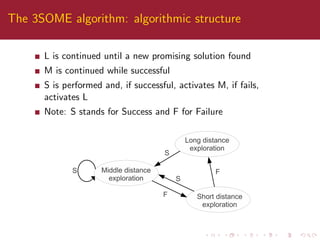
The 3SOME algorithm: algorithmic structure
L is continued until a new promising solution found
M is continued while successful
S is performed and, if successful, activates M, if fails,
activates L
Note: S stands for Success and F for Failure
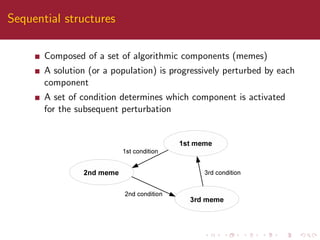
Sequential structures
Composed of a set of algorithmic components (memes)
A solution (or a population) is progressively perturbed by each
component
A set of condition determines which component is activated
for the subsequent perturbation
What is this paper about?
We attempted to study the sequential structure by removing
S and replacing it with other local search algorithms
Research Question: What happens to the performance If we
remove S and replace it with another local search logic?
(Implicit) Research Question: How much is the structure
important with respect to the memes composing it?
Short distance exploration (S)
The variables are perturbed one-by-one
For each coordinate i, xs[i] = xe[i] − ρ (ρ exploratory radius)
If xs outperforms xe, the trial solution xt is updated
Otherwise a half step in the opposite direction
xs[i] = xe[i] + ρ
2 is performed
xs replaces xt if it outperforms xe
Rosenbrock Algorithm 2
For each coordinate i, with an initial step size h, the variables
are perturbed
In case of success, the step size is increased of a factor α,
otherwise decreased of β and the opposite direction is tried
The coordinate system is rotated towards the
approximated gradient, the step size is reinitialized and the
procedure is repeated
2
H. H. Rosenbrock, An automatic method for finding the greatest or least
value of a function, The Computer Journal, vol. 3, no. 3, pp. 175-184,1960
Powell Algorithm3
n separate minimisations are performed along n different
directions
Along each direction (in this study) the Golden Section Search
is performed
The directions are taken linearly independent
3
M. J. D. Powell, An efficient method for finding the minimum of a function
of several variables without calculating derivatives, The Computer Journal,
vol. 7, no. 2, pp. 155-162, Jan. 1964.
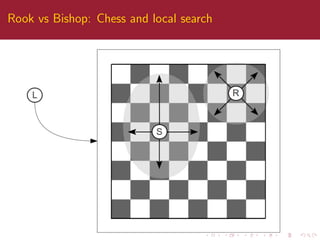
Rook vs Bishop: Chess and local search
Experimental Setup
BBOB20104 at 10,20, and 40 dimensions
CEC20105 at 1000 dimensions
100 runs, each of them has been performed for 5000 × n
fitness evaluations
The original 3SOME algorithm has been compared with their
versions where S is replaced by Rosenbrock and Powell
methods, respectively
4
N. Hansen, A. Auger, S. Finck, R. Ros et al., Real-parameter black- box
optimization benchmarking 2010: Noiseless functions definitions, INRIA,
Tech. Rep. RR-6829, 2010
5
K. Tang, X. Li, P. N. Suganthan, Z. Yang, and T. Weise, Benchmark func-
tions for the cec2010 special session and competition on large-scale global
optimization, University of Science and Technology of China (USTC), Tech.
Rep., 2010
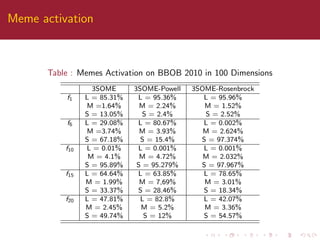
Meme activation
Table : Memes Activation on BBOB 2010 in 100 Dimensions
3SOME 3SOME-Powell 3SOME-Rosenbrock
f1 L = 85.31% L = 95.36% L = 95.96%
M =1.64% M = 2.24% M = 1.52%
S = 13.05% S = 2.4% S = 2.52%
f6 L = 29.08% L = 80.67% L = 0.002%
M =3.74% M = 3.93% M = 2.624%
S = 67.18% S = 15.4% S = 97.374%
f10 L = 0.01% L = 0.001% L = 0.001%
M = 4.1% M = 4.72% M = 2.032%
S = 95.89% S = 95.279% S = 97.967%
f15 L = 64.64% L = 63.85% L = 78.65%
M = 1.99% M = 7,69% M = 3.01%
S = 33.37% S = 28.46% S = 18.34%
f20 L = 47.81% L = 82.8% L = 42.07%
M = 2.45% M = 5.2% M = 3.36%
S = 49.74% S = 12% S = 54.57%
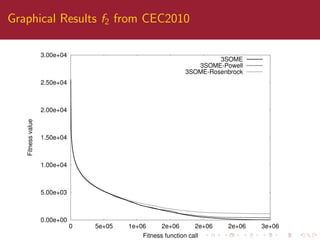
Graphical Results f2 from CEC2010
0.00e+00
5.00e+03
1.00e+04
1.50e+04
2.00e+04
2.50e+04
3.00e+04
0 5e+05 1e+06 2e+06 2e+06 2e+06 3e+06
Fitnessvalue
Fitness function call
3SOME
3SOME-Powell
3SOME-Rosenbrock
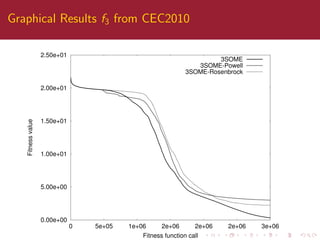
Graphical Results f3 from CEC2010
0.00e+00
5.00e+00
1.00e+01
1.50e+01
2.00e+01
2.50e+01
0 5e+05 1e+06 2e+06 2e+06 2e+06 3e+06
Fitnessvalue
Fitness function call
3SOME
3SOME-Powell
3SOME-Rosenbrock
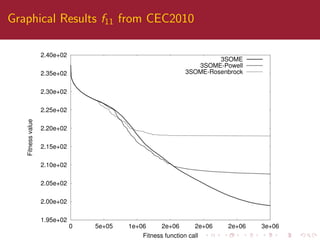
Graphical Results f11 from CEC2010
1.95e+02
2.00e+02
2.05e+02
2.10e+02
2.15e+02
2.20e+02
2.25e+02
2.30e+02
2.35e+02
2.40e+02
0 5e+05 1e+06 2e+06 2e+06 2e+06 3e+06
Fitnessvalue
Fitness function call
3SOME
3SOME-Powell
3SOME-Rosenbrock
Summary of the Results
The meme activation scales up with the dimensionality
(percentages are nearly constant for various dimensionality
values)
The meme activation slightly changes with the short distance
meme (e.g. a separable function makes use of S)
The performance of the 3SOME variants is very similar
for low dimensions (up to 100D)
For large scale problems, the performance is diverse in
some cases and similar in others
Remarks and Future Works
3SOME sequential structure displays a high performance even
when a meme is replaced
Algorithms composed of different memes but sharing the same
structure may have a similar behaviour
The structure of an algorithm is as important as the
memes/operators that compose it
Future automatic design of algorithms should properly select
the memes and ALSO combine them according to a proper
structure/logic
Thanks for your attention!

The Importance of Being Structured

  • 1.
    The Importance ofBeing Structured a Comparative Study on Multi Stage Memetic Approaches Fabio Caraffini, Giovanni Iacca, Ferrante Neri, and Ernesto Mininno CCI, De Montfort University, United Kingdom INCAS3 The Netherlands University of Jyv¨askyl¨a, Finland 05.09.2012 (UKCI2012, Edinburgh)
  • 2.
    Outline Background Ockham’s Razor andMultiple Stage Optimal Memetic Exploration Sequential Structure Local search logics within sequential structure The importance of the structure Numerical Results Conclusion
  • 3.
    Background Memetic Algorithm (MA):evolutionary framework + one or more local search components Memetic Computing (MC): structured set of heterogeneous components for solving problems Ockham’s Razor in MC: simple algorithms can display a performance which is as good as that of complex algorithms 1 Three Stage Optimal Memetic Exploration (3SOME): Sequential structure composed of three components that progressively perturb a single solution 1 G. Iacca, F. Neri, E. Mininno, Y.S. Ong, M.H. Lim, Ockham’s Razor in Memetic Computing: Three Stage Optimal Memetic Exploration, Informa- tion Sciences, Elsevier, Volume 188, pages 17-43, April 2012
  • 4.
    The 3SOME algorithm:algorithmic components The current best solution is named elite xe while a trial solution is named xt Long distance exploration (L): at first a solution xt is randomly generated and then the exponential crossover (Differential Evolution) with xe is applied Middle distance exploration (M): a hypercube of side δ, centred around the solution xe, is constructed and the trial point xt is generated within the hypercube Short distance exploration (S): a steepest descent local search attempts to improve upon xe by separately perturbing each variable
  • 5.
    The 3SOME algorithm:algorithmic structure L is continued until a new promising solution found M is continued while successful S is performed and, if successful, activates M, if fails, activates L Note: S stands for Success and F for Failure
  • 6.
    Sequential structures Composed ofa set of algorithmic components (memes) A solution (or a population) is progressively perturbed by each component A set of condition determines which component is activated for the subsequent perturbation
  • 7.
    What is thispaper about? We attempted to study the sequential structure by removing S and replacing it with other local search algorithms Research Question: What happens to the performance If we remove S and replace it with another local search logic? (Implicit) Research Question: How much is the structure important with respect to the memes composing it?
  • 8.
    Short distance exploration(S) The variables are perturbed one-by-one For each coordinate i, xs[i] = xe[i] − ρ (ρ exploratory radius) If xs outperforms xe, the trial solution xt is updated Otherwise a half step in the opposite direction xs[i] = xe[i] + ρ 2 is performed xs replaces xt if it outperforms xe
  • 9.
    Rosenbrock Algorithm 2 Foreach coordinate i, with an initial step size h, the variables are perturbed In case of success, the step size is increased of a factor α, otherwise decreased of β and the opposite direction is tried The coordinate system is rotated towards the approximated gradient, the step size is reinitialized and the procedure is repeated 2 H. H. Rosenbrock, An automatic method for finding the greatest or least value of a function, The Computer Journal, vol. 3, no. 3, pp. 175-184,1960
  • 10.
    Powell Algorithm3 n separateminimisations are performed along n different directions Along each direction (in this study) the Golden Section Search is performed The directions are taken linearly independent 3 M. J. D. Powell, An efficient method for finding the minimum of a function of several variables without calculating derivatives, The Computer Journal, vol. 7, no. 2, pp. 155-162, Jan. 1964.
  • 11.
    Rook vs Bishop:Chess and local search
  • 12.
    Experimental Setup BBOB20104 at10,20, and 40 dimensions CEC20105 at 1000 dimensions 100 runs, each of them has been performed for 5000 × n fitness evaluations The original 3SOME algorithm has been compared with their versions where S is replaced by Rosenbrock and Powell methods, respectively 4 N. Hansen, A. Auger, S. Finck, R. Ros et al., Real-parameter black- box optimization benchmarking 2010: Noiseless functions definitions, INRIA, Tech. Rep. RR-6829, 2010 5 K. Tang, X. Li, P. N. Suganthan, Z. Yang, and T. Weise, Benchmark func- tions for the cec2010 special session and competition on large-scale global optimization, University of Science and Technology of China (USTC), Tech. Rep., 2010
  • 13.
    Meme activation Table :Memes Activation on BBOB 2010 in 100 Dimensions 3SOME 3SOME-Powell 3SOME-Rosenbrock f1 L = 85.31% L = 95.36% L = 95.96% M =1.64% M = 2.24% M = 1.52% S = 13.05% S = 2.4% S = 2.52% f6 L = 29.08% L = 80.67% L = 0.002% M =3.74% M = 3.93% M = 2.624% S = 67.18% S = 15.4% S = 97.374% f10 L = 0.01% L = 0.001% L = 0.001% M = 4.1% M = 4.72% M = 2.032% S = 95.89% S = 95.279% S = 97.967% f15 L = 64.64% L = 63.85% L = 78.65% M = 1.99% M = 7,69% M = 3.01% S = 33.37% S = 28.46% S = 18.34% f20 L = 47.81% L = 82.8% L = 42.07% M = 2.45% M = 5.2% M = 3.36% S = 49.74% S = 12% S = 54.57%
  • 14.
    Graphical Results f2from CEC2010 0.00e+00 5.00e+03 1.00e+04 1.50e+04 2.00e+04 2.50e+04 3.00e+04 0 5e+05 1e+06 2e+06 2e+06 2e+06 3e+06 Fitnessvalue Fitness function call 3SOME 3SOME-Powell 3SOME-Rosenbrock
  • 15.
    Graphical Results f3from CEC2010 0.00e+00 5.00e+00 1.00e+01 1.50e+01 2.00e+01 2.50e+01 0 5e+05 1e+06 2e+06 2e+06 2e+06 3e+06 Fitnessvalue Fitness function call 3SOME 3SOME-Powell 3SOME-Rosenbrock
  • 16.
    Graphical Results f11from CEC2010 1.95e+02 2.00e+02 2.05e+02 2.10e+02 2.15e+02 2.20e+02 2.25e+02 2.30e+02 2.35e+02 2.40e+02 0 5e+05 1e+06 2e+06 2e+06 2e+06 3e+06 Fitnessvalue Fitness function call 3SOME 3SOME-Powell 3SOME-Rosenbrock
  • 17.
    Summary of theResults The meme activation scales up with the dimensionality (percentages are nearly constant for various dimensionality values) The meme activation slightly changes with the short distance meme (e.g. a separable function makes use of S) The performance of the 3SOME variants is very similar for low dimensions (up to 100D) For large scale problems, the performance is diverse in some cases and similar in others
  • 18.
    Remarks and FutureWorks 3SOME sequential structure displays a high performance even when a meme is replaced Algorithms composed of different memes but sharing the same structure may have a similar behaviour The structure of an algorithm is as important as the memes/operators that compose it Future automatic design of algorithms should properly select the memes and ALSO combine them according to a proper structure/logic
  • 19.
    Thanks for yourattention!