The Home of the Future
Perspectives on “Smart Home” from the viewpoint of HCI
Contents
Smart Home State-of-the-Art *
What is the Wise Home?
Smart Home Research Areas
Contributions to these Research Areas
Conclusions / Outlook
* The focus of research is COTS (consumer off the shelf) systems
available on the mass market.
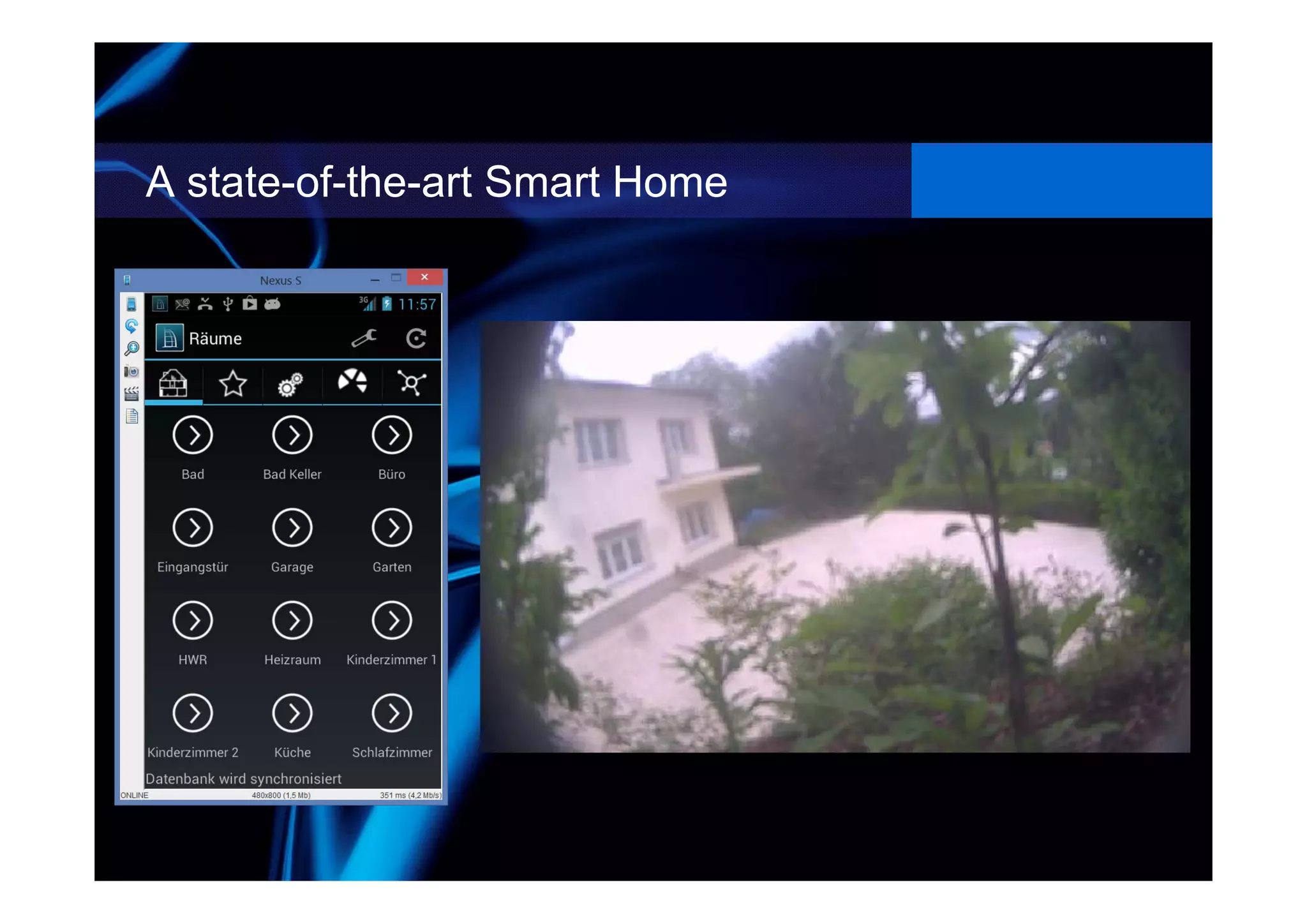
A state-of-the-art Smart Home
What about the future?
What could the smart home of the future look like?
Increased Automation
Multimodal Interaction
“Smartness” (e.g. Smart TV, UPnP, DLNA)
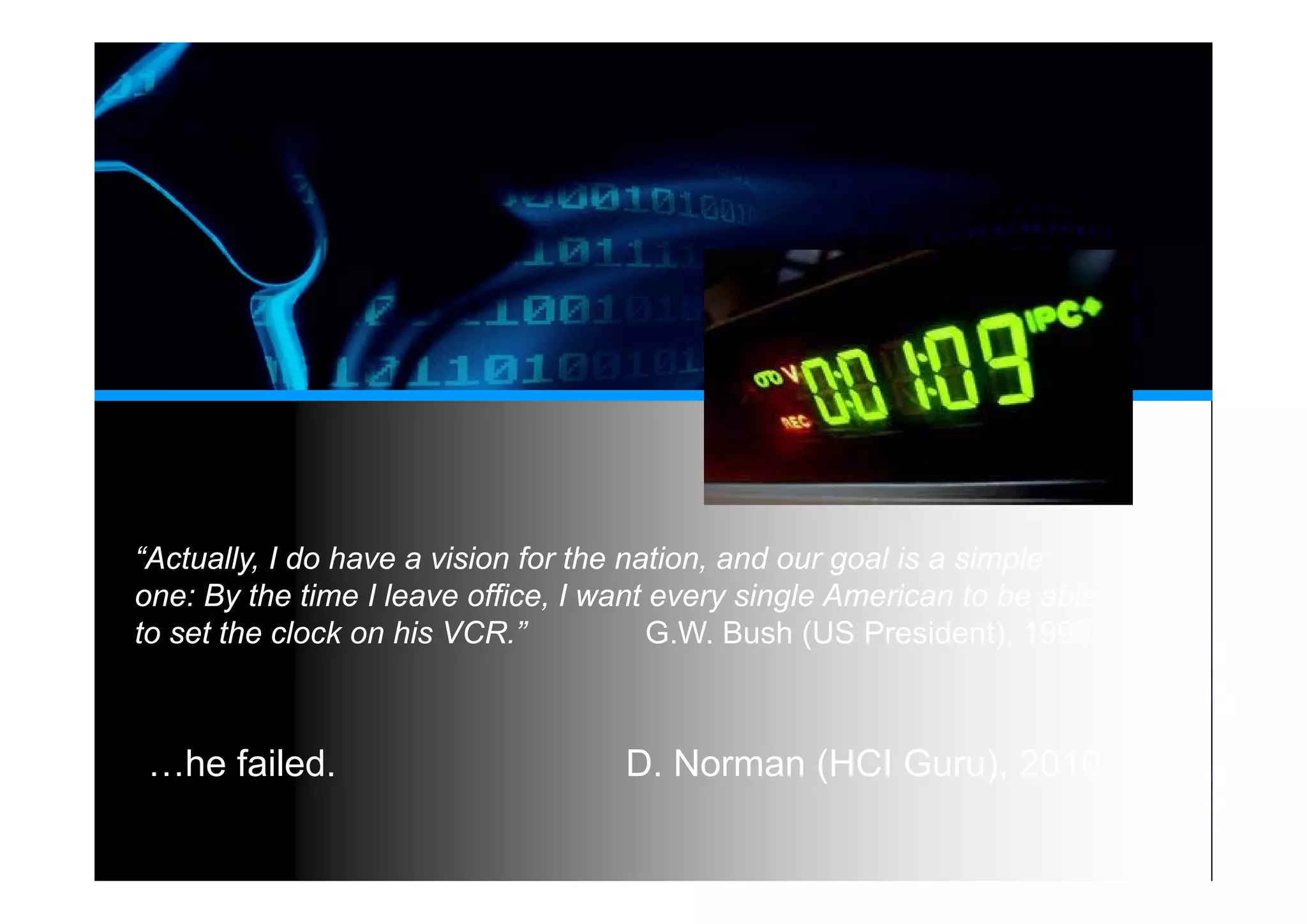
“Actually, I do have a vision for the nation, and our goal is a simple
one: By the time I leave office, I want every single American to be able
to set the clock on his VCR.” G.W. Bush (US President), 1990
…he failed. D. Norman (HCI Guru), 2010
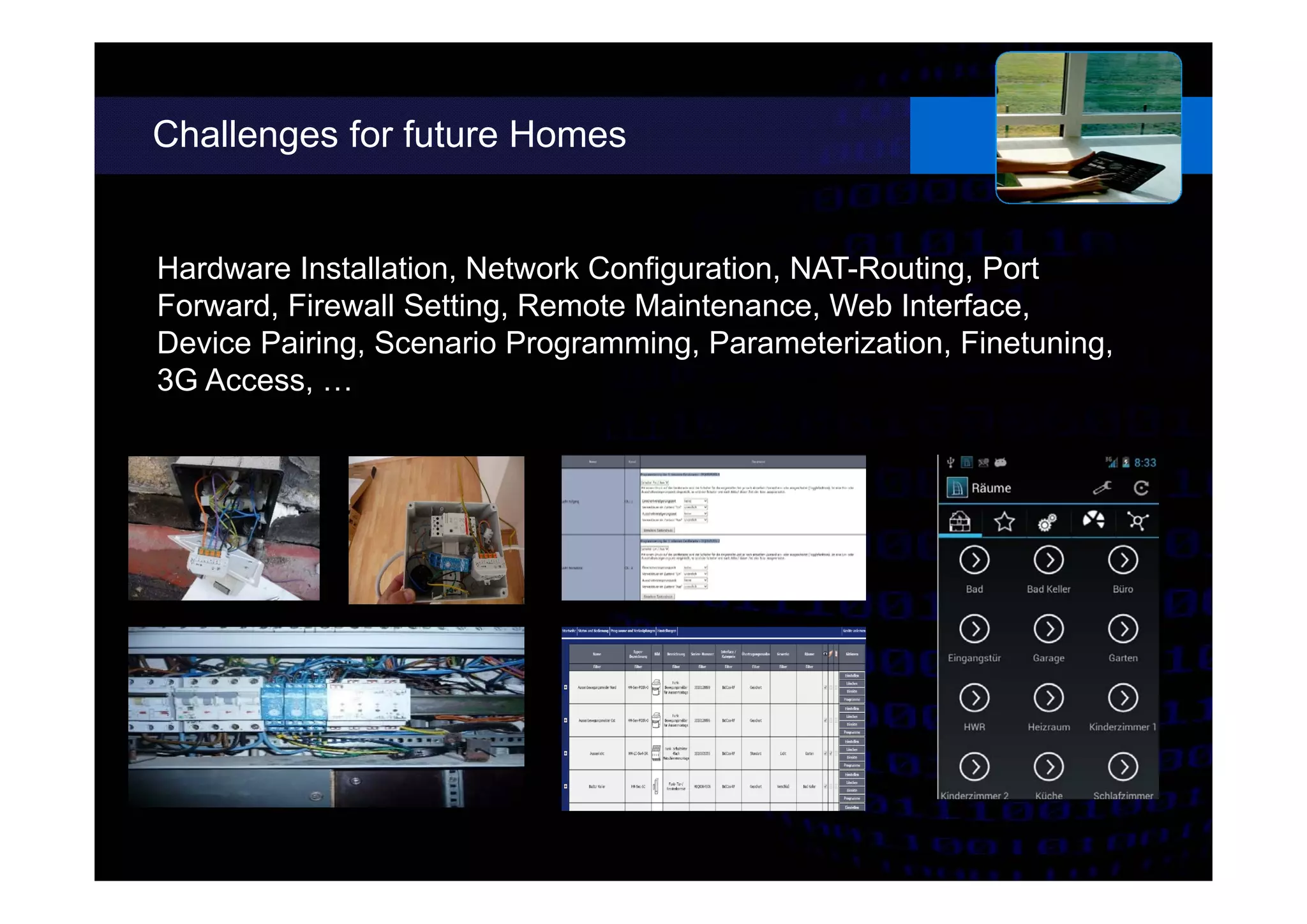
Challenges for future Homes
Hardware Installation, Network Configuration, NAT-Routing, Port
Forward, Firewall Setting, Remote Maintenance, Web Interface,
Device Pairing, Scenario Programming, Parameterization, Finetuning,
3G Access, …
But why should we care about Smart Homes ?
Demographic Change
Increase of Self Service
Ubiquitous Computing, Embedded Devices
What constitutes a Wise Home?
different possibilities.
A Wise home is to its users like a mother to her child. She is supporting when
necessary, but lets the child learn from own experiences, mistakes and
successes. However, when the child is in danger or not able to solve the
problem on its own, she intervenes.
State-of-the-Art smart Homes don’t work that way.
They have to be pre-programmed in a strict and un-flexible way.
They are not adaptive to changing needs.
They are overruling their users.
They do not learn from experiences.
The Wise home will be different…
Smart vs. Wise
Smart Home
One size fits all, rule-based
Limited technology
Focus on technology
Artificially-evaluated
Wise Home
Adaptive, context-sensitive
Based on open platforms
Multidisciplinary approach
Real world evaluation
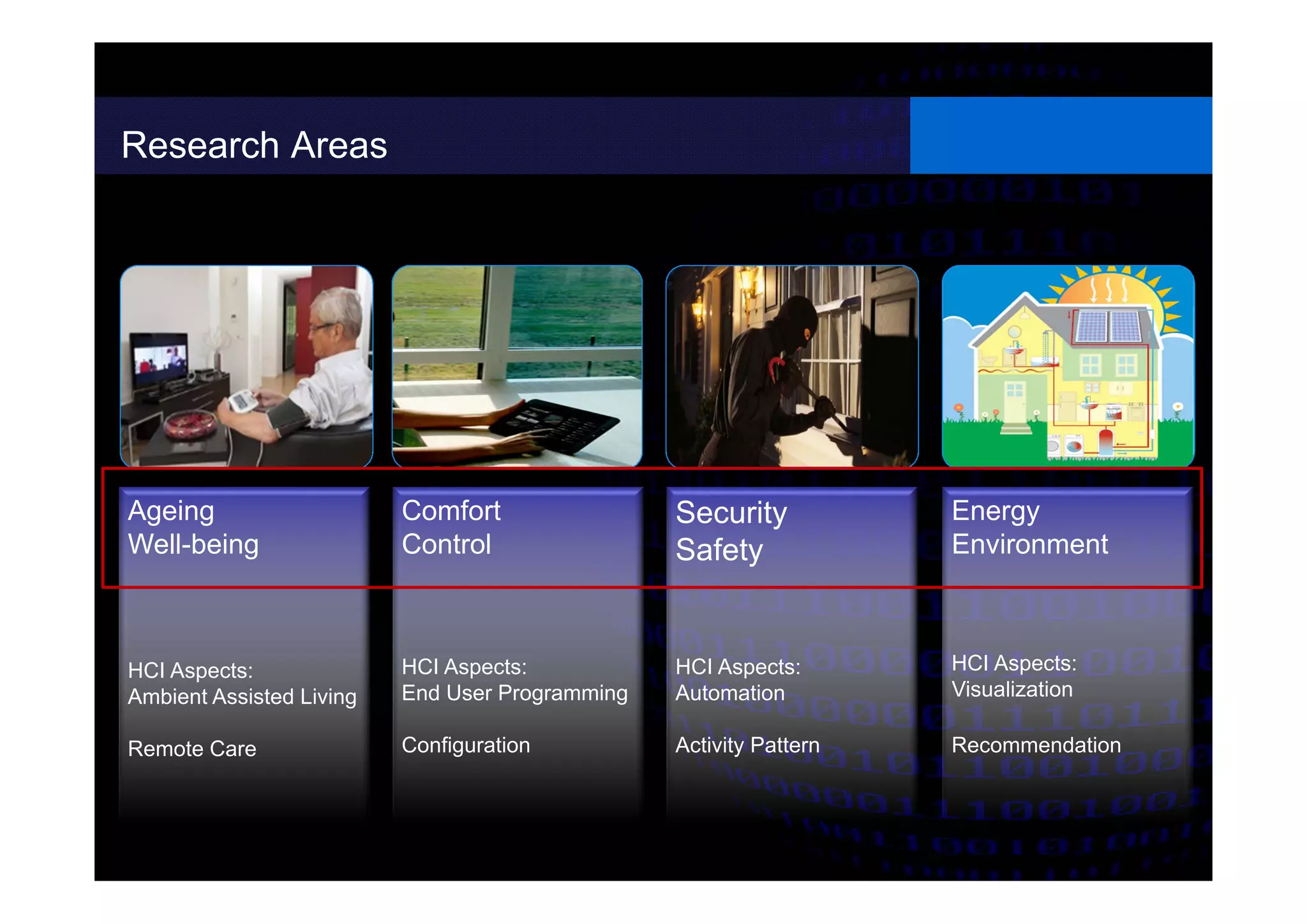
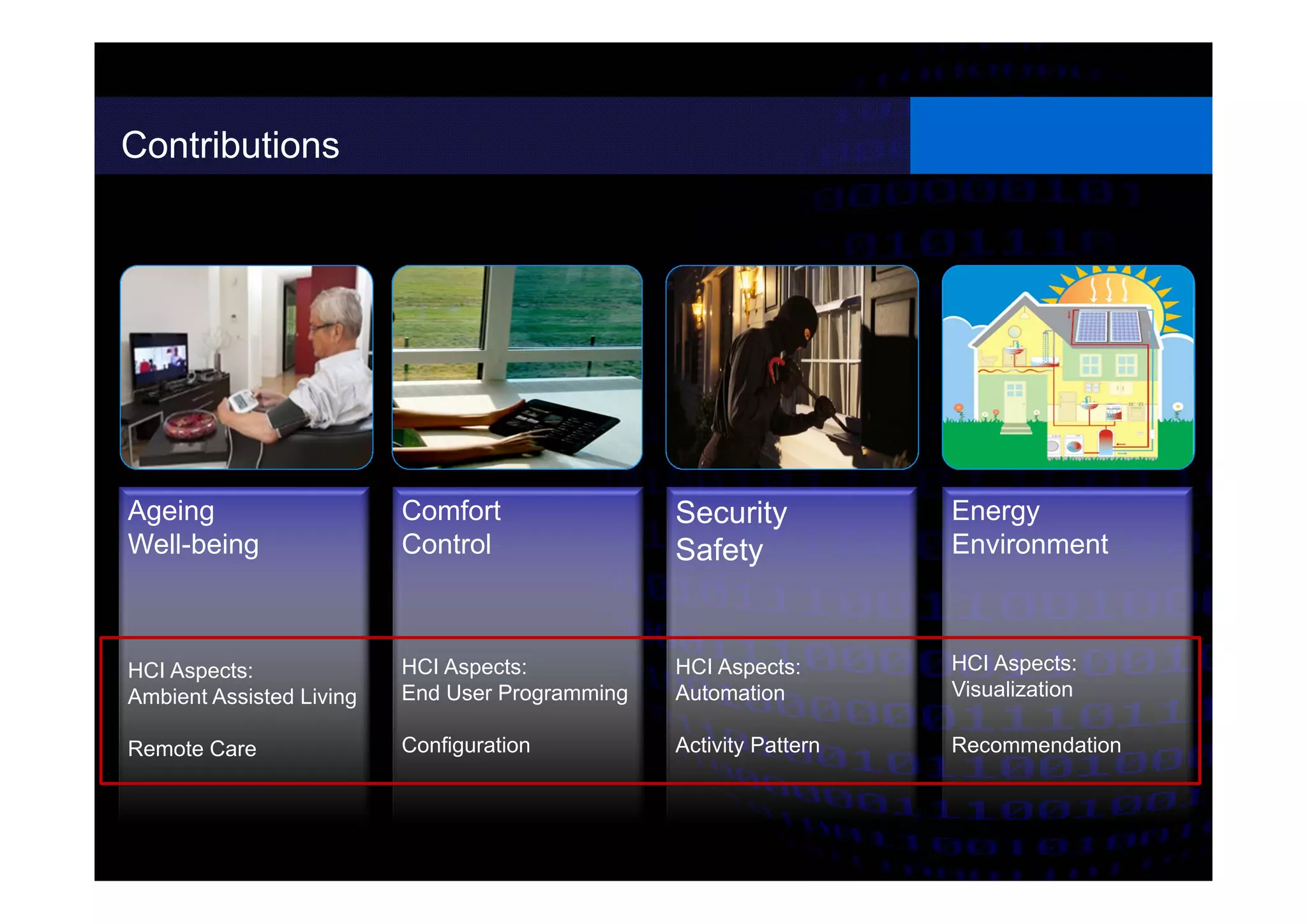
Research Areas
Comfort
Control
HCI Aspects:
End User Programming
Configuration
Security
Safety
HCI Aspects:
Automation
Activity Pattern
Ageing
Well-being
HCI Aspects:
Ambient Assisted Living
Remote Care
Energy
Environment
HCI Aspects:
Visualization
Recommendation
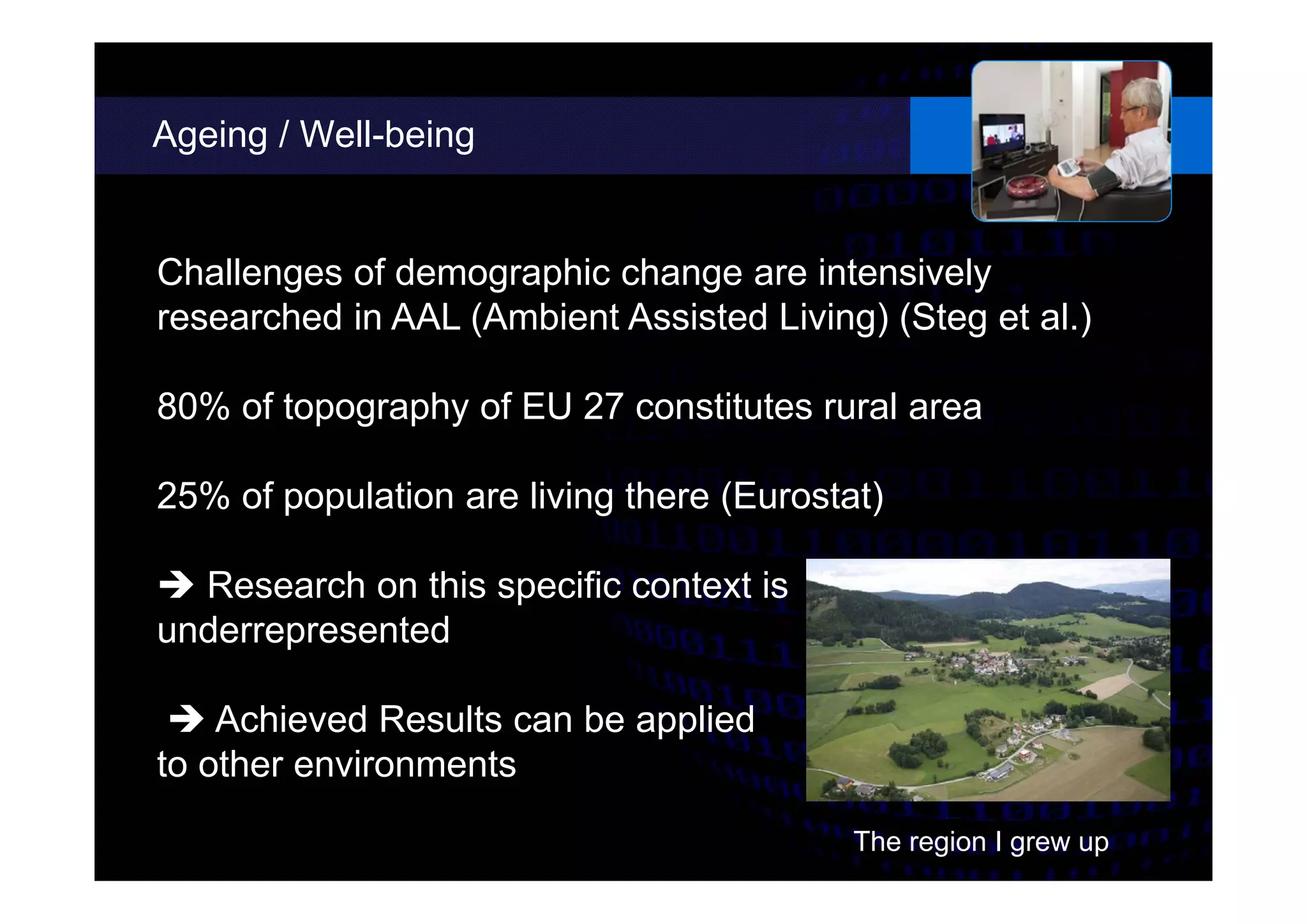
Ageing / Well-being
Challenges of demographic change are intensively
researched in AAL (Ambient Assisted Living) (Steg et al.)
80% of topography of EU 27 constitutes rural area
25% of population are living there (Eurostat)
 Research on this specific context is
underrepresented
 Achieved Results can be applied
to other environments
The region I grew up
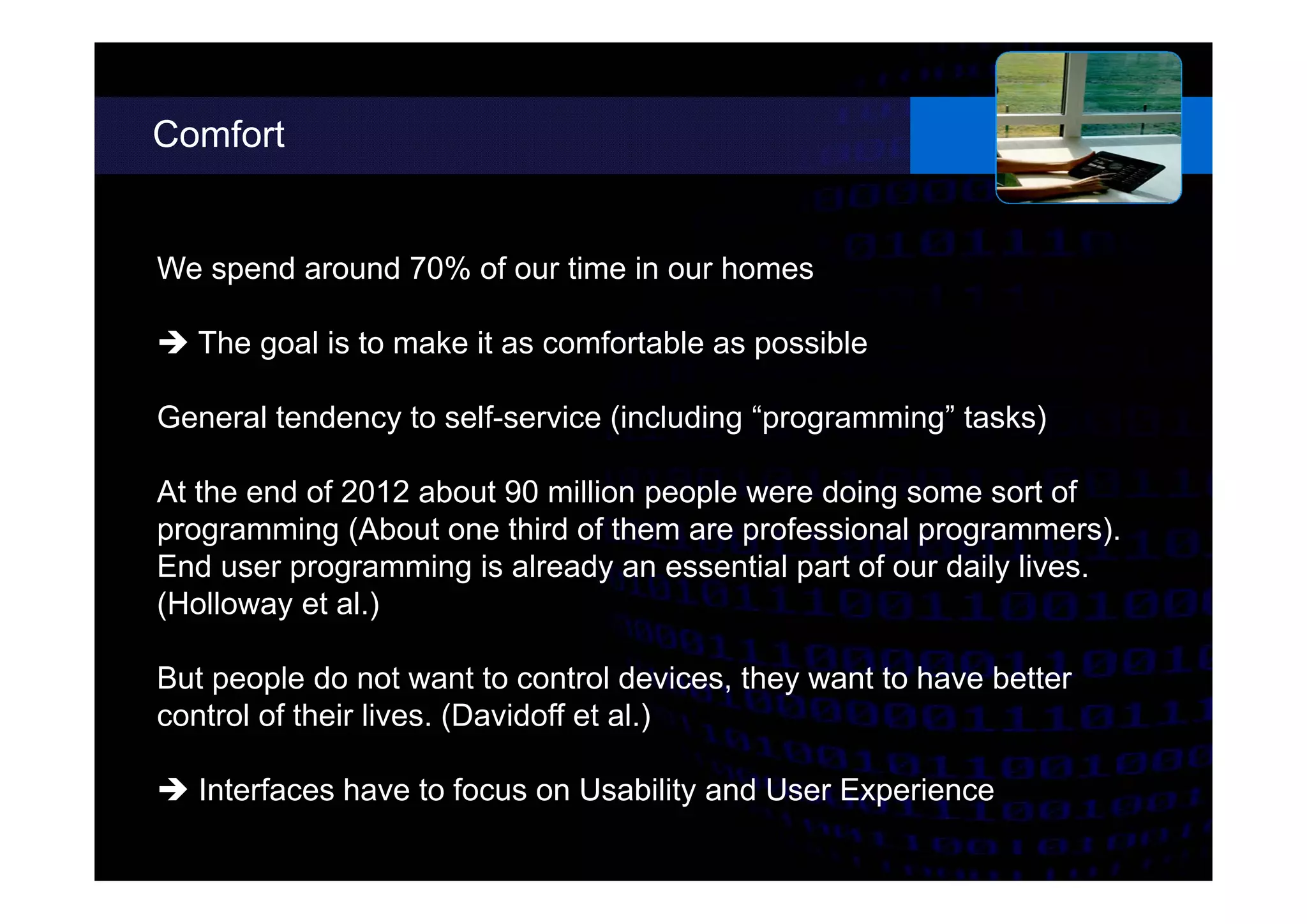
Comfort
We spend around 70% of our time in our homes
 The goal is to make it as comfortable as possible
General tendency to self-service (including “programming” tasks)
At the end of 2012 about 90 million people were doing some sort of
programming (About one third of them are professional programmers).
End user programming is already an essential part of our daily lives.
(Holloway et al.)
But people do not want to control devices, they want to have better
control of their lives. (Davidoff et al.)
 Interfaces have to focus on Usability and User Experience
Safety / Security
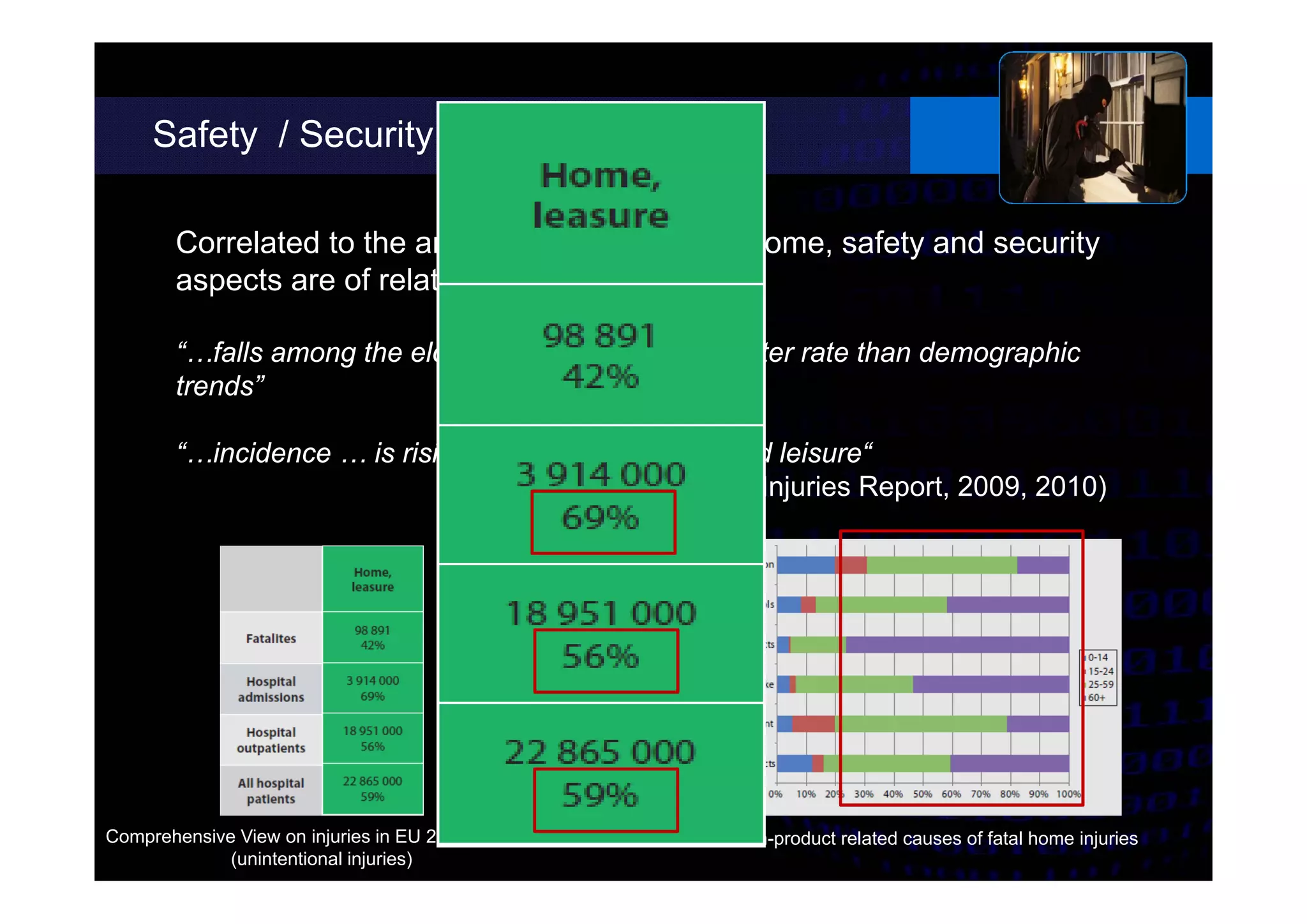
Correlated to the amount of time spent at home, safety and security
aspects are of relative importance
“…falls among the elderly, is increasing at a faster rate than demographic
trends”
“…incidence … is rising in the area of home and leisure“
(European Injuries Report, 2009, 2010)
Product and non-product related causes of fatal home injuriesComprehensive View on injuries in EU 27 by domain
(unintentional injuries)
Energy / Environment
different possibilities.
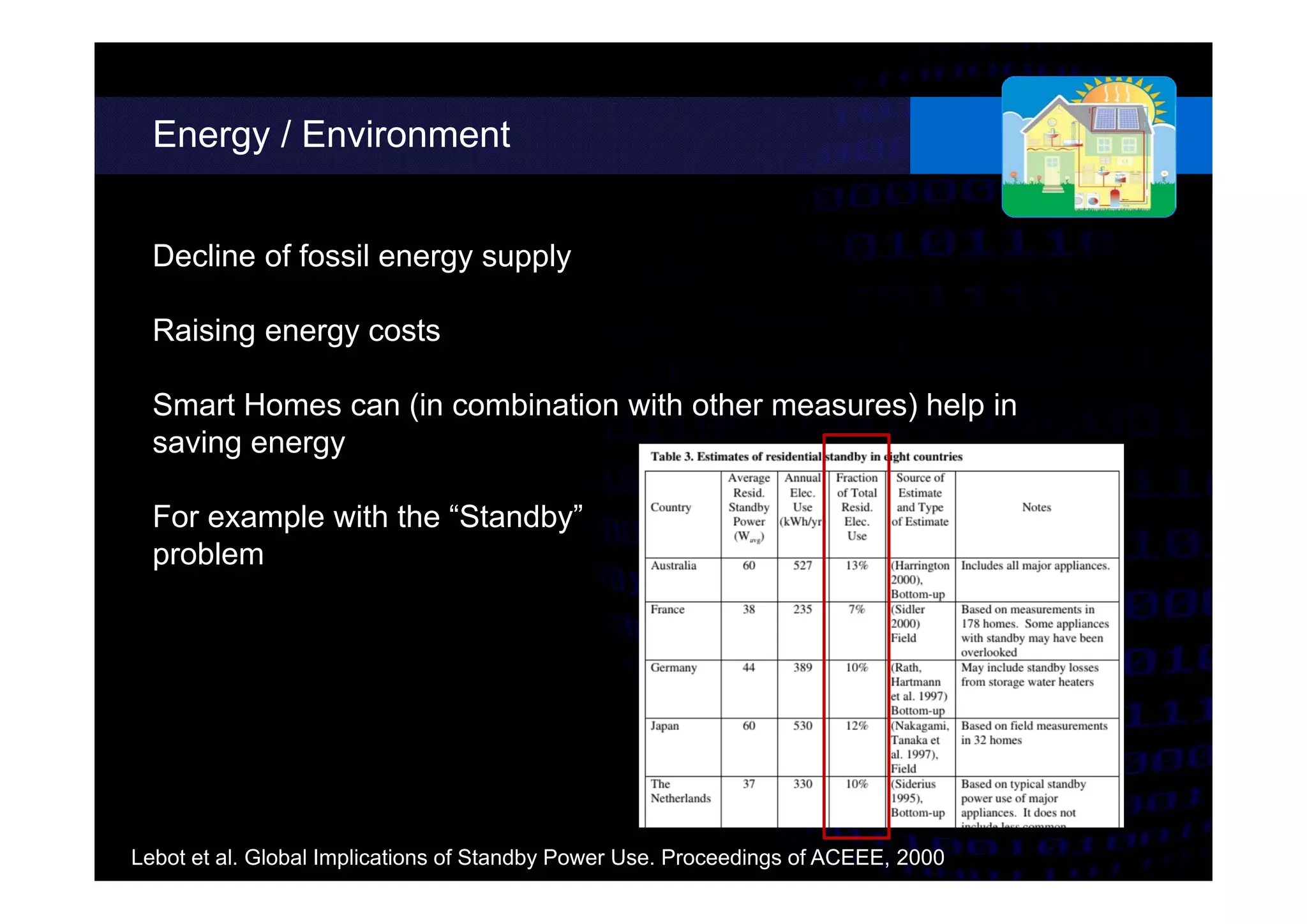
Decline of fossil energy supply
Raising energy costs
Smart Homes can (in combination with other measures) help in
saving energy
For example with the “Standby”
problem
Lebot et al. Global Implications of Standby Power Use. Proceedings of ACEEE, 2000
Contributions
Comfort
Control
HCI Aspects:
End User Programming
Configuration
Security
Safety
HCI Aspects:
Automation
Activity Pattern
Ageing
Well-being
HCI Aspects:
Ambient Assisted Living
Remote Care
Energy
Environment
HCI Aspects:
Visualization
Recommendation
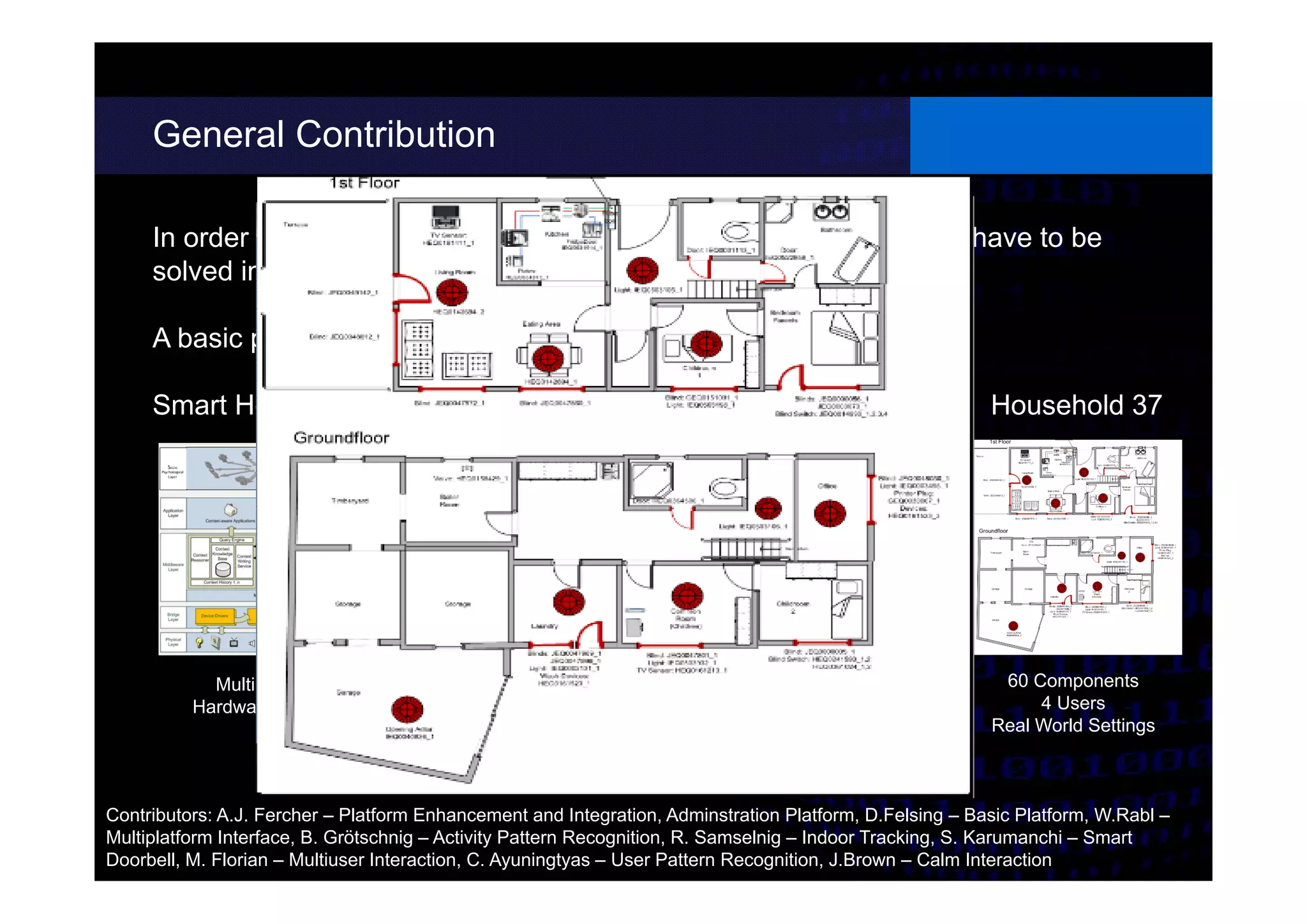
In order to be able to establish a Wise home, technological issues have to be
solved in advance.
A basic platform was built using the following components
Smart Home Platform Living Lab Administration Platform Household 37
General Contribution
different possibilities.
Multilayer OSGI
Hardware Abstraction
Experimental
Evaluation
Live Status View of
21 installations,
~ 2 Million Data Sets
60 Components
4 Users
Real World Settings
Contributors: A.J. Fercher – Platform Enhancement and Integration, Adminstration Platform, D.Felsing – Basic Platform, W.Rabl –
Multiplatform Interface, B. Grötschnig – Activity Pattern Recognition, R. Samselnig – Indoor Tracking, S. Karumanchi – Smart
Doorbell, M. Florian – Multiuser Interaction, C. Ayuningtyas – User Pattern Recognition, J.Brown – Calm Interaction
Contribution to Ageing / Well-being
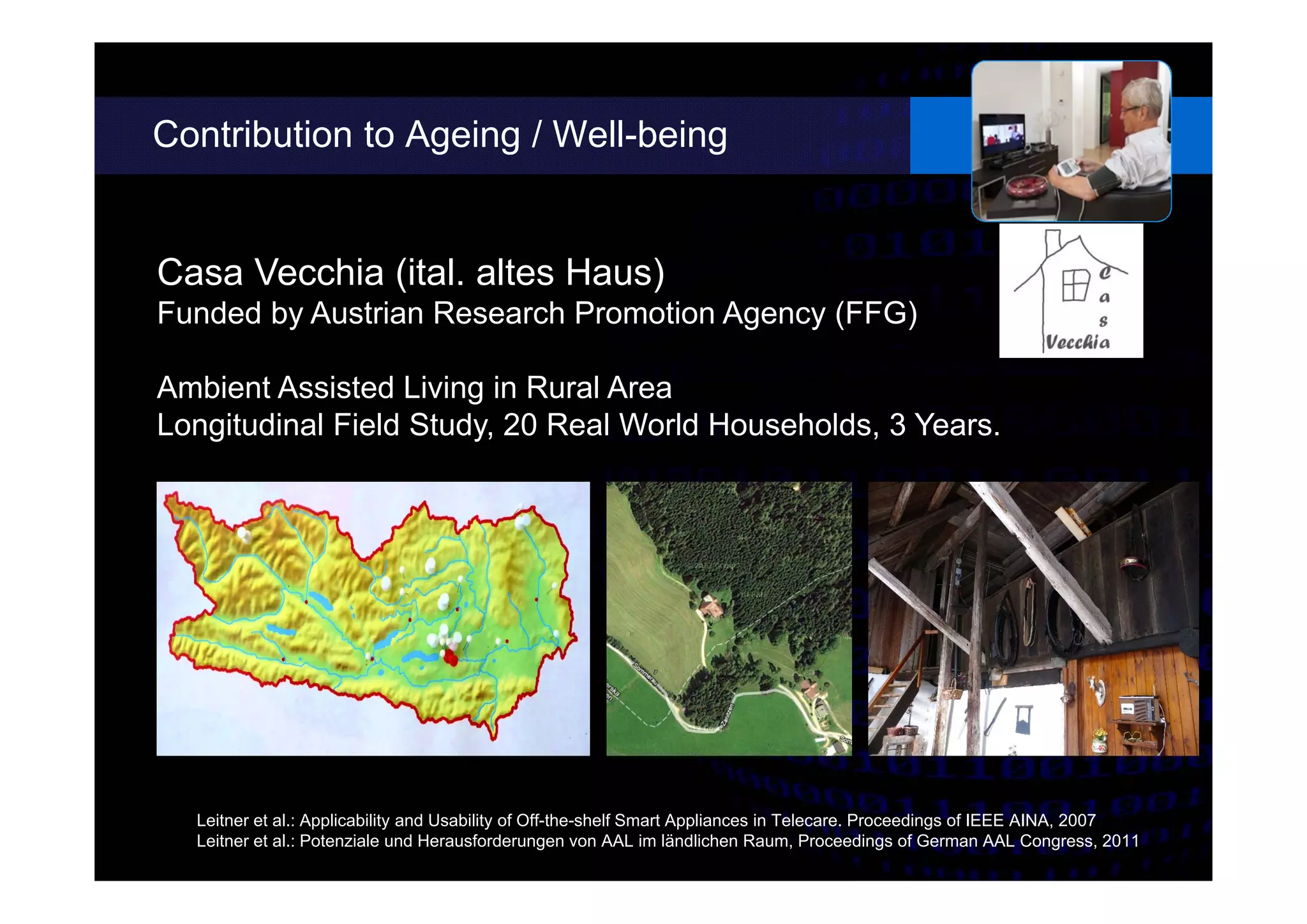
Casa Vecchia (ital. altes Haus)
Funded by Austrian Research Promotion Agency (FFG)
Ambient Assisted Living in Rural Area
Longitudinal Field Study, 20 Real World Households, 3 Years.
Leitner et al.: Applicability and Usability of Off-the-shelf Smart Appliances in Telecare. Proceedings of IEEE AINA, 2007
Leitner et al.: Potenziale und Herausforderungen von AAL im ländlichen Raum, Proceedings of German AAL Congress, 2011
Contribution to Ageing / Well-being
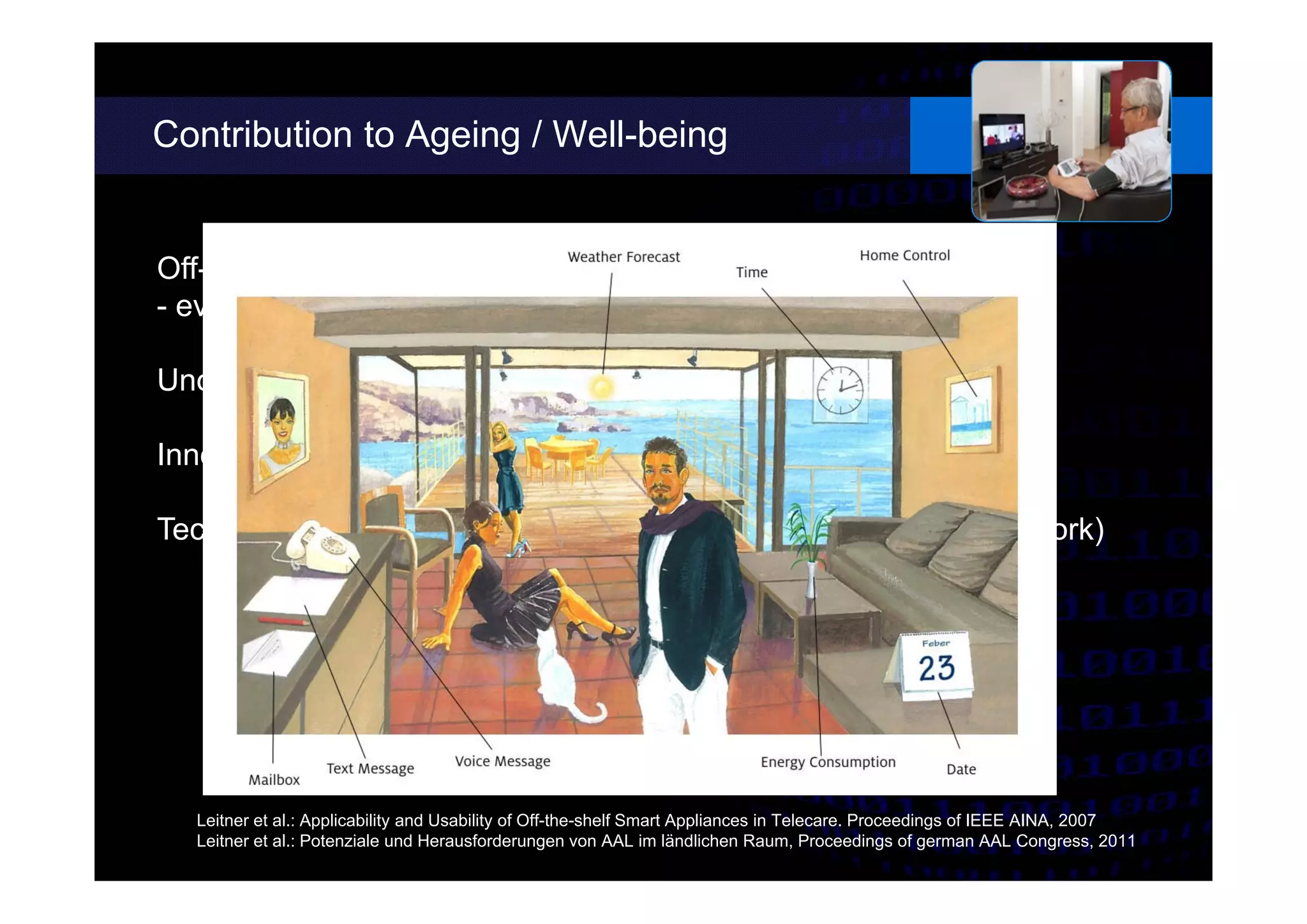
Off-the-shelf systems can support independent living
- even under sub-optimal circumstances
Unobtrusive environmental sensors do not disturb daily living
Innovative interaction concepts simplify the access to ICT
Technology can enhance different aspects of life (e.g. social network)
Leitner et al.: Applicability and Usability of Off-the-shelf Smart Appliances in Telecare. Proceedings of IEEE AINA, 2007
Leitner et al.: Potenziale und Herausforderungen von AAL im ländlichen Raum, Proceedings of german AAL Congress, 2011
Smartphone of
trusted persons
Alternative User Interface Metaphor
Contribution to Comfort / Control
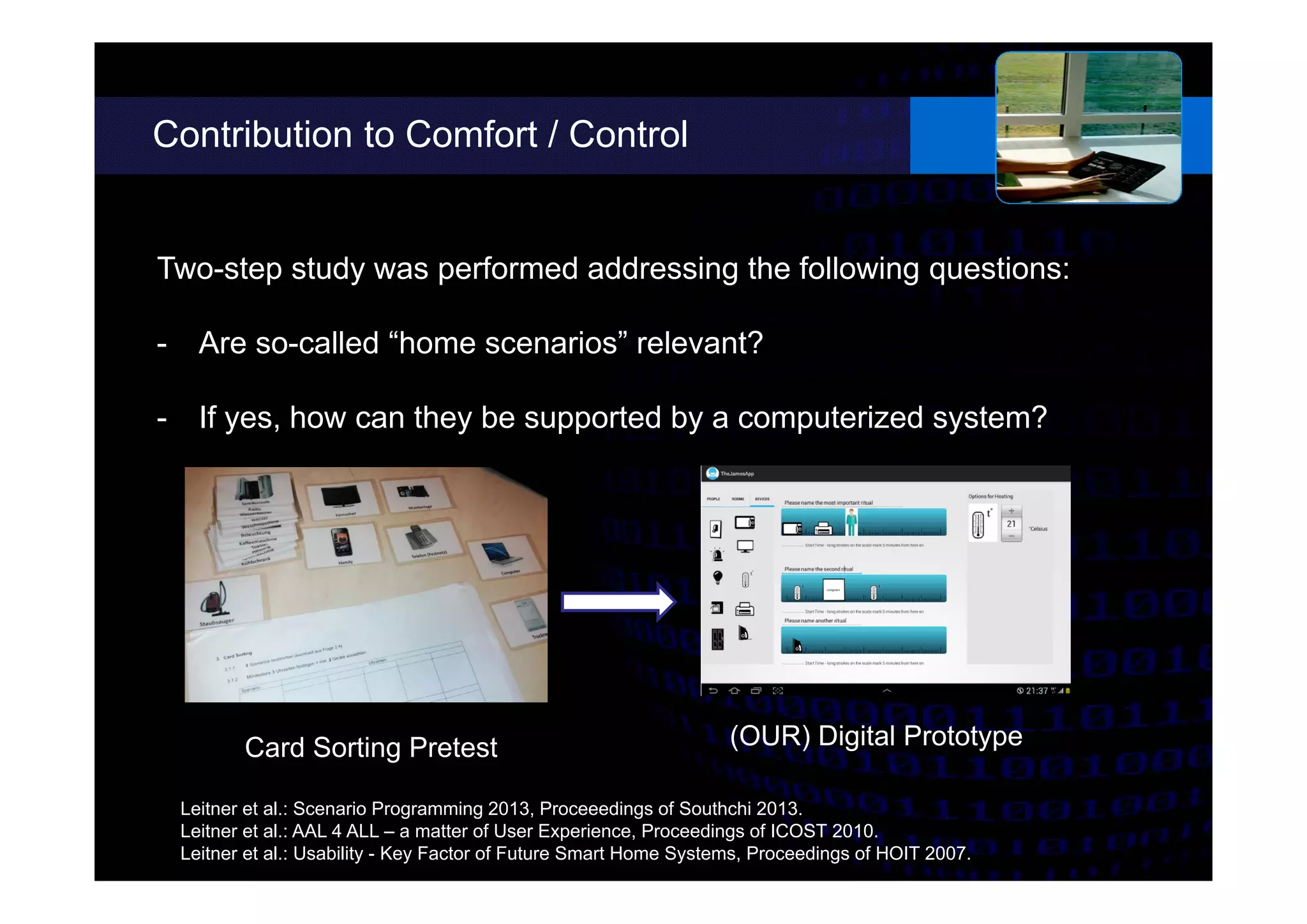
Two-step study was performed addressing the following questions:
- Are so-called “home scenarios” relevant?
- If yes, how can they be supported by a computerized system?
Leitner et al.: Scenario Programming 2013, Proceeedings of Southchi 2013.
Leitner et al.: AAL 4 ALL – a matter of User Experience, Proceedings of ICOST 2010.
Leitner et al.: Usability - Key Factor of Future Smart Home Systems, Proceedings of HOIT 2007.
Card Sorting Pretest (OUR) Digital Prototype
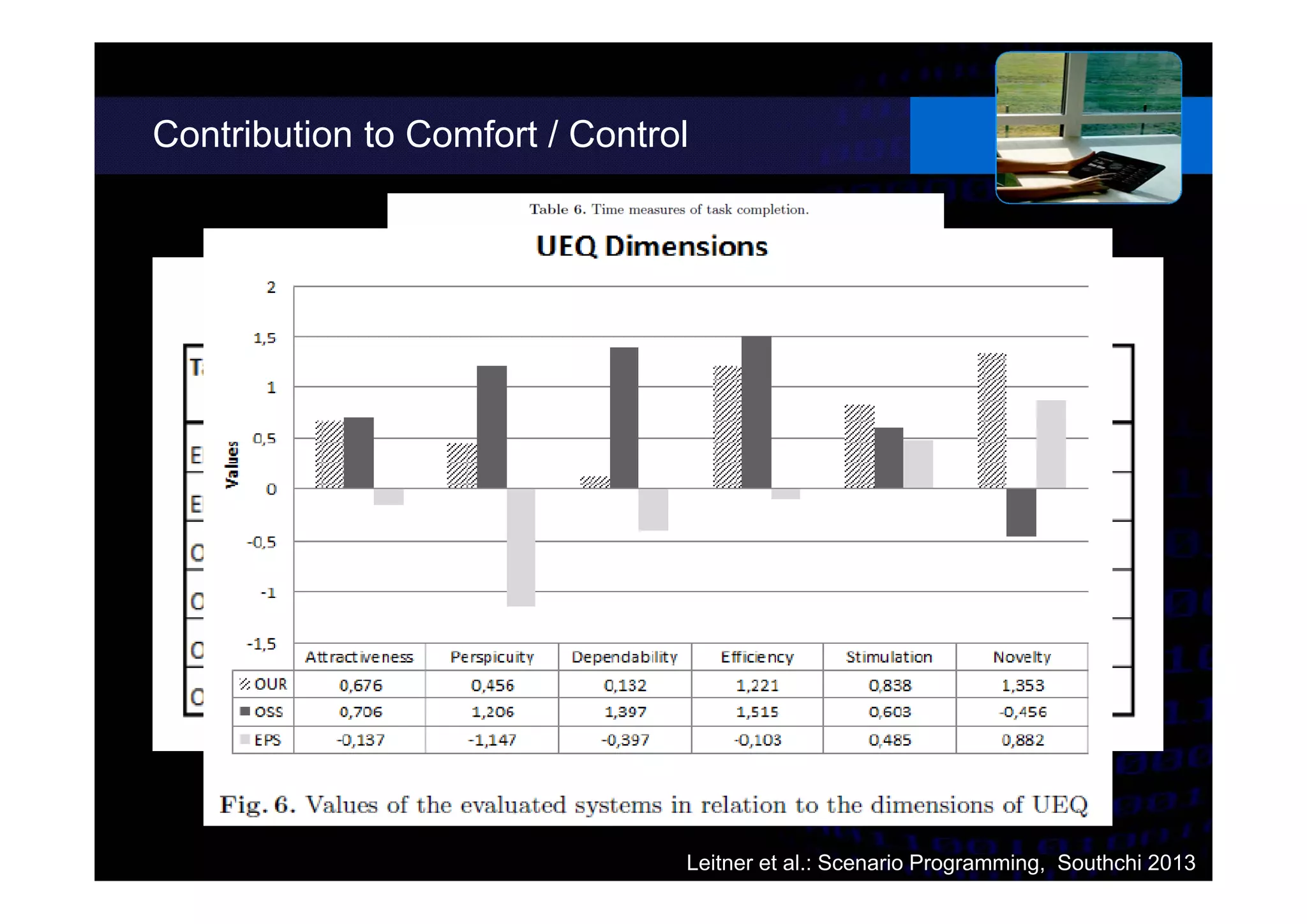
Contribution to Comfort / Control
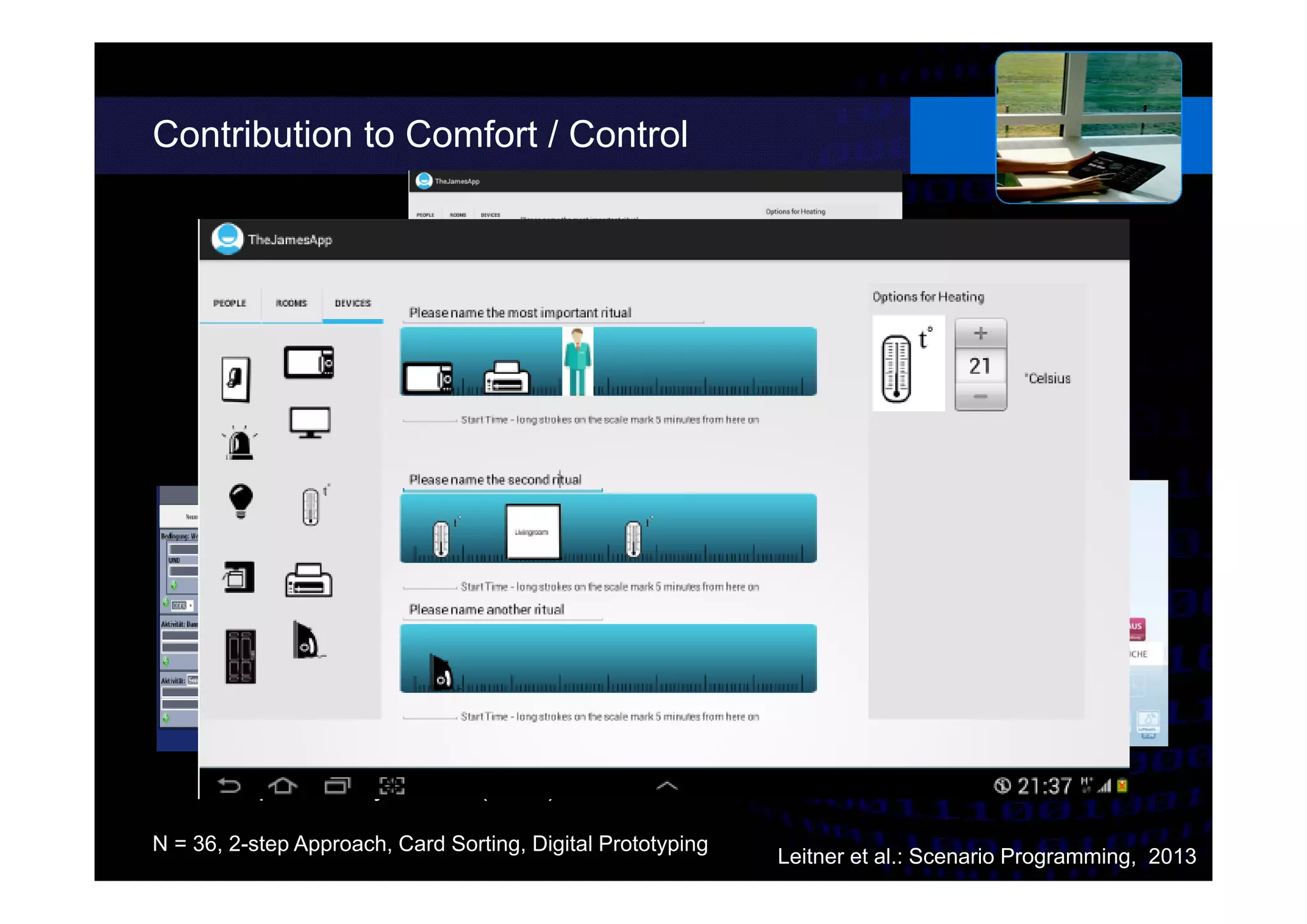
Leitner et al.: Scenario Programming, 2013
N = 36, 2-step Approach, Card Sorting, Digital Prototyping
Competitive System 1 (OSS) Competitive System 2 (EPS)
Contribution to Comfort / Control
Leitner et al.: Scenario Programming, Southchi 2013
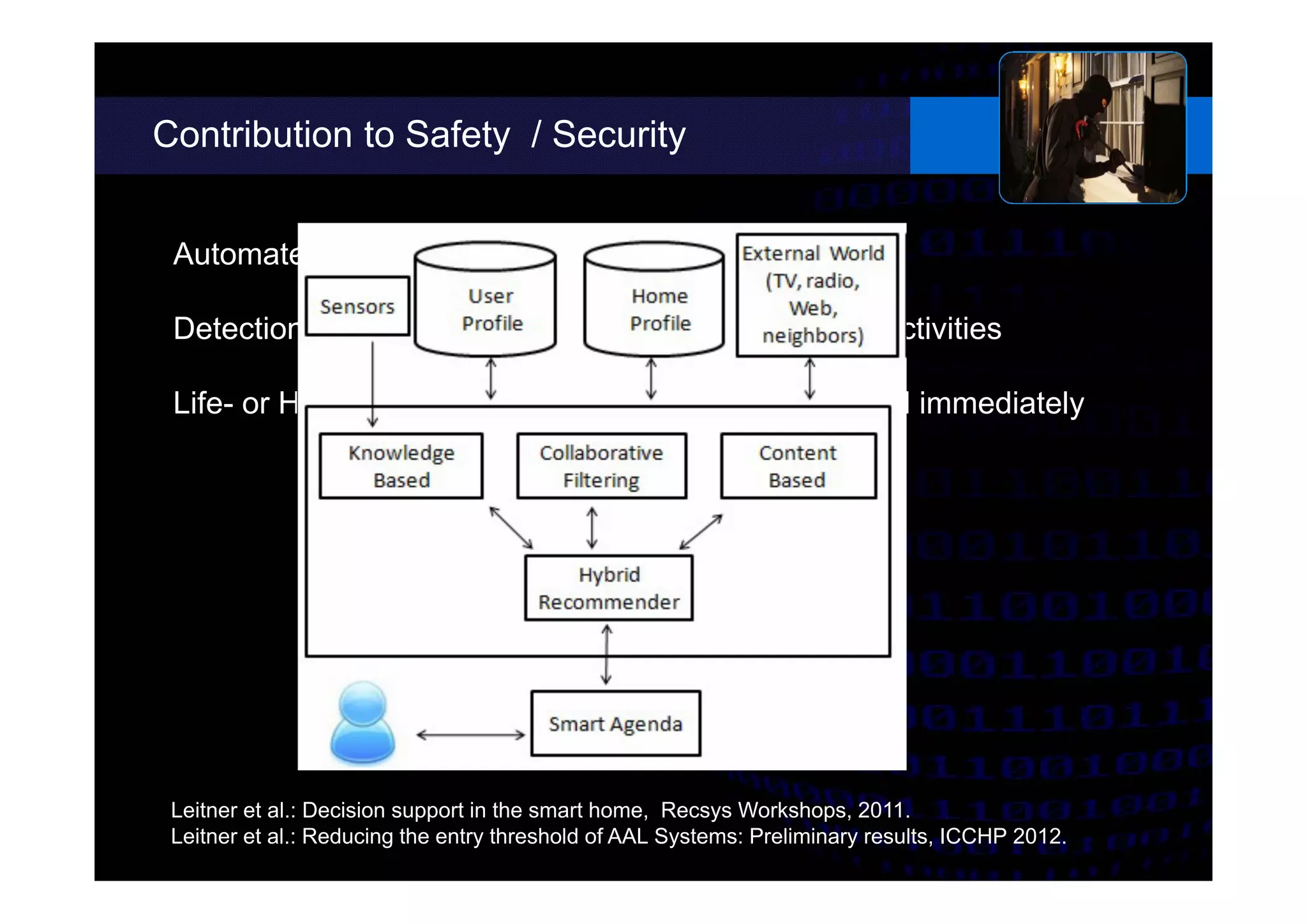
Contribution to Safety / Security
Leitner et al.: Decision support in the smart home, Recsys Workshops, 2011.
Leitner et al.: Reducing the entry threshold of AAL Systems: Preliminary results, ICCHP 2012.
Automated function based on probability estimation
Detection of accidents such as falls or deviations in activities
Life- or Health-critical accidents have to be processed immediately
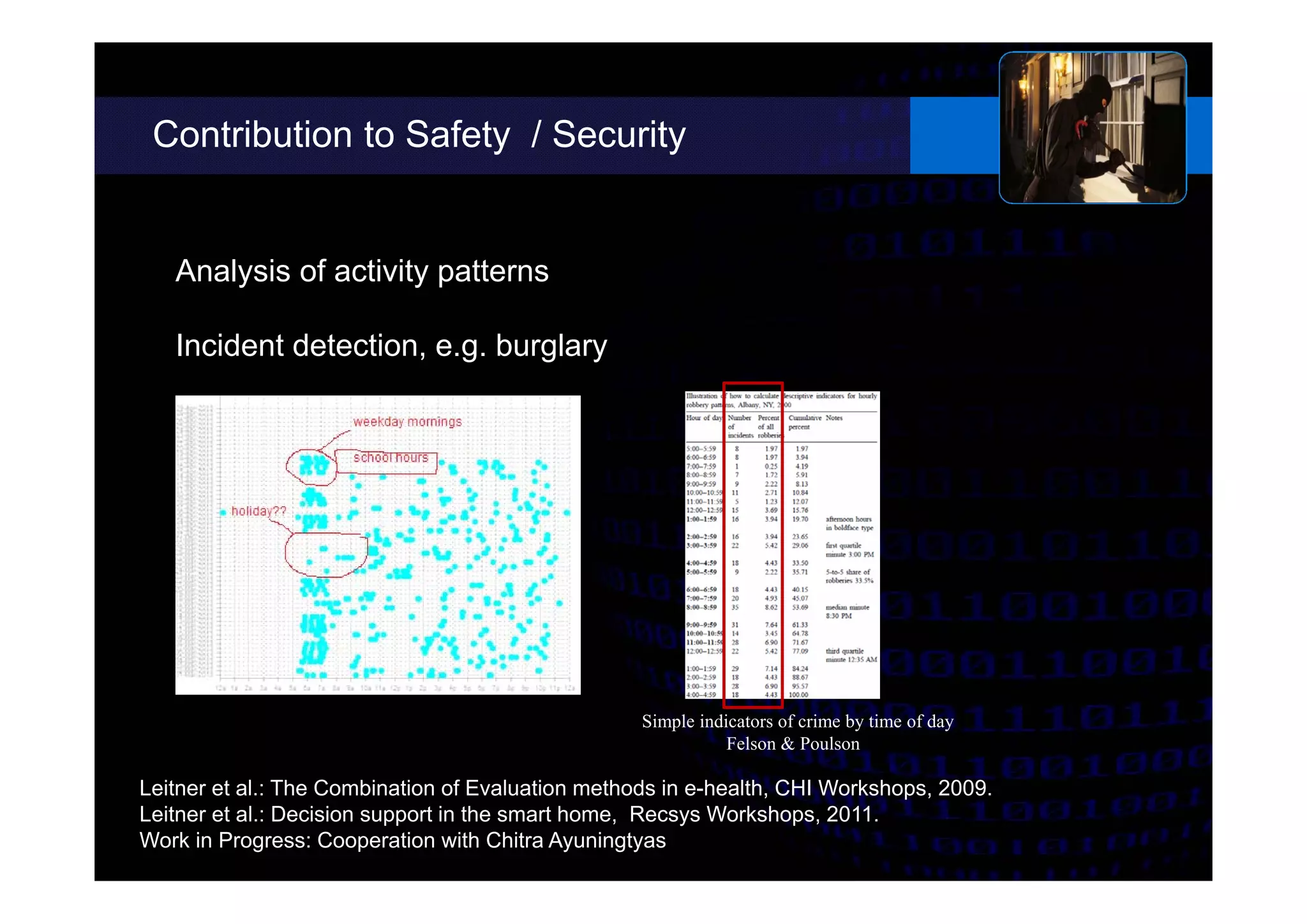
Contribution to Safety / Security
Leitner et al.: The Combination of Evaluation methods in e-health, CHI Workshops, 2009.
Leitner et al.: Decision support in the smart home, Recsys Workshops, 2011.
Work in Progress: Cooperation with Chitra Ayuningtyas
Analysis of activity patterns
Incident detection, e.g. burglary
Simple indicators of crime by time of day
Felson & Poulson
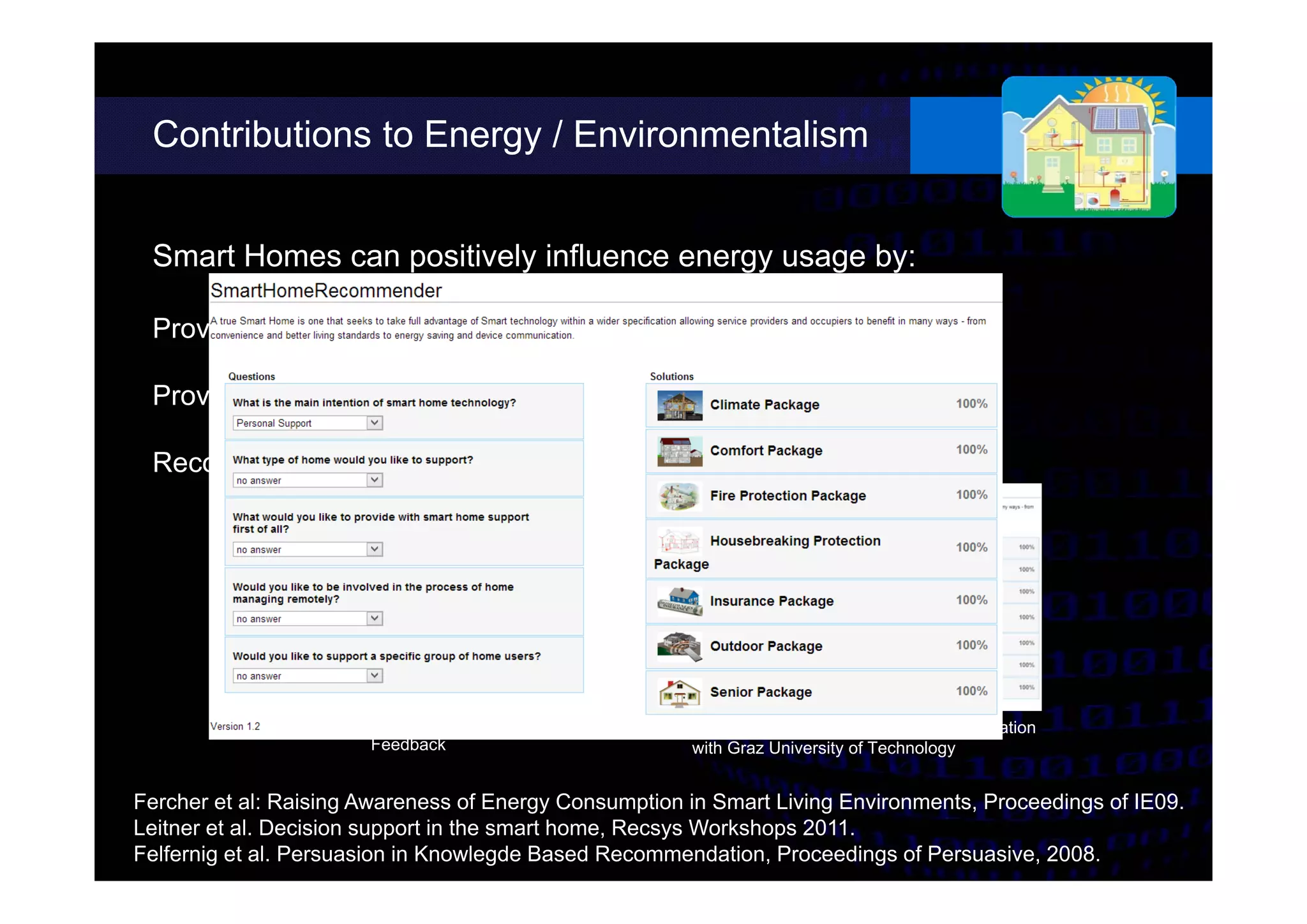
Contributions to Energy / Environmentalism
Work in Progress Prototype – Developed in Cooperation
with Graz University of Technology
different possibilities.
Smart Homes can positively influence energy usage by:
Providing adequate and frequent feedback
Providing the possibility for interventions
Recommending behavioral changes
Fercher et al: Raising Awareness of Energy Consumption in Smart Living Environments, Proceedings of IE09.
Leitner et al. Decision support in the smart home, Recsys Workshops 2011.
Felfernig et al. Persuasion in Knowlegde Based Recommendation, Proceedings of Persuasive, 2008.
Energy Consumption
Feedback
Contributions Summary
different possibilities.
The focus of this presentation was to show how a Human Computer
Interaction perspective can enhance the development of Smart Homes.
An interdisciplinary approach based on interoperable technologies enables
ethnographic research to achieve results with a high ecological validity.
A basic platform has been established and, in contrast to similar research
projects, is up and running under real world conditions for almost two years.
Unobtrusive ethnographic observation methods enable the collection of
meaningful data building the basis of further research activities.
A combination of methods allows for the identification of psychological,
sociological and social aspects influencing the access to technology in
general and smart home technology in particular. For example, significant
gender differences could be observed within Casa Vecchia.
What constitutes the home of the future?
different possibilities.
Smart Homes are not adaptive or flexible:
The WISE home adapts to the needs of its inhabitants, by enabling, e.g:
- Multimodal interaction
- Spontaneous interruption of automated procedures
(such as cruise control in a car)
- Interoperability of devices from different manufactures
- Learning of patterns of daily activities
- Consideration of changing life circumstances and stages of life
 So that we come closer to the goal that interaction with and within the
home is “as refreshing, as a walk in the woods”. (Weiser, 1991)
Bibliography
different possibilities.
Bush Zitat: Cristopher P. Nemeth Human Factors Methods for Design: Making Systems Human-
centered, Foreword.
Brush, A.J. B. , Jung, J. Mahajan, R. Scott J. m-HomeLab: Shared Infrastructure for Home
Technology Field Studies, UbiComp, September 5-8, 2012.
Holloway, S., Julien, C.: The case for end-user programming of ubiquitous computing environments.
Proceedings of the FSE/SDP workshop on Future of software engineering research (FoSER). pp
167–172. (2010)
Davidoff, S., Lee, M.K., Yiu, C., Zimmerman, J., Dey, A.K.: Principles of Smart Home Control.
Ubicomp, Springer, Orange County, CA, pp. 19–34. (2006)
Eurostat Yearbook (2010) http://epp.eurostat.ec.europa.eu/cache/
ITY_OFFPUB/KS-CD-11-001/EN/KS-CD-11-001-EN.PDF
Rode, J. A., Toye, E. F., Blackwell, A. F. (2004): The fuzzy felt ethnography?
Understanding the programming patterns of domestic appliances. Personal Ubiq. Computi. 8, 3-4,
pp. 161-176.
Iachello, G., Truong, K.N., Abowd, G.D., Hayes, G.R., Stevens, M. (2006): Experience prototyping
and sampling to evaluate ubicomp privacy in the real world, Proceedings of CHI06, pp. 1009-1018.
Weiser, M. (1991). The computer for the 21st century. Scientific american, 265(3), 94-104.

The Home of the Future

  • 1.
    The Home ofthe Future Perspectives on “Smart Home” from the viewpoint of HCI
  • 2.
    Contents Smart Home State-of-the-Art* What is the Wise Home? Smart Home Research Areas Contributions to these Research Areas Conclusions / Outlook * The focus of research is COTS (consumer off the shelf) systems available on the mass market.
  • 3.
  • 4.
    What about thefuture? What could the smart home of the future look like? Increased Automation Multimodal Interaction “Smartness” (e.g. Smart TV, UPnP, DLNA)
  • 5.
    “Actually, I dohave a vision for the nation, and our goal is a simple one: By the time I leave office, I want every single American to be able to set the clock on his VCR.” G.W. Bush (US President), 1990 …he failed. D. Norman (HCI Guru), 2010
  • 6.
    Challenges for futureHomes Hardware Installation, Network Configuration, NAT-Routing, Port Forward, Firewall Setting, Remote Maintenance, Web Interface, Device Pairing, Scenario Programming, Parameterization, Finetuning, 3G Access, …
  • 7.
    But why shouldwe care about Smart Homes ? Demographic Change Increase of Self Service Ubiquitous Computing, Embedded Devices
  • 8.
    What constitutes aWise Home? different possibilities. A Wise home is to its users like a mother to her child. She is supporting when necessary, but lets the child learn from own experiences, mistakes and successes. However, when the child is in danger or not able to solve the problem on its own, she intervenes. State-of-the-Art smart Homes don’t work that way. They have to be pre-programmed in a strict and un-flexible way. They are not adaptive to changing needs. They are overruling their users. They do not learn from experiences. The Wise home will be different…
  • 9.
    Smart vs. Wise SmartHome One size fits all, rule-based Limited technology Focus on technology Artificially-evaluated Wise Home Adaptive, context-sensitive Based on open platforms Multidisciplinary approach Real world evaluation
  • 10.
    Research Areas Comfort Control HCI Aspects: EndUser Programming Configuration Security Safety HCI Aspects: Automation Activity Pattern Ageing Well-being HCI Aspects: Ambient Assisted Living Remote Care Energy Environment HCI Aspects: Visualization Recommendation
  • 11.
    Ageing / Well-being Challengesof demographic change are intensively researched in AAL (Ambient Assisted Living) (Steg et al.) 80% of topography of EU 27 constitutes rural area 25% of population are living there (Eurostat)  Research on this specific context is underrepresented  Achieved Results can be applied to other environments The region I grew up
  • 12.
    Comfort We spend around70% of our time in our homes  The goal is to make it as comfortable as possible General tendency to self-service (including “programming” tasks) At the end of 2012 about 90 million people were doing some sort of programming (About one third of them are professional programmers). End user programming is already an essential part of our daily lives. (Holloway et al.) But people do not want to control devices, they want to have better control of their lives. (Davidoff et al.)  Interfaces have to focus on Usability and User Experience
  • 13.
    Safety / Security Correlatedto the amount of time spent at home, safety and security aspects are of relative importance “…falls among the elderly, is increasing at a faster rate than demographic trends” “…incidence … is rising in the area of home and leisure“ (European Injuries Report, 2009, 2010) Product and non-product related causes of fatal home injuriesComprehensive View on injuries in EU 27 by domain (unintentional injuries)
  • 14.
    Energy / Environment differentpossibilities. Decline of fossil energy supply Raising energy costs Smart Homes can (in combination with other measures) help in saving energy For example with the “Standby” problem Lebot et al. Global Implications of Standby Power Use. Proceedings of ACEEE, 2000
  • 15.
    Contributions Comfort Control HCI Aspects: End UserProgramming Configuration Security Safety HCI Aspects: Automation Activity Pattern Ageing Well-being HCI Aspects: Ambient Assisted Living Remote Care Energy Environment HCI Aspects: Visualization Recommendation
  • 16.
    In order tobe able to establish a Wise home, technological issues have to be solved in advance. A basic platform was built using the following components Smart Home Platform Living Lab Administration Platform Household 37 General Contribution different possibilities. Multilayer OSGI Hardware Abstraction Experimental Evaluation Live Status View of 21 installations, ~ 2 Million Data Sets 60 Components 4 Users Real World Settings Contributors: A.J. Fercher – Platform Enhancement and Integration, Adminstration Platform, D.Felsing – Basic Platform, W.Rabl – Multiplatform Interface, B. Grötschnig – Activity Pattern Recognition, R. Samselnig – Indoor Tracking, S. Karumanchi – Smart Doorbell, M. Florian – Multiuser Interaction, C. Ayuningtyas – User Pattern Recognition, J.Brown – Calm Interaction
  • 17.
    Contribution to Ageing/ Well-being Casa Vecchia (ital. altes Haus) Funded by Austrian Research Promotion Agency (FFG) Ambient Assisted Living in Rural Area Longitudinal Field Study, 20 Real World Households, 3 Years. Leitner et al.: Applicability and Usability of Off-the-shelf Smart Appliances in Telecare. Proceedings of IEEE AINA, 2007 Leitner et al.: Potenziale und Herausforderungen von AAL im ländlichen Raum, Proceedings of German AAL Congress, 2011
  • 18.
    Contribution to Ageing/ Well-being Off-the-shelf systems can support independent living - even under sub-optimal circumstances Unobtrusive environmental sensors do not disturb daily living Innovative interaction concepts simplify the access to ICT Technology can enhance different aspects of life (e.g. social network) Leitner et al.: Applicability and Usability of Off-the-shelf Smart Appliances in Telecare. Proceedings of IEEE AINA, 2007 Leitner et al.: Potenziale und Herausforderungen von AAL im ländlichen Raum, Proceedings of german AAL Congress, 2011 Smartphone of trusted persons Alternative User Interface Metaphor
  • 19.
    Contribution to Comfort/ Control Two-step study was performed addressing the following questions: - Are so-called “home scenarios” relevant? - If yes, how can they be supported by a computerized system? Leitner et al.: Scenario Programming 2013, Proceeedings of Southchi 2013. Leitner et al.: AAL 4 ALL – a matter of User Experience, Proceedings of ICOST 2010. Leitner et al.: Usability - Key Factor of Future Smart Home Systems, Proceedings of HOIT 2007. Card Sorting Pretest (OUR) Digital Prototype
  • 20.
    Contribution to Comfort/ Control Leitner et al.: Scenario Programming, 2013 N = 36, 2-step Approach, Card Sorting, Digital Prototyping Competitive System 1 (OSS) Competitive System 2 (EPS)
  • 21.
    Contribution to Comfort/ Control Leitner et al.: Scenario Programming, Southchi 2013
  • 22.
    Contribution to Safety/ Security Leitner et al.: Decision support in the smart home, Recsys Workshops, 2011. Leitner et al.: Reducing the entry threshold of AAL Systems: Preliminary results, ICCHP 2012. Automated function based on probability estimation Detection of accidents such as falls or deviations in activities Life- or Health-critical accidents have to be processed immediately
  • 23.
    Contribution to Safety/ Security Leitner et al.: The Combination of Evaluation methods in e-health, CHI Workshops, 2009. Leitner et al.: Decision support in the smart home, Recsys Workshops, 2011. Work in Progress: Cooperation with Chitra Ayuningtyas Analysis of activity patterns Incident detection, e.g. burglary Simple indicators of crime by time of day Felson & Poulson
  • 24.
    Contributions to Energy/ Environmentalism Work in Progress Prototype – Developed in Cooperation with Graz University of Technology different possibilities. Smart Homes can positively influence energy usage by: Providing adequate and frequent feedback Providing the possibility for interventions Recommending behavioral changes Fercher et al: Raising Awareness of Energy Consumption in Smart Living Environments, Proceedings of IE09. Leitner et al. Decision support in the smart home, Recsys Workshops 2011. Felfernig et al. Persuasion in Knowlegde Based Recommendation, Proceedings of Persuasive, 2008. Energy Consumption Feedback
  • 25.
    Contributions Summary different possibilities. Thefocus of this presentation was to show how a Human Computer Interaction perspective can enhance the development of Smart Homes. An interdisciplinary approach based on interoperable technologies enables ethnographic research to achieve results with a high ecological validity. A basic platform has been established and, in contrast to similar research projects, is up and running under real world conditions for almost two years. Unobtrusive ethnographic observation methods enable the collection of meaningful data building the basis of further research activities. A combination of methods allows for the identification of psychological, sociological and social aspects influencing the access to technology in general and smart home technology in particular. For example, significant gender differences could be observed within Casa Vecchia.
  • 26.
    What constitutes thehome of the future? different possibilities. Smart Homes are not adaptive or flexible: The WISE home adapts to the needs of its inhabitants, by enabling, e.g: - Multimodal interaction - Spontaneous interruption of automated procedures (such as cruise control in a car) - Interoperability of devices from different manufactures - Learning of patterns of daily activities - Consideration of changing life circumstances and stages of life  So that we come closer to the goal that interaction with and within the home is “as refreshing, as a walk in the woods”. (Weiser, 1991)
  • 27.
    Bibliography different possibilities. Bush Zitat:Cristopher P. Nemeth Human Factors Methods for Design: Making Systems Human- centered, Foreword. Brush, A.J. B. , Jung, J. Mahajan, R. Scott J. m-HomeLab: Shared Infrastructure for Home Technology Field Studies, UbiComp, September 5-8, 2012. Holloway, S., Julien, C.: The case for end-user programming of ubiquitous computing environments. Proceedings of the FSE/SDP workshop on Future of software engineering research (FoSER). pp 167–172. (2010) Davidoff, S., Lee, M.K., Yiu, C., Zimmerman, J., Dey, A.K.: Principles of Smart Home Control. Ubicomp, Springer, Orange County, CA, pp. 19–34. (2006) Eurostat Yearbook (2010) http://epp.eurostat.ec.europa.eu/cache/ ITY_OFFPUB/KS-CD-11-001/EN/KS-CD-11-001-EN.PDF Rode, J. A., Toye, E. F., Blackwell, A. F. (2004): The fuzzy felt ethnography? Understanding the programming patterns of domestic appliances. Personal Ubiq. Computi. 8, 3-4, pp. 161-176. Iachello, G., Truong, K.N., Abowd, G.D., Hayes, G.R., Stevens, M. (2006): Experience prototyping and sampling to evaluate ubicomp privacy in the real world, Proceedings of CHI06, pp. 1009-1018. Weiser, M. (1991). The computer for the 21st century. Scientific american, 265(3), 94-104.