The Great Plains
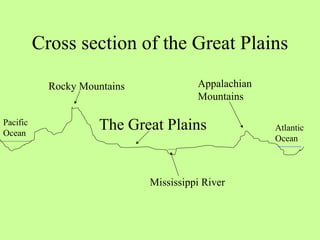
Cross section of the Great Plains Atlantic Ocean Appalachian Mountains Mississippi River Rocky Mountains Pacific Ocean The Great Plains
Thomas Farnham 1839 ‘…burnt and a desert, whose solemn stillness broken by the tread of any other animal than a wolf or a starved and thirsty horse…’
R.I Dodge 1877 ‘…my map of the United States showed…a long and broad white blotch, upon which was printed in small capitals THE GREAT AMERICAN DESERT-UNEXPLORED.’
Coronado 1540 ‘The country the buffalo travel over was so smooth and level that if one looked at them the sky could be seen between their legs…It would be impossible to establish a settlement here…there is no wood…’
Dee Brown 1995 ‘To settlers…the west of the 1830s was a rumour of indefinite obstacles…The great desert and ‘shining mountains’ stood as a barrier to the settlers…(there)…lay the treeless plains, where wind and…dust accompanied fierce storms, and fierce tribes roamed in search of buffalo.’
Why did the white Americans think it was impossible to live on the Great Plains?
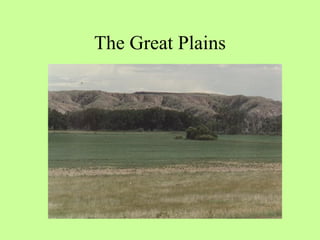
Vegetation In the west, near the Rocky Mountains, the grass was short.  Towards the east it grew taller (prairie grass).  In some of the river valleys, and in the area closest to the Mississippi, there was woodland.  Berries, root plants and wild fruit grew in places.  In the south the land became much drier.
Climate The climate of the region is one of extremes of temperature with strong winds all the year round.  In winter these winds bring blizzards and freezing cold.  In summer they were very hot, drying up the land and rivers.
Wildlife There was a wide variety of animals and birds.  These included antelope, coyote, deer, gophers, rabbits and the great herds of buffalo (bison), plus eagles, grouse and hawks.

The Great Plains

  • 1.
  • 2.
    Cross section ofthe Great Plains Atlantic Ocean Appalachian Mountains Mississippi River Rocky Mountains Pacific Ocean The Great Plains
  • 3.
    Thomas Farnham 1839‘…burnt and a desert, whose solemn stillness broken by the tread of any other animal than a wolf or a starved and thirsty horse…’
  • 4.
    R.I Dodge 1877‘…my map of the United States showed…a long and broad white blotch, upon which was printed in small capitals THE GREAT AMERICAN DESERT-UNEXPLORED.’
  • 5.
    Coronado 1540 ‘Thecountry the buffalo travel over was so smooth and level that if one looked at them the sky could be seen between their legs…It would be impossible to establish a settlement here…there is no wood…’
  • 6.
    Dee Brown 1995‘To settlers…the west of the 1830s was a rumour of indefinite obstacles…The great desert and ‘shining mountains’ stood as a barrier to the settlers…(there)…lay the treeless plains, where wind and…dust accompanied fierce storms, and fierce tribes roamed in search of buffalo.’
  • 7.
    Why did thewhite Americans think it was impossible to live on the Great Plains?
  • 8.
    Vegetation In thewest, near the Rocky Mountains, the grass was short. Towards the east it grew taller (prairie grass). In some of the river valleys, and in the area closest to the Mississippi, there was woodland. Berries, root plants and wild fruit grew in places. In the south the land became much drier.
  • 9.
    Climate The climateof the region is one of extremes of temperature with strong winds all the year round. In winter these winds bring blizzards and freezing cold. In summer they were very hot, drying up the land and rivers.
  • 10.
    Wildlife There wasa wide variety of animals and birds. These included antelope, coyote, deer, gophers, rabbits and the great herds of buffalo (bison), plus eagles, grouse and hawks.