The Great British School System
Courtesy of Olivia :)
Main differences between British
and German schools:
• School Uniform
• Types of Schools
• Structure of School day
• Examination Procedures
School Uniforms
• In almost every British school, children
must wear a uniform.
• Common colours for school uniforms
include navy blue, green, black, red and
grey.
• School uniforms are expensive £££
School Uniforms
• Harrow School Uniform:
School Uniforms
• Eton School Uniform:
School Uniforms
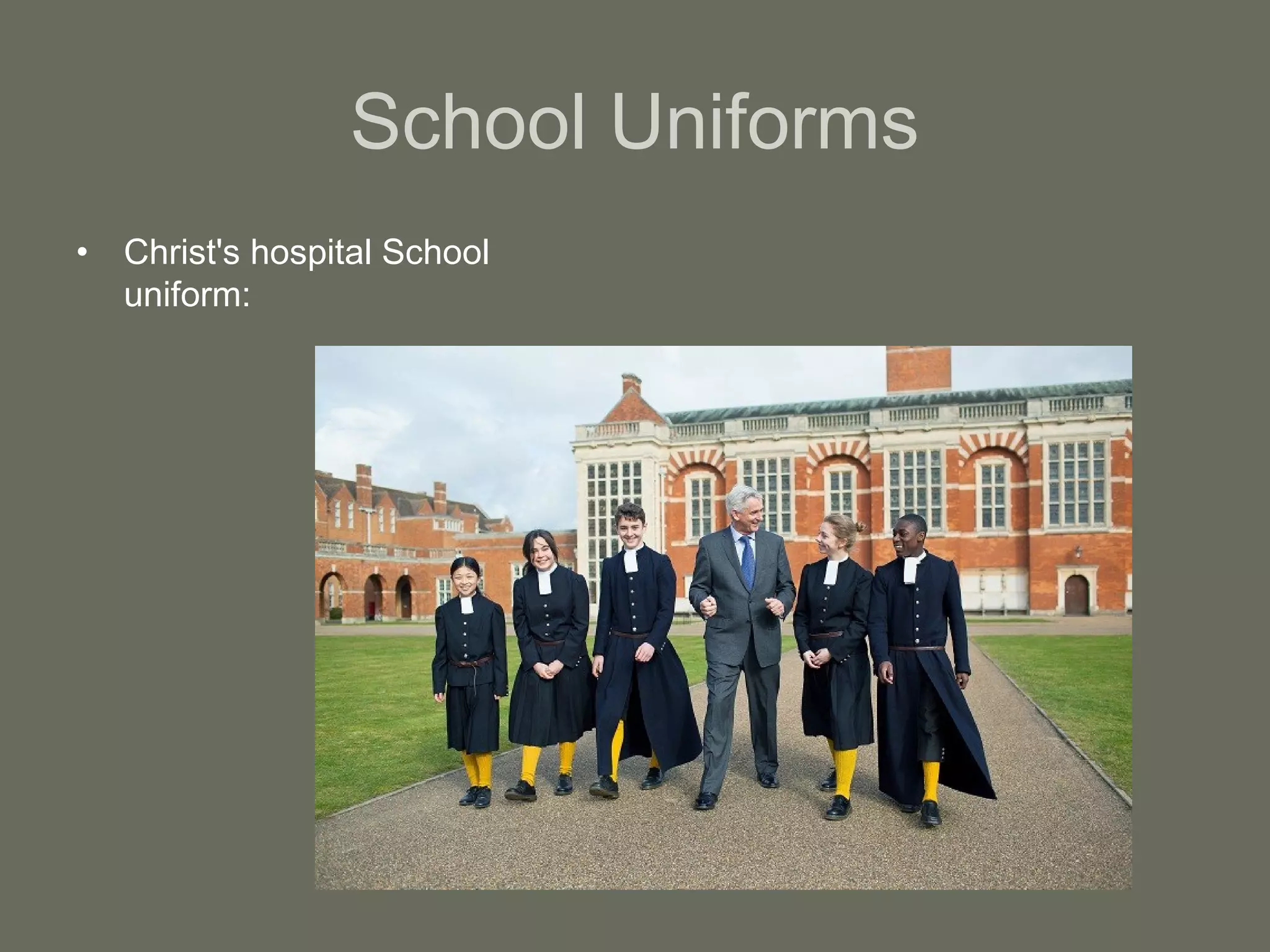
• Christ's hospital School
uniform:
School Uniforms
• St. Gregory's school uniform:
Types of British schools in most of
the country:
• Primary (Reception - year 6)
• Secondary (Year 7 - year 11, and 6th
form)
• State - free
• Private - tuition fees
Types of schools in Leighton
Buzzard:
• Lower (primary, Reception - year 4)
• Middle (primary and secondary, year 5 -
year 8)
• Upper (Secondary, year 9 - year 11 and
6th Form, year 12 and 13).
Lower School
• In Britain, children generally start school at
the age of 4.
• The first year of school is known as
'Reception'.
• Lower schools are normally quite small.
Middle School
• In Leighton Buzzard, children go to middle school in year
5 at the age of 9.
• Middle schools are big in comparison to lower schools.
There were roughly 1,000 pupils at my middle school.
• In middle school you begin to learn more subjects.
• Middle school tends to be the first time you learn foreign
languages.
• You begin to get homework... :'(
You can join sports teams in Middle
school
Upper school
• You start Upper school in year 9 at the age of
13.
• Upper schools are normally very big. My Upper
school had approximately 3,000 pupils and 80
teachers.
• Even more subjects become available.
• Facilities are better. My upper school had a gym,
climbing wall, trampolines, theatre among other
things.
The Cedars Upper - year 11
Structure of the Day
• In general, the school day begins at 9
o'clock in the morning and finishes at 3
o'clock in the afternoon.
• The day is broken up by registration,
morning break and lunch break.
• Most days of the week there are a number
of after school clubs.
Timetable
School dinners
• Most British children eat lunch at school. You
can either bring a packed lunch with you, or
buy a school dinner...
Examination Procedures
• You don't really do any exams until Upper
school, where you begin your GCSEs
(general certificate of secondary education).
• In some schools you are able to achieve up
to 12 GCSEs, but somewhere around 10 is
most common.
Grading GCSEs
• Highest - Lowest:
A* (Outstanding)
A (Very good)
B (Good)
C (Ok)
D (Bad)
E (Very bad)
F (Fail)
U (Ungraded)
GCSEs
• You are only able to proceed to 6th Form
or College if you have achieved the
required GCSEs.
• To study for A-levels in 6th form, you must
have achieved at least 5 A*-C grades.
Match the description with the
picture
They are
wearing
green
blazers and
navy ties.
This individual
is wearing a
grey jumper
and black tie.
This individual is
wearing a light blue,
checkered summer
dress with long white
socks and black
shoes.
This individual is
wearing a straw
hat and a dark
blazer and tie. He
looks very smart.
Solve these anagrams
1. CHINO ROOMFULS
2. VERTICALS HOOP
3. FOXMIRTHS
4. METALBITE
5. MUCHINLET KERAB
Homework :D
• Please answer one of the following:
- What are the advantages and disadvantages of
school uniforms and their role within a school?
- What are the differences between British and
German school systems?

The Great British School System

  • 1.
    The Great BritishSchool System Courtesy of Olivia :)
  • 2.
    Main differences betweenBritish and German schools: • School Uniform • Types of Schools • Structure of School day • Examination Procedures
  • 3.
    School Uniforms • Inalmost every British school, children must wear a uniform. • Common colours for school uniforms include navy blue, green, black, red and grey. • School uniforms are expensive £££
  • 4.
  • 5.
    School Uniforms • EtonSchool Uniform:
  • 6.
    School Uniforms • Christ'shospital School uniform:
  • 7.
    School Uniforms • St.Gregory's school uniform:
  • 8.
    Types of Britishschools in most of the country: • Primary (Reception - year 6) • Secondary (Year 7 - year 11, and 6th form) • State - free • Private - tuition fees
  • 9.
    Types of schoolsin Leighton Buzzard: • Lower (primary, Reception - year 4) • Middle (primary and secondary, year 5 - year 8) • Upper (Secondary, year 9 - year 11 and 6th Form, year 12 and 13).
  • 10.
    Lower School • InBritain, children generally start school at the age of 4. • The first year of school is known as 'Reception'. • Lower schools are normally quite small.
  • 13.
    Middle School • InLeighton Buzzard, children go to middle school in year 5 at the age of 9. • Middle schools are big in comparison to lower schools. There were roughly 1,000 pupils at my middle school. • In middle school you begin to learn more subjects. • Middle school tends to be the first time you learn foreign languages. • You begin to get homework... :'(
  • 15.
    You can joinsports teams in Middle school
  • 16.
    Upper school • Youstart Upper school in year 9 at the age of 13. • Upper schools are normally very big. My Upper school had approximately 3,000 pupils and 80 teachers. • Even more subjects become available. • Facilities are better. My upper school had a gym, climbing wall, trampolines, theatre among other things.
  • 18.
  • 19.
    Structure of theDay • In general, the school day begins at 9 o'clock in the morning and finishes at 3 o'clock in the afternoon. • The day is broken up by registration, morning break and lunch break. • Most days of the week there are a number of after school clubs.
  • 20.
  • 21.
    School dinners • MostBritish children eat lunch at school. You can either bring a packed lunch with you, or buy a school dinner...
  • 22.
  • 23.
    Examination Procedures • Youdon't really do any exams until Upper school, where you begin your GCSEs (general certificate of secondary education). • In some schools you are able to achieve up to 12 GCSEs, but somewhere around 10 is most common.
  • 24.
    Grading GCSEs • Highest- Lowest: A* (Outstanding) A (Very good) B (Good) C (Ok) D (Bad) E (Very bad) F (Fail) U (Ungraded)
  • 25.
    GCSEs • You areonly able to proceed to 6th Form or College if you have achieved the required GCSEs. • To study for A-levels in 6th form, you must have achieved at least 5 A*-C grades.
  • 26.
    Match the descriptionwith the picture They are wearing green blazers and navy ties. This individual is wearing a grey jumper and black tie. This individual is wearing a light blue, checkered summer dress with long white socks and black shoes. This individual is wearing a straw hat and a dark blazer and tie. He looks very smart.
  • 27.
    Solve these anagrams 1.CHINO ROOMFULS 2. VERTICALS HOOP 3. FOXMIRTHS 4. METALBITE 5. MUCHINLET KERAB
  • 28.
    Homework :D • Pleaseanswer one of the following: - What are the advantages and disadvantages of school uniforms and their role within a school? - What are the differences between British and German school systems?