
The Good
Earth
         By. Pearl S. Buck
Prepared by Miracel D.
Sacil
Characters:
Wang Lung- Poor farmer (main character)
O-lan-Wife of Wang Lung
Lotus- Mistress of Wang Lung
Ching- Bestfriend of Wang Lung
The story begins on the
day of Wang Lung's wedding
Wang Lung is a poor young peasa
who lives in an earthen
brick house with his father,
who has arranged for him
to marry a slave girl
named O-lan from the great
family of the House of Hwang.
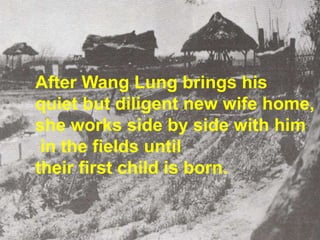
After Wang Lung brings his
quiet but diligent new wife home,
she works side by side with him
 in the fields until
their first child is born.
They are delighted with their son,
and at the New Year O-lan
dresses him up
and proudly takes him to the
House of Hwang to show
him off.
But soon Wang Lung encounters
Difficulties Wang Lung sells
his furniture for a bit of silver
to take his family south,
though he refuses to sell his land.
They ride a firewagon
to a southern city,
where they live in a makeshift
hut on the street. .
They survive by O-lan, the
grandfather, and the children
begging for food and Wang Lung pul
a jinrickshaw (or rickshaw) for the ric
or pulling wagonloads of cargo at nig
In the southern city,
Wang Lung perceives
the extraordinary wealth
of westerners
and Chinese aristocrats
and capitalists, and he is interested
in the revolutionaries‘
protests of the oppression of the po
There follow seven years of
prosperity, during which
the sons grow and begin school;
a third son is born with a twin siste
and the harvest is so
plentiful that Wang Lung hires
laborers and his loyal neighbor,
Ching, as a steward.
Bored with his plain and coarse wife,
he ventures into a tea shop in
town operated by a man from the south
where the rich and idle spend their time
drinking, gambling, and visiting prostitutes.
There he begins an affair with Lotus, a delica
beautiful but manipulatively demanding
courtesan whom he desires obsessively.
O-lan is deeply hurt and angry,
which makes Wang Lung
defensively guilty and cold with her;
there are conflicts between O-lan and
Lotus' maid Cuckoo who had mistrea
O-lan when she was a concubine of
the old master in the House of Hwang
Family affairs continue to
have ups and downs. O-lan's
sickness finally overpowers
her, and Wang Lung's
tender solicitousness
to her on her deathbed
cannot fully compensate
for the insults she
received when Lotus
moved into the house.
She is content to die only after
her first son's marriage is
consummated, so she
can expect a grandson.
His eldest son
persuades him to buy the old
estate of the House of Hwang in tow
both as a means of moving out from
the place where the disgraceful
uncle and his wife live, and as
a symbol of Wang Lung's
elevated social position.
Finally, Wang Lung returns to the eart
house of his land to die. Material
prosperity has brought him superficia
social satisfaction, but only his land
can provide peace and security.
Even his final days are troubled, whe
overhears his two older sons plannin
to sell the land as soon as he dies.
The Good Earth

The Good Earth

  • 1.
    The Good Earth By. Pearl S. Buck Prepared by Miracel D. Sacil
  • 2.
    Characters: Wang Lung- Poorfarmer (main character) O-lan-Wife of Wang Lung Lotus- Mistress of Wang Lung Ching- Bestfriend of Wang Lung
  • 3.
    The story beginson the day of Wang Lung's wedding
  • 4.
    Wang Lung isa poor young peasa who lives in an earthen brick house with his father, who has arranged for him to marry a slave girl named O-lan from the great family of the House of Hwang.
  • 5.
    After Wang Lungbrings his quiet but diligent new wife home, she works side by side with him in the fields until their first child is born.
  • 6.
    They are delightedwith their son, and at the New Year O-lan dresses him up and proudly takes him to the House of Hwang to show him off.
  • 7.
    But soon WangLung encounters Difficulties Wang Lung sells his furniture for a bit of silver to take his family south, though he refuses to sell his land. They ride a firewagon to a southern city, where they live in a makeshift hut on the street. .
  • 8.
    They survive byO-lan, the grandfather, and the children begging for food and Wang Lung pul a jinrickshaw (or rickshaw) for the ric or pulling wagonloads of cargo at nig
  • 9.
    In the southerncity, Wang Lung perceives the extraordinary wealth of westerners and Chinese aristocrats and capitalists, and he is interested in the revolutionaries‘ protests of the oppression of the po
  • 10.
    There follow sevenyears of prosperity, during which the sons grow and begin school; a third son is born with a twin siste and the harvest is so plentiful that Wang Lung hires laborers and his loyal neighbor, Ching, as a steward.
  • 11.
    Bored with hisplain and coarse wife, he ventures into a tea shop in town operated by a man from the south where the rich and idle spend their time drinking, gambling, and visiting prostitutes. There he begins an affair with Lotus, a delica beautiful but manipulatively demanding courtesan whom he desires obsessively.
  • 12.
    O-lan is deeplyhurt and angry, which makes Wang Lung defensively guilty and cold with her; there are conflicts between O-lan and Lotus' maid Cuckoo who had mistrea O-lan when she was a concubine of the old master in the House of Hwang
  • 13.
    Family affairs continueto have ups and downs. O-lan's sickness finally overpowers her, and Wang Lung's tender solicitousness to her on her deathbed cannot fully compensate for the insults she received when Lotus moved into the house.
  • 14.
    She is contentto die only after her first son's marriage is consummated, so she can expect a grandson.
  • 15.
    His eldest son persuadeshim to buy the old estate of the House of Hwang in tow both as a means of moving out from the place where the disgraceful uncle and his wife live, and as a symbol of Wang Lung's elevated social position.
  • 16.
    Finally, Wang Lungreturns to the eart house of his land to die. Material prosperity has brought him superficia social satisfaction, but only his land can provide peace and security. Even his final days are troubled, whe overhears his two older sons plannin to sell the land as soon as he dies.