The Giving Flower 
Valeria Gomez, Pierce McManus, Jordan Zenger. 
Accounting 1C
2 
I. General Information 
1. Industry/ Market Information 
The Giving Flower is a small start-up company that produces and sells origami flowers 
in several different farmers markets in the San Francisco Bay Area. These flowers are 
perfect for any occasion as they provide amazing ambiance with zero required 
maintenance or water in our current drought. Our business travels around setting up 
our cart in a new location four times a week. We are initially planning on visiting the 
farmers markets in San Jose, Los Gatos, Mountain View, and Los Altos. By going to these 
markets we are accessing the consumer in a niche market. The potential market 
penetration for these flowers is extremely high. As most of our competitors only 
operate through an online presence we are beating them to the punch, with a small 
operation that limits total overhead costs. 
2. Customer Information 
Our target customer population consists of people who frequent farmers markets. The 
paper flowers that we produce fit perfectly into the vibrant setting that attracts 
consumers to the farmers markets. The perfect customer is one who is environmentally 
conscious that is perusing farm fresh organic produce through the farmers themselves. 
These consumers are perfect for our company because they are willing to pay more 
money for a product with higher perceived value. Our product, gorgeous paper flowers, 
last much longer than regular flowers, providing a better value than fresh cut flowers 
for a comparable cost.
3 
3. Competitor Information 
There are no direct competitors in the San Francisco Bay Area. This means that there 
are no stores or companies who are already using the idea allowing The Giving Flower 
to have a large potential market share. There are several online competitors who sell 
origami floral arrangements, but their prices are considerably higher than The Giving 
Flower’s. This insures that the consumer’s costs are higher when purchasing through a 
competitor, as you have to account for shipping costs, and in a world of instant 
gratification, wait for delivery. Typically, at farmers markets, people are competing with 
one another trying to sell food, but we are not in the market for food, so therefore we 
can be price setters. We are solely competing with flower shops in local areas, which 
allow us to know our competition intimately. To out produce, and to outdo these 
aforementioned competitors, our company only has to highlight the immense benefits 
reaped from purchasing our products in comparison to the alternative. 
4. Product/Service Information 
We fold, create, and sell paper flowers at farmers markets. We have a selection of 
flowers for our customers to choose from that range in color. Our creations consist of 
folded paper that we then attach to a stem and secure to a box or tie in a bundle. To 
access multiple markets we offer the consumer three different products, bouquet, solo 
flower, and an orchid, depending upon their need. In addition to this every flower or 
flower arrangement we produce includes The Giving Flower’s business card. This card 
includes contact information, along with the URL for our company’s website. The 
Giving Flower offers unparalleled service in comparison to our competitors. When
4 
visiting The Giving Flower’s website you can see our upcoming schedule of cart 
appearances, and also order a specialized bouquet or flower arrangement with your 
choice of colors. This order can be either delivered on a specific day, or be picked up 
from our cart if you expect to see us at the farmers market. 
II. Technical Analysis 
1. Cost Analysis 
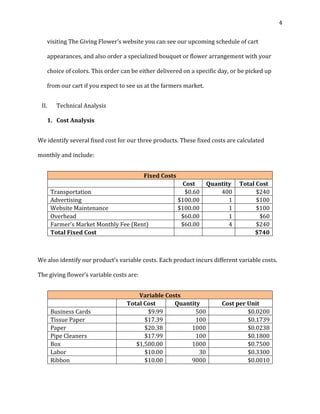
We identify several fixed cost for our three products. These fixed costs are calculated 
monthly and include: 
Fixed Costs 
Cost Quantity Total Cost 
Transportation $0.60 400 $240 
Advertising $100.00 1 $100 
Website Maintenance $100.00 1 $100 
Overhead $60.00 1 $60 
Farmer's Market Monthly Fee (Rent) $60.00 4 $240 
Total Fixed Cost $740 
We also identify our product’s variable costs. Each product incurs different variable costs. 
The giving flower’s variable costs are: 
Variable Costs 
Total Cost Quantity Cost per Unit 
Business Cards $9.99 500 $0.0200 
Tissue Paper $17.39 100 $0.1739 
Paper $20.38 1000 $0.0238 
Pipe Cleaners $17.99 100 $0.1800 
Box $1,500.00 1000 $0.7500 
Labor $10.00 30 $0.3300 
Ribbon $10.00 9000 $0.0010
5 
According to each product, the variable cost per unit is: 
VARIBLE COST PER PRODUCT 
Bouquet Solo Flower The Orchid 
Item Total 
Cost 
Quantity Cost/ 
Unit 
Total 
Cost 
Quantity Cost/ 
Unit 
Total 
Cost 
Quantity Cost/ 
Unit 
Business Card $0.02 1 $0.0200 $0.02 1 $0.0200 $0.02 1 $0.0200 
Tissue Paper $0.17 2 $0.3478 $0.17 1 $0.1739 $0.17 2 $0.3478 
Paper $0.02 12 $0.2856 $0.24 1 $0.2380 $0.24 6 $1.4280 
Pipe Cleaners $0.18 12 $2.1600 $0.18 1 $0.1800 $0.18 1 $0.1800 
Box $0.00 0 $0.0000 $0.75 1 $0.7500 $0.75 1 $0.7500 
Labor $12.00 0.33 $3.9600 $0.33 1 $0.3300 $0.33 6 $1.9800 
Variable Cost 
/ Unit 
$6.7734 $1.6919 $4.7058 
We are estimating to sell in an average 1,200 units per month. By determining how many 
units we would sell, we can identify the fixed cost per unit, therefore, our operating income 
per unit. 
Estimated Production after One Year of Operations 
Month Semester Year 
$740.00 1 6 12 
Total fixed cost/ month $740 $4,440 $8,880 
Expected Units 1200 7200 14400 
Fixed cost per unit $0.62 $0.62 $0.6167 
After identifying our variable and fixed costs and analyzing our indirect competitors, we 
could determinate the sale price per product. 
Per Unit Bouquet Solo Flower Orchid 
Sales Revenue $15.00 $4.50 $12.00 
Variable Cost $6.77 $1.69 $4.71 
Contribution Margin $8.23 $2.81 $7.29 
Fixed Cost -based on 1200 units- $0.62 $0.62 $0.62 
Operating Income $7.61 $2.19 $6.68
6 
Since The Giving flower produces and sells three different products, it is crucial to 
determinate how much is the contribution margin per product based on the different 
quantities sold per product. After analyzing our competitor we determinate that for every 
five bouquets we sell, we also sell three solo flowers and two orchids. 
Weighted Average Contribution Margin 
Bouquet Solo Flower Orchid Total 
Sale price per unit $15.00 $4.50 $12.00 
Variable cost per unit $6.77 $1.69 $4.71 
Contribution Margin per unit $8.23 $2.81 $7.29 
Expected Sale mix in units 5 3 2 10 
Contribution Margin $41.13 $8.42 $14.59 $64.15 
Weighted-average Contribution Margin (85.15/ 10) $6.41 
Knowing the weighted-average contribution margin of our three products, we could 
determinate the breakeven sales as follow: 
Breakeven sales 
Bouquet Solo Flower Orchid 
Units 58 35 23 
Price per Unit $15.00 $4.50 $12.00 
Breakeven point in dollars $865.22 $155.74 $276.87 
Total Sales Revenue $1,297.83 
COGS PER unit $3.43 $1.98 $3.34 
COGS breakeven units $197.85 $68.48 $77.12 
Total Cost of breakeven sales $343.44 
COGS margin of sales 0.26 
After determining the breakeven sales for our products, we could project our sales growth 
for the first year based on the breakeven sales. We project that the first six months of 
operations our sells will be 30% beyond the breakeven point. After six months of operation, 
we expect our sales to increase 50% beyond the breakeven point. After one year of
7 
operations we expect to product and sell the initial estimated 1200 units, on which we 
calculate our fixed cost per unit. 
Projection of growth of sales based on Breakeven sales 
Percentage of Breakeven sales 30% 50% 
Amount expected $389.35 $648.91 
Total amount of sales $1,687.17 $1,946.74 
Increase of COGS $103.03 $171.72 
Total COGS $446.48 $515.17 
COGS margin of sales 0.26 0.26 
Since we want a higher operating income, we determinate that our sale prices could be 
higher and still being competitive. Our final sales revenue for the first year of operation 
based on the different increases will be: 
30% above breakeven Bouquet Solo Flower Orchid TOTAL 
Mixed sale units 75 45 30 150 
Sale Price $18.00 $5.00 $15.00 
Sales revenue $1,349.74 $224.96 $449.91 $2,024.61 
COGS $257.21 $89.02 $100.25 $446.48 
50% above breakeven Bouquet Solo Flower Orchid TOTAL 
Mixed sale units 87 52 35 173 
Sale price $18.00 $5.00 $15.00 
Sales revenue $1,557.39 $259.57 $519.13 $2,336.09 
COGS $296.78 $102.71 $115.68 $515.17
8 
2. Budgets 
We calculated three operating budgets for our first two years of operations. The first 
year of operation includes two operating budgets. The second year of operation 
includes one operating budget. The three operating budges are as follow: 
a) Operating Budget for the first six months of operations: July-December 
2014 
 Sales Budget 
The Giving Flower 
Sales Budget 
July-December 2014 
30% above 
breakeven 
point 
July August September October November December 
July-Dec. 
Total 
Cash Sales $2,021.61 $2,021.61 $2,021.61 $2,021.61 $2,021.61 $2,021.61 
Total Sales 
100% 
$12,129.66 
 Inventory, Purchases and Cost of Goods Sold budget 
The Giving Flower 
Inventory, Purchases, and Cost of Goods Sold Budget 
July-December 2014 
30% above 
breakeven point 
July August September October November December 
July-Dec 
Total 
C.O.G.S. (26% of 
Sales) 
$446.48 $446.48 $446.48 $446.48 $446.48 $446.48 $2,678.88 
Desired Ending 
Inventory 
0 0 0 0 0 0 
Total inventory 
Required 
$446.48 $446.48 $446.48 $446.48 $446.48 $446.48
9 
 Operating Expense Budget 
Before we could prepare our operating expenses budget for the first three months, we had 
to calculate the total variable cost of labor for the mixed products. 
 Budgeted income Statement:
10 
We use straight-line depreciation to determinate our depreciation expense of our cart. 
We determined that the useful live is five years with zero residual value. 
Straight line depreciation 
Cart cost Years Depreciation expense Monthly Dep. Exp. 12 
$1,896.00 5 $379.20 $31.60 
b) Operating Budget for the second half six months of operations: January- 
June 2015 
 Sales Budget 
The Giving Flower 
Sales Budget 
January-June 2015 
50% above 
breakeven point 
January February March April May June 
Jan-June 
Total 
Cash Sales $2,336.09 $2,336.09 $2,336.09 $2,336.09 $2,336.09 $2,336.09 
Total Sales 100% $14,016.54
11 
 Inventory, Purchases and Cost of Goods Sold budget 
The Giving Flower 
Inventory, Purchases, and Cost of Goods Sold Budget 
January-June 2015 
50% above breakeven 
point 
January February March April May June 
Jan-June 
Total 
C.O.G.S (26% of Sales) 
$515.17 $515.17 $515.17 $515.17 $515.17 $515.17 $3,091.02 
Desired Ending 
Inventory 
0 0 0 0 0 0 
Total Inventory 
Required 
$515.17 $515.17 $515.17 $515.17 $515.17 $515.17 
 Operating Expense Budget
12 
 Budgeted Income Statement
13 
c) Operating Budget for the second year of operations: July 2015- June 2016 
For the second year of operations, we expect our variable and fixed costs to increase by 3% 
Increased Fixed Costs by 3% 
Cost Quantity Total Cost 
Transportation $0.60 400 $247 
Advertising $100.00 1 $103 
Website Maintenance $100.00 1 $103 
Overhead $60.00 1 $62 
Farmer's Market Monthly Fee (Rent) $60.00 4 $247 
Total Fixed Cost $762 
We also determine an increase of 3% of the cost of goods sold. The new amount of Cost of 
Goods Sold for all three of our products is as follow: 
Bouquet 
Solo 
Flower 
Orchid 
Cost of Goods $3.43 $1.98 $3.34 
Increased COGS by 3% $0.10 $0.06 $0.10 
Total Increased COGS $3.53 $2.04 $3.44 
Estimated 1200 units Bouquet 
Solo 
Flower Orchid TOTAL 
Mixed Sales 600 360 240 1200 
Sale Price $20.00 $6.00 $17.00 
Sales Revenue $12,000.00 $2,160.00 $4,080.00 $18,240.00 
COGS with 3% increase $2,119.74 $734.18 $825.65 $3,679.57
14 
 Sales budget and Inventory, Purchases and Cost of Goods Sold July 2015-June 2015. 
 Operating Expense budget 
Our company expects an annual growth of 75% after the first year of operations. Due to 
this we have adapted our expense budget for the recurring year with an expected increase 
of 20% in variable labor cost.
15 
 Budgeted Income Statement

The Giving Flower, Managerial Accounting

  • 1.
    The Giving Flower Valeria Gomez, Pierce McManus, Jordan Zenger. Accounting 1C
  • 2.
    2 I. GeneralInformation 1. Industry/ Market Information The Giving Flower is a small start-up company that produces and sells origami flowers in several different farmers markets in the San Francisco Bay Area. These flowers are perfect for any occasion as they provide amazing ambiance with zero required maintenance or water in our current drought. Our business travels around setting up our cart in a new location four times a week. We are initially planning on visiting the farmers markets in San Jose, Los Gatos, Mountain View, and Los Altos. By going to these markets we are accessing the consumer in a niche market. The potential market penetration for these flowers is extremely high. As most of our competitors only operate through an online presence we are beating them to the punch, with a small operation that limits total overhead costs. 2. Customer Information Our target customer population consists of people who frequent farmers markets. The paper flowers that we produce fit perfectly into the vibrant setting that attracts consumers to the farmers markets. The perfect customer is one who is environmentally conscious that is perusing farm fresh organic produce through the farmers themselves. These consumers are perfect for our company because they are willing to pay more money for a product with higher perceived value. Our product, gorgeous paper flowers, last much longer than regular flowers, providing a better value than fresh cut flowers for a comparable cost.
  • 3.
    3 3. CompetitorInformation There are no direct competitors in the San Francisco Bay Area. This means that there are no stores or companies who are already using the idea allowing The Giving Flower to have a large potential market share. There are several online competitors who sell origami floral arrangements, but their prices are considerably higher than The Giving Flower’s. This insures that the consumer’s costs are higher when purchasing through a competitor, as you have to account for shipping costs, and in a world of instant gratification, wait for delivery. Typically, at farmers markets, people are competing with one another trying to sell food, but we are not in the market for food, so therefore we can be price setters. We are solely competing with flower shops in local areas, which allow us to know our competition intimately. To out produce, and to outdo these aforementioned competitors, our company only has to highlight the immense benefits reaped from purchasing our products in comparison to the alternative. 4. Product/Service Information We fold, create, and sell paper flowers at farmers markets. We have a selection of flowers for our customers to choose from that range in color. Our creations consist of folded paper that we then attach to a stem and secure to a box or tie in a bundle. To access multiple markets we offer the consumer three different products, bouquet, solo flower, and an orchid, depending upon their need. In addition to this every flower or flower arrangement we produce includes The Giving Flower’s business card. This card includes contact information, along with the URL for our company’s website. The Giving Flower offers unparalleled service in comparison to our competitors. When
  • 4.
    4 visiting TheGiving Flower’s website you can see our upcoming schedule of cart appearances, and also order a specialized bouquet or flower arrangement with your choice of colors. This order can be either delivered on a specific day, or be picked up from our cart if you expect to see us at the farmers market. II. Technical Analysis 1. Cost Analysis We identify several fixed cost for our three products. These fixed costs are calculated monthly and include: Fixed Costs Cost Quantity Total Cost Transportation $0.60 400 $240 Advertising $100.00 1 $100 Website Maintenance $100.00 1 $100 Overhead $60.00 1 $60 Farmer's Market Monthly Fee (Rent) $60.00 4 $240 Total Fixed Cost $740 We also identify our product’s variable costs. Each product incurs different variable costs. The giving flower’s variable costs are: Variable Costs Total Cost Quantity Cost per Unit Business Cards $9.99 500 $0.0200 Tissue Paper $17.39 100 $0.1739 Paper $20.38 1000 $0.0238 Pipe Cleaners $17.99 100 $0.1800 Box $1,500.00 1000 $0.7500 Labor $10.00 30 $0.3300 Ribbon $10.00 9000 $0.0010
  • 5.
    5 According toeach product, the variable cost per unit is: VARIBLE COST PER PRODUCT Bouquet Solo Flower The Orchid Item Total Cost Quantity Cost/ Unit Total Cost Quantity Cost/ Unit Total Cost Quantity Cost/ Unit Business Card $0.02 1 $0.0200 $0.02 1 $0.0200 $0.02 1 $0.0200 Tissue Paper $0.17 2 $0.3478 $0.17 1 $0.1739 $0.17 2 $0.3478 Paper $0.02 12 $0.2856 $0.24 1 $0.2380 $0.24 6 $1.4280 Pipe Cleaners $0.18 12 $2.1600 $0.18 1 $0.1800 $0.18 1 $0.1800 Box $0.00 0 $0.0000 $0.75 1 $0.7500 $0.75 1 $0.7500 Labor $12.00 0.33 $3.9600 $0.33 1 $0.3300 $0.33 6 $1.9800 Variable Cost / Unit $6.7734 $1.6919 $4.7058 We are estimating to sell in an average 1,200 units per month. By determining how many units we would sell, we can identify the fixed cost per unit, therefore, our operating income per unit. Estimated Production after One Year of Operations Month Semester Year $740.00 1 6 12 Total fixed cost/ month $740 $4,440 $8,880 Expected Units 1200 7200 14400 Fixed cost per unit $0.62 $0.62 $0.6167 After identifying our variable and fixed costs and analyzing our indirect competitors, we could determinate the sale price per product. Per Unit Bouquet Solo Flower Orchid Sales Revenue $15.00 $4.50 $12.00 Variable Cost $6.77 $1.69 $4.71 Contribution Margin $8.23 $2.81 $7.29 Fixed Cost -based on 1200 units- $0.62 $0.62 $0.62 Operating Income $7.61 $2.19 $6.68
  • 6.
    6 Since TheGiving flower produces and sells three different products, it is crucial to determinate how much is the contribution margin per product based on the different quantities sold per product. After analyzing our competitor we determinate that for every five bouquets we sell, we also sell three solo flowers and two orchids. Weighted Average Contribution Margin Bouquet Solo Flower Orchid Total Sale price per unit $15.00 $4.50 $12.00 Variable cost per unit $6.77 $1.69 $4.71 Contribution Margin per unit $8.23 $2.81 $7.29 Expected Sale mix in units 5 3 2 10 Contribution Margin $41.13 $8.42 $14.59 $64.15 Weighted-average Contribution Margin (85.15/ 10) $6.41 Knowing the weighted-average contribution margin of our three products, we could determinate the breakeven sales as follow: Breakeven sales Bouquet Solo Flower Orchid Units 58 35 23 Price per Unit $15.00 $4.50 $12.00 Breakeven point in dollars $865.22 $155.74 $276.87 Total Sales Revenue $1,297.83 COGS PER unit $3.43 $1.98 $3.34 COGS breakeven units $197.85 $68.48 $77.12 Total Cost of breakeven sales $343.44 COGS margin of sales 0.26 After determining the breakeven sales for our products, we could project our sales growth for the first year based on the breakeven sales. We project that the first six months of operations our sells will be 30% beyond the breakeven point. After six months of operation, we expect our sales to increase 50% beyond the breakeven point. After one year of
  • 7.
    7 operations weexpect to product and sell the initial estimated 1200 units, on which we calculate our fixed cost per unit. Projection of growth of sales based on Breakeven sales Percentage of Breakeven sales 30% 50% Amount expected $389.35 $648.91 Total amount of sales $1,687.17 $1,946.74 Increase of COGS $103.03 $171.72 Total COGS $446.48 $515.17 COGS margin of sales 0.26 0.26 Since we want a higher operating income, we determinate that our sale prices could be higher and still being competitive. Our final sales revenue for the first year of operation based on the different increases will be: 30% above breakeven Bouquet Solo Flower Orchid TOTAL Mixed sale units 75 45 30 150 Sale Price $18.00 $5.00 $15.00 Sales revenue $1,349.74 $224.96 $449.91 $2,024.61 COGS $257.21 $89.02 $100.25 $446.48 50% above breakeven Bouquet Solo Flower Orchid TOTAL Mixed sale units 87 52 35 173 Sale price $18.00 $5.00 $15.00 Sales revenue $1,557.39 $259.57 $519.13 $2,336.09 COGS $296.78 $102.71 $115.68 $515.17
  • 8.
    8 2. Budgets We calculated three operating budgets for our first two years of operations. The first year of operation includes two operating budgets. The second year of operation includes one operating budget. The three operating budges are as follow: a) Operating Budget for the first six months of operations: July-December 2014  Sales Budget The Giving Flower Sales Budget July-December 2014 30% above breakeven point July August September October November December July-Dec. Total Cash Sales $2,021.61 $2,021.61 $2,021.61 $2,021.61 $2,021.61 $2,021.61 Total Sales 100% $12,129.66  Inventory, Purchases and Cost of Goods Sold budget The Giving Flower Inventory, Purchases, and Cost of Goods Sold Budget July-December 2014 30% above breakeven point July August September October November December July-Dec Total C.O.G.S. (26% of Sales) $446.48 $446.48 $446.48 $446.48 $446.48 $446.48 $2,678.88 Desired Ending Inventory 0 0 0 0 0 0 Total inventory Required $446.48 $446.48 $446.48 $446.48 $446.48 $446.48
  • 9.
    9  OperatingExpense Budget Before we could prepare our operating expenses budget for the first three months, we had to calculate the total variable cost of labor for the mixed products.  Budgeted income Statement:
  • 10.
    10 We usestraight-line depreciation to determinate our depreciation expense of our cart. We determined that the useful live is five years with zero residual value. Straight line depreciation Cart cost Years Depreciation expense Monthly Dep. Exp. 12 $1,896.00 5 $379.20 $31.60 b) Operating Budget for the second half six months of operations: January- June 2015  Sales Budget The Giving Flower Sales Budget January-June 2015 50% above breakeven point January February March April May June Jan-June Total Cash Sales $2,336.09 $2,336.09 $2,336.09 $2,336.09 $2,336.09 $2,336.09 Total Sales 100% $14,016.54
  • 11.
    11  Inventory,Purchases and Cost of Goods Sold budget The Giving Flower Inventory, Purchases, and Cost of Goods Sold Budget January-June 2015 50% above breakeven point January February March April May June Jan-June Total C.O.G.S (26% of Sales) $515.17 $515.17 $515.17 $515.17 $515.17 $515.17 $3,091.02 Desired Ending Inventory 0 0 0 0 0 0 Total Inventory Required $515.17 $515.17 $515.17 $515.17 $515.17 $515.17  Operating Expense Budget
  • 12.
    12  BudgetedIncome Statement
  • 13.
    13 c) OperatingBudget for the second year of operations: July 2015- June 2016 For the second year of operations, we expect our variable and fixed costs to increase by 3% Increased Fixed Costs by 3% Cost Quantity Total Cost Transportation $0.60 400 $247 Advertising $100.00 1 $103 Website Maintenance $100.00 1 $103 Overhead $60.00 1 $62 Farmer's Market Monthly Fee (Rent) $60.00 4 $247 Total Fixed Cost $762 We also determine an increase of 3% of the cost of goods sold. The new amount of Cost of Goods Sold for all three of our products is as follow: Bouquet Solo Flower Orchid Cost of Goods $3.43 $1.98 $3.34 Increased COGS by 3% $0.10 $0.06 $0.10 Total Increased COGS $3.53 $2.04 $3.44 Estimated 1200 units Bouquet Solo Flower Orchid TOTAL Mixed Sales 600 360 240 1200 Sale Price $20.00 $6.00 $17.00 Sales Revenue $12,000.00 $2,160.00 $4,080.00 $18,240.00 COGS with 3% increase $2,119.74 $734.18 $825.65 $3,679.57
  • 14.
    14  Salesbudget and Inventory, Purchases and Cost of Goods Sold July 2015-June 2015.  Operating Expense budget Our company expects an annual growth of 75% after the first year of operations. Due to this we have adapted our expense budget for the recurring year with an expected increase of 20% in variable labor cost.
  • 15.
    15  BudgetedIncome Statement