Marcel Kessler
uxcamp.ch, 2019-05-11
Demo and discussion of prototyping with coded components
The future of prototyping
TOC
What
- is this all about?
Why
- do I think this is the future of prototyping?
How
- does it work with UXPin Merge?
- does it work with FramerX?
- does it work with Alva?
- does it work with Modulz?
What
- do you think?
2
am I?
Who
5
A leading and independent Swiss
software company
Reliably reaching digital business
targets on an engaging journey
Innovative software covering the
entire lifecycle
Locations in Europe and Middle
East
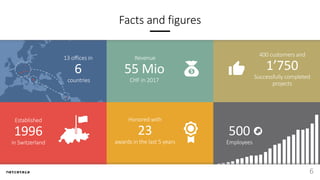
Facts and figures
6
Revenue
55 Mio
CHF in 2017
400 customers and
1’750
Successfully completed
projects
13 offices in
6
countries
Established
1996
in Switzerland
500
Employees
Honored with
23
awards in the last 5 years
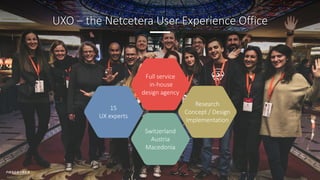
UXO – the Netcetera User Experience Office
Switzerland
Austria
Macedonia
15
UX experts
Research
Concept / Design
Implementation
Full service
in-house
design agency
8
UXO Locations @ Netcetera
15 UX experts in 4 out of 11+ cities
Interdisciplinary approach
Attractive nearshoring rates
UX-Architects close to the customer
Successful remote collaboration
Zurich (HQ)
Bern
Linz
Central Europe
Emirates (UAE)
Macedonia
Skopje
What is this all about?
9
What is your prototyping toolbox?
13
What is your prototyping workflow?
14
The alternative
15
16
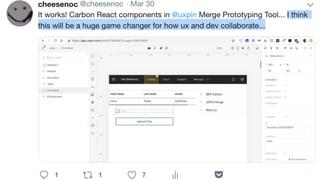
UXPin Merge
Designers and engineers express their thoughts
and ideas with tools lacking compatibility and
synchronicity. Developers work with the final,
platform-specific production technologies,
designers often use vector illustration tools (Sketch,
Figma, XD…) to design static representations of
interfaces.
Marcin Treder
https://medium.com/@marcintreder/can-designers-and-engineers-use-a-single-source-of-truth-ef10fb88a316
17
UXPin Merge
What if designers could use the very same
components used by engineers and they’re all
stored in a shared design system (with accurate
documentation and tests)? Many of the frustrating
and expensive misunderstandings between
designers and engineers would stop happening.
Marcin Treder
https://medium.com/@marcintreder/can-designers-and-engineers-use-a-single-source-of-truth-24490697ceec
18
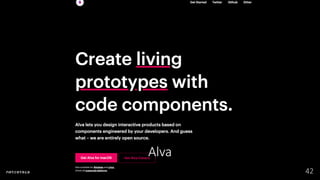
Create living prototypes with code components.
Alva lets you design interactive products based on components engineered by
your developers.
Alva
https://meetalva.io/
19
Almost all design tools are optimised for illustration. Vector-based tools are
great for wireframing and exploration, but when it comes to designing
interactive components, complex layouts and stateful user interfaces—we need
something more powerful.Modulz is specifically designed to produce robust,
accessible, production-grade components and interfaces.
Modulz
https://www.modulz.app/
20
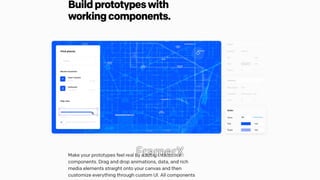
Make your prototypes feel real by adding interactive components. Drag and
drop animations, data, and rich media elements straight onto your canvas and
then customize everything through custom UI. All components are backed by
code, bringing you that much closer to development.
FramerX
https://www.framer.com/prototyping/
21
Across every company size and industry, there emerged two key determinators
of a successful design system:
- A workflow for keeping every component up-to-date.
- A direct connection between design systems and production code.
FramerX Bridge
https://www.framer.com/blog/posts/announcing-framer-bridge/
How the workflow could be…
>_
22
Design and Developer collaboration
1. Agree on (or create) a Design System that roughly fits user and biz requirements
2. Start prototyping in [UXPin|FramerX|Alva] using the provided react components
3. Apply theming directly in the code (SCSS)
4. For new (i.e. not-yet-existing) components
1. Design component and behavior in [Sketch|Figma|…]
2. Import visual design to [UXPin|FramerX|Alva] to continue prototyping
3. Implement component (e.g. using Storybook)
4. Push component
5. Trigger continuous integration build
6. Replace visual component in prototype with react component
23
Why I think this is the future…
24
Benefits
§ One source of truth (the holy grail)
§ “Interactive” components (e.g. text fields)
§ “Responsive” components (e.g. resize)
§ No need to manage a separate sketch library
§ It’s the real deal
§ Designer can still work with pages
§ Designers don’t need to code
25
How does it work?
26
Setup
1. Prototyping tool connects via token to your code repository and build system
2. Components usually come with ”default”/”dummy” content that can be overridden
3. States can be changed according to the props defined
4. Designer still create “pages”
5. Interaction can be added based on “actions”/”triggers” or traditional ”hotspots”
27
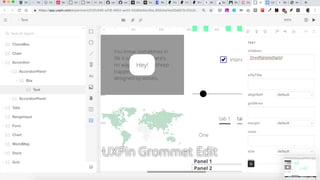
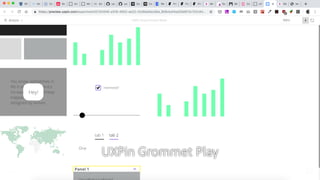
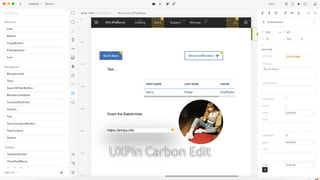
UXPin
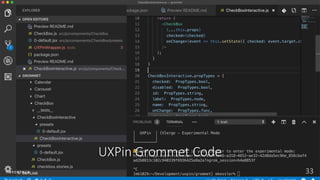
UXPin connects to a Git repository (command line tool is being installed as a project level dependency)
UXPin learns about the code of components stored in the repository and serializes its content
UXPin runs the build process and delivers production code to the UXPin design editor, where all the
components are identical with the production environment, fully interactive and available to designers
(even if they don’t know how to code)
UXPin allows for connecting to a Continuous Integration Server to enable automatic synchronization
between a Git repository and our design editor (every change in the production code is automatically
reflected in the components in UXPin’s design editor)
UXPin shows accurate specifications for all design projects that will show informative code snippets to
tell developers how to implement a given design
28
Demo time
29
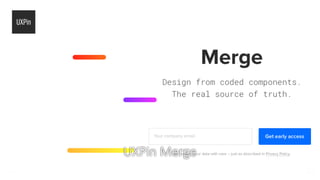
UXPin Merge
UXPin Grommet Edit
UXPin Grommet Play
UXPin Grommet Code
UXPin Carbon Edit
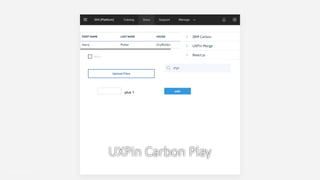
UXPin Carbon Play
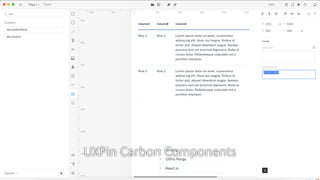
UXPin Carbon Components
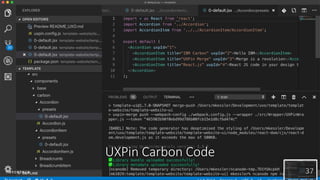
UXPin Carbon Code
FramerX
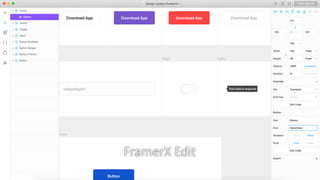
FramerX Edit
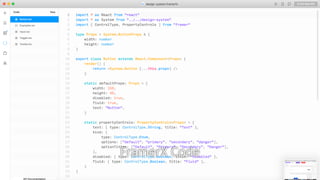
FramerX Code
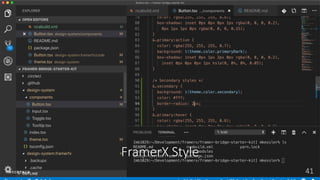
FramerX Style
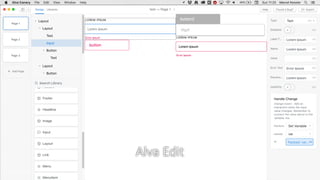
Alva
Alva Edit
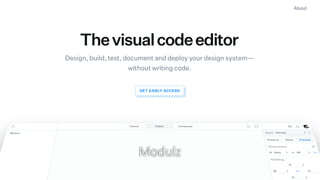
Modulz
Trade-offs
45
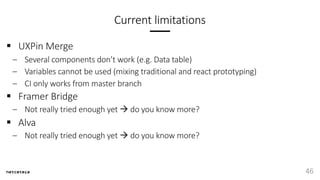
Current limitations
§ UXPin Merge
– Several components don’t work (e.g. Data table)
– Variables cannot be used (mixing traditional and react prototyping)
– CI only works from master branch
§ Framer Bridge
– Not really tried enough yet à do you know more?
§ Alva
– Not really tried enough yet à do you know more?
46
Summary
47
48
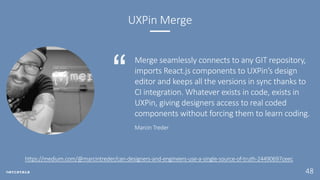
UXPin Merge
Merge seamlessly connects to any GIT repository,
imports React.js components to UXPin’s design
editor and keeps all the versions in sync thanks to
CI integration. Whatever exists in code, exists in
UXPin, giving designers access to real coded
components without forcing them to learn coding.
Marcin Treder
https://medium.com/@marcintreder/can-designers-and-engineers-use-a-single-source-of-truth-24490697ceec
49
UXPin Merge
With UXPin Merge, designers and engineers use a
single source of truth and can finally work together
without unnecessary misunderstandings and
frustrations. Guess what? The perfect
implementation of a design system is possible.
Marcin Treder
https://medium.com/@marcintreder/can-designers-and-engineers-use-a-single-source-of-truth-24490697ceec
My conclusion
§ The way to go!
§ Not yet ready…
§ …but hopefully soon
50
51
What is your experience?
Links
UXPin Merge
§ https://www.uxpin.com/merge
§ https://medium.com/@marcintreder/can-designers-and-engineers-use-a-single-source-of-truth-ef10fb88a316
§ https://wikiuxpin.atlassian.net/wiki/spaces/MA/pages/646938664/How+to+Integrate+Components+with+UXPin+Merge
FramerX
§ https://www.framer.com/prototyping/
§ https://designcode.io/framer-x-react-components
§ https://www.framer.com/blog/posts/announcing-framer-bridge
Alva
§ https://meetalva.io/
Modulz
§ https://meetalva.io/
52
Thanks
Netcetera AG Zypressenstrasse71
Postfach
CH-8040Zürich
info@netcetera.com
T+41442975555
54
Marcel Kessler
Head of User Experience
marcel.kessler@netcetera.com

The future of Prototpying

  • 1.
    Marcel Kessler uxcamp.ch, 2019-05-11 Demoand discussion of prototyping with coded components The future of prototyping
  • 2.
    TOC What - is thisall about? Why - do I think this is the future of prototyping? How - does it work with UXPin Merge? - does it work with FramerX? - does it work with Alva? - does it work with Modulz? What - do you think? 2
  • 3.
  • 5.
    5 A leading andindependent Swiss software company Reliably reaching digital business targets on an engaging journey Innovative software covering the entire lifecycle Locations in Europe and Middle East
  • 6.
    Facts and figures 6 Revenue 55Mio CHF in 2017 400 customers and 1’750 Successfully completed projects 13 offices in 6 countries Established 1996 in Switzerland 500 Employees Honored with 23 awards in the last 5 years
  • 7.
    UXO – theNetcetera User Experience Office Switzerland Austria Macedonia 15 UX experts Research Concept / Design Implementation Full service in-house design agency
  • 8.
    8 UXO Locations @Netcetera 15 UX experts in 4 out of 11+ cities Interdisciplinary approach Attractive nearshoring rates UX-Architects close to the customer Successful remote collaboration Zurich (HQ) Bern Linz Central Europe Emirates (UAE) Macedonia Skopje
  • 9.
    What is thisall about? 9
  • 13.
    What is yourprototyping toolbox? 13
  • 14.
    What is yourprototyping workflow? 14
  • 15.
  • 16.
    16 UXPin Merge Designers andengineers express their thoughts and ideas with tools lacking compatibility and synchronicity. Developers work with the final, platform-specific production technologies, designers often use vector illustration tools (Sketch, Figma, XD…) to design static representations of interfaces. Marcin Treder https://medium.com/@marcintreder/can-designers-and-engineers-use-a-single-source-of-truth-ef10fb88a316
  • 17.
    17 UXPin Merge What ifdesigners could use the very same components used by engineers and they’re all stored in a shared design system (with accurate documentation and tests)? Many of the frustrating and expensive misunderstandings between designers and engineers would stop happening. Marcin Treder https://medium.com/@marcintreder/can-designers-and-engineers-use-a-single-source-of-truth-24490697ceec
  • 18.
    18 Create living prototypeswith code components. Alva lets you design interactive products based on components engineered by your developers. Alva https://meetalva.io/
  • 19.
    19 Almost all designtools are optimised for illustration. Vector-based tools are great for wireframing and exploration, but when it comes to designing interactive components, complex layouts and stateful user interfaces—we need something more powerful.Modulz is specifically designed to produce robust, accessible, production-grade components and interfaces. Modulz https://www.modulz.app/
  • 20.
    20 Make your prototypesfeel real by adding interactive components. Drag and drop animations, data, and rich media elements straight onto your canvas and then customize everything through custom UI. All components are backed by code, bringing you that much closer to development. FramerX https://www.framer.com/prototyping/
  • 21.
    21 Across every companysize and industry, there emerged two key determinators of a successful design system: - A workflow for keeping every component up-to-date. - A direct connection between design systems and production code. FramerX Bridge https://www.framer.com/blog/posts/announcing-framer-bridge/
  • 22.
    How the workflowcould be… >_ 22
  • 23.
    Design and Developercollaboration 1. Agree on (or create) a Design System that roughly fits user and biz requirements 2. Start prototyping in [UXPin|FramerX|Alva] using the provided react components 3. Apply theming directly in the code (SCSS) 4. For new (i.e. not-yet-existing) components 1. Design component and behavior in [Sketch|Figma|…] 2. Import visual design to [UXPin|FramerX|Alva] to continue prototyping 3. Implement component (e.g. using Storybook) 4. Push component 5. Trigger continuous integration build 6. Replace visual component in prototype with react component 23
  • 24.
    Why I thinkthis is the future… 24
  • 25.
    Benefits § One sourceof truth (the holy grail) § “Interactive” components (e.g. text fields) § “Responsive” components (e.g. resize) § No need to manage a separate sketch library § It’s the real deal § Designer can still work with pages § Designers don’t need to code 25
  • 26.
    How does itwork? 26
  • 27.
    Setup 1. Prototyping toolconnects via token to your code repository and build system 2. Components usually come with ”default”/”dummy” content that can be overridden 3. States can be changed according to the props defined 4. Designer still create “pages” 5. Interaction can be added based on “actions”/”triggers” or traditional ”hotspots” 27
  • 28.
    UXPin UXPin connects toa Git repository (command line tool is being installed as a project level dependency) UXPin learns about the code of components stored in the repository and serializes its content UXPin runs the build process and delivers production code to the UXPin design editor, where all the components are identical with the production environment, fully interactive and available to designers (even if they don’t know how to code) UXPin allows for connecting to a Continuous Integration Server to enable automatic synchronization between a Git repository and our design editor (every change in the production code is automatically reflected in the components in UXPin’s design editor) UXPin shows accurate specifications for all design projects that will show informative code snippets to tell developers how to implement a given design 28
  • 29.
  • 30.
  • 31.
  • 32.
  • 33.
  • 34.
  • 35.
  • 36.
  • 37.
  • 38.
  • 39.
  • 40.
  • 41.
  • 42.
  • 43.
  • 44.
  • 45.
  • 46.
    Current limitations § UXPinMerge – Several components don’t work (e.g. Data table) – Variables cannot be used (mixing traditional and react prototyping) – CI only works from master branch § Framer Bridge – Not really tried enough yet à do you know more? § Alva – Not really tried enough yet à do you know more? 46
  • 47.
  • 48.
    48 UXPin Merge Merge seamlesslyconnects to any GIT repository, imports React.js components to UXPin’s design editor and keeps all the versions in sync thanks to CI integration. Whatever exists in code, exists in UXPin, giving designers access to real coded components without forcing them to learn coding. Marcin Treder https://medium.com/@marcintreder/can-designers-and-engineers-use-a-single-source-of-truth-24490697ceec
  • 49.
    49 UXPin Merge With UXPinMerge, designers and engineers use a single source of truth and can finally work together without unnecessary misunderstandings and frustrations. Guess what? The perfect implementation of a design system is possible. Marcin Treder https://medium.com/@marcintreder/can-designers-and-engineers-use-a-single-source-of-truth-24490697ceec
  • 50.
    My conclusion § Theway to go! § Not yet ready… § …but hopefully soon 50
  • 51.
    51 What is yourexperience?
  • 52.
    Links UXPin Merge § https://www.uxpin.com/merge §https://medium.com/@marcintreder/can-designers-and-engineers-use-a-single-source-of-truth-ef10fb88a316 § https://wikiuxpin.atlassian.net/wiki/spaces/MA/pages/646938664/How+to+Integrate+Components+with+UXPin+Merge FramerX § https://www.framer.com/prototyping/ § https://designcode.io/framer-x-react-components § https://www.framer.com/blog/posts/announcing-framer-bridge Alva § https://meetalva.io/ Modulz § https://meetalva.io/ 52
  • 53.
  • 54.