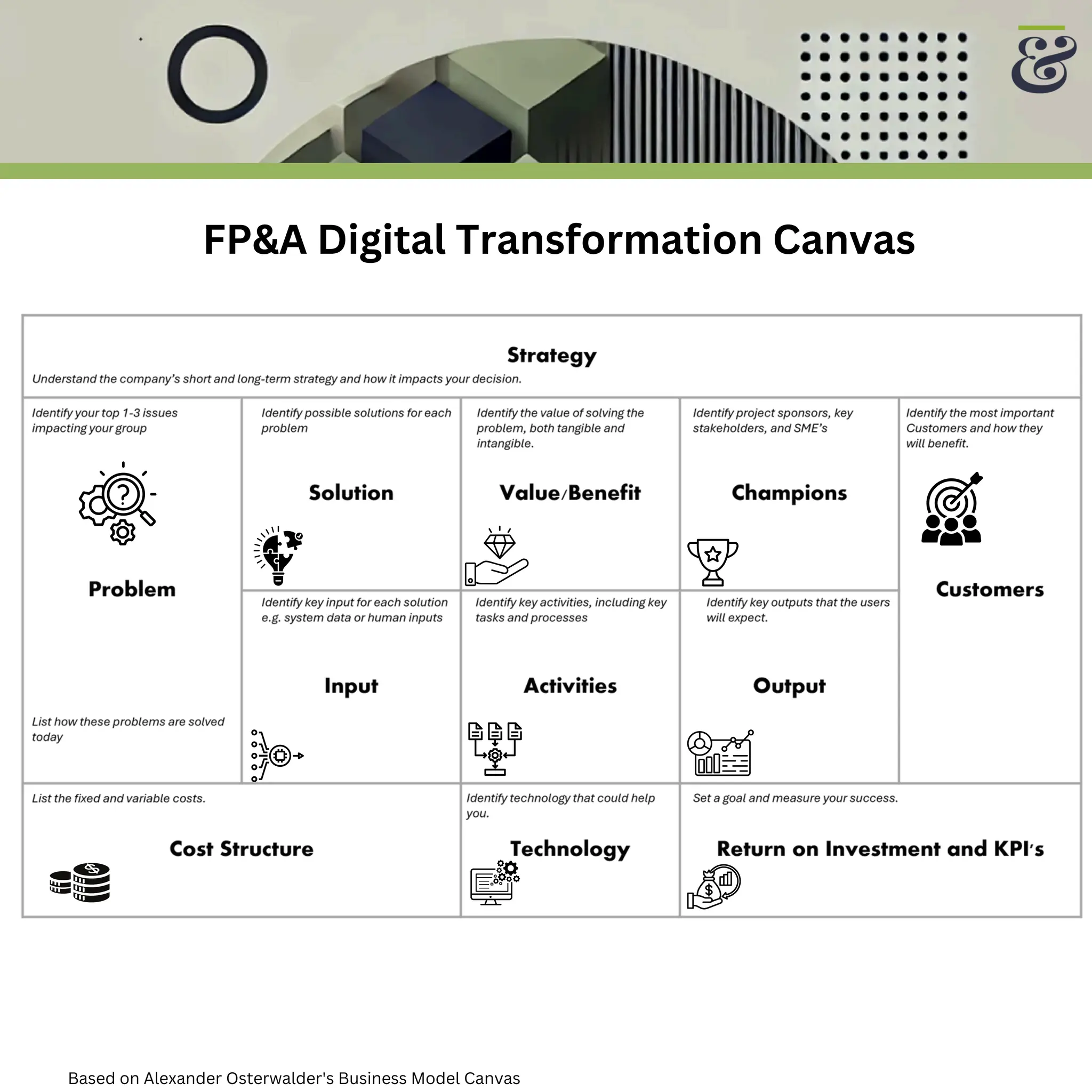
I borrowed Alexander Osterwalder's Business Model Canvas as a starting point and created a Finance Transformation Canvas to help Finance teams think through how to start a digital transformation
FP&A Digital TransformationCanvas
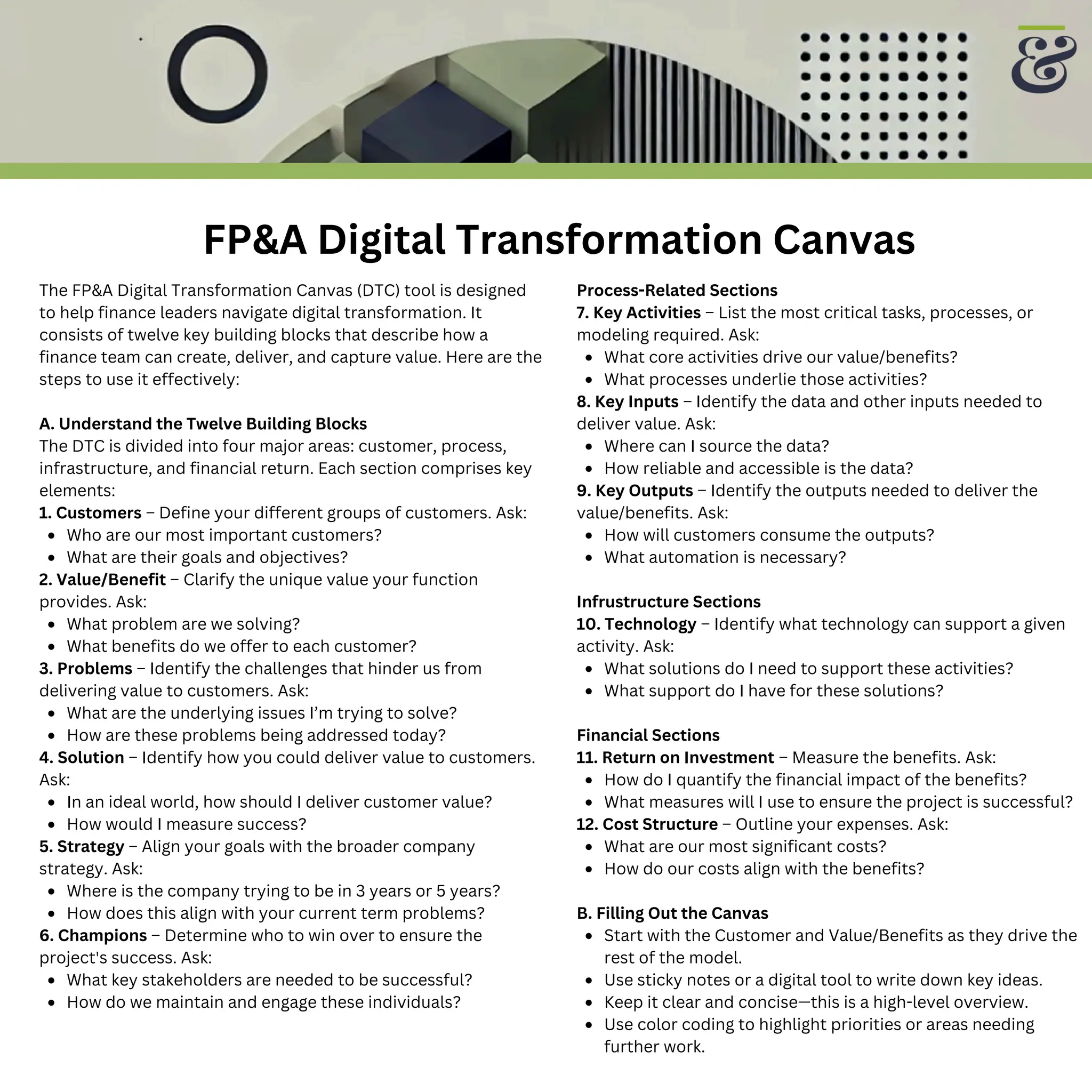
The FP&A Digital Transformation Canvas (DTC) tool is designed
to help finance leaders navigate digital transformation. It
consists of twelve key building blocks that describe how a
finance team can create, deliver, and capture value. Here are the
steps to use it effectively:
A. Understand the Twelve Building Blocks
The DTC is divided into four major areas: customer, process,
infrastructure, and financial return. Each section comprises key
elements:
1. Customers – Define your different groups of customers. Ask:
Who are our most important customers?
What are their goals and objectives?
2. Value/Benefit – Clarify the unique value your function
provides. Ask:
What problem are we solving?
What benefits do we offer to each customer?
3. Problems – Identify the challenges that hinder us from
delivering value to customers. Ask:
What are the underlying issues I’m trying to solve?
How are these problems being addressed today?
4. Solution – Identify how you could deliver value to customers.
Ask:
In an ideal world, how should I deliver customer value?
How would I measure success?
5. Strategy – Align your goals with the broader company
strategy. Ask:
Where is the company trying to be in 3 years or 5 years?
How does this align with your current term problems?
6. Champions – Determine who to win over to ensure the
project's success. Ask:
What key stakeholders are needed to be successful?
How do we maintain and engage these individuals?
Process-Related Sections
7. Key Activities – List the most critical tasks, processes, or
modeling required. Ask:
What core activities drive our value/benefits?
What processes underlie those activities?
8. Key Inputs – Identify the data and other inputs needed to
deliver value. Ask:
Where can I source the data?
How reliable and accessible is the data?
9. Key Outputs – Identify the outputs needed to deliver the
value/benefits. Ask:
How will customers consume the outputs?
What automation is necessary?
Infrustructure Sections
10. Technology – Identify what technology can support a given
activity. Ask:
What solutions do I need to support these activities?
What support do I have for these solutions?
Financial Sections
11. Return on Investment – Measure the benefits. Ask:
How do I quantify the financial impact of the benefits?
What measures will I use to ensure the project is successful?
12. Cost Structure – Outline your expenses. Ask:
What are our most significant costs?
How do our costs align with the benefits?
B. Filling Out the Canvas
Start with the Customer and Value/Benefits as they drive the
rest of the model.
Use sticky notes or a digital tool to write down key ideas.
Keep it clear and concise—this is a high-level overview.
Use color coding to highlight priorities or areas needing
further work.


![[DRAFT] Module 2 - Your Business or Mission Model.pdf](https://cdn.slidesharecdn.com/ss_thumbnails/draftmodule2-yourbusinessormissionmodel-230302201211-f6853c59-thumbnail.jpg?width=640&height=640&fit=bounds)


![Vibe Coding vs. Spec-Driven Development [Free Meetup]](https://cdn.slidesharecdn.com/ss_thumbnails/vibecodingvsspecdrivendevelopment-251209105622-43f455e7-thumbnail.jpg?width=640&height=640&fit=bounds)


