AI and Machine Learning :
Shaping the Future of Technology
Artificial Intelligence (AI) and Machine Learning (ML)
have emerged as revolutionary technologies that are
transforming various industries and aspects of our daily
lives. From predictive analytics to autonomous vehicles,
these advancements are driving innovation and shaping
the future of technology. In this article, we’ll delve into
the intricacies of AI and Machine Learning, exploring
their significance, applications, challenges, and
potential for the years ahead.
1. Introduction to AI and Machine Learning
In recent years, AI and Machine Learning have garnered widespread attention due to
their potential to replicate human cognitive functions. AI refers to the simulation of
human intelligence processes by machines, enabling them to perform tasks that
typically require human intelligence, such as problem-solving, decision-making, and
language understanding. Machine Learning, a subset of AI, involves training
machines to learn from data and improve their performance over time without explicit
programming.
2. The Fundamentals of AI
At its core, AI relies on algorithms and data to make decisions. These algorithms
process massive amounts of data to recognize patterns and make predictions. The
advent of powerful hardware and sophisticated algorithms has accelerated the
development of AI applications.
3. Understanding Machine Learning
Machine Learning is based on the principle of allowing machines to learn from data.
It involves supervised learning (where models learn from labeled data), unsupervised
learning (finding patterns in unlabeled data), and reinforcement learning
(reward-based learning). The ability of machines to learn and adapt makes them
highly versatile.
4. Applications of AI and Machine Learning
The applications of AI and Machine Learning span across industries. In healthcare,
AI aids in diagnosing diseases and predicting patient outcomes. In business, ML
algorithms analyse consumer behaviour to improve marketing strategies. The
education sector benefits from personalised learning paths, while autonomous
vehicles showcase AI’s potential in transportation.
5. AI and Machine Learning in Healthcare
AI-driven diagnosis and treatment planning are revolutionising healthcare. ML
algorithms can analyse medical images for accurate detection, and predictive
models help identify potential health risks, enabling early interventions.
6. Enhancing Business Operations with AI
AI enhances business efficiency by automating tasks and optimising processes.
Chatbots provide instant customer support, while AI-driven analytics assist in
data-driven decision-making, giving companies a competitive edge.
7. AI, Machine Learning, and Education
Education is becoming personalised with AI-powered tools that adapt to individual
learning styles. Virtual tutors and educational apps cater to students’ needs,
promoting interactive and effective learning experiences.
8. Ethical Considerations in AI Development
As AI becomes more integrated into our lives, ethical concerns arise. Issues of bias
in AI algorithms, data privacy, and job displacement due to automation require
careful consideration and regulation.
9. Challenges in AI and Machine Learning
Despite rapid advancements, challenges persist. Data quality and quantity,
interpretability of complex models, and ensuring AI’s accountability pose ongoing
hurdles.
10. The Future Landscape of AI and Machine
Learning
The future holds exciting possibilities for AI and ML. Integration with the Internet of
Things (IoT), 5G connectivity, and quantum computing will amplify their capabilities,
transforming industries and societies.
11. Advancements in Natural Language
Processing
Natural Language Processing (NLP) is a branch of AI that focuses on enabling
computers to understand, interpret, and generate human language. NLP’s evolution
opens doors for improved human-computer interaction and language-based
applications.
12. AI in Entertainment and Gaming
AI-driven content recommendations on streaming platforms and dynamic in-game
experiences showcase AI’s role in entertainment. Procedural content generation
enhances gaming by creating diverse and immersive worlds.
13. Combating Cybersecurity Threats with AI
AI strengthens cybersecurity by identifying patterns associated with cyber threats,
enabling rapid threat detection and response. AI algorithms can learn and adapt to
new attack vectors, bolstering digital defences.
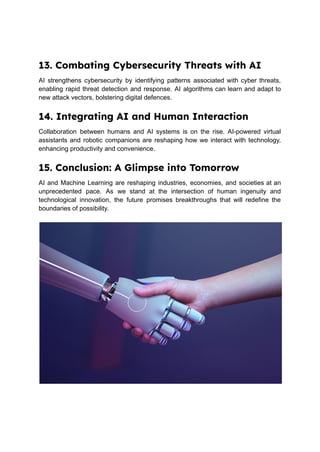
14. Integrating AI and Human Interaction
Collaboration between humans and AI systems is on the rise. AI-powered virtual
assistants and robotic companions are reshaping how we interact with technology,
enhancing productivity and convenience.
15. Conclusion: A Glimpse into Tomorrow
AI and Machine Learning are reshaping industries, economies, and societies at an
unprecedented pace. As we stand at the intersection of human ingenuity and
technological innovation, the future promises breakthroughs that will redefine the
boundaries of possibility.
FAQs
1. What is the difference between AI and Machine Learning?
AI encompasses the broader concept of simulating human
intelligence, while Machine Learning is a subset that focuses on
training machines using data.
2. How does AI impact job markets?
AI can automate routine tasks but also create new job roles that
require expertise in AI development, maintenance, and ethical
considerations.
3. What are some ethical concerns with AI?
Bias in AI algorithms, data privacy breaches, and the potential for
AI to make critical decisions without human intervention raise
ethical questions.
4. Can AI replace human creativity?
While AI can assist in creative tasks, human creativity remains
irreplaceable, as it involves complex emotions, experiences, and
subjective interpretations.
5. Is AI only for tech-savvy industries?
No, AI’s applications span diverse sectors, from healthcare and
finance to agriculture and entertainment, driving innovation across
the board.

AI and Machine Learning.pdf

  • 1.
    AI and MachineLearning : Shaping the Future of Technology Artificial Intelligence (AI) and Machine Learning (ML) have emerged as revolutionary technologies that are transforming various industries and aspects of our daily lives. From predictive analytics to autonomous vehicles, these advancements are driving innovation and shaping the future of technology. In this article, we’ll delve into the intricacies of AI and Machine Learning, exploring their significance, applications, challenges, and potential for the years ahead.
  • 2.
    1. Introduction toAI and Machine Learning In recent years, AI and Machine Learning have garnered widespread attention due to their potential to replicate human cognitive functions. AI refers to the simulation of human intelligence processes by machines, enabling them to perform tasks that typically require human intelligence, such as problem-solving, decision-making, and language understanding. Machine Learning, a subset of AI, involves training machines to learn from data and improve their performance over time without explicit programming. 2. The Fundamentals of AI At its core, AI relies on algorithms and data to make decisions. These algorithms process massive amounts of data to recognize patterns and make predictions. The advent of powerful hardware and sophisticated algorithms has accelerated the development of AI applications. 3. Understanding Machine Learning Machine Learning is based on the principle of allowing machines to learn from data. It involves supervised learning (where models learn from labeled data), unsupervised learning (finding patterns in unlabeled data), and reinforcement learning (reward-based learning). The ability of machines to learn and adapt makes them highly versatile. 4. Applications of AI and Machine Learning The applications of AI and Machine Learning span across industries. In healthcare, AI aids in diagnosing diseases and predicting patient outcomes. In business, ML algorithms analyse consumer behaviour to improve marketing strategies. The education sector benefits from personalised learning paths, while autonomous vehicles showcase AI’s potential in transportation. 5. AI and Machine Learning in Healthcare AI-driven diagnosis and treatment planning are revolutionising healthcare. ML algorithms can analyse medical images for accurate detection, and predictive models help identify potential health risks, enabling early interventions. 6. Enhancing Business Operations with AI AI enhances business efficiency by automating tasks and optimising processes. Chatbots provide instant customer support, while AI-driven analytics assist in data-driven decision-making, giving companies a competitive edge.
  • 3.
    7. AI, MachineLearning, and Education Education is becoming personalised with AI-powered tools that adapt to individual learning styles. Virtual tutors and educational apps cater to students’ needs, promoting interactive and effective learning experiences. 8. Ethical Considerations in AI Development As AI becomes more integrated into our lives, ethical concerns arise. Issues of bias in AI algorithms, data privacy, and job displacement due to automation require careful consideration and regulation. 9. Challenges in AI and Machine Learning Despite rapid advancements, challenges persist. Data quality and quantity, interpretability of complex models, and ensuring AI’s accountability pose ongoing hurdles. 10. The Future Landscape of AI and Machine Learning The future holds exciting possibilities for AI and ML. Integration with the Internet of Things (IoT), 5G connectivity, and quantum computing will amplify their capabilities, transforming industries and societies. 11. Advancements in Natural Language Processing Natural Language Processing (NLP) is a branch of AI that focuses on enabling computers to understand, interpret, and generate human language. NLP’s evolution opens doors for improved human-computer interaction and language-based applications. 12. AI in Entertainment and Gaming AI-driven content recommendations on streaming platforms and dynamic in-game experiences showcase AI’s role in entertainment. Procedural content generation enhances gaming by creating diverse and immersive worlds.
  • 4.
    13. Combating CybersecurityThreats with AI AI strengthens cybersecurity by identifying patterns associated with cyber threats, enabling rapid threat detection and response. AI algorithms can learn and adapt to new attack vectors, bolstering digital defences. 14. Integrating AI and Human Interaction Collaboration between humans and AI systems is on the rise. AI-powered virtual assistants and robotic companions are reshaping how we interact with technology, enhancing productivity and convenience. 15. Conclusion: A Glimpse into Tomorrow AI and Machine Learning are reshaping industries, economies, and societies at an unprecedented pace. As we stand at the intersection of human ingenuity and technological innovation, the future promises breakthroughs that will redefine the boundaries of possibility.
  • 5.
    FAQs 1. What isthe difference between AI and Machine Learning? AI encompasses the broader concept of simulating human intelligence, while Machine Learning is a subset that focuses on training machines using data. 2. How does AI impact job markets? AI can automate routine tasks but also create new job roles that require expertise in AI development, maintenance, and ethical considerations. 3. What are some ethical concerns with AI? Bias in AI algorithms, data privacy breaches, and the potential for AI to make critical decisions without human intervention raise ethical questions. 4. Can AI replace human creativity? While AI can assist in creative tasks, human creativity remains irreplaceable, as it involves complex emotions, experiences, and subjective interpretations. 5. Is AI only for tech-savvy industries? No, AI’s applications span diverse sectors, from healthcare and finance to agriculture and entertainment, driving innovation across the board.