Indira Memorial Sr. Secondary School
Social Science
Class – IX
Chapter – 1 The French Revolution (History)
Prepared By
Aditya Mishra
TGT- Social Science
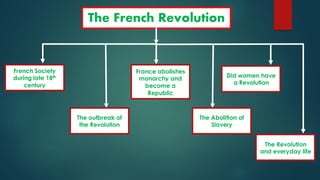
The French Revolution
French Society
during late 18th
century
The outbreak of
the Revolution
France abolishes
monarchy and
become a
Republic
The Abolition of
Slavery
Did women have
a Revolution
The Revolution
and everyday life
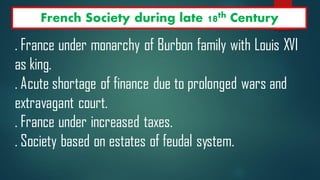
French Society during late 18th Century
. France under monarchy of Burbon family with Louis XVI
as king.
. Acute shortage of finance due to prolonged wars and
extravagant court.
. France under increased taxes.
. Society based on estates of feudal system.
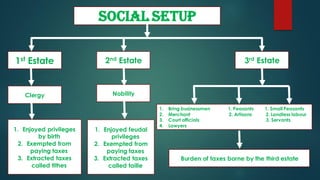
Social Setup
1st Estate 2nd Estate 3rd Estate
Clergy
1. Enjoyed privileges
by birth
2. Exempted from
paying taxes
3. Extracted taxes
called tithes
Nobility
1. Enjoyed feudal
privileges
2. Exempted from
paying taxes
3. Extracted taxes
called taille
1. Bring businessmen 1. Peasants 1. Small Peasants
2. Merchant 2. Artisans 2. Landless labour
3. Court officials 3. Servants
4. Lawyers
Burden of taxes borne by the third estate
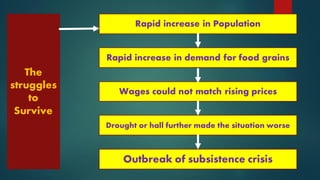
The
struggles
to
Survive
Rapid increase in Population
Wages could not match rising prices
Drought or hall further made the situation worse
Outbreak of subsistence crisis
Rapid increase in demand for food grains
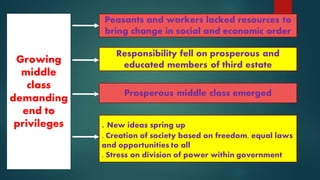
Growing
middle
class
demanding
end to
privileges
Peasants and workers lacked resources to
bring change in social and economic order
Prosperous middle class emerged
. New ideas spring up
. Creation of society based on freedom, equal laws
and opportunities to all
. Stress on division of power within government
Responsibility fell on prosperous and
educated members of third estate
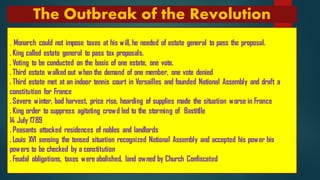
The Outbreak of the Revolution
. Monarch could not impose taxes at his will, he needed of estate general to pass the proposal.
. King called estate general to pass tax proposals.
. Voting to be conducted on the basis of one estate, one vote.
. Third estate walked out when the demand of one member, one vote denied
. Third estate met at an indoor tennis court in Versailles and founded National Assembly and draft a
constitution for France
. Severe winter, bad harvest, price rise, hoarding of supplies made the situation worse in France
. King order to suppress agitating crowd led to the storming of Bastitlle
14 July 1789
. Peasants attacked residences of nobles and landlords
. Louis XVI sensing the tensed situation recognized National Assembly and accepted his power his
powers to be checked by a constitution
. Feudal obligations, taxes were abolished, land owned by Church Confiscated
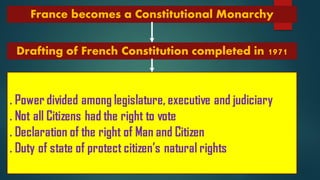
France becomes a Constitutional Monarchy
. Power divided among legislature, executive and judiciary
. Not all Citizens had the right to vote
. Declaration of the right of Man and Citizen
. Duty of state of protect citizen’s natural rights
Drafting of French Constitution completed in 1971
France
Abolishes
Monarchy
and
Becomes a
Republic
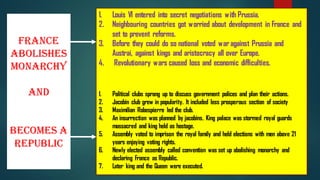
1. Louis VI entered into secret negotiations with Prussia.
2. Neighbouring countries got worried about development in France and
set to prevent reforms.
3. Before they could do so national voted war against Prussia and
Austrai, against kings and aristocracy all over Europe.
4. Revolutionary wars caused loss and economic difficulties.
1. Political clubs sprang up to discuss government polices and plan their actions.
2. Jacobin club grew in popularity. It included less prosperous section of society
3. Maximilian Robespierre led the club.
4. An insurrection was planned by jacobins. King palace was stormed royal guards
massacred and king held as hostage.
5. Assembly voted to imprison the royal family and held elections with men above 21
years enjoying voting rights.
6. Newly elected assembly called convention was set up abolishing monarchy and
declaring France as Republic.
7. Later king and the Queen were executed.
The Reign of Terror (1793 – 1794)
If the court found them ‘guilty’ they were ‘guillotined’ ( Guilotine is a device consisting of two
poles and a blade with which a person is beheaded)
All those he considered as his enemies – including his club members and anyone who did not agree to
his methods – were arrested, imprisoned and them tried by a revolutionary tribunal.
Laws were introduced in placing maximum ceiling on wages and price by
Robespierre’s government.
Robespierre pursued his policies to relentlessly that even his supporters
began to demand moderation.
Robespierre: the leader of the Jacobin- Followed a policy of serve control and Punishment.
He was convicted by a court in july 1794, arrested and guillotined.
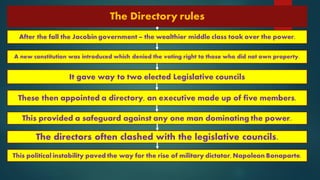
The Directory rules
It gave way to two elected Legislative councils
A new constitution was introduced which denied the voting right to those who did not own property.
These then appointed a directory, an executive made up of five members.
This provided a safeguard against any one man dominating the power.
After the fall the Jacobin government – the wealthier middle class took over the power.
The directors often clashed with the legislative councils.
This political instability paved the way for the rise of military dictator, Napoleon Bonaparte.
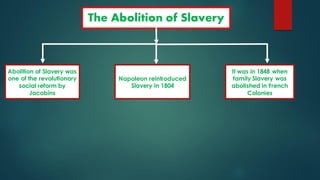
The Abolition of Slavery
Abolition of Slavery was
one of the revolutionary
social reform by
Jacobins
It was in 1848 when
family Slavery was
abolished in French
Colonies
Napoleon reintroduced
Slavery in 1804

The french revolution (Marthand Classes)

  • 1.
    Indira Memorial Sr.Secondary School Social Science Class – IX Chapter – 1 The French Revolution (History) Prepared By Aditya Mishra TGT- Social Science
  • 2.
    The French Revolution FrenchSociety during late 18th century The outbreak of the Revolution France abolishes monarchy and become a Republic The Abolition of Slavery Did women have a Revolution The Revolution and everyday life
  • 3.
    French Society duringlate 18th Century . France under monarchy of Burbon family with Louis XVI as king. . Acute shortage of finance due to prolonged wars and extravagant court. . France under increased taxes. . Society based on estates of feudal system.
  • 4.
    Social Setup 1st Estate2nd Estate 3rd Estate Clergy 1. Enjoyed privileges by birth 2. Exempted from paying taxes 3. Extracted taxes called tithes Nobility 1. Enjoyed feudal privileges 2. Exempted from paying taxes 3. Extracted taxes called taille 1. Bring businessmen 1. Peasants 1. Small Peasants 2. Merchant 2. Artisans 2. Landless labour 3. Court officials 3. Servants 4. Lawyers Burden of taxes borne by the third estate
  • 5.
    The struggles to Survive Rapid increase inPopulation Wages could not match rising prices Drought or hall further made the situation worse Outbreak of subsistence crisis Rapid increase in demand for food grains
  • 6.
    Growing middle class demanding end to privileges Peasants andworkers lacked resources to bring change in social and economic order Prosperous middle class emerged . New ideas spring up . Creation of society based on freedom, equal laws and opportunities to all . Stress on division of power within government Responsibility fell on prosperous and educated members of third estate
  • 7.
    The Outbreak ofthe Revolution . Monarch could not impose taxes at his will, he needed of estate general to pass the proposal. . King called estate general to pass tax proposals. . Voting to be conducted on the basis of one estate, one vote. . Third estate walked out when the demand of one member, one vote denied . Third estate met at an indoor tennis court in Versailles and founded National Assembly and draft a constitution for France . Severe winter, bad harvest, price rise, hoarding of supplies made the situation worse in France . King order to suppress agitating crowd led to the storming of Bastitlle 14 July 1789 . Peasants attacked residences of nobles and landlords . Louis XVI sensing the tensed situation recognized National Assembly and accepted his power his powers to be checked by a constitution . Feudal obligations, taxes were abolished, land owned by Church Confiscated
  • 8.
    France becomes aConstitutional Monarchy . Power divided among legislature, executive and judiciary . Not all Citizens had the right to vote . Declaration of the right of Man and Citizen . Duty of state of protect citizen’s natural rights Drafting of French Constitution completed in 1971
  • 9.
    France Abolishes Monarchy and Becomes a Republic 1. LouisVI entered into secret negotiations with Prussia. 2. Neighbouring countries got worried about development in France and set to prevent reforms. 3. Before they could do so national voted war against Prussia and Austrai, against kings and aristocracy all over Europe. 4. Revolutionary wars caused loss and economic difficulties. 1. Political clubs sprang up to discuss government polices and plan their actions. 2. Jacobin club grew in popularity. It included less prosperous section of society 3. Maximilian Robespierre led the club. 4. An insurrection was planned by jacobins. King palace was stormed royal guards massacred and king held as hostage. 5. Assembly voted to imprison the royal family and held elections with men above 21 years enjoying voting rights. 6. Newly elected assembly called convention was set up abolishing monarchy and declaring France as Republic. 7. Later king and the Queen were executed.
  • 10.
    The Reign ofTerror (1793 – 1794) If the court found them ‘guilty’ they were ‘guillotined’ ( Guilotine is a device consisting of two poles and a blade with which a person is beheaded) All those he considered as his enemies – including his club members and anyone who did not agree to his methods – were arrested, imprisoned and them tried by a revolutionary tribunal. Laws were introduced in placing maximum ceiling on wages and price by Robespierre’s government. Robespierre pursued his policies to relentlessly that even his supporters began to demand moderation. Robespierre: the leader of the Jacobin- Followed a policy of serve control and Punishment. He was convicted by a court in july 1794, arrested and guillotined.
  • 11.
    The Directory rules Itgave way to two elected Legislative councils A new constitution was introduced which denied the voting right to those who did not own property. These then appointed a directory, an executive made up of five members. This provided a safeguard against any one man dominating the power. After the fall the Jacobin government – the wealthier middle class took over the power. The directors often clashed with the legislative councils. This political instability paved the way for the rise of military dictator, Napoleon Bonaparte.
  • 12.
    The Abolition ofSlavery Abolition of Slavery was one of the revolutionary social reform by Jacobins It was in 1848 when family Slavery was abolished in French Colonies Napoleon reintroduced Slavery in 1804