Instructions
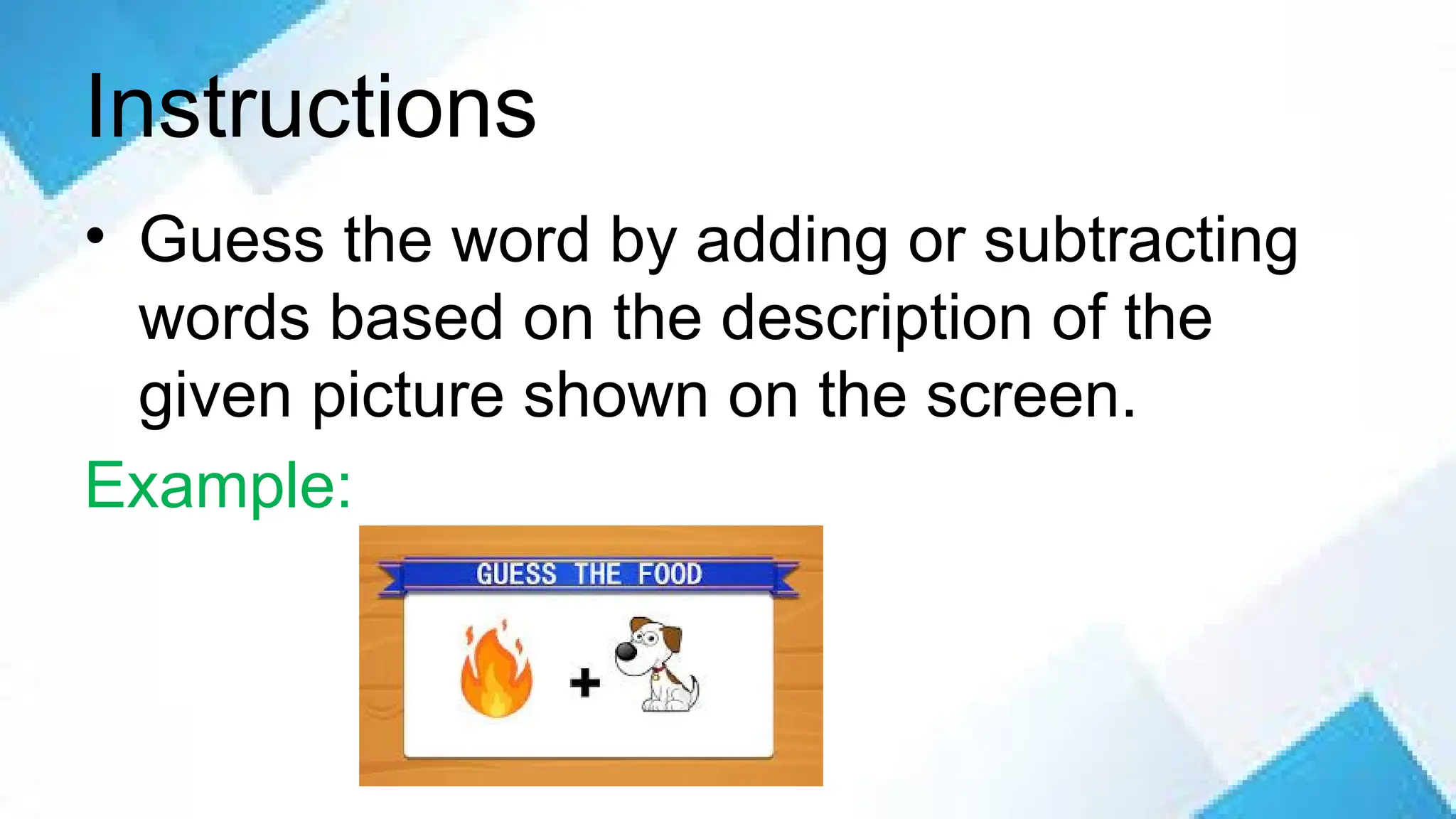
• Guess the word by adding or subtracting
words based on the description of the
given picture shown on the screen.
Example:
+
Current
+
Electrode
- ICFAN
+
Travel Speed
THE ESSENTIALS TO OBTAIN
QUALITY WELD
THE 5C’s
Objective:
At the end of the lesson you should be able to:
Identify 5C’s essentials to obtain quality weld
and its importance.
Unlocking of Terminology:
Current - the rate at which electrons flow past a point in a complete electrical
circuit.
Synonym: Electrons flow, Electric charge
Angle - a figure which is formed by two rays or lines that shares a common
endpoint
Synonym: Perspective, Diagonal
Base Metal – the material being welded or joint in the process of arc welding.
Synonym: Core metal, Primary Metal
Activity1
Message Relay
Direction:
Group yourselves into four groups and then form a line. A statement
related to the topic will flash on the screen. The first person in line
will choose their answer from the given choices and then relay the
answer through an ACTION, and then the next person will relay the
message to the person. You have 30 minutes only to relay the
answer, and then the last person will write the correct answer on the
provided manila paper.
Question #1
This essential emphasized the correct choice of
electrode size. The size of the electrode is
determined by its diameter.
Question #2
This essential play plays a crucial role in welding
metals. Current provides the heating and
melting points of the electrode and the metal.
Question #3
This is the distance between the base metal and
the electrode.
Question #4
This essential article emphasizes the importance
of the travel speed of the electrode.
Question #5
This essential emphasize the angle positioning
of your electrode. The position of your electrode
will allow the molten pool flows efficiently.
Question #1
This essential emphasized the correct choice of
electrode size. The size of the electrode is
determined by its diameter.
CORRECT ELECTRODE SIZE
Question #2
This essential play plays a crucial role in welding
metals. Current provides the heating and
melting points of the electrode and the metal.
CORRECT CURRENT
Question #3
This is the distance between the base metal and
the electrode.
CORRECT ARC LENGTH
Question #4
This essential article emphasizes the importance
of the travel speed of the electrode.
CORRECT TRAVEL SPEED
Question #5
This essential emphasize the angle positioning
of your electrode. The position of your electrode
will allow the molten pool flows efficiently.
CORRECT ELECTRODE ANGLE
THE ESSENTIALS TO OBTAIN
QUALITY WELD
1. CORRECT ELECTRODE SIZE
• This essential emphasized the correct choice of
electrode size. The size of the electrode is
determined by its diameter.
• The correct choice of electrode size involves
consideration of a variety of factors, such as the
type, position, preparation of the joint, the
current use, and the thickness of the metal.
1. CORRECT ELECTRODE SIZE
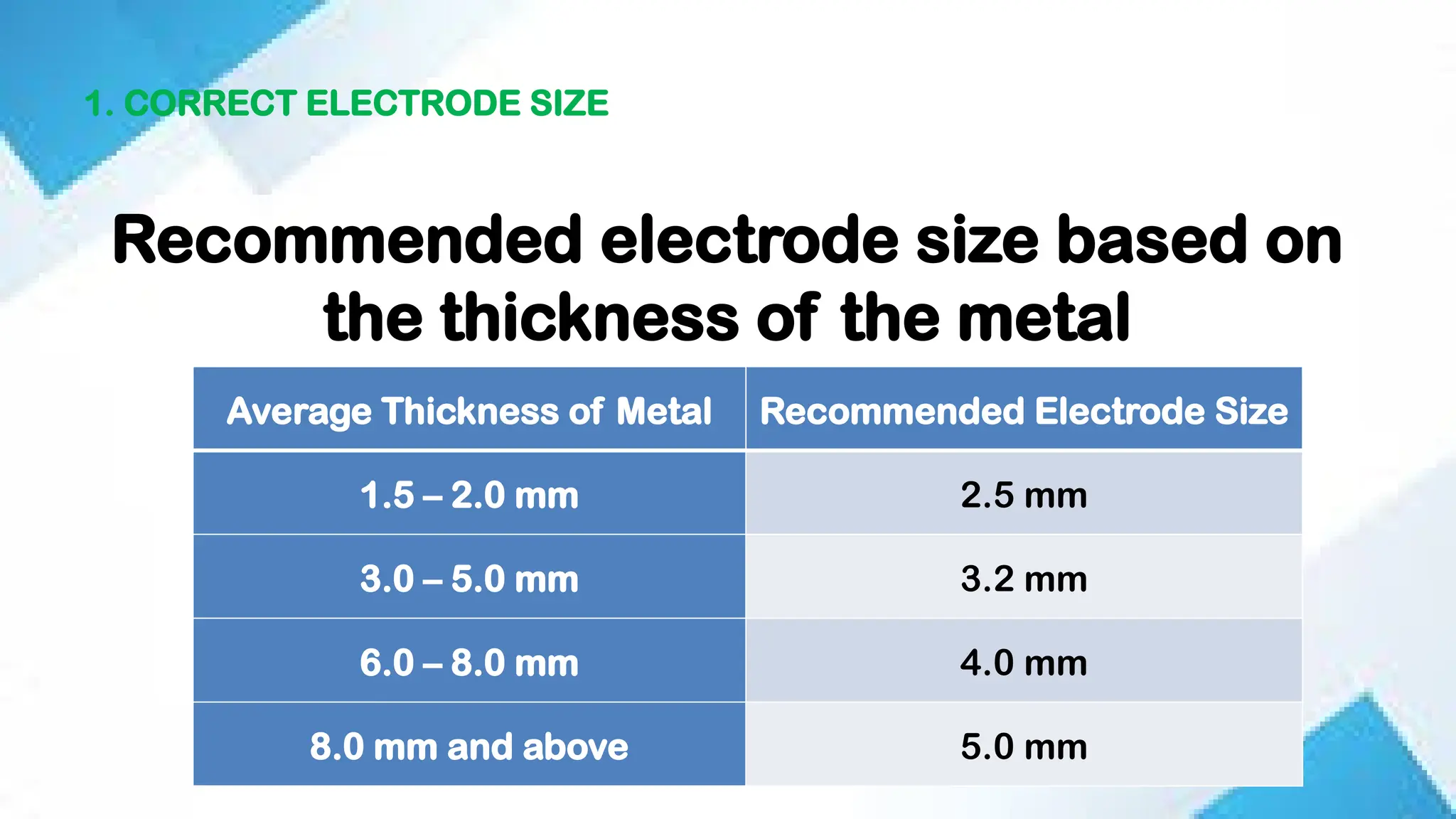
Recommended electrode size based on
the thickness of the metal
Average Thickness of Metal Recommended Electrode Size
1.5 – 2.0 mm 2.5 mm
3.0 – 5.0 mm 3.2 mm
6.0 – 8.0 mm 4.0 mm
8.0 mm and above 5.0 mm
2. CORRECT CURRENT
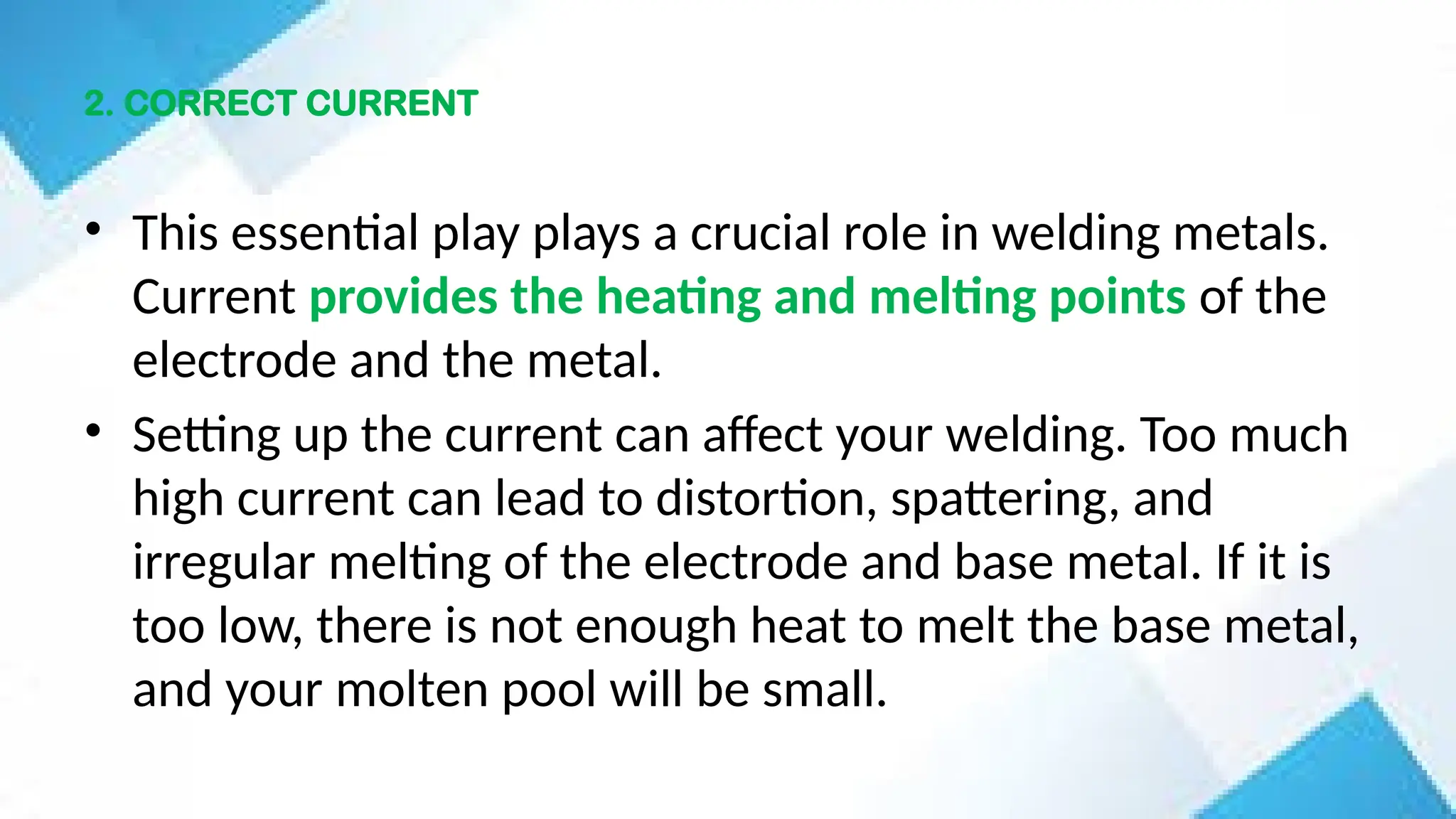
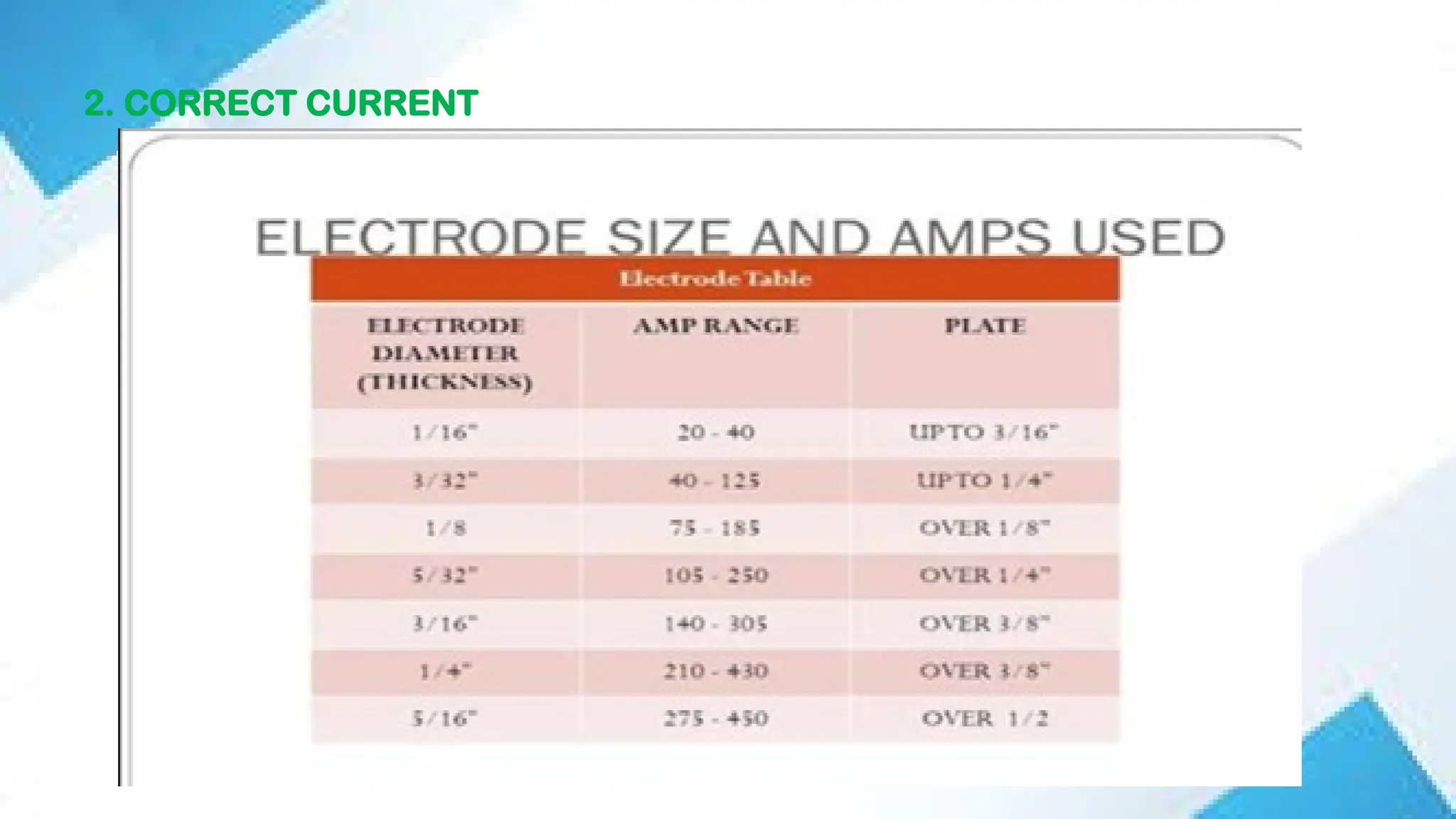
• This essential play plays a crucial role in welding metals.
Current provides the heating and melting points of the
electrode and the metal.
• Setting up the current can affect your welding. Too much
high current can lead to distortion, spattering, and
irregular melting of the electrode and base metal. If it is
too low, there is not enough heat to melt the base metal,
and your molten pool will be small.
2. CORRECT CURRENT
Science Integration:
Energy Conversion
Energy conversion refers to the process of changing one form of
energy into another.
• In welding, electrical energy is converted into thermal energy to
create the heat necessary for melting the welding electrode and
the base metals.
• The correct current is essential for maintaining the right balance,
ensuring optimal heat generation.
Math Integration:
Do you know how to compute the current using
ohms Law?
Ohms law Formula: I = P/V
What mathematical operation is used to calculate the amount of the
current?
3. CORRECT ARC LENGTH
• This is the distance between the base metal
and the electrode.
How to determine the arc length of the electrode?
- The arc length will be based on the diameter or the size of the
electrode. If the size of the electrode is 1/8, then the arc
length is 1/8.
3. CORRECT ARC LENGTH
- If the arc is too long the metal melts off the electrode is
large globules which wobble from side to side as the arc
wavers, giving a wide, spattered and irregular bead-with
poor fusion between original metal and deposited metal.
4. CORRECT TRAVEL SPEED
• This essential article emphasizes the importance of the correct
travel speed of the electrode. The travel speed determines the
heating and melting points of the electrode and base metal.
• When your speed is too fast, your pool does not last long
enough, and impurities and gas lock in. The bead was narrow,
and the ripples were pointed.
• When speed is too slow, the metal piles up, and the bead is high
and wide with a rather straight ripple.
5. CORRECT ELECTRODE ANGLE
• The electrode angle is of particular importance in fillet
welding and deep groove welding.
• This essential emphasize the angle positioning of your
electrode. The position of your electrode will allow the
molten pool flows efficiently.
Within Integration:
Three Components of Electricity
- The three components of electricity are voltage, current, and
resistance.
Activity 2
Directions: Help John to Identify the 5 Essentials to obtain
quality weld.
John:
I am thinking of making a dog house for Bantay. I do
not know how to begin. Would you like to share the
essentials for welding carbon/ mild steel plates that I need
to know before I begin?
Activity 2
Write your answers in the table on the activity sheet.
5 Essentials of Welding Why I Need to Know?
1.
2.
3.
4.
5.
Rubric for grading
Criteria Excellent (4) Good (3) Satisfactory (2)
Needs Improvement
(1)
Communication
Clarity
All essential
information is
accurately conveyed.
Most essential
information is clear.
Some essential
information is unclear.
Little to no essential
information is
conveyed.
Identification of 5C's
Accurately identifies
all 5C's in the picture
Identifies most of the
5C's accurately.
Identifies some of the
5C's, with a few
inaccuracies
Fails to identify the
majority of the 5C's
Time Management
Effectively utilizes the
2-minute time frame
to identify, describe,
and discuss the
essentials.
Manages time well,
but may rush or miss
some key points in the
activity.
Struggles to manage
time efficiently,
resulting in
incomplete
identification or
discussion.
Poor time
management; fails to
complete the activity
within the designated
time
Accuracy of
Information
Information is entirely
accurate and precise.
Minor inaccuracies or
omissions in
information.
Significant
inaccuracies or
omissions in
information.
Major inaccuracies or
omissions in
information.
Overall
Understanding of
Topic
Demonstrates a deep
understanding of
welding essentials.
Shows a good
understanding of
welding essentials.
Demonstrates a basic
understanding of
welding essentials.
Lacks understanding
of welding essentials.
IV. Evaluation:
Multiple-Choice
Instructions: Choose the letter of your answer for each question.
1. What does the correct choice of electrode size involve?
a. Only the type of electrode
b. Diameter and color of the electrode
c. Thickness of the metal and joint preparation
d. Type, position, and joint preparation only
2. What is the recommended electrode size for metal with an average thickness of 5.0 – 8.0
mm?
a. 2.5 mm
b. 3.2 mm
c. 4.0 mm
d. 5.0 mm
IV. Evaluation:
Multiple-Choice
Instructions: Choose the letter of your answer for each question.
3. How does current affect welding?
a. Current doesn't play a role in welding
b. It provides heating and melting points
c It only causes distortion and spattering
d. It doesn't affect the molten pool
4. What is the process used to produce heat for welding metal?
a. Energy Conservation
b. Energy Transition
c. Energy Conversion
d. Energy Transformation
5. How is the arc length determined in welding?
a. Fixed value for all electrodes
b. Based on the type of joint
c. Calculated using a complex formula
d. Depends on the diameter or size of the electrode

The Five Essentials to Obtain Good Quality Welding

  • 2.
    Instructions • Guess theword by adding or subtracting words based on the description of the given picture shown on the screen. Example:
  • 3.
  • 4.
  • 5.
  • 6.
    THE ESSENTIALS TOOBTAIN QUALITY WELD THE 5C’s
  • 7.
    Objective: At the endof the lesson you should be able to: Identify 5C’s essentials to obtain quality weld and its importance.
  • 8.
    Unlocking of Terminology: Current- the rate at which electrons flow past a point in a complete electrical circuit. Synonym: Electrons flow, Electric charge Angle - a figure which is formed by two rays or lines that shares a common endpoint Synonym: Perspective, Diagonal Base Metal – the material being welded or joint in the process of arc welding. Synonym: Core metal, Primary Metal
  • 9.
    Activity1 Message Relay Direction: Group yourselvesinto four groups and then form a line. A statement related to the topic will flash on the screen. The first person in line will choose their answer from the given choices and then relay the answer through an ACTION, and then the next person will relay the message to the person. You have 30 minutes only to relay the answer, and then the last person will write the correct answer on the provided manila paper.
  • 10.
    Question #1 This essentialemphasized the correct choice of electrode size. The size of the electrode is determined by its diameter.
  • 11.
    Question #2 This essentialplay plays a crucial role in welding metals. Current provides the heating and melting points of the electrode and the metal.
  • 12.
    Question #3 This isthe distance between the base metal and the electrode.
  • 13.
    Question #4 This essentialarticle emphasizes the importance of the travel speed of the electrode.
  • 14.
    Question #5 This essentialemphasize the angle positioning of your electrode. The position of your electrode will allow the molten pool flows efficiently.
  • 15.
    Question #1 This essentialemphasized the correct choice of electrode size. The size of the electrode is determined by its diameter. CORRECT ELECTRODE SIZE
  • 16.
    Question #2 This essentialplay plays a crucial role in welding metals. Current provides the heating and melting points of the electrode and the metal. CORRECT CURRENT
  • 17.
    Question #3 This isthe distance between the base metal and the electrode. CORRECT ARC LENGTH
  • 18.
    Question #4 This essentialarticle emphasizes the importance of the travel speed of the electrode. CORRECT TRAVEL SPEED
  • 19.
    Question #5 This essentialemphasize the angle positioning of your electrode. The position of your electrode will allow the molten pool flows efficiently. CORRECT ELECTRODE ANGLE
  • 20.
    THE ESSENTIALS TOOBTAIN QUALITY WELD
  • 21.
    1. CORRECT ELECTRODESIZE • This essential emphasized the correct choice of electrode size. The size of the electrode is determined by its diameter. • The correct choice of electrode size involves consideration of a variety of factors, such as the type, position, preparation of the joint, the current use, and the thickness of the metal.
  • 22.
    1. CORRECT ELECTRODESIZE Recommended electrode size based on the thickness of the metal Average Thickness of Metal Recommended Electrode Size 1.5 – 2.0 mm 2.5 mm 3.0 – 5.0 mm 3.2 mm 6.0 – 8.0 mm 4.0 mm 8.0 mm and above 5.0 mm
  • 23.
    2. CORRECT CURRENT •This essential play plays a crucial role in welding metals. Current provides the heating and melting points of the electrode and the metal. • Setting up the current can affect your welding. Too much high current can lead to distortion, spattering, and irregular melting of the electrode and base metal. If it is too low, there is not enough heat to melt the base metal, and your molten pool will be small.
  • 24.
  • 25.
    Science Integration: Energy Conversion Energyconversion refers to the process of changing one form of energy into another. • In welding, electrical energy is converted into thermal energy to create the heat necessary for melting the welding electrode and the base metals. • The correct current is essential for maintaining the right balance, ensuring optimal heat generation.
  • 26.
    Math Integration: Do youknow how to compute the current using ohms Law? Ohms law Formula: I = P/V What mathematical operation is used to calculate the amount of the current?
  • 27.
    3. CORRECT ARCLENGTH • This is the distance between the base metal and the electrode. How to determine the arc length of the electrode? - The arc length will be based on the diameter or the size of the electrode. If the size of the electrode is 1/8, then the arc length is 1/8.
  • 28.
    3. CORRECT ARCLENGTH - If the arc is too long the metal melts off the electrode is large globules which wobble from side to side as the arc wavers, giving a wide, spattered and irregular bead-with poor fusion between original metal and deposited metal.
  • 29.
    4. CORRECT TRAVELSPEED • This essential article emphasizes the importance of the correct travel speed of the electrode. The travel speed determines the heating and melting points of the electrode and base metal. • When your speed is too fast, your pool does not last long enough, and impurities and gas lock in. The bead was narrow, and the ripples were pointed. • When speed is too slow, the metal piles up, and the bead is high and wide with a rather straight ripple.
  • 30.
    5. CORRECT ELECTRODEANGLE • The electrode angle is of particular importance in fillet welding and deep groove welding. • This essential emphasize the angle positioning of your electrode. The position of your electrode will allow the molten pool flows efficiently.
  • 31.
    Within Integration: Three Componentsof Electricity - The three components of electricity are voltage, current, and resistance.
  • 32.
    Activity 2 Directions: HelpJohn to Identify the 5 Essentials to obtain quality weld. John: I am thinking of making a dog house for Bantay. I do not know how to begin. Would you like to share the essentials for welding carbon/ mild steel plates that I need to know before I begin?
  • 33.
    Activity 2 Write youranswers in the table on the activity sheet. 5 Essentials of Welding Why I Need to Know? 1. 2. 3. 4. 5.
  • 34.
    Rubric for grading CriteriaExcellent (4) Good (3) Satisfactory (2) Needs Improvement (1) Communication Clarity All essential information is accurately conveyed. Most essential information is clear. Some essential information is unclear. Little to no essential information is conveyed. Identification of 5C's Accurately identifies all 5C's in the picture Identifies most of the 5C's accurately. Identifies some of the 5C's, with a few inaccuracies Fails to identify the majority of the 5C's Time Management Effectively utilizes the 2-minute time frame to identify, describe, and discuss the essentials. Manages time well, but may rush or miss some key points in the activity. Struggles to manage time efficiently, resulting in incomplete identification or discussion. Poor time management; fails to complete the activity within the designated time Accuracy of Information Information is entirely accurate and precise. Minor inaccuracies or omissions in information. Significant inaccuracies or omissions in information. Major inaccuracies or omissions in information. Overall Understanding of Topic Demonstrates a deep understanding of welding essentials. Shows a good understanding of welding essentials. Demonstrates a basic understanding of welding essentials. Lacks understanding of welding essentials.
  • 35.
    IV. Evaluation: Multiple-Choice Instructions: Choosethe letter of your answer for each question. 1. What does the correct choice of electrode size involve? a. Only the type of electrode b. Diameter and color of the electrode c. Thickness of the metal and joint preparation d. Type, position, and joint preparation only 2. What is the recommended electrode size for metal with an average thickness of 5.0 – 8.0 mm? a. 2.5 mm b. 3.2 mm c. 4.0 mm d. 5.0 mm
  • 36.
    IV. Evaluation: Multiple-Choice Instructions: Choosethe letter of your answer for each question. 3. How does current affect welding? a. Current doesn't play a role in welding b. It provides heating and melting points c It only causes distortion and spattering d. It doesn't affect the molten pool 4. What is the process used to produce heat for welding metal? a. Energy Conservation b. Energy Transition c. Energy Conversion d. Energy Transformation 5. How is the arc length determined in welding? a. Fixed value for all electrodes b. Based on the type of joint c. Calculated using a complex formula d. Depends on the diameter or size of the electrode