The Linear Complementarity Problem Classics In
Applied Mathematics Richard W Cottle download
https://ebookbell.com/product/the-linear-complementarity-problem-
classics-in-applied-mathematics-richard-w-cottle-2543952
Explore and download more ebooks at ebookbell.com
Here are some recommended products that we believe you will be
interested in. You can click the link to download.
The Linear Algebra A Beginning Graduate Student Ought To Know 2ed
Golan Js
https://ebookbell.com/product/the-linear-algebra-a-beginning-graduate-
student-ought-to-know-2ed-golan-js-2043396
The Linear Ordering Problem Exact And Heuristic Methods In
Combinatorial Optimization 1st Edition Rafael Mart
https://ebookbell.com/product/the-linear-ordering-problem-exact-and-
heuristic-methods-in-combinatorial-optimization-1st-edition-rafael-
mart-2045796
The Linear Sampling Method In Inverse Electromagnetic Scattering
Cbmsnsf Regional Conference Series In Applied Mathematics Fioralba
Cakoni
https://ebookbell.com/product/the-linear-sampling-method-in-inverse-
electromagnetic-scattering-cbmsnsf-regional-conference-series-in-
applied-mathematics-fioralba-cakoni-2226046
The Linear Algebra A Beginning Graduate Student Ought To Know 3rd
Edition Jonathan S Golan Auth
https://ebookbell.com/product/the-linear-algebra-a-beginning-graduate-
student-ought-to-know-3rd-edition-jonathan-s-golan-auth-2612458
The Linear Algebra A Beginning Graduate Student Ought To Know 3rd
Edition Jonathan S Golan Auth
https://ebookbell.com/product/the-linear-algebra-a-beginning-graduate-
student-ought-to-know-3rd-edition-jonathan-s-golan-auth-2629226
The Linear Algebra Survival Guide Illustrated With Mathematica 1st
Edition Fred Szabo
https://ebookbell.com/product/the-linear-algebra-survival-guide-
illustrated-with-mathematica-1st-edition-fred-szabo-5138284
The Linear Model And Hypothesis A General Unifying Theory 1st Edition
George Seber Auth
https://ebookbell.com/product/the-linear-model-and-hypothesis-a-
general-unifying-theory-1st-edition-george-seber-auth-5235770
The Linear Chains Of Body And Spirit Calligaris Guiseppe
https://ebookbell.com/product/the-linear-chains-of-body-and-spirit-
calligaris-guiseppe-232179436
Extending The Linear Model With R Julian James Faraway
https://ebookbell.com/product/extending-the-linear-model-with-r-
julian-james-faraway-43135746
P 9
The Linear
Complementarity
Problem
b a
Books in the Classics in Applied Mathematics series are monographs and textbooks declared out
of print by their original publishers, though they are of continued importance and interest to the
mathematical community. SIAM publishes this series to ensure that the information presented in these
texts is not lost to today's students and researchers.
Editor-in-Chief
Robert E. O'Malley, Jr., University of Washington
Editorial Board
John Boyd, University of Michigan
Leah Edelstein-Keshet, University of British Columbia
William G. Faris, University of Arizona
Nicholas J. Higham, University of Manchester
Peter Hoff, University of Washington
Mark Kot, University of Washington
Peter Olver, University of Minnesota
Philip Protter, Cornell University
Gerhard Wanner, L'Universite de Geneve
Classics in Applied Mathematics
C. C. Lin and L. A. Segel, Mathematics Applied to Deterministic Problems in the Natural Sciences
Johan G. F. Belinfante and Bernard Kolman, A Survey of Lie Groups and Lie Algebras with Applications and
Computational Methods
James M. Ortega, Numerical Analysis: A Second Course
Anthony V. Fiacco and Garth P. McCormick, Nonlinear Programming: Sequential Unconstrained
Minimization Techniques
F. H. Clarke, Optimization and Nonsmooth Analysis
George F. Carrier and Carl E. Pearson, Ordinary Differential Equations
Leo Breiman, Probability
R. Bellman and G. M. Wing, An Introduction to Invariant Imbedding
Abraham Berman and Robert J. Plemmons, Nonnegative Matrices in the Mathematical Sciences
Olvi L. Mangasarian, Nonlinear Programming
*Carl Friedrich Gauss, Theory of the Combination of Observations Least Subject to Errors: Part One,
Part Two, Supplement. Translated by G. W. Stewart
Richard Bellman, Introduction to Matrix Analysis
U. M. Ascher, R. M. M. Mattheij, and R. D. Russell, Numerical Solution of Boundary Value Problems for
Ordinary Differential Equations
K. E. Brenan, S. L. Campbell, and L. R. Petzold, Numerical Solution of Initial-Value Problems
in Differential-Algebraic Equations
Charles L. Lawson and Richard J. Hanson, Solving Least Squares Problems
J. E. Dennis, Jr. and Robert B. Schnabel, Numerical Methods for Unconstrained Optimization and Nonlinear
Equations
Richard E. Barlow and Frank Proschan, Mathematical Theory of Reliability
Cornelius Lanczos, Linear Differential Operators
Richard Bellman, Introduction to Matrix Analysis, Second Edition
Beresford N. Parlett, The Symmetric Eigenvalue Problem
Richard Haberman, Mathematical Models: Mechanical Vibrations, Population Dynamics, and Traffic Flow
Peter W. M. John, Statistical Design and Analysis of Experiments
Tamer Ba§ar and Geert Jan Olsder, Dynamic Noncooperative Game Theory, Second Edition
Emanuel Parzen, Stochastic Processes
*First time in print.
Classics in Applied Mathematics (continued)
Petar Kokotovic, Hassan K. Khalil, and John O'Reilly, Singular Perturbation Methods in Control: Analysis
and Design
Jean Dickinson Gibbons, Ingram Olkin, and Milton Sobel, Selecting and Ordering Populations: A New
Statistical Methodology
James A. Murdock, Perturbations: Theory and Methods
Ivar Ekeland and Roger Temam, Convex Analysis and Variational Problems
Ivar Stakgold, Boundary Value Problems of Mathematical Physics, Volumes I and II
J. M. Ortega and W. C. Rheinboldt, Iterative Solution of Nonlinear Equations in Several Variables
David Kinderlehrer and Guido Stampacchia, An Introduction to Variational Inequalities and Their Applications
F. Natterer, The Mathematics of Computerized Tomography
Avinash C. Kale and Malcolm Slaney, Principles of Computerized Tomographic Imaging
R. Wong, Asymptotic Approximations of Integrals
O. Axelsson and V. A. Barker, Finite Element Solution of Boundary Value Problems: Theory and Computation
David R. Brillinger, Time Series: Data Analysis and Theory
Joel N. Franklin, Methods of Mathematical Economics: Linear and Nonlinear Programming, Fixed-Point
Theorems
Philip Hartman, Ordinary Differential Equations, Second Edition
Michael D. Intriligator, Mathematical Optimization and Economic Theory
Philippe G. Ciarlet, The Finite Element Method for Elliptic Problems
Jane K. Cullum and Ralph A. Willoughby, Lanczos Algorithms for Large Symmetric Eigenvalue
Computations, Vol. I: Theory
M. Vidyasagar, Nonlinear Systems Analysis, Second Edition
Robert Mattheij and Jaap Molenaar, Ordinary Differential Equations in Theory and Practice
Shanti S. Gupta and S. Panchapakesan, Multiple Decision Procedures: Theory and Methodology
of Selecting and Ranking Populations
Eugene L. Allgower and Kurt Georg, Introduction to Numerical Continuation Methods
Leah Edelstein-Keshet, Mathematical Models in Biology
Heinz-Otto Kreiss and Jens Lorenz, Initial-Boundary Value Problems and the Navier-Stokes Equations
J. L. Hodges, Jr. and E. L. Lehmann, Basic Concepts of Probability and Statistics, Second Edition
George F. Carrier, Max Krook, and Carl E. Pearson, Functions of a Complex Variable: Theory and
Technique
Friedrich Pukelsheim, Optimal Design of Experiments
Israel Gohberg, Peter Lancaster, and Leiba Rodman, Invariant Subspaces of Matrices with Applications
Lee A. Segel with G. H. Handelman, Mathematics Applied to Continuum Mechanics
Rajendra Bhatia, Perturbation Bounds for Matrix Eigenvalues
Barry C. Arnold, N. Balakrishnan, and H. N. Nagaraja, A First Course in Order Statistics
Charles A. Desoer and M. Vidyasagar, Feedback Systems: Input-Output Properties
Stephen L. Campbell and Carl D. Meyer, Generalized Inverses of Linear Transformations
Alexander Morgan, Solving Polynomial Systems Using Continuation for Engineering and Scientific Problems
I. Gohberg, P. Lancaster, and L. Rodman, Matrix Polynomials
Galen R. Shorack and Jon A. Wellner, Empirical Processes with Applications to Statistics
Richard W. Cottle, Jong-Shi Pang, and Richard E. Stone, The Linear Complementarity Problem
Rabi N. Bhattacharya and Edward C. Waymire, Stochastic Processes with Applications
Robert J. Adler, The Geometry of Random Fields
Mordecai Avriel, Walter E. Diewert, Siegfried Schaible, and Israel Zang, Generalized Concavity
Rabi N. Bhattacharya and R. Ranga Rao, Normal Approximation and Asymptotic Expansions
The Linear
n
Complementarity
Problem
b ci
Richard W. Cottle
Stanford University
Stanford, California
Jong-Shi Pang
University of Illinois at Urbana-Champaign
Urbana, Illinois
Richard E. Stone
Delta Air Lines
Eagan, Minnesota
Society for Industrial and Applied Mathematics
Philadelphia
Copyright © 2009 by the Society for Industrial and Applied Mathematics
This SIAM edition is a corrected, unabridged republication of the work first published
by Academic Press, 1992.
10987654321
All rights reserved. Printed in the United States of America. No part of this book may
be reproduced, stored, or transmitted in any manner without the written permission of
the publisher. For information, write to the Society for Industrial and Applied
Mathematics, 3600 Market Street, 6th Floor, Philadelphia, PA 19104-2688 USA.
Library of Congress Cataloging-in-Publication Data
Cottle, Richard.
The linear complementarity problem / Richard W. Cottle, Jong-Shi Pang, Richard E.
Stone.
p. cm. -- (Classics in applied mathematics ; 60)
Originally published: Boston: Academic Press, c1992.
Includes bibliographical references and index.
ISBN 978-0-898716-86-3
. Linear complementarity problem. I. Pang, Jong-Shi. II. Stone, Richard E. III. Title.
QA402.5.C68 2009
519.7'6--dc22
2009022440
S.L2.JTL is a registered trademark.
To Our Families
CONTENTS
PREFACE TO THE CLASSICS EDITION xiii
PREFACE xv
GLOSSARY OF NOTATION XXlll
NUMBERING SYSTEM xxvii
1 INTRODUCTION 1
1.1 Problem Statement ......................................... 1
1.2 Source Problems ........................................... 3
1.3 Complementary Matrices and Cones ........................ 16
1.4 Equivalent Formulations .................................... 23
1.5 Generalizations ............................................. 29
1.6 Exercises ................................................... 35
1.7 Notes and References ....................................... 37
2 BACKGROUND 43
2.1 Real Analysis .............................................. 44
2.2 Matrix Analysis ............................................ 59
2.3 Pivotal Algebra ............................................ 68
2.4 Matrix Factorization ....................................... 81
2.5 Iterative Methods for Equations ............................ 87
2.6 Convex Polyhedra .......................................... 95
2.7 Linear Inequalities ........................................ 106
2.8 Quadratic Programming Theory ............................113
2.9 Degree and Dimension ..................................... 118
2.10 Exercises ...................................................124
2.11 Notes and References .......................................131
ix
x CONTENTS
3 EXISTENCE AND MULTIPLICITY 137
3.1 Positive Definite and Semi-definite Matrices ................ 138
3.2 The Classes Q and Q0..................................... 145
3.3 P-matrices and Global Uniqueness ......................... 146
3.4 P- matrices and w-uniqueness .. ............................153
3.5 Sufficient Matrices ......................................... 157
3.6 Nondegenerate Matrices and Local Uniqueness ............. 162
3.7 An Augmented LCP ....................................... 165
3.8 Copositive Matrices ........................................ 176
3.9 Semimonotone and Regular Matrices ....................... 184
3.10 Completely-Q Matrices ......... ............................195
3.11 Z-matrices and Least-element Theory ...................... 198
3.12 Exercises ....................... ............................213
3.13 Notes and References ........... ............................218
4 PIVOTING METHODS 225
4.1 Invariance Theorems ....................................... 227
4.2 Simple Principal Pivoting Methods ......................... 237
4.3 General Principal Pivoting Methods ........................ 251
4.4 Lemke's Method ........................................... 265
4.5 Parametric LCP Algorithms ................................ 288
4.6 Variable Dimension Schemes ............................... 308
4.7 Methods for Z-matrices ........ ............................317
4.8 A Special n-step Scheme ................................... 326
4.9 Degeneracy Resolution ......... ............................336
4.10 Computational Considerations .. ............................352
4.11 Exercises ....................... ............................366
4.12 Notes and References ........... ............................375
5 ITERATIVE METHODS 383
5.1 Applications ................... ............................384
5.2 A General Splitting Scheme ............................... 394
5.3 Convergence Theory ........... ............................399
5.4 Convergence of Iterates: Symmetric LCP .................. 424
5.5 Splitting Methods With Line Search ....................... 429
5.6 Regularization Algorithms ................................. 439
CONTENTS xi
5.7 Generalized Splitting Methods ............................. 445
5.8 A Damped-Newton Method ............................... 448
5.9 Interior-point Methods ....................................461
5.10 Residues and Error Bounds ................................475
5.11 Exercises ..................................................492
5.12 Notes and References ......................................498
6 GEOMETRY AND DEGREE THEORY 507
6.1 Global Degree and Degenerate Cones ...................... 509
6.2 Facets .....................................................522
6.3 The Geometric Side of Lemke's Method ................... 544
6.4 LCP Existence Theorems ..................................564
6.5 Local Analysis .............................................571
6.6 Matrix Classes Revisited .................................. 579
6.7 Superfluous Matrices ...................................... 596
6.8 Bounds on Degree .........................................603
6.9 Q0-matrices and Pseudomanifolds ......................... 610
6.10 Exercises ..................................................629
6.11 Notes and References ......................................634
7 SENSITIVITY AND STABILITY ANALYSIS 643
7.1 A Basic Framework ........................................644
7.2 An Upper Lipschitzian Property ...........................646
7.3 Solution Stability ..........................................659
7.4 Solution Differentiability .................................. 673
7.5 Stability Under Copositivity ............................... 683
7.6 Exercises ............................'......................693
7.7 Notes and References ......................................697
BIBLIOGRAPHY 701
INDEX 753
PREFACE TO THE CLASSICS EDITION
The first edition of this book was published by Academic Press in 1992
as a volume in the series Computer Science and Scientific Computing edited
by Werner Rheinboldt. As the most up-to-date and comprehensive pub-
lication on the Linear Complementarity Problem (LCP), the book was a
relatively instant success. It shared the 1994 Frederick W. Lanchester Prize
from INFORMS as one of the two best contributions to operations research
and the management sciences written in the English language during the
preceding three years. In the intervening years, The Linear Complementar-
ity Problem has become the standard reference on the subject. Despite its
popularity, the book went out of print and out of stock around 2005. Since
then, the supply of used copies offered for sale has dwindled to nearly zero at
rare-book prices. This is attributable to the substantial growth of interest
in the LCP coming from diverse fields such as pure and applied mathemat-
ics, operations research, computer science, game theory, economics, finance,
and engineering. An important development that has made this growth
possible is the availability of several robust complementarity solvers that
allow realistic instances of the LCP to be solved efficiently; these solvers can
be found on the Website http://neos.mcs.anl.gov/neos/solvers/index.html.
The present SIAM Classics edition is meant to address the grave imbal-
ance between supply and demand for The Linear Cornplementarity Prob-
lem. In preparing this edition, we have resisted the temptation to enlarge
an already sizable volume by adding new material. We have, however,
xin
xiv PREFACE TO THE CLASSICS EDITION
corrected a large number of typographical errors, modified the wording of
some opaque or faulty passages, and brought the entries in the Bibliogra-
phy of the first edition up to date. We warmly thank all those who were
kind enough to report ways in which the original edition would benefit from
such improvements.
In addition, we are grateful to Sara Murphy, Developmental and Acqui-
sitions Editor of SIAM, and to the Editorial Board of the SIAM Classics
in Applied Mathematics for offering us the opportunity to bring forth this
revised edition. The statements of gratitude to our families expressed in
the first edition still stand, but now warrant the inclusion of Linda Stone.
Richard W. Cottle Stanford, California
Jong-Shi Pang Urbana, Illinois
Richard E. Stone Eagan, Minnesota
PREFACE
The linear complementarity problem (LCP) refers to an inequality sys-
tem with a rich mathematical theory, a variety of algorithms, and a wide
range of applications in applied science and technology. Although diverse
instances of the linear complementarity problem can be traced to publica-
tions as far back as 1940, concentrated study of the LCP began in the mid
1960's. As with many subjects, its literature is to be found primarily in
scientific journals, Ph.D. theses, and the like. We estimate that today there
are nearly one thousand publications dealing with the LCP, and the num-
ber is growing. Only a handful of the existing publications are monographs,
none of which are comprehensive treatments devoted to this subject alone.
We believe there is a demand for such a book—one that will serve the
needs of students as well as researchers. This is what we have endeavored
to provide in writing The Linear Complementarity Problem.
The LCP is normally thought to belong to the realm of mathematical
programming. For instance, its AMS (American Mathematical Society)
subject classification is 90C33, which also includes nonlinear complemen-
tarity. The classification 90xxx refers to economics, operations research,
programming, and games; the further classification 90Cxx is specifically
for mathematical programming. This means that the subject is normally
identified with (finite-dimensional) optimization and (physical or economic)
equilibrium problems. As a result of this broad range of associations, the
xv
xvi PREFACE
literature of the linear complementarity problem has benefitted from con-
tributions made by operations researchers, mathematicians, computer sci-
entists, economists, and engineers of many kinds (chemical, civil, electrical,
industrial, and mechanical).
One particularly important and well known context in which linear com-
plementarity problems are found is the first-order optimality conditions of
quadratic programming. Indeed, in its infancy, the LCP was closely linked
to the study of linear and quadratic programs. A new dimension was
brought to the LCP when Lemke and Howson published their renowned al-
gorithm for solving the bimatrix game problem. These two subjects played
a major role in the early development of the linear complementarity prob-
lem. As the field of mathematical programming matured, and the need for
solving complex equilibrium problems intensified, the fundamental impor-
tance of the LCP became increasingly apparent, and its scope expanded
significantly. Today, many new research topics have come into being as a
consequence of this expansion; needless to say, several classical questions
remain an integral part in the overall study of the LCP. In this book, we
have attempted to include every major aspect of the LCP; we have striven
to be up to date, covering all topics of traditional and current importance,
presenting them in a style consistent with a contemporary point of view,
and providing the most comprehensive available list of references.
Besides its own diverse applications, the linear complementarity prob-
lem contains two basic features that are central to the study of general
mathematical and equilibrium programming problems. One is the concept
of complementarity. This is a prevalent property of nonlinear programs;
in the context of an equilibrium problem (such as the bimatrix game), this
property is typically equivalent to the essential equilibrium conditions. The
other feature is the property of linearity; this is the building block for the
treatment of all smooth nonlinear problems. Together, linearity and com-
plementarity provide the fundamental elements needed for the analysis and
understanding of the very complex nature of problems within mathematical
and equilibrium programming.
Preview
All seven chapters of this volume are divided into sections. No chapter
has fewer than seven or more than thirteen sections. Generally speaking,
PREFACE xvii
the chapters are rather long. Indeed, each chapter can be thought of as a
part with its sections playing the role of chapters. We have avoided the
latter terminology because it tends to obscure the interconnectedness of
the subject matter presented here.
The last two sections of every chapter in this book are titled "Exercises"
and "Notes and References," respectively. By design, this organization
makes it possible to use The Linear Complementarity Problem as a text-
book and as a reference work. We have written this monograph for read-
ers with some background in linear algebra, linear programming, and real
analysis. In academic terms, this essentially means graduate student sta-
tus. Apart from these prerequisites, the book is practically self-contained.
Just as a precaution, however, we have included an extensive discussion
of background material (see Chapter 2) where many key definitions and
results are given, and most of the proofs are omitted. Elsewhere, we have
supplied a proof for each stated result unless it is obvious or given as an
exercise.
In keeping with the textbook spirit of this volume, we have attempted
to minimize the use of footnotes and literature citations in the main body
of the work. That sort of scholarship is concentrated in the notes and ref-
erences at the end of each chapter where we provide some history of the
subjects treated, attributions for the results that are stated, and pointers to
the relevant literature. The bibliographic details for all the references cited
in The Linear Complementarity Problem are to be found in the comprehen-
sive Bibliography at the back of the book. For the reader's convenience, we
have included a Glossary of Notation and what we hope is a useful Index.
Admittedly, this volume is exceedingly lengthy as a textbook for a one-
term course. Hence, the instructor is advised to be selective in deciding the
topics to include. Some topics can be assigned as additional reading, while
others can be skipped. This is the practice we have followed in teaching
courses based on the book at Stanford and Johns Hopkins.
The opening chapter sets forth a precise statement of the linear com-
plementarity problem and then offers a selection of settings in which such
problems arise. These "source problems" should be of interest to readers
representing various disciplines; further source problems (applications of
the LCP) are mentioned in later chapters. Chapter 1 also includes a num-
ber of other topics, such as equivalent formulations and generalizations
xviii PREFACE
of the LCP. Among the latter is the nonlinear complementarity problem
which likewise has an extensive theory and numerous applications.
Having already described the function of Chapter 2, we move on to
the largely theoretical Chapter 3 which is concerned with questions on the
existence and multiplicity of solutions to linear complementarity problems.
Here we emphasize the leitmotiv of matrix classes in the study of the LCP.
This important theme runs through Chapter 3 and all those which follow.
We presume that one of these classes, the positive semi-definite matrices,
will already be familiar to many readers, and that most of the other classes
will not. Several of these matrix classes are of interest because they charac-
terize certain properties of the linear complementarity problem. They are
the answers to questions of the form "what is the class of all real square
matrices such that every linear complementarity problem formulated with
such a matrix has the property ... ?" For pedagogical purposes, the LCP
is a splendid context in which to illustrate concepts of linear algebra and
matrix theory. The matrix classes that abound in LCP theory also provide
research opportunities for the mathematical and computational investiga-
tion of their characteristic properties.
In the literature on the LCP, one finds diverse terminology and notation
for the matrix classes treated in Chapter 3. We hope that our systematic
treatment of these classes and consistent use of notation will bring about
their standardization.
Algorithms for the LCP provide another way of studying the existence of
solutions, the so-called "constructive approach." Ideally, an LCP algorithm
will either produce a solution to a given problem or else determine that
no solution exists. This is called processing the problem. Beyond this, the
ability to compute solutions for large classes of problems adds to the utility
of the LCP as a model for real world problems.
There are two main families of algorithms for the linear complementar-
ity problem: pivoting methods (direct methods) and iterative methods (in-
direct methods). We devote one chapter to each of these. Chapter 4 covers
the better-known pivoting algorithms (notably principal pivoting methods
and Lemke's method) for solving linear complementarity problems of vari-
ous kinds; we also present their parametric versions. All these algorithms
are specialized exchange methods, not unlike the familiar simplex method
of linear programming. Under suitable conditions, these pivoting methods
PREFACE xix
are finite whereas the iterative methods are convergent in the limit. Algo-
rithms of the latter sort (e.g., matrix splitting methods, a damped Newton
method, and interior-point methods) are treated in Chapter 5.
Chapter 6 offers a more geometric view of the linear complementarity
problem. Much of it rests on the concept of complementary cones and the
formulation of the LCP in terms of a particular piecewise linear function,
both of which are introduced in Chapter 1. In addition, Chapter 6 features
the application of degree theory to the study of the aforementioned piece-
wise linear function and, especially, its local behavior. Ideas from degree
theory are also brought to bear on the parametric interpretation of Lemke's
algorithm, which can be viewed as a homotopy method.
The seventh and concluding chapter focuses on sensitivity and stability
analysis, the study of how small changes in the data affect various aspects
of the problem. Under this heading, we investigate issues such as the lo-
cal uniqueness of solutions, the local solvability of the perturbed problems,
continuity properties of the solutions to the latter problems, and also the
applications of these sensitivity results to the convergence analysis of al-
gorithms. Several of the topics treated in this chapter are examples of the
recent research items alluded to above.
Some comments are needed regarding the presentation of the algorithms
in Chapters 4 and 5. Among several styles, we have chosen one that suits
our taste and tried to use it consistently. This style is neither the terse
"pidgeon algol" (or "pseudo code") nor the detailed listing of FORTRAN
instructions. It probably lies somewhere in between. The reader is cau-
tioned not to regard our algorithm statements as ready-to-use implemen-
tations, for their purpose is to identify the algorithmic tasks rather than
the computationally sophisticated ways of performing them. With regard
to the pivotal methods, we have included a section in Chapter 4 called
"Computational Considerations" in which we briefly discuss a practical al-
ternative to pivoting in schemas (tableaux). This approach, which is the
counterpart of the revised simplex method of linear programming, paves
the way for the entrance of matrix factorizations into the picture. In terms
of the iterative methods, several of them (such as the point SOR method)
are not difficult to implement, while others (such as the family of interior-
point methods) are not as easy. A word of caution should perhaps be
offered to the potential users of any of these algorithms. In general, special
xx PREFACE
care is needed when dealing with practical problems. The effective man-
agement of the data, the efficient way of performing the computations, the
precaution toward numerical round-off errors, the termination criteria, the
problem characteristics, and the actual computational environment are all
important considerations for a successful implementation of an algorithm.
The exercises in the book also deserve a few words. While most of them
are not particularly difficult, several of them are rather challenging and may
require some careful analysis. A fair number of the exercises are variations
of known results in the literature; these are intended to be expansions of
the results in the text.
An apology
Though long, this book gives short shrift (or no shrift at all) to several
contemporary topics. For example, we pay almost no attention to the area
of parallel methods for solving the LCP, though several papers of this kind
are included in the Bibliography; and we do not cover enumerative methods
and global optimization approaches, although we do cite a few publications
in the Notes and References of Chapter 4 where such approaches can be
seen. Another omission is a summary of existing computer codes and com-
putational experience with them. Here, we regret to say, there is much
work to be done to assemble and organize such information, not just by
ourselves, but by the interested scientific community.
In Chapter 4, some discussion is devoted to the worst case behavior
of certain pivoting methods, and two special polynomially bounded pivot-
ing algorithms are presented in Sections 7 and 8. These two subjects are
actually a small subset of the many issues concerning the computational
complexity of the LCP and the design of polynomial algorithms for certain
problems with special properties. Omitted in our treatment is the family
of ellipsoid methods for a positive semi-definite LCP. The interior-point
methods have been analyzed in great detail in the literature, and their
polynomial complexity has been established for an LCP with a positive
semi-definite matrix. Our presentation in Section 9 of Chapter 5 is greatly
simplified and, in a way, has done an injustice to the burgeoning litera-
ture on this topic. Research in this area is still quite vigorous and, partly
because of this, it is difficult to assemble the most current developments.
We can only hope that by providing many references in the Bibliography,
PREFACE xxi
we have partially atoned for our insensitivity to this important class of
methods.
Acknowledgments
Many years have passed since the writing of this book began, and in
some respects (such as those just suggested) it is not finished yet. Be that
as it may, we have managed to accumulate a debt of gratitude to a list of
individuals who, at one time or another, have played a significant role in
the completion of this work. Some have shared their technical expertise
on the subject matter, some have provided the environment in which parts
of the research and writing took place, some have assisted with the in-
tricacies of computer-based typesetting, and some have criticized portions
of the manuscript. We especially thank George Dantzig for siring linear
programming; his continuing contributions to mathematical programming
in general have inspired generations of students and researchers, including
ourselves. The seminal work of Carlton Lemke did much to stimulate the
growth of linear complementarity. We have benefitted from his research
and his collegiality. In addition, we gratefully acknowledge the diverse con-
tributions of Steve Brady, Rainer Burkard, Curtis Eaves, Ulrich Eckhardt,
Gene Golub, George Herrmann, Bernhard Korte, Jerry Lieberman, Olvi
Mangasarian, Ernst Mayr, Steve Robinson, Michael Saunders, Siegfried
Schaible, Herb Shulman, John Stone, Albert Tucker, Pete Veinott, Franz
Weinberg, Wes Winkler, Philip Wolfe, Margaret Wright, a host of graduate
students at Stanford and Johns Hopkins, and colleagues there as well as
at AT&T Bell Laboratories. To all these people, we express our sincere
thanks and absolve them of guilt for any shortcomings of this book.
We also thankfully acknowledge the Air Force Office of Scientific Re-
search, the Department of Energy, the National Science Foundation, and
the Office of Naval Research. All these federal agencies—at various times,
through various contracts and grants—supported portions of our own re-
search programs and thus contributed in a vital way to this effort.
The text and the more elementary figures of The Linear Complementar-
ity Problem were typeset by the authors using Leslie Lamport's LATEX, a
document preparation system based on Donald Knuth's ThX program. The
more complicated figures were created using Michael Wichura's PICThX.
We deeply appreciate their contributions to the making of this book and
xxii PREFACE
to mathematical typesetting in general. In a few places we have used fonts
from the American Mathematical Society's AMSTEX. We extend thanks
also to the staff of Personal TEX, Inc. In the final stages of the process-
ing, we used their product Big PC 'IEX/386, Version 3.0 with astounding
results. Type 2000 produced the high resolution printing of our final . dvi
files. We are grateful to them and to Academic Press for their valuable
assistance.
No one deserves more thanks than our families, most of all Sue Cottle
and Cindy Pang, for their steadfast support, their understanding, and their
sacrifices over the lifetime of this activity.
Stanford, California
Baltimore, Maryland
Holmdel, New Jersey
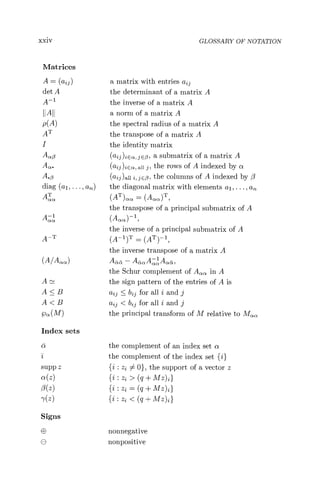
GLOSSARY OF NOTATION
Spaces
Rn real n-dimensional space
R the real line
Rn X Tn the space of n x m real matrices
R+ the nonnegative orthant of Rn
R++ the positive orthant of Rn
Vectors
zT the transpose of a vector z
{zv} a sequence of vectors z1 , z2 , z3 , .. .
eM an m-dimensional vector of all ones
(m is sometimes omitted)
HI anormonRm
xT y the standard inner product of vectors in Rn
x > y the (usual) partial ordering: xi > y2 , i = 1, ... n
x > y the strict ordering: xz > yz, i = 1, ... n
x >- y x is lexicographically greater than y
x >- y x is lexicographically greater than or equal to y
min(x, y) the vector whose i-th component is min(x, yz)
max(x, y) the vector whose i-th component is max(x, y2)
x * y (xjyj), the Hadamard product of x and y
zI the vector whose i-th component is Izz
z+ max(O, z), the nonnegative part of a vector z
z— max(O, —z), the nonpositive part of a vector z
z - the sign pattern of the components of z is
xxiii
xxiv GLOSSARY OF NOTATION
Matrices
A = (az^) a matrix with entries aid
det A the determinant of a matrix A
A- ' the inverse of a matrix A
a norm of a matrix A
p(A) the spectral radius of a matrix A
AT the transpose of a matrix A
I the identity matrix
Aß (aid )jca, E,Q, a submatrix of a matrix A
Aa . (aij)jca,all j, the rows of A indexed by cti
A.ß (aid )all Z, Eß, the columns of A indexed by ß
diag (a,,. , a) the diagonal matrix with elements al, ... , an,
laa (AT)ctia = (A a a) T
the transpose of a principal submatrix of A
`A-i
(A
Aaa)-1
the inverse of a principal submatrix of A
A-T (A- i)T = (AT) - i
the inverse transpose of a matrix A
(A/Aaa) Aca — A,, Actia `Lctia
the Schur complement of A. in A
A ^ the sign pattern of the entries of A is
A<B a2^ <b 3 for all i and j
A<B az^ < bz3 for all i and j
pa (M) the principal transform of M relative to Maa
Index sets
^ the complement of an index set ci
i the complement of the index set {i}
supp z {i : z2 0}, the support of a vector z
a(z) fi : zi > (q + Mz)z}
ß(z) {i : z = (q + Mz)z}
ry(z) {i : zz < (q + Mz)2}
Signs
nonnegative
S nonpositive
GLOSSARY OF NOTATION
Sets
E element membership
not an element of
the empty set
C set inclusion
C proper set inclusion
U, n, x union, intersection, Cartesian product
Sl  S2 the difference of sets Si and S2
S1 O S2 (51 'S2) U (S2  Sl) _ (S1 U S2)  (S1 n S2) ,
the symmetric difference of Sl and S2
Sl + Sz the (vector) sum of Sl and S2
the cardinality of a finite set S
SC the complement of a set S
dim S the dimension of a set S
bd S the (topological) boundary of a set S
cl S the (topological) closure of a set S
int S the topological interior of a set S
ri S the relative interior of a set S
rb S the relative boundary of a set S
S* the dual cone of S
O+S the set of recession directions of S
affn S the affine hull of S
cony S the convex hull of S
pos A the cone generated by the matrix A
[A] see 6.9.1
g(f) the graph of the function f
Sn-1 the unit sphere in Rn
£[x, y] the closed line segment between x and y
£(x, y) the open line segment between x and y
B(x, S) an (open) neighborhood of x with radius S
N(x) an (open) neighborhood of r
arg minx f (x) the set of x attaining the minimum of f (x)
arg maxi f (a) the set of x attaining the maximum of f (x)
[a, b] a closed interval in R
(a, b) an open interval in R
S the unit sphere
23 the closed unit ball
xxv
xxvi GLOSSARY OF NOTATION
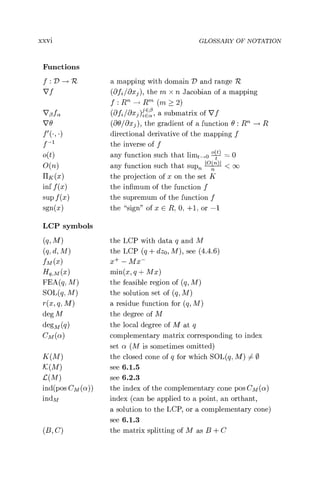
Functions
f : D -* 1Z a mapping with domain D and range R
Vf (8 f2 /axe ), the m x n Jacobian of a mapping
f:Rn-^Rm. (m > 2)
V ßfa (aff /äxß )ZEä , a submatrix of Vf
VO (OOB/öaj ), the gradient of a function 0 : RTh3 R
f'(,) directional derivative of the mapping f
f -1 the inverse of f
0(t) any function such that limt_^o = 0
0(n) any function such that sup )' < oc
HK(X) the projection of x on the set K
inf f (x) the infimum of the function f
sup f (x) the supremum of the function f
sgn(x) the "sign" of x E R, 0, +1, or -1
LCP symbols
(q, M) the LCP with data q and M
(q, d, M) the LCP (q + dzo , M), see (4.4.6)
fM (x) x+ - Mx-
Hq,M(x) min(x, q + Mx)
FEA(q, M) the feasible region of (q, M)
SOL(q, M) the solution set of (q, M)
r(x, q, M) a residue function for (q, M)
deg M the degree of M
deg(q) the local degree of M at q
CM(ct) complementary matrix corresponding to index
set a (M is sometimes omitted)
K(M) the closed cone of q for which SOL(q, M))4 0
K(M) see 6.1.5
G(M) see 6.2.3
ind(pos Cm (a)) the index of the complementary cone pos Cm (a)
indM index (can be applied to a point, an orthant,
a solution to the LCP, or a complementary cone)
see 6.1.3
(B, C) the matrix splitting of M as B + C
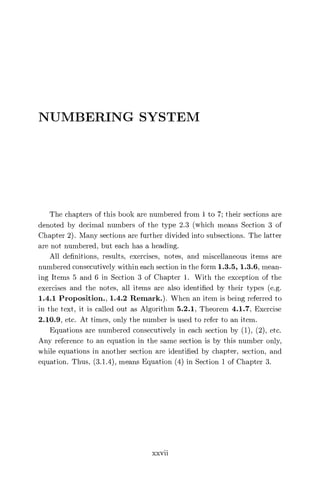
NUMBERING SYSTEM
The chapters of this book are numbered from 1 to 7; their sections are
denoted by decimal numbers of the type 2.3 (which means Section 3 of
Chapter 2). Many sections are further divided into subsections. The latter
are not numbered, but each has a heading.
All definitions, results, exercises, notes, and miscellaneous items are
numbered consecutively within each section in the form 1.3.5, 1.3.6, mean-
ing Items 5 and 6 in Section 3 of Chapter 1. With the exception of the
exercises and the notes, all items are also identified by their types (e.g.
1.4.1 Proposition., 1.4.2 Remark.). When an item is being referred to
in the text, it is called out as Algorithm 5.2.1, Theorem 4.1.7, Exercise
2.10.9, etc. At times, only the number is used to refer to an item.
Equations are numbered consecutively in each section by (1), (2), etc.
Any reference to an equation in the same section is by this number only,
while equations in another section are identified by chapter, section, and
equation. Thus, (3.1.4), means Equation (4) in Section 1 of Chapter 3.
xxvn
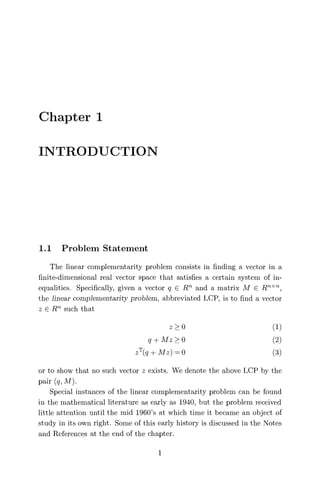
Chapter 1
INTRODUCTION
1.1 Problem Statement
The linear complementarity problem consists in finding a vector in a
finite-dimensional real vector space that satisfies a certain system of in-
equalities. Specifically, given a vector q E Rn and a matrix M E RnXT
the linear complementarity problem, abbreviated LCP, is to find a vector
z E R such that
z > 0 (1)
q -I- Mz 0 (2)
z T(q + Mz) = 0 (3)
or to show that no such vector z exists. We denote the above LCP by the
pair (q, M).
Special instances of the linear complementarity problem can be found
in the mathematical literature as early as 1940, but the problem received
little attention until the mid 1960's at which time it became an object of
study in its own right. Some of this early history is discussed in the Notes
and References at the end of the chapter.
1
2 1 INTRODUCTION
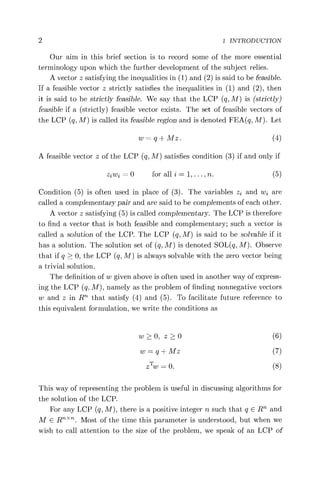
Our aim in this brief section is to record some of the more essential
terminology upon which the further development of the subject relies.
A vector z satisfying the inequalities in (1) and (2) is said to be feasible.
If a feasible vector z strictly satisfies the inequalities in (1) and (2), then
it is said to be strictly feasible. We say that the LCP (q, M) is (strictly)
feasible if a (strictly) feasible vector exists. The set of feasible vectors of
the LCP (q, M) is called its feasible region and is denoted FEA(q, M). Let
w = q + Mz . (4)
A feasible vector z of the LCP (q, M) satisfies condition (3) if and only if
ziwZ = 0 for all i = 1, ... , n. (5)
Condition (5) is often used in place of (3). The variables z2 and wi are
called a complementary pair and are said to be complements of each other.
A vector z satisfying (5) is called complementary. The LCP is therefore
to find a vector that is both feasible and complementary; such a vector is
called a solution of the LCP. The LCP (q, M) is said to be solvable if it
has a solution. The solution set of (q, M) is denoted SOL(q, M). Observe
that if q > 0, the LCP (q, M) is always solvable with the zero vector being
a trivial solution.
The definition of w given above is often used in another way of express-
ing the LCP (q, M), namely as the problem of finding nonnegative vectors
w and z in R"'' that satisfy (4) and (5). To facilitate future reference to
this equivalent formulation, we write the conditions as
w >0, z >0 (6)
w = q + Mz (7)
zTw = 0. (8)
This way of representing the problem is useful in discussing algorithms for
the solution of the LCP.
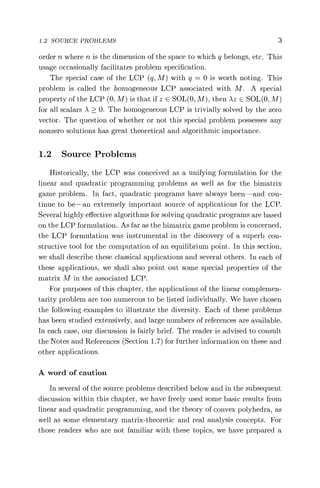
For any LCP (q, M), there is a positive integer n such that q E R' and
M E RT "Th. Most of the time this parameter is understood, but when we
wish to call attention to the size of the problem, we speak of an LCP of
1.2 SOURCE PROBLEMS 3
order n where n is the dimension of the space to which q belongs, etc. This
usage occasionally facilitates problem specification.
The special case of the LCP (q, M) with q = 0 is worth noting. This
problem is called the homogeneous LCP associated with M. A special
property of the LCP (0, M) is that if z E SOL(0, M), then Az e SOL(0, M)
for all scalars A > 0. The homogeneous LCP is trivially solved by the zero
vector. The question of whether or not this special problem possesses any
nonzero solutions has great theoretical and algorithmic importance.
1.2 Source Problems
Historically, the LCP was conceived as a unifying formulation for the
linear and quadratic programming problems as well as for the bimatrix
game problem. In fact, quadratic programs have always been—and con-
tinue to be—an extremely important source of applications for the LCP.
Several highly effective algorithms for solving quadratic programs are based
on the LCP formulation. As far as the bimatrix game problem is concerned,
the LCP formulation was instrumental in the discovery of a superb con-
structive tool for the computation of an equilibrium point. In this section,
we shall describe these classical applications and several others. In each of
these applications, we shall also point out some special properties of the
matrix M in the associated LCP.
For purposes of this chapter, the applications of the linear complemen-
tarity problem are too numerous to be listed individually. We have chosen
the following examples to illustrate the diversity. Each of these problems
has been studied extensively, and large numbers of references are available.
In each case, our discussion is fairly brief. The reader is advised to consult
the Notes and References (Section 1.7) for further information on these and
other applications.
A word of caution
In several of the source problems described below and in the subsequent
discussion within this chapter, we have freely used some basic results from
linear and quadratic programming, and the theory of convex polyhedra, as
well as some elementary matrix-theoretic and real analysis concepts. For
those readers who are not familiar with these topics, we have prepared a
4 1 INTRODUCTION
brief review in Chapter 2 which contains a summary of the background ma-
terial needed for the entire book. It may be advisable (for these readers) to
proceed to this review chapter before reading the remainder of the present
chapter. Several other source problems require familiarity with some topics
not within the main scope of this book, the reader can consult Section 1.7
for references that provide more details and related work.
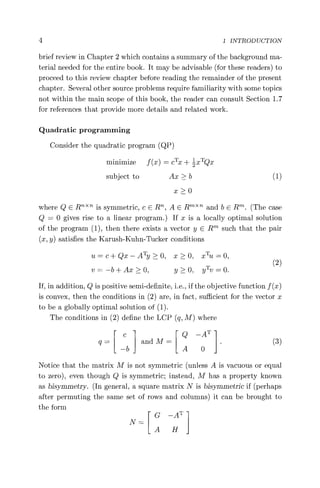
Quadratic programming
Consider the quadratic program (QP)
minimize f (x) = cTx + ZxTQx
subject to Ax > b (1)
x >0
where Q E RT "
Th is symmetric, c E R, A E Rm" and b E R. (The case
Q = 0 gives rise to a linear program.) If x is a locally optimal solution
of the program (1), then there exists a vector y E Rm such that the pair
(x, y) satisfies the Karush-Kuhn-Tucker conditions
u = c +Qx—ATy> 0, x>0, xTU =O,
v =—b +Ax>0, y >0, yTV =0. (2)
If, in addition, Q is positive semi-definite, i.e., if the objective function f (x)
is convex, then the conditions in (2) are, in fact, sufficient for the vector x
to be a globally optimal solution of (1).
The conditions in (2) define the LCP (q, M) where
c Q —AT
q= andM= (3)
—b A 0
Notice that the matrix M is not symmetric (unless A is vacuous or equal
to zero), even though Q is symmetric; instead, M has a property known
as bisymmetry. (In general, a square matrix N is bisymmetric if (perhaps
after permuting the same set of rows and columns) it can be brought to
the form
G —A'
A H
1.2 SOURCE PROBLEMS 5
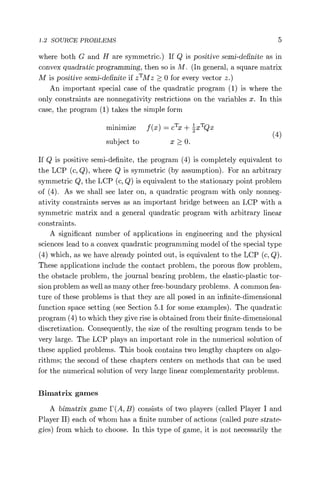
where both G and H are symmetric.) If Q is positive semi-definite as in
convex quadratic programming, then so is M. (In general, a square matrix
M is positive semi-definite if zTMz > 0 for every vector z.)
An important special case of the quadratic program (1) is where the
only constraints are nonnegativity restrictions on the variables x. In this
case, the program (1) takes the simple form
minimize f (x) = cTx + zxTQx
subject to x > 0. (4)
If Q is positive semi-definite, the program (4) is completely equivalent to
the LCP (c, Q), where Q is symmetric (by assumption). For an arbitrary
symmetric Q, the LCP (c, Q) is equivalent to the stationary point problem
of (4). As we shall see later on, a quadratic program with only nonneg-
ativity constraints serves as an important bridge between an LCP with a
symmetric matrix and a general quadratic program with arbitrary linear
constraints.
A significant number of applications in engineering and the physical
sciences lead to a convex quadratic programming model of the special type
(4) which, as we have already pointed out, is equivalent to the LCP (c, Q).
These applications include the contact problem, the porous flow problem,
the obstacle problem, the journal bearing problem, the elastic-plastic tor-
sion problem as well as many other free-boundary problems. A common fea-
ture of these problems is that they are all posed in an infinite-dimensional
function space setting (see Section 5.1 for some examples). The quadratic
program (4) to which they give rise is obtained from their finite-dimensional
discretization. Consequently, the size of the resulting program tends to be
very large. The LCP plays an important role in the numerical solution of
these applied problems. This book contains two lengthy chapters on algo-
rithms; the second of these chapters centers on methods that can be used
for the numerical solution of very large linear complementarity problems.
Bimatrix games
A bimatrix game F(A, B) consists of two players (called Player I and
Player II) each of whom has a finite number of actions (called pure strate-
gies) from which to choose. In this type of game, it is not necessarily the
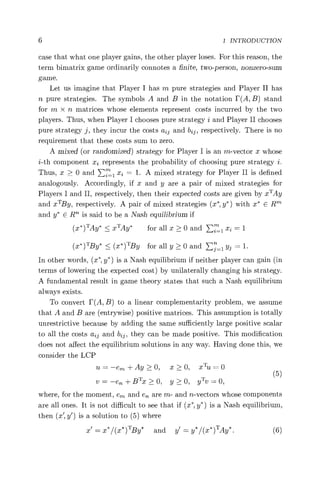
6 1 INTRODUCTION
case that what one player gains, the other player loses. For this reason, the
term bimatrix game ordinarily connotes a finite, two-person, nonzero-sum
game.
Let us imagine that Player I has m pure strategies and Player II has
n pure strategies. The symbols A and B in the notation F(A, B) stand
for m x n matrices whose elements represent costs incurred by the two
players. Thus, when Player I chooses pure strategy i and Player II chooses
pure strategy j, they incur the costs aid and b2^, respectively. There is no
requirement that these costs sum to zero.
A mixed (or randomized) strategy for Player I is an m-vector x whose
i-th component x. represents the probability of choosing pure strategy i.
Thus, x > 0 and E?" 1 xi = 1. A mixed strategy for Player II is defined
analogously. Accordingly, if x and y are a pair of mixed strategies for
Players I and II, respectively, then their expected costs are given by xTAy
and xTBy, respectively. A pair of mixed strategies (x*, y*) with x* E R""'
and y* E R' is said to be a Nash equilibrium if
(x*) TAy* < x`I'Ay* for all x > 0 and E2"1 xi = 1
(x*) T
'By* < (x*) TBy for all y> 0 and Ej i y = 1.
In other words, (x*, y*) is a Nash equilibrium if neither player can gain (in
terms of lowering the expected cost) by unilaterally changing his strategy.
A fundamental result in game theory states that such a Nash equilibrium
always exists.
To convert F(A, B) to a linear complementarity problem, we assume
that A and B are (entrywise) positive matrices. This assumption is totally
unrestrictive because by adding the same sufficiently large positive scalar
to all the costs aid and b2^, they can be made positive. This modification
does not affect the equilibrium solutions in any way. Having done this, we
consider the LCP
u =—e,,,, +Ay>0, x>0, xTu =0
(5)
v =—en +BTx>0, y >0, yTv =0,
where, for the moment, em and e7z are m- and n-vectors whose components
are all ones. It is not difficult to see that if (x*, y*) is a Nash equilibrium,
then (x', y') is a solution to (5) where
x' = x*/(x*)TBy* and y = y* /(x* )TAy* • (6)
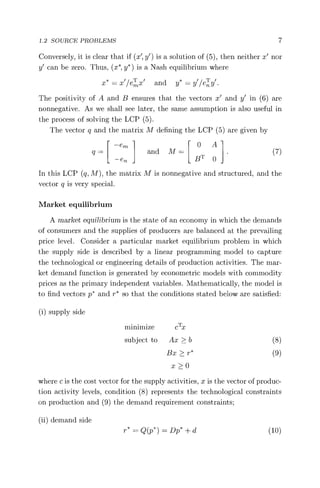
1.2 SOURCE PROBLEMS 7
Conversely, it is clear that if (x', y') is a solution of (5), then neither x' nor
y' can be zero. Thus, (x*, y*) is a Nash equilibrium where
x* = x'/ex' and y* = /eT y .
n
The positivity of A and B ensures that the vectors x' and y' in (6) are
nonnegative. As we shall see later, the same assumption is also useful in
the process of solving the LCP (5).
The vector q and the matrix M defining the LCP (5) are given by
—em0 A
q= and M= (7)
—enBT 0
In this LCP (q, M), the matrix M is nonnegative and structured, and the
vector q is very special.
Market equilibrium
A market equilibrium is the state of an economy in which the demands
of consumers and the supplies of producers are balanced at the prevailing
price level. Consider a particular market equilibrium problem in which
the supply side is described by a linear programming model to capture
the technological or engineering details of production activities. The mar-
ket demand function is generated by econometric models with commodity
prices as the primary independent variables. Mathematically, the model is
to find vectors p* and r* so that the conditions stated below are satisfied:
(i) supply side
minimize cTx
subject to Ax > b (8)
Bx > r* (9)
x>0
where c is the cost vector for the supply activities, x is the vector of produc-
tion activity levels, condition (8) represents the technological constraints
on production and (9) the demand requirement constraints;
(ii) demand side
r* = Q(p*) = Dp* + d (10)
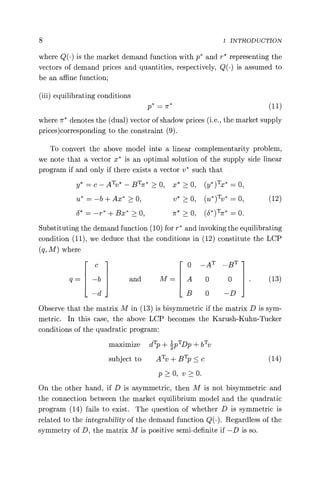
8 1 INTRODUCTION
where Q(.) is the market demand function with p* and r* representing the
vectors of demand prices and quantities, respectively, Q(•) is assumed to
be an affine function;
(iii) equilibrating conditions
p* _ 7r* (11)
where ir* denotes the (dual) vector of shadow prices (i.e., the market supply
prices) corresponding to the constraint (9).
To convert the above model into a linear complementarity problem,
we note that a vector x* is an optimal solution of the supply side linear
program if and only if there exists a vector v* such that
y* = c — ATv* — BTrr* > 0, x* > 0, (y* )Tx* = 0,
u* = —b + Ax* > 0, v* > 0, (u*) Tv* = 0, (12)
b* = —r* + Bx* > 0, > 0, (8*)TTr* = 0.
Substituting the demand function (10) for r* and invoking the equilibrating
condition (11), we deduce that the conditions in (12) constitute the LCP
(q, M) where
c 0 _AT —BT
q= —b and M= A 0 0 (13)
d B 0 —D
Observe that the matrix M in (13) is bisymmetric if the matrix D is sym-
metric. In this case, the above LCP becomes the Karush-Kuhn-Tucker
conditions of the quadratic program:
maximize dT
p + 1 pTDp + bTv
subject to ATv + BTp < c (14)
p>0, v>0.
On the other hand, if D is asymmetric, then M is not bisymmetric and
the connection between the market equilibrium model and the quadratic
program (14) fails to exist. The question of whether D is symmetric is
related to the integrability of the demand function Q(.). Regardless of the
symmetry of D, the matrix M is positive semi-definite if —D is so.
1.2 SOURCE PROBLEMS 9
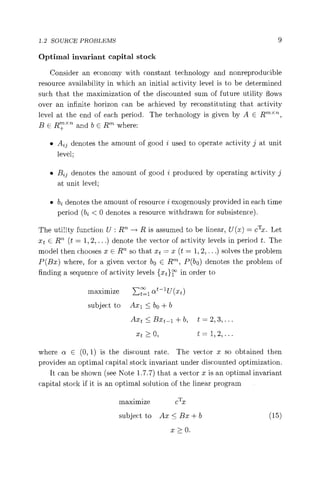
Optimal invariant capital stock
Consider an economy with constant technology and nonreproducible
resource availability in which an initial activity level is to be determined
such that the maximization of the discounted sum of future utility flows
over an infinite horizon can be achieved by reconstituting that activity
level at the end of each period. The technology is given by A E
B E R+ x n
and b E Rm where:
• denotes the amount of good i used to operate activity j at unit
level;
• Bz3 denotes the amount of good i produced by operating activity j
at unit level;
• bi denotes the amount of resource i exogenously provided in each time
period (bi < 0 denotes a resource withdrawn for subsistence).
The utility function U: Rn —f R is assumed to be linear, U(x) = cTx. Let
Xt E Rn (t = 1, 2,...) denote the vector of activity levels in period t. The
model then chooses x E R so that Xt = x (t = 1, 2,...) solves the problem
P(Bx) where, for a given vector b0 e RT", P(b0) denotes the problem of
finding a sequence of activity levels {xt }i° in order to
maximize Et=1 at-l U(xt)
subject to Axt < bo + b
Axt <Bxt _1 +b, t = 2,3,...
Xt > 0, t = 1,2,...
where ce E (0, 1) is the discount rate. The vector x so obtained then
provides an optimal capital stock invariant under discounted optimization.
It can be shown (see Note 1.7.7) that a vector x is an optimal invariant
capital stock if it is an optimal solution of the linear program
maximize cTx
subject to Ax < Bx + b (15)
x >0.
10 1 INTRODUCTION
Further, the vector y is a set of optimal invariant dual price proportions if
x and y satisfy the stationary dual feasibility conditions
ATy>aBTy+c, y>0, (16)
in addition to the condition
YT(b — (A — B)x) = XT«AT — uB^y — c) = 0.
Introducing slack variables u and v into the constraints (15) and (16), we
see that (x, y) provides both a primal and dual solution to the optimal
invariant capital stock problem if x solves (15) and if (x, y, u, v) satisfy
u=b+(B—A)x>0, y>O, uTy=0,
v=—c+(AT —aB^y>0, x>0, vTx=O.
The latter conditions define the LCP (q, M) where
E b 1r 0 B—A
q = I , and M= I I. (17)
L
—C
L
A i —aBT0
The matrix M in (17) is neither nonnegative nor positive semi-definite. It
is also not symmetric. Nevertheless, M can be written as
0 B—A 00
M= + (1 — a)
AT — BT 0 BT 0
which is the sum of a skew-symmetric matrix (the first summand) and a
nonnegative matrix (the second summand). Developments in Chapters 3
and 4 will show why this is significant.
Optimal stopping
Consider a Markov chain with finite state space E = {l, ... , u} and
transition probability matrix P. The chain is observed as long as desired.
At each time t, one has the opportunity to stop the process or to continue.
If one decides to stop, one is rewarded the payoff ri, if the process is in state
i U E, at which point the "game" is over. If one decides to continue, then
the chain progresses to the next stage according to the transition matrix P,
and a new decision is then made. The problem is to determine the optimal
time to stop so as to maximize the expected payoff.
1.2 SOURCE PROBLEMS 11
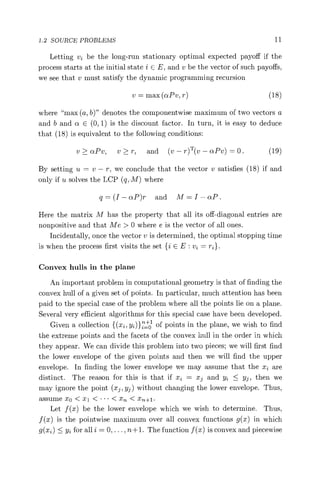
Letting vZ be the long-run stationary optimal expected payoff if the
process starts at the initial state i E E, and v be the vector of such payoffs,
we see that v must satisfy the dynamic programming recursion
v = max (aPv, r) (18)
where "max (a, b)" denotes the componentwise maximum of two vectors a
and b and a E (0, 1) is the discount factor. In turn, it is easy to deduce
that (18) is equivalent to the following conditions:
v>aPv, v>r, and (v —r)T(v—aPv) =0. (19)
By setting u = v — r, we conclude that the vector v satisfies (18) if and
only if u solves the LCP (q, M) where
q = (I—aP)r and M =I—aP.
Here the matrix M has the property that all its off-diagonal entries are
nonpositive and that Me > 0 where e is the vector of all ones.
Incidentally, once the vector v is determined, the optimal stopping time
is when the process first visits the set {i E E : vz = r}.
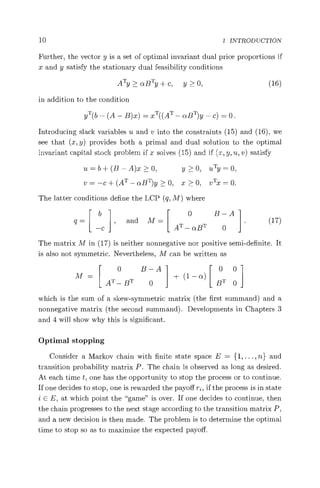
Convex
Convex hulls in the plane
An important problem in computational geometry is that of finding the
convex hull of a given set of points. In particular, much attention has been
paid to the special case of the problem where all the points lie on a plane.
Several very efficient algorithms for this special case have been developed.
Given a collection {(xi, y)}1 of points in the plane, we wish to find
the extreme points and the facets of the convex hull in the order in which
they appear. We can divide this problem into two pieces; we will first find
the lower envelope of the given points and then we will find the upper
envelope. In finding the lower envelope we may assume that the xZ are
distinct. The reason for this is that if xi = a and yz < yj , then we
may ignore the point (xi, yj) without changing the lower envelope. Thus,
assume xo <x1 < • • • < xn < xn+l-
Let f (x) be the lower envelope which we wish to determine. Thus,
f (x) is the pointwise maximum over all convex functions g(x) in which
g(xi) <p. for all i = 0, ... , n+l. The function f (x) is convex and piecewise
12 I INTRODUCTION
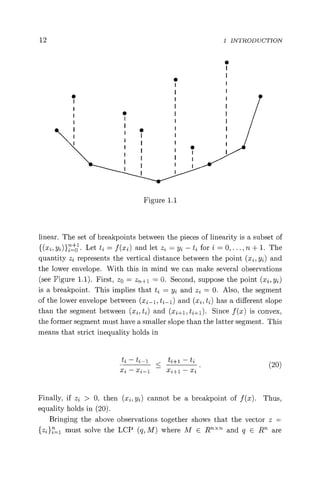
S
Figure 1.1
linear. The set of breakpoints between the pieces of linearity is a subset of
{(xi, yz) }iof . Let ti = f (xi) and let zz = y2 — tz for i = 0, ..., n + 1. The
quantity zz represents the vertical distance between the point (xi, yz) and
the lower envelope. With this in mind we can make several observations
(see Figure 1.1). First, z0 = z^,, + l = 0. Second, suppose the point (xi, y)
is a breakpoint. This implies that ti = yz and zi = 0. Also, the segment
of the lower envelope between (xi-1, ti-1) and (xi, ti) has a different slope
than the segment between (xi, tz) and (xi+i, t2+1). Since f (x) is convex,
the former segment must have a smaller slope than the latter segment. This
means that strict inequality holds in
t2 - ti- 1 < t2+1 - ti(20)
xi - x2-1
<
xi+1 - Xi
Finally, if zi > 0, then (xi, yz) cannot be a breakpoint of f (x). Thus,
equality holds in (20).
Bringing the above observations together shows that the vector z =
{z1} 1 must solve the LCP (q, M) where M E Rn < Th and q E Rn are
1.2 SOURCE PROBLEMS 13
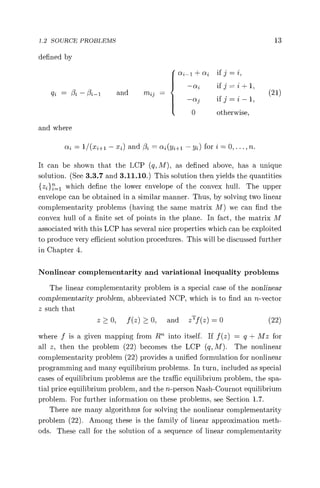
defined by
ai-1 + cq if j = 2,
qj = ßZ - ßj -i and
and where
—ai if j = i + 1,
mit _ (21)
—ctij if j = i — 1,
0 otherwise,
nj= 1 /(xi+1 — x2) and /3 = ai(y1+i — y2) for i = 0, ... , n.
It can be shown that the LCP (q, M), as defined above, has a unique
solution. (See 3.3.7 and 3.11.10.) This solution then yields the quantities
{zz }z 1 which define the lower envelope of the convex hull. The upper
envelope can be obtained in a similar manner. Thus, by solving two linear
complementarity problems (having the same matrix M) we can find the
convex hull of a finite set of points in the plane. In fact, the matrix M
associated with this LCP has several nice properties which can be exploited
to produce very efficient solution procedures. This will be discussed further
in Chapter 4.
Nonlinear complementarity and variational inequality problems
The linear complementarity problem is a special case of the nonlinear
complementarity problem, abbreviated NCP, which is to find an n-vector
z such that
z > 0, f (z) > 0, and zT f (z) = 0 (22)
where f is a given mapping from R" into itself. If f (z) = q + Mz for
all z, then the problem (22) becomes the LCP (q, M). The nonlinear
complementarity problem (22) provides a unified formulation for nonlinear
programming and many equilibrium problems. In turn, included as special
cases of equilibrium problems are the traffic equilibrium problem, the spa-
tial price equilibrium problem, and the n-person Nash-Cournot equilibrium
problem. For further information on these problems, see Section 1.7.
There are many algorithms for solving the nonlinear complementarity
problem (22). Among these is the family of linear approximation meth-
ods. These call for the solution of a sequence of linear complementarity
14 1 INTRODUCTION
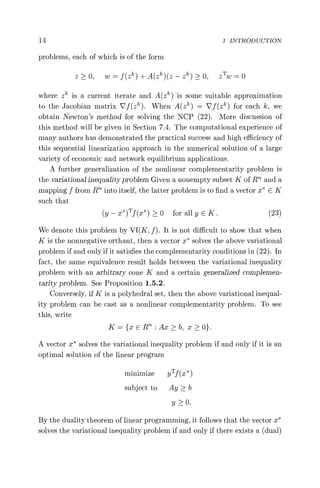
problems, each of which is of the form
z > 0, w = f (zk ) + A(zk )(z — zk ) > 0, zTw = 0
where zk is a current iterate and A(zk ) is some suitable approximation
to the Jacobian matrix V f (zk ). When A(zk ) = V f (zk ) for each k, we
obtain Newton's method for solving the NCP (22). More discussion of
this method will be given in Section 7.4. The computational experience of
many authors has demonstrated the practical success and high efficiency of
this sequential linearization approach in the numerical solution of a large
variety of economic and network equilibrium applications.
A further generalization of the nonlinear complementarity problem is
the variational inequality problem Given a nonempty subset K of R and a
mapping f from RTh into itself, the latter problem is to find a vector x* E K
such that
(y — x*)Tf(x*) > 0 for all y E K. (23)
We denote this problem by VI(K, f). It is not difficult to show that when
K is the nonnegative orthant, then a vector x* solves the above variational
problem if and only if it satisfies the complementarity conditions in (22). In
fact, the same equivalence result holds between the variational inequality
problem with an arbitrary cone K and a certain generalized complemen-
tarity problem. See Proposition 1.5.2.
Conversely, if K is a polyhedral set, then the above variational inequal-
ity problem can be cast as a nonlinear complementarity problem. To see
this, write
K={xER"':Ax>b, x>0}.
A vector x* solves the variational inequality problem if and only if it is an
optimal solution of the linear program
minimize yT f (x* )
subject to Ay > b
y > 0.
By the duality theorem of linear programming, it follows that the vector x*
solves the variational inequality problem if and only if there exists a (dual)
1.2 SOURCE PROBLEMS 15
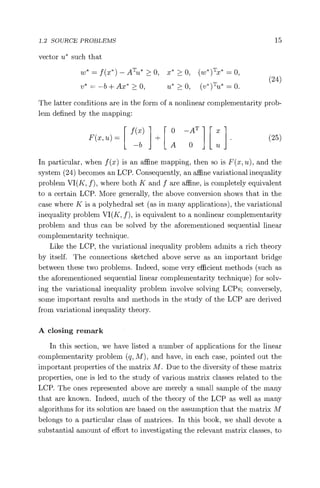
vector u* such that
w* = f (x* ) - ATu* > 0, x* > 0, (w* )Tx* = 0,
(24)
v* _ —b + Ax* > 0, u* > 0, (v* )Tu* = 0.
The latter conditions are in the form of a nonlinear complementarity prob-
lem defined by the mapping:
z
F(x u) = f (x)
+ 0 —A x
(25)
—b A 0 u
In particular, when f (x) is an affine mapping, then so is F(x, u), and the
system (24) becomes an LCP. Consequently, an affine variational inequality
problem VI(K, f), where both K and f are affine, is completely equivalent
to a certain LCP. More generally, the above conversion shows that in the
case where K is a polyhedral set (as in many applications), the variational
inequality problem VI(K, f), is equivalent to a nonlinear complementarity
problem and thus can be solved by the aforementioned sequential linear
complementarity technique.
Like the LCP, the variational inequality problem admits a rich theory
by itself. The connections sketched above serve as an important bridge
between these two problems. Indeed, some very efficient methods (such as
the aforementioned sequential linear complementarity technique) for solv-
ing the variational inequality problem involve solving LCPs; conversely,
some important results and methods in the study of the LCP are derived
from variational inequality theory.
A closing remark
In this section, we have listed a number of applications for the linear
complementarity problem (q, M), and have, in each case, pointed out the
important properties of the matrix M. Due to the diversity of these matrix
properties, one is led to the study of various matrix classes related to the
LCP. The ones represented above are merely a small sample of the many
that are known. Indeed, much of the theory of the LCP as well as many
algorithms for its solution are based on the assumption that the matrix M
belongs to a particular class of matrices. In this book, we shall devote a
substantial amount of effort to investigating the relevant matrix classes, to
16 1 INTRODUCTION
examining their interconnections and to exploring their relationship to the
LCP.
1.3 Complementary Matrices and Cones
Central to many aspects of the linear complementarity problem is the
idea of a cone.
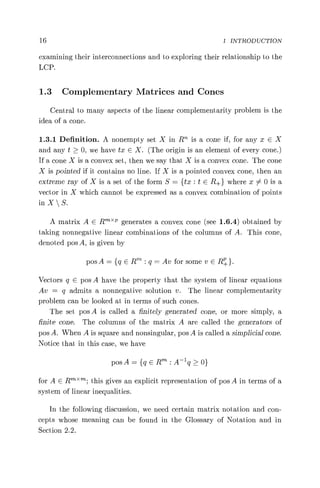
1.3.1 Definition. A nonempty set X in RTh is a cone if, for any x E X
and any t > 0, we have tx E X. (The origin is an element of every cone.)
If a cone X is a convex set, then we say that X is a convex cone. The cone
X is pointed if it contains no line. If X is a pointed convex cone, then an
extreme ray of X is a set of the form S = {tx: t E R+ } where x 0 is a
vector in X which cannot be expressed as a convex combination of points
in X  S.
A matrix A E R X P generates a convex cone (see 1.6.4) obtained by
taking nonnegative linear combinations of the columns of A. This cone,
denoted pos A, is given by
posA= {gERt':q=Av for some vER+}.
Vectors q E pos A have the property that the system of linear equations
Av = q admits a nonnegative solution v. The linear complementarity
problem can be looked at in terms of such cones.
The set pos A is called a finitely generated cone, or more simply, a
finite cone. The columns of the matrix A are called the generators of
pos A. When A is square and nonsingular, pos A is called a simplicial cone.
Notice that in this case, we have
posA= {geRt :A— 'q>0}
for A E R''''; this gives an explicit representation of pos A in terms of a
system of linear inequalities.
In the following discussion, we need certain matrix notation and con-
cepts whose meaning can be found in the Glossary of Notation and in
Section 2.2.
1.3 COMPLEMENTARY MATRICES AND CONES 17
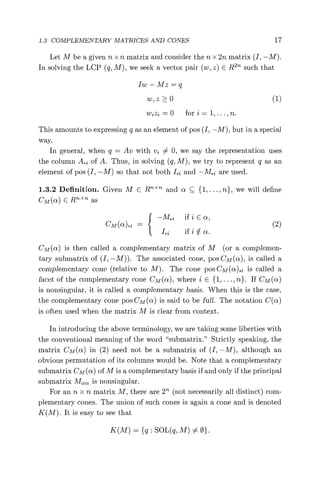
Let M be a given n x n matrix and consider the n x 2n matrix (I, —M).
In solving the LCP (q, M), we seek a vector pair (w, z) E Ren such that
1w — Mz = q
w, z > 0 (1)
wjz2 =0 fori= 1,...,n.
This amounts to expressing q as an element of pos (I, —M), but in a special
way.
In general, when q = Av with vi 0, we say the representation uses
the column A. of A. Thus, in solving (q, M), we try to represent q as an
element of pos (I, —M) so that not both I. and —M.Z are used.
1.3.2 Definition. Given M C RT >< and a C {l, ..., n}, we will define
CM(c) E Rn"n as
—M., if i E a,
CM(^)•i = (2)
I. ifi0a.
CM(c) is then called a complementary matrix of M (or a complemen-
tary submatrix of (I, —M)). The associated cone, pos CM(a), is called a
complementary cone (relative to M). The cone pos CM (a).I is called a
facet of the complementary cone CM(ce), where i E {1,...,n}. If CM(a)
is nonsingular, it is called a complementary basis. When this is the case,
the complementary cone pos CM (a) is said to be full. The notation C(a)
is often used when the matrix M is clear from context.
In introducing the above terminology, we are taking some liberties with
the conventional meaning of the word "submatrix." Strictly speaking, the
matrix CM(n) in (2) need not be a submatrix of (I, —M), although an
obvious permutation of its columns would be. Note that a complementary
submatrix CM(a) of M is a complementary basis if and only if the principal
submatrix Maa is nonsingular.
For an n x n matrix M, there are 2n (not necessarily all distinct) com-
plementary cones. The union of such cones is again a cone and is denoted
K(M). It is easy to see that
K(M) = {q: SOL(q, M) 0}.
18 1 INTRODUCTION
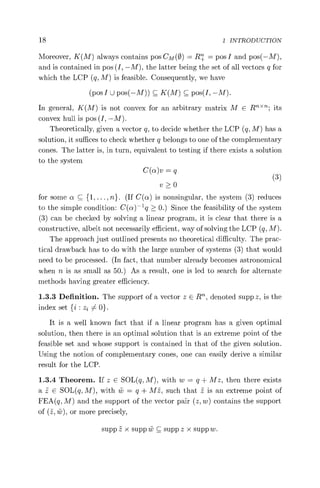
Moreover, K(M) always contains pos CM(0) = R+ = pos I and pos( —M),
and is contained in pos (I, —M), the latter being the set of all vectors q for
which the LCP (q, M) is feasible. Consequently, we have
(pos I U pos(—M)) C K(M) C pos(I, —M).
In general, K(M) is not convex for an arbitrary matrix M E Rn"n; its
convex hull is pos (I, —M).
Theoretically, given a vector q, to decide whether the LCP (q, M) has a
solution, it suffices to check whether q belongs to one of the complementary
cones. The latter is, in turn, equivalent to testing if there exists a solution
to the system
C(cti)v = q (3)
v>0
for some C {1, ..., n}. (If C(a) is nonsingular, the system (3) reduces
to the simple condition: C(n) —l q > 0.) Since the feasibility of the system
(3) can be checked by solving a linear program, it is clear that there is a
constructive, albeit not necessarily efficient, way of solving the LCP (q, M).
The approach just outlined presents no theoretical difficulty. The prac-
tical drawback has to do with the large number of systems (3) that would
need to be processed. (In fact, that number already becomes astronomical
when n is as small as 50.) As a result, one is led to search for alternate
methods having greater efficiency.
1.3.3 Definition. The support of a vector z E R', denoted supp z, is the
index set {i : z2 54 0}.
It is a well known fact that if a linear program has a given optimal
solution, then there is an optimal solution that is an extreme point of the
feasible set and whose support is contained in that of the given solution.
Using the notion of complementary cones, one can easily derive a similar
result for the LCP.
1.3.4 Theorem. If z E SOL(q, M), with w = q + Mz, then there exists
a z E SOL(q, M), with w = q + Mz, such that z is an extreme point of
FEA(q, M) and the support of the vector pair (z, w) contains the support
of (z, iv), or more precisely,
supp z x supp w C supp z x supp w.
1.3 COMPLEMENTARY MATRICES AND CONES 19
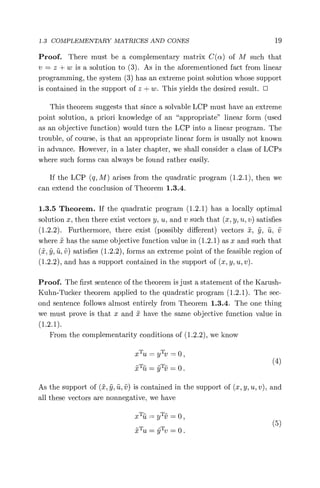
Proof. There must be a complementary matrix C(n) of M such that
v = z + w is a solution to (3). As in the aforementioned fact from linear
programming, the system (3) has an extreme point solution whose support
is contained in the support of z + w. This yields the desired result. ❑
This theorem suggests that since a solvable LCP must have an extreme
point solution, a priori knowledge of an "appropriate" linear form (used
as an objective function) would turn the LCP into a linear program. The
trouble, of course, is that an appropriate linear form is usually not known
in advance. However, in a later chapter, we shall consider a class of LCPs
where such forms can always be found rather easily.
If the LCP (q, M) arises from the quadratic program (1.2.1), then we
can extend the conclusion of Theorem 1.3.4.
1.3.5 Theorem. If the quadratic program (1.2.1) has a locally optimal
solution x, then there exist vectors y, u, and v such that (x, y, u, v) satisfies
(1.2.2). Furthermore, there exist (possibly different) vectors x, y, ii, v
where Jr has the same objective function value in (1.2.1) as x and such that
(x, y, ü, v) satisfies (1.2.2), forms an extreme point of the feasible region of
(1.2.2), and has a support contained in the support of (.x, y, u, v).
Proof. The first sentence of the theorem is just a statement of the Karush-
Kuhn-Tucker theorem applied to the quadratic program (1.2.1). The sec-
ond sentence follows almost entirely from Theorem 1.3.4. The one thing
we must prove is that x and x have the same objective function value in
(1.2.1).
From the complementarity conditions of (1.2.2), we know
xTU=yTV =0,
(4)
xTÜ=yTV =0.
As the support of (x, y, ü, v") is contained in the support of (x, y, u, v), and
all these vectors are nonnegative, we have
xTii=yTV =0,
(5)
xTu = üTv = 0.
20 1 INTRODUCTION
Consequently, it follows from (1.2.2), (4) and (5) that
0 = (x — x)T(u — ü) = (x — j) TQ(x — i) — (x — x)TAT(y — )
(x - x)TQ(x -) - (v - v)T(y - )
= (x — x)TQ(x — x).
Thus, for A E R we have
f(x + A(x — x)) = f(x) + A(c + Qx) T( — x),
which is a linear function in .A. Clearly, as the support of (x, y, u, v) contains
the support of (x, y, ü, v), there is some E > 0 such that x + )(x — x) is
feasible for (1.2.1) if A < e. Thus, as f (x + )(x — x)) is a linear function
in .A and x is a local optimum of (1.2.1), it follows that f (x + )(Jv — x)) is
a constant function in A. Letting A = 1 gives f (x) = f() as desired. ❑
1.3.6 Remark. Notice, if x is a globally optimal solution, then so is .
The following example illustrates the idea of the preceding theorem.
1.3.7 Example. Consider the (convex) quadratic program
minimize 2(x1 + x2)2 — 2(x1 + X2)
subject to x1 + x2 < 3
xi, x2 > 0
which has (xl, x2) _ (1, 1) as a globally optimal solution. In this instance
we have ul = u2 = 0, y = 0, and v = 1. The vector (x, y, u, v) satisfies
the Karush-Kuhn-Tucker conditions for the given quadratic program which
define the LCP below, namely
ul—2 1 11 x1
u2 = —2 + 1 1 1 X2
v 3 —1 —1 0 p
x, u, y, v > 0, x TU = yTv = 0;
1.3 COMPLEMENTARY MATRICES AND CONES 21
but this (x, y, u, v) is not an extreme point of the feasible region of the LCP
because the columns
1 1 0
1 1, 0
—1 —1 1
that correspond to the positive components of the vector (x, y, u, v) are
linearly dependent. However, the vector (fl, , ii, v) = ( 2, 0, 0, 0, 0, 1) sat-
ifies the same LCP system and is also an extreme point of its feasible
region. Moreover, the support of (x, , ii, v) is contained in the support of
(x, y, u, v)
For a matrix M of order 2, the associated cone K(M) can be rather
nicely depicted by drawing in the plane, the individual columns of the
identity matrix, the columns of —M, and the set of complementary cones
formed from these columns. Some examples are illustrated in Figures 1.2
through 1.7. In these figures we label the (column) vectors 1.1, 1.2, —M. 1 ,
and —M.2 as 1, 2, 1, and 2, respectively. The complementary cones are
indicated by arcs around the origin. The significance of these figures is as
follows.
Figure 1.2 illustrates a case where (q, M) has a unique solution for every
q E R2 . Figure 1.3 illustrates a case where K(M) = R2 , but for some
q E R2 the problem (q, M) has multiple solutions. Figure 1.4 illustrates a
case where K(M) is a halfspace. For vectors q that lie in one of the open
halfspaces, the problem (q, M) has a unique solution, while for those which
lie in the other open halfspace, (q, M) has no solution at all. All q lying
on the line separating these halfspaces give rise to linear complementarity
problems having infinitely many solutions. Figure 1.5 illustrates a case
where every point q E R2 belongs to an even number—possibly zero—of
complementary cones. Figure 1.6 illustrates a case where K(M) = R2 and
not all the complementary cones are full-dimensional. Figure 1.7 illustrates
a case where K(M) is nonconvex.
22 1 INTRODUCTION
Figure 1.2 Figure 1.3
Figure 1.4 Figure 1.5
Figure 1.6 Figure 1.7
Other documents randomly have
different content
another set of microscopes, pointing to a fixed horizontal circle, and
upon which the azimuth can be read. A complete observation
involves four such transits and sets of circle readings, two of
altitude, and two of azimuth; for after one of altitude and one of
azimuth the telescope is turned round, and a second observation is
taken in each element.
The observation gives us the altitude and azimuth of the star.
These particulars are of no direct value to us. But it is a mere matter
of computation, though a long and laborious one, to convert these
elements into right ascension and declination.
The usefulness of the altazimuth will be seen at once. It will be
remembered that with the transit circle any particular object can
only be observed as it crosses the meridian. If the weather should
be cloudy, or the observer late, the chance of observation is lost for
four and twenty hours, and in the case of the moon, for which the
altazimuth is specially used, it is on the meridian only in broad
daylight during that part of the month which immediately precedes
and follows new moon. At such times it is practically impossible to
observe it with the transit circle; with the altazimuth it may be
caught in the twilight before sunrise or after sunset; and at other
times in the month, if lost on the meridian in the transit circle, the
altazimuth still gives the observer a chance of catching it any time
before it sets. But for this instrument, our observations of the moon
would have been practically impossible over at least one-fourth of its
orbit.
Airy's altazimuth was but a small instrument of three and three-
quarter inches aperture, mounted in a high tower built on the site of
Flamsteed's mural arc; and, after a life history of about half a
century, has been succeeded by a far more powerful instrument. The
'New Altazimuth' has an aperture of eight inches, and is housed in a
very solidly constructed building of striking appearance, the
connection of the Observatory with navigation being suggested by a
row of circular lights which strongly recall a ship's portholes. This
building is at the southern end of the narrow passage, 'the wasp's
waist,' which connects the older Observatory domain with the newer.
It is the first building we come to in the south ground. The
computations of the department are carried on in the south wing of
the new Observatory.
It will be seen from the photograph that the instrument is much
larger, heavier, and less easy to move in azimuth than the old
altazimuth. It is, therefore, not often moved in azimuth, but is set in
some particular direction, not necessarily north and south, in which
it is used practically as a transit circle.
NEW ALTAZIMUTH BUILDING.
There is quite another way of determining the place of the moon,
which is sometimes available, and which offers one of the prettiest
of observations to the astronomer. As the moon travels across the
sky, moving amongst the stars from west to east, it necessarily
passes in front of some of them, and hides them from us for a time.
Such a passage, or 'occultation,' offers two observations: the
'disappearance,' as the moon comes up to the star and covers it; the
'reappearance,' as it leaves it again, and so discloses it.
THE NEW ALTAZIMUTH.
(From a photograph by Mr. Lacey.)
Except at the exact time of full moon, we do not see the entire
face of our satellite; one edge or 'limb' is in darkness. As the moon
therefore passes over the star, either the limb at which the star
disappears, or that at which it reappears, is invisible to us. To watch
an occultation at the bright limb is pretty; the moon, with its shining
craters and black hollows, its mountain ranges in bright relief, like a
model in frosted silver, slowly, surely, inevitably comes nearer and
nearer to the little brilliant which it is going to eclipse. The
movement is most regular, most smooth, yet not rapid. The observer
glances at his clock, and marks the minute as the two heavenly
bodies come closer and closer to each other. Then he counts the
clock beats: 'five, six, seven,' it may be, as the star has been all but
reached by the advancing moon. 'Eight,' it is still clear; ere the beat
of the clock rings to the 'nine,' perhaps the little diamond point has
been touched by the wide arch of the moon's limb, and has gone!
Less easy to exactly time is a reappearance at the bright limb. In this
case the observer must ascertain from the Nautical Almanac
precisely where the star will reappear; then a little before the
predicted time he takes his place at the telescope, watches intently
the moon's circumference at the point indicated, and, listening for
the clock-beats, counts the seconds as they fly. Suddenly, without
warning, a pin-point of light flashes out at the edge of the moon,
and at once draws away from it. The star has 'reappeared.'
Far more striking is a disappearance or reappearance at the 'dark
limb.' In this case the limb of the moon is absolutely invisible, and it
may be that no part of the moon is visible in the field of the
telescope. In this case the observer sees a star shining brightly and
alone in the middle of the field of his telescope. He takes the time
from his faithful clock, counting beat after beat, when suddenly the
star is gone! So sudden is the disappearance that the novice feels
almost as astonished as if he had received a slap in the face, and
not unfrequently he loses all count or recollection of the clock beats.
The reappearance at the dark limb is quite as startling; with a bright
star it is almost as if a shell had burst in his very face, and it would
require no very great imagination to make him think that he had
heard the explosion. One moment nothing was visible; now a great
star is shining down serenely on the watcher. A little practice soon
enables the observer to accustom himself to these effects, and an
old hand finds no more difficulty in observing an occultation of any
kind than in taking a transit.
Such an observation is useful for more purposes than one. If the
position of the star occulted is known—and it can be determined at
leisure afterwards—we necessarily know where the limb of the moon
was at the time of the observation. Then the time which the moon
took to pass over the star enables us to calculate the diameter of
our satellite; the different positions of the moon relative to the star,
as seen from different observatories, enable us to calculate its
distance.
But if the disappearance takes place at the bright limb, the
reappearance usually takes place at the dark, and vice versâ; and
the two observations are not quite comparable. There is one
occasion, however, when both observations are made under similar
circumstances, namely, at the full. And if the moon happens also to
be totally eclipsed, the occultations of quite faint stars can be
successfully observed, much fainter than can ordinarily be seen close
up to the moon. Total eclipses of the moon, therefore, have recently
come to be looked upon as important events for the astronomer, and
observatories the world over usually co-operate in watching them.
October 4, 1884, was the first occasion when such an organised
observation was made; there have been several since, and on these
nights every available telescope and observer at Greenwich is called
into action.
It may be asked why these different modes of observing the moon
are still kept up, year in and year out. 'Do we not know the moon's
orbit sufficiently well, especially since the discovery of gravitation?'
No; we do not. This simple and beautiful law—simple enough in
itself, gives rise to the most amazing complexity of calculation. If the
earth and moon were the only two bodies in the universe, the
problem would be a simple one. But the earth, sun, and moon are
members of a triple system, each of which is always acting on both
of the others. More, the planets, too, have an appreciable influence,
and the net result is a problem so intricate that our very greatest
mathematicians have not thoroughly worked it out. Our calculations
of the moon's motions need, therefore, to be continually compared
with observation, need even to be continually corrected by it.
There is a further reason for this continual observation, not only in
the case of the sun, which is our great standard star, since from it
we derive the right ascensions of the stars, and it is also our great
timekeeper; not only in that of the moon, but also in the case of the
planets. Their places as computed need continually to be compared
with their places as observed, and the discordances, if any, inquired
into. The great triumph which resulted to science from following this
course—to pure science, since Uranus is too faint a planet to be any
help to the sailor in navigation—is well known. The observed
movements of Uranus proved not to be in accord with computation,
and from the discordances between calculation and observation
Adams and Leverrier were able to predicate the existence of a
hitherto unseen planet beyond—
'To see it, as Columbus saw America from Spain. Its
movements were felt by them trembling along the far-reaching
line of their analysis, with a certainty hardly inferior to that of
ocular demonstration.'[5]
The discovery of Neptune was not made at Greenwich, and Airy
has been often and bitterly attacked because he did not start on the
search for the predicted planet the moment Adams addressed his
first communication to him, and so allowed the French astronomer
to engross so much of the honour of the exploit. The controversy
has been argued over and over again, and we may be content to
leave it alone here. There is one point, however, which is hardly ever
mentioned, which must have had much effect in determining Airy's
conduct. In 1845, the year in which Adams sent his provisional
elements of the unseen disturbing planet to Airy, the largest
telescope available for the search at Greenwich was an equatorial of
only six and three-quarter inches aperture, provided with small and
insufficient circles for determining positions, and housed in a very
small and inconvenient dome; whilst at Cambridge, within a mile or
so of Adams' own college, was the 'Northumberland' equatorial, of
nearly twelve inches aperture, under the charge of the University
Professor of Astronomy, Professor Challis, and which was then much
the largest, best mounted and housed equatorial in the entire
country. The 'Northumberland' had been begun from Airy's designs
and under his own superintendence, when he was Professor of
Astronomy at Cambridge. Naturally, then, knowing how much
superior the Cambridge telescope was to any which he had under his
care, he thought the search should be made with it. He had no
reason to believe that his own instrument was competent for the
work.
THE NEW OBSERVATORY AS SEEN FROM FLAMSTEED'S
OBSERVATORY.
On the other hand, it is hard for the ordinary man to understand
how it was that Adams not only left unnoticed and unanswered for
three-quarters of a year, an inquiry of Airy's with respect to his
calculations, but also never took the trouble to visit Challis, whom he
knew well, and who was so near at hand, to stir him up to the
search. But, in truth, the whole interest of the matter for Adams
rested in the mathematical problem. The irregularities in the motion
of Uranus were interesting to him simply for the splendid opportunity
which they gave him for their analysis. A purely imaginary case
would have served his purpose nearly as well. The actuality of the
planet which he predicted was of very little moment; the éclat and
popular reputation of the discovery was less than nothing; the
problem itself and the mental exercise in its solution, were what he
prized.
But it was not creditable to the nation that the Royal Observatory
should have been so ill-provided with powerful telescopes; and a few
years later Airy obtained the sanction of the Government for the
erection of an equatorial larger than the 'Northumberland,' but on
the same general plan and in a much more ample dome. This was
for thirty-four years the 'Great' or 'South-East' equatorial, and the
mounting still remains and bears the old name, though the original
telescope has been removed elsewhere. The object-glass had an
aperture of twelve and three-quarter inches and a focal length of
eighteen feet, and was made by Merz of Munich, the engineering
work by Ransomes and Sims of Ipswich, and the graduations and
general optical work by Simms, now of Charlton, Kent. The mounting
was so massive and stable that the present Astronomer Royal has
found it quite practicable and safe to place upon it a telescope (with
its counterpoises) of many times the weight, one made by Sir
Howard Grubb, of Dublin, of twenty-eight inches aperture and
twenty-eight feet focal length, the largest refractor in the British
Empire, though surpassed by several American and Continental
instruments.
The stability of the mounting was intended to render the telescope
suitable for a special work. This was the observation of 'minor
planets.' On the first day of the present century the first of these
little bodies was discovered by Piazzi at Palermo. Three more were
discovered at no great interval afterwards, and then there was an
interval of thirty-eight years without any addition to their number.
But from December 8, 1845, up to the present time, the work of
picking up fresh individuals of these 'pocket planets' has gone on
without interruption, until now more than 400 are known. Most of
these are of no interest to us, but a few come sufficiently near to the
earth for their distance to be very accurately determined; and when
the distance of one member of the solar system is determined, those
of all the others can be calculated from the relations which the law
of gravitation reveals to us. It is a matter of importance, therefore,
to continue the work of discovery, since we may at any time come
across an interesting or useful member of the family; and that we
may be able to distinguish between minor planets already discovered
and new ones, their orbits must be determined as they are
discovered, and some sort of watch kept on their movements.
A striking example of the scientific prizes which we may light upon
in the process of the rather dreary and most laborious work which
the minor planets cause, has been recently supplied by the discovery
of Eros. On August 13, 1898, Herr Witt, of the Urania Observatory,
Berlin, discovered a very small planet that was moving much faster
in the sky than is common with these small bodies. The great
majority are very much farther from the sun than the planet Mars,
many of them twice as far, and hence, since the time of a planet's
revolution round the sun increases, in accordance with Kepler's law,
more rapidly than does its distance, it follows that they move much
more slowly than Mars. But this new object was moving at almost
the same speed as Mars; it must, therefore, be most unusually near
to us. Further observations soon proved that this was the case, and
Eros, as the little stranger has been called, comes nearer to us than
any other body of which we are aware except the moon. Venus
when in transit is 241/2 millions of miles from us, Mars at its nearest
is 341/2 millions, Eros at its nearest approach is but little over 13
millions.
The use of such a body to us is, of course, quite apart from any
purpose of navigation, except very indirectly. But it promises to be of
the greatest value in the solution of a question in which astronomers
must always feel an interest, the determination of the distance of
the earth from the sun. We know the relative distances of the
different planets, and, consequently if we could determine the
absolute distance of any one, we should know the distances of all.
As it is practically impossible to measure our distance from the sun
directly, several attempts have been made to determine the
distances of Venus, Mars, or such of the minor planets as come the
nearest to us. Three of these in particular, the little planets Iris,
Victoria, and Sappho, have given us the most accurate
determinations of the sun's distance (92,874,000 miles) which we
have yet obtained; but Eros at its nearest approach will be six times
as near to us as either of the three mentioned above, and therefore
should give us a value with only one-sixth of the uncertainty
attaching to that just mentioned.
The discovery of minor planets has lain outside the scope of
Greenwich work, but their observation has formed an integral part of
it. The general public is apt to lay stress rather on the first than on
the second, and to think it rather a reproach to Greenwich that it has
taken no part in such explorations. Experience has, however, shown
that they may be safely left to amateur activity, whilst the
monotonous drudgery of the observation of minor planets can only
be properly carried out in a permanent institution.
The observation of these minute bodies with the transit circle and
altazimuth is attended with some difficulties; but precise
observations of various objects may be made with an equatorial;
indeed, comets are usually observed by its means.
The most ordinary way of observing a comet with an equatorial is
as follows: Two bars are placed in the eye-piece of the telescope, at
right angles to each other, and at an angle of forty-five degrees to
the direction of the apparent daily motion of the stars. The telescope
is turned to the neighbourhood of the comet, and moved about until
it is detected. The telescope is then put a little in front of the comet,
and very firmly fixed. The observer soon sees the comet entering his
field, and by pressing the contact button he telegraphs to the
chronograph the time when the comet is exactly bisected by each of
the bars successively. He then waits until a bright star, or it may be
two or three, have entered the telescope and been observed in like
manner. The telescope is then unclamped, and moved forward until
it is again ahead of the comet, and the observations are repeated;
and this is done as often as is thought desirable. The places of the
stars have, of course, to be found out from catalogues, or have to
be observed with the transit circle, but when they are known the
position of the comet or minor planet can easily be inferred.
Next to the glory of having been the means of bringing about the
publication of Newton's Principia, the greatest achievement of Halley,
the second Astronomer Royal, was that he was the first to predict
the return of a comet. Newton had shown that comets were no
lawless wanderers, but were as obedient to gravitation as were the
planets themselves, and he also showed how the orbit of a comet
could be determined from observations on three different dates.
Following these principles, Halley computed the orbits of no fewer
than twenty-four comets, and found that three of them, visible at
intervals of about seventy-five years, pursued practically the same
path. He concluded, therefore, that these were really different
appearances of the same object, and, searching old records, he
found reason to believe that it had been observed frequently earlier
still. It seems, in fact, to have been the comet which is recorded to
have been seen in 1066 in England at the time of the Norman
invasion; in A.D. 66, shortly before the commencement of that war
which ended in the destruction of Jerusalem by Titus; and earlier
still, so far back as B.C. 12. Halley, however, experienced a difficulty
in his investigation. The period of the comet's revolution was not
always the same. This, he concluded, must be due to the attraction
of the planets near which the comet might chance to travel. In the
summer of 1681 it had passed very close to Jupiter, for instance, and
in consequence he expected that instead of returning in August
1757, seventy-five years after its last appearance, it would not return
until the end of 1758 or the beginning of 1759. It has returned twice
since Halley's day, a triumphant verification of the law of gravitation;
and we are looking for it now for a third return some ten years
hence, in 1910.
Halley's comet, therefore, is an integral member of our solar
system, as much so as the earth or Neptune, though it is utterly
unlike them in appearance and constitution, and though its path is
so utterly unlike theirs that it approaches the sun nearer than our
earth, and recedes farther than Neptune. But there are other
comets, which are not permanent members of our system, but only
passing visitors. From the unfathomed depths of space they come,
to those depths they go. They obey the law of gravitation so far as
our sight can follow them, but what happens to them beyond? Do
they come under some other law, or, perchance, in outermost space
is there still a region reserved to primeval Chaos, the 'Anarch old,'
where no law at all prevails? Gravitation is the bond of the solar
system; is it also the bond of the Universe?
CHAPTER IX
THE MAGNETIC AND METEOROLOGICAL
DEPARTMENTS
Passing out of the south door of the new altazimuth building, we
come to a white cruciform erection, constructed entirely of wood.
This is the Magnet House or Magnetic Observatory, the home of a
double Department, the Magnetic and Meteorological.
This department does not, indeed, lie within the original purpose
of the Observatory as that was defined in the warrant given to
Flamsteed, and yet is so intimately connected with it, through its
bearing on navigation, that there can be no question as to its
suitability at Greenwich. Indeed, its creation is a striking example of
the thorough grasp which Airy had upon the essential principles
which should govern the great national observatory of an essentially
naval race, and of the keen insight with which he watched the new
development of science. The Magnetic Observatory, therefore, the
purpose of which was to deal with the observation of the changes in
the force and direction of the earth's magnetism—an inquiry which
the greater delicacy of modern compasses, and, in more recent
times, the use of iron instead of wood in the construction of ships
has rendered imperative—was suggested by Airy on the first possible
occasion after he entered on his office, and was sanctioned in 1837.
The Meteorological Department has a double bearing on the purpose
of the Observatory. On the one side, a knowledge of the
temperature and pressure of the atmosphere is, as we have already
seen, necessary in order to correct astronomical observations for the
effect of refraction. On the other hand, meteorology proper, the
study of the movements of the atmosphere, the elucidation of the
laws which regulate those movements, leading to accurate forecasts
of storms, are of the very first necessity for the safety of our
shipping. It is true that weather forecasts are not issued from
Greenwich Observatory, any more than the Nautical Almanac is now
issued from it; but just as the Observatory furnishes the
astronomical data upon which the Almanac is based, so also it takes
its part in furnishing observations to be used by the Meteorological
Office at Westminster for its daily predictions.
Those predictions are often made the subject of much cheap
ridicule; but, however far short they may fall of the exact and
accurate predictions which we would like to have, yet they mark an
enormous advance upon the weather-lore of our immediate
forefathers.
'He that is weather wise
Is seldom other wise,'
says the proverb, and the saying is not without a shrewd amount of
truth. For perhaps nowhere can we find a more striking combination
of imperfect observation and inconsequent deduction than in the
saws which form the stock-in-trade of the ordinary would-be
weather prophet. How common it is to find men full of the conviction
that the weather must change at the co-called 'changes of the
moon,' forgetful that
'If we'd no moon at all—
And that may seem strange—
We still should have weather
That's subject to change.'
They will say, truly enough, no doubt, that they have known the
weather to change at 'new' or 'full,' as the case may be, and they
argue that it, therefore, must always do so. But, in fact, they have
only noted a few chance coincidences, and have let the great
number of discordances pass by unnoticed.
But observations of this kind seem scientific and respectable
compared with those numerous weather proverbs which are based
upon the mere jingle of a rhyme, as
'If the ash is out before the oak,
You may expect a thorough soak'—
a proverb which is deftly inverted in some districts by making 'oak'
rhyme to 'choke.'
Others, again, are based upon a mere childish fancy, as, for
example, when the young moon 'lying on her back' is supposed to
bode a spell of dry weather, because it looks like a cup, and so might
be thought of as able to hold the water.
During the present reign, however, a very different method of
weather study has come into action, and the foundations of a true
weather wisdom have been laid. These have been based, not on
fancied analogies or old wives' rhymes, or a few forechosen
coincidences, but upon observations carried on for long periods of
time and over wide areas of country, and discussed in their entirety
without selection and bias. Above all, mathematical analysis has
been applied to the motions of the air, and ideas, ever gaining in
precision and exactness, have been formulated of the general
circulation of the atmosphere.
As compared with its sister science, astronomy, meteorology
appears to be still in a very undeveloped state. There is such a
difference between the power of the astronomer to foretell the
precise position of sun, moon, and planets for years, even for
centuries, beforehand, and the failure of the meteorologist to predict
the weather for a single season ahead, that the impression has been
widely spread that there is yet no true meteorological science at all.
It is forgotten that astronomy offered us, in the movements of the
heavenly bodies, the very simplest and easiest problem of related
motion. Yet for how many thousands of years did men watch the
planets, and speculate concerning their motions, before the labours
of Tycho, Kepler, and Newton culminated in the revelation of their
meaning? For countless generations it was supposed that their
movements regulated the lives, characters, and private fortunes of
individual men; just as quite recently it was fancied that a new moon
falling on a Saturday, or two full moons coming within the same
calendar month, brought bad weather!
It is still impossible to foresee the course of weather change for
long ahead; but the difference between the modern navigator, surely
and confidently making a 'bee-line' across thousands of miles of
ocean to his destination, and the timid sailor of old, creeping from
point to point of land, is hardly greater than the contrast between
the same two men, the one watching his barometer, the other
trusting in the old wives' rhymes which afforded him his only
indication as to coming storms.
It is still impossible to foresee the weather change for long ahead,
but in our own and in many other countries, especially the United
States, it has been found possible to predict the weather of the
coming four-and-twenty hours with very considerable exactness, and
often to forecast the coming of a great storm several days ahead.
This is the chief purpose of the two great observatories of the storm-
swept Indian and Chinese seas, Hong Kong and Mauritius; and the
value of the work which they have done in preventing the loss of
ships, and the consequent loss of lives and property, has been
beyond all estimate.
The Royal Observatory, Greenwich, is a meteorological as well as
an astronomical observatory, but, as remarked above, it does not
itself issue any weather forecasts. Just as the Greenwich
observations of the places of the moon and stars are sent to the
Nautical Almanac Office, for use in the preparation of that
ephemeris; just as the Greenwich determinations of time are used
for the issue of signals to the Post Office, whence they are
distributed over the kingdom, so the Greenwich observations of
weather are sent to the Meteorological Office, there to be combined
with similar records from every part of the British Isles, to form the
basis of the daily forecasts which the latter office publishes. To each
of these three offices, therefore, the Royal Observatory, Greenwich,
stands in the relation of purveyor. It supplies them with the original
observations more or less in reduced and corrected form, without
which they could not carry on most important portions of their work.
Let it be noted how closely these three several departments, the
Nautical Almanac Office, the Time Department, and the
Meteorological Office, are related to practical navigation. Whatever
questions of pure science—of knowledge, that is, apart from its
useful applications—may arise out of the following up of these
several inquiries, yet the first thought, the first principle of each, is
to render navigation more sure and more safe.
The first of all meteorological instruments is the barometer, which,
under its two chief forms of mercurial and aneroid, is simply a
means of measuring the pressure exerted by the atmosphere.
There are two important corrections to which its readings are
subject. The first is for the height of the station above the level of
the sea; the second is for the effect of temperature upon the
mercury in the barometer itself, lengthening the column. To
overcome these, the height of the standard barometer at Greenwich
above sea-level has been most carefully ascertained, and the heights
relative to it of the other barometers of the Observatory, particularly
those in rooms occupied by fundamental telescopes, have also been
determined, whilst the self-recording barometer is mounted in a
basement, where it is almost completely protected from changes of
temperature.
Next in importance to the barometer as a meteorological
instrument comes the thermometer. The great difficulty in the
Observatory use of the thermometer is to secure a perfectly
unexceptionable exposure, so that the thermometer may be in free
and perfect contact with the air, and yet completely sheltered from
any direct ray from the sun. This is secured in the great
thermometer shed at Greenwich by a double series of 'louvre'
boards, on the east, south, and west sides of the shed, the north
side being open. The shed itself is made a very roomy one, in order
to give access to a greater body of air.
A most important use of the thermometer is in the measurement
of the amount of moisture in the air. To obtain this, a pair of
thermometers are mounted close together, the bulb of one being
covered by damp muslin, and the other being freely exposed. If the
air is completely saturated with moisture, no evaporation can take
place from the damp muslin, and consequently the two
thermometers will read the same. But if the air be comparatively dry,
more or less evaporation will take place from the wet bulb, and its
temperature will sink to that at which the air would be fully
saturated with the moisture which it already contained. For the
higher the temperature, the greater is its power of containing
moisture. The difference of the reading of the two thermometers is,
therefore, an index of humidity. The greater the difference, the
greater the power of absorbing moisture, or, in other words, the
dryness of the air. The great shed already alluded to is devoted to
these companion thermometers.
THE SELF-REGISTERING
THERMOMETERS.
Very closely connected with atmospheric pressure, as shown us by
the barometer, is the study of the direction of winds. If we take a
map of the British Isles and the neighbouring countries, and put
down upon them the barometer readings from a great number of
observing stations, and then join together the different places which
show the same barometric pressure, we shall find that these lines of
equal pressure—technically called 'isobars'—are apt to run much
nearer together in some places than in others. Clearly, where the
isobars are close together it means that in a very short distance of
country we have a great difference of atmospheric pressure. In this
case we are likely to get a very strong wind blowing from the region
of high pressure to the region of low pressure, in order to restore
the balance.
If, further, we had information from these various observing
stations of the direction in which the wind was blowing, we should
soon perceive other relationships. For instance, if we found that the
barometer read about the same in a line across the country from
east to west, but that it was higher in the north of the islands than
in the south, we should then have a general set of winds from the
east, and a similar relation would hold good if the barometer were
highest in some other quarter; that is, the prevailing wind will come
from a quarter at right angles to the region of highest barometer, or,
as it is expressed in what is known as 'Buys Ballot's law,' 'stand with
your back to the wind, and the barometer will be lower on your left
hand than on your right.' This law holds good for the northern
hemisphere generally, except near to the equator; in the southern
hemisphere the right hand is the side of low barometer.
The instruments for wind observation are of two classes: vanes to
show its direction, and anemometers to show its speed and its
pressure. These may be regarded as two different modes in which
the strength of the wind manifests itself. Pressure anemometers are
usually of two forms: one in which a heavy plate is allowed to swing
by its upper edge in a position fronting the wind, the amount of its
deviation from the vertical being measured; and the other in which
the plate is supported by springs, the degree of compression of the
springs being the quantity registered in that case. Of the speed
anemometers, the best known form is the 'Robinson,' in which four
hemispherical cups are carried at the extremities of a couple of cross
bars.
For the mounting of these wind instruments the old original
Observatory, known as the Octagon Room, has proved an excellent
site, with its flat roof surmounted by two turrets in the north-east
and north-west corners, and raised some two hundred feet above
high-water mark.
THE ANEMOMETER ROOM, NORTH-
WEST TURRET.
The two chief remaining instruments are those for measuring the
amount of rainfall and of full sunshine. The rain gauge consists
essentially of a funnel to collect the rain, and a graduated glass to
measure it. The sunshine recorder usually consists of a large glass
globe arranged to throw an image of the sun on a piece of specially
prepared paper. This image, as the sun moves in the sky, moves
along the paper, charring it as it moves, and at the end of the day it
is easy to see, from the broken, burnt trace, at what hours the sun
was shining clear, and when it was hidden by cloud.
An amusing difficulty was encountered in an attempt to set on
foot another inquiry. The Superintendent of the Meteorological
Department at the time wished to have a measure of the rate at
which evaporation took place, and therefore exposed carefully
measured quantities of water in the open air in a shallow vessel. For
a few days the record seemed quite satisfactory. Then the
evaporation showed a sudden increase, and developed in the most
erratic and inexplicable manner, until it was found that some
sparrows had come to the conclusion that the saucer full of water
was a kindly provision for their morning 'tub,' and had made use of it
accordingly.
A large proportion of the meteorological instruments at Greenwich
and other first-class observatories are arranged to be self-recording.
It was early felt that it was necessary that the records of the
barometer and thermometer should be as nearly as possible
continuous; and at one time, within the memory of members of the
staff still living, it was the duty of the observer to read a certain set
of instruments at regular two-hour intervals during the whole of the
day and night—a work probably the most monotonous, trying, and
distasteful of any that the Observatory had to show.
The two-hour record was no doubt practically equivalent to a
continuous one, but it entailed a heavy amount of labour. Automatic
registers were, therefore, introduced whenever they were available.
The earliest of these were mechanical, and several still make their
records in this manner.
On the roof of the Octagon Room we find, beside the two turrets
already referred to, a small wooden cabin built on a platform several
feet above the roof level. This cabin and the north-western turret
contain the wind-registering instruments. Opening the turret door,
we find ourselves in a tiny room which is nearly filled by a small
table. Upon this table lies a graduated sheet of paper in a metal
frame, and as we look at it, we see that a clock set up close to the
table is slowly drawing the paper across it. Three little pencils rest
lightly on the face of the paper at different points. One of these, and
usually the most restless, is connected with a spindle which comes
down into the turret from the roof, and which is, in fact, the spindle
of the wind vane. The gearing is so contrived that the motion on a
pivot of the vane is turned into motion in a straight line at right
angles to the direction in which the paper is drawn by the clock. A
second pencil is connected with the wind-pressure anemometer. The
third pencil indicates the amount of rain that has fallen since the last
setting, the pencil being moved by a float in the receiver of the rain
gauge.
THE ANEMOMETER TRACE.
An objection to all the mechanical methods of continuous
registration is that, however carefully the gearing between the
instrument itself and the pencil is contrived, however lightly the
pencil moves over the paper, yet some friction enters in and affects
the record: this is of no great moment in wind registration, when we
are dealing with so powerful an agent as the wind, but it becomes a
serious matter when the barometer is considered, since its variations
require to be registered with the greatest minuteness. When
photography, therefore, was invented, meteorologists were very
prompt to take advantage of this new ally. A beam of light passing
over the head of the column of mercury in a thermometer or
barometer could easily be made to fall upon a drum revolving once
in the twenty-four hours, and covered with a sheet of photographic
paper. In this case, when the sensitive paper is developed, we find
its upper half blackened, the lower edge of the blackened part
showing an irregular curve according as the mercury in the
thermometer or barometer rose or fell, and admitted less or more
light through the space above it.
Here we have a very perfect means of registration: the passage of
the light exercises no friction or check on the free motion of the
mercury in the tube, or on the turning of the cylinder covered by the
sensitive paper, whilst it is easy to obtain a time scale on the register
by cutting off the light for an instant—say at each hour. In this way
the wet and dry bulb thermometers in the great shed make their
registers.
The supply of material to the Meteorological Office is not the only
use of the Greenwich meteorological observations. Two elements of
meteorology, the temperature and the pressure of the atmosphere,
have the very directest bearing upon astronomical work. And this in
two ways. An instrument is sensible to heat and cold, and undergoes
changes of form, size, or scale, which, however absolutely minute,
yet become, with the increased delicacy of modern work, not merely
appreciable, but important. So too with the density of the
atmosphere: the light from a distant star, entering our atmosphere,
suffers refraction; and being thus bent out of its path, the star
appears higher in the heavens than it really is. The amount of this
bending varies with the density of the layers of air through which the
light has to pass. The two great meteorological instruments, the
thermometer and barometer, are therefore astronomical instruments
as well.
In the arrangements at Greenwich the Magnetic Department is
closely connected with the Meteorological, and it is because the two
departments have been associated together that the building
Welcome to our website – the perfect destination for book lovers and
knowledge seekers. We believe that every book holds a new world,
offering opportunities for learning, discovery, and personal growth.
That’s why we are dedicated to bringing you a diverse collection of
books, ranging from classic literature and specialized publications to
self-development guides and children's books.
More than just a book-buying platform, we strive to be a bridge
connecting you with timeless cultural and intellectual values. With an
elegant, user-friendly interface and a smart search system, you can
quickly find the books that best suit your interests. Additionally,
our special promotions and home delivery services help you save time
and fully enjoy the joy of reading.
Join us on a journey of knowledge exploration, passion nurturing, and
personal growth every day!
ebookbell.com

The Linear Complementarity Problem Classics In Applied Mathematics Richard W Cottle
  • 1.
    The Linear ComplementarityProblem Classics In Applied Mathematics Richard W Cottle download https://ebookbell.com/product/the-linear-complementarity-problem- classics-in-applied-mathematics-richard-w-cottle-2543952 Explore and download more ebooks at ebookbell.com

  • 2.
    Here are somerecommended products that we believe you will be interested in. You can click the link to download. The Linear Algebra A Beginning Graduate Student Ought To Know 2ed Golan Js https://ebookbell.com/product/the-linear-algebra-a-beginning-graduate- student-ought-to-know-2ed-golan-js-2043396 The Linear Ordering Problem Exact And Heuristic Methods In Combinatorial Optimization 1st Edition Rafael Mart https://ebookbell.com/product/the-linear-ordering-problem-exact-and- heuristic-methods-in-combinatorial-optimization-1st-edition-rafael- mart-2045796 The Linear Sampling Method In Inverse Electromagnetic Scattering Cbmsnsf Regional Conference Series In Applied Mathematics Fioralba Cakoni https://ebookbell.com/product/the-linear-sampling-method-in-inverse- electromagnetic-scattering-cbmsnsf-regional-conference-series-in- applied-mathematics-fioralba-cakoni-2226046 The Linear Algebra A Beginning Graduate Student Ought To Know 3rd Edition Jonathan S Golan Auth https://ebookbell.com/product/the-linear-algebra-a-beginning-graduate- student-ought-to-know-3rd-edition-jonathan-s-golan-auth-2612458
  • 3.
    The Linear AlgebraA Beginning Graduate Student Ought To Know 3rd Edition Jonathan S Golan Auth https://ebookbell.com/product/the-linear-algebra-a-beginning-graduate- student-ought-to-know-3rd-edition-jonathan-s-golan-auth-2629226 The Linear Algebra Survival Guide Illustrated With Mathematica 1st Edition Fred Szabo https://ebookbell.com/product/the-linear-algebra-survival-guide- illustrated-with-mathematica-1st-edition-fred-szabo-5138284 The Linear Model And Hypothesis A General Unifying Theory 1st Edition George Seber Auth https://ebookbell.com/product/the-linear-model-and-hypothesis-a- general-unifying-theory-1st-edition-george-seber-auth-5235770 The Linear Chains Of Body And Spirit Calligaris Guiseppe https://ebookbell.com/product/the-linear-chains-of-body-and-spirit- calligaris-guiseppe-232179436 Extending The Linear Model With R Julian James Faraway https://ebookbell.com/product/extending-the-linear-model-with-r- julian-james-faraway-43135746
  • 6.
  • 7.
    Books in theClassics in Applied Mathematics series are monographs and textbooks declared out of print by their original publishers, though they are of continued importance and interest to the mathematical community. SIAM publishes this series to ensure that the information presented in these texts is not lost to today's students and researchers. Editor-in-Chief Robert E. O'Malley, Jr., University of Washington Editorial Board John Boyd, University of Michigan Leah Edelstein-Keshet, University of British Columbia William G. Faris, University of Arizona Nicholas J. Higham, University of Manchester Peter Hoff, University of Washington Mark Kot, University of Washington Peter Olver, University of Minnesota Philip Protter, Cornell University Gerhard Wanner, L'Universite de Geneve Classics in Applied Mathematics C. C. Lin and L. A. Segel, Mathematics Applied to Deterministic Problems in the Natural Sciences Johan G. F. Belinfante and Bernard Kolman, A Survey of Lie Groups and Lie Algebras with Applications and Computational Methods James M. Ortega, Numerical Analysis: A Second Course Anthony V. Fiacco and Garth P. McCormick, Nonlinear Programming: Sequential Unconstrained Minimization Techniques F. H. Clarke, Optimization and Nonsmooth Analysis George F. Carrier and Carl E. Pearson, Ordinary Differential Equations Leo Breiman, Probability R. Bellman and G. M. Wing, An Introduction to Invariant Imbedding Abraham Berman and Robert J. Plemmons, Nonnegative Matrices in the Mathematical Sciences Olvi L. Mangasarian, Nonlinear Programming *Carl Friedrich Gauss, Theory of the Combination of Observations Least Subject to Errors: Part One, Part Two, Supplement. Translated by G. W. Stewart Richard Bellman, Introduction to Matrix Analysis U. M. Ascher, R. M. M. Mattheij, and R. D. Russell, Numerical Solution of Boundary Value Problems for Ordinary Differential Equations K. E. Brenan, S. L. Campbell, and L. R. Petzold, Numerical Solution of Initial-Value Problems in Differential-Algebraic Equations Charles L. Lawson and Richard J. Hanson, Solving Least Squares Problems J. E. Dennis, Jr. and Robert B. Schnabel, Numerical Methods for Unconstrained Optimization and Nonlinear Equations Richard E. Barlow and Frank Proschan, Mathematical Theory of Reliability Cornelius Lanczos, Linear Differential Operators Richard Bellman, Introduction to Matrix Analysis, Second Edition Beresford N. Parlett, The Symmetric Eigenvalue Problem Richard Haberman, Mathematical Models: Mechanical Vibrations, Population Dynamics, and Traffic Flow Peter W. M. John, Statistical Design and Analysis of Experiments Tamer Ba§ar and Geert Jan Olsder, Dynamic Noncooperative Game Theory, Second Edition Emanuel Parzen, Stochastic Processes *First time in print.
  • 8.
    Classics in AppliedMathematics (continued) Petar Kokotovic, Hassan K. Khalil, and John O'Reilly, Singular Perturbation Methods in Control: Analysis and Design Jean Dickinson Gibbons, Ingram Olkin, and Milton Sobel, Selecting and Ordering Populations: A New Statistical Methodology James A. Murdock, Perturbations: Theory and Methods Ivar Ekeland and Roger Temam, Convex Analysis and Variational Problems Ivar Stakgold, Boundary Value Problems of Mathematical Physics, Volumes I and II J. M. Ortega and W. C. Rheinboldt, Iterative Solution of Nonlinear Equations in Several Variables David Kinderlehrer and Guido Stampacchia, An Introduction to Variational Inequalities and Their Applications F. Natterer, The Mathematics of Computerized Tomography Avinash C. Kale and Malcolm Slaney, Principles of Computerized Tomographic Imaging R. Wong, Asymptotic Approximations of Integrals O. Axelsson and V. A. Barker, Finite Element Solution of Boundary Value Problems: Theory and Computation David R. Brillinger, Time Series: Data Analysis and Theory Joel N. Franklin, Methods of Mathematical Economics: Linear and Nonlinear Programming, Fixed-Point Theorems Philip Hartman, Ordinary Differential Equations, Second Edition Michael D. Intriligator, Mathematical Optimization and Economic Theory Philippe G. Ciarlet, The Finite Element Method for Elliptic Problems Jane K. Cullum and Ralph A. Willoughby, Lanczos Algorithms for Large Symmetric Eigenvalue Computations, Vol. I: Theory M. Vidyasagar, Nonlinear Systems Analysis, Second Edition Robert Mattheij and Jaap Molenaar, Ordinary Differential Equations in Theory and Practice Shanti S. Gupta and S. Panchapakesan, Multiple Decision Procedures: Theory and Methodology of Selecting and Ranking Populations Eugene L. Allgower and Kurt Georg, Introduction to Numerical Continuation Methods Leah Edelstein-Keshet, Mathematical Models in Biology Heinz-Otto Kreiss and Jens Lorenz, Initial-Boundary Value Problems and the Navier-Stokes Equations J. L. Hodges, Jr. and E. L. Lehmann, Basic Concepts of Probability and Statistics, Second Edition George F. Carrier, Max Krook, and Carl E. Pearson, Functions of a Complex Variable: Theory and Technique Friedrich Pukelsheim, Optimal Design of Experiments Israel Gohberg, Peter Lancaster, and Leiba Rodman, Invariant Subspaces of Matrices with Applications Lee A. Segel with G. H. Handelman, Mathematics Applied to Continuum Mechanics Rajendra Bhatia, Perturbation Bounds for Matrix Eigenvalues Barry C. Arnold, N. Balakrishnan, and H. N. Nagaraja, A First Course in Order Statistics Charles A. Desoer and M. Vidyasagar, Feedback Systems: Input-Output Properties Stephen L. Campbell and Carl D. Meyer, Generalized Inverses of Linear Transformations Alexander Morgan, Solving Polynomial Systems Using Continuation for Engineering and Scientific Problems I. Gohberg, P. Lancaster, and L. Rodman, Matrix Polynomials Galen R. Shorack and Jon A. Wellner, Empirical Processes with Applications to Statistics Richard W. Cottle, Jong-Shi Pang, and Richard E. Stone, The Linear Complementarity Problem Rabi N. Bhattacharya and Edward C. Waymire, Stochastic Processes with Applications Robert J. Adler, The Geometry of Random Fields Mordecai Avriel, Walter E. Diewert, Siegfried Schaible, and Israel Zang, Generalized Concavity Rabi N. Bhattacharya and R. Ranga Rao, Normal Approximation and Asymptotic Expansions
  • 10.
    The Linear n Complementarity Problem b ci RichardW. Cottle Stanford University Stanford, California Jong-Shi Pang University of Illinois at Urbana-Champaign Urbana, Illinois Richard E. Stone Delta Air Lines Eagan, Minnesota Society for Industrial and Applied Mathematics Philadelphia
  • 11.
    Copyright © 2009by the Society for Industrial and Applied Mathematics This SIAM edition is a corrected, unabridged republication of the work first published by Academic Press, 1992. 10987654321 All rights reserved. Printed in the United States of America. No part of this book may be reproduced, stored, or transmitted in any manner without the written permission of the publisher. For information, write to the Society for Industrial and Applied Mathematics, 3600 Market Street, 6th Floor, Philadelphia, PA 19104-2688 USA. Library of Congress Cataloging-in-Publication Data Cottle, Richard. The linear complementarity problem / Richard W. Cottle, Jong-Shi Pang, Richard E. Stone. p. cm. -- (Classics in applied mathematics ; 60) Originally published: Boston: Academic Press, c1992. Includes bibliographical references and index. ISBN 978-0-898716-86-3 . Linear complementarity problem. I. Pang, Jong-Shi. II. Stone, Richard E. III. Title. QA402.5.C68 2009 519.7'6--dc22 2009022440 S.L2.JTL is a registered trademark.
  • 12.
  • 14.
    CONTENTS PREFACE TO THECLASSICS EDITION xiii PREFACE xv GLOSSARY OF NOTATION XXlll NUMBERING SYSTEM xxvii 1 INTRODUCTION 1 1.1 Problem Statement ......................................... 1 1.2 Source Problems ........................................... 3 1.3 Complementary Matrices and Cones ........................ 16 1.4 Equivalent Formulations .................................... 23 1.5 Generalizations ............................................. 29 1.6 Exercises ................................................... 35 1.7 Notes and References ....................................... 37 2 BACKGROUND 43 2.1 Real Analysis .............................................. 44 2.2 Matrix Analysis ............................................ 59 2.3 Pivotal Algebra ............................................ 68 2.4 Matrix Factorization ....................................... 81 2.5 Iterative Methods for Equations ............................ 87 2.6 Convex Polyhedra .......................................... 95 2.7 Linear Inequalities ........................................ 106 2.8 Quadratic Programming Theory ............................113 2.9 Degree and Dimension ..................................... 118 2.10 Exercises ...................................................124 2.11 Notes and References .......................................131 ix
  • 15.
    x CONTENTS 3 EXISTENCEAND MULTIPLICITY 137 3.1 Positive Definite and Semi-definite Matrices ................ 138 3.2 The Classes Q and Q0..................................... 145 3.3 P-matrices and Global Uniqueness ......................... 146 3.4 P- matrices and w-uniqueness .. ............................153 3.5 Sufficient Matrices ......................................... 157 3.6 Nondegenerate Matrices and Local Uniqueness ............. 162 3.7 An Augmented LCP ....................................... 165 3.8 Copositive Matrices ........................................ 176 3.9 Semimonotone and Regular Matrices ....................... 184 3.10 Completely-Q Matrices ......... ............................195 3.11 Z-matrices and Least-element Theory ...................... 198 3.12 Exercises ....................... ............................213 3.13 Notes and References ........... ............................218 4 PIVOTING METHODS 225 4.1 Invariance Theorems ....................................... 227 4.2 Simple Principal Pivoting Methods ......................... 237 4.3 General Principal Pivoting Methods ........................ 251 4.4 Lemke's Method ........................................... 265 4.5 Parametric LCP Algorithms ................................ 288 4.6 Variable Dimension Schemes ............................... 308 4.7 Methods for Z-matrices ........ ............................317 4.8 A Special n-step Scheme ................................... 326 4.9 Degeneracy Resolution ......... ............................336 4.10 Computational Considerations .. ............................352 4.11 Exercises ....................... ............................366 4.12 Notes and References ........... ............................375 5 ITERATIVE METHODS 383 5.1 Applications ................... ............................384 5.2 A General Splitting Scheme ............................... 394 5.3 Convergence Theory ........... ............................399 5.4 Convergence of Iterates: Symmetric LCP .................. 424 5.5 Splitting Methods With Line Search ....................... 429 5.6 Regularization Algorithms ................................. 439
  • 16.
    CONTENTS xi 5.7 GeneralizedSplitting Methods ............................. 445 5.8 A Damped-Newton Method ............................... 448 5.9 Interior-point Methods ....................................461 5.10 Residues and Error Bounds ................................475 5.11 Exercises ..................................................492 5.12 Notes and References ......................................498 6 GEOMETRY AND DEGREE THEORY 507 6.1 Global Degree and Degenerate Cones ...................... 509 6.2 Facets .....................................................522 6.3 The Geometric Side of Lemke's Method ................... 544 6.4 LCP Existence Theorems ..................................564 6.5 Local Analysis .............................................571 6.6 Matrix Classes Revisited .................................. 579 6.7 Superfluous Matrices ...................................... 596 6.8 Bounds on Degree .........................................603 6.9 Q0-matrices and Pseudomanifolds ......................... 610 6.10 Exercises ..................................................629 6.11 Notes and References ......................................634 7 SENSITIVITY AND STABILITY ANALYSIS 643 7.1 A Basic Framework ........................................644 7.2 An Upper Lipschitzian Property ...........................646 7.3 Solution Stability ..........................................659 7.4 Solution Differentiability .................................. 673 7.5 Stability Under Copositivity ............................... 683 7.6 Exercises ............................'......................693 7.7 Notes and References ......................................697 BIBLIOGRAPHY 701 INDEX 753
  • 18.
    PREFACE TO THECLASSICS EDITION The first edition of this book was published by Academic Press in 1992 as a volume in the series Computer Science and Scientific Computing edited by Werner Rheinboldt. As the most up-to-date and comprehensive pub- lication on the Linear Complementarity Problem (LCP), the book was a relatively instant success. It shared the 1994 Frederick W. Lanchester Prize from INFORMS as one of the two best contributions to operations research and the management sciences written in the English language during the preceding three years. In the intervening years, The Linear Complementar- ity Problem has become the standard reference on the subject. Despite its popularity, the book went out of print and out of stock around 2005. Since then, the supply of used copies offered for sale has dwindled to nearly zero at rare-book prices. This is attributable to the substantial growth of interest in the LCP coming from diverse fields such as pure and applied mathemat- ics, operations research, computer science, game theory, economics, finance, and engineering. An important development that has made this growth possible is the availability of several robust complementarity solvers that allow realistic instances of the LCP to be solved efficiently; these solvers can be found on the Website http://neos.mcs.anl.gov/neos/solvers/index.html. The present SIAM Classics edition is meant to address the grave imbal- ance between supply and demand for The Linear Cornplementarity Prob- lem. In preparing this edition, we have resisted the temptation to enlarge an already sizable volume by adding new material. We have, however, xin
  • 19.
    xiv PREFACE TOTHE CLASSICS EDITION corrected a large number of typographical errors, modified the wording of some opaque or faulty passages, and brought the entries in the Bibliogra- phy of the first edition up to date. We warmly thank all those who were kind enough to report ways in which the original edition would benefit from such improvements. In addition, we are grateful to Sara Murphy, Developmental and Acqui- sitions Editor of SIAM, and to the Editorial Board of the SIAM Classics in Applied Mathematics for offering us the opportunity to bring forth this revised edition. The statements of gratitude to our families expressed in the first edition still stand, but now warrant the inclusion of Linda Stone. Richard W. Cottle Stanford, California Jong-Shi Pang Urbana, Illinois Richard E. Stone Eagan, Minnesota
  • 20.
    PREFACE The linear complementarityproblem (LCP) refers to an inequality sys- tem with a rich mathematical theory, a variety of algorithms, and a wide range of applications in applied science and technology. Although diverse instances of the linear complementarity problem can be traced to publica- tions as far back as 1940, concentrated study of the LCP began in the mid 1960's. As with many subjects, its literature is to be found primarily in scientific journals, Ph.D. theses, and the like. We estimate that today there are nearly one thousand publications dealing with the LCP, and the num- ber is growing. Only a handful of the existing publications are monographs, none of which are comprehensive treatments devoted to this subject alone. We believe there is a demand for such a book—one that will serve the needs of students as well as researchers. This is what we have endeavored to provide in writing The Linear Complementarity Problem. The LCP is normally thought to belong to the realm of mathematical programming. For instance, its AMS (American Mathematical Society) subject classification is 90C33, which also includes nonlinear complemen- tarity. The classification 90xxx refers to economics, operations research, programming, and games; the further classification 90Cxx is specifically for mathematical programming. This means that the subject is normally identified with (finite-dimensional) optimization and (physical or economic) equilibrium problems. As a result of this broad range of associations, the xv
  • 21.
    xvi PREFACE literature ofthe linear complementarity problem has benefitted from con- tributions made by operations researchers, mathematicians, computer sci- entists, economists, and engineers of many kinds (chemical, civil, electrical, industrial, and mechanical). One particularly important and well known context in which linear com- plementarity problems are found is the first-order optimality conditions of quadratic programming. Indeed, in its infancy, the LCP was closely linked to the study of linear and quadratic programs. A new dimension was brought to the LCP when Lemke and Howson published their renowned al- gorithm for solving the bimatrix game problem. These two subjects played a major role in the early development of the linear complementarity prob- lem. As the field of mathematical programming matured, and the need for solving complex equilibrium problems intensified, the fundamental impor- tance of the LCP became increasingly apparent, and its scope expanded significantly. Today, many new research topics have come into being as a consequence of this expansion; needless to say, several classical questions remain an integral part in the overall study of the LCP. In this book, we have attempted to include every major aspect of the LCP; we have striven to be up to date, covering all topics of traditional and current importance, presenting them in a style consistent with a contemporary point of view, and providing the most comprehensive available list of references. Besides its own diverse applications, the linear complementarity prob- lem contains two basic features that are central to the study of general mathematical and equilibrium programming problems. One is the concept of complementarity. This is a prevalent property of nonlinear programs; in the context of an equilibrium problem (such as the bimatrix game), this property is typically equivalent to the essential equilibrium conditions. The other feature is the property of linearity; this is the building block for the treatment of all smooth nonlinear problems. Together, linearity and com- plementarity provide the fundamental elements needed for the analysis and understanding of the very complex nature of problems within mathematical and equilibrium programming. Preview All seven chapters of this volume are divided into sections. No chapter has fewer than seven or more than thirteen sections. Generally speaking,
  • 22.
    PREFACE xvii the chaptersare rather long. Indeed, each chapter can be thought of as a part with its sections playing the role of chapters. We have avoided the latter terminology because it tends to obscure the interconnectedness of the subject matter presented here. The last two sections of every chapter in this book are titled "Exercises" and "Notes and References," respectively. By design, this organization makes it possible to use The Linear Complementarity Problem as a text- book and as a reference work. We have written this monograph for read- ers with some background in linear algebra, linear programming, and real analysis. In academic terms, this essentially means graduate student sta- tus. Apart from these prerequisites, the book is practically self-contained. Just as a precaution, however, we have included an extensive discussion of background material (see Chapter 2) where many key definitions and results are given, and most of the proofs are omitted. Elsewhere, we have supplied a proof for each stated result unless it is obvious or given as an exercise. In keeping with the textbook spirit of this volume, we have attempted to minimize the use of footnotes and literature citations in the main body of the work. That sort of scholarship is concentrated in the notes and ref- erences at the end of each chapter where we provide some history of the subjects treated, attributions for the results that are stated, and pointers to the relevant literature. The bibliographic details for all the references cited in The Linear Complementarity Problem are to be found in the comprehen- sive Bibliography at the back of the book. For the reader's convenience, we have included a Glossary of Notation and what we hope is a useful Index. Admittedly, this volume is exceedingly lengthy as a textbook for a one- term course. Hence, the instructor is advised to be selective in deciding the topics to include. Some topics can be assigned as additional reading, while others can be skipped. This is the practice we have followed in teaching courses based on the book at Stanford and Johns Hopkins. The opening chapter sets forth a precise statement of the linear com- plementarity problem and then offers a selection of settings in which such problems arise. These "source problems" should be of interest to readers representing various disciplines; further source problems (applications of the LCP) are mentioned in later chapters. Chapter 1 also includes a num- ber of other topics, such as equivalent formulations and generalizations
  • 23.
    xviii PREFACE of theLCP. Among the latter is the nonlinear complementarity problem which likewise has an extensive theory and numerous applications. Having already described the function of Chapter 2, we move on to the largely theoretical Chapter 3 which is concerned with questions on the existence and multiplicity of solutions to linear complementarity problems. Here we emphasize the leitmotiv of matrix classes in the study of the LCP. This important theme runs through Chapter 3 and all those which follow. We presume that one of these classes, the positive semi-definite matrices, will already be familiar to many readers, and that most of the other classes will not. Several of these matrix classes are of interest because they charac- terize certain properties of the linear complementarity problem. They are the answers to questions of the form "what is the class of all real square matrices such that every linear complementarity problem formulated with such a matrix has the property ... ?" For pedagogical purposes, the LCP is a splendid context in which to illustrate concepts of linear algebra and matrix theory. The matrix classes that abound in LCP theory also provide research opportunities for the mathematical and computational investiga- tion of their characteristic properties. In the literature on the LCP, one finds diverse terminology and notation for the matrix classes treated in Chapter 3. We hope that our systematic treatment of these classes and consistent use of notation will bring about their standardization. Algorithms for the LCP provide another way of studying the existence of solutions, the so-called "constructive approach." Ideally, an LCP algorithm will either produce a solution to a given problem or else determine that no solution exists. This is called processing the problem. Beyond this, the ability to compute solutions for large classes of problems adds to the utility of the LCP as a model for real world problems. There are two main families of algorithms for the linear complementar- ity problem: pivoting methods (direct methods) and iterative methods (in- direct methods). We devote one chapter to each of these. Chapter 4 covers the better-known pivoting algorithms (notably principal pivoting methods and Lemke's method) for solving linear complementarity problems of vari- ous kinds; we also present their parametric versions. All these algorithms are specialized exchange methods, not unlike the familiar simplex method of linear programming. Under suitable conditions, these pivoting methods
  • 24.
    PREFACE xix are finitewhereas the iterative methods are convergent in the limit. Algo- rithms of the latter sort (e.g., matrix splitting methods, a damped Newton method, and interior-point methods) are treated in Chapter 5. Chapter 6 offers a more geometric view of the linear complementarity problem. Much of it rests on the concept of complementary cones and the formulation of the LCP in terms of a particular piecewise linear function, both of which are introduced in Chapter 1. In addition, Chapter 6 features the application of degree theory to the study of the aforementioned piece- wise linear function and, especially, its local behavior. Ideas from degree theory are also brought to bear on the parametric interpretation of Lemke's algorithm, which can be viewed as a homotopy method. The seventh and concluding chapter focuses on sensitivity and stability analysis, the study of how small changes in the data affect various aspects of the problem. Under this heading, we investigate issues such as the lo- cal uniqueness of solutions, the local solvability of the perturbed problems, continuity properties of the solutions to the latter problems, and also the applications of these sensitivity results to the convergence analysis of al- gorithms. Several of the topics treated in this chapter are examples of the recent research items alluded to above. Some comments are needed regarding the presentation of the algorithms in Chapters 4 and 5. Among several styles, we have chosen one that suits our taste and tried to use it consistently. This style is neither the terse "pidgeon algol" (or "pseudo code") nor the detailed listing of FORTRAN instructions. It probably lies somewhere in between. The reader is cau- tioned not to regard our algorithm statements as ready-to-use implemen- tations, for their purpose is to identify the algorithmic tasks rather than the computationally sophisticated ways of performing them. With regard to the pivotal methods, we have included a section in Chapter 4 called "Computational Considerations" in which we briefly discuss a practical al- ternative to pivoting in schemas (tableaux). This approach, which is the counterpart of the revised simplex method of linear programming, paves the way for the entrance of matrix factorizations into the picture. In terms of the iterative methods, several of them (such as the point SOR method) are not difficult to implement, while others (such as the family of interior- point methods) are not as easy. A word of caution should perhaps be offered to the potential users of any of these algorithms. In general, special
  • 25.
    xx PREFACE care isneeded when dealing with practical problems. The effective man- agement of the data, the efficient way of performing the computations, the precaution toward numerical round-off errors, the termination criteria, the problem characteristics, and the actual computational environment are all important considerations for a successful implementation of an algorithm. The exercises in the book also deserve a few words. While most of them are not particularly difficult, several of them are rather challenging and may require some careful analysis. A fair number of the exercises are variations of known results in the literature; these are intended to be expansions of the results in the text. An apology Though long, this book gives short shrift (or no shrift at all) to several contemporary topics. For example, we pay almost no attention to the area of parallel methods for solving the LCP, though several papers of this kind are included in the Bibliography; and we do not cover enumerative methods and global optimization approaches, although we do cite a few publications in the Notes and References of Chapter 4 where such approaches can be seen. Another omission is a summary of existing computer codes and com- putational experience with them. Here, we regret to say, there is much work to be done to assemble and organize such information, not just by ourselves, but by the interested scientific community. In Chapter 4, some discussion is devoted to the worst case behavior of certain pivoting methods, and two special polynomially bounded pivot- ing algorithms are presented in Sections 7 and 8. These two subjects are actually a small subset of the many issues concerning the computational complexity of the LCP and the design of polynomial algorithms for certain problems with special properties. Omitted in our treatment is the family of ellipsoid methods for a positive semi-definite LCP. The interior-point methods have been analyzed in great detail in the literature, and their polynomial complexity has been established for an LCP with a positive semi-definite matrix. Our presentation in Section 9 of Chapter 5 is greatly simplified and, in a way, has done an injustice to the burgeoning litera- ture on this topic. Research in this area is still quite vigorous and, partly because of this, it is difficult to assemble the most current developments. We can only hope that by providing many references in the Bibliography,
  • 26.
    PREFACE xxi we havepartially atoned for our insensitivity to this important class of methods. Acknowledgments Many years have passed since the writing of this book began, and in some respects (such as those just suggested) it is not finished yet. Be that as it may, we have managed to accumulate a debt of gratitude to a list of individuals who, at one time or another, have played a significant role in the completion of this work. Some have shared their technical expertise on the subject matter, some have provided the environment in which parts of the research and writing took place, some have assisted with the in- tricacies of computer-based typesetting, and some have criticized portions of the manuscript. We especially thank George Dantzig for siring linear programming; his continuing contributions to mathematical programming in general have inspired generations of students and researchers, including ourselves. The seminal work of Carlton Lemke did much to stimulate the growth of linear complementarity. We have benefitted from his research and his collegiality. In addition, we gratefully acknowledge the diverse con- tributions of Steve Brady, Rainer Burkard, Curtis Eaves, Ulrich Eckhardt, Gene Golub, George Herrmann, Bernhard Korte, Jerry Lieberman, Olvi Mangasarian, Ernst Mayr, Steve Robinson, Michael Saunders, Siegfried Schaible, Herb Shulman, John Stone, Albert Tucker, Pete Veinott, Franz Weinberg, Wes Winkler, Philip Wolfe, Margaret Wright, a host of graduate students at Stanford and Johns Hopkins, and colleagues there as well as at AT&T Bell Laboratories. To all these people, we express our sincere thanks and absolve them of guilt for any shortcomings of this book. We also thankfully acknowledge the Air Force Office of Scientific Re- search, the Department of Energy, the National Science Foundation, and the Office of Naval Research. All these federal agencies—at various times, through various contracts and grants—supported portions of our own re- search programs and thus contributed in a vital way to this effort. The text and the more elementary figures of The Linear Complementar- ity Problem were typeset by the authors using Leslie Lamport's LATEX, a document preparation system based on Donald Knuth's ThX program. The more complicated figures were created using Michael Wichura's PICThX. We deeply appreciate their contributions to the making of this book and
  • 27.
    xxii PREFACE to mathematicaltypesetting in general. In a few places we have used fonts from the American Mathematical Society's AMSTEX. We extend thanks also to the staff of Personal TEX, Inc. In the final stages of the process- ing, we used their product Big PC 'IEX/386, Version 3.0 with astounding results. Type 2000 produced the high resolution printing of our final . dvi files. We are grateful to them and to Academic Press for their valuable assistance. No one deserves more thanks than our families, most of all Sue Cottle and Cindy Pang, for their steadfast support, their understanding, and their sacrifices over the lifetime of this activity. Stanford, California Baltimore, Maryland Holmdel, New Jersey
  • 28.
    GLOSSARY OF NOTATION Spaces Rnreal n-dimensional space R the real line Rn X Tn the space of n x m real matrices R+ the nonnegative orthant of Rn R++ the positive orthant of Rn Vectors zT the transpose of a vector z {zv} a sequence of vectors z1 , z2 , z3 , .. . eM an m-dimensional vector of all ones (m is sometimes omitted) HI anormonRm xT y the standard inner product of vectors in Rn x > y the (usual) partial ordering: xi > y2 , i = 1, ... n x > y the strict ordering: xz > yz, i = 1, ... n x >- y x is lexicographically greater than y x >- y x is lexicographically greater than or equal to y min(x, y) the vector whose i-th component is min(x, yz) max(x, y) the vector whose i-th component is max(x, y2) x * y (xjyj), the Hadamard product of x and y zI the vector whose i-th component is Izz z+ max(O, z), the nonnegative part of a vector z z— max(O, —z), the nonpositive part of a vector z z - the sign pattern of the components of z is xxiii
  • 29.
    xxiv GLOSSARY OFNOTATION Matrices A = (az^) a matrix with entries aid det A the determinant of a matrix A A- ' the inverse of a matrix A a norm of a matrix A p(A) the spectral radius of a matrix A AT the transpose of a matrix A I the identity matrix Aß (aid )jca, E,Q, a submatrix of a matrix A Aa . (aij)jca,all j, the rows of A indexed by cti A.ß (aid )all Z, Eß, the columns of A indexed by ß diag (a,,. , a) the diagonal matrix with elements al, ... , an, laa (AT)ctia = (A a a) T the transpose of a principal submatrix of A `A-i (A Aaa)-1 the inverse of a principal submatrix of A A-T (A- i)T = (AT) - i the inverse transpose of a matrix A (A/Aaa) Aca — A,, Actia `Lctia the Schur complement of A. in A A ^ the sign pattern of the entries of A is A<B a2^ <b 3 for all i and j A<B az^ < bz3 for all i and j pa (M) the principal transform of M relative to Maa Index sets ^ the complement of an index set ci i the complement of the index set {i} supp z {i : z2 0}, the support of a vector z a(z) fi : zi > (q + Mz)z} ß(z) {i : z = (q + Mz)z} ry(z) {i : zz < (q + Mz)2} Signs nonnegative S nonpositive
  • 30.
    GLOSSARY OF NOTATION Sets Eelement membership not an element of the empty set C set inclusion C proper set inclusion U, n, x union, intersection, Cartesian product Sl S2 the difference of sets Si and S2 S1 O S2 (51 'S2) U (S2 Sl) _ (S1 U S2) (S1 n S2) , the symmetric difference of Sl and S2 Sl + Sz the (vector) sum of Sl and S2 the cardinality of a finite set S SC the complement of a set S dim S the dimension of a set S bd S the (topological) boundary of a set S cl S the (topological) closure of a set S int S the topological interior of a set S ri S the relative interior of a set S rb S the relative boundary of a set S S* the dual cone of S O+S the set of recession directions of S affn S the affine hull of S cony S the convex hull of S pos A the cone generated by the matrix A [A] see 6.9.1 g(f) the graph of the function f Sn-1 the unit sphere in Rn £[x, y] the closed line segment between x and y £(x, y) the open line segment between x and y B(x, S) an (open) neighborhood of x with radius S N(x) an (open) neighborhood of r arg minx f (x) the set of x attaining the minimum of f (x) arg maxi f (a) the set of x attaining the maximum of f (x) [a, b] a closed interval in R (a, b) an open interval in R S the unit sphere 23 the closed unit ball xxv
  • 31.
    xxvi GLOSSARY OFNOTATION Functions f : D -* 1Z a mapping with domain D and range R Vf (8 f2 /axe ), the m x n Jacobian of a mapping f:Rn-^Rm. (m > 2) V ßfa (aff /äxß )ZEä , a submatrix of Vf VO (OOB/öaj ), the gradient of a function 0 : RTh3 R f'(,) directional derivative of the mapping f f -1 the inverse of f 0(t) any function such that limt_^o = 0 0(n) any function such that sup )' < oc HK(X) the projection of x on the set K inf f (x) the infimum of the function f sup f (x) the supremum of the function f sgn(x) the "sign" of x E R, 0, +1, or -1 LCP symbols (q, M) the LCP with data q and M (q, d, M) the LCP (q + dzo , M), see (4.4.6) fM (x) x+ - Mx- Hq,M(x) min(x, q + Mx) FEA(q, M) the feasible region of (q, M) SOL(q, M) the solution set of (q, M) r(x, q, M) a residue function for (q, M) deg M the degree of M deg(q) the local degree of M at q CM(ct) complementary matrix corresponding to index set a (M is sometimes omitted) K(M) the closed cone of q for which SOL(q, M))4 0 K(M) see 6.1.5 G(M) see 6.2.3 ind(pos Cm (a)) the index of the complementary cone pos Cm (a) indM index (can be applied to a point, an orthant, a solution to the LCP, or a complementary cone) see 6.1.3 (B, C) the matrix splitting of M as B + C
  • 32.
    NUMBERING SYSTEM The chaptersof this book are numbered from 1 to 7; their sections are denoted by decimal numbers of the type 2.3 (which means Section 3 of Chapter 2). Many sections are further divided into subsections. The latter are not numbered, but each has a heading. All definitions, results, exercises, notes, and miscellaneous items are numbered consecutively within each section in the form 1.3.5, 1.3.6, mean- ing Items 5 and 6 in Section 3 of Chapter 1. With the exception of the exercises and the notes, all items are also identified by their types (e.g. 1.4.1 Proposition., 1.4.2 Remark.). When an item is being referred to in the text, it is called out as Algorithm 5.2.1, Theorem 4.1.7, Exercise 2.10.9, etc. At times, only the number is used to refer to an item. Equations are numbered consecutively in each section by (1), (2), etc. Any reference to an equation in the same section is by this number only, while equations in another section are identified by chapter, section, and equation. Thus, (3.1.4), means Equation (4) in Section 1 of Chapter 3. xxvn
  • 33.
    Chapter 1 INTRODUCTION 1.1 ProblemStatement The linear complementarity problem consists in finding a vector in a finite-dimensional real vector space that satisfies a certain system of in- equalities. Specifically, given a vector q E Rn and a matrix M E RnXT the linear complementarity problem, abbreviated LCP, is to find a vector z E R such that z > 0 (1) q -I- Mz 0 (2) z T(q + Mz) = 0 (3) or to show that no such vector z exists. We denote the above LCP by the pair (q, M). Special instances of the linear complementarity problem can be found in the mathematical literature as early as 1940, but the problem received little attention until the mid 1960's at which time it became an object of study in its own right. Some of this early history is discussed in the Notes and References at the end of the chapter. 1
  • 34.
    2 1 INTRODUCTION Ouraim in this brief section is to record some of the more essential terminology upon which the further development of the subject relies. A vector z satisfying the inequalities in (1) and (2) is said to be feasible. If a feasible vector z strictly satisfies the inequalities in (1) and (2), then it is said to be strictly feasible. We say that the LCP (q, M) is (strictly) feasible if a (strictly) feasible vector exists. The set of feasible vectors of the LCP (q, M) is called its feasible region and is denoted FEA(q, M). Let w = q + Mz . (4) A feasible vector z of the LCP (q, M) satisfies condition (3) if and only if ziwZ = 0 for all i = 1, ... , n. (5) Condition (5) is often used in place of (3). The variables z2 and wi are called a complementary pair and are said to be complements of each other. A vector z satisfying (5) is called complementary. The LCP is therefore to find a vector that is both feasible and complementary; such a vector is called a solution of the LCP. The LCP (q, M) is said to be solvable if it has a solution. The solution set of (q, M) is denoted SOL(q, M). Observe that if q > 0, the LCP (q, M) is always solvable with the zero vector being a trivial solution. The definition of w given above is often used in another way of express- ing the LCP (q, M), namely as the problem of finding nonnegative vectors w and z in R"'' that satisfy (4) and (5). To facilitate future reference to this equivalent formulation, we write the conditions as w >0, z >0 (6) w = q + Mz (7) zTw = 0. (8) This way of representing the problem is useful in discussing algorithms for the solution of the LCP. For any LCP (q, M), there is a positive integer n such that q E R' and M E RT "Th. Most of the time this parameter is understood, but when we wish to call attention to the size of the problem, we speak of an LCP of
  • 35.
    1.2 SOURCE PROBLEMS3 order n where n is the dimension of the space to which q belongs, etc. This usage occasionally facilitates problem specification. The special case of the LCP (q, M) with q = 0 is worth noting. This problem is called the homogeneous LCP associated with M. A special property of the LCP (0, M) is that if z E SOL(0, M), then Az e SOL(0, M) for all scalars A > 0. The homogeneous LCP is trivially solved by the zero vector. The question of whether or not this special problem possesses any nonzero solutions has great theoretical and algorithmic importance. 1.2 Source Problems Historically, the LCP was conceived as a unifying formulation for the linear and quadratic programming problems as well as for the bimatrix game problem. In fact, quadratic programs have always been—and con- tinue to be—an extremely important source of applications for the LCP. Several highly effective algorithms for solving quadratic programs are based on the LCP formulation. As far as the bimatrix game problem is concerned, the LCP formulation was instrumental in the discovery of a superb con- structive tool for the computation of an equilibrium point. In this section, we shall describe these classical applications and several others. In each of these applications, we shall also point out some special properties of the matrix M in the associated LCP. For purposes of this chapter, the applications of the linear complemen- tarity problem are too numerous to be listed individually. We have chosen the following examples to illustrate the diversity. Each of these problems has been studied extensively, and large numbers of references are available. In each case, our discussion is fairly brief. The reader is advised to consult the Notes and References (Section 1.7) for further information on these and other applications. A word of caution In several of the source problems described below and in the subsequent discussion within this chapter, we have freely used some basic results from linear and quadratic programming, and the theory of convex polyhedra, as well as some elementary matrix-theoretic and real analysis concepts. For those readers who are not familiar with these topics, we have prepared a
  • 36.
    4 1 INTRODUCTION briefreview in Chapter 2 which contains a summary of the background ma- terial needed for the entire book. It may be advisable (for these readers) to proceed to this review chapter before reading the remainder of the present chapter. Several other source problems require familiarity with some topics not within the main scope of this book, the reader can consult Section 1.7 for references that provide more details and related work. Quadratic programming Consider the quadratic program (QP) minimize f (x) = cTx + ZxTQx subject to Ax > b (1) x >0 where Q E RT " Th is symmetric, c E R, A E Rm" and b E R. (The case Q = 0 gives rise to a linear program.) If x is a locally optimal solution of the program (1), then there exists a vector y E Rm such that the pair (x, y) satisfies the Karush-Kuhn-Tucker conditions u = c +Qx—ATy> 0, x>0, xTU =O, v =—b +Ax>0, y >0, yTV =0. (2) If, in addition, Q is positive semi-definite, i.e., if the objective function f (x) is convex, then the conditions in (2) are, in fact, sufficient for the vector x to be a globally optimal solution of (1). The conditions in (2) define the LCP (q, M) where c Q —AT q= andM= (3) —b A 0 Notice that the matrix M is not symmetric (unless A is vacuous or equal to zero), even though Q is symmetric; instead, M has a property known as bisymmetry. (In general, a square matrix N is bisymmetric if (perhaps after permuting the same set of rows and columns) it can be brought to the form G —A' A H
  • 37.
    1.2 SOURCE PROBLEMS5 where both G and H are symmetric.) If Q is positive semi-definite as in convex quadratic programming, then so is M. (In general, a square matrix M is positive semi-definite if zTMz > 0 for every vector z.) An important special case of the quadratic program (1) is where the only constraints are nonnegativity restrictions on the variables x. In this case, the program (1) takes the simple form minimize f (x) = cTx + zxTQx subject to x > 0. (4) If Q is positive semi-definite, the program (4) is completely equivalent to the LCP (c, Q), where Q is symmetric (by assumption). For an arbitrary symmetric Q, the LCP (c, Q) is equivalent to the stationary point problem of (4). As we shall see later on, a quadratic program with only nonneg- ativity constraints serves as an important bridge between an LCP with a symmetric matrix and a general quadratic program with arbitrary linear constraints. A significant number of applications in engineering and the physical sciences lead to a convex quadratic programming model of the special type (4) which, as we have already pointed out, is equivalent to the LCP (c, Q). These applications include the contact problem, the porous flow problem, the obstacle problem, the journal bearing problem, the elastic-plastic tor- sion problem as well as many other free-boundary problems. A common fea- ture of these problems is that they are all posed in an infinite-dimensional function space setting (see Section 5.1 for some examples). The quadratic program (4) to which they give rise is obtained from their finite-dimensional discretization. Consequently, the size of the resulting program tends to be very large. The LCP plays an important role in the numerical solution of these applied problems. This book contains two lengthy chapters on algo- rithms; the second of these chapters centers on methods that can be used for the numerical solution of very large linear complementarity problems. Bimatrix games A bimatrix game F(A, B) consists of two players (called Player I and Player II) each of whom has a finite number of actions (called pure strate- gies) from which to choose. In this type of game, it is not necessarily the
  • 38.
    6 1 INTRODUCTION casethat what one player gains, the other player loses. For this reason, the term bimatrix game ordinarily connotes a finite, two-person, nonzero-sum game. Let us imagine that Player I has m pure strategies and Player II has n pure strategies. The symbols A and B in the notation F(A, B) stand for m x n matrices whose elements represent costs incurred by the two players. Thus, when Player I chooses pure strategy i and Player II chooses pure strategy j, they incur the costs aid and b2^, respectively. There is no requirement that these costs sum to zero. A mixed (or randomized) strategy for Player I is an m-vector x whose i-th component x. represents the probability of choosing pure strategy i. Thus, x > 0 and E?" 1 xi = 1. A mixed strategy for Player II is defined analogously. Accordingly, if x and y are a pair of mixed strategies for Players I and II, respectively, then their expected costs are given by xTAy and xTBy, respectively. A pair of mixed strategies (x*, y*) with x* E R""' and y* E R' is said to be a Nash equilibrium if (x*) TAy* < x`I'Ay* for all x > 0 and E2"1 xi = 1 (x*) T 'By* < (x*) TBy for all y> 0 and Ej i y = 1. In other words, (x*, y*) is a Nash equilibrium if neither player can gain (in terms of lowering the expected cost) by unilaterally changing his strategy. A fundamental result in game theory states that such a Nash equilibrium always exists. To convert F(A, B) to a linear complementarity problem, we assume that A and B are (entrywise) positive matrices. This assumption is totally unrestrictive because by adding the same sufficiently large positive scalar to all the costs aid and b2^, they can be made positive. This modification does not affect the equilibrium solutions in any way. Having done this, we consider the LCP u =—e,,,, +Ay>0, x>0, xTu =0 (5) v =—en +BTx>0, y >0, yTv =0, where, for the moment, em and e7z are m- and n-vectors whose components are all ones. It is not difficult to see that if (x*, y*) is a Nash equilibrium, then (x', y') is a solution to (5) where x' = x*/(x*)TBy* and y = y* /(x* )TAy* • (6)
  • 39.
    1.2 SOURCE PROBLEMS7 Conversely, it is clear that if (x', y') is a solution of (5), then neither x' nor y' can be zero. Thus, (x*, y*) is a Nash equilibrium where x* = x'/ex' and y* = /eT y . n The positivity of A and B ensures that the vectors x' and y' in (6) are nonnegative. As we shall see later, the same assumption is also useful in the process of solving the LCP (5). The vector q and the matrix M defining the LCP (5) are given by —em0 A q= and M= (7) —enBT 0 In this LCP (q, M), the matrix M is nonnegative and structured, and the vector q is very special. Market equilibrium A market equilibrium is the state of an economy in which the demands of consumers and the supplies of producers are balanced at the prevailing price level. Consider a particular market equilibrium problem in which the supply side is described by a linear programming model to capture the technological or engineering details of production activities. The mar- ket demand function is generated by econometric models with commodity prices as the primary independent variables. Mathematically, the model is to find vectors p* and r* so that the conditions stated below are satisfied: (i) supply side minimize cTx subject to Ax > b (8) Bx > r* (9) x>0 where c is the cost vector for the supply activities, x is the vector of produc- tion activity levels, condition (8) represents the technological constraints on production and (9) the demand requirement constraints; (ii) demand side r* = Q(p*) = Dp* + d (10)
  • 40.
    8 1 INTRODUCTION whereQ(.) is the market demand function with p* and r* representing the vectors of demand prices and quantities, respectively, Q(•) is assumed to be an affine function; (iii) equilibrating conditions p* _ 7r* (11) where ir* denotes the (dual) vector of shadow prices (i.e., the market supply prices) corresponding to the constraint (9). To convert the above model into a linear complementarity problem, we note that a vector x* is an optimal solution of the supply side linear program if and only if there exists a vector v* such that y* = c — ATv* — BTrr* > 0, x* > 0, (y* )Tx* = 0, u* = —b + Ax* > 0, v* > 0, (u*) Tv* = 0, (12) b* = —r* + Bx* > 0, > 0, (8*)TTr* = 0. Substituting the demand function (10) for r* and invoking the equilibrating condition (11), we deduce that the conditions in (12) constitute the LCP (q, M) where c 0 _AT —BT q= —b and M= A 0 0 (13) d B 0 —D Observe that the matrix M in (13) is bisymmetric if the matrix D is sym- metric. In this case, the above LCP becomes the Karush-Kuhn-Tucker conditions of the quadratic program: maximize dT p + 1 pTDp + bTv subject to ATv + BTp < c (14) p>0, v>0. On the other hand, if D is asymmetric, then M is not bisymmetric and the connection between the market equilibrium model and the quadratic program (14) fails to exist. The question of whether D is symmetric is related to the integrability of the demand function Q(.). Regardless of the symmetry of D, the matrix M is positive semi-definite if —D is so.
  • 41.
    1.2 SOURCE PROBLEMS9 Optimal invariant capital stock Consider an economy with constant technology and nonreproducible resource availability in which an initial activity level is to be determined such that the maximization of the discounted sum of future utility flows over an infinite horizon can be achieved by reconstituting that activity level at the end of each period. The technology is given by A E B E R+ x n and b E Rm where: • denotes the amount of good i used to operate activity j at unit level; • Bz3 denotes the amount of good i produced by operating activity j at unit level; • bi denotes the amount of resource i exogenously provided in each time period (bi < 0 denotes a resource withdrawn for subsistence). The utility function U: Rn —f R is assumed to be linear, U(x) = cTx. Let Xt E Rn (t = 1, 2,...) denote the vector of activity levels in period t. The model then chooses x E R so that Xt = x (t = 1, 2,...) solves the problem P(Bx) where, for a given vector b0 e RT", P(b0) denotes the problem of finding a sequence of activity levels {xt }i° in order to maximize Et=1 at-l U(xt) subject to Axt < bo + b Axt <Bxt _1 +b, t = 2,3,... Xt > 0, t = 1,2,... where ce E (0, 1) is the discount rate. The vector x so obtained then provides an optimal capital stock invariant under discounted optimization. It can be shown (see Note 1.7.7) that a vector x is an optimal invariant capital stock if it is an optimal solution of the linear program maximize cTx subject to Ax < Bx + b (15) x >0.
  • 42.
    10 1 INTRODUCTION Further,the vector y is a set of optimal invariant dual price proportions if x and y satisfy the stationary dual feasibility conditions ATy>aBTy+c, y>0, (16) in addition to the condition YT(b — (A — B)x) = XT«AT — uB^y — c) = 0. Introducing slack variables u and v into the constraints (15) and (16), we see that (x, y) provides both a primal and dual solution to the optimal invariant capital stock problem if x solves (15) and if (x, y, u, v) satisfy u=b+(B—A)x>0, y>O, uTy=0, v=—c+(AT —aB^y>0, x>0, vTx=O. The latter conditions define the LCP (q, M) where E b 1r 0 B—A q = I , and M= I I. (17) L —C L A i —aBT0 The matrix M in (17) is neither nonnegative nor positive semi-definite. It is also not symmetric. Nevertheless, M can be written as 0 B—A 00 M= + (1 — a) AT — BT 0 BT 0 which is the sum of a skew-symmetric matrix (the first summand) and a nonnegative matrix (the second summand). Developments in Chapters 3 and 4 will show why this is significant. Optimal stopping Consider a Markov chain with finite state space E = {l, ... , u} and transition probability matrix P. The chain is observed as long as desired. At each time t, one has the opportunity to stop the process or to continue. If one decides to stop, one is rewarded the payoff ri, if the process is in state i U E, at which point the "game" is over. If one decides to continue, then the chain progresses to the next stage according to the transition matrix P, and a new decision is then made. The problem is to determine the optimal time to stop so as to maximize the expected payoff.
  • 43.
    1.2 SOURCE PROBLEMS11 Letting vZ be the long-run stationary optimal expected payoff if the process starts at the initial state i E E, and v be the vector of such payoffs, we see that v must satisfy the dynamic programming recursion v = max (aPv, r) (18) where "max (a, b)" denotes the componentwise maximum of two vectors a and b and a E (0, 1) is the discount factor. In turn, it is easy to deduce that (18) is equivalent to the following conditions: v>aPv, v>r, and (v —r)T(v—aPv) =0. (19) By setting u = v — r, we conclude that the vector v satisfies (18) if and only if u solves the LCP (q, M) where q = (I—aP)r and M =I—aP. Here the matrix M has the property that all its off-diagonal entries are nonpositive and that Me > 0 where e is the vector of all ones. Incidentally, once the vector v is determined, the optimal stopping time is when the process first visits the set {i E E : vz = r}. Convex Convex hulls in the plane An important problem in computational geometry is that of finding the convex hull of a given set of points. In particular, much attention has been paid to the special case of the problem where all the points lie on a plane. Several very efficient algorithms for this special case have been developed. Given a collection {(xi, y)}1 of points in the plane, we wish to find the extreme points and the facets of the convex hull in the order in which they appear. We can divide this problem into two pieces; we will first find the lower envelope of the given points and then we will find the upper envelope. In finding the lower envelope we may assume that the xZ are distinct. The reason for this is that if xi = a and yz < yj , then we may ignore the point (xi, yj) without changing the lower envelope. Thus, assume xo <x1 < • • • < xn < xn+l- Let f (x) be the lower envelope which we wish to determine. Thus, f (x) is the pointwise maximum over all convex functions g(x) in which g(xi) <p. for all i = 0, ... , n+l. The function f (x) is convex and piecewise
  • 44.
    12 I INTRODUCTION S Figure1.1 linear. The set of breakpoints between the pieces of linearity is a subset of {(xi, yz) }iof . Let ti = f (xi) and let zz = y2 — tz for i = 0, ..., n + 1. The quantity zz represents the vertical distance between the point (xi, yz) and the lower envelope. With this in mind we can make several observations (see Figure 1.1). First, z0 = z^,, + l = 0. Second, suppose the point (xi, y) is a breakpoint. This implies that ti = yz and zi = 0. Also, the segment of the lower envelope between (xi-1, ti-1) and (xi, ti) has a different slope than the segment between (xi, tz) and (xi+i, t2+1). Since f (x) is convex, the former segment must have a smaller slope than the latter segment. This means that strict inequality holds in t2 - ti- 1 < t2+1 - ti(20) xi - x2-1 < xi+1 - Xi Finally, if zi > 0, then (xi, yz) cannot be a breakpoint of f (x). Thus, equality holds in (20). Bringing the above observations together shows that the vector z = {z1} 1 must solve the LCP (q, M) where M E Rn < Th and q E Rn are
  • 45.
    1.2 SOURCE PROBLEMS13 defined by ai-1 + cq if j = 2, qj = ßZ - ßj -i and and where —ai if j = i + 1, mit _ (21) —ctij if j = i — 1, 0 otherwise, nj= 1 /(xi+1 — x2) and /3 = ai(y1+i — y2) for i = 0, ... , n. It can be shown that the LCP (q, M), as defined above, has a unique solution. (See 3.3.7 and 3.11.10.) This solution then yields the quantities {zz }z 1 which define the lower envelope of the convex hull. The upper envelope can be obtained in a similar manner. Thus, by solving two linear complementarity problems (having the same matrix M) we can find the convex hull of a finite set of points in the plane. In fact, the matrix M associated with this LCP has several nice properties which can be exploited to produce very efficient solution procedures. This will be discussed further in Chapter 4. Nonlinear complementarity and variational inequality problems The linear complementarity problem is a special case of the nonlinear complementarity problem, abbreviated NCP, which is to find an n-vector z such that z > 0, f (z) > 0, and zT f (z) = 0 (22) where f is a given mapping from R" into itself. If f (z) = q + Mz for all z, then the problem (22) becomes the LCP (q, M). The nonlinear complementarity problem (22) provides a unified formulation for nonlinear programming and many equilibrium problems. In turn, included as special cases of equilibrium problems are the traffic equilibrium problem, the spa- tial price equilibrium problem, and the n-person Nash-Cournot equilibrium problem. For further information on these problems, see Section 1.7. There are many algorithms for solving the nonlinear complementarity problem (22). Among these is the family of linear approximation meth- ods. These call for the solution of a sequence of linear complementarity
  • 46.
    14 1 INTRODUCTION problems,each of which is of the form z > 0, w = f (zk ) + A(zk )(z — zk ) > 0, zTw = 0 where zk is a current iterate and A(zk ) is some suitable approximation to the Jacobian matrix V f (zk ). When A(zk ) = V f (zk ) for each k, we obtain Newton's method for solving the NCP (22). More discussion of this method will be given in Section 7.4. The computational experience of many authors has demonstrated the practical success and high efficiency of this sequential linearization approach in the numerical solution of a large variety of economic and network equilibrium applications. A further generalization of the nonlinear complementarity problem is the variational inequality problem Given a nonempty subset K of R and a mapping f from RTh into itself, the latter problem is to find a vector x* E K such that (y — x*)Tf(x*) > 0 for all y E K. (23) We denote this problem by VI(K, f). It is not difficult to show that when K is the nonnegative orthant, then a vector x* solves the above variational problem if and only if it satisfies the complementarity conditions in (22). In fact, the same equivalence result holds between the variational inequality problem with an arbitrary cone K and a certain generalized complemen- tarity problem. See Proposition 1.5.2. Conversely, if K is a polyhedral set, then the above variational inequal- ity problem can be cast as a nonlinear complementarity problem. To see this, write K={xER"':Ax>b, x>0}. A vector x* solves the variational inequality problem if and only if it is an optimal solution of the linear program minimize yT f (x* ) subject to Ay > b y > 0. By the duality theorem of linear programming, it follows that the vector x* solves the variational inequality problem if and only if there exists a (dual)
  • 47.
    1.2 SOURCE PROBLEMS15 vector u* such that w* = f (x* ) - ATu* > 0, x* > 0, (w* )Tx* = 0, (24) v* _ —b + Ax* > 0, u* > 0, (v* )Tu* = 0. The latter conditions are in the form of a nonlinear complementarity prob- lem defined by the mapping: z F(x u) = f (x) + 0 —A x (25) —b A 0 u In particular, when f (x) is an affine mapping, then so is F(x, u), and the system (24) becomes an LCP. Consequently, an affine variational inequality problem VI(K, f), where both K and f are affine, is completely equivalent to a certain LCP. More generally, the above conversion shows that in the case where K is a polyhedral set (as in many applications), the variational inequality problem VI(K, f), is equivalent to a nonlinear complementarity problem and thus can be solved by the aforementioned sequential linear complementarity technique. Like the LCP, the variational inequality problem admits a rich theory by itself. The connections sketched above serve as an important bridge between these two problems. Indeed, some very efficient methods (such as the aforementioned sequential linear complementarity technique) for solv- ing the variational inequality problem involve solving LCPs; conversely, some important results and methods in the study of the LCP are derived from variational inequality theory. A closing remark In this section, we have listed a number of applications for the linear complementarity problem (q, M), and have, in each case, pointed out the important properties of the matrix M. Due to the diversity of these matrix properties, one is led to the study of various matrix classes related to the LCP. The ones represented above are merely a small sample of the many that are known. Indeed, much of the theory of the LCP as well as many algorithms for its solution are based on the assumption that the matrix M belongs to a particular class of matrices. In this book, we shall devote a substantial amount of effort to investigating the relevant matrix classes, to
  • 48.
    16 1 INTRODUCTION examiningtheir interconnections and to exploring their relationship to the LCP. 1.3 Complementary Matrices and Cones Central to many aspects of the linear complementarity problem is the idea of a cone. 1.3.1 Definition. A nonempty set X in RTh is a cone if, for any x E X and any t > 0, we have tx E X. (The origin is an element of every cone.) If a cone X is a convex set, then we say that X is a convex cone. The cone X is pointed if it contains no line. If X is a pointed convex cone, then an extreme ray of X is a set of the form S = {tx: t E R+ } where x 0 is a vector in X which cannot be expressed as a convex combination of points in X S. A matrix A E R X P generates a convex cone (see 1.6.4) obtained by taking nonnegative linear combinations of the columns of A. This cone, denoted pos A, is given by posA= {gERt':q=Av for some vER+}. Vectors q E pos A have the property that the system of linear equations Av = q admits a nonnegative solution v. The linear complementarity problem can be looked at in terms of such cones. The set pos A is called a finitely generated cone, or more simply, a finite cone. The columns of the matrix A are called the generators of pos A. When A is square and nonsingular, pos A is called a simplicial cone. Notice that in this case, we have posA= {geRt :A— 'q>0} for A E R''''; this gives an explicit representation of pos A in terms of a system of linear inequalities. In the following discussion, we need certain matrix notation and con- cepts whose meaning can be found in the Glossary of Notation and in Section 2.2.
  • 49.
    1.3 COMPLEMENTARY MATRICESAND CONES 17 Let M be a given n x n matrix and consider the n x 2n matrix (I, —M). In solving the LCP (q, M), we seek a vector pair (w, z) E Ren such that 1w — Mz = q w, z > 0 (1) wjz2 =0 fori= 1,...,n. This amounts to expressing q as an element of pos (I, —M), but in a special way. In general, when q = Av with vi 0, we say the representation uses the column A. of A. Thus, in solving (q, M), we try to represent q as an element of pos (I, —M) so that not both I. and —M.Z are used. 1.3.2 Definition. Given M C RT >< and a C {l, ..., n}, we will define CM(c) E Rn"n as —M., if i E a, CM(^)•i = (2) I. ifi0a. CM(c) is then called a complementary matrix of M (or a complemen- tary submatrix of (I, —M)). The associated cone, pos CM(a), is called a complementary cone (relative to M). The cone pos CM (a).I is called a facet of the complementary cone CM(ce), where i E {1,...,n}. If CM(a) is nonsingular, it is called a complementary basis. When this is the case, the complementary cone pos CM (a) is said to be full. The notation C(a) is often used when the matrix M is clear from context. In introducing the above terminology, we are taking some liberties with the conventional meaning of the word "submatrix." Strictly speaking, the matrix CM(n) in (2) need not be a submatrix of (I, —M), although an obvious permutation of its columns would be. Note that a complementary submatrix CM(a) of M is a complementary basis if and only if the principal submatrix Maa is nonsingular. For an n x n matrix M, there are 2n (not necessarily all distinct) com- plementary cones. The union of such cones is again a cone and is denoted K(M). It is easy to see that K(M) = {q: SOL(q, M) 0}.
  • 50.
    18 1 INTRODUCTION Moreover,K(M) always contains pos CM(0) = R+ = pos I and pos( —M), and is contained in pos (I, —M), the latter being the set of all vectors q for which the LCP (q, M) is feasible. Consequently, we have (pos I U pos(—M)) C K(M) C pos(I, —M). In general, K(M) is not convex for an arbitrary matrix M E Rn"n; its convex hull is pos (I, —M). Theoretically, given a vector q, to decide whether the LCP (q, M) has a solution, it suffices to check whether q belongs to one of the complementary cones. The latter is, in turn, equivalent to testing if there exists a solution to the system C(cti)v = q (3) v>0 for some C {1, ..., n}. (If C(a) is nonsingular, the system (3) reduces to the simple condition: C(n) —l q > 0.) Since the feasibility of the system (3) can be checked by solving a linear program, it is clear that there is a constructive, albeit not necessarily efficient, way of solving the LCP (q, M). The approach just outlined presents no theoretical difficulty. The prac- tical drawback has to do with the large number of systems (3) that would need to be processed. (In fact, that number already becomes astronomical when n is as small as 50.) As a result, one is led to search for alternate methods having greater efficiency. 1.3.3 Definition. The support of a vector z E R', denoted supp z, is the index set {i : z2 54 0}. It is a well known fact that if a linear program has a given optimal solution, then there is an optimal solution that is an extreme point of the feasible set and whose support is contained in that of the given solution. Using the notion of complementary cones, one can easily derive a similar result for the LCP. 1.3.4 Theorem. If z E SOL(q, M), with w = q + Mz, then there exists a z E SOL(q, M), with w = q + Mz, such that z is an extreme point of FEA(q, M) and the support of the vector pair (z, w) contains the support of (z, iv), or more precisely, supp z x supp w C supp z x supp w.
  • 51.
    1.3 COMPLEMENTARY MATRICESAND CONES 19 Proof. There must be a complementary matrix C(n) of M such that v = z + w is a solution to (3). As in the aforementioned fact from linear programming, the system (3) has an extreme point solution whose support is contained in the support of z + w. This yields the desired result. ❑ This theorem suggests that since a solvable LCP must have an extreme point solution, a priori knowledge of an "appropriate" linear form (used as an objective function) would turn the LCP into a linear program. The trouble, of course, is that an appropriate linear form is usually not known in advance. However, in a later chapter, we shall consider a class of LCPs where such forms can always be found rather easily. If the LCP (q, M) arises from the quadratic program (1.2.1), then we can extend the conclusion of Theorem 1.3.4. 1.3.5 Theorem. If the quadratic program (1.2.1) has a locally optimal solution x, then there exist vectors y, u, and v such that (x, y, u, v) satisfies (1.2.2). Furthermore, there exist (possibly different) vectors x, y, ii, v where Jr has the same objective function value in (1.2.1) as x and such that (x, y, ü, v) satisfies (1.2.2), forms an extreme point of the feasible region of (1.2.2), and has a support contained in the support of (.x, y, u, v). Proof. The first sentence of the theorem is just a statement of the Karush- Kuhn-Tucker theorem applied to the quadratic program (1.2.1). The sec- ond sentence follows almost entirely from Theorem 1.3.4. The one thing we must prove is that x and x have the same objective function value in (1.2.1). From the complementarity conditions of (1.2.2), we know xTU=yTV =0, (4) xTÜ=yTV =0. As the support of (x, y, ü, v") is contained in the support of (x, y, u, v), and all these vectors are nonnegative, we have xTii=yTV =0, (5) xTu = üTv = 0.
  • 52.
    20 1 INTRODUCTION Consequently,it follows from (1.2.2), (4) and (5) that 0 = (x — x)T(u — ü) = (x — j) TQ(x — i) — (x — x)TAT(y — ) (x - x)TQ(x -) - (v - v)T(y - ) = (x — x)TQ(x — x). Thus, for A E R we have f(x + A(x — x)) = f(x) + A(c + Qx) T( — x), which is a linear function in .A. Clearly, as the support of (x, y, u, v) contains the support of (x, y, ü, v), there is some E > 0 such that x + )(x — x) is feasible for (1.2.1) if A < e. Thus, as f (x + )(x — x)) is a linear function in .A and x is a local optimum of (1.2.1), it follows that f (x + )(Jv — x)) is a constant function in A. Letting A = 1 gives f (x) = f() as desired. ❑ 1.3.6 Remark. Notice, if x is a globally optimal solution, then so is . The following example illustrates the idea of the preceding theorem. 1.3.7 Example. Consider the (convex) quadratic program minimize 2(x1 + x2)2 — 2(x1 + X2) subject to x1 + x2 < 3 xi, x2 > 0 which has (xl, x2) _ (1, 1) as a globally optimal solution. In this instance we have ul = u2 = 0, y = 0, and v = 1. The vector (x, y, u, v) satisfies the Karush-Kuhn-Tucker conditions for the given quadratic program which define the LCP below, namely ul—2 1 11 x1 u2 = —2 + 1 1 1 X2 v 3 —1 —1 0 p x, u, y, v > 0, x TU = yTv = 0;
  • 53.
    1.3 COMPLEMENTARY MATRICESAND CONES 21 but this (x, y, u, v) is not an extreme point of the feasible region of the LCP because the columns 1 1 0 1 1, 0 —1 —1 1 that correspond to the positive components of the vector (x, y, u, v) are linearly dependent. However, the vector (fl, , ii, v) = ( 2, 0, 0, 0, 0, 1) sat- ifies the same LCP system and is also an extreme point of its feasible region. Moreover, the support of (x, , ii, v) is contained in the support of (x, y, u, v) For a matrix M of order 2, the associated cone K(M) can be rather nicely depicted by drawing in the plane, the individual columns of the identity matrix, the columns of —M, and the set of complementary cones formed from these columns. Some examples are illustrated in Figures 1.2 through 1.7. In these figures we label the (column) vectors 1.1, 1.2, —M. 1 , and —M.2 as 1, 2, 1, and 2, respectively. The complementary cones are indicated by arcs around the origin. The significance of these figures is as follows. Figure 1.2 illustrates a case where (q, M) has a unique solution for every q E R2 . Figure 1.3 illustrates a case where K(M) = R2 , but for some q E R2 the problem (q, M) has multiple solutions. Figure 1.4 illustrates a case where K(M) is a halfspace. For vectors q that lie in one of the open halfspaces, the problem (q, M) has a unique solution, while for those which lie in the other open halfspace, (q, M) has no solution at all. All q lying on the line separating these halfspaces give rise to linear complementarity problems having infinitely many solutions. Figure 1.5 illustrates a case where every point q E R2 belongs to an even number—possibly zero—of complementary cones. Figure 1.6 illustrates a case where K(M) = R2 and not all the complementary cones are full-dimensional. Figure 1.7 illustrates a case where K(M) is nonconvex.
  • 54.
    22 1 INTRODUCTION Figure1.2 Figure 1.3 Figure 1.4 Figure 1.5 Figure 1.6 Figure 1.7
  • 55.
    Other documents randomlyhave different content
  • 56.
    another set ofmicroscopes, pointing to a fixed horizontal circle, and upon which the azimuth can be read. A complete observation involves four such transits and sets of circle readings, two of altitude, and two of azimuth; for after one of altitude and one of azimuth the telescope is turned round, and a second observation is taken in each element. The observation gives us the altitude and azimuth of the star. These particulars are of no direct value to us. But it is a mere matter of computation, though a long and laborious one, to convert these elements into right ascension and declination. The usefulness of the altazimuth will be seen at once. It will be remembered that with the transit circle any particular object can only be observed as it crosses the meridian. If the weather should be cloudy, or the observer late, the chance of observation is lost for four and twenty hours, and in the case of the moon, for which the altazimuth is specially used, it is on the meridian only in broad daylight during that part of the month which immediately precedes and follows new moon. At such times it is practically impossible to observe it with the transit circle; with the altazimuth it may be caught in the twilight before sunrise or after sunset; and at other times in the month, if lost on the meridian in the transit circle, the altazimuth still gives the observer a chance of catching it any time before it sets. But for this instrument, our observations of the moon would have been practically impossible over at least one-fourth of its orbit. Airy's altazimuth was but a small instrument of three and three- quarter inches aperture, mounted in a high tower built on the site of Flamsteed's mural arc; and, after a life history of about half a century, has been succeeded by a far more powerful instrument. The 'New Altazimuth' has an aperture of eight inches, and is housed in a very solidly constructed building of striking appearance, the connection of the Observatory with navigation being suggested by a row of circular lights which strongly recall a ship's portholes. This building is at the southern end of the narrow passage, 'the wasp's
  • 57.
    waist,' which connectsthe older Observatory domain with the newer. It is the first building we come to in the south ground. The computations of the department are carried on in the south wing of the new Observatory. It will be seen from the photograph that the instrument is much larger, heavier, and less easy to move in azimuth than the old altazimuth. It is, therefore, not often moved in azimuth, but is set in some particular direction, not necessarily north and south, in which it is used practically as a transit circle. NEW ALTAZIMUTH BUILDING. There is quite another way of determining the place of the moon, which is sometimes available, and which offers one of the prettiest of observations to the astronomer. As the moon travels across the sky, moving amongst the stars from west to east, it necessarily
  • 58.
    passes in frontof some of them, and hides them from us for a time. Such a passage, or 'occultation,' offers two observations: the 'disappearance,' as the moon comes up to the star and covers it; the 'reappearance,' as it leaves it again, and so discloses it. THE NEW ALTAZIMUTH. (From a photograph by Mr. Lacey.) Except at the exact time of full moon, we do not see the entire face of our satellite; one edge or 'limb' is in darkness. As the moon therefore passes over the star, either the limb at which the star disappears, or that at which it reappears, is invisible to us. To watch an occultation at the bright limb is pretty; the moon, with its shining craters and black hollows, its mountain ranges in bright relief, like a model in frosted silver, slowly, surely, inevitably comes nearer and nearer to the little brilliant which it is going to eclipse. The movement is most regular, most smooth, yet not rapid. The observer
  • 59.
    glances at hisclock, and marks the minute as the two heavenly bodies come closer and closer to each other. Then he counts the clock beats: 'five, six, seven,' it may be, as the star has been all but reached by the advancing moon. 'Eight,' it is still clear; ere the beat of the clock rings to the 'nine,' perhaps the little diamond point has been touched by the wide arch of the moon's limb, and has gone! Less easy to exactly time is a reappearance at the bright limb. In this case the observer must ascertain from the Nautical Almanac precisely where the star will reappear; then a little before the predicted time he takes his place at the telescope, watches intently the moon's circumference at the point indicated, and, listening for the clock-beats, counts the seconds as they fly. Suddenly, without warning, a pin-point of light flashes out at the edge of the moon, and at once draws away from it. The star has 'reappeared.' Far more striking is a disappearance or reappearance at the 'dark limb.' In this case the limb of the moon is absolutely invisible, and it may be that no part of the moon is visible in the field of the telescope. In this case the observer sees a star shining brightly and alone in the middle of the field of his telescope. He takes the time from his faithful clock, counting beat after beat, when suddenly the star is gone! So sudden is the disappearance that the novice feels almost as astonished as if he had received a slap in the face, and not unfrequently he loses all count or recollection of the clock beats. The reappearance at the dark limb is quite as startling; with a bright star it is almost as if a shell had burst in his very face, and it would require no very great imagination to make him think that he had heard the explosion. One moment nothing was visible; now a great star is shining down serenely on the watcher. A little practice soon enables the observer to accustom himself to these effects, and an old hand finds no more difficulty in observing an occultation of any kind than in taking a transit. Such an observation is useful for more purposes than one. If the position of the star occulted is known—and it can be determined at leisure afterwards—we necessarily know where the limb of the moon was at the time of the observation. Then the time which the moon
  • 60.
    took to passover the star enables us to calculate the diameter of our satellite; the different positions of the moon relative to the star, as seen from different observatories, enable us to calculate its distance. But if the disappearance takes place at the bright limb, the reappearance usually takes place at the dark, and vice versâ; and the two observations are not quite comparable. There is one occasion, however, when both observations are made under similar circumstances, namely, at the full. And if the moon happens also to be totally eclipsed, the occultations of quite faint stars can be successfully observed, much fainter than can ordinarily be seen close up to the moon. Total eclipses of the moon, therefore, have recently come to be looked upon as important events for the astronomer, and observatories the world over usually co-operate in watching them. October 4, 1884, was the first occasion when such an organised observation was made; there have been several since, and on these nights every available telescope and observer at Greenwich is called into action. It may be asked why these different modes of observing the moon are still kept up, year in and year out. 'Do we not know the moon's orbit sufficiently well, especially since the discovery of gravitation?' No; we do not. This simple and beautiful law—simple enough in itself, gives rise to the most amazing complexity of calculation. If the earth and moon were the only two bodies in the universe, the problem would be a simple one. But the earth, sun, and moon are members of a triple system, each of which is always acting on both of the others. More, the planets, too, have an appreciable influence, and the net result is a problem so intricate that our very greatest mathematicians have not thoroughly worked it out. Our calculations of the moon's motions need, therefore, to be continually compared with observation, need even to be continually corrected by it. There is a further reason for this continual observation, not only in the case of the sun, which is our great standard star, since from it we derive the right ascensions of the stars, and it is also our great
  • 61.
    timekeeper; not onlyin that of the moon, but also in the case of the planets. Their places as computed need continually to be compared with their places as observed, and the discordances, if any, inquired into. The great triumph which resulted to science from following this course—to pure science, since Uranus is too faint a planet to be any help to the sailor in navigation—is well known. The observed movements of Uranus proved not to be in accord with computation, and from the discordances between calculation and observation Adams and Leverrier were able to predicate the existence of a hitherto unseen planet beyond— 'To see it, as Columbus saw America from Spain. Its movements were felt by them trembling along the far-reaching line of their analysis, with a certainty hardly inferior to that of ocular demonstration.'[5] The discovery of Neptune was not made at Greenwich, and Airy has been often and bitterly attacked because he did not start on the search for the predicted planet the moment Adams addressed his first communication to him, and so allowed the French astronomer to engross so much of the honour of the exploit. The controversy has been argued over and over again, and we may be content to leave it alone here. There is one point, however, which is hardly ever mentioned, which must have had much effect in determining Airy's conduct. In 1845, the year in which Adams sent his provisional elements of the unseen disturbing planet to Airy, the largest telescope available for the search at Greenwich was an equatorial of only six and three-quarter inches aperture, provided with small and insufficient circles for determining positions, and housed in a very small and inconvenient dome; whilst at Cambridge, within a mile or so of Adams' own college, was the 'Northumberland' equatorial, of nearly twelve inches aperture, under the charge of the University Professor of Astronomy, Professor Challis, and which was then much the largest, best mounted and housed equatorial in the entire country. The 'Northumberland' had been begun from Airy's designs and under his own superintendence, when he was Professor of
  • 62.
    Astronomy at Cambridge.Naturally, then, knowing how much superior the Cambridge telescope was to any which he had under his care, he thought the search should be made with it. He had no reason to believe that his own instrument was competent for the work. THE NEW OBSERVATORY AS SEEN FROM FLAMSTEED'S OBSERVATORY. On the other hand, it is hard for the ordinary man to understand how it was that Adams not only left unnoticed and unanswered for three-quarters of a year, an inquiry of Airy's with respect to his calculations, but also never took the trouble to visit Challis, whom he knew well, and who was so near at hand, to stir him up to the search. But, in truth, the whole interest of the matter for Adams rested in the mathematical problem. The irregularities in the motion of Uranus were interesting to him simply for the splendid opportunity which they gave him for their analysis. A purely imaginary case would have served his purpose nearly as well. The actuality of the
  • 63.
    planet which hepredicted was of very little moment; the éclat and popular reputation of the discovery was less than nothing; the problem itself and the mental exercise in its solution, were what he prized. But it was not creditable to the nation that the Royal Observatory should have been so ill-provided with powerful telescopes; and a few years later Airy obtained the sanction of the Government for the erection of an equatorial larger than the 'Northumberland,' but on the same general plan and in a much more ample dome. This was for thirty-four years the 'Great' or 'South-East' equatorial, and the mounting still remains and bears the old name, though the original telescope has been removed elsewhere. The object-glass had an aperture of twelve and three-quarter inches and a focal length of eighteen feet, and was made by Merz of Munich, the engineering work by Ransomes and Sims of Ipswich, and the graduations and general optical work by Simms, now of Charlton, Kent. The mounting was so massive and stable that the present Astronomer Royal has found it quite practicable and safe to place upon it a telescope (with its counterpoises) of many times the weight, one made by Sir Howard Grubb, of Dublin, of twenty-eight inches aperture and twenty-eight feet focal length, the largest refractor in the British Empire, though surpassed by several American and Continental instruments. The stability of the mounting was intended to render the telescope suitable for a special work. This was the observation of 'minor planets.' On the first day of the present century the first of these little bodies was discovered by Piazzi at Palermo. Three more were discovered at no great interval afterwards, and then there was an interval of thirty-eight years without any addition to their number. But from December 8, 1845, up to the present time, the work of picking up fresh individuals of these 'pocket planets' has gone on without interruption, until now more than 400 are known. Most of these are of no interest to us, but a few come sufficiently near to the earth for their distance to be very accurately determined; and when the distance of one member of the solar system is determined, those
  • 64.
    of all theothers can be calculated from the relations which the law of gravitation reveals to us. It is a matter of importance, therefore, to continue the work of discovery, since we may at any time come across an interesting or useful member of the family; and that we may be able to distinguish between minor planets already discovered and new ones, their orbits must be determined as they are discovered, and some sort of watch kept on their movements. A striking example of the scientific prizes which we may light upon in the process of the rather dreary and most laborious work which the minor planets cause, has been recently supplied by the discovery of Eros. On August 13, 1898, Herr Witt, of the Urania Observatory, Berlin, discovered a very small planet that was moving much faster in the sky than is common with these small bodies. The great majority are very much farther from the sun than the planet Mars, many of them twice as far, and hence, since the time of a planet's revolution round the sun increases, in accordance with Kepler's law, more rapidly than does its distance, it follows that they move much more slowly than Mars. But this new object was moving at almost the same speed as Mars; it must, therefore, be most unusually near to us. Further observations soon proved that this was the case, and Eros, as the little stranger has been called, comes nearer to us than any other body of which we are aware except the moon. Venus when in transit is 241/2 millions of miles from us, Mars at its nearest is 341/2 millions, Eros at its nearest approach is but little over 13 millions. The use of such a body to us is, of course, quite apart from any purpose of navigation, except very indirectly. But it promises to be of the greatest value in the solution of a question in which astronomers must always feel an interest, the determination of the distance of the earth from the sun. We know the relative distances of the different planets, and, consequently if we could determine the absolute distance of any one, we should know the distances of all. As it is practically impossible to measure our distance from the sun directly, several attempts have been made to determine the
  • 65.
    distances of Venus,Mars, or such of the minor planets as come the nearest to us. Three of these in particular, the little planets Iris, Victoria, and Sappho, have given us the most accurate determinations of the sun's distance (92,874,000 miles) which we have yet obtained; but Eros at its nearest approach will be six times as near to us as either of the three mentioned above, and therefore should give us a value with only one-sixth of the uncertainty attaching to that just mentioned. The discovery of minor planets has lain outside the scope of Greenwich work, but their observation has formed an integral part of it. The general public is apt to lay stress rather on the first than on the second, and to think it rather a reproach to Greenwich that it has taken no part in such explorations. Experience has, however, shown that they may be safely left to amateur activity, whilst the monotonous drudgery of the observation of minor planets can only be properly carried out in a permanent institution. The observation of these minute bodies with the transit circle and altazimuth is attended with some difficulties; but precise observations of various objects may be made with an equatorial; indeed, comets are usually observed by its means. The most ordinary way of observing a comet with an equatorial is as follows: Two bars are placed in the eye-piece of the telescope, at right angles to each other, and at an angle of forty-five degrees to the direction of the apparent daily motion of the stars. The telescope is turned to the neighbourhood of the comet, and moved about until it is detected. The telescope is then put a little in front of the comet, and very firmly fixed. The observer soon sees the comet entering his field, and by pressing the contact button he telegraphs to the chronograph the time when the comet is exactly bisected by each of the bars successively. He then waits until a bright star, or it may be two or three, have entered the telescope and been observed in like manner. The telescope is then unclamped, and moved forward until it is again ahead of the comet, and the observations are repeated; and this is done as often as is thought desirable. The places of the
  • 66.
    stars have, ofcourse, to be found out from catalogues, or have to be observed with the transit circle, but when they are known the position of the comet or minor planet can easily be inferred. Next to the glory of having been the means of bringing about the publication of Newton's Principia, the greatest achievement of Halley, the second Astronomer Royal, was that he was the first to predict the return of a comet. Newton had shown that comets were no lawless wanderers, but were as obedient to gravitation as were the planets themselves, and he also showed how the orbit of a comet could be determined from observations on three different dates. Following these principles, Halley computed the orbits of no fewer than twenty-four comets, and found that three of them, visible at intervals of about seventy-five years, pursued practically the same path. He concluded, therefore, that these were really different appearances of the same object, and, searching old records, he found reason to believe that it had been observed frequently earlier still. It seems, in fact, to have been the comet which is recorded to have been seen in 1066 in England at the time of the Norman invasion; in A.D. 66, shortly before the commencement of that war which ended in the destruction of Jerusalem by Titus; and earlier still, so far back as B.C. 12. Halley, however, experienced a difficulty in his investigation. The period of the comet's revolution was not always the same. This, he concluded, must be due to the attraction of the planets near which the comet might chance to travel. In the summer of 1681 it had passed very close to Jupiter, for instance, and in consequence he expected that instead of returning in August 1757, seventy-five years after its last appearance, it would not return until the end of 1758 or the beginning of 1759. It has returned twice since Halley's day, a triumphant verification of the law of gravitation; and we are looking for it now for a third return some ten years hence, in 1910. Halley's comet, therefore, is an integral member of our solar system, as much so as the earth or Neptune, though it is utterly unlike them in appearance and constitution, and though its path is so utterly unlike theirs that it approaches the sun nearer than our
  • 67.
    earth, and recedesfarther than Neptune. But there are other comets, which are not permanent members of our system, but only passing visitors. From the unfathomed depths of space they come, to those depths they go. They obey the law of gravitation so far as our sight can follow them, but what happens to them beyond? Do they come under some other law, or, perchance, in outermost space is there still a region reserved to primeval Chaos, the 'Anarch old,' where no law at all prevails? Gravitation is the bond of the solar system; is it also the bond of the Universe?
  • 68.
    CHAPTER IX THE MAGNETICAND METEOROLOGICAL DEPARTMENTS Passing out of the south door of the new altazimuth building, we come to a white cruciform erection, constructed entirely of wood. This is the Magnet House or Magnetic Observatory, the home of a double Department, the Magnetic and Meteorological. This department does not, indeed, lie within the original purpose of the Observatory as that was defined in the warrant given to Flamsteed, and yet is so intimately connected with it, through its bearing on navigation, that there can be no question as to its suitability at Greenwich. Indeed, its creation is a striking example of the thorough grasp which Airy had upon the essential principles which should govern the great national observatory of an essentially naval race, and of the keen insight with which he watched the new development of science. The Magnetic Observatory, therefore, the purpose of which was to deal with the observation of the changes in the force and direction of the earth's magnetism—an inquiry which the greater delicacy of modern compasses, and, in more recent times, the use of iron instead of wood in the construction of ships has rendered imperative—was suggested by Airy on the first possible occasion after he entered on his office, and was sanctioned in 1837. The Meteorological Department has a double bearing on the purpose of the Observatory. On the one side, a knowledge of the temperature and pressure of the atmosphere is, as we have already seen, necessary in order to correct astronomical observations for the effect of refraction. On the other hand, meteorology proper, the study of the movements of the atmosphere, the elucidation of the laws which regulate those movements, leading to accurate forecasts
  • 69.
    of storms, areof the very first necessity for the safety of our shipping. It is true that weather forecasts are not issued from Greenwich Observatory, any more than the Nautical Almanac is now issued from it; but just as the Observatory furnishes the astronomical data upon which the Almanac is based, so also it takes its part in furnishing observations to be used by the Meteorological Office at Westminster for its daily predictions. Those predictions are often made the subject of much cheap ridicule; but, however far short they may fall of the exact and accurate predictions which we would like to have, yet they mark an enormous advance upon the weather-lore of our immediate forefathers. 'He that is weather wise Is seldom other wise,' says the proverb, and the saying is not without a shrewd amount of truth. For perhaps nowhere can we find a more striking combination of imperfect observation and inconsequent deduction than in the saws which form the stock-in-trade of the ordinary would-be weather prophet. How common it is to find men full of the conviction that the weather must change at the co-called 'changes of the moon,' forgetful that 'If we'd no moon at all— And that may seem strange— We still should have weather That's subject to change.' They will say, truly enough, no doubt, that they have known the weather to change at 'new' or 'full,' as the case may be, and they argue that it, therefore, must always do so. But, in fact, they have only noted a few chance coincidences, and have let the great number of discordances pass by unnoticed.
  • 70.
    But observations ofthis kind seem scientific and respectable compared with those numerous weather proverbs which are based upon the mere jingle of a rhyme, as 'If the ash is out before the oak, You may expect a thorough soak'— a proverb which is deftly inverted in some districts by making 'oak' rhyme to 'choke.' Others, again, are based upon a mere childish fancy, as, for example, when the young moon 'lying on her back' is supposed to bode a spell of dry weather, because it looks like a cup, and so might be thought of as able to hold the water. During the present reign, however, a very different method of weather study has come into action, and the foundations of a true weather wisdom have been laid. These have been based, not on fancied analogies or old wives' rhymes, or a few forechosen coincidences, but upon observations carried on for long periods of time and over wide areas of country, and discussed in their entirety without selection and bias. Above all, mathematical analysis has been applied to the motions of the air, and ideas, ever gaining in precision and exactness, have been formulated of the general circulation of the atmosphere. As compared with its sister science, astronomy, meteorology appears to be still in a very undeveloped state. There is such a difference between the power of the astronomer to foretell the precise position of sun, moon, and planets for years, even for centuries, beforehand, and the failure of the meteorologist to predict the weather for a single season ahead, that the impression has been widely spread that there is yet no true meteorological science at all. It is forgotten that astronomy offered us, in the movements of the heavenly bodies, the very simplest and easiest problem of related motion. Yet for how many thousands of years did men watch the planets, and speculate concerning their motions, before the labours of Tycho, Kepler, and Newton culminated in the revelation of their
  • 71.
    meaning? For countlessgenerations it was supposed that their movements regulated the lives, characters, and private fortunes of individual men; just as quite recently it was fancied that a new moon falling on a Saturday, or two full moons coming within the same calendar month, brought bad weather! It is still impossible to foresee the course of weather change for long ahead; but the difference between the modern navigator, surely and confidently making a 'bee-line' across thousands of miles of ocean to his destination, and the timid sailor of old, creeping from point to point of land, is hardly greater than the contrast between the same two men, the one watching his barometer, the other trusting in the old wives' rhymes which afforded him his only indication as to coming storms. It is still impossible to foresee the weather change for long ahead, but in our own and in many other countries, especially the United States, it has been found possible to predict the weather of the coming four-and-twenty hours with very considerable exactness, and often to forecast the coming of a great storm several days ahead. This is the chief purpose of the two great observatories of the storm- swept Indian and Chinese seas, Hong Kong and Mauritius; and the value of the work which they have done in preventing the loss of ships, and the consequent loss of lives and property, has been beyond all estimate. The Royal Observatory, Greenwich, is a meteorological as well as an astronomical observatory, but, as remarked above, it does not itself issue any weather forecasts. Just as the Greenwich observations of the places of the moon and stars are sent to the Nautical Almanac Office, for use in the preparation of that ephemeris; just as the Greenwich determinations of time are used for the issue of signals to the Post Office, whence they are distributed over the kingdom, so the Greenwich observations of weather are sent to the Meteorological Office, there to be combined with similar records from every part of the British Isles, to form the basis of the daily forecasts which the latter office publishes. To each
  • 72.
    of these threeoffices, therefore, the Royal Observatory, Greenwich, stands in the relation of purveyor. It supplies them with the original observations more or less in reduced and corrected form, without which they could not carry on most important portions of their work. Let it be noted how closely these three several departments, the Nautical Almanac Office, the Time Department, and the Meteorological Office, are related to practical navigation. Whatever questions of pure science—of knowledge, that is, apart from its useful applications—may arise out of the following up of these several inquiries, yet the first thought, the first principle of each, is to render navigation more sure and more safe. The first of all meteorological instruments is the barometer, which, under its two chief forms of mercurial and aneroid, is simply a means of measuring the pressure exerted by the atmosphere. There are two important corrections to which its readings are subject. The first is for the height of the station above the level of the sea; the second is for the effect of temperature upon the mercury in the barometer itself, lengthening the column. To overcome these, the height of the standard barometer at Greenwich above sea-level has been most carefully ascertained, and the heights relative to it of the other barometers of the Observatory, particularly those in rooms occupied by fundamental telescopes, have also been determined, whilst the self-recording barometer is mounted in a basement, where it is almost completely protected from changes of temperature. Next in importance to the barometer as a meteorological instrument comes the thermometer. The great difficulty in the Observatory use of the thermometer is to secure a perfectly unexceptionable exposure, so that the thermometer may be in free and perfect contact with the air, and yet completely sheltered from any direct ray from the sun. This is secured in the great thermometer shed at Greenwich by a double series of 'louvre' boards, on the east, south, and west sides of the shed, the north
  • 73.
    side being open.The shed itself is made a very roomy one, in order to give access to a greater body of air. A most important use of the thermometer is in the measurement of the amount of moisture in the air. To obtain this, a pair of thermometers are mounted close together, the bulb of one being covered by damp muslin, and the other being freely exposed. If the air is completely saturated with moisture, no evaporation can take place from the damp muslin, and consequently the two thermometers will read the same. But if the air be comparatively dry, more or less evaporation will take place from the wet bulb, and its temperature will sink to that at which the air would be fully saturated with the moisture which it already contained. For the higher the temperature, the greater is its power of containing moisture. The difference of the reading of the two thermometers is, therefore, an index of humidity. The greater the difference, the greater the power of absorbing moisture, or, in other words, the dryness of the air. The great shed already alluded to is devoted to these companion thermometers.
  • 74.
    THE SELF-REGISTERING THERMOMETERS. Very closelyconnected with atmospheric pressure, as shown us by the barometer, is the study of the direction of winds. If we take a map of the British Isles and the neighbouring countries, and put down upon them the barometer readings from a great number of observing stations, and then join together the different places which show the same barometric pressure, we shall find that these lines of equal pressure—technically called 'isobars'—are apt to run much
  • 75.
    nearer together insome places than in others. Clearly, where the isobars are close together it means that in a very short distance of country we have a great difference of atmospheric pressure. In this case we are likely to get a very strong wind blowing from the region of high pressure to the region of low pressure, in order to restore the balance. If, further, we had information from these various observing stations of the direction in which the wind was blowing, we should soon perceive other relationships. For instance, if we found that the barometer read about the same in a line across the country from east to west, but that it was higher in the north of the islands than in the south, we should then have a general set of winds from the east, and a similar relation would hold good if the barometer were highest in some other quarter; that is, the prevailing wind will come from a quarter at right angles to the region of highest barometer, or, as it is expressed in what is known as 'Buys Ballot's law,' 'stand with your back to the wind, and the barometer will be lower on your left hand than on your right.' This law holds good for the northern hemisphere generally, except near to the equator; in the southern hemisphere the right hand is the side of low barometer. The instruments for wind observation are of two classes: vanes to show its direction, and anemometers to show its speed and its pressure. These may be regarded as two different modes in which the strength of the wind manifests itself. Pressure anemometers are usually of two forms: one in which a heavy plate is allowed to swing by its upper edge in a position fronting the wind, the amount of its deviation from the vertical being measured; and the other in which the plate is supported by springs, the degree of compression of the springs being the quantity registered in that case. Of the speed anemometers, the best known form is the 'Robinson,' in which four hemispherical cups are carried at the extremities of a couple of cross bars. For the mounting of these wind instruments the old original Observatory, known as the Octagon Room, has proved an excellent
  • 76.
    site, with itsflat roof surmounted by two turrets in the north-east and north-west corners, and raised some two hundred feet above high-water mark. THE ANEMOMETER ROOM, NORTH- WEST TURRET. The two chief remaining instruments are those for measuring the amount of rainfall and of full sunshine. The rain gauge consists essentially of a funnel to collect the rain, and a graduated glass to measure it. The sunshine recorder usually consists of a large glass
  • 77.
    globe arranged tothrow an image of the sun on a piece of specially prepared paper. This image, as the sun moves in the sky, moves along the paper, charring it as it moves, and at the end of the day it is easy to see, from the broken, burnt trace, at what hours the sun was shining clear, and when it was hidden by cloud. An amusing difficulty was encountered in an attempt to set on foot another inquiry. The Superintendent of the Meteorological Department at the time wished to have a measure of the rate at which evaporation took place, and therefore exposed carefully measured quantities of water in the open air in a shallow vessel. For a few days the record seemed quite satisfactory. Then the evaporation showed a sudden increase, and developed in the most erratic and inexplicable manner, until it was found that some sparrows had come to the conclusion that the saucer full of water was a kindly provision for their morning 'tub,' and had made use of it accordingly. A large proportion of the meteorological instruments at Greenwich and other first-class observatories are arranged to be self-recording. It was early felt that it was necessary that the records of the barometer and thermometer should be as nearly as possible continuous; and at one time, within the memory of members of the staff still living, it was the duty of the observer to read a certain set of instruments at regular two-hour intervals during the whole of the day and night—a work probably the most monotonous, trying, and distasteful of any that the Observatory had to show. The two-hour record was no doubt practically equivalent to a continuous one, but it entailed a heavy amount of labour. Automatic registers were, therefore, introduced whenever they were available. The earliest of these were mechanical, and several still make their records in this manner. On the roof of the Octagon Room we find, beside the two turrets already referred to, a small wooden cabin built on a platform several feet above the roof level. This cabin and the north-western turret contain the wind-registering instruments. Opening the turret door,
  • 78.
    we find ourselvesin a tiny room which is nearly filled by a small table. Upon this table lies a graduated sheet of paper in a metal frame, and as we look at it, we see that a clock set up close to the table is slowly drawing the paper across it. Three little pencils rest lightly on the face of the paper at different points. One of these, and usually the most restless, is connected with a spindle which comes down into the turret from the roof, and which is, in fact, the spindle of the wind vane. The gearing is so contrived that the motion on a pivot of the vane is turned into motion in a straight line at right angles to the direction in which the paper is drawn by the clock. A second pencil is connected with the wind-pressure anemometer. The third pencil indicates the amount of rain that has fallen since the last setting, the pencil being moved by a float in the receiver of the rain gauge.
  • 79.
    THE ANEMOMETER TRACE. Anobjection to all the mechanical methods of continuous registration is that, however carefully the gearing between the instrument itself and the pencil is contrived, however lightly the pencil moves over the paper, yet some friction enters in and affects the record: this is of no great moment in wind registration, when we are dealing with so powerful an agent as the wind, but it becomes a serious matter when the barometer is considered, since its variations require to be registered with the greatest minuteness. When photography, therefore, was invented, meteorologists were very
  • 80.
    prompt to takeadvantage of this new ally. A beam of light passing over the head of the column of mercury in a thermometer or barometer could easily be made to fall upon a drum revolving once in the twenty-four hours, and covered with a sheet of photographic paper. In this case, when the sensitive paper is developed, we find its upper half blackened, the lower edge of the blackened part showing an irregular curve according as the mercury in the thermometer or barometer rose or fell, and admitted less or more light through the space above it. Here we have a very perfect means of registration: the passage of the light exercises no friction or check on the free motion of the mercury in the tube, or on the turning of the cylinder covered by the sensitive paper, whilst it is easy to obtain a time scale on the register by cutting off the light for an instant—say at each hour. In this way the wet and dry bulb thermometers in the great shed make their registers. The supply of material to the Meteorological Office is not the only use of the Greenwich meteorological observations. Two elements of meteorology, the temperature and the pressure of the atmosphere, have the very directest bearing upon astronomical work. And this in two ways. An instrument is sensible to heat and cold, and undergoes changes of form, size, or scale, which, however absolutely minute, yet become, with the increased delicacy of modern work, not merely appreciable, but important. So too with the density of the atmosphere: the light from a distant star, entering our atmosphere, suffers refraction; and being thus bent out of its path, the star appears higher in the heavens than it really is. The amount of this bending varies with the density of the layers of air through which the light has to pass. The two great meteorological instruments, the thermometer and barometer, are therefore astronomical instruments as well. In the arrangements at Greenwich the Magnetic Department is closely connected with the Meteorological, and it is because the two departments have been associated together that the building
  • 81.
    Welcome to ourwebsite – the perfect destination for book lovers and knowledge seekers. We believe that every book holds a new world, offering opportunities for learning, discovery, and personal growth. That’s why we are dedicated to bringing you a diverse collection of books, ranging from classic literature and specialized publications to self-development guides and children's books. More than just a book-buying platform, we strive to be a bridge connecting you with timeless cultural and intellectual values. With an elegant, user-friendly interface and a smart search system, you can quickly find the books that best suit your interests. Additionally, our special promotions and home delivery services help you save time and fully enjoy the joy of reading. Join us on a journey of knowledge exploration, passion nurturing, and personal growth every day! ebookbell.com