BGMEA University of Fashion and
Technology
Assignment
On
The Export-Import Policy of Bangladesh
SUBMITTED TO
Md. Habibur Rahman
Lecturer of BUFT
SUBMITTED BY
Shahed Shams Shetu
141-068-0-145
(Running Batch 142 AMT-3)
Date of Submission: 12th June 2017
ii
Letter of Transmittal
12 June, 2017
To
Md. Habibur Rahman
Lecturer
BGMEA University of Fashion and Technology
Dear Sir,
I take great pride in submitting this report on “The Export-Import Policy of Bangladesh”.You asked
me to prepare this report in the. The study describes comprehensive ins and outs of the Export-Import
Policy of Bangladesh and a competitive analysis with its major competitors.As you will go through the
report, you will find my effort. Following the procedure, I tried my level best to make the report
resourceful and informative. I left no stone unturned to bring out the highest result about study.
I am confident that this study will provide fruitful findings. As a student of BGMEA University of
Fashion and Technology, I am highly appreciated having this type of assignment because it helps me to
know the details about theExport-Import Policy of Bangladesh.
Sincerely Yours,
Shahed Shams Shetu
141-068-0-145
(runing batch 142 amt 3 )
iii
Acknowledgement
At the very beginning I would like to express my deepest gratitude to the Almighty Allah for giving me
the strength and the composure to finish the report within the scheduled time.
I would like to pay my gratitude to my honorable course teacher Md. Habibur Rahman Lecturer of
BGMEA University of Fashion and Technology,Dhaka who has assigned me this task and instructed
me in the right way and given me proper guidelines for preparing this report.
This report is not free from limitation. There might still be some minor mistakes including typing
errors despite utmost care, I apologize for these.
Best Regards,
Shahed Shams Shetu
BGMEA University of Fashion and Technology
141-068-0-145 (runing batch 142 amt 3 )
Date: 12/06/2017
iv
Table of Contents
Letter of Transmittal .........................................................................................................iii
Acknowledgement ...........................................................................................................iiii
Chapter 1......................................................................Error! Bookmark not defined.-6
Chapter 2.................................................................... 7-Error! Bookmark not defined.2
Chapter 3..................................................................Error! Bookmark not defined.3-22
Chapter 4....................................................................................................................23-26
Chapter 5....................................................................................................................27-29
Chapter 6....................................................................................................................30-34
Reference.........................................................................................................................35
1
Chapter 1
Introduction
2
International trade is the exchange of goods and services across national boundaries. It is the most
traditional form of international business activity and has played a major role in shaping world
history and has also been shaped by world history
A brief History of International Trade:
International Trade Based on the free exchange of goods started as early as 2500 BC.
Archeological discoveries indicate that the Sumerians of Northern Mesopotamian enjoyed great
prosperity based on trade on sea in textiles and metals. The Greek profited by exchange of olive
oil and wine for grain and metal somewhere before 2000 BC. With the decline of Greece, Rome
became powerful and began to expand to the East. In the first century the Romans traded through
the Silk Road and developed many trade routes and complex trading patterns by sea. By the time
of breaking up off Roman Empire in fifth century the papacy had emerged as a strong institution
in a new and unstable world. New products such as carpets, furniture, sugar, and spices brought
from Egypt, Syria, India and China stimulated the market and the growing commercial life of the
West. Letters of credits, bill of exchange, and insurance of goods in transit were extensively used
to accommodate the growing commercial and financial needs of merchants and travelers. By the
end of fifteenth century, the center of international commerce had moved from the
Mediterranean to Western Europe. The more developed areas of Europe were changing from a
subsistence economy to one relying heavily on imports paid by money or ;letter of credit. With
the discovery of America in 1492 and sea routes to India in 1498,trade flourished and luxury
goods and food products such as sugar, tobacco and coffee became available in the markets of
Europe. The second historical phase of overseas expansion happened during 1765-1900.By 1800
the industrial revolution had transformed the social and economic structure of England .The
major characteristics of economic relation from 1900 until the outbreak of world war 1 were
further development of trade and emergence of world economy. These were also the result of
integration of people and capital. The post world war recovery was delayed by the disruption of
trading links and border problems. There were problems of high tariff I certain countries and
embargo on certain products.
3
So to remedy the situation, in 1944 International monetary Fund (IMF) and World Bank
was established .This was followed by The General agreement on Tariffs and Trade, or the
GATT in 1948 to permit free flow of goods among nation.
WTO and The development in World trade:
The WTO (World Trade Organization) has been established in 1995 as the successor of the GATT
(General Agreement on Tariffs and Trade). Currently the organization has 153 members. The WTO is
an international organization that governs and maintains rules and regulations for conducting trade
among different countries. WTO rules are the basis for conducting businesses among countries. The
main functions of the WTO are –
(i) administer WTO agreements,
(ii) act as a negotiating forum,
(iii) handle trade disputes,
(iv) monitor national trade policies,
(v) provide technical assistance and trainings,
(vi) Cooperate with international organizations.
The WTO is a rule-based organization. In order to make the multi-lateral trading system (MTS)
rule-based, the WTO has three main agreements for three broad areas/disciplines of trade, which
are –
(i) GATT – 1994 (General Agreement on Tariffs and Trade) – for trade in goods
(ii) GATS (General Agreement on Trade in Services) – for trade in service
(iii) TRIPS (Agreement on Trade-Related Aspects of Intellectual Property Rights – for applying
intellectual property rights In addition to these three main agreements, there are many other
area/issue specific agreements for trade in goods, such as Agreement on Agriculture, SPS,
TBT, etc.
The basic principles of the WTO are –
(i) MFN (most favored nation) treatment equal treatment to all members in all respect,
4
(ii) National treatment, equal or similar treatment to domestic and imported products
(iii) Ensures predictability through practicing transparency in all stages of activities.
After establishment of the WTO, the first round of negotiations has been started in 2001 during the
Ministerial Conference held in Doha. This round of negotiations is known as Doha Round negotiations.
It is also called Development Round as its main focus is on development oriented issues. Though it was
originally scheduled to conclude the Round by 01 January 2005, several deadlines have been missed.
Though negotiations are at the final stage, few issues are yet to be resolved.Bangladesh is founder
member of the WTO and has been actively participating in all the activities of the WTO, including
negotiations. As an LDC (Least-developed country), Bangladesh is entitled to enjoy various kinds of
special & differential treatment (S&DT) under the WTO system.
Developments in Word Trade:
The volume of world trade in 2004 was about three times what it was in 1990 and approached
eleven trillion U.S. dollars. The dollar value of total world trade in 2004 was greater than gross
national product of every nation in the world except the United States. However recent data
showed a slowing down in volume of world merchandise exports (shown in the figure given
below). However, due to the emergence of world trade the following significant development occurred
in international trade.
From GATT to WTO:
The establishment of the world trade organization (WTO – replacing the GATT under The Final
Act of Uruguay Round in 1994) as a permanent trade organization and the principal agency of
the United Nations (UN) with responsibility for international trade. The Final Act signed by 124
governments primarily focused on global reduction in trade barriers, establishment of
multilateral framework of discipline for trade in services, and protection of trade-related property
rights. After the implementation of the
Uruguay Round, WTO members launched a subsequent round in Doha Qatar, in 2001 to
further reduce trade barriers and to promote equitable rules for developing nations and to
discourage the agricultural subsidies by them.
5
The Emergence of Developing Nations, Opening up of New Markets and the
Ascent of China:
There has been a steady growth in the role of developing countries in world trade. A number of
Newly Industrialized Countries (NICs), particularly Hong Kong, Singapore, South Korea, and
Taiwan have increased their roles in world trade. New markets, such as China and Eastern
Europe are now open for trade and investment. China joined the WTO in 2001 and now is
the world’s third largest exporter/importer of goods and services.
Shifting Emphasis of Developing Nations:
Many developing countries have shifted their emphasis from demanding tariff cuts by wealthy
countries for their exports to requesting technical assistance to increase production and exports.
Economic Integration:
There has been a marked increase in the establishment of common market and free trade area
such North American Free Trade Agreement (NAFTA) and European Union (EU). The main
reason behind this tendency is further increasing economic linkages among nations through
trade, investment, and the operations of multinational companies.
Increasing Dominance of Small and Medium Scale Firms: Export trade is no longer
limited to the big multinational firms. Small and medium sized businesses are increasing
their share of exports. These firms have the advantage of developing much more flexible
structures than the big multinational enterprises.
Service Economy and the Growing Share of Trade in Service: The developed
countries of the world have already become service economies and the developing
countries are also in the process of becoming service economy. Some developing nations
such as Egypt, India, and Pakistan have a surplus in their service account, largely
resulting from tourism and workers’ remittances.
Globalization, Competitive Pressures and the Relocation of Value-Added Services:
Globalization is spurred by the advances in communications & technology and
6
governments’ policies to reduce obstacles to the flow of trade and capital flows. A number of
Western companies have started outsourcing to overseas firms.
Imminent Pressures: Transportation cost is rising all the time due to the ever increasing
fuel prices. Faster economic growth in emerging economies is also putting pressures on
the limited supply of raw materials and other natural resources. Businesses are still
making adjustments to security costs after 9/11.
Bangladesh World Trade:
Bangladesh has been a WTO member since 1 January 1995.Infact Bangladesh is the founder
member of WTO. The geographic location and competitive advantage in producing export
quality local goods, low cost etc have made Bangladesh potential country in the field of world
trade, though Bangladesh is listed amongst the Least Development Countries(LDC),The
performance of Bangladesh in World trade is relatively good. Bangladesh’s contribution in
World trade is relatively good. Bangladesh’s contribution in WTO in 2013 is 0.115%.
7
CHAPTER 2
CURRENT STATUS OF EXPORT-IMPORT IN
BANGLADESH
8
Current Status of Export-Import in Bangladesh:
Bangladeshi international trade is extremely small relative to the size of its population, although
it experienced accelerated growth during the last decade. It is not very diversified and depends
on the fluctuations of the international market. The Bangladeshi government struggles to attract
export-oriented industries, removing red tape and introducing various financial and tax
initiatives. Between 1990 and 1995 Bangladesh doubled its exports from US$1.671 billion in
1990 to US$3.173 billion in 1995 and then almost doubled them again from US$3.173 billion in
1995 to US$5.523 billion in1999.During the 1990s, the United States has been the largest trading
partner for Bangladesh, with its exports to the United States reaching 35.7 percent in 1998-99.
This percentage consisted mainly of Ready-Made Garments (RMG). Germany is the second-
largest export market, with the proportion of goods reaching 10.4 percent; and the United
Kingdom is in third place at 8.3 percent.
Comparative Performance of Bangladesh’s Exports:
The performance of Bangladesh’s export sector in recent years is quite impressive especially in
the 1990s when we compare it with that of world and SAARC countries.
The average annual growth rate of Bangladesh export (11.91%) is higher than those of the world
(9.48%) and SAARC countries (10.69%) during 1990-2003. Because of the lower export
performance in the 1980s, annual average growth rate of this sector during1980-2003 is not as
impressive compared to other Asian countries and the world, though this sector shows
competitiveness compared to other SAARC countries (IMF various years). Over the period of
1980-2003 Bangladesh’s exports as a percentage of the world’s exports remain around 0.11% to
0.12% with the exception of 1984, when it was0.14%, and 1990-1994, when the ratio was around
0.09%. Bangladesh’s exports as a percentage of SAARC countries’ exports show slightly
increased trend especially in 2000and 2001.For these two years Bangladesh’s exports are 11%
and 12% of the SAARC countries ‘exports respectively. Bangladesh’s share of SAARC
country’s’ exports was the lowest, 7.72%, in 1983. Bangladesh’s exports share in the Asian
9
developing countries, however, shows a decreasing trend in the 1990s compared to the1980s
though the ratio is slightly higher in 1998 and 1999 compared to immediate earlier years. The
ratio dropped to0.59% in 2003 from 1.46% in 1980 though it was 0.75% in 2001 (IMF various
years)
Bangladesh Exports: Commodities
Here are the major export commodities of Bangladesh:
Garments
Frozen fish and seafood
Jute and jute
goods
Leather
Bangladesh Trade: Export Partners
The following were Bangladesh’s export partners as of 2008:
United States: 24%
Germany: 15.3%
UnitedKingdom: 10%
France: 7.4%
The Netherlands: 5.5%
Italy: 4.5%
Spain: 4.2%
10
Bangladesh Imports: Commodities
Here are the major import commodities of Bangladesh:
Machinery and equipment
Chemicals
Iron and steel
Textiles
Foodstuffs
Petroleum products
Cement
Bangladesh Imports: Partners
The following were Bangladesh’s import partners as of 2008:
China: 15.8%
India: 15.7%
Kuwait: 8.1%
Singapore: 7.6
11
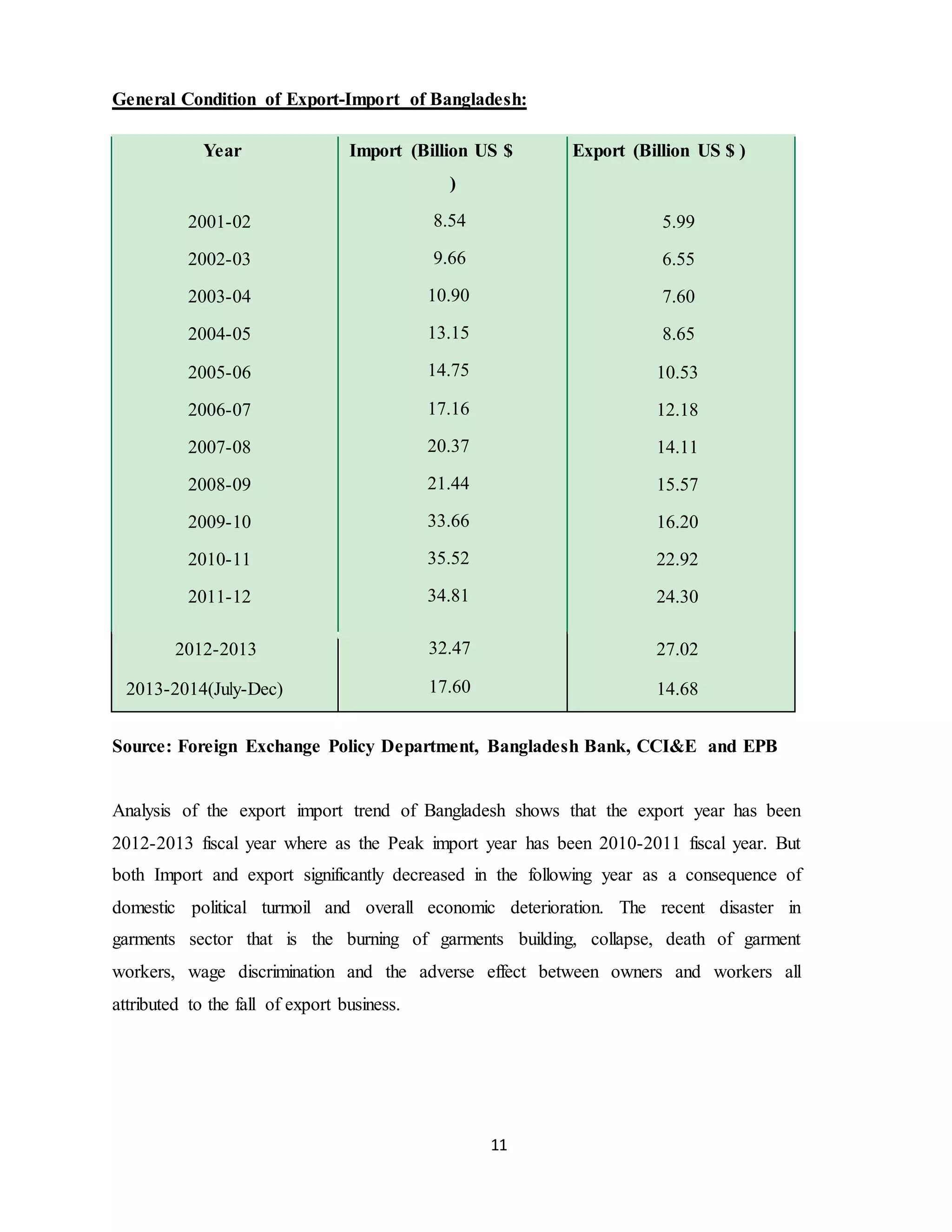
General Condition of Export-Import of Bangladesh:
Year
2001-02
2002-03
2003-04
2004-05
2005-06
2006-07
2007-08
2008-09
2009-10
2010-11
2011-12
Import (Billion US $
)
8.54
9.66
10.90
13.15
14.75
17.16
20.37
21.44
33.66
35.52
34.81
Export (Billion US $ )
5.99
6.55
7.60
8.65
10.53
12.18
14.11
15.57
16.20
22.92
24.30
2012-2013
2013-2014(July-Dec)
27.02
14.68
32.47
17.60
Source: Foreign Exchange Policy Department, Bangladesh Bank, CCI&E and EPB
Analysis of the export import trend of Bangladesh shows that the export year has been
2012-2013 fiscal year where as the Peak import year has been 2010-2011 fiscal year. But
both Import and export significantly decreased in the following year as a consequence of
domestic political turmoil and overall economic deterioration. The recent disaster in
garments sector that is the burning of garments building, collapse, death of garment
workers, wage discrimination and the adverse effect between owners and workers all
attributed to the fall of export business.
12
A Reviewof Trade Balance:
During the last decade, Bangladeshi exports shifted from the sale of agricultural products and
raw and processed natural resources to labor-intensive manufactured goods(including clothing,
footwear, and textiles), but the country, unlike neighboring India, could not catch up with the
exporters of skill-intensive products. The problem of balance of trade in Bangladesh is well
known: ever since the independence of the country, export earnings have persistently fallen
behind import payments. Consequently, every year the country incurs a huge trade deficit.
However, foreign trade is of vital importance to the economic development of Bangladesh. The
country’s import needs are large and the imperative to increase exports is immediate. In order to
finance those imports and also to reduce the country's dependence on foreign aid grants, the
government, since liberation, has been trying to enhance foreign exchange earnings through
planned and increased exports. The significance of foreign trade to the economy is manifest in a
number of facts and figures.
13
CHAPTER 3
EXPORT-IMPORT POLICY IN
BANGLADESH
14
Import Policy Order in Bangladesh
2009-2012
Short Title, Application, Duration:
1) This order is maybe called the Import policy order 2009-2015
2) Unless otherwise specified, this Order shall apply to all imports into
Bangladesh.
3) However, it will remain in force after the expiry of the validity until the new Import
Policy Order is issued.
Definition:
In this order, unless there is anything repugnant to the subject or context----
(1) Entre-port Trade‟ means such trade in case of which imported goods could be exported to a
third country after minimum value addition at 5% without changing quality, quantity or
shape and without allowing the said goods to be brought out side the port area but can
be carried, with the permission of the Ministry of Commerce, from one port to another port
for the purpose of exports.
(2) “Act” means, The Imports and Exports (Control) Act, 1950 (Act No. XXXIX of 1950)
(3) “Importer” means the „Importer‟ as defined in article 2(f) of Importers, Exporters and
Indenters (Registration) Order,1981
(4) “Import Control Authority” means the Chief Controller of Imports and Exports and
includes any other authorized officer to issue licenses, permits or registration certificates as
per the relevant provisions of Import and Exports (Control) Act, 1950 (XXXIX of 1950);
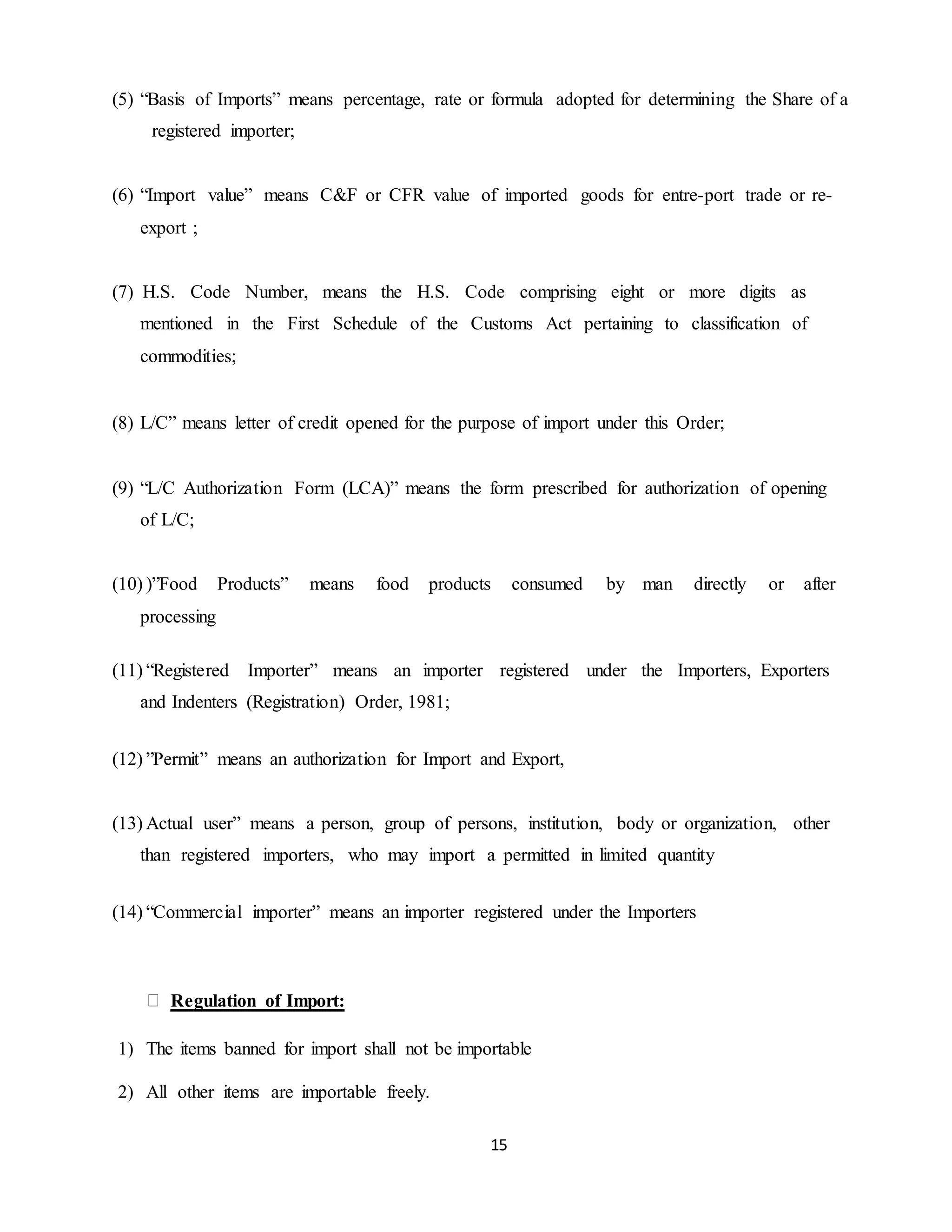
15
(5) “Basis of Imports” means percentage, rate or formula adopted for determining the Share of a
registered importer;
(6) “Import value” means C&F or CFR value of imported goods for entre-port trade or re-
export ;
(7) H.S. Code Number, means the H.S. Code comprising eight or more digits as
mentioned in the First Schedule of the Customs Act pertaining to classification of
commodities;
(8) L/C” means letter of credit opened for the purpose of import under this Order;
(9) “L/C Authorization Form (LCA)” means the form prescribed for authorization of opening
of L/C;
(10) )”Food Products” means food products consumed by man directly or after
processing
(11) “Registered Importer” means an importer registered under the Importers, Exporters
and Indenters (Registration) Order, 1981;
(12) ”Permit” means an authorization for Import and Export,
(13) Actual user” means a person, group of persons, institution, body or organization, other
than registered importers, who may import a permitted in limited quantity
(14) “Commercial importer” means an importer registered under the Importers
Regulation of Import:
1) The items banned for import shall not be importable
2) All other items are importable freely.
16
Conditions for regulating import:
1) In case any restriction is imposed on import of a particular commodity, Bangladesh
Tariff Commission shall strictly monitor production of that industrial unit regularly;
2) The industrial units shall have to move towards progressive manufacture
actively.
3) The price of finished product is excessively higher than the rise in the price of the
raw materials in the international market, the ban on the import may be withdraw on
the recommendation of the concerned Bangladesh Tariff Commission;
4) Goods from Israel shall not be importable
General Conditions of Import of goods:
1) H.S. Code number
2) No Objection Certificate on the basis of Right of Refusal 3)
pre-shipment inspection
4) Import at competitive rate
5) Import on C&F or CFR, CPT, FOB, CIF, CIP, DAF, DES, DEQ and DDU basis 6)
Import bymentioning “Country of Origin
7) Inscription of Name, Address and TIN of Importer-
Source of finance:
1) Cash
2) Cash foreign exchange
3) Foreign currency accounts
4) External economic aid
5) Commodity exchange: Barter and Special Trading Arrangement
Import procedure:
1) Import License not required
2) Import against LCA Form
17
3) Import through L/C
4) Import against LCA Form but without opening of Letter of Credit (L/C
5) Time limit for opening of L/C-
6) Validity of shipment for goods
7) Nominated Bank for Importing
Registration Certificate:
1) Registered commercial importers and industrial consumers have been
classified into six categories:
Category Value Ceiling of annual
import
Initial Registration
fees
Annual renewal
fees
First Tk. 1, 00,000.00 Tk. 1,800.00 Tk. 1,700.00
Second Tk. 5,00,000.00 Tk. 3,000.00 Tk. 2,300.00
Third Tk. 15,00,000.00 Tk. 4,800.00 Tk. 3,500.00
Fourth Tk. 50,00,000.00 Tk.9,500.00 Tk. 6,700.00
Fifth Tk. 1,00,00,000.00 Tk. 17,500.00 Tk. 11,000.00
Sixth Above Tk.1,00,00,000.00 Tk. 23,000.00 Tk. 17,000.00
2) An importer shall apply in writing
3) Import Control Authority shall make an approval under seal and signature
4) Importers whose already registered for renewal there registration certificate shall
submit two copies of application in writing.
5) Importer can pay renewal fee in cash
6) The banks shall deposit the money received as renewal fees to the Bangladesh Bank
7) No importer shall be allowed to open L/C in excess of the value maximum of annual
import applicable for him
Types of Import:
1) Import on Joint Basis
2) Import by Actual User
3) Import by Bangladeshi professional’s abroad
4) Import of Samples, Advertising Materials and Gifts
5) Import by Public Sector Importer
6) Import by Commercial Industries
18
7) Temporary importation
8) Export Processing Zone (EPZ)
9) import of food for human consumption
10) Import on date Basis
The following goods shall not be importable:
(1) Maps, charts and geographical globes which do not indicate the territory of
Bangladesh in accordance with the maps published by the Department of Survey,
Government of the People Republic of Bangladesh;
(2) Horror comics, obscene and subversive literature including such pamphlets, posters,
newspapers, periodicals, photographs, films, gramophone records and audio and video
cassette tapes etc;
(3) Books, newspapers, periodicals, documents and other papers, posters photographs,
films, gramophone records, audio and video cassettes, tapes etc. containing matters
likely to outrange the religious feelings and beliefs of any class of the citizens of
Bangladesh;
(4) Unless otherwise specified in this order, goods of secondary or sub-standard quality or
below –standard or old, used, reconditioned goods or factory rejects and goods of jobs
lot/stock-lot;
(5) Unless or otherwise specified in this order, all kinds of waste;
(6) Goods (including their containers) bearing any words or inscriptions of a religious
connotation the use or disposal of which may injure the religious feelings and beliefs of
any class of the citizens of Bangladesh;
(7) Goods) bearing any obscene picture
(8) Import of live viper and any item prepared from swine is banned.
19
Export Policy Order in Bangladesh 2009-
2012
Rules and Regulations to be followed for Export of Products:
1) Control of Export of Products:
Export Prohibited Products: Unless otherwise stated, products prohibited
under this Export Policy cannot be exported.
Products under Conditional Export: Products which are exportable
under some conditions can be exported only after fulfilling those
conditions.
2) Export of samples subject to fulfillment of the following conditions:
a) The product is not export illegal;
b) A maximum of US$ 5,000 worth of products (except medicine) based on FOB
Price (free on board) per exporter per year;
c) Products sent as samples free of cost; provided that in case of medicine the
maximum shall be
(1) US$ 30,000 if there is no export L/C (letter of credit), or
(2) 5% of the total value of the L/C or US$ 5000, whichever is less. Bangladesh
Bank can increase these limits examining each case, if necessary.
d) For 100% export-oriented garment industries, a maximum of US$ 7,500 worth
of samples of ready made garments per year;
e) Bond Commissioner or diamond producing/ diamond-studded jeweler processing
farms registered as producers with VAT Commissioner, under National Board of
Revenue can send abroad cut and polished diamond/diamond- studded jeweler
worth of US$ 50,000 annually
f) Promotional materials of any price or weight;
g) Gift parcel worth of US$ 1,000 or equivalent in Bangladeshi Taka;
Classification of Product and Service Sectors: Some products sectors will be
identified as “highest priority sectors” while some others will be identified
as “special development sectors” depending on the level of production
and supply, potential contribution to the export sector.
20
a) Highest Priority Sectors
Agro-products and agro-processed products;
2) Light engineering products (including auto-parts and bicycles);
3) Footwear and leather products;
4) Pharmaceutical products;
5) Software and ICT products;
6) Home textile;
7) The Sea-bound Ship Building Industries; and
8) Toiletries Products.
b) Special Development Sectors:
1) Crushed and finished leather production;
2) frozen fish production and processing;
3) handicrafts;
4) electric and electronic products;
5) fresh flower and foliage;
6) jute and jute products;
7) hand-woven textiles from hilly areas
8) uncut diamond;
9) producing herbal plants, medicine and medicinal products;
10) ceramic products and melamine;
11) plastic products
General Export Facility:
1) Export Promotion Fund
2) Financial Facilities
3) Funding for Export
4) Export Credit
5) Exception from
Insurance Premium
6) Incentives for Export of Non-traditional Industrial Products 7)
Bond Facilities for Export Oriented Industries:
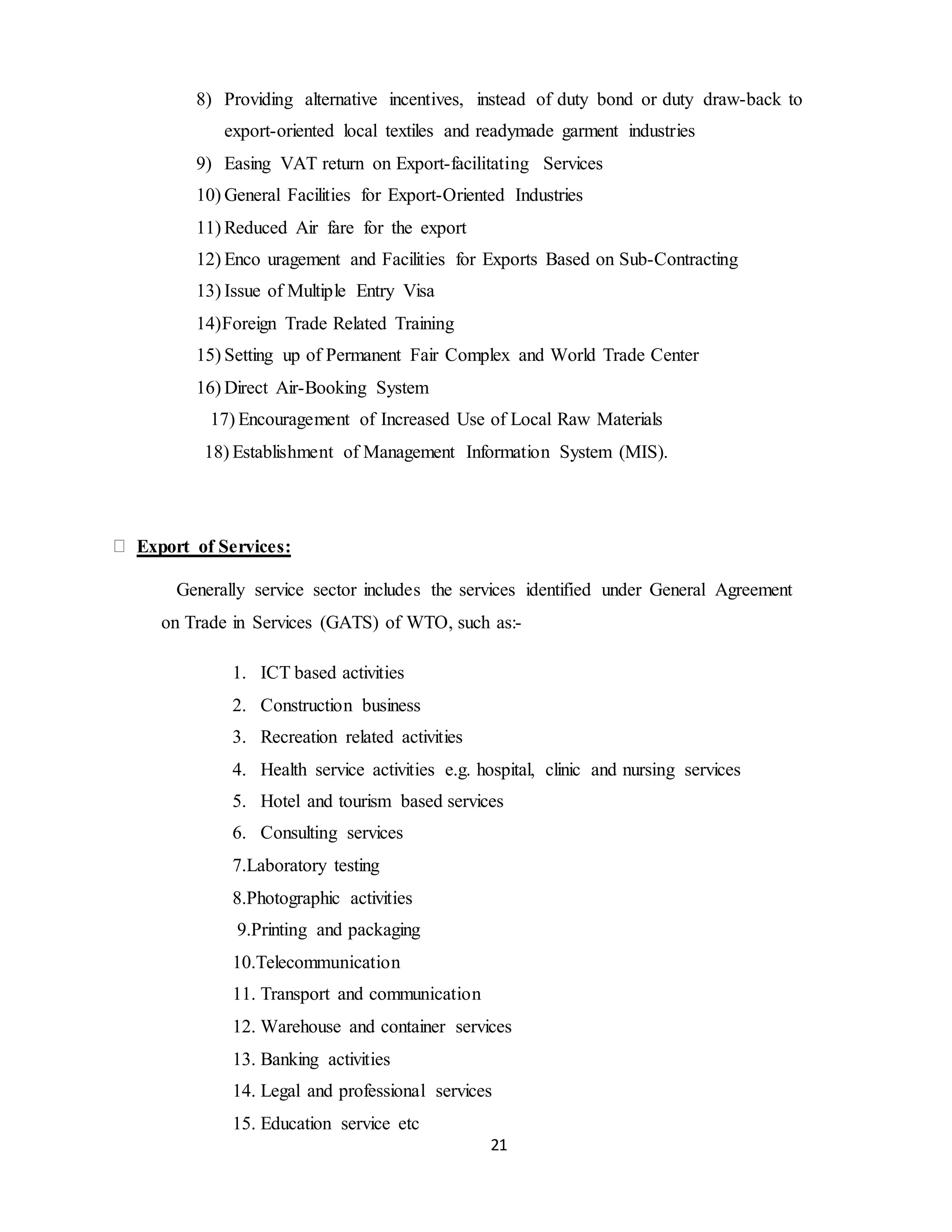
21
8) Providing alternative incentives, instead of duty bond or duty draw-back to
export-oriented local textiles and readymade garment industries
9) Easing VAT return on Export-facilitating Services
10) General Facilities for Export-Oriented Industries
11) Reduced Air fare for the export
12) Enco uragement and Facilities for Exports Based on Sub-Contracting
13) Issue of Multiple Entry Visa
14)Foreign Trade Related Training
15) Setting up of Permanent Fair Complex and World Trade Center
16) Direct Air-Booking System
17) Encouragement of Increased Use of Local Raw Materials
18) Establishment of Management Information System (MIS).
Export of Services:
Generally service sector includes the services identified under General Agreement
on Trade in Services (GATS) of WTO, such as:-
1. ICT based activities
2. Construction business
3. Recreation related activities
4. Health service activities e.g. hospital, clinic and nursing services
5. Hotel and tourism based services
6. Consulting services
7.Laboratory testing
8.Photographic activities
9.Printing and packaging
10.Telecommunication
11. Transport and communication
12. Warehouse and container services
13. Banking activities
14. Legal and professional services
15. Education service etc
22
Export Promotion Bureau will prepare a comprehensive plan of action in
coordination with the concerned departments/institutions and take necessary
steps for augmenting export in the service sector;
Export Promotion Bureau will take initiatives for maintaining export statistics of
service sector in parallel with that of goods;
Steps will be taken to enhance the capacity of Bangladesh Missions abroad to
promote export in the service sector;
A committee named “Service Export Development Coordination Committee”
headed by the Vice Chairman, Export Promotion Bureau and represented by the
concerned service sectors will be constituted to coordinate the activities of export
promotion in service sectors.
Different service sector specific Business Promotion Councils will be constituted.
List of Export-Prohibited Products:
Petroleum Product
Jute and `Shan‟ seeds
Wheat
Any kind of live animals
Fire arms, ammunition and related materials.
Radioactive materials
All shrimps except chilled
Cane, wood, wood logs
All types of frogs
Raw and wet blue leather.
Onion
23
CHAPTER 4
EXPORT-IMPORT IN BANGLADESH:
Institutional Framework
24
Institutional Framework:
Trade related policies, rules and regulations in Bangladesh are executed by different ministries
and departments of the government. Ministry of Commerce (MoC) and its a variety of
departments such as Chief Controller of Import and Export, WTO Cell, Tariff Commission,
Export Promotion Bureau play a key role in the implementation of trade related rules and
regulations. Ministry of Finance along with its various departments, such as NBR and Customs
also plays a significant role in dealing with trade issues.4 since a number of different
organizations under various ministries are directly involved in this process, inter-ministerial
coordination becomes critically important. Accordingly, this needs to be significantly
strengthened. Under the changing circumstances, it is important to rethink the roles played by
different departments particularly whether there is an opportunity to revisit the traditional roles
played by other ministries/departments.
The MoC involves the private sector in making decisions with regard to trade supportive
measures, providing intellectual feed back in case of formulation of policies and building
awareness on trade related issues etc. Trade bodies associated with different sectors, civil society
think tanks, private sector research organizations, academia and intellectuals also provide inputs
at various stages of formulation of the trade policy. No doubt, this collaboration between public
and private sectors does contribute to strengthening of policy formulation and promotes policy
ownership within the country. Despite the presence of an institutional setting and mechanism to
deal with trade-related issues, quality of decisions taken at the ministerial level tends to suffer,
and tends to have (unintended) adverse impact for the private sector. This happens because the
aforesaid exercise, whilst useful, tends to suffer from rigorous analytical treatment. Similarly,
different trade bodies are prone to suggest, promote and advocate a ‘narrow’ sect oral focus. In
an ideal situation such proposals ought to be examined from the perspective of a broader
framework which looks at trade policy in a comprehensive manner and from the perspective of
attaining key development goals. MoC should also strive to strengthen its role as a regulatory
and monitoring authority in order to ensure a competitive and fair environment in the market.
25
Trading Corporation of Bangladesh (TCB)
Trading Corporation of Bangladesh (TCB) in the backdrop of scarcities of essential consumer
items and industrial raw materials after the liberation of Bangladesh in 1971, the Trading
Corporation of Bangladesh (TCB) was established under President's Order No. 68 of 1972.
The main functions of the Corporation are:
To carry the business of imports and exports in accordance with the policy of the
Government.
To arrange for the sale and distribution of the imported goods and to appoint
dealers/agents etc. for this purpose as per Government directives.
To do all other acts and things connected with or ancillary thereto.
And monitoring of prices of essential commodities in the local market vis-a-vis prices
in the international market.
Tariff Commission
According to Bangladesh Tariff Commission Act 1992, the Commission may be required to
advise the government on the following matters:
a) Providing protection to industries within Bangladesh;
b) Encouraging competitiveness in industrial production;
c) Ensuring efficient use of industrial resources;
d) Promoting exports from Bangladesh;
e) Increasing efficient use of resources within and outside Bangladesh through bilateral and
multilateral negotiations.
f) Measures to counter dumping and other unfair measures adopted in respect of import and sale
of foreign goods in Bangladesh; and
26
g) Any other matter relating to protection or assistance to domestic industry or efficient use of
resources in such industry that the Government may refer to the Commission.
In addition to the functions above, the Commission may assist the government in preparing the
national budget and also advise the government on trade matters
Functions and Responsibilities of the BTC
For a smooth and speedy disposal of business, the Commission has been divided into three
wings:
(a) Trade Policy Wing,
(b) Trade Remedies Wing,
(c) International Cooperation Wing. Each Wing is headed by a Member.
Besides, there is also an Administrative section headed by the Secretary of the Commission to
conduct administrative business of the Commission.
Functions of Trade Policy Wing
The main function of the Trade Policy Wing is the protection and expansion of domestic
industries. To this end, BTC recommends appropriate tariff and import measures to the
government as and when asked for. The main goals of trade policy of Bangladesh are to
accelerate growth of exports, diversify export products, make imported inputs easily available at
reasonable prices and reduce the current account deficit to a sustainable level.
To firm up its recommendations, the Commission usually holds meetings with
thee related government agencies, business associations, experts and other
concernedinstitutionalrepresentatives. In the case of controversial issues, the Commission
sometimes holds public hearings before making recommendations to the government.
27
CHAPTER 5
THE FUTURE of EXPORT-IMPORT in
BANGLADESH:
28
1. ¼ of everything grown & made is now exported by Bangladesh like other countries of the
world. The rte may fluctuate in future days.
2. The participation of Bangladesh in International trade will increase/decrease.
3. Bangladesh will be in the next four Asian Tiger countries.
4. New product development will increase due to the technical assistance facilities.
E.g. like Walton other companies will take facilities.
5. Bangladesh is upcoming country whose service sector will be high & foreign remittance
will be high.
Budget 2013-14: GDP Growth Target 7.2%
The government has set a target of 7.2 percent gross domestic product (GDP) growth for fiscal
2013-14 in the backdrop of this year’s estimated growth of 6.03 percent, which was predicted 7.2
in his earlier Budget (FY 12-13).
Finance Minister AMA Muhith made the projection, while placing his budget proposal
Thursday, based on some underlying assumptions and expectations.
In his budget proposal he said, “Enhancing the rate of investment and raising it to at
least 30 percent of GDP from 24 percent. This calls for strategies like augmenting domestic
revenues, forging public-private partnership, increasing flow of external resources and scaling up
foreign investment.”
He hoped that growth will accelerate in agriculture, industry and service sectors propelled by the
positive momentum in the world economy in 2013 and afterwards.
He also predicted that the raising GDP growth rate to 8 percent by 2014 and 10 percent by 2017
He said, the redeeming feature is that towards the later part of 2012, world economy began to
show signs of steady recovery. The global growth performance has somewhat improved, thanks
to ongoing financial supports to debt-ridden EU countries, warding off fiscal cliff by the US
economy and adopting expansionary monetary programs by Japan. Given this perspective,
according to the latest outlook, the global growth is likely to be 3.3 and 4.0 percent in 2013 and
2014 respectively. The developing Asian economies may attain 7.1 and 7.3 percent growth
respectively in these two years.
29
“Despite the recessionary shocks, in keeping with developing and emerging Asian economies we
were able to sustain satisfactory economic growth by pursuing cautious and prudent
macroeconomic strategies. Over the past four years, average real GDP growth in Bangladesh was
6.2 percent. In FY 2011-12, our economy posted real GDP growth of 6.23 percent. Bangladesh
Bureau of Statistics has recently released the provisional estimate of GDP for FY 2012-13 which
is 6.03 percent.” He added
The minister also said that with the steady recovery of trade partner economies from the latter
part of 2012, the external demand picked up and our export posted 10.1 percent growth.
In tandem, remittance inflows grew by 16.0 percent.
Though growth of government consumption expenditure and investment remained satisfactory
during July-March period, private sector credit growth was 7.0 percent during this period against
13.6 percent growth over the corresponding period of the last fiscal.
The provisional estimate is based on 8 months’ actual production statistics which exclude data on
Boro, potato and maize harvest.“We assume production of these crops to be impressive this year
leading me to believe that inclusion of all these data would definitely push up GDP growth
number to at least last year’s level,” he added.
“Another important point that you may like to note is that this year the private investment may
slightly slide down. However, the public investment as percentage of GDP is going to rise to
7.85 percent from 6.5 percent. This will certainly make positive contribution to overall growth
rate,” said the minister.
30
CHAPTER 6
CONCLUSION & POLICY GUIDELINES
31
Conclusion:
From the conversation we can effortlessly pronounce that, International Trade is measured an
awfully significant fraction all above the world. It is well thought-out as a vital resource of
returns and also for employment. Furthermore replace the goods and services from one country
to another country. It is based on the free exchange of goods started as early as 2500 BC. We talk
about WTO, which is largely worked for the progress of World Trade. WTO is successor of the
GATT (General Agreement on Tariffs and Trade). Bangladesh has been a WTO member since
1 January 1995.Infact Bangladesh is the founder member of WTO. The volume of world trade in
2004 was about three times what it was in 1990 and approached eleven trillion U.S. dollars. In
addition, many developing countries have shifted their emphasis from demanding tariff cuts by
wealthy countries for their exports to requesting technical assistance to increase production and
exports. There has been a marked increase in the establishment of common market and free trade
area such North American Free Trade Agreement (NAFTA) and European Union (EU). The
performance of Bangladesh’s export and import sector in recent years is quite inspiring
particularly in the 1990s when we compare it with that of world and SAARC countries. The
proportion of Import in Bangladesh is 17.60% and the percentage of Export in Bangladesh is
14.68%. However, foreign trade is of vital importance to the economic development of
Bangladesh. Further, we discuss about the various policies and laws of Export and Import
business. It’s really necessary to follow them perfectly with a respect. Subsequently, we also
discuss about the Institutional Framework of Export and Import in Bangladesh. The main focus
point is Trading Corporation of Bangladesh (TCB). Moreover, we talked about the role and
future of export and import in Bangladesh briefly.
32
Guidelines:
1. The country’s import requirements are large and the imperative to increase exports is
immediate.
2.The significance of foreign trade to the economy is visible in a number of facts and
figures. So necessitate more government concern.
3. Export of Bangladesh is decreasing then the previous years. So have to know the reason
why it is decreased and work out the difficulty
4. The crisis of stability of trade in Bangladesh is well known: ever since the
independence of the country, export earnings have persistently fallen behind import
payments. Consequently, every year the country incurs a huge trade deficit. So, require
to find out the dilemma. Government and concentration of export and import business
man can simply resolve the problem.
5. Bangladesh performs export and Import business with a number of little number of
countries from side to side a little number of commodities, Need to raise the number of
export and import business area and products also.
6. The price of finished product is excessively higher than the rise in the price of the
raw materials in the international market. Extremely higher price product is applicable
for the county which has high income of people or for market skimming. So need to
discover a number of alternatives.
7. The product of both export and import must check very carefully before importing and
exporting. No illegal product is acceptable.
8. Try to increase the number of the export product. Because, export is highly related with
the income of a country.
9.Need to provide protection to industries within Bangladesh. Besides, encouraging our
business man to do the business, produce product and materials. So that they can also
play the role of Supply Agent.
10. Promotion of the product and services internationally.
11. Carry the business of imports and exports in accordance with the policy and law of
the Government
33
Policy guidelines for economic development of Bangladesh:
1. We know, Export industry is positively related with the income in particular industry. But
it is mismatch in Bangladesh. The salary of the garments people re not
sufficiently increase. So try to sort out these problems.
2. Improvement of general quality of institutional framework.
3. If government determines the trade &foreign exchange policies, then do it in n effective
way.
4. Foreign resources can be made available by using the international trade to
mitigate backward integration of RMG sector in Bangladesh.
5. As, International Trade involves less amount of resources, we should create scope (FDI)
for different country’s companies.
6. By using IT we can test our country market s it ir the most inexpensive way.
7. As the growth rate of service sector is high than merchandise, Bangladesh is focusing
on service sector.
8. Dr. Paul Samuelson predicted that in 2055 the growth rate of service &merchandise will be
same. So Bangladesh should focus on service & merchandise tactically.
9. Bangladesh should focus on the protection of trade related property rights.
10. To increase the export rte Bangladesh should motivate developed countries to provide
technical assistance facilities.
11. Bangladesh govt. should give priority to systematic approach rather reactive approaches.
Some foreign companies use reactive approach.
12. Companies of Bangladesh should conduct market research to evaluate, identify &
compare the size &potentiality of various markets & select the most desirable markets for
given product/service.
13. Improving the efficiencies of the foreign exchange supporting banks.
14. Analyzing the population, GDP, per capita income, distribution of wealth before
exporting.
15. Determining the needs of products &services and other factors before importing.
16. Ensuring the availability of credit & financing.
17. Trying to maintain stability of exchange rte.
34
18. Balancing between supply & demand of currency.
19. Trying to retrieve the lost effective export products like jute
20. Always reassessing the market changes that may require change in export-import strategy.
35
References:
1. http://www.bdembassyusa.org/uploads/Bangladesh%20Export%20Policy%20(2009-
2012).pdf
2. http://www.bdembassyusa.org/uploads/Bangladesh%20Import%20Policy%20(2009-
2012).pdf
3. A brief history of World trade’: Export-Import Theory, Practices and Procedure, Bela
Seyoum, Second edition
4. http://en.w ikipedia.org/wiki/Economy_of_Bangladesh
5. www.mincom.gov.bd/
6. www.bb.org.bd
7. www.scribd.com/
8. www.epb.gov.bd
9. www.ccie.gov.bd .
10. www.economywatch.com
11. www.wto.org ›
12. http://www.indexmundi.com/bangladesh/economy_profile.html
13. http://www.tradingeconomics.com/bangladesh/gdp-growth
14.http://tazakhobor.com/national/4591-budget-2013-14-gdp-growth-target-72
5

The Export-Import Policy of Bangladesh made by shahed shams shetu

  • 1.
    BGMEA University ofFashion and Technology Assignment On The Export-Import Policy of Bangladesh SUBMITTED TO Md. Habibur Rahman Lecturer of BUFT SUBMITTED BY Shahed Shams Shetu 141-068-0-145 (Running Batch 142 AMT-3) Date of Submission: 12th June 2017
  • 2.
    ii Letter of Transmittal 12June, 2017 To Md. Habibur Rahman Lecturer BGMEA University of Fashion and Technology Dear Sir, I take great pride in submitting this report on “The Export-Import Policy of Bangladesh”.You asked me to prepare this report in the. The study describes comprehensive ins and outs of the Export-Import Policy of Bangladesh and a competitive analysis with its major competitors.As you will go through the report, you will find my effort. Following the procedure, I tried my level best to make the report resourceful and informative. I left no stone unturned to bring out the highest result about study. I am confident that this study will provide fruitful findings. As a student of BGMEA University of Fashion and Technology, I am highly appreciated having this type of assignment because it helps me to know the details about theExport-Import Policy of Bangladesh. Sincerely Yours, Shahed Shams Shetu 141-068-0-145 (runing batch 142 amt 3 )
  • 3.
    iii Acknowledgement At the verybeginning I would like to express my deepest gratitude to the Almighty Allah for giving me the strength and the composure to finish the report within the scheduled time. I would like to pay my gratitude to my honorable course teacher Md. Habibur Rahman Lecturer of BGMEA University of Fashion and Technology,Dhaka who has assigned me this task and instructed me in the right way and given me proper guidelines for preparing this report. This report is not free from limitation. There might still be some minor mistakes including typing errors despite utmost care, I apologize for these. Best Regards, Shahed Shams Shetu BGMEA University of Fashion and Technology 141-068-0-145 (runing batch 142 amt 3 ) Date: 12/06/2017
  • 4.
    iv Table of Contents Letterof Transmittal .........................................................................................................iii Acknowledgement ...........................................................................................................iiii Chapter 1......................................................................Error! Bookmark not defined.-6 Chapter 2.................................................................... 7-Error! Bookmark not defined.2 Chapter 3..................................................................Error! Bookmark not defined.3-22 Chapter 4....................................................................................................................23-26 Chapter 5....................................................................................................................27-29 Chapter 6....................................................................................................................30-34 Reference.........................................................................................................................35
  • 5.
  • 6.
    2 International trade isthe exchange of goods and services across national boundaries. It is the most traditional form of international business activity and has played a major role in shaping world history and has also been shaped by world history A brief History of International Trade: International Trade Based on the free exchange of goods started as early as 2500 BC. Archeological discoveries indicate that the Sumerians of Northern Mesopotamian enjoyed great prosperity based on trade on sea in textiles and metals. The Greek profited by exchange of olive oil and wine for grain and metal somewhere before 2000 BC. With the decline of Greece, Rome became powerful and began to expand to the East. In the first century the Romans traded through the Silk Road and developed many trade routes and complex trading patterns by sea. By the time of breaking up off Roman Empire in fifth century the papacy had emerged as a strong institution in a new and unstable world. New products such as carpets, furniture, sugar, and spices brought from Egypt, Syria, India and China stimulated the market and the growing commercial life of the West. Letters of credits, bill of exchange, and insurance of goods in transit were extensively used to accommodate the growing commercial and financial needs of merchants and travelers. By the end of fifteenth century, the center of international commerce had moved from the Mediterranean to Western Europe. The more developed areas of Europe were changing from a subsistence economy to one relying heavily on imports paid by money or ;letter of credit. With the discovery of America in 1492 and sea routes to India in 1498,trade flourished and luxury goods and food products such as sugar, tobacco and coffee became available in the markets of Europe. The second historical phase of overseas expansion happened during 1765-1900.By 1800 the industrial revolution had transformed the social and economic structure of England .The major characteristics of economic relation from 1900 until the outbreak of world war 1 were further development of trade and emergence of world economy. These were also the result of integration of people and capital. The post world war recovery was delayed by the disruption of trading links and border problems. There were problems of high tariff I certain countries and embargo on certain products.
  • 7.
    3 So to remedythe situation, in 1944 International monetary Fund (IMF) and World Bank was established .This was followed by The General agreement on Tariffs and Trade, or the GATT in 1948 to permit free flow of goods among nation. WTO and The development in World trade: The WTO (World Trade Organization) has been established in 1995 as the successor of the GATT (General Agreement on Tariffs and Trade). Currently the organization has 153 members. The WTO is an international organization that governs and maintains rules and regulations for conducting trade among different countries. WTO rules are the basis for conducting businesses among countries. The main functions of the WTO are – (i) administer WTO agreements, (ii) act as a negotiating forum, (iii) handle trade disputes, (iv) monitor national trade policies, (v) provide technical assistance and trainings, (vi) Cooperate with international organizations. The WTO is a rule-based organization. In order to make the multi-lateral trading system (MTS) rule-based, the WTO has three main agreements for three broad areas/disciplines of trade, which are – (i) GATT – 1994 (General Agreement on Tariffs and Trade) – for trade in goods (ii) GATS (General Agreement on Trade in Services) – for trade in service (iii) TRIPS (Agreement on Trade-Related Aspects of Intellectual Property Rights – for applying intellectual property rights In addition to these three main agreements, there are many other area/issue specific agreements for trade in goods, such as Agreement on Agriculture, SPS, TBT, etc. The basic principles of the WTO are – (i) MFN (most favored nation) treatment equal treatment to all members in all respect,
  • 8.
    4 (ii) National treatment,equal or similar treatment to domestic and imported products (iii) Ensures predictability through practicing transparency in all stages of activities. After establishment of the WTO, the first round of negotiations has been started in 2001 during the Ministerial Conference held in Doha. This round of negotiations is known as Doha Round negotiations. It is also called Development Round as its main focus is on development oriented issues. Though it was originally scheduled to conclude the Round by 01 January 2005, several deadlines have been missed. Though negotiations are at the final stage, few issues are yet to be resolved.Bangladesh is founder member of the WTO and has been actively participating in all the activities of the WTO, including negotiations. As an LDC (Least-developed country), Bangladesh is entitled to enjoy various kinds of special & differential treatment (S&DT) under the WTO system. Developments in Word Trade: The volume of world trade in 2004 was about three times what it was in 1990 and approached eleven trillion U.S. dollars. The dollar value of total world trade in 2004 was greater than gross national product of every nation in the world except the United States. However recent data showed a slowing down in volume of world merchandise exports (shown in the figure given below). However, due to the emergence of world trade the following significant development occurred in international trade. From GATT to WTO: The establishment of the world trade organization (WTO – replacing the GATT under The Final Act of Uruguay Round in 1994) as a permanent trade organization and the principal agency of the United Nations (UN) with responsibility for international trade. The Final Act signed by 124 governments primarily focused on global reduction in trade barriers, establishment of multilateral framework of discipline for trade in services, and protection of trade-related property rights. After the implementation of the Uruguay Round, WTO members launched a subsequent round in Doha Qatar, in 2001 to further reduce trade barriers and to promote equitable rules for developing nations and to discourage the agricultural subsidies by them.
  • 9.
    5 The Emergence ofDeveloping Nations, Opening up of New Markets and the Ascent of China: There has been a steady growth in the role of developing countries in world trade. A number of Newly Industrialized Countries (NICs), particularly Hong Kong, Singapore, South Korea, and Taiwan have increased their roles in world trade. New markets, such as China and Eastern Europe are now open for trade and investment. China joined the WTO in 2001 and now is the world’s third largest exporter/importer of goods and services. Shifting Emphasis of Developing Nations: Many developing countries have shifted their emphasis from demanding tariff cuts by wealthy countries for their exports to requesting technical assistance to increase production and exports. Economic Integration: There has been a marked increase in the establishment of common market and free trade area such North American Free Trade Agreement (NAFTA) and European Union (EU). The main reason behind this tendency is further increasing economic linkages among nations through trade, investment, and the operations of multinational companies. Increasing Dominance of Small and Medium Scale Firms: Export trade is no longer limited to the big multinational firms. Small and medium sized businesses are increasing their share of exports. These firms have the advantage of developing much more flexible structures than the big multinational enterprises. Service Economy and the Growing Share of Trade in Service: The developed countries of the world have already become service economies and the developing countries are also in the process of becoming service economy. Some developing nations such as Egypt, India, and Pakistan have a surplus in their service account, largely resulting from tourism and workers’ remittances. Globalization, Competitive Pressures and the Relocation of Value-Added Services: Globalization is spurred by the advances in communications & technology and
  • 10.
    6 governments’ policies toreduce obstacles to the flow of trade and capital flows. A number of Western companies have started outsourcing to overseas firms. Imminent Pressures: Transportation cost is rising all the time due to the ever increasing fuel prices. Faster economic growth in emerging economies is also putting pressures on the limited supply of raw materials and other natural resources. Businesses are still making adjustments to security costs after 9/11. Bangladesh World Trade: Bangladesh has been a WTO member since 1 January 1995.Infact Bangladesh is the founder member of WTO. The geographic location and competitive advantage in producing export quality local goods, low cost etc have made Bangladesh potential country in the field of world trade, though Bangladesh is listed amongst the Least Development Countries(LDC),The performance of Bangladesh in World trade is relatively good. Bangladesh’s contribution in World trade is relatively good. Bangladesh’s contribution in WTO in 2013 is 0.115%.
  • 11.
    7 CHAPTER 2 CURRENT STATUSOF EXPORT-IMPORT IN BANGLADESH
  • 12.
    8 Current Status ofExport-Import in Bangladesh: Bangladeshi international trade is extremely small relative to the size of its population, although it experienced accelerated growth during the last decade. It is not very diversified and depends on the fluctuations of the international market. The Bangladeshi government struggles to attract export-oriented industries, removing red tape and introducing various financial and tax initiatives. Between 1990 and 1995 Bangladesh doubled its exports from US$1.671 billion in 1990 to US$3.173 billion in 1995 and then almost doubled them again from US$3.173 billion in 1995 to US$5.523 billion in1999.During the 1990s, the United States has been the largest trading partner for Bangladesh, with its exports to the United States reaching 35.7 percent in 1998-99. This percentage consisted mainly of Ready-Made Garments (RMG). Germany is the second- largest export market, with the proportion of goods reaching 10.4 percent; and the United Kingdom is in third place at 8.3 percent. Comparative Performance of Bangladesh’s Exports: The performance of Bangladesh’s export sector in recent years is quite impressive especially in the 1990s when we compare it with that of world and SAARC countries. The average annual growth rate of Bangladesh export (11.91%) is higher than those of the world (9.48%) and SAARC countries (10.69%) during 1990-2003. Because of the lower export performance in the 1980s, annual average growth rate of this sector during1980-2003 is not as impressive compared to other Asian countries and the world, though this sector shows competitiveness compared to other SAARC countries (IMF various years). Over the period of 1980-2003 Bangladesh’s exports as a percentage of the world’s exports remain around 0.11% to 0.12% with the exception of 1984, when it was0.14%, and 1990-1994, when the ratio was around 0.09%. Bangladesh’s exports as a percentage of SAARC countries’ exports show slightly increased trend especially in 2000and 2001.For these two years Bangladesh’s exports are 11% and 12% of the SAARC countries ‘exports respectively. Bangladesh’s share of SAARC country’s’ exports was the lowest, 7.72%, in 1983. Bangladesh’s exports share in the Asian
  • 13.
    9 developing countries, however,shows a decreasing trend in the 1990s compared to the1980s though the ratio is slightly higher in 1998 and 1999 compared to immediate earlier years. The ratio dropped to0.59% in 2003 from 1.46% in 1980 though it was 0.75% in 2001 (IMF various years) Bangladesh Exports: Commodities Here are the major export commodities of Bangladesh: Garments Frozen fish and seafood Jute and jute goods Leather Bangladesh Trade: Export Partners The following were Bangladesh’s export partners as of 2008: United States: 24% Germany: 15.3% UnitedKingdom: 10% France: 7.4% The Netherlands: 5.5% Italy: 4.5% Spain: 4.2%
  • 14.
    10 Bangladesh Imports: Commodities Hereare the major import commodities of Bangladesh: Machinery and equipment Chemicals Iron and steel Textiles Foodstuffs Petroleum products Cement Bangladesh Imports: Partners The following were Bangladesh’s import partners as of 2008: China: 15.8% India: 15.7% Kuwait: 8.1% Singapore: 7.6
  • 15.
    11 General Condition ofExport-Import of Bangladesh: Year 2001-02 2002-03 2003-04 2004-05 2005-06 2006-07 2007-08 2008-09 2009-10 2010-11 2011-12 Import (Billion US $ ) 8.54 9.66 10.90 13.15 14.75 17.16 20.37 21.44 33.66 35.52 34.81 Export (Billion US $ ) 5.99 6.55 7.60 8.65 10.53 12.18 14.11 15.57 16.20 22.92 24.30 2012-2013 2013-2014(July-Dec) 27.02 14.68 32.47 17.60 Source: Foreign Exchange Policy Department, Bangladesh Bank, CCI&E and EPB Analysis of the export import trend of Bangladesh shows that the export year has been 2012-2013 fiscal year where as the Peak import year has been 2010-2011 fiscal year. But both Import and export significantly decreased in the following year as a consequence of domestic political turmoil and overall economic deterioration. The recent disaster in garments sector that is the burning of garments building, collapse, death of garment workers, wage discrimination and the adverse effect between owners and workers all attributed to the fall of export business.
  • 16.
    12 A Reviewof TradeBalance: During the last decade, Bangladeshi exports shifted from the sale of agricultural products and raw and processed natural resources to labor-intensive manufactured goods(including clothing, footwear, and textiles), but the country, unlike neighboring India, could not catch up with the exporters of skill-intensive products. The problem of balance of trade in Bangladesh is well known: ever since the independence of the country, export earnings have persistently fallen behind import payments. Consequently, every year the country incurs a huge trade deficit. However, foreign trade is of vital importance to the economic development of Bangladesh. The country’s import needs are large and the imperative to increase exports is immediate. In order to finance those imports and also to reduce the country's dependence on foreign aid grants, the government, since liberation, has been trying to enhance foreign exchange earnings through planned and increased exports. The significance of foreign trade to the economy is manifest in a number of facts and figures.
  • 17.
  • 18.
    14 Import Policy Orderin Bangladesh 2009-2012 Short Title, Application, Duration: 1) This order is maybe called the Import policy order 2009-2015 2) Unless otherwise specified, this Order shall apply to all imports into Bangladesh. 3) However, it will remain in force after the expiry of the validity until the new Import Policy Order is issued. Definition: In this order, unless there is anything repugnant to the subject or context---- (1) Entre-port Trade‟ means such trade in case of which imported goods could be exported to a third country after minimum value addition at 5% without changing quality, quantity or shape and without allowing the said goods to be brought out side the port area but can be carried, with the permission of the Ministry of Commerce, from one port to another port for the purpose of exports. (2) “Act” means, The Imports and Exports (Control) Act, 1950 (Act No. XXXIX of 1950) (3) “Importer” means the „Importer‟ as defined in article 2(f) of Importers, Exporters and Indenters (Registration) Order,1981 (4) “Import Control Authority” means the Chief Controller of Imports and Exports and includes any other authorized officer to issue licenses, permits or registration certificates as per the relevant provisions of Import and Exports (Control) Act, 1950 (XXXIX of 1950);
  • 19.
    15 (5) “Basis ofImports” means percentage, rate or formula adopted for determining the Share of a registered importer; (6) “Import value” means C&F or CFR value of imported goods for entre-port trade or re- export ; (7) H.S. Code Number, means the H.S. Code comprising eight or more digits as mentioned in the First Schedule of the Customs Act pertaining to classification of commodities; (8) L/C” means letter of credit opened for the purpose of import under this Order; (9) “L/C Authorization Form (LCA)” means the form prescribed for authorization of opening of L/C; (10) )”Food Products” means food products consumed by man directly or after processing (11) “Registered Importer” means an importer registered under the Importers, Exporters and Indenters (Registration) Order, 1981; (12) ”Permit” means an authorization for Import and Export, (13) Actual user” means a person, group of persons, institution, body or organization, other than registered importers, who may import a permitted in limited quantity (14) “Commercial importer” means an importer registered under the Importers Regulation of Import: 1) The items banned for import shall not be importable 2) All other items are importable freely.
  • 20.
    16 Conditions for regulatingimport: 1) In case any restriction is imposed on import of a particular commodity, Bangladesh Tariff Commission shall strictly monitor production of that industrial unit regularly; 2) The industrial units shall have to move towards progressive manufacture actively. 3) The price of finished product is excessively higher than the rise in the price of the raw materials in the international market, the ban on the import may be withdraw on the recommendation of the concerned Bangladesh Tariff Commission; 4) Goods from Israel shall not be importable General Conditions of Import of goods: 1) H.S. Code number 2) No Objection Certificate on the basis of Right of Refusal 3) pre-shipment inspection 4) Import at competitive rate 5) Import on C&F or CFR, CPT, FOB, CIF, CIP, DAF, DES, DEQ and DDU basis 6) Import bymentioning “Country of Origin 7) Inscription of Name, Address and TIN of Importer- Source of finance: 1) Cash 2) Cash foreign exchange 3) Foreign currency accounts 4) External economic aid 5) Commodity exchange: Barter and Special Trading Arrangement Import procedure: 1) Import License not required 2) Import against LCA Form
  • 21.
    17 3) Import throughL/C 4) Import against LCA Form but without opening of Letter of Credit (L/C 5) Time limit for opening of L/C- 6) Validity of shipment for goods 7) Nominated Bank for Importing Registration Certificate: 1) Registered commercial importers and industrial consumers have been classified into six categories: Category Value Ceiling of annual import Initial Registration fees Annual renewal fees First Tk. 1, 00,000.00 Tk. 1,800.00 Tk. 1,700.00 Second Tk. 5,00,000.00 Tk. 3,000.00 Tk. 2,300.00 Third Tk. 15,00,000.00 Tk. 4,800.00 Tk. 3,500.00 Fourth Tk. 50,00,000.00 Tk.9,500.00 Tk. 6,700.00 Fifth Tk. 1,00,00,000.00 Tk. 17,500.00 Tk. 11,000.00 Sixth Above Tk.1,00,00,000.00 Tk. 23,000.00 Tk. 17,000.00 2) An importer shall apply in writing 3) Import Control Authority shall make an approval under seal and signature 4) Importers whose already registered for renewal there registration certificate shall submit two copies of application in writing. 5) Importer can pay renewal fee in cash 6) The banks shall deposit the money received as renewal fees to the Bangladesh Bank 7) No importer shall be allowed to open L/C in excess of the value maximum of annual import applicable for him Types of Import: 1) Import on Joint Basis 2) Import by Actual User 3) Import by Bangladeshi professional’s abroad 4) Import of Samples, Advertising Materials and Gifts 5) Import by Public Sector Importer 6) Import by Commercial Industries
  • 22.
    18 7) Temporary importation 8)Export Processing Zone (EPZ) 9) import of food for human consumption 10) Import on date Basis The following goods shall not be importable: (1) Maps, charts and geographical globes which do not indicate the territory of Bangladesh in accordance with the maps published by the Department of Survey, Government of the People Republic of Bangladesh; (2) Horror comics, obscene and subversive literature including such pamphlets, posters, newspapers, periodicals, photographs, films, gramophone records and audio and video cassette tapes etc; (3) Books, newspapers, periodicals, documents and other papers, posters photographs, films, gramophone records, audio and video cassettes, tapes etc. containing matters likely to outrange the religious feelings and beliefs of any class of the citizens of Bangladesh; (4) Unless otherwise specified in this order, goods of secondary or sub-standard quality or below –standard or old, used, reconditioned goods or factory rejects and goods of jobs lot/stock-lot; (5) Unless or otherwise specified in this order, all kinds of waste; (6) Goods (including their containers) bearing any words or inscriptions of a religious connotation the use or disposal of which may injure the religious feelings and beliefs of any class of the citizens of Bangladesh; (7) Goods) bearing any obscene picture (8) Import of live viper and any item prepared from swine is banned.
  • 23.
    19 Export Policy Orderin Bangladesh 2009- 2012 Rules and Regulations to be followed for Export of Products: 1) Control of Export of Products: Export Prohibited Products: Unless otherwise stated, products prohibited under this Export Policy cannot be exported. Products under Conditional Export: Products which are exportable under some conditions can be exported only after fulfilling those conditions. 2) Export of samples subject to fulfillment of the following conditions: a) The product is not export illegal; b) A maximum of US$ 5,000 worth of products (except medicine) based on FOB Price (free on board) per exporter per year; c) Products sent as samples free of cost; provided that in case of medicine the maximum shall be (1) US$ 30,000 if there is no export L/C (letter of credit), or (2) 5% of the total value of the L/C or US$ 5000, whichever is less. Bangladesh Bank can increase these limits examining each case, if necessary. d) For 100% export-oriented garment industries, a maximum of US$ 7,500 worth of samples of ready made garments per year; e) Bond Commissioner or diamond producing/ diamond-studded jeweler processing farms registered as producers with VAT Commissioner, under National Board of Revenue can send abroad cut and polished diamond/diamond- studded jeweler worth of US$ 50,000 annually f) Promotional materials of any price or weight; g) Gift parcel worth of US$ 1,000 or equivalent in Bangladeshi Taka; Classification of Product and Service Sectors: Some products sectors will be identified as “highest priority sectors” while some others will be identified as “special development sectors” depending on the level of production and supply, potential contribution to the export sector.
  • 24.
    20 a) Highest PrioritySectors Agro-products and agro-processed products; 2) Light engineering products (including auto-parts and bicycles); 3) Footwear and leather products; 4) Pharmaceutical products; 5) Software and ICT products; 6) Home textile; 7) The Sea-bound Ship Building Industries; and 8) Toiletries Products. b) Special Development Sectors: 1) Crushed and finished leather production; 2) frozen fish production and processing; 3) handicrafts; 4) electric and electronic products; 5) fresh flower and foliage; 6) jute and jute products; 7) hand-woven textiles from hilly areas 8) uncut diamond; 9) producing herbal plants, medicine and medicinal products; 10) ceramic products and melamine; 11) plastic products General Export Facility: 1) Export Promotion Fund 2) Financial Facilities 3) Funding for Export 4) Export Credit 5) Exception from Insurance Premium 6) Incentives for Export of Non-traditional Industrial Products 7) Bond Facilities for Export Oriented Industries:
  • 25.
    21 8) Providing alternativeincentives, instead of duty bond or duty draw-back to export-oriented local textiles and readymade garment industries 9) Easing VAT return on Export-facilitating Services 10) General Facilities for Export-Oriented Industries 11) Reduced Air fare for the export 12) Enco uragement and Facilities for Exports Based on Sub-Contracting 13) Issue of Multiple Entry Visa 14)Foreign Trade Related Training 15) Setting up of Permanent Fair Complex and World Trade Center 16) Direct Air-Booking System 17) Encouragement of Increased Use of Local Raw Materials 18) Establishment of Management Information System (MIS). Export of Services: Generally service sector includes the services identified under General Agreement on Trade in Services (GATS) of WTO, such as:- 1. ICT based activities 2. Construction business 3. Recreation related activities 4. Health service activities e.g. hospital, clinic and nursing services 5. Hotel and tourism based services 6. Consulting services 7.Laboratory testing 8.Photographic activities 9.Printing and packaging 10.Telecommunication 11. Transport and communication 12. Warehouse and container services 13. Banking activities 14. Legal and professional services 15. Education service etc
  • 26.
    22 Export Promotion Bureauwill prepare a comprehensive plan of action in coordination with the concerned departments/institutions and take necessary steps for augmenting export in the service sector; Export Promotion Bureau will take initiatives for maintaining export statistics of service sector in parallel with that of goods; Steps will be taken to enhance the capacity of Bangladesh Missions abroad to promote export in the service sector; A committee named “Service Export Development Coordination Committee” headed by the Vice Chairman, Export Promotion Bureau and represented by the concerned service sectors will be constituted to coordinate the activities of export promotion in service sectors. Different service sector specific Business Promotion Councils will be constituted. List of Export-Prohibited Products: Petroleum Product Jute and `Shan‟ seeds Wheat Any kind of live animals Fire arms, ammunition and related materials. Radioactive materials All shrimps except chilled Cane, wood, wood logs All types of frogs Raw and wet blue leather. Onion
  • 27.
    23 CHAPTER 4 EXPORT-IMPORT INBANGLADESH: Institutional Framework
  • 28.
    24 Institutional Framework: Trade relatedpolicies, rules and regulations in Bangladesh are executed by different ministries and departments of the government. Ministry of Commerce (MoC) and its a variety of departments such as Chief Controller of Import and Export, WTO Cell, Tariff Commission, Export Promotion Bureau play a key role in the implementation of trade related rules and regulations. Ministry of Finance along with its various departments, such as NBR and Customs also plays a significant role in dealing with trade issues.4 since a number of different organizations under various ministries are directly involved in this process, inter-ministerial coordination becomes critically important. Accordingly, this needs to be significantly strengthened. Under the changing circumstances, it is important to rethink the roles played by different departments particularly whether there is an opportunity to revisit the traditional roles played by other ministries/departments. The MoC involves the private sector in making decisions with regard to trade supportive measures, providing intellectual feed back in case of formulation of policies and building awareness on trade related issues etc. Trade bodies associated with different sectors, civil society think tanks, private sector research organizations, academia and intellectuals also provide inputs at various stages of formulation of the trade policy. No doubt, this collaboration between public and private sectors does contribute to strengthening of policy formulation and promotes policy ownership within the country. Despite the presence of an institutional setting and mechanism to deal with trade-related issues, quality of decisions taken at the ministerial level tends to suffer, and tends to have (unintended) adverse impact for the private sector. This happens because the aforesaid exercise, whilst useful, tends to suffer from rigorous analytical treatment. Similarly, different trade bodies are prone to suggest, promote and advocate a ‘narrow’ sect oral focus. In an ideal situation such proposals ought to be examined from the perspective of a broader framework which looks at trade policy in a comprehensive manner and from the perspective of attaining key development goals. MoC should also strive to strengthen its role as a regulatory and monitoring authority in order to ensure a competitive and fair environment in the market.
  • 29.
    25 Trading Corporation ofBangladesh (TCB) Trading Corporation of Bangladesh (TCB) in the backdrop of scarcities of essential consumer items and industrial raw materials after the liberation of Bangladesh in 1971, the Trading Corporation of Bangladesh (TCB) was established under President's Order No. 68 of 1972. The main functions of the Corporation are: To carry the business of imports and exports in accordance with the policy of the Government. To arrange for the sale and distribution of the imported goods and to appoint dealers/agents etc. for this purpose as per Government directives. To do all other acts and things connected with or ancillary thereto. And monitoring of prices of essential commodities in the local market vis-a-vis prices in the international market. Tariff Commission According to Bangladesh Tariff Commission Act 1992, the Commission may be required to advise the government on the following matters: a) Providing protection to industries within Bangladesh; b) Encouraging competitiveness in industrial production; c) Ensuring efficient use of industrial resources; d) Promoting exports from Bangladesh; e) Increasing efficient use of resources within and outside Bangladesh through bilateral and multilateral negotiations. f) Measures to counter dumping and other unfair measures adopted in respect of import and sale of foreign goods in Bangladesh; and
  • 30.
    26 g) Any othermatter relating to protection or assistance to domestic industry or efficient use of resources in such industry that the Government may refer to the Commission. In addition to the functions above, the Commission may assist the government in preparing the national budget and also advise the government on trade matters Functions and Responsibilities of the BTC For a smooth and speedy disposal of business, the Commission has been divided into three wings: (a) Trade Policy Wing, (b) Trade Remedies Wing, (c) International Cooperation Wing. Each Wing is headed by a Member. Besides, there is also an Administrative section headed by the Secretary of the Commission to conduct administrative business of the Commission. Functions of Trade Policy Wing The main function of the Trade Policy Wing is the protection and expansion of domestic industries. To this end, BTC recommends appropriate tariff and import measures to the government as and when asked for. The main goals of trade policy of Bangladesh are to accelerate growth of exports, diversify export products, make imported inputs easily available at reasonable prices and reduce the current account deficit to a sustainable level. To firm up its recommendations, the Commission usually holds meetings with thee related government agencies, business associations, experts and other concernedinstitutionalrepresentatives. In the case of controversial issues, the Commission sometimes holds public hearings before making recommendations to the government.
  • 31.
    27 CHAPTER 5 THE FUTUREof EXPORT-IMPORT in BANGLADESH:
  • 32.
    28 1. ¼ ofeverything grown & made is now exported by Bangladesh like other countries of the world. The rte may fluctuate in future days. 2. The participation of Bangladesh in International trade will increase/decrease. 3. Bangladesh will be in the next four Asian Tiger countries. 4. New product development will increase due to the technical assistance facilities. E.g. like Walton other companies will take facilities. 5. Bangladesh is upcoming country whose service sector will be high & foreign remittance will be high. Budget 2013-14: GDP Growth Target 7.2% The government has set a target of 7.2 percent gross domestic product (GDP) growth for fiscal 2013-14 in the backdrop of this year’s estimated growth of 6.03 percent, which was predicted 7.2 in his earlier Budget (FY 12-13). Finance Minister AMA Muhith made the projection, while placing his budget proposal Thursday, based on some underlying assumptions and expectations. In his budget proposal he said, “Enhancing the rate of investment and raising it to at least 30 percent of GDP from 24 percent. This calls for strategies like augmenting domestic revenues, forging public-private partnership, increasing flow of external resources and scaling up foreign investment.” He hoped that growth will accelerate in agriculture, industry and service sectors propelled by the positive momentum in the world economy in 2013 and afterwards. He also predicted that the raising GDP growth rate to 8 percent by 2014 and 10 percent by 2017 He said, the redeeming feature is that towards the later part of 2012, world economy began to show signs of steady recovery. The global growth performance has somewhat improved, thanks to ongoing financial supports to debt-ridden EU countries, warding off fiscal cliff by the US economy and adopting expansionary monetary programs by Japan. Given this perspective, according to the latest outlook, the global growth is likely to be 3.3 and 4.0 percent in 2013 and 2014 respectively. The developing Asian economies may attain 7.1 and 7.3 percent growth respectively in these two years.
  • 33.
    29 “Despite the recessionaryshocks, in keeping with developing and emerging Asian economies we were able to sustain satisfactory economic growth by pursuing cautious and prudent macroeconomic strategies. Over the past four years, average real GDP growth in Bangladesh was 6.2 percent. In FY 2011-12, our economy posted real GDP growth of 6.23 percent. Bangladesh Bureau of Statistics has recently released the provisional estimate of GDP for FY 2012-13 which is 6.03 percent.” He added The minister also said that with the steady recovery of trade partner economies from the latter part of 2012, the external demand picked up and our export posted 10.1 percent growth. In tandem, remittance inflows grew by 16.0 percent. Though growth of government consumption expenditure and investment remained satisfactory during July-March period, private sector credit growth was 7.0 percent during this period against 13.6 percent growth over the corresponding period of the last fiscal. The provisional estimate is based on 8 months’ actual production statistics which exclude data on Boro, potato and maize harvest.“We assume production of these crops to be impressive this year leading me to believe that inclusion of all these data would definitely push up GDP growth number to at least last year’s level,” he added. “Another important point that you may like to note is that this year the private investment may slightly slide down. However, the public investment as percentage of GDP is going to rise to 7.85 percent from 6.5 percent. This will certainly make positive contribution to overall growth rate,” said the minister.
  • 34.
    30 CHAPTER 6 CONCLUSION &POLICY GUIDELINES
  • 35.
    31 Conclusion: From the conversationwe can effortlessly pronounce that, International Trade is measured an awfully significant fraction all above the world. It is well thought-out as a vital resource of returns and also for employment. Furthermore replace the goods and services from one country to another country. It is based on the free exchange of goods started as early as 2500 BC. We talk about WTO, which is largely worked for the progress of World Trade. WTO is successor of the GATT (General Agreement on Tariffs and Trade). Bangladesh has been a WTO member since 1 January 1995.Infact Bangladesh is the founder member of WTO. The volume of world trade in 2004 was about three times what it was in 1990 and approached eleven trillion U.S. dollars. In addition, many developing countries have shifted their emphasis from demanding tariff cuts by wealthy countries for their exports to requesting technical assistance to increase production and exports. There has been a marked increase in the establishment of common market and free trade area such North American Free Trade Agreement (NAFTA) and European Union (EU). The performance of Bangladesh’s export and import sector in recent years is quite inspiring particularly in the 1990s when we compare it with that of world and SAARC countries. The proportion of Import in Bangladesh is 17.60% and the percentage of Export in Bangladesh is 14.68%. However, foreign trade is of vital importance to the economic development of Bangladesh. Further, we discuss about the various policies and laws of Export and Import business. It’s really necessary to follow them perfectly with a respect. Subsequently, we also discuss about the Institutional Framework of Export and Import in Bangladesh. The main focus point is Trading Corporation of Bangladesh (TCB). Moreover, we talked about the role and future of export and import in Bangladesh briefly.
  • 36.
    32 Guidelines: 1. The country’simport requirements are large and the imperative to increase exports is immediate. 2.The significance of foreign trade to the economy is visible in a number of facts and figures. So necessitate more government concern. 3. Export of Bangladesh is decreasing then the previous years. So have to know the reason why it is decreased and work out the difficulty 4. The crisis of stability of trade in Bangladesh is well known: ever since the independence of the country, export earnings have persistently fallen behind import payments. Consequently, every year the country incurs a huge trade deficit. So, require to find out the dilemma. Government and concentration of export and import business man can simply resolve the problem. 5. Bangladesh performs export and Import business with a number of little number of countries from side to side a little number of commodities, Need to raise the number of export and import business area and products also. 6. The price of finished product is excessively higher than the rise in the price of the raw materials in the international market. Extremely higher price product is applicable for the county which has high income of people or for market skimming. So need to discover a number of alternatives. 7. The product of both export and import must check very carefully before importing and exporting. No illegal product is acceptable. 8. Try to increase the number of the export product. Because, export is highly related with the income of a country. 9.Need to provide protection to industries within Bangladesh. Besides, encouraging our business man to do the business, produce product and materials. So that they can also play the role of Supply Agent. 10. Promotion of the product and services internationally. 11. Carry the business of imports and exports in accordance with the policy and law of the Government
  • 37.
    33 Policy guidelines foreconomic development of Bangladesh: 1. We know, Export industry is positively related with the income in particular industry. But it is mismatch in Bangladesh. The salary of the garments people re not sufficiently increase. So try to sort out these problems. 2. Improvement of general quality of institutional framework. 3. If government determines the trade &foreign exchange policies, then do it in n effective way. 4. Foreign resources can be made available by using the international trade to mitigate backward integration of RMG sector in Bangladesh. 5. As, International Trade involves less amount of resources, we should create scope (FDI) for different country’s companies. 6. By using IT we can test our country market s it ir the most inexpensive way. 7. As the growth rate of service sector is high than merchandise, Bangladesh is focusing on service sector. 8. Dr. Paul Samuelson predicted that in 2055 the growth rate of service &merchandise will be same. So Bangladesh should focus on service & merchandise tactically. 9. Bangladesh should focus on the protection of trade related property rights. 10. To increase the export rte Bangladesh should motivate developed countries to provide technical assistance facilities. 11. Bangladesh govt. should give priority to systematic approach rather reactive approaches. Some foreign companies use reactive approach. 12. Companies of Bangladesh should conduct market research to evaluate, identify & compare the size &potentiality of various markets & select the most desirable markets for given product/service. 13. Improving the efficiencies of the foreign exchange supporting banks. 14. Analyzing the population, GDP, per capita income, distribution of wealth before exporting. 15. Determining the needs of products &services and other factors before importing. 16. Ensuring the availability of credit & financing. 17. Trying to maintain stability of exchange rte.
  • 38.
    34 18. Balancing betweensupply & demand of currency. 19. Trying to retrieve the lost effective export products like jute 20. Always reassessing the market changes that may require change in export-import strategy.
  • 39.
    35 References: 1. http://www.bdembassyusa.org/uploads/Bangladesh%20Export%20Policy%20(2009- 2012).pdf 2. http://www.bdembassyusa.org/uploads/Bangladesh%20Import%20Policy%20(2009- 2012).pdf 3.A brief history of World trade’: Export-Import Theory, Practices and Procedure, Bela Seyoum, Second edition 4. http://en.w ikipedia.org/wiki/Economy_of_Bangladesh 5. www.mincom.gov.bd/ 6. www.bb.org.bd 7. www.scribd.com/ 8. www.epb.gov.bd 9. www.ccie.gov.bd . 10. www.economywatch.com 11. www.wto.org › 12. http://www.indexmundi.com/bangladesh/economy_profile.html 13. http://www.tradingeconomics.com/bangladesh/gdp-growth 14.http://tazakhobor.com/national/4591-budget-2013-14-gdp-growth-target-72
  • 40.