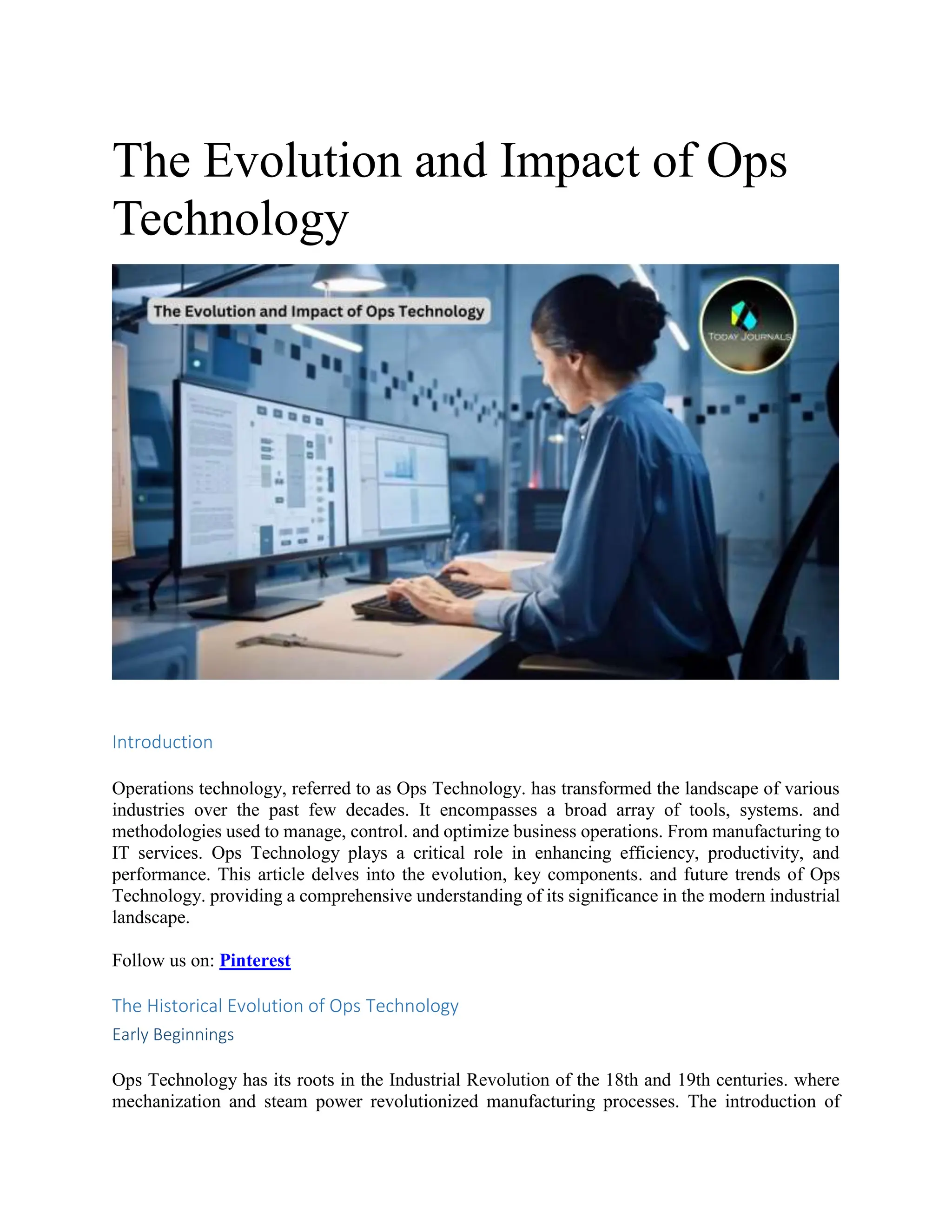
The Evolution and Impact of Ops
Technology
Introduction
Operations technology, referred to as Ops Technology. has transformed the landscape of various
industries over the past few decades. It encompasses a broad array of tools, systems. and
methodologies used to manage, control. and optimize business operations. From manufacturing to
IT services. Ops Technology plays a critical role in enhancing efficiency, productivity, and
performance. This article delves into the evolution, key components. and future trends of Ops
Technology. providing a comprehensive understanding of its significance in the modern industrial
landscape.
Follow us on: Pinterest
The Historical Evolution of Ops Technology
Early Beginnings
Ops Technology has its roots in the Industrial Revolution of the 18th and 19th centuries. where
mechanization and steam power revolutionized manufacturing processes. The introduction of
machinery boosted productivity. and set the stage for future advancements in operational
methodologies.
The 20th Century: Automation and IT Integration
The 20th century saw a series of technological advancements that propelled Ops Technology to
new heights. The introduction of assembly lines by Henry Ford in the early 1900s marked a
significant milestone. leading to mass production and operational efficiency.
The latter half of the 20th century saw the integration of Information Technology (IT) into
operations. The advent of computers, programmable logic controllers (PLCs). and enterprise
resource planning (ERP) systems transformed how businesses managed their operations. These
technologies enabled real-time data processing, improved communication, and streamlined
workflows.
The Digital Age: IoT and Big Data
The 21st century has brought about the digital age. characterized by the proliferation of the Internet
of Things (IoT), big data, and cloud computing. These technologies have further revolutionized
Ops Technology by providing unprecedented levels of connectivity, data analytics, and
automation. IoT devices, for example, allow for real-time monitoring and control of industrial
processes. while big data analytics enables predictive maintenance and operational optimization.
Key Components of Ops Technology
Ops Technology is a multifaceted domain encompassing various components that work together
to enhance operational efficiency. The following are some of the key components:
1. Automation Systems
Automation is at the heart of modern Ops Technology. It involves the use of control systems, such
as PLCs and robots. to perform tasks with minimal human intervention. Automation systems are
essential for reducing errors, and increasing speed. and improving consistency in operations.
2. Enterprise Resource Planning (ERP) Systems
They provide a comprehensive view of operations. including inventory management, order
processing, human resources, and finance. By centralizing data and processes, ERP systems enable
better decision-making and operational efficiency.
3. Internet of Things (IoT)
IoT refers to the network of interconnected devices that collect and exchange data. In an
operational context, IoT devices can check machinery, track inventory. and manage logistics in
real time. This connectivity allows for more responsive and adaptive operations.
4. Big Data Analytics
Big data analytics involves the examination of large datasets to uncover patterns, correlations, and
insights. In operations, big data can used to predict equipment failures. optimize supply chains,
and enhance customer experiences. Advanced analytics tools, including machine learning and
artificial intelligence. are employed to extract actionable insights from data.
5. Cloud Computing
Cloud computing provides scalable and flexible resources for data storage, processing, and
management. By leveraging cloud services, businesses can access advanced computing
capabilities without significant upfront investments in infrastructure. Cloud-based Ops
Technology solutions ease collaboration, remote monitoring, and real-time data access.
6. Cybersecurity
As operations become more digitized, the importance of cybersecurity cannot overstated.
Protecting sensitive operational data and systems from cyber threats is crucial for maintaining
operational integrity and preventing disruptions. Advanced cybersecurity measures. such as
encryption, intrusion detection systems. and secure access controls, are integral components of
modern Ops Technology.
The Impact of Ops Technology on Industries
Ops Technology has had a profound impact on various industries. driving innovation, efficiency,
and competitiveness. The following sections highlight how different sectors have benefited from
the adoption of Ops Technology.
Manufacturing
The manufacturing industry has been a primary beneficiary of Ops Technology. Automation and
robotics have revolutionized production lines. enabling faster and more precise manufacturing
processes. IoT devices check equipment health, reducing downtime through predictive
maintenance. ERP systems streamline supply chain management. ensuring timely delivery of raw
materials and finished products.
Moreover, advanced analytics optimize production schedules, cut waste, and enhance product
quality. The integration of digital twins—virtual replicas of physical assets. allows manufacturers
to simulate. and optimize processes in a virtual environment before implementing them on the
factory floor.
Healthcare
In the healthcare sector, Ops Technology enhances patient care. streamlines administrative
processes, and improves operational efficiency. Electronic Health Records (EHR) systems provide
a centralized repository of patient information. facilitating better diagnosis and treatment. IoT
devices, such as wearable health monitors. enable real-time tracking of patient vitals and early
detection of potential health issues.
Big data analytics in healthcare allows for population health management. predictive analytics,
and personalized medicine. For instance, analyzing patient data can identify trends. and patterns
that inform preventive care strategies. Additionally, automation of administrative tasks, such as
appointment scheduling and billing. frees up healthcare professionals to focus on patient care.
Logistics and Supply Chain Management
Ops Technology plays a crucial role in optimizing logistics and supply chain operations. IoT
devices track the location and condition of goods in transit. ensuring timely and efficient delivery.
Advanced analytics tools analyze supply chain data to identify bottlenecks. forecast demand, and
optimize inventory levels.
Automation technologies, such as autonomous vehicles and drones. are revolutionizing last-mile
delivery, reducing delivery times and costs. ERP systems provide end-to-end visibility of the
supply chain. enabling better coordination between suppliers, manufacturers, and retailers.
Energy and Utilities
The energy and utilities sector leverages Ops Technology to enhance the generation. distribution,
and consumption of energy. Smart grids, powered by IoT devices. enable real-time monitoring and
control of energy flows. improving the reliability and efficiency of power distribution. Advanced
analytics tools predict energy demand, optimize generation schedules, and reduce energy wastage.
Renewable energy sources, such as solar and wind. enjoy Ops Technology through improved
forecasting and integration into the grid. Automation systems manage the operation of power
plants. ensuring optimal performance and minimizing downtime. Furthermore, cybersecurity
measures protect critical infrastructure from cyber threats. ensuring the uninterrupted supply of
energy.
Retail
In the retail industry, Ops Technology enhances the customer experience. optimizes inventory
management, and streamlines operations. Point-of-sale (POS) systems, integrated with ERP
solutions. provide real-time sales data, enabling better inventory control and demand forecasting.
IoT devices track inventory levels and automate reordering processes. reducing stock outs and
overstock situations.
Advanced analytics tools analyze customer data to identify purchasing patterns and preferences.
enabling personalized marketing and promotions. Automation technologies, such as self-checkout
systems and robotics. improve the efficiency of in-store operations. enhancing the shopping
experience.
Financial Services
The financial services sector benefits from Ops Technology through improved operational
efficiency, enhanced customer service. and robust risk management. Automation of routine tasks.
such as transaction processing and compliance reporting, reduces operational costs and errors. Big
data analytics identify fraud patterns, assess credit risk, and enhance decision-making.
Digital banking platforms, powered by cloud computing. provide customers with convenient
access to financial services, improving customer satisfaction. Cybersecurity measures protect
sensitive financial data. ensuring the integrity and security of financial transactions.
Future Trends in Ops Technology
The future of Ops Technology shaped by emerging trends. and innovations that promise to further
enhance operational efficiency and effectiveness. The following are some of the key trends to
watch:
1. Artificial Intelligence and Machine Learning
Artificial Intelligence (AI) and Machine Learning (ML) are set to play a pivotal role in the future
of Ops Technology. These technologies enable predictive analytics, process automation, and
intelligent decision-making. AI-powered systems can analyze vast amounts of data to identify
patterns, optimize processes. and make real-time adjustments.
For example, in manufacturing. AI can predict equipment failures and recommend maintenance
schedules. reducing downtime and maintenance costs. In healthcare, AI algorithms can analyze
patient data to identify potential health issues. and suggest personalized treatment plans. The
integration of AI and ML into Ops Technology will drive greater efficiency, accuracy. and
innovation across industries.
2. Edge Computing
Edge computing involves processing data closer to the source. rather than relying on centralized
cloud servers. This approach reduces latency, improves real-time decision-making, and enhances
data security. In an operational context. edge computing enables faster processing of data from
IoT devices. allowing for more responsive and adaptive operations.
For instance, in manufacturing. edge computing can analyze data from sensors in real-time to
optimize production processes. and detect anomalies. In the energy sector, edge computing can
manage the operation of smart grids. ensuring efficient energy distribution and consumption. The
adoption of edge computing will enable more efficient. and agile operations across various
industries.
3. Blockchain Technology
Blockchain technology offers a decentralized. and secure way to record transactions and manage
data. In Ops Technology, blockchain can enhance supply chain transparency. improve traceability,
and reduce fraud. By providing a tamper-proof record of transactions. blockchain ensures the
integrity and authenticity of data.
For example, in logistics. blockchain can track the movement of goods from the manufacturer to
the end consumer. ensuring transparency and accountability. In the financial services sector,
blockchain can streamline transactions. reduce processing times, and enhance security. The
adoption of blockchain technology will drive greater trust, efficiency. and security in operational
processes.
4. Augmented Reality and Virtual Reality
Augmented Reality (AR) and Virtual Reality (VR). technologies are transforming the way
operations conducted. AR overlays digital information onto the physical world, providing real-
time guidance and insights. VR, , creates immersive virtual environments for training and
simulation.
In manufacturing, AR can provide workers with step-by-step instructions for complex tasks.
improving accuracy and efficiency.
FAQ
Understanding Ops Merchant and Ops tech
What is an Ops Merchant?
An Ops Merchant, short for Operations Merchant. refers to a professional or entity involved in the
management. and optimization of business operations. These individuals or teams work within
various industries to streamline processes. improve efficiency, and ensure smooth operational
workflows. Ops Merchants play a crucial role in bridging the gap between strategic planning and
tactical execution. Their responsibilities often include:
Process Optimization:
Identifying inefficiencies and implementing solutions to improve operational workflows.
Resource Management:
Ensuring that resources such as manpower, materials, and machinery used .
Data Analysis:
Utilizing data analytics to check performance, predict trends, and make informed decisions.
Quality Control:
Maintaining high standards of quality and compliance in all operational activities.
Technology Integration:
Implementing and managing technology solutions that enhance operational capabilities.
In essence, Ops Merchants are key players in driving operational excellence. and contributing to
the success of an organization.
What is Ops tech?
Ops Tech, short for Operations Technology, encompasses the tools, systems. and methodologies
used to manage, control, and optimize business operations. It is a broad field that includes various
technologies. and practices aimed at improving the efficiency, productivity. and effectiveness of
operational processes. The primary components of Ops Tech include:
1. Automation Systems:
Utilizing machinery and software to perform tasks with minimal human intervention. Examples
include robotic process automation (RPA) and programmable logic controllers (PLCs).
2. Enterprise Resource Planning (ERP) Systems:
Integrated software platforms that join various business processes. such as inventory management,
finance, human resources. and order processing, into a unified system.
3. Internet of Things (IoT):
Connecting physical devices to the internet. allowing for real-time monitoring and control of
equipment, inventory, and other operational assets.
4. Big Data Analytics:
Analyzing large datasets to uncover insights, predict trends, and inform decision-making. This can
include predictive maintenance, supply chain optimization, and customer behavior analysis.
5. Cloud Computing:
Providing scalable and flexible IT resources for data storage, processing, and management. Cloud-
based solutions ease collaboration, remote monitoring, and real-time data access.
6. Cybersecurity:
Implementing measures to protect operational systems and data from cyber threats. ensuring the
integrity and security of operations.
The Role of Ops Merchants in Ops tech
Ops Merchants often work with Ops Tech to leverage its capabilities in optimizing business
operations. Their role involves:
Implementation:
Introducing and integrating Ops Tech solutions within the organization to enhance operational
processes.
Management:
Overseeing the deployment and ongoing management of Ops Tech systems to ensure they function
.
Analysis:
Using data generated by Ops Tech systems to check performance. identify issues, and make
improvements.
Training:
Educating staff on how to use Ops Tech tools and systems to maximize their benefits.

The Evolution and Impact of Ops Technology.docx

  • 1.
    The Evolution andImpact of Ops Technology Introduction Operations technology, referred to as Ops Technology. has transformed the landscape of various industries over the past few decades. It encompasses a broad array of tools, systems. and methodologies used to manage, control. and optimize business operations. From manufacturing to IT services. Ops Technology plays a critical role in enhancing efficiency, productivity, and performance. This article delves into the evolution, key components. and future trends of Ops Technology. providing a comprehensive understanding of its significance in the modern industrial landscape. Follow us on: Pinterest The Historical Evolution of Ops Technology Early Beginnings Ops Technology has its roots in the Industrial Revolution of the 18th and 19th centuries. where mechanization and steam power revolutionized manufacturing processes. The introduction of
  • 2.
    machinery boosted productivity.and set the stage for future advancements in operational methodologies. The 20th Century: Automation and IT Integration The 20th century saw a series of technological advancements that propelled Ops Technology to new heights. The introduction of assembly lines by Henry Ford in the early 1900s marked a significant milestone. leading to mass production and operational efficiency. The latter half of the 20th century saw the integration of Information Technology (IT) into operations. The advent of computers, programmable logic controllers (PLCs). and enterprise resource planning (ERP) systems transformed how businesses managed their operations. These technologies enabled real-time data processing, improved communication, and streamlined workflows. The Digital Age: IoT and Big Data The 21st century has brought about the digital age. characterized by the proliferation of the Internet of Things (IoT), big data, and cloud computing. These technologies have further revolutionized Ops Technology by providing unprecedented levels of connectivity, data analytics, and automation. IoT devices, for example, allow for real-time monitoring and control of industrial processes. while big data analytics enables predictive maintenance and operational optimization. Key Components of Ops Technology Ops Technology is a multifaceted domain encompassing various components that work together to enhance operational efficiency. The following are some of the key components: 1. Automation Systems Automation is at the heart of modern Ops Technology. It involves the use of control systems, such as PLCs and robots. to perform tasks with minimal human intervention. Automation systems are essential for reducing errors, and increasing speed. and improving consistency in operations. 2. Enterprise Resource Planning (ERP) Systems They provide a comprehensive view of operations. including inventory management, order processing, human resources, and finance. By centralizing data and processes, ERP systems enable better decision-making and operational efficiency. 3. Internet of Things (IoT) IoT refers to the network of interconnected devices that collect and exchange data. In an operational context, IoT devices can check machinery, track inventory. and manage logistics in real time. This connectivity allows for more responsive and adaptive operations.
  • 3.
    4. Big DataAnalytics Big data analytics involves the examination of large datasets to uncover patterns, correlations, and insights. In operations, big data can used to predict equipment failures. optimize supply chains, and enhance customer experiences. Advanced analytics tools, including machine learning and artificial intelligence. are employed to extract actionable insights from data. 5. Cloud Computing Cloud computing provides scalable and flexible resources for data storage, processing, and management. By leveraging cloud services, businesses can access advanced computing capabilities without significant upfront investments in infrastructure. Cloud-based Ops Technology solutions ease collaboration, remote monitoring, and real-time data access. 6. Cybersecurity As operations become more digitized, the importance of cybersecurity cannot overstated. Protecting sensitive operational data and systems from cyber threats is crucial for maintaining operational integrity and preventing disruptions. Advanced cybersecurity measures. such as encryption, intrusion detection systems. and secure access controls, are integral components of modern Ops Technology. The Impact of Ops Technology on Industries Ops Technology has had a profound impact on various industries. driving innovation, efficiency, and competitiveness. The following sections highlight how different sectors have benefited from the adoption of Ops Technology. Manufacturing The manufacturing industry has been a primary beneficiary of Ops Technology. Automation and robotics have revolutionized production lines. enabling faster and more precise manufacturing processes. IoT devices check equipment health, reducing downtime through predictive maintenance. ERP systems streamline supply chain management. ensuring timely delivery of raw materials and finished products. Moreover, advanced analytics optimize production schedules, cut waste, and enhance product quality. The integration of digital twins—virtual replicas of physical assets. allows manufacturers to simulate. and optimize processes in a virtual environment before implementing them on the factory floor. Healthcare In the healthcare sector, Ops Technology enhances patient care. streamlines administrative processes, and improves operational efficiency. Electronic Health Records (EHR) systems provide
  • 4.
    a centralized repositoryof patient information. facilitating better diagnosis and treatment. IoT devices, such as wearable health monitors. enable real-time tracking of patient vitals and early detection of potential health issues. Big data analytics in healthcare allows for population health management. predictive analytics, and personalized medicine. For instance, analyzing patient data can identify trends. and patterns that inform preventive care strategies. Additionally, automation of administrative tasks, such as appointment scheduling and billing. frees up healthcare professionals to focus on patient care. Logistics and Supply Chain Management Ops Technology plays a crucial role in optimizing logistics and supply chain operations. IoT devices track the location and condition of goods in transit. ensuring timely and efficient delivery. Advanced analytics tools analyze supply chain data to identify bottlenecks. forecast demand, and optimize inventory levels. Automation technologies, such as autonomous vehicles and drones. are revolutionizing last-mile delivery, reducing delivery times and costs. ERP systems provide end-to-end visibility of the supply chain. enabling better coordination between suppliers, manufacturers, and retailers. Energy and Utilities The energy and utilities sector leverages Ops Technology to enhance the generation. distribution, and consumption of energy. Smart grids, powered by IoT devices. enable real-time monitoring and control of energy flows. improving the reliability and efficiency of power distribution. Advanced analytics tools predict energy demand, optimize generation schedules, and reduce energy wastage. Renewable energy sources, such as solar and wind. enjoy Ops Technology through improved forecasting and integration into the grid. Automation systems manage the operation of power plants. ensuring optimal performance and minimizing downtime. Furthermore, cybersecurity measures protect critical infrastructure from cyber threats. ensuring the uninterrupted supply of energy. Retail In the retail industry, Ops Technology enhances the customer experience. optimizes inventory management, and streamlines operations. Point-of-sale (POS) systems, integrated with ERP solutions. provide real-time sales data, enabling better inventory control and demand forecasting. IoT devices track inventory levels and automate reordering processes. reducing stock outs and overstock situations. Advanced analytics tools analyze customer data to identify purchasing patterns and preferences. enabling personalized marketing and promotions. Automation technologies, such as self-checkout systems and robotics. improve the efficiency of in-store operations. enhancing the shopping experience.
  • 5.
    Financial Services The financialservices sector benefits from Ops Technology through improved operational efficiency, enhanced customer service. and robust risk management. Automation of routine tasks. such as transaction processing and compliance reporting, reduces operational costs and errors. Big data analytics identify fraud patterns, assess credit risk, and enhance decision-making. Digital banking platforms, powered by cloud computing. provide customers with convenient access to financial services, improving customer satisfaction. Cybersecurity measures protect sensitive financial data. ensuring the integrity and security of financial transactions. Future Trends in Ops Technology The future of Ops Technology shaped by emerging trends. and innovations that promise to further enhance operational efficiency and effectiveness. The following are some of the key trends to watch: 1. Artificial Intelligence and Machine Learning Artificial Intelligence (AI) and Machine Learning (ML) are set to play a pivotal role in the future of Ops Technology. These technologies enable predictive analytics, process automation, and intelligent decision-making. AI-powered systems can analyze vast amounts of data to identify patterns, optimize processes. and make real-time adjustments. For example, in manufacturing. AI can predict equipment failures and recommend maintenance schedules. reducing downtime and maintenance costs. In healthcare, AI algorithms can analyze patient data to identify potential health issues. and suggest personalized treatment plans. The integration of AI and ML into Ops Technology will drive greater efficiency, accuracy. and innovation across industries. 2. Edge Computing Edge computing involves processing data closer to the source. rather than relying on centralized cloud servers. This approach reduces latency, improves real-time decision-making, and enhances data security. In an operational context. edge computing enables faster processing of data from IoT devices. allowing for more responsive and adaptive operations. For instance, in manufacturing. edge computing can analyze data from sensors in real-time to optimize production processes. and detect anomalies. In the energy sector, edge computing can manage the operation of smart grids. ensuring efficient energy distribution and consumption. The adoption of edge computing will enable more efficient. and agile operations across various industries.
  • 6.
    3. Blockchain Technology Blockchaintechnology offers a decentralized. and secure way to record transactions and manage data. In Ops Technology, blockchain can enhance supply chain transparency. improve traceability, and reduce fraud. By providing a tamper-proof record of transactions. blockchain ensures the integrity and authenticity of data. For example, in logistics. blockchain can track the movement of goods from the manufacturer to the end consumer. ensuring transparency and accountability. In the financial services sector, blockchain can streamline transactions. reduce processing times, and enhance security. The adoption of blockchain technology will drive greater trust, efficiency. and security in operational processes. 4. Augmented Reality and Virtual Reality Augmented Reality (AR) and Virtual Reality (VR). technologies are transforming the way operations conducted. AR overlays digital information onto the physical world, providing real- time guidance and insights. VR, , creates immersive virtual environments for training and simulation. In manufacturing, AR can provide workers with step-by-step instructions for complex tasks. improving accuracy and efficiency. FAQ Understanding Ops Merchant and Ops tech What is an Ops Merchant? An Ops Merchant, short for Operations Merchant. refers to a professional or entity involved in the management. and optimization of business operations. These individuals or teams work within various industries to streamline processes. improve efficiency, and ensure smooth operational workflows. Ops Merchants play a crucial role in bridging the gap between strategic planning and tactical execution. Their responsibilities often include: Process Optimization: Identifying inefficiencies and implementing solutions to improve operational workflows. Resource Management: Ensuring that resources such as manpower, materials, and machinery used . Data Analysis: Utilizing data analytics to check performance, predict trends, and make informed decisions.
  • 7.
    Quality Control: Maintaining highstandards of quality and compliance in all operational activities. Technology Integration: Implementing and managing technology solutions that enhance operational capabilities. In essence, Ops Merchants are key players in driving operational excellence. and contributing to the success of an organization. What is Ops tech? Ops Tech, short for Operations Technology, encompasses the tools, systems. and methodologies used to manage, control, and optimize business operations. It is a broad field that includes various technologies. and practices aimed at improving the efficiency, productivity. and effectiveness of operational processes. The primary components of Ops Tech include: 1. Automation Systems: Utilizing machinery and software to perform tasks with minimal human intervention. Examples include robotic process automation (RPA) and programmable logic controllers (PLCs). 2. Enterprise Resource Planning (ERP) Systems: Integrated software platforms that join various business processes. such as inventory management, finance, human resources. and order processing, into a unified system. 3. Internet of Things (IoT): Connecting physical devices to the internet. allowing for real-time monitoring and control of equipment, inventory, and other operational assets. 4. Big Data Analytics: Analyzing large datasets to uncover insights, predict trends, and inform decision-making. This can include predictive maintenance, supply chain optimization, and customer behavior analysis. 5. Cloud Computing: Providing scalable and flexible IT resources for data storage, processing, and management. Cloud- based solutions ease collaboration, remote monitoring, and real-time data access.
  • 8.
    6. Cybersecurity: Implementing measuresto protect operational systems and data from cyber threats. ensuring the integrity and security of operations. The Role of Ops Merchants in Ops tech Ops Merchants often work with Ops Tech to leverage its capabilities in optimizing business operations. Their role involves: Implementation: Introducing and integrating Ops Tech solutions within the organization to enhance operational processes. Management: Overseeing the deployment and ongoing management of Ops Tech systems to ensure they function . Analysis: Using data generated by Ops Tech systems to check performance. identify issues, and make improvements. Training: Educating staff on how to use Ops Tech tools and systems to maximize their benefits.