IOT APPLICATION IN
MANUFACTURING
PRESENTED BY:
GHANASHYAM B N
7TH SEMESTER
E & I ENGINEERING.
1.ABSTRACTION
The Internet of Things (IoT) envisions the seamless interconnection of
the physical world and the cyber space. This provides a promising
opportunity to build powerful services and applications for manufacturing.
2.INTRODUCTION:
With the globalization of the world’s economy, manufacturing
enterprises are facing severe competition from their worldwide
counterparts in terms of product price, function, quality, cost, lead-
time, etc. and growing pressure to meet higher environmental
standards due to the “enhanced producer responsibility” [1].
Meanwhile, consumers have more diversified and demanding needs,
e.g., customized products. These challenges push the manufacturing
industry to embrace new technologies to keep competitive and meet
user demands. The Internet of Things (IoT), which has great potential
in transforming the manufacturing sector [2], attracts tremendous
attention from both academia and industry.
2.DIGITAL/CONNECTED FACTORY:
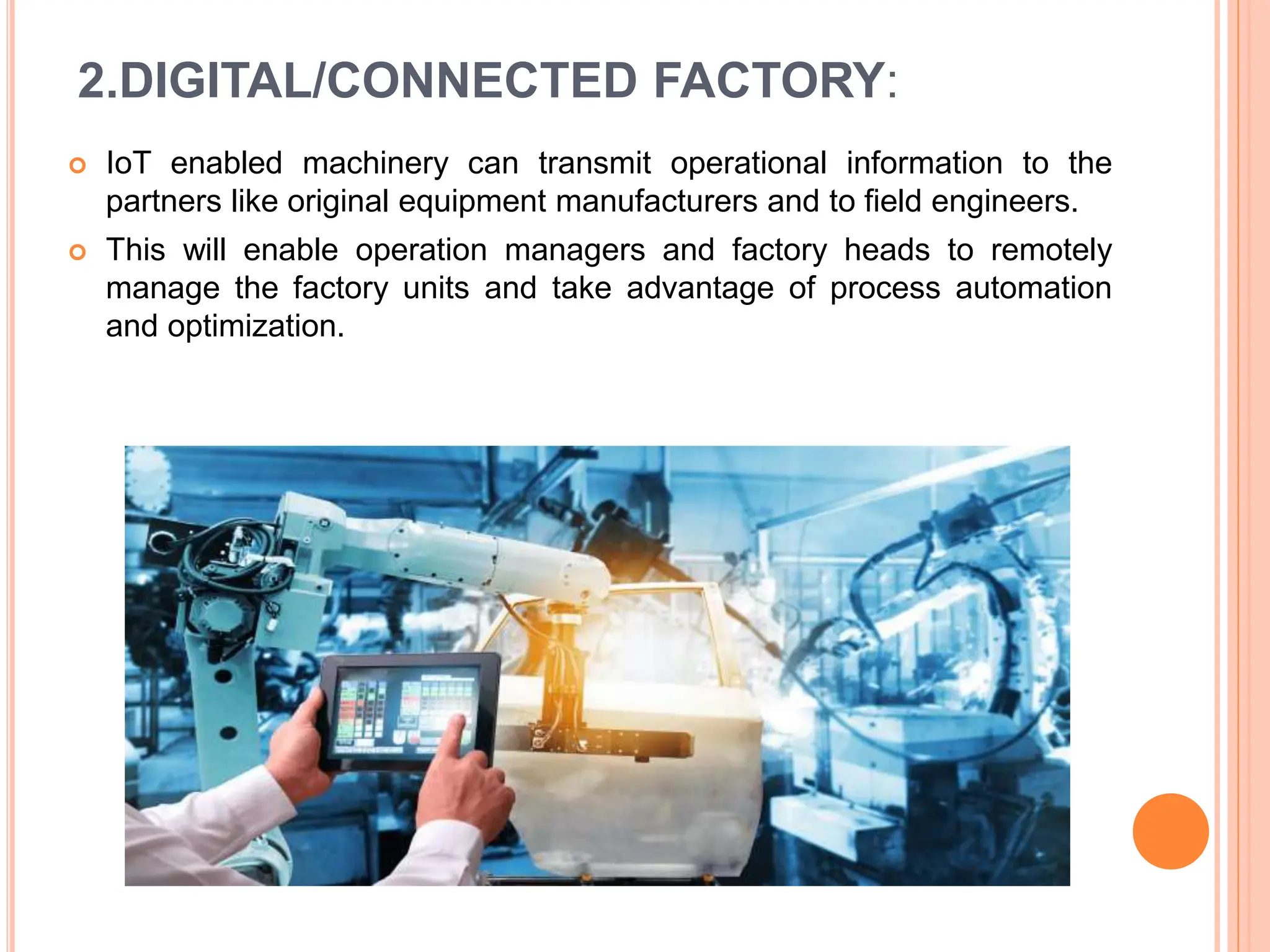
 IoT enabled machinery can transmit operational information to the
partners like original equipment manufacturers and to field engineers.
 This will enable operation managers and factory heads to remotely
manage the factory units and take advantage of process automation
and optimization.
3. FACILITY MANAGEMENT:
 The use of IoT sensors in manufacturing equipment enables condition-
based maintenance alerts.
 There are many critical machine tools that are designed to function
within certain temperature and vibration ranges.
 By ensuring the prescribed working environment for machinery,
manufacturers can conserve energy, reduce costs, eliminate machine
downtime and increase operational efficiency.
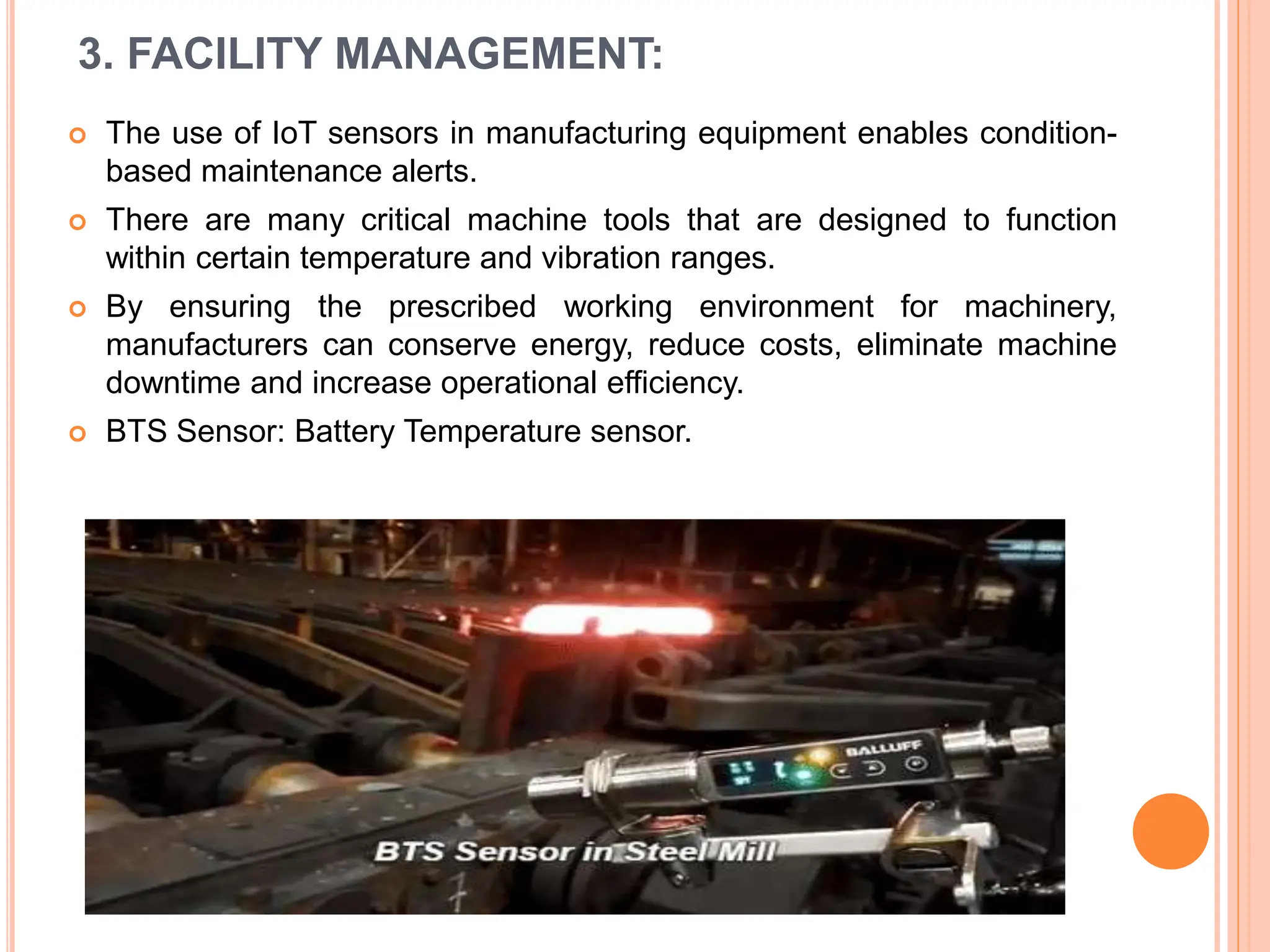
 BTS Sensor: Battery Temperature sensor.
4. PRODUCTION FLOW MONITORING:
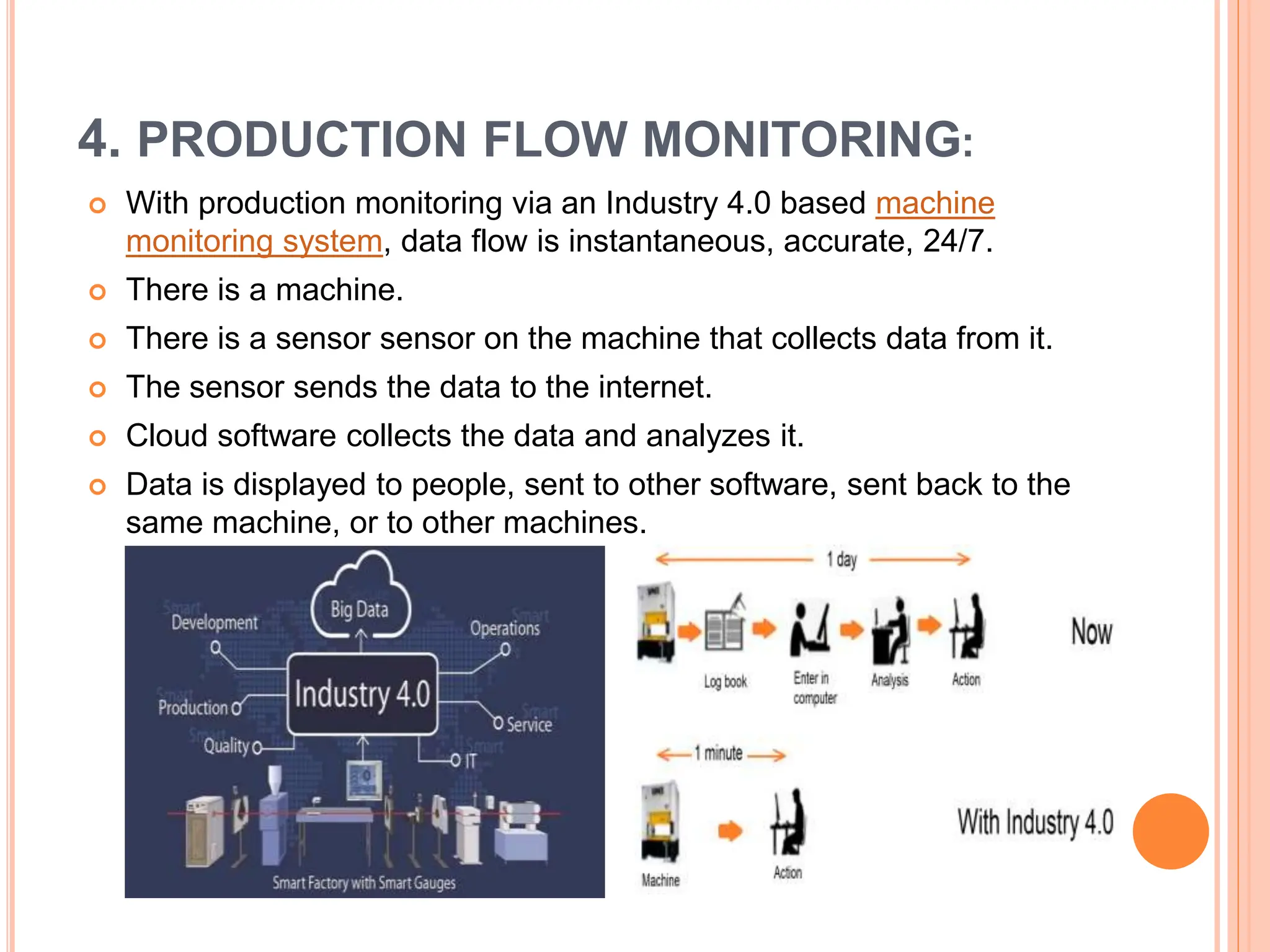
 With production monitoring via an Industry 4.0 based machine
monitoring system, data flow is instantaneous, accurate, 24/7.
 There is a machine.
 There is a sensor sensor on the machine that collects data from it.
 The sensor sends the data to the internet.
 Cloud software collects the data and analyzes it.
 Data is displayed to people, sent to other software, sent back to the
same machine, or to other machines.
5. INVENTORY MANAGEMENT:
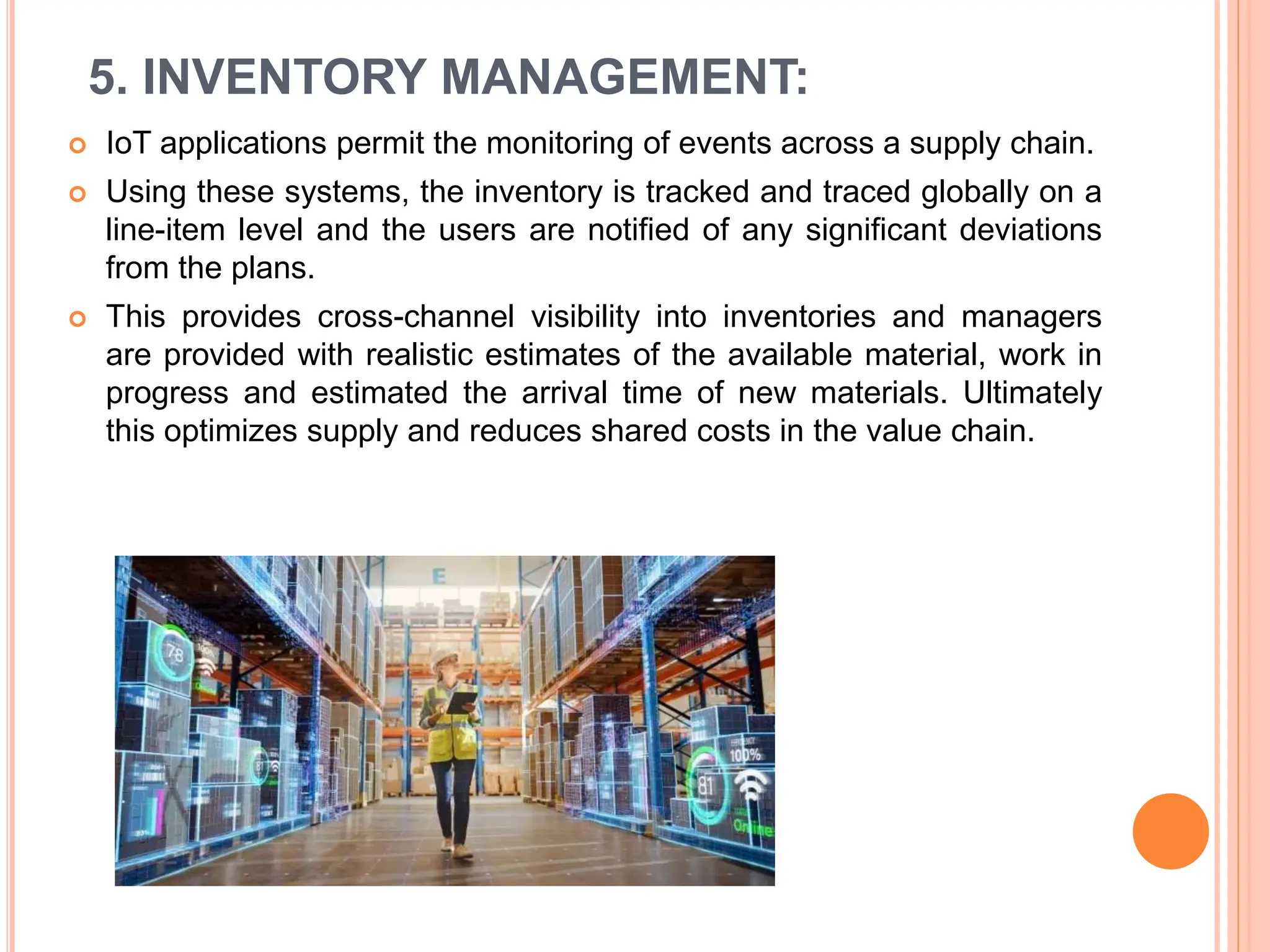
 IoT applications permit the monitoring of events across a supply chain.
 Using these systems, the inventory is tracked and traced globally on a
line-item level and the users are notified of any significant deviations
from the plans.
 This provides cross-channel visibility into inventories and managers
are provided with realistic estimates of the available material, work in
progress and estimated the arrival time of new materials. Ultimately
this optimizes supply and reduces shared costs in the value chain.
6. PLANT SAFETY AND SECURITY:
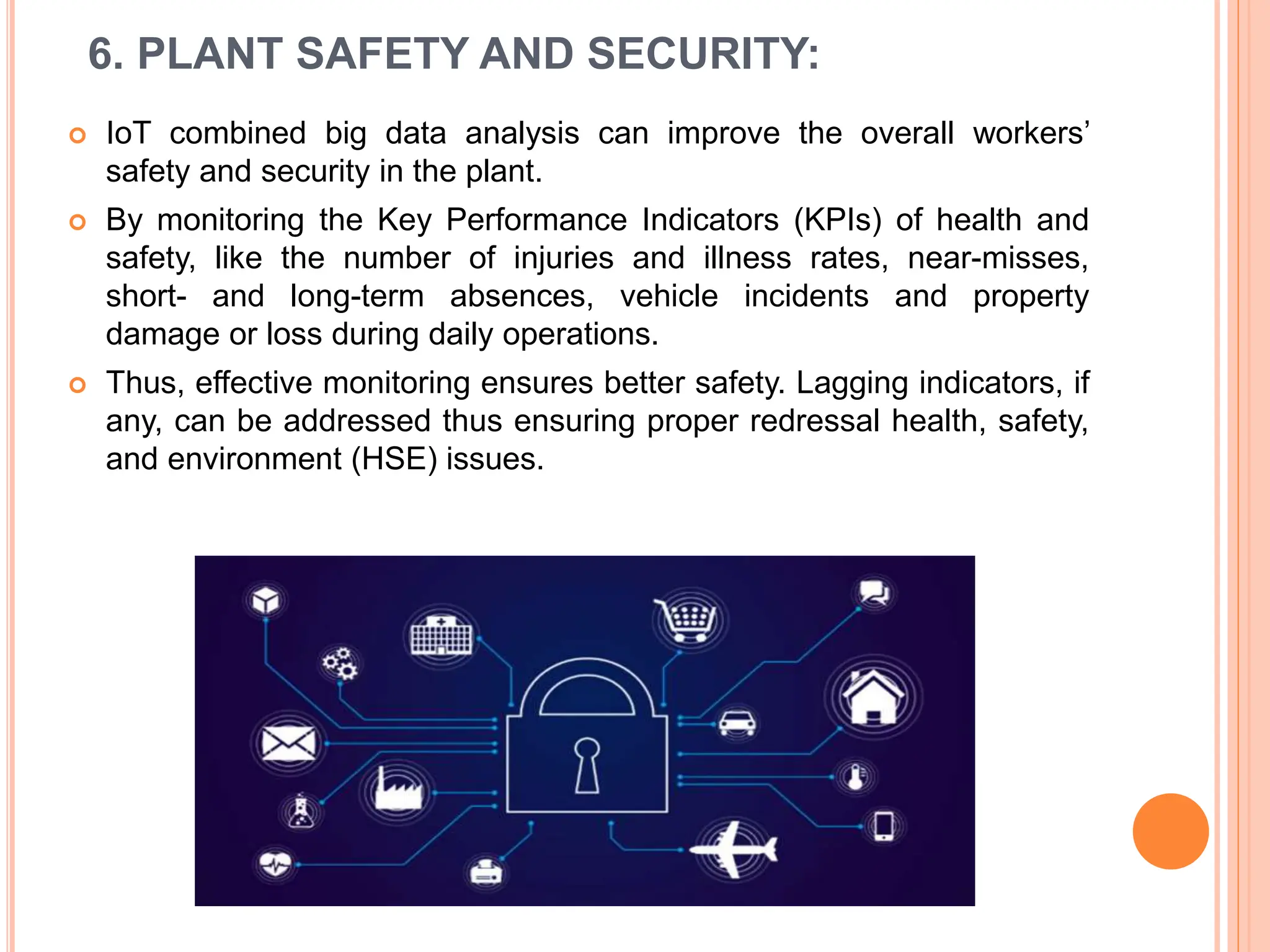
 IoT combined big data analysis can improve the overall workers’
safety and security in the plant.
 By monitoring the Key Performance Indicators (KPIs) of health and
safety, like the number of injuries and illness rates, near-misses,
short- and long-term absences, vehicle incidents and property
damage or loss during daily operations.
 Thus, effective monitoring ensures better safety. Lagging indicators, if
any, can be addressed thus ensuring proper redressal health, safety,
and environment (HSE) issues.
7. QUALITY CONTROL:
 How IoT is impacting quality control.?
For manufacturers, IoT technologies represent the next step in real-
time monitoring, process automation and data analytics.
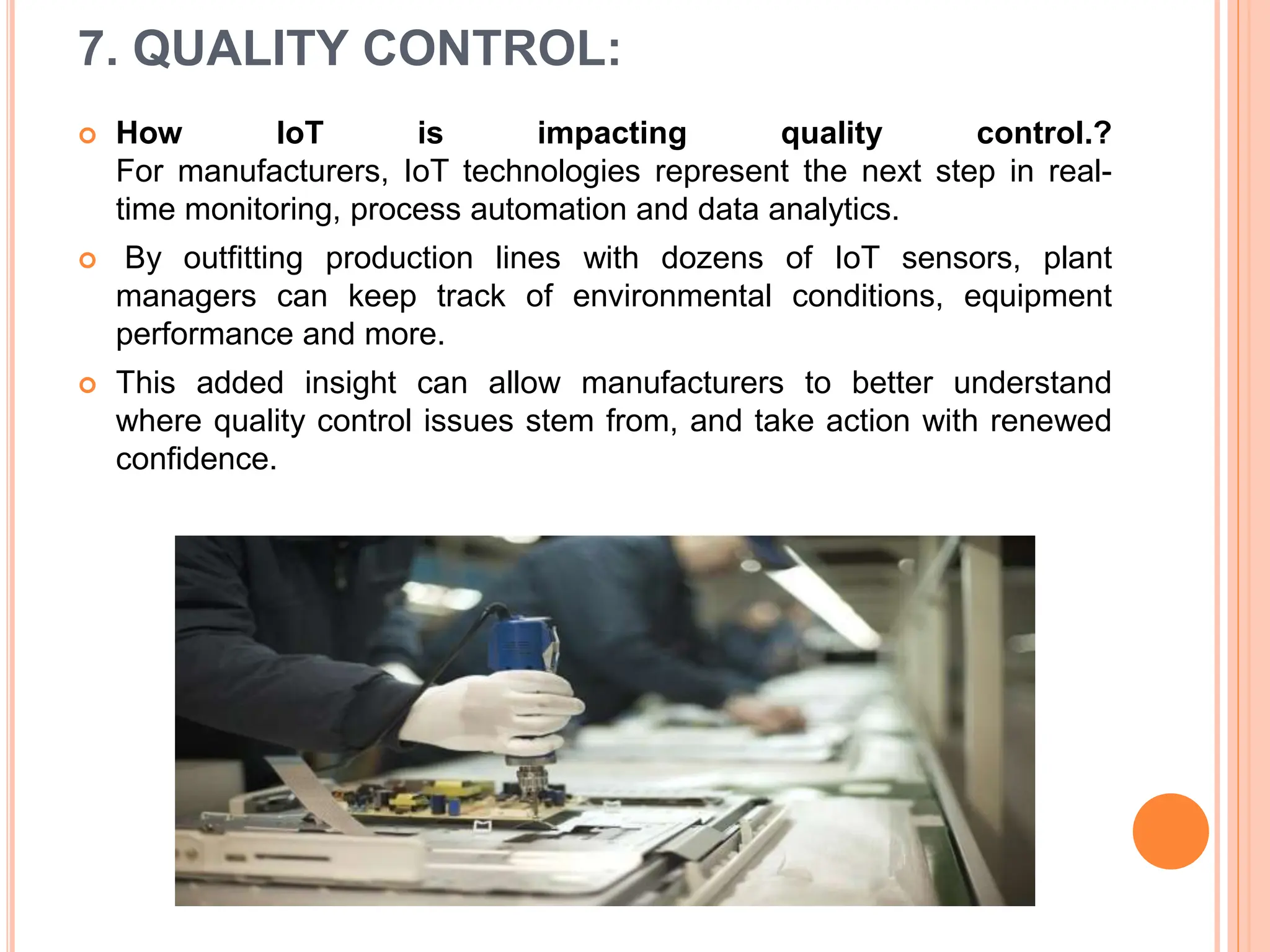
 By outfitting production lines with dozens of IoT sensors, plant
managers can keep track of environmental conditions, equipment
performance and more.
 This added insight can allow manufacturers to better understand
where quality control issues stem from, and take action with renewed
confidence.
8. PACKAGING OPTIMIZATION:
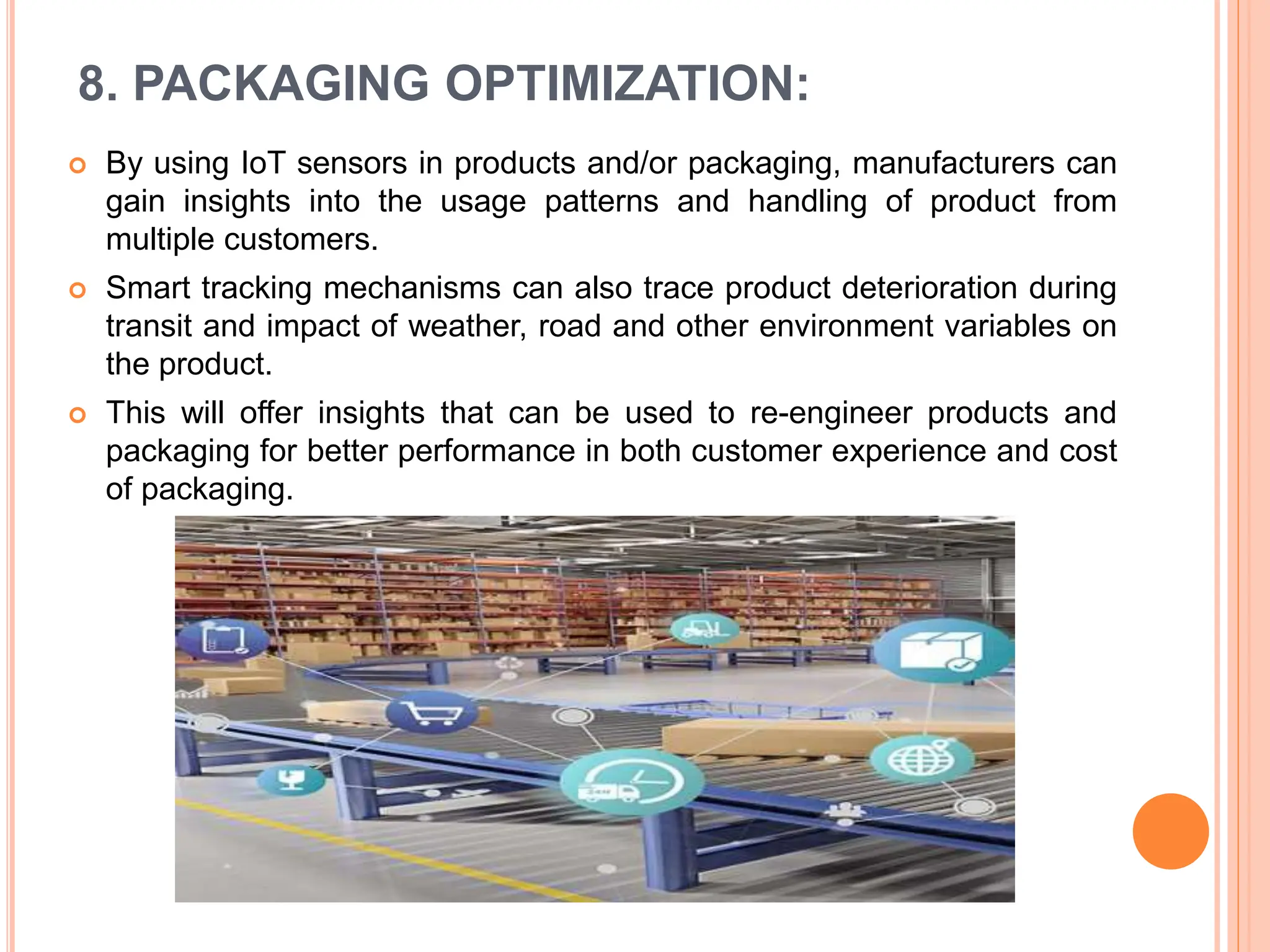
 By using IoT sensors in products and/or packaging, manufacturers can
gain insights into the usage patterns and handling of product from
multiple customers.
 Smart tracking mechanisms can also trace product deterioration during
transit and impact of weather, road and other environment variables on
the product.
 This will offer insights that can be used to re-engineer products and
packaging for better performance in both customer experience and cost
of packaging.
9. LOGISTICS AND SUPPLY CHAIN
OPTIMIZATION:
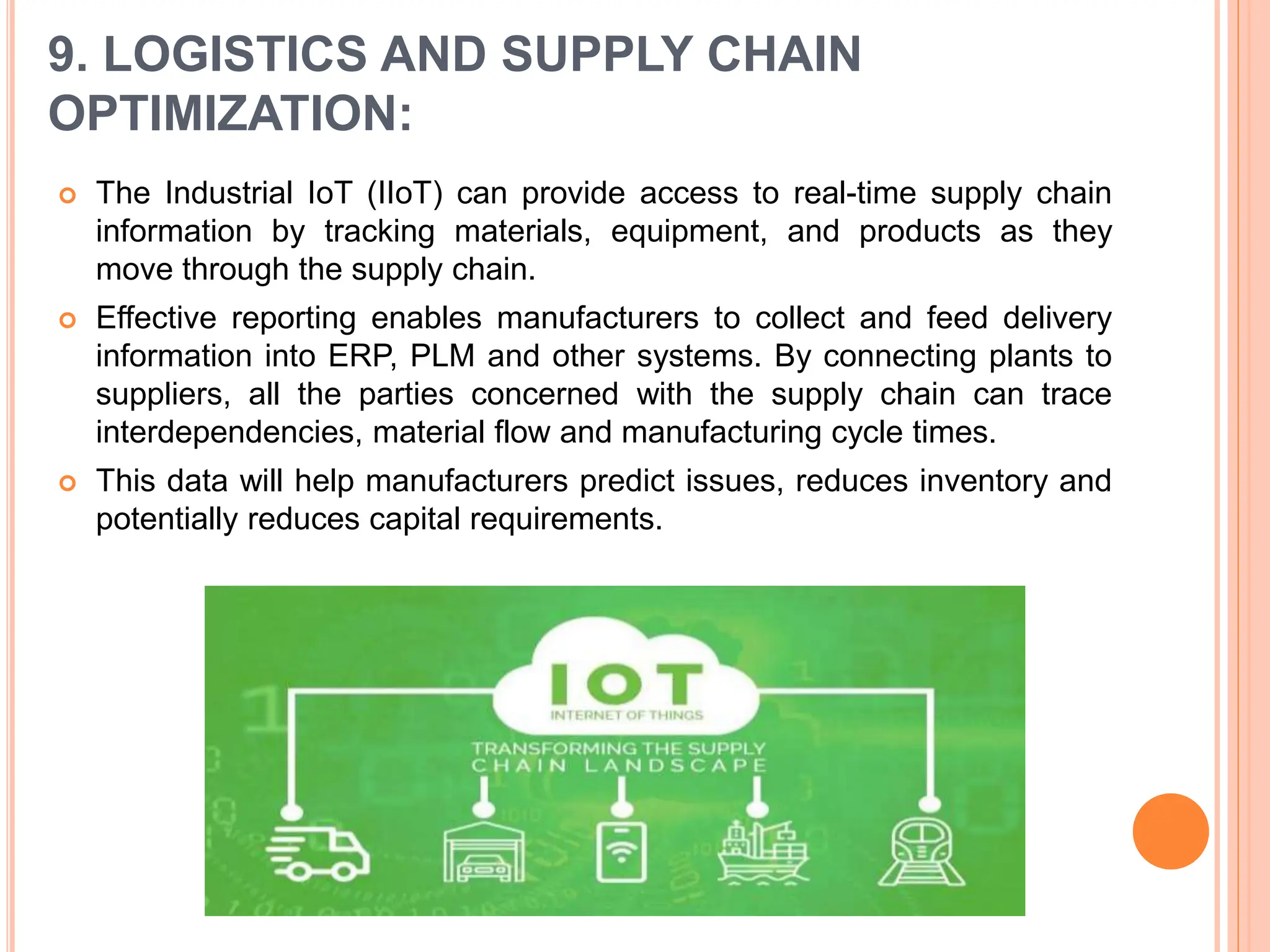
 The Industrial IoT (IIoT) can provide access to real-time supply chain
information by tracking materials, equipment, and products as they
move through the supply chain.
 Effective reporting enables manufacturers to collect and feed delivery
information into ERP, PLM and other systems. By connecting plants to
suppliers, all the parties concerned with the supply chain can trace
interdependencies, material flow and manufacturing cycle times.
 This data will help manufacturers predict issues, reduces inventory and
potentially reduces capital requirements.
ADVANTAGES OF IOT IN MANUFACTURING:
 Asset tracking.
 Enhanced machine utilization.
 Predictive maintenance.
 Connecting remote assets.
 Process and behavior monitoring.
DISADVANTAGES OF IoT IN MANUFACTURING:
 Security of data management: As the IoT systems are
interconnected and communicate over networks.
 High implementation cost: The cost of implementing IoT does cost a
considerable amount.
 Connectivity outages: In manufacturing, the buildings are massive,
which allows for dead spots.

IoT Application in Manufacturing & Advantage , Disadvantage.

  • 1.
    IOT APPLICATION IN MANUFACTURING PRESENTEDBY: GHANASHYAM B N 7TH SEMESTER E & I ENGINEERING.
  • 2.
    1.ABSTRACTION The Internet ofThings (IoT) envisions the seamless interconnection of the physical world and the cyber space. This provides a promising opportunity to build powerful services and applications for manufacturing. 2.INTRODUCTION: With the globalization of the world’s economy, manufacturing enterprises are facing severe competition from their worldwide counterparts in terms of product price, function, quality, cost, lead- time, etc. and growing pressure to meet higher environmental standards due to the “enhanced producer responsibility” [1]. Meanwhile, consumers have more diversified and demanding needs, e.g., customized products. These challenges push the manufacturing industry to embrace new technologies to keep competitive and meet user demands. The Internet of Things (IoT), which has great potential in transforming the manufacturing sector [2], attracts tremendous attention from both academia and industry.
  • 3.
    2.DIGITAL/CONNECTED FACTORY:  IoTenabled machinery can transmit operational information to the partners like original equipment manufacturers and to field engineers.  This will enable operation managers and factory heads to remotely manage the factory units and take advantage of process automation and optimization.
  • 4.
    3. FACILITY MANAGEMENT: The use of IoT sensors in manufacturing equipment enables condition- based maintenance alerts.  There are many critical machine tools that are designed to function within certain temperature and vibration ranges.  By ensuring the prescribed working environment for machinery, manufacturers can conserve energy, reduce costs, eliminate machine downtime and increase operational efficiency.  BTS Sensor: Battery Temperature sensor.
  • 5.
    4. PRODUCTION FLOWMONITORING:  With production monitoring via an Industry 4.0 based machine monitoring system, data flow is instantaneous, accurate, 24/7.  There is a machine.  There is a sensor sensor on the machine that collects data from it.  The sensor sends the data to the internet.  Cloud software collects the data and analyzes it.  Data is displayed to people, sent to other software, sent back to the same machine, or to other machines.
  • 6.
    5. INVENTORY MANAGEMENT: IoT applications permit the monitoring of events across a supply chain.  Using these systems, the inventory is tracked and traced globally on a line-item level and the users are notified of any significant deviations from the plans.  This provides cross-channel visibility into inventories and managers are provided with realistic estimates of the available material, work in progress and estimated the arrival time of new materials. Ultimately this optimizes supply and reduces shared costs in the value chain.
  • 7.
    6. PLANT SAFETYAND SECURITY:  IoT combined big data analysis can improve the overall workers’ safety and security in the plant.  By monitoring the Key Performance Indicators (KPIs) of health and safety, like the number of injuries and illness rates, near-misses, short- and long-term absences, vehicle incidents and property damage or loss during daily operations.  Thus, effective monitoring ensures better safety. Lagging indicators, if any, can be addressed thus ensuring proper redressal health, safety, and environment (HSE) issues.
  • 8.
    7. QUALITY CONTROL: How IoT is impacting quality control.? For manufacturers, IoT technologies represent the next step in real- time monitoring, process automation and data analytics.  By outfitting production lines with dozens of IoT sensors, plant managers can keep track of environmental conditions, equipment performance and more.  This added insight can allow manufacturers to better understand where quality control issues stem from, and take action with renewed confidence.
  • 9.
    8. PACKAGING OPTIMIZATION: By using IoT sensors in products and/or packaging, manufacturers can gain insights into the usage patterns and handling of product from multiple customers.  Smart tracking mechanisms can also trace product deterioration during transit and impact of weather, road and other environment variables on the product.  This will offer insights that can be used to re-engineer products and packaging for better performance in both customer experience and cost of packaging.
  • 10.
    9. LOGISTICS ANDSUPPLY CHAIN OPTIMIZATION:  The Industrial IoT (IIoT) can provide access to real-time supply chain information by tracking materials, equipment, and products as they move through the supply chain.  Effective reporting enables manufacturers to collect and feed delivery information into ERP, PLM and other systems. By connecting plants to suppliers, all the parties concerned with the supply chain can trace interdependencies, material flow and manufacturing cycle times.  This data will help manufacturers predict issues, reduces inventory and potentially reduces capital requirements.
  • 11.
    ADVANTAGES OF IOTIN MANUFACTURING:  Asset tracking.  Enhanced machine utilization.  Predictive maintenance.  Connecting remote assets.  Process and behavior monitoring. DISADVANTAGES OF IoT IN MANUFACTURING:  Security of data management: As the IoT systems are interconnected and communicate over networks.  High implementation cost: The cost of implementing IoT does cost a considerable amount.  Connectivity outages: In manufacturing, the buildings are massive, which allows for dead spots.