

The EU Migration Crisis Management
Policies on Management of Asylum-seekers, Refugees and External Borders
A Presentation Provided for the Course of:
“The Seminar of Crises Management in the City by Professor S.Mahdi Zarghani”
Delivered by:
Siamak A.Bazzaz
June 25th, 2019
EU Migration Crisis Management
❖ General Statement
❖ Treaties of Maastricht (1993), Amsterdam (1999), Nice (2003), Lisbon (2009)
❖ EU-EP and C. Dublin III Regulation
❖ EU-EC CEAS (Common European Asylum System)
❖ EU-EP Asylum Policy
❖ EU-EP Immigration Policy
❖ EU-EP Management of the External Boarders Policy
❖ EU-EC Action Plan against Migrant Smuggling
❖ EU-EC Action Plan on Return
❖ EU Agencies (FRONTEX, Eurodac, Eurosur, EC SIS, EU Copernicus, Europol, EMSA, EFCA)
❖ Impacts
• Economic Impacts
• Political Impacts
• Social Impacts
❖ EU Reactions
• Saving lives and securing
• Relocation and assistance
• Support third countries
• Cooperating with third countries
• Further regulation and proposals
❖ Terminology/Main References
Outline
❖ General Statement
EU Migration Crisis Management
Migration represents challenges and opportunities for Europe. The increase in migration to Europe requires a response from the EU on a number of levels. Firstly, policies to handle regular and irregular
immigration, and secondly, common EU-wide rules on asylum. The migrant crisis of late has also resulted in a need for additional measures and reforms to ensure border security as well as a fairer
distribution of asylum seekers among EU countries. The current migration crisis is the worst since World War II. In 2015 and 2016 alone, more than 2.5 million people applied for asylum in the EU, while
more than 2,030 people are thought to have lost their lives in the Mediterranean in the first six months of 2017 alone. In 2015 and 2016, more than 2.3 million illegal crossings were detected by Frontex,
the EU border surveillance agency. The crisis has exposed shortcomings in the European migration system. Parliament and the EU have sought to combat this by reforming the EU asylum rules and creating
a fairer system of distributing asylum seekers among EU countries, as well as strengthening EU border controls and managing controlling irregular immigration.
The immigration policy at European level deals both with legal and irregular immigration. Regarding regular immigration, the EU decides on conditions for legal entry and residence. Member states keep
the right to rule on admission volumes for people coming from non-EU countries to seek work. The European Union tackles also irregular immigration, especially through a return policy that respects
fundamental rights. With regards to integration, there is no harmonisation of national legislations. However, the EU can play a supporting role, especially financially. The European Parliament is actively
involved, in the adoption of new laws on irregular and regular immigration. It is a full co-legislator together with the Council representing member states on these matters since the entry into force of the
Lisbon Treaty in 2009.
Since 1999, the EU has been working to create a Common European Asylum System (CEAS). For the common system to work, it must have:
• Consistent rules for granting the refugee status across all member states
• A mechanism for determining which member state is responsible for considering an asylum application
• Standards on reception conditions
• Partnerships and cooperation with non-EU countries
Immigration to Europe
EU Migration Crisis Management
Immigration to Europe has a long history, but increased substantially in the later 20th century.
Western European countries, especially, saw a high growth in immigration after World War II and
many European nations today (particularly those of the EU-15) have sizeable immigrant
populations, both of European and non-European origin. In contemporary globalization, migrations
to Europe have accelerated in speed and scale. Over the last decades, there has been an increase in
negative attitudes towards immigration, and many studies have emphasized marked differences in
the strength of anti-immigrant attitudes among European countries.
Beginning in 2004, the European Union has granted EU citizens a freedom of movement and
residence within the EU, and the term "immigrant" has since been used to refer to non EU citizens,
meaning that EU citizens are not to be defined as immigrants within the EU territory. The
European commission defines "immigration" as the action by which a person from a non-EU
country establishes his or her usual residence in the territory of an EU country for a period that is,
or is expected to be, at least twelve months. Between 2010 and 2013, around 1.4 million non-EU
nationals, excluding asylum seekers and refugees, immigrated into the EU each year using regular
means, with a slight decrease since 2010.
In 2015 the number of asylum seekers arriving from outside Europe increased substantially during
the European migrant crisis. In 2017, approximately 825,000 persons acquired citizenship of a
member state of the European Union, down from 995,000 in 2016. The largest groups were
nationals of Morocco, Albania, India, Turkey and Pakistan. 2.4 million non-EU migrants entered
the EU in 2017.
Immigration to Europe
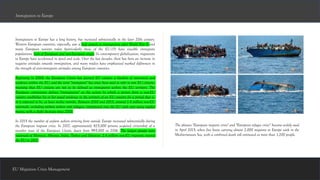
The phrases "European migrant crisis" and "European refugee crisis“ became widely used
in April 2015, when five boats carrying almost 2,000 migrants to Europe sank in the
Mediterranean Sea, with a combined death toll estimated at more than 1,200 people.
EU Migration Crisis Management
Over the past few years, the EU has been facing the worst refugee crisis since the end of World War II. There has been a
significant increase in migration to Europe since 2015. In 2016, 362,753 people fled to the EU by crossing the
Mediterranean. Of these 5,022 are reported missing or dead. The EU is currently working on the best approach to deal with
this unprecedented crisis.
In recent years, millions of people have fled to Europe from conflict, terror and persecution in their own countries. Of the
1.2 million first-time applications for asylum in the EU in 2016, over a quarter came from war-torn Syria, with
Afghanistan and Iraq in second and third place respectively. In all these countries civilians face threats from extremist
insurgent groups. In March 2016, the European Union and Ankara reached a deal to return to Turkey all irregular
migrants crossing to the Greek islands. Since May 2016 there has been a noted increase in the number of migrants crossing
the Mediterranean from Africa into Italy.
Europe’s migration crisis has exposed shortcomings in the Union’s asylum system. The European Parliament is currently
preparing a position on the reform of the Dublin system, which determines which member state is responsible for processing
asylum applications. The next step is a vote in the civil liberties committee. Parliament also took part in preparing new
measures for managing illegal immigration, tighter border controls as well as a more effective system of collecting and storing
information about people entering the EU.
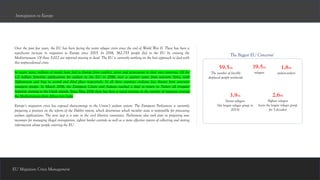
The Biggest EU Concerns!
59.5m
The number of forcibly
displaced people worlswide
19.5m
refugees
1.8m
asylum-seekers
3.9m
Syrian refugees
(the largest refugee group in
2015)
2.6m
Afghan refugees
(were the largest refugee group
for 3 decades)
Immigration to Europe
EU Migration Crisis Management
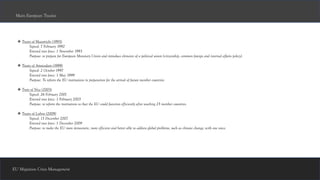
❖ Treaty of Maastricht (1993)
Signed: 7 February 1992
Entered into force: 1 November 1993
Purpose: to prepare for European Monetary Union and introduce elements of a political union (citizenship, common foreign and internal affairs policy).
❖ Treaty of Amsterdam (1999)
Signed: 2 October 1997
Entered into force: 1 May 1999
Purpose: To reform the EU institutions in preparation for the arrival of future member countries
❖ Traty of Nice (2003)
Signed: 26 February 2001
Entered into force: 1 February 2003
Purpose: to reform the institutions so that the EU could function efficiently after reaching 25 member countries.
❖ Treaty of Lisbon (2009)
Signed: 13 December 2007
Entered into force: 1 December 2009
Purpose: to make the EU more democratic, more efficient and better able to address global problems, such as climate change, with one voice.
Main European Treaties
EU Migration Crisis Management
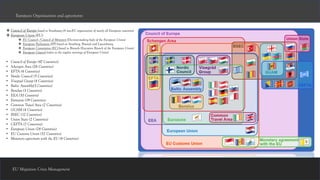
❖ Council of Europe based in Strasbourg (A non-EU organisation of nearly all European countries)
❖ European Union (EU)
❖ EU Council /Council of Ministers (Decision-making body of the European Union)
❖ European Parliament (EP) based on Strasburg, Brussels and Luxembourg
❖ European Commission (EC) based in Brussels (Executive Branch of the European Union)
❖ European Council (refers to the regular meetings of European Union)
• Council of Europe (47 Countries)
• Schengen Area (26 Countries)
• EFTA (4 Countries)
• Nordic Council (5 Countries)
• Visegrad Group (4 Countries)
• Baltic Assembly(3 Countries)
• Benelux (3 Countries)
• EEA (30 Countris)
• Eurozone (19 Countries)
• Common Travel Area (2 Countries)
• GUAM (4 Countries)
• BSEC (12 Countries)
• Union State (2 Countries)
• CEFTA (7 Countries)
• European Union (28 Countries)
• EU Customs Union (32 Countries)
• Monetary agreement with the EU (4 Countries)
European Organisations and agreements
EU Migration Crisis Management
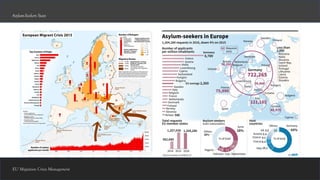
Asylum-Seekers Stats
EU Migration Crisis Management
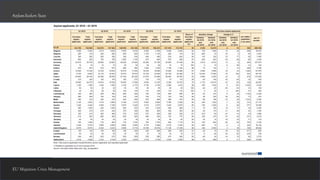
Asylum-Seekers Stats
EU Migration Crisis Management
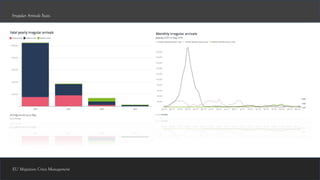
Irregular Arrivals Stats.
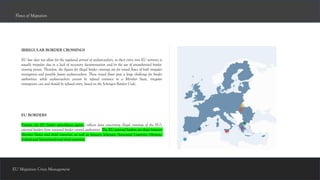
IRREGULAR BORDER CROSSINGS
EU law does not allow for the regulated arrival of asylum-seekers, so their entry into EU territory is
usually irregular, due to a lack of necessary documentation and/or the use of unauthorised border-
crossing points. Therefore, the figures for illegal border crossings are for mixed flows of both irregular
immigrants and possible future asylum-seekers. These mixed flows pose a large challenge for border
authorities: while asylum-seekers cannot be refused entrance to a Member State, irregular
immigrants can and should be refused entry, based on the Schengen Borders Code.
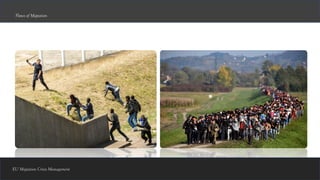
Flows of Migration
EU BORDERS
Frontex, the EU border surveillance agency, collects data concerning illegal crossings of the EU's
external borders from national border control authorities. The EU external borders are those between
Member States and third countries, as well as between Schengen Associated Countries (Norway,
Iceland and Switzerland) and third countries.
EU Migration Crisis Management
Flows of Migration
EU Migration Crisis Management
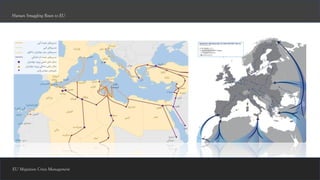
Human Smuggling Routs to EU
EU Migration Crisis Management
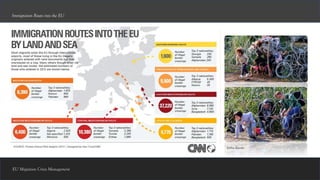
Immigration Routs into the EU
Serbia Boarder
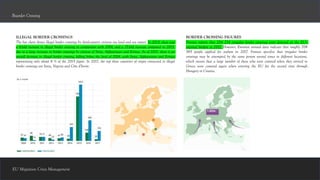
ILLEGAL BORDER CROSSINGS
The bar chart shows illegal border crossings by third-country citizens via land and sea routes. In 2015, there was
a 6-fold increase in illegal border crossing in comparison with 2014, and a 17-fold increase compared to 2013,
due to a large increase in border crossings by citizens of Syria, Afghanistan and Eritrea. As of 2017, there is an
overall decrease in illegal border crossing, falling below the level of 2014, with Syria, Afghanistan and Eritrea
representing only about 8 % of the 2015 figure. In 2017, the top three countries of origin connected to illegal
border crossings are Syria, Nigeria and Côte d'Ivoire.
BORDER CROSSING FIGURES
Frontex reports that 204 734 irregular border crossings were detected at the EU's
external borders in 2017. However, Eurostat annual data indicate that roughly 708
585 people applied for asylum in 2017. Frontex specifies that irregular border
crossings may be attempted by the same person several times in different locations,
which means that a large number of those who were counted when they arrived in
Greece were counted again when entering the EU for the second time through
Hungary or Croatia.
EU Migration Crisis Management
Boarder Crossing
EU Migration Crisis Management
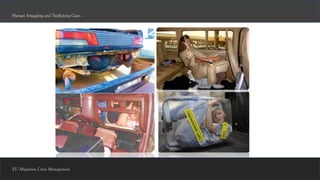
Human Smuggling and Trafficking Cases
EU Migration Crisis Management
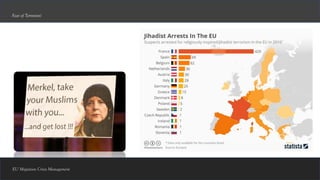
Fear of Terrorism!
❖ EU-EP and C. Dublin III Regulation
❖ EU-EC CEAS (Common European Asylum System)
EU Migration Crisis Management
The Dublin Regulation (Regulation No. 604/2013; sometimes the Dublin III Regulation;
previously the Dublin II Regulation and Dublin Convention) is a European Union (EU) law that
determines which EU Member State is responsible for the examination of an application for
asylum, submitted by persons seeking international protection under the Geneva Convention and
the EU Qualification Directive, within the European Union. It is the cornerstone of the Dublin
System, which consists of the Dublin Regulation and the EURODAC Regulation, which
establishes a Europe-wide fingerprinting database for unauthorised entrants to the EU. The Dublin
Regulation aims to “determine rapidly the Member State responsible [for an asylum claim] ”and
provides for the transfer of an asylum seeker to that Member State. Usually, the responsible
Member State will be the state through which the asylum seeker first entered the EU.
❖ Asylum seekers must remain in the first European country they enter and that country is solely
responsible for examining migrants' asylum applications.
❖ Migrants who travel to other EU states face deportation back to the EU country they originally
entered.
❖ Reformation of the Dublin Regulation
Dublin III Regulation
EU Migration Crisis Management
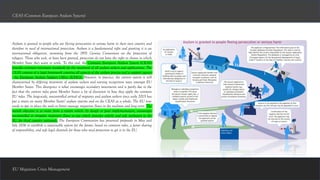
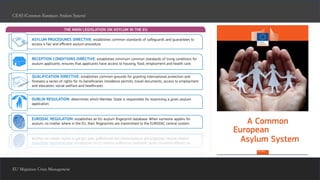
Asylum is granted to people who are fleeing persecution or serious harm in their own country and
therefore in need of international protection. Asylum is a fundamental right and granting it is an
international obligation, stemming from the 1951 Geneva Convention on the protection of
refugees. Those who seek, or have been granted, protection do not have the right to choose in which
Member State they want to settle. To this end, the Common European Asylum System (CEAS)
provides common minimum standards for the treatment of all asylum seekers and applications. The
CEAS consists of a legal framework covering all aspects of the asylum process and a support agency
- the European Asylum Support Office (EASO). However, in practice, the current system is still
characterised by differing treatment of asylum seekers and varying recognition rates amongst EU
Member States. This divergence is what encourages secondary movements and is partly due to the
fact that the current rules grant Member States a lot of discretion in how they apply the common
EU rules. The large-scale, uncontrolled arrival of migrants and asylum seekers since early 2015 has
put a strain on many Member States’ asylum systems and on the CEAS as a whole. The EU now
needs to put in place the tools to better manage migration flows in the medium and long term. The
overall objective is to move from a system which, by design or poor implementation, encourages
uncontrolled or irregular migratory flows to one which provides orderly and safe pathways to the
EU for third country nationals. The European Commission has presented proposals in May and
July 2016 to establish a sustainable system for the future, based on common rules, a fairer sharing
of responsibility, and safe legal channels for those who need protection to get it in the EU.
CEAS (Common European Asylum System)
EU Migration Crisis Management
CEAS (Common European Asylum System)
❖ EU-EP Asylum Policy
❖ EU-EP Immigration Policy
❖ EU-EP Management of the External Boarders Policy
EU Migration Crisis Management
EU Policies on Asylum-seekers, Refugees and External Borders
EU Migration Crisis Management
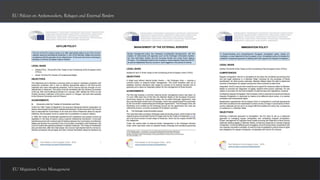
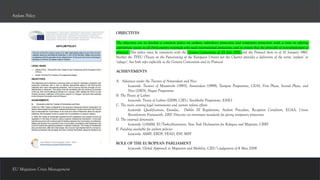
Asylum Policy
OBJECTIVES
The objectives are to develop a common policy on asylum, subsidiary protection and temporary protection with a view to offering
appropriate status to all third-country nationals who need international protection, and to ensure that the principle of non-refoulement is
observed. This policy must be consistent with the Geneva Convention of 28 July 1951 and the Protocol there to of 31 January 1967.
Neither the TFEU (Treaty on the Functioning of the European Union) nor the Charter provides a definition of the terms ‘asylum’ or
‘refugee’, but both refer explicitly to the Geneva Convention and its Protocol.
ACHIEVEMENTS
A. Advances under the Treaties of Amsterdam and Nice
keywords: Treaties of Maastricht (1993), Amsterdam (1999), Tampere Programme, CEAS, First Phase, Second Phase, and
Nice (2003), Hague Programme
B. The Treaty of Lisbon
keywords: Treaty of Lisbon (2009), CJEU, Stockholm Programme, EASO
C. The main existing legal instruments and current reform efforts
keywords: Qualification, Eurodac, Dublin III Regulations, Asylum Procedure, Reception Condition, EUAA, Union
Resettlement Framework, 2001 Directive on minimum standards for giving temporary protection
D. The external dimension
keywords: GAMM, EU-TurkeyStatement, New York Declaration for Refugees and Migrants, CRRF
E. Funding available for asylum policies
keywords: AMIF, ERDF, FEAD, ESF, MFF
ROLE OF THE EUROPEAN PARLIAMENT
keywords: Global Approach to Migration and Mobility, CJEU’s judgement of 6 May 2008
EU Migration Crisis Management
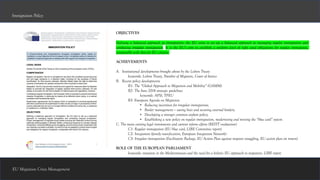
Immigration Policy
OBJECTIVES
Defining a balanced approach to immigration: the EU aims to set up a balanced approach to managing regular immigration and
combating irregular immigration. It is the EU’s aim to establish a uniform level of right sand obligations for regular immigrants,
comparable with that for EU citizens.
ACHIEVEMENTS
A. Institutional developments brought about by the Lisbon Treaty
keywords: Lisbon Treaty, Number of Migrants, Court of Justice
B. Recent policy developments
B1: The “Global Approach to Migration and Mobility” (GAMM)
B2: The June 2014 strategic guidelines
keywords: AFSJ, TFEU
B3: European Agenda on Migration
• Reducing incentives for irregular immigration;
• Border management — saving lives and securing external borders;
• Developing a stronger common asylum policy;
• Establishing a new policy on regular immigration, modernising and revising the “blue card” system
C. The main existing legal instruments and current reform efforts (REFIT evaluation)
C1: Regular immigration (EU blue card, LIBE Committee report)
C2: Integration (family reunification, European Integration Network)
C3: Irregular immigration (Facilitators Package, EU Action Plan against migrant smuggling, EU action plan on return)
ROLE OF THE EUROPEAN PARLIAMENT
keywords: situation in the Mediterranean and the need for a holistic EU approach to migration, LIBE report
EU Migration Crisis Management
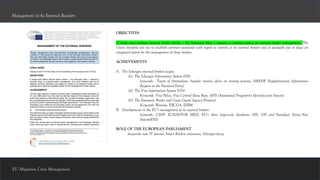
Management of the External Boarders
OBJECTIVES
A single area without internal border checks — the Schengen Area — requires a common policy on external border management. The
Union therefore sets out to establish common standards with regard to controls at its external borders and to gradually put in place an
integrated system for the management of those borders.
ACHIEVEMENTS
A. The Schengen external borders acquis
A1: The Schengen Information System (SIS)
keywords: Treaty of Amsterdam, boarder control, alerts on missing persons, SIRENE (Supplementary Information
Request at the National Entry)
A2: The Visa Information System (VIS)
Keywords: Visa Policy, Visa Central Data Base, AFIS (Automated Fingerprint Identification System)
A3: The European Border and Coast Guard Agency (Frontex)
Keywords: Warsaw, EBCGA, EIBM
B. Developments in the EU’s management of its external borders
keywords: CSDP, EUNAVFOR MED, EU’s three large-scale databases (SIS, VIS and Eurodac), Entry/Exit
System(EES)
ROLE OF THE EUROPEAN PARLIAMENT
keywords: new IT systems ,Smart Borders initiatives, Schengen freeze
❖ EU-EC Action Plan against Migrant Smuggling
❖ EU Agencies (FRONTEX, Eurodac, Eurosur, EC SIS, EU Copernicus, Europol, EMSA, EFCA)
EU Migration Crisis Management
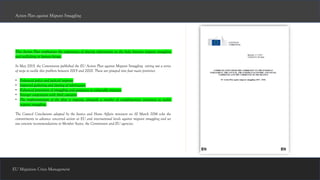
This Action Plan emphasizes the importance of sharing information on the links between migrant smuggling
and trafficking in human beings.
In May 2015, the Commission published the EU Action Plan against Migrant Smuggling setting out a series
of steps to tackle this problem between 2015 and 2020. These are grouped into four main priorities:
• Enhanced police and judicial response
• Improved gathering and sharing of information
• Enhanced prevention of smuggling and assistance to vulnerable migrants
• Stronger cooperation with third countries
• The implementation of the plan is ongoing, alongside a number of complimentary initiatives to tackle
migrant smuggling.
The Council Conclusions adopted by the Justice and Home Affairs ministers on 10 March 2016 echo the
commitments to advance concerted action at EU and international levels against migrant smuggling and set
out concrete recommendations to Member States, the Commission and EU agencies.
Action Plan against Migrant Smuggling
EU Migration Crisis Management
FRONTEX (European Border and Coast Guard Agency)
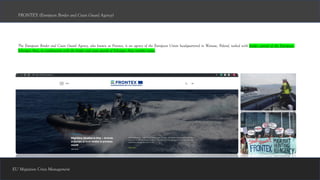
The European Border and Coast Guard Agency, also known as Frontex, is an agency of the European Union headquartered in Warsaw, Poland, tasked with border control of the European
Schengen Area, in coordination with the border and coast guards of Schengen Area member states.
EU Migration Crisis Management
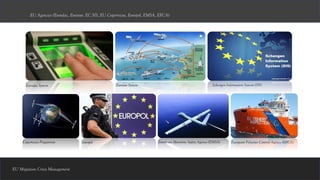
EU Agencies (Eurodac, Eurosur, EC SIS, EU Copernicus, Europol, EMSA, EFCA)
Eurodac System Eurosur System Schengen Information System (SIS)
Copernicus Programme Europol European Maritime Safety Agency (EMSA) European Fisheries Control Agency (EFCA)
❖ Impacts
❖ EU Reactions
EU Migration Crisis Management
Economic Impacts
EU Migration Crisis Management
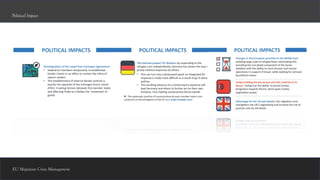
Political Impact
EU Migration Crisis Management
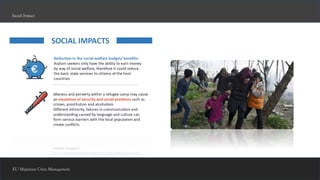
Social Impact
EU Migration Crisis Management
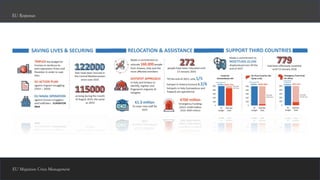
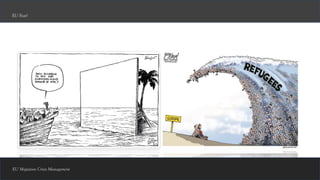
EU Responses
EU Migration Crisis Management
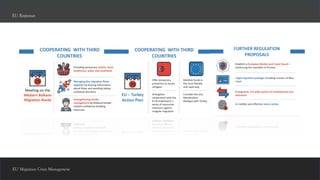
EU Responses
EU Migration Crisis Management
EU Fear!
EU Migration Crisis Management
A Reminder: The Death of Aylan Kurdi , Syrian Refugee Kid!
EU Migration Crisis Management
A Reminder: Steve Jobs, the son of a Syrian Refugee!
EU Migration Crisis Management
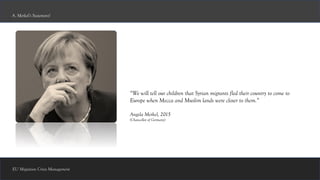
“We will tell our children that Syrian migrants fled their country to come to
Europe when Mecca and Muslim lands were closer to them.”
Angela Merkel, 2015
(Chancellor of Germany)
A. Merkel’s Statement!
❖ Terminology
❖ Main References
• Refugee
• Displaced Person
• Asylum-Seeker
• Migration
• Immigration (to)
• Emigration (from)
Acronyms:
• ECRE = European Council on Refugees and Exiles
• ENP = European Neighbourhood Policy
• ERF = European Refugee Fund
• AMIF = Asylum, Migration and Integration Fund
• ICMPD = International Centre for Migration Policy Development
• ICRC =International Committee of the Red Cross
• IDPs = Internally displaced persons
• EASO = European Asylum Support Office
• MPI= Migration Policy Institute
• RSD= Refugee Status Determination
• UNHCR = United Nations High Commissioner for Refugees
• IOM = International Organization For Migration
• EBCGA = European Border and Coast Guard Agency
Terminology
EU Migration Crisis Management
• Refugee
A person who has been recognised as being in need of international protection. According to the Geneva Refugee Convention, a refugee is a person who ‘owing to well-founded fear of being persecuted for
reasons of race, religion, nationality, membership of a particular social group or political opinion, is outside the country of his nationality and is unable or, owing to such fear, unwilling to avail himself of
the protection of that country’.
• Asylum-seeker
An asylum-seeker is a person requesting international protection due to the risk of persecution or due to risk of being ill-treated or being subjected to other serious harm in his or her home country. To qualify
as a refugee, an asylum-seeker needs to present evidence for evaluation.
• Migrants
People migrating to the EU are categorised as either: an asylum-seeker, a refugee, a beneficiary of subsidiary protection, an irregular immigrant or a legal immigrant.
• Irregular immigrant
An irregular immigrant is a person from a third-country (non-EU country) who does not fulfil, or no longer fulfils, the conditions of entry as set out in the Schengen Borders Code or other conditions for
entry, stay or residence in a Member State.
• Multiannual financial framework (MFF)
A framework regulating the budget of the EU over a number of years. It is laid down in a unanimously adopted Council Regulation with a consent of the European Parliament. The financial framework
sets the maximum amount of commitment appropriations in the EU budget each year for broad policy areas ("headings") and fixes an overall annual ceiling on payment and commitment appropriations.
• European Asylum Support Office (EASO)
The European Asylum Support Office is an agency created by European Union Regulation 439/2010 to strengthen the cooperation of EU Member States on asylum, enhance the implementation of the
Common European Asylum System, and support Member States under particular pressure.
EU Migration Crisis Management
Terminology
❖ The EU Common European Asylum System (CEAS)
It is a set of EU laws, completed in 2005. They are intended to ensure that all EU member states protect the rights of asylum seekers and refugees.
❖ Action Plan against Migrant Smuggling
EU Action Plan against migrant smuggling (2015 – 2020) This Action Plan emphasizes the importance of sharing information on the links between migrant smuggling and trafficking in human beings.
❖ The Dublin Regulation
The Dublin Regulation (Regulation No. 604/2013; sometimes the Dublin III Regulation; previously the Dublin II Regulation and Dublin Convention) is a European Union (EU) law that determines
which EU Member State is responsible for the examination of an application for asylum, submitted by persons seeking international protection under the Geneva Convention and the EU Qualification
Directive, within the European Union.
❖ Frontex
Frontex is the Agency, which helps Member States that are facing strong migratory pressure to secure the EU’s external borders, through coordinating deployment of equipment and border guards made
available by Member States. In 2016, FRONTEX became the European Border and Coast Guard Agency. The Agency coordinates joint operations of the EU Member States at the EU’s land, sea and
air borders and supports Member States in the field of migration management, the fight against cross-border crimes and search and rescue operations. It can create European Border Guard Teams (EBGT)
for deployment in joint operations and rapid border interventions and has a role in returning migrants to their country of origin.
❖ TFEU (Treaty on the Functioning of the European Union)
The Treaty on the Functioning of the European Union (2007) is one of two primary Treaties of the European Union, alongside the Treaty on European Union (TEU).
❖ Geneva Convention (1951): It is a United Nations multilateral treaty that defines who a refugee is, and sets out the rights of individuals who are granted asylum and the responsibilities of nations
that grant asylum.
❖ CJEU: The Court of Justice of the European Union is the institution of the European Union that encompasses the whole judiciary. Seated in the Kirchberg quarter of Luxembourg City.
❖ Stockholm Programme: The Stockholm Programme is a five-year plan with guidelines for justice and home affairs of the member states of the European Union for the years 2010 through 2014.
❖ Tampere Programme: A common EU asylum and migration policy.
❖ Hague Programme: The Hague programme is a five-year programme for closer co-operation in justice and home affairs at EU level from 2005 to 2010.
EU Migration Crisis Management
Terminology
❖ Global Approach to Migration and Mobility (GAMM): It is, since 2005, the overarching framework of the EU external migration and asylum policy.
❖ EU-Turkey Statement: Under this deal, Turkey agreed to take back migrants who enter Greece, and send legal refugees to EU. In exchange, EU agreed to give Turkey six billion euros, and to allow
visa-free travel for Turkish citizens by the end of June 2016 if Turkey meets 72 conditions.
❖ New York Declaration for Refugees and Migrants: The New York Declaration for Refugees and Migrants expresses the political will of world leaders to save lives, protect rights and share
responsibility on a global scale.
❖ Comprehensive Refugee Response Framework (CRRF): The overarching framework of the European Union’s external migration policy based on genuine partnership with non-EU countries and
addressing all aspects of migration and mobility issues in an integrated, comprehensive and balanced manner.
❖ Asylum Migration and Integration Fundn (AMIF): It was set up for the period 2014-20, with a total of EUR 3.137 billion for the seven years. It will promote the efficient management of
migration flows and the implementation, strengthening and development of a common Union approach to asylum and immigration.
❖ European Regional Development Fund (ERDF): is a fund allocated by the European Union. Its purpose is to transfer money from richer regions (not countries), and invest it in the infrastructure
and services of underdeveloped regions. This will allow those regions to start attracting private sector investments, and create jobs on their own.
❖ Fund for European Aid to the Most Deprived (FEAD): It is an EU-wide programme to help people take their first steps out of poverty and social exclusion.
❖ European Social Fund (ESF): The European Social Fund. Each year the ESF helps millions of Europeans improve their lives by learning new skills and finding better jobs.
❖ Multiannual Financial Framework (MFF): is the EU's long-term budget. It sets the limits for EU spending - as a whole and also for different areas of activity - over a period of at least five years.
Recent MFFs usually covered seven years.
❖ European Asylum Support Office (EASO) : It is an agency created by European Union Regulation 439/2010 to strengthen the cooperation of EU Member States on asylum.
❖ European Ayurveda Association (EUAA): It is a federation of Ayurvedic organizations, hospitals, educational institutions, therapists, manufacturers and suppliers.
❖ Union Resettlement Framework: This Regulation will help reduce irregular migration by ensuring safe and legal alternatives.
EU Migration Crisis Management
Terminology
❖ Supplementary Information Request at the National Entry (SIRENE): It is an authority established on the basis of Article 108 of the Convention Implementing the Schengen Agreement in each
state being a party to the said Convention as an authority which should have central responsibility for its national section of the Schengen Information System.
❖ Automated Fingerprint Identification System (AFIS): It is the process of using a computer to match fingerprints against a database of known and unknown prints.
❖ European Border and Coast Guard Agency (EBCGA): see FRONTEX
❖ European integrated border management (EIBM): National and international coordination and cooperation among all relevant authorities and agencies involved in border security and trade
facilitation to establish effective, efficient and coordinated border management at the external EU borders , in order to reach the objective of open, but well controlled and secure borders.
❖ Common Security and Defence Policy (CSDP): It is the EU's course of action in the fields of defence and crisis management, and a main component of the EU's Common Foreign and Security Policy
❖ EUNAVFOR MED: It is a military operation of the European Union with the aim of neutralising established refugee smuggling routes in the Mediterranean.
❖ Entry/Exit System (EES): It is a large-scale IT system planned by the European Union for the automatic monitoring of the border-crossing of third-country nationals.
❖ Area of Freedom, Security and Justice (AFSJ): It is a collection of home affairs and justice policies designed to ensure security, rights and free movement within the European Union (EU).
❖ EU Blue Card: It is an approved EU -wide work permit allowing high-skilled non-EU citizens to work and live in any country within the EU, excluding Denmark, Ireland and the UK.
❖ The Committee on Civil Liberties, Justice and Home Affairs (LIBE): It is a standing committee of the European Parliament that is responsible for protecting civil liberties and human rights,
including those of minorities, as listed in the Charter of Fundamental Rights of the European Union.
❖ European Integration Network (EIN): brings together representatives of national public authorities - mainly from the ministries responsible for migrant integration - from all 28 EU Member States and
two EEA countries, Iceland and Norway.
❖ EU Action Plan on Return: It will support substantially the return activities of the Member States, which are planning to devote more than €800 million to return in their national programmes in the
period 2014-2020.
❖ UNHCR: the UN Refugee Agency
EU Migration Crisis Management
Terminology
EU Migration Crisis Management
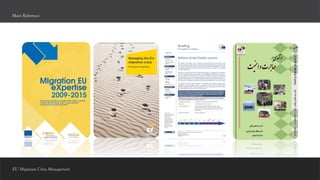
Main References
EU Migration Crisis Management
FineThank you for Attention
Siamak A.Bazzaz
“ Europe is caught between those who want to get in, those who want to get out, and those who want to destroy it. The incomers are
desperate, the outbound are angry and the destroyers are brandishing flags. This triple onslaught has, for the first time in its history, left
the 28-member European Union more vulnerable to fracture than it is susceptible to further integration.”
Roger Cohen, 2015
(Columnist for The New York Times and International New York Times)

The EU Migration Crisis Management

  • 1.
    The EU MigrationCrisis Management Policies on Management of Asylum-seekers, Refugees and External Borders A Presentation Provided for the Course of: “The Seminar of Crises Management in the City by Professor S.Mahdi Zarghani” Delivered by: Siamak A.Bazzaz June 25th, 2019
  • 2.
    EU Migration CrisisManagement ❖ General Statement ❖ Treaties of Maastricht (1993), Amsterdam (1999), Nice (2003), Lisbon (2009) ❖ EU-EP and C. Dublin III Regulation ❖ EU-EC CEAS (Common European Asylum System) ❖ EU-EP Asylum Policy ❖ EU-EP Immigration Policy ❖ EU-EP Management of the External Boarders Policy ❖ EU-EC Action Plan against Migrant Smuggling ❖ EU-EC Action Plan on Return ❖ EU Agencies (FRONTEX, Eurodac, Eurosur, EC SIS, EU Copernicus, Europol, EMSA, EFCA) ❖ Impacts • Economic Impacts • Political Impacts • Social Impacts ❖ EU Reactions • Saving lives and securing • Relocation and assistance • Support third countries • Cooperating with third countries • Further regulation and proposals ❖ Terminology/Main References Outline
  • 3.
  • 4.
    EU Migration CrisisManagement Migration represents challenges and opportunities for Europe. The increase in migration to Europe requires a response from the EU on a number of levels. Firstly, policies to handle regular and irregular immigration, and secondly, common EU-wide rules on asylum. The migrant crisis of late has also resulted in a need for additional measures and reforms to ensure border security as well as a fairer distribution of asylum seekers among EU countries. The current migration crisis is the worst since World War II. In 2015 and 2016 alone, more than 2.5 million people applied for asylum in the EU, while more than 2,030 people are thought to have lost their lives in the Mediterranean in the first six months of 2017 alone. In 2015 and 2016, more than 2.3 million illegal crossings were detected by Frontex, the EU border surveillance agency. The crisis has exposed shortcomings in the European migration system. Parliament and the EU have sought to combat this by reforming the EU asylum rules and creating a fairer system of distributing asylum seekers among EU countries, as well as strengthening EU border controls and managing controlling irregular immigration. The immigration policy at European level deals both with legal and irregular immigration. Regarding regular immigration, the EU decides on conditions for legal entry and residence. Member states keep the right to rule on admission volumes for people coming from non-EU countries to seek work. The European Union tackles also irregular immigration, especially through a return policy that respects fundamental rights. With regards to integration, there is no harmonisation of national legislations. However, the EU can play a supporting role, especially financially. The European Parliament is actively involved, in the adoption of new laws on irregular and regular immigration. It is a full co-legislator together with the Council representing member states on these matters since the entry into force of the Lisbon Treaty in 2009. Since 1999, the EU has been working to create a Common European Asylum System (CEAS). For the common system to work, it must have: • Consistent rules for granting the refugee status across all member states • A mechanism for determining which member state is responsible for considering an asylum application • Standards on reception conditions • Partnerships and cooperation with non-EU countries Immigration to Europe
  • 5.
    EU Migration CrisisManagement Immigration to Europe has a long history, but increased substantially in the later 20th century. Western European countries, especially, saw a high growth in immigration after World War II and many European nations today (particularly those of the EU-15) have sizeable immigrant populations, both of European and non-European origin. In contemporary globalization, migrations to Europe have accelerated in speed and scale. Over the last decades, there has been an increase in negative attitudes towards immigration, and many studies have emphasized marked differences in the strength of anti-immigrant attitudes among European countries. Beginning in 2004, the European Union has granted EU citizens a freedom of movement and residence within the EU, and the term "immigrant" has since been used to refer to non EU citizens, meaning that EU citizens are not to be defined as immigrants within the EU territory. The European commission defines "immigration" as the action by which a person from a non-EU country establishes his or her usual residence in the territory of an EU country for a period that is, or is expected to be, at least twelve months. Between 2010 and 2013, around 1.4 million non-EU nationals, excluding asylum seekers and refugees, immigrated into the EU each year using regular means, with a slight decrease since 2010. In 2015 the number of asylum seekers arriving from outside Europe increased substantially during the European migrant crisis. In 2017, approximately 825,000 persons acquired citizenship of a member state of the European Union, down from 995,000 in 2016. The largest groups were nationals of Morocco, Albania, India, Turkey and Pakistan. 2.4 million non-EU migrants entered the EU in 2017. Immigration to Europe The phrases "European migrant crisis" and "European refugee crisis“ became widely used in April 2015, when five boats carrying almost 2,000 migrants to Europe sank in the Mediterranean Sea, with a combined death toll estimated at more than 1,200 people.
  • 6.
    EU Migration CrisisManagement Over the past few years, the EU has been facing the worst refugee crisis since the end of World War II. There has been a significant increase in migration to Europe since 2015. In 2016, 362,753 people fled to the EU by crossing the Mediterranean. Of these 5,022 are reported missing or dead. The EU is currently working on the best approach to deal with this unprecedented crisis. In recent years, millions of people have fled to Europe from conflict, terror and persecution in their own countries. Of the 1.2 million first-time applications for asylum in the EU in 2016, over a quarter came from war-torn Syria, with Afghanistan and Iraq in second and third place respectively. In all these countries civilians face threats from extremist insurgent groups. In March 2016, the European Union and Ankara reached a deal to return to Turkey all irregular migrants crossing to the Greek islands. Since May 2016 there has been a noted increase in the number of migrants crossing the Mediterranean from Africa into Italy. Europe’s migration crisis has exposed shortcomings in the Union’s asylum system. The European Parliament is currently preparing a position on the reform of the Dublin system, which determines which member state is responsible for processing asylum applications. The next step is a vote in the civil liberties committee. Parliament also took part in preparing new measures for managing illegal immigration, tighter border controls as well as a more effective system of collecting and storing information about people entering the EU. The Biggest EU Concerns! 59.5m The number of forcibly displaced people worlswide 19.5m refugees 1.8m asylum-seekers 3.9m Syrian refugees (the largest refugee group in 2015) 2.6m Afghan refugees (were the largest refugee group for 3 decades) Immigration to Europe
  • 7.
    EU Migration CrisisManagement ❖ Treaty of Maastricht (1993) Signed: 7 February 1992 Entered into force: 1 November 1993 Purpose: to prepare for European Monetary Union and introduce elements of a political union (citizenship, common foreign and internal affairs policy). ❖ Treaty of Amsterdam (1999) Signed: 2 October 1997 Entered into force: 1 May 1999 Purpose: To reform the EU institutions in preparation for the arrival of future member countries ❖ Traty of Nice (2003) Signed: 26 February 2001 Entered into force: 1 February 2003 Purpose: to reform the institutions so that the EU could function efficiently after reaching 25 member countries. ❖ Treaty of Lisbon (2009) Signed: 13 December 2007 Entered into force: 1 December 2009 Purpose: to make the EU more democratic, more efficient and better able to address global problems, such as climate change, with one voice. Main European Treaties
  • 8.
    EU Migration CrisisManagement ❖ Council of Europe based in Strasbourg (A non-EU organisation of nearly all European countries) ❖ European Union (EU) ❖ EU Council /Council of Ministers (Decision-making body of the European Union) ❖ European Parliament (EP) based on Strasburg, Brussels and Luxembourg ❖ European Commission (EC) based in Brussels (Executive Branch of the European Union) ❖ European Council (refers to the regular meetings of European Union) • Council of Europe (47 Countries) • Schengen Area (26 Countries) • EFTA (4 Countries) • Nordic Council (5 Countries) • Visegrad Group (4 Countries) • Baltic Assembly(3 Countries) • Benelux (3 Countries) • EEA (30 Countris) • Eurozone (19 Countries) • Common Travel Area (2 Countries) • GUAM (4 Countries) • BSEC (12 Countries) • Union State (2 Countries) • CEFTA (7 Countries) • European Union (28 Countries) • EU Customs Union (32 Countries) • Monetary agreement with the EU (4 Countries) European Organisations and agreements
  • 9.
    EU Migration CrisisManagement Asylum-Seekers Stats
  • 10.
    EU Migration CrisisManagement Asylum-Seekers Stats
  • 11.
    EU Migration CrisisManagement Irregular Arrivals Stats.
  • 12.
    IRREGULAR BORDER CROSSINGS EUlaw does not allow for the regulated arrival of asylum-seekers, so their entry into EU territory is usually irregular, due to a lack of necessary documentation and/or the use of unauthorised border- crossing points. Therefore, the figures for illegal border crossings are for mixed flows of both irregular immigrants and possible future asylum-seekers. These mixed flows pose a large challenge for border authorities: while asylum-seekers cannot be refused entrance to a Member State, irregular immigrants can and should be refused entry, based on the Schengen Borders Code. Flows of Migration EU BORDERS Frontex, the EU border surveillance agency, collects data concerning illegal crossings of the EU's external borders from national border control authorities. The EU external borders are those between Member States and third countries, as well as between Schengen Associated Countries (Norway, Iceland and Switzerland) and third countries. EU Migration Crisis Management
  • 13.
    EU Migration CrisisManagement Flows of Migration
  • 14.
    EU Migration CrisisManagement Human Smuggling Routs to EU
  • 15.
    EU Migration CrisisManagement Immigration Routs into the EU Serbia Boarder
  • 16.
    ILLEGAL BORDER CROSSINGS Thebar chart shows illegal border crossings by third-country citizens via land and sea routes. In 2015, there was a 6-fold increase in illegal border crossing in comparison with 2014, and a 17-fold increase compared to 2013, due to a large increase in border crossings by citizens of Syria, Afghanistan and Eritrea. As of 2017, there is an overall decrease in illegal border crossing, falling below the level of 2014, with Syria, Afghanistan and Eritrea representing only about 8 % of the 2015 figure. In 2017, the top three countries of origin connected to illegal border crossings are Syria, Nigeria and Côte d'Ivoire. BORDER CROSSING FIGURES Frontex reports that 204 734 irregular border crossings were detected at the EU's external borders in 2017. However, Eurostat annual data indicate that roughly 708 585 people applied for asylum in 2017. Frontex specifies that irregular border crossings may be attempted by the same person several times in different locations, which means that a large number of those who were counted when they arrived in Greece were counted again when entering the EU for the second time through Hungary or Croatia. EU Migration Crisis Management Boarder Crossing
  • 17.
    EU Migration CrisisManagement Human Smuggling and Trafficking Cases
  • 18.
    EU Migration CrisisManagement Fear of Terrorism!
  • 19.
    ❖ EU-EP andC. Dublin III Regulation ❖ EU-EC CEAS (Common European Asylum System)
  • 20.
    EU Migration CrisisManagement The Dublin Regulation (Regulation No. 604/2013; sometimes the Dublin III Regulation; previously the Dublin II Regulation and Dublin Convention) is a European Union (EU) law that determines which EU Member State is responsible for the examination of an application for asylum, submitted by persons seeking international protection under the Geneva Convention and the EU Qualification Directive, within the European Union. It is the cornerstone of the Dublin System, which consists of the Dublin Regulation and the EURODAC Regulation, which establishes a Europe-wide fingerprinting database for unauthorised entrants to the EU. The Dublin Regulation aims to “determine rapidly the Member State responsible [for an asylum claim] ”and provides for the transfer of an asylum seeker to that Member State. Usually, the responsible Member State will be the state through which the asylum seeker first entered the EU. ❖ Asylum seekers must remain in the first European country they enter and that country is solely responsible for examining migrants' asylum applications. ❖ Migrants who travel to other EU states face deportation back to the EU country they originally entered. ❖ Reformation of the Dublin Regulation Dublin III Regulation
  • 21.
    EU Migration CrisisManagement Asylum is granted to people who are fleeing persecution or serious harm in their own country and therefore in need of international protection. Asylum is a fundamental right and granting it is an international obligation, stemming from the 1951 Geneva Convention on the protection of refugees. Those who seek, or have been granted, protection do not have the right to choose in which Member State they want to settle. To this end, the Common European Asylum System (CEAS) provides common minimum standards for the treatment of all asylum seekers and applications. The CEAS consists of a legal framework covering all aspects of the asylum process and a support agency - the European Asylum Support Office (EASO). However, in practice, the current system is still characterised by differing treatment of asylum seekers and varying recognition rates amongst EU Member States. This divergence is what encourages secondary movements and is partly due to the fact that the current rules grant Member States a lot of discretion in how they apply the common EU rules. The large-scale, uncontrolled arrival of migrants and asylum seekers since early 2015 has put a strain on many Member States’ asylum systems and on the CEAS as a whole. The EU now needs to put in place the tools to better manage migration flows in the medium and long term. The overall objective is to move from a system which, by design or poor implementation, encourages uncontrolled or irregular migratory flows to one which provides orderly and safe pathways to the EU for third country nationals. The European Commission has presented proposals in May and July 2016 to establish a sustainable system for the future, based on common rules, a fairer sharing of responsibility, and safe legal channels for those who need protection to get it in the EU. CEAS (Common European Asylum System)
  • 22.
    EU Migration CrisisManagement CEAS (Common European Asylum System)
  • 23.
    ❖ EU-EP AsylumPolicy ❖ EU-EP Immigration Policy ❖ EU-EP Management of the External Boarders Policy
  • 24.
    EU Migration CrisisManagement EU Policies on Asylum-seekers, Refugees and External Borders
  • 25.
    EU Migration CrisisManagement Asylum Policy OBJECTIVES The objectives are to develop a common policy on asylum, subsidiary protection and temporary protection with a view to offering appropriate status to all third-country nationals who need international protection, and to ensure that the principle of non-refoulement is observed. This policy must be consistent with the Geneva Convention of 28 July 1951 and the Protocol there to of 31 January 1967. Neither the TFEU (Treaty on the Functioning of the European Union) nor the Charter provides a definition of the terms ‘asylum’ or ‘refugee’, but both refer explicitly to the Geneva Convention and its Protocol. ACHIEVEMENTS A. Advances under the Treaties of Amsterdam and Nice keywords: Treaties of Maastricht (1993), Amsterdam (1999), Tampere Programme, CEAS, First Phase, Second Phase, and Nice (2003), Hague Programme B. The Treaty of Lisbon keywords: Treaty of Lisbon (2009), CJEU, Stockholm Programme, EASO C. The main existing legal instruments and current reform efforts keywords: Qualification, Eurodac, Dublin III Regulations, Asylum Procedure, Reception Condition, EUAA, Union Resettlement Framework, 2001 Directive on minimum standards for giving temporary protection D. The external dimension keywords: GAMM, EU-TurkeyStatement, New York Declaration for Refugees and Migrants, CRRF E. Funding available for asylum policies keywords: AMIF, ERDF, FEAD, ESF, MFF ROLE OF THE EUROPEAN PARLIAMENT keywords: Global Approach to Migration and Mobility, CJEU’s judgement of 6 May 2008
  • 26.
    EU Migration CrisisManagement Immigration Policy OBJECTIVES Defining a balanced approach to immigration: the EU aims to set up a balanced approach to managing regular immigration and combating irregular immigration. It is the EU’s aim to establish a uniform level of right sand obligations for regular immigrants, comparable with that for EU citizens. ACHIEVEMENTS A. Institutional developments brought about by the Lisbon Treaty keywords: Lisbon Treaty, Number of Migrants, Court of Justice B. Recent policy developments B1: The “Global Approach to Migration and Mobility” (GAMM) B2: The June 2014 strategic guidelines keywords: AFSJ, TFEU B3: European Agenda on Migration • Reducing incentives for irregular immigration; • Border management — saving lives and securing external borders; • Developing a stronger common asylum policy; • Establishing a new policy on regular immigration, modernising and revising the “blue card” system C. The main existing legal instruments and current reform efforts (REFIT evaluation) C1: Regular immigration (EU blue card, LIBE Committee report) C2: Integration (family reunification, European Integration Network) C3: Irregular immigration (Facilitators Package, EU Action Plan against migrant smuggling, EU action plan on return) ROLE OF THE EUROPEAN PARLIAMENT keywords: situation in the Mediterranean and the need for a holistic EU approach to migration, LIBE report
  • 27.
    EU Migration CrisisManagement Management of the External Boarders OBJECTIVES A single area without internal border checks — the Schengen Area — requires a common policy on external border management. The Union therefore sets out to establish common standards with regard to controls at its external borders and to gradually put in place an integrated system for the management of those borders. ACHIEVEMENTS A. The Schengen external borders acquis A1: The Schengen Information System (SIS) keywords: Treaty of Amsterdam, boarder control, alerts on missing persons, SIRENE (Supplementary Information Request at the National Entry) A2: The Visa Information System (VIS) Keywords: Visa Policy, Visa Central Data Base, AFIS (Automated Fingerprint Identification System) A3: The European Border and Coast Guard Agency (Frontex) Keywords: Warsaw, EBCGA, EIBM B. Developments in the EU’s management of its external borders keywords: CSDP, EUNAVFOR MED, EU’s three large-scale databases (SIS, VIS and Eurodac), Entry/Exit System(EES) ROLE OF THE EUROPEAN PARLIAMENT keywords: new IT systems ,Smart Borders initiatives, Schengen freeze
  • 28.
    ❖ EU-EC ActionPlan against Migrant Smuggling ❖ EU Agencies (FRONTEX, Eurodac, Eurosur, EC SIS, EU Copernicus, Europol, EMSA, EFCA)
  • 29.
    EU Migration CrisisManagement This Action Plan emphasizes the importance of sharing information on the links between migrant smuggling and trafficking in human beings. In May 2015, the Commission published the EU Action Plan against Migrant Smuggling setting out a series of steps to tackle this problem between 2015 and 2020. These are grouped into four main priorities: • Enhanced police and judicial response • Improved gathering and sharing of information • Enhanced prevention of smuggling and assistance to vulnerable migrants • Stronger cooperation with third countries • The implementation of the plan is ongoing, alongside a number of complimentary initiatives to tackle migrant smuggling. The Council Conclusions adopted by the Justice and Home Affairs ministers on 10 March 2016 echo the commitments to advance concerted action at EU and international levels against migrant smuggling and set out concrete recommendations to Member States, the Commission and EU agencies. Action Plan against Migrant Smuggling
  • 30.
    EU Migration CrisisManagement FRONTEX (European Border and Coast Guard Agency) The European Border and Coast Guard Agency, also known as Frontex, is an agency of the European Union headquartered in Warsaw, Poland, tasked with border control of the European Schengen Area, in coordination with the border and coast guards of Schengen Area member states.
  • 31.
    EU Migration CrisisManagement EU Agencies (Eurodac, Eurosur, EC SIS, EU Copernicus, Europol, EMSA, EFCA) Eurodac System Eurosur System Schengen Information System (SIS) Copernicus Programme Europol European Maritime Safety Agency (EMSA) European Fisheries Control Agency (EFCA)
  • 32.
  • 33.
    EU Migration CrisisManagement Economic Impacts
  • 34.
    EU Migration CrisisManagement Political Impact
  • 35.
    EU Migration CrisisManagement Social Impact
  • 36.
    EU Migration CrisisManagement EU Responses
  • 37.
    EU Migration CrisisManagement EU Responses
  • 38.
    EU Migration CrisisManagement EU Fear!
  • 39.
    EU Migration CrisisManagement A Reminder: The Death of Aylan Kurdi , Syrian Refugee Kid!
  • 40.
    EU Migration CrisisManagement A Reminder: Steve Jobs, the son of a Syrian Refugee!
  • 41.
    EU Migration CrisisManagement “We will tell our children that Syrian migrants fled their country to come to Europe when Mecca and Muslim lands were closer to them.” Angela Merkel, 2015 (Chancellor of Germany) A. Merkel’s Statement!
  • 42.
  • 43.
    • Refugee • DisplacedPerson • Asylum-Seeker • Migration • Immigration (to) • Emigration (from) Acronyms: • ECRE = European Council on Refugees and Exiles • ENP = European Neighbourhood Policy • ERF = European Refugee Fund • AMIF = Asylum, Migration and Integration Fund • ICMPD = International Centre for Migration Policy Development • ICRC =International Committee of the Red Cross • IDPs = Internally displaced persons • EASO = European Asylum Support Office • MPI= Migration Policy Institute • RSD= Refugee Status Determination • UNHCR = United Nations High Commissioner for Refugees • IOM = International Organization For Migration • EBCGA = European Border and Coast Guard Agency Terminology EU Migration Crisis Management
  • 44.
    • Refugee A personwho has been recognised as being in need of international protection. According to the Geneva Refugee Convention, a refugee is a person who ‘owing to well-founded fear of being persecuted for reasons of race, religion, nationality, membership of a particular social group or political opinion, is outside the country of his nationality and is unable or, owing to such fear, unwilling to avail himself of the protection of that country’. • Asylum-seeker An asylum-seeker is a person requesting international protection due to the risk of persecution or due to risk of being ill-treated or being subjected to other serious harm in his or her home country. To qualify as a refugee, an asylum-seeker needs to present evidence for evaluation. • Migrants People migrating to the EU are categorised as either: an asylum-seeker, a refugee, a beneficiary of subsidiary protection, an irregular immigrant or a legal immigrant. • Irregular immigrant An irregular immigrant is a person from a third-country (non-EU country) who does not fulfil, or no longer fulfils, the conditions of entry as set out in the Schengen Borders Code or other conditions for entry, stay or residence in a Member State. • Multiannual financial framework (MFF) A framework regulating the budget of the EU over a number of years. It is laid down in a unanimously adopted Council Regulation with a consent of the European Parliament. The financial framework sets the maximum amount of commitment appropriations in the EU budget each year for broad policy areas ("headings") and fixes an overall annual ceiling on payment and commitment appropriations. • European Asylum Support Office (EASO) The European Asylum Support Office is an agency created by European Union Regulation 439/2010 to strengthen the cooperation of EU Member States on asylum, enhance the implementation of the Common European Asylum System, and support Member States under particular pressure. EU Migration Crisis Management Terminology
  • 45.
    ❖ The EUCommon European Asylum System (CEAS) It is a set of EU laws, completed in 2005. They are intended to ensure that all EU member states protect the rights of asylum seekers and refugees. ❖ Action Plan against Migrant Smuggling EU Action Plan against migrant smuggling (2015 – 2020) This Action Plan emphasizes the importance of sharing information on the links between migrant smuggling and trafficking in human beings. ❖ The Dublin Regulation The Dublin Regulation (Regulation No. 604/2013; sometimes the Dublin III Regulation; previously the Dublin II Regulation and Dublin Convention) is a European Union (EU) law that determines which EU Member State is responsible for the examination of an application for asylum, submitted by persons seeking international protection under the Geneva Convention and the EU Qualification Directive, within the European Union. ❖ Frontex Frontex is the Agency, which helps Member States that are facing strong migratory pressure to secure the EU’s external borders, through coordinating deployment of equipment and border guards made available by Member States. In 2016, FRONTEX became the European Border and Coast Guard Agency. The Agency coordinates joint operations of the EU Member States at the EU’s land, sea and air borders and supports Member States in the field of migration management, the fight against cross-border crimes and search and rescue operations. It can create European Border Guard Teams (EBGT) for deployment in joint operations and rapid border interventions and has a role in returning migrants to their country of origin. ❖ TFEU (Treaty on the Functioning of the European Union) The Treaty on the Functioning of the European Union (2007) is one of two primary Treaties of the European Union, alongside the Treaty on European Union (TEU). ❖ Geneva Convention (1951): It is a United Nations multilateral treaty that defines who a refugee is, and sets out the rights of individuals who are granted asylum and the responsibilities of nations that grant asylum. ❖ CJEU: The Court of Justice of the European Union is the institution of the European Union that encompasses the whole judiciary. Seated in the Kirchberg quarter of Luxembourg City. ❖ Stockholm Programme: The Stockholm Programme is a five-year plan with guidelines for justice and home affairs of the member states of the European Union for the years 2010 through 2014. ❖ Tampere Programme: A common EU asylum and migration policy. ❖ Hague Programme: The Hague programme is a five-year programme for closer co-operation in justice and home affairs at EU level from 2005 to 2010. EU Migration Crisis Management Terminology
  • 46.
    ❖ Global Approachto Migration and Mobility (GAMM): It is, since 2005, the overarching framework of the EU external migration and asylum policy. ❖ EU-Turkey Statement: Under this deal, Turkey agreed to take back migrants who enter Greece, and send legal refugees to EU. In exchange, EU agreed to give Turkey six billion euros, and to allow visa-free travel for Turkish citizens by the end of June 2016 if Turkey meets 72 conditions. ❖ New York Declaration for Refugees and Migrants: The New York Declaration for Refugees and Migrants expresses the political will of world leaders to save lives, protect rights and share responsibility on a global scale. ❖ Comprehensive Refugee Response Framework (CRRF): The overarching framework of the European Union’s external migration policy based on genuine partnership with non-EU countries and addressing all aspects of migration and mobility issues in an integrated, comprehensive and balanced manner. ❖ Asylum Migration and Integration Fundn (AMIF): It was set up for the period 2014-20, with a total of EUR 3.137 billion for the seven years. It will promote the efficient management of migration flows and the implementation, strengthening and development of a common Union approach to asylum and immigration. ❖ European Regional Development Fund (ERDF): is a fund allocated by the European Union. Its purpose is to transfer money from richer regions (not countries), and invest it in the infrastructure and services of underdeveloped regions. This will allow those regions to start attracting private sector investments, and create jobs on their own. ❖ Fund for European Aid to the Most Deprived (FEAD): It is an EU-wide programme to help people take their first steps out of poverty and social exclusion. ❖ European Social Fund (ESF): The European Social Fund. Each year the ESF helps millions of Europeans improve their lives by learning new skills and finding better jobs. ❖ Multiannual Financial Framework (MFF): is the EU's long-term budget. It sets the limits for EU spending - as a whole and also for different areas of activity - over a period of at least five years. Recent MFFs usually covered seven years. ❖ European Asylum Support Office (EASO) : It is an agency created by European Union Regulation 439/2010 to strengthen the cooperation of EU Member States on asylum. ❖ European Ayurveda Association (EUAA): It is a federation of Ayurvedic organizations, hospitals, educational institutions, therapists, manufacturers and suppliers. ❖ Union Resettlement Framework: This Regulation will help reduce irregular migration by ensuring safe and legal alternatives. EU Migration Crisis Management Terminology
  • 47.
    ❖ Supplementary InformationRequest at the National Entry (SIRENE): It is an authority established on the basis of Article 108 of the Convention Implementing the Schengen Agreement in each state being a party to the said Convention as an authority which should have central responsibility for its national section of the Schengen Information System. ❖ Automated Fingerprint Identification System (AFIS): It is the process of using a computer to match fingerprints against a database of known and unknown prints. ❖ European Border and Coast Guard Agency (EBCGA): see FRONTEX ❖ European integrated border management (EIBM): National and international coordination and cooperation among all relevant authorities and agencies involved in border security and trade facilitation to establish effective, efficient and coordinated border management at the external EU borders , in order to reach the objective of open, but well controlled and secure borders. ❖ Common Security and Defence Policy (CSDP): It is the EU's course of action in the fields of defence and crisis management, and a main component of the EU's Common Foreign and Security Policy ❖ EUNAVFOR MED: It is a military operation of the European Union with the aim of neutralising established refugee smuggling routes in the Mediterranean. ❖ Entry/Exit System (EES): It is a large-scale IT system planned by the European Union for the automatic monitoring of the border-crossing of third-country nationals. ❖ Area of Freedom, Security and Justice (AFSJ): It is a collection of home affairs and justice policies designed to ensure security, rights and free movement within the European Union (EU). ❖ EU Blue Card: It is an approved EU -wide work permit allowing high-skilled non-EU citizens to work and live in any country within the EU, excluding Denmark, Ireland and the UK. ❖ The Committee on Civil Liberties, Justice and Home Affairs (LIBE): It is a standing committee of the European Parliament that is responsible for protecting civil liberties and human rights, including those of minorities, as listed in the Charter of Fundamental Rights of the European Union. ❖ European Integration Network (EIN): brings together representatives of national public authorities - mainly from the ministries responsible for migrant integration - from all 28 EU Member States and two EEA countries, Iceland and Norway. ❖ EU Action Plan on Return: It will support substantially the return activities of the Member States, which are planning to devote more than €800 million to return in their national programmes in the period 2014-2020. ❖ UNHCR: the UN Refugee Agency EU Migration Crisis Management Terminology
  • 48.
    EU Migration CrisisManagement Main References
  • 49.
    EU Migration CrisisManagement FineThank you for Attention Siamak A.Bazzaz “ Europe is caught between those who want to get in, those who want to get out, and those who want to destroy it. The incomers are desperate, the outbound are angry and the destroyers are brandishing flags. This triple onslaught has, for the first time in its history, left the 28-member European Union more vulnerable to fracture than it is susceptible to further integration.” Roger Cohen, 2015 (Columnist for The New York Times and International New York Times)