TheThe
EngagementEngagement
FactorFactor
Workforce engagement…What is it?Workforce engagement…What is it?
How is it accomplished?How is it accomplished?
Washoe Tribe
Of Nevada & California
What is anWhat is an
engagedengaged
workforce?workforce?
► Engagement is a positive and strong emotional
connection with one’s work
► Engaged individuals feel that WHO they are and WHAT
they do are intrinsically connected.
► A combination of energy, enthusiasm, and focus Engaged
individuals feel energetic, are proud of what they do, and
are able to concentrate on their tasks at work.
How to achieve engagementHow to achieve engagement
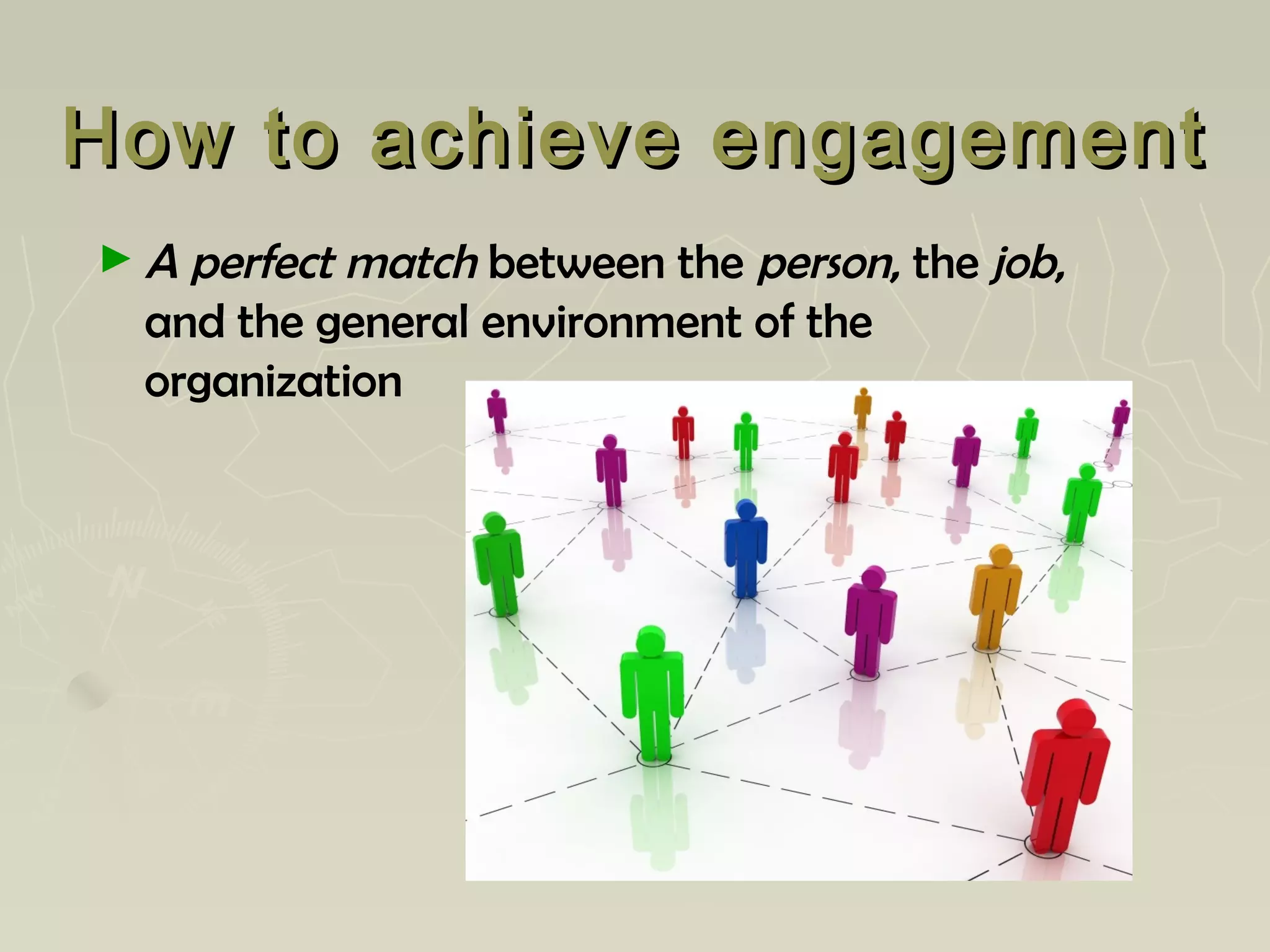
► A perfect match between the person, the job,
and the general environment of the
organization
Results of an engagedResults of an engaged
workforceworkforce
► Desirable outcomes result in
customer commitment, employee
loyalty, increased productivity,
and superior service.
► Ideally, a fully engaged worker
could win the lottery and still
come to work the next day
CharacteristicsCharacteristics
of an engagedof an engaged
workerworker
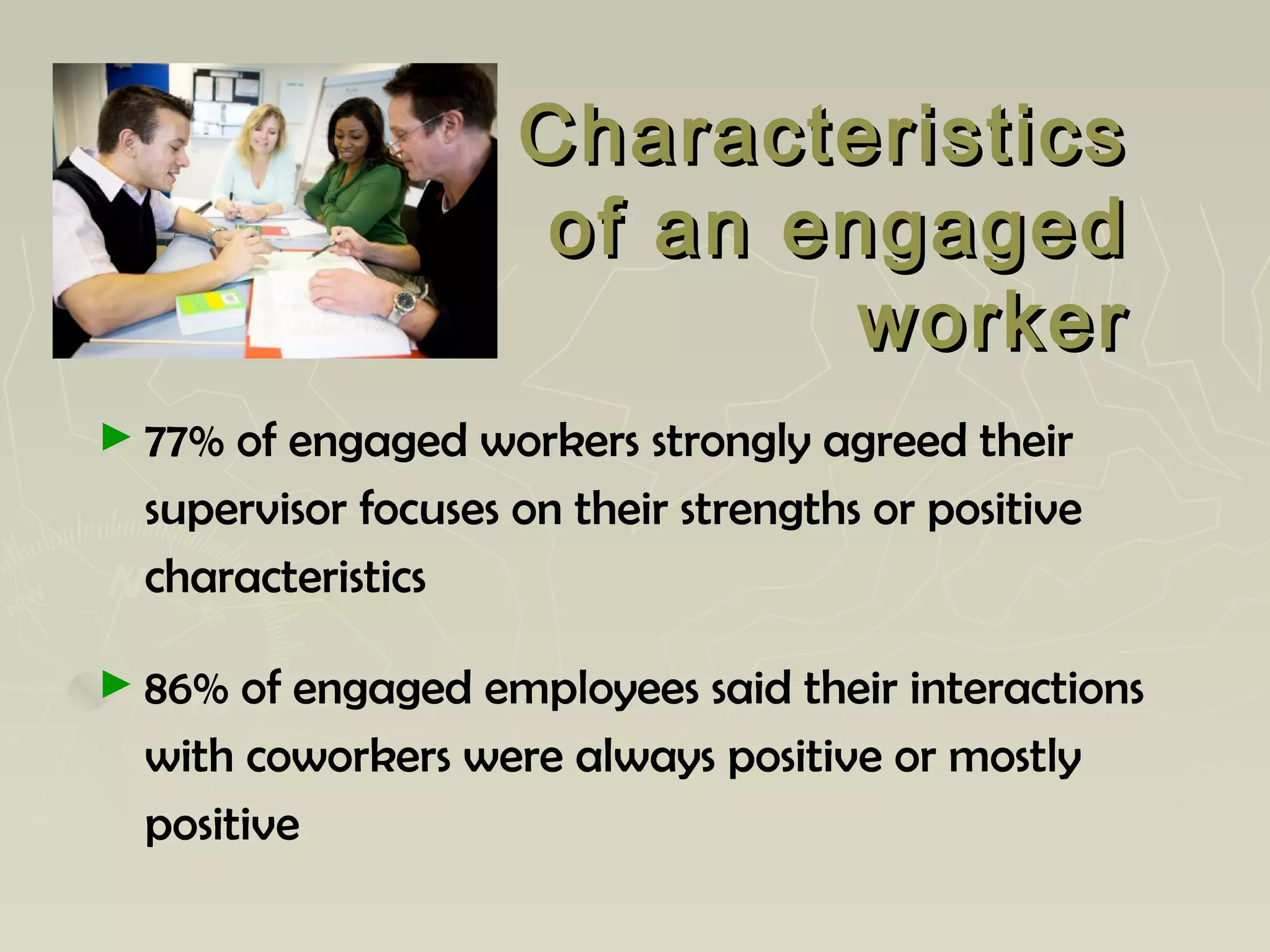
► 77% of engaged workers strongly agreed their
supervisor focuses on their strengths or positive
characteristics
► 86% of engaged employees said their interactions
with coworkers were always positive or mostly
positive
Who is engaged?Who is engaged?
► Approx. 29% of U.S. employees
are engaged
► Not permanent
► Different employees
► Different degrees of
engagement
► Different times of the day
► Different days of the week
Engagement mayEngagement may
help workerhelp worker
longevitylongevity
► 61% of engaged workers said they feel challenged at
work very often
► Almost 4 in 10 engaged employees (39%) indicated that
they rarely or never feel frustrated at work
► 76% of engaged employees said it would be extremely
or somewhat difficult for their employer to replace them
Engaged workers areEngaged workers are
safer, happier andsafer, happier and
less stressedless stressed
► 54% of engaged workers felt more secure at work than
they did a year ago
► 86% of engaged workers said they very often felt happy
while at work
► More than half (54%) of actively disengaged workers said
they had three or more days in the past month when
work stress caused them to behave poorly with friends or
family members.
DisengagementDisengagement
How to disengage employees:
► Enforce unnecessary rules.
► Make them fear for their jobs.
► Make it boring.
► Ignore contributions.
► Pay NO attention to human relations problems.
► Work them to death.
► Ignore the culture of the organization in your hiring
process.
The benefits ofThe benefits of
engagementengagement
► The results of the survey* show a strong relationship between
worker happiness and workplace engagement.
► Happy and engaged employees are:
 much more likely to have a positive relationship with their boss
 better equipped to handle new challenges and changes
 feel they are more valued by their employers
 handle stress more effectively
 much more satisfied with their lives.
*Gallup Management Journal Employee Engagement Index
So how do we engage ourSo how do we engage our
employees?employees?
► Regular positive recognition & reassuranceRegular positive recognition & reassurance
► Regularly give them challenges – get their inputRegularly give them challenges – get their input
► Show concern when something is not rightShow concern when something is not right
► Compassion as a supervisor and a personCompassion as a supervisor and a person
► Hire people who fit inHire people who fit in
► Delegate – responsibility with accountabilityDelegate – responsibility with accountability

The Engagement Factor

  • 1.
    TheThe EngagementEngagement FactorFactor Workforce engagement…What isit?Workforce engagement…What is it? How is it accomplished?How is it accomplished? Washoe Tribe Of Nevada & California
  • 2.
    What is anWhatis an engagedengaged workforce?workforce? ► Engagement is a positive and strong emotional connection with one’s work ► Engaged individuals feel that WHO they are and WHAT they do are intrinsically connected. ► A combination of energy, enthusiasm, and focus Engaged individuals feel energetic, are proud of what they do, and are able to concentrate on their tasks at work.
  • 3.
    How to achieveengagementHow to achieve engagement ► A perfect match between the person, the job, and the general environment of the organization
  • 4.
    Results of anengagedResults of an engaged workforceworkforce ► Desirable outcomes result in customer commitment, employee loyalty, increased productivity, and superior service. ► Ideally, a fully engaged worker could win the lottery and still come to work the next day
  • 5.
    CharacteristicsCharacteristics of an engagedofan engaged workerworker ► 77% of engaged workers strongly agreed their supervisor focuses on their strengths or positive characteristics ► 86% of engaged employees said their interactions with coworkers were always positive or mostly positive
  • 6.
    Who is engaged?Whois engaged? ► Approx. 29% of U.S. employees are engaged ► Not permanent ► Different employees ► Different degrees of engagement ► Different times of the day ► Different days of the week
  • 7.
    Engagement mayEngagement may helpworkerhelp worker longevitylongevity ► 61% of engaged workers said they feel challenged at work very often ► Almost 4 in 10 engaged employees (39%) indicated that they rarely or never feel frustrated at work ► 76% of engaged employees said it would be extremely or somewhat difficult for their employer to replace them
  • 8.
    Engaged workers areEngagedworkers are safer, happier andsafer, happier and less stressedless stressed ► 54% of engaged workers felt more secure at work than they did a year ago ► 86% of engaged workers said they very often felt happy while at work ► More than half (54%) of actively disengaged workers said they had three or more days in the past month when work stress caused them to behave poorly with friends or family members.
  • 9.
    DisengagementDisengagement How to disengageemployees: ► Enforce unnecessary rules. ► Make them fear for their jobs. ► Make it boring. ► Ignore contributions. ► Pay NO attention to human relations problems. ► Work them to death. ► Ignore the culture of the organization in your hiring process.
  • 10.
    The benefits ofThebenefits of engagementengagement ► The results of the survey* show a strong relationship between worker happiness and workplace engagement. ► Happy and engaged employees are:  much more likely to have a positive relationship with their boss  better equipped to handle new challenges and changes  feel they are more valued by their employers  handle stress more effectively  much more satisfied with their lives. *Gallup Management Journal Employee Engagement Index
  • 11.
    So how dowe engage ourSo how do we engage our employees?employees? ► Regular positive recognition & reassuranceRegular positive recognition & reassurance ► Regularly give them challenges – get their inputRegularly give them challenges – get their input ► Show concern when something is not rightShow concern when something is not right ► Compassion as a supervisor and a personCompassion as a supervisor and a person ► Hire people who fit inHire people who fit in ► Delegate – responsibility with accountabilityDelegate – responsibility with accountability

Editor's Notes

  • #3 Engagement is the buzz word that is currently being used by many HR professionals. It is a positive and strong emotional connection with one’s work accrding to William Kahn in his 1990 book on the psychology of engagement. Engaged individuals feel that WHO they are and WHAT they do are intrinsically connected. A combination of energy, enthusiasm, and focus (Schaufeli et al., 2002). Engaged individuals feel energetic, are proud of what they do, and are able to concentrate on their tasks at work. That doesn’t mean that they are outwardly energetic and enthusiastic but they are towards their work. They could actually be a quiet person who is fully engaged in their work.
  • #4 Ideally we achieve engagement with a perfect match between the person, the job, and the general environment of the organization
  • #7 A study showed that approx 29% of US employees are engaged. It is not clear how to perceive this since it can change at any time. After all, engagement is not a permanent state. Some employees are more engaged than others… And at different times of the day or different days of the week…even on different task assignments.
  • #10 How to disengage employees: Enforce unnecessary rules. Some rules are more important than others…if we can be more lenient at times without sacrificing our integrity it might go a long way in keeping a worker engaged. Make them fear for their jobs. When peoples jobs are at stake how can they be engaged. They may instead be engaged in searching for another job if there are big layoffs or some such fear. Make it boring. People need challenge as much as they need routine if not more. Ignore contributions. Ideally every employee should recognize the contributions and accomplishments of all other employees. Pay NO attention to human relations problems. Good or bad relationships can make or break an organization. We are in the people business. The work gets done by the people. Do things together to build those relationships. Teambuilding exercises or just fun stuff. We all have our own families at home but sometimes we need to take time for our work families to keep them engaged. Work them to death. Take time to smell the roses. Once in a while encourage your workers to take a break from their hard work so they don’t burn out their energy level. After all Energy is a key component to engagement. Ignore the culture of the organization in your hiring process. Sometimes we need to consider hiring a worker who is not necessarily just the best person for the job but who will And remember that disengaged workers can disengage other workers.