The Endangered Indigenous


              Ambrosia Danu
LIB315 The Environment & the Human Spirit
          Instructor: Robin Glenn
        Submitted: January 14, 2013


  (Click anywhere to advance each slide)
Who are the Indigenous?


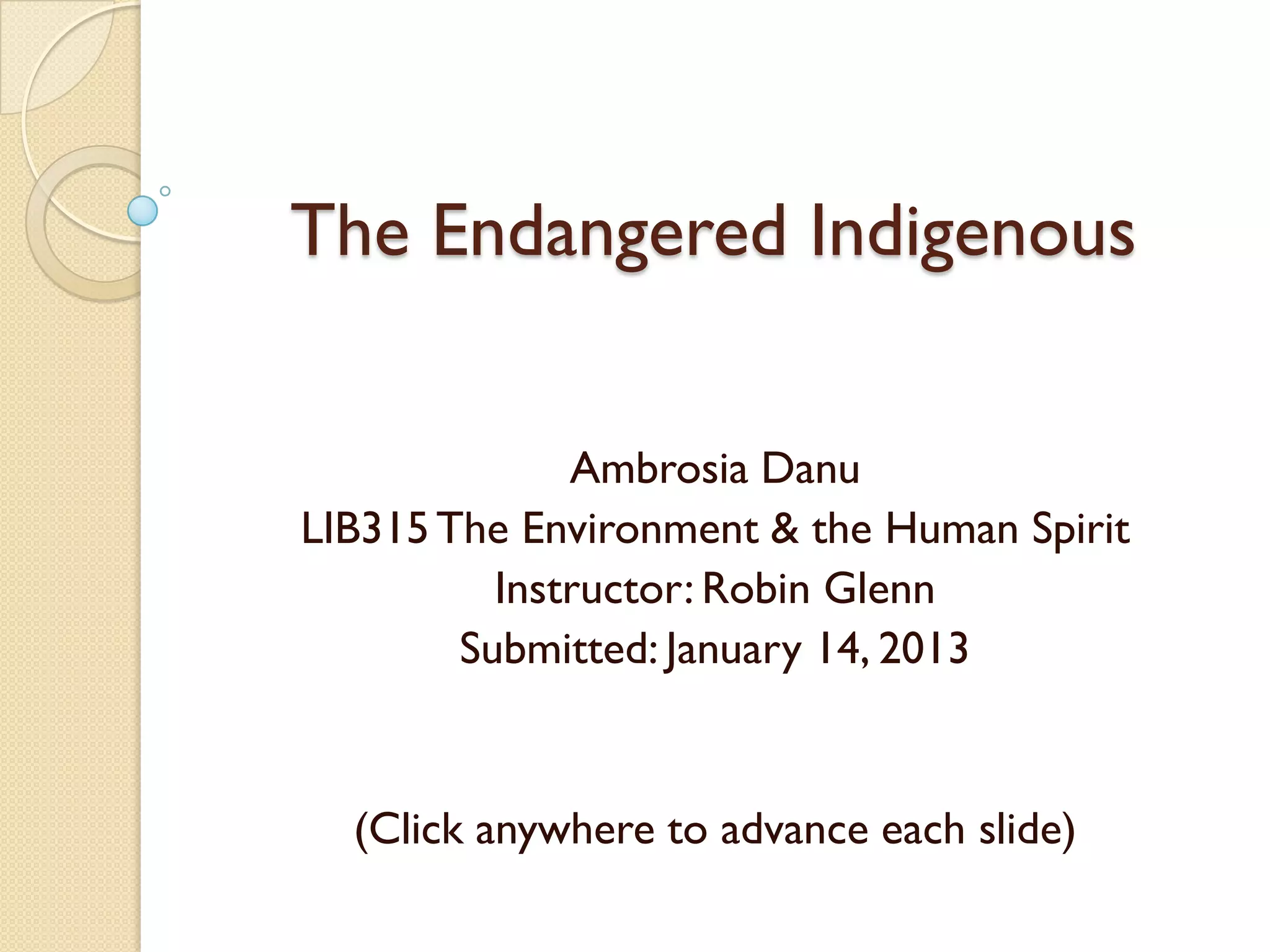
A Kenyan woman works in a tree nursery during a time when 100 million trees a
  year are needed to restore the lost and declining indigenous forests (Kenyan
                                   Woman).
Who are the Indigenous?
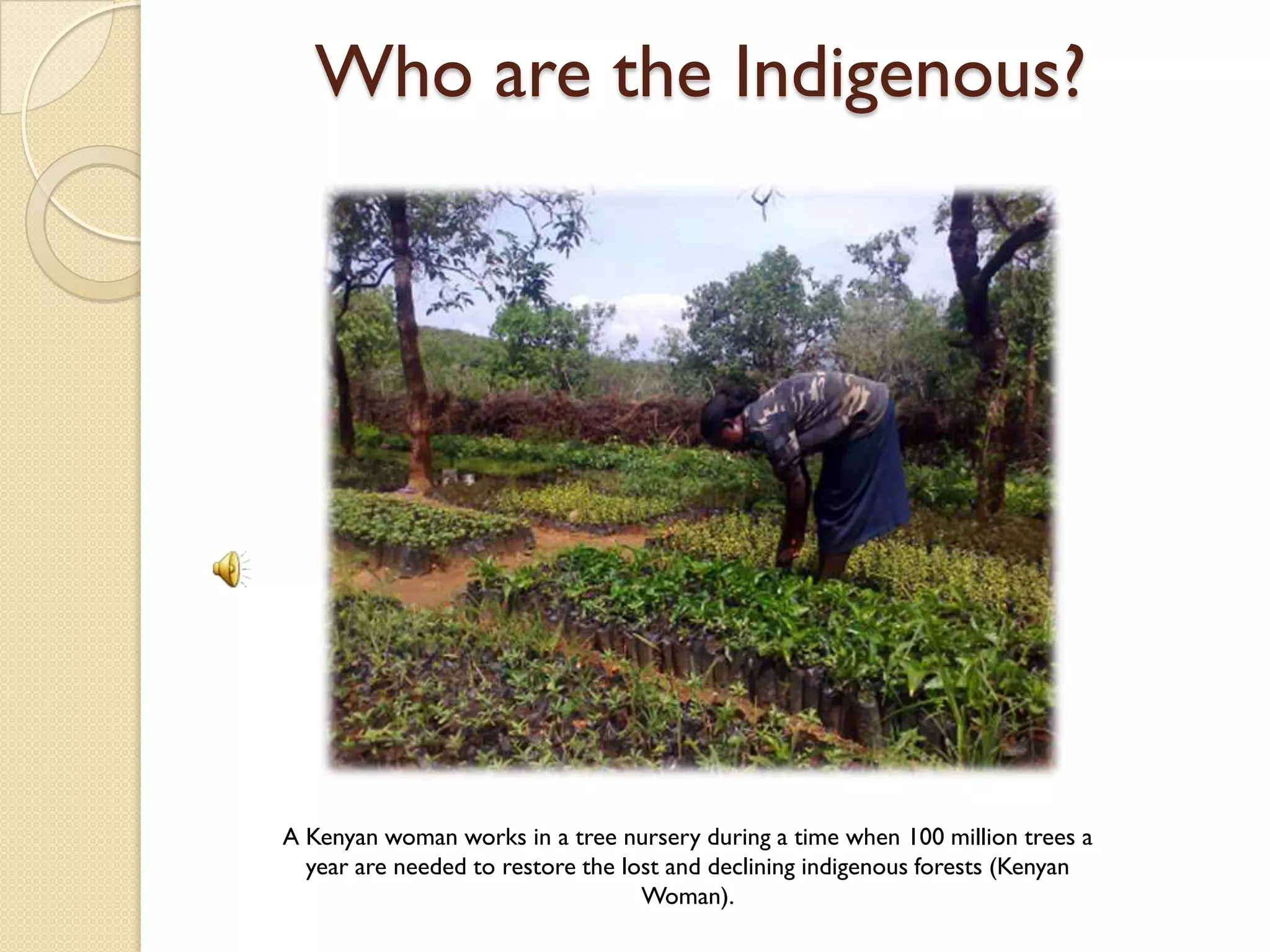
   Indigenous tribes are generally ethnic groups of people that are
   historically connected to particular parts of the globe.


A Kuna tribe member walks a path through the rainforest in Panama (Kuna Woman).
Who are the Indigenous?
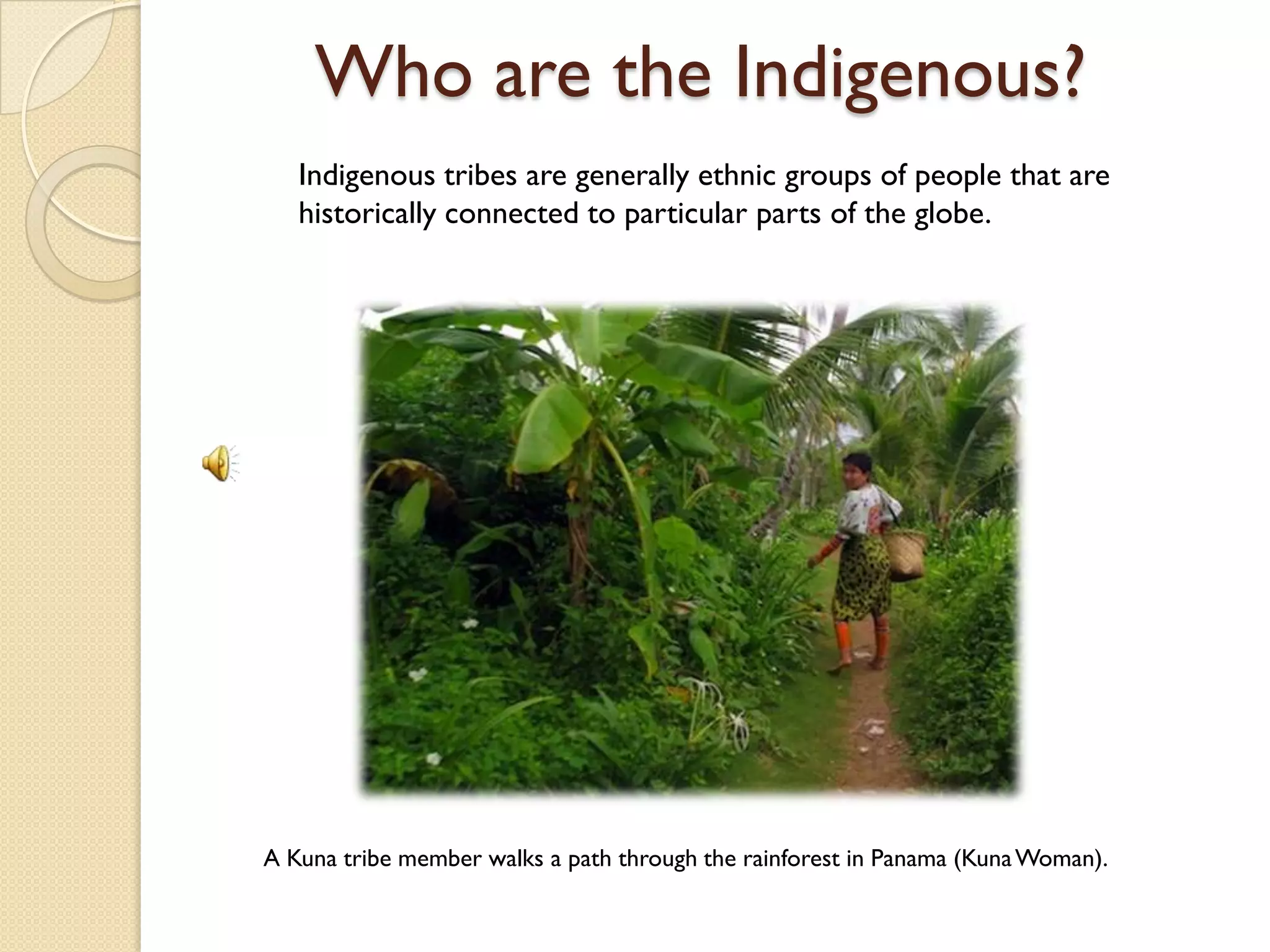
Due to centuries of colonialism and expansion, these native
peoples have encountered many obstacles to preserving their
way of life, which includes their natural habitats.


  A stone quarry with adult and child labourers,Wakiso district, Uganda
                            (Uganda quarry).
Who are the Indigenous?
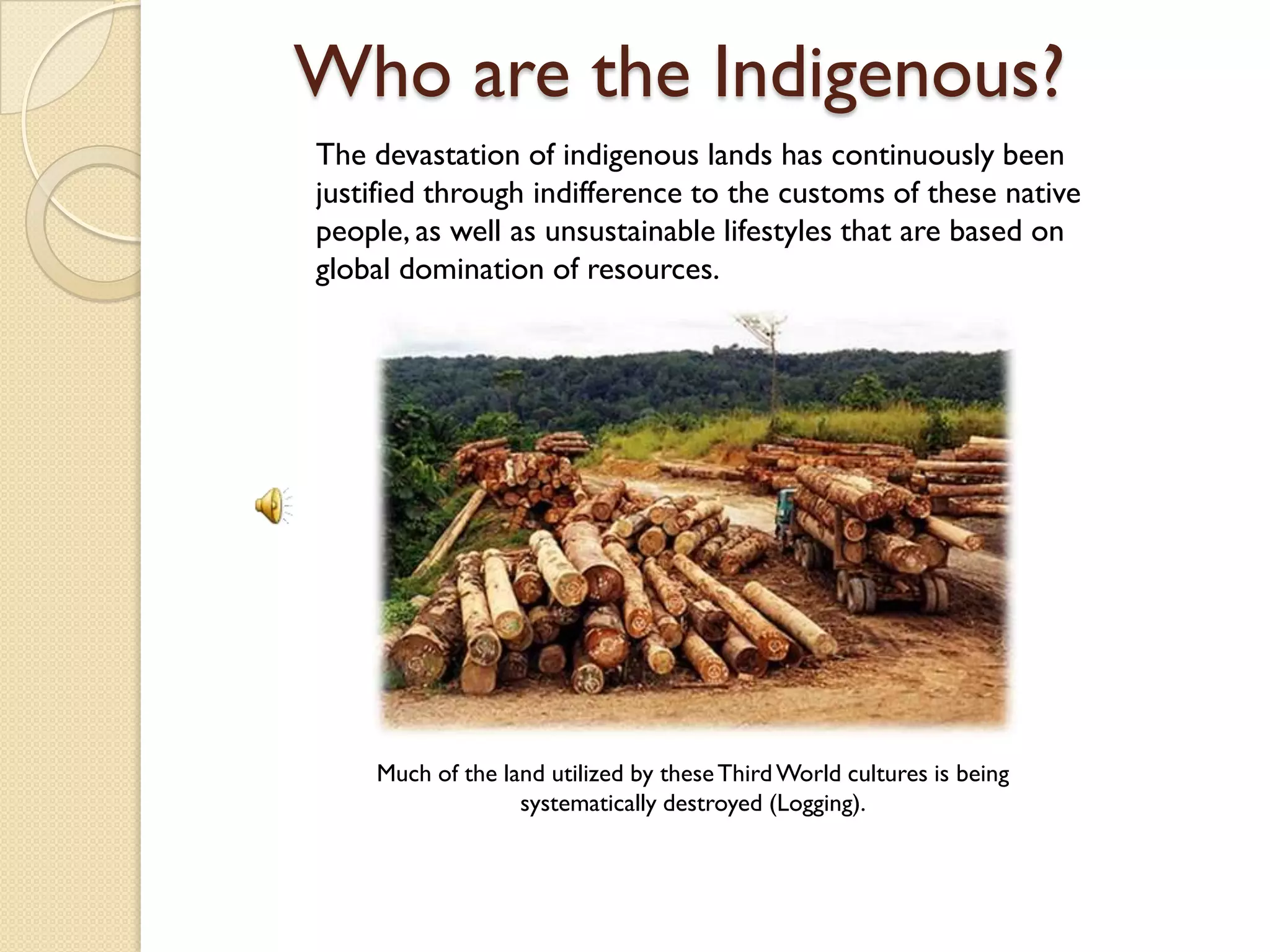
The devastation of indigenous lands has continuously been
justified through indifference to the customs of these native
people, as well as unsustainable lifestyles that are based on
global domination of resources.


    Much of the land utilized by these Third World cultures is being
                  systematically destroyed (Logging).
The Issues
                                                                             Many of the dilemmas faced by
                                                                             these indigenous tribes include
                                                                             linguistic and cultural
                                                                             preservation, exploitation of
                                                                             natural resources,
                                                                             environmental degradation,
                                                                             political autonomy, and
                                                                             discrimination.


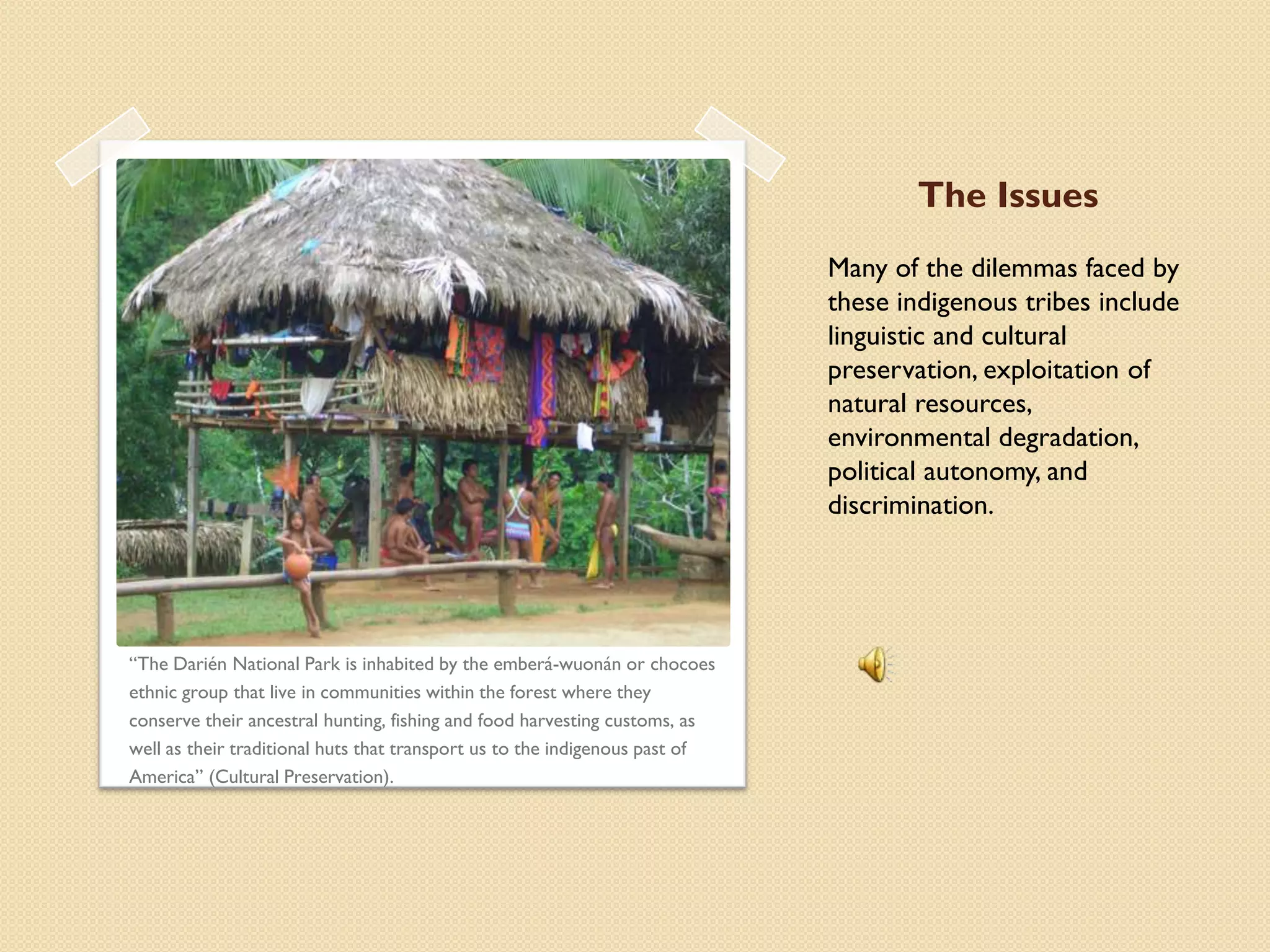
“The Darién National Park is inhabited by the emberá-wuonán or chocoes
ethnic group that live in communities within the forest where they
conserve their ancestral hunting, fishing and food harvesting customs, as
well as their traditional huts that transport us to the indigenous past of
America” (Cultural Preservation).
Political autonomy and discrimination

     Throughout history, indigenous tribes have encountered conflicts in
     their attempts to avoid oppression while struggling to understand
     the newly invading cultures.


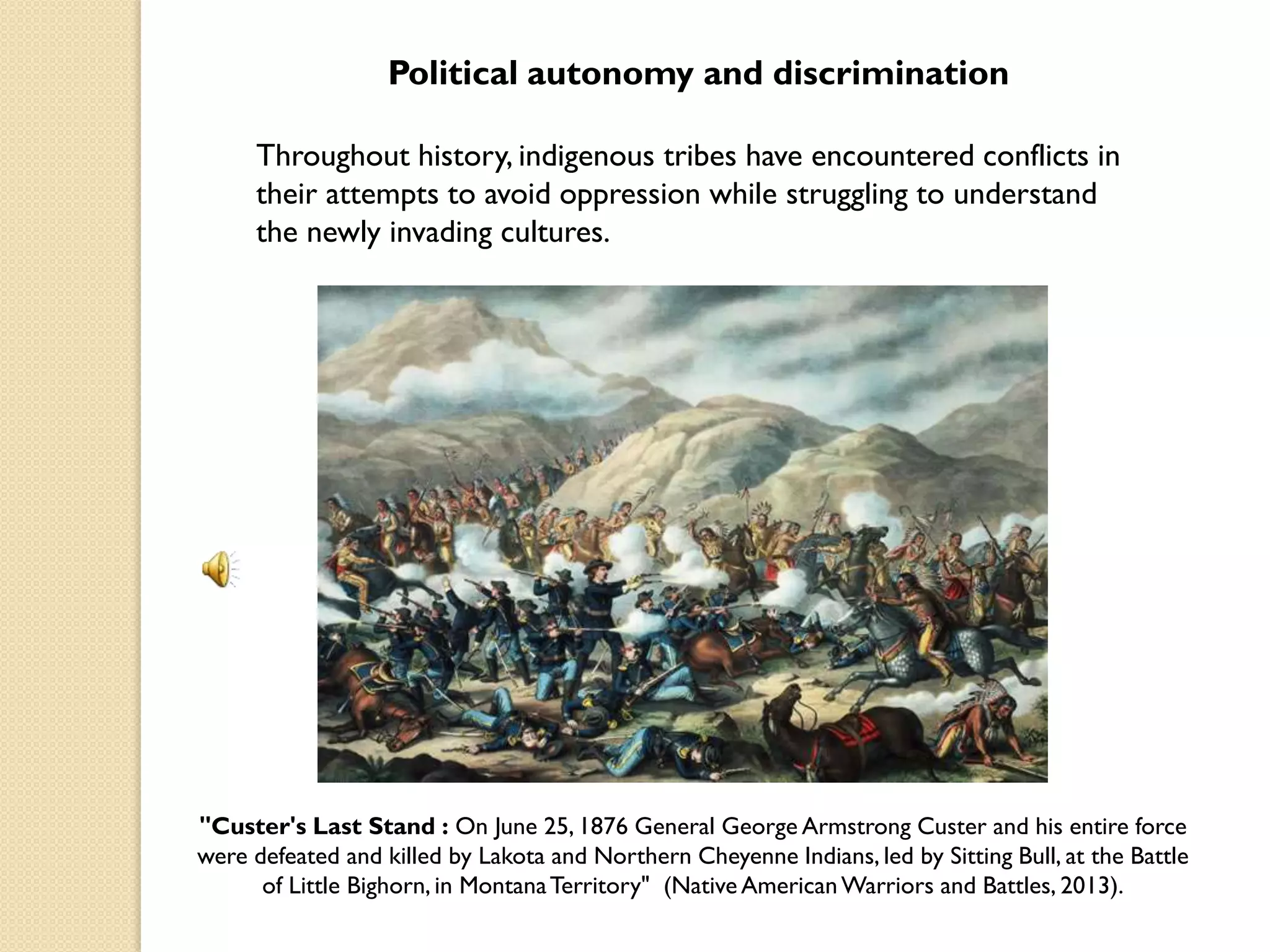
"Custer's Last Stand : On June 25, 1876 General George Armstrong Custer and his entire force
were defeated and killed by Lakota and Northern Cheyenne Indians, led by Sitting Bull, at the Battle
      of Little Bighorn, in Montana Territory" (Native American Warriors and Battles, 2013).
Imperialism

                                                            Historically, Africa has been a
                                                            prime example of indigenous
                                                               disruption due to its high
                                                             levels of minerals and other
                                                                  profitable resources.


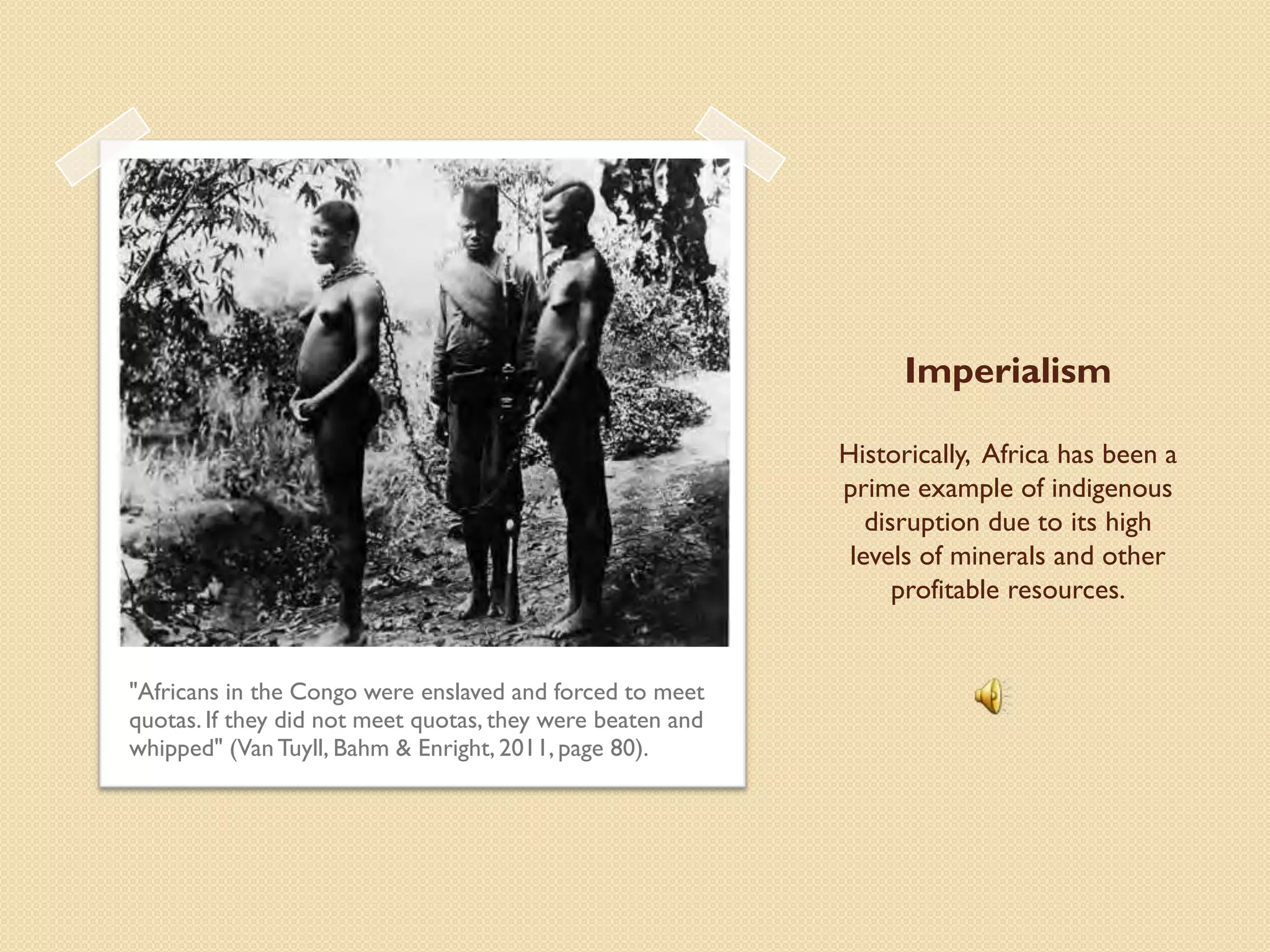
"Africans in the Congo were enslaved and forced to meet
quotas. If they did not meet quotas, they were beaten and
whipped" (Van Tuyll, Bahm & Enright, 2011, page 80).
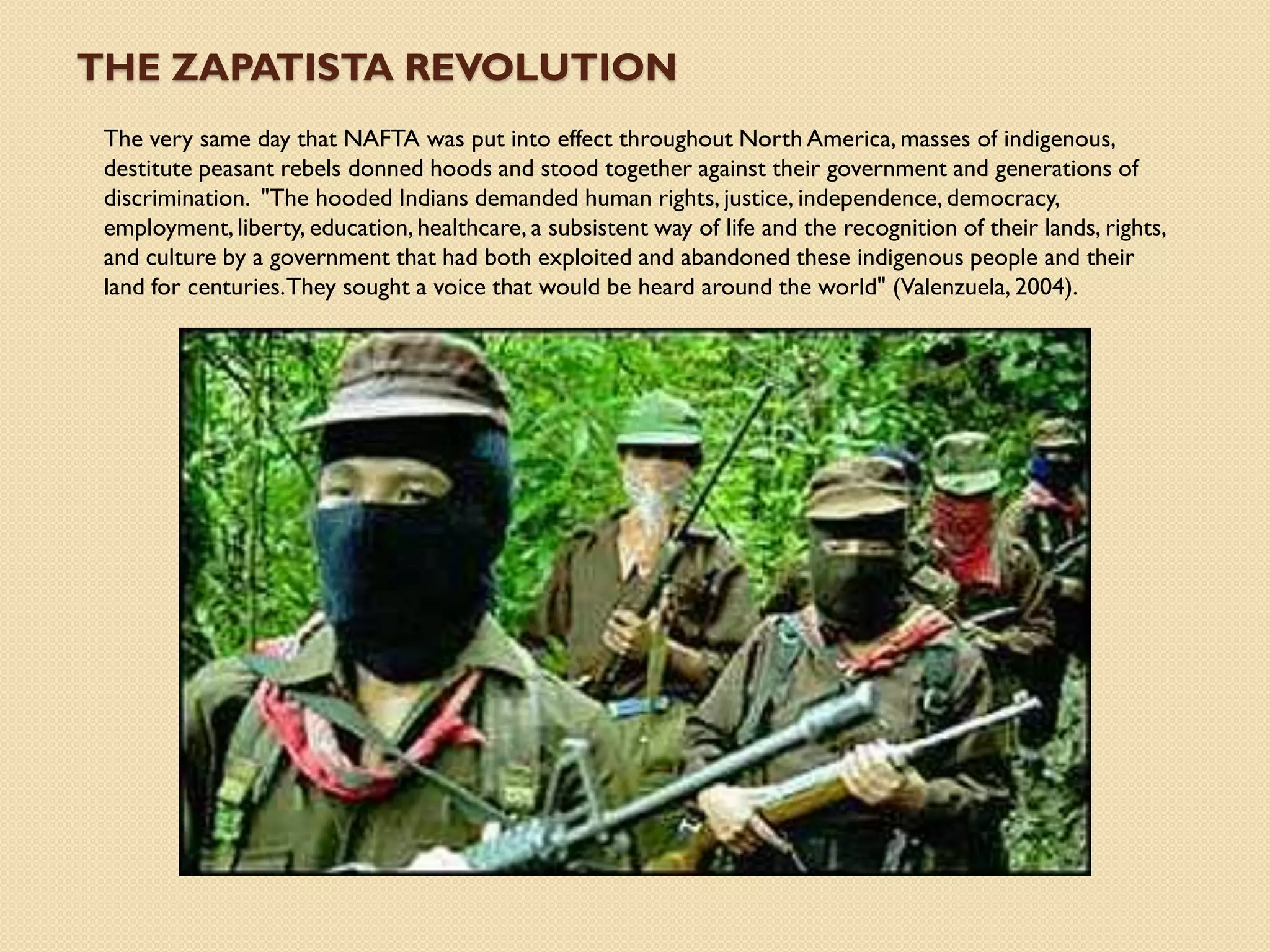
THE ZAPATISTA REVOLUTION
 The very same day that NAFTA was put into effect throughout North America, masses of indigenous,
 destitute peasant rebels donned hoods and stood together against their government and generations of
 discrimination. "The hooded Indians demanded human rights, justice, independence, democracy,
 employment, liberty, education, healthcare, a subsistent way of life and the recognition of their lands, rights,
 and culture by a government that had both exploited and abandoned these indigenous people and their
 land for centuries. They sought a voice that would be heard around the world" (Valenzuela, 2004).
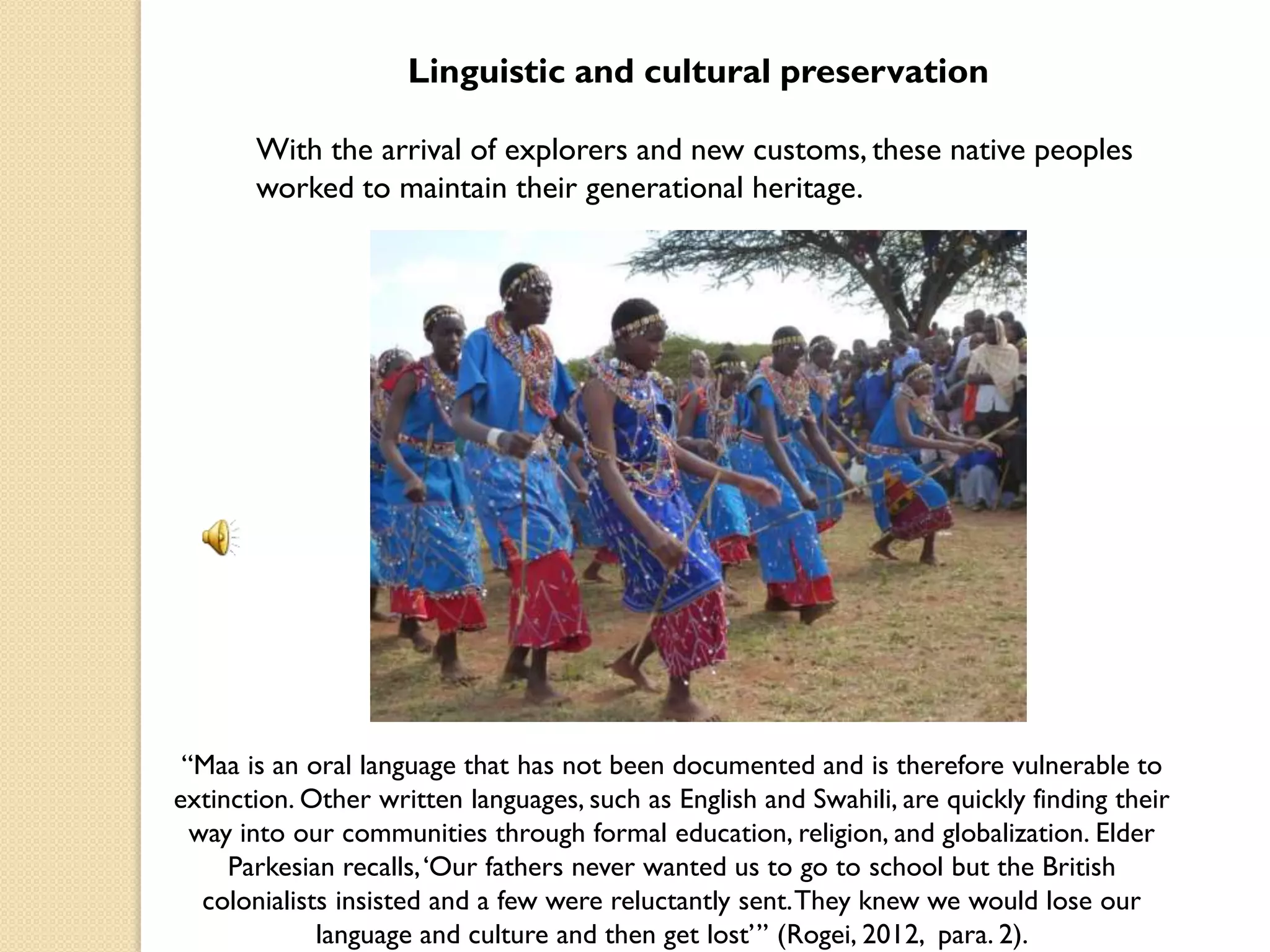
Linguistic and cultural preservation

       With the arrival of explorers and new customs, these native peoples
       worked to maintain their generational heritage.


 “Maa is an oral language that has not been documented and is therefore vulnerable to
extinction. Other written languages, such as English and Swahili, are quickly finding their
  way into our communities through formal education, religion, and globalization. Elder
     Parkesian recalls, „Our fathers never wanted us to go to school but the British
   colonialists insisted and a few were reluctantly sent. They knew we would lose our
              language and culture and then get lost‟” (Rogei, 2012, para. 2).
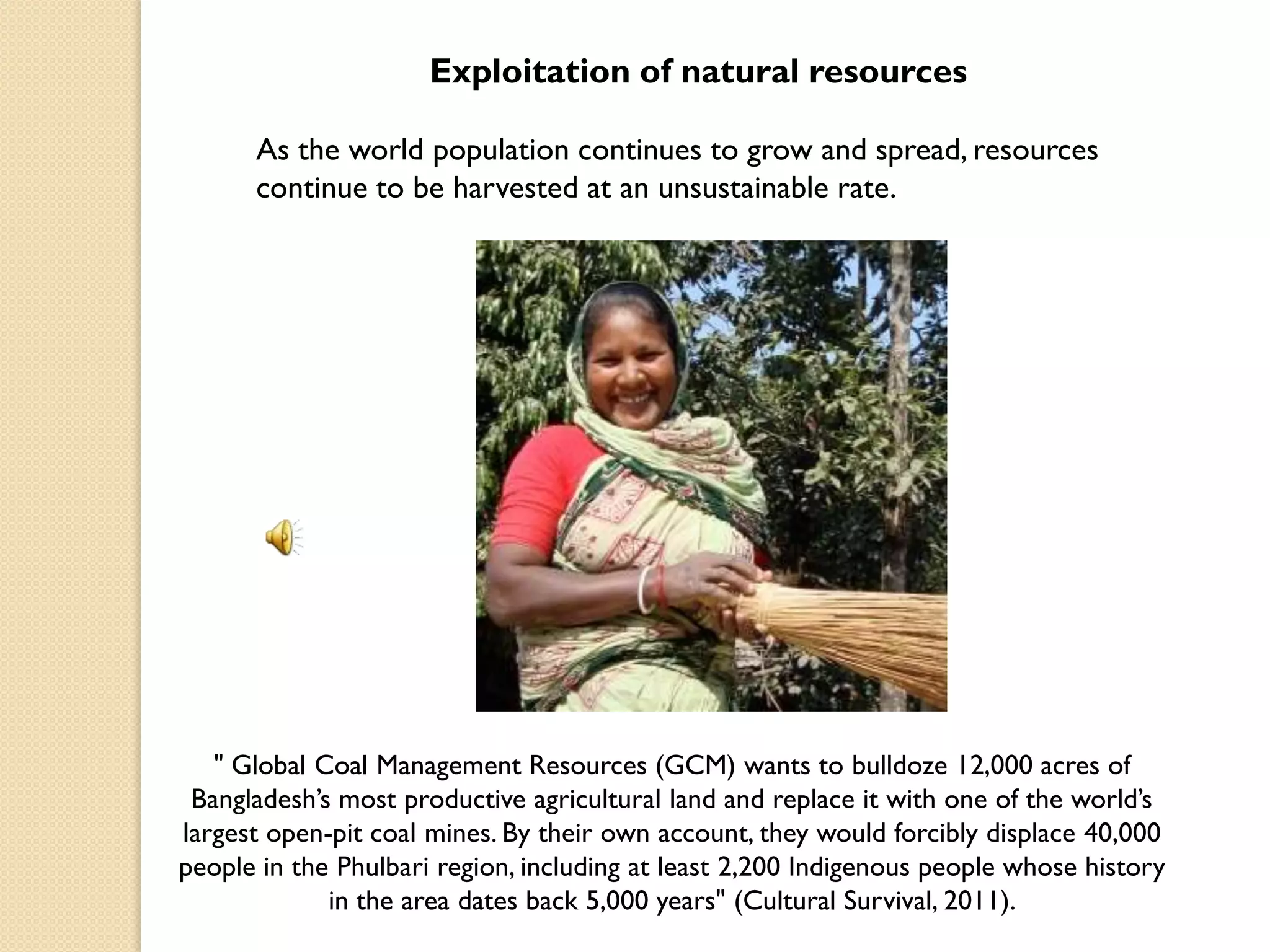
Exploitation of natural resources

      As the world population continues to grow and spread, resources
      continue to be harvested at an unsustainable rate.


   " Global Coal Management Resources (GCM) wants to bulldoze 12,000 acres of
 Bangladesh‟s most productive agricultural land and replace it with one of the world‟s
largest open-pit coal mines. By their own account, they would forcibly displace 40,000
people in the Phulbari region, including at least 2,200 Indigenous people whose history
             in the area dates back 5,000 years" (Cultural Survival, 2011).
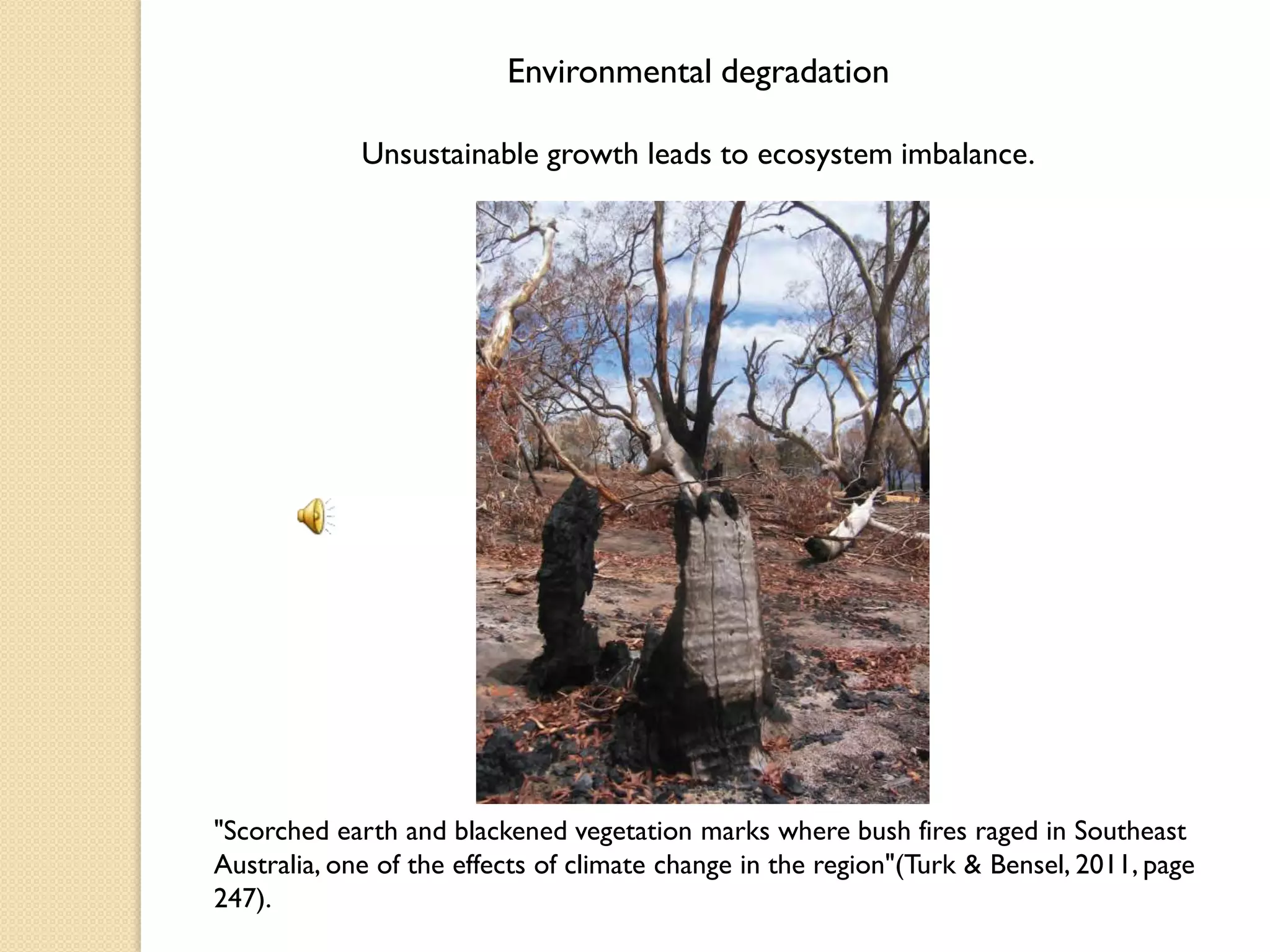
Environmental degradation

             Unsustainable growth leads to ecosystem imbalance.


"Scorched earth and blackened vegetation marks where bush fires raged in Southeast
Australia, one of the effects of climate change in the region"(Turk & Bensel, 2011, page
247).
References
Cultural Preservation. [Photo]. Retrieved from:
http://www.panamacanalcountry.com/images/CIMG2343.JPG
Cultural Survival. (February 2011). Bangladesh: Ban Coal Mine, Save Forests and Farms.
Retrieved from: http://www.culturalsurvival.org/take-action/bangladesh-ban-coal-mine-save-
forests-and-farms
Kenyan Woman. [Photo]. Retrieved from: http://www.agrowingculture.org/wp-
content/uploads/2011/11/trees3.jpg
Kuna Woman. [Photo]. Retrieved from: http://www.takepart.com/article/2012/12/14/cuipo-
partners-kuna-create-project-good-hands?cmpid=tp-twtr
Logging. [Photo]. Retrieved from: http://www.treehugger.com/corporate-responsibility/un-
forest-protection-scheme-open-for-organized-crime-abuse.html
Native American Warriors and Battles. (2013). The History Channel website. Retrieved
7:48, January 14, 2013, from http://www.history.com/photos/native-americans-warriors-and-
battles.
Rogei, D. S. (November 26, 2012).We, Maasai: Revitalizing Indigenous Language and
Knowledge for Sustainable Development in Maasailand, Kenya. Retrieved from:
http://www.culturalsurvival.org/publications/cultural-survival-quarterly/we-maasai-revitalizing-
indigenous-language-and-knowledge
Turk, J., & Bensel, T. (2011). Contemporary environmental issues. San Diego, CA Bridgepoint
Education, Inc. Retrieved from: https://content.ashford.edubooksAUSCI207.10.1
Uganda Quarry. [Photo]. Retrieved from:
http://www.unmultimedia.org/radio/english/2011/09/seizure-of-land-for-mining-a-violation-of-
indigenous-peoples-rights/
Valenzuela, M. (January 11, 2004). Not in our Back Yard. Retrieved from: http://www.world-
crisis.com/print_format/348_0_15_0
Van Tuyll, H., Bahm, K., & Enright, K. (2011). Historical contexts and literature. San Diego, CA:

The endangered indigenous.am.danu

  • 1.
    The Endangered Indigenous Ambrosia Danu LIB315 The Environment & the Human Spirit Instructor: Robin Glenn Submitted: January 14, 2013 (Click anywhere to advance each slide)
  • 2.
    Who are theIndigenous? A Kenyan woman works in a tree nursery during a time when 100 million trees a year are needed to restore the lost and declining indigenous forests (Kenyan Woman).
  • 3.
    Who are theIndigenous? Indigenous tribes are generally ethnic groups of people that are historically connected to particular parts of the globe. A Kuna tribe member walks a path through the rainforest in Panama (Kuna Woman).
  • 4.
    Who are theIndigenous? Due to centuries of colonialism and expansion, these native peoples have encountered many obstacles to preserving their way of life, which includes their natural habitats. A stone quarry with adult and child labourers,Wakiso district, Uganda (Uganda quarry).
  • 5.
    Who are theIndigenous? The devastation of indigenous lands has continuously been justified through indifference to the customs of these native people, as well as unsustainable lifestyles that are based on global domination of resources. Much of the land utilized by these Third World cultures is being systematically destroyed (Logging).
  • 6.
    The Issues Many of the dilemmas faced by these indigenous tribes include linguistic and cultural preservation, exploitation of natural resources, environmental degradation, political autonomy, and discrimination. “The Darién National Park is inhabited by the emberá-wuonán or chocoes ethnic group that live in communities within the forest where they conserve their ancestral hunting, fishing and food harvesting customs, as well as their traditional huts that transport us to the indigenous past of America” (Cultural Preservation).
  • 7.
    Political autonomy anddiscrimination Throughout history, indigenous tribes have encountered conflicts in their attempts to avoid oppression while struggling to understand the newly invading cultures. "Custer's Last Stand : On June 25, 1876 General George Armstrong Custer and his entire force were defeated and killed by Lakota and Northern Cheyenne Indians, led by Sitting Bull, at the Battle of Little Bighorn, in Montana Territory" (Native American Warriors and Battles, 2013).
  • 8.
    Imperialism Historically, Africa has been a prime example of indigenous disruption due to its high levels of minerals and other profitable resources. "Africans in the Congo were enslaved and forced to meet quotas. If they did not meet quotas, they were beaten and whipped" (Van Tuyll, Bahm & Enright, 2011, page 80).
  • 9.
    THE ZAPATISTA REVOLUTION The very same day that NAFTA was put into effect throughout North America, masses of indigenous, destitute peasant rebels donned hoods and stood together against their government and generations of discrimination. "The hooded Indians demanded human rights, justice, independence, democracy, employment, liberty, education, healthcare, a subsistent way of life and the recognition of their lands, rights, and culture by a government that had both exploited and abandoned these indigenous people and their land for centuries. They sought a voice that would be heard around the world" (Valenzuela, 2004).
  • 10.
    Linguistic and culturalpreservation With the arrival of explorers and new customs, these native peoples worked to maintain their generational heritage. “Maa is an oral language that has not been documented and is therefore vulnerable to extinction. Other written languages, such as English and Swahili, are quickly finding their way into our communities through formal education, religion, and globalization. Elder Parkesian recalls, „Our fathers never wanted us to go to school but the British colonialists insisted and a few were reluctantly sent. They knew we would lose our language and culture and then get lost‟” (Rogei, 2012, para. 2).
  • 11.
    Exploitation of naturalresources As the world population continues to grow and spread, resources continue to be harvested at an unsustainable rate. " Global Coal Management Resources (GCM) wants to bulldoze 12,000 acres of Bangladesh‟s most productive agricultural land and replace it with one of the world‟s largest open-pit coal mines. By their own account, they would forcibly displace 40,000 people in the Phulbari region, including at least 2,200 Indigenous people whose history in the area dates back 5,000 years" (Cultural Survival, 2011).
  • 12.
    Environmental degradation Unsustainable growth leads to ecosystem imbalance. "Scorched earth and blackened vegetation marks where bush fires raged in Southeast Australia, one of the effects of climate change in the region"(Turk & Bensel, 2011, page 247).
  • 13.
    References Cultural Preservation. [Photo].Retrieved from: http://www.panamacanalcountry.com/images/CIMG2343.JPG Cultural Survival. (February 2011). Bangladesh: Ban Coal Mine, Save Forests and Farms. Retrieved from: http://www.culturalsurvival.org/take-action/bangladesh-ban-coal-mine-save- forests-and-farms Kenyan Woman. [Photo]. Retrieved from: http://www.agrowingculture.org/wp- content/uploads/2011/11/trees3.jpg Kuna Woman. [Photo]. Retrieved from: http://www.takepart.com/article/2012/12/14/cuipo- partners-kuna-create-project-good-hands?cmpid=tp-twtr Logging. [Photo]. Retrieved from: http://www.treehugger.com/corporate-responsibility/un- forest-protection-scheme-open-for-organized-crime-abuse.html Native American Warriors and Battles. (2013). The History Channel website. Retrieved 7:48, January 14, 2013, from http://www.history.com/photos/native-americans-warriors-and- battles. Rogei, D. S. (November 26, 2012).We, Maasai: Revitalizing Indigenous Language and Knowledge for Sustainable Development in Maasailand, Kenya. Retrieved from: http://www.culturalsurvival.org/publications/cultural-survival-quarterly/we-maasai-revitalizing- indigenous-language-and-knowledge Turk, J., & Bensel, T. (2011). Contemporary environmental issues. San Diego, CA Bridgepoint Education, Inc. Retrieved from: https://content.ashford.edubooksAUSCI207.10.1 Uganda Quarry. [Photo]. Retrieved from: http://www.unmultimedia.org/radio/english/2011/09/seizure-of-land-for-mining-a-violation-of- indigenous-peoples-rights/ Valenzuela, M. (January 11, 2004). Not in our Back Yard. Retrieved from: http://www.world- crisis.com/print_format/348_0_15_0 Van Tuyll, H., Bahm, K., & Enright, K. (2011). Historical contexts and literature. San Diego, CA: