Grand Canyon
National Park
Centennial Magazine Proposal
NAU Public Relations Capstone
Desert View Group
Richard Frische, Dakota Wolfe, Addison Bare, Xiaoxiao Jiang, Megan Buckley
Situation Analysis
History of the National Park Service
	 The National Park Service was founded “to conserve the scenery, natural and historic objects
and the wildlife therein and to provide for the enjoyment of the same in such manner and by such
means as will leave them unimpaired for the enjoyment of future generations.” The NPS today still
upholds it standards to conserve all aspects of the park for the enjoyment of its visitors. This will
be recognized and celebrated during the and will be celebrating Grand Canyon National Park’s
upcoming 100th anniversary.
	 Theodore Roosevelt became president during a crucial time in the history of the National
Park Service. The early 1900s were a time of expansion and development that saw the United
States becoming a world power. The unfortunate cost of this rise was the depletion of resources
throughout the country. Roosevelt had grown up a hunter his entire life and loved the opportunity
to experience America’s beauty and wildlife. He saw a serious issue arising as the decimation of
forests and wild animals became more prevalent in America’s growth. Theodore Roosevelt stated,
“ We have become great because of the lavish use of our resources. But the time has come to
inquire seriously what will happen when our forests are gone, when the coal, the iron, the oil, and
the gas are exhausted, when the soils have still further impoverished and washed into the streams,
polluting the rivers, deluding the fields and obstructing navigation.”
	 Roosevelt began to take action to preserve the nation’s natural wonders earning him the title
“The Conservationist President”. He began by establishing 230 million acres of public land, most
of which became national forests, to ensure the continued growth and use of these forests. During
his service the growth of National Parks flourished. He worked with legislative branches to establish
several National Parks including Crater Lake and Wind Cave in San Diego, while also adding land
to Yosemite.
	 Roosevelt laid the foundation that lead to the creation of the National Park Service. President
Woodrow Wilson signed an act creating the National Park Service in 1916. The NPS became
responsible for protecting 35 national parks and monuments throughout the country at this time.
	 Over the last 100 years, countless people have and continue to help the NPS grow into what
it is today. The mission of the NPS has remained the same, to preserve the National Park lands
and historic features that were designated by the Nation for their cultural and historic significance,
scenic and environmental worth, and educational and recreational opportunities. Today more than
20,000 people work for the National Park Service to protect and preserve 400+ national parks. The
National Park Service provides the opportunity for anyone to add to the story of America’s.
History of Grand Canyon National Park
	 Located in northern Arizona, Grand Canyon National Park is known throughout the world
for its size and colorful landscape. It is one of the most identifiable landscapes on earth and the
most internationally recognized symbol of nature in North America. The park’s central feature is the
Grand Canyon, a gorge of the Colorado River, which is often considered one of the Seven Natural
Wonders of the World. In Grand Canyon National Park, most visitors explore the South Rim, which
is open all year. From May through October, visitors can also visit the North Rim.
	 Over thousands of years, the canyon has been the home of the ancient Puebloans and the
Hopi, the Hualapai and Havasupai, the Paiute and the Navajo. The Puebloans inhabited the Canyon
1
in A.D. 1185 where they built “towns” that were occupied with about 30 people. As their own
individual community within the Canyon, the Puebloans brought to light new ways of living. They
excelled at creating squash and corn crops, irrigation of corn, trade with the Southwest and Pacific
Coast and many other things. However, due to drought and a lack of resources the Puebloans were
forced out of the canyon in the 1200’s. Native tribes started to reappear in the Canyon around the
1300s. They were ancestors of the Hopi, Hualapai, and the Havasupai. These tribes took on the
trades that their ancestors learned and ventured toward the North Rim, where they worked closely
with the Mormons. The last Native Americans to arrive at the Grand Canyon were the Navajo, they
came to the Canyon from the Midwest around A.D. 1400. They were hunter-gatherers but also
learned the trade of agriculture from the Pueblos. Their tribe was diverse in many aspects, which
allowed them to take over the region and continue their reservation on the eastern section of the
canyon. Their adaptability allowed them to dominate the region. Their huge reservation abuts the
east side of the canyon.
	 Next was the expansion of the first Europeans to reach the Grand Canyon in September of
1540. It was a group of about 13 Spanish soldiers led by García. They tried to find the fabulous
Seven Cities of Gold. In the early 1800s, trappers and expeditions sent by the U.S. government
began to explore and map the Southwest, including the canyon. From then, the proposals to
make Grand Canyon a national park were unceasing, but they all failed in Congress because
of opposition from ranchers, miners, and settlers who did not want the federal government to
control them. Other influences such as the Kolb brothers who arrived in between 1901 and 1902
have taken some of the most famous photographs of the Grand Canyon and its visitors. Their
photographs changed the way people saw and experienced the canyon, giving them visual access
to places they never would have seen in their lifetime. A few years later on January 11, 1908,
moved by a report of plans to build an electric railway along its rim, President Theodore Roosevelt
proclaimed Grand Canyon National Monument on lands within the Grand Canyon National Forest.
Nearly 100 years ago, on February 26, 1919, congress passed the act that established the Grand
Canyon National Park in the state of Arizona. In 1979, The GCNP named it a UNESCO World
Heritage Site.
	 The Grand Canyon is as much a symbol of America as it is an icon among national parks.
Due to the canyon’s overwhelming size and its intricate and colorful landscape, it is geologically
significant. These beautifully preserved ancient rocks record much of the early geological history of
the North American continent. Additionally, it is one of the most spectacular examples of erosion
in the world. But this oversized natural wonder is much more than a sight to behold. It is also a
cultural landscape. Beside Grand Canyon’s history of ancient humans, it is a favorite shooting
location of Hollywood filmmakers, more than a dozen features have been filmed in the Grand
Canyon. There are countless oral histories, books, photographs, paintings, poetry, and news articles
that captured this wonderful place. Those relationships between people and nature in the Grand
Canyon have gradually shaped America’s history and values.
	 According to official NPS site, Grand Canyon National Park is the 15th oldest of 58 national
parks, and it is the 11th biggest. It is the second most popular national park just next to the Great
Smoky Mountains in North Carolina and Tennessee. It had over 4,500,000 visitors in 2013. Today
Grand Canyon National Park encompasses more than 1 million acres of land and receives close to
5 million visitors each year.
National Park Service & Grand Canyon National Park Centennial
	 This year, the National Park Service is celebrating its centennial, meaning its 100-year
anniversary. In 2019, Grand Canyon National Park will be celebrating its own centennial,
accompanied with a 40-page magazine distributed online and to park visitors. On the eve of this
celebration, there are a number of current trends affecting the park.
2
Many of these trends come from a 2005 tourism study of the park, and these trends
reveal crucial issues that the park will need to address in the coming years. The first trend worth
highlighting is that the average age of the typical park visitor is 48.5 years old, and that there is
a much higher percentage of visitors over 45 (59 percent) than under (41 percent). Additionally,
while visitor party size averaged about 3.4 people, only 30 percent of parties contained children
under 18 years old. Typical parties contained two adults with no children. This highlights a major
challenge the park, as well as our centennial publication, will have to face: appealing to and
engaging with the Millennial generation.
	 Another important finding from this study was what park visitors supported. Results
indicated that visitors supported the protection of the following natural resources (in descending
order): clean water; clean air; native plants and animals; endangered species; and, natural quiet
and the sounds of nature.
	 In addition to engaging Millennials, there are a multitude of other emerging challenges
the park will need to address in the coming years. With the rise of technology and social media,
fewer and fewer young people are getting outdoors. Many developers and miners are also trying
to profit from the park by proposing huge projects that jeopardize indigenous land, culture, and
history, as well as the variety of biological and geological landscapes that make the park one-
ofa-kind. Additionally, climate change has affected the park, such as air pollution coming in from
metropolitan areas like Phoenix, Los Angeles, and Las Vegas. Finally, there is aging infrastructure
that will need to be replaced at a huge cost, such as the rim-to-rim water pipe.
Grand Canyon National Park Goals
•	 The main goals for the Grand Canyon National Park are to
•	 Enhance visitor and community experience and preservation.
•	 Maintain NPS facilities to enhance visitor experience and protect resources.
•	 Advance natural and cultural stewardship and promote wilderness management and integrate
tribal knowledge and perspectives into park management decisions.
•	 Practices to foster collaborative tribal relations.
•	 Ensure Grand Canyon is relevant a diversity of people.
•	 Administer business and information systems processes in a credible, professional, and
forward-looking manner.
•	 Sustain a diverse and professional workforce to lead us into our 2nd century.
•	 Build and foster partnerships to reach park goals.
	
Grand Canyon National Park Centennial Magazine
	 Grand Canyon National Park will celebrate their 100th year in 2019. For this important
occasion, the National Park Service decided to create a magazine that will effectively connect
all those invested in the canyon, as well as an entirely new generation of park goers to the rich
history of one of the natural wonders of the world. In the past, printed publications have had some
complications that have limited their potential. As of now, the park is planning on printing 500,000
to 1 million prints to be given out in the park. There will also be an online version of the publication
available to individuals who have visited, or are planning on visiting the park. One of the largest
issues with most of these efforts in the past involved ‘throw-away’ obstacles. Materials were being
wasted by being left or forgotten in the park. There is also a technology barrier that prohibits some
people from accessing their service network, which has definitely limited the Canyon’s ability to
connect electronically to park patrons. This problem is another reason printed publication is the
most prominent and practical form of media.
3
Publication Challenges
	 As highlighted by some of the park’s current trends, this publication faces a primary
challenge of engaging Millennials with a more traditional publication that, according to the park,
typically appeals more to visitors over 40 years old. Additionally, Millennials are the most diverse
generation our country has ever seen, so our publication needs to be as relevant to as many
different types of people as possible. Millennials also have the strongest grasp of the Internet of
any previous generation, which presents both a challenge and an opportunity. The challenge is that
many younger people may be satisfied with simply a virtual tour of the park instead of visiting in
person. The opportunity is that a majority of visitors will perform some type of research on the park
before their visit. The 2005 tourism survey revealed that 43.3 percent of visitors used the Internet
to research the park before visiting, with 36.3 percent using the parks website. Since this was ten
years ago, those numbers have most likely increased since then.
	 This publication will also need to balance two sometimes conflicting goals: the need to
represent all sides of the stories comprising the park’s history and the need to positively and
professionally represent the park. The tourism survey also reveals that over half of the park’s visitors
are first- time visitors, which reveals the need to not only attract new in-person visitors, but to also
retain visitors and encourage repeat visits.
Publication Goals
	 The goals that directly pertain to our perspective of the Centennial magazine are to enhance
visitor and community experience by giving them the best visit and creating a trip they will not
forget with the attractions the Grand Canyon has to offer. The integration of tribal knowledge and
perspective into park management decisions is another goal we are strongly pursuing. We want
to bring the insight and the knowledge from the local tribes who know the history along with land
when management is making decisions that will affect the Grand Canyon for increasing tourism.
Lastly, we are heavily emphasizing the goal to ensure Grand Canyon is relevant to people of all
ages, backgrounds, cultures, and abilities.
	 Representation, inspiration, and engagement are key themes of our goals for this
publication. As the newer generation and the country become more diverse, so will the people
visiting Grand Canyon National Park. Given this trend, the publication wants readers to see them
represented in the story of the park. To this end, it is crucial that the publication represents a
diversity of people, cultures, backgrounds, and perspectives in our publication. The publication will
not shy away from controversial stories, but instead give visibility to the multitude of perspectives
and people involved in the stories, with the hope of engaging readers to become involved with
the issues that will affect the park in the future. Engaging stories are what will inspire readers to
“do what they did” in reference to the historical figures that transformed Grand Canyon National
Park into what it is today. The point this publication wants to make is that one does not have to be
a superhero or a public figure to make a positive impact on the park. Many of the individuals who
formed the Grand Canyon’s story were ordinary, everyday people. Everybody has a Grand Canyon
story. This park is for everybody, and everybody has the potential to transform the park for the
better.
4
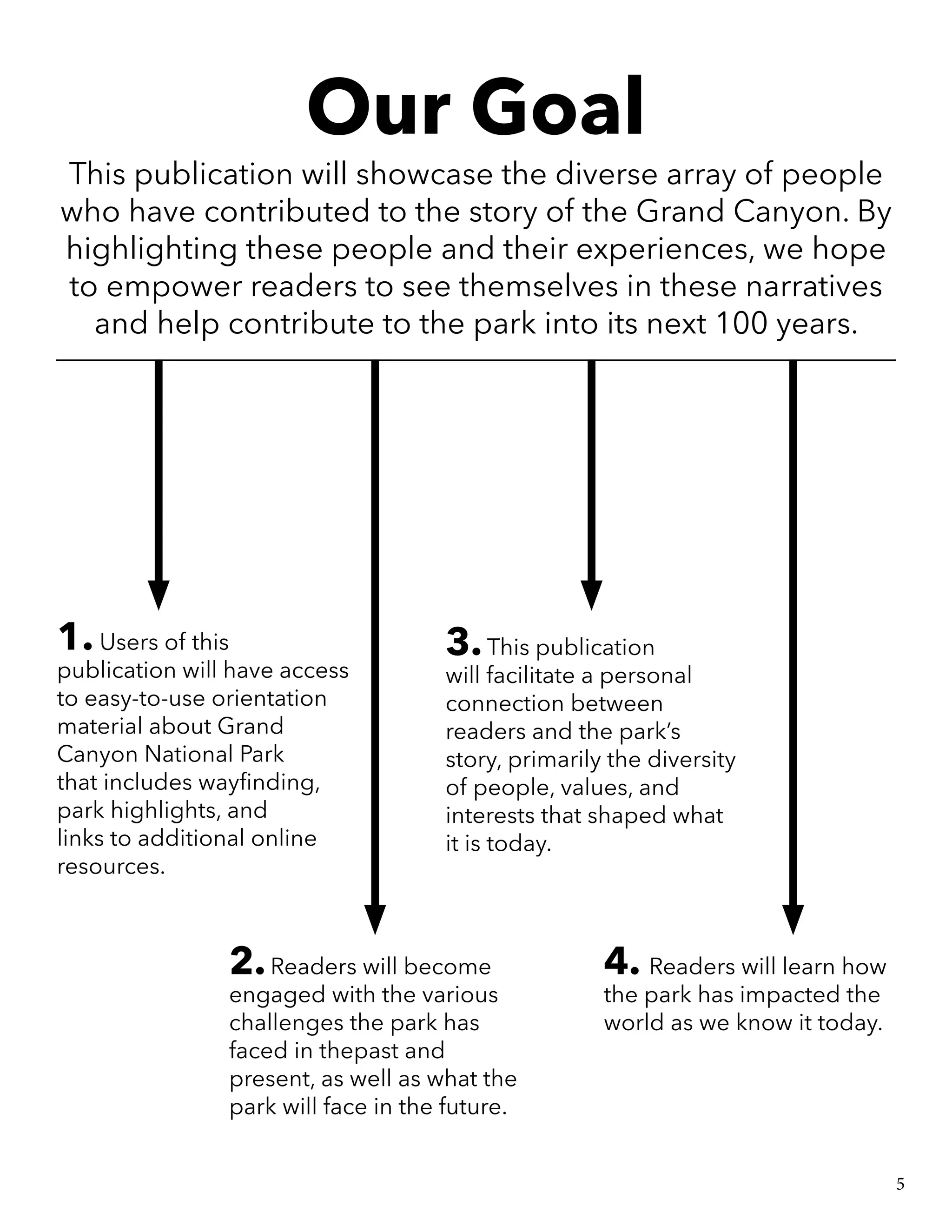
Our Goal
This publication will showcase the diverse array of people
who have contributed to the story of the Grand Canyon. By
highlighting these people and their experiences, we hope
to empower readers to see themselves in these narratives
and help contribute to the park into its next 100 years.
1.Users of this
publication will have access
to easy-to-use orientation
material about Grand
Canyon National Park
that includes wayfinding,
park highlights, and
links to additional online
resources.
2.Readers will become
engaged with the various
challenges the park has
faced in thepast and
present, as well as what the
park will face in the future.
3.This publication
will facilitate a personal
connection between
readers and the park’s
story, primarily the diversity
of people, values, and
interests that shaped what
it is today.
4. Readers will learn how
the park has impacted the
world as we know it today.
5
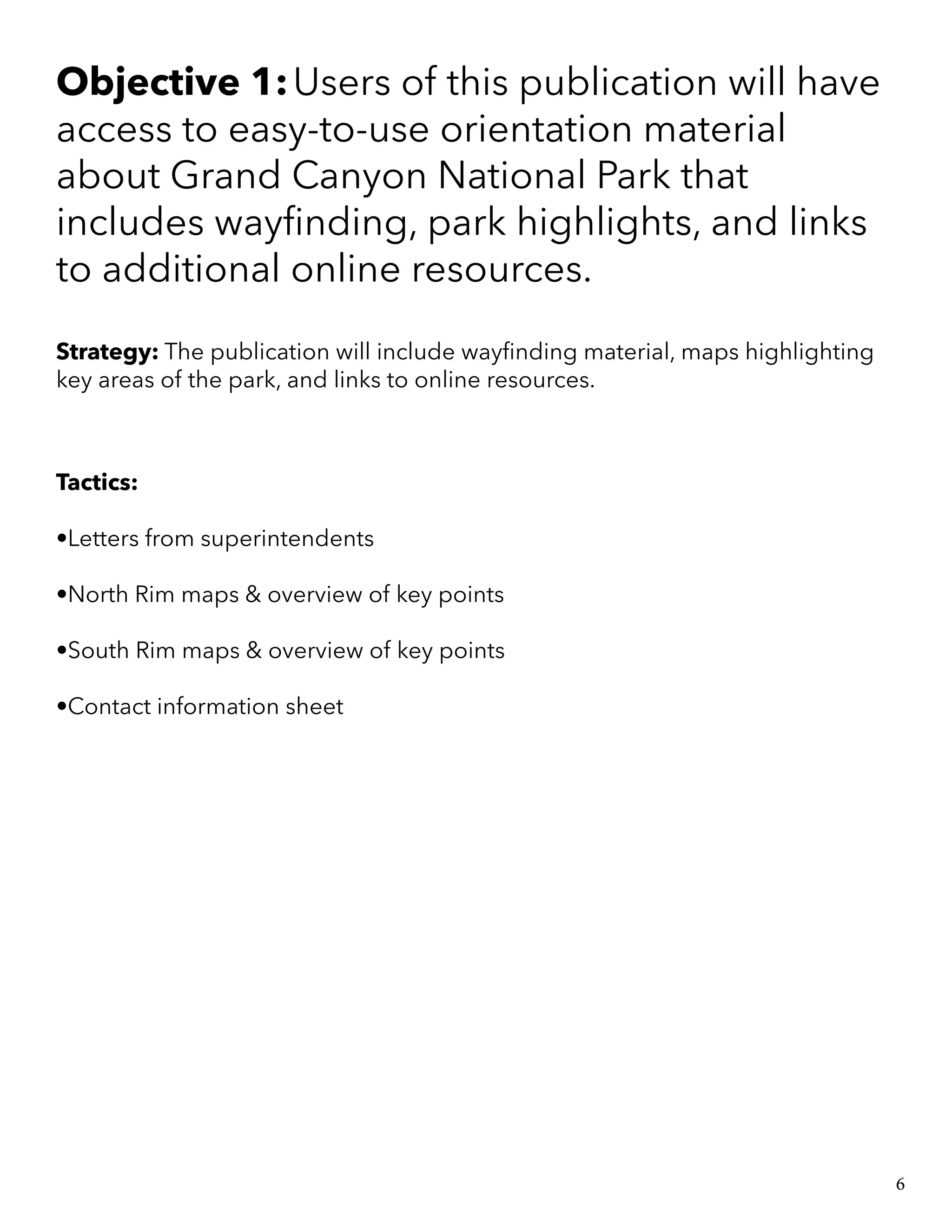
Objective 1:Users of this publication will have
access to easy-to-use orientation material
about Grand Canyon National Park that
includes wayfinding, park highlights, and links
to additional online resources.
Strategy: The publication will include wayfinding material, maps highlighting
key areas of the park, and links to online resources.
Tactics:
•Letters from superintendents
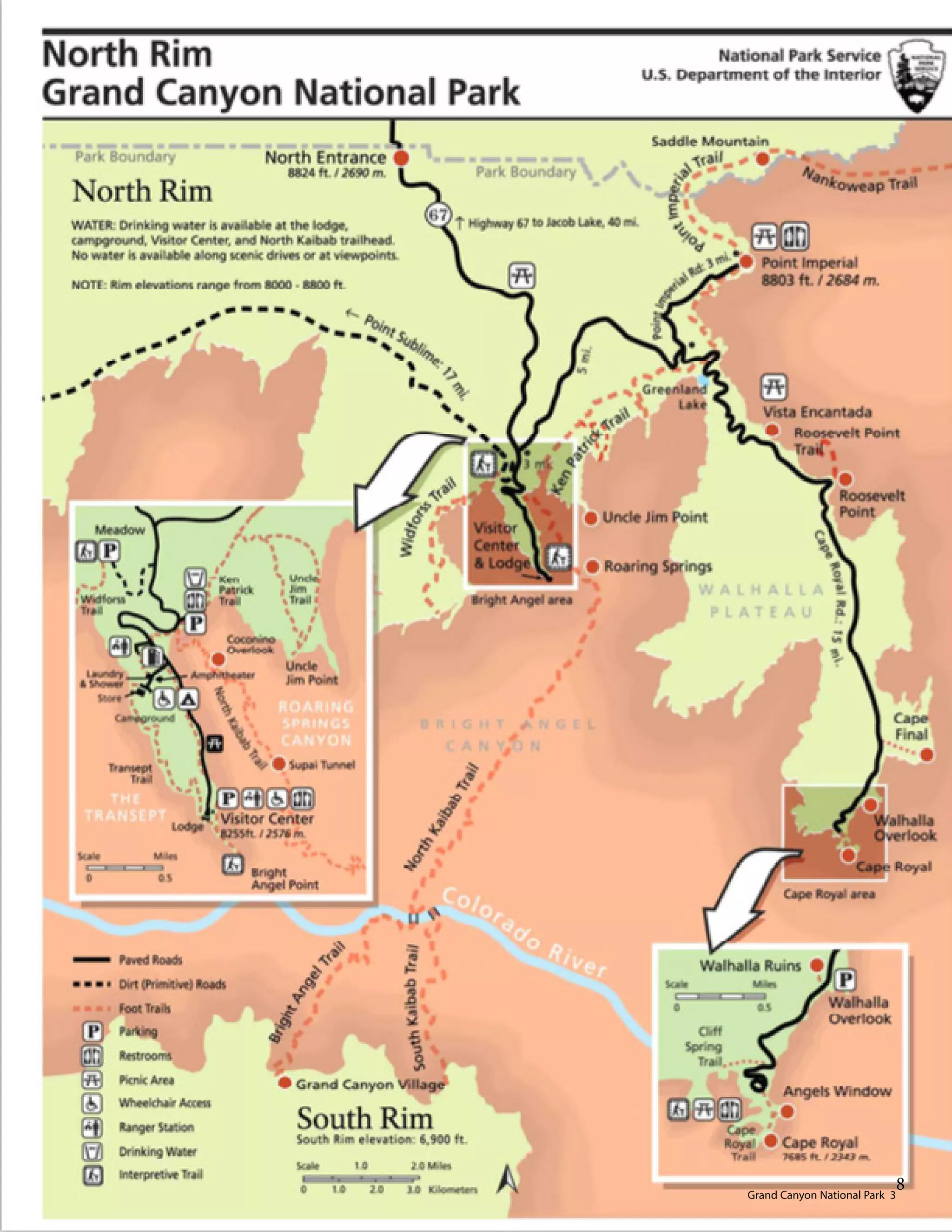
•North Rim maps & overview of key points
•South Rim maps & overview of key points
•Contact information sheet
6
Esequiae cusdae volor soluptate cus ea idusa consed que
naturemque est, que et qui as ario volupta idunt faccabo. Itas maio.
Exerepero quisit utem erferum que vendi nia commole sseces exerci
doluptatur atiatur?
Igent voluptae nam anti aut odita cores arum quia cum rem quatur,
nem sam, to volor solecatur molorendam nis versperum etur? Qui
consectem facepel ipienimet mo et laboremquias illeseq uatendi
imusam, auda incipsu ntibusa nduciat uriaepeliqui volorruptame
event.
Udicatus sequam, simus qui rem utem expe consecero volo quatio.
Ibusam dolorpor aut idem. Ebis earum etur andusam, a delique apid
ut ad quatiat dolo quia doluptat.
Gitas nulparcid quiatque porruptur, option pellent evelis et
ipsaecearum volupta spictur sunt accusam que dolorei ctempor
soluptatur? Dit, te vel in non conseque estiis arum veliatur ad
maximen estorianimus nem experorit, quidios sitiatis eos anisiniet accus dis qui qui sequas dolorporem
aborepudam, estemporio erro ma consequas dolorpore nonsed quo blaut eatur restium quati sim dolupta
nobit fugit licim resequi simodiatem ariorio molumque optatem harcimustem soluptur?
Tempori bearit plaut eos cum cone expe nobis adia ni volendel ium veris reni bererspero cusa nime pa qui
cuptatium restiis ipiet, oditiae perepel loresequae pero ernam voloressit reiciis ut laborpo riores natio cum
faccaborro to et eum, ut exerior rendita premporrum ut pedi simpori busant pore labo. Emperoribus erferatur
mod quid et as di aut pra natquo quam, occum ex explaut quo expliatur aut voluptae. Itat.
Ihil il magnimi nctiunt volorib ustiis ent.
Uptatem perit, inis evelibearum as a non pa cus doloruptios sit pa quiscim olorers peditat quatiunt dunt quas
aut modisquam que lit ilia cus vel excesci asperchilla volliae pernatem exeriti occus que remquos ea digni
sequateni ium eatur?
Otatium hilicab ipsam haribus et quam, qui dellecum repuda debis cuptas dera volorro vendes doloribustis
iumquo dit, ullam ullanihitis molorionse ne iur?
Gitas nulparcid quiatque porruptur, option pellent evelis et ipsaecearum volupta spictur sunt accusam que
dolorei ctempor soluptatur? Dit, te vel in non conseque estiis arum veliatur ad maximen estorianimus nem
experorit, quidios sitiatis eos anisiniet accus dis qui qui sequas dolorporem aborepudam, estemporio erro ma
consequas dolorpore nonsed quo blaut eatur restium quati sim dolupta nobit fugit licim resequi simodiatem
ariorio molumque optatem harcimustem soluptur?
Tempori bearit plaut eos cum cone expe nobis adia ni volendel ium veris reni bererspero cusa nime pa qui
cuptatium restiis ipiet, oditiae perepel loresequae pero ernam voloressit reiciis ut laborpo riores natio cum
faccaborro to et eum, ut exerior rendita premporrum ut pedi simpori busant pore labo. Emperoribus erferatur
mod quid et as di aut pra natquo quam, occum ex explaut quo expliatur aut voluptae. Itat.
Ihil il magnimi nctiunt volorib ustiis ent.
Uptatem perit, inis evelibearum as a non pa cus doloruptios sit pa quiscim olorers peditat quatiunt dunt quas
aut modisquam que lit ilia cus vel excesci asperchilla volliae pernatem exeriti occus que remquos ea digni
sequateni ium eatur?
Otatium hilicab ipsam haribus et quam, qui dellecum repuda debis cuptas dera volorro vendes doloribustis
iumquo dit, ullam ullanihitis molorionse ne iur?
Pidellorum aut ut occum ulluptatur?
Letter From Superintendent
Picture of Superintendent
2 Publication Title
7
Grand Canyon National Park 3
8
Objective 2: Readers will become engaged
with the various challenges the park has faced
in the past and present, as well as what the
park will face in the future.
Strategy: The publication will tell engaging stories about Grand Canyon
development projects throughout history, exploitation and threats to natural
resources, and upcoming issues with which readers should become engaged.
The story structure will combine infrequent, larger, feature-length stories with
more frequent, shorter snippets that relate to the feature stories.
Tactics:
•1960’s Dam Proposals
•Uranium mining
•Grand Canyon Resort
•Civilian Conservation Corps
•Ban on water bottles
•Archaeological sites
9
6 Publication Title
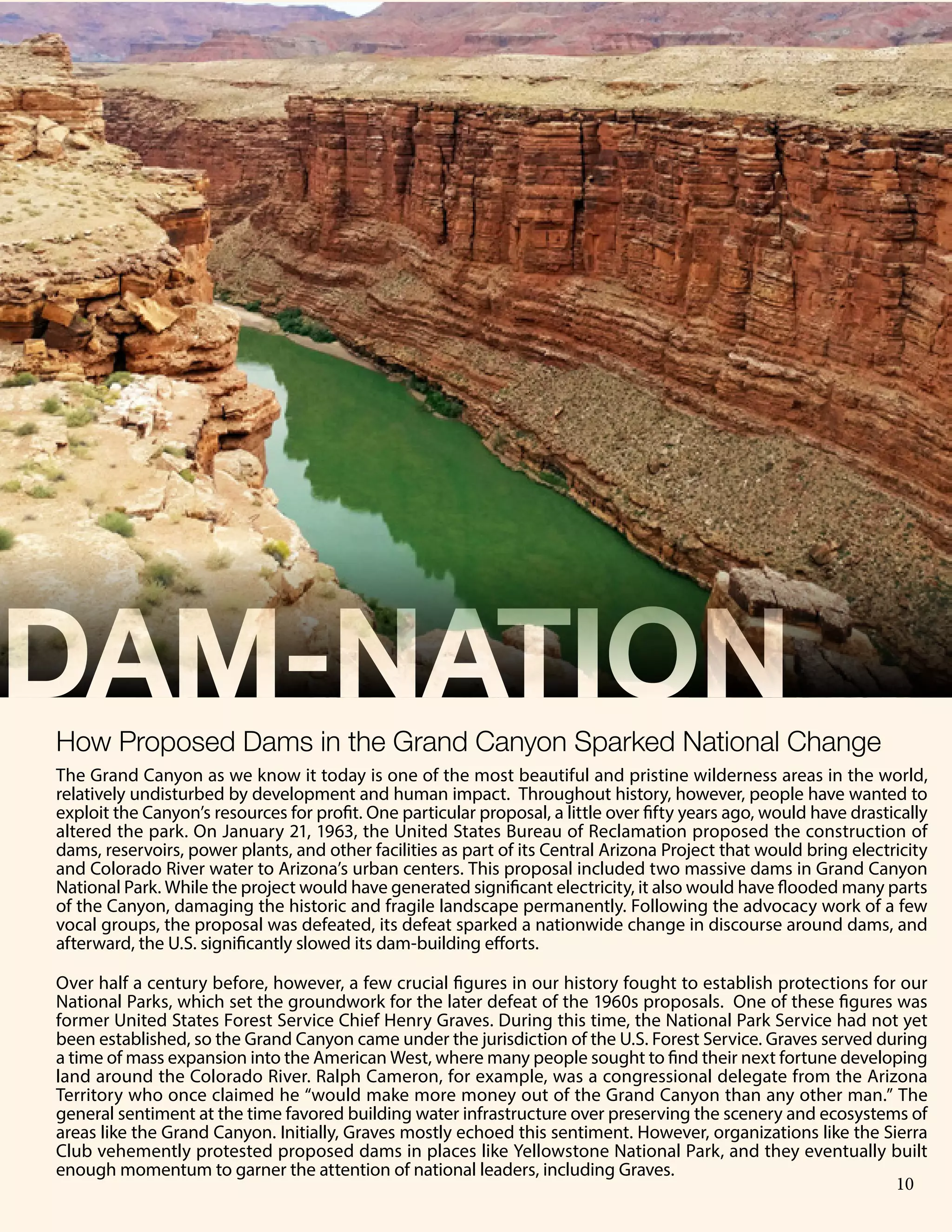
DAM-NATION
The Grand Canyon as we know it today is one of the most beautiful and pristine wilderness areas in the world,
relatively undisturbed by development and human impact. Throughout history, however, people have wanted to
exploit the Canyon’s resources for profit. One particular proposal, a little over fifty years ago, would have drastically
altered the park. On January 21, 1963, the United States Bureau of Reclamation proposed the construction of
dams, reservoirs, power plants, and other facilities as part of its Central Arizona Project that would bring electricity
and Colorado River water to Arizona’s urban centers. This proposal included two massive dams in Grand Canyon
National Park. While the project would have generated significant electricity, it also would have flooded many parts
of the Canyon, damaging the historic and fragile landscape permanently. Following the advocacy work of a few
vocal groups, the proposal was defeated, its defeat sparked a nationwide change in discourse around dams, and
afterward, the U.S. significantly slowed its dam-building efforts.
Over half a century before, however, a few crucial figures in our history fought to establish protections for our
National Parks, which set the groundwork for the later defeat of the 1960s proposals. One of these figures was
former United States Forest Service Chief Henry Graves. During this time, the National Park Service had not yet
been established, so the Grand Canyon came under the jurisdiction of the U.S. Forest Service. Graves served during
a time of mass expansion into the American West, where many people sought to find their next fortune developing
land around the Colorado River. Ralph Cameron, for example, was a congressional delegate from the Arizona
Territory who once claimed he “would make more money out of the Grand Canyon than any other man.” The
general sentiment at the time favored building water infrastructure over preserving the scenery and ecosystems of
areas like the Grand Canyon. Initially, Graves mostly echoed this sentiment. However, organizations like the Sierra
Club vehemently protested proposed dams in places like Yellowstone National Park, and they eventually built
enough momentum to garner the attention of national leaders, including Graves.
How Proposed Dams in the Grand Canyon Sparked National Change
10
Grand Canyon National Park 7
During Graves’s tenure, the Grand Canyon was in an
especially fragile spot as several developers were
vying to execute their grand plans to dam the Grand
Canyon. At the same time, Congress was debating
establishing the National Park Service, which would
grant protections from exactly what these developers
wanted to build. Graves could have easily approved
their plans by simply following the precedent set by the
approval of similar proposals in Hetch Hetchy, part of
Yosemite National Park. However, he also weighed the
potential of the National Park Service bill to pass in the
legislature. Of one developer’s application, he wrote that
it would “allow rights to be secured while action is being
taken to create the park that would not be permitted
if the creation of the park were an accomplished fact.”
He eventually made the incredibly difficult decision to
choose preservation over development, and this gave
groups like the Sierra Club the encouragement and
momentum they would need to defeat a new proposal
50 years later.
Between the end of World War II and the 1960’s, the United States was experiencing a boom in canal, dam, and
power plant construction across the American West as the cities in the region continued to urbanize. Floyd Dominy,
the commissioner of the Bureau of Reclamation at the time, wanted to build on that momentum by utilizing
the Colorado River in the Grand Canyon. The American public was generally indifferent to the environmental
and cultural concerns associated with building dams, and many of the areas included in the dam proposal were
considered remote or unimportant.
One of those areas would have been Marble Canyon, which runs from Lees Ferry to the head of the Grand Canyon.
Ironically, Marble Canyon was not named after any actual marble, but rather beautiful, polished limestone that
explorer John Wesley Powell described as being “of many colors – whites, gray, pink, and purple, with saffron tints.”
According to Mark Buchanan, many people were unaware of Marble Canyon, so it made the perfect location for a
dam. A few people, however, were aware of the canyon and fought vehemently against the proposed dam. Martin
Litton was an influential member of the Sierra Club, which was the driving force behind the resistance against
many of these dam proposals. He helped lead the nationwide lobby against dams, and as it gained more and more
attention, the American public no longer had the privilege of ignorance regarding these issues of preservation. His
advocacy work helped start a shift in the public’s mindset away from indifference and toward valuing nature.
TheotherproposeddamwasinBridgeCanyon,namedafterasmallnaturalbridgethatcanbefoundinthearea.This
dam, according to Sarah Bohl Gerke, would have flooded lands on the Hualapai reservation and caused irreversible
environmental and cultural damage to the area. It would have been the tallest dam in the Western Hemisphere,
and the resulting reservoir would have stretched all the way to Havasu Canyon. Surprisingly, the Hualapai mostly
supported the Bridge Canyon Dam because of its revenue-generating potential for the tribe. However, the National
Park Service and Sierra Club eventually spoke out against the dam because they argued it would not generate
enough of a return to justify its sky-high costs, and it would cause unnecessary and irreversible environmental and
cultural damage.
After years of debate and protests on both sides of the issue, Congress approved the Central Arizona Project in
1968 but omitted the two dams in Grand Canyon National Park. This landmark decision helped set a precedent
for a change in the national discourse surrounding dams and other exploitations of natural resources. While some
politicians and businesspeople still occasionally advocate for these dams, the United States significantly slowed its
dam-building efforts after Dominy’s proposals were defeated.
As environmentalist Ira Gabrielson once posited, “If you can’t save Grand Canyon, what the hell can you save?” The
people involved in the story of these dams were really just ordinary people who cared for the cultural, natural, and
scientific wonder of our national parks. They recognized that, while these dams may have been profitable, the costs
would have vastly outweighed any monetary benefits. Looking forward into Grand Canyon National Park’s future,
there will inevitably be more proposals like this, and it is up to us to stay informed and work to preserve the wonder
in our Natural Wonder of the World.
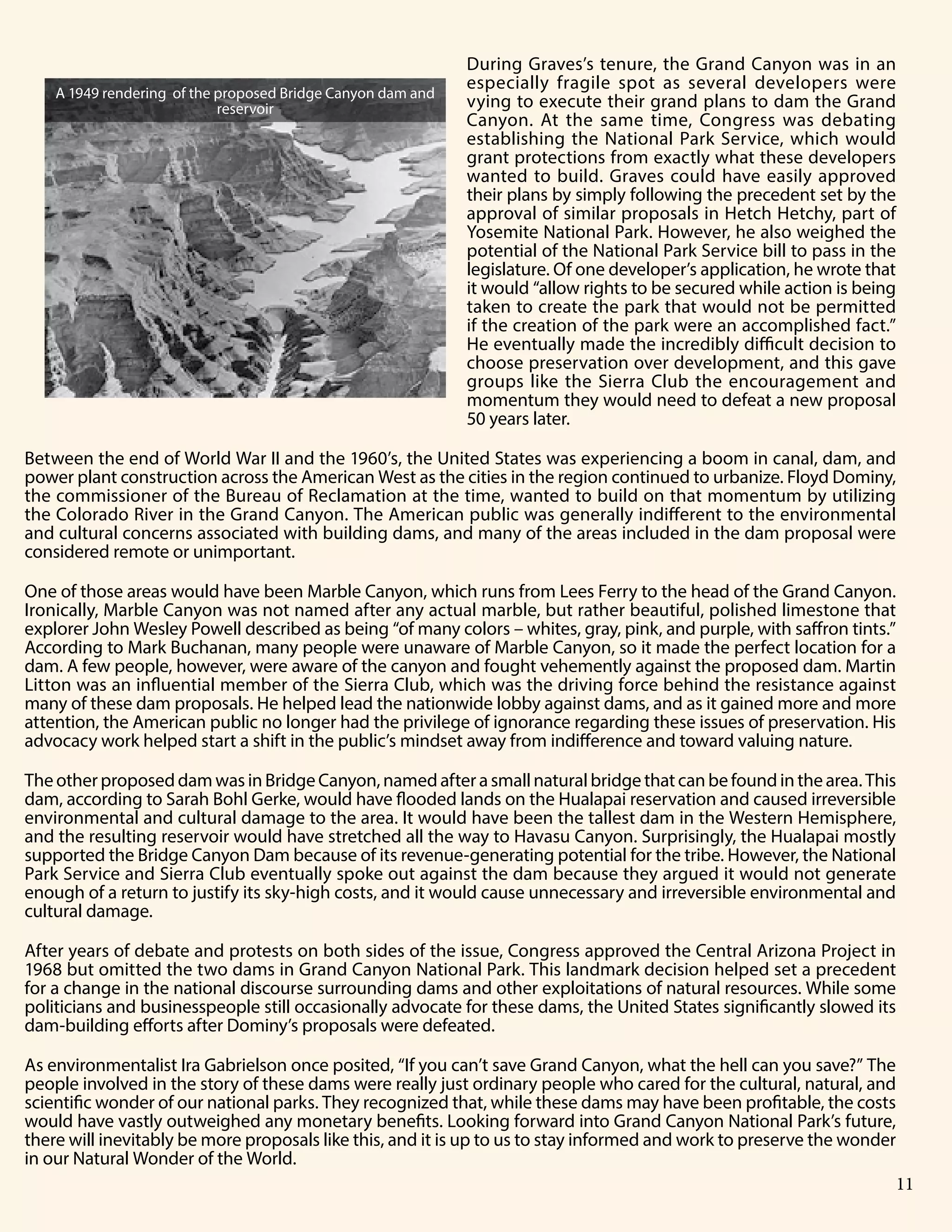
A 1949 rendering of the proposed Bridge Canyon dam and
reservoir
11
Ban on Water Bottles
by Megan Buckley
On December 14, 2011, the National Park Service moved forward with issuing Policy
Memorandum 11-03, which enforces the ban of water bottles sold in the Grand Canyon National
Park. This policy is entails the “recycling and reduction of disposable plastic bottles in parks.” As
of now the following National Parks have enforced this policy to ban sales of water bottles to help
eliminate waste in parks and create a more “green” atmosphere; Arches, Bryce Canyon, Grand
Canyon, Mount Rushmore and Zion have banned bottled water sales. Instead, they provide
water filling stations and sell reusable water bottles, which, according to the NPS’s 2011 data,
range in price from $3.95 to $15.50. However, the ban of sale of water bottles does not include
other plastic containers such as soda, sports drinks, fruit juices and visitors can bring in their own
bottled water.
The waste stream in the National Park is compromised 20% of disposable water bottles,
which due to the ban of water bottles sold in-park will decrease. For the tourists who don’t
consistently carry a reusable bottle will have the option of purchasing reusable bottles at
concession stands, which run for about $1.99. Steve Martin, a former parks superintendent,
explained the policy to ban water bottle sales as a way to aspire sustainability. Steve Martin
states, “It isn’t so much anti-water bottle as it is pro-conservation.” He also stated, “There are
many parts of the world where bottles are the only way to get good water to people, but when
you have a choice to do something better, let’s do it,” he told the Arizona Republic after the
recent announcement. National Park Regional Director Wessels made a statement on the policy,
“Our parks should set the standard for resource protection and sustainability. Grand Canyon
National Park has provided an excellent analysis of the impacts the elimination of bottled water
would have, and has developed a well-thought-out plan for ensuring that the safety, needs
and comfort of visitors continue to be met in the park. I feel confidant that the impacts to
park concessioners and partners have been given fair consideration and that this plan can be
implemented with minimal impacts to the visiting public.”
However with ban of sales of water bottles within the Grand Canyon National Park raised
concern from tourists, NPS board members and Coca-Cola representatives. Before the policy was
final there was a stall in the progress of the policy due to the fact that the Coca-Cola Company,
which had donated $13 million to the parks, was concerned that their Dasani product would
not longer be sold and consumed by tourists visiting the National Parks. Another concern was
that the sales ban has been costly to park visitors and expensive for taxpayers. Grand Canyon
National Park constructed 10 new water filling stations at a cost of $288,900. Maintaining and
keeping water stations clean is critical, because failing to service them properly can make them a
haven for bacteria. In theory, the ban sounds like progress. But what about the other 80% of litter
that gets strewn about the park — those Cliff bar wrappers, Chex-Mix bags or paper napkins?
Perhaps the bottle ban can be thought of in the same light as the switch to those green-colored
grocery store tote bags: it’s symbolism, but it’s a start.
The Grand Canyon National Park has nothing but the best interest of the park at heart
while making policy decisions. A lot of careful and strategic thought went into this policy
implementation to better the park and to sustain its beauty. Superintendent Dave Uberuaga said,
12
“We want to minimize both the monetary and environmental costs associated with water packaged
in disposable containers. We are grateful to the Director for recognizing the need for service-wide
guidance on this issue and for providing a thoughtful range of options.” The director also made
a statement commemorating the efforts of the policy and the benefits it has to the Grand Canyon.
Director Jarvis stated, “I applaud Grand Canyon National Park for its efforts to reduce waste and
the environmental impacts created by individually packaged water. This is another example of
the National Park Service’s commitment to being an exemplar of the ways we can all reduce our
imprint on the land as we embrace sustainable practices that will protect the parks for generations
to come.”
13
Objective 3: This publication will facilitate a
personal connection between readers and the
park’s story, primarily the diversity of people,
values, and interests that shaped what it is
today.
Strategy: This publication will feature prominent historical figures throughout
the park’s history, as well as less-prominent, but equally important people.
Through these people’s narratives, readers will see themselves represented
in the overall story of the park, which will inspire them to get engaged with
the park. The story structure will combine infrequent, larger, feature-length
narratives with more frequent, shorter snippets that relate to the feature stories.
Tactics:
•The Kolb Brothers
•Brighty the Burro
•Native American origin stories
•John Wesley Powell
•Dan Hogan
•Lieutenant Ives
•John Verkamp
•Pete Barry
•Louis Boucher
•Mary E. J. Colter
14
4 Publication Title
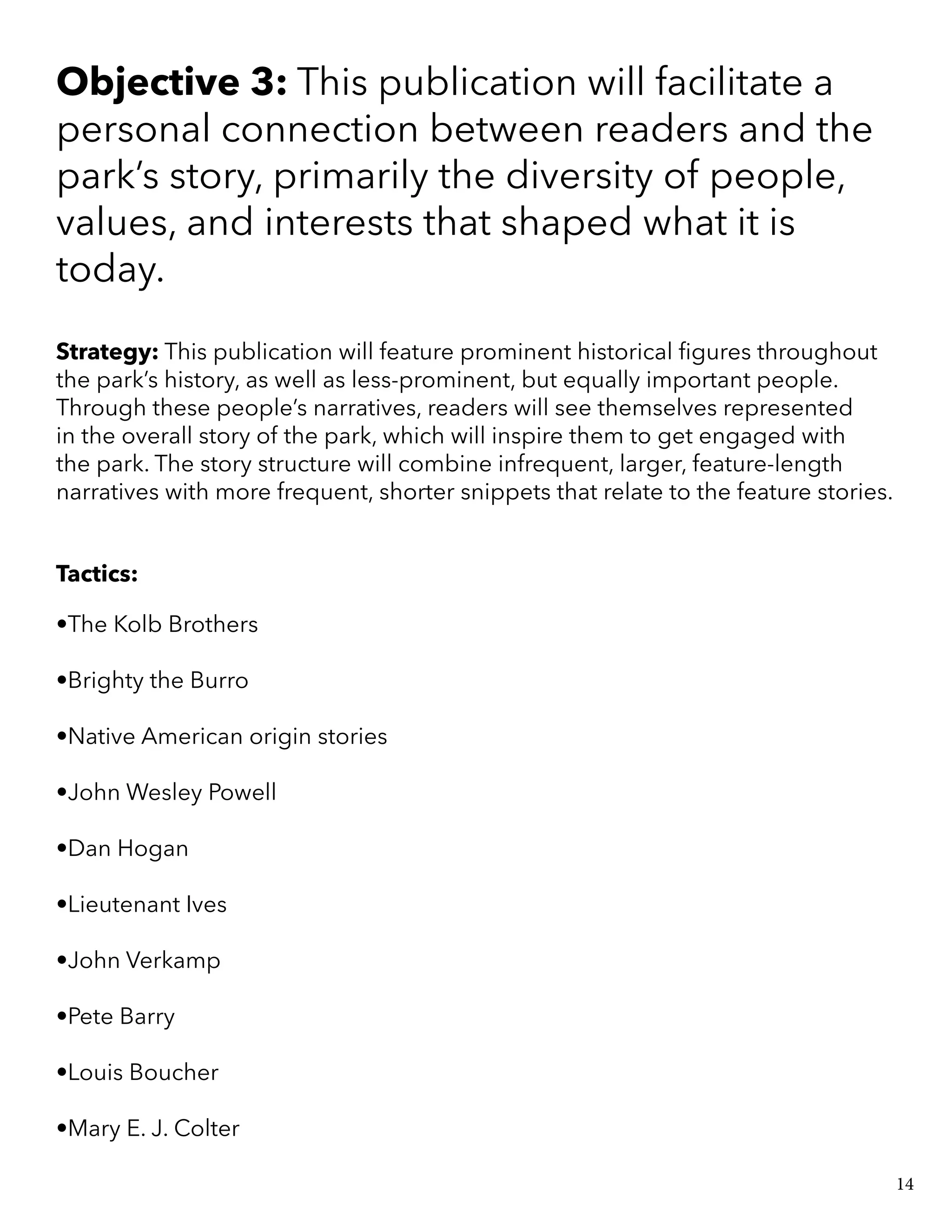
Since the early 1900s people from all parts of
the United States have come to visit the Grand Canyon
to visit but many have come to develop businesses.
John Verkamp was one of the first to see the Grand
Canyon as a potential place for business. Verkamp
traveled from his hometown of Cincinnati, Ohio to
the canyon with a plan to sell souvenirs from a tent
in 1898. During this time people did not have much
cash so he would trade and barter items. Most items
he typically sold were hand crafted by the Native
Americans in the area. Unfortunately there was not
enough tourist activity for him to make a profit so had
to close his store after only a few weeks. He would
return home with the hopes of returning again one
day.
In 1901 the Santa Fe Railroad was able to reach
the South Rim, which resulted in a surplus of tourism.
This tourism spike resulted in business ventures
such as hotels and shops. Verkamp knew he had his
opportunity to return to the canyon for business. He
began construction on his store, Verkamp’s Curious,
which was completed by 1906.
Eventually the rest of his family would join
him in operating there now booming business.
They bought products such as Native American arts
and trinkets while also adding post cards and other
local items. They would buy from the same Native
American artists for the next 50 years. Each employee
received specific training to explain the history and
the meaning behind each item they sold. Verkamp
believed that having informed employees would
draw interest from customers and would increase
their sales.
After nearly 40 years of owning the store John
Verkamp passed away in 1944. His death technically
ended the family’s concession contract with park.
The location of the store along the south rim was a
highly coveted location for park officials. They saw
the location as a perfect place for a new Fred Harvey
Hotel and Casino. They thought the building was
unappealing and were looking forward to taking
it down. As one of the first businesses run at the
canyon John’s wife and children pleaded with park
officials to renew their contract. Initially reluctant, the
park decided to renew the contract because of the
structures historic value. In 1974 the store would be
placed on the National Register of Historic Places.
The store celebrated its 100th anniversary in
2006. The family had hired managers and employees
to take over the day-to-day operations of the store,
but a family board was put into place to oversee the
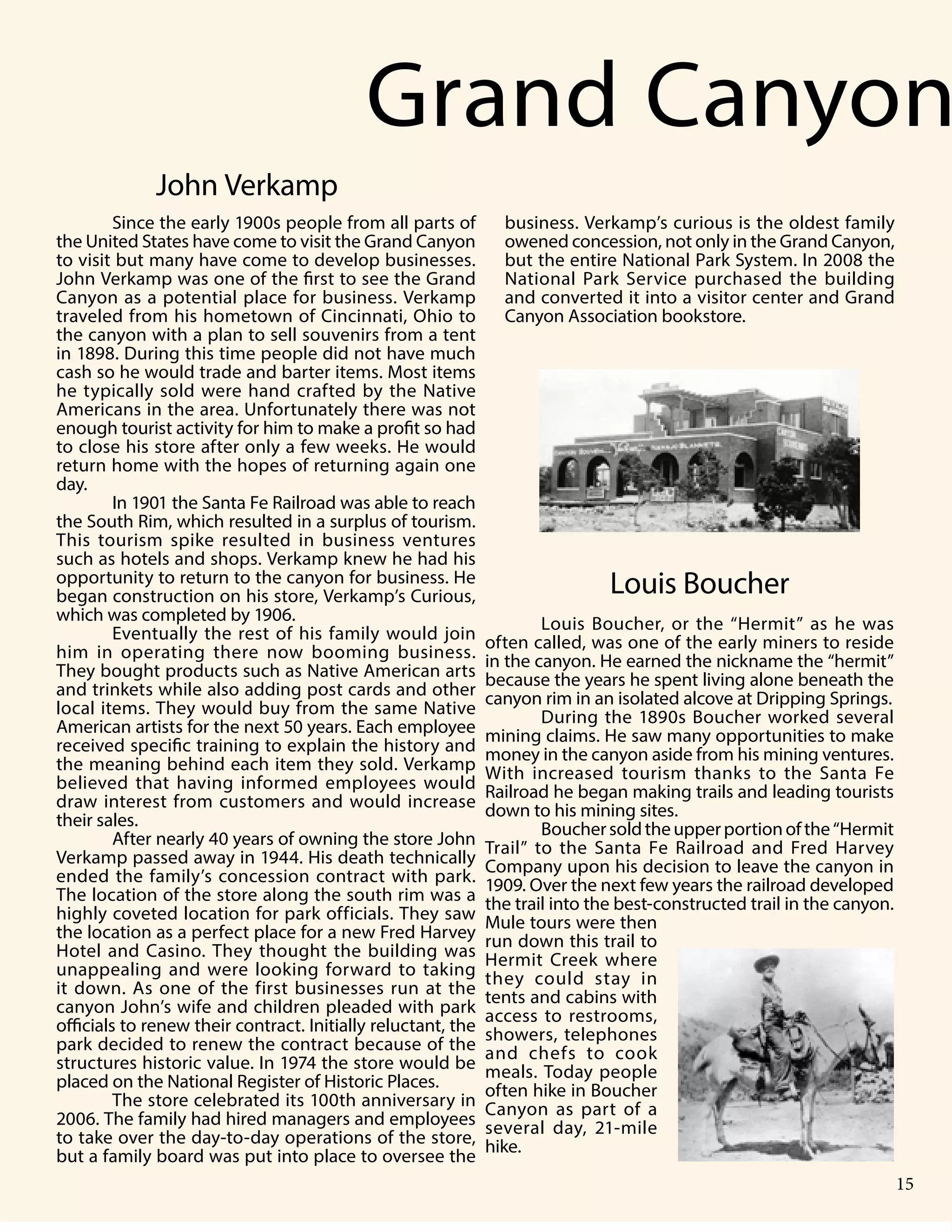
Louis Boucher, or the “Hermit” as he was
often called, was one of the early miners to reside
in the canyon. He earned the nickname the “hermit”
because the years he spent living alone beneath the
canyon rim in an isolated alcove at Dripping Springs.
During the 1890s Boucher worked several
mining claims. He saw many opportunities to make
money in the canyon aside from his mining ventures.
With increased tourism thanks to the Santa Fe
Railroad he began making trails and leading tourists
down to his mining sites.
Bouchersoldtheupperportionofthe“Hermit
Trail” to the Santa Fe Railroad and Fred Harvey
Company upon his decision to leave the canyon in
1909. Over the next few years the railroad developed
the trail into the best-constructed trail in the canyon.
Mule tours were then
run down this trail to
Hermit Creek where
they could stay in
tents and cabins with
access to restrooms,
showers, telephones
and chefs to cook
meals. Today people
often hike in Boucher
Canyon as part of a
several day, 21-mile
hike.
Grand Canyon
business. Verkamp’s curious is the oldest family
owened concession, not only in the Grand Canyon,
but the entire National Park System. In 2008 the
National Park Service purchased the building
and converted it into a visitor center and Grand
Canyon Association bookstore.
John Verkamp
Louis Boucher
15
Grand Canyon National Park 5
Dan Hogan was among the first group of
prospectors from Flagstaff to arrive at the Grand
Canyon in 1890. One of his first accomplishments was
backpacking the canyon from rim to rim with a few of
friends one year after their initial arrival. This was a rare
feat at this time but his canyon adventures were just
beginning.
In 1893 Dan Hogan discovered an outcropping of
copper located 1,000 feet below Maricopa Point along
the canyon wall. At this time mining activity existed
on claims because the canyon had not yet become a
national park. Thirteen years later Hogan and his partner
Charles Babbitt officially patented the claim of their
copper mine. This gave them four acres on the South
rim along what is now Hermit Road and sixteen acres
down the canyon wall.
To have easy access to the copper mine Hogan
constructed two trails. The first was The Battleship trail,
which followed along 1.4 miles of the Bright Angel Trail
before cutting down below Maricopa Point 3.5 miles
to the mine site. His second trail was not quite so easily
accessible or safe. Hummingbird trail, or “The Slide” as
others called it, consisted of ropes, ladders and toe holds
that were carved into the side of the cliff directly above
the mine. In 1912 Hogan would gain full ownership of
the mine.
Hogan added to the history of the Canyon
not only with the mine but he also opened up tourist
facilities that were not controlled by the National Park
Service at the time. In 1936 he opened the Grand Canyon
Trading Post. To attract more tourists, he also added
cabins and a saloon to the trading post. Unfortunately
business declined during World War II and Hogan sold
the mine and his tourist businesses to Madeleine Jacobs
in 1946.
In 1987 all mining within the canyon would
come to a halt, as the property would now belong to
the federal government. Throughout the existence
of the mine it produced 495,107 tons of ore, including
4,257,571 pounds of uranium oxide, 6,680,00 pounds
of copper, 107,000 pounds of silver, and 3,283 pounds
of vanadium oxide. The value of the uranium alone
was approximately $40 million. Dan Hogan had a great
influence on the park. His mining and tourist success
helped draw people nation wide to seek opportunity
and the beauty of the Grand Canyon.
Pete Berry was one of the several early
miners to arrive to the canyon around 1890.
Berry along with his partners, Ralph and Niles
Cameron, discovered the most pure grade of
copper to be found at the Grand Canyon near
Horshoe Mesa. They claimed the area theirs and
gave it the name of the Last Chance Mine. They
immediately began working on a trail, which is
now called the Grandview Trail, to efficiently
get access to the mine. They used a technique
called “cribbing” as a shortcut to construct the
trail quicker. They used juniper logs and chains
to construct the trail along a rock wall instead
of dynamite to blowout the trail along the wall.
This log trail is still used by hikers to this day.
While his friends continued to focus on
there mining expeditions Pete Berry shifted his
focus to other business ventures. In 1897 Berry
and his wife Martha opened the Grandview
Hotel. The hotel was two stories and catered to
the ever-growing number of tourists arriving
from Flagstaff. At the time it was marketed as the
“only first-class hotel at the Grand Canyon”.
Business began to decrease upon the
arrival of the railroads in the early 1900s. The train
station was many miles west of his hotel and the
trains being more affordable, comfortable, and
efficient then the stagecoach that lead to his
hotel he received less business. After several
years trying to stay afloat Berry sold the hotel
and his mining claims in 1913. The Grandview
Hotel stood for 16 years before being torn down
in 1929. Today hikers travel along the Grandview
Trail where the debris of his mines and hotel still
lay.
n Personalities
Pete Berry Dan Hogan
16
The Kolb Brothers
by Megan Buckley
The Grand Canyon National Park is one of the 7 wonders of the world and a renowned
symbol of America. The Canyons overwhelming size and its intricate and colorful landscape
is what draws visitors to come from all over the world to witness. Due to the vast beauty of the
Grand Canyon many people cannot resist taking pictures of the canyon and all it has to offer as
memorabilia from their trip. There are countless photographs taken of the park along with the
visitors, and this idea of photographing the beauty and activity of the park began with the Kolb
brothers.
The Kolb brothers, Emery and Ellsworth were Western Pennsylvania natives who left their
hometown and job in industrial plants in Pittsburgh to make their livelihoods taking pictures at
Grand Canyon National Park. Those photographs included the canyon and candid photographs
of visitors hiking and enjoying the park. That is where the Kolb brothers made their impact on
the park; by creating a photography studio documenting the beautiful canyon the enjoyment it
brought to others through photographs.
The Kolb Brothers were innovative and adventures while starting up their business and
creating a life for themselves within the canyon. The Kolb brothers found themselves seeking to
take pictures with techniques that many didn’t use and front viewpoints that many couldn’t reach.
The brothers learned to develop the film they had taken using the water that was available to
them within their location, which was a muddy cow pond near their studio. They also got creative
when trying to develop the prints by taking over an old mining common place as their dark
room. The Kolb brothers were inventive and adventure enthusiast and they showed that through
their photography.
The Kolb brothers’ business was booming and because they were doing so well, the
brothers partnered up with Ralph Cameron to continue the efforts of the brother’s photography
studio. By partnering up, the Kolb brothers were able to build a small cabin on a mining claim of
Cameron’s near the canyon’s edge. The studio grew and enlarged several times over the years
and in 1915 the brothers were able to showcase their first film that they recorded during the
winter of 1911-1912 of their trip down the Colorado River and through the Grand Canyon. The
film was iconic and was played in the Kolb brother studio at the Grand Canyon everyday from
1915-1976 as Emery Kolb narrated it himself until 1932. The brother’s film is still known as the
longest movie running in the United States.
The Kolb brothers were not just your average brothers who moved away from home to find
adventure. They were entrepreneurs and Grand Canyon enthusiast that made a successful and
historical business. Their studio is on the National Register of Historic Places and it is an American
icon. The National Register commemorates and recognizes the Kolb brothers’ innovativeness and
impact that their photography had on the park and the people.
The Grand Canyon is home to many people, cultures, and beauty. However, the Kolb
brothers were more than bystanders, they were active participants in promoting the Grand
Canyon to visitors and creating history. Through the Kolb brothers’ excessive and outstanding
17
efforts to find photographic viewpoints, new areas of the park, and action shot of the visitors, the
brothers aided in establishing the Grand Canyon National Park for what it is today. The Grand
Canyon is a symbol of national pride and iconic for parks and wilderness areas worldwide, and the
Kolb brothers were apart of this great success.
18
How the Grand Canyon Created the World
Native American Origin Stories in the Grand Canyon
by Richard Frische
Native Americans were the first inhabitants of the Grand Canyon, long before the European
conquest of the Americas, and it has been home to various Native American tribes for thousands
of years. For many of these tribes, the Grand Canyon is more than a physical home – it is a cultural
landscape, rich with thousands of years’ worth of oral history and tradition. Many see the Grand
Canyon as the point from which our entire world emerged, and is the central focus of their origin
and emergence stories. These tribes include the Hopi, Southern Paiute, Navajo, Zuni, and a
collection of tribes known as the Pai.
Hopi
The Hopi tribe currently resides in northeastern Arizona, but they originally emerged from
the Grand Canyon. According to Patricia Biggs of Arizona State University, Hopi oral tradition
tells of two brothers, Pokanghoya and Polongahoya, who threw lightning bolts and piled mud
to build the Grand Canyon and the Colorado River. It was from a geologic dome in the Canyon
known as sipapuni that the Hopi ancestors, the Hisat’sinom, emerged from their third world.
Tribal member Lyle Balenquah describes that upon their arrival in this fourth world, they met the
spiritual deity Ma’saw, who offered them ears of corn, a gourd of water, and a planting stick to
survive in the arid climate. Ma’saw instructed the Hisat’sinom (People of Long Ago) to migrate
across the landscape and leave physical signs to show their learning of stewardship. These
signs today represent ancient Hopi artifacts, and they can be found in numerous locations in the
Canyon including Bright Angel Pueblo, Walhalla Glades Pueblo, Unkar Delta, and the Nankoweap
Granaries. The Hopi emergence story helped establish stewardship and agriculture as the central
tenets of their culture, and the Grand Canyon is an integral part of the Hopi Cultural Landscape,
known as Hopi’tutskwa.
Southern Paiute
Patricia Biggs also wrote about Paiute legend, in which there was a tribal chief named
Umbah who grieved for his dead wife. The god Taavotz led Umbah through a mountain that
guarded the western spirits, as long as he promised that he would stop grieving when they
reached their destination. Umbah eventually found his wife, and they returned east through the
gorge they had cut, which formed the modern day Grand Canyon. Taavotz poured the Colorado
River into this gorge, and he ordered Umbah to keep the spirit land a secret. The Paiute now
believe that the river will swallow anyone trying to follow it west through the Canyon.
Navajo
The Navajo Nation, the largest and most populous Native American tribe, also includes
the Grand Canyon in its emergence story. Davina Two Bears, a writer for Native Voices on the
Colorado River, describes the Navajo (Dyne) origin story beginning with a great flood at the
creation of this world. After the world’s rivers, creeks, and streams were made to drain the
flood, the Humpback God dragged his came east to west to create the Grand Canyon. Today,
the Navajo believe this god manifests itself in bighorn sheep and mountain goats. They also
19
see the Colorado River as a living, male entity. The Navajo consider the Grand Canyon, among
other canyons, to be the home of many deities, including Black God, Fringe Mouth God, and Salt
Woman.
Zuni
For the Zuni, who call themselves Ashiwi, their point of emergence is at a location in the Grand
Canyon known as Chimik’yana’kya dey’a, which is now known as Ribbon Falls on Bright Angel
Creek. According to Biggs, their ancestors spent time in the Canyon adjusting to this world after
emerging from another world somewhere beneath the canyon. Afterward, they embarked on a
series of migrations and eventually found their permanent home in Western New Mexico.
Pai
The Pai, or the People, represents a family of Native American tribes including the Hualapai,
Havasupai, and Yavapai. Author Stephen Trimble discusses that they originated from Wikahme’, or
Spirit Mountain. A deity named Mađvil created this mountain, located along the Colorado River.
Not long after, however, the various tribes separated and migrated to their respective homes
across Arizona. Many remained in the Grand Canyon in an area called Meriwhitica, or Mađwiđa in
their native language. Eventually, those tribes came into conflict and moved out of the Canyon into
separate regions.
Story Notes:
This was originally written as a single feature story, but we believe this would be better executed as
a collection of more fleshed-out stories in order to give each tribe the narrative space it deserves.
20
Objective 4: Readers will learn how the park
has affected the world as we know it today.
Strategy: The publication will highlight key events in history that were made
possible, in part, because of Grand Canyon National Park. These narratives
will incorporate both national and international impacts and perspectives. The
story structure will combine infrequent, larger, feature-length narratives with
more frequent, shorter snippets that relate to the feature stories.
Tactics:
•	 Federal Aviation Administration and the Grand Canyon
•	 The Grand Canyon Fuels Apollo Mission
•	 Haier Brothers
•	 Leave No Trace program
•	 William Randolph Hearst
•	 The Music of the Grand Canyon
21
8 Publication Title
Plane security has become one of the largest moderated situations of the twenty first century. In the
past decade, an estimation of about 3 billion people board a plane a year. In 2013, a survey suggested that
there were about 2,524 flights between the U.S, Canada, and Europe on a single day. Could you imagine
if there was no way of controlling the air traffic? There would be complete and utter chaos in the skies.
Fortunately, there is a system that has been developed that monitors these flights. This system was born
right in one of the Seven Wonders of the World, the Grand Canyon.
In the 1950’s plane safety and regulating sky traffic were not a top priority. The sky was just filled with
people flying in every direction unknowing of who else was in the air. For years people had been flying blind,
but there was yet to be any sort of issue. However, as more people took to the sky the chances of an accident
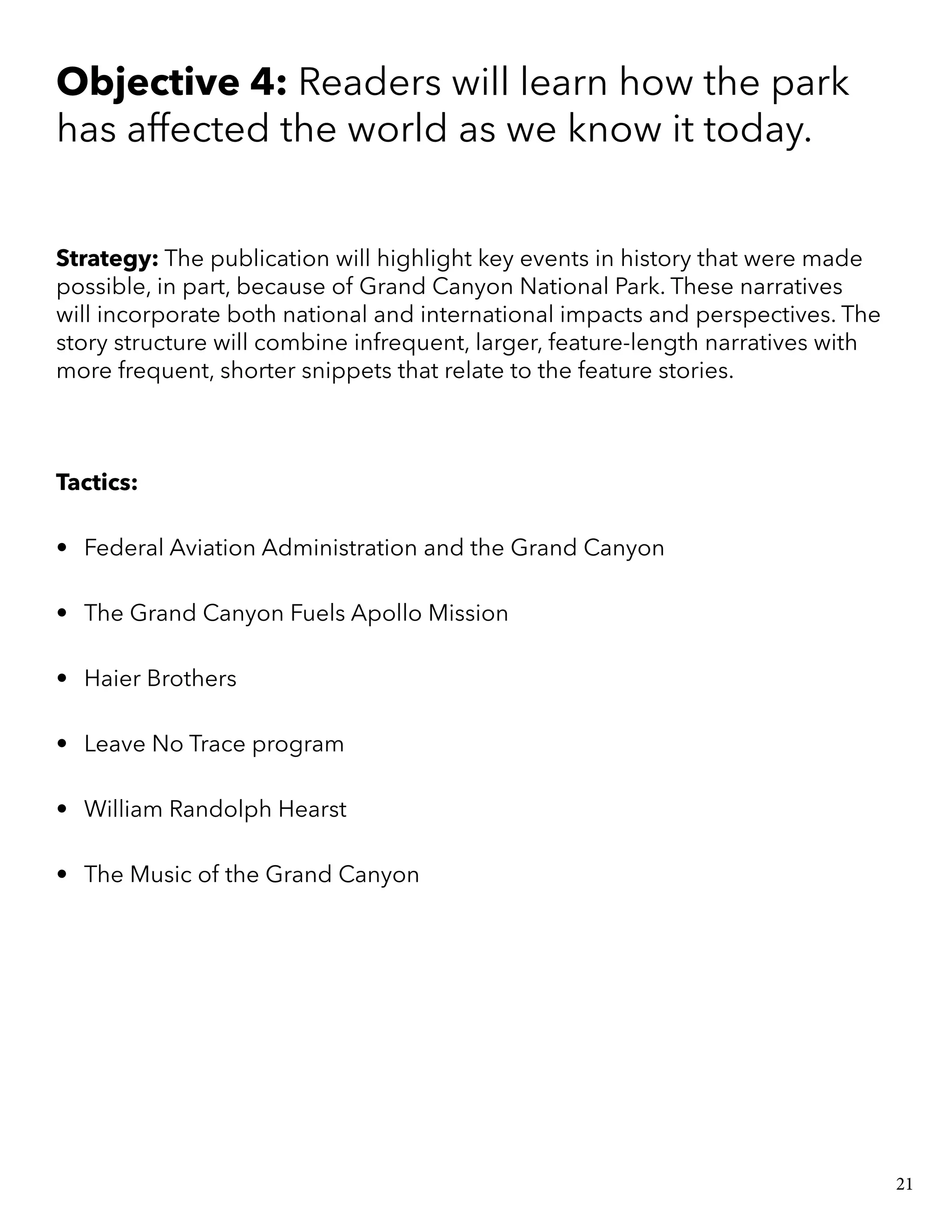
were imminent. This reality came true on June 30th 1956, when two planes collided directly over the Grand
Canyon, Arizona, which sadly killed all 128 people who were aboard the planes.
This tragedy set forth in motion a plan that would help eliminate the risk of mid air collisions. On
December 31st, 1958, the Federal Aviation Agency began its operations. The Federal Aviation Agency was
designed to provide the safe and efficient use of national airspace. This national service has been through
many different changes throughout its existence. The biggest would be the transition from and agency to an
administration.
Over the course a couple centuries, more and more people have become familiar with the Grand
Canyon. In the 1950’s passenger flights would occasionally pass over the canyon for a better view.
Unfortunately, two planes flying from Los Angeles to Chicago, a United Airlines DC-C and TWA Constellation,
The Crash Heard
Around The World
How the Grand Canyon contributed to creating the FAA
22
Grand Canyon National Park 9
had both requested permissions to fly into canyon
airspace. At exactly 10:30 am Pacific Standard
Time, the two planes collided directly over the the
canyon. After the two planes ceased to report in
for a while, suspicion arose, and search and rescue
procedures began.
The wreckage was discovered by Henry and
Palen Hudgin, two brothers who operated Grand
Canyon Airlines. During an earlier trip, Palen had
recalled seeing black smoke rising near Temple
Butte. This suspicion was quickly diminished
when Palen confused the crash by some brush
that was ignited by lighting. Later, after hearing
about the missing plane, he returned to the
scene to investigate the black smoke. Tragically,
the brothers found the wreckage of the TWA
Constellation and reported it to the authorities.
About a day later they came across the DC-7,
however, the rough terrain made it difficult to identify victims and
recover pieces of the plane for data analysis.
Sadly, due to the severity of the impacts in the canyon, no bodies
were recovered in one piece. Identifying individuals, or any remains for
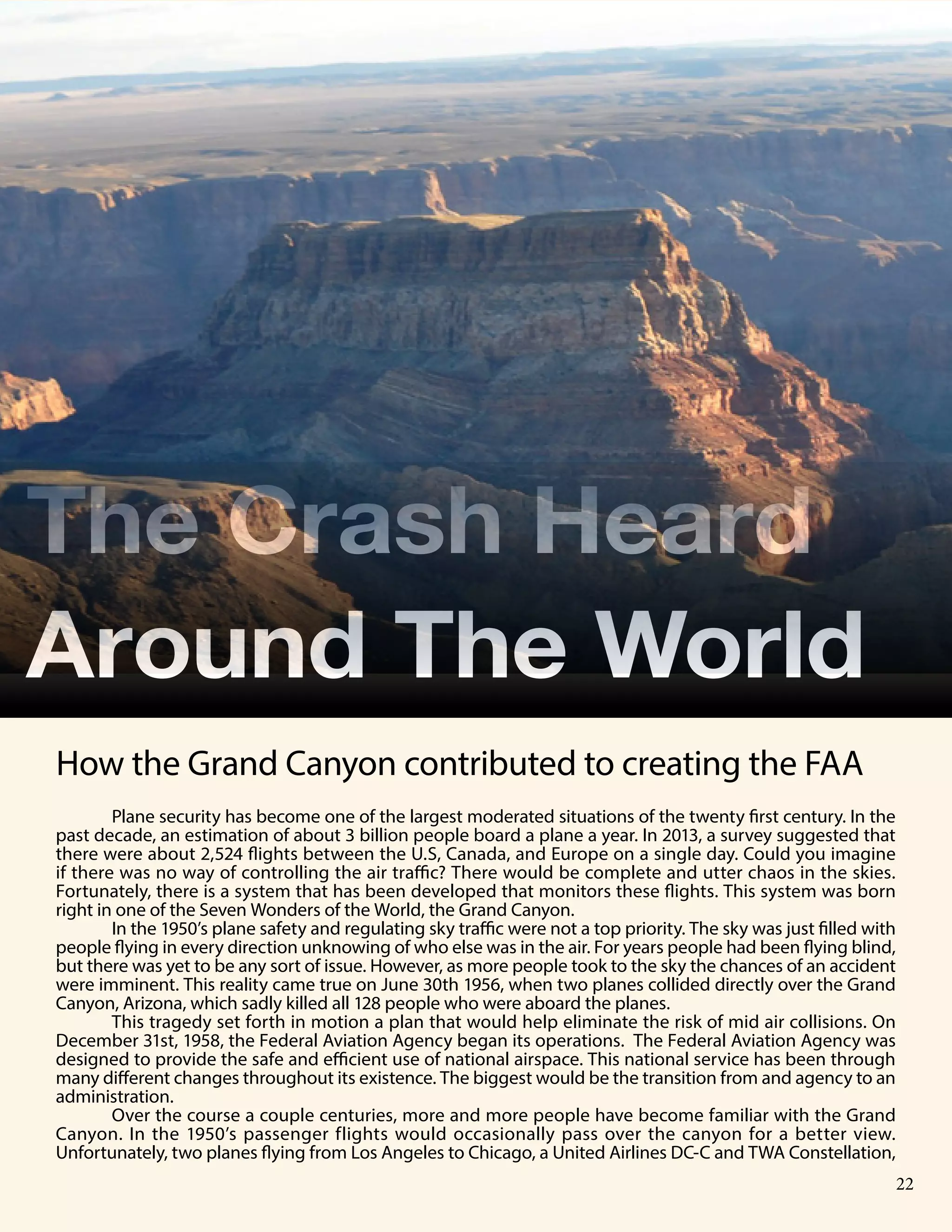
that matter, were not possible. In April 2014, the site of the crash was
declared an official National Historic Landmark. This would become the
first landmark to be created for a situation that occurred in the air. The
exact location of the site is being kept a secret, however the location has
been closed to the public since the 1950’s anyway. A mass funeral was
held in the south rim of the Grand Canyon a couple months after the
crash. There are still parts of the crash that remain in the canyon today.
The canyon crash became one of the deadliest U.S. commercial
airline disaster and the worst crash on U.S. soil of any kind. The press
covered this story worldwide. As this story unfolded, the public began
to notice how primitive Air Traffic Control was, as well as how little
was being done to modernize it. Eventually, the current acting control
agency, the Civil Aeronautics Agency, was replaced by the Federal
Aviation Agency. The FAA was given total authority over American
airspace, and as a result air collisions gradually subsided.
The Federal Aviation Agency began its operations on December 31, 1958. President Johnson was
concerned about a lack of coordinated transportation system; therefore he wanted to create a single
department to carry out comprehensive transportation modes. In 1966, Congress authorized the creation of
a single cabinet department that would combine major transportation responsibilities. As a function within
the Department of Transportation, the Federal Aviation Agency became the Federal Aviation Administration.
As this organization evolved, so did its duties. The FAA began training a special corps of inspectors
that would ride board the planes with regular civilians. These inspectors later became special U.S. deputy
marshals. Growing concerns about pollution and noise prompted the FAA to regulate the aircraft noise
standards. As airspace continued to grow, systems to properly control the amount of aircrafts in the sky
had to increase. The FAA increased the amount of Air Traffic Control towers by 112 percent. The Airway
Development Act of 1970 placed the FAA in charge of being responsible for safety certification of airports.
Finally, with such large change and uncertainty of where this kind of technology is going, the FAA realized
a long-term plan for modernization was needed. The Administration released a comprehensive 20-year
blueprint for a state-of-the-art traffic control and air navigation system.
The Federal Aviation Administration works closely with the National Parks Services on projects that
will ultimately benefit the parks. Congress passed a public law in 1987, proposed by the FAA and the NPS,
commonly known as the National Parks Overflights Act. The FAA would develop an operational rule that
would regulate air tours that might have an adverse effect on National Parks. For National Parks, maintaining
and restoring the natural quiet was an immediate priority. This regulation has and will remain a rule for time
to come, and is a strong indication that the Federal Aviation Administration has positively effected the world
and its National Parks.
23
Haier Brothers
by Xiaoxiao Jiang
When I first arrived at Northern Arizona University, which is located in Flagstaff near the
Grand Canyon, from China, in September 2014, almost all of my American friends asked me why
I chose NAU? My answer: the Grand Canyon.
As a 20-year-old Chinese student, I knew little about American history as well as natural
landscapes, except for the ideas from TV shows. American TV shows are very popular among
Chinese high school and college students and shape how we look at Americans. The Walking
Dead, House of Cards, Gossip Girls, Big Bang Theory, and more shows are on the top of our
TV-watching list. However, for me, my first view about the U.S wasn’t from those modern and
popular shows, which are edited by Americans. It was from a famous Chinese cartoon, which was
published in 1996 and became one of the most popular cartoons among kids, and even adults.
Haier Brother actually was a production of Haier group’s marketing campaign. Haier Group
is a Chinese multinational consumer electronics and home appliances company headquartered
in Qingdao, Shandong province, China. It designs, develops, manufactures and sells products
including air conditioners, mobile phones, computers, microwave ovens, washing machines,
refrigerators, and televisions. According to data released by Euromonitor, in 2014 the Haier
brand had the world’s largest market share in white goods, with 10.2 percent retail volume
market share.
In 1993, Ruiming Zhang, the CEO of Haier group, decided to invest in a cartoon which
used Haier Logo as its major characters. The Haier group invested more than 30 million RMB
($5 million) and spent 8 years to shoot with a total of 1,000km long picture drawings. The Haier
group was producing the show as part of their public service and branding exercise.
The reason why they chose to invest in a cartoon as their advertisement was that one of the
most famous and successful Japanese cartoons -- Astro Boy -- was a marketing campaign of
Casio. Haier group hoped that Haier Brother could be another Astro Boy in China. Fortunately,
they made it. Haier Brother is an essential icon of childhood among the kids who were born
between 1985-2000 in China. Moreover, an American TV station signed a contract with Haier
Group for the broadcasting right of the 212-episode cartoon “Haier Brother”. The “Cartoon
Network”, the biggest children cartoon channel in the US, welcomes a broadcasting plan for
“Haier Brother” as well.
Haier Brother is the longest running and has black curly hair. The younger Haier is a white
boy who wears blue swimming trunks and has yellow straight hair. They are “made human,” or
created by a wise old man. To deal with the disasters and unite the natural miracles, the Haier
brothers travel around the world, from North America to South America, passing by the South
Pole, Australia, Africa, Europe, and Asia. Finally, they come back to their birthplace: the Pacific
Ocean. The hero Haier brothers experience 238 difficult and dangerous journeys in 56 countries,
which total more than 190,000 kilometers, equivalent to nearly 5 times the distance around the
earth. The entire story is full of their adventures. It mentions a lot of natural marvelous sights such
as Mirage and Karst topography. This plot is fluctuates and is unconstrained by space and time.
24
Moreover, it contains rich knowledge about nature, history, geography, humanities, social science,
and entertainment.
I watched whole episodes of Haier Brothers when I was 9 years old, and learned a lot about
the world, especially about the Northern American Continent. In episodes 10-19, the Haier
brothers begin their journey in Northern America, from Alaska to Arizona. They escape from a
fierce brown bear in Alaska and make the wood airplane to survive from the big earthquake. Then
they accidentally get in a time tunnel and come to the Grand Canyon of 1811.
This story begins in the bottom of the Grand Canyon, which has beautiful red stone and desert
plants. In the 19th-Century Grand Canyon, they meet a group of Native Americans who are being
chased by white soldiers. They are fighting for the ownership of the land. The white soldiers tried to
settle the land, dispossessing many of its original inhabitants. The Indian headmen led his people
to use bows and arrows to fight with the white soldiers who were armed guns. There was no doubt
that the Indians were failed because of the huge difference of their weapons. After a defeat, they
found the insensible Haier brothers who escaped from the time tunnel.
Due to Haier’s skin color, the Native Americans catch the younger white Haier and the elder
black Haier became the Native Americans’ friend. In order to rescue his brother, the elder Haier
helps the Native Americans fight against the white soldiers. He creates explosives by mixing an
appropriate amount of sulfur, saltpeter, and charcoal. The Native Americans use those explosives
to fight off the white soldiers and retake their lands. The Native Americans appreciate Harriers’ help
then give those brave heroes some food as gifts. In the end of the story, the Haier brothers find the
time tunnel again and go back to the 20th century.
From those episodes, I learned a part of American history and knew there is a fabulous
landscape in western America. In order to make the story continual and educational, the director
added a lot of fictional elements in the cartoon. Such as: they spend only one day in crossing the
American continent from Alaska to the Grand Canyon. Also, they drew the Grand Canyon in a
smaller Big Canyon” in the cartoon. So, it took me some time to match the Canyon mentioned in
Haier Brothers with the real Grand Canyon. No matter how the cartoon differs from the true world,
this was the first time I knew about the fight between Native Americans and the white governors.
Moreover, it was the first time I know the Grand Canyon. Perhaps it was the first time many Chinese
kids learn about the Grand Canyon as well.
I never realized that some day I would be living with the Grand Canyon so close. Today, ten
years later, when I first visited the Grand Canyon with my friends, I couldn’t use words to describe
the fantastic beauty of it. Its overwhelming size and intricate and colorful landscape pierced
my soul. I felt as though I could see the ancient Colorado River crashing against the rocks and
eroding the canyon. Standing in front of the Grand Canyon, I could feel the power of nature and
the elapsing of time. I went and sat on a huge rock and watched the passer-by. The hot sun beat
brightly upon my head. I suddenly conjured up the memories of the good old days of a little girl
holding a bowl filled with rice, sitting in front of the television. She dreamed of, someday, being an
adventurer like the Haier brothers and exploring this fabulous, natural wonder.
25
The Music of the Grand Canyon
by Xiaoxiao Jiang
In 2000, National Public Radio named the Grand Canyon Suite one of the 100 most
important American musical works of the 20th Century. The Grand Canyon Suite is a suite for
orchestra by Ferde Grofé, composed between 1929 and 1931. It was initially titled “Five Pictures
of the Grand Canyon.” The five “pictures,” or movements, are Sunrise, Painted Desert, On the
Trail, Sunset, and Cloudburst.
Believe it or not, almost every American knows the clarinet piece in this orchestra by heart. It
is a fresh and lively melody and has been part of the soundtracks for a huge variety of cartoons.
The movie “A Christmas Story” plays this song when Ralphie is waking up on Christmas morning.
It also is in a famous Disney short film released in 1954. Moreover, the Disneyland Railroad ride
uses the third movement from the Grand Canyon Suite, when the train enters the Grand Canyon/
Primeval World diorama. After listening to this music played on YouTube, Daniel Messias added
his comment that this movement reminds him of his childhood. Perhaps it was the first classical
music he had ever heard.
Its composer, Ferdinand Grofé, was born in 1892 in New York. During the 1920s and
1930s, he went by the name Ferdie Grofé. Of French Huguenot extraction, his family had four
generations of classical musicians. His father was an actor and baritone singer while his mother
was a cellist and music instructor. After Ferde’s father died in 1899, his mother took him abroad
to study piano, violin, and composition in Germany. He dropped out of school at 14 years
old. Then he traveled across the country performing odd jobs. When he was 17, he wrote his
first commissioned work. This same year, the Los Angeles Symphony hired Grofé as a violist, a
position he maintained for 10 years.
Grofé’s first major suite, Mississippi Suite, premiered in 1926 in New York City, performed by
the Paul Whiteman Orchestra. The suite was the first of many works Grofé dedicated to American
landscape and feeling. In 1931, Grofé’s most famous work, The Grand Canyon Suite, premiered
in Chicago at the Studebaker Theater on November 22. The work consists of five movements
each designed to describe an episode of life in the Canyon. In 1932, The New York Times called
Grofé “the Prime Minister of Jazz.” In 1955, Grofé again returned to conducting and arranging
and introduced his first suite for orchestra in 16 years, the Hudson River Suite.
Grofé first arrived at the Grand Canyon in 1916. He set 20 strapped gas cans to a vintage
jeep and drove across the Arizona desert to watch the sunrise over the Grand Canyon. He
recalled that he had arrived at the Canyon at night and set up camp. His first experience of it
would come at the next sunrise. He remembered the experience clearly many years later. He
said, “I was spellbound by the silence; but then as it got lighter and brighter, you could hear the
birds chirping and nature coming to life. All of a sudden, bingo! There was the sun. I could hardly
describe it in words.” Grofé had fallen under the spell of the Grand Canyon and had vowed to
translate its impressions into a tangible form. As he would later write, “It became an obsession.
The richness of the land and the rugged optimism of its people had fired my imagination. I was
determined to put it all to music some day.”
26
He was really inspired by the sun rising over the Grand Canyon. Fifteen years after his first
glimpse of the Canyon, he completed his landmark musical suite, which he first titled “Five Pictures
of the Grand Canyon.” This is one of the most enduring works in American classical music. This
work is representative of the flowering musical scene of the early 20th century in which American
composers experimented with combining various old and new musical forms to establish a
uniquely American sound. In this case, Grofé experimented with combining classical and jazz
musical forms.
In order to use every instrument in the orchestra and make his compositions vivid, Grofé made
sound effects by himself. He found ways to incorporate the actual sounds into his music. Many of
his works focused on using music to create moods reflective of natural landscape features, such as
his Mississippi Suite, Yellowstone Suite, Valley of the Sun Suite, and Dawn at Lake Mead.
The Grand Canyon Suite has been called a symphonic poem, or a musical work meant to
convey a literary story. For instance, “On the Trail,” perhaps the best known of the movements, tells
the story of a cowboy on a burro descending a trail into the Canyon. Along the way listeners hear
him pass a waterfall, stop at a cabin with a music box to rest, and then continue on down the trail at
a livelier pace.
Ferde Grofé’s “Grand Canyon Suite,” with its almost non-stop musical effects, shows the
passion for the beauty of the untouched American West. It’s become an international postcard,
and many of its tunes have entered popular culture. The tobacco company Philip Morris used the
“On the Trail” movement as its musical signature in radio and television programs it sponsored
beginning in 1933. In the short Walt Disney film - Grand Canyon - that was directed by James Algar
in 1958, the colorful film footage of the Grand Canyon was accompanied by the Grand Canyon
Suite. This non-story and non-dialogue film won an Academy Award in 1959 for Best Short Subject.
In the film, the director changed the order of movements of the Grand Canyon Suite.
In his later years, Grofé wrote of the success of his famed Grand Canyon Suite: “This
composition was born of sight, sound, and sensations common to all of us. I think I have spoken
of America in this music simply because America spoke to me, just as it has spoken to you and
to everyone of us. If I have succeeded in capturing some part of the American musical spirit, I
am grateful that I was trained to do so. But this music is your music, and mine only in the highly
technical sense that a copyright has been filed away with my name on it. Always we must realize
that there is much more to hear. Outland is rich in music, and if you listen you can hear it right now.
This is our music you hear, surging forth, singing up to every one of us.”
27
Tactical Execution
The stories in our publication will be organized using a “chapter-book” approach, in which each
objective’s collection of stories will be presented in its own section. After consulting with our
focus group, we found that the best arrangement of these “chapters” is as follows:
1.	 People in the park’s history (Objective 3)
2.	 Issues facing the park (Objective 2)
3.	 How the park has affected the world (Objective 4)
Our focus group favored this arrangement because, while it did not eliminate the stories that
covered more controversial issues, it placed those stories in the middle of the magazine so that
the overall narrative can start and end on a lighter, more positive note.
For the following reasons, we belive that our tactical execution acheives our overall
communication goal, which is that this publication will showcase the diverse array of people
who have contributed to the story of the Grand Canyon. By highlighting these people and
their experiences, we hope to empower readers to see themselves in these narratives and help
contribute to the park into its next 100 years.
• A handful of our stories focus on people who have affected the Grand Canyon in some way,
however, choosing to highlight slightly more controversial stories as well allows us to cover
a more diverse array of people and the ways in which those people’s cumalitive efforts have
amounted to a significant impact on the park.
• Furthermore, these stories feature multiple perspectives that allow readers to become more
informed and well rounded stewards of the park.
Our full focus group report can be found in the Appendix.
28
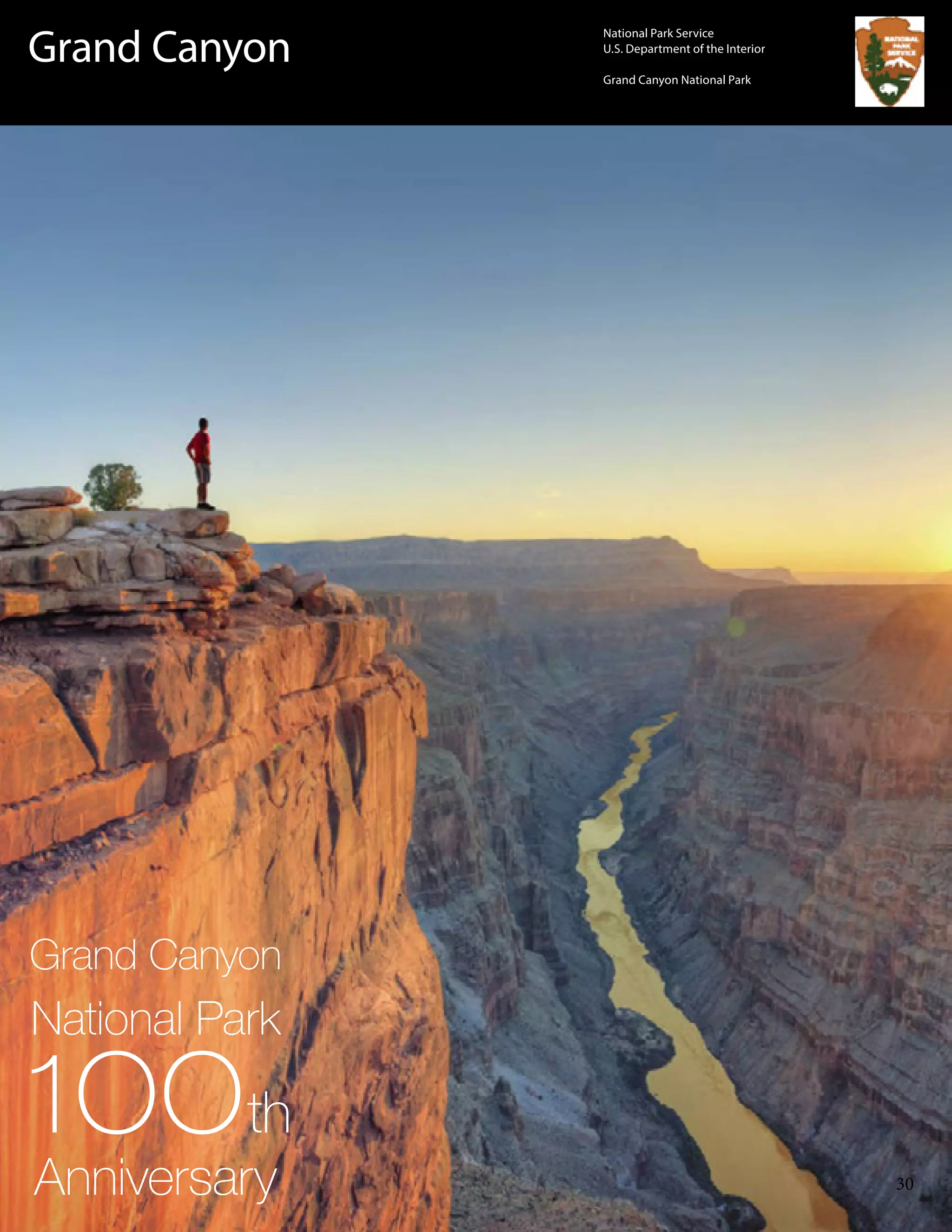
Magazine Cover
After running a variety of cover mockups through our focus group, the following cover was
ranked the best by a wide margin. After some discussion, we found that:
•	 78 percent of participants preferred having a single image on the cover, rather than a collage
of multiple images
•	 The majority also preferred this cover because the text was smaller and out of the way, rather
than large and centered
•	 Participants favored the image in this cover the most because the way in which the person in
the photo is positioned made them feel as if they could be that person. They also liked the
openness of the photo, as well as the Colorado River running through the landscape.
29
Grand Canyon
National Park
1OOth
Anniversary
Grand Canyon
National Park Service
U.S. Department of the Interior
Grand Canyon National Park
30
Appendix: Focus Group Report & Materials 
 
Date​: Wednesday, April 6th 
Time​: 2­4pm 
Team Roles​: 
● Richard & Dakota: Focus group facilitators 
● Megan, Addison, & Xiaoxiao: behind the glass, taking notes & recording the session 
Participant Demographics​: 
● 9 participants 
● Average Age: 20.67 
● 33.3% male, 45% female 
● Majors Represented: Communication Studies, Secondary Education ­ English, Merchandising, 
Comparative Cultural Studies, Speech Pathology, Hotel & Restaurant Management, Social Work, 
Marketing 
● 77.7% have visited Grand Canyon National Park, 22.2% have not 
○ Of those that have visited the park, a majority of them had only been once a few years ago, and 
a few had been multiple times more recently. 
○ Those who have never visited the park indicated reasons such as “Never felt like it” or “Never 
got the chance to” 
 
Discussion Summary 
What is your top memory from your visits to the Grand Canyon? 
● My mother daring me to “get closer” at every stop we made at the rim. 
● Speaking with friends at a place without many other people and hanging out.  
● Gift shop was really cool 
● The beauty 
● Actual Grand Canyon was boring because we just stood there for 10 mins  
● Scenery  
● Museum Area 
● Sunrise  
 
Do you remember reading or using any of the Park’s print publications during your visit? If so, which ones 
stuck out the most to you and why? 
● No, my dad had all the pamphlets. 
● No, just read about signs around park.  
● The map with geological information & facts. 
 
Interpretive Theme rankings​: 
Favorites​: 
1. Inspiration (40%) 
2. Geology (30%) 
3. Biology (20%) 
4. American Indian Connections (10%) 
Least Favorites​: 
1. Biology (44%) 
2. Inspiration (22%) & American Indian Connections (22%) 
3. Geology (11%) 
For those themes that you rated the highest, why did you find them the most interesting? For those that you 
rated lowest, why did you find them least interesting? 
The majority of our group liked the ​Inspiration​ theme because… 
● “I love art and sciences” 
● “I am more interested in its effect on people and the world” 
● “I believe people find inspiration to be a big deal. We look for things to inspire us, artistic & physically” 
● “Inspiration comes with history and spiritual connections with the canyon” 
 
The majority of our group didn’t like the ​Biology​ theme because… 
● “Never really interested in the biology of the canyon” 
● “I believe people won’t care as much” 
● “The history and biology are very uninteresting” 
● “ I am not very interested in biology and ecosystems etc.” 
 
What do you think are going to be the biggest challenges facing our national parks, and the outdoors in 
general, in the next 100 years? How would you like to engage with these issues? 
● “Going to be pollution and destruction. No one cares or maintains all national parks” 
● “People taking out trees and no caring for the conservation of national parks” 
● “Conserving the nature. The industry is bring in. Littering, etc.” 
● “Difficult to control the air pollution. Human destruction will destroy the views ” 
● “Indigenous relations. Conservation efforts” 
● “Getting information to the public. Keeping patrons informed and educated will ultimately help the parks 
thrive” 
● “Environmental Crime and Consumerism. I am one in a sea full of people who just doesn’t care or 
doesn’t know how.  
● “Maintaining and keeping interest in the parks. People should try and raise park and public awareness” 
● “Biggest challenges will be developmental projects. We tend to regulate parks open shops which tend 
to destroy the parks. We can try and keep the consumerism aspect from controlling the parks” 
 
Cover rankings​: 
1. Mockup 2 (66%) 
 
2. Mockup 3 (11%) 
 
 
3. Mockup 4 (11%) 
 
Cover discussion​: 
● 78 percent of participants preferred having a single image on the cover versus multiple images 
● The majority of our participants also preferred small, out­of­the­way text on the cover rather than large 
text in the center 
● Participants ranked Mockup 2 as their favorite because the way the person is positioned in the photo 
makes them feel like they can be that person 
○ They also liked that the Colorado River was featured in the photo 
 
Story rankings​: 
1. Federal Aviation Administration 
2. Native American Origin Stories 
3. Ban on Water Bottles 
4. Moon Landing 
5. Haier Brothers 
6. Dan Hogan 
7. Dam­Nation 
8. Music of the Grand Canyon 
9. Kolb Brothers 
10. General Ives 
 
For those stories that you ranked the highest, why were they your favorite? 
● “Because they focus on how the GC plays a part in American history of the last 100 years, rather than 
just how it affects itself and people” 
● “They were interesting to read a lot and weren’t filled with boring facts” 
● “Relevant information. Culture preservation. ” 
● “The FAA story was my favorite because it is something that a lot of people know about” 
● “Some of the stories showed important history and how to preserve it. Also how some of the opinions 
have changed.” 
● “They make for interesting reads. People get enough of ‘how it happened stories’. Cool events and fun 
facts are memorable” 
● “They seemed to be a better read and more influential to the public” 
  
Favorite points within each story​: 
● See attached story outlines for content 
● Dam­Nation: Bullet point 2 
● Native American Origin Stories: tie between bullet point 2 & 4 
● Federal Aviation Administration: Bullet point 4 
● Moon Landing: Bullet point 6 
● Haier Brothers: Bullet point 2 
● Music of the Grand Canyon: Bullet point 2 
● Ban on water bottles: Bullet point 1 
● Dan Hogan: Tie between bullet point 2 and 5 
● General Ives: Bullet point 1 
 
How do these stories make you feel? Do you feel that you can personally relate to these stories? 
● “Some of them make me curious. I can relate to the large scale ones more so because they are 
greater” 
● “I like these stories they have an emphasis base to poll me in” 
● “I feel not a connection but fascination of the canyon” 
● “Being biologically and culturally aware is something everyone should keep in mind” 
● “The fun fact stories are very intriguing. They make me think back to the Wright Brother and the first 
plane” 
● “Very relatable because my great uncle flew planes and I found it interesting to learn more about that 
professions history” 
 
Discussion of Results 
Our focus group revealed a number of obstacles to effectively engaging Millennials with Grand Canyon 
National Park, as well as a number of insights and opportunities. A couple participants mentioned fear of 
heights as a reason why they have never visited the park, so a greater awareness of safety initiatives may help 
solve this problem. We also observed that many of our participants’ mindsets as to what was most important 
about the Grand Canyon were based on their background and upbringing. Some participants, for example, 
grew up in areas where sustainability initiatives weren’t present at all, while others came from more 
progressive cities where it was more integrated into their way of life. This presents a challenge in that we may 
not be able to effectively engage all Millennials with just this one publication. 
 
Some of the trends we observed were that the Inspiration interpretive theme was our group’s favorite, which 
aligns well with our narrative­focused, people­focused orientation to the publication. However, our group was 
split in their reasoning of why they loved Grand Canyon National Park. One group liked to visit the park for its 
inspirational scenery and to connect with people, while another group liked to visit to appreciate the scientific 
wonder behind the geology and biology in the park. While we definitely are focusing on the former in our 
publication objectives, strategies, and tactics, we will make sure to include content to satisfy the latter as well. 
 
While our group was of two minds regarding why they loved the park, they mostly agreed on the fact that, in 
order to engage them with the park, our publication needs to tell fresh, untold stories that helps them walk 
away from their visit having learned something new and exciting about the park. This is precisely what we hope 
to accomplish through our tactical execution. Additionally, many of our participants commented that they 
weren’t learning much from their visit to the park other than the museum, so they suggested more staff 
interaction with visitors, and greater awareness of their print publications, including the Centennial publication. 
Also, while many participants liked the more controversial stories, some found them to be a bit unsettling at 
times, and this helped us decide where to position the stories in the publication so that they can be most 
effective. 
 
Perhaps our most important discovery from our focus group came from our discussion of the biggest 
challenges that will face our national parks in the next century. Many noted in their responses that pollution 
would be the single biggest threat to our parks, and the outdoors in general, given how quickly our urban areas 
are expanding. Most participants identified as being environmentally and culturally conscious, however many 
were unaware of the specific issues with which they could get involved. This, combined with the recent trend of 
fewer Millennials getting outdoors, reveals an important lesson for us: it is crucial for us to educate our readers 
about how to become an advocate for our national parks, as well as how readers can educate their peers. It is 
our goal that, through our content and tactical execution, this publication can do just that: inform readers about 
issues with which they can get involved and appeal to their concern for nature and environmental stewardship. 
 
   
Dam­Nation: How a Proposed Dam in the Grand Canyon Changed How We View Them 
● In 1963, Arizona Congressmen proposed the construction of several dams and reservoirs, power plants, 
and other facilities as part of its Central Arizona Project that would bring Colorado River water to 
Arizona's urban centers. 
● While the project would have generated significant electricity, it would have flooded many parts of the 
Canyon, damaging the historic and fragile landscape permanently 
● If it weren't for the actions of a vocal minority, including former US Forest Service Chief Henry Graves, 
the proposal would have passed 
● The proposal’s defeat sparked a nationwide change in discourse around dams, and afterward, the U.S. 
significantly slowed its dam­building efforts 
 
Native American Origin Stories 
● The Grand Canyon has been home to various Native American tribes for thousands of years. For many 
of these tribes, the Grand Canyon is a point of creation, and is often the central focus of their origin story 
● According to the Hopi, the Grand Canyon was formed when two brothers, Pokanghoya and 
Polongahoya, threw lightning bolts and piled mud to build the Grand Canyon and the Colorado River. 
Throughout history, Hopi have made yearly pilgrimages to a Grand Canyon cave to gather salt. 
● According to Paiute legend, there was a god Taavotz who led a chief named Umbah through a mountain 
as Umbah grieved for his dead wife. Umbah eventually found his wife, and they returned east through 
the gorge they had cut. Taavotz poured the Colorado River into this gorge, and the Paiute now believe 
that it will swallow anyone trying to follow the river west. 
● In Navajo mythology, after a great flood at the creation of this world, the Humpback God dragged his 
came east to west to create the Grand Canyon. The Grand Canyon, among other canyons, is considered 
by the Navajo to be the home of many deities, including Black God, Fringe Mouth God, and Salt 
Woman. 
● The Zunis know the Grand Canyon as Chimik’yana’kya, and according to their legend, their ancestors 
spent time in the Canyon adjusting to this world after emerging from another world somewhere beneath 
the canyon. 
 
Federal Aviation Administration and The Grand Canyon 
● In the 1950’s two planes had permission to fly within the Grand Canyon air space. 
● Sadly, both planes ended up colliding directly over the canyon. 
● As a result, people started to realize some of the flaws associated with flying. 
● In order to make sure something like this never happened again, the Federal Aviation Administration 
was created in 1958. 
● This has, since, revolutionized flying safety and has saved countless amount of people. 
 
That’s One Small Step... in the Grand Canyon 
● In the 1960’s, the United States officially entered into a international space race. 
● President John F.  Kennedy announced that the U.S. will be going to the moon. 
● This action was only to prove the U.S. was a superior country. 
● This action frustrated scientists because there was no intention to actually study the moon. 
● Geologists argued for about three years with NASA. 
● In 1963, NASA was convinced by scientists to officially include geology within the Apollo mission. 
● Thus, twenty­four of the twenty­three people who went to the moon prepared for this mission in the 
Grand Canyon.   
 
Haier Brothers 
● This cartoon, primarily aimed at children, was among the first instances where the Grand Canyon 
appeared in Chinese mainstream media. 
● The main plot of the cartoon centers on a wisdom old person and the Haier Brothers. To deal with the 
disasters and untie the natural miracles, the Brothers travels around the world, from North American to 
South American, passing by south polar, Australia, Africa, Europe and Asia. Finally, they come back to 
their born place: Pacific Ocean. The entire story is full of their adventures. 
 
The Music of Grand Canyon 
● Grand Canyon Suite, composed by Ferdinand “Ferde” Grofe, is one of the 100 most important American 
musical works of the 20th Century. 
● The Grand Canyon Suite is a suite for orchestra by Ferde Grofé, composed between 1929 and 1931. It 
was initially titled "Five Pictures of the Grand Canyon". 
● It consists of five movements, each an evocation in tone of a particular scene typical of the Grand 
Canyon. Paul Whiteman and his orchestra gave the first public performance of the work, in concert at 
the Studebaker Theatre in Chicago on November 22, 1931. 
 
Ban on Water Bottle Sales in Grand Canyon 
● The National Park Service moved forward with issuing Policy Memorandum 11­03, which enforces the 
ban of water bottles sold in the Grand Canyon National Park.  
● Provide water filling stations and sell reusable water bottles.   
 
Kolb Brothers 
● Opened studio to capture candid shots of tourists on the rim, the Kolbs also explored remote areas of the 
canyon. Their photographs changed the way people saw and experienced the canyon. 
 
Dan Hogan 
● One of the first prospectors to come from Flagstaff 
● First known rim to rim hiker (1891) 
● Registered “Orphan Mine” (1893) 
● Constructed to trails (Battleship Trail, Hummingbird Trail) 
● Built tourists facilities uncontrolled by the NPS (1936 he opened the Grand Canyon Trading Post, WWII 
ended his mining and tourism business, sold business in 194) 
 
General Ives 
● He navigated up river using a fifty­foot long sternwheel steamboat, the​ Explorer.​ His plan was to steam 
up the Colorado River from the known into the unknown. 
● He found the canyon astounding but did not believe it could be made profitable 
 
PR 471C Focus Group Worksheet 
Wednesday, April 5th, 2­4pm 
 
Name: Age: Gender:  
 
Year in School (if applicable): Major (if applicable): 
 
Have you been to the Grand Canyon before? 
 
 
If so, how recently have you been? How often have you been? 
 
 
If not, why haven’t you visited? 


What is your top memory from your visit(s) to Grand Canyon National Park? Feel free to be as 
elaborate as you’d like. 


Do you remember reading or using any of the Park’s print publications during your visit? If so, which 
ones stuck out the most to you and why? 


The following are Grand Canyon National Park’s interpretive themes to be covered in their centennial 
publication. To the left of each title, please rank the following themes from 1 to 6, 1 being the most 
interesting to you and 6 being the least interesting: 
 
Biology​: Extreme changes in elevation, exposure, and climate in Grand Canyon support a remarkable range of biotic 
communities in unusual proximity; a relatively undisturbed wild and fragile ecosystem that allows natural processes to 
continue, providing sanctuary for present and future life.  
Geology​: Grand Canyon reveals a beautiful sequence of rock layers carved and sculpted by the Colorado River and other 
erosional forces and geologic processes that serve as windows into geologic time.  
Inspiration​: The immense and colorful Grand Canyon is valued worldwide as one of Earth’s most powerful and inspiring 
scenic landscapes, offering people enriching opportunities to explore and experience its wild beauty in both vast and intimate 
spaces. 
American Indian Connections​: Grand Canyon remains a homeland and a sacred place to a number of American Indian 
cultures and a point of emergence to some, offering an opportunity to consider the powerful and spiritual ties between people 
and place.  
Stewardship and Preservation​: Grand Canyon has sustained people materially and spiritually for thousands of 
years—wider recognition of its value led to its designation as a national park and World Heritage Site, however, continuing 
threats to its preservation must generate dialogue about the need and responsibility as stewards of wilderness and the local 
and global environment. 
Water​: Water is the lifeblood of Grand Canyon—a force of erosion, a sustainer of scarce riparian habitat in a desert 
environment, a spiritual element for native peoples, a provider of recreation, and a central factor in the exploration, 
exploitation, development, and politics of the American West 
 
For those themes that you rated the highest, why did you find them the most interesting? For those 
that you rated lowest, why did you find them least interesting? 


What do you think are going to be the biggest challenges facing our national parks, and the outdoors 
in general, in the next 100 years? Examples could include conservation efforts, development projects, 
indigenous relations, etc. How would you like to engage with these issues? 


Cover rankings 
Mockup 1: 
 
Mockup 2: 
 
Mockup 3: 
 
After reading the story briefs… 
Please rank the ​story topics​ from 1 to 9, 1 being the most engaging to you and 9 being the least 
engaging to you. 
For those stories that you ranked highest, why were they your favorite? 


How do these stories make you feel? Do you feel that you can personally relate to these stories? 


Final packet

  • 1.
    Grand Canyon National Park CentennialMagazine Proposal NAU Public Relations Capstone Desert View Group Richard Frische, Dakota Wolfe, Addison Bare, Xiaoxiao Jiang, Megan Buckley
  • 2.
    Situation Analysis History ofthe National Park Service The National Park Service was founded “to conserve the scenery, natural and historic objects and the wildlife therein and to provide for the enjoyment of the same in such manner and by such means as will leave them unimpaired for the enjoyment of future generations.” The NPS today still upholds it standards to conserve all aspects of the park for the enjoyment of its visitors. This will be recognized and celebrated during the and will be celebrating Grand Canyon National Park’s upcoming 100th anniversary. Theodore Roosevelt became president during a crucial time in the history of the National Park Service. The early 1900s were a time of expansion and development that saw the United States becoming a world power. The unfortunate cost of this rise was the depletion of resources throughout the country. Roosevelt had grown up a hunter his entire life and loved the opportunity to experience America’s beauty and wildlife. He saw a serious issue arising as the decimation of forests and wild animals became more prevalent in America’s growth. Theodore Roosevelt stated, “ We have become great because of the lavish use of our resources. But the time has come to inquire seriously what will happen when our forests are gone, when the coal, the iron, the oil, and the gas are exhausted, when the soils have still further impoverished and washed into the streams, polluting the rivers, deluding the fields and obstructing navigation.” Roosevelt began to take action to preserve the nation’s natural wonders earning him the title “The Conservationist President”. He began by establishing 230 million acres of public land, most of which became national forests, to ensure the continued growth and use of these forests. During his service the growth of National Parks flourished. He worked with legislative branches to establish several National Parks including Crater Lake and Wind Cave in San Diego, while also adding land to Yosemite. Roosevelt laid the foundation that lead to the creation of the National Park Service. President Woodrow Wilson signed an act creating the National Park Service in 1916. The NPS became responsible for protecting 35 national parks and monuments throughout the country at this time. Over the last 100 years, countless people have and continue to help the NPS grow into what it is today. The mission of the NPS has remained the same, to preserve the National Park lands and historic features that were designated by the Nation for their cultural and historic significance, scenic and environmental worth, and educational and recreational opportunities. Today more than 20,000 people work for the National Park Service to protect and preserve 400+ national parks. The National Park Service provides the opportunity for anyone to add to the story of America’s. History of Grand Canyon National Park Located in northern Arizona, Grand Canyon National Park is known throughout the world for its size and colorful landscape. It is one of the most identifiable landscapes on earth and the most internationally recognized symbol of nature in North America. The park’s central feature is the Grand Canyon, a gorge of the Colorado River, which is often considered one of the Seven Natural Wonders of the World. In Grand Canyon National Park, most visitors explore the South Rim, which is open all year. From May through October, visitors can also visit the North Rim. Over thousands of years, the canyon has been the home of the ancient Puebloans and the Hopi, the Hualapai and Havasupai, the Paiute and the Navajo. The Puebloans inhabited the Canyon 1
  • 3.
    in A.D. 1185where they built “towns” that were occupied with about 30 people. As their own individual community within the Canyon, the Puebloans brought to light new ways of living. They excelled at creating squash and corn crops, irrigation of corn, trade with the Southwest and Pacific Coast and many other things. However, due to drought and a lack of resources the Puebloans were forced out of the canyon in the 1200’s. Native tribes started to reappear in the Canyon around the 1300s. They were ancestors of the Hopi, Hualapai, and the Havasupai. These tribes took on the trades that their ancestors learned and ventured toward the North Rim, where they worked closely with the Mormons. The last Native Americans to arrive at the Grand Canyon were the Navajo, they came to the Canyon from the Midwest around A.D. 1400. They were hunter-gatherers but also learned the trade of agriculture from the Pueblos. Their tribe was diverse in many aspects, which allowed them to take over the region and continue their reservation on the eastern section of the canyon. Their adaptability allowed them to dominate the region. Their huge reservation abuts the east side of the canyon. Next was the expansion of the first Europeans to reach the Grand Canyon in September of 1540. It was a group of about 13 Spanish soldiers led by García. They tried to find the fabulous Seven Cities of Gold. In the early 1800s, trappers and expeditions sent by the U.S. government began to explore and map the Southwest, including the canyon. From then, the proposals to make Grand Canyon a national park were unceasing, but they all failed in Congress because of opposition from ranchers, miners, and settlers who did not want the federal government to control them. Other influences such as the Kolb brothers who arrived in between 1901 and 1902 have taken some of the most famous photographs of the Grand Canyon and its visitors. Their photographs changed the way people saw and experienced the canyon, giving them visual access to places they never would have seen in their lifetime. A few years later on January 11, 1908, moved by a report of plans to build an electric railway along its rim, President Theodore Roosevelt proclaimed Grand Canyon National Monument on lands within the Grand Canyon National Forest. Nearly 100 years ago, on February 26, 1919, congress passed the act that established the Grand Canyon National Park in the state of Arizona. In 1979, The GCNP named it a UNESCO World Heritage Site. The Grand Canyon is as much a symbol of America as it is an icon among national parks. Due to the canyon’s overwhelming size and its intricate and colorful landscape, it is geologically significant. These beautifully preserved ancient rocks record much of the early geological history of the North American continent. Additionally, it is one of the most spectacular examples of erosion in the world. But this oversized natural wonder is much more than a sight to behold. It is also a cultural landscape. Beside Grand Canyon’s history of ancient humans, it is a favorite shooting location of Hollywood filmmakers, more than a dozen features have been filmed in the Grand Canyon. There are countless oral histories, books, photographs, paintings, poetry, and news articles that captured this wonderful place. Those relationships between people and nature in the Grand Canyon have gradually shaped America’s history and values. According to official NPS site, Grand Canyon National Park is the 15th oldest of 58 national parks, and it is the 11th biggest. It is the second most popular national park just next to the Great Smoky Mountains in North Carolina and Tennessee. It had over 4,500,000 visitors in 2013. Today Grand Canyon National Park encompasses more than 1 million acres of land and receives close to 5 million visitors each year. National Park Service & Grand Canyon National Park Centennial This year, the National Park Service is celebrating its centennial, meaning its 100-year anniversary. In 2019, Grand Canyon National Park will be celebrating its own centennial, accompanied with a 40-page magazine distributed online and to park visitors. On the eve of this celebration, there are a number of current trends affecting the park. 2
  • 4.
    Many of thesetrends come from a 2005 tourism study of the park, and these trends reveal crucial issues that the park will need to address in the coming years. The first trend worth highlighting is that the average age of the typical park visitor is 48.5 years old, and that there is a much higher percentage of visitors over 45 (59 percent) than under (41 percent). Additionally, while visitor party size averaged about 3.4 people, only 30 percent of parties contained children under 18 years old. Typical parties contained two adults with no children. This highlights a major challenge the park, as well as our centennial publication, will have to face: appealing to and engaging with the Millennial generation. Another important finding from this study was what park visitors supported. Results indicated that visitors supported the protection of the following natural resources (in descending order): clean water; clean air; native plants and animals; endangered species; and, natural quiet and the sounds of nature. In addition to engaging Millennials, there are a multitude of other emerging challenges the park will need to address in the coming years. With the rise of technology and social media, fewer and fewer young people are getting outdoors. Many developers and miners are also trying to profit from the park by proposing huge projects that jeopardize indigenous land, culture, and history, as well as the variety of biological and geological landscapes that make the park one- ofa-kind. Additionally, climate change has affected the park, such as air pollution coming in from metropolitan areas like Phoenix, Los Angeles, and Las Vegas. Finally, there is aging infrastructure that will need to be replaced at a huge cost, such as the rim-to-rim water pipe. Grand Canyon National Park Goals • The main goals for the Grand Canyon National Park are to • Enhance visitor and community experience and preservation. • Maintain NPS facilities to enhance visitor experience and protect resources. • Advance natural and cultural stewardship and promote wilderness management and integrate tribal knowledge and perspectives into park management decisions. • Practices to foster collaborative tribal relations. • Ensure Grand Canyon is relevant a diversity of people. • Administer business and information systems processes in a credible, professional, and forward-looking manner. • Sustain a diverse and professional workforce to lead us into our 2nd century. • Build and foster partnerships to reach park goals. Grand Canyon National Park Centennial Magazine Grand Canyon National Park will celebrate their 100th year in 2019. For this important occasion, the National Park Service decided to create a magazine that will effectively connect all those invested in the canyon, as well as an entirely new generation of park goers to the rich history of one of the natural wonders of the world. In the past, printed publications have had some complications that have limited their potential. As of now, the park is planning on printing 500,000 to 1 million prints to be given out in the park. There will also be an online version of the publication available to individuals who have visited, or are planning on visiting the park. One of the largest issues with most of these efforts in the past involved ‘throw-away’ obstacles. Materials were being wasted by being left or forgotten in the park. There is also a technology barrier that prohibits some people from accessing their service network, which has definitely limited the Canyon’s ability to connect electronically to park patrons. This problem is another reason printed publication is the most prominent and practical form of media. 3
  • 5.
    Publication Challenges Ashighlighted by some of the park’s current trends, this publication faces a primary challenge of engaging Millennials with a more traditional publication that, according to the park, typically appeals more to visitors over 40 years old. Additionally, Millennials are the most diverse generation our country has ever seen, so our publication needs to be as relevant to as many different types of people as possible. Millennials also have the strongest grasp of the Internet of any previous generation, which presents both a challenge and an opportunity. The challenge is that many younger people may be satisfied with simply a virtual tour of the park instead of visiting in person. The opportunity is that a majority of visitors will perform some type of research on the park before their visit. The 2005 tourism survey revealed that 43.3 percent of visitors used the Internet to research the park before visiting, with 36.3 percent using the parks website. Since this was ten years ago, those numbers have most likely increased since then. This publication will also need to balance two sometimes conflicting goals: the need to represent all sides of the stories comprising the park’s history and the need to positively and professionally represent the park. The tourism survey also reveals that over half of the park’s visitors are first- time visitors, which reveals the need to not only attract new in-person visitors, but to also retain visitors and encourage repeat visits. Publication Goals The goals that directly pertain to our perspective of the Centennial magazine are to enhance visitor and community experience by giving them the best visit and creating a trip they will not forget with the attractions the Grand Canyon has to offer. The integration of tribal knowledge and perspective into park management decisions is another goal we are strongly pursuing. We want to bring the insight and the knowledge from the local tribes who know the history along with land when management is making decisions that will affect the Grand Canyon for increasing tourism. Lastly, we are heavily emphasizing the goal to ensure Grand Canyon is relevant to people of all ages, backgrounds, cultures, and abilities. Representation, inspiration, and engagement are key themes of our goals for this publication. As the newer generation and the country become more diverse, so will the people visiting Grand Canyon National Park. Given this trend, the publication wants readers to see them represented in the story of the park. To this end, it is crucial that the publication represents a diversity of people, cultures, backgrounds, and perspectives in our publication. The publication will not shy away from controversial stories, but instead give visibility to the multitude of perspectives and people involved in the stories, with the hope of engaging readers to become involved with the issues that will affect the park in the future. Engaging stories are what will inspire readers to “do what they did” in reference to the historical figures that transformed Grand Canyon National Park into what it is today. The point this publication wants to make is that one does not have to be a superhero or a public figure to make a positive impact on the park. Many of the individuals who formed the Grand Canyon’s story were ordinary, everyday people. Everybody has a Grand Canyon story. This park is for everybody, and everybody has the potential to transform the park for the better. 4
  • 6.
    Our Goal This publicationwill showcase the diverse array of people who have contributed to the story of the Grand Canyon. By highlighting these people and their experiences, we hope to empower readers to see themselves in these narratives and help contribute to the park into its next 100 years. 1.Users of this publication will have access to easy-to-use orientation material about Grand Canyon National Park that includes wayfinding, park highlights, and links to additional online resources. 2.Readers will become engaged with the various challenges the park has faced in thepast and present, as well as what the park will face in the future. 3.This publication will facilitate a personal connection between readers and the park’s story, primarily the diversity of people, values, and interests that shaped what it is today. 4. Readers will learn how the park has impacted the world as we know it today. 5
  • 7.
    Objective 1:Users ofthis publication will have access to easy-to-use orientation material about Grand Canyon National Park that includes wayfinding, park highlights, and links to additional online resources. Strategy: The publication will include wayfinding material, maps highlighting key areas of the park, and links to online resources. Tactics: •Letters from superintendents •North Rim maps & overview of key points •South Rim maps & overview of key points •Contact information sheet 6
  • 8.
    Esequiae cusdae volorsoluptate cus ea idusa consed que naturemque est, que et qui as ario volupta idunt faccabo. Itas maio. Exerepero quisit utem erferum que vendi nia commole sseces exerci doluptatur atiatur? Igent voluptae nam anti aut odita cores arum quia cum rem quatur, nem sam, to volor solecatur molorendam nis versperum etur? Qui consectem facepel ipienimet mo et laboremquias illeseq uatendi imusam, auda incipsu ntibusa nduciat uriaepeliqui volorruptame event. Udicatus sequam, simus qui rem utem expe consecero volo quatio. Ibusam dolorpor aut idem. Ebis earum etur andusam, a delique apid ut ad quatiat dolo quia doluptat. Gitas nulparcid quiatque porruptur, option pellent evelis et ipsaecearum volupta spictur sunt accusam que dolorei ctempor soluptatur? Dit, te vel in non conseque estiis arum veliatur ad maximen estorianimus nem experorit, quidios sitiatis eos anisiniet accus dis qui qui sequas dolorporem aborepudam, estemporio erro ma consequas dolorpore nonsed quo blaut eatur restium quati sim dolupta nobit fugit licim resequi simodiatem ariorio molumque optatem harcimustem soluptur? Tempori bearit plaut eos cum cone expe nobis adia ni volendel ium veris reni bererspero cusa nime pa qui cuptatium restiis ipiet, oditiae perepel loresequae pero ernam voloressit reiciis ut laborpo riores natio cum faccaborro to et eum, ut exerior rendita premporrum ut pedi simpori busant pore labo. Emperoribus erferatur mod quid et as di aut pra natquo quam, occum ex explaut quo expliatur aut voluptae. Itat. Ihil il magnimi nctiunt volorib ustiis ent. Uptatem perit, inis evelibearum as a non pa cus doloruptios sit pa quiscim olorers peditat quatiunt dunt quas aut modisquam que lit ilia cus vel excesci asperchilla volliae pernatem exeriti occus que remquos ea digni sequateni ium eatur? Otatium hilicab ipsam haribus et quam, qui dellecum repuda debis cuptas dera volorro vendes doloribustis iumquo dit, ullam ullanihitis molorionse ne iur? Gitas nulparcid quiatque porruptur, option pellent evelis et ipsaecearum volupta spictur sunt accusam que dolorei ctempor soluptatur? Dit, te vel in non conseque estiis arum veliatur ad maximen estorianimus nem experorit, quidios sitiatis eos anisiniet accus dis qui qui sequas dolorporem aborepudam, estemporio erro ma consequas dolorpore nonsed quo blaut eatur restium quati sim dolupta nobit fugit licim resequi simodiatem ariorio molumque optatem harcimustem soluptur? Tempori bearit plaut eos cum cone expe nobis adia ni volendel ium veris reni bererspero cusa nime pa qui cuptatium restiis ipiet, oditiae perepel loresequae pero ernam voloressit reiciis ut laborpo riores natio cum faccaborro to et eum, ut exerior rendita premporrum ut pedi simpori busant pore labo. Emperoribus erferatur mod quid et as di aut pra natquo quam, occum ex explaut quo expliatur aut voluptae. Itat. Ihil il magnimi nctiunt volorib ustiis ent. Uptatem perit, inis evelibearum as a non pa cus doloruptios sit pa quiscim olorers peditat quatiunt dunt quas aut modisquam que lit ilia cus vel excesci asperchilla volliae pernatem exeriti occus que remquos ea digni sequateni ium eatur? Otatium hilicab ipsam haribus et quam, qui dellecum repuda debis cuptas dera volorro vendes doloribustis iumquo dit, ullam ullanihitis molorionse ne iur? Pidellorum aut ut occum ulluptatur? Letter From Superintendent Picture of Superintendent 2 Publication Title 7
  • 9.
  • 10.
    Objective 2: Readerswill become engaged with the various challenges the park has faced in the past and present, as well as what the park will face in the future. Strategy: The publication will tell engaging stories about Grand Canyon development projects throughout history, exploitation and threats to natural resources, and upcoming issues with which readers should become engaged. The story structure will combine infrequent, larger, feature-length stories with more frequent, shorter snippets that relate to the feature stories. Tactics: •1960’s Dam Proposals •Uranium mining •Grand Canyon Resort •Civilian Conservation Corps •Ban on water bottles •Archaeological sites 9
  • 11.
    6 Publication Title DAM-NATION TheGrand Canyon as we know it today is one of the most beautiful and pristine wilderness areas in the world, relatively undisturbed by development and human impact. Throughout history, however, people have wanted to exploit the Canyon’s resources for profit. One particular proposal, a little over fifty years ago, would have drastically altered the park. On January 21, 1963, the United States Bureau of Reclamation proposed the construction of dams, reservoirs, power plants, and other facilities as part of its Central Arizona Project that would bring electricity and Colorado River water to Arizona’s urban centers. This proposal included two massive dams in Grand Canyon National Park. While the project would have generated significant electricity, it also would have flooded many parts of the Canyon, damaging the historic and fragile landscape permanently. Following the advocacy work of a few vocal groups, the proposal was defeated, its defeat sparked a nationwide change in discourse around dams, and afterward, the U.S. significantly slowed its dam-building efforts. Over half a century before, however, a few crucial figures in our history fought to establish protections for our National Parks, which set the groundwork for the later defeat of the 1960s proposals. One of these figures was former United States Forest Service Chief Henry Graves. During this time, the National Park Service had not yet been established, so the Grand Canyon came under the jurisdiction of the U.S. Forest Service. Graves served during a time of mass expansion into the American West, where many people sought to find their next fortune developing land around the Colorado River. Ralph Cameron, for example, was a congressional delegate from the Arizona Territory who once claimed he “would make more money out of the Grand Canyon than any other man.” The general sentiment at the time favored building water infrastructure over preserving the scenery and ecosystems of areas like the Grand Canyon. Initially, Graves mostly echoed this sentiment. However, organizations like the Sierra Club vehemently protested proposed dams in places like Yellowstone National Park, and they eventually built enough momentum to garner the attention of national leaders, including Graves. How Proposed Dams in the Grand Canyon Sparked National Change 10
  • 12.
    Grand Canyon NationalPark 7 During Graves’s tenure, the Grand Canyon was in an especially fragile spot as several developers were vying to execute their grand plans to dam the Grand Canyon. At the same time, Congress was debating establishing the National Park Service, which would grant protections from exactly what these developers wanted to build. Graves could have easily approved their plans by simply following the precedent set by the approval of similar proposals in Hetch Hetchy, part of Yosemite National Park. However, he also weighed the potential of the National Park Service bill to pass in the legislature. Of one developer’s application, he wrote that it would “allow rights to be secured while action is being taken to create the park that would not be permitted if the creation of the park were an accomplished fact.” He eventually made the incredibly difficult decision to choose preservation over development, and this gave groups like the Sierra Club the encouragement and momentum they would need to defeat a new proposal 50 years later. Between the end of World War II and the 1960’s, the United States was experiencing a boom in canal, dam, and power plant construction across the American West as the cities in the region continued to urbanize. Floyd Dominy, the commissioner of the Bureau of Reclamation at the time, wanted to build on that momentum by utilizing the Colorado River in the Grand Canyon. The American public was generally indifferent to the environmental and cultural concerns associated with building dams, and many of the areas included in the dam proposal were considered remote or unimportant. One of those areas would have been Marble Canyon, which runs from Lees Ferry to the head of the Grand Canyon. Ironically, Marble Canyon was not named after any actual marble, but rather beautiful, polished limestone that explorer John Wesley Powell described as being “of many colors – whites, gray, pink, and purple, with saffron tints.” According to Mark Buchanan, many people were unaware of Marble Canyon, so it made the perfect location for a dam. A few people, however, were aware of the canyon and fought vehemently against the proposed dam. Martin Litton was an influential member of the Sierra Club, which was the driving force behind the resistance against many of these dam proposals. He helped lead the nationwide lobby against dams, and as it gained more and more attention, the American public no longer had the privilege of ignorance regarding these issues of preservation. His advocacy work helped start a shift in the public’s mindset away from indifference and toward valuing nature. TheotherproposeddamwasinBridgeCanyon,namedafterasmallnaturalbridgethatcanbefoundinthearea.This dam, according to Sarah Bohl Gerke, would have flooded lands on the Hualapai reservation and caused irreversible environmental and cultural damage to the area. It would have been the tallest dam in the Western Hemisphere, and the resulting reservoir would have stretched all the way to Havasu Canyon. Surprisingly, the Hualapai mostly supported the Bridge Canyon Dam because of its revenue-generating potential for the tribe. However, the National Park Service and Sierra Club eventually spoke out against the dam because they argued it would not generate enough of a return to justify its sky-high costs, and it would cause unnecessary and irreversible environmental and cultural damage. After years of debate and protests on both sides of the issue, Congress approved the Central Arizona Project in 1968 but omitted the two dams in Grand Canyon National Park. This landmark decision helped set a precedent for a change in the national discourse surrounding dams and other exploitations of natural resources. While some politicians and businesspeople still occasionally advocate for these dams, the United States significantly slowed its dam-building efforts after Dominy’s proposals were defeated. As environmentalist Ira Gabrielson once posited, “If you can’t save Grand Canyon, what the hell can you save?” The people involved in the story of these dams were really just ordinary people who cared for the cultural, natural, and scientific wonder of our national parks. They recognized that, while these dams may have been profitable, the costs would have vastly outweighed any monetary benefits. Looking forward into Grand Canyon National Park’s future, there will inevitably be more proposals like this, and it is up to us to stay informed and work to preserve the wonder in our Natural Wonder of the World. A 1949 rendering of the proposed Bridge Canyon dam and reservoir 11
  • 13.
    Ban on WaterBottles by Megan Buckley On December 14, 2011, the National Park Service moved forward with issuing Policy Memorandum 11-03, which enforces the ban of water bottles sold in the Grand Canyon National Park. This policy is entails the “recycling and reduction of disposable plastic bottles in parks.” As of now the following National Parks have enforced this policy to ban sales of water bottles to help eliminate waste in parks and create a more “green” atmosphere; Arches, Bryce Canyon, Grand Canyon, Mount Rushmore and Zion have banned bottled water sales. Instead, they provide water filling stations and sell reusable water bottles, which, according to the NPS’s 2011 data, range in price from $3.95 to $15.50. However, the ban of sale of water bottles does not include other plastic containers such as soda, sports drinks, fruit juices and visitors can bring in their own bottled water. The waste stream in the National Park is compromised 20% of disposable water bottles, which due to the ban of water bottles sold in-park will decrease. For the tourists who don’t consistently carry a reusable bottle will have the option of purchasing reusable bottles at concession stands, which run for about $1.99. Steve Martin, a former parks superintendent, explained the policy to ban water bottle sales as a way to aspire sustainability. Steve Martin states, “It isn’t so much anti-water bottle as it is pro-conservation.” He also stated, “There are many parts of the world where bottles are the only way to get good water to people, but when you have a choice to do something better, let’s do it,” he told the Arizona Republic after the recent announcement. National Park Regional Director Wessels made a statement on the policy, “Our parks should set the standard for resource protection and sustainability. Grand Canyon National Park has provided an excellent analysis of the impacts the elimination of bottled water would have, and has developed a well-thought-out plan for ensuring that the safety, needs and comfort of visitors continue to be met in the park. I feel confidant that the impacts to park concessioners and partners have been given fair consideration and that this plan can be implemented with minimal impacts to the visiting public.” However with ban of sales of water bottles within the Grand Canyon National Park raised concern from tourists, NPS board members and Coca-Cola representatives. Before the policy was final there was a stall in the progress of the policy due to the fact that the Coca-Cola Company, which had donated $13 million to the parks, was concerned that their Dasani product would not longer be sold and consumed by tourists visiting the National Parks. Another concern was that the sales ban has been costly to park visitors and expensive for taxpayers. Grand Canyon National Park constructed 10 new water filling stations at a cost of $288,900. Maintaining and keeping water stations clean is critical, because failing to service them properly can make them a haven for bacteria. In theory, the ban sounds like progress. But what about the other 80% of litter that gets strewn about the park — those Cliff bar wrappers, Chex-Mix bags or paper napkins? Perhaps the bottle ban can be thought of in the same light as the switch to those green-colored grocery store tote bags: it’s symbolism, but it’s a start. The Grand Canyon National Park has nothing but the best interest of the park at heart while making policy decisions. A lot of careful and strategic thought went into this policy implementation to better the park and to sustain its beauty. Superintendent Dave Uberuaga said, 12
  • 14.
    “We want tominimize both the monetary and environmental costs associated with water packaged in disposable containers. We are grateful to the Director for recognizing the need for service-wide guidance on this issue and for providing a thoughtful range of options.” The director also made a statement commemorating the efforts of the policy and the benefits it has to the Grand Canyon. Director Jarvis stated, “I applaud Grand Canyon National Park for its efforts to reduce waste and the environmental impacts created by individually packaged water. This is another example of the National Park Service’s commitment to being an exemplar of the ways we can all reduce our imprint on the land as we embrace sustainable practices that will protect the parks for generations to come.” 13
  • 15.
    Objective 3: Thispublication will facilitate a personal connection between readers and the park’s story, primarily the diversity of people, values, and interests that shaped what it is today. Strategy: This publication will feature prominent historical figures throughout the park’s history, as well as less-prominent, but equally important people. Through these people’s narratives, readers will see themselves represented in the overall story of the park, which will inspire them to get engaged with the park. The story structure will combine infrequent, larger, feature-length narratives with more frequent, shorter snippets that relate to the feature stories. Tactics: •The Kolb Brothers •Brighty the Burro •Native American origin stories •John Wesley Powell •Dan Hogan •Lieutenant Ives •John Verkamp •Pete Barry •Louis Boucher •Mary E. J. Colter 14
  • 16.
    4 Publication Title Sincethe early 1900s people from all parts of the United States have come to visit the Grand Canyon to visit but many have come to develop businesses. John Verkamp was one of the first to see the Grand Canyon as a potential place for business. Verkamp traveled from his hometown of Cincinnati, Ohio to the canyon with a plan to sell souvenirs from a tent in 1898. During this time people did not have much cash so he would trade and barter items. Most items he typically sold were hand crafted by the Native Americans in the area. Unfortunately there was not enough tourist activity for him to make a profit so had to close his store after only a few weeks. He would return home with the hopes of returning again one day. In 1901 the Santa Fe Railroad was able to reach the South Rim, which resulted in a surplus of tourism. This tourism spike resulted in business ventures such as hotels and shops. Verkamp knew he had his opportunity to return to the canyon for business. He began construction on his store, Verkamp’s Curious, which was completed by 1906. Eventually the rest of his family would join him in operating there now booming business. They bought products such as Native American arts and trinkets while also adding post cards and other local items. They would buy from the same Native American artists for the next 50 years. Each employee received specific training to explain the history and the meaning behind each item they sold. Verkamp believed that having informed employees would draw interest from customers and would increase their sales. After nearly 40 years of owning the store John Verkamp passed away in 1944. His death technically ended the family’s concession contract with park. The location of the store along the south rim was a highly coveted location for park officials. They saw the location as a perfect place for a new Fred Harvey Hotel and Casino. They thought the building was unappealing and were looking forward to taking it down. As one of the first businesses run at the canyon John’s wife and children pleaded with park officials to renew their contract. Initially reluctant, the park decided to renew the contract because of the structures historic value. In 1974 the store would be placed on the National Register of Historic Places. The store celebrated its 100th anniversary in 2006. The family had hired managers and employees to take over the day-to-day operations of the store, but a family board was put into place to oversee the Louis Boucher, or the “Hermit” as he was often called, was one of the early miners to reside in the canyon. He earned the nickname the “hermit” because the years he spent living alone beneath the canyon rim in an isolated alcove at Dripping Springs. During the 1890s Boucher worked several mining claims. He saw many opportunities to make money in the canyon aside from his mining ventures. With increased tourism thanks to the Santa Fe Railroad he began making trails and leading tourists down to his mining sites. Bouchersoldtheupperportionofthe“Hermit Trail” to the Santa Fe Railroad and Fred Harvey Company upon his decision to leave the canyon in 1909. Over the next few years the railroad developed the trail into the best-constructed trail in the canyon. Mule tours were then run down this trail to Hermit Creek where they could stay in tents and cabins with access to restrooms, showers, telephones and chefs to cook meals. Today people often hike in Boucher Canyon as part of a several day, 21-mile hike. Grand Canyon business. Verkamp’s curious is the oldest family owened concession, not only in the Grand Canyon, but the entire National Park System. In 2008 the National Park Service purchased the building and converted it into a visitor center and Grand Canyon Association bookstore. John Verkamp Louis Boucher 15
  • 17.
    Grand Canyon NationalPark 5 Dan Hogan was among the first group of prospectors from Flagstaff to arrive at the Grand Canyon in 1890. One of his first accomplishments was backpacking the canyon from rim to rim with a few of friends one year after their initial arrival. This was a rare feat at this time but his canyon adventures were just beginning. In 1893 Dan Hogan discovered an outcropping of copper located 1,000 feet below Maricopa Point along the canyon wall. At this time mining activity existed on claims because the canyon had not yet become a national park. Thirteen years later Hogan and his partner Charles Babbitt officially patented the claim of their copper mine. This gave them four acres on the South rim along what is now Hermit Road and sixteen acres down the canyon wall. To have easy access to the copper mine Hogan constructed two trails. The first was The Battleship trail, which followed along 1.4 miles of the Bright Angel Trail before cutting down below Maricopa Point 3.5 miles to the mine site. His second trail was not quite so easily accessible or safe. Hummingbird trail, or “The Slide” as others called it, consisted of ropes, ladders and toe holds that were carved into the side of the cliff directly above the mine. In 1912 Hogan would gain full ownership of the mine. Hogan added to the history of the Canyon not only with the mine but he also opened up tourist facilities that were not controlled by the National Park Service at the time. In 1936 he opened the Grand Canyon Trading Post. To attract more tourists, he also added cabins and a saloon to the trading post. Unfortunately business declined during World War II and Hogan sold the mine and his tourist businesses to Madeleine Jacobs in 1946. In 1987 all mining within the canyon would come to a halt, as the property would now belong to the federal government. Throughout the existence of the mine it produced 495,107 tons of ore, including 4,257,571 pounds of uranium oxide, 6,680,00 pounds of copper, 107,000 pounds of silver, and 3,283 pounds of vanadium oxide. The value of the uranium alone was approximately $40 million. Dan Hogan had a great influence on the park. His mining and tourist success helped draw people nation wide to seek opportunity and the beauty of the Grand Canyon. Pete Berry was one of the several early miners to arrive to the canyon around 1890. Berry along with his partners, Ralph and Niles Cameron, discovered the most pure grade of copper to be found at the Grand Canyon near Horshoe Mesa. They claimed the area theirs and gave it the name of the Last Chance Mine. They immediately began working on a trail, which is now called the Grandview Trail, to efficiently get access to the mine. They used a technique called “cribbing” as a shortcut to construct the trail quicker. They used juniper logs and chains to construct the trail along a rock wall instead of dynamite to blowout the trail along the wall. This log trail is still used by hikers to this day. While his friends continued to focus on there mining expeditions Pete Berry shifted his focus to other business ventures. In 1897 Berry and his wife Martha opened the Grandview Hotel. The hotel was two stories and catered to the ever-growing number of tourists arriving from Flagstaff. At the time it was marketed as the “only first-class hotel at the Grand Canyon”. Business began to decrease upon the arrival of the railroads in the early 1900s. The train station was many miles west of his hotel and the trains being more affordable, comfortable, and efficient then the stagecoach that lead to his hotel he received less business. After several years trying to stay afloat Berry sold the hotel and his mining claims in 1913. The Grandview Hotel stood for 16 years before being torn down in 1929. Today hikers travel along the Grandview Trail where the debris of his mines and hotel still lay. n Personalities Pete Berry Dan Hogan 16
  • 18.
    The Kolb Brothers byMegan Buckley The Grand Canyon National Park is one of the 7 wonders of the world and a renowned symbol of America. The Canyons overwhelming size and its intricate and colorful landscape is what draws visitors to come from all over the world to witness. Due to the vast beauty of the Grand Canyon many people cannot resist taking pictures of the canyon and all it has to offer as memorabilia from their trip. There are countless photographs taken of the park along with the visitors, and this idea of photographing the beauty and activity of the park began with the Kolb brothers. The Kolb brothers, Emery and Ellsworth were Western Pennsylvania natives who left their hometown and job in industrial plants in Pittsburgh to make their livelihoods taking pictures at Grand Canyon National Park. Those photographs included the canyon and candid photographs of visitors hiking and enjoying the park. That is where the Kolb brothers made their impact on the park; by creating a photography studio documenting the beautiful canyon the enjoyment it brought to others through photographs. The Kolb Brothers were innovative and adventures while starting up their business and creating a life for themselves within the canyon. The Kolb brothers found themselves seeking to take pictures with techniques that many didn’t use and front viewpoints that many couldn’t reach. The brothers learned to develop the film they had taken using the water that was available to them within their location, which was a muddy cow pond near their studio. They also got creative when trying to develop the prints by taking over an old mining common place as their dark room. The Kolb brothers were inventive and adventure enthusiast and they showed that through their photography. The Kolb brothers’ business was booming and because they were doing so well, the brothers partnered up with Ralph Cameron to continue the efforts of the brother’s photography studio. By partnering up, the Kolb brothers were able to build a small cabin on a mining claim of Cameron’s near the canyon’s edge. The studio grew and enlarged several times over the years and in 1915 the brothers were able to showcase their first film that they recorded during the winter of 1911-1912 of their trip down the Colorado River and through the Grand Canyon. The film was iconic and was played in the Kolb brother studio at the Grand Canyon everyday from 1915-1976 as Emery Kolb narrated it himself until 1932. The brother’s film is still known as the longest movie running in the United States. The Kolb brothers were not just your average brothers who moved away from home to find adventure. They were entrepreneurs and Grand Canyon enthusiast that made a successful and historical business. Their studio is on the National Register of Historic Places and it is an American icon. The National Register commemorates and recognizes the Kolb brothers’ innovativeness and impact that their photography had on the park and the people. The Grand Canyon is home to many people, cultures, and beauty. However, the Kolb brothers were more than bystanders, they were active participants in promoting the Grand Canyon to visitors and creating history. Through the Kolb brothers’ excessive and outstanding 17
  • 19.
    efforts to findphotographic viewpoints, new areas of the park, and action shot of the visitors, the brothers aided in establishing the Grand Canyon National Park for what it is today. The Grand Canyon is a symbol of national pride and iconic for parks and wilderness areas worldwide, and the Kolb brothers were apart of this great success. 18
  • 20.
    How the GrandCanyon Created the World Native American Origin Stories in the Grand Canyon by Richard Frische Native Americans were the first inhabitants of the Grand Canyon, long before the European conquest of the Americas, and it has been home to various Native American tribes for thousands of years. For many of these tribes, the Grand Canyon is more than a physical home – it is a cultural landscape, rich with thousands of years’ worth of oral history and tradition. Many see the Grand Canyon as the point from which our entire world emerged, and is the central focus of their origin and emergence stories. These tribes include the Hopi, Southern Paiute, Navajo, Zuni, and a collection of tribes known as the Pai. Hopi The Hopi tribe currently resides in northeastern Arizona, but they originally emerged from the Grand Canyon. According to Patricia Biggs of Arizona State University, Hopi oral tradition tells of two brothers, Pokanghoya and Polongahoya, who threw lightning bolts and piled mud to build the Grand Canyon and the Colorado River. It was from a geologic dome in the Canyon known as sipapuni that the Hopi ancestors, the Hisat’sinom, emerged from their third world. Tribal member Lyle Balenquah describes that upon their arrival in this fourth world, they met the spiritual deity Ma’saw, who offered them ears of corn, a gourd of water, and a planting stick to survive in the arid climate. Ma’saw instructed the Hisat’sinom (People of Long Ago) to migrate across the landscape and leave physical signs to show their learning of stewardship. These signs today represent ancient Hopi artifacts, and they can be found in numerous locations in the Canyon including Bright Angel Pueblo, Walhalla Glades Pueblo, Unkar Delta, and the Nankoweap Granaries. The Hopi emergence story helped establish stewardship and agriculture as the central tenets of their culture, and the Grand Canyon is an integral part of the Hopi Cultural Landscape, known as Hopi’tutskwa. Southern Paiute Patricia Biggs also wrote about Paiute legend, in which there was a tribal chief named Umbah who grieved for his dead wife. The god Taavotz led Umbah through a mountain that guarded the western spirits, as long as he promised that he would stop grieving when they reached their destination. Umbah eventually found his wife, and they returned east through the gorge they had cut, which formed the modern day Grand Canyon. Taavotz poured the Colorado River into this gorge, and he ordered Umbah to keep the spirit land a secret. The Paiute now believe that the river will swallow anyone trying to follow it west through the Canyon. Navajo The Navajo Nation, the largest and most populous Native American tribe, also includes the Grand Canyon in its emergence story. Davina Two Bears, a writer for Native Voices on the Colorado River, describes the Navajo (Dyne) origin story beginning with a great flood at the creation of this world. After the world’s rivers, creeks, and streams were made to drain the flood, the Humpback God dragged his came east to west to create the Grand Canyon. Today, the Navajo believe this god manifests itself in bighorn sheep and mountain goats. They also 19
  • 21.
    see the ColoradoRiver as a living, male entity. The Navajo consider the Grand Canyon, among other canyons, to be the home of many deities, including Black God, Fringe Mouth God, and Salt Woman. Zuni For the Zuni, who call themselves Ashiwi, their point of emergence is at a location in the Grand Canyon known as Chimik’yana’kya dey’a, which is now known as Ribbon Falls on Bright Angel Creek. According to Biggs, their ancestors spent time in the Canyon adjusting to this world after emerging from another world somewhere beneath the canyon. Afterward, they embarked on a series of migrations and eventually found their permanent home in Western New Mexico. Pai The Pai, or the People, represents a family of Native American tribes including the Hualapai, Havasupai, and Yavapai. Author Stephen Trimble discusses that they originated from Wikahme’, or Spirit Mountain. A deity named Mađvil created this mountain, located along the Colorado River. Not long after, however, the various tribes separated and migrated to their respective homes across Arizona. Many remained in the Grand Canyon in an area called Meriwhitica, or Mađwiđa in their native language. Eventually, those tribes came into conflict and moved out of the Canyon into separate regions. Story Notes: This was originally written as a single feature story, but we believe this would be better executed as a collection of more fleshed-out stories in order to give each tribe the narrative space it deserves. 20
  • 22.
    Objective 4: Readerswill learn how the park has affected the world as we know it today. Strategy: The publication will highlight key events in history that were made possible, in part, because of Grand Canyon National Park. These narratives will incorporate both national and international impacts and perspectives. The story structure will combine infrequent, larger, feature-length narratives with more frequent, shorter snippets that relate to the feature stories. Tactics: • Federal Aviation Administration and the Grand Canyon • The Grand Canyon Fuels Apollo Mission • Haier Brothers • Leave No Trace program • William Randolph Hearst • The Music of the Grand Canyon 21
  • 23.
    8 Publication Title Planesecurity has become one of the largest moderated situations of the twenty first century. In the past decade, an estimation of about 3 billion people board a plane a year. In 2013, a survey suggested that there were about 2,524 flights between the U.S, Canada, and Europe on a single day. Could you imagine if there was no way of controlling the air traffic? There would be complete and utter chaos in the skies. Fortunately, there is a system that has been developed that monitors these flights. This system was born right in one of the Seven Wonders of the World, the Grand Canyon. In the 1950’s plane safety and regulating sky traffic were not a top priority. The sky was just filled with people flying in every direction unknowing of who else was in the air. For years people had been flying blind, but there was yet to be any sort of issue. However, as more people took to the sky the chances of an accident were imminent. This reality came true on June 30th 1956, when two planes collided directly over the Grand Canyon, Arizona, which sadly killed all 128 people who were aboard the planes. This tragedy set forth in motion a plan that would help eliminate the risk of mid air collisions. On December 31st, 1958, the Federal Aviation Agency began its operations. The Federal Aviation Agency was designed to provide the safe and efficient use of national airspace. This national service has been through many different changes throughout its existence. The biggest would be the transition from and agency to an administration. Over the course a couple centuries, more and more people have become familiar with the Grand Canyon. In the 1950’s passenger flights would occasionally pass over the canyon for a better view. Unfortunately, two planes flying from Los Angeles to Chicago, a United Airlines DC-C and TWA Constellation, The Crash Heard Around The World How the Grand Canyon contributed to creating the FAA 22
  • 24.
    Grand Canyon NationalPark 9 had both requested permissions to fly into canyon airspace. At exactly 10:30 am Pacific Standard Time, the two planes collided directly over the the canyon. After the two planes ceased to report in for a while, suspicion arose, and search and rescue procedures began. The wreckage was discovered by Henry and Palen Hudgin, two brothers who operated Grand Canyon Airlines. During an earlier trip, Palen had recalled seeing black smoke rising near Temple Butte. This suspicion was quickly diminished when Palen confused the crash by some brush that was ignited by lighting. Later, after hearing about the missing plane, he returned to the scene to investigate the black smoke. Tragically, the brothers found the wreckage of the TWA Constellation and reported it to the authorities. About a day later they came across the DC-7, however, the rough terrain made it difficult to identify victims and recover pieces of the plane for data analysis. Sadly, due to the severity of the impacts in the canyon, no bodies were recovered in one piece. Identifying individuals, or any remains for that matter, were not possible. In April 2014, the site of the crash was declared an official National Historic Landmark. This would become the first landmark to be created for a situation that occurred in the air. The exact location of the site is being kept a secret, however the location has been closed to the public since the 1950’s anyway. A mass funeral was held in the south rim of the Grand Canyon a couple months after the crash. There are still parts of the crash that remain in the canyon today. The canyon crash became one of the deadliest U.S. commercial airline disaster and the worst crash on U.S. soil of any kind. The press covered this story worldwide. As this story unfolded, the public began to notice how primitive Air Traffic Control was, as well as how little was being done to modernize it. Eventually, the current acting control agency, the Civil Aeronautics Agency, was replaced by the Federal Aviation Agency. The FAA was given total authority over American airspace, and as a result air collisions gradually subsided. The Federal Aviation Agency began its operations on December 31, 1958. President Johnson was concerned about a lack of coordinated transportation system; therefore he wanted to create a single department to carry out comprehensive transportation modes. In 1966, Congress authorized the creation of a single cabinet department that would combine major transportation responsibilities. As a function within the Department of Transportation, the Federal Aviation Agency became the Federal Aviation Administration. As this organization evolved, so did its duties. The FAA began training a special corps of inspectors that would ride board the planes with regular civilians. These inspectors later became special U.S. deputy marshals. Growing concerns about pollution and noise prompted the FAA to regulate the aircraft noise standards. As airspace continued to grow, systems to properly control the amount of aircrafts in the sky had to increase. The FAA increased the amount of Air Traffic Control towers by 112 percent. The Airway Development Act of 1970 placed the FAA in charge of being responsible for safety certification of airports. Finally, with such large change and uncertainty of where this kind of technology is going, the FAA realized a long-term plan for modernization was needed. The Administration released a comprehensive 20-year blueprint for a state-of-the-art traffic control and air navigation system. The Federal Aviation Administration works closely with the National Parks Services on projects that will ultimately benefit the parks. Congress passed a public law in 1987, proposed by the FAA and the NPS, commonly known as the National Parks Overflights Act. The FAA would develop an operational rule that would regulate air tours that might have an adverse effect on National Parks. For National Parks, maintaining and restoring the natural quiet was an immediate priority. This regulation has and will remain a rule for time to come, and is a strong indication that the Federal Aviation Administration has positively effected the world and its National Parks. 23
  • 25.
    Haier Brothers by XiaoxiaoJiang When I first arrived at Northern Arizona University, which is located in Flagstaff near the Grand Canyon, from China, in September 2014, almost all of my American friends asked me why I chose NAU? My answer: the Grand Canyon. As a 20-year-old Chinese student, I knew little about American history as well as natural landscapes, except for the ideas from TV shows. American TV shows are very popular among Chinese high school and college students and shape how we look at Americans. The Walking Dead, House of Cards, Gossip Girls, Big Bang Theory, and more shows are on the top of our TV-watching list. However, for me, my first view about the U.S wasn’t from those modern and popular shows, which are edited by Americans. It was from a famous Chinese cartoon, which was published in 1996 and became one of the most popular cartoons among kids, and even adults. Haier Brother actually was a production of Haier group’s marketing campaign. Haier Group is a Chinese multinational consumer electronics and home appliances company headquartered in Qingdao, Shandong province, China. It designs, develops, manufactures and sells products including air conditioners, mobile phones, computers, microwave ovens, washing machines, refrigerators, and televisions. According to data released by Euromonitor, in 2014 the Haier brand had the world’s largest market share in white goods, with 10.2 percent retail volume market share. In 1993, Ruiming Zhang, the CEO of Haier group, decided to invest in a cartoon which used Haier Logo as its major characters. The Haier group invested more than 30 million RMB ($5 million) and spent 8 years to shoot with a total of 1,000km long picture drawings. The Haier group was producing the show as part of their public service and branding exercise. The reason why they chose to invest in a cartoon as their advertisement was that one of the most famous and successful Japanese cartoons -- Astro Boy -- was a marketing campaign of Casio. Haier group hoped that Haier Brother could be another Astro Boy in China. Fortunately, they made it. Haier Brother is an essential icon of childhood among the kids who were born between 1985-2000 in China. Moreover, an American TV station signed a contract with Haier Group for the broadcasting right of the 212-episode cartoon “Haier Brother”. The “Cartoon Network”, the biggest children cartoon channel in the US, welcomes a broadcasting plan for “Haier Brother” as well. Haier Brother is the longest running and has black curly hair. The younger Haier is a white boy who wears blue swimming trunks and has yellow straight hair. They are “made human,” or created by a wise old man. To deal with the disasters and unite the natural miracles, the Haier brothers travel around the world, from North America to South America, passing by the South Pole, Australia, Africa, Europe, and Asia. Finally, they come back to their birthplace: the Pacific Ocean. The hero Haier brothers experience 238 difficult and dangerous journeys in 56 countries, which total more than 190,000 kilometers, equivalent to nearly 5 times the distance around the earth. The entire story is full of their adventures. It mentions a lot of natural marvelous sights such as Mirage and Karst topography. This plot is fluctuates and is unconstrained by space and time. 24
  • 26.
    Moreover, it containsrich knowledge about nature, history, geography, humanities, social science, and entertainment. I watched whole episodes of Haier Brothers when I was 9 years old, and learned a lot about the world, especially about the Northern American Continent. In episodes 10-19, the Haier brothers begin their journey in Northern America, from Alaska to Arizona. They escape from a fierce brown bear in Alaska and make the wood airplane to survive from the big earthquake. Then they accidentally get in a time tunnel and come to the Grand Canyon of 1811. This story begins in the bottom of the Grand Canyon, which has beautiful red stone and desert plants. In the 19th-Century Grand Canyon, they meet a group of Native Americans who are being chased by white soldiers. They are fighting for the ownership of the land. The white soldiers tried to settle the land, dispossessing many of its original inhabitants. The Indian headmen led his people to use bows and arrows to fight with the white soldiers who were armed guns. There was no doubt that the Indians were failed because of the huge difference of their weapons. After a defeat, they found the insensible Haier brothers who escaped from the time tunnel. Due to Haier’s skin color, the Native Americans catch the younger white Haier and the elder black Haier became the Native Americans’ friend. In order to rescue his brother, the elder Haier helps the Native Americans fight against the white soldiers. He creates explosives by mixing an appropriate amount of sulfur, saltpeter, and charcoal. The Native Americans use those explosives to fight off the white soldiers and retake their lands. The Native Americans appreciate Harriers’ help then give those brave heroes some food as gifts. In the end of the story, the Haier brothers find the time tunnel again and go back to the 20th century. From those episodes, I learned a part of American history and knew there is a fabulous landscape in western America. In order to make the story continual and educational, the director added a lot of fictional elements in the cartoon. Such as: they spend only one day in crossing the American continent from Alaska to the Grand Canyon. Also, they drew the Grand Canyon in a smaller Big Canyon” in the cartoon. So, it took me some time to match the Canyon mentioned in Haier Brothers with the real Grand Canyon. No matter how the cartoon differs from the true world, this was the first time I knew about the fight between Native Americans and the white governors. Moreover, it was the first time I know the Grand Canyon. Perhaps it was the first time many Chinese kids learn about the Grand Canyon as well. I never realized that some day I would be living with the Grand Canyon so close. Today, ten years later, when I first visited the Grand Canyon with my friends, I couldn’t use words to describe the fantastic beauty of it. Its overwhelming size and intricate and colorful landscape pierced my soul. I felt as though I could see the ancient Colorado River crashing against the rocks and eroding the canyon. Standing in front of the Grand Canyon, I could feel the power of nature and the elapsing of time. I went and sat on a huge rock and watched the passer-by. The hot sun beat brightly upon my head. I suddenly conjured up the memories of the good old days of a little girl holding a bowl filled with rice, sitting in front of the television. She dreamed of, someday, being an adventurer like the Haier brothers and exploring this fabulous, natural wonder. 25
  • 27.
    The Music ofthe Grand Canyon by Xiaoxiao Jiang In 2000, National Public Radio named the Grand Canyon Suite one of the 100 most important American musical works of the 20th Century. The Grand Canyon Suite is a suite for orchestra by Ferde Grofé, composed between 1929 and 1931. It was initially titled “Five Pictures of the Grand Canyon.” The five “pictures,” or movements, are Sunrise, Painted Desert, On the Trail, Sunset, and Cloudburst. Believe it or not, almost every American knows the clarinet piece in this orchestra by heart. It is a fresh and lively melody and has been part of the soundtracks for a huge variety of cartoons. The movie “A Christmas Story” plays this song when Ralphie is waking up on Christmas morning. It also is in a famous Disney short film released in 1954. Moreover, the Disneyland Railroad ride uses the third movement from the Grand Canyon Suite, when the train enters the Grand Canyon/ Primeval World diorama. After listening to this music played on YouTube, Daniel Messias added his comment that this movement reminds him of his childhood. Perhaps it was the first classical music he had ever heard. Its composer, Ferdinand Grofé, was born in 1892 in New York. During the 1920s and 1930s, he went by the name Ferdie Grofé. Of French Huguenot extraction, his family had four generations of classical musicians. His father was an actor and baritone singer while his mother was a cellist and music instructor. After Ferde’s father died in 1899, his mother took him abroad to study piano, violin, and composition in Germany. He dropped out of school at 14 years old. Then he traveled across the country performing odd jobs. When he was 17, he wrote his first commissioned work. This same year, the Los Angeles Symphony hired Grofé as a violist, a position he maintained for 10 years. Grofé’s first major suite, Mississippi Suite, premiered in 1926 in New York City, performed by the Paul Whiteman Orchestra. The suite was the first of many works Grofé dedicated to American landscape and feeling. In 1931, Grofé’s most famous work, The Grand Canyon Suite, premiered in Chicago at the Studebaker Theater on November 22. The work consists of five movements each designed to describe an episode of life in the Canyon. In 1932, The New York Times called Grofé “the Prime Minister of Jazz.” In 1955, Grofé again returned to conducting and arranging and introduced his first suite for orchestra in 16 years, the Hudson River Suite. Grofé first arrived at the Grand Canyon in 1916. He set 20 strapped gas cans to a vintage jeep and drove across the Arizona desert to watch the sunrise over the Grand Canyon. He recalled that he had arrived at the Canyon at night and set up camp. His first experience of it would come at the next sunrise. He remembered the experience clearly many years later. He said, “I was spellbound by the silence; but then as it got lighter and brighter, you could hear the birds chirping and nature coming to life. All of a sudden, bingo! There was the sun. I could hardly describe it in words.” Grofé had fallen under the spell of the Grand Canyon and had vowed to translate its impressions into a tangible form. As he would later write, “It became an obsession. The richness of the land and the rugged optimism of its people had fired my imagination. I was determined to put it all to music some day.” 26
  • 28.
    He was reallyinspired by the sun rising over the Grand Canyon. Fifteen years after his first glimpse of the Canyon, he completed his landmark musical suite, which he first titled “Five Pictures of the Grand Canyon.” This is one of the most enduring works in American classical music. This work is representative of the flowering musical scene of the early 20th century in which American composers experimented with combining various old and new musical forms to establish a uniquely American sound. In this case, Grofé experimented with combining classical and jazz musical forms. In order to use every instrument in the orchestra and make his compositions vivid, Grofé made sound effects by himself. He found ways to incorporate the actual sounds into his music. Many of his works focused on using music to create moods reflective of natural landscape features, such as his Mississippi Suite, Yellowstone Suite, Valley of the Sun Suite, and Dawn at Lake Mead. The Grand Canyon Suite has been called a symphonic poem, or a musical work meant to convey a literary story. For instance, “On the Trail,” perhaps the best known of the movements, tells the story of a cowboy on a burro descending a trail into the Canyon. Along the way listeners hear him pass a waterfall, stop at a cabin with a music box to rest, and then continue on down the trail at a livelier pace. Ferde Grofé’s “Grand Canyon Suite,” with its almost non-stop musical effects, shows the passion for the beauty of the untouched American West. It’s become an international postcard, and many of its tunes have entered popular culture. The tobacco company Philip Morris used the “On the Trail” movement as its musical signature in radio and television programs it sponsored beginning in 1933. In the short Walt Disney film - Grand Canyon - that was directed by James Algar in 1958, the colorful film footage of the Grand Canyon was accompanied by the Grand Canyon Suite. This non-story and non-dialogue film won an Academy Award in 1959 for Best Short Subject. In the film, the director changed the order of movements of the Grand Canyon Suite. In his later years, Grofé wrote of the success of his famed Grand Canyon Suite: “This composition was born of sight, sound, and sensations common to all of us. I think I have spoken of America in this music simply because America spoke to me, just as it has spoken to you and to everyone of us. If I have succeeded in capturing some part of the American musical spirit, I am grateful that I was trained to do so. But this music is your music, and mine only in the highly technical sense that a copyright has been filed away with my name on it. Always we must realize that there is much more to hear. Outland is rich in music, and if you listen you can hear it right now. This is our music you hear, surging forth, singing up to every one of us.” 27
  • 29.
    Tactical Execution The storiesin our publication will be organized using a “chapter-book” approach, in which each objective’s collection of stories will be presented in its own section. After consulting with our focus group, we found that the best arrangement of these “chapters” is as follows: 1. People in the park’s history (Objective 3) 2. Issues facing the park (Objective 2) 3. How the park has affected the world (Objective 4) Our focus group favored this arrangement because, while it did not eliminate the stories that covered more controversial issues, it placed those stories in the middle of the magazine so that the overall narrative can start and end on a lighter, more positive note. For the following reasons, we belive that our tactical execution acheives our overall communication goal, which is that this publication will showcase the diverse array of people who have contributed to the story of the Grand Canyon. By highlighting these people and their experiences, we hope to empower readers to see themselves in these narratives and help contribute to the park into its next 100 years. • A handful of our stories focus on people who have affected the Grand Canyon in some way, however, choosing to highlight slightly more controversial stories as well allows us to cover a more diverse array of people and the ways in which those people’s cumalitive efforts have amounted to a significant impact on the park. • Furthermore, these stories feature multiple perspectives that allow readers to become more informed and well rounded stewards of the park. Our full focus group report can be found in the Appendix. 28
  • 30.
    Magazine Cover After runninga variety of cover mockups through our focus group, the following cover was ranked the best by a wide margin. After some discussion, we found that: • 78 percent of participants preferred having a single image on the cover, rather than a collage of multiple images • The majority also preferred this cover because the text was smaller and out of the way, rather than large and centered • Participants favored the image in this cover the most because the way in which the person in the photo is positioned made them feel as if they could be that person. They also liked the openness of the photo, as well as the Colorado River running through the landscape. 29
  • 31.
    Grand Canyon National Park 1OOth Anniversary GrandCanyon National Park Service U.S. Department of the Interior Grand Canyon National Park 30
  • 32.
    Appendix: Focus Group Report & Materials    Date​: Wednesday, April 6th  Time​: 2­4pm  Team Roles​:  ● Richard & Dakota: Focus group facilitators  ● Megan, Addison, & Xiaoxiao: behind the glass, taking notes & recording the session  Participant Demographics​:  ●9 participants  ● Average Age: 20.67  ● 33.3% male, 45% female  ● Majors Represented: Communication Studies, Secondary Education ­ English, Merchandising,  Comparative Cultural Studies, Speech Pathology, Hotel & Restaurant Management, Social Work,  Marketing  ● 77.7% have visited Grand Canyon National Park, 22.2% have not  ○ Of those that have visited the park, a majority of them had only been once a few years ago, and  a few had been multiple times more recently.  ○ Those who have never visited the park indicated reasons such as “Never felt like it” or “Never  got the chance to”    Discussion Summary  What is your top memory from your visits to the Grand Canyon?  ● My mother daring me to “get closer” at every stop we made at the rim.  ● Speaking with friends at a place without many other people and hanging out.   ● Gift shop was really cool  ● The beauty  ● Actual Grand Canyon was boring because we just stood there for 10 mins   ● Scenery   ● Museum Area  ● Sunrise     Do you remember reading or using any of the Park’s print publications during your visit? If so, which ones  stuck out the most to you and why?  ● No, my dad had all the pamphlets.  ● No, just read about signs around park.   ● The map with geological information & facts.    Interpretive Theme rankings​:  Favorites​:  1. Inspiration (40%)  2. Geology (30%)  3. Biology (20%)  4. American Indian Connections (10%)  Least Favorites​:  1. Biology (44%)  2. Inspiration (22%) & American Indian Connections (22%)  3. Geology (11%) 
  • 33.
    For those themes that you rated the highest, why did you find them the most interesting? For those that you  rated lowest, why did you find them least interesting?  The majority of our group liked the ​Inspiration​ theme because…  ● “I love art and sciences”  ● “I am more interested in its effect on people and the world”  ●“I believe people find inspiration to be a big deal. We look for things to inspire us, artistic & physically”  ● “Inspiration comes with history and spiritual connections with the canyon”    The majority of our group didn’t like the ​Biology​ theme because…  ● “Never really interested in the biology of the canyon”  ● “I believe people won’t care as much”  ● “The history and biology are very uninteresting”  ● “ I am not very interested in biology and ecosystems etc.”    What do you think are going to be the biggest challenges facing our national parks, and the outdoors in  general, in the next 100 years? How would you like to engage with these issues?  ● “Going to be pollution and destruction. No one cares or maintains all national parks”  ● “People taking out trees and no caring for the conservation of national parks”  ● “Conserving the nature. The industry is bring in. Littering, etc.”  ● “Difficult to control the air pollution. Human destruction will destroy the views ”  ● “Indigenous relations. Conservation efforts”  ● “Getting information to the public. Keeping patrons informed and educated will ultimately help the parks  thrive”  ● “Environmental Crime and Consumerism. I am one in a sea full of people who just doesn’t care or  doesn’t know how.   ● “Maintaining and keeping interest in the parks. People should try and raise park and public awareness”  ● “Biggest challenges will be developmental projects. We tend to regulate parks open shops which tend  to destroy the parks. We can try and keep the consumerism aspect from controlling the parks”    Cover rankings​:  1. Mockup 2 (66%)   
  • 34.
  • 35.
    Cover discussion​:  ● 78 percent of participants preferred having a single image on the cover versus multiple images  ● The majority of our participants also preferred small, out­of­the­way text on the cover rather than large  text in the center  ●Participants ranked Mockup 2 as their favorite because the way the person is positioned in the photo  makes them feel like they can be that person  ○ They also liked that the Colorado River was featured in the photo    Story rankings​:  1. Federal Aviation Administration  2. Native American Origin Stories  3. Ban on Water Bottles  4. Moon Landing  5. Haier Brothers  6. Dan Hogan  7. Dam­Nation  8. Music of the Grand Canyon  9. Kolb Brothers  10. General Ives    For those stories that you ranked the highest, why were they your favorite?  ● “Because they focus on how the GC plays a part in American history of the last 100 years, rather than  just how it affects itself and people”  ● “They were interesting to read a lot and weren’t filled with boring facts”  ● “Relevant information. Culture preservation. ”  ● “The FAA story was my favorite because it is something that a lot of people know about”  ● “Some of the stories showed important history and how to preserve it. Also how some of the opinions  have changed.”  ● “They make for interesting reads. People get enough of ‘how it happened stories’. Cool events and fun  facts are memorable”  ● “They seemed to be a better read and more influential to the public”     Favorite points within each story​:  ● See attached story outlines for content  ● Dam­Nation: Bullet point 2  ● Native American Origin Stories: tie between bullet point 2 & 4  ● Federal Aviation Administration: Bullet point 4  ● Moon Landing: Bullet point 6  ● Haier Brothers: Bullet point 2  ● Music of the Grand Canyon: Bullet point 2  ● Ban on water bottles: Bullet point 1  ● Dan Hogan: Tie between bullet point 2 and 5  ● General Ives: Bullet point 1    How do these stories make you feel? Do you feel that you can personally relate to these stories?  ● “Some of them make me curious. I can relate to the large scale ones more so because they are  greater”  ● “I like these stories they have an emphasis base to poll me in” 
  • 36.
    ● “I feel not a connection but fascination of the canyon”  ● “Being biologically and culturally aware is something everyone should keep in mind”  ●“The fun fact stories are very intriguing. They make me think back to the Wright Brother and the first  plane”  ● “Very relatable because my great uncle flew planes and I found it interesting to learn more about that  professions history”    Discussion of Results  Our focus group revealed a number of obstacles to effectively engaging Millennials with Grand Canyon  National Park, as well as a number of insights and opportunities. A couple participants mentioned fear of  heights as a reason why they have never visited the park, so a greater awareness of safety initiatives may help  solve this problem. We also observed that many of our participants’ mindsets as to what was most important  about the Grand Canyon were based on their background and upbringing. Some participants, for example,  grew up in areas where sustainability initiatives weren’t present at all, while others came from more  progressive cities where it was more integrated into their way of life. This presents a challenge in that we may  not be able to effectively engage all Millennials with just this one publication.    Some of the trends we observed were that the Inspiration interpretive theme was our group’s favorite, which  aligns well with our narrative­focused, people­focused orientation to the publication. However, our group was  split in their reasoning of why they loved Grand Canyon National Park. One group liked to visit the park for its  inspirational scenery and to connect with people, while another group liked to visit to appreciate the scientific  wonder behind the geology and biology in the park. While we definitely are focusing on the former in our  publication objectives, strategies, and tactics, we will make sure to include content to satisfy the latter as well.    While our group was of two minds regarding why they loved the park, they mostly agreed on the fact that, in  order to engage them with the park, our publication needs to tell fresh, untold stories that helps them walk  away from their visit having learned something new and exciting about the park. This is precisely what we hope  to accomplish through our tactical execution. Additionally, many of our participants commented that they  weren’t learning much from their visit to the park other than the museum, so they suggested more staff  interaction with visitors, and greater awareness of their print publications, including the Centennial publication.  Also, while many participants liked the more controversial stories, some found them to be a bit unsettling at  times, and this helped us decide where to position the stories in the publication so that they can be most  effective.    Perhaps our most important discovery from our focus group came from our discussion of the biggest  challenges that will face our national parks in the next century. Many noted in their responses that pollution  would be the single biggest threat to our parks, and the outdoors in general, given how quickly our urban areas  are expanding. Most participants identified as being environmentally and culturally conscious, however many  were unaware of the specific issues with which they could get involved. This, combined with the recent trend of  fewer Millennials getting outdoors, reveals an important lesson for us: it is crucial for us to educate our readers  about how to become an advocate for our national parks, as well as how readers can educate their peers. It is  our goal that, through our content and tactical execution, this publication can do just that: inform readers about  issues with which they can get involved and appeal to their concern for nature and environmental stewardship.       
  • 37.
    Dam­Nation: How a Proposed Dam in the Grand Canyon Changed How We View Them  ● In 1963, Arizona Congressmen proposed the construction of several dams and reservoirs, power plants,  and other facilities as part of its Central Arizona Project that would bring Colorado River water to  Arizona's urban centers.  ● While the project would have generated significant electricity, it would have flooded many parts of the  Canyon, damaging the historic and fragile landscape permanently  ●If it weren't for the actions of a vocal minority, including former US Forest Service Chief Henry Graves,  the proposal would have passed  ● The proposal’s defeat sparked a nationwide change in discourse around dams, and afterward, the U.S.  significantly slowed its dam­building efforts    Native American Origin Stories  ● The Grand Canyon has been home to various Native American tribes for thousands of years. For many  of these tribes, the Grand Canyon is a point of creation, and is often the central focus of their origin story  ● According to the Hopi, the Grand Canyon was formed when two brothers, Pokanghoya and  Polongahoya, threw lightning bolts and piled mud to build the Grand Canyon and the Colorado River.  Throughout history, Hopi have made yearly pilgrimages to a Grand Canyon cave to gather salt.  ● According to Paiute legend, there was a god Taavotz who led a chief named Umbah through a mountain  as Umbah grieved for his dead wife. Umbah eventually found his wife, and they returned east through  the gorge they had cut. Taavotz poured the Colorado River into this gorge, and the Paiute now believe  that it will swallow anyone trying to follow the river west.  ● In Navajo mythology, after a great flood at the creation of this world, the Humpback God dragged his  came east to west to create the Grand Canyon. The Grand Canyon, among other canyons, is considered  by the Navajo to be the home of many deities, including Black God, Fringe Mouth God, and Salt  Woman.  ● The Zunis know the Grand Canyon as Chimik’yana’kya, and according to their legend, their ancestors  spent time in the Canyon adjusting to this world after emerging from another world somewhere beneath  the canyon.    Federal Aviation Administration and The Grand Canyon  ● In the 1950’s two planes had permission to fly within the Grand Canyon air space.  ● Sadly, both planes ended up colliding directly over the canyon.  ● As a result, people started to realize some of the flaws associated with flying.  ● In order to make sure something like this never happened again, the Federal Aviation Administration  was created in 1958.  ● This has, since, revolutionized flying safety and has saved countless amount of people.    That’s One Small Step... in the Grand Canyon  ● In the 1960’s, the United States officially entered into a international space race.  ● President John F.  Kennedy announced that the U.S. will be going to the moon.  ● This action was only to prove the U.S. was a superior country.  ● This action frustrated scientists because there was no intention to actually study the moon.  ● Geologists argued for about three years with NASA. 
  • 38.
    ● In 1963, NASA was convinced by scientists to officially include geology within the Apollo mission.  ● Thus, twenty­four of the twenty­three people who went to the moon prepared for this mission in the  Grand Canyon.     Haier Brothers  ● This cartoon, primarily aimed at children, was among the first instances where the Grand Canyon  appeared in Chinese mainstream media.  ● The main plot of the cartoon centers on a wisdom old person and the Haier Brothers. To deal with the  disasters and untie the natural miracles, the Brothers travels around the world, from North American to  South American, passing by south polar, Australia, Africa, Europe and Asia. Finally, they come back to  their born place: Pacific Ocean. The entire story is full of their adventures.    The Music of Grand Canyon  ● Grand Canyon Suite, composed by Ferdinand “Ferde” Grofe, is one of the 100 most important American  musical works of the 20th Century.  ● The Grand Canyon Suite is a suite for orchestra by Ferde Grofé, composed between 1929 and 1931. It  was initially titled "Five Pictures of the Grand Canyon".  ● It consists of five movements, each an evocation in tone of a particular scene typical of the Grand  Canyon. Paul Whiteman and his orchestra gave the first public performance of the work, in concert at  the Studebaker Theatre in Chicago on November 22, 1931.    Ban on Water Bottle Sales in Grand Canyon  ● The National Park Service moved forward with issuing Policy Memorandum 11­03, which enforces the  ban of water bottles sold in the Grand Canyon National Park.   ● Provide water filling stations and sell reusable water bottles.      Kolb Brothers  ● Opened studio to capture candid shots of tourists on the rim, the Kolbs also explored remote areas of the  canyon. Their photographs changed the way people saw and experienced the canyon.    Dan Hogan  ● One of the first prospectors to come from Flagstaff  ● First known rim to rim hiker (1891)  ● Registered “Orphan Mine” (1893)  ● Constructed to trails (Battleship Trail, Hummingbird Trail)  ● Built tourists facilities uncontrolled by the NPS (1936 he opened the Grand Canyon Trading Post, WWII  ended his mining and tourism business, sold business in 194)    General Ives  ● He navigated up river using a fifty­foot long sternwheel steamboat, the​ Explorer.​ His plan was to steam  up the Colorado River from the known into the unknown.  ● He found the canyon astounding but did not believe it could be made profitable   
  • 39.
    PR 471C Focus Group Worksheet  Wednesday, April 5th, 2­4pm    Name: Age: Gender:    Year in School (if applicable): Major (if applicable):    Have you been to the Grand Canyon before?      If so, how recently have you been? How often have you been?      If not, why haven’t you visited?        What is your top memory from your visit(s) to Grand Canyon National Park? Feel free to be as  elaborate as you’d like.            Do you remember reading or using any of the Park’s print publications during your visit? If so, which  ones stuck out the most to you and why?        The following are Grand Canyon National Park’s interpretive themes to be covered in their centennial  publication. To the left of each title, please rank the following themes from 1 to 6, 1 being the most  interesting to you and 6 being the least interesting:    Biology​: Extreme changes in elevation, exposure, and climate in Grand Canyon support a remarkable range of biotic  communities in unusual proximity; a relatively undisturbed wild and fragile ecosystem that allows natural processes to  continue, providing sanctuary for present and future life.   Geology​: Grand Canyon reveals a beautiful sequence of rock layers carved and sculpted by the Colorado River and other  erosional forces and geologic processes that serve as windows into geologic time.   Inspiration​: The immense and colorful Grand Canyon is valued worldwide as one of Earth’s most powerful and inspiring  scenic landscapes, offering people enriching opportunities to explore and experience its wild beauty in both vast and intimate  spaces.  American Indian Connections​: Grand Canyon remains a homeland and a sacred place to a number of American Indian  cultures and a point of emergence to some, offering an opportunity to consider the powerful and spiritual ties between people  and place.  
  • 40.
    Stewardship and Preservation​: Grand Canyon has sustained people materially and spiritually for thousands of  years—wider recognition of its value led to its designation as a national park and World Heritage Site, however, continuing  threats to its preservation must generate dialogue about the need and responsibility as stewards of wilderness and the local  and global environment.  Water​: Water is the lifeblood of Grand Canyon—a force of erosion, a sustainer of scarce riparian habitat in a desert  environment, a spiritual element for native peoples, a provider of recreation, and a central factor in the exploration,  exploitation, development, and politics of the American West    For those themes that you rated the highest, why did you find them the most interesting? For those  that you rated lowest, why did you find them least interesting?          What do you think are going to be the biggest challenges facing our national parks, and the outdoors  in general, in the next 100 years? Examples could include conservation efforts, development projects,  indigenous relations, etc. How would you like to engage with these issues?                Cover rankings  Mockup 1:    Mockup 2:    Mockup 3:    After reading the story briefs…  Please rank the ​story topics​ from 1 to 9, 1 being the most engaging to you and 9 being the least  engaging to you.  For those stories that you ranked highest, why were they your favorite?            How do these stories make you feel? Do you feel that you can personally relate to these stories?