The eMule application of the eDonkey protocol Yoram Kulbak Advisor: Danny Bickson Academic supervisor: Prof. Scott Kirkpatrick
Agenda Introduction The protocol Client - Server protocol Client to Client protocol The application Queue management Credit system Download part ordering Corrupted download recovery
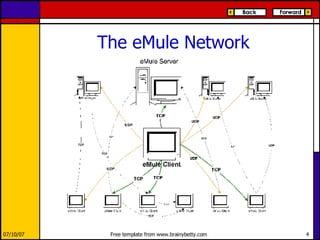
Introduction eMule is a P2P file sharing network Based on an extended eDonkey protocol  Uses both TCP and UDP Client Server architecture Open source client High rate of expansions and improvements Latest sources can be found at  sourceforce There is also an official  website
The eMule Network
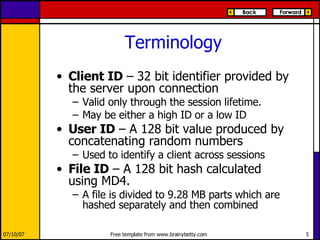
Terminology Client ID  – 32 bit identifier provided by the server upon connection Valid only through the session lifetime.  May be either a high ID or a low ID User ID  – A 128 bit value produced by concatenating random numbers Used to identify a client across sessions File ID  – A 128 bit hash calculated using MD4. A file is divided to 9.28 MB parts which are hashed separately and then combined
The Protocol Each message starts with a 6 byte header [protocol, size ,type] Empty messages are allowed Encoded are Integers, Strings and bit sets Strings are encoded using a 2 byte length, value encoding Message tags
Agenda Introduction The protocol Client - Server protocol Client to Client protocol The application Queue management Credit system Download part ordering Corrupted download recovery
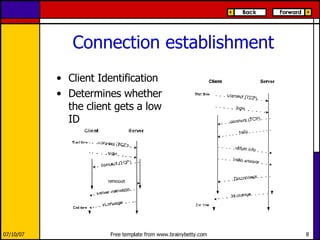
Connection establishment Client Identification Determines whether the client gets a low ID
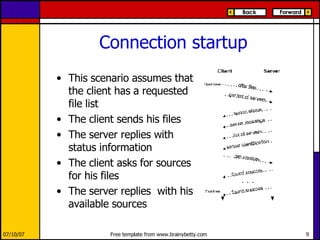
Connection startup This scenario assumes that the client has a requested file list The client sends his files  The server replies with status information The client asks for sources for his files The server replies  with his available sources
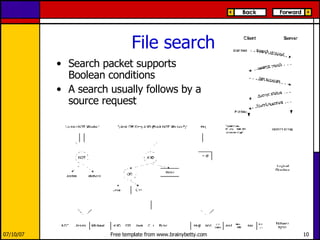
File search Search packet supports Boolean conditions A search usually follows by a source request
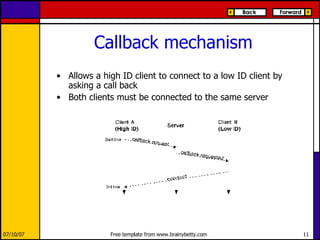
Callback mechanism Allows a high ID client to connect to a low ID client by asking a call back Both clients must be connected to the same server
Agenda Introduction The protocol Client - Server protocol Client to Client protocol The application Queue management Credit system Download part ordering Corrupted download recovery
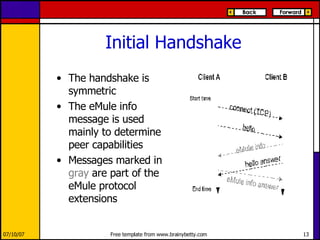
Initial Handshake The handshake is symmetric The eMule info message is used mainly to determine peer capabilities Messages marked in gray are part of the eMule protocol extensions
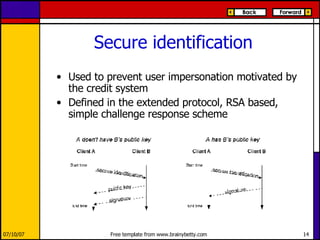
Secure identification Used to prevent user impersonation motivated by the credit system Defined in the extended protocol, RSA based, simple challenge response scheme
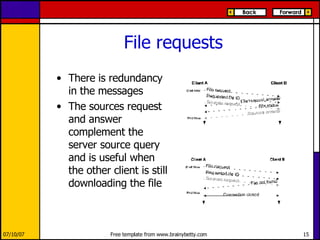
File requests There is redundancy in the messages The sources request and answer complement the server source query and is useful when the other client is still downloading the file
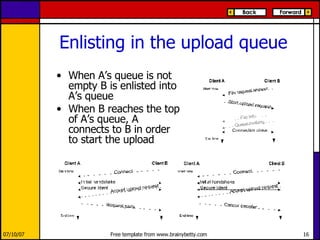
Enlisting in the upload queue When A’s queue is not empty B is enlisted into A’s queue When B reaches the top of A’s queue, A connects to B in order to start the upload
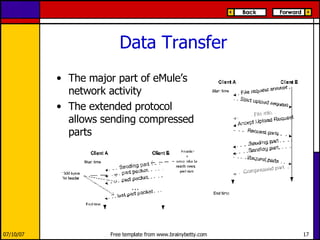
Data Transfer The major part of eMule’s network activity The extended protocol allows sending compressed parts
Agenda Introduction The protocol Client - Server protocol Client to Client protocol The application Queue management Credit system Download part ordering Corrupted download recovery
Download queue The eMule client connects to sources in the order they were received from the server / UDP connection There is a special mechanism which deals with the corner case where the remote client is a potential source for several files
Upload queue A priority queue, based on waiting time At the head of the queue are clients with the highest  Score  Score =  Rating  x (seconds in queue)/100 Or 0x0FFFFFFF (infinite) in case of a friend   The rating initial value is 100 Banned users rating value is 0
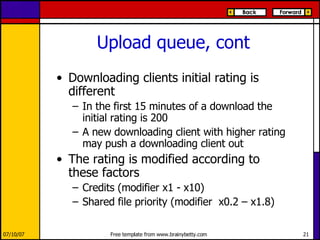
Upload queue, cont Downloading clients initial rating is different In the first 15 minutes of a download the initial rating is 200  A new downloading client with higher rating may push a downloading client out The rating is modified according to these factors Credits (modifier x1 - x10) Shared file priority (modifier  x0.2 – x1.8)
Agenda Introduction The protocol Client - Server protocol Client to Client protocol The application Queue management Credit system Download part ordering Corrupted download recovery
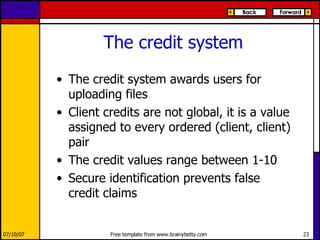
The credit system The credit system awards users for uploading files Client credits are not global, it is a value assigned to every ordered (client, client) pair The credit values range between 1-10 Secure identification prevents false credit claims
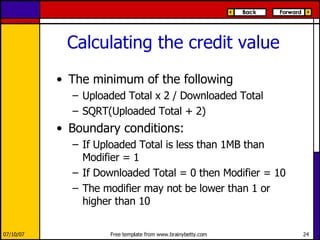
Calculating the credit value The minimum of the following Uploaded Total x 2 / Downloaded Total SQRT(Uploaded Total + 2) Boundary conditions:  If Uploaded Total is less than 1MB than Modifier = 1  If Downloaded Total = 0 then Modifier = 10  The modifier may not be lower than 1 or higher than 10
Agenda Introduction The protocol Client - Server protocol Client to Client protocol The application Queue management Credit system Download part ordering Corrupted download recovery
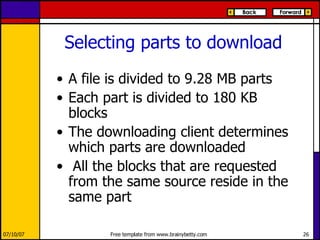
Selecting parts to download A file is divided to 9.28 MB parts Each part is divided to 180 KB blocks The downloading client determines which parts are downloaded All the blocks that are requested from the same source reside in the same part
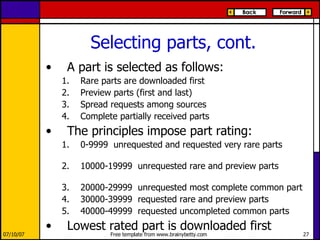
Selecting parts, cont. A part is selected as follows: Rare parts are downloaded first Preview parts (first and last) Spread requests among sources Complete partially received parts The principles impose part rating: 0-9999  unrequested and requested very rare parts  10000-19999  unrequested rare and preview parts  20000-29999  unrequested most complete common part 30000-39999  requested rare and preview parts 40000-49999  requested uncompleted common parts Lowest rated part is downloaded first
Agenda Introduction The protocol Client - Server protocol Client to Client protocol The application Queue management Credit system Download part ordering Corrupted download recovery
Basic corruption handling The default corruption handling mechanism named ICH The algorithm: When a part download completes, compute and compare its hash against the source In case of a mismatch, blocks are downloaded one by one until the corruption is corrected
Advanced corruption handling A new feature (since 2004) also called AICH Seems that it is soon to be replaced A tree based recovery mechanism
Backup slides Screen shots Client server UDP communication Client to Client UDP communication
The End Thank you
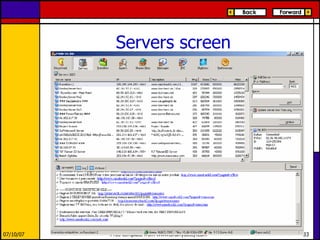
Servers screen
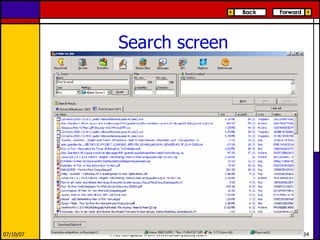
Search screen
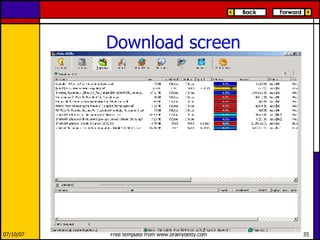
Download screen
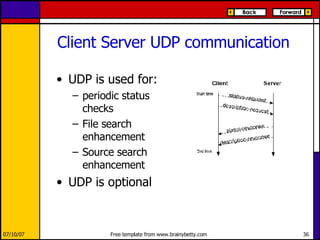
Client Server UDP communication UDP is used for: periodic status checks File search enhancement Source search enhancement UDP is optional
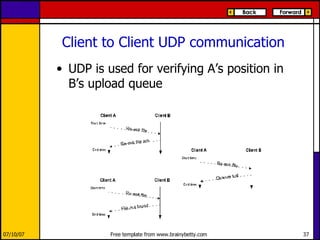
Client to Client UDP communication UDP is used for verifying A’s position in B’s upload queue
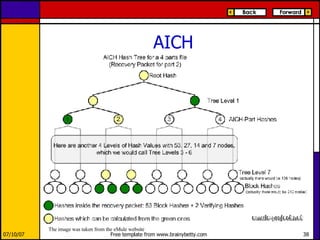
AICH The image was taken from the eMule website

The eMule application of the eDonkey protocol

  • 1.
    The eMule applicationof the eDonkey protocol Yoram Kulbak Advisor: Danny Bickson Academic supervisor: Prof. Scott Kirkpatrick
  • 2.
    Agenda Introduction Theprotocol Client - Server protocol Client to Client protocol The application Queue management Credit system Download part ordering Corrupted download recovery
  • 3.
    Introduction eMule isa P2P file sharing network Based on an extended eDonkey protocol Uses both TCP and UDP Client Server architecture Open source client High rate of expansions and improvements Latest sources can be found at sourceforce There is also an official website
  • 4.
  • 5.
    Terminology Client ID – 32 bit identifier provided by the server upon connection Valid only through the session lifetime. May be either a high ID or a low ID User ID – A 128 bit value produced by concatenating random numbers Used to identify a client across sessions File ID – A 128 bit hash calculated using MD4. A file is divided to 9.28 MB parts which are hashed separately and then combined
  • 6.
    The Protocol Eachmessage starts with a 6 byte header [protocol, size ,type] Empty messages are allowed Encoded are Integers, Strings and bit sets Strings are encoded using a 2 byte length, value encoding Message tags
  • 7.
    Agenda Introduction Theprotocol Client - Server protocol Client to Client protocol The application Queue management Credit system Download part ordering Corrupted download recovery
  • 8.
    Connection establishment ClientIdentification Determines whether the client gets a low ID
  • 9.
    Connection startup Thisscenario assumes that the client has a requested file list The client sends his files The server replies with status information The client asks for sources for his files The server replies with his available sources
  • 10.
    File search Searchpacket supports Boolean conditions A search usually follows by a source request
  • 11.
    Callback mechanism Allowsa high ID client to connect to a low ID client by asking a call back Both clients must be connected to the same server
  • 12.
    Agenda Introduction Theprotocol Client - Server protocol Client to Client protocol The application Queue management Credit system Download part ordering Corrupted download recovery
  • 13.
    Initial Handshake Thehandshake is symmetric The eMule info message is used mainly to determine peer capabilities Messages marked in gray are part of the eMule protocol extensions
  • 14.
    Secure identification Usedto prevent user impersonation motivated by the credit system Defined in the extended protocol, RSA based, simple challenge response scheme
  • 15.
    File requests Thereis redundancy in the messages The sources request and answer complement the server source query and is useful when the other client is still downloading the file
  • 16.
    Enlisting in theupload queue When A’s queue is not empty B is enlisted into A’s queue When B reaches the top of A’s queue, A connects to B in order to start the upload
  • 17.
    Data Transfer Themajor part of eMule’s network activity The extended protocol allows sending compressed parts
  • 18.
    Agenda Introduction Theprotocol Client - Server protocol Client to Client protocol The application Queue management Credit system Download part ordering Corrupted download recovery
  • 19.
    Download queue TheeMule client connects to sources in the order they were received from the server / UDP connection There is a special mechanism which deals with the corner case where the remote client is a potential source for several files
  • 20.
    Upload queue Apriority queue, based on waiting time At the head of the queue are clients with the highest Score Score = Rating x (seconds in queue)/100 Or 0x0FFFFFFF (infinite) in case of a friend The rating initial value is 100 Banned users rating value is 0
  • 21.
    Upload queue, contDownloading clients initial rating is different In the first 15 minutes of a download the initial rating is 200 A new downloading client with higher rating may push a downloading client out The rating is modified according to these factors Credits (modifier x1 - x10) Shared file priority (modifier x0.2 – x1.8)
  • 22.
    Agenda Introduction Theprotocol Client - Server protocol Client to Client protocol The application Queue management Credit system Download part ordering Corrupted download recovery
  • 23.
    The credit systemThe credit system awards users for uploading files Client credits are not global, it is a value assigned to every ordered (client, client) pair The credit values range between 1-10 Secure identification prevents false credit claims
  • 24.
    Calculating the creditvalue The minimum of the following Uploaded Total x 2 / Downloaded Total SQRT(Uploaded Total + 2) Boundary conditions: If Uploaded Total is less than 1MB than Modifier = 1 If Downloaded Total = 0 then Modifier = 10 The modifier may not be lower than 1 or higher than 10
  • 25.
    Agenda Introduction Theprotocol Client - Server protocol Client to Client protocol The application Queue management Credit system Download part ordering Corrupted download recovery
  • 26.
    Selecting parts todownload A file is divided to 9.28 MB parts Each part is divided to 180 KB blocks The downloading client determines which parts are downloaded All the blocks that are requested from the same source reside in the same part
  • 27.
    Selecting parts, cont.A part is selected as follows: Rare parts are downloaded first Preview parts (first and last) Spread requests among sources Complete partially received parts The principles impose part rating: 0-9999 unrequested and requested very rare parts 10000-19999 unrequested rare and preview parts 20000-29999 unrequested most complete common part 30000-39999 requested rare and preview parts 40000-49999 requested uncompleted common parts Lowest rated part is downloaded first
  • 28.
    Agenda Introduction Theprotocol Client - Server protocol Client to Client protocol The application Queue management Credit system Download part ordering Corrupted download recovery
  • 29.
    Basic corruption handlingThe default corruption handling mechanism named ICH The algorithm: When a part download completes, compute and compare its hash against the source In case of a mismatch, blocks are downloaded one by one until the corruption is corrected
  • 30.
    Advanced corruption handlingA new feature (since 2004) also called AICH Seems that it is soon to be replaced A tree based recovery mechanism
  • 31.
    Backup slides Screenshots Client server UDP communication Client to Client UDP communication
  • 32.
  • 33.
  • 34.
  • 35.
  • 36.
    Client Server UDPcommunication UDP is used for: periodic status checks File search enhancement Source search enhancement UDP is optional
  • 37.
    Client to ClientUDP communication UDP is used for verifying A’s position in B’s upload queue
  • 38.
    AICH The imagewas taken from the eMule website