1
IGCSE Physics
Waves
2
Lesson 4 – The EM Spectrum
Aims:
•To understand that light is part of a continuous
electromagnetic spectrum which includes radio,
microwave, infra-red, visible, ultraviolet, X-ray and
gamma ray radiations and that all these waves travel at
the same speed in free space.
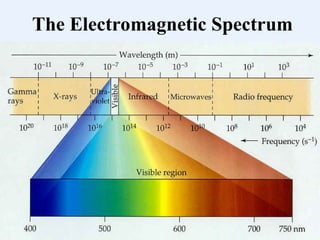
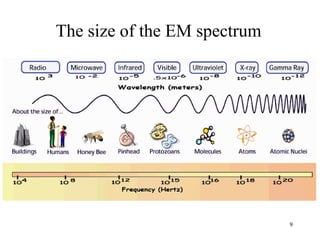
•To recall the order of the electromagnetic spectrum in
decreasing wavelength and increasing frequency,
including the colours of the visible spectrum.
•To recall some of the uses and dangers of
electromagnetic radiations.
3
4
Dispersion
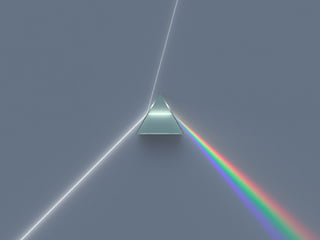
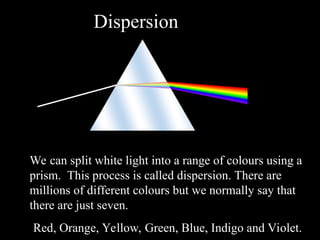
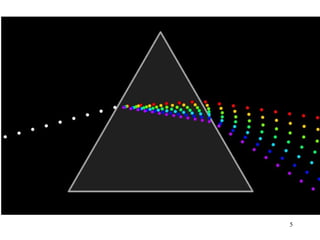
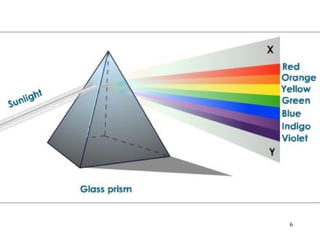
We can split white light into a range of colours using a
prism. This process is called dispersion. There are
millions of different colours but we normally say that
there are just seven.
Red, Orange, Yellow, Green, Blue, Indigo and Violet.
5
6
7
Above and below
UV
IR
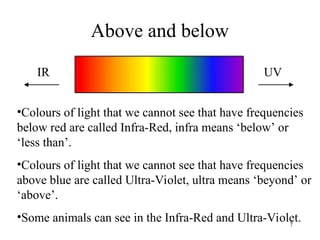
•Colours of light that we cannot see that have frequencies
below red are called Infra-Red, infra means ‘below’ or
‘less than’.
•Colours of light that we cannot see that have frequencies
above blue are called Ultra-Violet, ultra means ‘beyond’ or
‘above’.
•Some animals can see in the Infra-Red and Ultra-Violet.
8
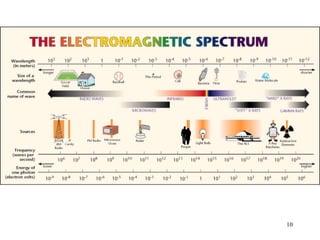
The Electromagnetic Spectrum
9
The size of the EM spectrum
10
The Electromagnetic Spectrum
11
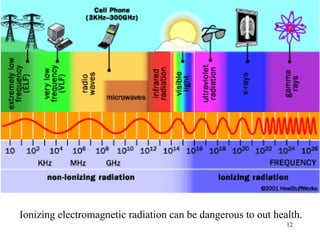
EM Radiation
Shorter wavelength
means more danger.
12
Ionizing electromagnetic radiation can be dangerous to out health.
13
Speed of Light
•Light and all other Electromagnetic waves travel at the
same speed, called the speed of light!
•In free space (a vacuum like outer space), light travels
at 300,000,000 m/s.
•When light or other EM waves pass through the air
they move only a tiny bit slower.
•Light can travel round the equator of the Earth eight
times in a second.
c = 3 × 10⁸
m/s = 186,000 miles/s
14
The electromagnetic spectrum
 Light, a type of radiation, is part of the
electromagnetic spectrum.
 The electromagnetic spectrum is made
up of different types of radiation.
 The different types of radiation have
different properties and behaviour.
 All electromagnetic waves can travel
through space.
 All electromagnetic waves travel at the
same speed in a vacuum
(300,000,000 m/s).
TRUE/FALSE
TRUE/FALSE
TRUE/FALSE
TRUE/FALSE
TRUE/FALSE
15
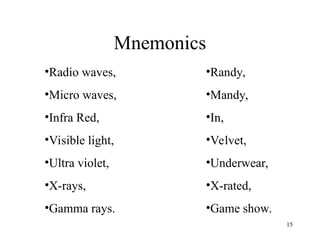
Mnemonics
•Radio waves,
•Micro waves,
•Infra Red,
•Visible light,
•Ultra violet,
•X-rays,
•Gamma rays.
•Randy,
•Mandy,
•In,
•Velvet,
•Underwear,
•X-rated,
•Game show.
16
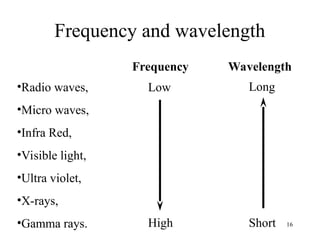
Frequency and wavelength
•Radio waves,
•Micro waves,
•Infra Red,
•Visible light,
•Ultra violet,
•X-rays,
•Gamma rays.
Frequency Wavelength
Low Long
High Short
17
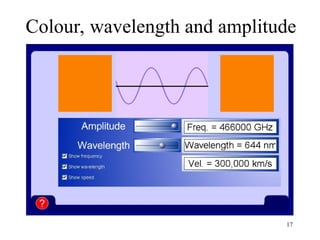
Colour, wavelength and amplitude
18
Uses and Dangers
While there are many uses and dangers
associated with electromagnetic waves
we only need to learn a few.
19
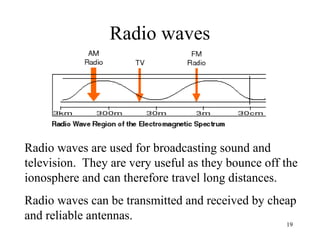
Radio waves
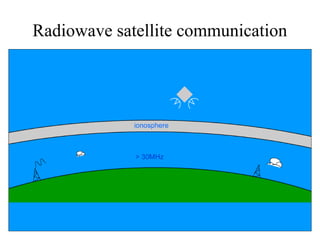
Radio waves are used for broadcasting sound and
television. They are very useful as they bounce off the
ionosphere and can therefore travel long distances.
Radio waves can be transmitted and received by cheap
and reliable antennas.
20
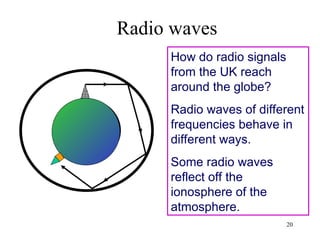
How do radio signals
from the UK reach
around the globe?
Radio waves of different
frequencies behave in
different ways.
Some radio waves
reflect off the
ionosphere of the
atmosphere.
Radio waves
21
Radiowave satellite communication
22
Microwaves
Microwaves are useful for cooking food but are also
used for communications. Microwaves can pass through
clouds without being affected. They are used for mobile
phones and satellite communications.
The Amazon and the background
radiation of space.
23
Microwave heating
•The microwaves used in a cooking machine are about
12 cm long. They vibrate water and fat particles to
make them hot. Microwaves cannot go very far into
food which is why big turkeys cannot be cooked in a
normal microwave oven.
•Microwaves given off by a cooker or a mobile phone
can cause the heating of internal body parts. A cooker
has a shield on it to stop this happening. Mobile
phones only cause a tiny amount of heating and are not
really very dangerous. Just don’t phone for a long time
or when you are on your bike.
24
Infra Red
•All objects that have a temperature give off some Infra
Red (IR) radiation. Unless something is much hotter
than us we cannot feel this radiation.
•A heater or grill or toaster uses IR radiation to heat a
room or cook some food.
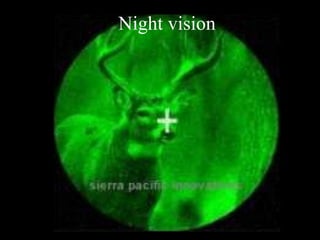
•Special cameras can be used to change IR into visible
light so that we can see hot objects.
•Too much IR radiation, such as sticking your hand
under a grill, can cause burns to our skin.
25
Infra red images
A man with a match The eyes of a cat
26
Night vision
27
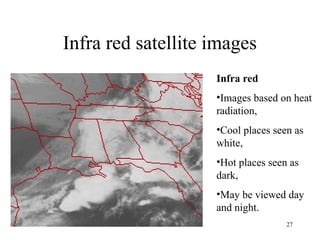
Infra red satellite images
Infra red
•Images based on heat
radiation,
•Cool places seen as
white,
•Hot places seen as
dark,
•May be viewed day
and night.
28
Ultra Violet
•Ultraviolet light can come from the Sun or artificial
lamps. 10 % of the Sun’s light is UV.
•An ultraviolet sunbed can be used to change the
colour of our skin.
•Ultraviolet lamps are used to prevent crime by
detecting chemicals that we cannot see and checking
to see whether a bank note is forged or real.
29
Damaging UV
•Unfortunately UV light is damaging to our eyes and
skin. Frequent exposure can lead to eye problems and
even blindness (Galileo).
•UV light can also cause skin cancer, which is why you
should wear sun block even if your skin does not burn.
•The Earth is protected from a lot of UV light by the
ozone layer; unfortunately chemicals from air con,
fridges and other industries have made a big hole in the
layer.
30
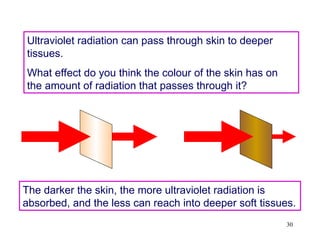
Ultraviolet radiation can pass through skin to deeper
tissues.
What effect do you think the colour of the skin has on
the amount of radiation that passes through it?
The darker the skin, the more ultraviolet radiation is
absorbed, and the less can reach into deeper soft tissues.
31
X-rays
•X-rays are very small waves that can pass through our
bodies. Some X-rays can pass through flesh but not bone,
this lets us see shadows of our bones.
•X-rays are very dangerous and can cause cancer. In small
doses they are less likely to cause cancer and are very
useful for looking for broken bones.
•X-rays are also very useful for looking inside all sorts of
objects. They are used to find cracks in pipes and aircraft
parts. They are also useful for looking inside suitcases
without having to open them.
32
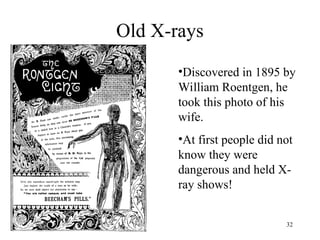
Old X-rays
•Discovered in 1895 by
William Roentgen, he
took this photo of his
wife.
•At first people did not
know they were
dangerous and held X-
ray shows!
33
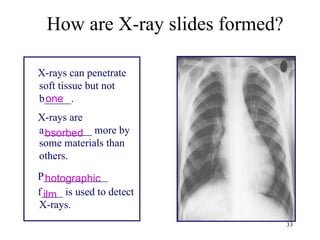
X-rays can penetrate
soft tissue but not
b_____.
X-rays are
a_________ more by
some materials than
others.
P____________
f____ is used to detect
X-rays.
How are X-ray slides formed?
one
bsorbed
hotographic
ilm
34
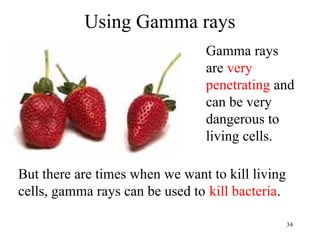
Using Gamma rays
But there are times when we want to kill living
cells, gamma rays can be used to kill bacteria.
Gamma rays
are very
penetrating and
can be very
dangerous to
living cells.
35
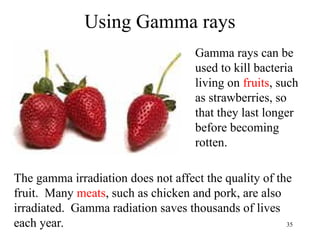
Using Gamma rays
Gamma rays can be
used to kill bacteria
living on fruits, such
as strawberries, so
that they last longer
before becoming
rotten.
The gamma irradiation does not affect the quality of the
fruit. Many meats, such as chicken and pork, are also
irradiated. Gamma radiation saves thousands of lives
each year.
36
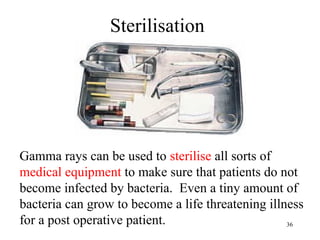
Gamma rays can be used to sterilise all sorts of
medical equipment to make sure that patients do not
become infected by bacteria. Even a tiny amount of
bacteria can grow to become a life threatening illness
for a post operative patient.
Sterilisation
37
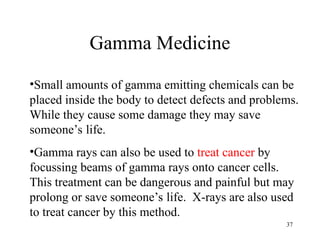
Gamma Medicine
•Small amounts of gamma emitting chemicals can be
placed inside the body to detect defects and problems.
While they cause some damage they may save
someone’s life.
•Gamma rays can also be used to treat cancer by
focussing beams of gamma rays onto cancer cells.
This treatment can be dangerous and painful but may
prolong or save someone’s life. X-rays are also used
to treat cancer by this method.
38
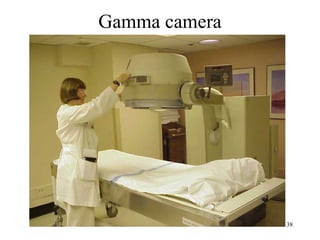
Gamma camera
39
Anagrams
40
Multiple-choice quiz
41
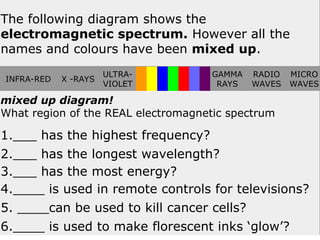
The following diagram shows the
electromagnetic spectrum. However all the
names and colours have been mixed up.
INFRA-RED X -RAYS
ULTRA-
VIOLET
GAMMA
RAYS
RADIO
WAVES
MICRO
WAVES
mixed up diagram!
What region of the REAL electromagnetic spectrum
1.___ has the highest frequency?
2.___ has the longest wavelength?
3.___ has the most energy?
4.____ is used in remote controls for televisions?
5. ____can be used to kill cancer cells?
6.____ is used to make florescent inks ‘glow’?
42
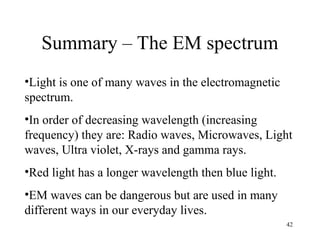
Summary – The EM spectrum
•Light is one of many waves in the electromagnetic
spectrum.
•In order of decreasing wavelength (increasing
frequency) they are: Radio waves, Microwaves, Light
waves, Ultra violet, X-rays and gamma rays.
•Red light has a longer wavelength then blue light.
•EM waves can be dangerous but are used in many
different ways in our everyday lives.

The EM spectrum .ppt physics grade 10 ems

  • 1.
  • 2.
    2 Lesson 4 –The EM Spectrum Aims: •To understand that light is part of a continuous electromagnetic spectrum which includes radio, microwave, infra-red, visible, ultraviolet, X-ray and gamma ray radiations and that all these waves travel at the same speed in free space. •To recall the order of the electromagnetic spectrum in decreasing wavelength and increasing frequency, including the colours of the visible spectrum. •To recall some of the uses and dangers of electromagnetic radiations.
  • 3.
  • 4.
    4 Dispersion We can splitwhite light into a range of colours using a prism. This process is called dispersion. There are millions of different colours but we normally say that there are just seven. Red, Orange, Yellow, Green, Blue, Indigo and Violet.
  • 5.
  • 6.
  • 7.
    7 Above and below UV IR •Coloursof light that we cannot see that have frequencies below red are called Infra-Red, infra means ‘below’ or ‘less than’. •Colours of light that we cannot see that have frequencies above blue are called Ultra-Violet, ultra means ‘beyond’ or ‘above’. •Some animals can see in the Infra-Red and Ultra-Violet.
  • 8.
  • 9.
    9 The size ofthe EM spectrum
  • 10.
  • 11.
  • 12.
    12 Ionizing electromagnetic radiationcan be dangerous to out health.
  • 13.
    13 Speed of Light •Lightand all other Electromagnetic waves travel at the same speed, called the speed of light! •In free space (a vacuum like outer space), light travels at 300,000,000 m/s. •When light or other EM waves pass through the air they move only a tiny bit slower. •Light can travel round the equator of the Earth eight times in a second. c = 3 × 10⁸ m/s = 186,000 miles/s
  • 14.
    14 The electromagnetic spectrum Light, a type of radiation, is part of the electromagnetic spectrum.  The electromagnetic spectrum is made up of different types of radiation.  The different types of radiation have different properties and behaviour.  All electromagnetic waves can travel through space.  All electromagnetic waves travel at the same speed in a vacuum (300,000,000 m/s). TRUE/FALSE TRUE/FALSE TRUE/FALSE TRUE/FALSE TRUE/FALSE
  • 15.
    15 Mnemonics •Radio waves, •Micro waves, •InfraRed, •Visible light, •Ultra violet, •X-rays, •Gamma rays. •Randy, •Mandy, •In, •Velvet, •Underwear, •X-rated, •Game show.
  • 16.
    16 Frequency and wavelength •Radiowaves, •Micro waves, •Infra Red, •Visible light, •Ultra violet, •X-rays, •Gamma rays. Frequency Wavelength Low Long High Short
  • 17.
  • 18.
    18 Uses and Dangers Whilethere are many uses and dangers associated with electromagnetic waves we only need to learn a few.
  • 19.
    19 Radio waves Radio wavesare used for broadcasting sound and television. They are very useful as they bounce off the ionosphere and can therefore travel long distances. Radio waves can be transmitted and received by cheap and reliable antennas.
  • 20.
    20 How do radiosignals from the UK reach around the globe? Radio waves of different frequencies behave in different ways. Some radio waves reflect off the ionosphere of the atmosphere. Radio waves
  • 21.
  • 22.
    22 Microwaves Microwaves are usefulfor cooking food but are also used for communications. Microwaves can pass through clouds without being affected. They are used for mobile phones and satellite communications. The Amazon and the background radiation of space.
  • 23.
    23 Microwave heating •The microwavesused in a cooking machine are about 12 cm long. They vibrate water and fat particles to make them hot. Microwaves cannot go very far into food which is why big turkeys cannot be cooked in a normal microwave oven. •Microwaves given off by a cooker or a mobile phone can cause the heating of internal body parts. A cooker has a shield on it to stop this happening. Mobile phones only cause a tiny amount of heating and are not really very dangerous. Just don’t phone for a long time or when you are on your bike.
  • 24.
    24 Infra Red •All objectsthat have a temperature give off some Infra Red (IR) radiation. Unless something is much hotter than us we cannot feel this radiation. •A heater or grill or toaster uses IR radiation to heat a room or cook some food. •Special cameras can be used to change IR into visible light so that we can see hot objects. •Too much IR radiation, such as sticking your hand under a grill, can cause burns to our skin.
  • 25.
    25 Infra red images Aman with a match The eyes of a cat
  • 26.
  • 27.
    27 Infra red satelliteimages Infra red •Images based on heat radiation, •Cool places seen as white, •Hot places seen as dark, •May be viewed day and night.
  • 28.
    28 Ultra Violet •Ultraviolet lightcan come from the Sun or artificial lamps. 10 % of the Sun’s light is UV. •An ultraviolet sunbed can be used to change the colour of our skin. •Ultraviolet lamps are used to prevent crime by detecting chemicals that we cannot see and checking to see whether a bank note is forged or real.
  • 29.
    29 Damaging UV •Unfortunately UVlight is damaging to our eyes and skin. Frequent exposure can lead to eye problems and even blindness (Galileo). •UV light can also cause skin cancer, which is why you should wear sun block even if your skin does not burn. •The Earth is protected from a lot of UV light by the ozone layer; unfortunately chemicals from air con, fridges and other industries have made a big hole in the layer.
  • 30.
    30 Ultraviolet radiation canpass through skin to deeper tissues. What effect do you think the colour of the skin has on the amount of radiation that passes through it? The darker the skin, the more ultraviolet radiation is absorbed, and the less can reach into deeper soft tissues.
  • 31.
    31 X-rays •X-rays are verysmall waves that can pass through our bodies. Some X-rays can pass through flesh but not bone, this lets us see shadows of our bones. •X-rays are very dangerous and can cause cancer. In small doses they are less likely to cause cancer and are very useful for looking for broken bones. •X-rays are also very useful for looking inside all sorts of objects. They are used to find cracks in pipes and aircraft parts. They are also useful for looking inside suitcases without having to open them.
  • 32.
    32 Old X-rays •Discovered in1895 by William Roentgen, he took this photo of his wife. •At first people did not know they were dangerous and held X- ray shows!
  • 33.
    33 X-rays can penetrate softtissue but not b_____. X-rays are a_________ more by some materials than others. P____________ f____ is used to detect X-rays. How are X-ray slides formed? one bsorbed hotographic ilm
  • 34.
    34 Using Gamma rays Butthere are times when we want to kill living cells, gamma rays can be used to kill bacteria. Gamma rays are very penetrating and can be very dangerous to living cells.
  • 35.
    35 Using Gamma rays Gammarays can be used to kill bacteria living on fruits, such as strawberries, so that they last longer before becoming rotten. The gamma irradiation does not affect the quality of the fruit. Many meats, such as chicken and pork, are also irradiated. Gamma radiation saves thousands of lives each year.
  • 36.
    36 Gamma rays canbe used to sterilise all sorts of medical equipment to make sure that patients do not become infected by bacteria. Even a tiny amount of bacteria can grow to become a life threatening illness for a post operative patient. Sterilisation
  • 37.
    37 Gamma Medicine •Small amountsof gamma emitting chemicals can be placed inside the body to detect defects and problems. While they cause some damage they may save someone’s life. •Gamma rays can also be used to treat cancer by focussing beams of gamma rays onto cancer cells. This treatment can be dangerous and painful but may prolong or save someone’s life. X-rays are also used to treat cancer by this method.
  • 38.
  • 39.
  • 40.
  • 41.
    41 The following diagramshows the electromagnetic spectrum. However all the names and colours have been mixed up. INFRA-RED X -RAYS ULTRA- VIOLET GAMMA RAYS RADIO WAVES MICRO WAVES mixed up diagram! What region of the REAL electromagnetic spectrum 1.___ has the highest frequency? 2.___ has the longest wavelength? 3.___ has the most energy? 4.____ is used in remote controls for televisions? 5. ____can be used to kill cancer cells? 6.____ is used to make florescent inks ‘glow’?
  • 42.
    42 Summary – TheEM spectrum •Light is one of many waves in the electromagnetic spectrum. •In order of decreasing wavelength (increasing frequency) they are: Radio waves, Microwaves, Light waves, Ultra violet, X-rays and gamma rays. •Red light has a longer wavelength then blue light. •EM waves can be dangerous but are used in many different ways in our everyday lives.