THE EARTH: LAYERS An in-depth look at Earth's
composition
Ponce Joaquin
AR Chemistry
Bethany Schmith
INTRODUCTI
ON
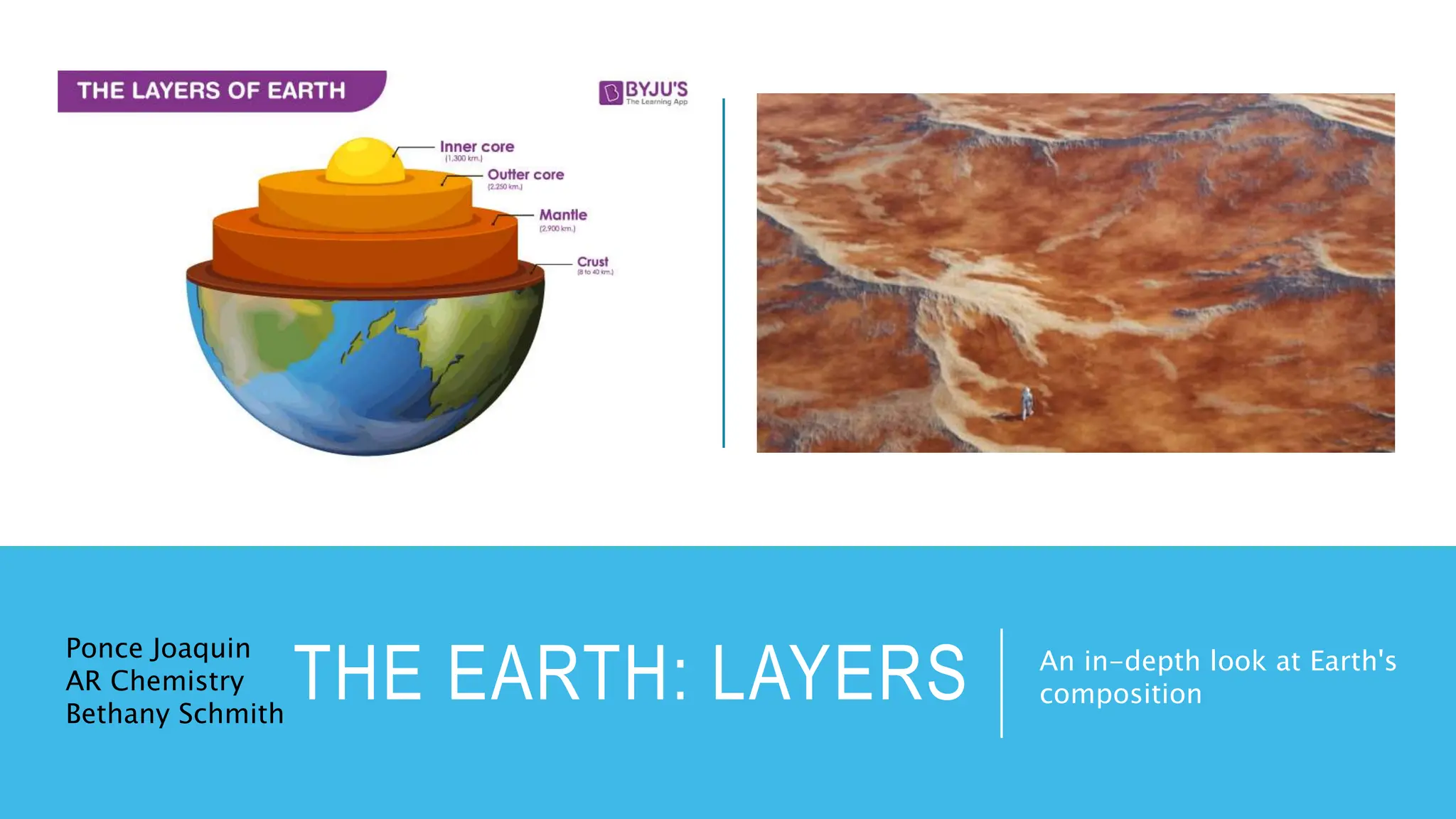
The Earth is a complex structure consisting of
several layers, each with unique properties
and significance.
Earth's complex and interconnected systems
make it a unique and vibrant entity in the
cosmos. Understanding the layers that
compose our planet is crucial for unraveling
the mysteries of its past, present, and future,
as well as appreciating the delicate balance
that sustains life on this remarkable celestial
body.
1. CRUST
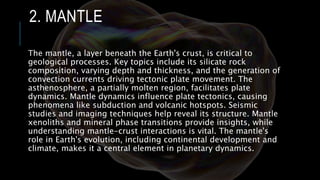
•The Earth's crust is the outermost and thinnest
layer of the Earth's structure. It forms the solid
shell that envelops the entire planet and is
crucial for supporting life and various
geological processes.
•Tectonic Plates: The crust is divided into
several large and rigid pieces known as
tectonic plates. The movement of these plates
is responsible for continental drift, seismic
activity, and the creation of mountain ranges.
•Increasing Depth: As one moves deeper into
the Earth's crust, temperature and pressure
increase. The uppermost layer experiences
more significant temperature variations
compared to the deeper sections.
2. MANTLE
The mantle, a layer beneath the Earth's crust, is critical to
geological processes. Key topics include its silicate rock
composition, varying depth and thickness, and the generation of
convection currents driving tectonic plate movement. The
asthenosphere, a partially molten region, facilitates plate
dynamics. Mantle dynamics influence plate tectonics, causing
phenomena like subduction and volcanic hotspots. Seismic
studies and imaging techniques help reveal its structure. Mantle
xenoliths and mineral phase transitions provide insights, while
understanding mantle-crust interactions is vital. The mantle's
role in Earth's evolution, including continental development and
climate, makes it a central element in planetary dynamics.
3. OUTER CORE
The outer core is like a hot, liquid layer
beneath the Earth's surface. It's made of
melted iron and nickel. This liquid
movement helps create the magnetic field
around our planet. Think of it as a big,
swirling soup of hot metal that makes
Earth's magnetic shield, which is important
for protecting our planet. The outer core's
movement also plays a role in shaping how
the Earth behaves.
4. INNER
CORE
At the Earth's
center, the inner
core is a solid ball
of iron and nickel.
Despite high
temperatures, the
immense pressure
keeps it in a solid
state.
Despite extremely
high temperatures,
the intense
pressure at the
Earth's center keeps
it in a solid state.
The inner core
contributes to
Earth's stability and
plays a crucial role
in generating the
planet's magnetic
field.
CONCLUSION
In exploring the layers of the Earth, we have
delved into the intricate and dynamic
composition of our home planet. From the
solid crust that supports life to the semi-fluid
mantle steering tectonic forces, and the
molten outer core generating a protective
magnetic shield, to the solid yet hot inner core
at the Earth's heart, each layer reveals a unique
story of Earth's geophysical processes.
Together, these layers create a harmonious
symphony of geological activity that shapes
landscapes, influences climates, and sustains
life. Understanding the layers of the Earth is
not just a journey through rocks and heat—it
is a key to deciphering the mysteries of our
planet's past, present, and future.
HOW IS THIS
RELATED TO
CHEMISTRY?
The study of the Earth's layers is closely related
to chemistry as it involves understanding the
chemical composition, properties, and
interactions of various materials that make up
the planet. From the mineral composition of
the crust to the molten iron and nickel in the
outer core, and the solid-state conditions of
the inner core, chemistry provides insights into
the geological processes shaping the Earth.
The study of phase transitions, isotopic
compositions, and the behavior of elements
under extreme conditions contributes to our
comprehension of Earth's dynamic nature and
its history. In essence, chemistry is a
fundamental tool for unraveling the chemical
intricacies underlying the formation and
CITED URL´S
*
https://education.nationalgeographic.org/reso
urce/resource-library-earth-structure/
https://education.nationalgeographic.org/reso
urce/earth/
https://education.nationalgeographic.org/reso
urce/mantle/
https://education.nationalgeographic.org/reso
urce/core/
https://volcano.oregonstate.edu/earths-
layers-lesson-1

The Earth.pptx

  • 1.
    THE EARTH: LAYERSAn in-depth look at Earth's composition Ponce Joaquin AR Chemistry Bethany Schmith
  • 2.
    INTRODUCTI ON The Earth isa complex structure consisting of several layers, each with unique properties and significance. Earth's complex and interconnected systems make it a unique and vibrant entity in the cosmos. Understanding the layers that compose our planet is crucial for unraveling the mysteries of its past, present, and future, as well as appreciating the delicate balance that sustains life on this remarkable celestial body.
  • 3.
    1. CRUST •The Earth'scrust is the outermost and thinnest layer of the Earth's structure. It forms the solid shell that envelops the entire planet and is crucial for supporting life and various geological processes. •Tectonic Plates: The crust is divided into several large and rigid pieces known as tectonic plates. The movement of these plates is responsible for continental drift, seismic activity, and the creation of mountain ranges. •Increasing Depth: As one moves deeper into the Earth's crust, temperature and pressure increase. The uppermost layer experiences more significant temperature variations compared to the deeper sections.
  • 4.
    2. MANTLE The mantle,a layer beneath the Earth's crust, is critical to geological processes. Key topics include its silicate rock composition, varying depth and thickness, and the generation of convection currents driving tectonic plate movement. The asthenosphere, a partially molten region, facilitates plate dynamics. Mantle dynamics influence plate tectonics, causing phenomena like subduction and volcanic hotspots. Seismic studies and imaging techniques help reveal its structure. Mantle xenoliths and mineral phase transitions provide insights, while understanding mantle-crust interactions is vital. The mantle's role in Earth's evolution, including continental development and climate, makes it a central element in planetary dynamics.
  • 5.
    3. OUTER CORE Theouter core is like a hot, liquid layer beneath the Earth's surface. It's made of melted iron and nickel. This liquid movement helps create the magnetic field around our planet. Think of it as a big, swirling soup of hot metal that makes Earth's magnetic shield, which is important for protecting our planet. The outer core's movement also plays a role in shaping how the Earth behaves.
  • 6.
    4. INNER CORE At theEarth's center, the inner core is a solid ball of iron and nickel. Despite high temperatures, the immense pressure keeps it in a solid state. Despite extremely high temperatures, the intense pressure at the Earth's center keeps it in a solid state. The inner core contributes to Earth's stability and plays a crucial role in generating the planet's magnetic field.
  • 7.
    CONCLUSION In exploring thelayers of the Earth, we have delved into the intricate and dynamic composition of our home planet. From the solid crust that supports life to the semi-fluid mantle steering tectonic forces, and the molten outer core generating a protective magnetic shield, to the solid yet hot inner core at the Earth's heart, each layer reveals a unique story of Earth's geophysical processes. Together, these layers create a harmonious symphony of geological activity that shapes landscapes, influences climates, and sustains life. Understanding the layers of the Earth is not just a journey through rocks and heat—it is a key to deciphering the mysteries of our planet's past, present, and future.
  • 8.
    HOW IS THIS RELATEDTO CHEMISTRY? The study of the Earth's layers is closely related to chemistry as it involves understanding the chemical composition, properties, and interactions of various materials that make up the planet. From the mineral composition of the crust to the molten iron and nickel in the outer core, and the solid-state conditions of the inner core, chemistry provides insights into the geological processes shaping the Earth. The study of phase transitions, isotopic compositions, and the behavior of elements under extreme conditions contributes to our comprehension of Earth's dynamic nature and its history. In essence, chemistry is a fundamental tool for unraveling the chemical intricacies underlying the formation and
  • 9.