The Dynamic Information Model
Supporting the Information Model with auto-generated
Schematron patterns, tool tips, and constraints
George BinaDawn Stevens
Copyright @ Syncro Soft, 2015. All rights reserved.Copyright @ Syncro Soft, 2015. All rights reserved.
The Dynamic Information ModelThe Dynamic Information Model
Why do I need one?
● DITA provides core information types, but no
instructions for when to use them
● DITA has hundreds of elements; most
companies use less than half of them
● DITA has a relatively flexible structure; most
companies tighten it up
Copyright @ Syncro Soft, 2015. All rights reserved.Copyright @ Syncro Soft, 2015. All rights reserved.
The Dynamic Information ModelThe Dynamic Information Model
What is an information model?
• A set of specifications that defines
• The structure of your information
• The architectural elements to be used
• The expected outputs
• The required functionality of your authoring
environment
Copyright @ Syncro Soft, 2015. All rights reserved.Copyright @ Syncro Soft, 2015. All rights reserved.
The Dynamic Information ModelThe Dynamic Information Model
What does it contain?
● Information types
● Block and inline elements
● Metadata taxonomy
● Mapping guidelines
● Linking strategies
● Reuse mechanisms
● Authoring guidelines
Copyright @ Syncro Soft, 2015. All rights reserved.Copyright @ Syncro Soft, 2015. All rights reserved.
The Dynamic Information ModelThe Dynamic Information Model
How is it enforced?
● Code reviews
● Templates and tool tips
● Subject scheme maps
● Automated tools and Schematron
● Constraints and specializations
Copyright @ Syncro Soft, 2015. All rights reserved.Copyright @ Syncro Soft, 2015. All rights reserved.
The Dynamic Information ModelThe Dynamic Information Model
Who enforces it?
Information architect creates / maintain the
information model
BUT, will not usually have these skills:
● Schematron
● XML schema languages (DTD, XML Schema, Relax
NG)
● Complex tool configuration
Copyright @ Syncro Soft, 2015. All rights reserved.Copyright @ Syncro Soft, 2015. All rights reserved.
The Dynamic Information ModelThe Dynamic Information Model
Wouldn't it be nice if...
● The work you did to create the information
model could be single-sourced into automated
enforcement?
● You didn't need specialized skills to create
those tools?
Copyright @ Syncro Soft, 2015. All rights reserved.Copyright @ Syncro Soft, 2015. All rights reserved.
The Dynamic Information ModelThe Dynamic Information Model
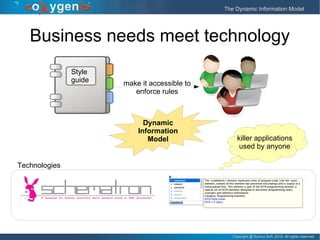
Business needs meet technology
Style
guide make it accessible to
enforce rules
Dynamic
Information
Model
Technologies
killer applications
used by anyone
Copyright @ Syncro Soft, 2015. All rights reserved.Copyright @ Syncro Soft, 2015. All rights reserved.
The Dynamic Information ModelThe Dynamic Information Model
Overview
Ideas behind DIM
The DIM project
Demo
Future plans
Q&A
Copyright @ Syncro Soft, 2015. All rights reserved.Copyright @ Syncro Soft, 2015. All rights reserved.
The Dynamic Information ModelThe Dynamic Information Model
A little bit of recent history...
Related presentations at previous conferences
– DITA North America 2013
How to make a style guide available to authors
– DITA North America 2014
Schematron use cases for DITA
– DITA Europe 2014
Introducing the DIM project
Copyright @ Syncro Soft, 2015. All rights reserved.Copyright @ Syncro Soft, 2015. All rights reserved.
The Dynamic Information ModelThe Dynamic Information Model
DITA North America 2013
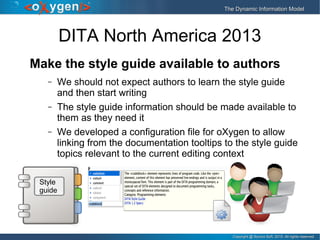
Make the style guide available to authors
– We should not expect authors to learn the style guide
and then start writing
– The style guide information should be made available to
them as they need it
– We developed a configuration file for oXygen to allow
linking from the documentation tooltips to the style guide
topics relevant to the current editing context
Style
guide
Copyright @ Syncro Soft, 2015. All rights reserved.Copyright @ Syncro Soft, 2015. All rights reserved.
The Dynamic Information ModelThe Dynamic Information Model
DITA North America 2014
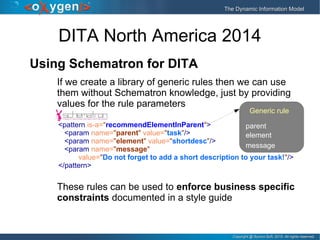
Using Schematron for DITA
If we create a library of generic rules then we can use
them without Schematron knowledge, just by providing
values for the rule parameters
<pattern is-a="recommendElementInParent">
<param name="parent" value="task"/>
<param name="element" value="shortdesc"/>
<param name="message"
value="Do not forget to add a short description to your task!"/>
</pattern>
These rules can be used to enforce business specific
constraints documented in a style guide
parent
element
message
Generic rule
Copyright @ Syncro Soft, 2015. All rights reserved.Copyright @ Syncro Soft, 2015. All rights reserved.
The Dynamic Information ModelThe Dynamic Information Model
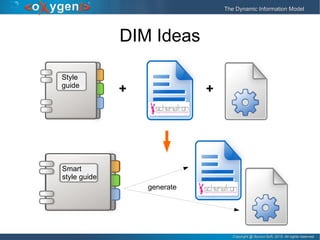
DIM Ideas
Style
guide
+ +
Smart
style guide
generate
Copyright @ Syncro Soft, 2015. All rights reserved.Copyright @ Syncro Soft, 2015. All rights reserved.
The Dynamic Information ModelThe Dynamic Information Model
DIM Ideas
● Generate the style guide integration
configuration file from the style guide itself
● Encode business rules within the style guide,
next to the text that describes them
● Make authoring of style guide metadata and
rules very easy to use
Copyright @ Syncro Soft, 2015. All rights reserved.Copyright @ Syncro Soft, 2015. All rights reserved.
The Dynamic Information ModelThe Dynamic Information Model
DITA Europe 2014
Introducing the DIM project
– Single source style guide as
● descriptive prose
● code to automatically enforce those rules
– Support information architects in defining rules encoded
within the style guide though a simple user interface
– Make the style guide more accessible by annotating
topics with metadata information
– Automatically generate Schematron rules and
configuration files from the style guide information
Copyright @ Syncro Soft, 2015. All rights reserved.Copyright @ Syncro Soft, 2015. All rights reserved.
The Dynamic Information ModelThe Dynamic Information Model
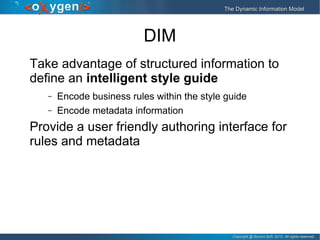
DIM
Take advantage of structured information to
define an intelligent style guide
– Encode business rules within the style guide
– Encode metadata information
Provide a user friendly authoring interface for
rules and metadata
Copyright @ Syncro Soft, 2015. All rights reserved.Copyright @ Syncro Soft, 2015. All rights reserved.
The Dynamic Information ModelThe Dynamic Information Model
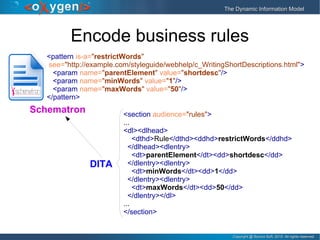
Encode business rules
<pattern is-a="restrictWords"
see="http://example.com/styleguide/webhelp/c_WritingShortDescriptions.html">
<param name="parentElement" value="shortdesc"/>
<param name="minWords" value="1"/>
<param name="maxWords" value="50"/>
</pattern>
<section audience="rules">
...
<dl><dlhead>
<dthd>Rule</dthd><ddhd>restrictWords</ddhd>
</dlhead><dlentry>
<dt>parentElement</dt><dd>shortdesc</dd>
</dlentry><dlentry>
<dt>minWords</dt><dd>1</dd>
</dlentry><dlentry>
<dt>maxWords</dt><dd>50</dd>
</dlentry></dl>
...
</section>
Schematron
DITA
Copyright @ Syncro Soft, 2015. All rights reserved.Copyright @ Syncro Soft, 2015. All rights reserved.
The Dynamic Information ModelThe Dynamic Information Model
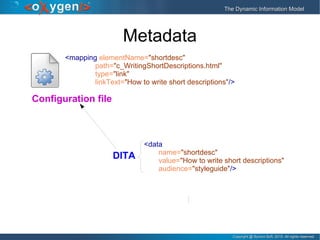
Metadata
<mapping elementName="shortdesc"
path="c_WritingShortDescriptions.html"
type="link"
linkText="How to write short descriptions"/>
<data
name="shortdesc"
value="How to write short descriptions"
audience="styleguide"/>
Configuration file
DITA
Copyright @ Syncro Soft, 2015. All rights reserved.Copyright @ Syncro Soft, 2015. All rights reserved.
The Dynamic Information ModelThe Dynamic Information Model
The DIM project
Open source (Apache 2.0 license)
Available on GitHub
http://www.github.com/oxygenxml/dim
Copyright @ Syncro Soft, 2015. All rights reserved.Copyright @ Syncro Soft, 2015. All rights reserved.
The Dynamic Information ModelThe Dynamic Information Model
DIM project content
● A generic DITA style guide provided by
Comtech Services that can be used as a
starting point for your own style guide
● A Schematron library of generic rules that can
be instantiated to implement actual rules
● oXygen customization to provide an easy
authoring environment for rules and metadata
● XSLT scripts to generate Schematron rules and
an oXygen configuration file
● Other resources (XML Catalog, configuration)
Copyright @ Syncro Soft, 2015. All rights reserved.Copyright @ Syncro Soft, 2015. All rights reserved.
The Dynamic Information ModelThe Dynamic Information Model
DIM project deliverables
● Style guide output as WebHelp and other
formats
● A Schematron schema containing all the rules
defined within the style guide
● An oXygen configuration file to enable links
from element or attribute tooltips to the style
guide topic.
Copyright @ Syncro Soft, 2015. All rights reserved.Copyright @ Syncro Soft, 2015. All rights reserved.
The Dynamic Information ModelThe Dynamic Information Model
DIM Demo
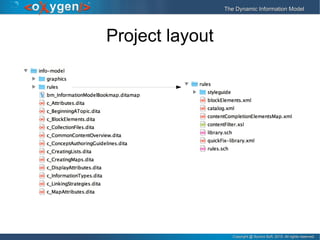
● Project layout
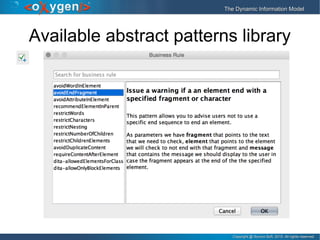
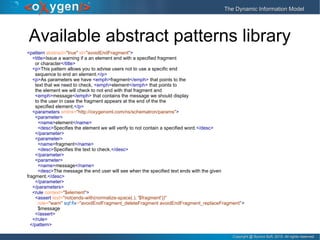
● Available abstract patterns library
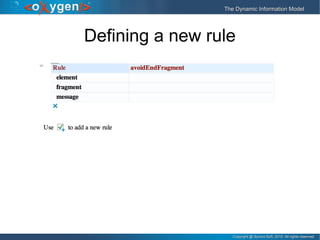
● Defining a new rule
● Generate the Schematron rules file
● Using the Schematron rules
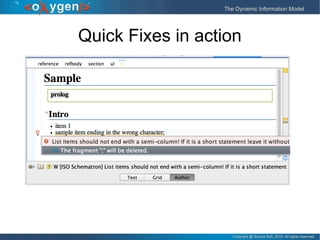
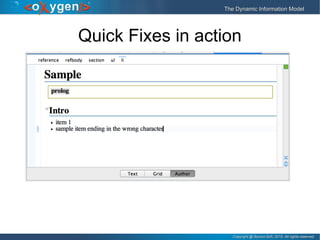
● Quick Fixes in action
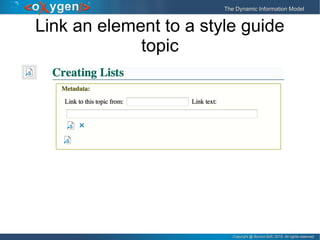
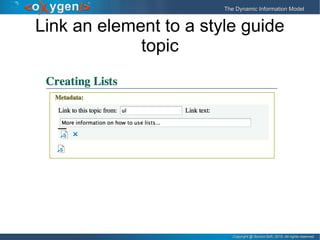
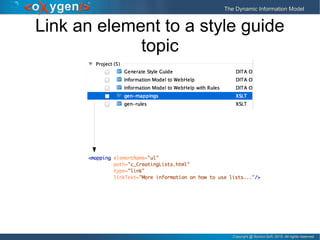
● Link an element to a style guide topic
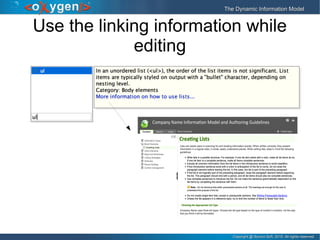
● Use the linking information while editing
Copyright @ Syncro Soft, 2015. All rights reserved.Copyright @ Syncro Soft, 2015. All rights reserved.
The Dynamic Information ModelThe Dynamic Information Model
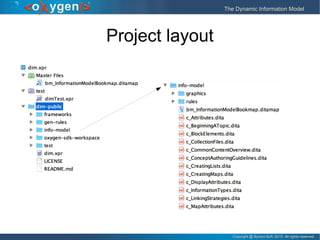
Project layout
Copyright @ Syncro Soft, 2015. All rights reserved.Copyright @ Syncro Soft, 2015. All rights reserved.
The Dynamic Information ModelThe Dynamic Information Model
Project layout
Copyright @ Syncro Soft, 2015. All rights reserved.Copyright @ Syncro Soft, 2015. All rights reserved.
The Dynamic Information ModelThe Dynamic Information Model
Available abstract patterns library
Copyright @ Syncro Soft, 2015. All rights reserved.Copyright @ Syncro Soft, 2015. All rights reserved.
The Dynamic Information ModelThe Dynamic Information Model
Available abstract patterns library
<pattern abstract="true" id="avoidEndFragment">
<title>Issue a warning if a an element end with a specified fragment
or character</title>
<p>This pattern allows you to advise users not to use a specific end
sequence to end an element.</p>
<p>As parameters we have <emph>fragment</emph> that points to the
text that we need to check, <emph>element</emph> that points to
the element we will check to not end with that fragment and
<emph>message</emph> that contains the message we should display
to the user in case the fragment appears at the end of the the
specified element.</p>
<parameters xmlns="http://oxygenxml.com/ns/schematron/params">
<parameter>
<name>element</name>
<desc>Specifies the element we will verify to not contain a specified word.</desc>
</parameter>
<parameter>
<name>fragment</name>
<desc>Specifies the text to check.</desc>
</parameter>
<parameter>
<name>message</name>
<desc>The message the end user will see when the specified text ends with the given
fragment.</desc>
</parameter>
</parameters>
<rule context="$element">
<assert test="not(ends-with(normalize-space(.), '$fragment'))"
role="warn" sqf:fix="avoidEndFragment_deleteFragment avoidEndFragment_replaceFragment">
$message
</assert>
</rule>
</pattern>
Copyright @ Syncro Soft, 2015. All rights reserved.Copyright @ Syncro Soft, 2015. All rights reserved.
The Dynamic Information ModelThe Dynamic Information Model
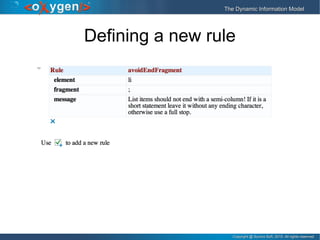
Defining a new rule
Copyright @ Syncro Soft, 2015. All rights reserved.Copyright @ Syncro Soft, 2015. All rights reserved.
The Dynamic Information ModelThe Dynamic Information Model
Defining a new rule
Copyright @ Syncro Soft, 2015. All rights reserved.Copyright @ Syncro Soft, 2015. All rights reserved.
The Dynamic Information ModelThe Dynamic Information Model
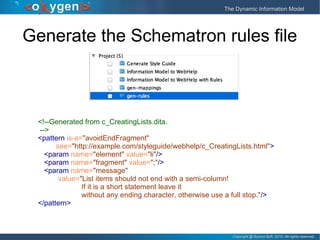
Generate the Schematron rules file
<!--Generated from c_CreatingLists.dita.
-->
<pattern is-a="avoidEndFragment"
see="http://example.com/styleguide/webhelp/c_CreatingLists.html">
<param name="element" value="li"/>
<param name="fragment" value=";"/>
<param name="message"
value="List items should not end with a semi-column!
If it is a short statement leave it
without any ending character, otherwise use a full stop."/>
</pattern>
Copyright @ Syncro Soft, 2015. All rights reserved.Copyright @ Syncro Soft, 2015. All rights reserved.
The Dynamic Information ModelThe Dynamic Information Model
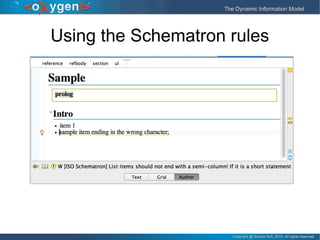
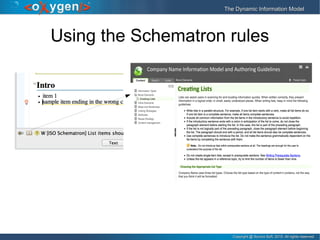
Using the Schematron rules
Copyright @ Syncro Soft, 2015. All rights reserved.Copyright @ Syncro Soft, 2015. All rights reserved.
The Dynamic Information ModelThe Dynamic Information Model
Using the Schematron rules
Copyright @ Syncro Soft, 2015. All rights reserved.Copyright @ Syncro Soft, 2015. All rights reserved.
The Dynamic Information ModelThe Dynamic Information Model
Quick Fixes in action
Copyright @ Syncro Soft, 2015. All rights reserved.Copyright @ Syncro Soft, 2015. All rights reserved.
The Dynamic Information ModelThe Dynamic Information Model
Quick Fixes in action
Copyright @ Syncro Soft, 2015. All rights reserved.Copyright @ Syncro Soft, 2015. All rights reserved.
The Dynamic Information ModelThe Dynamic Information Model
Link an element to a style guide
topic
Copyright @ Syncro Soft, 2015. All rights reserved.Copyright @ Syncro Soft, 2015. All rights reserved.
The Dynamic Information ModelThe Dynamic Information Model
Link an element to a style guide
topic
Copyright @ Syncro Soft, 2015. All rights reserved.Copyright @ Syncro Soft, 2015. All rights reserved.
The Dynamic Information ModelThe Dynamic Information Model
Link an element to a style guide
topic
Copyright @ Syncro Soft, 2015. All rights reserved.Copyright @ Syncro Soft, 2015. All rights reserved.
The Dynamic Information ModelThe Dynamic Information Model
Use the linking information while
editing
Copyright @ Syncro Soft, 2015. All rights reserved.Copyright @ Syncro Soft, 2015. All rights reserved.
The Dynamic Information ModelThe Dynamic Information Model
Future plans
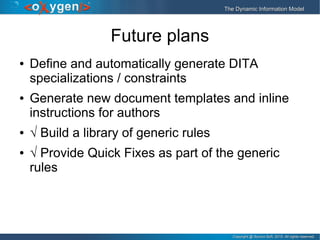
● Define and automatically generate DITA
specializations / constraints
● Generate new document templates and inline
instructions for authors
● √ Build a library of generic rules
● √ Provide Quick Fixes as part of the generic
rules
Copyright @ Syncro Soft, 2015. All rights reserved.Copyright @ Syncro Soft, 2015. All rights reserved.
The Dynamic Information ModelThe Dynamic Information Model
Thank you!
Questions?
Dawn Stevens
dawn.stevens@comtech-serv.com
@comtechdawn
George Bina
george@oxygenxml.com
@georgebina

The Dynamic Information Model

  • 1.
    The Dynamic InformationModel Supporting the Information Model with auto-generated Schematron patterns, tool tips, and constraints George BinaDawn Stevens
  • 2.
    Copyright @ SyncroSoft, 2015. All rights reserved.Copyright @ Syncro Soft, 2015. All rights reserved. The Dynamic Information ModelThe Dynamic Information Model Why do I need one? ● DITA provides core information types, but no instructions for when to use them ● DITA has hundreds of elements; most companies use less than half of them ● DITA has a relatively flexible structure; most companies tighten it up
  • 3.
    Copyright @ SyncroSoft, 2015. All rights reserved.Copyright @ Syncro Soft, 2015. All rights reserved. The Dynamic Information ModelThe Dynamic Information Model What is an information model? • A set of specifications that defines • The structure of your information • The architectural elements to be used • The expected outputs • The required functionality of your authoring environment
  • 4.
    Copyright @ SyncroSoft, 2015. All rights reserved.Copyright @ Syncro Soft, 2015. All rights reserved. The Dynamic Information ModelThe Dynamic Information Model What does it contain? ● Information types ● Block and inline elements ● Metadata taxonomy ● Mapping guidelines ● Linking strategies ● Reuse mechanisms ● Authoring guidelines
  • 5.
    Copyright @ SyncroSoft, 2015. All rights reserved.Copyright @ Syncro Soft, 2015. All rights reserved. The Dynamic Information ModelThe Dynamic Information Model How is it enforced? ● Code reviews ● Templates and tool tips ● Subject scheme maps ● Automated tools and Schematron ● Constraints and specializations
  • 6.
    Copyright @ SyncroSoft, 2015. All rights reserved.Copyright @ Syncro Soft, 2015. All rights reserved. The Dynamic Information ModelThe Dynamic Information Model Who enforces it? Information architect creates / maintain the information model BUT, will not usually have these skills: ● Schematron ● XML schema languages (DTD, XML Schema, Relax NG) ● Complex tool configuration
  • 7.
    Copyright @ SyncroSoft, 2015. All rights reserved.Copyright @ Syncro Soft, 2015. All rights reserved. The Dynamic Information ModelThe Dynamic Information Model Wouldn't it be nice if... ● The work you did to create the information model could be single-sourced into automated enforcement? ● You didn't need specialized skills to create those tools?
  • 8.
    Copyright @ SyncroSoft, 2015. All rights reserved.Copyright @ Syncro Soft, 2015. All rights reserved. The Dynamic Information ModelThe Dynamic Information Model Business needs meet technology Style guide make it accessible to enforce rules Dynamic Information Model Technologies killer applications used by anyone
  • 9.
    Copyright @ SyncroSoft, 2015. All rights reserved.Copyright @ Syncro Soft, 2015. All rights reserved. The Dynamic Information ModelThe Dynamic Information Model Overview Ideas behind DIM The DIM project Demo Future plans Q&A
  • 10.
    Copyright @ SyncroSoft, 2015. All rights reserved.Copyright @ Syncro Soft, 2015. All rights reserved. The Dynamic Information ModelThe Dynamic Information Model A little bit of recent history... Related presentations at previous conferences – DITA North America 2013 How to make a style guide available to authors – DITA North America 2014 Schematron use cases for DITA – DITA Europe 2014 Introducing the DIM project
  • 11.
    Copyright @ SyncroSoft, 2015. All rights reserved.Copyright @ Syncro Soft, 2015. All rights reserved. The Dynamic Information ModelThe Dynamic Information Model DITA North America 2013 Make the style guide available to authors – We should not expect authors to learn the style guide and then start writing – The style guide information should be made available to them as they need it – We developed a configuration file for oXygen to allow linking from the documentation tooltips to the style guide topics relevant to the current editing context Style guide
  • 12.
    Copyright @ SyncroSoft, 2015. All rights reserved.Copyright @ Syncro Soft, 2015. All rights reserved. The Dynamic Information ModelThe Dynamic Information Model DITA North America 2014 Using Schematron for DITA If we create a library of generic rules then we can use them without Schematron knowledge, just by providing values for the rule parameters <pattern is-a="recommendElementInParent"> <param name="parent" value="task"/> <param name="element" value="shortdesc"/> <param name="message" value="Do not forget to add a short description to your task!"/> </pattern> These rules can be used to enforce business specific constraints documented in a style guide parent element message Generic rule
  • 13.
    Copyright @ SyncroSoft, 2015. All rights reserved.Copyright @ Syncro Soft, 2015. All rights reserved. The Dynamic Information ModelThe Dynamic Information Model DIM Ideas Style guide + + Smart style guide generate
  • 14.
    Copyright @ SyncroSoft, 2015. All rights reserved.Copyright @ Syncro Soft, 2015. All rights reserved. The Dynamic Information ModelThe Dynamic Information Model DIM Ideas ● Generate the style guide integration configuration file from the style guide itself ● Encode business rules within the style guide, next to the text that describes them ● Make authoring of style guide metadata and rules very easy to use
  • 15.
    Copyright @ SyncroSoft, 2015. All rights reserved.Copyright @ Syncro Soft, 2015. All rights reserved. The Dynamic Information ModelThe Dynamic Information Model DITA Europe 2014 Introducing the DIM project – Single source style guide as ● descriptive prose ● code to automatically enforce those rules – Support information architects in defining rules encoded within the style guide though a simple user interface – Make the style guide more accessible by annotating topics with metadata information – Automatically generate Schematron rules and configuration files from the style guide information
  • 16.
    Copyright @ SyncroSoft, 2015. All rights reserved.Copyright @ Syncro Soft, 2015. All rights reserved. The Dynamic Information ModelThe Dynamic Information Model DIM Take advantage of structured information to define an intelligent style guide – Encode business rules within the style guide – Encode metadata information Provide a user friendly authoring interface for rules and metadata
  • 17.
    Copyright @ SyncroSoft, 2015. All rights reserved.Copyright @ Syncro Soft, 2015. All rights reserved. The Dynamic Information ModelThe Dynamic Information Model Encode business rules <pattern is-a="restrictWords" see="http://example.com/styleguide/webhelp/c_WritingShortDescriptions.html"> <param name="parentElement" value="shortdesc"/> <param name="minWords" value="1"/> <param name="maxWords" value="50"/> </pattern> <section audience="rules"> ... <dl><dlhead> <dthd>Rule</dthd><ddhd>restrictWords</ddhd> </dlhead><dlentry> <dt>parentElement</dt><dd>shortdesc</dd> </dlentry><dlentry> <dt>minWords</dt><dd>1</dd> </dlentry><dlentry> <dt>maxWords</dt><dd>50</dd> </dlentry></dl> ... </section> Schematron DITA
  • 18.
    Copyright @ SyncroSoft, 2015. All rights reserved.Copyright @ Syncro Soft, 2015. All rights reserved. The Dynamic Information ModelThe Dynamic Information Model Metadata <mapping elementName="shortdesc" path="c_WritingShortDescriptions.html" type="link" linkText="How to write short descriptions"/> <data name="shortdesc" value="How to write short descriptions" audience="styleguide"/> Configuration file DITA
  • 19.
    Copyright @ SyncroSoft, 2015. All rights reserved.Copyright @ Syncro Soft, 2015. All rights reserved. The Dynamic Information ModelThe Dynamic Information Model The DIM project Open source (Apache 2.0 license) Available on GitHub http://www.github.com/oxygenxml/dim
  • 20.
    Copyright @ SyncroSoft, 2015. All rights reserved.Copyright @ Syncro Soft, 2015. All rights reserved. The Dynamic Information ModelThe Dynamic Information Model DIM project content ● A generic DITA style guide provided by Comtech Services that can be used as a starting point for your own style guide ● A Schematron library of generic rules that can be instantiated to implement actual rules ● oXygen customization to provide an easy authoring environment for rules and metadata ● XSLT scripts to generate Schematron rules and an oXygen configuration file ● Other resources (XML Catalog, configuration)
  • 21.
    Copyright @ SyncroSoft, 2015. All rights reserved.Copyright @ Syncro Soft, 2015. All rights reserved. The Dynamic Information ModelThe Dynamic Information Model DIM project deliverables ● Style guide output as WebHelp and other formats ● A Schematron schema containing all the rules defined within the style guide ● An oXygen configuration file to enable links from element or attribute tooltips to the style guide topic.
  • 22.
    Copyright @ SyncroSoft, 2015. All rights reserved.Copyright @ Syncro Soft, 2015. All rights reserved. The Dynamic Information ModelThe Dynamic Information Model DIM Demo ● Project layout ● Available abstract patterns library ● Defining a new rule ● Generate the Schematron rules file ● Using the Schematron rules ● Quick Fixes in action ● Link an element to a style guide topic ● Use the linking information while editing
  • 23.
    Copyright @ SyncroSoft, 2015. All rights reserved.Copyright @ Syncro Soft, 2015. All rights reserved. The Dynamic Information ModelThe Dynamic Information Model Project layout
  • 24.
    Copyright @ SyncroSoft, 2015. All rights reserved.Copyright @ Syncro Soft, 2015. All rights reserved. The Dynamic Information ModelThe Dynamic Information Model Project layout
  • 25.
    Copyright @ SyncroSoft, 2015. All rights reserved.Copyright @ Syncro Soft, 2015. All rights reserved. The Dynamic Information ModelThe Dynamic Information Model Available abstract patterns library
  • 26.
    Copyright @ SyncroSoft, 2015. All rights reserved.Copyright @ Syncro Soft, 2015. All rights reserved. The Dynamic Information ModelThe Dynamic Information Model Available abstract patterns library <pattern abstract="true" id="avoidEndFragment"> <title>Issue a warning if a an element end with a specified fragment or character</title> <p>This pattern allows you to advise users not to use a specific end sequence to end an element.</p> <p>As parameters we have <emph>fragment</emph> that points to the text that we need to check, <emph>element</emph> that points to the element we will check to not end with that fragment and <emph>message</emph> that contains the message we should display to the user in case the fragment appears at the end of the the specified element.</p> <parameters xmlns="http://oxygenxml.com/ns/schematron/params"> <parameter> <name>element</name> <desc>Specifies the element we will verify to not contain a specified word.</desc> </parameter> <parameter> <name>fragment</name> <desc>Specifies the text to check.</desc> </parameter> <parameter> <name>message</name> <desc>The message the end user will see when the specified text ends with the given fragment.</desc> </parameter> </parameters> <rule context="$element"> <assert test="not(ends-with(normalize-space(.), '$fragment'))" role="warn" sqf:fix="avoidEndFragment_deleteFragment avoidEndFragment_replaceFragment"> $message </assert> </rule> </pattern>
  • 27.
    Copyright @ SyncroSoft, 2015. All rights reserved.Copyright @ Syncro Soft, 2015. All rights reserved. The Dynamic Information ModelThe Dynamic Information Model Defining a new rule
  • 28.
    Copyright @ SyncroSoft, 2015. All rights reserved.Copyright @ Syncro Soft, 2015. All rights reserved. The Dynamic Information ModelThe Dynamic Information Model Defining a new rule
  • 29.
    Copyright @ SyncroSoft, 2015. All rights reserved.Copyright @ Syncro Soft, 2015. All rights reserved. The Dynamic Information ModelThe Dynamic Information Model Generate the Schematron rules file <!--Generated from c_CreatingLists.dita. --> <pattern is-a="avoidEndFragment" see="http://example.com/styleguide/webhelp/c_CreatingLists.html"> <param name="element" value="li"/> <param name="fragment" value=";"/> <param name="message" value="List items should not end with a semi-column! If it is a short statement leave it without any ending character, otherwise use a full stop."/> </pattern>
  • 30.
    Copyright @ SyncroSoft, 2015. All rights reserved.Copyright @ Syncro Soft, 2015. All rights reserved. The Dynamic Information ModelThe Dynamic Information Model Using the Schematron rules
  • 31.
    Copyright @ SyncroSoft, 2015. All rights reserved.Copyright @ Syncro Soft, 2015. All rights reserved. The Dynamic Information ModelThe Dynamic Information Model Using the Schematron rules
  • 32.
    Copyright @ SyncroSoft, 2015. All rights reserved.Copyright @ Syncro Soft, 2015. All rights reserved. The Dynamic Information ModelThe Dynamic Information Model Quick Fixes in action
  • 33.
    Copyright @ SyncroSoft, 2015. All rights reserved.Copyright @ Syncro Soft, 2015. All rights reserved. The Dynamic Information ModelThe Dynamic Information Model Quick Fixes in action
  • 34.
    Copyright @ SyncroSoft, 2015. All rights reserved.Copyright @ Syncro Soft, 2015. All rights reserved. The Dynamic Information ModelThe Dynamic Information Model Link an element to a style guide topic
  • 35.
    Copyright @ SyncroSoft, 2015. All rights reserved.Copyright @ Syncro Soft, 2015. All rights reserved. The Dynamic Information ModelThe Dynamic Information Model Link an element to a style guide topic
  • 36.
    Copyright @ SyncroSoft, 2015. All rights reserved.Copyright @ Syncro Soft, 2015. All rights reserved. The Dynamic Information ModelThe Dynamic Information Model Link an element to a style guide topic
  • 37.
    Copyright @ SyncroSoft, 2015. All rights reserved.Copyright @ Syncro Soft, 2015. All rights reserved. The Dynamic Information ModelThe Dynamic Information Model Use the linking information while editing
  • 38.
    Copyright @ SyncroSoft, 2015. All rights reserved.Copyright @ Syncro Soft, 2015. All rights reserved. The Dynamic Information ModelThe Dynamic Information Model Future plans ● Define and automatically generate DITA specializations / constraints ● Generate new document templates and inline instructions for authors ● √ Build a library of generic rules ● √ Provide Quick Fixes as part of the generic rules
  • 39.
    Copyright @ SyncroSoft, 2015. All rights reserved.Copyright @ Syncro Soft, 2015. All rights reserved. The Dynamic Information ModelThe Dynamic Information Model Thank you! Questions? Dawn Stevens dawn.stevens@comtech-serv.com @comtechdawn George Bina george@oxygenxml.com @georgebina